



Abstract
Herb names not only facilitate identification but also convey crucial information regarding the potential uses and benefits of traditional Chinese herbs. However, the names of herbal medicines have received scant systematic study previously, especially from a cognitive onomastics perspective. By investigating the motivation for the nomenclature of 217 common Chinese herbs selected from the herbology section of Compendium of Materia Medica, we found that 160 herbs were named based on a single salient characteristic such as shape, efficacy, color, nature & flavor, place of origin, folklore, harvesting season, habitat, and odor, ranked in descending order. The remaining 57 herbs were named by integrating two or more characteristics. We contend that giving priority to shape and color in naming aligns with the gestalt principle and the human optic nerve’s sensitivity to color. Efficacy, nature & flavor, origin, harvesting season, and odor are crucial factors determining the quality and efficacy of herbs, thus being included in the herb names. We conclude that names for Chinese herbs can be attributed to the cognitive metonymy pattern CHARACTERISTICS FOR HERB. However, both conceptual blending and conceptual metaphor play significant roles in the naming of herbs, as conceptual blending integrates characteristics in naming and conceptual metaphor links herbs to familiar entities in naming.
Introduction
Traditional Chinese medicine (hereafter TCM) has been formulated and developed in the daily lives of Chinese people during their millennia-long fight against diseases. Originating in China, TCM has also assimilated elements from other civilizations, evolving and gradually spreading worldwide.
Extensive research has been carried out in the medical field to explore herbal nomenclature, aiming to enhance their identification and provide guidance for the proper use of herbs (e.g., Ding, 2016; Y. Q. Xu, 2014; Yang, 2006). The nomenclature of Chinese herbal medicine mirrors the unique characteristics of Chinese culture, making it a popular subject of cultural investigation. Studies have delved into various aspects such as the formation of herb names and their cultural implications (Yang, 2006, pp.77–79); the local features and cultural significance encapsulated in the names of Chinese herbal medicines (Liao, 2014); and the shape, efficacy, origin, smell, and habitat conveyed in the names of medicinal plants (Y. Q. Xu, 2014, p. 210).
The linguistic examination of plant names can be traced back to ancient Chinese classics like
Nevertheless, the names of herbal medicines have not undergone systematic study previously, and there is a notable absence of quantitative statistical analysis. Additionally, few studies have uncovered the naming process of Chinese herbal medicines in the Compendium of Materia Medica from a cognitive onomastics perspective. This study aims to bridge these gaps by addressing the following questions: (1) What are the naming patterns of herbs from herbology section in the Compendium of Materia Medica? (2) What are the cognitive mechanisms underlying the naming of the herbs? The purpose of this study is to offer a cognitive onomastics account of traditional Chinese herb names, uncovering the underlying cognitive mechanisms involved in the naming of these herbs.
Methodology
Data Source
Data Collection and Analysis
Altogether, 1,892 pharmaceutical objects were collected in The Compendium of Materia Medica, and they are divided into 16 sections by Li Shizhen. For our research in the present study, we have chosen to focus on the herbology section. Within this section, there are 217 herbs. Li Shizhen further classified these herbs into various types such as
The detailed descriptions of pharmaceutical medicines found in The Compendium of Materia Medica were categorized into eight parts by Li Shizhen, starting with
We primarily refer to the
Once the motivations were compiled, herbs with corresponding motivations were imported into Excel. Following this step, name patterns for traditional Chinese herbs were classified based on their motivations. Patterns with the same motivation were then consolidated. Since some herbs were named based on a single salient characteristic while others incorporated multiple characteristics, the name patterns were grouped accordingly.
After establishing the naming patterns for traditional Chinese herbal medicine, the metonymical mechanisms behind these names were checked manually—herbs are referred to by their shapes, colors, efficacy, and so on. Accordingly, the metonymy patterns were represented as SHAPE FOR HERBS, COLOR FOR HERBS, and EFFICACY FOR HERBS. Additionally, since some herbs have names that combine two or even more characteristics, the conceptual integration mechanism involved in the naming process is also quite evident. Finally, we further revealed the conceptual metaphor mechanism behind naming based on similarities among things within the herbs named after their shape.
Results
Naming Patterns of Traditional Chinese Herbs
Based on the motivation of herbal names, the nomenclatures of herbs are divided into two major categories: naming by a single characteristic and naming by integrating two or more characteristics. Out of the 217 herbs analyzed, 160 were named based on a single salient characteristic, while the remaining 57 were named by combining two or more characteristics. Below are the presentations of these categories.
Naming by Single Characteristic
It can be observed from Table 1 below that nine patterns have been identified for the 160 common herbs named based on a single salient characteristic. The detailed numbers and proportions of the nomenclatures are presented in descending order in Table 1 as well.
Number and Proportion of Herbs Naming by Single Characteristic.
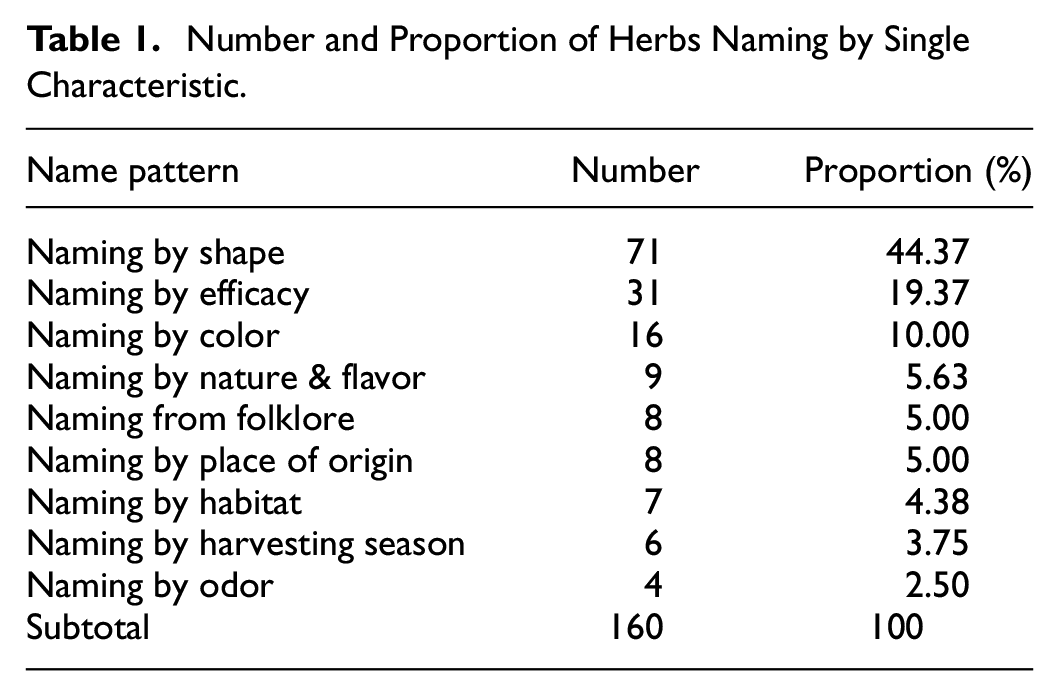
The results indicate that traditional Chinese herbs named based on single characteristics are associated with their shape, efficacy, color, nature & flavor, folklore, place of origin, habitat, harvesting season, and odor. The detailed illustration of the name patterns is elaborated below.
Naming by Shape. In the table above, it is evident that 71 out of the 160 (44.38%) Chinese herb names originate from their shapes, claiming the top spot in naming conventions. It is important to note that the concept of shape encompasses not only the specific form of the herbs, but also their height, thickness, size, and other physical attributes. Noteworthy examples include:
(1)
(2)
(3)
(4)
Metaphors play a crucial role in herb naming. As Ullmann (1962, p. 215) observed, many plants owe their name to some vague resemblance, often fanciful or jocular, to an animal: a goat’s beard, a cock’s foot, a dog’s tail, etc. Chinese herb names follow this trend. In traditional Chinese herb naming, metaphorical comparisons extend beyond animals to objects. For instance:
(5)
(6)
(7)
These metaphors often involve comparing plant appearances with other objects, reflecting the findings of Wang (2009) who highlighted the significance of the plant’s shape in metaphorical naming. Scholars have also noted the use of zodiac animals in naming plants and animals based on perceived resemblances. According to Gestalt psychology, external stimuli are perceived holistically rather than as individual parts by the brain (Wagemans et al., 2012). The shape of herbs, encompassing their overall form, contributes to the prominence effect in herb naming.
Naming by Efficacy. Naming based on efficacy ranks second, constituting 19.38% of the total. Examples include
(8)
(9)
(10)
In TCM, the efficacy of herbs holds paramount importance for individuals, making it a prominent aspect. Naming herbs based on their efficacy directly communicates their functions to people, thus promoting cognitive efficiency. Therefore, it is logical for naming by efficacy to hold the second position in herb nomenclature.
Naming by Color. Naming by color follows the pattern of naming by efficacy, with 16 herbal plants (10%) named based on color. Notable examples include
(11)
(12)
(13)
Naming by Nature & Flavor. Nine herbs were named based on their nature & flavor, encompassing 5.63% of the nomenclature. Examples include
(14)
(15)
(16)
Naming from Folklore. Eight herbs, representing 5% of the nomenclature, are named after notable individuals or groups, historical events, or geographic features as a mark of honor. Examples include
(17)
(18)
Naming by Place of Origin. Eight herbal plants, making up 5% of the nomenclature, are named based on their place of origin. Examples include
(19)
(20)
Naming by Habitat. Seven herbal plants, comprising 4.38% of the total, are named based on their habitat. An example is
Naming by Harvesting Season. Six herbal medicines, accounting for 3.75% of the subtotal, are named based on the harvesting season. Examples include
(21)
(22)
Naming by Odor. Four herbs, representing 2.50% and ranking last among single-characteristic-based herbs, are named based on their distinctive fragrant, pungent, firm, or light odor.
In summary, single-characteristic-based traditional Chinese herbs receive names based on their shape, efficacy, color, nature & flavor, place of origin, folklore, harvesting season, habitat, and odor. Just as Callebaut (1990, p. 75) puts it, naming in the natural sciences is based on different types of motivation, referring to the appearance of plants or animals, their habits, place or time of living or flowering, their uses, and folklore.
The aforementioned naming patterns apply specifically to single-characteristic-based traditional Chinese herbs. Conversely, statistics reveal that other traditional Chinese herbs receive names by combining multiple characteristics, as detailed in subsequent results.
Naming by Integrating Characteristics
Out of the 217 common herbs in the study, 57 traditional Chinese herbs, amounting to 26.27% of the total, are named by combining two or three characteristics. The naming conventions encompass various characteristics such as shape, efficacy, color, nature & flavor, place of origin, harvesting season, habitat, and odor, as previously discussed. Seventeen distinct name patterns are identified based on integrating these characteristics, with Color + Shape emerging as the most prevalent pattern. Other significant patterns include Habitat + Shape, Color + Efficacy, Shape + Nature & Flavor, Place of Origin + Shape, Efficacy + Shape, among others. Detailed ranking is presented in Table 2 below. For economic reasons, in the integration statistics, we do not differentiate the order of characteristics.
Number and Proportion of Herbs Naming by Integrating Characteristics.

This integrated approach to naming traditional Chinese herbs reflects a comprehensive understanding of the herbs’ attributes and properties. By combining multiple characteristics, herbal names convey a holistic view of the herb’s physical appearance, efficacy, origins, environmental preferences, and sensory qualities. These complex naming patterns provide valuable insights into the diverse attributes and characteristics of traditional Chinese herbs, enhancing their recognition, classification, and usage within the realm of natural medicine.
Naming by Integrating Color and Shape. When a single characteristic is insufficient to differentiate an herb, multiple characteristics are integrated to name the herb. The two most prominent characteristics in herbal naming are shape and color, either individually or combined. The integration of color and shape ranks highest in herb naming practices, with 14 herbs, representing 24.56%, falling into this pattern. Examples include
(23)
(24)
In this pattern, color precedes shape in some herb names, but the word order can be reversed. Alternatively, the shape may come before the color, as exemplified by
In
Naming by Integrating Habitat and Shape. Name pattern Color + Shape is followed by Habitat + Shape, taking 12.28%. Examples of this pattern include
Similarly,
Naming by Integrating Color and Efficacy. Six herbs, totaling 10.53%, are designated by an integration of color and medicinal efficacy. For instance,
Another example is
Naming by Integrating Shape and Nature & Flavor. Five herbs, constituting 8.77% of the integration naming pattern, are designated by integrating Shape with Nature & Flavor characteristics.
Naming by Integrating Origin and Shape. Five herbs (8.77%) are categorized under this naming pattern. In TCM, the quality and efficacy of herbs are often closely linked to their place of origin. When the origin itself is insufficient to distinguish herbs, additional characteristics such as shape come into play, leading to the integration of origin and shape for herb nomenclature. An exemplary instance of this naming convention is
Naming by Integrating Efficacy and Shape. Four herbs, constituting 7.02% of integrated herbal names, are classified under the integration of efficacy and shape. For instance,
Others. In addition to the integration patterns mentioned above, various herbs are named by combining Color and Odor, Odor and Shape, Color and Growing Environment, etc. For example,
Moreover, some herbs receive their names through the integration of three characteristics.
Cognitive Mechanisms Underlying the Naming of Traditional Chinese Herbs
Cognitive linguistics diverges from the traditional perspective of viewing language as an autonomous system governed by innate cognitive universals. Instead, it conceives language as a fundamental cognitive faculty of individuals closely intertwined with their minds and experiences. In this paradigm, linguistic meaning is seen as a reflection of conceptual structures, suggesting that meaning essentially stems from the process of conceptualization. This stance starkly opposes the long-standing belief in the arbitrariness of language. Accordingly, the act of naming is not the act of linking a certain lexical item with an autonomous concept, as it is stated in the structuralist approach, but rather a way to comprehend and conceptualize reality (Glebkin, 2023, p. 336). Furthermore, naming is one of the important cultural practices through which many societies demonstrate their cultural values, beliefs and philosophies (Yakub, 2024, p. 167).
Within the realm of cognitive linguistics, names assigned to traditional Chinese herbs are not haphazard labels used merely to identify physical entities. Rather, they are purposeful constructs reflecting people’s conceptualizations and lexicalizations grounded in how they perceive and categorize these herbs. In essence, the name of a Chinese herb represents a mental representation of reality, as construed by the human mind, mediated by our unique perceptual and conceptual systems (Evans & Green, 2006, p. 7).
The amalgamation of cognitive linguistics and onomastics has given rise to the burgeoning field of cognitive onomastics, which delves into the study of proper names through the lenses of conceptual metonymy theory, conceptual integration theory, and conceptual metaphor theory, among others. Cognitive onomastics is a relatively new approach to the study of proper names based on a cognitive approach to language, using the framework of cognitive linguistics and other cognitive sciences. The main feature that differentiates cognitive onomastics from onomastics is the focus on the cognitive aspects (Reszegi, 2023, p. 1). Names as linguistic elements are parts of the cognitive system, thus mental representation and usage of proper names need to be described by general cognitive processes (Reszegi, 2022b). Cognitive onomastics approach can enhance our understanding of naming process. By leveraging cognitive mechanisms such as conceptual metonymy, conceptual integration, and conceptual metaphor theories, one can elucidate the seemingly arbitrary yet deeply motivated process behind the naming of Chinese traditional herbs. These cognitive frameworks unveil the intricate web of thought processes and conceptual mappings that underlie the naming conventions, shedding light on the profound connections between language, cognition, and cultural practices.
Conceptual Metonymy in Herbs Naming
Cognitive Linguistics regards metonymy as a vital mechanism that aids in structuring the human conceptual system. In this framework, naming practices serve as vivid reflections of conceptual metonymy. Kövecses and Radden (1998, p. 39) define metonymy as a cognitive process in which one conceptual entity, the vehicle, provides mental access to another conceptual entity, the target, within the same domain. Therefore, herbal names function as vehicles, providing mental access to the herbs along with a wealth of associated information. Drawing from Langacker (1993, p. 30), metonymy is elucidated as a cognitive process where one conceptual entity is accessed mentally through another entity. The metonymic entity serves as a “reference point,” enabling access to the intended target—another conceptual entity. Consequently, herb names, derived from their most salient characteristics, are foregrounded to act as reference points facilitating access to the herbs, while less significant attributes are backgrounded or excluded in the nomenclature. Shu (2024, p.21) asserts that the nature of naming things is fundamentally metonymic. The naming of Chinese herbs is no exception.
Given the unique significance of efficacy, nature & flavor, place of origin, harvesting season, habitat, and odor in herbal contexts, these characteristics, along with shape and color, play pivotal roles in herb naming. This metonymy-based approach engenders distinct name patterns such as SHAPE FOR HERBS, EFFICACY FOR HERBS, COLOR FOR HERBS, NATURE & FLAVOR FOR HERBS, PLACE OF ORIGIN FOR HERBS, HARVESTING SEASON FOR HERBS, HABITAT FOR HERBS, and ODOR FOR HERBS. These patterns underscore how salient features are represented to encapsulate the essence of herbs, providing efficient mental access to these botanical entities within the realm of cognitive linguistics.
Moreover, herbal names often integrate characteristics to designate the herbs, prompting the emergence of intricate metonymic patterns such as COLOR AND SHAPE FOR HERBS, HABITAT AND SHAPE FOR HERBS, COLOR AND EFFICACY FOR HERBS, SHAPE AND NATURE & FLAVOR FOR HERBS, ORIGIN AND SHAPE FOR HERBS, EFFICACY AND SHAPE FOR HERBS, to name but a few. Generally, the nomenclature of Chinese herbs can be succinctly encapsulated as the metonymy CHARACTERISTICS FOR HERB.
Additionally, as demonstrated in the aforementioned instances, traditional Chinese herb appellations frequently encompass representative Chinese characters symbolizing their entire structure, embodying the metonymic paradigm PART OF A FORM FOR THE WHOLE FORM. For example, in
Language is fundamentally metonymical in nature because language is only the visible tip of iceberg providing mental access to a plethora of invisible concepts it may evoke. Language enables individuals to refer to physical entities, with only selected characteristics linked to those entities being encoded into language. Consequently, language tends to highlight the most salient perceptible traits of objects while disregarding less pivotal features—a principle vividly illustrated by the economy principle in language. Therefore, language is inherently metonymical, epitomized by the metonymy FORM FOR CONCEPT, as delineated by Lakoff and Turner (1989, p. 108) in their assertion WORDS STAND FOR THE CONCEPTS THEY EXPRESS. The very nature of language hinges on this metonymic tenet since no alternative medium can supplant language in articulating and conveying our ideas. As Wachowski (2019, p. 2) articulates, “Our ordinary conceptual system, in terms of which we both think and act, is fundamentally not only metaphorical but also metonymical in nature.” Herb nomenclature similarly entails profiling, encapsulating only the prominent facets or viewpoints of a given herb’s conceptual content. Therefore, conceptual metonymy stands out as a pivotal and indispensable cognitive mechanism underpinning the nomenclature of herbs.
Conceptual Integration in Herbs Naming
Language is but the tip of the iceberg, and beneath the visible, simple language involves very complicated conceptual integration. The practice of naming herbs by integrating characteristics provides compelling evidence of a deceptively simple yet sophisticated conceptual integration process. Conceptual integration represents a ubiquitous cognitive phenomenon not confined to herb names but extending to plant names, animal names, and terminologies across various domains.
Many terms and names are formed by compounding or blending, with conceptual integration serving as the underlying cognitive mechanism. Morphological blends involve the creation of new words by amalgamating parts of existing words, as exemplified by terms like COVID-19 integrated from coronavirus, disease, and 2019. Similarly, the nomenclature SARS-CoV-2 (Severe Acute Respiratory Syndrome Coronavirus 2) adopted by The International Committee on Taxonomy of Viruses reflects this blending process. Through phylogenetic considerations and established conventions, the ICTV officially designates this virus as a variant linked to Severe Acute Respiratory Syndrome coronaviruses, showcasing the role of conceptual integration in formal naming practices.
In onomasiology and specialized languages, integration emerges as a prevailing phenomenon. In accordance with Fauconnier and Turner (2002, p. 12), blending is an invisible, unconscious activity involved in every aspect of human life. This view finds an echo in Evans and Green’s (2006) claim: …conceptual blending is central to human thought and imagination, and that evidence for this can be found not only in human language but also in a wide range of other areas of human activity, such as art, religious thought and practice, and scientific endeavor, to name but a few.
This integration naming pattern also verifies the view advanced by Sánchez et al. (2012, p. 80) that in specialized languages, blending is a common cognitive phenomenon. When a single characteristic proves insufficient to encapsulate the essence of an herb, people instinctively integrate multiple attributes such as shape and color, habitat, and shape, color and efficacy, among others, to bestow names upon these herbs. This integration of characteristics underscores the pervasive and subconscious nature of conceptual integration, affirming its integral role in shaping not only linguistic expressions but also human cognition and imaginative capacities.
Conceptual Metaphor in Herbs Naming
Lakoff and Johnson’s groundbreaking work in 1980 shed light on the pivotal role of metaphor as not just a literary tool but a fundamental cognitive mechanism essential for our conceptualization and comprehension of reality. Metaphors pervade our language, thoughts, and actions, with the understanding that the human conceptual system is metaphorical in essence. They (Lakoff & Johnson,1980, pp. 4–5) hold that human conceptual system is fundamentally metaphorical in nature, defining metaphor as “understanding and experiencing one kind of thing (target domain) in terms of another (source domain).” Conceptual metaphor has an experiential basis. As Boers (1999, p. 55) claims, a source domain is more likely to be used for metaphorical mapping as it becomes more salient in everyday experience. According to Lee (2001, p. 6), source domains tend to be relatively concrete, whereas target domains are more abstract. Pinker (2007, p. 257) also references examples like selection in evolution, kettle pond in geology, linkage in genetics to demonstrate how scientists often rely on metaphors when naming newly discovered entities, illustrating how metaphorical frameworks aid in explaining complex or unfamiliar concepts through familiar analogies.
This practice showcases how people naturally gravitate toward metaphorical conceptualization when dealing with abstract or less familiar subjects. As Kövecses (2002, p. 20) puts it, target domains are abstract, diffuse, and lack clear delineation; as a result, they “cry out” for metaphorical conceptualization. Consequently, individuals may unconsciously employ familiar objects to name unfamiliar entities based on the perceived resemblance between the two.
One of its special types is the image metaphor in which—a source domain image is mapped onto a target image. As Reszegi (2022a, p. 236) puts, the mechanism of image metaphor also appears in name-giving and serves as the basis of a not too numerous but nevertheless significant name type. For instance, in the naming of marine flora and fauna, terrestrial animals and plants are metaphorically mapped onto their aquatic counterparts, resulting in names like sea cow, sea horse, tiger shark, sea lettuce, sea grass, and sea anemone, etc. Conceptual metaphor serves as a potent cognitive tool that aids in our comprehension of the world. Animals, being more familiar to individuals than plants, are commonly utilized in plant names to enrich people’s understanding. Examples include adder’s tongue, goat’s beard, buck’s beard, cock’s foot, cat’s ears, and dog’s tail, among others. Above-mentioned herb names like
Metaphors play a crucial role in making herbs more accessible and memorable by associating them with everyday entities that people are already acquainted with. The employment of image metaphors in herb naming allows individuals to effortlessly envision the shape and characteristics of herbs through the vivid image evoked by their names. In this way, metaphors serve as powerful cognitive tools that assist in herb identification and recall, demonstrating how metaphorical associations can enrich our understanding and engagement with the natural world.
Discussion
In Tan’s (2005) exploration of plant names, the rule for naming plants is delineated as perspective selection, emphasizing that individuals typically designate entities based on their prominent attributes referred to as “meaning perspectives.” These may encompass characteristics like shape, color, smell, taste, sound, texture, function, among others. If one feature is insufficient, people often integrate multiple characteristics in their nomenclature. This rule, as observed, extends to herb naming as well. Common Chinese herbs, as a subset of plants, adhere to the practice of selecting characteristics like shape, color, origin, and habitat for their nomenclature, echoing the conventions followed in plant naming.
Interestingly, in contrast to typical plants, common Chinese herbs predominantly emphasize efficacy, nature & flavor, harvesting season, and odor—qualities crucial for assessing herb quality or distinguishing them uniquely. These characteristics take center stage in naming Chinese herbs, showcasing a strategic focus on qualities directly linked to the medicinal and distinguishing aspects of these herbs.
Color serves as a relatively more prominent feature for individuals to identify and distinguish herbs. Furthermore, given that color is a visual stimulus easily perceived by humans, it plays pivotal role in traditional Chinese herb nomenclature. Both shape and color not only hold significance in single characteristic naming but also in integrated naming patterns as indicated by statistics. As Rastall (1996, p. 31) highlights, plant names often draw metaphors related to the color and shape of the plant.
The precedence of shape and color over other characteristics in herb naming is reasonable. Among the five senses, vision holds paramount importance, leading people to fully utilize the visual system in perception and differentiation. The optic nerve, most sensitive to color and shape, effectively transmits signals from the eye to the brain. Consequently, color and shape are swiftly and easily discerned by the optic nerve, justifying their prioritization in herb nomenclature.
In addition to the visual system, the gustatory system plays a crucial role in how individuals perceive the external world. Consequently, it is understandable why ancient Chinese named herbs based on their distinct natures and flavors. Moreover, traditional herbal plant “flavors” typically align with the “five flavors”—bitter, sour, sweet, pungent, and salty, while the more abstract notion of “nature” includes qualities like ascending, descending, floating, and sinking. These perspectives reflect the efficacy of herbs, thus prompting their naming based on unique nature & flavor characteristics.
Herbal plants named in memory of historical figures hold significant commemorative value. It is common for people to honor those who discovered medicines or made remarkable contributions. Typically, these commemorated individuals are renowned emperors, generals, talented individuals, skilled artisans, or figures from famous folk tales, customs, or historical events. Such naming practices serve as a tribute to these important individuals and their contributions to society.
China’s vast territory, rich natural resources, and diverse medicinal herbs reflect its varied climatic and environmental conditions, leading to the production of unique indigenous herbs in each region. The quality and efficacy of herbs are often closely tied to their place of origin. Local herbs, considered authentic, represent premium Chinese herbs with superior qualities and enhanced effectiveness. It is therefore a logical practice for ancient Chinese to name herbal medicines based on their origin, recognizing the significance of the source in determining the efficacy and benefits of the herbs.
Similar to naming based on place of origin, the natural environment plays a significant role in influencing the quality of herbs. The same herbal plant can vary greatly in quality based on the environment in which it grows. This naming pattern not only reflects the habitat of the herbs but also aids herb collectors in easily locating these plants based on the environmental clues embedded within their names. By naming herbs according to their habitats, individuals can better understand the natural environment that contributes to the properties and characteristics of these medicinal plants.
In TCM, the harvesting season significantly influences the quality and efficacy of herbs. Therefore, naming herbs based on the harvesting season serves as a reminder for people, both current and future generations, about the importance of considering the specific season for harvesting these medicinal plants. By naming herbs after the seasons, individuals can better understand the ideal times for harvesting and utilizing these herbs to maximize their beneficial properties.
Odor, along with shape, color, and efficacy, plays a crucial role in recognizing and identifying medicinal herbs. The human olfactory system is highly sensitive to various scents, making odor a significant factor in naming herbs.
Conclusion
Working within the theoretical lens of cognitive onomastics, this study has examined the naming patterns and cognitive mechanisms embedded in names of 217 common Chinese herbs sourced from the herbology section of the Compendium of Materia Medica. Results revealed that 160 herbs were named based on a single prominent characteristic, with shape, efficacy, color, nature & flavor, place of origin, folklore, harvesting season, habitat, and odor emerging as the primary attributes influencing herb naming, ranked in descending order. Additionally, 57 herbs were named through an integration of 2 or more characteristics, such as shape and color, habitat and shape, and color and efficacy.
We observed that common Chinese herbs, falling under the category of plants, exhibit characteristics akin to those found in the broader plant category, encompassing attributes such as shape, color, origin, and habitat within their names. Notably, shape and color hold the first and third positions, respectively, in the single-characteristic naming convention of herbs. This prioritization aligns with the gestalt principle, with shape being regarded as the prime exemplification of this principle in the naming practices of Chinese herbal medicines. Color occupies the third position in single-characteristic naming, which is attributed to the heightened sensitivity of human optic nerves to color.
Characteristics like efficacy, nature & flavor, origin, harvesting season, and odor, which are instrumental in determining the quality, efficacy, and identification of herbs, are prominently featured in herb names. These characteristics serve as key indicators of an herb’s properties and value, aiding individuals in recognizing and distinguishing different herbal species. As essential factors influencing the therapeutic or medicinal qualities of herbs, these characteristics are accentuated and emphasized within herb nomenclature to underscore their significance in traditional Chinese medicine practices.
Drawing upon insights from cognitive onomastics, the names assigned to traditional Chinese herbs are not arbitrary; rather, they stem from name-givers’ conceptualization and lexicalization, shaped by their perceptions and categorization of the herbs. The prevailing cognitive metonymy pattern observed in herb naming is CHARACTERISTICS FOR HERB, where herb names are constructed around the most salient features, serving as key reference-points for accessing and identifying specific herbs. Conceptual blending emerges as a significant mechanism facilitating the integration of multiple characteristics in the naming of herbs. By blending distinct attributes, this cognitive process enriches herb names with layered meanings, enhancing their descriptive power and aiding in distinguishing between different herbal species. Furthermore, conceptual metaphor proves instrumental in simplifying the understanding of herbs by linking them to familiar everyday entities that individuals have already assimilated.
Cognitive onomastics is a relatively new approach to the study of proper names based on a cognitive approach to language. Previous onomastic work has often concentrated on the description of names on their own, without necessarily taking the cognitive mechanisms in naming into account. As the modern trends of onomastics, the cognitive onomastics study of traditional Chinese herb names can help unveil the intricate cognitive processes underlying naming conventions, shedding light on future study of the cognitive aspect of nomination and the review of the conceptual derivation of proper names.
Footnotes
Acknowledgements
We would like to express our gratitude to five anonymous reviewers for their insightful suggestions and comments.
Declaration of Conflicting Interests
The author(s) declared no potential conflicts of interest with respect to the research, authorship, and/or publication of this article.
Funding
The author(s) disclosed receipt of the following financial support for the research, authorship, and/or publication of this article: This paper is funded by the Social Science Foundation of Jiangxi Province in P. R. China “A cognitive terminology perspective study of the translation for terms in Traditional Chinese Medicine” (fund number:23YY06) and the Humanities and Social Sciences Foundation from the Education Department of Jiangxi Province “A Critical Cognitive Linguistics Study of Metaphors for COVID-19” (fund number: YY22107).
Ethical Approval
This research does not include any content of animal and human studies.

Data Availability Statement
Data will be made available on request.