



Abstract
Entrepreneurial intention (EI) is a predictor of entrepreneurial behavior. In past years, it received significant attention due to the numerous advantages of entrepreneurial activities. The formation of EI within diverse international settings has been studied by researchers; however, the results of these studies are still inconclusive. Building on the Theory of Planned Behavior (TPB), this study aims to shed light on how EI is created within three countries with different cultural, economic, and social backgrounds. Data was collected through a questionnaire completed by 413 business students enrolled in three universities in Germany, Romania, and Ukraine. Structural equation modeling analysis was used to examine the structure model of developing EI, and bootstrap confidence intervals were examined to test the mediating role, and multi-group analysis was used to identify differences among the three samples. Overall, the results reveal that both the attitude toward behavior (ATB) and the perceived behavior control (PBC) influence the EI of business students. These relationships were found to be significant in the three samples. ATB and PBC were identified as significant mediators of the relationship between social norms (SN) and EI in the overall sample. Within the subsamples, ATB was shown to have a mediation effect within the Ukrainian sample, whereas PBC was found to mediate the impact of SN on EI within the German and Ukrainian samples. The findings are discussed and both theoretical and practical implications are provided.
Keywords
Introduction
Entrepreneurial intention (EI), that is, the intention of an individual to start a business, has received significant attention in past years as a powerful theoretical framework (Amofah et al., 2020). Because of this, EI has become a consolidated field of research within the entrepreneurship literature (Liñán & Fayolle, 2015). One of the first studies that focused on the factors shaping intention for pursuing an entrepreneurial career was undertaken over 40 years ago (Shapero & Sokol, 1982). Since then, the number of studies dealing with EI has increased exponentially, supporting the applicability of the framework in various settings. One stream of research that stands out when EI literature is analayzed is the one dedicated to the study of the influence of regional, cultural, and institutional environments on the configuration of EI (Liñán & Fayolle, 2015). Related to this, a number of scholars have documented significant cross-national differences with respect to EI topics (Çelik et al., 2021; Davey et al., 2016; De Pillis & Reardon, 2007; Engle et al., 2010; Iakovleva & Solesvik, 2014; Kristiansen & Indarti, 2004; Moriano et al., 2012; Veciana et al., 2005). Initially, these studies consisted of two-country samples. Later studies had wider samples - up to 13 countries. Initial research provided limited explanations as to how various aspects of the economic, political, or social context of the countries where the studies were performed might influence EI.
The aim of this article is to explore the formation of EI in three countries that have diverse cultural, social, and economic backgrounds. To the best of our knowledge, this is the first study to compare the formation of EI in a developed market (Germany) with a frontier market (Romania) and with a standalone market (Ukraine). Countries which are part of the emerging economy market do not have the economic strength of the developed markets. Compared to countries with frontier economy markets, emerging countries possess greater liquidity and stability. Countries included in the frontier markets category demonstrate a relative openness to and accessibility for foreign investors and are not experiencing extreme economic or political instability, whereas countries characterized as standalone markets do not meet the threshold criteria established by MSCI Global Market Accessibility Review (MSCI, 2021).
The varied nature of entrepreneurial activities is evident in unified Germany. In the 1990s, East Germany struggled with the difficult transformation from a centrally planned socialist system to a market economic system (Fritsch et al., 2014). Moreover, entrepreneurship was seldom a separate field of study at German universities (Achtenhagen & Zu Knyphausen-Aufsess, 2008). In order to compensate for these drawbacks, the German Federal Ministry of Education and Research launched and financed the initiative “EXISTS.” As a result, West Germany’s market economy framework became the framework for all of Germany, leading to adjustments in East Germany’s socialist heritage - previously entrepreneurship had been regarded as a bourgeois anachronism that would foster other values than socialist ones. Significantly, East Germany reached in 15 years the level of self-employment of West Germany (Fritsch et al., 2014). Today, Germany’s market economy framework is, of course, among the most highly-developed in Europe and vital to the well-functioning of its economic activities. And Germany’s entrepreneurial conditions in terms of government policy support are exceptional. Still, there are various entrepreneurial constraints in Germany. For instance, we must mention the abundance of employment opportunities and the demographic changes that limit the German entrepreneurs desire to start their own businesses. Germans have an employee mentality, require security, and have high risk aversion (Lehrer, 2000). For Germany, Europe’s largest economy, large companies from the industrial and manufacturing sectors are structurally important to the economy. Start-ups excel in traditional industries, but maintaining a comparative advantage and avoiding liquidation is difficult for those who don’t reorient to high-tech sectors (Lehrer, 2000).
Romania used to be a communist country characterized by a command market economy (Bordean et al., 2011). The communist legacy continued to have a negative impact on entrepreneurial activities even after the fall of the authoritarian regime, and private initiative was extremely limited, lacking any perspective for development (Popescu et al., 2016). But Romania’s political and economic context changed radically after it joined the European Union (EU), allowing it to create a more stable environment for entrepreneurial initiatives and investments. Additionally, free movement within the EU brought a social change that contributed radically to a shift in the perspective of many Romanians - they have come to understand that entrepreneurship can be a determinant for well-being, and thus have started championing entrepreneurial initiatives in recent years.
Ukraine was once the second largest state in the former Soviet Union. It has witnessed severe economic problems in past years that have led to a high migration rate. Even though entrepreneurship is viewed as a key driver to stimulate economic development (Solesvik et al., 2014), there are several barriers to enterprise entrepreneurial activity (Iakovleva & Solesvik, 2014; Parsyak & Zhuravlyova, 2007; Timchenko et al., 2017). The most significant barriers that aspiring entrepreneurs face in Ukraine are a lack of credit resources, unfavorable tax policy, limited opportunities for legal defense, and inconsistency in the regulatory framework. Both the economic and social context of Ukraine raise considerable challenges for the creation of EI.
The study of EI has been approached using various theoretical models (Ajzen, 1991; Al-Jubari, 2019; Davidsson, 1995; Elfving et al., 2009; Lüthje & Franke, 2003; Shapero & Sokol, 1982). The current study builds on the Theory of Planned Behavior (TPB), which provides a frame of reference to explain and predict behavioral intention. According to the TPB, EI is shaped by attitude toward behavior (ATB), social norms (SN) and perceived behavioral control (PBC). TPB remains one of the most applied models within the entrepreneurial literature to study individuals’ EI (Alferaih, 2017; Haus et al., 2013; Schlaegel & Koenig, 2014; Souitaris et al., 2007). For the current study, we chose to investigate the formation of EI based on the TPB for two reasons; first, the TPB has been tested and validated in multiple EI studies (Alferaih, 2017; Krueger et al., 2000), and second, the TPB is the dominant model in the empirical literature on EI (Schlaegel & Koenig, 2014). Even though there have been numerous attempts to validate EI through the TPB within Western cultures, there is still a lot of uncertainty about whether EI should be underpinned with a behavioral model in other cultures.
The contributions of this study regarding EI are threefold and they address the existing research gaps within the EI literature. First, we provide insights on EI by comparing EI across three countries. The study enhances our understanding of Comparative International Entrepreneurship (CIE), which is dedicated to investigating entrepreneurial behaviors across various countries and cultures. Although a number of studies have investigated the formation of EI in different cultures (Armitage & Conner, 2001; De la Cruz Sánchez-Escobedo et al., 2014; Engle et al., 2010; Liñán & Chen, 2009; Paul et al., 2017), empirical investigations involving the impact of post communist contexts on EI remain elusive (Iakovleva & Solesvik, 2014; Liguori et al., 2019). Second, the study adds to the TPB by investigating the role of attitude toward behavior, social norms, and perceived behavioral control on EI in a cross-cultural setting. The conflicting results obtained so far with regard to how the determinants of TPB influence the formation of EI highlights the need for testing these relationships in different geographical and economical contexts (Anjum et al., 2018). Third, the study assesses the mediating role of both ATB and PBC between SN and EI. Previous research has demonstrated the impact of SN on ATB and PBC (Liñán, 2008; Liñán et al., 2013; Liñán & Chen, 2009); however, no studies have been done to test the indirect effect of SN on EI via ATB and PBC.
The remainder of this study is organized as follows: EI theoretical models are discussed and hypotheses are developed. Next, the methodology adopted for the investigation is described and details about sampling procedures, measures and analyses are offered. The last sections highlight empirical results, implications, limitations, and new areas for future research.
Theoretical Background and Hypotheses Development
Entrepreneurial Intention Models
Studies aimed at identifying the reasons that make some individuals more entrepreneurial than others span a plethora of theoretical models (e.g., Opportunity-Recognition Model, Effectuation Theory, Social Network Theory, Entrepreneurial Event Model, Theory of Planned Behavior). While these theoretical models attempt to explain the main determinants of EI, only two theoretical models have made significant contributions to the development and understanding of the field—the Entrepreneurial Event Model (EEM) and the Theory of Planned Behavior (TPB; Shook et al., 2003).
The EEM, also known as the Krueger-Shapero model, is considered one of the earliest models claiming to investigate the formation of EI. According to this model, individuals are likely to manifest EI based on the following three determinants: perceived desirability, propensity to act, and perceived feasibility (Shapero & Sokol, 1982). An individual’s perceived desirability refers to the degree to which he or she feels attracted to becoming an entrepreneur. An individual’s propensity to act deals with his or her disposition to act on one’s decision. Finally, an individual’s perceived feasibility refers to the degree to which he or she is able to start a business.
EEM served as an inspirational model for the development of the TPB (Ajzen, 1991), according to which an individual’s intention is determined by ATB, SN and PBC. Within an entrepreneurial context, ATB reflects whether or not an individual has a favorable or unfavorable evaluation performing a behavior related to entrepreneurship. SN deals with an individual’s perceptions about his or her significant others (i.e., family, friends, relatives, etc.) to provide support for starting a business. PBC reflects an individual’s belief about his or her ability to perform an entrepreneurial behavior and the perception that the behavior is within the individual’s control.
Even though the EEM and TPB models might be seen as having overlapping elements, there is conclusive evidence that significant differences exist between them (Alferaih, 2017; Krueger et al., 2000; Schlaegel & Koenig, 2014). The current study uses the TPB to test the creation of EI. The reasons for choosing the TPB within the current study is twofold. First, there is considerable evidence that suggests TPB is the preferred model for conducting research seeking to explain the way in which EI is created within individuals (Schlaegel & Koenig, 2014). Second, the TPB has been validated within previous cross-cultural contexts (Hoda et al., 2021; Kibler et al., 2017; Ozaralli & Rivenburgh, 2016) and also in longitudinal studies (Kautonen et al., 2015).
TPB and EI
Previous studies have used ATB extensively as a predictor for EI. Within an entrepreneurial setting, individuals could show a positive attitude toward starting a business if they perceive there are positive outcomes related to such an action. Notably, several studies conducted over different periods of time that used meta-analysis review revealed that ATB is the most influential factor of EI (Alferaih, 2017; Armitage & Conner, 2001; Mensah et al., 2021; Schlaegel & Koenig, 2014).
Moreover, there are enough findings to support the positive effect that ATB might exert on EI (Ferreira et al., 2012; Krueger et al., 2000; Miranda et al., 2017; Munir et al., 2019; Shook & Bratianu, 2010; P. Zhang & Cain, 2017). Hence, we anticipate that ATB will be positively associated to EI.
SN is another factor of the TPB that has been used to explain the formation of EI. SN deals with the perception that individuals will receive support for their entrepreneurial endeavors from referent people. Previous research has provided some contradictory results in terms of the impact that SN may have on EI. Hence, researchers have found either positive (Feder & Niţu-Antonie, 2017; Ferreira et al., 2012; Karimi et al., 2017; Miralles et al., 2016; Munir et al., 2019; P. Zhang et al., 2015) or no influences of SN on EI (Autio et al., 2001; Krueger et al., 2000; Marques et al., 2012). Considering that the reference people (i.e., family members, friends, etc.) are willing to show support for aspiring entrepreneurs to start their businesses, we expect that SN will positively impact EI.
The last component of the TPB is PBC, which deals with the perception that individuals are able to perform a certain behavior, namely to start a business. Research has clearly shown that individuals who see themselves apt for the fulfillment of firm creation are more likely to develop an EI (Fini et al., 2011; Moriano et al., 2012; Paco et al., 2011; Shook & Bratianu, 2010). We anticipate that EI will be positively influenced by PBC. Consequently, the following hypotheses are proposed with respect to the components of TPB and EI:
H1: ATB will be positively related to EI.
H2: SN will be positively related to EI.
H3: PBC will be positively related to EI.
Mediating Effect
To date, researchers address the way in which the elements of the TPB impact EI and highlight that, among the three elements, SN carries the weakest influence on intentio (Armitage & Conner, 2001). Using this as a basis, the causal effect between SN and EI and SN and PBC has been investigated. Several studies suggest that the support of the referent people causes more favorable perceptions regarding ATB and PBC (Liñán, 2008; Liñán et al., 2013; Liñán & Chen, 2009). These findings suggest that there might be an indirect effect of SN on EI through ATB and PBC. Therefore, we formulate the following hypotheses:
H4: ATB mediates the relationship between SN and EI.
H5: PBC mediates the relationship between SN and EI.
TPB and EI: The Contextual Influence
MSCI Global Market Accessibility Review (MSCI, 2021) classifies countries into four categories: developed markets, emerging markets, frontier markets and standalone markets based on five criteria - openness to foreign ownership, ease of capital inflows/outflows, efficiency of the operational framework, availability of investment instruments, and stability of the institutional framework. The three countries included in this study each fall into a distinct category: Germany is a developed market; Romania is a frontier market, and Ukraine is a standalone market (MSCI, 2021). Previous research has shown that the predictors of EI are subject to both cultural and contextual factors of influence (Bae et al., 2014; Lüthje & Franke, 2003; Munir et al., 2019).
One cultural dimension that has been used extensively in cross-country studies to explain differences is individualism and collectivism (Hofstede, 2013). People from individualistic countries tend to consider themselves more autonomous and independent, so they don’t want to rely on social groups. Conversely, people from collectivistic countries are more likely to follow group rather than personal goals, and their decisions are highly influenced by the referent people. The three countries included in this study differ from each other culturally: Germany is part of the more individualistic countries, whereas Romania and Ukraine are part of the more collectivistic countries.
Previous studies have addressed the issue of EI formation in different contexts. For example, in a study carried out on three groups of countries, gender was used to explain the different levels of impact on EI according to various socio economic and psychological factors (De la Cruz Sánchez-Escobedo et al., 2014). Another study found that while cultural and social dimensions have a minor role in EI formation, the self-efficacy dimension is a better predictor of EI (Pruett et al., 2009). Using samples from two diverse economies (i.e., China and Pakistan), Munir et al. (2019) were able to demonstrate that there is a significant influence of ATB on EI in the two countries. Moriano et al. (2012) provided support for the effects that culture might have while investigating the components of TPB on EI in a study performed across six countries. Based on these findings, we formulate the following hypotheses:
H6: There are significant differences in the effect of ATB on EI among different countries (i.e., Germany, Romania, Ukraine).
H7: There are significant differences in the effect of SN on EI among different countries (i.e., Germany, Romania, Ukraine).
H8: There are significant differences in the effect of PBC on EI among different countries (i.e., Germany, Romania, Ukraine).
The general theoretical model that corresponds to the TPB (Ajzen, 1991) is highlighted in Figure 1.
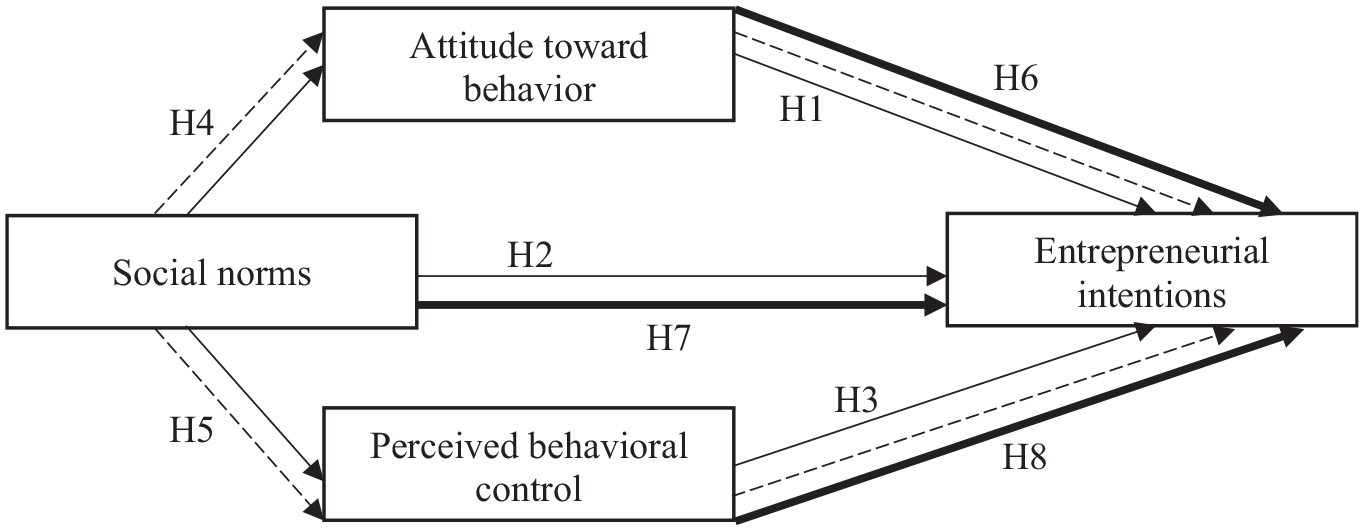
The theoretical model.
Research Methodology
Sample Description
A questionnaire-based survey was conducted on a final sample of 413 students who volunteered to take part in the study (see Table 1). This sample size is in accordance with the existing prescriptions in the literature of PLS-SEM and the “ten times rule” was used as a rough guideline (Hair Jet al., 2014). Additionally, given the nature of the research (e.g., a cross-country comparison) we took into consideration the sample size recommendations for a statistical power of 80% by Cohen (1992) and Hair et al. (2014) for multigroup analysis in PLS-SEM. The final sample comprised only students who declared that their nationality was German, Romanian or Ukrainian. In Germany, total response was 89, seven incomplete questionnaires were discarded, finally 82 questionnaires were found usable. In Romania, total response rate was 177, 21 incomplete questionnaires were discarded, finally 156 questionnaires were used in the survey. In Ukraine, 187 questionnaires were collected, 12 incomplete questionnaires were discarded, finally 175 questionnaires were retained and used in the survey.
Sample Distribution and Characteristics.
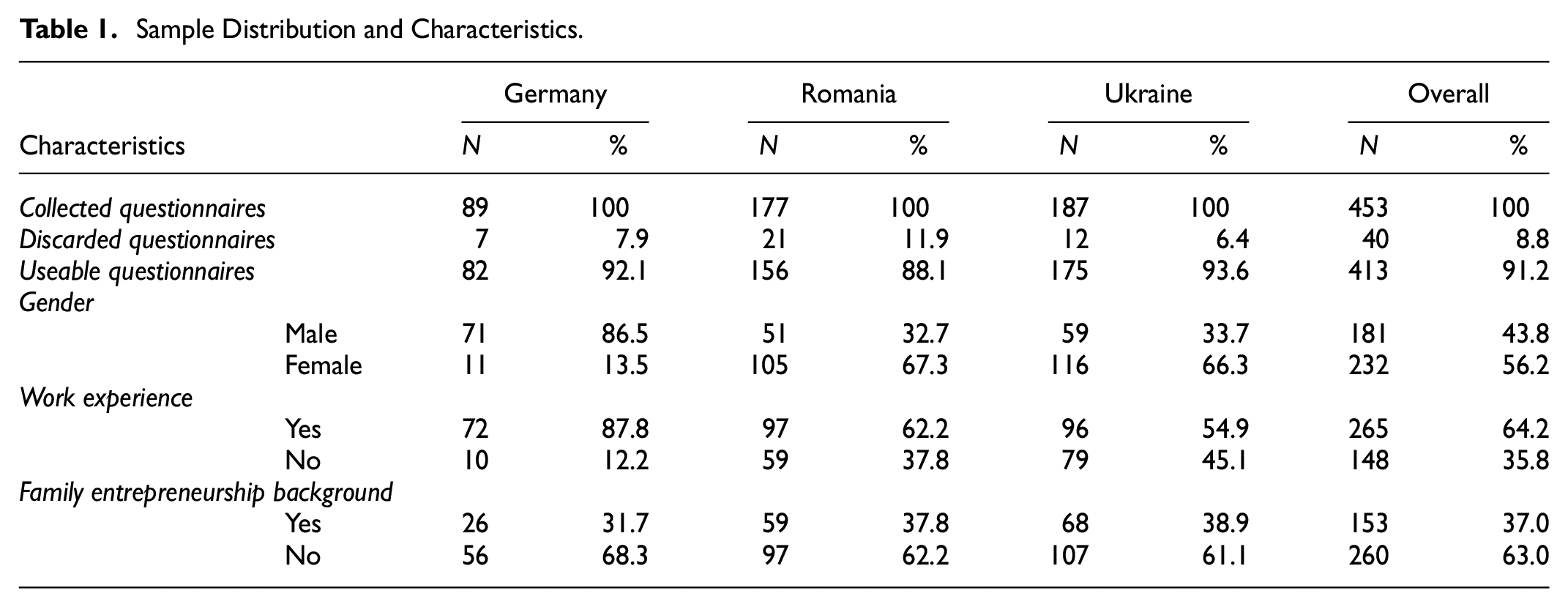
The demographic characteristics in the sample from Germany included 71 male respondents (86.5%) and 11 female respondents (13.5%) and the mean age was 23.37. The Romanian sample included 51 male respondents (32.7%) and 105 female respondents (67.3%) and the mean age was 22.41. The Ukrainian sample included 59 male respondents (33.7%) and 116 female respondents (66.3%) and the mean age of the respondents was 19.43.
In terms of previous exposure to entrepreneurship, 37.8% of the Romanian students and 38.9% of Ukrainian students were coming from families with an entrepreneurial background. This percentage was smaller for the German sample as only 31.74% of the respondents said that their parents had an entrepreneurial background. As for work experience, the results showed that 87.8% of the respondents from the German sample were employed whereas only 62.2% of the respondents from the Romanian sample, and 54.9% of the respondents from the Ukrainian sample, had a job at the time when the survey was conducted.
The students included in this survey were enrolled in business programs and they were well aware of the challenges of starting a new venture. Students from the Romanian sample were following a Management specialization; those from the German university were enrolled in the Automotive Business specialization, and the students from Ukraine were part of the Commodity Department. The use of students as a sample was considered suitable for studying EI due to the high exposure to the business decision making environment. Moreover, several studies on entrepreneurship confirmed the use of student samples (Liñán & Chen, 2009).
Data Collection and the Instrument Tool
Students were given precise details about the purpose of the survey and then given the questionnaires to be completed according to the instructions provided. Students were assured of complete anonymity for this survey. For all three samples, a paper-translated version of the questionnaire using a translation-back-translation (Hambleton et al., 1994) method was used in order to increase both the response rate and the accuracy of the responses.
The instrument used for this study was designed based on validated questionnaires that were previously tested in surveys that attempted to investigate EI (Liñán, 2008; Liñán et al., 2013; Liñán & Chen, 2009). The questionnaire consisted of several parts that included both Likert scale questions and nominal scales. ATB was measured with five items that assess the possibility of starting a business and the attraction toward such a career (e.g., Being an entrepreneur would entail great satisfaction for me). SN was measured with three items that assessed both the approval and support received from family, friends and colleagues for starting a business. PBC was measured with five items that assessed the capacity for starting a business (e.g., I know the necessary practical details to start a firm). EI was measured with four items that assessed the likelihood of starting a business (e.g., I will make every effort to start and run my own firm).
Following an item selection procedure from the literature, we only retained four of the six EI items and five of the six PBC items in order to firstly maximize the internal consistency and secondly to maximize both the convergent and discriminant validity (Raubenheimer, 2004). The variables were constructed using a seven-point Likert scale (1 = strongly disagree; 7 = strongly agree). The questionnaire included three control variables: gender (1 = Male, 0 = Female); entrepreneurial family background (1 = Yes, 0 = No) and previous work experience (1 = Yes, 0 = No).
Data Analysis and Results
In order to test the hypotheses, data was analyzed through a structure equation modeling technique (SEM) using SmartPLS 3.3.3. SEM is considered a proper technique in studies of social sciences (Nunnally, 1978) and has been frequently used in recent years in studies within the field of entrepreneurship (Manley et al., 2021). Moreover, SmartPLS is a comprehensive software program that adequately satisfies researchers’ analytical needs, regardless of their background (Sarstedt & Cheah, 2019). The conceptual model in Figure 1 was generated using structural equations for each of the three country samples and for the overall sample.
Reliability and Validity Assessment
In order to assess the reliability of the constructs, we used Cronbach’s Alpha and Composite Reliability (CR). The results are presented in Table 2 for the overall sample and for each country-specific sample. Cronbach’s Alpha is the most commonly used method for assessing the reliability of constructs (Bollen, 1989). For Cronbach’s Alpha the score of .700 and above is considered to be adequate (Hair et al., 2011), whereas for Composite Reliability, the score of 0.600 and above is considered adequate (Bagozzi & Yi, 1988). In the present study, values of Cronbach’s Alpha ranged between .700 and .948, whereas the CR ranged between 0.833 and 0.962. Hence, all the constructs and their dimensions are reliable.
Results of the Reliability and Validity Analysis.

Note. ATB = attitude toward behavior; SN = social norms; PBC = perceived behavioral control; EI = entrepreneurial intention.
The convergent validity of the constructs was tested using Average Variance Extracted (AVE). Since all constructs had an AVE above 0.500, which is considered the benchmark (Fornell & Larcker, 1981), we were able to establish convergent validity for all the constructs. Additionally, the discriminant validity was assessed through cross-loadings, and also Fornell and Larcker Criterion, and Heterotrait-Monotrait (HTMT) Ratio were assessed (see Table 3). Since all the loadings in their underlying construct were greater than their cross-loadings, we concluded that discriminant validity was established.
Results of the Discriminant Validity Analysis.

Note. On the diagonal, bold and italicized are the square roots of the AVE. Below the diagonal elements are the correlations between the construct’s values. Above the diagonal elements are the heterotrait—monotrait ratio of correlations values.
ATB = attitude toward behavior; SN = social norms; PBC = perceived behavioral control; EI = entrepreneurial intention.
Structural Equation Model Assessment
In order to assess the predictive power of the structural model, we estimated the coefficient of determination. Previous studies showed that the predictors from the TPB explained about 30% to 45% of the variation in EI (Liñán & Chen, 2009; van Gelderen et al., 2008). Our results showed that the independent variables (ATB, SN, and PBC) caused a 61.1% change in EI (R2 = 0.611) in the overall sample, 59.5% change in the German sample (R2 = 0.595), 60.0% change in the Romanian sample (R2 = 0.600), and 57.2% change in the Ukrainian sample (R2 = 0.572). To check for common method bias, we assessed each set of predictor constructs separately for each subpart of the structural model (i.e., the VIF values). Since all VIFs in the inner model resulting from the collinearity test are lower than 3.3, we conclude that our model is free of common method bias (Kock, 2015).
The findings of the structural equation model for the overall sample together with the results for the structural equation model for each sample are shown in Table 4. On the one hand, for the overall sample, the findings show that there is a direct and significant relationship between ATB and EI (ß = .523, t = 13.253, p < .001), and also a direct and significant relationship between PBC and EI (ß = .337, t = 8.748, p < .001). On the other hand, the findings show that there is an insignificant relationship between SN and EI (ß = .065, t = 1.742, p = .082). Therefore, hypotheses H1 and H3 were supported, whereas hypothesis H2 was not supported.
Results of the Structural Model Assessment.

Note. ATB = attitude toward behavior; SN = social norms; PBC = perceived behavioral control; EI = entrepreneurial intention.
For the German sample, the findings point to a direct and significant relationship between ATB and EI (ß = .464, t = 4.295, p < .001), between PBC and EI (ß = .324, t = 3.271, p < .01), but also between SN and EI (ß = .190, t = 2.522, p < .05). Given these findings we concluded that all three hypotheses (H1, H2 and H3) were supported for the German sample.
For the Romanian sample, the findings showed that there was a direct and significant relationship between ATB and EI (ß = .496, t = 9.113, p < .001), and between PBC and EI (ß = .380, t = 6.136, p < .001). However, the findings also showed that there was an insignificant relationship between SN and EI (ß = .026, t = 0.410, p = .682). Hence, hypotheses H1 and H3 were supported whereas H2 was not supported for the sample from Romania.
For the Ukrainian sample, the findings showed that there was a direct and significant relationship between ATB and EI (ß = .591, t = 9.124, p < .001), and also between PBC and EI (ß = .274, t = 4.419, p < .001). However, the findings showed that there was an insignificant relationship between SN and EI (ß = −.038, t = 0.603, p = .547). Hence, hypotheses H1 and H3 were supported whereas H2 was not supported for the sample from Ukraine.
Mediation Assessment
In order to test the fourth and fifth hypotheses, we followed general guidelines of Ringle et al. (2020) and we applied the complete bootstrapping technique using 5,000 subsamples with two-tailed for all the four samples. In order to examine mediation effects, we followed the recommendations and guidelines suggested by Nitzl et al. (2016). The model was analyzed for the overall sample and for each country-specific sample through two approaches. First, the direct effect of SN on EI was calculated and second, the indirect effect of SN on EI was calculated, with both ATB and PBC as mediating variables. The results of the mediation analysis are highlighted in Table 5.
Results of the Mediation Analysis.

Note. ATB = attitude toward behavior; SN = social norms; PBC = perceived behavioral control; EI = entrepreneurial intention.
When exploring the overall sample, the indirect effect of SN on EI through ATB was found significant (ß = .147, t = 5.079, p < .001). With the inclusion of the ATB mediator, SN no longer had a significant direct effect on EI (ß = .065, t = 1.742, p = .082). This allowed us to conclude that there was a full mediation between SN and EI through ATB; hence H4 was supported for the overall sample. Moreover, the indirect effect of SN on EI through PBC was significant (ß = .095, t = 5.013, p < .001) and the direct effect of SN on EI was not significant (ß = .065, t = 1.742, p = .082), which implies that PBC fully mediates the influence of SN on EI, providing support for H5 within the overall sample.
In the German sample, the indirect effect of SN on EI through ATB was not significant (ß = .111, t = 1.676, p = .094) and the direct effect of SN on EI with the inclusion of the mediator was significant (ß = .190, t = 2.522, p < .05). This means that there is a direct effect between SN and EI; however there is no mediation between these constructs provided by ATB and therefore H4 is not supported for the German sample. The indirect effect of SN on EI through PBC was found significant (ß = .109, t = 2.241, p < .05) and the direct effect of the SN on EI on the presence of the mediator was significant (ß = .190, t = 2.522, p < .05). This means that for the German sample, there is a partial mediation between SN and EI through PBC, which supports H5.
When performing the mediation analysis for the Romanian sample the results showed that the indirect effect of SN on EI through ATB was not significant (ß = .058, t = 1.127, p = .260) and the direct effect between SN and EI in the presence of the mediator was still not significant (ß = .026, t = 0.410, p = .682). This means that there is no effect between SN and EI and no mediation effect of SN on EI through ATB. At the same time, the indirect effect of SN on EI through PBC was found to be insignificant (ß = .051, t = 1.260, p = .208) and the direct effect of SN on EI in the presence of the mediator was not significant (ß = .026, t = 0.410, p = .682). The results point to the conclusion that there is no effect between SN and EI in the Romanian sample and no mediation between the two constructs through ATB. In conclusion, neither H4 nor H5 were supported for the Romanian sample.
Finally, in the sample from Ukraine, the indirect effect of SN on EI through ATB was found significant (ß = .216, t = 3.967, p < .001). The direct effect of SN on EI with the inclusion of the mediator was no longer significant (ß = −.038, t = 0.603, p = .547). This shows that ATB fully mediates the relationship between SN and EI. Hence, H4 was supported for the Ukrainian sample. Also, the indirect effect of SN on EI through PBC was found to be significant (ß = .071, t = 2.921, p < .05). The direct effect of SN on EI in the presence of the mediator was found to be insignificant (ß = −.038, t = 0.603, p = .547). This allowed us to conclude that PBC fully mediates the influence that SN exerts over EI; hence H5 was supported for the Ukrainian sample.
Multi-Group Analysis
In order to test the existence of significant differences in the effects of ATB, SN, and PBC on EI among the different countries (i.e., Germany, Romania, and Ukraine) we implemented multi-group analysis (MGA) with the bootstrapping technique for 5,000 subsamples two-tailored following the procedure described in the literature (Matthews, 2017). Multi-group analysis allowed us to test the differences between identical models estimated for different groups of respondents (Hair et al., 2014). Moreover, the MGA allowed us to uncover differences of subsamples within the population which are not evident when examined as a whole. MGA is seen as a useful approach for globally focused research, such as cross-cultural studies (Matthews, 2017). Table 6 reports the differences in paths across pairs of countries. According to the results of the MGA-PLS, the impact of SN on EI was significantly different in Germany and Ukraine. However, none of the other differences were significant when comparing the effect of the independent constructs (i.e., ATB, SN, and PBC) on the dependent construct (EI). Therefore, hypotheses H6, H7 and H8 were not supported by the results of the MGA analysis.
Results of the Multigroup Analysis.

Note. ATB = attitude toward behavior; SN = social norms; PBC = perceived behavioral control; EI = entrepreneurial intention.
Discussion
This study aimed to assess the formation of EI in three countries using the TPB framework. Business students enrolled at three universities, one in Germany, one in Romania, and one in Ukraine, were surveyed. Overall, the findings enrich the entrepreneurship literature because of insights gained about the role that determinants of TPB have on EI in these three distinct cultural and economic contexts. These insights are discussed in the next paragraphs.
According to the results, ATB is the most common predictor of EI within the TPB framework within all the three countries included in this study. This is in line with previous studies that analyzed the two constructs and found a positive association between them (Al-Jubari, 2019; Al-Jubari, Hassan, & Liñán, 2019; Farooq et al., 2018; Kautonen et al., 2015; Liñán & Chen, 2009; Moriano et al., 2012; van Gelderen et al., 2008). The findings point to the general idea that self-employment is a more appealing option among young people as opposed to being organizationally employed.
On measuring the impact of PBC on EI, we found positive and significant relationships in all three samples and in the overall sample. These findings broadly support the work of other studies that have tried to assess the relationship between PBC and EI (Almobaireek & Manolova, 2013; Iakovleva & Solesvik, 2014; Liñán & Chen, 2009; Moriano et al., 2012; Siu & Lo, 2013; Van Gelderen et al., 2008; Zhao, 2005). The findings clearly indicate that respondents in all three samples are eager to start businesses on their own. In the context of Ukraine, this can be additionally supported by recent findings (Sułkowski et al., 2023) indicating a noticeable increase in inclinations related to patriotic entrepreneurship within the last 2 years.The findings revealed support for the impact of SN on EI only in the German sample. This result might be attributed to the distinct cultural backgrounds of the respondents in the three samples. This study’s results are in accordance with previous studies—studies which demonstrate that SN are most closely related to EI in individualistic countries (Dimitrov et al., 2019; Hayton et al., 2002; Moriano et al., 2012; Mueller et al., 2014).
The theoretical framework of the current study conceptualized an indirect relationship between SN and EI through the mediating role of ATB and PBC. Our results included two interesting findings that further this understanding. First, our findings with regard to the overall sample provide support for the role that both constructs have in shaping the relationship between SN and EI, which means that the friends and families influence EI formation. In the entrepreneurship literature, it has been generally accepted that role models have a social influence on people’s intention to start businesses (Krueger et al., 2000; Liñán & Fayolle, 2015; Urbano et al., 2011). The impact of role models on a given behavior can also be explained through the lens of social learning theory (Bandura, 1977), according to which learning happens as a result of interaction with others. In the field of entrepreneurship, role models are people with a supportive and encouraging attitude toward entrepreneurship. Recent studies have shown that it is the interplay between role models, attitude toward behavior, and perceived self-efficacy that is likely to promote EI (Nowiński & Haddoud, 2019; Zapkau et al., 2017).
An even more surprising finding was revealed when the mediation process was applied to each of the three samples of respondents in this study, suggesting that exposure to various role models that are part of the SN dimension have different effects on EI based on cultural contexts (Abbasianchavari & Moritz, 2021). Our findings suggest that ATB exerts a continuous mediating effect between SN and EI only for the Ukrainian sample. This finding is consistent with that of Mykolenko et al. (2022) who found that personal attitudes have a mediating role on the relationship between cultural context and EI of Ukrainian students. It can therefore be assumed that strong socio-cultural support of the Ukrainian students from family or friends contributes to a positive attitude toward entrepreneurship, which then boosts EI. Moreover, such problems as the lack of a “safety airbag” for business development, information vacuum, business model crisis, difficulties in conquering new markets, as well as the personnel crisis in Ukraine, noted in recent years (Zahorskyi et al., 2020), critically influence the building of specific country context-related intentions in self-employment and social norms in entrepreneurship.
The study didn’t find that ATB moderates the linkage between SN and EI in either the German sample nor the Romanian one. These results may be explained by the fact that the stigmas of business failure and fear of failure rooted in cultural norms and social hierarchies have significant adverse impact on entrepreneurial ventures (Armour & Cumming, 2008; Landier, 2005). Previous studies have shown that the stigma of failure may have negative implications for people with EI (Simmons et al., 2014, 2019). Several German studies reveal that a low level of entrepreneurial activity is mostly due to a business culture that is characterized by stigmatization of failure (Wagner, 2006; Wagner & Sternberg, 2004). Fear of business failure refers to the unwillingness of individuals to take entrepreneurial risks (Cacciotti et al., 2016). It has been proven that cultures characterized by higher levels of uncertainty avoidance are more likely to experience greater fear of business failure (Hofstede, 2013), and Romania is one of those societies (Živko & Zver, 2006).
Previous studies demonstrated that Romanian students who failed in their entrepreneurial endeavors were rather skeptical about trying again and preferred going for employment (Pantea, 2018). Moreover, Romania suffers from the post-communist syndrome that harbors a negative orientation toward entrepreneurs, nudging people to seek stable employment. Also, entrepreneurship is typically viewed negatively by older members of society (Shook & Bratianu, 2010).
Lastly, our findings show that the influence of SN on students’ EI to start a business is indirect and operates through their perceived ability to control their own behavior (for students in the German and Ukrainian samples). Our findings in the Ukrainian context can be supported by recent observations of the extremely low (24.6%) willingness of Ukrainian students to start their own business after graduating (Ligonenko et al., 2023). This unpreparedness is a consequence of a lack of trust in the state and its institutions, as well as the less-than-sufficient work of universities in building the confidence of students to control their own behavior.The explanation for this finding likely involves a variety of factors, including cultural differences, the education system, the economic environment, and the level of support available.
Multi-group analysis revealed insignificant differences in the impact of TPB on EI across the three countries with the exception of impact of SN on EI in Germany and Ukraine. In Germany, entrepreneurship is highly valued, and students often receive significant support from their peers and teachers. Additionally, the strong German economy provides a favorable environment for entrepreneurship, with a well-developed market economy framework and access to financing (Fuerlinger et al., 2015; Noseleit, 2013). Moreover, the German education system places a heavy emphasis on hands-on, practical learning and encourages students to think critically and independently (Deissinger, 2007). These SN play a significant role in inspiring and supporting students’ EI.
In Ukraine the economic and political situation can be more challenging for aspiring entrepreneurs, and access to resources and financing may be limited (Markina et al., 2017). Additionally, the business environment in Ukraine is often perceived as being less favorable for entrepreneurs due to the lack of support and presence of numerous challenges such as corruption, bureaucracy, and a lack of access to funding. Furthermore, our findings align with recent studies (Ligonenko et al., 2023) that highlight the significant impact of conceptual factors, such as support for the generation and testing of business ideas, as well as financial backing from universities, on the actual EI of both students and graduates. These studies indicate dissatisfaction with the current system supporting entrepreneurship in Ukrainian universities. Consequently, a key focus in the national education development goals for Ukraine should include transforming universities into hubs not only for nurturing specific competencies but also for fostering and guiding EI. Ultimately, the aim should be to cultivate entrepreneurial aspirations among young individuals.
Implications
Theoretical Implications
With regards to theoretical implications, overall, the research on EI through TPB has mostly consisted of studies conducted in Asia (Maheshwari et al., 2023). Our study makes use of the TPB framework to identify antecedents of EI in less explored regions/countries (i.e., post-communist countries; developing vs. under-developed countries). It also contributes to a better understanding of the CIE, a particular strand of entrepreneurship research that deals with cross-cultural or international perspectives (Baier-Fuentes et al., 2019; Terjesen et al., 2016). CIE focuses on exploring entrepreneurial behaviors in different countries and cultures.
Our study also addresses the role of culture in the career intention of students. EI literature is further enhanced by results that point to the existence of the mediating effects of ATB and PBC on the relationship between SN and EI. The findings highlight the importance of doing cross-national research aimed at identifying the various relationships between the elements of TPB—attitude toward behavior, perceived behavioral control, and social norms—and how they relate to the formation of EI.
Practical Implications and Policy Recommendations
EI is central to understanding entrepreneurship as it is the first step in the process of discovering, creating, and exploiting opportunities (Bandura, 1977). Entrepreneurial activity is of vital importance for both the economic and social development of a region or country; it’s what stimulates competitiveness and innovation (Barba-Sánchez et al., 2022). It is clear that entrepreneurial activity needs to be encouraged, and students in particular need support to start new businesses. This study holds several managerial implications in relation to the importance of increasing students’ EI.
Recommendation 1
The research findings highlight that ATB and PBC influence the EI of business students. So universities should establish a robust system to continually evaluate and align their entrepreneurship education programs with ever changing market demands. This involves working closely with industry stakeholders, including business leaders, entrepreneurs, and local businesses. By actively engaging these stakeholders, universities can gain insight into emerging market trends, skill requirements and industry areas of expertise (Bischoff et al., 2018). Such alignment can ensure that graduates are well prepared to meet the demands of the business environment, increasing their confidence in their own knowledge, skills, and relevance, thereby promoting positive attitudes toward entrepreneurship and increasing their intention to pursue an entrepreneurial career. Moreover, universities should implement robust mechanisms to measure the impact of entrepreneurship education and support programs. By collecting and analyzing data on students’ experiences and outcomes, universities can gain valuable insights into the effectiveness of their initiatives.
Recommendation 2
To effectively develop students’ EI, universities should offer specialized entrepreneurship workshops and elective courses to students in any curriculum. These workshops/courses should be carefully designed to address the students’ pre-identified unique challenges, interests, and aspirations. These specialized workshops/courses should lead to the development of entrepreneurial awareness and equip students with specific practical skills and knowledge (Al-Mamary et al., 2020; Y. Zhang et al., 2014).
Recommendation 3
Universities should organize a wide range of entrepreneurship-related events, networking sessions, and guest speaker series. These events create opportunities for students to interact with successful entrepreneurs, investors, and peers who share their entrepreneurial interests (Chen & Goldstein, 2022). Engaging in such activities exposes students to the dynamic entrepreneurial ecosystem and fosters a sense of belonging within this community.
Recommendation 4
To further bolster students’ EI, universities should establish mentorship programs that connect students with seasoned entrepreneurs and industry experts. These mentors can offer invaluable guidance, share real-world experiences, and provide insights into the challenges and opportunities of entrepreneurship. By facilitating these mentorship relationships, universities can inspire students, boost their self-efficacy, and enhance their confidence in pursuing entrepreneurial endeavors. Moreover, previous studies have proven the efficiency of the well-designed government programs in Central and Eastern Europe over early-stage entreprenurship activities (Pilková et al., 2022).
Recommendation 5
To encourage and support student-led startups, universities should establish or support startup incubators and student entrepreneurship ecosystems within the academic environment. These incubators would provide students with essential resources, workspace, and access to funding opportunities. By offering a supportive infrastructure for innovation and entrepreneurship, universities empower students to transform their ideas into viable businesses (Maritz et al., 2022). This comprehensive approach will enable students to view entrepreneurship as a realistic career option, ultimately enhancing their EI.
Recommendation 6
Universities should strategically facilitate the formation of peer networks that will bring together students who share common entrepreneurial interests. By promoting collaboration and knowledge sharing among students, universities can effectively strengthen the social norms associated with entrepreneurship. Creating dedicated platforms for interaction, where students can engage with individuals who have successfully pursued entrepreneurial paths, reinforces the notion that entrepreneurship is a socially endorsed and attainable career choice (Baroncelli et al., 2022).
Recommendation 7
Finally, universities should take active steps to develop an entrepreneurial culture within their academic environment by organizing events, competitions and initiatives that highlight success stories and role models in the entrepreneurial community, especially student entrepreneurs (Kelly et al., 2022). Using these success stories as inspirational tools reinforces the belief that entrepreneurship is not only socially acceptable, but also holds the potential for significant success.
Limitations and Future Research Directions
As with all research, the results of this study should be viewed in light of their limitations. First, EI was operationalized at a single point in time at three universities in three different countries. The years of study constitute an extremely sensitive period during which preferences can change substantially. This is especially true for university graduates who are entering a world with demands and expectations different from previous generations (Delanoë-Gueguen & Fayolle, 2019). The current study was carried out before the invasion of Ukraine by Russia, which has had significant repercurssions on the both the economy and the educational system in Ukraine, therefore affecting the perception of students regarding entrepreneurial activities (Kruszewska & Lavrenova, 2022). Moreover, previous research has shown that even under conditions of war, individuals will develop EI based on their resilience and their ability of building entrepreneurial self-efficacy (Bullough et al., 2014). Therefore, longitudinal studies should be conducted regularly to monitor the EI level of Ukraine’s university graduates, to further extend current findings.
Second, consistent with previous work, our study focuses on students’ intention rather than their actual entrepreneurial behavior. Latent EI may not turn into actual entrepreneurial behavior. This could be an interesting opportunity to study latent EI and whether it manifests into actual entrepreneurship within multicultural contexts as suggested by Batista-Canino et al. (2024) in their recent holitistic literature review of EI.
Third, in applying EI to new and broader cross-cultural samples in universities, it is necessary to conduct further research on students’ EI in both developing and developed economies to better reflect a wide range of variables - including economic development, population size, geographic location, political system, historical, and cultural backgrounds. And the cognitive scripts of the various nations need to be taken into account. Future studies could even offer important insights into the dynamics of nation-states.
Lastly, since only self-reported data was collected in this study, bias is possible. Students could have reported more socially desirable responses than their actual behaviors. To ensure the accuracy of the results, further studies should include data from multiple sources in which multiple perspectives are taken into consideration, such as those of academics and entrepreneurs, to obtain more objective results, providing a more complete picture of the research topic. This drawback could be overcome also by using diverse methodological approaches such as fsQCA analysis which focuses on combinations of conditions leading to an outcome. Recent research on EI has used fsQCA for identifying configurational relationships between variables in an attempt to understand the formation of EI (Bordean et al., 2024; Sisu et al., 2024) based on specific combinations of self-reported conditions.
Footnotes
Acknowledgements
N/A
Declaration of Conflicting Interests
The author(s) declared no potential conflicts of interest with respect to the research, authorship, and/or publication of this article.
Funding
The author(s) disclosed receipt of the following financial support for the research, authorship, and/or publication of this article: The publication of this article was supported by the 2024 Development Fund of the Babeş-Bolyai University and Tom Estad’s AY 24-25 Faculty Research Fund, SC Johnson College of Business, Cornell University.

Data Availability Statement
The data presented in this study are available on request from the corresponding author.