




Abstract
In this study, we aim to understand the influence of the university’s environment and support system (ESS) on subjective social norms (SSN) as one of the precursors of the entrepreneurial intention (EI) of university students. For this, we applied a customized mathematical model of EI based on the theory of planned behavior to probe whether the university’s ESS can affect SSN and analyze the paths that this influence may follow to form the EI of students. In other words, this study argues that the university plays a critical dual role in shaping the EI of students. First, it can provide support mechanisms to help students translate their ideas into viable business models that may further translate into successful ventures. Second, it can help students gain the support of their families and friends who influence their SSN, thus affecting their EI through the mediating effects of the other two precursors of intention. We collected the data from students in a public university in Atlantic Canada via a structured non-disguised questionnaire to test the hypotheses formulated in this study. We analyzed them through partial least square-structural equation modeling of a second-order mathematical model of EI. Analysis of the data indicates that the mathematical model is appropriate for evaluating the relations among the five constructs of the mathematical model of EI. Results of this study support the hypothesis that the university’s ESS may influence students’ perceptions of the opinions of important reference people regarding their prospects of becoming entrepreneurs. Furthermore, we determined that the university’s ESS influences the EI of students mediated by the more proximal precursors of intention. The effect of the university’s ESS is such that it may positively impact the EI of students, but its importance in the mathematical model of EI is still low. These findings can help universities assess their initiatives to promote innovation and entrepreneurship on campus.
Keywords
Introduction
This study aims at understanding the effect of the university’s environment and support system (ESS) on subjective social norms (SSN) as one of the antecedents (precursors) of the entrepreneurial intention (EI) of university students (henceforth students). Today, an increasing number of policymakers believe that more entrepreneurship is essential to generate higher levels of innovation and development in the current knowledge economy (Casanovas & de Castro, 2022). At the same time, universities worldwide have been integrating entrepreneurship programs into their curricula to train students who may choose entrepreneurship as a career path after graduation (Schimperna et al., 2021). The impact of entrepreneurship education programs on the antecedents of the EI of students has been the topic of many studies over the years (Rae & Woodier-Harris, 2013; Rauch & Hulsink, 2015; Sánchez, 2011; Wu, Jiang et al., 2021). In addition, a few studies have assessed how the university’s ESS can encourage students to consider an entrepreneurial career (Bazan, Datta, et al., 2019; Bazan, Shaikh et al., 2019; Lu et al., 2021; Saeed et al., 2015; Trivedi, 2016, 2017; Zamrudi & Yulianti, 2020). Furthermore, well-established and aspiring entrepreneurial universities have been actively helping develop regional entrepreneurial ecosystems by providing students with support mechanisms such as business incubation services, business start-up coaching, technology transfer and commercialization, and intellectual property protection. These are all necessary resources for entrepreneurial activity and form part of the university’s ESS (Audretsch, 2014; Etzkowitz & Webster, 1998; Urbano & Guerrero, 2013). Thus, we define the university’s ESS as the group of support mechanisms established to support the university’s entrepreneurship and innovation initiatives on and around campus.
Previous studies by Bazan, Shaikh et al. (2019) and Bazan, Datta, et al. (2019) applied a customized mathematical model of EI based on the theory of planned behavior (TPB) (Ajzen, 1991) to understand the effect of the university’s ESS on the antecedents of the EI of students, that is, attitude toward behavior (ATB) and perceived behavioral control (PBC). Both prior studies corroborated the strong effect of ATB and PBC on the EI of students. They also showed that the university’s ESS could indirectly influence students’ EI via its impact on ATB and PBC. Moreover, given the strong effect of SSN on both ATB and PBC found in both prior studies, those authors posed the challenge of finding ways to design some aspects of the university’s ESS to positively affect the SSN and (ultimately) the EI of students. Thus, we accepted the challenge and investigated whether the university’s ESS can affect SSN along with the paths that this influence may follow to affect the EI of students. This study took place in a public university in Atlantic Canada. As the only university in the province, this aspiring entrepreneurial university has a special obligation to its people. Since its founding in 1925, the university has played an integral role in the province’s cultural, social, health, and economic development. It has educated most of its business people, civil servants, educators, engineers, scientists, health professionals, cultural workers, artists, and leaders. In addition, over the past 10 years, the university has been transforming itself to play an even more prominent role in the province’s economic and social development strategies. This transformation comprised several initiatives to promote innovation and entrepreneurship among students, faculty, and staff. Some of the new support mechanisms forming part of the university’s ESS are the Technology Transfer and Commercialization Office (2015), the Center for Entrepreneurship (2016), the Center for Social Enterprise (2016), the Innovation Initiative (2016), the Director of Innovation and Entrepreneurship (2020), and the Innovation Strategy (2022). Consequently, there is a need for systematic approaches to evaluate the impact of these initiatives at the student level.
This study shares some similarities with the studies above and the literature below. Although it also shows many differences and expands previous contributions by others. Most studies in the literature analyzed the effect of the university on the EI of students by assessing the impact of entrepreneurship education on the students’ ATB and PBC. However, the literature review below reveals that these results have been very heterogeneous and inconsistent. We conjecture that these inconsistencies stem from contextual variables that are not accounted for by the different models. To our knowledge, this study is the first to examine the university’s ESS as a multidimensional influencer of the SSN of students as a precursor of their EI. This study argues that the critical role played by the university in shaping the EI of students is twofold. First, it can provide support mechanisms to help students translate their ideas into viable business models, which they can then translate into successful business ventures. Second, it can help students gain the support of their families and friends who affect their ATB and PBC through their SSN. The findings of this study can help the university assess the effectiveness of its entrepreneurship and innovation initiatives for encouraging more entrepreneurial activities on and around campus. This understanding could help the institution increase the perceptions of entrepreneurship as feasible and desirable, thus raising students’ perceptions of opportunity.
The remainder of the paper comprises the following sections. The Literature Review section describes previous studies on the SSN of students as affected by their local environment. The Conceptual Model and Hypotheses section explains the proposed conceptual model of EI and formulates the hypotheses tested through partial least squares-structural equation modeling. The Data Collection and Analysis section describes the processes for collecting, curating, and analyzing the data to assess the study design’s applicability. The Discussion of Results section outlines the implications of the findings for the university and offers recommendations for possible interventions. Finally, the Conclusion section summarizes the findings and suggests possible future work.
Literature Review
A region’s economic development and demographic characteristics affect the opportunity structure, resources, capabilities, and interests that influence the local economic activity (Wennekers et al., 2002). The literature has acknowledged that the local and regional context’s situational variables indirectly influence EI by affecting essential attitudes and an individual’s motivation to pursue or avoid the behavior (Krueger et al., 2000; Malecki, 2009; Trettin & Welter, 2011). Environmental conditions may influence the formation of EI by shaping the individual’s beliefs and perceptions and affecting the three precursors of intention: ATB, SSN, and PBC (Ajzen & Fishbein, 2005). Most studies in the literature have analyzed the effect of the local environment (e.g., the university’s) on the EI of students by assessing its impact on their ATB and PBC (Karimi et al., 2017; Luthje & Franke, 2003; Turker & Sonmez Selcuk, 2009). However, few studies have analyzed the effect of the local environment on the SSN of students within an EI model. Even fewer studies have examined the effect of the university’s ESS on the SSN of students that can eventually impact their EI either directly or indirectly. Most studies that did so have investigated the effect of entrepreneurship education on the SSN of students.
Following are some studies that considered the impact of the regional environment on the antecedents of the EI of students. Kibler (2013) studied the contextual embeddedness of TPB models by proposing that regional characteristics affect the relative importance of ATB, SSN, and PBC as influencers of EI. He argued that the regional environment has implications for the perceptual domain (Begley et al., 2005; Davidsson, 1991) and entrepreneurial preferences (Bosma et al., 2009). Thus, it may influence the formation of EI. To assess the influence of contextual factors on EI development, he tested these external factors as mediated by the more proximal antecedents of intention (ATB, SSN, and PBC) and as moderators of the relationship between EI and its three precursors (Cooke & Sheeran, 2004). He found that the regional environment within which an individual is embedded moderates their perceptions of entrepreneurship and their EI formation. Liñán et al. (2011) pointed out that the institutional economic theory is helpful to evaluate the effect of environmental factors on entrepreneurship. With that in mind, they examined the role played by entrepreneurship valuation in the individual’s closer and wider environments. They posited that closer valuation and social valuation have positive effects on SSN but differ depending on the regional context. Their study found that perceptions concerning general-society and closer-environment values affect motivational factors determining EI. However, this influence would differ at least in two aspects. First, closer valuation of entrepreneurship seems to exert a more substantial effect over ATB, while social valuation influences perceptions concerning PBC. Second, these effects differ depending on the region. Lim (2018) argued that environmental conditions such as the availability of local support, financial resources, and possible opportunities—which are beyond the control of the individual—might influence the decision to embark on an entrepreneurial journey. She suggested that the anomalies in the outcome on the predictive power of the variables on EI models across various studies from different countries may be due to the effect these environmental conditions exert on the antecedents of EI (Iakovleva et al., 2011). She posited that universities are gaining much attention among possible environmental conditions affecting the precursors of the EI of students. She conjectured that the right university environment can provide much needed confidence for students to consider the starting of new business ventures. Findings of her study indicate that the EI of students is affected by encouragement and support received within the university environment in the form of infrastructure, networking, knowledge, and mentorship.
The findings by Lim (2018) serve as a good transition for the subsequent studies that consider the university context as a possible influencer of the antecedents of EI of students. García-Rodríguez et al. (2017) studied the role that the sociocultural, family, and university environments play in the EI of students. They hypothesized that a student’s university and sociocultural contexts would positively influence their ATB, SSN, PBC, and EI. Their findings show that the university environment and learning directly influence ATB and PBC and indirectly, although moderately, the EI of students. They also show that the social context exerts a weak direct influence on the ATB and indirectly on EI. However, the same university environment does not influence students’ perceptions of support by family and friends to their idea of starting a new business. Guerrero and Urbano (2015) considered the basis of the social-cognitive perspective to suggest that an individual’s decision results from the interaction among behavioral, cognitive, and environmental factors (Bandura, 1991). Thus, cognitive factors—such as ATB and PBC—and environmental factors, including the university context and SSN, will affect the EI of students. They measured the environmental factors by the perception of social pressures (social environment) and the perception of university support (ESS). They posited that the university and social environments could influence the students’ intentions through their ATB and PBC at the time of graduation. Their results confirm the arguments regarding the mediating role of cognitive factors and the relevant role of the university environment for students in innovative economies. Asimakopoulos et al. (2019) mentioned that SSN refers not only to important reference people around the individual but also the influence of the environment in which they operate. Students perceiving a supportive entrepreneurship environment (including the university), they may be more motivated to start a business (Saeed et al., 2015). They argued that individuals involved in an entrepreneurship education program are more likely to have the intention to start a new business when they perceive an environment that supports them. Thus, they explained the role of SSN as a moderator of the relationship between entrepreneurship education and EI and in the relationship between PBC and EI. Their results show that entrepreneurship education and PBC are more likely to affect EI with adequate social support.
Most studies that considered the effect of the university’s ESS on the SSN of students did so by analyzing one aspect of this effect, that of the offering of entrepreneurship education by the university. Souitaris et al. (2007) used a pretest-posttest quasi-experimental design to test the influence of benefits derived from entrepreneurship programs (i.e., learning, inspiration, and resource-utilization) on the EI of engineering and science students. Their results show that students in the “program” group increased their SSN and EI, whereas the “control” group did not. They also found that inspiration (and not learning or resource-utilization) was the program’s benefit related to increasing the SSN and EI of students. Tognazzo et al. (2017) examined if students’ perception of whether their university education affects their entrepreneurial skills and attitudes influence the EI of students. They also investigated if students’ perception of whether their university favors and supports entrepreneurship can influence the EI of students. They hypothesized that the learning experience and the university climate would moderate the relationship between ATB, SSN, and PBC and the EI of students. Their findings show that if students perceive that the university education provides them with management skills and capacities to identify opportunities and develop networks, the positive views of entrepreneurial careers of reference people negatively affect students’ intentions to pursue an entrepreneurial career. Karimi et al. (2016) used an ex-ante and ex-post survey to assess the impacts of elective and mandatory entrepreneurship education programs on the EI of students and the identification of opportunities. They hypothesized that the completion of both types of entrepreneurship education programs has significant positive effects on the SSN and PBC of students. They also posited that students whose ATB, SSN, and PBC had increased also see an increase in their EI. Their results confirmed the impact of both entrepreneurship education programs on SSN (Souitaris et al., 2007; Weber & Harhoff, 2012). Their study did not offer evidence that entrepreneurship education programs affect the EI of students. However, they argued that the increase in the mean value of SSN might reflect the emphasis within both programs on teamwork and on allowing students to build a network with entrepreneurship-minded friends and peers as well as with entrepreneurs themselves.
This study shares some similarities with two recent studies conducted simultaneously with our study. For example, Lu et al. (2021) evaluated the influence of the university’s ESS on the EI of students in the Chinese context. They examined students’ perceptions of the support they received from Chinese universities and the impact on their EI. Their findings show that students are dissatisfied with the ESS of their universities. However, their results also indicate a weak positive relationship between the university’s ESS and the EI of students mediated by ATB, SSN, and PBC. Pinheiro et al. (2022) investigated the entrepreneurs’ and potential entrepreneurs’ (students’) perceptions of the relation between SSN, the university’s ESS, and the perceived satisfaction concerning universities’ conditions to nurture entrepreneurial orientation in the Brazilian context. Their results indicate that SSN affects how students perceive the ESS of Brazilian universities and that this impression shapes their satisfaction levels. The main two differences between our study and Lu et al. (2021) and Pinheiro et al. (2022) are as follows. First, our study focuses on the effect of the university’s ESS on the SSN of students as the primary research question. Second, our study considers the true multidimensionality of the university’s ESS. That is, we conceived the university’s ESS as an exogenous second-order construct that can account for three seemingly different but highly interrelated first-order components. The university’s ESS is a highly complex ecosystem that needs a sophisticated mathematical model to account for the equally complex entrepreneurship phenomena under study.
Conceptual Model and Hypotheses
The literature argues that the intention to start a new venture is a better predictor of the behavior of starting a new business than personality, demographics, beliefs, or attitudes (Ajzen, 1991, 2001; Delmar & Davidsson, 2000; Fayolle et al., 2006; Krueger et al., 2000). Bazan, Shaikh, et al. (2019) designed a study to understand the influence of the university’s ESS on the antecedents of the EI of students (i.e., ATB and PBC). Their study applied a customized mathematical model of EI based on the TPB (Ajzen, 1991) following previous works by Trivedi (2016, 2017) and Liñán and Chen (2009). The TPB anticipates that the more favorable the ATB and SSN and the greater the PBC, the stronger the individual’s intention to behave (Kolvereid, 1996b). Researchers use TPB-based models in the entrepreneurial context to successfully predict the behavior of starting a new venture (Kautonen et al., 2013, 2015). This study adopted and adapted the mathematical model of EI by Bazan, Shaikh, et al. (2019) as modified by Bazan, Datta, et al. (2019), represented (conceptually) in Figure 1. This mathematical model postulates and defines the variables’ governing rules and measurement properties.

Conceptual model of entrepreneurial intention.
Table 1 shows the nine hypotheses formulated in this study. Previous authors have given sufficient theoretical arguments for postulating hypotheses H0 to H7. However, and for completeness, we provide a brief justification for each hypothesis below and refer the reader to Bazan, Shaikh et al. (2019) and Bazan, Datta, et al. (2019) and the references therein for a detailed discussion of these arguments in the literature.
Hypotheses of the Study.

Hypothesis H0 corresponds to the assumption that the university’s ESS has three distinct dimensions. That is entrepreneurship training (ET), start-up support (SS), and entrepreneurial milieu (EM) (not shown in Figure 1), that affect the EI of students via the mediation of the more proximal antecedents of intention (Bazan, Datta, et al., 2019). There is growing evidence in the literature that the university’s ESS can help students develop their entrepreneurial competencies and encourage them to consider entrepreneurship as a career (Franke & Lüthje, 2004; Kraaijenbrink et al., 2010). Trivedi (2016) identified three elements of the university’s ESS that might affect the antecedents of EI. He suggested that targeted cognitive and non-cognitive supports—along with the general university environment—positively correlate with the antecedents of EI. Bazan, Datta, et al. (2019) showed that the effect of the university’s ESS comprises three distinct, interdepended dimensions mentioned above: ET (e.g., workshops, courses), SS (e.g., seed funding, mentorship), and EM (e.g., entrepreneurial atmosphere). In the past, many researchers believed that ATB and PBC were two of the three antecedents of intention most affected by the university’s ESS (Shirokova et al., 2016). Thus, we formulate the following hypothesis:
H0: ESS comprises three distinct dimensions: ET, SS, and EM.
Hypotheses H1, H2, and H3 belong to the traditional TPB-based intention model. Hypothesis H1 implies that the more favorable the ATB of starting a new venture, the stronger the intention to behave and create a new business (Pruett et al., 2009; Segal et al., 2005; van Gelderen & Jansen, 2006; Varamäki et al., 2013). The literature has determined ATB as the most effective construct in explaining the intention to start a new business (Watchravesringkan et al., 2013). Hypothesis H2 suggests that a strong PBC concerning creating a new business will generally lead to a strong intention to conduct the behavior (Swann et al., 2007). Various researchers found PBC to be the most influential factor in shaping EI (Souitaris et al., 2007; van Gelderen et al., 2008). Hypothesis H3 implies that if important reference people support the behavior of creating a new venture, SSN would positively influence the intention to start a new business. However, results in the literature concerning the importance of SSN as a direct influencer of EI have been inconclusive (Kautonen et al., 2013; Kolvereid & Isaksen, 2006; Luthje & Franke, 2003). Thus, we formulate the following hypotheses:
H1: ATB positively influences the EI of students.
H2: PBC positively influences the EI of students.
H3: SSN positively influences the EI of students.
Hypotheses H4 and H5 explain the inner structure of the antecedents of intention. Ajzen’s (1991) original TPB alluded that SSN influences ATB and PBC. Several authors substantiated this assumption from a social capital point of view (Liñán & Santos, 2007). Thus, we formulate the following hypotheses:
H4: SSN positively influences the ATB of students.
H5: SSN positively influences the PBC of students.
Hypotheses H6 and H7 postulate that the university’s ESS would affect the ATB and PBC of students. The literature has been adding evidence to suggest that contextual and situational factors affect EI by influencing the cognitive precursors of intention (ATB and PBC) and the general motivation to behave (Krueger et al., 2000; Lee & Wong, 2004). Thus, we formulate the following hypotheses:
H6: ESS positively influences the ATB of students.
H7: ESS positively influences the PBC of students.
This study focuses on the effect of the university’s ESS on SSN as postulated by hypothesis H8. SSN refers to the perceptions by an individual of the social pressures to conduct (or not to conduct) the behavior exerted by important reference people (family, friends). More specifically, it is concerned with whether the important reference people approve (support) or disapprove (discourage) the individual’s behavior (compliance). It is also affected by the degree that the opinion of the important reference people matters to the individual (Ajzen, 1991, 2001). When the individual cares about the opinions of the important reference people, the intention to behave would be stronger when the important reference people seem to encourage the behavior (Pruett et al., 2009). This study measures these two different dimensions of SSN in a single construct (Kolvereid, 1996b). As mentioned above, prior studies of the direct influence of SSN on the EI of students have given mixed results, although many studies have established an indirect effect on EI via its strong impact on both ATP and PBC (Bazan, Datta, et al., 2019; Bazan, Shaikh et al., 2019). The literature suggests that the university context influences the EI of students (Bae et al., 2014; Liñán et al., 2011; Lu et al., 2021; Shirokova et al., 2016; Trivedi, 2016; Zhang et al., 2014). The university’s ESS can help students develop their entrepreneurial competencies and encourage them to consider a career as an entrepreneur upon graduation (Franke & Lüthje, 2004; Kraaijenbrink et al., 2010). Bazan, Datta, et al. (2019) tested the effect of the university’s ESS that comprises three distinct, interdepended dimensions: SS, ET, and EM. They hypothesized that the university’s ESS would primarily affect two of the three precursors of intention, ATB and PBC (Shirokova et al., 2016). Their results support the hypothesis that the university’s ESS construct consists of three components. Their findings corroborate previous arguments in the literature that assumed that the university environment affects a student’s attitude (desire) and self-efficacy (feasibility) necessary to become an entrepreneur (Degroof & Roberts, 2004; Guerrero et al., 2008; Meyer, 2003).
This study subscribes to the premise of the embedded entrepreneur, that is, an entrepreneur is surrounded by certain environmental conditions that can positively (or negatively) affect their perceptions of entrepreneurship (Kibler, 2013). Guerrero and Urbano (2015) argued that the institutional economics approach could help understand the environmental factors that foster entrepreneurship inside universities. In particular, the influence of a student’s perceptions about how their university reinforces their capabilities, skills, and the knowledge required to become an entrepreneur. They argued that identifying and taking advantage of entrepreneurial opportunities within universities need a supportive climate that promotes the drive for innovation and entrepreneurship among all members (Mueller, 2007). With that in mind, they proposed to model the university environment by the perception of the university members (students, professors, and staff) who provide both support measures and cultural values that help to legitimize, recognize, and create a favorable and fertile entrepreneurial environment (Guerrero & Urbano, 2015). Researchers have identified different antecedents of SSN respecting the nature of the phenomenon under study (Aziz et al., 2017). This study posits that the university’s ESS influences the cognitive precursors of EI of students (ATB and PBC) and their SSN. Some theoretical and empirical evidence in the literature supports this argument. Previous studies have proposed organizational climate as an antecedent of the SSN of employees (Wu & Zhu, 2012). Other studies have found that there is indeed a positive relationship between an organizational climate and SSN (Bock et al., 2005; Tohidinia & Mosakhani, 2010). The organizational climate refers to the common judgment of its members about the organization as a whole and should affect everyone in the organization (Ashkanasy et al., 2011; Othman et al., 2018). Thus, as an organization, the university would influence all university members, including aspiring student entrepreneurs and their fellow students (i.e., friends). In addition, the presence of student entrepreneurs on an entrepreneurial university’s campus could be critical to this positive effect of the university environment on the individual considering entrepreneurship (Asimakopoulos et al., 2019; Liñán et al., 2011; Turker & Sonmez Selcuk, 2009). Consequently, hypothesis H8 posits that the university’s ESS would affect the SSN of students by its influence on a student’s important reference people (e.g., fellow students who may also be their friends). Note that depending on the particular university of the students under study, the university’s ESS may also influence the opinion of family members based on the support that their students could receive from the university. Family members of a student might have a better view regarding their student becoming an entrepreneur if they believe that the university can provide them with appropriate new venture creation support. Thus, we formulate the following hypothesis:
H8: ESS positively influences the SSN of students.
Data Collection and Analysis
This study developed a structured questionnaire shown in the Appendix to collect the data. The questionnaire adapted validated scale items from the literature to measure the constructs, that is, ESS, ATB, SSN, PBC, EI (Bazan, Shaikh, et al., 2019; Liñán & Chen, 2009; Trivedi, 2016, 2017). Three faculty members and five non-participating students assess the research instrument to check for clarity, readability, and ease of completion. Furthermore, the university’s Interdisciplinary Committee on Ethics in Human Research reviewed and approved the study design. We sent students a recruitment letter explaining the study’s goals, the confidentiality of their participation, and instructions for completing the survey. The items in the questionnaire use a Likert-type scale from “1” (Total Disagreement) to “7” (Total Agreement). (Students who completed the survey had a chance to win small incentives.) We used the software packages SPSS® v25 (IBM, 2022) and SmartPLS v3.3.3 (Ringle et al., 2015) to analyze the data. This study used partial least square-structural equation modeling (PLS-SEM) to analyze the data. As a second-generation statistical method, PLS-SEM is suitable for situations in which the theory is still under development; and the main objective for employing structural equation modeling is to explain and predict the target constructs (Hair et al., 2017). Furthermore, PLS-SEM is a nonparametric method that achieves high statistical power with smaller sample sizes than as required by asymptotic methods. The theoretical background and characteristics of the data sample of this study suggest the PLS-SEM is an appropriate choice.
This study employed the convenience sampling method to collect the data from students at the public university in Atlantic Canada (∼17,000 students enroll in this university in any academic year). We followed basic sampling theory guidelines (Sarstedt et al., 2018) by relying on sample size requirements that consider the statistical power of the estimates when analyzing the predictive model using PLS-SEM. We use the inverse square root method proposed by Kock and Hadaya (2018) to set the minimum sample size for this study. The inverse square root method accounts for the probability that the ratio of a path coefficient and its standard error will be higher than the critical value of the test statistic for a specific significant level (Hair et al., 2021). It is a conservative approach that slightly overestimates the sample size. For example, the required sample size for a minimum path coefficient between 0.11 and 0.20, a significance level of 5%, and a power of 80% is 155 samples (Hair et al., 2021, p. 18). Thus, we aimed at recruiting enough participants to achieve 155 usable responses.
The study collected the data during July and August 2020 by distributing the recruitment letter to all students registered during the summer semester. We collected 424 responses with a 93% average completion rate. A thorough screening of the raw data detected the following. (1) A total of 80 rows were missing one or more entries. Of these, 39 rows were missing more than three values (>10%), and we deleted them. The other 41 rows were missing one (34 rows), two (five rows), or three (two rows) values (<10%), and we kept them for potential imputation. (2) Unengaged respondents: 14 rows displayed odd patterns of responses (e.g., straight lines) and very low time to completion, and we deleted them (including two rows missing one value). (3) Data imputation: we ran the Little’s Missing Completely at Random (MCAR) test, which failed to reject the null hypothesis that missing values were missing completely at random (χ2 = 1,095.389, DF = 971, Sig. = 0.061). Thus, we used the expectation-maximization (EM) algorithm for each category of measurement variables separately to impute the 39 rows with missing values. 4) Influential outliers: we deleted 21 rows from the dataset based on the Mahalanobis distance compared to a chi-square distribution with the same degrees of freedom (Aguinis et al., 2013). (5) Data normality: The largest skewness and kurtosis are −1.289 and 1.712 for ATB5 and SSN3, respectively, which are slightly larger than the prescribed threshold of ±1. These values for skewness and kurtosis mean that the distributions are slightly non-normal, which further justifies the use of PLS-SEM. The final dataset comprises 350 rows plus seven columns of demographics. This sample size (350) exceeds the minimum required sample size (155) discussed above. However, this study does not claim the sample to be representative of the entire student population. Instead, it focuses on sample size for adequate statistical power when using PLS-SEM.
This study assumes the influence of the university’s ESS on EI is not direct but indirect through the more proximal precursors ATB, SSN, and PBC. To test whether ATB, SSN, and PBC mediate the effect of the university’s ESS on EI, we first evaluated whether ESS and the mediators ATB, SSN, and PBC have (individually) a significant direct effect on EI. There are two reasons for testing the direct effects this way (Judd & Kenny, 2015). First, a direct effect constituting an indirect effect must be substantial for a mediation to take place. Second, there could be an inconsistent mediation, that is, suppression of effects (Maassen & Bakker, 2001). Furthermore, knowing a mediator’s relative importance can help refine the pathways by which an exogenous variable affects an outcome (Ledermann & Macho, 2015). The simple models for the lone effect of ESS, ATB, SSN, and PBC (individually) on EI fit the data well. Table 2 shows that the path coefficients between each antecedent and EI are significant at the p < .001 level (***) or the p < .050 level (**). The mediation analysis based on the recommendation given in Carrión et al. (2017) at the end of this section supports the assumptions above.
Isolated Effects on EI by Individual Factors.

This study adopted the recommendations in Hair et al. (2017, 2019), and Sarstedt et al. (2019) to process the data and analyze the results using PLS-SEM. The mathematical model tested in this study has eight latent variables with reflective constructs (one second-order and seven first-order measurement models). The exogenous second-order construct assumes that the shared underlying, second-order construct ESS can account for the seemingly different yet interrelated first-order components: SS, ET, and EM. The first-order components SS, ET, and EM, have five indicators each. This study draws on the repeated indicators approach to form the reflective-reflective second-order construct of the model. That is, we assigned all the indicators of the reflectively measured first-order components (SS, ET, and EM) simultaneously to the reflective measurement model of the second-order construct (ESS). The exogenous/endogenous constructs ATB and PBC and the endogenous construct EI have five indicators each. Following Kolvereid (1996a), the exogenous/endogenous construct SSN is the product of two sets of measures. The first set contains four indicators measuring a student’s beliefs of how much their family and friends value the entrepreneurial career and whether they believe their family and friends would support them if they become an entrepreneur. The second set of two indicators represents the extent to which those opinions matter to the student (Kibler, 2013). Figure 2 shows the second-order structural model of the EI of students.
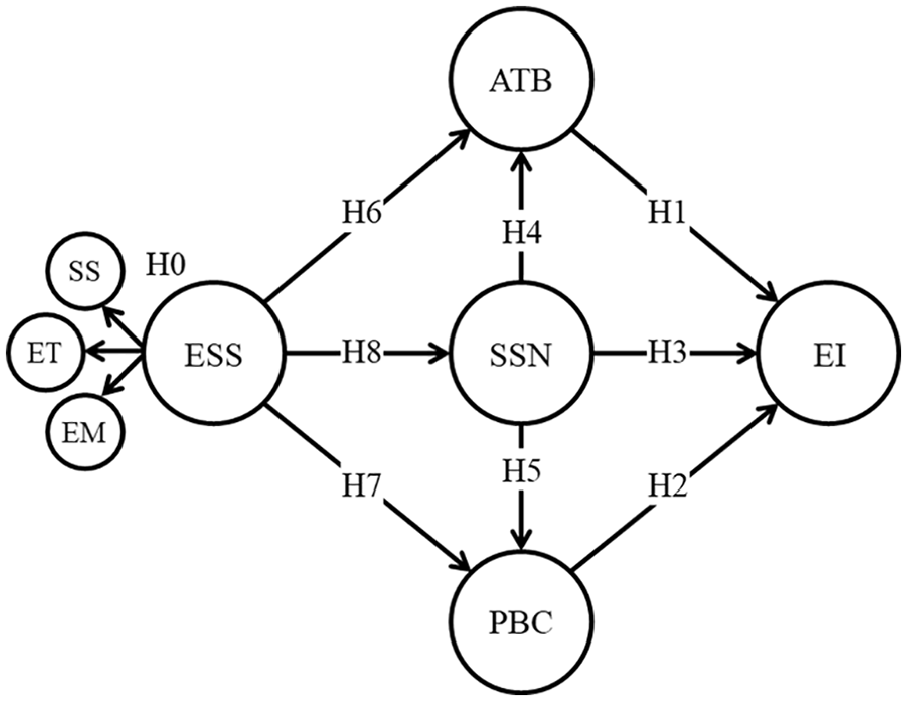
Second-order structural model of entrepreneurial intention.
Measurement Model Analysis
This study examined the measurement models as the first step in assessing the PLS-SEM results. The mathematical model in this study comprises second-order and first-order measurement models. Evaluating higher-order models requires the same evaluation criteria as any PLS-SEM analysis (Chin, 2010). However, evaluating the second-order construct needs to consider the evaluation criteria for two measurement models, that is, the measurement models of the first-order components (SS, ET, and EM), and the measurement model of the second-order construct as a whole, characterized by the relations between the second-order construct and its first-order components (Sarstedt et al., 2019). The model under study includes only reflective measurement models; thus, we used the (extended) repeated indicators approach for the PLS-SEM analysis. The metrics relevant to validating the measurement model of a higher- or lower-order construct are (1) individual indicator reliability, (2) internal consistency reliability, (3) convergent validity, and (4) discriminant validity. A discussion of the evaluation follows below, while Table 3 summarizes the results and their recommended thresholds. (Note: This study used bootstrapping with the following settings: 5,000 bootstrap samples, accelerated bootstrap with bias-corrected, two-tailed testing, and 5% significance level.)
Summary of Measurement Model Metrics.

(1) Individual indicator reliability: This study used the size of the outer loading for each indicator to assess individual indicator reliability. In the model of this study, the first-order components are reflections of the second-order construct (reflective-reflective model); thus, the path relationships represent loadings of the second-order construct. In other words, we interpreted the constructs SS, ET, and EM as if they were indicators of the ESS construct. Examination of the outer loadings of the second-order and first-order constructs revealed that they are all statistically significant and above the recommended threshold. In addition, the lowest outer loading corresponds to the indicator SSN5 (0.703), thus providing support for individual indicator reliability.
(2) Internal consistency reliability: Following, we report three metrics of internal consistency reliability. (i) Composite reliability (

Where

Where

Where

Where
(3) Convergent validity: This study used the average variance extracted (AVE) to assess the convergent validity of the reflective constructs. The calculation of the AVE value of the second-order construct requires a manual process. The AVE is (Sarstedt et al., 2019):

The calculation of the AVE metric of the second-order construct ESS using Equation (5) above is
(4) Discriminant validity: Following, we report three metrics of discriminant validity. (i) Cross-loadings: We compared each indicator’s outer loading to its correlations with the other constructs revealing that there is no cross-loadings in the model. (ii) Fornell-Larcker criterion: We compared the AVE value for each construct in the model and found that they are larger than the squared inter-construct correlation between each construct and the other constructs in the model. (iii) Heterotrait-monotrait (HTMT) ratio: The calculation of the HTMT criterion of the second-order construct requires a manual process. The HTMT criterion is the mean value of the indicator correlations across constructs (i.e., heterotrait-heteromethod correlations) relative to the geometric mean of the average correlations for the indicators measuring the same construct (i.e., monotrait-heteromethod correlations) (Henseler et al., 2015). The heterotrait-heteromethod correlations of the second-order construct (ESS) are the cross-loadings of the other constructs in the model (ATB, SSN, PBC, and EI) with the first-order components (SS, ET, and EM). The monotrait-heteromethod correlations of the second-order construct (ESS) are equal to the correlations between the first-order components (SS, ET, and EM) (Sarstedt et al., 2019). Table 4 shows the values of the HTMT criterion of the second-order construct ESS after computing the quotient between the heterotrait-heteromethod correlations and the geometric mean of the average monotrait-heteromethod correlations. Note that constructs ATB and EI are conceptually similar since they reflect the attractiveness and desirability of pursuing an entrepreneurial career. Thus, the highest HTMT value in the model corresponds to ATB → EI (0.940).
Heterotrait-Monotrait Ratio.

Overall, examining the measurement models above revealed that they meet all the required criteria for reflective constructs. Tables 3 and 4 above summarize the reflective measurement model assessment results providing support for the reliability and validity of the model.
Structural Model Analysis
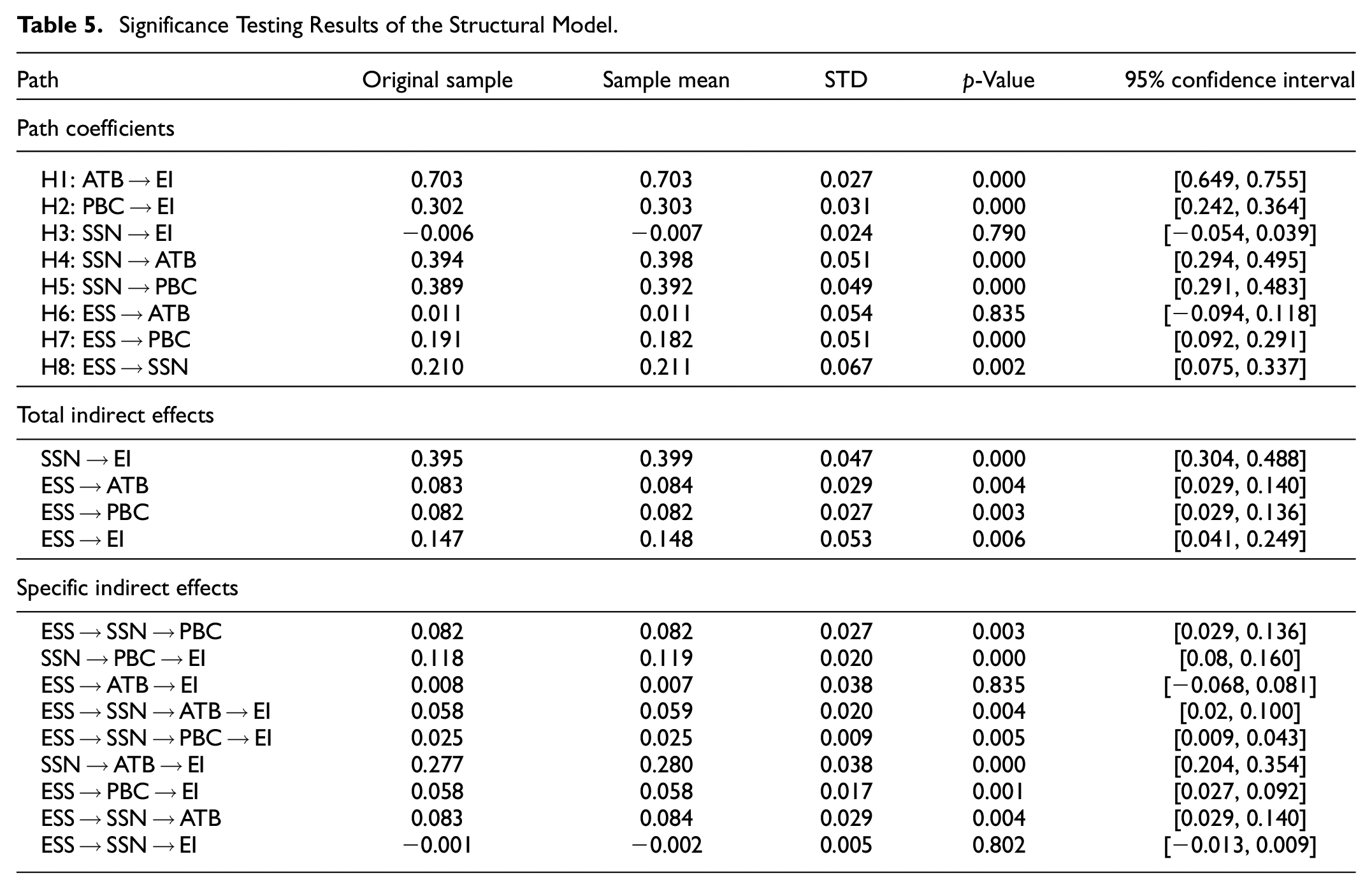
The second step in evaluating PLS-SEM results corresponds to the assessment of the structural model. To evaluate the structural model, we assessed (1) collinearity, (2) explained variance, (3) predictive relevance, and (4) the size and statistical significance of the structural path coefficients. These structural model evaluation criteria apply for the relationships of the second-order construct (ESS) to the other constructs in the model (ATB, SSN, PBC, and EI) except to its first-order components (SS, ET, and EM). The first-order components of the second-order construct are not part of the structural model. Table 5 and Figure 3 show the results of the structural equation modeling.
Significance Testing Results of the Structural Model.

Structural path model with standardized path coefficients.
(1) Collinearity: We assessed collinearity by examining the variance inflation factor (VIF). We checked for the size of the VIF to ensure that collinearity does not bias the regression results. The highest FIF value in the model corresponds to PBC → EI (1.695), which is below the recommended threshold. (2) Explained variance: We used the coefficient of determination (

As a guideline, values higher than 0.02, 0.15, and 0.35 represent small, medium, and large
(3) Predictive relevance: We calculated the Stone-Geisser’s
This study used the PLSpredict algorithm to examine the model’s out-of-sample prediction power. For this, we estimated the model on a training sample and evaluated its predictive performance on data other than the training sample after dividing the dataset into
(4) We ran bootstrapping with the parameters described before to evaluate the values of the path coefficients and assess their statistical significance. We also calculated the total indirect effect and specific indirect effect exerted by each exogenous construct in the model. Table 5 shows the path coefficients, total indirect effects, and specific indirect effects. It also shows the bootstrapping mean values, standard deviation,
Figure 3 shows the results of the structural model. In summary, hypotheses H1, H2, H4, H5, H7, and H8 are statistically significant, while hypotheses H3 and H6 are not statistically significant. Note that statistically significant path coefficients close to +1 represent strong positive relationships, while statistically significant path coefficients close to −1 represent strong negative relationships. In addition, analyses of the measurement and structural models above support hypothesis H0.
Discussion of Results
The primary aim of this study is to help understand the influence of the university’s ESS on the SSN as one of the antecedents of the EI of students. For this, we applied a customized mathematical model of EI based on the TPB to probe whether the university’s ESS can affect SSN and analyze the paths that this influence may follow to form the EI of students. This study argues that the university plays a critical dual role in shaping the EI of students. First, it can provide support mechanisms to help students translate their ideas into viable business models that could become successful businesses. Second, it can help students gain the support of their families and friends who influence their SSN, thus affecting their EI through the mediating role of the other two precursors of intention. The discussion of results below reflects the efforts by the university to provide students with support mechanisms constituting the university’s ESS. The specific university in this study offers a wide range of resources such as an entrepreneurship center, business incubation services, business start-up coaching, technology transfer support, and intellectual property protection.
Analysis of the results indicates that the four antecedents of EI, that is, ATB, SSN, PBC, and indirectly ESS, explain 84% of the variance in the EI of students. Two of the three direct paths affecting the EI of students are statistically significant, that is, ATB → EI and PBC → EI. Similar to other studies in the literature, the direct path SSN → EI is not statistically significant. Thus, the perception by students of the approval and support of family and friends are not directly relevant to their intention to start a new venture (Bazan, Shaikh, et al., 2019). Of the two statistically significant direct influencers of EI, ATB appears the most influential (0.703***) while the influence of PBC is less than half that effect (0.302***). Of the two direct influencers of ATB, that is, SSN and ESS, only SSN is statistically significant and exerts a strong influence (0.394***). Of the two direct influencers of PBC, that is, SSN and ESS, both are statistically significant, with SSN being more influential (0.389***) than ESS (0191***). As mentioned before, although SSN does not directly influence EI, it has a strong statistically significant direct effect on both ATB and PCB. Both SSN and ESS have statistically significant total indirect effects on EI (0.395*** and 0.147**, respectively) through their mediators. It is worth noticing that the indirect paths SSN → ATB → EI (0.277***) and SSN → PBC → EI (0.118***) are both statistically significant while the direct path SSN → EI is not. These results confirm the assumption that ATB and PBC exert complete mediation of the influence of SSN on EI (Carrión et al., 2017).
This study confirms the direct effect of ESS on SSN (0.210***) and the total indirect effect of ESS on the EI of students (0.147**). The influence of ESS on EI revealed in this study agrees with some other studies in the literature (Bazan, Datta, et al., 2019; Lu et al., 2021; Moraes et al., 2018; Nasiru et al., 2015; Schwarz et al., 2009). However, this study and the one by Bazan, Datta, et al. (2019) are the only studies modeling the influence of the university’s ESS as a multidimensional second-order construct to capture the university’s complex effect exerted on the EI of students. The wide range of other results concerning the impact of the university’s ESS on the EI of students (e.g., from 0.017*** to 0.424*** by Lu et al., 2021; Moraes et al., 2018, respectively), is partly a consequence of the local contexts. Notwithstanding, we argue that it is also partly a consequence of oversimplifications in modeling the university’s ESS.
Interestingly, ESS does not have a statistically significant direct effect on ATB in this study. Still, it does have a statistically significant total indirect effect on ATB through the path ESS → SSN → ATB (0.083**). Furthermore, in addition to its statistically significant direct effect on PBC (0.191***), ESS has a total indirect effect on PBC through the path ESS → SSN → PBC (0.082**). As hypothesized, ESS has a statistically significant effect on SSN (0.210**), giving support to H8, that is, the university’s ESS can influence students’ perception regarding the support and approval of important reference people toward their EI. In other words, there is a positive correlation between the entrepreneurial support that the university provides to students and the opinion of important reference people concerning the EI of their students. The total indirect effect of ESS on the EI of students (0.147**) follows three main paths, ESS → SSN → ATB → EI (0.058**), ESS → SSN → PBC → EI (0.025**), and ESS → PBC → EI (0.058***). Furthermore, given that the indirect effects of ESS on EI through the more proximal mediators are statistically significant while the direct effect is not, that provides support for the total mediation exerted by ATB, SSN, and PBC of the influence of ESS on EI of students (Carrión et al., 2017). Is it worth noting that the majority of the studies in the literature assume a direct influence of the university’s ESS on the EI of students. Furthermore, most EI studies in the literature rely on the TPB as the framework to formulate their predictive EI models. The TPB is a cognitive theory, and, as such, it attempts to explain human behavior by understanding the thought processes as primary determinants of emotions and behavior (Ryle, 1985). The literature argues that the TPB is open to the inclusion of further predictors in the form of additional background variables to help improve the predictive power of the theory (Lee et al., 2018). However, the literature also cautions researchers not involved in theory building to carefully differentiate between precursor and control variables when analyzing cognitive theories of intention (Hennessy et al., 2010).
Practical Implications
A career as an entrepreneur seems quite attractive for the sample of students, while their perceived locus of control to start and run a successful business seems about average. These statistics appear to translate into a slightly above-average intention to start a new business. Furthermore, as mentioned above, the results of this study indicate that the opinions of important reference people positively influence the ATB and PBC of students. Consequently, important reference people could eventually support such prospects. Between the two, SSN seems to influence ATB more than PBC. In general, this makes sense given that the opinion of important reference people could improve a student’s outlook toward entrepreneurship. Correspondingly, SSN could only enhance their PBC to the extent that these important reference people can contribute to the student’s capability to start a new business (e.g., financial support, mentoring). Students in the sample seem to perceive the university’s ESS as good. Among the three dimensions deflecting the university’s ESS, the ET appears to be the most influential, followed by the EM, while the SS seems to be the least influential. These findings are important for the university to identify the elements that could improve the overall university’s ESS. Recall that each first-order construct reflects five different indicators that could provide the university with finer granularity in designing the possible interventions.
Perhaps of most importance to the university are the paths that its ESS follows to influence the EI of students. Although the university’s ESS does not affect the ATB of students, it does influence ATB and then EI through its effect on the SSN of students. Furthermore, in addition to its direct impact on the PBS of students, the university’s ESS exerts an additional effect on PBC and then EI through its influence on the SSN of students. The university could eventually influence only the views of families and friends regarding their students’ prospects as entrepreneurs. The influence of SSN on ATB and PBC appears to be equally important. Although, the effect of ATB on EI more than doubles that of PBC on EI. The university could design interventions to make families and friends aware and inform them of the multiple resources available to student entrepreneurs (e.g., through open houses, targeted communications). It could also showcase the success stories involving student entrepreneurs who started their own businesses successfully with the help of the university (e.g., via social media, press releases).
Lastly, Figure 4 shows the standardized importance-performance map (IPMA) of the target construct EI at the construct level. As anticipated after the discussion above, ATB has above-average importance and performance on EI. Despite the lack of a statistically significant effect of SSN on EI and its below-average performance, SSN seems to have average importance, larger than PBC and ESS. The importance and performance of PBC seem marginally below-average, indicating some room for improvement regarding students’ perceived capability to start a new business. Furthermore, ESS seems to have below-average importance but above-average performance in the model. In essence, the construct ESS fares well concerning its place in the mathematical model even though its contribution toward increasing the EI of students is relatively low. This analysis can give universities additional information for possible interventions to make the prospects of an entrepreneurial career more attractive and desirable. For example, design the university’s ESS elements to support more student entrepreneurs.

Standardized importance-performance map of the target construct EI at the construct level.
Limitations of the study: We acknowledge some limitations of this study that are similar to previous studies in the literature. First, this study focuses on intentionality. It is well-established that starting a new business is a rare event. Thus, the intentions to create a new venture may not turn into actual behaviors in the future. Second, the collected data represent the perceptions of students. A gap between “perception” and “reality” may exist. However, we also believe it is equally important to analyze how students perceive their reality since this might shape their EI (Turker & Sonmez Selcuk, 2009). Third, this study used a questionnaire and self-selection to gather the data. Thus, this study takes respondents’ statements about their EI as a reliable source of information. Fourth, this study used convenience sampling as part of the data collection process. Convenience samples do not produce representative results. However, convenience samples may provide accurate correlations. This study was more interested in the relationships among variables than the proportions of the target audience. Fifth, this study employed cross-sectional data, that is, there is no temporal link between the outcome and the exposure. The purpose of the cross-sectional study was to examine the presence of an outcome and the presence of an exposure (prevalence) at a specific point in time. Finally, a cohort study design (incidence study) can extend and improve our understanding of the phenomenon and the applicability and validity of the proposed framework.
Conclusion
This study enables a better understanding of the influence of the university’s ESS on SSN as an antecedent of the EI of students. More specifically, the results of this study support the hypothesis that the university’s ESS may influence students’ perceptions of the opinions of important reference people regarding their prospects of becoming entrepreneurs. The literature review revealed a few published studies that measured the influence of the local environment on SSN. However, fewer researchers conducted specific studies to understand the relationship between the environment of the university and the SSN of students. Those that did so conducted studies to assess the influence of entrepreneurship education on the SSN of students or using very simple models of the complex university’s ESS construct. Based on previous research by others, we were able to design a mathematical model to evaluate the effect of the university’s ESS on the SSN of students. Analysis of the results suggests that the model is appropriate for measuring the relation between the four precursors of intention (ATB, SSN, PBC, ESS) and the EI of students. Moreover, this study determined that SSN affects the EI of students mediated by ATB, SSN, and PBC. The effect of ESS is such that it may positively affect the EI of students, but its importance in the mathematical model is still low.
Given the discussion above, this study posits that since SSN influences both the ATB and PBC of students and ESS has an important effect on SSN, finding ways to design elements of the university’s ESS that positively affect SSN might prove beneficial in supporting more student entrepreneurs. In addition, results from this study can serve as a baseline for future research providing the university with a means to assess its evolution toward an entrepreneurial university model. With the evolving information, the university can evaluate the efficacy of its entrepreneurship and innovation initiatives over time. By understanding its entrepreneurial effectiveness, the institution could help raise the perceptions of business feasibility and desirability and increase students’ perception of opportunity. We hope that other aspiring entrepreneurial universities will conduct similar studies to grow the literature with more cases that researchers and practitioners can use to better understand the EI of students.
Footnotes
Appendix
Acknowledgements
I acknowledge the support from the Atlantic Canada Opportunity Agency (ACOA), The Government of Newfoundland and Labrador, and the Memorial Centre for Entrepreneurship. I also appreciate the additional support provided by the Offices of the Vice-President (Research), the Dean of Business Administration, and the Dean of Engineering and Applied Science at Memorial University.
Declaration of Conflicting Interests
The author declared no potential conflicts of interest with respect to the research, authorship, and/or publication of this article.
Funding
The author received no financial support for the research, authorship, and/or publication of this article.
