




Abstract
This study empirically examines how graduate students’ attitude, subjective norm, perceived behavioral control, knowledge, and acceptance of agro-business influence student intention to start agro-entrepreneurship and the moderating effect of gender and faculty on the relationship among the factors based on the Theory of Planned Behavior. The study adopted the cross-sectional design from 300 public university students. The results of the study revealed that attitude toward agro-entrepreneurship, perceived behavioral control, and acceptance of agro-entrepreneurial exert a positive and significant effect on agro-entrepreneurial intention among university students. Moreover, the gender-based multiple group analysis revealed that male graduate students accept more agro-business than female students. Thus, policy makers can facilitate the promotion of agro-entrepreneurship among graduate students. Based on Theory of Planned Behavior, this study improves our understanding on university students’ agro-entrepreneurial intention in Malaysia. Finally, the discussion, recommendations and conclusion of the study are discussed in the research paper.
Introduction
Entrepreneurial intention has recently garnered considerable attention from academics and policymakers (Al-Jubari, 2019) to the accomplishment that entrepreneurial intent can lead to business activities (Miriti, 2020), which has a great potentiality for generating new employment for university students (Sher et al., 2017), developing human resources and contributing to the economic development (Ambad & Damit, 2016). Universities are creating an increasing number of graduates, which adds to the unemployment rate each year (Sher et al., 2017). Besides, unemployment among university graduate students is one of the key challenges confronting many governments in developing (Miriti, 2020) and emerging countries including Malaysia (Rahman et al., 2020). The problem of graduate unemployment has prompted policymakers and government authorities to raise awareness about the value of entrepreneurship (Otchengco & Akiate, 2021), which is important for society’s progress and well-being (Hamiruzzaman et al., 2020), economic growth and development, as it creates jobs and influences innovation (Miriti, 2020).
In Malaysia, the unemployment rate is 4.3% (Department of Statistics Malaysia, 2021), students who have recently graduated are urged to become self-employed as they have the knowledge and skills necessary to establish their own firms (Hamiruzzaman et al., 2020). In addition, Malaysia government promotes graduate students to engage in entrepreneurship and to consider it as a career option since it is crucial for economic growth and societal development (Ambad & Damit, 2016). The Malaysian government has been tremendously supportive of entrepreneurial growth by providing financial, technical, and advisory support, tax advantages, and other forms of assistance (Ambad et al., 2016). Moreover, the Malaysian federal government provides financial assistance to graduates through the Graduate Entrepreneurship Fund in order to assist and encourage them to start their own new businesses (Hamiruzzaman et al., 2020).
However, only a small proportion of graduate students would like to engage in entrepreneurship, notably in agro-entrepreneurship (Morris et al., 2017). The young educated generation prefers to remain away from agriculture and is more focused on specific, office-based jobs that offer more attractive rewards (Aziz & Naem, 2013). The growing global population and the threat of climate change make it critical to entice the next generation to pursue agribusiness as a career option as one of the means to address food security challenges (Masoomi et al., 2016). Furthermore, the reputation of agro-business as a professional option remains relatively low, and most agricultural graduates believe that agro-based entrepreneurship is a non-viable alternative (Klerkx & Leeuwis, 2008; Morris et al., 2017).
Agriculture based developing countries need to establish the agro-enterprises that can promote economic development as well as providing rural employment and income generation for young entrepreneurs (Soon et al., 2016). According to reports from the Ministry of Human Resources, the number of people working in the agriculture industry has been falling at a rate of 10% over the last few years in Malaysia (MOHR, 2017). Tiraieyari and Krauss (2018) also found that there is a limited data on young participation in the urban agriculture in Malaysia. Youth engagement in agriculture is dwindling, and they are increasingly interested in non-traditional employment possibilities. In addition, the poor involvement of the younger generation in the agricultural production is also linked to a decrease in the sector’s national income. As a result, entrepreneurial actions by innovative youths are encouraged to develop the sector (Ridha et al., 2017). Agricultural entrepreneurship must be developed in order to boost the sector’s human productivity sectorIntention is a strong desire among acquaintances to engage in agricultural enterprise. The attitude toward the behavior, the subjective norm, and perceived behavior control all play an essential role in entrepreneurial intention (Al-Jubari, 2019; Miriti, 2020; Otchengco & Akiate, 2021). In addition, knowledge and acceptance of agro-entrepreneurship are essential for graduate student to engage in agro-business (Abdullah & Sulaiman, 2013; Zaremohzzabieh et al., 2021). Thus, the study’s major goal was to see how attitudes toward agro-entrepreneurship, subjective norms, perceived behavior control, acceptability and knowledge of agro-entrepreneurship influenced entrepreneurial intent among university students and the moderating effect of gender and faculty among the study factors. The literature on the relationship between entrepreneurial intention and attitude, subjective norm, perceived behavioral control, acceptance, and knowledge is discussed in the next section. The third section describes the details of research methodology. The analysis and results are reported in sections 4 and section 5 the discussion and implications. Section 6 concludes with recommendations for further research as well as limitations of the study.
Literature Review
Theoretical Foundation
This study uses Ajzen’s (1991) Theory of Planned Behavior (TPB) framework, moderated by gender and faculty factor, to examine how graduate students’ attitude, subjective norm, perceived behavioral control, knowledge, and acceptance of agro-business influence their intention to start agro-entrepreneurship. The TPB is based on Fishbein and Ajzen (1975), and Ajzen and Fishbein (1980) Theory Reasoned Action, and is among the most extensively utilized and recognized theory in entrepreneurial intention research (Al-Jubari, 2019). It is one of the most widely quoted and clarified theories for explaining, predicting, and changing human social behavior (Hamiruzzaman et al., 2020; Rahman et al., 2020; Vamvaka et al., 2020). TPB is the prominent theoretical paradigm (Ajzen, 1991) that explains how attitudes, subjective norms, and perceived behavioral control influence human behavior (Al-Jubari, 2019; Ambad et al., 2016; Soon et al., 2016). In TPB, the self-desire to proactively perform a behavior is evaluated by the feature of attitude toward behavior (Onyeukwu & Padmavathi, 2019), which is influenced by one’s perception and expectation about the behavior’s personal consequences (Rahman et al., 2020). The subjective norm is said to be based on the level of incentive in the social environment (Bagheri & Pihie, 2014), while personal ability to carry out the business planning process is perceived control over the intention (Miriti, 2020). According to the TPB, the more positive the attitude and subjective norm are, and the larger the perceived behavioral control is, the higher the person’s intention to perform a specific behavior (Otchengco & Akiate, 2021; Vamvaka et al., 2020). In addition, when students have expressed an interest in starting a new business, they are generally soliciting opinions and recommendations on the advantages of doing business from their parents, relatives, instructors, and friends (Al-Jubari, 2019; Rahman et al., 2020). The feedback they obtain may influence their behavior of how easy or challenging an entrepreneurial career is (Sher et al., 2017), and eventually, whether they should accept to pursue entrepreneurial activities based on their attitude, perceived behavioral control, and knowledge (Rahman et al., 2020). Thus, this study adopts TPB to examine the effect of graduate students’ attitude, subjective norm, perceived behavioral control, knowledge, and acceptance of agro-business on their intention to start agro—ntrepreneurship in Malaysia.
Hypotheses Development
Intention to adopt agro-entrepreneurship
Intention is the first stage that starts from having a cognitive understanding to engage in a particular behavior (Ridha et al., 2017). Entrepreneurial intention is described as an individual’s propensity to conduct and participate in entrepreneurial activities or behavior or to be self-employed, or to start a new business in the future (Hamiruzzaman et al., 2020). Students can embrace agro-entrepreneurial career choice when they decide to start a new business in agriculture. This is because deciding to build and pursue a business career is the first step (Jemal, 2017). Students with high entrepreneurial aspirations are more inclined than those with low entrepreneurship intention to start a firm (Hamiruzzaman et al., 2020; Sher et al., 2017). Investigations on entrepreneurial intention can help researchers gain a better knowledge and understanding of entrepreneurial process by determining antecedents of entrepreneurial intention. Thus, this study utilizes intention to adopt agro-entrepreneurship among the young university graduates as the outcome of the study.
Attitude toward agro-entrepreneurship
Attitude toward a behavior refers to “the degree to which a person has a favorable or unfavorable evaluation or appraisal of the behavior in question” (Ajzen, 1991). It is a mental state of the individual toward behaviors in question (Soon et al., 2016). Student’s own opinions about a particular habit or action, such as entrepreneurship, are reflected in their attitude (Al-Jubari, 2019). Such attitudes can be beneficial or unfavorable, and they have an influence on how student can engage or not engage in agro-entrepreneurship (Miriti, 2020). Young Africans have a favorable attitude about agro-entrepreneurs and would want to pursue it as a realistic career (Zakaria et al., 2014). A positive attitude among students is more helpful to increase student’s intention in engaging in entrepreneurship (Ambad et al., 2016). Empirical research had shown that a student’s attitude about entrepreneurship has the biggest impact on their desire to become an entrepreneur (Al-Jubari, 2019; Ambad et al., 2016; Hamiruzzaman et al., 2020). Thus, this study formulates the following hypothesis:
Hypothesis 1 (H1): Attitude toward agro-entrepreneurship has a positive effect on the intention toward agro-entrepreneurship.
Subjective norm
Subjective norms refer to an individual’s personal impression about how others in their immediate social circle, such as parents, relatives, and neighbors, would react to them engaged in or not engaged in a particular behavior, such as entrepreneur (Al-Jubari, 2019). The perceived social pressures that drive people to behave in more socially acceptable habits are also referred to as the subjective norm (Soon et al., 2016). People are significantly influenced by social pressure to behave in a certain way. Students are more confident to become entrepreneurs if they have strong support from family and relatives (Ambad et al., 2016). Thus, students may seek guidance and encouragement from those around them, and their views may impact whether or not to participate in entrepreneurial action (Al-Jubari, 2019). The general public’s acceptance of agriculture as a socially acceptable norm means that agro-entrepreneurship is becoming more popular among young people (Morris et al., 2017). Subjective norm has a positive and considerable influence on the intention of young entrepreneurs, according to empirical research (Al-Jubari, 2019; Ridha et al., 2017). Hence, the above discussion leads to the following hypothesis:
Hypothesis 2 (H2): Subjective norm has a positive effect on the intention toward agro-entrepreneurship.
Perceived behavioral control
Perceived behavioral control refers to people’s perceptions of how easy or difficult it is to do a specific behavior, and it involves people’s past experiences with overcoming difficulties (Ajzen, 1991). Perceived behavioral control is also described as the prevailing assumption that essential resource is readily available to perform the anticipated behavior (Soon et al., 2016). Students can become an agro-entrepreneur if they believe it is simple and easy to become an entrepreneur. Furthermore, the more support they receive from their parents, relatives, friends, and others, the more entrepreneurial they want to be (Hamiruzzaman et al., 2020). When students have a positive perspective of the availability of required resources, they are more likely to engage in agro-entrepreneurship (Ridha et al., 2017). The availability of resources to start an agribusiness has a significant impact on the decision to pursue agriculture as a viable profession (Morris et al., 2017). Taking into consideration the above discussion, the following hypothesis is formulated:
Hypothesis 3 (H3): Perceived behavioral control has a pos-itive effect on the intention toward agro-entrepreneurship.
Acceptance of agro-entrepreneurship
Running a self-owned business gives individual the independence they need and allows them to experiment with new startups (Zakaria et al., 2014). Acceptance can be defined as an expression or inference of approval to the terms and conditions of an offer, resulting in the establishment of a legally enforceable contract (Abdullah & Sulaiman, 2013). Acceptance to have the agri-business as a profession offers the necessary autonomy and create viable financial freedom (Bennani & Oumlil, 2014a; Masoomi et al., 2016). The rising worldwide food demand and the provision of credit incentives encourage people to start agro-based businesses (Bennani & Oumlil, 2014b). According to Abdullah and Sulaiman (2013) attitudes and acceptances are the elements that have the most impact on young people’s interest in agriculture business. Thus, the introduction of an acceptance variable may gradually encourage more students to participate in agriculture, and the following hypothesis is formulated:
Hypothesis 4 (H4): Acceptance of agro-entrepreneurship has a positive effect on the intention toward agro-entrepreneurship.
Agro-entrepreneurship knowledge
An individual’s understanding and appreciation of the notions, abilities, and mindset required of an entrepreneur is referred to as entrepreneurial knowledge (Tshikovhi & Shambare, 2015). Thus, entrepreneurial education and the development of entrepreneurial knowledge are linked. Indeed, the primary goal of entrepreneurship education is to raise student knowledge of entrepreneurship (Abdullah & Sulaiman, 2013), provide opportunities for students to acquire entrepreneurial skills (Rahman et al., 2020), teach students how to apply theory with practice, and promote entrepreneurship as a career route (Miriti, 2020). In the context of agro-business, improved agricultural knowledge and comprehension influences an individual’s decision to pursue a career in agriculture (Mohavedi et al., 2013). Learning from successful agri-entrepreneurs’ tales, taking new courses, or participating in self-help programs might help individuals to develop a good attitude toward agro-entrepreneurship (Mohavedi et al., 2013). Both entrepreneurial knowledge and personal attitudes, according to Tshikovhi and Shambare (2015), have a substantial impact on entrepreneurship intentions. Thus, the above discussion prompt to offer the following hypothesis:
Hypothesis 5 (H5): Agro-entrepreneurship knowledge has a positive effect on the intention toward agro-entrepreneurship.
The moderating effect of faculty and gender
Several studies have found that gender perspective has a significant impact on students’ decision to pursue a career as an entrepreneur or self-employed person (Bagheri et al., 2014; Onyeukwu & Padmavathi, 2019; Robledo et al., 2015; Vamvaka et al., 2020). In fact, Vamvaka et al. (2020) stated that men exhibit more positive views toward business, have better levels of perceived behavioral control, and have a greater desire for entrepreneurship. Similarly, according to Strobl et al. (2012), male students have more positive attitudes toward entrepreneurship and significantly more specific entrepreneurial goals. However, for Bagheri et al. (2014), females’ entrepreneurial intentions were influenced more by subjective norms, while males’ entrepreneurial aspirations were influenced more by entrepreneurial attitude and self-efficacy. Moreover, Onyeukwu & Padmavathi (2019) also revealed that gender has a moderating influence on entrepreneurship ambitions, due to subjective norms, perceived behavioral control, and attitude toward the behavior. Thus, in order to eliminate gender disparities in agro-entrepreneurship, long-term strategies are thought to originate with the school system. As a result, it is crucial to figure out how gender and faculty affects the relationship between agro-entrepreneurship intention and the variables. Therefore, this study offers the following hypotheses:
H1MGA: There is the significant categorical moderating effect of respondents’ faculty on the relationship among model constructs.
H2MGA: There is the significant categorical moderating effect of respondents’ gender on the relationship among model constructs.
Research Methodology
Data Collection and Sample Selection
This study uses a cross-sectional research methodology. The study population of this study was the final year students from one Public University in Malaysia. This university students were selected since their main disciplines are entrepreneurial and business. Throughout their studies, the students were also introduced to an agro-entrepreneurship course. According to Sekaran, the sample size between 30 and 500 is considered appropriate to undertake scientific research. Reinartz et al. (2009), proposed a minimum threshold of 100 samples for structural equation modeling via partial least squares (PLS-SEM). Krejcie and Morgan (1970) have developed a well-established scientific table which determines the research population. The sampling frame of this study is based on the list of university students with a total of 1041. Therefore, according to Krejcie and Morgan (1970), the sample size for collecting data for this study should be 285. However, Hair et al. (2010) suggested that when using structural equation modeling (SEM), the higher the sample size, the better. Therefore, in order to avoid any possible complication that may arise due to the small sample size, this study uses the Google Forms platform to collect data from 300 students.
Research Instrument
The questionnaire items were adopted from previous validated studies. Items for attitude toward agri-entrepreneurship, subjective norm, perceived behavior control, acceptance of agro-entrepreneurs, and knowledge of the agro-entrepreneurship all were obtained from Zaremohzzabieh et al. (2016), while intention to become agro-entrepreneur items were retrieved from Ridha et al. (2017). The data for each construct of the research model was collected using a seven-point Likert scale ranging from 1 to 5, with 1 indicating strong disagreement and 5 indicating strong agreement.
Assessment of Common Method Variance (CMV)
Common method bias is a phenomenon generated by the measuring method utilized in the SEM investigation in the context of PLS-SEM. Thus, multiple methods were used in this analysis to reduce the effect of common method variance. First, the study assured respondents of their privacy and confidentiality, emphasized the importance of answering the questions honestly, and assured them that there are no wrong or correct answers to the issue (Podsakoff et al., 2003). Moreover, as recommended by Podsakoff et al. (2012), Harman’s one-factor test was used to determine the potential bias on the study constructs. Harman’s one-factor test clarified 16.38% of variance, which is less than the necessary 50%, suggesting that CMV has a marginal impact.
Data Analysis Method
Partial least squares structural equation modeling (PLS-SEM) with the Smart-PLS software 3.1 exploited to evaluate the respondents’ data. PLS-SEM is a multivariate exploration instrument to assess path models that has the latent constructs with composites (Hair et al., 2019). PLS-SEM empowers the investigator to exploit the non-normal, and small data set. Besides, PLS-SEM associated with the casual-predictive nature that helps to work with composites based complex models and having no postulation of goodness-of-fit estimation as in covariance-based SEM (Chin, 2010). PLS-SEM data analysis postulated to perform the analysis in two-steps. The first step is performed to deal with model measurement, where the reliability and validity of the study construct evaluated (Hair et al., 2019), discriminant validity achieved by the old and newly proposed methods (Fornell & Larcker, 1981; Henseler et al., 2014). Step two is executed to assess the structural model associations and examination of study hypotheses with significance levels (Chin, 2010). Model estimation performed with r2, Q2, and the effect size f2 describes the path effect from exogenous construct to endogenous construct (Hair et al., 2019).
Furthermore, Multi-group analysis (MGA) in PLS-SEM empowers the scholars to differentiate the differences in pre-defined groups under examination (Henseler et al., 2009). The MGA is a handy method to check the variances among the groups classified as the data (Hair et al., 2014). The MGA supports the researchers in assessing the changes amongst the structural paths of the various groups that exist in the data (Henseler et al., 2009). The first researcher needs to establish the groups grounded on the categorical variables of interest such as age, gender, or income. Then the path coefficients of each group is scrutinized, and the groups’ differences as significantly diverse from each other or not, centered around the guidelines of the Henseler et al. (2009) must be reported. The variances that exist within the data based on the characteristics of the groups may not be evident in aggregated data. Path coefficients of the group data can demonstrate the statistical variance by the use of MGA to institute the differences that exist statistically substantial between data based on the categorical bases (Henseler et al., 2009).
Data Analysis
Descriptive Statistics
This study managed to collect a total of 300 respondents which consists of two (2) different faculties which are Faculty X and Faculty Y. One hundred percent of the students indicated that they are taking one subject offered by university which is Agropreneur. The respondent consisted of a high proportion of female students (62%) which aged between 22 and 25 years old (94%). Ninety-five percent status of the respondent recorded as single. In term of race, Malay was recorded as the highest race which is 70% followed by Chinese 14.7%, Indian (11.3%), and others 4%. Faculty X was recorded as the highest respondent which is 76.3% compared to Faculty Y
Validity and Reliability
The reliability analysis of this study was estimated with Cronbach’s Alpha, Composite Reliability (CR), Dillon–Goldstein rho (DG rho), and AVE. The Cronbach’s Alpha, as indicated in Table 1. The results demonstrate that all the reliability scores are in the acceptable range. The minimum value (α) was .909, for (CR) was .845, and DG rho-A .822, respectively. Values of (α), (CR), and rho-A for each construct are well above the threshold of .70 (Hair et al., 2019). These results specify that the model constructs are reliable. AVE for all the constructs need to be higher than the threshold of .50 score to establish the convergent validity as an indication of the uni-dimensionality of each construct (Hair et al., 2019). Variance inflation factor (VIF), for each construct reported in Table 1, all the VIF values are less than 3.3, instituting the lack of multi-collinearity issues for the model constructs. Items display that construct have acceptable convergent validity (see Table 1). The item loading and cross-loading reported for validation of construct discriminant validity. The study constructs have acceptable discriminant validity (See Table 2). Additionally, the Fornell-Larcker (1981) criterion, results of the Fornell-Larcker criterion for each construct must be higher for its own construct than other latent constructs, to establish discriminant validity for each study construct (Hair et al., 2019). Table 2. shows that the study has discriminant validity.
Reliability Analysis.

Outer Loading and Cross Loadings.

Note. (1) ATT = Attitude toward agro-entrepreneurship; SNM = Subjective norm; PCB = perceived behavioral control; Acceptance of agro-entrepreneurship: AEK = Agro-entrepreneurship knowledge; AGI = Agro-entrepreneurship intention. (2) Italic values are loading, other values cross-loading
Path Analysis
Table 3 presents the path analysis of the effects of attitude toward agro-entrepreneurship, subjective norm, perceived behavioral control, acceptance of agro-entrepreneurial, and agro-entrepreneurial knowledge on the agro-entrepreneurial intention. The path coefficients showed that the coefficients value for attitude toward agro-entrepreneurship (β = .463, t = 6.341, p = .000), perceived behavioral control (β = .143, t = 1.889, p = .030), and acceptance of agro-entrepreneurial (β = .226, t = 2.397, p = .008) indicate a significant and positive effect on agro-entrepreneurial intention, supporting respectively H1, H3, and H4. In addition, the f2 value of 24.8% obtained shows a medium effect of attitude toward agro-entrepreneurship on the agro-entrepreneurial intention. Similarly, the f2 value of perceived behavioral control and acceptance of agro-entrepreneurial at 2.3% and 4.4% for, respectively, indicated no effect and small effect sizes on agro-entrepreneurial intention. However, subjective norm (β = .082, t = 1.298, p = .093), and agro-entrepreneurial knowledge (β = .066, t = .820, p = .206) indicate an insignificant but positive effect on agro-entrepreneurial intention, thus provides no statistical support for H2 and H5 respectively.
Hypothesis Testing.
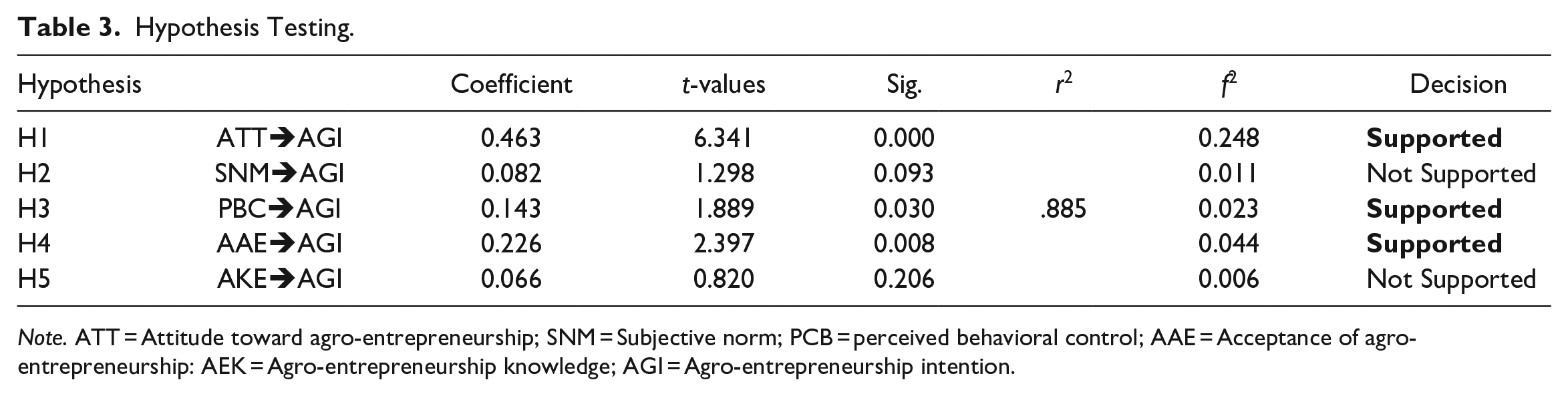
Note. ATT = Attitude toward agro-entrepreneurship; SNM = Subjective norm; PCB = perceived behavioral control; AAE = Acceptance of agro-entrepreneurship: AEK = Agro-entrepreneurship knowledge; AGI = Agro-entrepreneurship intention.
The adjusted r2 value for agro-entrepreneurial intention is .833, showing 83.3% of the variation in the agro-entrepreneurial intention of students can be explained by the five exogenous constructs (i.e., attitude toward agro-entrepreneurship, subjective norm, perceived behavioral control, acceptance of agro-entrepreneurial and agro-entrepreneurial knowledge). In addition, the predictive relevance (Q2) value for the intention to become agri-entrepreneurs’ is more than zero (0.711), thus, indicating a high predictive relevance (Chin, 2010).
Multiple Group Analysis
Multiple group analyses were carried out to assess the variations in the outcomes of various groups based on faculty and gender. One non-parametric test was used to analyze variations in the model’s intense relationship based on the faculty and gender characteristics of the study respondents. Tables 4 and 5 depicts the path values for two groups and with the differences within the groups with the p-values as recommended by the Henseler et al. (2009). The PMGA represents the p-values achieved using the multiple group analysis of PLS-SEM as the extent of the importance of the difference between the groups under study (Henseler et al., 2009).
Multiple Group Comparisons Based on Faculty.

Note. ATT = Attitude toward agro-entrepreneurship; SNM = Subjective norm; PCB = perceived behavioral control; AAE = Acceptance of agro-entrepreneurship: AEK = Agro-entrepreneurship knowledge; AGI = Agro-entrepreneurship intention.
Multiple Group Comparison Based on Gender.

Note. ATT = Attitude toward agro-entrepreneurship; SNM = Subjective norm; PCB = perceived behavioral control; AAE = Acceptance of agro-entrepreneurship: AEK = Agro-entrepreneurship knowledge; AGI = Agro-entrepreneurship intention.
Effects of faculty-based group
The results of the multiple group analysis based on faculty indicated an insignificant effect of attitude, subject norm, perceived behavioral control, acceptance and knowledge of agro-entrepreneurship on intention to became agro-entrepreneurs in both faculties. Thus, the variance of faculty does not influence the study postulated relationships.
Gender-based groups
The results of the multiple group analysis based on gender showed an insignificant effect of attitude, subject norm, perceived behavioral control, acceptance and knowledge of agro-entrepreneurship on female intention to became agro-entrepreneurs, while male acceptance of agro-entrepreneurship was positive and significant. Thus, male graduate students accept more agri-business than female graduate students in the context of this study.
Discussions and Implications
The objective of this study is to examine how attitudes toward agro-entrepreneurship, subjective norms, perceived behavior control, acceptability, and knowledge of agro-entrepreneurship influenced entrepreneurial intent among university students, and the multiple group effect of gender and faculty on the relationship among the factors. The results of the study revealed that attitude toward agro-entrepreneurship, perceived behavioral control, and acceptance of agro-entrepreneurial exert a positive and significant effect on agro-entrepreneurial intention. The finding of this study is consistent with that reported by Otchengco and Akiate (2021), who asserted that personal attitude and perceived behavior control had a positive and significant influence on entrepreneurial intention. Similarly, Abdullah and Sulaiman (2013), confirmed that attitudes and acceptances are fundamental factors that determines young engagement in agricultural business. In addition, according to Al-Jubari (2019), attitude had the greatest influence on entrepreneurial intended intention among university graduates, followed by perceived behavior control and societal norm. However, this study found that subjective norm, and knowledge of agro-entrepreneurial had an insignificant but positive effect on agro-entrepreneurial intention. This study’s additional findings are consistent with those reported by Abdullah and Sulaiman (2013), who asserted that knowledge is not a significant factor in predicting youth’s desire to participate in becoming entrepreneurs, and disconfirm those identified by Ridha et al. (2017), who illustrated that subjective norm had a significantly positive influence on youth entrepreneurial intention. Moreover, the gender-based multiple group comparison shows that male graduates accept more agri-business than female graduates, whereas the faculty-based multiple group analysis indicates that faculty diversity has no effect on the relationship among the determinants. The result of the study is consistent with that stated by Bazkiaei et al. (2021), who showed that men have more positive attitudes toward entrepreneurial behavior, report significantly higher levels behavioral control, are more completely devoted to entrepreneurship, and are therefore more involved in business start-up.
The practical implication for this study is that, the government and policymakers may implement more specific policies, programs, and strategies for young agro-entrepreneurs, such as financial support, online business platform, start-up incubation, and incentives and facilities to encourage graduate agro-entrepreneurship. They should establish young agro-entrepreneur networks that will allow them to explore new business opportunities in the agriculture sector, gain access to more resources, share information, and promote the sector. Furthermore, university administrators should continue to implement agro-entrepreneurship programs on a larger scale, involving and pushing students to become successful agro-entrepreneurs. Students are urged to have a positive attitude toward agro-entrepreneurship because attitude is a personal impression and had a significant influence on agro-entrepreneurial intention. Encouragement of university students to go into agro-business for themselves provides a solution of young graduates being unemployed. Even ought subjective norm to be insignificant in this study, external aspect is the core motive of the young entrepreneur’s intention in agro-entrepreneurship. As a result, the role of family, parent, friend, teachers, and government officials are critical in attracting and motivating young entrepreneurs to pursue careers in agriculture. Similarly, as agro-entrepreneurship knowledge had little influence on intention behavior, students must be subjected to a multitude of adequate education, expertise and knowledge, information, and competencies connected to agro-entrepreneurship education in order to develop entrepreneurial thinking and traits and become successful agro-entrepreneurs.
Conclusion
The objective of this study is to explore the impact of the graduate students’ attitude, subjective norm, perceived behavioral control, acceptance of agri-business, and knowledge about agri-business on the intention to start agro-entrepreneurship. The outcomes of the study revealed that attitude toward agro-entrepreneurship, perceived behavioral control, and acceptance of agro-entrepreneurial had a positive and significant influence on the agro-entrepreneurial intention of graduate students, while subjective norm, and knowledge of agro-entrepreneurial exert an insignificant but positive effect on agro-entrepreneurial intention. Furthermore, the multigroup analysis based on faculty demonstrates that faculty diversity has no effect on the study’s hypothesized associations, whereas the multigroup analysis based on gender shows that male graduates accept more agri-business than female graduates. In addition, the results of this research lead to the expansion of the TPB while simultaneously improve our understanding on graduate students’ agro-entrepreneurial intention.
Despite the fact that this study is greatly beneficial, it does have certain limitations. Since the study data were retrieved in a cross-sectional manner in Malaysia, thus the findings of this study may not be generalizable. Additionally, the data used in this research was cross-sectional, and students’ intentions to become an agro-entrepreneur may alter over time, thus, longitudinal data may be employed in future studies. Mediation analysis was not used in this study. As a result, future study could employ mediation investigation to predict whether the determinants of agro-entrepreneurial intention follow a direct or indirect path. Moreover, longitudinal studies would also enable researchers to look into the long-term effects of moderator’s factors like gender on agro-entrepreneurial intention-action. In order to improve the number of promising female and male agro-entrepreneurs, future study should consider gender specific distinctions in agro-entrepreneurship.
Footnotes
Declaration of Conflicting Interests
The author(s) declared no potential conflicts of interest with respect to the research, authorship, and/or publication of this article.
Funding
The author(s) received no financial support for the research, authorship, and/or publication of this article.
