



Abstract
This study explores the relationship between entrepreneurial education (EE) and sustainable entrepreneurial intention (SEI) among university students in Bangladesh, highlighting the mediating role of attitude toward sustainable entrepreneurship (ATSE) and the moderating effects of prior entrepreneurial experience (PEE). The study employs a quantitative methodology based on the theory of planned behavior and human capital theory. The analysis used a sample of 600 respondents, employing partial least squares structural equation modelling with SmartPLS4. The results demonstrate that EE has a significantly positive impact on SEI, indicating that students who receive an EE are more likely to foster SEI. The findings also reveal that attitude partially mediates the relationship between EE and SEI, indicating that EE improves students’ attitude toward sustainability, which, in turn, strengthens their SEI. Additionally, EE has a direct positive effect on students’ attitude toward sustainability, reinforcing the role of EE in shaping their attitude to sustainable entrepreneurship. The findings also indicate that PEE moderates the relationship between EE and ATSE, suggesting that students with PEE develop stronger positive attitudes toward sustainability. This finding highlights the importance of hands-on experience in reinforcing the impact of EE. The findings contribute to the literature by highlighting the importance of EE in fostering SEI and by offering practical insights for incorporating sustainability into entrepreneurship programs. The inclusion of sustainability in EE combined with experiential learning can effectively foster sustainable entrepreneurial mindsets and intentions of university students in Bangladesh.
Keywords
Introduction
It is widely acknowledged that entrepreneurship plays a crucial role in driving national economic growth, innovation, and job creation (Martínez-Cañas et al., 2023; Talukder and Lakner, 2023; Talukder et al., 2024a). Moreover, entrepreneurship is essential for identifying opportunities, mobilizing resources, and creating value through the establishment of new ventures (Ellahi et al., 2021; Talukder et al., 2024b). The primary objective of entrepreneurial endeavors has been to maximize economic profitability and market expansion by prioritizing financial returns (Porfírio et al., 2023). Nevertheless, the entrepreneurship paradigm has undergone a transformation in recent decades to include a broader range of factors that extend beyond immediate financial benefits (Ediagbonya et al., 2024). The emergence of sustainable entrepreneurship represents a substantial change in entrepreneurial practice, as environmental stewardship and social responsibility are now integrated with economic objectives (Lopes et al., 2023). Therefore, sustainable entrepreneurship integrates the triple bottom line, creating economic, social, and environmental values (Hammer & Pivo, 2017). Additionally, sustainable entrepreneurship has the potential to solve global problems, such as social inequality, environmental degradation, and climate change (Barrera-Verdugo et al., 2024; Zhang et al., 2024). Furthermore, sustainable entrepreneurship advocates for the establishment of businesses that are both financially viable and support long-term sustainability. It emphasizes the increasing acknowledgement that business ventures must strike a balance between profitability and contributions to ecological and social well-being, thereby influencing the future of socially responsible economic growth. It is becoming increasingly recognized that sustainable entrepreneurship is a key factor in achieving sustainable development goals set by United Nations (Gu et al., 2021; Shepherd & Patzelt, 2011). Researchers have recently emphasized the importance of youth participation in achieving the Sustainable Development Goals (SDGs) (Boateng et al., 2023; Iduseri et al., 2022). Many developed economies use sustainable business models to address critical issues, including climate change, resource depletion, and social inequality (Gimenez-Jimenez & Harc, 2024). In developing economies like Bangladesh, promoting young people to become sustainable entrepreneurs can make a big difference in making the economy more resilient to climate change, and promoting sustainable economic growth that benefits every individual (Emon & Khan, 2023). In Bangladesh, rapid urbanization, environmental degradation, and youth unemployment present significant challenges (Ferdousi et al., 2023; Talukder et al., 2024b). In 2024, the total population of Bangladesh was 172.02 million, with an expected increase to 180.24 million by 2029 (Bangladesh: Total Population from 2019 to 2029 | Statista; Statista, n.d.-a.). Overall, youth constitute almost 20% of Bangladesh’s population (Population Trends; UNFPA Bangladesh, n.d.). The unemployment rate for individuals aged 15 to 24 years in Bangladesh in 2023 has been estimated at 15.7%, exceeding the global youth unemployment average of 13.8% and the low- and middle-income average of 14.1% (Bangladesh: Youth Unemployment Rate from 2004 to 2023| Statista; Statista, n.d.-b). A possible solution to the country’s youth unemployment problem may be to foster an entrepreneurial mindset among the youth. Promoting sustainability-driven enterprises is essential for economic viability and helps attain long-term resilience. Sustainable entrepreneurship is becoming a significant business model in Bangladesh shifting to a green economy. Few number of innovative Bangladeshi enterprises, including Grameen Shakti’s renewable energy programs, Aarong’s ethical fashion initiatives, and iFarmer’s inclusive agri-fintech model, show how entrepreneurship can effectively contribute to the triple bottom line of sustainability: economic empowerment, social inclusion, and environmental stewardship (Asif & Barua, 2011; Shahidullah & Haque, 2014; Yunus et al., 2010). These few successful cases provide practical inspiration for sustainable entrepreneurship led by youths, particularly in a developing country’s context. Understanding the key drivers that affect students’ SEI is crucial for advocating future policies and educational frameworks that can foster a sustainable entrepreneurial ecosystem in the country. University students are at the forefront of this transformative movement, as they represent the next generation of entrepreneurs who will influence the future of businesses and society (Ashari et al., 2022). University students in Bangladesh have the opportunity to promote sustainable entrepreneurial activities, which could help reduce youth unemployment rates and build a more responsible and equitable society.
In the past few years, there has been a significant increase in the recognition of entrepreneurial education (EE) as a key driver of entrepreneurial intentions among individuals, particularly university students (Cui, 2021; Talukder et al., 2024b; Truong et al., 2022). Intentions signify the degree to which someone is willing to make an effort to participate in certain behaviors (Icek Ajzen, 1991). To encourage students to actively participate in sustainable entrepreneurship, higher education institutions worldwide, including those in Bangladesh, have incorporated sustainability into their EE curricula. Thus, EE has become a vital instrument for cultivating students’ attitudes, abilities, and knowledge of sustainable entrepreneurship (Makuya & Changalima, 2024).
Although research on entrepreneurial education and sustainable entrepreneurial intention has proliferated, most studies concentrate solely on their direct relationship (Abbes, 2024; Purwana et al., 2025; Valencia-Arias et al., 2025), ignoring the possible moderated mediation effects of prior entrepreneurial experience and attitudes towards entrepreneurship. Moreover, the effectiveness of EE in promoting sustainable entrepreneurship intentions remains largely unexplored in Bangladesh. Research in Bangladesh has mostly focused on general and social forms of entrepreneurship intention (Hossain et al., 2024; Naznen et al., 2023; Rahman et al., 2024; Shahriar et al., 2024; Ukil et al., 2024). To the best of our knowledge, this is the first study in Bangladesh to demonstrate the impact of EE on university students’ attitudes and intentions toward sustainable entrepreneurship. Therefore, it is essential to fully understand the effect of EE on students’ attitudes, intentions, and behaviors in relation to sustainable entrepreneurship to create educational frameworks and policies that can effectively address the country’s distinctive socioeconomic challenges.
Two important psychological factors—attitude toward sustainable entrepreneurship (ATSE) and prior entrepreneurial experience (PEE)—are the subject of this study, as they are used to understand the connection between EE and sustainable entrepreneurial intention (SEI) among higher education students in Bangladesh. To understand how students’ attitudes toward sustainability affect their intentions, we have examined the mediating role of attitude. To determine whether prior business exposure strengthens or weakens the relationship between EE and ATSE, the study has examined the moderating effect of PEE. This research addresses these dynamics to add to the expanding literature on sustainability in EE and provide educational institutions in Bangladesh with practical insights that can be used to cultivate responsible and sustainable entrepreneurial mindsets in the next generation of entrepreneurs.
The remainder of this paper is structured as follows. The next section examines the theoretical foundation and literature on sustainable entrepreneurship, EE, ATSE, PEE, SEI, and their interrelationship. Then, the research framework and hypotheses are presented, followed by the methodology and results. Finally, we conclude with a discussion of the results, their implications for policy and practice, and recommendations for future research.
Theoretical framework
Theoretical Foundations
The conceptual framework of the research was grounded on two theories: the theory of planned behavior (TPB) and human capital theory (HCT). According to Ajzen (2002), the TPB, the most widely recognized theory, proposes that entrepreneurial behaviors are significantly influenced by intentions, followed by personal entrepreneurial attitudes, subjective norms, and perceived behavioral control (Ajzen, 2002). Meanwhile, HCT states that skills and expertise can enhance an individual’s intellectual abilities in carrying out tasks effectively (Schultz, 1980; Stern & Becker, 2019). Human capital associated with entrepreneurship influences the recognition of opportunities, establishment of businesses, and operational success of businesses in various phases of the entrepreneurial journey (Marvel et al., 2016). Previous studies have confirmed that individuals with strong cognitive aptitudes are more adept at conducting entrepreneurial activities than those with limited cognitive abilities (Faghih & Forouharfar, 2022). Education is a key component of human capital building, and its interventions provide a substantial means of gaining new knowledge and skills (Martin et al., 2013). Therefore, EE is a critical component of the operation of a new business when an individual aspires to establish it (Zhao et al., 2005) and contributes to the cultivation of entrepreneurial intentions among individuals (Talukder, Lakner and Temesi, 2024a, 2024b). It has been observed that the TPB emphasizes personality attributes, including attitude, self-efficacy, and subjective norms, as potential predictors of EI (Krueger et al., 2000). The human capital approach has been employed to understand entrepreneurship, in which individuals intentionally allocate their resources in response to dynamic economic circumstances (Schultz, 1980), suggesting that entrepreneurial capabilities can be enhanced through human capital development.
Although the TPB is commonly employed to predict entrepreneurial intentions, it fails to explicitly consider the influence of individual knowledge, skills, and experience, which are essential for effectively engaging in entrepreneurship. In the realm of sustainable entrepreneurship intentions, the two theories are complementary: the TPB elucidates how students’ SEI is influenced by their attitudes, whereas the HCT delineates how education, sustainability knowledge, and PEE enable them to materialize those intentions. This study integrates the TPB and HCT to offer a comprehensive framework for understanding the influence of psychological and contextual factors on students’ SEI in a developing country, Bangladesh.
Hypothesis Development
Entrepreneurial Education and Sustainable Entrepreneurial Intention
Students’ intentions to participate in entrepreneurial activities are shaped by EE, which provides essential knowledge, skills, and competencies (Porfírio et al., 2022). According to studies (Liñán & Chen, 2009; Talukder et al., 2024b) educational programs that promote entrepreneurship help students acquire skills such as seeking opportunities, coming up with creative solutions, and being willing to take risks. Moreover, according to previous studies (Fatoki 2020; Parra 2013; Talukder, Lakner and Temesi, 2024a, 2024b) students who participate in EE programs are more likely to consider entrepreneurship as a possible career choice. This is because students have more realistic expectations regarding the benefits and drawbacks of starting their own businesses after participating in these programs. However, students from Taiwan and India realized the challenges of starting a business and their entrepreneurial intentions decreased slightly, even though EE programs were highly effective and the students were satisfied (Baber, 2024; S. C. Chen et al., 2015). Despite the effectiveness of EE, students have developed a greater understanding of business risks, financial instability, and market challenges, which has subsequently weakened their intentions. Cultural expectations, job security preferences, and regulatory barriers may discourage individuals from considering entrepreneurship a viable career option (Mwasalwiba, 2010). However, higher education has the potential to become an essential player in the integration of sustainability and EE, thus producing human capital that actively contributes to the realization of sustainability in businesses (Kummitha & Kummitha, 2021). Sustainability-focused EE teaches students the value of ethical and environmentally responsible activities (Romero-Colmenares & Reyes-Rodríguez, 2022). Education that prioritizes sustainability increases the understanding of social and environmental issues, which in turn encourages students to think about sustainable business practices in their enterprises (Fatoki, 2020). Thus, we propose the following hypothesis.
Entrepreneurial Education and Attitude Toward Sustainable Entrepreneurship
EE is essential for the development of students’ perspectives on sustainable entrepreneurship by enhancing their understanding of the significance of the balance between economic, social, and environmental aspects in business ventures (Joensuu-Salo et al., 2022; Parra, 2013). Furthermore, EE facilitates students’ understanding of the importance and feasibility of incorporating sustainable practices into entrepreneurship by means of specialized curricula that emphasize sustainability, ethics, and corporate responsibility (Kuckertz & Wagner, 2010; Truong et al., 2022). Hence, education cultivates a positive attitude toward sustainability by exposing students to the challenges and opportunities of sustainable business models, thereby increasing the likelihood that they will regard it as a necessary and desirable aspect of entrepreneurial success (Romero-Colmenares & Reyes-Rodríguez, 2022). Moreover, students are more likely to involve in sustainable ventures if they have a positive attitudes on sustainable entrepreneurship (Ashwyn Bapoo et al., 2021; Pascucci et al., 2022). Thus, we propose the following hypothesis.
Attitude Toward Sustainable Entrepreneurship and Sustainable Entrepreneurial Intention
As the TPB emphasizes, attitudes are crucial in determining behavioral intentions (Icek Ajzen, 1991). In the context of sustainable entrepreneurship, ATSE indicates an individual’s assessment of the feasibility and appeal of pursuing business ventures that prioritize environmental, social, and economic sustainability. Positive ATSE is frequently associated with the conviction that sustainable practices not only generate economic value but also promote environmental preservation and societal well-being (Pascucci et al., 2022). Earlier research has revealed that individuals with positive attitudes toward sustainability are more inclined to participate in entrepreneurial endeavors that correspond to sustainability principles (Nitu-Antonie et al., 2022). Students who develop positive ATSE are more likely to engage in enterprises that emphasize ethical and sustainable objectives (Kuckertz & Wagner, 2010; Ndofirepi, 2023; Truong et al., 2022). A study conducted in Saudi Arabia revealed a positive and significant relationship between students’ attitudes toward sustainability and their intentions to pursue sustainable entrepreneurship (Abdelwahed, 2022). Furthermore, the relationship between entrepreneurial intentions and positive sustainability attitudes has been fortified by the increasing global emphasis on responsible business practices, particularly among younger generations, who are more informed of the need for responsible business practices (Romero-Colmenares & Reyes-Rodríguez, 2022). Thus, we propose the following hypothesis.
Mediating Role of Attitude Toward Sustainable Entrepreneurship
Integrating sustainability into the curriculum is particularly beneficial for cultivating students’ entrepreneurial intentions through EE. Nevertheless, the direct relationship between SEI and EE might not be apparent, as ATSE is likely to serve as a mediator. As a means of developing students’ understanding of sustainable business practices within the framework of sustainable entrepreneurship, EE promotes optimism toward sustainability (Makuya & Changalima, 2024). These attitudes are necessary for the development of SEI, as individuals who hold a positive perspective on sustainable entrepreneurship are more inclined to pursue it (Vuorio et al., 2018). Previous research has substantiated the idea that attitudes act as a mediator in the relationship between intention and education. The mediation effect of ATSE is further supported by evidence indicating that sustainable EE improves students’ intentions by enhancing opportunity identification and attitudes toward sustainability (He et al., 2024). For instance, research has demonstrated that EE has a beneficial impact on attitude toward entrepreneurship and motivates individuals entrepreneurial intentions (Sargani et al., 2020). Education in the context of sustainability not only provides students with knowledge but also affects their perceptions of the feasibility and desirability of sustainable business ventures. Research conducted in Pakistan and India indicates that ATSE mediates the relationship between EE and SEI (El-Gohary et al., 2023; Rajpal & Singh, 2024). Therefore, the development of SEI is facilitated by positive ATSE, which acts as a bridge between knowledge acquired through education (Rajpal & Singh, 2024; Zemlyak et al., 2022). Thus, we hypothesize as follows.
Moderating Role of Prior Entrepreneurial Experience
PEE has a substantial impact on the relationship between EE and ATSE. The effectiveness of EE can be improved by incorporating PEE, which can provide a practical context and reinforce the learning outcomes associated with sustainable entrepreneurship (Ma, 2022; Matzembacher et al., 2019). Entrepreneurial experience provides individuals with practical insights into the real-world aspects of starting and managing a business, which may influence how they internalize and respond to EE (Talukder et al., 2024b). According to experiential learning theory, individuals learn more effectively when they connect new knowledge with prior experiences (MURRELL & CLAXTON, 1987). Students who have previously engaged in entrepreneurial activities are more likely to approach EE with a better understanding of business dynamics, which enables them to integrate and appreciate the sustainability components of educational programs more effectively (Kuckertz & Wagner, 2010). Research indicates that individuals with experience in entrepreneurship are more likely to possess entrepreneurial attitudes because of their prior exposure to the challenges and opportunities associated with business ventures (Yasir et al., 2023). Entrepreneurial experience positively affects attitudes toward sustainable businesses by increasing environmental value, perceived control, and motivation. This experience, along with enthusiasm and education, profoundly influences the intentions and behaviors of potential sustainable entrepreneurs (Rajpal & Singh, 2024). Consequently, when students are exposed to EE that emphasizes sustainability, they are more inclined to cultivate favorable ATSE (Virgosita et al., 2024). Moreover, entrepreneurial experience improves the capacity to assess the viability of sustainable business models, strengthening the constructive impact of education on attitudes toward sustainability. Thus, we propose the following hypotheses:
Proposed research model
After reviewing the relevant literature and theories, we propose a conceptual model to test our hypotheses. The model depicted in Figure 1 employs ATSE as a mediator to connect EE to SEI, and PEE as a moderator in the link between EE and ASTE.
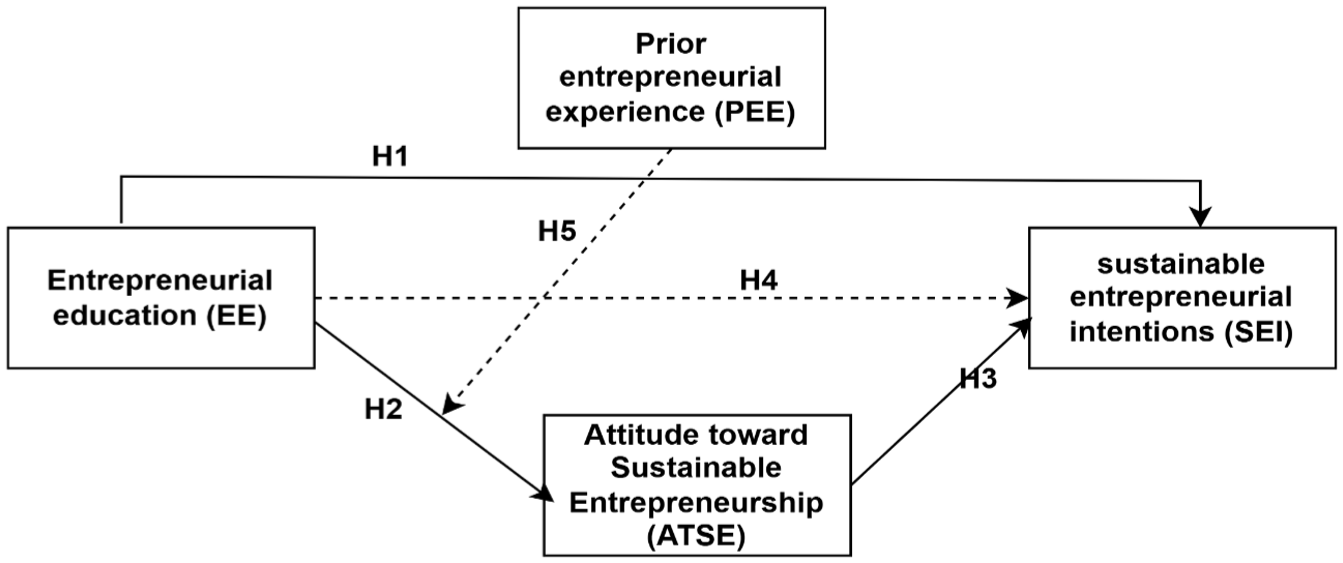
Proposed conceptual framework of the research.
Methodology
Study site
This research was carried out in Bangladesh, focused on university students from public and private institutions. Bangladesh provides a unique setting for analyzing SEI, given its increasing youth demographic and economic challenges that necessitate innovative solutions. University students, as prospective entrepreneurs, constitute a vital demographic for promoting sustainable entrepreneurship in the developing economy like Bangladesh.
Research design
This study employed a quantitative research design using a survey-based approach to investigate the factors affecting university students’ SEI. This research is based on two significant theories: the TPB, which elucidates the influence of attitudes on entrepreneurial intentions, and HCT, which analyzes the impact of education and prior experience as contextual elements that affect entrepreneurial decision-making. This framework facilitates the identification of psychological and contextual factors influencing the SEI of university students in Bangladesh. A questionnaire was developed using the conceptual framework of this study. Most of the latent variables were derived from prior studies. Peers and experts reviewed the instrument thoroughly and confirmed its validity. After minor language and scale changes, the final instrument of 17 items was created. Participants were asked to choose one of five possible responses on a five-point Likert scale ranging from 1 (strongly disagree) to 5 (strongly agree).
Along with sociodemographic questions about the study respondents, the questionnaire contained three groups of questions. The six items derived from prior research comprised this EE construct. The second set consisted of five items concerning ATSE and the third construct consisted of six items referring to SEI. Table 1 presents all the constructs that examined the variables under consideration.
Variables and Their Sources.

Prior entrepreneurial experience was assessed by a single binary item: “Have you ever participated in any entrepreneurial activity, such as initiating or managing a business, either formally or informally?” Responses were categorized as 1 for Yes and 0 for No. This variable was integrated into the structural model as a moderator to evaluate its impact on the association between Entrepreneurship Education and Attitudes Toward Sustainable Entrepreneurship. A moderation analysis was performed in SmartPLS 4, wherein an interaction term was generated between Entrepreneurship Education and Prior Entrepreneurial Experience. The interaction effect's significance was evaluated by bootstrapping processes.
Population and Sample
The target population comprised university students in Bangladesh, regarded as future catalysts for innovation and sustainable development. The sample consisted of students from both public and private universities all over the country, encompassing a range of disciplines, such as business, engineering, natural sciences, and social sciences. A convenience sampling method was employed for data collection due to practical limitations, including time and budget constraints. While this approach is useful for gathering a big sample in a short period of time, it has a disadvantage in terms of representativeness because the sample may not fully reflect the diversity of the entire population (Farrokhi & Mahmoudi-Hamidabad, 2012). To address this limitation, efforts were undertaken to engage students from diverse universities, academic disciplines, and geographic areas within Bangladesh, thereby ensuring comprehensive representation of the student population. Moreover, the collection of data was carried out in each of the eight most important divisional cities in Bangladesh. The sample size necessary for this study was calculated utilizing G*Power 3.1. A medium effect size of 0.15, a significance level of 0.05, and a power of 0.95 were employed, incorporating predictors into the model. The power analysis indicated that a minimum sample size of 104 respondents is required. Even with small samples, partial least squares structural equation modelling (PLS-SEM) produces reliable results (Lin et al., 2020). Moreover, we applied generally accepted methods to calculate the minimal sample size required to provide acceptable results (Chow et al., 2017). Therefore, we calculated the minimal sample size according to the following generally accepted formula:

where M is the value of the Gaussian (standard) normal distribution at the preliminarily determined confidence level, E symbolizes the margin of error, and p indicates Estimated population proportion (often 0.5 for maximum variability). We calculated the 0.05 marginal error rate and 95% level of confidence. The value of the standard normal distribution at this error rate was 1.96, which explains why the calculation of the minimum sample size was based on the following equation:

In this case n = 384.16. From this, it follows that, theoretically, 385 respondents would have been sufficient to provide reliable information. However, our study gathered 600 responses, which significantly surpassed the necessary sample size, thereby ensuring adequate statistical power and reliability. Descriptive statistics of the respondents’ demographic information are presented in Table 2.
Demographic Information of Respondents.

Data Collection
Data were collected using a structured online questionnaire distributed through social media platforms, university forums, and academic groups. The questionnaire comprises 17 items distributed across three constructs that assess SEI, attitude toward sustainability, and EE. Before being sent to a large group of students, a pretest was conducted with 30 students to ensure the reliability and validity of the questionnaire items. A non-probability convenience sampling technique was employed to collect 620 observations from different university students in Bangladesh. A total of 600 valid observations remained after eliminating 20 incomplete observations. All participants provided informed consent and participation was voluntary. Depending on the personal networks used for data collection, selection bias might have been introduced. To reduce bias in the questionnaire, the survey link was distributed to various student groups across different universities and disciplines to enhance sample diversity. Respondents were assured of their anonymity to mitigate social desirability bias and encourage honest responses. We collected the data between December 2023 and March 2024.
Data Analysis Techniques
Structural equation modelling (SEM) is commonly used in entrepreneurial behavior research, particularly for estimating causal models and hypotheses (Talukder et al., 2024b). Moreover, SEM enables researchers to test numerous related hypotheses simultaneously by calculating the connections between multiple independent and dependent variables in a structural model (Gefen et al., 2005). Regarding management studies, SEM is among the most popular tools for causal analysis (Shin & Konrad, 2014). PLS-SEM was selected because of its suitability for analyzing complex models involving latent variables and for supporting smaller sample sizes (Sarstedt et al., 2023). For data analysis, SmartPLS 4.0 software was used. PLS-SEM is frequently employed in exploratory investigations to explain the variations in dependent variables (Hair et al., 2014). It involves two major steps: measurement and structural model evaluation (Henseler et al., 2015). The composite reliability (CR), convergent validity, and discriminant validity were the initial metrics used to estimate the measurement model. The t-statistics for the path coefficients were examined using a bootstrapping approach. Finally, R2 and the Q2 indexes were used to assess the models’ in-sample and out-of-sample predictive power.
Common Method Variance and Non-Response Bias
Common method variance (CMV) and non-response bias were evaluated using the Harman single-factor test, collinearity statistics, variance inflation factor (VIF), and t-test. Initially, the results of the factor analysis indicated that a single factor accounted for only 43.85% of variance. This finding suggests that the dataset did not contaminate the CMV because the variance was less than 50% (Podsakoff et al., 2003). In addition, we used the Kock-recommended comprehensive collinearity test on all VIFs, as shown in Table 3. It is clear that the VIF values for all components of this model are less than the 3.3 level (Kock, 2015). Finally, a t-test was used to evaluate the existence of any substantial disparities between the early and late responses. Consequently, we applied the 75%–25% rule to determine early and late responses. The paired-sample t-test results indicated no significant differences in the mean scores of the main constructs, as the p-values were greater than 0.05. Therefore, our study did not have non-response bias (Armstrong & Overton, 1997).
VIF (Inner model).

Ethical Considerations and Data Security
This study received ethical approval from the university’s research ethics committee on November 30, 2023 (Case No. 17/2023). The study complied with the ethical guidelines for studies involving human participants and safeguarded their rights, dignity, and confidentiality throughout the process. All participants were informed of the purpose of the study, and their participation was completely voluntary, allowing for withdrawal at any time without consequences. To protect data privacy, all survey responses were stored in encrypted files. The data were kept in password-protected folders and were accessible only to the main investigator and authorized study team members.
Results
Assessment of the Measurement Model
We employed PLS-SEM, which was conducted in two stages, as the main statistical analysis technique. The measurement model was first evaluated to ensure that the data were valid and reliable for further analysis. To examine the predictive relationships among EE, ATSE, and SEI, a structural model was evaluated in the second stage. Table 4 indicates that the measures were both valid and reliable, with Cronbach’s alpha coefficients of 0.936 for EE, 0.918 for ASTE, and 0.925 for SEI. In addition, the CR values for the exogenous and endogenous variables were 0.923, 0.937, and 0.930, respectively, both of which exceed 0.7 (Hair et al., 2019). Consequently, reliability was not a concern. Ultimately, indicator reliability was achieved when the outer factor loadings exceeded 0.708 (Cheah et al., 2024; Hair et al., 2022). However, convergence was achieved because of the average variance extracted (AVE) values being 0.5 or greater (Hair et al., 2019), as presented in Table 4. We also used the heterotrait-monotrait (HTMT) technique and the Fornell–Larcker criterion to verify discriminant validity, and all criteria were satisfied (Cheah et al., 2024; Hair et al., 2022). Table 5 indicates that the square root of the AVE values is greater than the correlation between constructs, and the HTMT matrix has values less than 0.85 (Hair et al., 2019).
Measurement Model Evaluation (Reliability-Validity and VIF).

Discriminant Validity (Fornell–Larcker and HTMT Criteria).

Structural Model Assessment-Hypothesis Testing
After the measurement model was evaluated, we continued to the second phase of model assessment. Bootstrapping was used to evaluate structural models. The determination coefficients (R2) and Q2 statistics were used to evaluate the structural model. The predictive accuracy of the model is denoted by R2, which typically ranges from 0 to 1 (Hair et al., 2019). We calculated R squared to ascertain the in-sample power of the models. The findings demonstrate that EE and ATSE contribute 0.573% of the total variance in SEI, which has been identified as moderate (Hair et al., 2019), as shown in Table 6. Hair et al. (2022) demonstrate that the model is predictively relevant when Q2 values exceed zero (Hair et al., 2022). The Q2 of ATSE (0.201) and SEI (0.195) constructs were within their respective parameters.
Coefficient of Determination R2 of SEI.

The path coefficients for the relationships between EE and SEI; and EE and ATSE are significant at β = .135, T = 3.768, p < .01, and β = .366, T = 6.441, p < .01, respectively, thereby supporting H1 and H2. The path coefficient at β = .687, T = 19.198, and p < .01 is also significant for the relationships between ATSE and SEI; as a result, H3 is supported. Additionally, H5 is supported by β = .236, T = 2.735, and p < .01, which suggests that the relationship between EE and ATSE is moderated (strengthened) by PEE. Figure 2 and Table 7 present the comprehensive structural model analysis.

Results of structural model assessment.
Results of Direct Relationship (Hypothesis Testing by Bootstrapping).

Note. EE = entrepreneurial education; ATSE = attitude toward sustainable entrepreneurship; PEE = prior entrepreneurial experience; SEI = sustainable entrepreneurial intention. LL = lower limit; UL = upper limit; CI = confidence interval with bias correction in the complete bootstrapping routine.
For one-tailed experiments, statistical significance is described as p .05 and (t-value > 1.645).
Significant at the 0.01 level (one-tailed), bootstrap sample size 10,000.
We used the procedures described by Hair et al. (2022) to assess the mediating effects of the conceptual model (Hair et al., 2022). The relationship between EE and sustainable entrepreneurship intention (SEI) is partially mediated by the variable (ATSE), and therefore, H4 is supported. In Table 8, the results suggest that ATSE (β = .05, T = 6.199, p < .05) mediates the relationship between EE and SEI.
Hypothesis Testing Mediation Analysis.
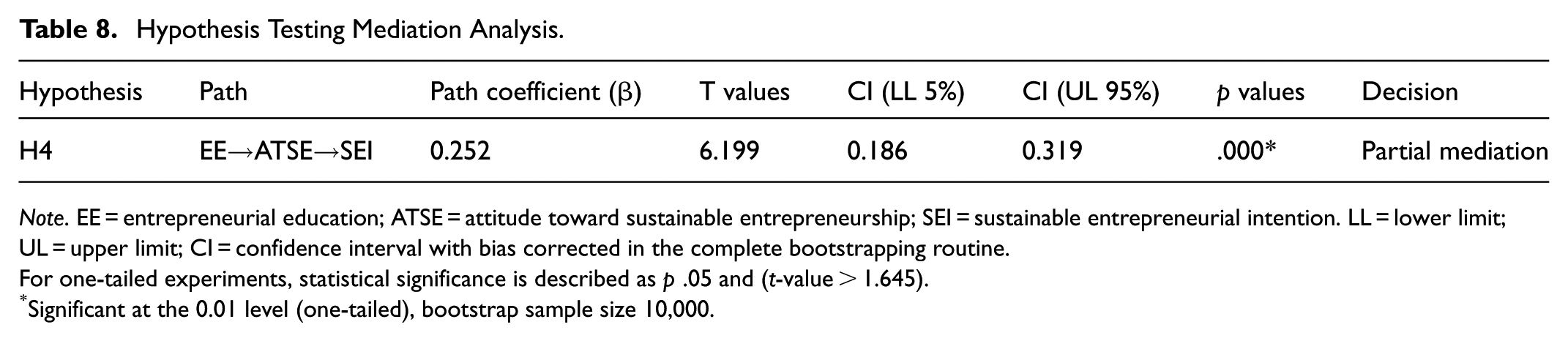
Note. EE = entrepreneurial education; ATSE = attitude toward sustainable entrepreneurship; SEI = sustainable entrepreneurial intention. LL = lower limit; UL = upper limit; CI = confidence interval with bias corrected in the complete bootstrapping routine.
For one-tailed experiments, statistical significance is described as p .05 and (t-value > 1.645).
Significant at the 0.01 level (one-tailed), bootstrap sample size 10,000.
Discussion
This study examined the relationships among EE, ATSE, and SEI while considering the mediating and moderating influences of ATSE and PEE. The findings support all five proposed hypotheses and offer significant insights into the dynamics of education, experience, attitudes, and intentions in the context of sustainable entrepreneurship.
The positive relationship between EE and SEI suggests that EE is a vital instrument for cultivating SEI. Our findings are consistent with earlier studies, which underscored the importance of education in providing the requisite skills, knowledge, and awareness to pursue sustainable ventures (Agu, 2021; Kummitha & Kummitha, 2021; Mambali et al., 2024; Nitu-Antonie et al., 2022; Romero-Colmenares & Reyes-Rodríguez, 2022). Nonetheless, our findings contradict a study that suggests EE cannot directly impact the SEI of university students (Agu et al., 2021). The contradiction may originate from differences in curriculum emphasis and the cultural contexts of different nations. Nevertheless, EE enhances individuals’ cognitive and practical capacities, thereby enabling them to identify sustainable business opportunities and reinforce their intention to participate in entrepreneurial activities that prioritize long-term environmental and social impact (Agu, 2021; Joensuu-Salo et al., 2022).
It is evident that EE has a direct and positive effect on ATSE. This result implies that educational experiences not only shape an individual’s intentions but also significantly shape their attitudes toward sustainability in entrepreneurship. Our results are consistent with previous findings emphasizing the importance of education in cultivating socially responsible and pro-environmental mindsets in university students (Agu et al., 2021). Moreover, EE is likely to enhance individuals’ understanding of sustainability, fostering a more favorable attitude toward incorporating sustainability into business practices (Baltador & Grecu, 2023). Universities can improve EE by incorporating gamification techniques, such as business simulation games, startup competitions, and interactive challenges, which facilitate experiential learning (Li & Jianxing, 2025). Integrating the metaverse into EE would enable universities to enhance experiential learning, develop entrepreneurial skills, and equip students with real-world business challenges (G. Chen et al., 2024). This may be linked to exposure to sustainability-oriented content, experiential learning opportunities, and case studies illustrating the long-term significance of sustainable entrepreneurship.
The results revealed a positive relationship between ATSE and SEI. This finding is in accordance with the TPB (Icek Ajzen, 1991), which highlights the substantial influence of attitude on intention. Specifically, in the context of sustainable entrepreneurship, individuals who cultivate positive attitudes toward sustainability are more likely to establish strong intentions to participate in sustainable entrepreneurship (Fatoki, 2020; Robertson & Barling, 2013; Vuorio et al., 2018). The results indicate that cultivating positive attitudes toward sustainability can be an effective strategy for developing sustainable entrepreneurship intentions. Our result is consistent with previous studies (Abdelwahed, 2022; Pascucci et al., 2022; Truong et al., 2022; Vuorio et al., 2018). Attitudes are influenced by both personal beliefs and external factors, such as educational interventions that aim to improve individuals’ attitudes toward sustainability, which can significantly increase their intention to pursue sustainable ventures (Romero-Colmenares & Reyes-Rodríguez, 2022). Consequently, educators, policymakers, and incubators should prioritize the development of positive attitudes toward sustainability in their entrepreneurship programs, as this would likely give rise to a greater number of future entrepreneurs who would be engaged in tackling environmental and social challenges.
These findings also indicate that ATSE serves as a mediator in the link between EE and SEI. This finding is particularly significant, because it underscores that the relationship between SEI and EE is not entirely direct; rather, it is partially mediated by ATSE. Our findings align with prior research indicating that ATSE mediates the relationship between EE and SEI (Patel et al., 2024; Rajpal & Singh, 2024). EE may influence SEI in two ways: first, by pushing students to think more positively about sustainability, and second, by shaping their actual intentions. This finding highlights the significance of attitude as a key mechanism in transforming educational experiences into long-term entrepreneurial action. Moreover, the findings reveal that the relationship between EE and ATSE is moderated by PEE. This finding implies that individuals with entrepreneurial experience are more likely to develop positive ATSE. Previous research suggests that experienced individuals are more effective at applying educational content to practical situations (Saengchai & Jermsittiparsert, 2019). Students may be more receptive to the sustainability aspects of EE owing to their prior exposure to the complexities and challenges of entrepreneurship (Rajpal and Singh, 2024). The results of this study indicate that educational programs may be more effective if customized based on the entrepreneurial experience. For instance, individuals without experience may benefit from fundamental training in both entrepreneurship and sustainability, whereas experienced individuals may benefit from advanced entrepreneurial sustainability-oriented content that builds on their prior knowledge (Alkhatib et al., 2021).
Conclusions
This study provides empirical evidence of the importance of EE in developing SEI among university students in Bangladesh. The results suggest that EE has both direct and indirect effects on SEI by fostering positive ATSE. Moreover, the relationship between education and attitude is strengthened by PEE, emphasizing the significance of combining practical experience with formal educational settings. EE aligned with the SDGs enables universities to contribute directly to global sustainability initiatives, while providing students with the necessary skills to drive positive impacts on society. Universities should cultivate environments conducive to the development of innovative, impact-driven business solutions by integrating curricula, incubators, and research programs centered on sustainability. This aligns with SDG 4 (quality education) by improving learning outcomes and SDG 8 (decent work and economic growth) by promoting sustainable job creation. Universities function as centers for knowledge exchange, policy advocacy, and collaboration with industry, thereby advancing SDG 9 (industry, innovation, and infrastructure). Embedding sustainability principles in EE enables universities to equip future leaders with the skills necessary to establish businesses that address climate action (SDG 13), promote responsible consumption and production (SDG 12), and advance social equity (SDG 10). This comprehensive approach guarantees that universities not only produce graduates, but also actively participate in the attainment of the SDGs via research, innovation, and entrepreneurship. It emphasizes the significance of education in fostering innovative and responsible business practices by highlighting the role of EE in fostering SEI. In addition, this research contributes to SDG 17 (partnerships for the goals) by highlighting the importance of collaboration between higher educational institutions, businesses, and policymakers to promote sustainable development. Universities and policymakers can significantly influence the development of the next generation of entrepreneurs, who are motivated and prepared to confront urgent social and environmental issues through sustainable business practices, by addressing the need for sustainability-focused EE.
Theoretical Implications
The study presents important theoretical contributions by combining the TPB with HCT to enhance the understanding of sustainable entrepreneurship. This study emphasizes the mediating role of ATSE in transforming EE into SEI and asserts that education should foster positive attitudes that positively affect intentions. The moderating role of PEE illustrates the interaction between experiential learning and formal education in shaping attitudes toward sustainability, thereby enhancing HCT by highlighting the complementary functions of education and experience. This integration offers a framework for understanding the collective impact of education and experiential learning on SEI. This study contributes to the literature on sustainable entrepreneurship and provides insights for designing educational programs that promote sustainability-oriented mindsets and practices.
Practical and Policy Implications
Practically, the findings indicate that universities should incorporate sustainability into their educational curricula to foster favorable attitudes and stronger intentions regarding sustainable entrepreneurship. This may entail integrating sustainability-focused case studies, experiential learning opportunities, and mentorship programs to familiarize students with real-world sustainable business practices. Furthermore, educational programs should customize the content according to students’ PEE. Workshops for beginner-level students should emphasize foundational skills, including ideation, opportunity recognition, and basic business planning, while integrating sustainability principles. The beginner level modules may encompass case studies of successful sustainable startups, practical exercises for formulating eco-friendly business concepts, and strategies for aligning personal values with entrepreneurial objectives. However, the curriculum for advanced students with PEE may consider more complex subjects for long-term sustainability, including sustainable scaling strategies, impact measurement, and systems thinking. Advanced modules may also include practical projects, mentorship with sustainable entrepreneurs, and simulations that address scaling challenges in resource-limited settings. Policymakers and university administrators should promote collaboration with businesses and industries that emphasize sustainability and provide students with internships or project-based learning experiences to observe sustainable entrepreneurship in practice. Moreover, through collaboration with universities and industries, the government can create sustainable business incubators to assist aspiring entrepreneurs. Incubators can provide financial support, seed capital, and networking opportunities to facilitate the development and growth of sustainable businesses through collaboration, mentorship, and access to resources.
Limitations and Future Research
This study offers significant insights into the sustainable entrepreneurial intention of university students in Bangladesh, although certain limitations should be recognized. First, the cross-sectional design limits the capacity to identify causal links. Future study should employ longitudinal approaches to provide a deeper insight into the temporal impacts of entrepreneurship education (EE) on sustainable entrepreneurial intentions. Second, the study analyzed EE as a single construct. Future research may analyze EE by breaking it down into its fundamental components—such as experiential learning, sustainability-oriented modules, mentorship, and business simulations—to evaluate their distinct effects on students' attitudes and intents. Third, previous business experience was analyzed as a binary moderator. Future research may investigate different types and levels of experience (e.g., formal versus informal, individual versus collaborative endeavors) and their subtle impacts on the examined relationships. Finally, this study employed a quantitative design; however, qualitative or mixed-methods techniques could yield deeper insights into students’ interpretations of sustainability in the context of entrepreneurship, especially within Bangladesh’s cultural and institutional framework. These guidelines can assist in formulating more focused educational policies and initiatives to promote sustainable entrepreneurship among young individuals.
Footnotes
Acknowledgements
We thank the Hungarian University of Agriculture and Life Sciences and the Doctoral School of Economic and Regional Sciences for their support to this research. We also thank the academic editors and the anonymous reviewers for their insightful and constructive comments.

Ethical Considerations
This study received ethical approval from the Hungarian University of Agriculture and Life Sciences’ research ethics committee on November 30, 2023 (Case No. 17/2023). All participants were informed of the purpose of the study, and their participation was completely voluntary, allowing for withdrawal at any time without consequences.
Author Contributions
S.C.T. and Z.L. contributed to the conceptualization, methodology, software, validation, formal analysis, and original draft writing. S.C.T., Z.L., and Á.T. were responsible for investigation and visualization. Resources were provided by Z.L. and Á.T., while data curation was carried out by S.C.T. Review and editing were performed by S.C.T. and Z.L. Supervision was provided by Z.L. and Á.T., while project administration was managed by S.C.T., and Z.L. All authors have read and approved the final version of the manuscript.
Funding
The authors disclosed receipt of the following financial support for the research, authorship, and/or publication of this article: This research was funded by the Hungarian National Research, Development and Innovation Office—NKFIH (OTKA K 132915).
Declaration of Conflicting Interests
The authors declared no potential conflicts of interest with respect to the research, authorship, and/or publication of this article.
Data Availability Statement
The data that supports the findings of this study are available from the corresponding author, upon reasonable request.