



Abstract
With the increasingly fierce competition in the employment market, entrepreneurship has gradually become a crucial approach for college students to expand their employment channels. However, there are numerous factors influencing college students’ entrepreneurial intentions. Employing the fuzzy-set qualitative comparative analysis (fsQCA) method, this study takes 124 college students from Chinese finance and economics universities as the research sample, and explores the multiple combined paths through which different combinations of variables affect college students’ entrepreneurial intentions from the dual perspectives of internal cognition and external environment, such as attitude toward the behavior, subjective norm, perceived behavioral control, innovation and entrepreneurship education, and government policy support. The results indicate that there are four configuration paths to enhance college students’ entrepreneurial intentions, namely the “policy incentive-attitude dominated” configuration, the “innovation and entrepreneurship education empowered” configuration, the “external support deficiency compensation” configuration, and the “multi-subject collaboration” configuration, with each configuration playing a differentiated role.
Keywords
Introduction
The 20th National Congress of the Communist Party of China underscored that education, science and technology, and talent constitute the fundamental and strategic pillars for building a modern socialist country. Coordinating these three core elements, prioritizing innovation as the primary driver of development, and establishing a high-caliber innovation-oriented talent system can provide comprehensive support for advancing China’s modernization drive (Y. Wu, 2022). In the era of the digital economy, emerging sectors such as smart manufacturing and the sharing economy fueled by cutting-edge digital technologies including big data and artificial intelligence, have unlocked abundant entrepreneurial opportunities for college students (P. N. D. Nguyen & Nguyen, 2024). Leveraging their disciplinary advantages in economics, finance and management, finance and economics institutions are well-positioned to cultivate innovative and well-rounded talents who can contribute to the vitality of socio-economic development (Chen & Yan, 2017). Against the backdrop of fierce employment market competition, the surging number of college graduates, coupled with the inadequate growth of job supplies, has rendered entrepreneurship a pivotal avenue for students to diversify their employment options (Jiang et al., 2025). Therefore, enhancing the entrepreneurial intentions of students in finance and economics not only responds to the national call but also serves as a crucial approach for these institutions to fulfill their social responsibilities and elevate the quality of education
College students’ entrepreneurial intentions are shaped by a multitude of factors. The theory of planned behavior (TPB) is a pivotal theoretical framework for explaining individuals’ behavioral decision-making. It posits that behavioral intention, as the immediate antecedent of actual behavior, is jointly determined by three core constructs including attitude toward the behavior, subjective norm, and perceived behavioral control (Ajzen, 1991; Al Halbusi et al., 2023; Gu et al., 2024). Notably, the influence of subjective norm is particularly salient in Asian countries rooted in Confucian culture, which may be attributed to the prevalence of collectivist values in these contexts (G. N. Nguyen & Nguyen, 2024). In the context of entrepreneurship, internal and external factors exert interactive effects on entrepreneurs’ intentions and behavioral outcomes (Y. Z. Du & Ma, 2022). On the internal front, cognitive factors including attitude, subjective norm, and perceived behavioral control are central to shaping behavioral intent (Duan & Jiang, 2008; Lopes et al., 2023; Martín-Navarro et al., 2023). On the external front, contextual factors such as innovation and entrepreneurship education and government policy support also exert a profound impact on entrepreneurial intentions (Ramadani et al., 2022; L. S. Wu, 2019). Specifically, innovation and entrepreneurship education enhances individuals’ entrepreneurial capabilities and enthusiasm by equipping them with specialized knowledge, practical skills, and essential resources, in turn fostering their entrepreneurial intentions (Huang, 2023; Morris et al., 2013). For instance, Huang (2023) argues that entrepreneurial education can equip students with specialized entrepreneurial knowledge and practical skills through classroom instruction and hands-on training, while also guiding them to develop sound entrepreneurial values, thus fostering their entrepreneurial intentions. From the perspective of government policy, scholars contend that governments can help aspiring entrepreneurs mitigate initial resource constrains and strengthen their entrepreneurial intentions by providing targeted support including financial subsidies, tax incentives, and professional entrepreneurship training programs (Bu et al., 2023; Urbano et al., 2019).
Prior studies have investigated the determinants of college students’ entrepreneurial intentions from diverse perspectives, laying a robust theoretical and empirical foundation for the present research. However, the majority of these works have centered on single-factor analyses, overlooking the interactions and synergistic effects among multiple influencing factors. Moreover, there is a dearth of in-depth investigations targeting students enrolled in finance and economics institutions, as most relevant studies have relied solely on conventional empirical analysis approaches. This research gap hinders a comprehensive understanding of the formation mechanisms and multifaceted determinants underlying college students’ entrepreneurial intentions. As a result, existing literature falls short of providing adequate theoretical guidance and practical implications for designing effective innovation and entrepreneurship education strategies tailored to such institutions. The formation of entrepreneurial intentions constitutes a complex process involving the interplay of multiple internal and external factors. Single-factor analytical approaches fail to adequately unravel the underlying mechanisms and intricate pathways shaping these intentions. It’s therefore necessary to adopt a holistic perspective to systematically explore the interaction mechanisms among these influencing factors (Y. Z. Du & Ma, 2022). Fuzzy-set qualitative comparative analysis embodies a holistic perspective by examining the interactions between different causal conditions, unraveling complex causal relationships among variables, and thereby identifying multiple equivalent pathways that influence entrepreneurial intentions (Y. Z. Du & Jia, 2017).
Against this backdrop, the present study, grounded in the theory of planned behavior (TPB), constructs a multi-level analytical framework that integrates internal cognitive factors (including attitude, subjective norm, and perceived behavioral control) and external environmental factors (including innovation and entrepreneurship education and government policy support). Employing fsQCA, this study explores the combinational pathways of diverse influencing factors and their synergistic effects on entrepreneurial intentions. This analytical approach enables a more comprehensive and systematic elucidation of the complexity inherent in entrepreneurial intentions formation.
Literature Review and Theoretical Foundations
Theory of Planned Behavior
The TPB was proposed by Ajzen (1985) on the basis of the theory of reasoned action (TRA). The TRA emphasizes the impacts of attitude and subjective norm on behavioral intention, framing such intention as the immediate determinant of actual behavior. However, TRA’s core assumption that behavior is entirely subject to volitional control constrains its applicability in empirical research (Duan & Jiang, 2008). To address this limitation, Ajzen (1985) incorporated the construct of perceived behavioral control into the TRA, thereby developing the TPB. The TPB posits that behavioral intention, the immediate precursor of actual behavior, is jointly shaped by three core dimensions, such as attitude toward the behavior, subjective norm, and perceived behavioral control. Notably, perceived behavioral control can exert an influence not only on behavioral intention but also on the enactment of actual behavior itself (Ajzen, 1991). The TPB addresses the limitations of the TRA in explaining non-volitional behaviors, highlighting the pivotal role of perceived behavioral control in behavioral decision-making (Ulker-Demirel & Ciftci, 2020). The incorporation of this construct extends the TPB’s applicability to behaviors constrained by external factors, rendering it widely adopted in the fields of education and psychology. For example, W. Du et al. (2025) employed the TPB as a theoretical framework to examine how attitude, perceived behavioral control, and subjective norm influence students’ participation in mathematics classrooms. Their findings revealed that attitude and subjective norm positively predict students’ participation, whereas perceived behavioral control exhibits no significant correlation with this outcome.
While the TPB has been widely employed to understand and predict individual behavior, the specific mechanisms through which past behavior influences current behavior remain unclear. To address this research gap, Tom St Quinton (2022) developed a TPB-based model to examine the impact of past behavior on college students’ sports participation. The findings revealed that past behavior does not directly affect such participation but exerts an indirect influence through three core constructs of the TPB, such as attitude, subjective norm, and perceived behavioral control. Beyond these domains, the TPB has also been extensively applied in the field of entrepreneurship and innovation. For instance, Al Halbusi et al. (2023) adopted the TPB framework to investigate electronic entrepreneurship, demonstrating that positive entrepreneurial attitudes, favorable subjective norm, and strong perceived behavioral control enhance electronic entrepreneurial intentions. This study further advances the application of the TPB in the entrepreneurial context (Batista-Canino et al., 2024).
Extant research has established that individual’s entrepreneurial intentions are jointly influenced by internal and external factors (Y. Z. Du & Ma, 2022). However, the TPB primarily focuses on internal cognitive factors at the individual level (Ajzen, 1991) and has yet to provide a comprehensive explanatory framework for how external environmental factors interact with internal cognitive processes to jointly shape behavioral intentions. This limitation is particularly notable in the entrepreneurial domain, where entrepreneurial activities are highly dependent on external resources and institutional contexts (Hechavarría & Terjesen, 2025). Neglecting the synergistic effects between external environmental factors and internal cognitive processes hinders a comprehensive elucidation of the intricate mechanisms underpinning entrepreneurial intentions formation. Among the array of external environmental factors, innovation and entrepreneurship education and government policy support are recognized as two pivotal variables shaping college students’ entrepreneurial intentions ((Ahmed et al., 2025; Maresch et al., 2016). On the one hand, college students are in a critical phase of knowledge acquisition and value formation. Systematic innovation and entrepreneurship education can foster individuals’ positive attitudes toward entrepreneurship and their sense of self-efficacy by imparting specialized knowledge, practical skills, and value-shaping guidance, thereby strengthening their willingness to engage in entrepreneurial endeavors. (Huang, 2023; Yousaf et al., 2022). For instance, Walsh et al. (2021) argue that entrepreneurial education can enhance individuals’ self- efficacy in the short term, which in turn ignites entrepreneurial passion and ultimately stimulates the launch of new ventures in the long run. On the other hand, entrepreneurial activities are characterized by high risk and strong resource dependency. Governments can directly help aspiring entrepreneurs mitigate initial resource constraints through financial support and tax incentives, thereby enhancing their entrepreneurial intentions (Bu et al., 2023; Urbano et al., 2019).
Additionally, scholars have found that government policies can influence the economic and opportunity costs of entrepreneurship by modifying formal institutions such as laws and regulations. This renders entrepreneurship more attractive and less risky, which in turn strengthens individuals’ entrepreneurial intentions (Autio et al., 2014; Bu et al., 2023). Accordingly, grounded in the TPB, the present study incorporates two key external variables, namely innovation and entrepreneurship education and government policy support, to construct a multi-level analytical framework encompassing both internal cognitive factors (attitude toward the behavior [ATB], subjective norm [SN], perceived behavioral control [PBC], and external environmental factors, innovation and entrepreneurship education [IEE], government policy support [GPS]). Leveraging this framework, the study explores the multiple influencing factors and configurational pathways affecting the entrepreneurial intentions of students in finance and economics institutions. On this basis, a model depicting the influencing factors and configurational pathways of these students’ entrepreneurial intentions is developed, as illustrated in Figure 1.
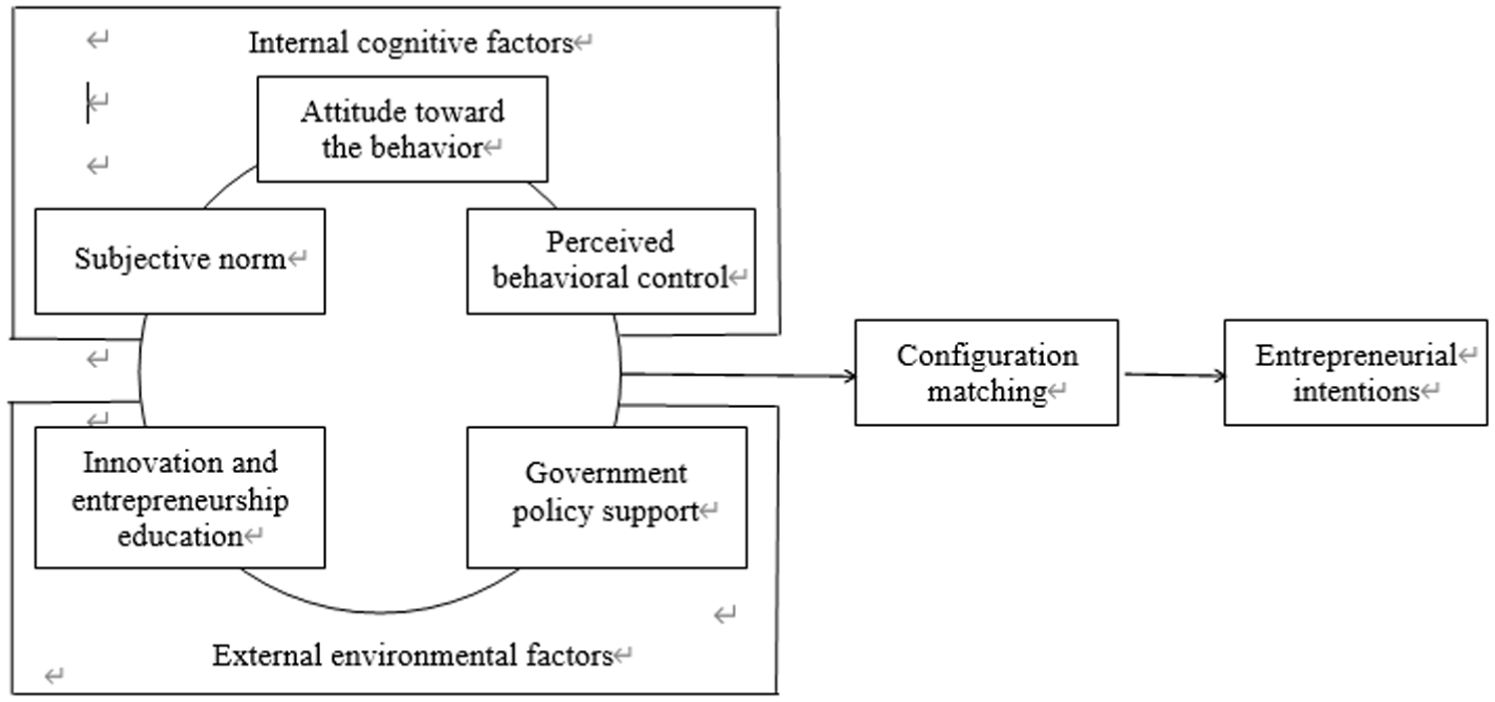
Multi-level framework of entrepreneurial intentions formation.
Attitude Toward the Behavior
Attitude toward the behavior refers to an individual’s positive or negative evaluation of a specific behavior, or their favorable or unfavorable predisposition toward engaging in entrepreneurial and innovative activities (Ajzen, 1991). According to TPB, attitude toward the behavior constitutes a core determinant of both behavioral intention and actual behavior, with a positive entrepreneurial attitude exerting a significant positive effect on enhancing individuals’ entrepreneurial intentions (X. E. Zhang et al., 2018). Notably, attitude toward the behavior can be further categorized into affective and cognitive dimensions (Duong, 2022a; Liñán & Chen, 2009). Among these two dimensions, affective attitude exerts a stronger influence on entrepreneurial intention than cognitive attitude does. This phenomenon may be attributed to the inherently high-risk nature of entrepreneurial activities, in which context emotional inclination serves as the primary driver of behavioral intention, whereas rational cognition plays a more auxiliary role (Fitzsimmons & Douglas, 2011).
Empirical research demonstrates that attitude toward the behavior exerts a more significant influence on entrepreneurial and innovative intentions than do subjective norm and perceived behavioral control (Youssef et al., 2021). For instance, Roy et al. (2017) explored the determinants of entrepreneurial intentions among engineering graduates in India and identified attitude toward the behavior as the most salient predictor among the three core constructs of the TPB. Notably, the impact of attitude toward the behavior on entrepreneurial intentions is not independent; instead, it operates through interactive mechanisms with other factors. For example, a positive entrepreneurial attitude can strengthen an individual’s perceived control over entrepreneurial activities, thereby increasing their willingness to pursue such endeavors (Ahmed et al., 2025). Attitude toward the behavior can also directly drive the formation of college students’ entrepreneurial and innovative intentions (Martín-Navarro et al., 2023). Specifically, when individuals hold positive perceptions and evaluations of entrepreneurial behavior and view it as valuable, meaningful, and feasible, they are more inclined to develop intentions to engage in entrepreneurial and innovative activities (Al Halbusi et al., 2023).
Subjective Norm
Subjective norm, a core construct of the TPB, plays a pivotal role in understanding the formation of entrepreneurial intentions. It refers to the social pressure that individuals perceive from significant others, such as family members and friends, regarding their engagement in entrepreneurial behavior (Ajzen, 1991). Specially, when individuals perceive approval of their entrepreneurial endeavors from these significant others, their entrepreneurial intentions are significantly strengthened (Al Halbusi et al., 2023).
Empirical research indicates that subjective norm can influence college students’ entrepreneurial intentions through multiple pathways (Liñán & Chen, 2009; Martín-Navarro et al., 2023). First, subjective norm exerts a direct impact: the greater the approval and support from significant referents, such as family members, friends, or mentors, for entrepreneurial and innovative activities, the more readily students are motivated to engage in such endeavors, thereby significantly strengthening their entrepreneurial intentions (Maresch et al., 2016). Second, subjective norm can also exert an indirect influence by shaping attitude toward the behavior and perceived behavioral control (Anderson, 2023). Specifically, recognition of entrepreneurial behavior within an individual’s social network (including family members and friends) can foster a positive entrepreneurial attitude, leading individuals to perceive entrepreneurship as valuable and thus strengthening their entrepreneurial intentions (Ramos-Rodríguez et al., 2019). Additionally, when individuals perceive social support, they are more likely to feel competent and resource-endowed in pursuing entrepreneurship, which enhances their perceived behavioral control and further facilitates the formation of entrepreneurial intentions (Martín-Navarro et al., 2023).
Perceived Behavioral Control
Perceived behavioral control, a core determinant of entrepreneurial intentions, plays a pivotal role in the entrepreneurial decision-making process. Rooted in the TPB, perceived behavioral control refers to an individual’s perceived ease or difficulty of enacting a specific behavior. Its influence mechanism encompasses two dimensions: indirectly affecting actual behavior through behavioral intention, and directly moderating the likelihood of behavioral enactment (Ajzen, 1991). Notably, some scholars have decomposed perceived behavioral control into self-efficacy and perceived controllability (Kraft et al., 2005; Vamvaka et al., 2020). Self-efficacy denotes an individual’s belief in their own capability to perform the target behavior, whereas perceived controllability refers to an individual’s perceived level of control over the outcomes of that behavior (Vamvaka et al., 2020).
Empirical research demonstrates that high levels of perceived behavioral control can significantly enhance an individual’s intentions to engage in entrepreneurial and innovative activities (P. N. D. Nguyen & Nguyen, 2024). When individuals perceive themselves as capable of effectively managing resources and addressing challenges throughout the entrepreneurial process, they are more inclined to pursue entrepreneurial behavior (de Sousa-Filho et al., 2023; Liñán & Chen, 2009). Specifically, when college students believe they can readily access critical resources such as funding and human capital, the perceived uncertainty associated with entrepreneurial activities is reduced, which further strengthens their entrepreneurial intentions (Aragon-Sanchez et al., 2017). Additionally, when individuals are confident in their ability to navigate entrepreneurial challenges, their risk-taking propensity is heightened, thereby increasing their likelihood of taking entrepreneurial action (Newman et al., 2019).
Innovation and Entrepreneurship Education
Innovation and entrepreneurship education, a educational model designed to cultivate innovative thinking, entrepreneurial capabilities, and a practice-oriented spirit (Anubhav et al., 2024), has garnered widespread attention in both academic and practical domains as a core approach to nurturing entrepreneurial mindset. A consensus among scholars holds that innovation and entrepreneurship education exerts a significant influence on college students’ entrepreneurial intentions (Huang, 2023; Ramadani et al., 2022; X. E. Zhang et al., 2018).
On the one hand, innovation and entrepreneurship education can directly boost college students’ intentions to engage in entrepreneurial and innovative activities by fostering innovative thinking, enhancing entrepreneurial capabilities, and igniting entrepreneurial passion (Huang, 2023). On the other hand, it can also exert an indirect influence through multiple mediating pathways. For instance, Souitaris et al. (2007) found that entrepreneurial education enhanced the entrepreneurial intentions of engineering students by imparting specialized knowledge, providing inspirational guidance, and offering tangible resource support. Additionally, Yousaf et al. (2022) verified the mediating role of entrepreneurial attitude in the relationship between entrepreneurial education and entrepreneurial intention. Specifically, entrepreneurial education drives positive shifts in entrepreneurial attitudes by strengthening individuals’ entrepreneurial capabilities and reshaping their risk perceptions, thereby ultimately improving their entrepreneurial intentions.
Government Policy Support
Government policy support, a core component of the entrepreneurial ecosystem, exerts a significant influence on individuals’ entrepreneurial intentions (Ahmed et al., 2025). On the one hand, government-provided entrepreneurial subsidies and tax incentives effectively alleviate the funding constraints faced by college students and mitigate the adverse selection problems arising from their lack of startup capital (Bu et al., 2023). On the other hand, a sound policy framework safeguards college students’ legal rights during the entrepreneurial, process, reduces anxieties stemming from legal uncertainties, and lowers the institutional risks associated with entrepreneurship, thereby shaping their entrepreneurial and innovative intentions (Wang et al., 2019).
Furthermore, culture contexts and social norm play a pivotal moderating role in shaping the effectiveness of government policies. In regions with robust institutional support, societal recognition of entrepreneurship and policy initiatives exert a synergistic effect, thereby enhancing the policy impact on fostering entrepreneurial intentions (Liñán & Chen, 2009). For instance, China’s “Mass Entrepreneurship and Innovation” policy, promoted by the government through media campaigns and entrepreneurial success narratives, has fostered a positive entrepreneurial culture and amplified the policy’s catalytic effect on entrepreneurial intentions.
Research Design
Data Collection
This study adopted a questionnaire-based survey approach combined with a multi-channel randomized sampling strategy to examine whether antecedent variables constitute the necessary and sufficient conditions for enhancing the entrepreneurial intentions of college students. In this study, convenience sampling was adopted for data collection. With the assistance of the Academic Affairs Office and college counselors of the university, questionnaires were distributed in student-concentrated areas such as teaching buildings, libraries, and entrepreneurship incubation bases. Prior to distribution, the purpose of the survey and the principles of data confidentiality were clearly explained to the participants. The questionnaires were filled out on a voluntary basis and collected anonymously. Invalid questionnaires with incomplete responses or logical contradictions were excluded. A total of 180 surveys were distributed to undergraduates at a finance-oriented institution in Shandong Province, yielding 138 retrievals. Preliminary screening identified 14 invalid responses (5 due to patterned selections; 9 exhibiting logical inconsistencies), resulting in 124 analyzable datasets (68.89% validity rate). This attrition threshold mitigated non-response bias concerns.
To ensure sample representativeness, the participants were distributed across all academic years with the following composition: freshmen, 4.84% (n = 6); sophomores, 56.45% (n = 70); juniors, 25.81% (n = 32); and seniors, 12.90% (n = 16). The demographic profile of the sample was as follows: gender, males (27.42%, n = 34); females (72.58%, n = 90); academic majors, economics 9.68% (n = 12); management, 85.48% (n = 106); and other disciplines, 4.84% (n = 6). It can be seen from this that the sample is relatively evenly distributed across the core demographic dimensions.
Variable Measurement
This study adapted well-validated measurement scales and refined them iteratively to develop context-specific 5-point Likert-type scales.
Attitude Toward the Behavior
Adapted from Liñán and Chen’s (2009) entrepreneurial intentions scale, this construct was operationalized using five items designed to measure students’ perceptions of entrepreneurship (e.g., “Entrepreneurship holds strong appeal for me”; “Entrepreneurial activities would provide personal fulfillment”).
Subjective Norm
Drawing on Y. Q. Li et al.’s (2008) normative framework, this construct was operationalized with four items designed to gauge social influence on students’ entrepreneurial decisions (e.g., “My parents endorse my entrepreneurial pursuits”; “My peers recognize entrepreneurship as a viable career option”).
Perceived Behavioral Control
Adapted and modified from Modified from Liñán and Chen’s (2009) scale, this construct was operationalized with six items designed to assess students’ self-efficacy perceptions (e.g., “I have mastered the critical procedures required for entrepreneurship”; “I perceive a high probability of success in my potential entrepreneurial ventures”).
Innovation and Entrepreneurship Education
Drawing on Deng et al.’s (2023) analytical framework, this construct was operationalized with four items designed to assess the institutional support embedded in students’ entrepreneurship education experiences (e.g., “Entrepreneurship training workshops are held frequently”; “Multi-level innovation practice platforms are available for use”).
Government Policy Support
Adapted from Ran et al.’s (2020) measurement instrument, this construct was operationalized with four items designed to gauge the perceived effectiveness of governmental assistance for entrepreneurship (e.g., “The implemented entrepreneurship policies are highly effective”; “The government provides targeted solutions to address entrepreneurial challenges”).
Innovation and Entrepreneurial Intention
Adapted and modified from Y. Q. Li et al. (2008), this construct was operationalized with five items designed to measure students’ entrepreneurial career propensity (e.g., “I have formulated specific plans for future entrepreneurship”; “I perceive a high probability of launching an entrepreneurial venture within five years”).
Common Method Bias Analysis
To mitigate potential measurement biases arising from environmental uncertainties and respondent heterogeneity, Harman’s single-factor test was conducted in accordance with the procedure outlined by Podsakoff et al. (2003). The results extracted six factors with eigenvalues greater than 1, among which the largest factor accounted for 37.84% of the total variance. Given that this value is below the 40% threshold, the level of common method variance (CMV) in the current study is deemed acceptable. Furthermore, this study employed a latent methods factor CFA to test for common method bias. The results showed that, compared with the five-factor model, the single-factor model yielded the following fit indices. The χ2/df was 5.368, NFI was 0.723, CFI was 0.758, TLI was 0.732, and RMSEA was 0.156. These results indicate that the single-factor model exhibited extremely poor fit. Consequently, the risk of common method bias in this study is within an acceptable range, which did not cause substantial interference with data quality or subsequent analyses. Thus, the data are suitable for hypothesis testing.
Reliability and Validity
As presented in Table 1, all constructs exhibited satisfactory psychometric properties across three key assessments (1) internal consistency reliability, with Cronbach’s α and CR values both exceeding the 0.7 threshold (Nunnally, 1978); (2) convergent validity, where all standardized factor loadings surpassed 0.7 and AVE values met the 0.7 criterion (Liu et al., 2016); and (3) sampling adequacy, as evidenced by the KMO statistic exceeding 0.7.
Results of Reliability and Validity.

To further examine the discriminant validity of each variable, this study employed the AMOS 17.0 to conduct a confirmatory factor analysis (CFA) on five variables, namely attitude toward the behavior, subjective norm, perceived behavioral control, innovation and entrepreneurship, and government policy support. As presented in Table 2, the five-factor model exhibited a good fit. Specifically, the χ2/df was 1.933, which fell within the acceptable range of 1 to 5. The NFI was 0.912, CFI was 0.956, and the TLI was 0.948, all of which exceeded the threshold of 0.900. Additionally, the PNFI was 0.825 (greater than 0.500), and the RMSEA was 0.078 (less than 0.08). In contrast, the fit degrees of other factor models were significantly poorer. These results fully demonstrate that the five-factor model can well reflect the factor structure of the measurement items for each variable, indicating that all variables possess high discriminant validity.
Results of Confirmatory Factor Analysis.

Variable Calibration
To convert the original scores of the continuous conditional variables into continuous fuzzy-set membership scores within the [0, 1] interval, such as attitude toward the behavior, subjective norm, perceived behavioral control, innovation and entrepreneurship education, and government policy support, this study adopted the direct calibration method. Specifically, the 75th, 50th, and 25th percentiles of the original data for each variable were used as the calibration anchors for “full membership,”“crossover point,” and “full non-membership” respectively, to facilitate subsequent operations and research.
Results
Analysis of Sufficient and Necessary Conditions for College Students’ Entrepreneurial Intentions
As presented in Table 3, this study examined the sufficiency and necessity of antecedent conditions affecting college students’ entrepreneurial intentions. In the sufficiency analysis, the consistency scores of all individual conditions fell below the 0.9 threshold, indicating that no single antecedent condition alone constituted a sufficient condition for the outcome variable. Therefore, it is necessary to examine the impact of conditional configurations on college students’ entrepreneurial intentions. The threshold for conditional configuration consistency is set at 0.8. A value greater than 0.8 indicates that the configuration can fully explain the occurrence of the outcome variable (Xue et al., 2024).Table 3 presents the configuration analysis results for college students’ entrepreneurial intentions, derived using the fsQCA method. The results show that the consistency of all four configurations is higher than the threshold of 0.8, with an overall consistency of 0.858 (also exceeding the threshold of 0.8), indicating that each configuration constitutes a sufficient condition for college students’ entrepreneurial intentions. The overall coverage rate is 0.641, meaning that the four configurations explain approximately 64.1% of the factors contributing to the formation of college students’ entrepreneurial intentions.
Necessary Condition Analysis Results.

∼ Denotes logical negation.
Configurations of Antecedent Conditions for Entrepreneurial Intentions
Employing fsQCA 3.0 software, this study identified conditional configurations via standardized truth table analysis, with a consistency threshold set at 0.8 and a PRI threshold established at 0.6. In accordance with established methodological guidelines (H. Zhang & Su, 2021), core conditions were defined as those present in both the parsimonious and intermediate solutions, whereas auxiliary conditions were designated as factors that appear exclusively in the intermediate solution. As presented in Table 4, all derived configurations yielded consistency scores ranging from 0.806 to 0.941, which satisfy the minimum standards for validity in fsQCA analyses. Four distinct conditional configurations were identified, reflecting heterogeneous causal pathways to the enhancement of college students’ entrepreneurial intentions:
Conditional Configuration Analysis Results.

Note. ● = Presence of core conditions; • = presence of auxiliary conditions; ⊗ = absence of auxiliary conditions.
In configuration M1, the combination of attitude toward the behavior and government policy support as core conditions, coupled with subjective norm as an auxiliary condition, generates a positive effect on enhancing college students’ entrepreneurial intentions. This configuration underscores the synergistic mechanism through which external institutional environments and internal psychological cognition interact to drive entrepreneurial intentions. The finding aligns with Youssef et al.’s (2021) conclusion that attitude toward the behavior exerts a positive impact on entrepreneurial intentions, thereby further verifying that attitudes constitute a crucial motivational antecedent for individuals’ entrepreneurial engagement. It also corroborates Urbano et al.’s (2019) proposition that “institutional environments impact entrepreneurial intentions.” Specifically, the interaction between government policy support and a positive attitude toward the behavior exerts an impact on individuals’ entrepreneurial intentions through two distinct pathways. First, policy support helps individuals perceive entrepreneurial feasibility and amplifies the motivational impetus of t attitude toward the behavior by lowering market entry barriers and mitigating perceived risks, primarily through the provision of tangible resources such as startup funding and tax incentives (Wang et al., 2019). This institutional safeguard enables students to recognize the intrinsic value of entrepreneurship, thereby enhancing their confidence and motivation to pursue entrepreneurial endeavors (Bu et al., 2023; Urbano et al., 2019). Second, a positive attitude toward the behavior elevates the efficiency of policy resource utilization. Specifically, individuals with such an attitude proactively seek out and interpret government policies, evaluate policy-related information with an optimistic bias, and leverage these resources effectively to minimize entrepreneurial risks and maximize the likelihood of entrepreneurial success (Cheng et al., 2022).
Subjective norm, as an auxiliary condition, further reinforces college students’ entrepreneurial intentions from a social relational perspective. This construct reflects students’ perceptions of their social environment, specifically capturing the attitudes of significant others toward entrepreneurial activities. When students perceive support from these key stakeholders, they are more inclined to regard entrepreneurship as a viable career option, thereby strengthening their entrepreneurial intentions (Al Halbusi et al., 2023; Maresch et al., 2016). In configuration M1, attitude toward the behavior and government policy support lay the foundational basis for enhancing college students’ entrepreneurial intentions. Specifically, attitude toward the behavior not only ignites students’ entrepreneurial enthusiasm but also elevates the efficiency of government policy utilization. As an external institutional factor, government policy support, reinforces individuals’ positive entrepreneurial attitudes through institutional safeguards. Meanwhile, subjective norm as an auxiliary condition complements and interacts with these two core conditions, forming a synergistic configuration that effectively fosters college students’ entrepreneurial intentions.
Configuration M2 consists of innovation and entrepreneurship education, perceived behavioral control, and subjective norm, with perceived behavioral control serving as the core condition. This underscores the criticality of enhancing individuals’ self-efficacy in entrepreneurial capabilities and their sense of control over behavioral outcomes. Specifically, innovation and entrepreneurship education can systematically impart entrepreneurial knowledge and practical skills, thereby strengthening students’ self-efficacy and stimulating their entrepreneurial engagement intentions (Ramadani et al., 2022). Meanwhile, subjective norm reinforces such confidence through perceived social support. Accordingly, this study labels configuration M2 the “innovation and entrepreneurship education-empowered
Systematic innovation and entrepreneurship education can comprehensively cultivate the competencies and qualities essential for college students’ entrepreneurial endeavors. In turn, this enhances their perceived behavioral control and confidence in executing entrepreneurial activities, thereby elevating their entrepreneurial intentions (Walsh et al., 2021). For example, through participation in specialized courses and practical projects, students can advance from entrepreneurial novices to individuals capable of independently managing project planning; notably, their perceived behavioral control strengthens concomitantly with the improvement of their practical capabilities. Furthermore, the widespread implementation of innovation and entrepreneurship education can amplify the positive effects of subjective norm on entrepreneurial intentions. It cultivates a cultural milieu that incentivizes innovation and underpins entrepreneurship both within the campus ecosystem and broader society, while reshaping conventional perceptions of entrepreneurial activities. As family members and peers recognize that individuals equipped with formal entrepreneurship education demonstrate enhanced competencies, their endorsement of entrepreneurial endeavors grows more favorable, thereby indirectly amplifying the influence of subjective norm (X. E. Zhang et al., 2018). Furthermore, the absence of government policy support as an auxiliary condition in this configurational framework indicates that even amid inadequate external policy backing, the synergistic interaction of innovation and entrepreneurship education, perceived behavioral control, and subjective norm can effectively galvanize college students’ entrepreneurial intentions.
In configuration M3, subjective norm and perceived behavioral control serve as core conditions, with government policy support included as an auxiliary condition; by contrast, innovation and entrepreneurship education is absent as an auxiliary condition in this configuration. This finding indicates that even in contexts characterized by insufficient external support, strengthening subjective norm and perceived behavioral control can compensate for the absence of innovation and entrepreneurship education and still effectively foster college students’ entrepreneurial intentions. Accordingly, this study labels configuration M3 the “external support deficiency-compensated configuration,” which elucidates the formation mechanism of individuals’ entrepreneurial intentions in contexts characterized by limited external resources. This finding aligns with de Sousa-Filho et al.’s (2023) research highlighting the positive role of perceived behavioral control in driving entrepreneurial outcomes, further verifying that the bidirectional interaction between subjective norm and perceived behavioral control can offset deficits in external resource support.
When external resource support is inadequate, supportive beliefs derived from subjective norm exert a significant positive effect on strengthening individuals’ entrepreneurial intentions. Specifically, if college students perceive entrepreneurial support from their immediate social surroundings, they can still develop robust entrepreneurial intentions by virtue of government policy support even in the absence of systematic innovation and entrepreneurship education. Positive attitudes from referent groups provide individuals with psychological security and motivational impetus for entrepreneurial engagement (Al Halbusi et al., 2023). Perceived behavioral control reflects an individual’s subjective assessment of the ease or difficulty associated with executing entrepreneurial behaviors (Martín-Navarro et al., 2023). In contexts characterized by insufficient external support, enhancing perceived behavioral control, for instance, by improving entrepreneurial self-efficacy and resource-acquisition capabilities, can offset the disadvantages arising from the lack of systematic innovation and entrepreneurship education.
The findings derived from configuration M3 demonstrate that in resource- constrained contexts, the formation of entrepreneurial intentions does not depend entirely on external support; instead, it can be achieved by strengthening subjective norm and perceived behavioral control. Specifically, the favorable social atmosphere and peer influence stemming from positive subjective norm can enhance college students’ self-recognition of their entrepreneurial behaviors, thereby boosting their perceived behavioral control (Duong, 2022a). In turn, robust perceived behavioral control renders students more receptive to subjective norm. These two factors exert a mutually reinforcing effect, jointly driving the enhancement of students’ entrepreneurial intentions.
Configuration M4, labeled the “multi-agent collaborative configuration,” underscores the synergistic interaction among governments, universities, and individuals in fostering college students’ entrepreneurial intentions. Government support policies such as startup subsidies and tax incentives alleviate students’ financial burdens, mitigate entrepreneurial risks, and provide robust macro-level safeguards and impetus for student entrepreneurship (Bu et al., 2023). At the university level, innovation and entrepreneurship education, delivered through foundational courses and practical activities, equips students with pertinent entrepreneurial knowledge and skills, thereby fostering their entrepreneurial intentions (Duong, 2022b). Furthermore, innovation and entrepreneurship education can be integrated with government policies to cultivate students’ entrepreneurial competencies in a targeted manner (G. Li et al., 2023). For instance, universities can align their curricula and projects with government-supported emerging industries. This alignment enables students to better interpret policy provisions, master policy-oriented entrepreneurial skills, and nurture their enthusiasm for entrepreneurship amid policy support, ultimately enhancing their entrepreneurial intentions in these sectors. At the individual level, the policy-education synergy enhances the efficiency of resource utilization, converting external support into internal entrepreneurial confidence (Tomy & Pardede, 2020).
Within configuration M4, governments provide institutional backing and resource integration support through policy instruments, universities equip students with specialized knowledge and practical skills via innovation and entrepreneurship education, and individuals strengthen their confidence in entrepreneurial capabilities through perceived behavioral control. These three actors engage in effective collaboration, jointly driving the development of college students’ entrepreneurial intentions. The mechanism model of entrepreneurial intentions formation is presented in Figure 2.

Mechanism model of entrepreneurial intentions formation.
Robustness Test
This study employed two approaches to conduct robustness tests. First, the minimum case frequency threshold was raised from 1 to 2, and no changes were observed in the results. Second, the PRI consistency threshold was increased from 0.6 to 0.65, and the resulting configurations basically included the existing configurations. The results are presented in Table 5. The aforementioned robustness test results exhibit similar combinations to the original model, indicating that the study results are robust.
Robustness Test Results (With Increased PRI Threshold).

Note. ● = Presence of core conditions; • = presence of auxiliary conditions; ⊗ = absence of auxiliary conditions.
Discussion
This study provides a contextual extension of the TPB, expanding beyond its original explanatory boundaries. While the traditional TPB model is widely employed to account for entrepreneurial intentions, it primarily centers on internal cognitive factors (Ajzen, 1991) and lacks a systematic elucidation of how external environmental factors can be integrated into the TPB framework. Urbano et al. (2019) posit that institutional contexts influence entrepreneurship, whereas Ramadani et al. (2022) underscore the role of education in this domain. In response to these theoretical calls, this study innovatively incorporates innovation and entrepreneurship education and government policy support as antecedent conditions, integrating them with the core constructs of the TPB model. This extension not only formally enriches the TPB analytical framework but also mechanistically unravels the complex interactive relationships between external environments and internal cognitive factors. It provides a more comprehensive perspective on the complexity of entrepreneurial behaviors, thereby enriching the theoretical underpinnings for innovation and entrepreneurship education targeting college students.
Adopting a configurational perspective, this study explores multiple pathways influencing college students’ entrepreneurial intentions. In contrast, prior studies have predominantly employed traditional quantitative methods to examine f linear relationships between individual factors and entrepreneurial intentions (Roy et al., 2017; Walsh et al., 2021). While some scholars have employed QCA methods to identify multiple pathways influencing entrepreneurial intentions (Y. Z. Du & Ma, 2022), most studies failed to integrate internal and external environments within a unified analytical framework. This study utilizes fsQCA to systematically position the core constructs of the TPB and key environmental variables at the same analytical level, thereby examining complex interrelationships among factors. Furthermore, it uncovers the asymmetric effects of antecedent variables. For instance, government policy support serves as a core condition in configurations M1 and M4 yet may be absent in configurations M2 and M3. In contrast, perceived behavioral control and subjective norm play pivotal roles across most configurations, with a finding consistent with the work of Martín-Navarro et al. (2023) and Al Halbusi et al. (2023), which underscores their foundational importance. This methodological approach not only facilitates a more comprehensive understanding of entrepreneurial intentions formation mechanisms but also proposes a novel analytical paradigm for behavioral intention research in complex contextual settings.
Focusing on students at finance and economics institutions, this study highlights their distinctive professional backgrounds and disciplinary attributes, including expertise in economics and management, that endow them with inherent advantages in entrepreneurial endeavors. For instance, configuration M3 indicates that students at finance and economics institutions can leverage their specialized disciplinary knowledge to conduct risk assessments and design business models more efficiently amid resource constraints. This in turn, enhances their perceived behavioral control, thereby offsetting the limitations of insufficient external support. In comparison to prior research focusing on university students in general, this study delivers greater specificity and uniqueness, yielding deeper insights into the factors shaping entrepreneurial intentions among finance and economics students. It further provides theoretical guidance and practical implications for developing targeted innovation and entrepreneurship education programs tailored to such institutions.
Practical Implications
Governmental Strategies
Governments should refine policy frameworks by implementing multidimensional interventions to reduce entry barriers and mitigate entrepreneurial risks for recent graduate entrepreneurs, thereby boosting their participation in innovation-driven initiatives. For the “policy-incentive and attitude-drive configuration (M1),” governments should strengthen policy promotion and interpretation to ensure effective conversion into positive individual entrepreneurial attitudes. For instance, governments can leverage digital technologies such as big data analytics to build policy promotion databases and widely disseminate relevant policies through new media platforms. For the “multi-agent collaborative configuration (M4),” governments should prioritize the establishment of incubation systems and industry-academia-research platforms that are closely integrated with higher education institutions, achieving effective alignment between policy objectives and educational practices. Additionally, governments need to foster a societal culture that encourages innovation and tolerates failure through media campaigns and the dissemination of entrepreneurial success stories. This directly reinforces the subjective norm of student groups, a measure that is particularly critical for the external support deficiency-compensated configuration (M3).
Institutional Initiatives
High education institutions must prioritize innovation and entrepreneurship education by establishing curricular frameworks that integrate theoretical instruction and experiential learning components. Multimodal pedagogical interventions, such as case-based learning, entrepreneurial competitions, and industry-academia collaborative projects, can systematically enhance students’ venture creation competencies and entrepreneurial self-efficacy, thereby strengthening their willingness to engage in entrepreneurial activities. For the “innovation and entrepreneurship education-empowered configuration (M2),” institutions can develop a curriculum system that balances theoretical knowledge and practical application, which in turn reinforces students’ perceived behavioral control. Particularly in the digital economy era, finance and economics institutions can leverage digital technologies to transform teaching methodologies, further integrating core disciplines (e.g., economics, finance, and management) with emerging fields (e.g., artificial intelligence and big data) to cultivate students’ digital entrepreneurship capabilities. Additionally, universities can foster a campus culture that incentivizes innovation and entrepreneurship by organizing activities such as startup lectures and alumni sharing sessions, thereby enhancing students’ subjective perception of social norms. For the “multi-agent collaborative configuration (M4),” institutions should proactively align with venture capital firms to channel external policy resources into campus ecosystems, further boosting students’ entrepreneurial aspirations.
Individual Development
Emerging adult students must enhance their entrepreneurial competencies through dual pathways: optimizing self-awareness and engaging with socio-contextual resources. First, systematic self-assessment conducted via self-reflection and career evaluation exercises enables them to identify personal strengths, innovation potential, and alignment with entrepreneurial career trajectories. Concurrently, participation in entrepreneurial curricula, skill-building workshops, and experiential training initiatives (e.g., business plan formulation, market research, and team management practice) strengthens domain-specific expertise and elevates perceived behavioral control over venture creation processes. This is particularly critical for students aligned with configurations M2 and M3, as high levels of perceived behavioral control function as a core factor in offsetting insufficient external support or translating educational inputs into actionable outcomes. Second, actively constructing entrepreneurial networks enhances sensitivity to subjective norm, a factor that is especially significant for students in configuration M3, where strong subjective norm acts as a key motivator. Proactively communicating entrepreneurial concepts to key referents (e.g., family members, peers, and faculty members) fosters social validation and supportive resources. Strategic participation in entrepreneurial forums and mentorship programs facilitates the establishment of alliances with industry practitioners, thereby expanding access to collaborative opportunities and market intelligence. Third, strategic resource utilization enhances competitive differentiation: proactively monitoring government innovation and entrepreneurship policies enables students to capitalize on sector-specific incentives and emerging market niches. Concurrently, college students should effectively leverage external entrepreneurial resources to strengthen their competitive advantages, which includes closely tracking policy dynamics and trends in key supported industries to timely capture policy dividends and entrepreneurial opportunities, and fully utilize the innovation and entrepreneurship education resources provided by universities. This includes systematically acquiring theoretical knowledge, refining entrepreneurial competencies, and further stimulating their willingness to engage in innovation and entrepreneurial activities.
Limitations
This study acknowledges three limitations. First, the selection of five variables within the internal cognitive and external environmental framework, which is derived from the TPB, fails to fully capture the multidimensional antecedents of entrepreneurial intentions. Future research should incorporate additional covariates, such as familial entrepreneurial exposure, labor market pressures, and institutional ecosystem maturity, to comprehensively examine configurational effects. For instance, a family entrepreneurial background may shape subjective norm and perceived behavioral control through intergenerational learning mechanisms. Notably, in the digital economy era, digital literacy has increasingly emerged as a critical variable influencing individual entrepreneurial intentions, and it could be integrated into the multidimensional analytical framework of this study in subsequent investigations.
Second, the exclusive focus on students at finance and economics institutions limits the ecological validity of the findings. Disciplinary disparities in technical competencies, resource accessibility, and policy support mechanisms are likely to generate heterogeneous entrepreneurial pathways across different academic fields. For instance, engineering students may rely more heavily on innovation and entrepreneurship education to develop technical skills, whereas liberal arts students may prioritize subjective norm and policy support as key enables. Future research should conduct comparative analyses across academic disciplines to identify discipline-specific configurational patterns and enhance the generalizability of the findings.
Third, while the fsQCA methodology effectively identifies equifinal pathways to enhancing entrepreneurial intentions, the lack of longitudinal validation through structural equation modeling or experimental research designs limits the ability to draw definitive causal inferences. Empirical verification of the identified configurational patterns using multi-wave panel data could further strengthen the theoretical parsimony and causal validity of the findings.
Conclusions
The formation of entrepreneurial intentions is a complex process involving synergistic interactions between multiple intrinsic and extrinsic factors. Employing fsQCA, this study explores the combinatorial effects of cognitive factors (i.e., attitude toward the behavior, subjective norm, perceived behavioral control) and environmental factors (i.e., innovation and entrepreneurship education, government policy support), and identifies four distinct configurational pathways that facilitate the enhancement of college students’ entrepreneurial intentions.
Policy-Incentive and Attitude-Driven Configuration
This pathway combines a strong attitude toward entrepreneurial behavior with substantial government policy support, supplemented by positive subjective norm. The core mechanism of this configuration is that robust government policy support, which acts as both an external enabler and signal, directly enhances the perceived feasibility of entrepreneurial behavior. By reducing perceived risks and providing resource guarantees, government policy support significantly strengthens individuals’ positive attitudes toward entrepreneurship, thereby increasing their entrepreneurial intentions. Concurrently, a proactive attitude toward entrepreneurial behavior optimizes the efficiency of policy resource utilization. Notably, subjective norm reinforces intention formation through social endorsement mechanisms, demonstrating the synergistic potential of external policy frameworks and intrinsic motivational factors. The practical implications of this configuration indicate that policymakers should prioritize enhancing policy accessibility, outreach, and targeting precision. Through concrete measures such as tax incentives and startup subsidies, policymakers can effectively reshape potential entrepreneurs’ perceptions of the costs and returns associated with entrepreneurial activity. This, in turn, will strengthen their intrinsic entrepreneurial attitudes and ultimately boost their entrepreneurial intentions.
Innovation and Entrepreneurship Education-Empowered Configuration
Characterized by heightened perceived behavioral control supported by systematic innovation and entrepreneurship education and social validation, this configuration demonstrates the compensatory potential of educational inventions. Innovation and entrepreneurship education enhances individuals’ perceived behavioral control by imparting specialized entrepreneurial knowledge and practical skills while providing simulated practice opportunities, thereby directly and effectively boosting their confidence in successful executing of entrepreneurial actions. The nurturing educational ecosystem indirectly reinforces subjective norm, which in turn reciprocally strengthen behavioral confidence through social support networks. This pathway underscores the foundational role of education in sustaining entrepreneurial motivation even amid insufficient policy support. Therefore, the focus of institutional interventions should be on establishing a practice-integrated curriculum and activity system. Through pedagogical approaches such as case-based teaching, entrepreneurial competitions, and project incubation programs, institutions can effectively enhance students’ entrepreneurial competencies and behavioral confidence.
External Support Deficiency-Compensated Configuration
Emerging under conditions of insufficient external support, this configuration emphasizes the compensatory interaction between subjective norm and perceived behavioral control. Results indicate that social support from family, peers, and other reference groups provides individuals with psychological security, enhances their positive recognition of entrepreneurial behavior, and directly facilitates the formation of entrepreneurial intentions. Perceived behavioral control offsets the lack of external resources by boosting self-efficacy and resource acquisition capabilities, thereby compensating for the constraints imposed by insufficient external support. The mutual reinforcement mechanism between social expectations and individual capabilities effectively mitigates the constraints of external resource deficiencies, underscoring the critical role of intrinsic motivation systems. Therefore, for institutions with limited external resources, strengthening positive entrepreneurial guidance within reference groups and implementing practical training to enhance entrepreneurial capabilities can improve students’ subjective norm and perceived behavioral control. This approach compensates for insufficient educational support, thereby stimulating college students’ entrepreneurial motivations and intentions.
Multi-Agent Collaborative Configuration
This optimal configuration integrates government policy support, educational interventions, and individual capability development. Macro-level policy frameworks provide institutional safeguards and resource integration platforms, while micro-level educational enhancements facilitate the transformation of external support into intrinsic motivation. At the individual level, perceived behavioral control strengthens confidence in entrepreneurial capabilities. The tripartite collaboration among government, institutional, and individual actors constructs an entrepreneurial ecosystem that synergistically amplifies the formation of entrepreneurial intentions. This configuration underscores the necessity of cross-sectoral collaborative governance, which requires multiple stakeholders (including governments, universities, and enterprises) to establish multi-party communication and cooperation platforms. Such platforms ensure the effective integration of policies, curricula, and practical initiatives, thereby collectively building a sustainable and supportive entrepreneurial ecosystem.
Footnotes

Ethical Considerations
This study was conducted in accordance with the ethical standards of the American Psychological Association (APA) and the ethical guidelines for research involving human participants in China. Given that the affiliated institution does not have a specialized institutional research ethics committee, the research protocol was reviewed and approved by the School of Business Administration of Shandong University of Finance and Economics to ensure compliance with ethical principles.
Consent to Participate
Informed consent was obtained from all individual participants included in the study. All participants were informed of the study’s purpose, procedures, potential risks, and the right to withdraw at any time without penalty.
Author Contributions
Both authors contributed to the study conception and design. Material preparation, data collection, and analysis were performed by Wenxiu Fu and Hui Zhang. Both authors read and approved the final manuscript.
Funding
The authors disclosed receipt of the following financial support for the research, authorship, and/or publication of this article: This research is funded by the Shandong Natural Science Foundation Project (ZR2022QG040).
Declaration of Conflicting Interests
The authors declared no potential conflicts of interest with respect to the research, authorship, and/or publication of this article.
Data Availability Statement
The data of this research is from the college students in China, which is effective, and it is analyzed by software fsQCA and SPSS, and the code is available. All data collected and analyzed during the current study are available from the corresponding author upon reasonable request, in compliance with ethical and legal requirements.