




Abstract
In most cases, society and particular organizations need leaders who will set moral standards for their members and work to eliminate the corresponding environmental problems. In business, the environmental issues have been rising, recent decades have seen a growing consensus among theorists that ethics is crucial in shaping good character among individuals to ensure the success of societies and their members. The purpose of this research is to examine how ethical leadership contributes to psychological ownership, psychological empowerment and organizational commitment to environmental performances among hotel employees in China. Focusing on China, this article examines the mediating function of psychological ownership and psychological empowerment in the link between ethical leadership and organizational commitment to environmental performances. We used quantitative approach and applied PLS-SEM which is the appropriate tool to test theory and path analysis. The researcher decided to distribute 2,000 questionnaires among hotel employees in China and 860 responses with complete data and outliers were considered valid for testing the hypotheses. The study found positive relationships among proposed hypotheses and provided significant theoretical and practical implications. Theoretically, the findings of this study would contribute to the Social learning theory and its future implications.
Plain Language Summary
The purpose of this research is to examine how ethical leadership contributes to psychological ownership, psychological empowerment and organizational commitment to environmental performances among hotel employees in China. Focusing on China, this article examines the mediating function of psychological ownership and psychological empowerment in the link between ethical leadership and organizational commitment to environmental performances. We used quantitative approach and applied PLS-SEM which is the appropriate tool to test theory and path analysis. The researcher decided to distribute 2,000 questionnaires among hotel employees in China and 860 responses with complete data and outliers were considered valid for testing the hypotheses. The study found positive relationships among proposed hypotheses and provided significant theoretical and practical implications. Theoretically, the findings of this study would contribute to the Social learning theory and its future implications.
Keywords
Introduction
Leadership in organizations has been a subject of extensive study for several decades, and in contemporary times, a wide range of approaches is employed to ensure effective management practices (Awan et al., 2023). Ethical leadership is one form of leadership that has been getting much attention lately (EL). Ethical leadership describes a manager’s approach to giving subordinates more say in day-to-day operations, whereas psychological empowerment (PE) examines how those employees feel about the newfound authority they’ve been given (Yousaf et al., 2019; Zhu et al., 2019). The primary premise behind PE is that workers will be better able to demonstrate good interactions with customers or patients while also producing new ideas that aid in enhancing performance on the job (Guo et al., 2021; Wong et al., 2021). When employees have a sense of autonomy, they’re more likely to take an active rather than a passive role in their organization (Chauhan et al., 2020; Debus et al., 2020). Examining organizational commitment to environmental performance is crucial in the context of hotel employees (Patwary, Mohd Yusof, et al., 2022; Patwary, Sharif, et al., 2022). Ethical leadership plays a significant role in setting the moral standards and promoting environmentally responsible behavior within hotels. Psychological ownership and psychological empowerment contribute to employees’ sense of responsibility and autonomy, fostering their engagement in environmental initiatives. Understanding the impact of ethical leadership, psychological ownership, and psychological empowerment on organizational commitment to environmental performance is essential for promoting sustainable practices within the hotel industry (Begum et al., 2022).
Recent decades have seen a growing consensus among theorists that ethics is crucial in shaping good character among individuals to ensure the success of societies and their members (Ul-Durar et al., 2023). In most cases, society and particular organizations need leaders who will set moral standards for their members and work to eliminate the corresponding problems (Farkas & Romaniuk, 2020). As a result of the morally ambiguous nature of business operations in the contemporary economic climate, the study of ethical leadership has grown in importance and scope (Jha & Singh, 2019). Ethical leadership defines as “the presentation of normatively suitable behavior through personal acts and interpersonal connections and the encouragement of such conduct to followers through two-way communication, reinforcement, and decision-making” (Shakeel et al., 2019). In addition, it is observable from an empirical and philosophical stance. Ethical leadership scale that incorporates key features of the authentic, charismatic, and transformative varieties of leadership. Ethical leadership research has found that leader actions are crucial to organizational success (Lumpkin & Achen, 2018; Saha et al., 2020). Organizational culture is crucial to the success of any business, and leaders at all levels play a crucial role in creating one that lasts (Srisathan et al., 2020). Asif et al. (2019) note a meteoric rise in the number of studies focusing on ethical behavior in businesses and ethical leadership.
Human resource management boasts a plethora of research that examines the ripple effects of corporate commitment on topics like employee psychological empowerment. Critical elements affecting organizational commitment were identified by Berberoglu (2018). The researchers used factor analysis to narrow down the variables to four that they believed had the most impact on employee loyalty to their organization: affective commitment, continuous commitment, moral commitment, and enduring commitment. The examination of the data showed that the psychological empowerment of employees may have a major effect on the organizational learning processes. The connection between social capital and loyalty to one’s organization was the subject of an empirical survey published by Yeşil and Doğan (2019).
Confronting the diversity of the workforce successfully is a major obstacle. The current circumstance has increased the demand for workers with risk-taking, creative, and market-responsive abilities (Wahyudi & Mangkona, 2022). The topic of giving workers more say in their workplaces has been receiving a lot of attention as of late. By distributing authority down from upper management, a business can empower its staff (Berg et al., 2022). Hotels have been among the many industries that have looked into and tried out psychological empowerment to boost employee productivity (Francis & Alagas, 2020).
Empowered employees are more likely to be satisfied with their work and more invested in the success of their company (Garcia & Bonavia, 2021). The term “psychological ownership” describes the emotional state in which workers feel a sense of pride in their job and a desire to take personal responsibility for their outcomes (Dai et al., 2020). In China’s hospitality business, the concept of “psychological ownership” is a mediator between the various forms of psychological empowerment within the industry. Several important facets of professional responsibility can be summarized within the concept of psychological ownership. Since the ethical framework of the hotels in China still needed to be adequately explored, this study needed more information to illuminate the potential and problems present in the industry fully. Existing research on unethical management practices in China lacks several key areas, including employee management, organizational commitment, ethical leadership, psychological empowerment, and psychological ownership.
Although there is a growing body of literature on organizational commitment, environmental performance, ethical leadership, psychological ownership, and psychological empowerment, there is a specific research gap that needs to be addressed. Limited research has explored the combined influence of ethical leadership, psychological ownership, and psychological empowerment on organizational commitment to environmental performance among hotel employees. Therefore, this study aims to bridge this gap by investigating how these factors interact and contribute to sustainable practices within the hotel industry. Investigating the relationship between ethical leadership, psychological ownership, psychological empowerment, and organizational commitment to environmental performance holds several potential implications. Firstly, it can provide insights into effective leadership strategies that promote environmental responsibility and sustainable practices within hotels. Secondly, understanding the role of psychological ownership and psychological empowerment can help enhance employees’ sense of responsibility and engagement towards environmental initiatives. Ultimately, the findings of this study can inform managerial practices, guide leadership development, and contribute to the creation of environmentally conscious organizational cultures within the hotel industry.
This paper will follow a structured approach to examine the role of ethical leadership, psychological ownership, and psychological empowerment in organizational commitment to environmental performance among hotel employees. In regards to research questions, this study will answer the question on to what extent ethical leadership, psychological ownership, and psychological empowerment will influence organizational commitment environmental performance among hotel employees? The objectives of the study will be outlined, followed by a description of the methodology employed, including data collection and analysis techniques. The anticipated findings will be discussed, highlighting the contributions to the existing literature and the implications for theory and practice. The paper will conclude by providing recommendations for hotel managers and future research directions in this area.
Literature Review and Hypothesis Development
Theoretical Underpinnings
Social learning theory, as suggested by Brown et al. (2005), holds that leaders should act as examples and employ incentives and sanctions to encourage moral behavior among their followers. The majority of the literature on ethical leadership can be traced back to social learning theory (Men et al., 2020). Role modeling is one-way leaders communicate the potential significance of normatively proper action for employees, which refers to the learning and control of observational learning (Presbitero & Calleja, 2019). Leadership that is based on ethics has an impact on staff because it is a source of direction that is processed cognitively, allowing for the formation of value judgments and the informing of subsequent conduct. An essential component of social learning theory is that employees’ self-efficacy determines how well they can perform self-regulatory tasks (Graham et al., 2020). An important factor in explaining the benefits of ethical leadership in the hospitality sector is self-efficacy, which controls whether or not individuals act in response to external influences (in this example, ethical leadership). Ethical leadership theory has implicitly neglected cultural circumstances as contributing elements. Given workplace diversity and globalization’s blurring of cultural and institutional borders, ethical leadership studies that ignore “context” are flawed.
Ethical Leadership, Psychological Empowerment, and Psychological Ownership
Muduli and Pandya (2018) described psychological empowerment as “the process of increasing employees’ feelings of self-efficacy by identifying situations that make people feel powerless and getting rid of them through both formal organizational practices and informal ways of giving information about efficacy.” Empowerment is based on the idea of decentralizing decision-making power, which means giving lower-level employees the power to make decisions and giving them the tools to do so on their own (Arefin et al., 2019; Skrinou & Gkorezis, 2020). These are some traits that ethical leadership encourages (Javed et al., 2018). According to the findings of recent studies, ethical leadership and psychological empowerment are inextricably linked (Asif et al., 2019; Javed et al., 2018; Mnxuma, 2018). Brown et al. (2005) defines ethical leadership as “the demonstration of normatively appropriate conduct through personal actions and interpersonal relationships, and the promotion of such conduct to followers through two-way communication, reinforcement, and decision-making” (Igwe et al., 2020). Ethical leadership is positively associated with employees’ psychology in the workplace, such as job satisfaction, motivation, and organizational commitment, through psychological empowerment (Qing et al., 2020). Ethical leaders take each employee’s strengths and areas where they need to improve into account when deciding where to put them (Sarwar et al., 2020). These leaders treat their staff with respect instead of just using them as merely as a means, especially when it comes to the results and productivity of the organization (Qing et al., 2020). In a nutshell, ethical leadership ensures and promotes the rights, dignity, and autonomy of workers, which can ultimately lead to psychological empowerment for those workers (Qing et al., 2020).
Empowering leaders play a crucial role in fostering psychological ownership among employees (Jiang et al., 2019). Psychological ownership refers to the phenomenon where employees develop possessive feelings towards their organization (S. Zhang et al., 2021). By encouraging their employees in decision-making and increasing their involvement, employees have the opportunity to expand their knowledge and learn from one another through information exchange (S. Zhang et al., 2021). Empowering leadership not only enhances followers’ self-efficacy but also contributes to the development of psychological ownership (Ullah et al., 2021). Additionally, empowering leaders recognize the importance of individuals’ identity in work settings and create experiences that foster psychological ownership towards the organization (Jiang et al., 2019). Empowering leaders provide ample opportunities for employees to invest themselves in job or work outcomes, promoting a sense of connectedness within the organization (Kim & Beehr, 2020). They encourage followers’ initiative and decision-making, which in turn increases their sense of accountability and responsibility (S. Zhang et al., 2021). As employees engage in the decision-making process and take ownership of their tasks, they become more attentive and feel a greater sense of responsibility towards their performance, ultimately influencing their sense of psychological ownership (S. Zhang et al., 2021).
Similar processes of learning social norms connect ethical leadership and employee psychological ownership (Saeed et al., 2022). According to Ullah et al. (2021), leaders’ ethical values like equity, accountability, and belongingness make a difference in how employees feel about the company. Employees will be influenced by their leaders’ actions that show equity, accountability, and a sense of belonging (Sun et al., 2020) because leaders serve as role models and employees are influenced by observing their leaders’ ethical behaviors. These moral actions can inspire a sense of pride in the product (Ullah et al., 2021). Workers are more likely to invest time and effort into their work if they feel an emotional connection to the company they represent (Saeed et al., 2022). Consequently, they will exhibit exceptional productivity. According to Al Halbusi et al. (2021), a hallmark of ethical leaders is their willingness to hear out their staff members and incorporate their feedback into operations. Employees who feel heard and respected at work are more invested in the success of both the company and their team, as suggested by research from Al Halbusi et al. (2021) and Sun et al. (2020). This sense of belonging is essential to employees’ psychological ownership, and it is fostered when ethical leaders look out for their followers’ best interests and listen to their concerns (Y. Zhang et al., 2021).
Psychological Ownership and Organizational Commitment to Environmental Performance
Organizational commitment is an attitude through which employees identify organizational goals and invest themselves in the organization for the sake of staying in the organization (Ridwan et al., 2020). Employees may develop organizational commitment on the basis of being positively attracted by the sense of belonging to the organization (Y. Zhang et al., 2021). According to Al-Jabari and Ghazzawi (2019) stated that organizational commitment refers to employees’ propensity to join and remain with the company. Employees are encouraged to feel like they own the company through psychological ownership. When it comes to the context of environmental performance within an organization, psychological ownership plays a significant role in fostering a sense of commitment and engagement among employees (Cheng et al., 2021). Organizational commitment to environmental performance is the extent to which individuals within an organization identify with and are dedicated to promoting and achieving environmental sustainability goals (Chaudhary, 2020). Psychological ownership acts as a catalyst, influencing employees’ attitudes, behaviors, and perceptions towards environmental performance (Chen et al., 2021). When employees perceive a sense of psychological ownership towards their organization’s environmental performance, they develop a deep-rooted connection and sense of responsibility (S. Zhang et al., 2021). This ownership mindset arises from the belief that their contributions are essential for achieving environmental goals (Chaudhary, 2020). As a result, employees with a strong sense of psychological ownership are more likely to take ownership of environmental issues, generating proactive behaviors and initiatives to address sustainability challenges (Ullah et al., 2021). The link between psychological ownership and organizational commitment to environmental performance is mutually reinforcing. Employees who feel psychologically connected to their organization’s environmental agenda demonstrate higher levels of commitment. They embrace environmental values, show greater willingness to implement sustainable practices, and actively participate in initiatives aimed at reducing the organization’s ecological footprint (Ullah et al., 2021). Their commitment to environmental performance is fueled by the personal satisfaction they derive from contributing to a cause they perceive as their own, fostering a sense of purpose and fulfilment in their work (Chen et al., 2021).
Psychological Empowerment and Organizational Commitment to Environmental Performances
Increased job satisfaction, organizational commitment, and productivity may arise from giving employees more autonomy in their work (AlKahtani et al., 2021). Empowered workers are more likely to be focused, self-motivated, and resilient, all of which have been linked to increased levels of organizational commitment (Kawiana et al., 2018; Soomro & Shah, 2019). When given a chance to make their own decisions, face new challenges, and take on more responsibility, workers become more grateful for their positions. Feelings of significance, competence, autonomy, and influence all stem from being appreciated and they will likely show greater loyalty to the company (Aban et al., 2019). It stands to reason that employees will be more dedicated to their jobs. The present study delves deeper into the connection between psychological empowerment and organizational commitment by exploring the links between the many aspects of this concept. When employees feel empowered, they are more likely to take ownership of environmental initiatives, generating innovative ideas and solutions to address environmental challenges (Iqbal et al., 2020). This sense of empowerment fosters a culture of responsibility and accountability towards the environment, leading to increased organizational commitment to environmental performances (Iqbal et al., 2020). By nurturing psychological empowerment and fostering organizational commitment to environmental performances, businesses can create a harmonious synergy between individual motivation and collective action, resulting in a more sustainable future (Fry & Egel, 2021).
Mediating Role of Psychological Ownership and Psychological Empowerment
Employees are more likely to be happy in their jobs when they feel like they have some control over the company, according to research by Akram et al. (2015). This control includes the freedom to make decisions, use company resources, and implement new ideas. Employee job satisfaction is significantly impacted by psychological empowerment because it grants the right to information, decision making, evaluation, financial value, and control (Qing et al., 2020). Feelings of ownership are fostered by empowerment, leading to the formation of a “psychological contract” between management and employees (Kundu et al., 2019) in which the latter take a vested interest in the affairs of the former and actively participate in running the business on a day-to-day basis. Employees who experience psychological empowerment are more invested in the success of their organizations because they take pride in their work and its outcomes (Qing et al., 2020). Employees who feel more in control of their lives at work are happier, more productive, and more dedicated to the success of their organization (Akgunduz & Bardakoglu, 2017). When employees feel empowered, they are more likely to be proactive and take initiatives which leads to improved job performance and a greater sense of commitment to the organization’s goals and objectives (Akram et al., 2015).
Research Hypothesis and Framework
Based on the above literature support and discussion this study has proposed following hypotheses and framework (Figure 1).
H1: Ethical Leadership is positively related with psychological ownership of hotel employees in China.
H2: Ethical Leadership is positively related with psychological empowerment of hotel employees in China.
H3: Psychological Ownership is positively related with organizational commitment to environmental performance of hotel employees in China.
H4: Psychological Empowerment is positively related with organizational commitment to environmental performance of hotel employees in China.
H5: Psychological ownership mediates the relationship between ethical leadership and organizational commitment to environmental performance of hotel employees in China.
H6: Psychological empowerment mediates the relationship between ethical leadership and organizational commitment to environmental performance of hotel employees in China.
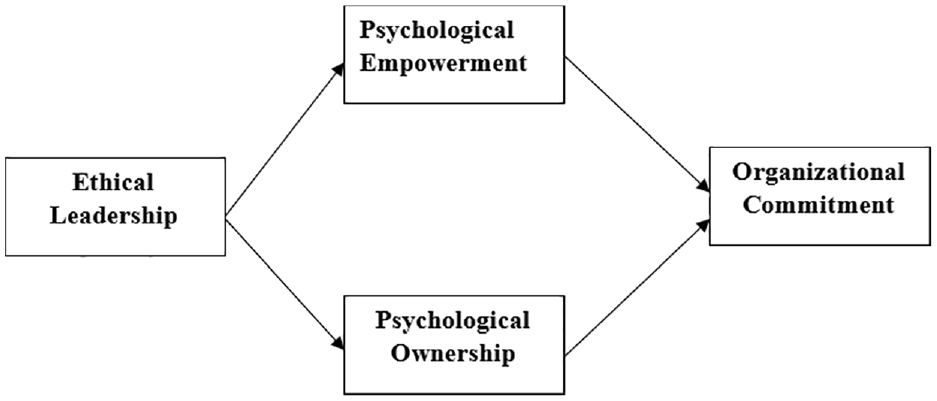
Research framework.
Research Method
Sampling
As Thompson (2012) stated, 384 cases are enough sample size for unknown population hypothesis testing. Krejcie and Morgan (1970) also recommended the same sample size for populations ranging from 75,000 to 1 million. Since our study population (N) is approximately 25.9 million international tourists in Malaysia, our sample size (Sample Size) is 384, as recommended by Krejcie and Morgan (1970). The unit of the analysis of this study hotel employees in China. The researcher decided to distribute 2,000 questionnaires using purposive sampling technique among hotel employees in China and expected to receive back at least 384 for further analysis.
Data Collection
Data were collected from January to October 2022. According to the recommendation of previous research, over 50% response rate is adequate for a pen-paper survey. To get at least 384 responses, 2,000 questionnaires were distributed through a purposive sampling method. To cover the large area, the researchers, and their representatives (e.g., students, friends, colleagues, etc.) were involved in distributing the questionnaire. Out of 886 (44.3%) returned questionnaire responses, 860 responses with complete data and outliers were considered valid for testing the hypotheses.
Measurement
Hotel employees rated their opinions on organizational commitment to environmental performance, ethical leadership, psychological empowerment and psychological ownership. Organizational commitment to environmental performance was measured using the six items from Meyer and Allen (1991). Psychological ownership was measured using seven items from Van Dyne and Pierce (2004). We measured ethical leadership using the 10-item scale from Brown et al. (2005). Psychological empowerment was measured using the nine items adapted from Thomas and Velthouse (1990).
Results
Outliers, Multicollinearity, and Normality
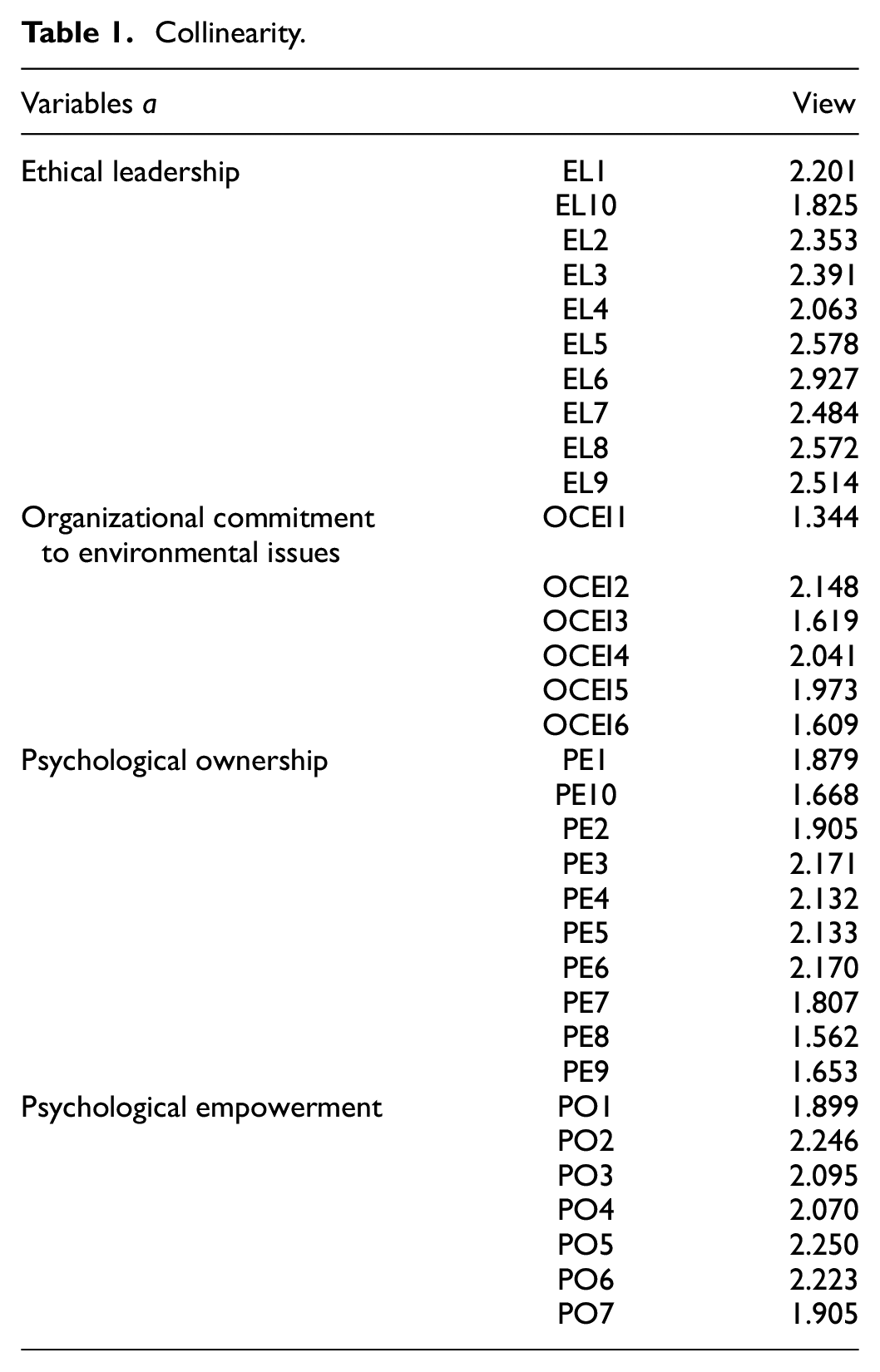
We applied PLS-SEM which is the appropriate tool to test theory and path analysis. The first step was to follow Lynch’s (2013) advice and remove multivariate outliers with a p value of .001 or higher. Due to the data coming from a single source, we took measures both statistical and procedural to exclude the possibility of common method variance (Podsakoff et al., 2012). In addition, we eliminated potential for confounding by using a condensed form of the behavioral intention measurement. A single component explained just 16.54% of the overall variance (63.23%), according to Harman’s single-factor test. In this case, the fact that the value was below 50% proved that the data did not share a common method variance (Podsakoff & Organ, 1986). The study’s collinearity statistics are presented in Table 1.
Collinearity.
Results of the Assessment of the Measurement Model
The convergent and divergent validity of the variables was assessed using a consistent approach, as described by Dijkstra and Henseler (2015). Convergent validity requires a minimum item loading of .60, a composite reliability (CR) of greater than .70, and an average variance extracted (AVE) of greater than .50. All construct pieces had loadings between .642 and .824, as seen in Figure 2 (Dijkstra & Henseler, 2015; Hair et al., 2020).

Measurement model (loading and AVE).
Cronbach’s alpha, rho A, composite reliability, and average extracted variance are presented in Table 2. When compared to the established reliability level, all constructs in the study were found to be credible. When compared to the recommended values of .50, AVE readings were much greater (see Figure 2 in the white circle). The CR values were .943 for ethical leadership, .888 for organizational commitment to environmental issues, .898 for psychological ownership, and .918 for psychological empowerment, respectively. This means that the criteria for convergent validity were met across the board for all constructs (Dijkstra & Henseler, 2015; Hair et al., 2019).
Construct Validity and Reliability.

And the Heterotrait-to-Monotrait (HTMT) ratio needs to be between .85 and .90 for discriminant validity (Hair et al., 2019; Henseler et al., 2015). In all cases, the HTMT ratios were lower than the optimal value of .85 (see Table 3). Furthermore, all indication constructs (primary) were superior to all other constructs. Therefore, all the constructs have adequate discriminant validation for further study, as stated by Hair et al. (2020) and Henseler et al. (2015).
HTMT (Heterotrait & Monotrait) Ratio Criterion for Discriminant Validity.

For insight into the model’s accuracy, we calculated metrics like standardized root mean residual (SRMR) and R2. Satisfaction is indicated by an R2 of .10, but low values of .037, .110, and .226 imply little to no impact (Hair et al., 2020). Predictive value and effect size are both moderate in this model, as seen by the SRMR and R2 values in Table 4 (Hair et al., 2019).
Quality of the Model.

Results of the Assessment of Structural Model and Hypothesis Testing
Direct and indirect effects were tested using statistical approaches (p-values, t-values, and bootstrapping) (see Table 5). Table 5 and Figure 3 reveal that there is a positive correlation between a sense of psychological ownership and empowerment and an organization’s commitment to environmental issues. Because of this, both H1 (t = 2.293, p = .022) and H2 (t = 8.918, p = .000) are true. In addition, ethical leadership is correlated favorably with both a sense of psychological ownership and a sense of psychological empowerment (t = 8.410, p = .000; t = 40.349, p = .000). Therefore, Hypotheses 1, 2, 3, and 4 are all correct.
Hypothesis.

Note. β = path coefficient; ns = not significant.
p < .001 or t > 3.29. **p < .01 or t > 2.58. ***p < .05 or t > 1.96.

Structural model (p-values and path coefficients).
For indirect effect, Table 5 and Figure 3 demonstrate the indirect effects and show that ethical leadership (t value = 9.688; p value = .000) positively correlates with an organizational commitment to environmental issues. Thus, H5 is supported.
Discussion and Conclusion
The purpose of this research is to examine how ethical leadership (EL) contributes to psychological ownership (PO), psychological empowerment (PE) and organizational commitment (OC) to environmental performances among hotel employees in China. Focusing on China, this article examines the mediating function of PO and PE in the link between EL, OC. This investigation provides a nuanced distinction that is crucial to comprehend the effect of EL on PE and OC. Hotel employees’ and managers who hold genuine leadership beliefs were recognized as being crucial in improving morale and making workers feel like they belong at the company. Most researchers agree that when workers are given more autonomy, they perform better (Wicaksana & Mangundjaya, 2021). For instance, Leitão et al. (2019) also agreed that when workers feel they have some degree of autonomy at work, they are more likely to stay motivated and productive, which in turn benefits the organization as a whole. This research confirms previous findings that there is no correlation between EL and OC. Mediating analysis findings, however, show that PE and PO play a pivotal role in this connection (Chen et al., 2021). Psychological empowerment creates a feeling of possession in employees which is the core of psychological ownership. Employees of public sector organizations, when empowered by their higher authorities develop a sense of ownership and perform their job with high affiliation. In this way they are able to do their routine work by going out of the way. Empowered employees are expected to perform beyond their formally prescribed roles (Patwary et al., 2024).
It was also found that psychological ownership had a partial mediating role in the effect of psychological empowerment on employee performance. Organizations have the power to increase their productivity by creating suitable environments for their employees. When organizations exercise effective empowerment among employees the perception of employees develops healthy because they are more engaged to their work. Employee empowerment in all respects will reflect positively on the organization. Employees who feel psychologically empowered will feel a sense of competence in their work and will contribute more to the organization. In this direction, the performance of employees within the organization will increase. But the commitment of employees with a high sense of psychological ownership to their organizations will also be higher and this will have a positive impact on the performance of employees.
Mardani and Mardani (2014) discovered that psychological empowerment has a meaningful and positive effect on organizational commitment. Workplace outcomes are said to improve when there is a strong commitment and relationship among influential factors because it increases employees’ intrinsic drive or sense of control. Exchanges built on trust have a significant impact on the experience and performance of both leaders and followers (Mangundjaya, 2019). These relational duty behaviors are associated with increased psychological empowerment and commitment (Saleem et al., 2019).
Theoretical Implications
Implications for further studies of franchising can be drawn from these findings. Previous studies have analyzed this phenomenon, mostly from the franchiser’s perspective, using the lenses of agency theory and resource scarcity. Based on our research, we may conclude that these points of view are vital, but not sufficient, for understanding how a franchise network can expand so quickly through franchising. To impact franchisees’ thoughts and actions as business owners, researchers need to figure out how to combine the ownership of assets (or property rights) with affective components. Based on our findings, the emphasis on the importance of emotion in the entrepreneurial process, which favors franchising over formal ownership, should be complemented by the psychological ownership dimension (S. Zhang et al., 2021). Researching the effects and influences of emotion or analyzing the development of businesses through the use of planned hybrid organizational forms are both worthwhile avenues for learning more about the circumstances under which franchising is more effective than company ownership over time (Vaio et al., 2020).
Moreover, the findings greatly broaden the scope of studies into the expansion of businesses. Agency theorists argue that entrepreneurs can circumvent management restrictions to business expansion by transforming employment connections into residual claimant relationships (Yue et al., 2019). Furthermore, the results of this research show that business owners can surpass certain managerial constraints on expansion if they take on a “psychological ownership” of their ventures. These findings corroborate the notion that franchises are used by businesses that wish to expand rapidly and therefore suggest that franchising frees up franchisers from some growth constraints (Pick, 2020). Additionally, our findings corroborate the early observations of Ahad et al. (2021) and show that franchisers’ emotional investment in a brand is crucial to the success of franchise chains by helping them to push through internal barriers to expansion. This research has real-world implications because it explains why some franchise groups might not be constrained by a lack of funds or credibility (Ridwan et al., 2020). Or, why franchisees are more likely to invest time, effort, and even out-of-character behaviors (like telling their friends about the franchise) in the franchise system? This study’s findings regarding agency and franchise ownership models provide some food for thought for future research. This research shows that franchise systems thrive because of a focus on cutting down on agency expenses and intangibles like a sense of personal investment and pride in the brand. In general, legal ownership of a franchise system by both the franchiser and the franchisee helps alleviate agency concerns and strengthen the relationship between the principal and the agent in terms of franchise governance. However, proof of the foregoing assertion requires a formal ownership structure in which complementary assets are a part of a brand. We argue that enhancing the franchisee’s brand-specific assets is the only way to raise the departure barrier for a franchise and decrease agency difficulties. Moreover, our research demonstrates that the degree to which an individual feels an emotional connection to a franchise brand is negatively impacted by the ownership of non-brand-specific supplementary assets. Finally, we find that brand-specific complementary asset ownership is adversely correlated with brand-psychological ownership, brand-organizational commitment, and brand-peer diffusion willingness. Nonetheless, we caution that not all associations are robust to statistical analysis. The study recommends that future studies investigate the potential effects of various forms of psychological ownership on a franchisee’s mindset and actions.
Managerial Implications
Workers’ sense of autonomy and independence on the job is a key indicator of psychological empowerment (Ibrahim, 2020). A practice called job enrichment can help businesses reduce employee burnout by making employees’ occupations more interesting and varied by reducing the number of routine tasks they perform. Employees can feel bored with their jobs if they are always the same. This method encourages employees to take initiative and accomplish more.
Choi (2021) states that “empowerment evokes organizational commitment. A meaningful job provides a suitable fit between the requirements and purposes of one’s organizational work roles and one’s value system; A sense of competence gives workers the belief that they can perform their work roles with skill and success, stimulating them to exert considerable effort on behalf of the organization; Self-determination gives workers control over their work and a voice in the work-related decision process, leading to enhanced involvement in the organization; and Having impact facilitates workers’ possibilities to participate in shaping the organizational system in which they are embedded.”
According to the social exchange theory, when an employer invests in its employees by providing them with more autonomy, those workers will feel beholden to the company and will be more likely to work hard for it in return (Xu et al., 2020). As a result, there won’t be any need for a supervision system if workers are given the autonomy to carry out their assigned tasks. We advise managers to form teams to foster the growth of employees’ inherent skills since psychological empowerment has been shown to have a good and significant effect on employees’ dedication to their organizations. Employees’ issues may originate from a lack of faith in their talents. Workers who are given specific tasks to complete may have a more positive outlook on their jobs and the company as a whole.
The findings revealed that employee burnout is reduced when there is a strong sense of belonging to the firm. One of the major contributors to employee burnout is a lack of dedication to the company. Negative work outcomes were buffered for those who were dedicated to their organizations because they had a deeper sense of belonging and purpose in their jobs as a result (Scharp et al., 2021). The level of dedication that employee has to their organization buffers them from the harmful consequences of stress and burnout (Park et al., 2020).
Increased employee emotional involvement is proposed as a means of lowering burnout’s two main components: a lack of enthusiasm for one’s work and a belief in one’s inadequacy. For instance, reducing feelings of ineptitude and increasing the likelihood that employees will remain with the company can be accomplished by fostering a close-knit, cooperative environment and a sense of sympathy among workers. Through increased organizational dedication, psychological empowerment can also reduce job burnout. To reduce the stress at work that leads to burnout, it is advised that we pinpoint and manage the elements that determine the intensity and frequency of burnout. Staff psychological empowerment, including increased competence, adequate freedom, job dedication, a sense of efficacy, and relief from job-related stress, might help resolve this problem.
An improvement in competitive advantage can be achieved by the psychological empowerment of employees and the addition of values in people management, as discussed by Li et al. (2018). Employees who feel they have a voice in the company’s direction are more likely to work hard to enhance their work and prove themselves, valuable contributors. Highly talented workers are the most useful to a business at the strategic level, where they may help it gain a competitive edge by implementing new strategies (Amor et al., 2021). The degree to which an employee feels psychologically empowered can provide insight into that person’s strength in an organization (Maan et al., 2020). High levels of competitive advantage are achieved when employees believe their work makes a difference and that they have the freedom to make decisions.
Limitations and Future Research Directions
The first drawback of our study is that, because of the difficult organizational situation, we did not try to investigate nurses’ perceptions of the level of theoretical empowerment they experienced at the hospital (Lv et al., 2021). To learn more about the relationship between actual and perceived levels of empowerment, a multi-level study of hospitals with varying levels of (actual) empowerment is warranted. The impacts of EL on outcomes are embedded in the more complicated pathways associated with high-performance and high-involvement work, which has been the focus of this research. One interpretation of this research is that it is an attempt to measure the contribution of EL to WE via physical activity and attentional control channels. Work-related stress, burnout, and attrition are just a few examples of potential consequences that could benefit from more study. That it was conducted among hotel employees in China, is another evident constraint. The extent to which the results can be extrapolated to other situations is constrained. Future studies should include a larger sample of hospitals. Leadership theory demonstrates the need of situating leadership practices.
Footnotes
Declaration of Conflicting Interests
The author(s) declared no potential conflicts of interest with respect to the research, authorship, and/or publication of this article.
Funding
The author(s) received no financial support for the research, authorship, and/or publication of this article.
Ethical Approval and Consent to Participate
N/A
Consent for Publication
We do not have any individual person’s data in any form.

Data Availability Statement
The data that support the findings of this study are openly available on request