




Abstract
The undeniable presence of translators has stimulated a growing interest in issues such as translator’s voice by Theo Hermans and translator’s style by Mona Baker. For a long time, existing research in China has exclusively explored translational style, with a focus on the faithful reproduction of the style of the source text (ST) in the target text (TT). Since Baker’s introduction of corpus-based translation studies in 2000, translator’s style has been an emerging and fast-growing topic in translation studies in China bolstered by empirical data for more persuasive argumentation. This research first adopts a bibliometric analysis of translator’s style by employing articles from the database Web of Science (WoS) for international studies and the Chinese National Knowledge Infrastructure (CNKI; CSSCI-indexed; Chinese Social Sciences Citation Index) for Chinese studies. As Chinese scholars rank first in the contributions generated according to the collaborative countries analysis, there is a need to examine the current development of translator’s style in China. This study will help answer a series of queries on topics such as the most researched domain, the most applied mode and the most researched work. Furthermore, by closely examining the timezone view of keywords of translator’s style studies, and a close reading of selected articles, three stages and three modes are suggested for studies on translator’s style. Then, recent development of translator’s style in China is presented to draw a clear picture of corpus-based studies of translator’s style in China, followed by a summary of the deficiencies present in existing Chinese studies of translator’s style.
Plain language summary
This research first adopts a bibliometric analysis of translator’s style between China and other countries. This study employs articles from the database Web of Science (WOS) for international studies and the Chinese National Knowledge Infrastructure (CNKI; CSSCI-indexed; Chinese Social Sciences Citation Index) for Chinese studies. As Chinese scholars rank first in the contributions generated according to the collaborative countries analysis, there is a need to look both backwards and forwards to examine the current development of translator’s style in China. Doing so will present an overall picture of the strengths and weaknesses of translator’s style in theory and practice in the Chinese context. This study will help answer a series of queries on topics such as the most researched domain, the most applied mode and the most researched work. Furthermore, by closely examining the timezone view of keywords of translator’s style studies, and closely reading selected articles, three stages and three modes are suggested for studies on translator’s style.
Keywords
Introduction
The definition of Translator’s Style
As scholars have begun to view translation in the historical context, such as “translation as history” put forward by Hermans (2022), exploring the important function of translation in the historical past, nowadays, translators as important figures in historic moments have been mentioned with greater frequency than in the previous translation studies (see Burke, 2007; Rizzi et al., 2019; etc.). This has led to more studies on translators and one important topic has been translator’s style, with style regarded as “a textual and personal attribute” (Saldanha, 2011a, p. 28).
As claimed as “a kind of thumbprint that is expressed in a range of linguistic—as well as non-lingustic—features” and called as “preferred or recurring patterns of linguistic behavior” (Baker, 2000, p. 245), translator’s style concerns the style of the translator, different from the style of the text (translation style), as demonstrated by Malmkjær (2003) and Boase-Beier (2006). Saldanha (2011a, p. 31) has worked out a revised definition of translator style that shares the following characteristics: A “way of translating” which (a) is felt to be recognizable across a range of translations by the same translator; (b) distinguishes the translator’s work from that of others, (c) constitutes a coherent pattern of choice, (d) is “motivated,” in the sense that it has a discernable function or functions, and (e) cannot be explained purely with reference to the author or source-text style, or as the result of linguistic constraints.
In China, translator’s style has been studied in both broad and narrow fashions. In the broad sense, translator’s style refers to “both the linguistic and non-linguistic features including the selection of the source text and the use of the translation strategies and methods, preface, footnotes and endnotes, etc.”(Hu, 2016, p. 123). In the narrow sense, translator’s style refers to a “translator’s preferences in language use, or the recurrent linguistic patterns in the target text” (Hu, 2016, p. 124). Translator’s style also encompasses the artistic features and creativity of a translator (C. Li, 2009, p. 10).
Regarding the controversy over the existence of translator’s style, most investigations have found that stylistic differences are indeed present among individual translators (Baker, 2000; Lynch & Vogel, 2018; Pan et al., 2017; etc.). Others, however, have not found such discrepancies and argue that translators do not leave any traces in their translations (Rybicki, 2012, etc.).
By employing Burrows’s Delta, one of the machine-learning stylometric distance methods used in identifying authorship attribution, in corpora of literary translations, Rybicki (2012) finds that Delta usually fails to identify the translator and identifies the author of the original instead. However, in another study of translationship attribution in the Polish translation of a single novel by Virginia Woolf, Night and Day, which was taken over by another translator when the first translator died, Rybicki and Heydel (2013) find that Delta (stylistic authorship attribution methods based on a multivariate analysis of most-frequent-word frequencies) has been successful in identifying the point of takeover in this translation. The reason why Rybicki (2012) failed to identify translator’s style is that the technique, Delta when used for translatorship attribution, might not necessarily be adequate to differentiate one translator’s style from the other. The design of Delta relies heavily on subject matter, examining linguistic habits at the lower syntactical level, but that’s not where translator’s deliberate choices are captured.
More recent studies of corpus-based translator’s study can be found in K. Liu and Afzaal (2021) for the analysis of lexical bundles in two English translations of Hongloumeng and Y. Liu (2022) for the analysis of two Chinese translations of Moment in Peking, etc.
The Theoretical Framework for Translator’s Style
Style has been defined as “the linguistic characteristics of a particular text” (Leech & Short, 2007, p. 11). The importance of style has been made more prominent in recent translation studies, such as the emphasis on the primordial feature of style in the translation of the literary text in Hewson (2001), as he tries to go against the forces sweeping style in translation into oblivion.
M. Munday (2008, p. 227) stresses that “style in translation is inherently non-systematic as none of the translators always translates in the same way in all cases” and that “translation is not scientific and there is always an element of choice and poetic taste.” By locating different parameters to make translator’s style prominent, it is the researcher’s responsibility to explain more about the process and product of translation, how and why the translation came about the way it did and what social, cultural and political effects the translation produced on the target language and target culture (D. Li, 2017, p. 111).
In traditional translation studies, translators are believed to be invisible as accuracy and faithfulness are required of translators to realize the primacy of the source text and achieve equivalence. Thus, reproduction of the style of the source text is the ultimate goal for translators to achieve. Since the cultural turn in translation studies in the 1960s, translators tend to be visible as they are the ones who take a central role in cross-cultural activities to reshape the target text. Especially since the advance of descriptive translation studies, scholars have put forward systematic descriptive research methodology for translation studies, such as the three-phase research methodology put forward by Toury (1995) and latter summarized by J. Munday (2001, p. 112):
Situate the text within the target culture system, looking at its significance or acceptability;
Compare the ST and the TT for shifts, identifying relationships between “coupled pairs” of ST and TT segments, and attempting generalization about the underlying concept of translation;
Draw implications for decision-making in future translating.
The three-phase methodology can also be applied in the study of translator’s style and evidence of the translator’s fingerprints can be found in diverse sources, such as translators’ prefaces or notes, footnotes or endnotes in the translated text, interviews of the translators, and review of translations by the professional readers and pleasure readers, etc.
There are basically four theoretical approaches for explaining style in literary translation, that is, stylometry, literary stylistics, cognitive stylistics, and sociology, summarized by Saldanha (2021).
From the perspective of stylometry, the techniques borrowed from stylometry, such as Delta, are originated to identify authorship attribution and pay more attention to the linguistic habits at the lower syntactic level. Different statistics, such as average sentence length and type/token ratio employed by Baker (2000) are ideas borrowed from stylometry to identify the differences between translated works. However, the deliberate uses of language in translations are beyond the level that can be captured by those techniques.
From the perspective of literary stylistics, identifying stylistic features attributed to the translator has been the main focus. As what may be termed as natural, the translator’s style is likely to be superimposed on an author’s style (Bernardini, 2005), but it has been detected by studies done in the comparison between the target text and the original text, and comparisons of different translations within the same time span as well. Keywords have also been applied in the study of translator’s style, but relatively few, such as keyword analysis for the identification of translator’s personal usage of German modal particles with different frequences in Winters (2009). In addition, after comparing the keyword lists from Xiao’s and Jin’s Chinese version of Joyce’s Ulysses, Q. Wang and Li (2011) make a double check of the sharp-contrasted verb duo (
Mikhailov and Villikka (2001) claim that modal words, particles, conjunctions, grammar forms, etc., as well as splitting or joining sentences and paragraphs and expanding or shortening the text could be the most important indicators to identify translator’s personal features.
From a cognitive stylistics approach, Boase-Beier (2006, p. 5) focuses on “the style of the source test as perceived by the translator and how it is conveyed or changed or to what extent it is or can be preserved in translation,” and assumes that “by attempting to reconstruct the style of a text, the translator is attempting to reconstruct states of mind and thought processes, always with the awareness that individual states of mind are affected by social and cultural influences.” Xu (2006) adopts a relevance-theoretic approach to the translator’s style for its better explanation of unidiomatic translation, multi-translation, implicit, and explicit information in translation and translation of poetry, as the optimal relevance can be achieved by a balance between the translator’s understanding of the target reader’s cognitive environment and the translator’s own preference and ability.
From the perspective of sociology, Simeoni (1998, p. 1) has employed habitus to help account for the reason why as we register intuitively when reading them, translators’ styles differ consistently from one another (and from the authors’, whose voices they report). The concept of habitus has been employed to explain the translator’s stylistic patterns in Yannakopoulou (2014).
The first approach, that is, stylometry will be further demonstrated here. The potential of corpus linguistics has been most identified in Baker’s early work (Baker, 1993, 1995, 1996), launching corpus-based translation studies.
As stated by Tymoczko (1998, p. 653), a number of CTS (corpus-based translation studies) scholars promote and justify corpus-based approaches on the grounds that such studies will uncover and establish universal laws of translation. The distinctive, universal features of translated texts have been summarized by Baker (1996, pp. 176–177) as simplification (the idea that translators subconsciously simplify the language or message or both), explicitation (the tendency to spell things out in translation, including, in its simplest form, the practice of adding background information) and normalization or conservatism (the tendency to conform to patterns and practices which are typical of the target language, even to the point of exaggerating them) and leveling out (less idiosyncratic, more similar to each other, for translated texts than original texts). Researchers in CTS also pay attention to the distinctive behavior of individual translators.
In terms of translation, rather than original writing, the notion of style might include the (literary) translator’s choice of the type of material to translate, where applicable, and his or her consistent use of specific strategies, including the use of prefaces or afterwords, footnotes, glossing in the body of the text, etc. (Baker, 2000, p. 245).
The linguistic and nonlinguistic patterns modified based on Baker (2000)’s study for translator’s style are demonstrated in the figure below (Table 1). By comparing the standardized type/token ratio, average sentence length, frequency and patterning of SAY in the translated works by two translators, Baker (2000) finds that the type/token ratio is lower overall for Clark, with a very restricted range of variation among individual texts. However, in Bush’s translations there is much more variation among individual texts (Baker, 2000, p. 250). The average sentence length is much lower for Clark and again with much less variation among individual texts (Baker, 2000, p. 251).
An Extended Framework of Translator’s Style Based on Baker’s (2000) Model.

The study of translator’s style, for most cases, involves two stages. The first stage involves revealing stylistic patterns that are specific to the translator and the use of translation strategy and translation methods, and the second stage is to interpret the findings and expound possible reasons for translator’s style from extra-linguistic factors, as stated in Saldanha (2005, p. 54)’s statement, that is, the socio-economic context, the translator’s background, the translator’s project, the translator’s position, and the horizon of translation.
With Baker’s framework as the starting line, many researchers go deeper and discover more parameters involved in the study of translator’s style. Analysis techniques range from the basic statistics initially applied by Baker (2000) and others (Huang & Chu, 2014; Kajzer-Wietrzny, 2013; Walder, 2013), to more complex stylometric techniques such as Delta, applied for example by Rybicki (2012), Rybicki and Heydel (2013) (Bernardini & Kenny, 2019, p. 113). Follow-up corpus-based studies have further advanced Baker’s linguistic patterns.
In this bibliometric analysis, translator’s style is adopted in the broader sense, including corpus-based and non-corpus-based studies.
Purpose of the Study
This study aims to answer the following four main questions:
(1) What are the differences in translator’s style within translation studies between China and the West with data collected from WoS and CNKI (CSSCI) respectively, in terms of co-citation clusters analysis, keyword analysis and cluster analysis based on Citespace and VOSViewer?
(2) What are the stages of studies on translator’s style in China?
(3) What are the most applied research modes in studies of translator’s style in China?
(4) What is the recent development of translator’s style in China and its deficiencies within the Chinese context?
The review of translator’s style allows us to trace the origins and most recent development of translator’s style in China. Thus, we can gain a greater understanding of relevant trends and use them as references for comparison of translation studies between China and the West.
Research Methodology
The benefits of applying bibliometric analysis in translation studies have been demonstrated in many studies carried out by scholars in translation studies in recent years (Gile, 2000; Šajkevič, 1992; etc.).
A special issue for bibliometric and bibliographical research in translation studies has been presented in Perspectives, the renowned journal in translation studies in 2015. The metabibliometric approach includes crucial methodological issues, such as the way an innocent-looking collection of bibliographic data might impose particular mappings of TS conducted by Gile (2015), and the confirmation of the use of English in translation studies as a lingua franca in Agost (2015), and a review of macro- and micro-level biases in research assessment rankings and peer review in translation studies by Franco Aixelá and Rovira-Esteva (2015), and exploration of the subfields within translation studies, shifts of research interests and foci over the years by Zanettin et al. (2015).
The bibliometric proper approach has also been applied to find out that a spearhead of a small group of scholars with a continuous interest in non-professional interpreting are complemented by one-timers from a wide array of disciplines in Martínez-Gómez (2015). This approach has also revealed low international visibility of Mainland Chinese Translation Studies Scholars in X. Li (2015), and a steady and consistent stream of research on interpreting studies based on a corpus of nearly 1,300 Chinese-language theses in Z. Xu (2015), as well as a detailed exploration of the geographical spread of Translation and Interpreting research and links between keyword frequency and journals and languages of publication in van Doorslaer and Gambier (2015). In addition, M. Zhang et al. (2015) conduct a bibliometric analysis of discourse analysis and translation studies by making a survey of eight translation journals in the period of 1990 to 2013.
Not limited to a glimpse of translation studies or interpreting as a whole, F. Wang et al. (2019) have sketched a map of the translation studies conducted so far on The Journey to the West based on the keyword analysis of the bibliographical data. D. Dong and Chen (2015) employ co-citation and co-occurrence analysis methods to identify three important aspects of translation studies, that is, the core literature (linguistic theories, research methodology, theoretical models, interpreting, and new perspectives), the key publication sources (language and linguistics, applied linguistics and pragmatics, phonetics and acoustics, and translation and interpreting) and major research areas (theoretical translation studies, translation and interpreting training, and descriptive translation studies).
Just like the emphasis placed on the significance of the citation information in the bibliometric studies in D. Dong and Chen (2015, p. 1112), this study also explores the co-citation cluster of the international studies on translator’s style, so as to identify the structure of this discipline, the trends that developed within, and the network of authors and papers that belong to the same school, paradigm or theory therein (Borgman, 1990; White, 1990; etc.).
In this study, we carry out cluster analyses using VOSviewer to produce visualization:
Co-citation analysis of the cited references to identify the core literature as well as their linkage to other works;
Keyword cluster analysis of translator’s style in WoS (Web of Science) and CNKI (CSSCI) in China.
The bibliometric analysis applied in translation studies has provided a more comprehensive and relatively broader view of a large dataset by its robust automatic cluster function. The automatic integration of keywords of retrieved papers into meaningful groups according to the similarities can be efficient and effective in data mining and analysis and present sufficient supporting materials for later qualitative interpretation of those statistics generated from the software.
This study’s bibliometric analysis primarily employs VOSviewer and Citespace to visualize nodes and networks. VOSviewer allows for a clear and detailed presentation of thematic clusters. Citespace in turn provides powerful analysis in-reference co-citation and gradual optimal algorithm analysis and function. In this study, in addition to cluster analysis based on VOSviewer, we employ Citespace for key word analysis, timezone view, keywords trend chart and top 25 keywords with the strongest citation bursts. Given the different advantages of each software, this study will combine these two tools in the interest of the best possible outcome.
The qualitative analysis of both English and Chinese articles aims to systematically examine most researched terms, theories and translated works. The evolution of the research on translator’s style and the research modes in the Chinese contexts are also analyzed.
This research adopts a combination of quantitative and qualitative analysis. The quantitative analysis will be supplemented by a qualitative analysis based on reasoning and intuition, rendered by a close reading of the international bibliography and the Chinese contributions on the topic of translator’s style.
After a brief comparison of journal articles from China and abroad, we determined that our interest lies in a more detailed analysis of the stages developed and research modes scholars adopt in the study of translator’s style in the Chinese context. This study further reports the latest development and the insufficiencies in research on translator’s style in the Chinese context and its gaps compared to its international counterpart.
Data Sources and Selection
Papers selected from WoS must come from Web of Science Core Collection (WoSCC) and papers selected from China National Knowledge Infrastructure (CNKI, the largest database for academic online libraries in China) should be included in Chinese Social Sciences Citation Index (CSSCI, which compiles cutting-edge research in social sciences and humanities in China). The reason is that both WoSCC and CNKI (CSSCI) are representatives of authoritative data sources in international and Chinese academia, respectively.
In WoS, we limit our search to article type and the timespan was set to cover the period 1992 to 2022. To narrow the scope of the selected articles, we refine the data to include research categories most relevant to the study of translator’s style: Language Linguistics, Linguistics and Literature.
As we chose “Language Linguistics, Linguistics and Literature” as the category in the database of Web of Science, the majority of articles under the Category “Literature” were excluded for their primary or full attention to (1) introducing the famous writer’s career and contribution as a literary writer and translator, with style only been mentioned as a minor part of the writer’s writing characteristics (2) discussing the style of certain literary works with translation only mentioned as a brief introduction to the dissemination of the work, not for the research foci.
In addition, for the Chinese part, we have excluded book reviews, introductions of new books, and symposium review and reflections on the course related to translator’s style from the result.
The English bibliographical references with full records of meta-information (such as journal names, author names, abstracts, keywords, institutions and references) were downloaded from the Web of Science Core Collection (1985–present), the world’s leading scholarly academic search engine. They were then loaded into the bibliometric analysis software VOSviewer for the generation of keyword clusters, co-citation cluster graphs and more. The software Citespace has also been applied to generate a timezone chart based on keywords. As all cited references for all publications are fully indexed in Web of Science (abbreviated as WoS), the collection allows for co-citation clusters to be generated. Citespace can also demonstrate the frequency of academic works and journal articles referenced and cited, as well as the research foci in this area.
For the Chinese part, in addition to the retrieved data from CNKI labeled in CSSCI, we have added another 13 qualified journal articles published in CSSCI journals before 1997, the year when the CSSCI was established as a key index. The earliest publication can date back to the year 1980, when Hong (1980) is not supportive of translator style and regards the author as the only object to follow in translation.
The Chinese bibliographical references (with meta-information, including journal names, author names, abstracts, keywords, institutions and so on) were downloaded from CNKI. The selected references were indexed in the Chinese Social Sciences Citation Index (CSSCI). When loaded into the software VOSviwer and Citespace, keyword lists and cluster graphs are generated.
The bibliometric indicators include the year of publication, keywords, authors, institutions, and references.
The two authors checked the research results with title, author information, journal information and abstract retrieved from the WoS Core Collection and CNKI (CSSCI-Indexed), screened out the articles needed in the study, and then discussed whether to leave the articles out. When different opinions converged, we reread the abstract together and referred to the full text when necessary to reach a consensus.
Data Analysis
We searched Web of Science for references in which the topic contained “translat*” AND “styl*.” This search produced 292 articles. These were procured after refining by Web of Science Categories under the selection of “Language Linguistics, Linguistics and Literature” and sorting out irrelevant book reviews, chapters, and conference proceedings—as well as articles not specific to translator’s style—from 692 references which were originally obtained from searching the Web of Science Core Collection. This data was retrieved on 15 September 2022.
We searched CNKI for the search item “theme” that contained “
The metadata was saved as Refworks format, with key journal information stored, such as research type, author, institution, title, publications, publication year, keywords, and abstract.
The dataset from WoS contains reference lists, so co-citation clusters can be generated by VOSViewer to present the most-cited and referenced academic works and academic journals, which can further demonstrate the research foci in the current area.
For the Chinese part, the metadata was also saved in the same type, but without references included.
In VoSviwer, press Button “Create” in the Map and choose type of data “Create a map based on text data.” Then, choose data source (Read data from bibliographic database files). Next, choose the text downloaded from Web of Science. For the next step, for type of analysis, choose “co-occurrence” and for unit of analysis, choose author keywords and for counting method, choose “full counting.” And then adjust the keyword occurrence to best present the node numbers in the map. Then, network visualization (occurrence ≥ 3) is presented in Figure 3.
In Citespace, timespan is set from 2006 to 2022, with Slice Length=1. We choose Keyword at the Node Types, Pathfinder at the Pruning. Then the visualization is shown in Figure 4. Other procedures follow the same pattern. For the Chinese part, similar procedures are adopted.
Results and Findings
A Bibliometric Analysis of Translation Studies on Translator’s Style in WoS and CNKI (CSSCI)
The overall development of research in translator’s style in translation studies in China can be presented. Figure 1 shows that the first paper appeared in 1980 in the database. There are only scattered publications in this domain until 2006.

119 Articles on translator’s style published in CNKI (CSSCI) journals in China.
As the data searched from Web of Science starting the year 2006, the frequency of publications on translator’s style in China and abroad through 2022 is illustrated in Figure 2. The figure has shown that the two lines share the same rise and decline in most cases with only some exceptions. This demonstrates that research on translator’s style is still in its preliminary stages in China and abroad. However, it is promising to see a sharp increase in the period 2018 to 2021 in the international database. This growth represents a gradually increasing interest in translator’s style within translation studies. Due to the time lag of indexed articles and incomplete data for the entirety of 2022 (as it was retrieved before the end of the year), it can be inferred that both of the lines were still on the rise through 2022.

Publications on translator’s style in WOS and CNKI(CSSCI) 2006–2022.
Co-Citation Clusters Analysis
Co-citation clusters analysis can represent the theory and methods applied in studies on translator’s style. By adopting VOSviewer software for co-citation clusters analysis, 63 references (occurrence ≥ 4) have been automatically generated into five clusters, as visualized in Figure 3. The larger the space a cluster occupies, the greater the number of co-citations collected in the cluster. As shown in Figure 3, the bigger the font size, the more times the co-citation has been cited. In addition to cutting-edge academic journals from the Web of Science, academic works that have been frequently cited are also presented in Figure 3.
Cluster 1 (color red) concerns literature reviews and descriptive methods of translator’s style, as represented by encyclopedias of translation studies (Bassnett, 2002; J. Munday, 2001) and anthologies of essays in translation studies. Additionally, translator’s invisibility (Venuti, 1995, 2008, 2013), descriptive translation studies (Toury, 1995), sociology (Bourdieu, 1993) and polysystem theory (Even-Zohar, 1990) have been frequently applied as frameworks for descriptive methods in translator’s style.
Cluster 2 (color green) represents the research methodologies adopted in translator’s style. Quantitative and qualitative methods have been combined under a corpus-based approach to translator’s style, represented by Baker (1993, 2000, 2004), Bosseaux (2004), Olohan (2004), Laviosa (2002), and Huang (2014). Cluster 3 (color blue) is concerned with the comparison of two German translations of F.S. Fitzgerald’s The Beautiful and Damned by Winters (2004a, 2004b, 2007, 2009). Cluster 4 (color yellow)is about the stylistic approach to translation studies, as represented by Boase-Beier (2006). Cluster 5 (color purple) centers around style and foregrounding by G. Leech (2008) in his influential work, titled Language in Literature: Style and Foregrounding.
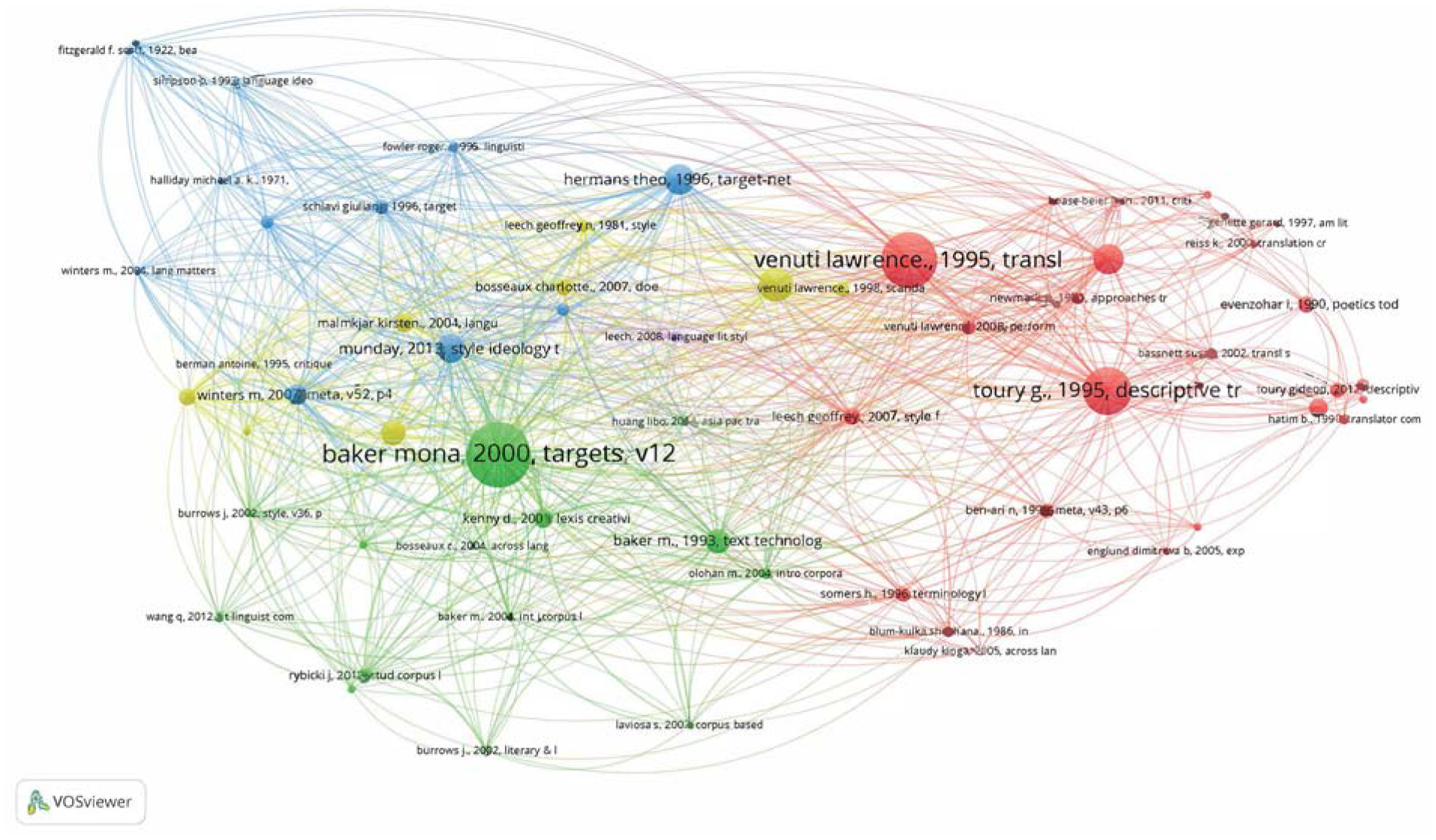
Cocitation clusters.
Co-citation cluster analysis has demonstrated the interdisciplinary nature of translator’s style. This is done by borrowing insights and ideas from stylistics, descriptive translation studies, the sociology of translation, and other related disciplines. A corpus-based approach to translator’s style has been trending among recent studies. Furthermore, the co-citation analysis is in line with Saldanha’s (2021) examination of translator’s style from the four theoretical approaches: stylometry, literary stylistics, cognitive stylistics and sociology.
Keyword Analysis
Keywords of translator’s style in WoS are automatically generated in Citespace (occurrence ≥ 3) as shown in Figure 4. The larger the circle, the more prominent and frequently discussed the keyword is. Translator’s style is addressed most within the domains of literary translation (occurrence: 27, rank: 1) and translation studies (occurrence: 10, rank: 2). Translation strategy (occurrence: 10, rank: 2) is the most popular topic (occurrence: 7, rank: 4). Modal particle (Winters, 2007, etc.) has been the most frequently discussed subject explored under the corpus-based translation studies of translator’s style. This is the approach that has been most frequently adopted by scholars, as evidenced by the terms “corpus stylistics,” “corpus methodology” and “corpus” ranking seventh, eighth and ninth, respectively, on the keyword list. Additionally, studies on translator’s style have emerged from the traditional domain of translation studies to be put under the framework of world literature. This leads to a further discussion of the significance of translated literature to other literature within its country of origin or from an international lens.
Finding 1: The evolution of the term. As shown in Figure 5, keywords “
Finding 2: The most researched work. The keyword
Finding 3: The most researched mode. As illustrated in Figure 5, “
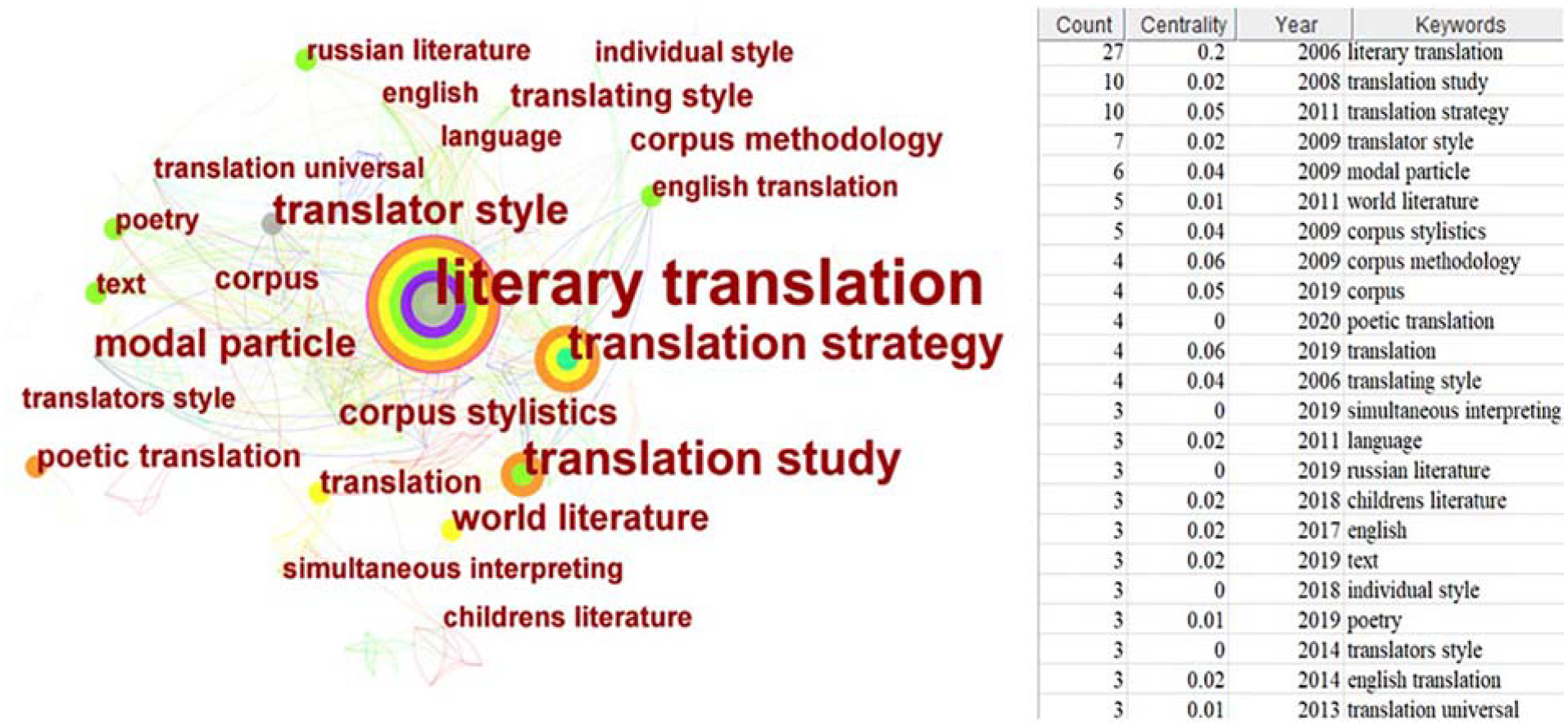
Keyword analysis of translator’s style in WoS generated by Citespace (occurrence ≥ 3).

Keyword graph in CNKI (CSSCI; generated by Citespace, occurrence ≥ 3).
Cluster Analysis
According to the software VOSviewer’s automatic generation, a total of 131 keywords (occurrence ≥ 2) from 292 articles are grouped into 19 clusters as shown in Figure 6. These seemingly-scattered but close-knit 19 clusters (as shown in Table 2) can be further combined into seven categories.
Category 1 is translator’s style in the newly-emerging topic of audiovisual translation—with subtitling or dubbing as its major domain. Mboudjeke (2016) finds that Quebecois and French translators rendered differently in their representations of 104 first-person singular future actions in dubbing and regarding the variability observed from factors such as sex, age, social class, and level of education. These differences are the results of both a style-shifting phenomenon and an ideological posture taken by the translators.
Category 2 is corpus-based study of literary translation, or translator training as mentioned in Clusters 3, 4, and 6. Baker (2000) proposes a target-text-oriented research methodology for studying translator’s style. She discusses its application in the corpus composed of five English translations by Peter Bush from Portuguese and Spanish, and three Arabic-to-English translations by Peter Clark. Saldanha (2011a) formally proposes the research methodology for translator’s style and investigates the use of loanwords, taking both S and T-type translator’s styles into consideration. She further examines the uses of italics and say/tell connectives based on a bidirectional English-Portuguese translation corpus. Saldanha (2011b) finds that italics may be less common in English translations from Portuguese than in non-translated English texts. In addition, how interpreters make decisions in critical points has been revealed from the corpus-based approach.
Following Baker (2000)’s line, this approach is mainly from the perspective of linguistic preference and translation strategy, based on either a comparative or a parallel model. Olohan (2003) investigates the tendency of using contradicted forms in four novels translated by Peter Bush and Dorathy S. Blair. Olohan (2004) later validates and examines translation strategies through the keyword lists of four novels translated by Venuti. Winters (2004a, 2004b, 2007, 2009, 2010, 2013) compares two German translations of Fitzgerald’s The Beautiful and Damned from the perspectives of loanwords and code-switching, mood particles, speech-act report verbs, narrative perspective, and presentation of speech thoughts. Ji (2008, 2009) focuses on the use of four-character idioms and archaic styles in two Chinese translations of Don Quixote. Additionally, Casas-Tost (2014) examines onomatopoeia in the Spanish translation of To Live (a novel written by Yu Hua, a famous Chinese novelist). Khalifa (2020)’s study also falls into this category by discussing the phenomenon of retranslation.
Besides, this approach can be delved into from certain stylistic characteristics. Ren et al. (2014) employ corpus stylistics to examine the use of (im)politeness in Death of a Salesman and its two Chinese-translated versions. In doing so, they find that modal particles and slang expressions in Chinese help to reconstruct the characterization of the translated drama.
Category 3 is interpreter’s style as shown in Clusters 5 and 12. Gumul (2021) investigates the correlation between explicitating frequency and retrospective styles in simultaneous interpreting trainees. This is done to identify idiosyncratic differences. Gumul thus determines that a significant correlation exists between the density of explicitation patterns and the verbosity of the participants.
Category 4 is translation history as shown in Clusters 5, 15 and 18. In some cases, translator’s style has been examined from the perspective of paratextual information. By exploring the social status and role of Roman interpreters and their continuous association with limited education, McElduff (2009) argues that Cicero’s rejection of the interpreter as a literal translator was not just a rejection of a particular style of translation, but an attempt with a specific purpose to keep the elite position of translation of Greek literature in Rome.
Category 5 is machine translation studies. Kenny and Winters (2020) use Hans-Christian Oeser, a renowned English-German translator, as an example to study how the process of machine translation affects a translator’s voice. The result shows that Oeser’s textual voice is weakened when he edits a chapter of a novel he has translated and that the contextual voice is still prominent when he comments on the edited work later on.
Category 6 is translator’s style with different genres or text types. As illustrated in Clusters 7 and 8, most studies have focused on fiction literature; however, genre literature, poetry, operas, religious texts, songs, and other text types have also been addressed. Based on two professional corpora, Diao (2022) uses the L2SCA (the L2 Syntactical Complexity Analyser, a tool for the examination of syntactic complexity of written English) and the MAT 1.3.2 (the Multidimensional Analysis Tagger designed by Andrea Nini for the purpose of Multi-Dimensional Analysis) to investigate the stylistic and linguistic features of the English translation of the first two volumes of The Legend of the Condor Heroes (a wuxia novel by Chinese writer Louis Cha, better known as Yong Jin). The results indicate that the two translated volumes share a large degree of homogeneity at the syntactic and lexico-grammatical levels.
Catering to a different group of readers and based on a corpus-based model, Zabir and Haroon (2021) find that many types of creative lexical items in children’s literature are replaced with common words when translated from English into Malay. The unique features of the original works are thus lost, but translators compensate for some losses by introducing other elements into the translations.
Category 7 is world literature. Some studies on translator’s style have been carried out from the viewpoint of world literature, emphasizing the importance of translators’ contributions to promoting cultural exchange and communication among different nationalities. Muhaidat (2021) speaks highly of Haqqi’s considerable effort in his translation of Emily Bronte’s (1818–1848) Wuthering Heights (1847), a landmark of English and world literature, accessible to Arabic readers. Boggild’s (2018) appraisal of translations of Hans Christian Andersen is not so favorable, however; he points out that Andersen’s writings have been translated predominantly for children, despite this not being the author’s intended audience. Boggild analyzes the sanitizations of Andersen’s original texts and how difficult formulations and stylistic anomalies have been eliminated by his two major English translators, Christian Haugaard and Jean Hersholdt Erik. Boggild concludes that such translations have diminished the thematic depth and complexity of Andersen, as well as his stylistic idioms.

Keyword clusters of translator’s style in WoS generated by VOSviewer.
A Full List of Keyword Clusters of Translator’s Style From WOS (Retrieved From 292 Articles).

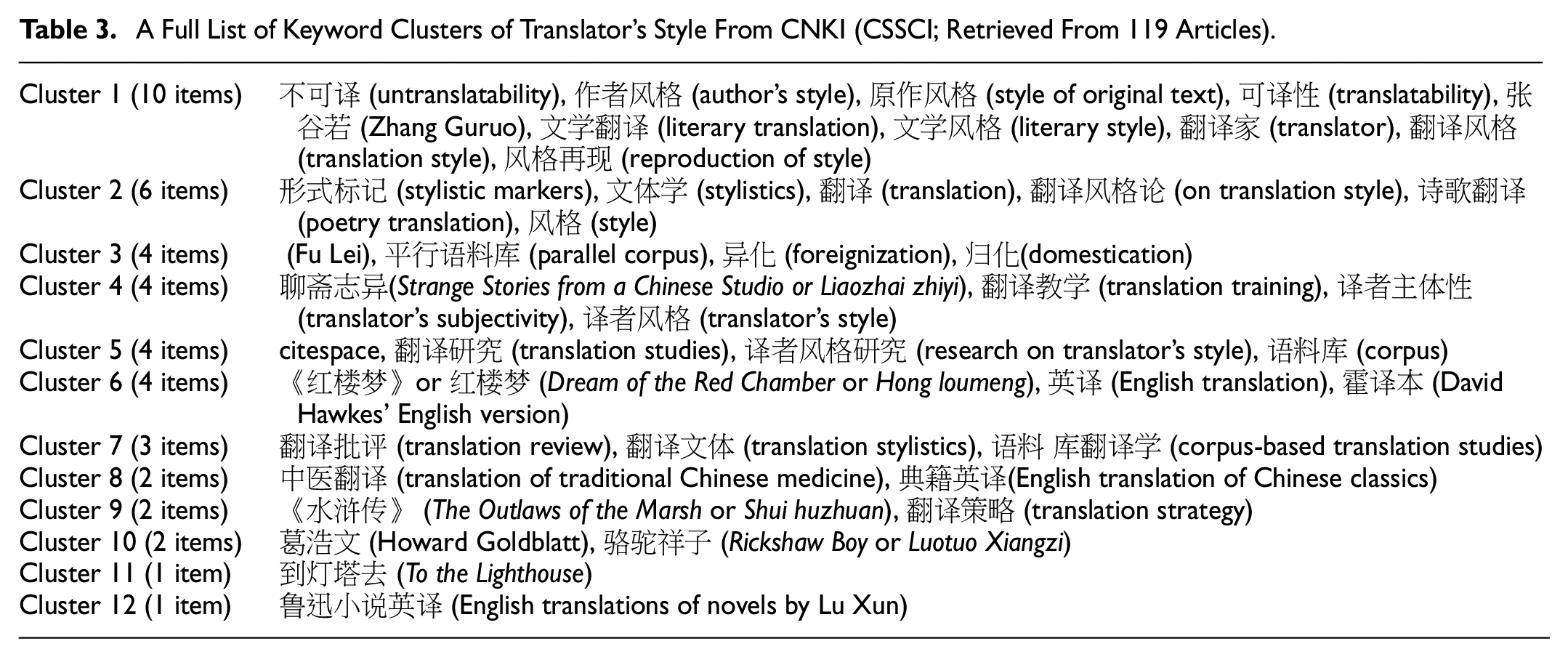
According to the automatic generation of the software VOSviewer shown in Figure 7 (with English translations of the Chinese keywords), a total of 43 keywords (occurrence ≥ 2) from 119 articles are grouped into 12 clusters. Table 3 and Figure 7 complement each other in that the figure visualizes the cluster size and relations between each cluster, and the table illustrates the detailed list of each cluster. Each color represents an independent cluster and the larger the cluster, the more keywords it contains within each theme. The adjacent clusters may hold shared features, as shown in the inclusion of similar keywords, such as “
Cluster 1 is concerned with different terms related to translator’s style, including the participants or concepts in the translation process, or some frequently addressed key terms, such as translatability and untranslatability.
Cluster 2 represents studies on translator’s style from the perspective of stylistics.
Cluster 3 (parallel corpus) and Cluster 5 (corpus) represent the methodology used in the study of translator’s style. As shown in Figure 7, corpus has been the third largest cluster node after the nodes of translator’s style and translation style.
Cluster 4 (
Clusters 10 (Howard Goldblatt, Rickshaw Boy or Luotuo Xiangzi), 11 (To the Lighthouse) and 12 (English translations of Lu Xun’s short stories) are the extension of the most-discussed translators and literary works on the topic of translator’s style.
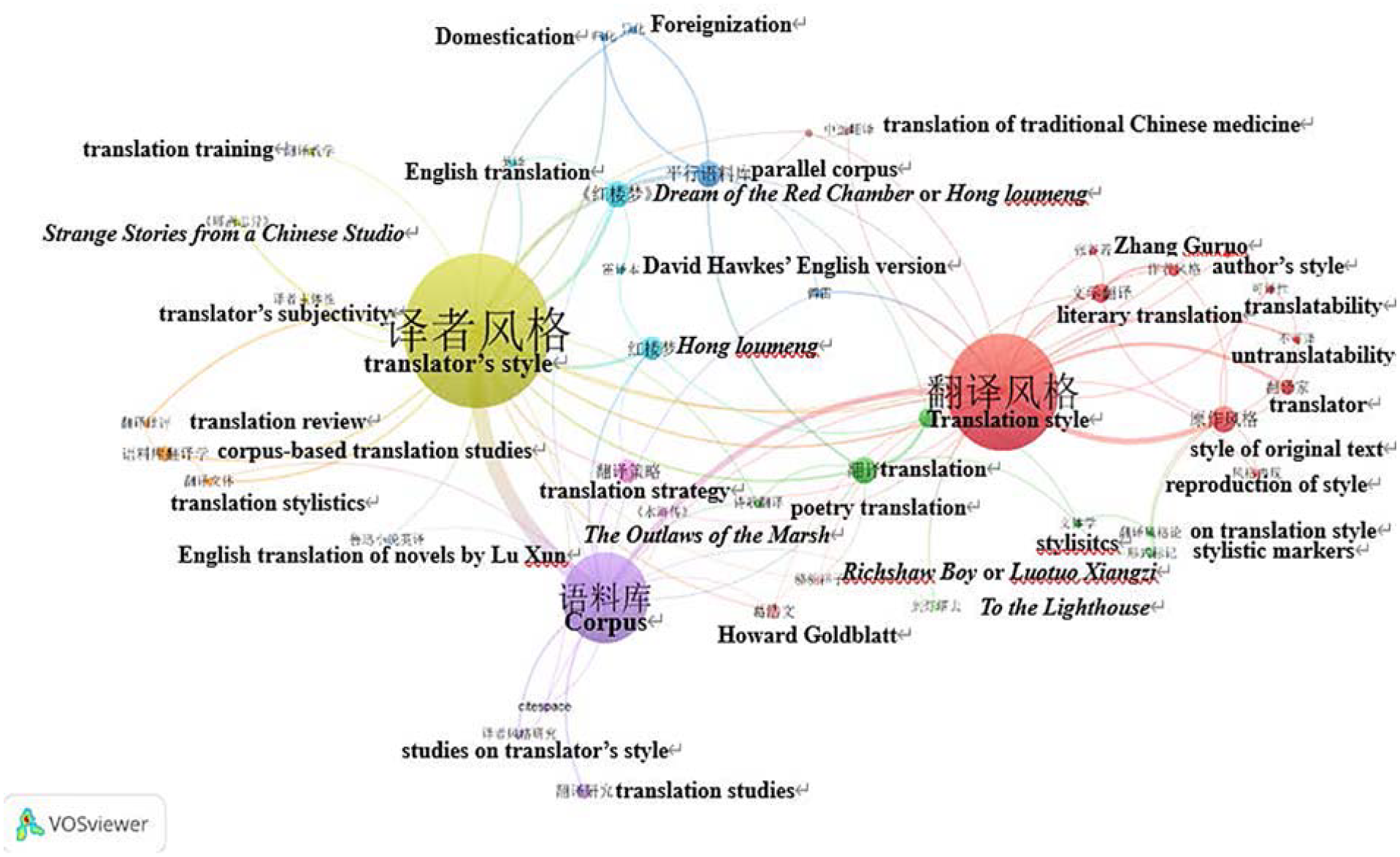
Keyword clusters of translator’s style in CNKI (CSSCI) in China generated by VOSviewer.
A Full List of Keyword Clusters of Translator’s Style From CNKI (CSSCI; Retrieved From 119 Articles).
In summary, compared with cluster analysis of Web of Science, research on translator’s style in China has not been fully extended to the four categories classified from top articles in Web of Science: audiovisual translation, interpreter style, machine translation studies and world literature. This means that Chinese academia is currently inclined to open new fields in audiovisual translation, interpreter style and machine translation. Only limited attention is currently paid to the macro-level framework of world literature. Additionally, in terms of text types, Chinese researchers have been scantly concerned about certain areas, such as songs and political documents. Also, unlike the international research covering cognate (e.g., Indo-European languages) and non-cognate languages, even with three language pairs involved, such as Chinese, Japanese and English (Kaminski, 2017), Chinese academia has rarely referred to other language pairings, besides English and Chinese.
Collaborative Countries Analysis
The first six countries with the most publications are the People’s Republic of China (35 publications), Spain (30 publications), Russia (30 publications), England (24 publications), Italy (16 publications), and the United States (15 publications). There are collaborations between scholars from the P.C.R. and England, Canada, Spain, the U.S., and France, as well as collaborations between scholars from countries such as Russia and Spain, as shown in the lines in Figure 8. As Chinese scholars contribute the most to the study of translator’s style, it is necessary to take a closer look at research trends within the Chinese context.

Collaborating countries generated by Citespace.
Studies of Translator’s Style in China
The discussion of style in translation has a long tradition in China, from the translation of Buddhist scriptures with a 2000-year history to the emergence of several translation peaks during foreign exchanges. This is fully demonstrated by Dao An’s “phrase according to the original text,” to “literal translation versus liberal translation” in the translation of Buddhist scriptures, and by Yan Fu’s three criteria for translation: “faithfulness, expressiveness and elegance.”
Because traditional translation theories in China were derived from “classical literary theory and traditional esthetics” (Luo, 1984, p. 15), Chinese translation studies in the traditional sense have mostly involved subjective commentaries, sometimes with flowery diction, lacking relatively systematic, and theoretical statements and presented in scattered descriptions or judgments of the translated works. Topics related to translator’s style have been discussed extensively. Yet, as translator’s style has not been defined clearly in translation studies, being devoid of a theoretical concept, there have been wider extensions of the notion of translator’s style as illustrated and scattered in articles related to translation studies in the early stage of studies of translator’s style.
Three Stages of Studies on Translator’s Style in China
As shown in the timezone view of translator’s style in CNKI (CSSCI-indexed; Figure 9), the evolution of each keyword has been clearly demonstrated. The location of each circle corresponds to the first time the term appears and when the keyword appears again. The accumulation of the keyword is added to the position where the keyword first appears. Hence, some keywords have consistently accumulated in the same circle even though they appear in different years.
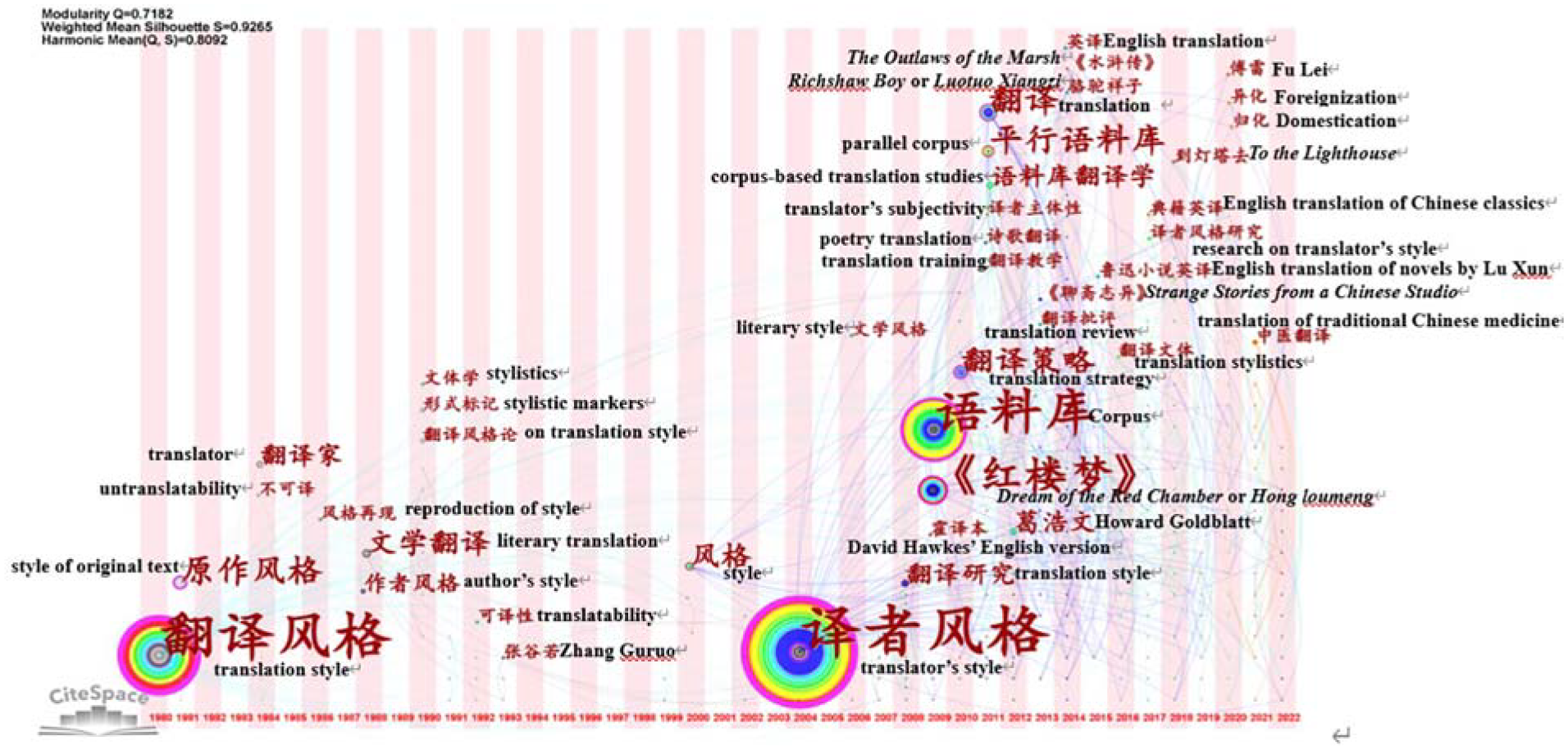
Timezone view of translator’s style in CNKI (CSSCI-indexed).
In China, studies on translator’s style can be described from three stages, each with different focuses.
From the timezone view, this study divides the keyword clusters into three stages, as shown in Figure 10 generated by Citespace. The three stages are from 1980 to 2001, from 2002 to 2009, and from 2010 to 2022. The evolution of the keyword clusters shows the tendency of study of translator’s style to a more clustered form. As shown in Figure 9, the first stage of studies of translator’s style mainly focuses on achieving the reproduction of the style of the original text in the target text. Thus, how to reproduce the style of the author in literary works has commanded discussion of translation style from stylistics, centering on stylistic markers, and the fundamental question of translatability and untranslatability in translation studies.
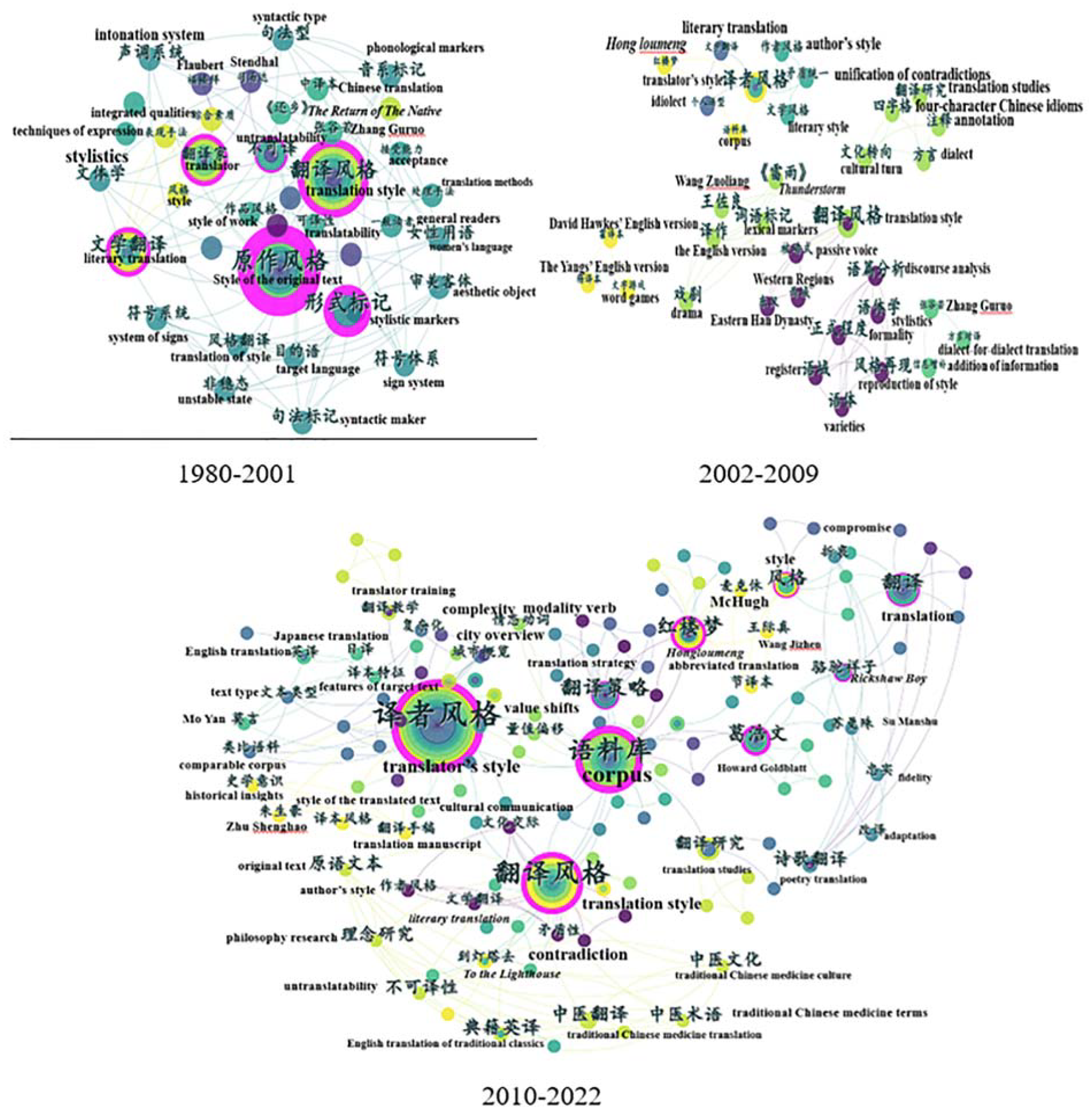
The keywords trend chart in translator’s style in China.
From 1980 to 2001: the keyword cluster only centers around translation style, emphasizing style of the original work within the framework of traditional literary translation studies.
From 2002 to 2009: more clusters appear besides the cluster in the first period. The English translation of Hongloumeng by Hawkes and the Yangs, the English translation of drama, Thunderstorm translated by Wang Zuoliang, as well as dialect translation and corpus form new clusters in this period. In this stage, translator’s style establishes its supremacy when scholars begin to realize that translators may have their own style. This stage also sees the gradual increase of translator’s status in history.
From 2010 to 2022: corpus develops into the second-largest node, accompanied by parallel corpus and corpus-based translation studies. Different text types have been presented, including classical Chinese works, poetry and traditional Chinese medicine, and translator’s style has also been explored in translator training and translation history.
Stage 1: Unity of the Style of the Translated Text and Original Text (1980–2001)
J. Xu (1995, p. 48) claims that style is the most debated topic in literary translation studies. He writes that the focus of debate is whether translators should convey the author’s style and how the translated texts convey the characteristics of the source language given the different rules of expression in the two languages.
Faithfulness long dominated the early studies on translator’s style in China, with the main focus on the reproduction of the style of the original text. Hong (1980), in strong support of literal translation, argues that translators have only the author to follow and that it is problematic for translators to possess their own fixed style.
In terms of the relationship between translator’s style and that of the author, S. Yang (1985, p. 21) maintains that the higher the translation quality, the higher the fidelity to the style of the original text and the more profoundly the translator’s style will show. Yang emphasizes that the translator’s style may vary, but it should always aim to convey the author’s style. J. Xu (1986, p. 61) points out that the lowest standard of reproduction should be that the style of the translation should not diminish or tarnish the style of the original work. In turn, the highest standard, as Qian Zhongshu (a renowned scholar with expansive knowledge of contemporary China, has put forward the “Theory of Sublimity”) stated, is to preserve intact the flavor of the original (Qian, 2002, p. 77; Qian, 1975, pp. 8–9, translated by Kao). Zhang (1988) investigates the style of literary translation from the perspective of external relations (personality of the writer, nationality, times, literature of other nationalities and readers) and internal regularities (genre and content). M. Liu (1990a, 1990b) categorizes the stylistic markers into formal markers (i.e., phonology, register, syntax, words, composition and rhetorical markers) and informal markers (i.e., manners of expression, intrinsic quality of works, temperament of the author and fusion of horizons of the recipients).
Based on Liu Miqing’s stylistic markers (formal and informal), J. Xu (1993, p. 9) examines style in the Chinese translated versions of the seven volumes of In Search of Lost Time, co-translated by 15 translators from the perspective of words, syntax, composition, rhetoric, register markers, and narrative style. He notes that translator’s style does exist and further argues that while admitting translator’s style, the unity and adaptability of the translator’s style and the author’s should be emphasized. He writes that in some respects, translators should make conscious sacrifices to approximate the author’s style. J. Xu (2001) further proposes that literary translation should pursue harmony and unity of the overall style.
Stage 2: Contradiction and Unity Between the Translator’s Style and the Author’s Style (2002–2009)
With the linguistic turn in the 1950s and the cultural turn in the 1980s of Western translation studies, as well as with the deepening development of translation studies in China, Chinese scholars have further explored the contradiction and unity of the translator’s style and the author’s style (Y. Zhang, 2006, etc.). Thus, instead of solely pursuing the style of the original text in the first stage, scholars sought to combine the style of translator and that of the author, which they believe may contradict one another but are united as a whole in the translated text. Departing from early studies of preliminary explorations of theoretical methods to grasp translator’s overall style, many scholars in the second stage examine from the micro-level. These can include dialect, annotation and wordplay.
W. Zhao and Sun (2004) reveal the inevitability of the translator’s style in literary translation regarding the influence of dialects on the understanding of expressions in translation. In a case study on the Chinese translation of Tess of the d’Urbervilles by Zhang Guruo (an expert on and translator of Thomas Hardy’s works, whose tactical translation of Wessex dialect into Shandong dialect as well as his annotations based on his study of Hardy’s writing background and characteristics of realism have qualified him in his role of Hardy expert), W. Zhao (2008) examines the translators’ style of Zhang Guruo in consideration of Chinese four-character idioms, annotation and dialect. Through the analysis of wordplay reproduced in the two English versions of Hongloumeng, Yao (2009) finds that the English version co-translated by Yang Xianyi and Gladys Yang keeps faithful to the original text. This fidelity is primarily achieved through literal translation, supplemented by annotations. Meanwhile, David Hawks’ English version exemplifies faithful yet innovative lingual conversion through his skillful combination of literal and free translation.
Stage 3: Corpus-Based Approach to Translator’s Style as the Primary Trend (2010–2022)
In terms of research paradigm, Chinese studies on translator’s style have transitioned from the traditional perspective of translation studies and linguistics to interdisciplinary research based on corpus.
These fruitful studies have primarily focused on the Four Great Chinese Classical Novels (i.e., The Outlaws of the Marsh (pinyin: Shuihu zhuan), The Romance of the Three Kingdoms (pinyin: Sanguo yanyi), The Journey to the West (pinyin: Xiyou ji) and Dream of the Red Chamber (pinyin: Hongloumeng, also known as The Story of A Stone), with Hong loumeng as the center of the majority of the studies. In addition, there are studies on other Chinese classics, such as The Analects of Confucius (a record of the words and deeds of the ancient Chinese philosopher Confucius; Cai & Yu, 2018; Fan, 2017), Tao Te Ching (a classical Chinese Taoist; Y. Zhao, 2015) and Strange Tales from a Chinese Studio (a collection of nearly 500 short tales of the supernatural by Pu Songling; Lu, 2014). Modern and contemporary literary works have also been the research target, such as works of Mo Yan (the winner of the Nobel Prize in Literature in 2012; Hou et al., 2014), Jia Pingwa (a renowned author from Shaanxi Province, i.e., the setting in most of his stories; R. Wang & Huang, 2015) and other authors with international fame. For other literary and non-literary genres, translator’s style of prose (Sun & Guo, 2014), poetry (Yan, 2011), and political reports (Li & Li, 2020) have also been discussed.
Chinese translations of foreign classical works have also been chosen to discuss, such as Pride and Prejudice (Zhan & Jiang, 2016), Tess of the d’Urbervilles (L. Zhang & Xu, 2013), To the Lighthouse (Huang & Wang, 2011) and The Kite Runner (J. Zhang & Zhu, 2020). There have also been studies on renowned translators such as Zhou Shoujuan (a representative figure of “Mandarin Duck and Butterfly—Saturday School” (yuanyang hudie pai—libai liu in pinyin; C. Li, 2018) and Fu Lei (an outstanding translator and art critic celebrated for his taste in painting, literature and music; Y. Zhao, 2022). Scattered discussions also fall on non-literary works, such as Chinese city profiles (J. Li, 2014) and the concept of traditional Chinese medicine (Chen & Huang, 2021).
Furthermore, research methods in corpus stylistics, quantitative linguistics and other fields have been widely used for reference. C. Zhao (2020a, 2020b, 2020c) examines the differences in genre dimensions of the translated versions and the factors contributing to their calculation. To do so, Zhao employs Multi-dimensional Analysis (MF/MD) for the comparative description of translator’s style. X. Dong (2014a, 2014b, 2017) initiates a mathematical model by employing the Dimension-Reduction Methods of Subjunctive Categorization and Principal Component Analysis. Dong then further proposes the Quantitative Sphere Model of Translation Style. Z. Yang (2016) proposes a construction-based information retrieval from corpora to examine the recurring patterns in translated texts. Since the construction-based approach to translation enables distinction among translation styles, translation-context-related recurring patterns and translator’s style, it sheds new light on translator’s style in corpus-based translation studies.
Three Modes for the Comparative Study of Translator’s Style in China
Huang and Chu (2014) argues that certain parameters, the previous research has adopted, such as STTR (Standardized Type/Token Ratio), and average sentence length, are not effective in differentiating translator style as these parameters share certain universal features of translated texts. They thus propose a multiple-complex model of comparison, both the S-type and T-tyle translator’s styles. By a close reading of 119 articles on translator’s style in CNKI (CSSCI-indexed) in China, three modes can be summarized as seen in Table 4: observation mode, parallel mode and a combination of parallel and comparable mode. They are the Target-text type, Source-text type or the combination of TT type and ST type.
Three Modes of Studies of Translator’s Style in CSSCI in China.

The first mode is to examine the regularities of different translated works by the same translator or those by a certain group of translators, as demonstrated in Figure 11. Gao (2002) discusses the style of Buddhist scripture translators from the Western Regions in the Eastern Han Dynasty. Shan (2018) conducts an in-depth study of the multi-dimensional image of Howard Goldblatt, and argues that Goldblatt is a translator who highlights himself and represents “glocalism.”

Interpretation of Mode 1.
The second mode is to examine different translated versions of the same source text, as demonstrated in Figure 12. Many experts and scholars in China have conducted multi-level research on the English translation of classical works. Feng (2008) compares two English versions of Hong longmeng—one by David Hawks and John Minford, and the other by Yang Xiangyi and Gladys Yang. This comparison is conducted from the perspective of rhetorical features, culturally-loaded words, English idioms, high-frequency words and more to examine the influence of native language translators on translated works. Liu et al. (2010), Z. Liu et al. (2011), Z. Liu and Tang (2022) explore translator’s style in the three English-translated versions (by David Hawks and John Minford, Yang Xiangyi and Gladys Yang, and Henry Bencraft Joly), four existing unabridged translated versions (three published versions by David Hawks and John Minford, Yang Xiangyi and Gladys Yang, and Henry Bencraft Joly, and one unpublished but with manuscript version by Geoffrey Weatherill Bonsall), and two abridged translated versions (by Chi-chen Wang and Florence & Isabel McHugh) of Hongloumeng, respectively. Hu et al. (2007), Hu and Zou (2009), Hu (2012, 2015, 2016), Hu and Xie (2017) conduct a review of corpus-based translation studies and produce a comparative study of bei passives and other prominent structures in the Chinese translations of Shakespeare’s plays by Liang Shiqiu and Zhu Shenghao. Reasons behind a given translator’s style have also been explored.

Interpretation of Mode 2.
Huang and Wang (2011), Huang (2013, 2014, 2018a) examine Howard Goldblatt’s English translations of modern and contemporary novels from the perspective of linguistic parameters. This research also introduces the design of the Chinese-English Parallel Corpus of Modern and Contemporary Chinese Novels (CEPCOCN) and the corpus-based stylistic translation studies that have been carried out. Additionally, it discusses the translation of narrative discourse in three English-translated versions of Luotuo Xiangzi (a masterpiece of Lao She [1899–1966], who has been praised as the “People’s Artist” and a “Great Master of Language”) and the transitivity, modality, demonstrative language and personal pronouns in two Chinese-translated versions of To the Lighthouse. L. Zhang and Xu (2013) investigate the stylistic differences and possible reasons behind them for two Chinese-translated versions of Tess of the d’Urbervilles in terms of habitual expressions, additional texts and translation strategy. Yan (2011) analyzes Li Bai’s poetry and its three English translations based on a self-built corpus. Zhu (2018) conducts a comparison of typical examples in Japanese-English translations of Howard Goldblatt’s works, and finds that Japanese-translated versions are generally more “literally faithful” to their source text than their English counterparts.
The third mode involves making a diversified comparison of different translated versions of the same source text and different translated works by the same translator, as demonstrated in Figure 13. D. Li et al. (2018) compare Julia Lovell’s English translation of Lu Xun’s novel with those made by three other translators (Wang Jizhen, Yang Xianyi, and William A. Lyell). Furthermore, a comparable corpus has been employed to compare Julia Lovell’s English translation of Wen Zhu’s I Love Dollars with that of Lu Xun’s fiction to further assess her style as a translator. In an alternative manner, there are studies which compare different translated works by the same translator and then use the original English works by other writers for reference to examine translator’s style in multiple ways. To examine Howard Goldblatt’s style as a translator, Huang and Zhu (2012) use Gladys Yang’s translated works as a reference, as well as the original novels of four English writers for comparison.

Interpretation of Mode 3.
Recent Development of Translator’s Style in China
In recent years, translator’s style has been consistently examined from innovative perspectives, the first of which is translation history. That is to say, translator’s style has been spurred by the awareness of history and the extended use of paratexts, which can be demonstrated in the following two examples. Zhang (2022) investigates the difference between translator’s style and the style of the published version from a historical perspective by comparing Zhu Shenghao’s Chinese-translated manuscript with two printed Chinese versions of Much Ado About Nothing. The research findings reveal the importance of the edition, which means that the translated manuscript reflects the translator’s style, while the printed version of the translation reflects the style of the printed text. Liang (2021) examines how the subtext of Penguin’s English translation of Six Stories of a Floating Life (an autobiography written by Shen Fu [1763–1825], who is a prominent writer and literary figure during the Qing Dynasty) constructs the thematic image of the work and cultural images of China, how annotation and thick translation reveal translator’s style, and how publishing houses, book series and cover designs promote the dissemination and acceptance of the translated works. D. Zhang and Liu (2014) investigate the differences between the first 24 chapters and the final 32 chapters of the Chinese-translated version of Dream of the Red Chamber by Henry Bencraft Joly in terms of rhyme, sentence and context. By comparing Joly’s version with three other translated English versions, they infer that Joly’s version was probably not done by only one translator.
Additionally, translator’s style has been investigated in translation training, for example, the mode of training of translators based on the translator’s style in Xia Yan’s Chinese-translated version of Mother (Guo, 2016). Translator’s style has also been examined in the discussion of crowdsourcing in the language service industry (Shao & Cao, 2020).
Moreover, corpus-based research on translator’s style has been conducted in more diversified ways. Descriptive parameters (including formal parameters, language parameters, narrative parameters and comprehensive parameters; Huang, 2018b) have been more multi-dimensional and multi-layered in recent studies. Huang (2021) detects and reports new trends in corpus-based translator’s style studies. These include the emergence of sub-topics (interpreter style, group translator’s style, self-translating style and the diachronic variation in translating style of specific translator) and new perspectives (sociological, quantitative linguistic and the multi-dimensional or factorial perspective). Such studies have emerged looking at the modality shifts in eight Chinese versions of Lady Windermere’s Fan (Zhao, Li & Mal., 2020) and the analysis of the pragmatic marker “I think” in David Hawks’ English-translated version of Dream of the Red Chamber, alongside possible reasons behind preference for its use (Hou & Guo, 2021).
Deficiencies in Studies of Translator’s Style in China
Studies of translator’s style in China have the following limitations that merit greater attention in future studies. The first is inconsistency in terminology. The second is the inadequate analysis of the global style. Moreover, relevant parameters have not been sufficient in highlighting and demonstrating translator’s style. These existing deficiencies have required more effective measurements and analysis of translator’s style from a more comprehensive perspective.
In addition, Li (2017) has summarized the most prominent flaws of corpus-assisted studies of translator’s style as “mystery of corpus,” “magic of numbers,” and “mimicking of designs.” In his analysis of mimicking research designs, he observes that decades of studies have seen little innovation in research design. Li also reports that some subsequent studies seem to have been simply modeled after earlier studies in both corpus design and the operators used to illustrate the research issues (Li, 2017, p. 112). By examining existing theories employed in studies of translator’s style, Saldanha (2021, p. 62) argues that they have failed to go beyond the reproduction of style as a characteristic of the source text and socio-cultural constraints to promote an understanding of translators as artists in their own right.
Though scholars have tried to explain the reason of translator’s style from the sociocultural and ideological aspects after analyzing the linguistic habits and stylistic patterns, the deeper reflection of translator’s style haven’t been frequently addressed, such as from the analysis of the material chosen for translation and the implied target readership as reminded by Baker (2000, p. 260) in the study of the motivation of translator’s style, and the influence of all the participants in the translation network, who may exert certain impact on the translated products, with editors, authors, publishers, translators and etc. involved and considered from a whole.
Future Suggestions for Translation Studies in China
As the beginning and ending year of keywords with the strongest citation bursts have shown the hotspot within the given time span, it can be found that in the more recent years, the emergency of detailed topics in studies of translator’s style have been revealed, such as corpus (research tools), Hongloumeng, To the Lighthouse (literary works), domestication and foreignization (translation strategies), Howard Goldblatt and Fu Lei (translators), etc., as shown in Figure 14.

Top 25 keywords with the strongest citation bursts.
Possible Reasons for the Fast Development of Translator’s Style in China
One of the reasons for the robust development of translator’s style in China is that there exist fairly favorable amounts of retranslation in the Chinese translation history. When rethinking the methodology of translator’s style, Baker (2000, p. 201) points out that by comparing different translations of the same source text into the same target language, by different translators would be one option, as it can keep the variables of author and source language constant. She further mentions that this is with difficulties as very few texts are translated more than once into the same target language and during the same period (Baker, 2000, pp. 201–202). But that’s a different picture in China, as different Chinese-translated versions of classical world literature during the May Fourth Movement and some other peaks in Chinese translation history can be found. There are also different English translations of Chinese classical works, such as the two translated versions of Hongloumeng: The Story of the Stone (published in 1973–1986, translated by David Hawkes and John Minford) and A Dream of Red Mansions (published in 1978–1980, translated by the Yangs). The urge to translate claimed by Ricoeur (2006, p. 7) is “stimulated by the dissatisfaction with regard to existing translations” and as claimed by scholars, the 1990s was not only a decade of a retranslation boom, but also a reprint and re-edition boom of translated classics, as publishers strive for a large profit and poor-quality retranslations of literary masterworks emerged (M. Xu & Tian, 2014).
The other possible reason is China’s cultural policy of introducing Chinese literary works into the world in recent years. This has stimulated a surge of translation studies, seeking to find out the best possible solution or modes for introducing more Chinese literary works into the world.
Conclusion
According to the bibliometric analysis conducted in this study, though Chinese scholars contribute the most in the international domain of translator’s style, there are some aspects that Chinese studies may address in the future: (1) the four categories that feature in the international counterpart: audiovisual translation, interpreter’s style, machine translation studies, and world literature; (2) more diversified text types, such as subtitling, lyrics and political documents, etc.; (3) more language pairs.
From the above analysis of different stages and recent development of translator’s style in China, we can come up with the following conclusions: (1) study of translator’s style tends to be more corpus-based to follow the international trend; (2) collaborations between scholars from different institutions or regions or countries may enforce the credibility and practicality of translator’s style with more diversified language pairs and linguistic parameters (STTR, average sentence Length, lexical bundles, etc.) as the research foci.
The study has implications for researchers in linguistics, translation studies and cultural studies, when style is discussed in terms of individual translators and the sociocultural factors to be considered behind it. Diversified the way and methods we adopt for translator’s style may be, the ultimate goal is to understand translation activities in a more comprehensive way, to put translation in its sociocultural contexts that shape and recontextualize it.
Supplemental Material
sj-zip-1-sgo-10.1177_21582440251322591 – Supplemental material for A Bibliometric Analysis of Translator’s Style in Translation Studies: A Chinese Perspective (1980–2022)
Supplemental material, sj-zip-1-sgo-10.1177_21582440251322591 for A Bibliometric Analysis of Translator’s Style in Translation Studies: A Chinese Perspective (1980–2022) by He He and Bing Xiong in SAGE Open
Footnotes
Acknowledgements
The authors extend their sincere gratitude to the anonymous reviewers for their invaluable advice.
Declaration of Conflicting Interests
The author(s) declared no potential conflicts of interest with respect to the research, authorship, and/or publication of this article.
Funding
The author(s) disclosed receipt of the following financial support for the research, authorship, and/or publication of this article: This work is supported by the National Social Science Fund of China under Grant [No. 19BYY119, “Translation, Dissemination and Reception of Contemporary Chinese Science Fiction in the English-speaking World”], and the Fundamental Research Funds for the Central Universities [No. CCNU24ZZ094, “The Protection and Utilization of Intangible Cultural Heritage in China”].
Ethics Statement
No animal studies and no human studies are presented in this manuscript. No potentially identifiable human images or data is presented in this study.

Data Availability Statement
The datasets analyzed for this study can be found in the article/supplementary material, further inquiries can be directed to the corresponding author.
Supplemental Material
Supplemental material for this article is available online.
References
Supplementary Material
Please find the following supplemental material available below.
For Open Access articles published under a Creative Commons License, all supplemental material carries the same license as the article it is associated with.
For non-Open Access articles published, all supplemental material carries a non-exclusive license, and permission requests for re-use of supplemental material or any part of supplemental material shall be sent directly to the copyright owner as specified in the copyright notice associated with the article.
