




Abstract
This paper investigates the levels of Integrated Reporting (IR) content elements alignment in the context of Borsa Istanbul (BIST) Small and Medium-sized Enterprise (SME) Industrial Index, the integrity of the content elements, and the financial factors related to company size, company profitability, leverage and market performance that influence IR disclosure. This study also aims to demonstrate the current situation in which integrated thinking is applied in SMEs and how they can create value for all stakeholders. The population of the paper comprises all firms included in the BIST SME Industrial Index. As of 2022, 46 firms are listed in this index and whose data was fully accessible in 2022 were selected as the sample for the study. This study determines the level of IR content elements alignment scores for Turkish-listed SMEs using the content analysis method. Pearson correlation analysis was utilized between the principles to analyze the degree of integrity. A regression analysis was performed to understand whether the financial factors influence the alignment of the IR content elements. The comprehensive results show that the BIST SME Industrial Index firms do not fully meet the content elements of the International Integrated Reporting Council (IIRC) Framework, however, has an effort to disclose information about the content elements in terms of organizational overview, external environment, and business models. The coal and lignite mining industry has the highest average alignment with the IR content elements, which is consistent with the view that the IR voluntary adoption should be adopted by the most polluting industries first. Regression analyses demonstrate that SMEs with a higher proportion of institutional investors are more willing to disclose content elements to satisfy greater stakeholder scrutiny. Few studies evaluate the level of alignment of IR content elements for SME context. This study constructs an index relating to the IR content elements and provides new insights into the evolution of the adoption of IR by SMEs. Additionally, the paper explores how SMEs create value through the content elements of the IIRC framework underlining the integrity issue. This paper enriches the emerging literature on the adaptation of IR in SMEs by examining the financial drivers for the disclosure of IR content elements. Turkish SMEs still have a long way to go, particularly in terms of the corporate governance principles disclosure. Insufficient disclosure of governance-related content elements could be of concern to policymakers, such as governance mechanisms, strategy, and allocation of resources.
Plain language summary
This study aims to demonstrate the current situation in which integrated thinking is applied in SMEs and how they can create value for all stakeholders.
Introduction
Small and medium-sized enterprises (SMEs) play a crucial role in the global economy through sustainable development. They have the potential to create jobs and are promoters of economic and social development (Szonyi, 1991). The “Think Small First” principle, which has become established in European Union (EU) policies, and the OECD’s assessment of the Small Business Act (OECD, 2022) have significantly changed the influence of SMEs on the European economy. In an increasingly competitive environment, SMEs need to be able to attract funding from investors to grow and expand. Corporate reports play a significant role in the decision-making process of fund owners. Over time, stakeholder demands for disclosure of non-financial information as well as financial information have increased, and the content of corporate reporting has begun to expand. Thus, the Integrated Reporting (IR) framework helps all stakeholders of an organization, specifically investors, make better decisions by providing a holistic perspective on the organization. By making the connections between environment, society, and governance with integrated reporting, organizations have the opportunity to present not only the results of their past performance but also their long-term prospects (Dimes & de Villiers, 2024).
As Churet and Eccles (2014) note, IR is the only complementary report that goes beyond the combination of sustainability and financial reporting. The International Reporting Standards Board’s (IFRS) guidance on implementing IR for SMEs makes it clear that IR can help SMEs demonstrate where and to what extent the company creates value in its interactions with various public and private entities. International Federation of Accountants (IFAC) (2017) creating value for SME's report states that a good starting point for consideration is how SMEs create value. IFAC is one of the leading organizations influencing the impact of IR and SMEs. Through the framework based on the IIRC principles, SMEs can better manage how they create value and also report on this value creation.
In Türkiye, companies that employ fewer than 250 employees per year and whose annual net sales or total assets do not exceed 250 million Turkish liras are defined as SMEs (TURKSTAT, 2022 Bulletin). Turkish SMEs accounted for 99.7% of the total number of companies in 2022. They also accounted for 70.6% of employment, 47.5% of personnel costs, 42.5% of turnover, 36.3% of production value, and 36.4% of value added at factor cost (Turkey Statistical Institute, 2022). Integrated reporting is widely used in many countries, but it is still a new topic in Türkiye. The Integrated Reporting Türkiye (ERTA) was founded to raise awareness of IR and to ensure how can corporations create value today and also in the future (Aras & Sarıoglu, 2015). Aras et al. (2019) first examined the perceptions of stakeholders in Türkiye, where the main benefit of the IR framework is to create an integrated mindset that enables the company to evaluate its long-term sustainable development. Since there are no SMEs in Turkey that publish an IR following the IIRC framework (Integrated Reporting Turkey, 2024), there are few studies that look at the voluntary non-financial disclosure of SMEs to examine the level of alignment of IR disclosure.
SMEs are examined in this study for several reasons. SMEs are at the center of the global economy and interact with various stakeholders through different dimensions. In addition, transparency and accountability of small businesses have attracted the attention of the public and regulators. Finally, analyzing how SMEs create value for all stakeholders can be a crucial aspect of understanding integrated thinking in an emerging economy. In this context, this paper proposes to extend the previous findings by examining the extent to which the annual reports of Turkish-listed SMEs contain the content elements required by the IR framework. It also analyzes the level of integrity and finally examines the impact of firm-specific factors related to firm size, leverage, firm profitability, and market performance on the level of alignment of IR content elements in Turkey. To determine the approach for the alignment of IR content elements in Turkish SMEs, the Research Questions (RQ) have been posed:
RQ1. Do SMEs meet the content elements of the IIRC framework?
RQ2. What is the level of integrity within the content elements?
RQ3. What financial factors influence the IR content elements disclosure alignment levels?
Concerning RQ1, a content analysis was performed to determine the disclosure levels of the IR content elements. To reveal integrity (RQ2), a Pearson correlation analysis was conducted between the principles to analyze the degree of integrity. To understand whether the financial factors influence the alignment of the IR content elements (RQ3), corresponding hypotheses were developed, and a regression analysis was performed.
This paper contributes to the current literature in various ways. First, this paper constructs an index relating to the IR content elements and provides new insights into the evolution of the adoption of IR by SMEs. Second, this paper explores how SMEs create value through the content elements of the IIRC framework underlining the integrity issue. Third, this paper enriches the emerging literature on the adaptation of IR in SMEs by examining the financial drivers for the disclosure of IR content elements.
The following part of the study is structured as follows: In the following parts, the theoretical framework and previous literature on the disclosure of IR are highlighted. The methodology section presents two different methodological analyses in the form of a content analysis and a Pearson correlation analysis. The empirical findings of the alignment of the IR content elements for Turkish-listed SMEs and correlation analysis results within the content elements to reveal the integrity perspective are given. The empirical evidence part includes the findings of the driving factors for the disclosure of IR content by SMEs. The conclusion section concludes the study giving an outlook for future research.
Literature Review and Hypotheses Development
Several theories address a company’s decision whether to voluntarily disclose information while considering forward-looking disclosures. This paper focuses on the stakeholder, agency, and signaling theories and assumes that IR conveys a broader range of material information that meets the expectations of various stakeholders for forward-looking disclosure. Stakeholder theory states that companies should respond to a range of stakeholder expectations to maximize value (Freeman, 2009). In this context, this theory emphasizes that voluntary disclosure by companies enables them to meet the expectations and demands of stakeholders. Agency theory deals with the conflicts of interest that can arise when company owners (principals) delegate their authority to company managers (agents). The fact that the principal and the agent have different levels of information, the efforts of both parties to maximize their interests, and the difficulty of the principal to control the agent can lead to agency problems (Fama & Jensen, 1983; Jensen & Meckling, 1976). Finally, the increase in voluntary reporting is consistent with signaling theory, which states that if decision-makers do not have sufficient knowledge about an organization, they may use the signals (Spence, 1973). Signaling theory can clarify the degree of alignment of IR content elements for SMEs and thus improve accountability.
Empirically, previous research has offered various perspectives on IR, for example, IR disclosure and financial performance (Adegboyegun et al., 2020; Hurghis, 2015; Islam, 2021); the level of IR guiding principles disclosure (Ruiz-Lozano & Tirado-Valencia, 2016); the level of IR disclosure and firm value (Barth et al., 2017; Cooray et al., 2020; Lee & Yeo, 2016); IR disclosure and cost of capital (García-Sánchez & Noguera-Gámez, 2017); the level of IR content elements disclosure and financial performance (Al Amosh & Mansor, 2021; Kılıç & Kuzey, 2018; Nguyen et al., 2022; Wen & Yap Kiew Heong, 2017); the content and quality of IR (Eccles et al., 2019; Vitolla et al., 2020) and the level of disclosure of IR content elements with liquidity position (Dey, 2020). James (2013) argues that IR disclosure has some internal and external benefits for SMEs. Internal stakeholder engagement, protection effective use of resources, and employee satisfaction can be the internal benefits, while developing sustainable services and ensuring value maximization can be the external benefits. The main motivation for implementing the IIRC framework is to overcome the limitations of financial reporting in the overall financial statements (Eccles & Krzus, 2015) and to improve decision-making through integrated thinking (Robertson & Samy, 2015).
Despite the increasing importance of SMEs to economies, there is little work that addresses the methodology of IR disclosure for SMEs. Del Baldo (2017) worked on a case study and attempted to investigate the feasibility of IR within a single case. In addition, Muslichah et al. (2020) constructed a model of IR for SMEs based on the results of interviews and surveys with six certified sustainability reporters, SME owners, and SME department heads. Nada and Gyori (2024) conducted an interview with a Hungarian SME to investigate the drivers for the adoption of IR using a case study method.
Turkish organizations have started to implement IR but is still in its infancy. Therefore, empirical studies generally focus on the benefits resulting from the disclosure of IR. Aracı and Yüksel (2016) attempted to determine the extent to which the corporate reports of companies listed in the BIST SME Index. Another study by Yüksel and Aracı (2017) examined the degree of compliance of the integrated reports of the companies included in the IIRC database with the IIRC framework. In addition, İbiş and Mizrahitokatlı (2022) investigated the benefits of IR for SMEs by conducting a survey among various participants. The participants of the survey are certified public accountants, chartered accountants, auditors, and financial advisors. The results of the survey show that participants are generally positive about IR and believe that integrated reports offer benefits for SMEs.
Hypotheses Development
Hossain et al. (2023) conducted a systematic literature review that included 119 peer-reviewed IR articles published in 36 journals between 2012 and 2021. The results of the systematic literature review show that firm size, profitability, leverage, and market capitalization are the most important firm-level factors that determine IR alignment. Permatasari and Tjahjadi (2023) examined 46 papers from 2017 and 2022 and found that firm size, profitability, and leverage are the most commonly used firm attributes that determine IR quality.
Considering the related systematic literature studies and in line with the existing literature citations referenced below, four corporate indicators, namely company size, asset profitability, corporate leverage, and market capitalization, were used as the factors driving the alignment of IR content elements based on the theoretical and empirical literature.
The related hypotheses are as follows.
Company Size
The relationship between total assets and the extent of disclosure of IR content items has been demonstrated in several studies (Al Amosh & Mansor, 2021; Cooray et al., 2020; Manes-Rossi et al., 2021; Muttakin & Khan, 2014; Nguyen et al., 2022). Large companies with more shareholders and employees are obliged to disclose information and must provide higher-quality integrated reports. Therefore, company size has a positive influence on the level of alignment of IR content elements disclosure. To examine company size as a driver of the IR framework, the first hypothesis is constructed as follows:
Hypothesis 1 (H1). Company size has a positive effect on the level of alignment of IR content elements.
Company Profitability
The nexus between the level of IR disclosure and Return on Assets ratio (ROA) has been studied in several papers such as Al Amosh and Mansor (2021), Frias-Aceituno et al. (2014), and Vitolla et al. (2020). Return on assets reflects a company’s efficiency in generating profits through the utilization of its assets (Honggowati & Aryani, 2015). High profitability motivates management to share more information with its stakeholders to maximize the company’s values and gain trust (Al Amosh & Mansor, 2021). The company’s high profits are an indicator of management’s success and therefore provide benefits such as strengthening the company’s reputation through voluntary disclosures that increase information sharing (Dey, 2020; Elfeky, 2017). Moreover, Permatasari and Tjahjadi (2023) argue that top managers are incentivized to disclose more information as a result of high profitability to maximize shareholder value. Therefore, the profitability of the company has a positive effect on the degree of customization of IR content elements.
Hypothesis 2 (H2). Company profitability has a positive effect on the level of alignment of IR content elements.
Financial Leverage
Several papers have established a link between the financial leverage ratio and the extent of information disclosure, for example, Girella et al. (2019) and Manes-Rossi et al. (2021). According to agency theory, corporate creditors demand more information when debt increases, according to capital requirements theory. Companies that require external financing voluntarily disclose information (Dilling & Caykoylu, 2019). Financial leverage tends to negatively reinforce investor reactions (Geno et al., 2022). Highly leveraged companies offer security to lenders and reduce risk. They are proposed to provide higher-quality disclosure for financial leverage. Financial leverage has a positive impact on the level of alignment of IR content elements.
Hypothesis 3 (H3). Financial leverage has a positive effect on the level of alignment of IR content elements.
Market Capitalization
Investor expectations play a crucial role in the level of voluntary disclosure. Several papers have demonstrated the relationship between the level of IR disclosure and market capitalization (Landau et al., 2020; Pavlopoulos et al., 2019). Two different views on the relationship between market value and voluntary disclosure have been identified in the empirical literature. The cost-based approach argues that investing in ESG activities places a financial burden on companies and increases their costs, resulting in lower market values (Mervelskemper & Streit, 2017). Furthermore, the information in the integrated report had a negative impact on shareholders. If sensitive information has to be shared in the reports, this has a negative impact on company value, according to (Cortesi & Vena, 2019; Elshandidy et al., 2022).
From a value creation perspective, participation in voluntary disclosure is seen as a tool that provides a competitive advantage, thereby increasing high market value and financial returns for shareholders (Mervelskemper & Streit, 2017). In addition to carrying out these activities, disclosures are communicated with multiple stakeholders, making IR an important tool in this sense (Gal & Akisik, 2020). They are expected to provide higher quality information for market perspective. Market capitalization has been found to have a positive impact on the degree of customization of IR content elements.
Hypothesis 4 (H4). Market capitalization has a positive effect on the level of alignment of IR content elements.
Research Methodology
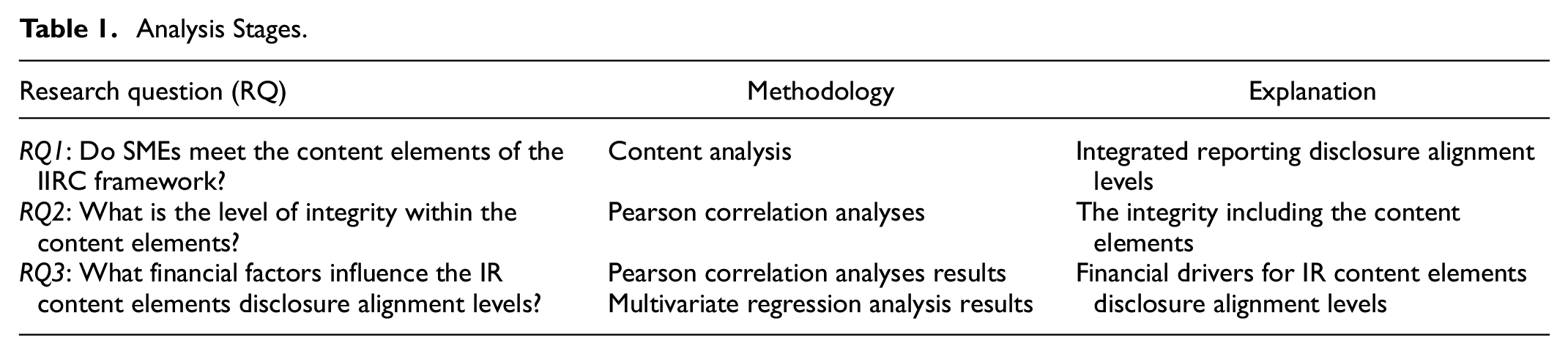
Concerning the RQ1, this study determines the level of IR content elements alignment scores for Turkish-listed SMEs. The content analysis was used to analyze the disclosure levels. To answer RQ2, Pearson correlation analysis was utilized to clarify the integrity of the content elements. Finally, with regard to RQ3, four hypotheses were developed to provide empirical evidence of the driving factors for disclosure of IR content by SMEs.
Table 1 presents the analysis process considering research questions, methods used, and explanations.
Analysis Stages.
The Selection of Sample
The population of the paper comprises all firms included in the BIST SME Index. As of 2022, 46 firms are listed in this index and whose data was fully accessible in 2022 were selected as the sample for the study. The variables related to the IR content elements were taken from the firms’ corporate reports, while the financial variables were taken from the Bloomberg database for the year 2022.
Table 2 exhibits the distribution of sampled firms listed in the BIST SME Industrial Index. With 15 companies, chemicals, petroleum, rubber, and plastic products account for the largest share (32.60%), followed by the food, beverage, and tobacco industry (19.56%) and the metal products, machinery, and electrical equipment sector (19.56%). The industries were classified according to the Bloomberg Industry Classification Standard (BICS) following the industry classification of the Public Disclosure Platform of Türkiye.
Distribution of Sampled Corporations with an Industry Breakdown.

Research Model
A multivariate regression analysis was used to prove RQ3 and to examine the associations proposed in the four hypotheses.
The regression analyses are described in the following equation:

Dependent Variable
To determine the alignment scores of the companies listed in the BIST SME Index with the IR content elements, this study uses the content analysis method first employed by Bowman and Haire (1975). To investigate the level of alignment of IR content items, the methodology used in previous examples (Nguyen et al., 2022; Ruiz-Lozano & Tirado-Valencia, 2016) is used.
The IIRC framework is a principles-based framework that proposes that an integrated report would include content elements such as an organizational overview along with the external environment, governance, business model, risk and opportunities, strategies, performance, outlook, and basis of preparation and presentation (International Integrated Reporting Framework, 2021). The empirical literature has examined the alignment of IR content elements (Albetairi et al., 2018; Nguyen et al., 2022; Stent & Dowler, 2015; Wen & Yap Kiew Heong, 2017; Yüksel, 2018), some of which have examined the alignment of guiding principles (Chersan, 2015; Ruiz-Lozano & Tirado-Valencia, 2016).
The revised International Integrated Reporting Framework (2021) and Nguyen et al., 2022 methodology were used to prepare the assessments for the level of alignment of the IR content element disclosures. Appendix 1 contains the content items and sub-items with the frequency of content items and associated scores. Among eight content elements and considering 38 items, the companies’ annual reports were reviewed and converted into a numerical variable with a value of 0, 1, or 2 to examine the degree of alignment, following the methodology of Ruiz-Lozano and Tirado-Valencia (2016) and Nguyen et al. (2022). The sub-item of content elements is defined as 0 if it is not included in the corporation’s annual report, 1 if the information provided is insufficient, and 2 if it is sufficiently disclosed.
The alignment score of the IR content elements was determined for each SME through a content analysis methodology. This score is calculated by dividing the total score that the business receives as a result of the scoring by the maximum score that the business can receive. The maximum score the company can receive is 76, which is the product of the number of criteria (38). The score for the criterion disclosure was calculated by dividing the total score that the criterion received in all reports by the maximum score that the criterion can receive. The maximum score that each criterion can receive is 92, which is the product of the number of reports examined (46).


Independent Variables
Taking into account the related systematic literature studies and in line with the existing literature citations referred to in the previous section, four financial factors, namely company size, profitability of assets, corporate leverage and market capitalization, were used as factors for the alignment of IR content elements based on the theoretical and empirical literature. Total assets were used as an indicator of company size (SIZE). To show the financial profitability of the companies, return on assets (ROA) was used. This indicator reflects the management’s view of profitability. In addition, financial leverage (LEV) was used to show the financial risk and to capture the investors’ perceptions, and market performance (MCAP) was used. Table 3 presents the related variables, abbreviations, and definitions.
Independent Variables.

Empirical Results
In this section, the alignment scores for the IR content elements disclosure for BIST SME Index companies as well as the integrity levels for these elements are first indicated and finally, the financial indicators that may affect the IR content elements alignment are described.
Integrated Reporting Disclosure Alignment Levels—Content Analysis Results
This analysis was carried out using the frequencies of the scores of 38 content items. Table 4 shows the average industry alignment of the IR content elements. The mining and lignite industry has the highest average score for IR content elements (47.37%), followed by the manufacture of fabricated metal products, machinery, and electrical equipment (44.44%) and the food, beverage, and tobacco industry (39.77%), while the basic materials industry (32.89%) and the textile, apparel and leather industry have the lowest scores (28.95%).
Average Frequencies for Each of the Content Elements with Industrial Breakdown.

Concerning the RQ1, Table 5 exhibits the average frequencies for all content elements subitems. The content items organization overview and external environment have the highest frequency (66.96%), followed by business model (50.43%) and performance (43.79%). The lowest frequency of content element disclosure belongs to the basis of presentation (9.78%). Furthermore, the results ensure that among the content elements in the 2022 corporate annual reports for BIST SME Index firms, the highest alignment is with the items “Organizational overview” and “External environment,” and the lowest agreement is with the elements “Basis of presentation” (SME Policy Index, 2022).
Average Frequencies for Content Elements.

Compared to the studies in the literature, Kılıç and Kuzey (2018) examined listed non-financial companies and found that risk and opportunity (88%) and company outlook (79%) were the most frequently mentioned, while strategy and resource allocation were the least frequently mentioned (23%). In addition, Nguyen et al. (2022) studied listed companies in Vietnam and found that the elements of corporate governance (69%), risks and opportunities (58%), and company outlook (55%) were the most frequently followed; the lowest compliance was found for the content element outlook (15%). Although the basic element of preparation and presentation was not included in both studies, the results are generally similar in terms of the highest compliance with the corporate overview and external environment elements among the content elements in annual reports.
Table 6 shows the 10 most common elements of the disclosed content. The ownership or operating structure and (94.57%) the countries in which the company operates (82.61%) were disclosed most frequently, both overall and about the company overview and the external environment.
Top 10 Disclosed Content Elements Items with Higher Frequencies.

Table 7 refers to the top 10 disclosed contents with lower frequency. The table clearly shows that no disclosure was seen for the content items relating to governance—whether the organization applies corporate governance practices that go beyond the legal requirements—, outlook content item—a summary of the organization’s process for determining materiality and basis of preparation and presentation—an explanation of the reporting boundary and how it is determined.
Top 10 Disclosed Content Elements Items with Lower Frequencies.

The Integrity of Content Elements—Correlations Between Content Elements
Concerning RQ2, a Pearson correlation analysis was utilized to clarify the integrity of the content elements.
Table 8 shows the integrity including the content elements. The results in Table 8 confirm the integrity of the content elements. The highest correlations are between the content element of outlook and strategy and resource allocation (0.655) and risks and opportunities and strategy and resource allocation (0.651) respectively. Some other correlations between the content elements are significant, albeit with lower correlations. There is no correlation between the content elements of the basis of presentation and governance and also basis of presentation and risks and opportunities.
Correlations Between IR Content Elements.

Note. *Correlation is significant at the 0.05 level (2-tailed). **Correlation is significant at the 0.01 level (2-tailed).
Financial Drivers for IR Content Elements Disclosure Alignment Levels
A regression analysis was conducted to examine RQ3, namely which financial factors influence the degree of IR content item disclosure alignment. This part presents the regression model empirical findings for testing the four hypotheses.
Descriptive Statistics
Table 9 provides the related variables’ descriptive statistics for the corresponding financial drivers to examine the disclosure levels of the IR content elements. There is considerable variance in the IR content item disclosure scores, ranging from 0.12 to 0.82. Although the companies listed in the BIST SME Index do have not an integrated report, there are some SMEs with high alignment scores whose reports contain almost all the IIRC content elements framework. Furthermore, the SIZE ranged from 17.05 to 21.21, with a mean score of 19.43. In addition, the MCAP variable ranged from 18.83 to 23.01, with a mean score of 20.42.
Related Variables Descriptive Statistics.

Pearson Correlation Analyses Results
Pearson correlation analysis was conducted to investigate the correlation between the financial drivers of all content elements and the content elements’ disclosure score. The linear association between the variables exhibits that there is only a significant and positive linkage between company size and IR content item disclosure scores (p < .01). Table 10 shows the correlation matrix of the relevant variables for demonstrating any multicollinearity issues. There are no correlations greater than 0.80. There is a lower risk of multicollinearity for the independent variables (Gujarati and Porter, 2009).
Pearson Correlations Between IR Content Elements Disclosure Alignment Levels and Financial Drivers.

Note. **Correlation is significant at the 0.01 level (two-tailed).
Multivariate Regression Analysis Results
A multivariate regression analysis was used to prove RQ3 and to examine the associations proposed in the four hypotheses. Table 11 shows multivariate regression model findings for companies listed in the BIST SME Index. The empirical findings reveal that the model is statistically significant in demonstrating the level of IR content alignment for the corresponding companies (F = 3.375, p < .05). Regarding multicollinearity issues, Variance Inflation Factor (VIF) statistics results have been provided. The values of VIF for all variables are lower than 5. This suggests that there is no multicollinearity.
Multivariate Regression Model Empirical Findings.

The first hypothesis (H1) states that company size has a positive impact on the level of IR content element alignment scores. The result contradicts this prediction, showing that company scale does not affect the level of IR content elements alignment scores. Hurghis (2015) investigated the linkage between the financial performance of integrated reports disclosed by 65 companies between 2012 and 2014 as part of the IIRC pilot program.
The empirical findings reveal that there is a linkage between the level of integrated reporting and the profitability ratio of assets. Lee and Yeo (2016) stated a positive relationship between integrated reporting disclosures and firm value for 822 observations covering the years between 2010 and 2013. The findings demonstrate that companies with higher levels of integrated reporting have better financial performance. Islam (2021) analyzed the companies that voluntarily adopted integrated reporting in Bangladesh between 2016 and 2018. Content analysis empirical findings reveal that the percentage of information disclosed by the companies was 65 on average, differentiated by sector, with asset profitability as a proxy of company performance.
Al Amosh and Mansor (2021) analyzed the effect of financial indicators on the integrated reporting disclosure levels for 51 companies traded on the Jordanian stock exchange, covering the years between 2014 and 2019. Finally, the results also suggest that the profitability of the company and the firms’ leverage ratio do not have a significant impact on the alignment of the IR content elements of disclosure.
While recent studies document the positive effect of corporate profitability on the IR disclosure level (Al Amosh & Mansor, 2021; Dey, 2020); the results of Kılıç and Kuzey (2018) show no effect of corporate profitability on the IR content elements disclosure levels. Several papers show that having a high market capitalization tends to disclose more IR content items (Gal & Akisik, 2020); some of the papers cannot prove this relationship (Elshandidy et al., 2022; Mervelskemper & Streit, 2017). In line with the prediction of the fourth hypothesis, the results of the multivariate regression analysis show that the variable coefficient of market capitalization is positive and statistically significant (∝ = 0.443, p < .05), demonstrating a positive effect for Turkish-listed SMEs with the level of alignment of IR content item.
Discussions
This paper proposes to extend the previous findings by examining the extent to which the annual reports of Turkish-listed SMEs contain the content elements required by the IR framework. This study also analyzes the level of integrity and finally examines the impact of financial factors.
This analysis was carried out using the frequencies of the scores of 38 content elements. The overall results show that the average alignment of the IR content items for the companies in the BIST SME Industrial Index is 39.33%. Furthermore, the highest level of alignment was found in the elements of “Organizational overview and external environment” (66.96%) and “Business models” (50.53%), which are above 50%, while the lowest level of alignment was found in the elements of “Basis of presentation” (9.78%) among the content elements. Kılıç and Kuzey (2018) found that the average alignment of the IR content items for the companies in the BIST 100 Index is 63%. In addition, Nguyen et al. (2022) state for Vietnam that companies disclose almost slightly more than 40% on average.
SMEs’ annual reports lack disclosure of governance policies and resource allocation plans, which are critical to understanding value creation models. However, Nguyen et al. (2022) and Kılıç and Kuzey (2018) show that most disclosures belong to organizational overview and governance. This fact clearly shows the inadequate practices of SMEs in governance disclosure. Nada and Gyori (2024) also demonstrate that the concepts of value creation, stakeholder engagement, and materiality are unclear for Hungarian SMEs. The results also show that the mining and lignite industries have the highest average score of IR content elements (47.37%) while the textile, apparel, and leather industries have the lowest score (28.95%). This result is consistent with the view that voluntary adoption of IR should first be adopted by the most polluting industries. Some industries have gradually developed an awareness of proactive voluntary disclosure. Industry-specific schemes could have encouraged the uptake of IR and enabled SMEs to adopt and consolidate integrated thinking, action, and reporting.
The comprehensive results show that the BIST SME Industrial Index firms do not fully meet the content elements of the IIRC framework, however, has an effort to disclose information about the content elements in terms of organizational overview, external environment, and business models. The highest correlations are found between the content element of outlook and strategy and resource allocation (0.655) and risks and opportunities and strategy and resource allocation (0.651) respectively. Some other correlations between the content elements are significant, albeit with lower correlations. These findings confirm the integrity of the content elements.
Finally, the regression analyses reveal that market capitalization has a positive impact on the level of IR content element alignment scores. SMEs with higher market capitalization tend to disclose more content elements. Pavlopoulos et al. (2019) investigated the level of IR quality and market value and revealed that greater market values are seen in companies with significant levels of IR disclosure. Furthermore, Elshandidy et al. (2022) argue that IR is a tool that a company can use to improve the quality of disclosed information and provide companies with better access to market resources. To meet investor expectations, SMEs disclose more information about forward-looking implementations.
Conclusions
SMEs have a huge interaction with various stakeholders, and the adoption of an IR can become a fundamental tool to show how significant these entities are and how SMEs create value through firm-related disclosures, potentially achieving a better image and improving the relationship with institutional investors.
Integrated reporting tends to create a culture of accountability and transparency that supports the monitoring and analysis of information. Such a reporting framework can be an investment in public and private sector engagement and can add value through the value creation model, taking into account business strategy. This paper examines a previously under-researched context and presents what is known about the adoption of IR by Turkish SMEs. The comprehensive results show that the BIST SME Industrial Index firms do not fully meet the content elements of the IIRC framework, however, the firms’ effort to disclose voluntary disclosure about the content elements in terms of organizational overview, external environment, and business models agrees with the signaling theory. Moreover, regression analyses demonstrate that SMEs with a higher proportion of institutional investors are more willing to disclose content elements to satisfy greater stakeholder scrutiny. Given the fact that few companies in Turkey apply the IIRC Framework, the financial drivers can facilitate and encourage the alignment of IIRC content elements and guiding principles while preparing corporate annual reports.
Turkish SMEs still have a long way to go, particularly in terms of the corporate governance principles disclosure. Insufficient disclosure of governance-related content elements could be of concern to policymakers, such as governance mechanisms, strategy, and allocation of resources. To encourage disclosure of governance-related items, practitioners should provide specific guidance on assessment so that transparency and accountability issues would help SMEs to disclose more.
There are some limitations to the study. First, this study measures IR content items, disclosure, alignment, and disclosure index. Future work could develop disclosure scores that incorporate the guiding principles. This study only considers the companies listed in the BIST SME Industrial Index, which may only partially represent the entirety of Turkish-listed companies. Further work could be conducted on a larger sample with a long-time horizon to assess the differences in IR reporting alignment.
Footnotes
Appendix
IR Content Elements, Disclosure Items and Frequencies.

| Content elements | # | Related items | Overall points | Frequency |
|---|---|---|---|---|
| Organizational overview and external environment | 1 | Mission, vision, organization culture, ethics or values, code of conduct | 47 | 0.5109 |
| 2 | Ownership or operating structure | 87 | 0.9457 | |
| 3 | Countries in which the organization operates | 76 | 0.8261 | |
| 4 | Competitive landscape and market positioning | 55 | 0.5978 | |
| 5 | Legal, political, social factors and market forces | 43 | 0.4674 | |
| Governance | 6 | Board of directors list and board experience or skills | 62 | 0.6739 |
| 7 | Culture, ethics and values are reflected in its use of and effects on the capitals | 10 | 0.1087 | |
| 8 | Actions are taken to monitor strategic direction | 29 | 0.3152 | |
| 9 | Whether the organization carries out corporate governance practices that exceed legal requirements | 0 | 0.0000 | |
| 10 | Compensation policies | 66 | 0.7174 | |
| Business models | 11 | Key inputs | 66 | 0.7174 |
| 12 | Business operations | 74 | 0.8043 | |
| 13 | A simple diagram highlighting key elements and a clear explanation of their relevance to the organization to support this | 15 | 0.1630 | |
| 14 | A clear explanation of the key elements of the business model | 12 | 0.1304 | |
| 15 | Consequences (internal and external-positive and negative) | 65 | 0.7065 | |
| Risks and Opportunities | 16 | Risk management philosophy | 43 | 0.4674 |
| 17 | The specific source of risks and opportunities (internal, external, or commonly a mix of the two) | 42 | 0.4565 | |
| 18 | The organization evaluates the likelihood of the risk or opportunity occurring and the magnitude of its impact if it occurs | 19 | 0.2065 | |
| 19 | Actions taken to reduce or manage key risks or create value from key opportunities | 48 | 0.5217 | |
| Strategy and resource allocation | 20 | Short-, medium- and long-term strategic objectives | 45 | 0.4891 |
| 21 | Strategies it has in place or intends to implement, to achieve those strategic objectives | 23 | 0.2500 | |
| 22 | Resource allocation plans required to implement the strategy | 11 | 0.1196 | |
| 23 | How to measure achievements and targeted results in the short, medium and long term | 10 | 0.1087 | |
| 24 | How the strategy and resource allocation plans are affected by and respond to the external environment and identified risks and opportunities | 10 | 0.1087 | |
| 25 | Key features and findings of stakeholder interaction used in formulating strategy and resource allocation plans | 3 | 0.0326 | |
| Performance | 26 | Positive and negative effects on financial capital | 61 | 0.6630 |
| 27 | Positive and negative effects on social capital | 30 | 0.3261 | |
| 28 | Positive and negative effects on human capital | 35 | 0.3804 | |
| 29 | Positive and negative effects on intellectual capital | 32 | 0.3478 | |
| 30 | Positive and negative effects on manufactured capital | 56 | 0.6087 | |
| 31 | Positive and negative effects on natural capital | 32 | 0.3478 | |
| 32 | The linkages between past and current performance | 36 | 0.3913 | |
| Outlook | 33 | The comparison between regional/industry benchmarks | 28 | 0.3043 |
| 34 | Financial implications of significant effects on other capitals | 25 | 0.2717 | |
| 35 | How the organization is currently organized to respond to the critical challenges and uncertainties it is likely to face | 52 | 0.5652 | |
| Basis of preparation and presentation | 36 | A summary of the organization’s materiality determination process | 0 | 0.0000 |
| 37 | An explanation of the reporting limit and how it is determined | 0 | 0.0000 | |
| 38 | A summary of the major frameworks and methods used to qualify or evaluate material matters | 27 | 0.2935 |
Source. Integrated Reporting Framework, 2021 retrieved from https://integratedreporting.ifrs.org/wp-content/uploads/2021/01/InternationalIntegratedReportingFramework.pdf and Nguyen et al. (2022).
Declaration of Conflicting Interests
The author(s) declared no potential conflicts of interest with respect to the research, authorship, and/or publication of this article.
Funding
The author(s) received no financial support for the research, authorship, and/or publication of this article.
Ethical Approval
Ethics approval is not required for the sample.
