




Abstract
This study aims to validate the applicability of the technology acceptance model (TAM) in the context of using Chat GPT as an educational tool. TAM serves as the theoretical foundation for this research. To investigate the antecedents of technology acceptance, this study focused on three key attributes: information credibility, enjoyment, and responsiveness. The moderating effects of fun were explored as another objective. Data for the study were collected through Amazon Mechanical Turk, resulting in 465 valid responses for statistical analysis. The research hypotheses were tested using a structural equation model. To capture the moderating effect of fun, Hayes’ Process Macro Model 1 was employed. The results indicate that fun and ease of use positively affect usefulness. Also, usefulness is positively associated with attitude. The usefulness of Chat GPT for learning is positively related to the intention to use. It is found that fun negatively moderates the relationship between information credibility and usefulness as well as attitude and intention to use. This study provides insights for program developers, offering a clearer understanding of the market for Chat GPT in educational settings.
Plain language summary
This work examined users of Chat GPT for learning using technology acceptance model as theoretical underpinning.
Introduction
Tooltester (2023) reported that it took only 5 days for the chat-generated pre-trained transformer (hereafter Chat GPT) to garner millions of users because it is a very innovative system to be used as a tool for better working efficiency. Tooltester (2023) also announced that the number of visitors to Chat GPT was more than 1 billion in February 2023. It can be inferred that Chat GPT has gained substantial social interest. Additionally, the University of Cambridge (2023) stated that Chat GPT could be a double-edged sword for education because although it can improve efficiency in learning, it could also become an instrument for cheating. Yu (2023) documented that the adoption of Chat GPT for education needs to be carefully approached because it contains both pros and cons. Also, many researchers have explored the users of Chat GPT in the domain of education to utilize the systems more appropriately (Saif et al., 2024; Sharma & Yadav, 2022; Yu, 2023). Such characteristics motivate this research to examine how Chat GPT could be used adequately in the domain of education. This study thus examines the psychological mechanism of Chat GPT users.
This study takes the technology acceptance model (TAM) as its theoretical underpinning. Many previous studies have commonly adopted the TAM to determine user behaviors related to certain educational technologies because technologies play a pivotal role in accomplishing better performance in the area of education (Alfadda & Mahdi, 2021; Fathema et al., 2015; Shroff et al., 2011). Additionally, numerous scholars have explored the application of Chat GPT in the education sector, noting its potential to enhance student performance by reducing the time and effort required for learning (Sharma & Yadav, 2022; Yu, 2023). This underscores the value of investigating Chat GPT’s role within an educational context. Saif et al. (2024) confirmed the relevance of TAM in the context of university education with Chat GPT and highlighted the need for further research. They emphasized the importance of examining TAM with a broader range of attributes to better understand student behavior. Hence, this study chooses three attributes as the determinants of usefulness for studying: information credibility, fun, and responsiveness. For learning, attaining adequate information is critical because false information causes poor outcomes in education (Castillo et al., 2013; Metzger et al., 2003). This implies that the credibility of the information causes better efficiency in learning because it allows users to save time and effort to ensure the reliability of information (Ismagilova et al., 2020; Kang & Namkung, 2019; Mangan et al., 2020). Next, previous studies have found that reducing the burden of learning is accomplished by exciting experiences, which ultimately results in enhanced utility (Bisson & Luckner, 1996; Lim et al., 2020; Mann-Lang et al., 2016; Özhan & Kocadere, 2020). Such an argument encourages this research to examine fun as an explanatory attribute of the usefulness of Chat GPT in learning by minimizing psychological barriers and elevating excitement. Moreover, this research selects responsiveness as the third determinant of the usefulness of Chat GPT concerning the assertion that time is the resource for working (Al Lily et al., 2020; Brookfield, 2015; S. Lee & Lee, 2020; Nambisan et al., 2016).
The next area of this research is to examine the moderating effect of fun on the association between information credibility and usefulness. Prior research alluded that fun allows students to pay more attention to the educational process, whereas fun deters students from concentrating on the main contents of the lesson (Dismore & Bailey, 2011; Har et al., 2019; Jones & Washko, 2022; Ling et al., 2023). It suggests that fun elements in education have both merits and demerits. Given the arguments, this research is to clarify the moderating roles of fun in the domain of Chat GPT as an educational tool. It could be ensured by testing how the delivery of credible information affects usefulness for education by separating the cases, which leads this work to test the moderating roles of fun. Additionally, the potential downside of enjoyment may influence users’ decision-making process. Allen et al. (2020) argued that selecting a technological tool can be challenging, as learners tend to be conservative in their learning preferences. Given the controversial role of enjoyment in education, it is plausible that the relationship between users’ attitudes toward Chat GPT and their intention to use it may manifest in different ways. This study thus attests to the moderating effect of fun on the relationship between attitude and intention to use.
Overall, the purpose of this research is to scrutinize user behaviors in the case of Chat GPT using the TAM as the theoretical foundation. Few studies have been empirically implemented to understand Chat GPT’s user behaviors in the context of education. Thus, this research sheds light on the literature by demonstrating the accountability of the TAM in the case of Chat GPT. Another objective of this research is to clarify the moderating effect of enjoyment. This goal can be achieved by examining how enjoyment moderates the relationships between various attributes, including information credibility, usefulness, attitude, and intention to use. By doing so, this research contributes to the literature in terms of the clarification among attributes. Moreover, this research is worthy of informing the market reaction of Chat GPT to program developers. This could become the point to improve the Chat GPT system for better education.
Review of Literature and Theoretical Foundation
Technology Acceptance Model (TAM) and Antecedents of Usefulness
The technology acceptance model aims to determine user behaviors for certain technologies (Ghazizadeh et al., 2012; Granić & Marangunić, 2019; Marangunić & Granić, 2015). Numerous studies have selected the TAM as a theoretical underpinning. For example, W. S. Lee et al. (2023) showed the explanatory power of the TAM in the context of food delivery application systems. Pai and Huang (2011) employed a TAM in the case of healthcare information systems. Moreover, many studies have selected TAM in the domain of education: learning management systems (Fathema et al., 2015; Sulaiman et al., 2023), e-portfolio systems (Shroff et al., 2011), e-learning (Chahal & Rani, 2022), and Zoom applications (Alfadda & Mahdi, 2021). Given such fertility, it can be inferred that the TAM is quite strong in accounting for user behaviors.
A main attribute of the TAM is usefulness, which is linked with users’ utility by using certain technologies (Moon et al., 2022; Rauniar et al., 2014; Yuen et al., 2021). Usefulness in the TAM is connected with other attributes: ease of use, attitude, and intention to use (Kamal et al., 2020; W. S. Lee et al., 2023; Moon et al., 2023). This implies that usefulness could become a central element in the TAM. Indeed, many studies have explored the antecedents of usefulness using the technology acceptance model (Bailey et al., 2017; Hsu & Lu, 2004; Melas et al., 2011; Sciarelli et al., 2022). For example, Chahal and Rani (2022) explored the determinants of perceived usefulness in e-learning, while Sulaiman et al. (2023) examined the key factors influencing usefulness in learning management systems. These studies highlight ongoing efforts to identify the antecedents of usefulness in educational technologies. Therefore, it can be inferred that investigating the determinants of usefulness is a valuable endeavor. Although Saif et al. (2024) applied TAM to study user behaviors related to ChatGPT in an educational context, the range of attributes examined remains limited.
The first attribute is information credibility. Information credibility refers to how individuals evaluate the reliability of information for working (Flanagin & Metzger, 2000; Karlsen & Aalberg, 2023; Mangan et al., 2020). Keshavarz (2021) argued that filtering credible information has become increasingly important due to the overwhelming amount of information available online. Similarly, Metzger et al. (2003) emphasized the need for students to critically evaluate the information they access for learning purposes. Credible information is closely linked to learning efficiency, as incorrect information necessitates additional time and effort for correction (Ismagilova et al., 2020; Kang & Namkung, 2019; Metzger et al., 2003). This suggests that trustworthy information can enhance learning efficiency by saving students time and effort. The second piece of this work is fun. Prior studies have documented that learning is a boring and painful process; it is imperative to overcome such a barrier with interesting elements (Bisson & Luckner, 1996; Lim et al., 2020; Mann-Lang et al., 2016). Pienimäki et al. (2021) argued that enjoyment is a critical attribute for motivating students, particularly at the initial stages of technology-enhanced education. Since ChatGPT allows learners to engage with artificial intelligence without causing emotional fatigue, interacting with ChatGPT may increase enjoyment, which can enhance learning by reducing the psychological burden associated with studying (Lund & Wang, 2023; Marcus et al., 2021; Özhan & Kocadere, 2020; PC Guide, 2023). The third focus of this research is responsiveness, defined as how quickly users perceive a system’s processing speed (Ashby & Gonzalez, 2017; Murray et al., 2019). Kavanagh et al. (2020) also emphasized that responsiveness is critical in education, as timely feedback significantly contributes to improving learning outcomes. Scholars have argued that time is a resource, and time savings allow users to improve their efficiency in both learning and working (Brookfield, 2015; Husted et al., 2000; Nambisan et al., 2016). Indeed, many studies have contended that time savings are related to utility (Al Lily et al., 2020; S. Lee & Lee, 2020; Naidoo & Leonard, 2007). Yang (2022) emphasized that the responsiveness of artificial intelligence systems in education enhances students’ learning experiences by compensating for the limitations of human instructors. Given the literature review, this study thus proposes the following research hypotheses:
H1: Information credibility is positively associated with usefulness.
H2: Fun is positively associated with usefulness.
H3: Responsiveness is positively associated with usefulness.
Association Between Attributes Within the TAM
A vast body of literature contends that the TAM adopts usefulness, ease of use, attitude, and intention to use to explore user behavior (Moon et al., 2022; Teo, 2010). Usefulness is an evaluation of how technology enhances task efficiency; ease of use is defined as how a system is easy to interact with (Kamal et al., 2020; Moon et al., 2023; Rauniar et al., 2014). Attitude is a mindset toward technology, and intention to use is how users are willing to use technology for their work (Rafique et al., 2020; Yuen et al., 2021). In addition, previous studies have presented the relationship between attributes in the TAM. Granić and Marangunić (2019) implemented a review of the literature, and they asserted that ease of use is positively related to usefulness and attitude, and usefulness is positively associated with both attitude and intention to use. W. S. Lee et al. (2023) and Moon et al. (2022) disclosed that ease of use is positively related to both usefulness and attitude. In a related context, Moon et al. (2023) highlighted that the ease of use of beverage ordering systems positively influences their perceived usefulness. Similarly, Fussell and Truong (2022) demonstrated that perceived usefulness significantly impacts users’ attitudes, which in turn positively affects their intention to use virtual reality technology. Alfadda and Mahdi (2021) found that, in the education domain, the perceived usefulness of Zoom not only influenced users’ attitudes but also their intentions to use the platform. Yuen et al. (2021) and Moon et al. (2022) further corroborated these findings, revealing that intention to use is positively related to both attitude and perceived usefulness. Kamal et al. (2020) also reported that ease of use has a positive effect on both perceived usefulness and attitude, particularly within telemedicine service systems. In the field of educational research, Sulaiman et al. (2023) identified a positive relationship between ease of use and the perceived usefulness of learning management systems. Additionally, Chahal and Rani (2022) revealed significant interrelationships among ease of use, usefulness, attitude, and intention to use in the context of e-learning systems for higher education. Through a review of the literature, this research proposes the following research hypotheses:
H4: Ease of use is positively associated with usefulness.
H5: Ease of use is positively associated with attitude.
H6: Usefulness is positively associated with attitude.
H7: Usefulness is positively associated with intention to use.
H8: Attitude is positively associated with intention to use.
The next area of this research is the function of fun. Fun is an important aspect of education. Scholars claim that fun is essential because it can be used to encourage students to take part in the learning process (Garn & Cothran, 2006; Maxim, 2003). In the education technology area, previous research documented that fun is a critical aspect of improving learning efficiency by adopting electronic devices (Dismore & Bailey, 2011; Jones & Washko, 2022). Scholars have highlighted that the element of fun in education is associated with higher levels of emotional engagement, which in turn enhances student performance (Erdoğdu & Çakıroğlu, 2021; Schöbel et al., 2023). However, existing literature also cautions about the potential drawbacks of incorporating fun into education, suggesting that it may distract learners from focusing on the core content (Lei et al., 2010; Rahmawati, 2016). Pienimäki et al. (2021) and Tisza and Markopoulos (2021) argued that educators need to carefully consider the role of fun, as it can reduce the effectiveness of delivering essential knowledge and often requires significant resources. Specifically, the inclusion of fun in educational activities may obscure the primary educational objectives. Previous studies have also indicated that the use of technology in learning environments can divert students’ attention away from educational content, as fun and curiosity lead them to focus more on the electronic device itself rather than the material being taught (Har et al., 2019; Ling et al., 2023). Namely, learners concentrate more on the fun metaphor itself rather than educational content. Hence, the trustworthiness of information for building utility in education could be diluted by using Chat GPT because Chat GPT contains fun aspects. Plus, the effect of attitude on intention to use could be weakened by the effect of fun because it can make the essence of education thin when individuals decide on their learning instrument in the case of Chat GPT. Therefore, this research proposes the following research hypotheses:
H9: Fun significantly moderates the relationship between information credibility and usefulness.
H10: Fun significantly moderates the relationship between attitude and intention to use.
Method
Research Model and Data Collection Procedure
The objective of this work is to examine the antecedents of usefulness in TAM. Figure 1 exhibits the research model. The determinants of usefulness are information credibility, fun, and responsiveness. Usefulness is also positively influenced by ease of use. Next, attitude is positively associated with usefulness and ease of use, and intention to use is positively influenced by usefulness and attitude. Next, another goal of this research is to inspect the moderating effect of fun. Figure 2 is the second model of this work. Fun moderates the relationship between information credibility and usefulness. Moreover, fun is another moderating variable on the effect of attitude on intention to use.

Research model.

Research model for moderating effect of fun.
This study employed Amazon Mechanical Turk (MTurk) for data collection, a platform widely used by numerous scholars (Chon et al., 2021; W. S. Lee et al., 2023; Lu et al., 2022; Russell & Barry, 2021), which underscores the credibility and reliability of the data for statistical analysis. Data collection occurred between May 7 and May 15, 2023. Participants were initially asked whether they had experience using ChatGPT for educational purposes. The study also limited participation to English speakers, as ChatGPT’s learning model is primarily based on English-language data, ensuring optimal performance in that language. A pilot test, conducted with 100 participants, was used to refine the survey questions. The initial dataset comprised 476 responses; however, 11 responses were excluded due to poor response quality, resulting in a final sample size of 465 valid observations.
Illustration of Measurement and Operational Definition
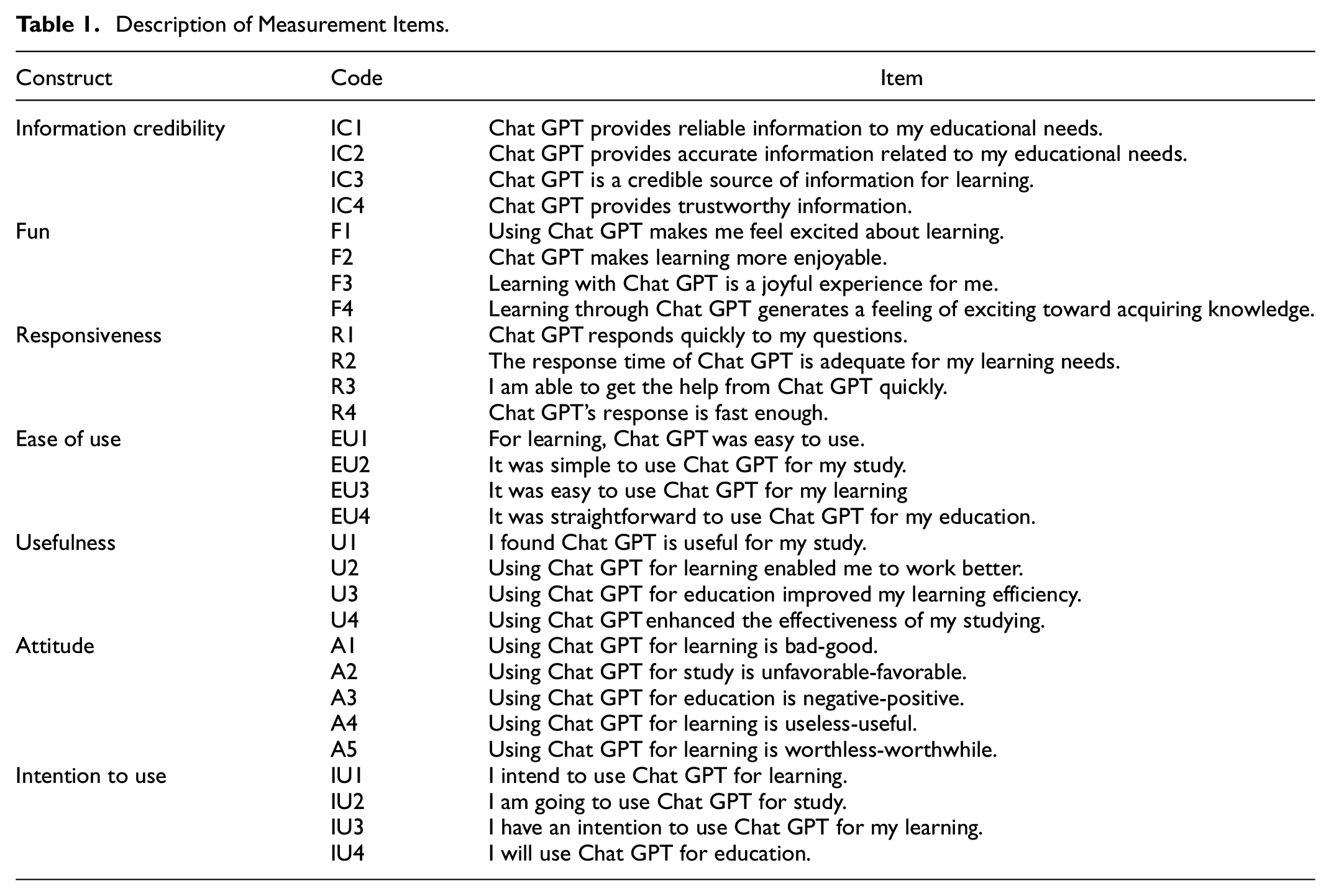
The measurement item is depicted in Table 1. This study primarily employed a 5-point Likert scale (1 = strongly disagree, 5 = strongly agree). The main attributes of this work were derived from the extant literature. The items were adjusted to be suitable for the aim of the current research. Information credibility is defined as how trustworthy the information offered by Chat GPT is (Castillo et al., 2013; Kang & Namkung, 2019; Metzger et al., 2003). The definition of fun is how much excitement Chat GPT users feel while using Chat GPT (Lim et al., 2020; Marcus et al., 2021; Özhan & Kocadere, 2020). Responsiveness is defined as how Chat GPT users appraise the response speed of Chat GPT in the working process (Ashby & Gonzalez, 2017; S. Lee & Lee, 2020; Murray et al., 2019). Ease of use is defined as how users evaluate the simplicity of controlling Chat GPT for their learning (Alfadda & Mahdi, 2021; Fathema et al., 2015; W. S. Lee et al., 2023). Usefulness is how users perceive the utility of using Chat GPT for education (Moon et al., 2022; Rauniar et al., 2014; Yuen et al., 2021). The definition of attitude in this work is how users assess Chat GPT for education (Kamal et al., 2020; Marangunić & Granić, 2015; Moon et al., 2022). Intention to use is defined as the degree to which users adopt Chat GPT for their learning (Bailey et al., 2017; W. S. Lee et al., 2023; Sciarelli et al., 2022). Moreover, the demographic information of this work includes gender, age, household income, employment, education level, and monthly usage frequency of Chat GPT.
Description of Measurement Items.
Data Analysis
This research implemented frequency analysis for the profile information of survey participants. Next, confirmatory factor analysis was performed to test the convergent validity and reliability of the measurements. Scholars have argued that convergent validity is established by meeting specific thresholds: a factor loading of at least 0.5, a construct reliability (CR) value of 0.7 or higher, and an average variance extracted (AVE) of at least 0.5 (Fornell & Larcker, 1981; Hair et al., 2010; Hoyle, 1995). In this study, the mean and standard deviation of the constructs were calculated, and a correlation matrix was used to examine the relationships between the variables. The study employed a structural equation model based on covariance-based maximum likelihood estimation (MLE) to test the hypotheses. Given that the sample size exceeded 250, the use of covariance-based MLE was considered appropriate for parameter estimation (Hair et al., 2010; Hoyle, 1995). With a sufficient number of observations (n = 465), the estimation using the SEM was expected to be reliable.
The literature further specifies that goodness of fit for both confirmatory factor analysis (CFA) and SEM should be assessed using multiple indices: Q (CMIN/degree of freedom) < 3, RMR (Root-mean-square residual) < 0.05, RMSEA (Root mean square error of approximation) < 0.05, GFI (Goodness-of-fit index) > 0.9, NFI (Normed fit index) > 0.9, RFI (Relative fit index) > 0.9, IFI (Incremental fit index) > 0.9, TLI (Tucker–Lewis Index) > 0.9, and CFI (Comparative fit index) > 0.8 (Fornell & Larcker, 1981; Hair et al., 2010; Hoyle, 1995).
Additionally, this study utilized Hayes’ process macro model 1 with 5,000 bootstrapping samples to test the moderating effect of fun. The process macro model, as documented by Hayes (2017), mitigates concerns regarding normality, making it a robust tool for testing moderating effects. This approach was deemed suitable for estimating the moderating role of fun. The study then conducted a median split analysis to further investigate the moderating effect of fun on the relationship between information credibility and usefulness. The median values of information credibility, fun, and attitude were found to be 4. The first moderating effect examined was between information credibility and usefulness, while the second focused on the relationship between attitude and intention to use.
Results
Profile of Survey Participants
Table 2 shows the demographic information of the survey participants. The number of observations is 465. The numbers of males and females are 227 and 238, respectively. For employment, the employed proportion is 88.0%. Regarding the highest academic degree, the bachelor’s degree proportion is the largest (70.3%). Table 2 shows survey participants’ information on age (younger than 20: 5, the 20s: 141, 30s: 207, 40s: 56, 50s: 41, and older than 60: 15), monthly household income (under $2,000: 114, $2,000–4,000: 86, $4,000–6,000: 100, $6,000–8,000: 50 $8,000–10,000: 47, and over $10,000: 68), and monthly use frequency (less than 1 time: 83, 1–3 times: 150, 3–5 times: 145, and more than 5 times: 87).
Demographic Information (N = 465).

Results of Confirmatory Factor Analysis and Descriptive Statistics
Table 3 shows the results of the confirmatory factor analysis. All factor loadings, AVE, and CR values are greater than the threshold, and the goodness of fit indices meet the criteria (χ2 = 623.759, df = 356, χ2/df = 1.752, RMR = 0.025, GFI = 0.915, NFI = 0.936, RFI = 0.926, IFI = 0.971, TLI = 0.967, CFI = 0.971, and RMSEA = 0.040). This suggests that the constructs were valid and could be usable. Seven attributes are derived from the factor analysis: information credibility, fun, responsiveness, ease of use, usefulness, attitude, and intention to use. Table 3 also includes the descriptive information of the attributes: information credibility (mean= 3.82, SD = 0.79), fun (mean= 3.87, SD = 0.80), responsiveness (mean= 3.98, SD = 0.72), ease of use (mean= 4.00, SD = 0.72), usefulness (mean= 3.93, SD = 0.78), attitude (mean= 4.03, SD = 0.78), and intention to use (mean= 3.91, SD = 0.86).
Confirmatory Factor Analysis Results.

Note. *p < .05 Goodness of fit indices: χ2 = 623.759, df = 356, χ2/df = 1.752 RMR = 0.025, GFI = 0.915, NFI = 0.936, RFI = 0.926, IFI = 0.971, TLI = 0.967, CFI = 0.971, RMSEA = 0.040, CR denotes construct reliability, and AVE stands for average variance extracted.
Correlation Matrix and Results of Hypothesis Testing
Table 4 describes the correlation matrix. Information credibility positively correlates with fun (r = .738, p < .05), responsiveness (r = .656, p < .05), ease of use (r = .655, p < .05), usefulness (r = .732, p < .05), attitude (r = .726, p < .05), and intention to use (r = .730, p < .05). Fun also positively correlates with responsiveness (r = .654, p < .05), ease of use (r = .697, p < .05), usefulness (r = .809, p < .05), attitude (r = .772, p < .05), and intention to use (r = .776, p < .05). Responsiveness positively correlates with ease of use (r = .706, p < .05), usefulness (r = .668, p < .05), attitude (r = .663, p < .05), and intention to use (r = .650, p < .05). Finally, intention to use positively correlates with ease of use (r = .776, p < .05), usefulness (r = .853, p < .05), and attitude (r = .791, p < .05).
Correlation Matrix.

*p < .01.
Table 5 exhibits the results of the hypothesis testing using the structural equation model. The goodness-of-fit index indicates the statistical significance of the structural equation model (χ2 = 583.194, df = 336, χ2/df = 1.736, RMR = 0.025, GFI = 0.918, NFI = 0.937, RFI = 0.929, IFI = 0.972, TLI = 0.969, CFI = 0.972, and RMSEA = 0.040). Fun (β = .526, p < .01) and ease of use (β = .416, p < .01) positively affect usefulness. Moreover, attitude is positively influenced by usefulness (β = 1.068, p < .01). Also, usefulness exerts a positive effect on the intention to use (β = 1.226, p < .01).
Results of Hypotheses Testing Using Structural Equation Model.

Note. *p < .01 Goodness of fit indices: χ2 = 583.194, df = 336, χ2/df = 1.736, RMR = 0.025, GFI = 0.918, NFI = 0.937, RFI = 0.929, IFI = 0.972, TLI = 0.969, CFI = 0.972, and RMSEA = 0.040.
Figure 3 presents the graphical representation of the hypothesis testing. The results indicate that hypotheses H2, H4, H6, and H7 are supported. Specifically, the findings reveal that fun is the only significant predictor of usefulness. Furthermore, the results demonstrate a positive association between ease of use and usefulness, confirming that usefulness is positively related to both attitude and the intention to use ChatGPT for learning.
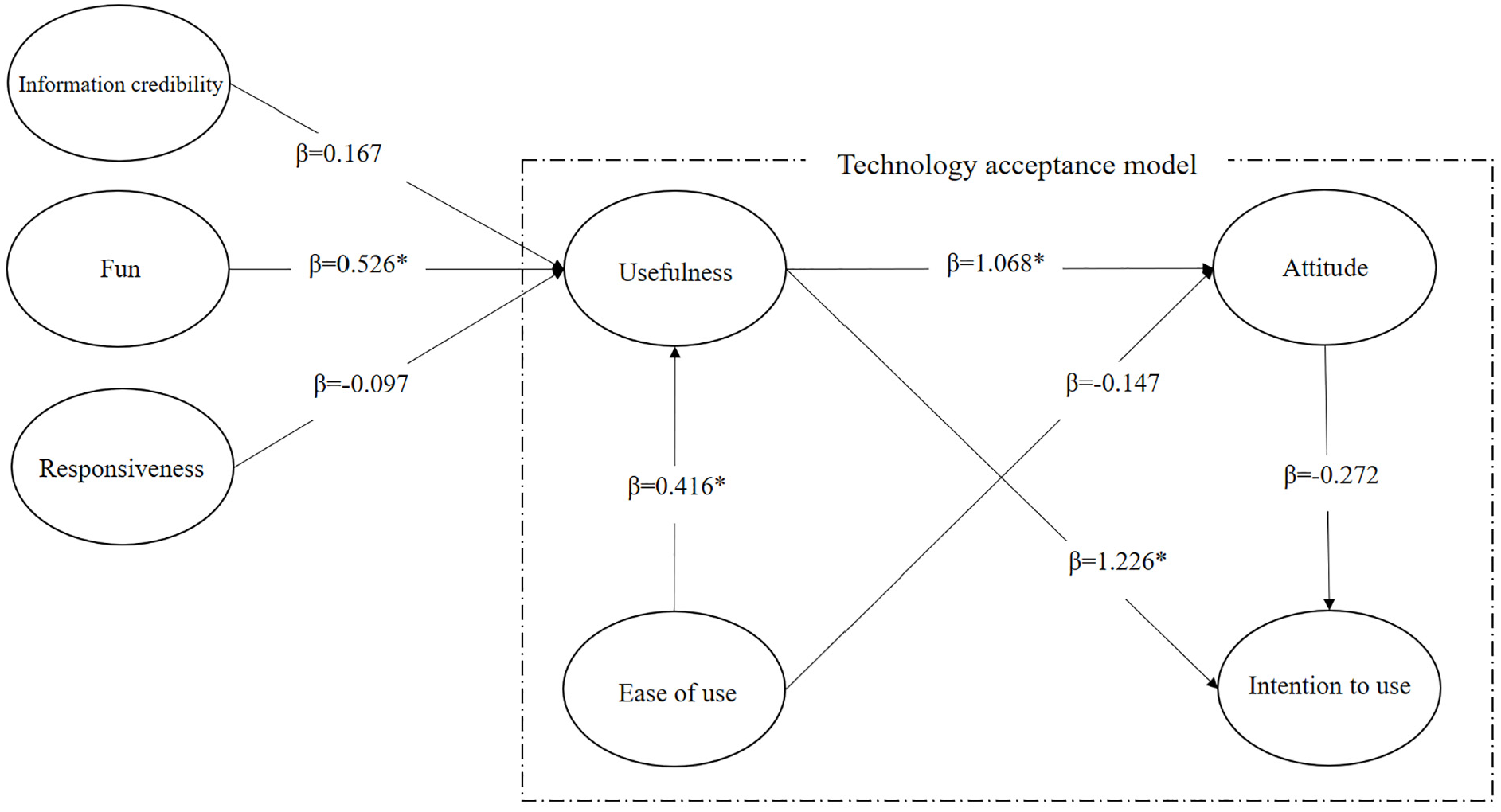
Results of hypothesis testing.
Table 6 presents the results of the moderating effect of fun on the relationship between information credibility and usefulness. The analysis shows that the interaction term Information Credibility × Fun exerts a negative effect on usefulness (β = −.070, p < .05), indicating a significant moderating role of fun in this relationship. This supports hypothesis H9. The model is statistically significant, as indicated by its F-value (p < .05). Additionally, the conditional effects of the focal predictors are also statistically significant (p < .05).
Results of Hayes Process Macro Model 1.

Note. Dependent variable: Usefulness, *p < .05.
Figure 4 graphically presents the mean values for four groups: high information credibility and high fun (mean High information credibility and high fun = 4.41), high information credibility and low fun (mean High information credibility and low fun: 3.79 = 3.79), low information credibility and high fun (mean Low information credibility and high fun = 4.07), and low information credibility and low fun (mean Low information credibility and low fun = 3.25). Notably, the difference in usefulness between low and high credibility within the low-fun group is larger than the difference in usefulness between low and high credibility within the high-fun group.

Moderating effect of fun between information credibility and usefulness.
Table 7 shows the results of the moderating effect of fun on the relationship between attitude and intention to use. The results exposed that the moderating variable (Attitude × Fun) exerted a negative effect on usefulness (β = −.072, p < .05). It indicates that H10 is supported. The model is statistically significant regarding its F-value (p < .05). The conditional effects of focal predictors are also statistically significant (p < .05).
Results of Hayes Process Macro Model 1.

Note. Dependent variable: Intention to use, *p < .05.
Figure 5 presents the graphical presentation of the moderating effect of fun. The mean values of the four groups are presented in Figure 5 (mean High attitude and high fun = 4.40, mean High attitude and low fun = 3.92, mean Low attitude and high fun = 3.86, and mean Low attitude and low fun = 3.05). The gap of intention to use for the group between low attitude and high attitude within low fun group is greater than the gap of intention to use for the group between low attitude and high attitude within high fun group.

Moderating effect of fun between attitude and intention to use.
Discussion
This study examined the antecedents of perceived usefulness within the TAM framework for Chat GPT and assessed the model’s explanatory power in the context of Chat GPT usage for learning. Saif et al. (2024) emphasized the need to investigate additional attributes within the TAM to better understand user behavior regarding Chat GPT. In response to these recommendations, this research extended the TAM by incorporating a broader range of attributes, specifically information credibility, fun, and responsiveness, to provide a more comprehensive analysis of user acceptance. Examining the descriptive statistics, information credibility recorded the lowest mean value (mean= 3.82), while the mean value of attitude was the highest (mean= 4.03). This indicates that Chat GPT users are slightly wary about the information provided by Chat GPT for their education, while the overall attitude toward Chat GPT is quite positive. Next, the results depicted that ease of use presented the second-highest mean values. It can be inferred that Chat GPT is easy for users to handle because it is controlled by both voice and text messages. The testing results implied that Chat GPT users gained utility in their learning-by-fun experience. That is, fun experiences while interacting with Chat GPT might improve learning efficiency from the viewpoint of users. Moreover, ease of use was positively associated with usefulness, and it can be inferred that the simplicity of the controlling system might become the reason for the higher level of utility from the perspective of Chat GPT users for learning. The results also demonstrated that usefulness appeared to be a significant determinant of attitude and intention to use for learning. In other words, Chat GPT’s utility from learning could become the key motivation for better attitude and intention to use. The findings of this research align with prior studies by confirming significant relationships among key attributes of the TAM, namely ease of use, usefulness, attitude, and intention to use (Alfadda & Mahdi, 2021; Kamal et al., 2020; W. S. Lee et al., 2023). However, the results indicate that the effect of ease of use on attitude was not significant, which contrasts with previous studies that found ease of use to be a significant determinant of attitude (W. S. Lee et al., 2023; Moon et al., 2022). This discrepancy could be attributed to the presence of simpler learning tools, such as textbooks and online class systems, where ease of use alone may not be sufficient to elicit positive user reactions in the educational context. Furthermore, the results revealed that attitude did not serve as a critical determinant of intention to use, differing from prior research that underscored its importance (Fussell & Truong, 2022; Yuen et al., 2021). This could be because a positive attitude alone is not sufficient to adopt certain systems for learning instruments. After all, the effect has not yet been demonstrated. That is, users might be somewhat conservative in selecting Chat GPT for their learning due to the non-significant association between attitude and intention to use. Allen et al. (2020) observed that some students prefer traditional tools like pencils and notebooks over new technological devices and systems for learning due to their familiarity. In this study, it was found that information credibility did not significantly influence perceived usefulness. This may be attributed to the relatively low level of perceived information credibility, as users may consider generated responses less reliable. Additionally, the findings indicated that responsiveness was not a critical determinant of usefulness. This may be because Chat GPT users expect rapid responses as a given, diminishing the perceived importance of responsiveness in determining usefulness.
Furthermore, the study identified a significant moderating effect of fun. Specifically, it was found that the educational utility of Chat GPT may be reduced when humorous delivery styles or overly engaging interactions overshadow the core delivery of information. Moreover, the findings suggest that the inclusion of fun elements in educational tools like Chat GPT may weaken the relationship between attitude and intention to use, as fun can distract users from the primary educational purpose, leading to hesitation in decision-making.
Conclusion
Theoretical Implications
This study sheds light on the literature by demonstrating the explanatory power of the TAM in the case of Chat GPT. Although Chat GPT has become more popular in the market, its function has not yet been elucidated. This research makes several important contributions. First, it demonstrates the explanatory power of the TAM in the context of Chat GPT for learning. Second, it advances the literature by identifying antecedents of perceived usefulness within TAM specifically for Chat GPT in an educational setting. This finding is distinctive compared to prior studies (Granić & Marangunić, 2019; Marangunić & Granić, 2015; Moon et al., 2022; Yuen et al., 2021), suggesting that the external validity of TAM attributes related to usefulness is a unique theoretical contribution of this work. Additionally, the study contributes by revealing the significant moderating effect of fun on the relationship between information credibility and usefulness. It also illuminates the interaction between attitude, fun, and intention to use Chat GPT for learning, highlighting the role of fun as a moderating factor. Such an outcome of this work leads researchers to understand more about the behavior of Chat GPT users.
Practical Implications
This research presents practical implications for the system designers of Chat GPT. Above all, the resources going into the development of Chat GPT might need to be dedicated to building a more exciting system for learning. This could include having varied voices, joking, and interesting anecdotes and example suggestion functions for studying which are linked with the excitement of communication with the system. Next, Chat GPT system providers might consider their investment in easier systems because this could become a way to elevate the utility of users for learning. From a practical perspective, developers should consider allocating resources to enhance the working efficiency of Chat GPT in educational contexts, as efficiency is a key determinant of positive user evaluations and decision-making. The findings also underscore the importance of managing the moderating effect of fun. Teachers using Chat GPT in their classrooms may need to establish guidelines to ensure students focus on lesson content rather than the platform itself, which could enhance learning outcomes. Moreover, developers should carefully consider how fun elements are integrated into Chat GPT, as these elements may cause users to become skeptical about fully adopting the platform for educational purposes.
Suggestions for Future Research
This study has some limitations. First, the method of this research is limited to the survey. Future research might use varied methods (e.g., experimental design and qualitative research) to examine whether Chat GPT is effective for education. Moreover, this research was limited to participants speaking English. Future research might consider participants using other languages. Such an effort might lead scholars to further determine the influence of Chat GPT. Additionally, the data collection period was relatively short in this work. It suggests that the information might not be able to catch the current progress of Chat GPT systems for the investigation of user behaviors. Future research might be able to consider both longer periods and more recent information.
Footnotes
Declaration of Conflicting Interests
The author(s) declared no potential conflicts of interest with respect to the research, authorship, and/or publication of this article.
Funding
The author(s) received no financial support for the research, authorship, and/or publication of this article.

Data Availability Statement
Data sharing not applicable to this article as no datasets were generated or analyzed during the current study.