




Abstract
Learning motivation is essential to online learning success. This study recognizes two aspects of learners’ motivation for E-learning and proposed technology acceptance model as cognitive process and stimulus-organism-response as affective process to explain the undergraduates’ continuous intention to use E-learning system based on Stimulus-Organism-Response model. It employes a quantitative research approach to analyze the data from 662 undergraduates using structural equation modeling. Specifically, it examines how flow experience (a generalized sense of enjoyment) as the external variable affects the perceived ease of use and perceived usefulness and the continuous use of the E-learning system. The results affirm that flow experience is a significant cognitive state in online virtual community behavior and has a significant influence on continuous intention to use. Perceived ease of use of the E-learning system is found more influential than perceived usefulness. Furthermore, the perceived ease of use and perceived usefulness were significant mediators between Flow and continuous intention. The findings of this study will help system designers, policymakers, educationists and other stakeholders take necessary steps in improving e-learners’ flow experience and their perceived ease of use and usefulness to increase retention rate and performance. More importantly, it will promote the formation of sustainable learning and ultimately achieve a lifelong learning society for all.
Plain Language Summary
(1) This study aims to employ the Stimulus-Organism-Response framework to explore the relationship between flow, perceived ease of use and perceived usefulness on undergraduates’ behavioral intentions toward sustainable using E-learning system. (2) This study applies a quantitative method using a survey tool to collect data from undergraduates in their sophomore year at 4 public universities in Guangxi, an undeveloped province in China. Partial Least Squares-Structural Equation Modeling (PLS-SEM) technique was used to test hypotheses and proposed research model. (3) Results from a survey of 662 undergraduates show that flow, perceived ease of use and perceived usefulness have positive effect on continuous use. Perceived ease of use of the E-learning system is found more influential than perceived usefulness. Furthermore, the perceived ease of use and perceived usefulness are significant mediators between flow and continuous intention. (4) The findings have both theoretical and practical significance, which help system designers, policymakers, educationists and other stakeholders take necessary steps in improving e-learner’s flow experience and their perceived ease of use and usefulness to increase retention rate and their performance, promote the formation of sustainable learning and ultimately achieve a lifelong learning society for all. (5) The limitations on samples, the perspectives of stakeholders, and the investigation method such as longitudinal study have been put forward.
Keywords
Introduction
China has more than two decades of development and implementation of leading-edge distance education programs, the construction of an open educational network, and life-long learning systems. It has achieved major growth in the E-learning domain in both basic education and higher education involving teachers, students and learning resources. However, despite these achievements, the development of E-learning in China is fraught with many challenges. These challenges are not specific to China such as poor or lack of infrastructure, financial constraints, inadequate support, lack of E-learning knowledge and teachers’ resistance to change and high dropout rates (Alias et al., 2021; Al-Samarrai et al., 2020). However, China faces one unique challenge: its teacher-centered approach to education, particularly in primary and secondary schools (Xue et al., 2020) may not be conducive to promoting active engagement, personalized learning experiences, and student autonomy, which are essential for effective online learning. To this day, the Confucian idiom “Respect teachers and revere their teaching” is still held as truth for most Chinese students.
So, when COVID-19 broke out and digital online became the default and no longer regarded as just supplementary, the whole education sectors were impacted. China is no exception. In the China case, a strategic national plan of “Suspending Classes without Stopping Learning (SCWSL)” for online education to ensure continuing teaching and learning was launched. Millions of students have to adapt to a new medium for learning, while teachers have had to provide teaching using online resources without any preparation (Hodges et al., 2020). This sudden massive change has precipitated a massive shift in learning patterns for both students and teachers (Carolan et al., 2020). While the overnight change of pedagogy in education provided a good respite, and afforded universities the saving grace for the completion of the semester in difficult times, it also exposes huge challenges despite the benefits associated with online education. Till to date, educators and students continue to struggle to move from the traditional Chinese-Confucian values that endorse teacher-centered instruction (Crawford et al., 2020). Fu et al.’s (2020) online survey of 2,420 primary and secondary school teachers showed that in the COVID-19 pandemic, teachers face many problems with online teaching, and unsatisfactory teacher-student interaction is a common problem. Similarly, Shen’s (2020) study of 46,149 kindergarten parents in China found that parents were also not happy with the effects of online teaching on their children during the pandemic. Students appear to be unable to understand the educational role of online technologies and consider them as irrelevant or even an obstacle to learning (Ellis & Bliuc, 2019). Invariably, high dropout rates and churn rates remain major challenges for online learning (Zhao et al., 2021). A similar study conducted by Nguyen et al. (2022) reported that online students are 2.5 times more likely than on-campus students to withdraw without a qualification. Similarly, Fang (2015) found only 12.7% of students could complete an E-learning course. This high dropout challenge and concerns have attracted the attention of many researchers. Several studies have identified the difficulties and challenges in online teaching and learning. Among these are studies conducted by Aldon et al. (2021), Y. Cao et al. (2021), Salloum et al. (2019) and Y. H. Chen (2023). However, there is lack of agreement about the critical challenges and factors that shape the successful usage of E-learning system (Almaiah et al., 2020). From these studies, it is evident that while online learning offers various advantages, it also brings about notable challenges. These challenges include didactic pedagogy, social isolation, learner procrastination, and technological distractions (Rasheed et al., 2020), ultimately resulting in heightening learners’ dissatisfaction and dropout rates (Pursel et al., 2016), a sense of alienation and COVID-related anxiety (Toader et al., 2021) and poor mental health, a spotty Internet connection, and an unlearning-friendly home environment (Kapasia et al., 2020). Similarly, Sutton (2020) revealed that many students who were accustomed to the traditional face-to-face method of teaching found the burdensome online method and had difficulty in maintaining focus during online learning due to the distraction at home. Flores et al. (2022) found that students showed a preference for face-to-face or hybrid teaching model and cited lack of teachers’ support and technological resources as key reasons for their preference. This highlights the importance of considering learners’ experiences and motivations to enhance E-learning success. Motivation is the “engine” of learning, and it influences when, what, and how students learn (Schunk & Usher, 2012).
Our reviews show there is relatively limited research on the experience and motivation of Chinese students and teachers in online learning, and majority of the current studies focus on Western countries. The limited available online studies that were conducted with Chinese students have taken place in developed cities and there are not many studies on online education in China’s remote rural areas or minority educational groups (Y. H. Chen, 2023). Research on the online learning motivations and experiences of the large Chinese student population holds significant potential to impact and provide valuable reference points for the global online education trend. This is especially relevant due to the unique Confucian heritage learning culture that influences Chinese education, as highlighted by Ho (2020). By examining the motivations and experiences of Chinese students in online learning environments, researchers can gain insights into how cultural factors shape learning behaviors and preferences in an increasingly digitalized world. Such research not only contributes to our understanding of online education trends but also offers practical implications for educators and policymakers seeking to enhance online learning experiences for diverse student populations worldwide. According to Li et al. (2024), a country’s national culture affects virtual learning environment adoption in higher education. They pointed out that power distance is associated with the institutional normative facilitation. On the other hand, masculinity-femininity is linked to individual cognition, while uncertainty avoidance has a connection with individual digital capability in the virtual learning environment adoption process. In the same vein, cultural psychologies have revealed the profound influence of culture on cognitive, emotional and motivational processes shaping individuals into active agents (Kitayama & Salvador, 2024). Hence, it is important to understand these Confucian heritage learners’ learning process and if their mental state affects the way they perceive the use of online learning system.
Motivated by the gaps, this study develops a research model applying the Stimulus-Organism-Response framework (S-O-R, Mehrabian & Russell, 1974) to examine how ‘flow’ fortifies students’ perceived ease of use and perceived usefulness, which subsequently influences their behavioral responses (i.e., continuous intention to use). This study seeks to theoretically integrate Flow Theory and Technology Acceptance Model (TAM), applying the Stimulus-Organism-Response (S-O-R) model in explaining key contextual and psychological factors that might influence learners’ E-learning experiences and acceptances in an economically underdeveloped region: Guangxi Zhuang Autonomous Region (GZAR), home to 18 million minority citizens in an attempt to capture the unique cultural influences that may impact the students’ psychological states that engage many sensory, cognitive, emotional and social processes as an antecedent variable to explain the continuous intention to use E-learning among undergraduates living in this multi-ethnic province of China. The study can contribute to the understanding of the influence of multi-ethnic culture, language and economy on the success of E-learning adoption as most studies so far are conducted in the developed urban context (Esteban-Millat et al., 2018; Hong et al., 2019).
Literature Review
As described above, this study examines the undergraduates’ perspective using Flow as the “stimulus (S),” perceived ease of use (PEOU) and perceived usefulness (PU) of the E-learning system as the “organism (O)” in the model and operationalizes the continuous use of E-learning system as the “response (R).”
Online Learning Motivation and Flow
Past studies suggest that lack of time and lack of motivation are primary causes of learner attrition in online settings (Aragon & Johnson, 2008). Song (2000) suggested that this motivation can be organized into three major categories of motivational influences in online environment: internal, external, and personal factors. Existing research on motivation in online environment tends to use either a trait-like model which relates to the personal characteristics that drives the internal motivation of the learners and the design of online learning environment, the external factors to encourage optimal learner motivation. Regardless, it is clear that motivation must be ensured in order to achieve student engagement (Dörnyei, 2020). Recent studies suggest a clear relationship between flow and the student’s perceived learning of the subject matters, student’s perceived skill development and student satisfaction (Amini et al., 2016; Rossin et al., 2009). According to the Journal of Educators Online, some of the biggest reasons why students choose to drop out of online courses include feelings of isolation, frustration, and disconnection, as well as a general lack of faculty contact, instructor participation, and social interaction. Along the same line of research, Zhou et al. (2021), a professor from Hunan University, investigated the learners’ E-learning acceptance in two universities in Changsha, an economically developed city. The research found flow, as typical psychological factor, a determining antecedent can impact Chinese learners’ E-learning acceptance; however, the missing link between flow and perceived ease of use was found. These studies highlighted the effect of Flow, as an important source of motivation (Joo et al., 2012), can be a significant predictor of course satisfaction, which can lead to higher retention. However, research on flow for the context of E-learning is exiguous, and the minuscule investigation into the effects of flow is scattered across diverse papers which have explored single, separate outcomes (Rodríguez-Ardura & Meseguer-Artola, 2016).
Flow Theory in the E-learning Context
This study supports the view of Holsapple and Wu (2008) that the flow states that it is associated with the traditional indicator of intrinsic motivation which can be an antecedent to continuous intention to use. It appears that there is a circular relationship between cognition and emotion. Different studies have demonstrated that the flow construct is capable of predicting long-term continuity intention and behavior (C. F. Chen & Chen, 2011; Csikszentmihalyi, 2014; Rodríguez-Ardura & Meseguer-Artola, 2016), and it has been confirmed as a key intrinsic motivational factor in the aspect of continuing to use technology (C. Y. Hung et al., 2015). Various studies (such as Al-alak & Alnawas, 2011; Guo et al., 2016) confirmed that flow experience plays a crucial role in the E-learning process. Active engagement in learning activities within an E-learning system, such as participating in chats or discussions, completing quizzes, and watching videos, can significantly enhance users’ acquisition of knowledge and skills. This active involvement also fosters a sense of flow experience, as suggested by Goh and Yang (2021), contributing to the overall development of learners’ skills and competencies. In addition, flow experience is found to be developed when users start to focus on their learning activities (Van den Hout & Davis, 2019) and confirmed as psychological factor to impact on use intention in E-learning context (Rodríguez-Ardura & Meseguer-Artola, 2016; Yang & Lee, 2018) and developed stronger intention to continue using the E-learning system (M. Lee, 2010; Lu et al., 2019).
Perceived Usefulness and Perceived Ease of Use
Perceived ease of use and perceived usefulness have been confirmed as two crucial constructs in technology acceptance model (F. D. Davis, 1989) and the most reliable and robust determinant of the behavioral adoption of any new technology (F. D. Davis, 1989; Jiang et al., 2022). In this context, perceived ease of use (PEOU) refers to the degree to which the users believe that using a particular system would be free from effort (F. D. Davis, 1989) and they will be more willing to continue to use it. On the other hand, perceived usefulness (PU) refers to the degree to which the users believe that the use of technology will improve their academic performance (F. D. Davis, 1989). In essence, users are more likely to continue using a novel technology when they perceive it as offering benefits such as improved academic performance and the effective and efficient completion of tasks. This perception of tangible benefits serves as a strong motivator for continued engagement with the technology.
Despite the utility of PEOU and PU as a strong predictor of user’s behavior toward new technologies (Dai et al., 2020; S. Fu et al., 2020), there are insufficient studies to elaborate on the inter-relationship between the intrinsic motivational psychology, Flow and PEOU and PU. Various scholars have introduced different external variables such as computer anxiety (Abdullah et al., 2016), subjective norm (Abdullah et al., 2016) and computer self-efficacy (Chang et al., 2017; Jiang et al., 2022), to study users’ behavior intention through PEOU and PU. Thus, it is necessary to assess the psychological factors related with continuing to use E-learning system so as to improve E-learning practice.
Hence, this study suggests that a well-designed E-learning system that offers engaging, challenging, and rewarding experiences can facilitate flow for users; thus, it can be the source of flow experience. It provides learning tasks that are demanding enough to be interesting, but not too difficult to cause frustration. Therefore, flow is modeled as an antecedent to perceived ease of use (PEOU) and perceived usefulness (PU). It is the stimulus that provides the impulse to affect PEOU and PU, and PEOU and PU act as organisms that are affected by Flow, the stimulus. In this study, the author suggests that understanding the e-learners’ dynamic intrinsic motivational psychology can help to better predict their cognition of the E-learning system, which subsequently impacts their behavioral intention.
Stimulus-Organism-Response (S-O-R) Model
The Stimulus-Organism-Response (S-O-R) model (Mehrabian & Russell, 1974) is adopted to underpin this study’s research model. It illustrates a basic relationship among the variables: Flow, a psychological state, through the mediating variables of the organism; PEOU and PU to the final response—the continuous use intention. S-O-R model has been widely employed in investigating online user behaviors (X. Cao et al., 2018; Majeed et al., 2022). According to the authors, S-O-R framework demonstrates that external antecedents influence individual’s psychological processing, first as a perceptive stimulus, affecting their cognitive and emotional reflections, then as an organism, contributing toward formulating their mental or behavioral traits, and finally as a response, such as an attitude, adoption intention or actual usage (Mehrabian & Russell, 1974). The S-O-R framework has been modified with different external variables to analyze in a qualified way the connections between the stimulus (environmental input), the organism (mental process) and the response (behavioral outputs), in order to explain users’ behaviors in various scenarios.
For this study, the cognitive and emotional mechanism is operationalized by perceived ease of use and usefulness in the E-learning context. Both define the internal processes that mediate the effect of environmental cues on continuous intention to use E-learning. “Response” pertains to relevant user reactions, including intentions, decisions, or behavioral changes caused by stimulus and organism factors. The current study defines the response as a continuous intention to use E-learning. Based on the S-O-R framework, external environments could stimulate individuals’ inner cognition and emotional mechanisms, which in turn influence a response such as continuous intention to use E-learning as shown in Figure 1 below.

The basic S-O-R framework for this study (Mehrabian &Russell, 1974).
Previous researchers have explored how flow can indirectly influence users’ ultimate responses, such as their intention to adopt, actual usage behavior, and intention to continue using a system. This influence may occur either directly or through users’ mental reflection variables, such as perceived value, satisfaction, and attitude (C. C. Chen & Lin, 2018; S. Y. Hung et al., 2016). However, the combined effects of flow, perceived ease of use, and perceived usefulness have not yet been empirically validated to ascertain learners’ behavioral intentions to continue using an online system.
Flow, in this study, is modeled as a unidimensional, second-order construct, as the dimensions of the flow experience are inter-correlated and reflect the latent higher-order construct of Flow, and any change of the dimensions will change the latent variable (construct). The research environment closely resembles that of Shin’s (2006) study, prompting the adoption of dimensions from Shin’s research to assess the flow experience in this context. For the purpose of this study, telepresence, one of the components of Flow is not included in this as the E-learning systems in Guangxi universities do not have an interactive feature.
The mediating variables, perceived usefulness and perceived ease of use are modeled as “organisms” and play mediating roles. This supports the study by Al-Okaily et al. (2020) confirmed the mediating function between subjective norm and E-learning usage intention via both PU and PEOU (Figure 2).

Proposed conceptual model: Evaluating the continuance intention to use E-learning.
Research Hypotheses
Therefore, the following hypotheses are proposed and discussed in the subsequent section
Direct Hypotheses
Numerous studies (e.g., De Smet et al., 2012; Y. Lee et al., 2013; Purnomo & Lee, 2013) have emphasized the reciprocal relationship between perceived ease of use (PEOU) and perceived usefulness (PU) and the influence of flow on PEOU and PU within online environments. Cheng (2014) found a positive effect of flow experience on online users’ intention to continue using an E-learning system. Similarly, R. Davis and Wong (2007), Guo et al. (2016), Hsu et al. (2012), O’Cass and Carlson (2010), and Scherer and Teo (2019) identified the positive influence of flow experience on online users’ intentions to continue in various contexts. However, few studies have explored this psychological factor—flow—to investigate the intention to use E-learning systems among undergraduates in underdeveloped regions of China. Therefore, based on the above discussion, the following hypothesis is proposed
This study is premised on the notion that if E-learners perceive that using a specific technology, such as UNIPUS as an auxiliary tool, is easy and will enhance their learning performance, they are likely to perceive it as more useful. The increased perception of usefulness, in turn can lead to a greater intention to use the information technology system. Previous studies (Hone & El Said, 2016; E. Kim et al., 2021; Prasetyo et al., 2021) have supported the positive relationship between perceived ease of use and perceived usefulness. Therefore, in the present study, it is hypothesized that perceived ease of use positively influences perceived usefulness, as follows:
Mediating Hypotheses
Flow has not only been found to directly affect users’ intention to continue using E-learning systems, but also indirectly contributed to the continued intention to use the system (CIU) via PU (Cheng, 2014). Flow experience was also found to have relevance with PU and PEOU (Joo et al., 2012) in the E-learning context. When an e-learner is learning via an E-learning system in a flow state, the immersed and focused attention generates a stronger motivation to appreciate the usefulness of the E-learning system (Buil et al., 2017). It indicates that flow, as a stimulus, is an effective and valuable antecedent for PU and PEOU. In other words, there is a reciprocal relationship among Flow, PEOU, PU and CIU, and PU and PEOU have a mediating effect on CIU and indirectly predict the continuous intention to use E-learning by e-learners. Hence, the following hypotheses are proposed:
Methodology
Research Design
This study employs a Quantitative research as it is very well suited to establishing cause-and-effect relationships, to testing hypotheses and to determining the opinions, attitudes and practices of a large population. The purpose of this study was to determine the cause and effect relationship between Flow and perceived ease of use and perceived usefulness and continuous intention to use. Further, this study focused exclusively on undergraduates undertaking online courses at four universities in the Guangxi province.
This study utilized an electronic survey method to conduct investigation. The electronic approach allowed data to be collected at low cost and relatively low response burden on the part of the participants. This was important for two reasons. Firstly, since the time for gathering data for this study was during the COVID-19 epidemic (from September to December 2022), online survey could help to overcome the restrictions imposed to control COVID-19 pandemic. As expected, there has been an increasing interest among researchers in utilizing Internet-based data collection methods during the COVID-19 pandemic. This trend is evident in the growing number of studies that have employed online surveys to gather data since the onset of the pandemic (Akintunde et al., 2021). Secondly, because the potential participants are undergraduates who were mandated to adopt the E-learning system abruptly, they were unlikely to feel an allegiance to the program and may be more likely to refuse to respond or experience response burden. Hence, an online survey with clear instruction may help to survey instructions and can change respondents’ perceptions of the survey experience. Bradburn’s seminar paper identified four factors related to the respondent burden: (1) the length of the survey, (2) the effort required answering, (3) the stress level put on the respondent, and (4) the periodicity with which the respondent is interviewed (Bradburn, 1978). Using online survey is one way to reduce response burden (Bottone, et al., 2022).
The data collection was carried out using an online questionnaire with a 5-point Likert scale (1 = strongly disagree, 5 = strongly agree). The questionnaires were made and completed electronically (distributed via the online Wenjuanxin survey platform). Guangxi province was selected as the study site as it is an undeveloped province and inhabited by 12 ethnic groups. This study suggests that local ethnic culture and their level of cognition may influence the continuous use of E-learning. Thus, the study presented here constitutes a contribution to the field and fills a gap in the literature for this particular context.
Research Instruments
To measure Flow in this context, which is characterized using four components such as enjoyment (E), engagement (ENG), focused attention (FA), and time distortion (TD), multiple scales were used. The scales for E were adapted from Al-Aulamie (2013) and Shin (2006). The scales for ENG and FA were both taken from Shin (2006) whereas the scales for TD were adopted from Shin (2006) and Kiili (2006). The four scales with their measurement items can be found in Appendix Table A1.
The adapted original English questionnaire was translated into Chinese version by two experts from the field of educational technology who have proficiency in two languages, following Brislin’s (1980) back-translation method to ensure that the content reflects the original intent. Therefore, the face validity of these scales was validated by the experts, and their recommendations were incorporated into the finalized questionnaire.
Sample Size and Sampling Technique
The target samples in this study are undergraduates in their sophomore year who have at least 1 year of experience using E-learning. For this study, undergraduates have a dual identity as both a system user and a learner of the non-mandatory usage of the E-learning system—UNIPUS. The total number of sophomore students for each of the four universities and their sample size are computed according to a common sampling formula as given below where n is the number of sample sizes required; p refers to the proportion of the sample; MOE is the margin of error; N is the total population size; Z-(α/2) indicates the critical value of the normal distribution at an α/2 (for a confidence interval level of 95%, α is the significance level 0.05 and the critical value is 1.96).


Hence, if the total population of sophomores (N) is 27,000, the significance level a is set to 0.5 and the confidence level is 1-0.05 = 0.95, p = .5, MOE = 0.05, z_ (α/2) = 1.96, and the minimum sample is 379.


A stratified proportional random sampling method was employed in this study because four universities would be investigated at the same time. Four groups or strata representing the four universities were organized as per above and random samples were taken in the proportion to the population from each of the universities. This is to ensure that all four universities have an equal opportunity to participate in this survey.
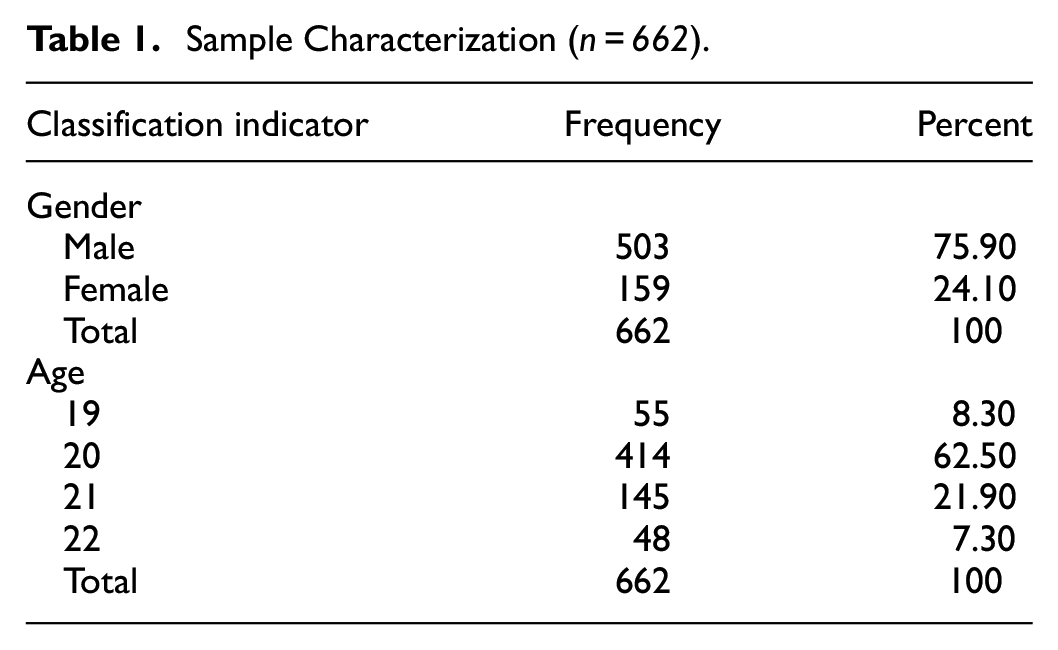
The survey questionnaire was administered electronically by the administrators of each university to send to the list of sophomores who have at least 1 year of experience using UNIPUS. The ethical clearance from universities had been received before conducting the study. The ethical protocol was strictly adhered to. The respondents were informed of the possibility that their data would be used for publication. All information is presented in the aggregated form so that no individual respondent is identifiable. The respondents were also told that this is not part of the student’s assessment. 250 online questionnaires were sent out separately to each university. A total of 837 responses were collected online. Among them, 189 were from A University, 226 were from B University, 183 were from C University, and 239 were from D University. The response rates were 75.6%, 90.4%, 73.2%, and 95.6%, respectively. After checking 837 responses, 14 responses did not complete the questionnaire and 823 valid responses were retained for further analyses. Next, the data screening was conducted, and the outlier tests showed 161 responses were invalid. Therefore, only 662 out of 837 responses were found to be valid for data analysis. Table 1 shows the descriptive statistics and background information of the sample population.
Sample Characterization (n = 662).
Data Analysis and Results
SPSS software and Partial Least Squares-Structural Equation Modeling (PLS-SEM) path modeling analysis were conducted to make descriptive statistics and analyze the relationship among those variables in the model respectively. The PLS-SEM method was employed in this study as it can fit both formative and reflective measurement models (Hair et al., 2013); second, the predictive advantages of PLS-SEM, such as the coefficients of determination (R2 values) and the predictive relevancy (Q2 values) (Hair et al., 2013), help to discover the contribution of each variable; third, it is appropriate to carry out exploratory work (Lowry & Gaskin, 2014). Last but not least, since the data distribution was not normal in this study, PLS-SEM is deemed more suitable.
Several steps were taken to perform the data analysis. Descriptive statistics using SPSS was first carried out before evaluating the data in the measurement model and the structural model. The second-order construct’s convergent validity, collinearity and outer weights were also performed before assessing the structural model.
The hypotheses for this investigation were tested using structural equation modeling with SmartPLS 3.3.3, and the outcomes of the mediating relationship were achieved by employing a bootstrapping procedure as recommended by Hair et al. (2014). The last step was to conduct an important-performance map analysis.
Descriptive Statistics
Table 2 illustrates the mean, median value and standard deviation of four factors. The means of the items were between 3.32 and 3.40 for perceived usefulness, revealing that the respondents perceive that using E-learning is useful and believe they can get benefits from using it, such as the ability to perform tasks efficiently, enhancing study performance, and making study easier. The means for perceived ease of use were between 3.36 and 3.49, illustrating that their cognition of ease of use is quite good. The means of enjoyment items (between 3.21 and 3.43), focused attention items (between 2.98 and 3.18), time distortion items (between 3.19 and 3.46), and engagement items (between 3.06 and 3.34) indicate the positive flow experience can be generated by using E-learning. The means of continued intention to use (ranging from 3.35 to 3.48) reveal that the respondents tend to continue using E-learning.
The Measured Variables’ Mean, Median Value and Standard Deviation.

Note. M1 = Mean; M2 = Median value; SD = Standard Deviation, (n = 662).
Results of the Measurement Model
Convergent and discriminant validity tests were carried out to evaluate the adequacy of the constructs used in the measurement model. The results shown in Table 3 indicate that the reliability of internal consistency was established since the composite reliabilities values (CR values) of all dimensions were more than 0.836, above the threshold value of 0.70 (Hair et al., 2017). The results show that outer loading for most indicators exceeded the recommended value of 0.708 (Hair et al., 2017). However, two indicators, FA2 (0.614) and TD6 (0.684) were still retained because the average variance extracted (AVE) results of construct of FA (0.579) and TD (0.559) were above 0.5 (Ramayah et al., 2018). Further, the results also show that the AVE values (range from 0.559 to 0.693) exceeded 0.50 and met the acceptable level, indicating that this model has satisfactory convergent validity (Hair et al., 2017).
Reflective Measurement Model: Factor Loadings, CA, CR, and AVE.

Note. FL = factor loadings, CA = Cronbach’s a, CR = composite reliability, AVE = average variance extracted, (n = 662)
Fornell-Larcker criterion is the approach to evaluate the construct’s level of discriminant validity (Henseler et al., 2009). Table 4 represents the discriminant validity test results of sample data, which shows all the values on top of each (in bold) row were larger than other values in the column and its row. The discriminant validity was achieved in the model based on the Fornell-Larcker criterion (Fornell & Larcker, 1981).
Discriminant Validity by Fornell-Larcker Criterion.
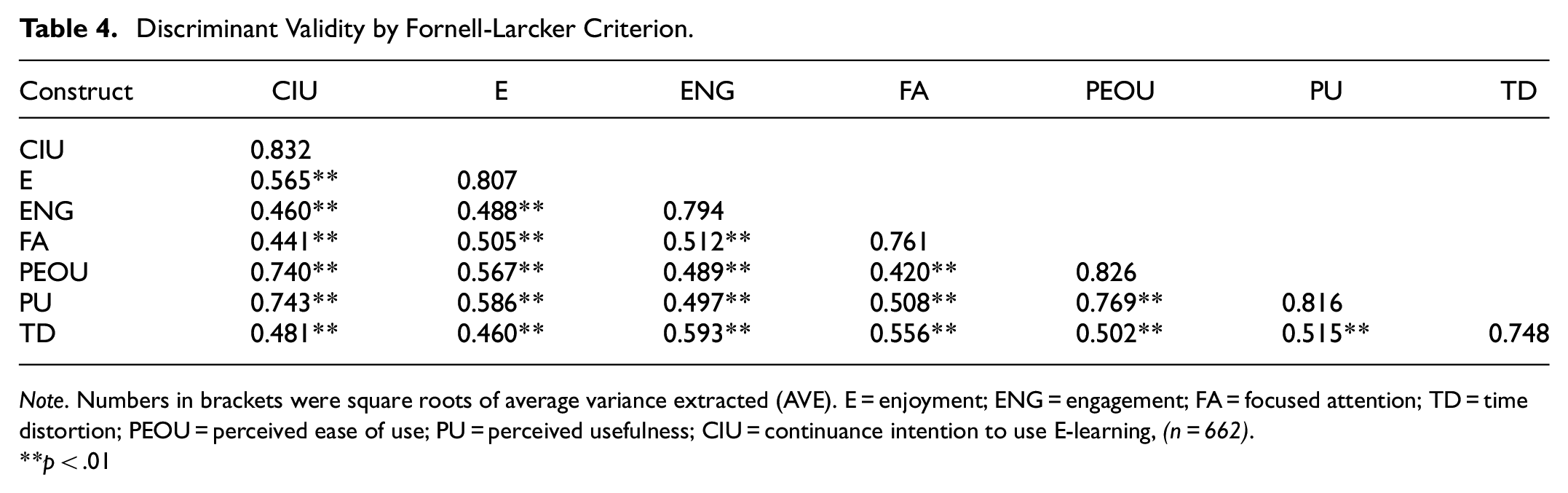
Note. Numbers in brackets were square roots of average variance extracted (AVE). E = enjoyment; ENG = engagement; FA = focused attention; TD = time distortion; PEOU = perceived ease of use; PU = perceived usefulness; CIU = continuance intention to use E-learning, (n = 662).
p < .01
Heterotrait-Monotrait Ratio (HTMT) signifies the estimate for the construct’s correlation with the other constructs, which should be smaller than one (Henseler et al., 2016). It is a method to determine if high multicollinearity exists (Khatib et al., 2019). Table 5 presents the HTMT ratio and shows that all constructs are significantly different at HTMT0.90 (Henseler et al., 2015). Therefore, the discriminant validity has been well established.
Heterotrait-Monotrait Ratio (HTMT) Analysis.
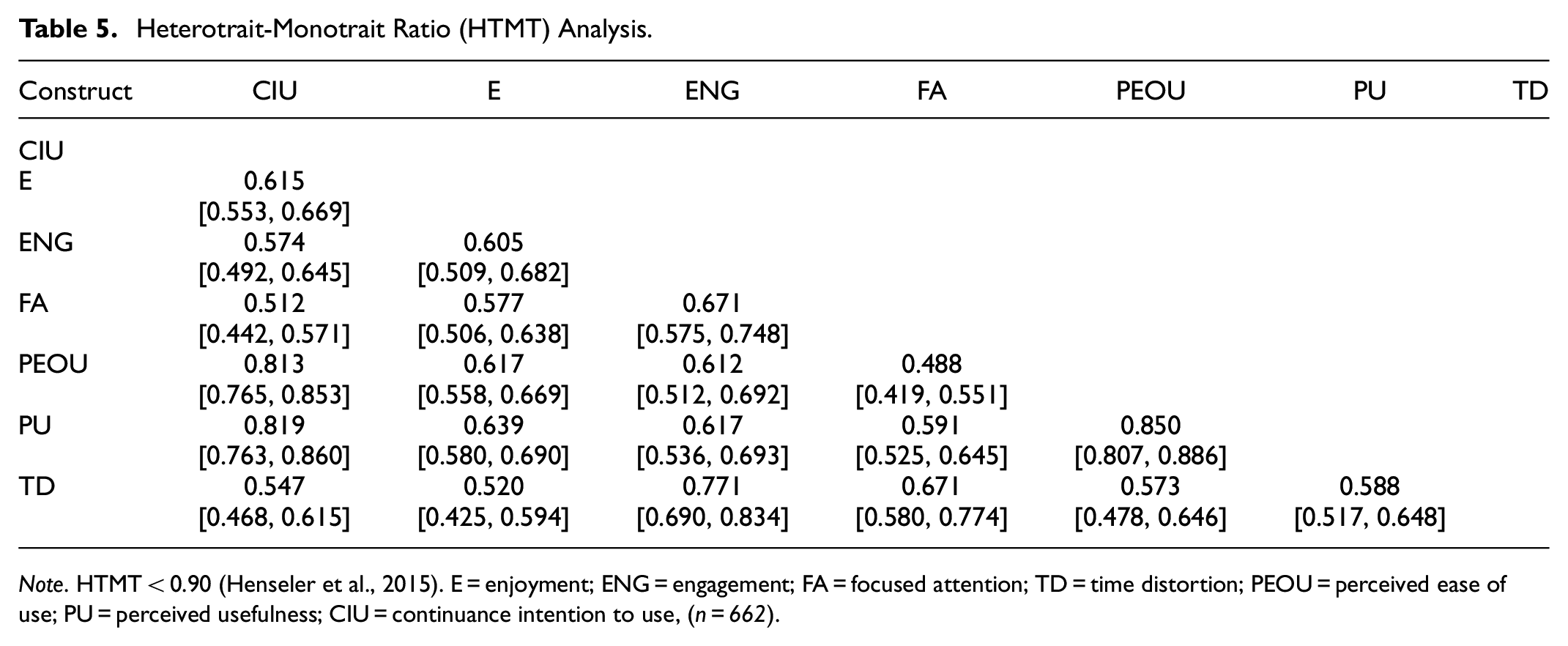
Note. HTMT < 0.90 (Henseler et al., 2015). E = enjoyment; ENG = engagement; FA = focused attention; TD = time distortion; PEOU = perceived ease of use; PU = perceived usefulness; CIU = continuance intention to use, (n = 662).
Assessment of Reflective-Formative Second-Order Model
In this study, Flow experience was conceptualized as a reflective-formative second-order construct (Type II HCM) with four first-order reflective constructs coded as enjoyment, focused attention, engagement, and time distortion. Since the second-order model is commonly used, this study chose to test Flow as a second-order construct to provide a more parsimonious explanation of a complex model.
Testing convergent validity is the first step in evaluating the formative measurement model to make sure whether the formatively measured construct is highly correlated with a reflective measure of the same construct. This study uses a global single item to evaluate the validity of the reflective-formative latent variable since it is an alternative approach to assess convergent validity (Hair et al., 2017; Ramayah et al., 2018). Ideally, the magnitude of the path coefficient linking the two constructs is 0.7 or above, which is the recommended threshold value (Hair et al., 2017). The global single item of Flow summarizes the essence of each formative measured construct. The analysis observed a magnitude of 0.783 for path coefficients between latent variables while the R2 value for the dependent latent variable was 0.613 (Figure 3), thus supporting the formative construct’s convergent validity.
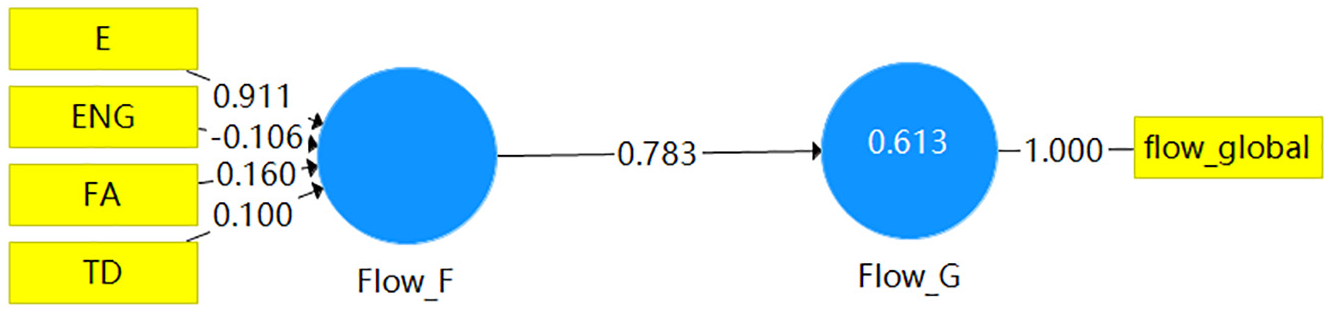
Assessment of convergent validity of second-order construct (n = 662).
The collinearity assessment is the second step because it is vital to ensure that these variables or factors do not measure the same construct (Khatib et al., 2019). This study examines the outer VIF values and the results in Table 6 show that time distortion had the highest VIF value (1.812), and other VIF values were uniformly below the threshold value of 3.3 (Diamantopoulos & Siguaw, 2006), indicating that collinearity did not reach critical levels in the formative construct. In other words, the construct was distinct and evaluated different aspects of the Flow. Therefore, there was not a concern for collinearity issues among the formative construct’s items.
Collinearity Assessment for Formative Construct (outer VIF, n = 662).

The third step is necessary to analyze the outer weights for the formative construct’s significance and relevance (Hair et al., 2017). Table 7 demonstrates the outer weights’ value for each formative indicator using Bootstrapping (Hair et al., 2014). The p-value of enjoyment (β = .587) was zero, and the p-value for other indicators was all below .05, indicating that they were significant. Hence, the results revealed that all formative indicators are significant. Thus, the indicators in the formative construct were all retained. The subsequent section describes the evaluation of the structural model.
Formative Indicators’ Outer Weights Significance Testing Results.

Note. Significant at a level of 0.05, **t > 1.65, ***t-value > 2.33, (one-tailed). Std. Dev = Standard Deviation; E = enjoyment; ENG = engagement; FA = focused attention; TD = time distortion, (n = 662).
Results of the Structural Model
The procedure for assessing the structural model covers the collinearity assessment (VIF < 3.3), the structural model path coefficients (p < .05), the coefficient of determination (R2) (The cut-off levels are 0.190 weak, 0.333 moderate, and 0.670 substantial), effect size (f2), and the predictive relevance (Q2) (cut-off point larger than zero) (Hair et al., 2017).
The results showed that all inner VIF values for constructs are clearly under the critical value of 3.3 (Diamantopoulos & Siguaw, 2006), showing that lateral collinearity among the predictor constructs is not an issue in this investigation. Based on a complete bootstrapping procedure with 5,000 bootstrapping samples for all the subsamples, the R2 value of continuous intention to use is 0.634, indicating that Flow, perceived ease of use, and perceived usefulness account for 63.4% of the variance in continuous intention to use with a moderate predictive power of the variance. In addition, the R2 value of PEOU is 0.41, suggesting that Flow accounts for 41% of PEOU variance with a moderate predictive power. The R2 value of PU is 0.644, indicating that Flow and PEOU account for 64.4% of PU variance with moderate predictive power.
Q 2 (predictive relevance) value was measured with the blindfolding SmartPLS procedure to assess the predictive power of exogenous constructs compared to endogenous constructs (Hair et al., 2017). The Q2 values for continuous intention to use (0.435), perceived usefulness (0.294) and perceived ease of use (0.274), are shown in Table 8. As all the values exceed 0, it suggests that the model has sufficient predictive relevance (Hair et al., 2017).
Predictive Power Estimation of the Model (n = 662).

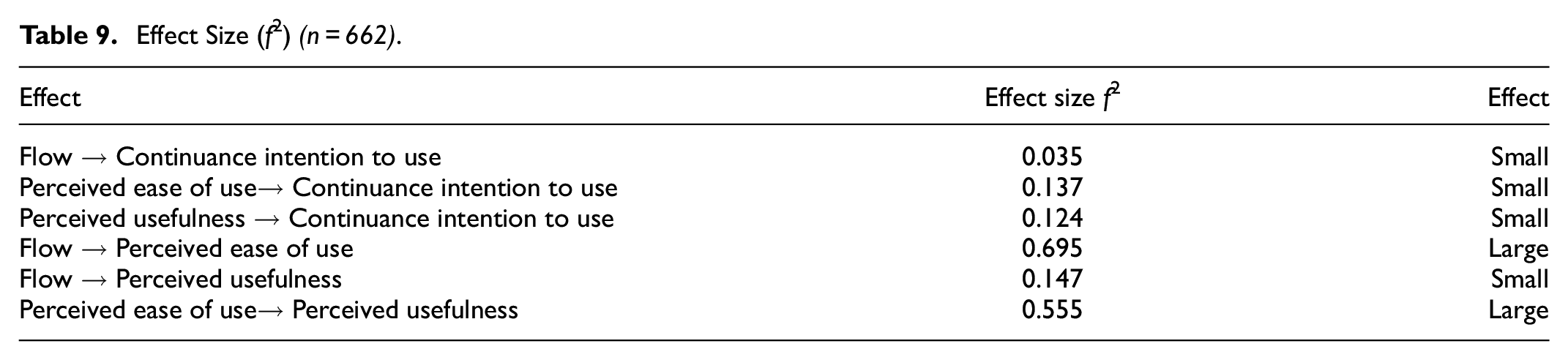
Table 9 shows the effect sizes of the exogenous variables on the endogenous variable, where the Flow has a large effect size on PEOU (f2 = 0.695), followed by PEOU toward PU with 0.555. Flow has the smallest effect size on CIU (f2 = 0.035). PEOU (f2 = 0.137) and PU (f2 = 0.124) have a small effect size on CIU. The result suggested that Flow has a minimal effect on the CIU, followed by PU and PEOU. Flow has the highest f2 value toward PEOU, indicating Flow is important to explain PEOU.
Effect Size (f2) (n = 662).
G*Power version 3.1.9.7 software is used to test the effect size. Figure 4 illustrates the screenshot of G*Power and the parameters. A power of 0.875 is achieved at α = .05 significant level, indicating the effect size has statistical power since it is above 0.8 (Peng & Lai, 2012).

G*Power analysis and parameters.
The significance levels of the model were assessed with the path coefficients (β value), confidence intervals, t-values, and p-values (p < .05, one-tailed distribution) (Hair et al., 2017). Figure 5 shows the path coefficients of this study. The results as shown in Table 10 indicate that Flow is positively related to CIU (β = .158, t = 4.296) and PEOU is also positively related to PU (β = .579, t = 14.266). Therefore, H1 and H2 are supported.

The structural model and its’ path coefficients (n = 662, Bootstrapping subsample 5,000, one-tailed).
Path Co-efficient Assessment.

Note. Flow = Flow experience, CIU = continuance intention to use E-learning, PEOU = perceived ease of use, PU = perceived usefulness; significant at a level of 0.05, ***t-value > 2.33, (one-tailed), (n = 662).
Table 11 shows the results of the mediating effect. The results indicate the indirect effect of Flow experience on CIU via PEOU was significant (β = .233, t = 6.464). The indirect effect of Flow experience on CIU via PU was also confirmed (β = .106, t = 5.413). Thus, both hypotheses are supported. Using the boot.ci function to get the 95% confidence interval [LL = 0.175, UL = 0.295, and LL = 0.076, UL = 0.140] does not straddle a zero in between, indicating that PEOU and PU mediate the relationship between Flow experience and CIU (Preacher & Hayes, 2008).
Special Indirect Effects (Mean, STDEV, T-Values, p-Values).

Note. Flow = Flow experience; PEOU = perceived ease of use; PU = perceived usefulness; CIU = continuance intention to use E-learning; significant at a level of 0.05, **t > 1.65, ***t-value > 2.33, (one-tailed), (n = 662).
Analysis of Important-Performance Map (IPMA)
In order to help prioritize managerial action, an analysis was conducted. IPMA extends the results on the relative performance of the construct beyond the standard PLS-SEM analysis. Figure 6 and Table 12 are the graphical illustrations of the results of the importance-performance map. The results indicate that the exogenous construct PEOU (0.578) is the most important construct to predict continuous intention to use, followed by the predecessor Flow (0.463) and PU (0.360). PEOU (61.075) has the highest performance, followed by PU (59.081) and Flow (57.282). Hence, managerial or political actions should prioritize improving users’ perception of ease of use to enhance users’ continuance intention.

Importance-Performance Map (Construct Level) (n = 662).
Data of the Importance-Performance Map for Constructs (n = 662).

Discussion
The present study employs the S-O-R framework to explore the relationship between flow and perceived ease of use and perceived usefulness on undergraduates’ behavioral intentions toward sustainable using E-learning. A four-hypothesis model for various influencing elements was built and experimentally evaluated using the S-O-R framework to examine the undergraduates’ E-learning sustainable usage intention in Guangxi province, an under-developed area in China.
Based on the empirical analysis, hypotheses H1 and H2 are supported. The results show that Flow, as a stimulus, can directly measure and significantly influence continuance intention to use E-learning (as a response). This result is consistent with the assertions of Bilgihan et al. (2015), Goh and Yang (2021), Hariguna and Akmal (2019), Y. J. Kim and Han (2014), and Mpinganjira (2016) that Flow experience carries significant experiential value for e-learners. They found that the experience of Flow would help users focus on learning and demonstrate better academic performance, then motivate them to continue using E-learning. Hence, this study suggests that when designing the content of E-learning courses, instructional designers should consider cultural and content structures that are “culturally sensitive,” providing students with an “optimal experience”; thus, retaining them (Aldás-Manzano et al., 2009). This is particularly important as this explored the perceptions of students from Guangxi which has the largest population of China’s ethnic minorities after Yunnan, in particular, the Zhuang people, who make up 32% of the population. It is important for online instructors to recognize the cultural diversity and challenges that many of these minority students may face. Csikszentmihalyi and Nakamura (1986) stated that different cultural upbringings as a possible source for the differences and can have a different impact on the intrinsic motivation which is related to flow.
Regarding the antecedent of perceived usefulness, the result of H2 successfully validated perceived ease of use is a significant predictor. The finding agrees with previous studies (Joo et al., 2016; Unal & Uzun, 2020). The significant influence of PEOU on PU may be because UNIPUS has a friendly man-machine interaction interface. Hence, undergraduates might have operated UNIPUS without difficulty when conducting any instructional activities. Moreover, through UNIPUS, undergraduates could add a comment in the discussion area, or access to any learning section they are interested in. This contributes to their perception of ease of use, and further impacts their perception of usefulness.
H3 and H4 results verified that perceived ease of use and perceived usefulness (as organisms) have a mediating effect on the relationship between Flow experience and continuous intention to use. The indirect mediating influence of PEOU (β = .233) was stronger than PU (β = .106), suggesting PEOU may play a more important mediating role than PU in stimulating the e-learners’ behavioral intention. That is to say, the e-learners believe the ease of use of information systems outweighs the usefulness. The E-learning system is useful because it is designed to improve the e-learners’ knowledge or skill; however, if the system is not easy to be used even if they perceive the benefit they can get, the e-learners will suffer from poor operation or function of E-learning, which causes them to fall into a fidgety mood and then give up using it. Therefore, e-learners are more likely to experience flow and perceive ease of use during E-learning. As the findings by Joo et al. (2012) and Cheng (2014) indicated, the opportunity for the users to experience flow in the learning process increases as their perceived usefulness and ease of use increase, implying that PEOU and PU can mediate Flow in the context of E-learning. In other words, organisms can mediate environmental stimulus and their response. Therefore, developing a successful E-learning environment can boost the positive flow experience of e-learners, making them feel that the system’s usability and ease of use may further enhance their intention to continue using E-learning.
The results confirm the importance of Flow experience in stimulating users’ continuous intention, and perceived ease of use and perceived usefulness mediate Flow and continuous intention, revealing that the Flow state experience (stimulus), PEOU and PU (organisms) are important factors to be considered in designing an effective E-learning system. Thus, educators and policymakers must carefully consider these factors, including taking into account the cultural differences of undergraduates and the diverse cultural experiences they bring to the E-learning environments, while planning for full-scale deployment of E-learning.
Conclusion and Implications
Technology has impacted every aspect of our lives today, and online education is no exception. More so, now than ever with the dramatic shift from the traditional face-to-face teaching environment to a flexible learning mode that caters to learners’ situations and preferences. E-learners’ learning experience will become the key differentiator and overtake both product and price value propositions. It is now up to instructional designers and educational technologies to make the most of the opportunities provided by technology to provide e-learners with the optimal learning experience. E-learning system providers who want to ensure that the e-learners who want to get the most out of their learning must set themselves apart by placing a higher focus on creating or inducing a flow state, where the person using the system functions at his or her fullest capacity with their attention focused on the learning activities and cause them to participate for the sheer sakes of doing it (Csikszentmihalyi, 1990).
From both a theoretical and practical perspective, this study has enriched the S-O-R model and has made contributions to the literature on exploring the antecedent (flow as a stimulus), mediating effect (i.e., perceived ease of use and perceived usefulness as organisms), and continuous behavior intention (as a response). The finding also proved that Flow is positively related to PEOU and PU (to a lesser extent) of the E-learning system. The direct and indirect impact of flow through the mediating variables of PEOU and PU in continuous intention is in line with previous findings (such as Buil et al., 2017; Hong et al., 2019). The results affirm two important contributions: flow-like states can occur in a more mundane situation such as when e-learners are engaging in an E-learning activity without feeling bored as long as the degree of the task challenge (the E-learning activities) coincides with the skills to do the tasks. A learner in a flow state generates a stronger motivation to appreciate the PEOU and PU of the E-learning system. This is in line with Csikszentmihalyi’s (1988) flow theory that learners who are in a flow state are using the intrinsic motivation as flow is a positive mental state, leading to increased motivation to master the skills to maintain the flow state which leads to greater retention.
The results also showed that although both perceived ease of use and perceived usefulness mediated the relationship between flow and continuous intention to use, PEOU has a higher mediating effect than PU, indicating e-learners prioritize the ease of use over its usefulness in this study’s context. A possible explanation for the higher mediating effect of PEOU over PU is the e-learners from undeveloped region, Guangxi, believe that even if E-learning may be useful, it cannot sufficiently stimulate their motivation to continue use when they perceive the system as difficult to use. This finding reflects their closed-mind influenced by the local minority culture. The unexpected result aligns with the findings of Sinaga et al. (2021), which suggest that PEOU plays a more significant role than PU in facilitating the generation of flow experience and the realization of usefulness experience which all can influence users’ continuance intention to use. In other words, it is also reflecting a fact that the advanced technology and reliable E-learning system can enhance the e-learners’ continuing using intention (Ulrich & Karvonen, 2011). This is in line with the Technology Acceptance Model (TAM) that PEOU had a dual effect on usage intentions, both directly and indirectly. Indirect effects on the intention occur through perceived usefulness because the more effortless the E-learning system to use, the more valuable it will be, which in turn leads to higher intention to use (Venkatesh, 2000).
The results of this study were able to explain 63.4% of the variation of continuous intention to use. This provides important implications for the development and management of E-learning in the higher educational setting. For instance, system designers must therefore provide adequate training and support for users, especially students, who are not technology savvy. The content developers, service providers and product designers must give high priority to developing E-learning activities that are sensitive to the learners’ performance expectations. They can design and prioritize learning content that can meet the learners’ needs because the users’ sense of enjoyment and flow experience can be weakened if the content is excessively unappealing. The personalized learning material also needs to be considered when designing the content to increase users’ learning efficiency and performance. They also can add additional features to enhance man-machine interaction to bring about a more immersive Flow experience, designing a more humanized interface to enhance their cognition of the ease of use to use. Additionally, enhancing man-machine interaction and providing an E-learning environment that matches the challenges student faces in a particular learning activity to the skills he or she has to get them in a state of flow is an important part of the skill acquisition process. They should also place emphasis on ease of use such that users perceive that the use of the E-learning system could be mentally and physically effortless, balancing between challenge and skills. In other words, identification and acquisition of a suitable E-learning system for users to meet their learning needs and entertain them simultaneously to enhance their flow experience.
Limitations and Recommendations for Further Studies
As with any research, this study is not free of limitations, some of which open avenues for further research.
Firstly, the samples in the study are confined to the sophomore students from four public universities in a Tier 3 city in Guangxi, China. Validity and reliability and the generalizability of the results would be improved if future research would consider extending such a study to more universities in Guangxi and also different stakeholders in the implementation of different E-learning programs from different disciplines, such as engineering majors. This would provide a more nuanced understanding of the use of E-learning by students from different disciplines and majors. It would also be useful to consider other relevant attributes of an individual (such as disciplines, overuse of social media, and family background); this can help better understand the utility of E-learning to enhance not only the system functionality but also the “flow experience” which can lead to a more optimal learning outcome.
Secondly, 75% of the sample in this research is male undergraduates, which may influence the result because of the difference in gender. Future research may want to use a proportionate sampling method to ensure that the genders are proportionally selected.
Thirdly, this study focuses on the perception of the e-learner only and future research should also consider the perspectives of other stakeholders such as instructors and school administrators to better understand how their attitude may impact the learning process mechanism.
Last but not least, a longitudinal study should be undertaken to measure e-learners’ flow experience in the E-learning environment to understand the relationship between the different levels of flow experience and the effectiveness of technology-enhanced learning environments. Eye tracking technology can be used to dynamically capture users’ behaviors in the E-learning environment to understand how they handle the learning tasks and where they find challenges that may disrupt their flow.
Supplemental Material
sj-doc-1-sgo-10.1177_21582440241305231 – Supplemental material for Influencing Factors of Continuous Intention to Use E-learning System of Undergraduates in Guangxi, China: The Mediating Role of Perceived Ease of Use and Perceived Usefulness
Supplemental material, sj-doc-1-sgo-10.1177_21582440241305231 for Influencing Factors of Continuous Intention to Use E-learning System of Undergraduates in Guangxi, China: The Mediating Role of Perceived Ease of Use and Perceived Usefulness by Shen Yan, Liow Guat Eng and Lim Chui Seong in SAGE Open
Footnotes
Acknowledgements
I acknowledge with grateful thanks my supervisor, Dr. Wendy Liow, for providing me the strength and the discipline in my weakest hour. She has led me through this incredible journey with her patience, guidance, support, constructive feedback, understanding, and knowing that I can count on her to help me was a great relief. I owe a debt of gratitude to her. Without her commitment to the highest standards, massive knowledge, insightful reviews, and crucial comments at every stage, this paper would not have been able to materialize.
Declaration of Conflicting Interests
The author(s) declared no potential conflicts of interest with respect to the research, authorship, and/or publication of this article.
Funding
The author(s) disclosed receipt of the following financial support for the research, authorship, and/or publication of this article: This study was granted by Project No. JGY2022120 from Innovation Project of Guangxi Graduate Education, People’s Republic of China.

Research Data Availability
The data is private.
Supplemental Material
Supplemental material for this article is available online.
References
Supplementary Material
Please find the following supplemental material available below.
For Open Access articles published under a Creative Commons License, all supplemental material carries the same license as the article it is associated with.
For non-Open Access articles published, all supplemental material carries a non-exclusive license, and permission requests for re-use of supplemental material or any part of supplemental material shall be sent directly to the copyright owner as specified in the copyright notice associated with the article.
