




Abstract
Informed by Social Exchange Theory, this study has developed a mediation model that explains the role of I-deals in the relationship between perceived supervisor support and employees’ discretionary behaviors (i.e., voice and silence). Using a sample of 140 Chile employees, results from our structural equation modeling, indicated that the relationship between supervisor support and employees’ voice (positive) and silence (negative) was mediated by task I-deals. However, we found that the relationship between supervisor support and employees’ voice (negative) was mediated by task I-incentive while this type of I-deals did not mediate the relationship between supervisor support and employees’ silence. This research expands the I-deals literature by focusing on the provision of I-deals to their subordinates and by analyzing the outcomes of incentive I-deals and task I-deals to employees’ discretionary behaviors. Supervisors and HR departments might utilize task I-deals to help facilitate desirable employee outcomes, namely more voice and less silence.
Keywords
Introduction
Due to the rising demand for flexibility in labor markets, increased competition, and employees’ search for having more autonomy in their work and careers, many organizations have been drifting away from their standardized human resource management (HRM) practices. Instead, they have increasingly adopted more flexible employment relationships (Jackson et al., 2014; Liu et al., 2013; Morf et al., 2019; Rousseau et al., 2006; Van der Heijden et al., 2021), which introduced individualized working arrangements, namely idiosyncratic deals (I-deals). I-deals refer to “special conditions of employment negotiated between an individual employee and his or her employer” (Rousseau, 2005, p. 7). In other words, in negotiating an I-deal, employees attempt to align their own needs with the requirements of the organization in the form of a tailor-made arrangement in their employment conditions that matches optimally with their lives (Kroon et al., 2015; Simosi et al., 2023). While some I-deals can be as narrow as a single request (i.e., working on a specific project), others concern the idiosyncratic negation of one’s entire employment contract (Davis & van der Heijden, 2018; Rousseau, 2005). Overall, when employees make a personalized negotiation(s) with their organization, the I-deal is expected to help employees satisfy requirements for customized work arrangements in line with their needs while simultaneously helping the organization to attract, motivate and/or retain valuable employees, who in turn can distinctively add to an organization’s viable and competitive interests (Anand et al., 2022; Collings & Mellahi, 2009; Las Heras et al., 2017; Lee et al., 2022; Liao et al., 2016; Simosi et al., 2023).
Creating such I-deals requires employees to get into a process of bargaining and negotiation about personalized employment conditions with their supervisors. A positive relationship between employees and their supervisor facilitates this negotiation process. An I-deal is successful when both parties take each other’s interests and viewpoints into consideration. On the part of the employer, when the supervisor considers the employee’s needs and goals, the employee is more likely to be successful in bargaining different I-deals with respect to, for example, task selection, job content, career development, working hours, and location (Hornung et al., 2014; for a recent review see Simosi et al., 2021).
In the meantime, as I-deals imply a refinement of the exchange relationship between employee and employer, when an organization rewards an I-deal the employee is expected to reciprocate with higher positive attitudes and behaviors (Rousseau, 2005). Studies have indeed shown that I-deals are connected to employees’ positive outcomes (e.g., Anand et al., 2010, 2022; Bakker & Ererdi, 2022; Hornung et al., 2008; Lee et al., 2022; Simosi et al., 2023). However, different types of I-deals—flexibility with hours tasks, location, and financial incentives—evoke different resource exchanges and consequently may not always generate reciprocity (Liao et al., 2016). Incentive I-deals involve those financial incentives which relate to why employees do their jobs and seem to be directly associated with viewing the employee to employer relationship as an economic exchange. Even though few studies have examined incentive I-deals, Rosen et al. (2013) found that these kinds of I-deals only have a relationship with the employee’s continuance commitment. Moreover, Sun et al. (2021) found that incentive I-deals had a positive relationship with occupational well-being and organization-based self-esteem. However, Saldivar and Liao (2023) developed a conceptual model in which the content of I-deals is proposed to reflect different forms of exchange between an employee and their employer, with task and work responsibilities, schedule flexibility, and location flexibility I-deals contributing more to social exchange, while incentive I-deals are proposed to contribute more to economic exchange and an overall competitive environment within the organization. In contrast, task I-deals focus on daily work activities and create the employee to employer relationship as a high-quality social exchange. Resources exchanged in task I-deals are arranged based on emotional bonds and the employee can fulfill his/her socio-emotional needs for personal growth and recognition. In line with this assumption, those who negotiate task I-deals tend to demonstrate higher positive attitudes (e.g., job satisfaction, organizational commitment, work engagement, higher performance; Anand et al., 2022; Liao et al., 2016) and lower negative attitudes (e.g., turnover intentions, incivility; Ho & Tekleab, 2013; Hong et al., 2012; Howard et al., 2022).
Research has underscored the significance of I-deals in improving employment outcomes such as performance (i.e., Anand et al., 2022; Hornung et al., 2014; Lee et al., 2022) and well-being (i.e., Bakker & Ererdi, 2022; Howard et al., 2022; Kooij et al., 2017). However, the mediating role of I-deals in the relationship between perceived supervisor support and employee behaviors (voice and silence) has hardly been researched. This is however an important omission because the degree to which employees’ perception of supervisor support plays a critical role in negotiating their I-deals. In other words, we expect that those employees who perceived high support from their supervisors will experience more incentive and task I-deals. Moreover, our study demonstrates the necessity to consider the type of I-deal (i.e., incentive or task) when aiming to understand its consequence on employee discretionary behaviors. Indeed, we postulate that, in contrast to incentive I-deals, task I-deals relate positively with positive (i.e., voice) and negatively with negative (i.e., silence) employees’ discretionary behaviors. Understanding employee voice and silence is imperative for several reasons. First, it directly impacts organizational performance and innovation, as employees who actively voice their ideas contribute to productivity and creativity (Carnevale et al., 2017). Second, understanding the causes and consequences of silence is essential for promoting employee well-being and mental health. Third, these behaviors play a pivotal role in conflict resolution, reducing turnover, and fostering a culture of ethical conduct (Erkutlu & Chafra, 2015). Additionally, employee voice is a valuable source of feedback for organizational learning and adaptation (Milliken & Lam, 2009).
This study goes beyond previous research on I-deals in four ways. First, we extend the current literature’s focus on proactive behaviors in relation to the creation and holding of I-deals (Liu et al., 2013) by also focusing on the relationship between I-deals and negative discretionary behaviors (i.e., silence). Second, further examination of additional research that distinguishes different I-deals needs to be concluded before concrete results can be drawn regarding the outcomes and antecedents of these (M. Bal & Rousseau, 2015), particularly financial I-deals (Liao et al., 2016). In line with Social Exchange Theory (Blau, 1964) which highlights the employment relationship nature to explain employee outcomes, in this study, we considered that I-tasks evoke a socio-emotional relationship and I-incentives evoke an economic relationship and, consequently, should show a different relationship with employees’ behaviors. Third, because previous studies on I-deals have largely ignored their antecedents, especially those of the supervisor (Las Heras et al., 2017), we focused on employees’ perception of supervisor support and expect that personal experience relates positively with one’s I-deals. Finally, previous research has studied I-deals mainly in Eastern (China, India, and South Korea) or Western (Germany, USA, and Netherlands) cultures, perhaps overlooking the probable applicability of I-deals in other contexts and cultures (Ng & Feldman, 2015; Rousseau, 2005) As such, we exam I-deals in Chile, a different context outside US and Western Europe where most I-deals’ studies to date have been carried out (e.g., Anand et al., 2010; Ng & Feldman, 2015).
Theoretical Framework
Supervisor Support and I-deals
Supervisors are important organizational agents who not only represent the organization (Shore et al., 2004), but who are also key in acknowledging and addressing employees’ needs at work (M. Bal & Rousseau, 2015; Varma et al., 2022). Particularly in the case of I-deals, employees are likely to negotiate any personalized benefits with their immediate supervisors (Rousseau, 2005; Simosi et al., 2021). An employee’s supervisor has been considered an I-deals antecedent (Liao et al., 2016) and current research has examined the relationship between supervisor-leadership characteristics and I-deals. For example, research assuming the leader-member exchange perspective has shown that employees who have high-standing exchange relationships with their supervisors are also considered to have more I-deals (Hornung et al., 2014). Similarly, research has also found that leader consideration had a positive effect on individual’s I-deals and employees were more likely to negotiate for I-deals when they perceived their leader as more considerate of their personal needs rather than merely focused on the task at hand (Hornung et al., 2011).
Consistent with Social Exchange Theory, Kottke and Sharafinski (1988) believed that employees develop a general perception about the support received from supervisors that would be important to the employment relationship they establish with their organization. Perceived supervisor support captures employee’s perception regarding the degree to which supervisors value their contributions and care about their well-being (Eisenberger et al., 2002). Perceived support can also be observed as supervisors communicate and display respect and recognition to employees (Eisenberger et al., 2002) or provide emotional support in terms of understanding the unique needs of their subordinates (Kelly et al., 2020). Thus, high supervisor support signals to employees that they can not only to initiate a negotiation but also to obtain a positive result (Varma et al., 2022). Moreover, high perceived supervisor support also signals that supervisors are concerned with employees’ needs and well-being and ultimately entails a social exchange relationship which implies that both parties are key in helping the other achieve their goals (Cropanzano & Mitchell, 2005). Thus, we expect that when employees perceive support from their supervisors, they are more likely to successfully negotiate I-deals regarding their needs.
The current study is based on examining the views of employees regarding I-deals. This study specifically focuses on the relationship between employee’s perception of supervisor support and I-deals. Moreover, this option is similar to that which has been used by several studies based on this field. On the other hand, we can distinguish the I-deals content: flexibility I-deals that enable employees to adjust their working hours or to work outside the office so as to accommodate their needs; development I-deals that imply additional opportunities for individuals to broaden their knowledge and skills and pursue career advancement; workload reduction I-deals that are individual negotiations that result in reduced work demands and hours; task I-deals that are awarded so that employees can creatively alter their particular job’s content; incentives I-deals that involve customized compensation arrangements that fit individual needs (for a revision see Conway & Coyle-Shapiro, 2015). This study focuses on I-task and I-incentives because these I-deals evoke different resources that should be freely negotiated between supervisor and worker. Furthermore, in line with Rosen et al. (2013) who noticed that classification of I-deals substance is limited by the samples used in the research, we did not include workload reduction I-deals because they are not commonly negotiated across jobs (Rosen et al., 2013) nor flexibility I-deals because they are unusual in Chile (Macfarlane, 2016). Development I-deals are not freely negotiated between supervisors and workers in Chile but usually depend on HR practices developed for all employees or some employees’ groups. Thus, we extend previous findings by hypothesizing that the supervisor support relates positively with task and incentive I-deals.
Hypothesis 1: Perceived supervisor support is positively related to I-task (H1a) and to I-incentive (H1b).
I-Deals and Employees’ Behaviors
Based on the social exchange theory, I-deals play a significant role in influencing the attitudes and behaviors of employees, considering that they are grounded on the premise that organizations must uphold a high-quality leader-member exchange (LMX) relationship (Rousseau et al., 2006). Empirical research has confirmed that I-deals benefit the organization through enhancements in favorable employee attitudes, such as job satisfaction (e.g., Hornung et al., 2010; Vizcaíno et al., 2023), organizational commitment (e.g., Liu et al., 2013), constructive employee performance behaviors, such as working unpaid overtime hours or engaging in organizational citizenship behaviors (Hornung et al., 2008; Van Waeyenberg et al., 2023), and performance (Anand et al., 2022; Lee et al., 2022). When employees can idiosyncratically arrange their work tasks, they can better meet work requirements and are more likely to feel positive emotions and attitudes such as enhanced self-esteem and sense of competence, as well as reduced deviant and uncivil behaviors (P. M. Bal & Boehm 2019; Howard et al., 2022; Kong et al., 2020).
Furthermore, as I-deals are voluntary, personalized, nonstandard employment arrangements negotiated between an employee and an employer/supervisor, we expect that those employees who are granted I-deals can reciprocate with organizational discretionary behaviors because they can make these decisions under their own volition (Anand et al., 2010). In line with this assumption, this study analyzed the relationship between I-deals and voice behaviors. Voice is an organizational citizenship behavior that involves employees’ expressions of innovative, change-oriented ideas and suggestions to resolve problems (Van Dyne & LePine, 1998) which contribute to organization’ performance and efficacy (Graham & Van Dyne, 2006). Positive discretionary behaviors have frequently been investigated as a way for workers to reciprocate their employers/supervisors’ positive treatment and Ng and Feldman (2015) confirm that I-deals (i.e., scheduling flexibility and professional development) promote voice behaviors.
Going a step further, this study also analyzed employee’s silence or an employee’s curbing expression of their ideas, information, and feedback with direct relevance to improvements in work conditions and the organization itself (Morrison & Milliken, 2000). Silence has negative consequences on an organizations’ ability to change (Morrison & Milliken, 2000) and can be distinguished from the simple absence of voice (Van Dyne et al., 2003). Employees who are intentionally withholding relevant ideas to protect themselves, based on the belief that speaking up will have unpleasant consequences (Pinder & Harlos, 2001) or because they feel that their opinions are not valued (Morrison & Milliken, 2000). Thus, silence is also a proactive and intentional behavior that employees choose to exert when they feel they are working under unjust employment conditions (Pinder & Harlos, 2001). Thus, we could expect that those employees who are granted I-deals and obtain direct benefits resulting from such deals can choose to reciprocate with less silence behavior.
According to Rousseau et al. (2006), the resources involved in I-deals can either be collective or concrete because of their shared meaning, versus intangible, which is deemed as particular to a specific individual. For example, incentives I-deals which imply modifications regarding pay can be awarded without direct contact and are more likely to be given based on equity issues (internal or external) in comparison to tasks I-deals which imply the employer’s socio-emotional concerns for an employee. In fact, I-deals involving financial benefits more closely follow economic conditions of employment and directly involve the transactional conditions of the employee to employer relationship. I-deals related to task and work duties are present of the cost continuum because they correlate precisely with various employment aspects, including benefits which are aligned with meeting an individual’s socio-emotional needs for personal growth and recognition) and illustrates a high-quality exchange relationship (Rosen et al., 2013). This difference in the employment relationship implies a difference in employee outcomes (Chambel & Castanheira, 2007). In the case of an economic exchange, the employee involvement toward the organization is limited. When only material resources are awarded, the employee is likely to make minimal contributions to the organization by performing only the stipulated tasks and hours. On the other hand, in a socio-emotional exchange, the organization provides specific resources that satisfy employees important needs (i.e., development, learning). These then foster greater loyalty and engagement and, in contrast to economic exchanges, they involve long term, open ended and non-specific obligations (Shore et al., 2006).
In line with these assumptions, as we previously referred, empirical studies confirmed that task I-deals are more socio-emotional in nature, and were related to employees’ higher job satisfaction, as such creating greater engagement with the organization in terms of affective, continuance, and normative commitment (Rosen et al., 2013) along with better employee performance and lower turnover intentions (Ho & Tekleab, 2013; Hong et al., 2012). On the contrary, financial I-deals which are economic in nature only showed positive relationship with continuance commitment (Rosen et al., 2013). Extending these findings, we hypothesized that task I-deals will be related with employees’ behaviors, namely positively with voice and negatively with silence (Kong et al., 2020).
Hypothesis 2: I-task is positively related to employee voice behavior (H2a) and negatively related to employee silence behavior (H2b).
Mediation by I-Deals
Though the impact of the perceived support on behavior has often been deemed a direct effect (e.g., Crant, 2000), Social Exchange Theory suggests that the influence of the organization’s characteristics on the behavior of its employees is mediated by the influence of the employer-employee relationship (Blau, 1964). Employer-employee relationship descriptions of employee behavior operate on the premise that effective employee reaction is subject to congruence between the desired outcome (needed or wanted by an individual) and the outcome that is supplied by the work situation or organization. When the organizational context enables employees to achieve desired outcomes and, more importantly, when employees feel that they are given new learning opportunities, can use valued skills and abilities, have a degree of responsibility or when they consider the work itself to be personally interesting and meaningful like with I-task, they are more likely to volunteer to reciprocate with behavior that favors the organization (Hornung et al., 2010; Oostrom et al., 2016; Rofcanin et al., 2016). Task I-deals convey to employees that they are valuable and special to the employer/supervisor, in that the employer is willing to make special provisions for them at work (Hornung et al., 2014; Rofcanin et al., 2016). When supervisors customize challenging tasks, task I-deals, or focus on valued activities on the job and working on the chosen tasks they show their support and individual consideration (Hornung et al., 2010; Liao et al., 2016), therefore these job-related I-deals are more likely to bring out positive employee behaviors. Thus, the possibility of achieving higher I-task through supervisor support is more likely to lead to higher levels of positive behaviors, i.e., discretionary behaviors such as more voice and less silence (Robinson, 2018). Thus, I-task can be the mechanism that explains the relationship between perceived supervisor support and discretionary behaviors. Indeed, limited empirical work has underwritten the mediating role of I-task. For example, Vizcaíno et al. (2023) found that task I-deals mediated the relationship between schedule i-deals (i.e., an employee’s flexible daily work hours and focus on the employee’s ability to negotiate a flexible work schedule; Oostrom et al., 2016) and job satisfaction. Moreover, Kaner (2020) found that I-deals mediated the relationship between perceived justice climate and affective and continuance commitment toward the organization. As a final example, Ng et al. (2021) found that developmental I-deals (i.e., special career development activities that serve to improve the knowledge, skills, and abilities of employees, such as sponsored overseas education, job rotation opportunities, and off-the-job training; Rosen et al., 2013) mediate the relationship between innovative behavior and vigor, gratitude, and cynicism. We thus propose that I-task mediates the relationship between perceived supervisor support and discretionary behaviors.
Hypothesis 3: I-task mediates the relationship between perceived supervisor support and employee voice behavior (H3a) and employee silence behavior (H3b).
Method
Procedure and Sample
Respondents in this study were professionals employed in different companies in Chile—a country run by a hierarchical market economy where the labor law privileges full time jobs, and the most common labor arrangement is based on a daily 9-hr work schedule (Macfarlane, 2016)—who attended a part-time MBA offered by one of the major universities in this country. We collected the data through paper-based surveys. We requested respondents to participate in the study while they attended activities on campus. We trained a team of research assistants to administrate the paper-based surveys. Specifically, we instructed research assistants to introduce the project, explain its objectives, highlight respondents’ privacy rights, and non-compulsory participation. The study did not involve any form of deception or risk to the respondents beyond those which they encountered in everyday life. We included a cover letter which indicated that the survey was being conducted solely for scientific purposes. Moreover, our research was approved by the Institutional Review Board of Universidad de Santiago de Chile.
Our sample (N = 140) was predominantly male (N = 73, 52.10%). The average age of respondents was 39.25 (SD = 9.54) years, with a range from 23 to 66. The educational level of the participants is as follows; 5.70% had a high school degree, 22.90% had a technical education degree, 41.40% had a university degree, and 30.00% had a postgraduate degree. They had an average tenure at their organization of 8.97 years (SD = 9.71).
Measures
We used existing and validated scales to measure the constructs under study. Because our respondents spoke Spanish, we translated and backtranslated (conducted by the second and fourth author who are native Spanish speakers) the surveys to Spanish in line with the procedure of Brislin (1980). In cases of possible translation discrepancies, the two translators discussed these differences and the implications thereof and decided on a final version of the respective item together. All items were measured on a seven-point Likert scale ranging from (1) strongly disagree to (7) strongly agree, unless otherwise indicated.
Perceived Supervisor Support
Perceived supervisor support was measured using the eight-items scale by Eisenberger et al. (1986). Respondents were requested to indicate their degree of agreement with statements such as “My supervisor would forgive an honest mistake on my part” (α = .92).
I-Task
I-task was measured using the six-item subdimension of the ideals’ scale by Rosen et al. (2013). Respondents were requested to indicate their degree of agreement with statements such as “At my request, my supervisor has assigned me tasks that better develop my skills” (α = .80).
I-Incentives
I-incentives was measured using the five-item subdimension of the I-deals’ scale by Rosen et al. (2013). Respondents were requested to indicate their degree of agreement with statements such as “Because of my personal circumstances, my supervisor has created a compensation arrangement that is tailored to fit me” (α = .86).
Voice
Voice was measured with the three-item scale of the prosocial voice scale by Van Dyne et al. (2003). Respondents were requested to indicate their degree of agreement with statements such as “I express solutions to problems with the cooperative motive of benefiting the organization” (α = .84).
Silence
Silence was measured with the three-item scale by Detert and Edmondson (2011) assessing the extent to which employees withhold their ideas and thoughts in the workplace. Respondents were requested to indicate their degree of agreement with statements such as “I keep ideas for developing new products or service to myself” (α = .89).
Control Variables
Given that various studies have shown that gender, age, education, and tenure could potentially affect the extent to which one would engage in voice or silence behaviors, we added these demographic variables as a control to our model. Gender was measured by asking respondents to indicate their gender (1 = male, 2 = female). Age was measured as a continuous variable. Education was measured by asking respondents to indicate their highest level of completed education (1 = high school degree, 2= technical education degree, 3 = university degree, and 4 = postgraduate degree). Tenure was measured as a continuous variable (Table 1).
Sample Description.

Note. N = 140.
Data Analysis
We used Mplus version 7.4 (Muthén & Muthén, 2013) to estimate a mediation model in which perceived supervisor support was the independent variable, I-task and I-incentive were the mediators, and voice and silence were the dependent variables. The mediation effects were tested by means of the product-of-coefficients approach (Preacher & Hayes, 2008) and their significance was scrutinized by means of 95% Confidence Intervals (95%CI; Preacher & Selig, 2012).
Results
Confirmatory Factor Analysis
A confirmatory factor analysis (CFA) was first performed to determine if the measures were true representations of varied constructs (Podsakoff et al., 2003). Dyer et al.’s (2005) conventional standards were utilized in evaluating model goodness of fit and the likelihood ratio test used in comparing competing models. Specifically, we evaluated model fit for each of these CFA models based on the Root Mean Square Error of Approximation (RMSEA), the Comparative Fit Index (CFI), the Incremental Fit Index (IFI), and the Standardized Root Means Square Residual (SRMR). Based on the recommendations of Schreiber et al. (2006), a model was considered to offer a good fit to the data when CFI and IFI values were in the mid .90’s or higher, and when RMSEA and SRMR values were 0.08 or less (Table 2).
Confirmatory Factor Analyses Results.

Note. Theoretical model: perceived supervisor support, I-task, I-incentive, voice and silence each load to a different latent factor. Alternative model A: I-task and I-incentive load onto a single latent factor; perceived supervisor support, voice and silence load onto a different latent factor. Alternative model B: voice and silence load to a single latent factor; perceived supervisor support, I-task and I-incentive load onto a different latent factor. Alternative model C: perceived supervisor support, I-task, I-incentive, voice and silence each load onto a single latent factor.
A model with a five-factor structure was first identified and given a latent factor based on the study’s concepts. Table 2 shows the CFA Results, with an illustration of how well the theoretical model fits the data. Second, the three alternative models were estimated at it was established that alternative model A (Δχ2 [5] = 148.18, p < .001), alternative model B (Δχ2 [9] = 321.88, p < .001), and alternative model C (Δχ2 [15] = 944.55, p < .001) do not fit well to the data, compared to the theoretical model. Therefore, RMSEA = 0.07, CFI = 0.91, IFI = 0.91, SRMR = 0.07 was used considered as the best alternative for hypotheses testing.
Moreover, we also tested a common method factor model, whereby an unmeasured latent methods construct was added to the theoretical five-factor model. All the items loaded on their respective latent factor, and on the latent common method factor. The common method factor was attributed to 19% of the variance, which is significantly lower than the 50% threshold (Podsakoff et al., 2003). Even though both models constitute similar observed variables, it is impossible to include the common method factor model within the one-factor model. Therefore, the CFI difference was calculated to compare the models in terms of their goodness-of-fit. The difference in CFI between the models was 0.03, which is slightly lower than the 0.05 standard value (Bagozzi & Yi, 1990). Overall, it was concluded that the common method variance was not of significant concern in this study.
Descriptive Results
Table 3 presents means, standard deviations, and zero-order correlations of our study variables. As can be seen from Table 3, only education level correlates positively with voice (r = .17, p < .05). All other demographic background variables are not significantly correlated with any of the study variables. Moreover, perceived supervisor support was positively correlated with task I-deals (r = .45, p < .001), incentive I-deals (r = .51, p < .001), voice (r = .22, p < .01), and negatively correlated with silence (r = −.35, p < .001). Task I-deals were positively correlated with incentive I-deals (r = .43, p < .001), voice (r = .36, p < .001), and negatively correlated with silence (r = −.29, p < .01). Incentive I-deals were negatively correlated with silence (r = −.20 p < .05). Finally, voice was negatively correlated with silence (r = −.37 p < .001).
Descriptive Statistics.

p < .05. **p < .01. ***p < .001.
Preliminary Testing
The parsimony principle was used for comparing the mediation model with a partial mediation model. We first estimated a full mediation model in which the relationship between perceived supervisor support and employees’ voice and neglect behaviors is fully mediated tasks and incentives I-deals. This model showed an acceptable fit to the data (χ2 [336] = 564.17, p < .01, SRMR = 0.07, CFI = 0.91, IFI = 0.91, RMSEA = 0.07). Then, we also estimated a partial mediation model in which we also included direct relationships between perceived supervisor support and employees’ voice and neglect behaviors. The partial mediation model also showed good fit (χ2 [333] = 558.23, p < .01, SRMR = 0.07, CFI = 0.91, IFI = 0.91, RMSEA = 0.07), despite having not proven to be better compared to the full mediation model (Δχ2 [3] = 5.94, p = .12).
A comparison of the model with the above-described demographic characteristics as control variables was made with a different model without the said demographic characteristics was made, while adhering to the best practice recommendations (Becker et al., 2016). It was established that there was no significant improvement in model fit despite including the demographic characteristics (Δχ2 [18] = 129.46, p < .001). Therefore, it was presumed that none of the demographic characteristics were significantly correlated with either the enactment of voice or silence in our model. Based on the best practice recommendations suggested by Bernerth and Aguinis (2016), the demographic characteristics were removed from the model. Therefore, the findings presented are all from the full mediation model in which the demographic characteristics as control variables have been excluded.
Hypothesis Testing
Findings (see also Table 4 and Figure 1) indicate that perceived supervisor support was positively related to task I-deals (β = .60, p < .01); supporting Hypothesis 1a. Moreover, we found that perceived supervisor support was positively related to incentive I-deals (β = .59, p < .01); supporting Hypothesis 1b.
Overview of Results.

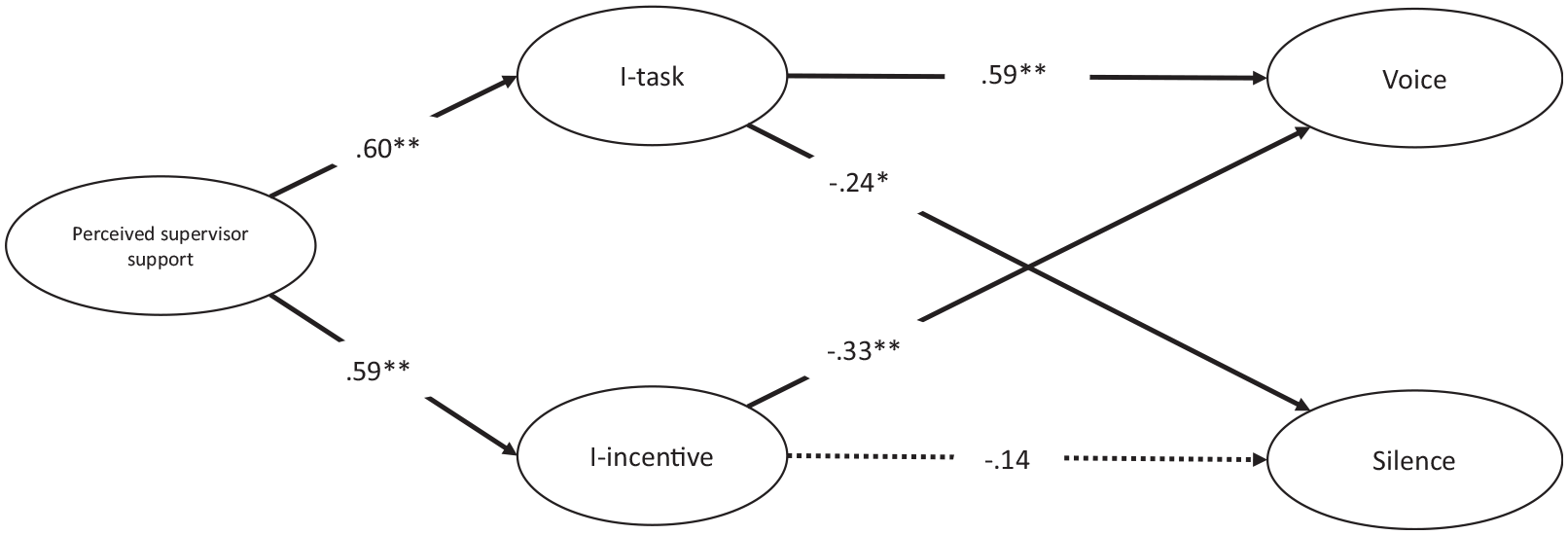
Standardized estimated paths in the mediation model.
Furthermore, we also found that task I-deals were positively related to voice (β = .59, p < .01) and negatively related to silence (β = −.24, p < .05); supporting Hypothesis 2. Next, we could consider the role of task I-deals as mediator of the relationship between perceived supervisor support and employees’ voice and silence, supported hypothesis 3.
Finally, we also found that incentive I-deals were not significantly related to silence (β = −.14, p = .19) but was negatively related to voice (β = −.33, p < .01). It was also established that the correlation between perceived supervisor support and employees’ silence was arbitrated by incentive I-deals. Instead, incentive I-deals mediated the association between perceived supervisor support and employees’ voice.
Alternative Model Testing
Considering that the study utilized a cross-sectional design, a test was performed on the reverse mediation model in which both task and incentive I-deals mediated the relationship between both voice and silence and perceived supervisor support. We found that this reverse mediation model does not fit the data (χ2 [3] = 56.20, p < .001, SRMR = 0.36, CFI = 0.53, IFI = 0.42, RMSEA = 0.14). Moreover, we also estimated another alternative model in which perceived supervisor support mediated the relationship between task and incentives I-deals and enactment of voice and silence. This alternative mediation model showed good fit (χ2 [339] = 581.29, p < .01, SRMR = 0.07, CFI = 0.90, IFI = 0.90, RMSEA = 0.07). However, when comparing this model to the above-described full mediation model, we found that this alternative model has a higher AIC value (AIC = 715.29) compared to the full mediation model (AIC = 704.17). Note that these models are not nested and that we are thus unable to compare these models using a loglikelihood ratio test but instead must rely on a comparison based on AIC values (Akaike, 1987). Our hypothesize model indicated a lower AIC value (704.17) compared to the reversed mediation model (715.29).
Discussion
The main objective of this research was to test a model positing that perceived supervisor support related to employees’ I-deals. In turn, task I-deals, contrary to incentive I-deals, was hypothesized to predict higher levels of voice behavior and lower levels of silence behaviors. Results from our mediation analysis verified the hypothesized model and revealed that all hypothesized paths were significant and task I-deals mediated the relationship between supervisor support and both employee voice and silence as per expected. This finding is in line with some other recent academic research which has demonstrated that employees with task I-deals are more likely to demonstrate positive behaviors, that is, more attachment to their jobs and the organization, higher performance levels and lower turnover intentions (Ho & Tekleab, 2013; Hong et al., 2012). Nevertheless, regarding incentive I-deals, we also observed that these I-deals were related negatively with employees’ voice behavior and mediated the relationship between supervisor support and the employees’ discretionary positive behavior. The result on incentive I-deals may be partly due to the lower level of relative importance and low level of relatedness to employees’ work attitudes and behaviors. Furthermore, they are less relationship driven and more transactional in nature.
Theoretical Implications
Previous studies have indicated that higher levels of I-deals are reported by employees when they feel they have high-quality relationships with their supervisors (Hornung et al., 2011). Findings from our study are congruent with this prior research and we observed that when employees perceived high supervisor support (i.e., that their supervisor values their contributions and cares about their well-being, Eisenberger, et al., 2002) they also perceived more I-deals. Much of the evidence on the relationship between supervisor support and I-deals rests heavily upon Leader-Members Exchange theory. This study focused more on employees’ own perceived impressions as to whether, and how their supervisors appreciate their contributions at work and care about their well-being (Eisenberger et al., 2002) and how that is related to the perceived I-deals. Aligned with our hypotheses, and in accordance with the indicators of Social Exchange Theory (Blau, 1964), our results also showed that employees respond to I-deals with discretionary behaviors. When employees were able to negotiate task I-deals involving intangible resources, it implies employer/supervisor’s socio-emotional concerns for the employee. This indicates the existence of a high LMX relationship (Rousseau et al., 2006) in which employees reciprocate with more constructive behaviors (i.e., voice) and less destructive behaviors (i.e., silence). Thus, the present study highlights that increments in tasks I-deals are directly related to positive organizational outcomes. Specifically, employees reciprocate not only by displaying more voice, but through exhibiting less silence, as suggested by Ng and Feldman (2015). Also aligned with our hypotheses, and in accordance with the indicators of Social Exchange Theory (Blau 1964), our results also suggest that the relationship between supervisor support and employees’ reciprocation with discretionary behaviors is a mediated by the presence of task I-deals instead of a direct relationship. The findings imply that changes in supervisor support were neither correlated with changes in employees’ voice nor silence behaviors. Instead, it is evident that the changes were indirectly related through the presence of task I-deals. Therefore, the possibility of creating or altering job content to fit the employees’ needs (i.e., I-task) through supervisor support implies that he/she not only will engage in more constructive voice behaviors but also will be less likely to engage in more destructive silence behavior.
We also observed unexpected results; namely that incentives I-deals were negatively related to employees’ voice behaviors and this type of I-deal is also a mechanism to explain the relationship between supervisor support and this constructive discretionary behavior. We propose that incentive I-deals evoke an economic exchange suggesting that employment is merely a measured finance-based transaction, which is bound by the interchange of resources that are both specific and tangible (Rosen et al., 2013) that do not present a relationship with employees’ discretionary behaviors. However, incentives I-deals seem to undermine the display of constructive voice behavior. This unexpected result could arise, we argue, because the extrinsic focus of incentive I-deals can narrow the range of employees’ motivation and have negative spillover effects on subsequent discretionary behaviors. In fact, when the interpretation of rewards is being controlled, employees feel pressured to think, feel, or behave in particular ways, so the rewards frustrate the employee’s basic needs, thus undermining their intrinsic motivation in the organization and, consequently decreases discretionary positive behaviors (Deci et al., 2017). Moreover, the observed negative relationship between incentive I-deals and voice leads us to question whether we can consider them I-deals, that is, a special condition of employment negotiated those benefits both, the employee, and the employer (Conway & Coyle-Shapiro, 2018).
Practical Implications
Promoting a flexible employment relationship with individualized working arrangements namely, idiosyncratic deals (I-deals) is positive for both employee and employer. When each individual employee finds an alignment between their own needs and the requirements of the organization, he/she will consequently retribute with discretionary behaviors that contribute to the organization’s sustainable competitive advantage (Collings & Mellahi, 2009). Thus, organizations need to implement idiosyncratic practices to provide employees with more opportunities to satisfy their specific needs, leading to better outcomes, such as higher voice and lower silence. Specifically, by adjusting job contents which allows employees to fulfill their personal needs for growth and recognition, adoption of task I-deals in particular—would be a fitting option. In addition, trainings that promote the development of leadership skills and help their subordinates to utilize similar task I-deals, would be another option since it was observed that supervisory support helps employees to feel that they have more I-deals opportunities.
Limitations and Recommendations for Future Research
This study has various constraints that may affect the interpretation of findings. The first limitation is based on the study’s design. The study employed a cross-sectional design, hence making it difficult to make assumptions based on causality (Singleton & Straits, 2005). In this case, use of the longitudinal approach would allow drawing of conclusions with regards to temporal precedence among these same variables (Campbell & Campbell, 2012). In addition, use of the longitudinal design would enable us to make comparisons regarding the effectiveness of the models, considering voice and silence as a behavioral reaction to the presence of task and/or incentive I-deals, which results in a perception of supervisor support.
The second limitation is based on the sample used in this study. The participants included only Chilean employees, thereby making it difficult to generalize the findings to other populations in varied countries. The third constraint relates to the use of self-report questionnaires. Despite being a valuable approach of collecting data which specifically reflects on individuals’ perceptions regarding supervisor support and I-deals, self-report questionnaires are associated with various legitimate concerns including the likelihood of bias (Keeney & Svyantek, 2000).
Moreover, utilization of self-reported data is contingent on the effect of common-method variance, which may subsequently influence the relationship between study variables (Podsakoff et al., 2003). Hinkin (1995) and Podsakoff et al. (2003) recommended various approaches of minimizing the potential risks associated with the use of self-reported data. The first step entailed promoting the confidentiality of study participants. participants who are assured that their information would remain confidential are unlikely to edit their responses with the aim of presenting themselves in a socially acceptable manner. The second measure was to inform the participants that all the responses to the questionnaires would be considered. With assurance that no answers would be regarded as wrong or right, the participants will be encouraged to respond based on their honest perspectives. The third approach entailed placing the study variables in different sections of the questionnaire, comprising of a varied set of instructions (Podsakoff et al., 2003).
Conclusion
In conclusion, this study sheds light on the significant impact of I-deals on employee behavior and the role of perceived supervisor support in shaping these idiosyncratic arrangements. Task I-deals, driven by the socio-emotional concerns of supervisors, were found to increase employee voice behavior and reduce silence. This highlights the importance of fostering high-quality relationships between supervisors and employees to encourage I-deals and, subsequently, constructive behaviors. However, the unexpected negative relationship between incentive I-deals and voice behavior suggests that a purely transactional approach may undermine employee motivation and discretionary positive behaviors. Practically, organizations can benefit from promoting flexible employment relationships and embracing idiosyncratic deals, particularly task I-deals, to satisfy employees’ needs and enhance their constructive contributions in the form of increased voice and decreased silence.
Footnotes
Declaration of Conflicting Interests
The author(s) declared no potential conflicts of interest with respect to the research, authorship, and/or publication of this article.
Funding
The author(s) received no financial support for the research, authorship, and/or publication of this article.

Data Availability Statement
Data associated with this research is available upon reasonable request from the author via email at