




Abstract
Workplace ostracism, which is defined as the extent to which an individual perceives that he or she is ignored or excluded by others, has become a pervasive phenomenon. Most scholars found that workplace ostracism has a negative linear effect on the employees’ work outcomes. However, based on the transactional theory of stress and coping, individuals could evaluate pressure and take action to solve the problems. Thus, they could positively cope with workplace ostracism when they are in trouble. This study investigates the curvilinear relationship between workplace ostracism, psychological empowerment, and the employees’ career success using a multi-wave design (257 respondents from three-time points). We found the curvilinear effect of workplace ostracism on subjective career success via psychological empowerment. The current investigation supports the theorized links and offers notable implications for personnel assessment and career development.
Plain Language Summary
This study investigates the curvilinear relationship between workplace ostracism, psychological empowerment, and the employees’ career success using a multi-wave design (257 respondents from three-time points). We found the curvilinear effect of workplace ostracism on subjective career success via psychological empowerment. The current investigation supports the theorized links and offers notable implications for personnel assessment and career development.
Social connection can be a sweet blessing when others accept us and a bitter curse when others reject us (Babalola et al., 2021). Workplace ostracism, defined as the extent to which an individual perceives that he or she is ignored or excluded by others (Ferris et al., 2008), is seemingly a commonplace phenomenon (Anasori et al., 2021; Bedi, 2021; Kwan et al., 2018). Within the work environment, 66% of employees in the United States have experienced ostracism within their work environment (Spector et al., 2006). Coping with workplace ostracism and alleviating the detrimental effects has become a burning question in human resources management.
For most, ostracism is linked to painful and aversive experiences. Psychology studies show that brain structures activated in physical pain were also activated after the individuals’ experienced social rejection (Anasori et al., 2021; Sharma & Dhar, 2022). Workplace ostracism has received extensive attention from experts in various fields and has become a considerable concern for organizations, as its frequency and impact have increased over the years (Dash et al., 2023; Zhang et al., 2023). Previous studies focused on identifying the adverse effects of workplace exclusion and coping mechanisms (e.g., Sharma & Dhar, 2022; Zhang et al., 2023). Numerous studies have found that workplace ostracism seriously hinders the cultivation of the individual positive mentality, which is inconducive to the realization of positive results such as the employees’ proactive behaviors and excellent work performance. Previous studies have proposed that workplace ostracism may harm the crucial criterion variables in organizational research: job performance (Ferris et al., 2015; Imran et al., 2023). Second, there is a negative association between workplace ostracism and the employees’ innovation behavior (Xing & Li, 2022). Some scholars have demonstrated that workplace ostracism negatively affects the employees’ behavior, such as employee voice behavior (C.-F. Li & Tian, 2016) and organizational citizenship behavior (Tandon et al., 2022). Despite this attention, remedies to combat workplace ostracism remain elusive. Although previous studies have not explored the relationship between workplace ostracism and career success, it can be inferred from the mainstream view that workplace ostracism is inconducive to individual career success. When the workplace ostracism encountered by an individual reaches a certain degree, will the individual rebound and try various means to change the status quo and get rid of the stressful situation? The transactional theory of stress and coping conceptualizes stress and coping as a process based on changing cognitive appraisals, which provides a different account from previous studies to explain inconsistent findings on the association between workplace ostracism and career success. A fundamental proposition of the transactional model (Lazarus & Folkman, 1987) is that it is the interaction of the person and environment that creates perceived stress. Stress is not a property of the person or the environment but arises when a conjunction exists between a particular kind of environment and a particular kind of person that leads to a threat appraisal.
Negative coping often produces negative emotional experiences and stimulates strategies such as escape and tolerance. The coping framework of “stress evaluation—active-cognitive coping—problem-focused coping” in the transactional theory of stress and coping provides a positive interpretation of the relationship between workplace ostracism and career success (Billings & Moos, 1981). Various coping strategies show the need to delve more deeply into how workplace ostracism affects individual career success and the underlying mechanism. As Friedman (2009) stated, future studies may benefit more from attempting to address questions about the circumstances under which each competing prediction holds than attempting to determine which of these eminently respectable, and most likely conditionally valid, intellectual traditions has a lock on the truth. Previous studies on workplace ostracism focused on the psychological, behavioral, and output changes of individuals who suffered from workplace ostracism. The perspective of the transactional theory of stress and coping does not deny the negative impact of workplace exclusion. It lays stress on the change of coping strategies with the change of the degree of workplace ostracism, which comprises not only the initial passive tolerance or escape but also the positive coping choices made by individuals to get rid of the current dilemma when the stress situation is concentrated to a certain extent. The two seemingly contradictory views have achieved a logical continuation. Therefore, this study proposes that the association between workplace ostracism and individual career success goes beyond a simple linear relationship. A curvilinear relationship, in which the individual career experienced a decline, then bottomed out and then rose.
In the association between workplace ostracism and career success, the individual’s cognition plays a key role (Wu et al., 2016). What type of mentality when facing workplace ostracism is crucial to take further measures and achieve bottoming out. Organizational researchers and practitioners have identified psychological empowerment as a construct meriting critical inquiry (S. H. Hsieh et al., 2022). Individuals with a high degree of psychological empowerment often have positive perceptions of work significance. They possess substantial work competence and autonomy (Lee et al., 2021), which is undoubtedly an essential prerequisite for getting rid of the unfavorable status quo and achieving career success. Therefore, our investigation contributes to the mechanism between workplace ostracism and career success by drawing from the perspective of psychological empowerment. Finally, this study aims to unpack the curvilinear relationship among workplace ostracism, psychological empowerment, and career success. We try to shed light on the conflicting argument of whether workplace ostracism is “good” or “bad” to its impact on employees’ success, and if it can be both, when, and how it changes between one another.
The remainder of this paper is organized as follows: The next section presents the purpose of the study, theory hypothesis development. Further sections present the methods and results. The final section presents the discussion and the study’s implications, followed by the future direction.
Theory and Hypothesis
Purpose of the Study
The current study aims to investigate the impact of workplace ostracism on the psychological and career-related outcomes grounded in the transactional theory of stress and coping. Previous studies found that ostracism was as painful to the target as is physical injury (Jahanzeb et al., 2020). When an individual experiences ostracism, he or she is likely to suffer from impaired cognitive function (Mao et al., 2021), increased psychological distress (Qi et al., 2020), engage in self-defeating behaviors (Twenge et al., 2002), and lead to low job performance (Kuo & Wu, 2022). The transactional theory of stress and coping may provide a positive interpretation of the relationship between workplace ostracism and psychological and career-related outcomes (Billings & Moos, 1981). Thus, we determine that the relationship between workplace ostracism and psychological and career-related outcomes may not be a simple linear relationship. This study tries to extend the “mixed blessing” of workplace ostracism by investigating a curvilinear effect of workplace ostracism on subjective career success through psychological empowerment on the basis of previous ostracism literature.
Stress in Career Development
The classic definition of stress offered by Lazarus (1966) is that “it occurs when an individual perceives that the demands of an external situation are beyond his or her perceived ability to cope with them.” Scholars focus on stress in the workplace since the 1970s. The word “job stress” has emerged with the global competitive pressure, increases in working hours, and the prevalence of dual-career couples, managerial bullying, and technological change (Colligan & Higgins, 2006). It is unsurprising that an essential source of the employees’ interference between work and nonwork domains—both work interference in nonwork and nonwork interference in work (Judge et al., 1994). The World Health Organization has declared occupational stress as a worldwide epidemic. A large-scale survey at Princeton Survey Research Associates (1997) indicated that most employees at all levels feel “quite a bit or extremely stressed” at work. The American Psychological Association (Bethune & Panlener, 2007) noted that 50% of Americans state that their stress has significantly increased in the past 5 years and that work is the most significant stressor for 74% of Americans, which is up from 59% in 2006.
According to Matteson and Ivancevich (1987), there are hundreds of definitions for stress to be found in the research and professional literature. “Virtually all of them can be placed into one of two categories, however: stress can be defined as either a stimulus or a response” (p. 10). The classic definition of stress offered by Lazarus (1966) is that it “occurs when an individual perceives that the demands of an external situation are beyond his or her perceived ability to cope with them.”Caplan (1980) defined job stress as the employees’ characteristics of the job environment (e.g., substantial demands of the job or insufficient supply of resources) as threatening. Job stress is a psychological strain leading to job-related hardness, tension, anxiety, frustration, and worry emerging from work (Schwepker & Dimitriou, 2021). Job stress can be harmful over time, leading to an increased mental withdrawal from the job (Cheek, 1984), reduced interactions with clients and coworkers (J. Chen et al., 2020), accidents on the job (Zhou et al., 2014), reduced job satisfaction (Esmaeilifar et al., 2020) and motivation to perform on the job (Eisapareh et al., 2022), increased conflict with family and friends, absenteeism (Eisapareh et al., 2022), turnover (Hoeve et al., 2020), burnout (Peasley et al., 2020), health/medical problems (Bradley & Cartwright, 2002), and even premature death (Woodruff, 1993). Although such stress affects employees today, it results in adverse outcomes. For example, Beehr and Newman (1978) reviewed numerous definitions of job stress and concluded that job stress is the interaction of work conditions with worker traits that changes normal psychological functions. Their definition also allows for stress that improves performance. Other scholars also asserted that occupational stress may attract positive outcomes, such as increased creativity (Le Fevre et al., 2003) and enhanced performance (Marino, 1997).
Workplace Ostracism and Psychological Empowerment
Ostracism has been part of human life since the beginning of recorded history when the ancient Greeks would vote to ostracize individuals from their communities as a form of punishment (Williams, 1997). As workplace ostracism is prevalent in organizations (Mao et al., 2021), it is a growing concern for managers (Anasori et al., 2021). Psychological empowerment is defined as a motivational construct that manifested in four cognitions: meaning (the value of a work goal or purpose), competence (an individual’s capability to perform activities with skill), self-determination (an individual’s choice in initiating and regulating actions), and impact (the degree to which an individual can influence strategic, administrative, or operating outcomes at work) (Monje Amor et al., 2021). These four cognitions reflect an active orientation to a work role (Spreitzer, 1995).
Following the existing research logic of workplace ostracism, workplace ostracism negatively affects the employees’ empowerment, which is mainly based on the following reasons: First, as an interpersonal stressor, ostracism threatens the social resources of the target, which are assets that can be drawn upon when needed, to solve a problem or cope with a challenging event (Greenhaus & Powell, 2006). The painful and aversive emotional experience will undoubtedly bring interpersonal barriers. In this case, employees facing workplace ostracism will have doubts about meaning, competence, self-determination, and impact; they will quickly fall into self-denial, wherein the psychological empowerment will decline (Anasori et al., 2021). Aside from its capacity to cause bad personal relationships, workplace ostracism is aversive in that it simultaneously threatens the individual’s belongings. This is because ostracism often signals a differentiation between the ostracized target and others in the workplace, thus mitigating the sense of similarity (H. Hsieh & Karatepe, 2019), which conveys implicit information to the ostracized target that he or she has done something unacceptable and symbolizes social death in the organization (Ferris et al., 2008). Being ostracized by others may lessen the employees’ belongings and their identification with the organization. Thwarted belonging and organizational identification may produce cognitive overload and detract from psychological empowerment, undermining one’s ability to regulate one’s behavior and to exert sustained efforts on tasks (O’Reilly & Robinson, 2009).
The transactional theory of stress and coping describes the coping strategies adopted by individuals in the face of stressful situations (Yan et al., 2021) and the ways and effects of the strategies. According to the transactional theory of stress and coping, when faced with stress, individuals first evaluate the stress situation, assess whether the events can bring pressure and the extent of the pressure, then continue to evaluate whether he can manage the pressure, and then forms coping strategies, which comprise both positive and negative coping strategies (Lazarus, 1984). Thus, it is unsurprising that we use the transactional theory of stress and coping with explaining the situation that ostracized individuals display a lack of organizational identity and the inability to self-regulate (C. Chen et al., 2019). They often hold negative coping strategies under this circumstance, such as escaping and enduring, which will cause a decline in their sense of psychological empowerment. If employees can face the challenges with positive cognition, the influence of workplace ostracism on their sense of psychological empowerment can be expected to shift. When individuals face workplace ostracism, they should first ponder over the current stress and accept the existence of an unfavorable stress state (Xia et al., 2019). To change the status quo, individuals should realize the meaning of work through paying great efforts and improving their competence, self-determination, and impact, and hope to make contributions and get rid of workplace ostracism subsequently (Anasori et al., 2021). The psychological empowerment of employees is restored and gradually enhanced in doing so. Finally, the individuals will make positive responses and take a series of actions to change the status quo.
We proposed a curvilinear model that integrates the positive and negative effects of workplace ostracism, in particular, on psychological empowerment. We propose that workplace ostracism will evoke negative emotions and do harm to organizational identity. What follows is that employees are likely to doubt their job meaning, competence, self-determination, and impact. The ostracized employees tend to adopt negative coping strategies such as escape and tolerance, and their sense of psychological empowerment drops obviously. When it drops to a certain degree, individuals feel the enormous pressure from the surrounding environment and expect to change the status quo and realize the rebound through efforts. Through the coping framework of “stress evaluation—active-cognitive coping—problem-focused coping,” the employees strive to eliminate workplace ostracism and regain the meaning, competence, self-determination, and impact and thus improve psychological empowerment. The relationship between workplace ostracism and psychological empowerment may be curvilinear in nature. That is, a curvilinear shape may best describe such relationship because a moderate level of workplace ostracism results in the lowest level of psychological empowerment. Thus, we propose the following hypothesis:
Hypothesis 1: The relationship between workplace ostracism and psychological empowerment will exhibit a concave upward curve, such that workplace ostracism will negatively impact psychological empowerment to some point and begin to exhibit increasing returns.
Workplace Ostracism and Subjective Career Success
Career success is of concern to individuals and organizations because employees’ success can eventually contribute to organizational success (Ekmekcioglu et al., 2020; Judge et al., 1999). Career success has been defined as the positive psychological and accumulated work-related outcomes derived from individual experience (Milhabet et al., 2020; Ng et al., 2005). It is objective successes such as salary or hierarchical position, and it also comprises the beholder’s success, which is an individual’s evaluation of his/her career (Haenggli & Hirschi, 2020; Pfeffer, 2022; Spurk et al., 2021). Subjective career success was chosen as the result variable by referring to the methods of authoritative literature (Park et al., 2017; Rode et al., 2008; Smale et al., 2019). Several scholars (De Vos & Soens, 2008; Semeijn et al., 2020; Y.-F. Wang et al., 2011) have accentuated subjective career success over objective success due to the current contemporary working environment. There are two reasons for this notion: first, intersecting with objective career success, subjective career success has a broader connotation (Z. Wang et al., 2019). Subjective career success is a combination of internal and external success perceptions about achievements, ambitions, and relationships among colleagues within the organization (Haenggli & Hirschi, 2020). Second, this research explores the association between workplace ostracism, psychological empowerment, and career success. Compared with salary, job title, and promotions, the employees’ mental state directly impacts their appraisal of career success (Bagdadli & Gianecchini, 2019). The present study focuses on subjective career success as a crucial factor in the perception of career success.
Greenhaus et al. (2009) argue that determining if people considered to have hierarchical and financial success are also satisfied with their careers is crucial. Subjective career success is most commonly operationalized as job or career satisfaction (Heslin, 2005; Rahman, Rahman, Ali, & Khan, 2016; Rahman, Rahman, Khan, & Anwar, et al., 2016). Substantial studies used job satisfaction as a proxy for subjective career success since individuals who are dissatisfied with their jobs are unlikely to consider their careers successful (Boudreau et al., 2001; Judge & Bretz, 1994; Murrell et al., 1996). We speculate that workplace ostracism undermines the employees’ job satisfaction for several reasons. First, workplace ostracism potentially harms the employees’ mental and physical health (Heaphy & Dutton, 2008). It signals that the individuals have lost their coworkers or supervisors (Robinson et al., 2013). They are likely to worry that they will experience the loss of other job resources such as work-related information and career advancement opportunities, which leads to stress for employees (Qian et al., 2019). The employees under stress are more likely to be in a worse physical state (Melamed et al., 2006). For example, previous studies have indicated that workplace ostracism leads to physical effects, such as interference with sleep (Robinson et al., 2013).
Ostracism’s negative emotional experience entails physiological arousal such as somatic complaints (Duffy et al., 2002). This accumulated effect may further contribute to health problems in the long term. Thus, they have lower levels of physical strength and job satisfaction. Second, as ostracism represents a form of exclusion, it can harm the employees’ perception of fairness and self-esteem level, factors that could contribute to work dissatisfaction (Ferris et al., 2008). It is likely to undermine an employee’s judgment of their value in the organization and lead to lower levels of organizational identification in such a stressful situation. In essence, the negative effect derived from working in an environment where one is ostracized should also adversely impact the feelings employees have toward their jobs and the personal evaluation of success in the organization (Gemzøe Mikkelsen & Einarsen, 2002). Third, ostracism may lead to maladaptive behaviors, including self-defeating behavior and aggressive behaviors, because it damages individuals’ self-regulation processes (Yang & Treadway, 2018). Consistent with this notion, it seems that ostracized individuals are unable to process social information correctly and make beneficial decisions for themselves (Twenge, 2001). They found that excluded participants produced averse noise toward others, which will inevitably hinder social interactions.
Grounded in the transactional theory of stress and coping framework, stress and coping can be viewed as a dynamic process formed as part of the personal environmental transaction that occurs when an individual perceives a situation as stressful (Parasuraman & Cleek, 1984). King et al. (1983) underlined the importance of stress in coping perception because they believe stress occurs when coping is uncertain. When able to cope with stress, individuals can overcome stress, which results in an increase in job performance under stress. When the exclusion reaches the limit, ostracized individuals will evaluate the available resources and coping strategies that can be used to overcome difficult situations, alleviate harm or gain benefits rather than persisting despite frustrations (Folkman et al., 1986). As the coping is certain, individuals will embrace active management and alteration of the person-environment relationship. By using the problem-focused coping strategies, individuals may conduct alternative solutions, choose the best plans, and actively engage in ostracism solving (Lu et al., 2017). Anderson (2000) determined that active coping strategies were positively related to low levels of depersonalization and high levels of personal accomplishment.
Coping strategies have been considered as a mediation role in the relationship between the appraisal and mental health outcomes by transforming the appraisal and its attendant emotion (Hudson, 2003). The employees’ self-confidence and self-regulation will be significantly enhanced, interpersonal relationships will gradually grow harmonious, and job satisfaction will also increase with the recovery of physical and mental health. Under this circumstance, employees will naturally become optimistic about their career evaluation.
Hypothesis 2: The relationship between workplace ostracism and subjective career success will exhibit a concave upward curve, such that workplace ostracism will negatively impact subjective career success at some point and begin to exhibit increasing returns.
Mediation Role of Psychological Empowerment
Upward mobility is germane to career success because those who are able to move up the societal or organizational hierarchy are typically regarded as successful and are more likely to view themselves as successful (Ng et al., 2005). Upward mobility contains two categories: contest mobility and sponsored mobility. A contest-mobility system reflects the central belief that all people can compete for upward mobility, which is considered as a significant incentive for employees to pursue career success. The contest-mobility perspective indicates that people compete in an open and fair contest for advancement, and victory comes to those who demonstrate outstanding accomplishments (Turner, 1960). Therefore, individuals will exert considerable efforts to avoid “workplace elimination” and achieve career success. As far as this study is concerned, when employees face ostracism from the workplace, they feel ignored and interpersonal injustice (Ferris et al., 2008). Even minimal forms of ostracism, such as exclusion from a computerized ball-toss game, can reduce the sense of belonging and lessen the individuals’ psychological empowerment (Williams et al., 2000). Employees are trapped in self-doubt and negation, which makes it hard to evaluate the status quo positively. Correspondingly, their subjective career success is negatively affected. Drawing from the transactional theory of stress and coping, employees will attempt to see the upside of the situation and take some effective measures to achieve upward “contest-mobility,” then reducing emotional tension and enhancing psychological empowerment; thus, subjective career success will be significantly improved.
However, the sponsored-mobility perspective indicates that established elites pay special attention to those members deemed to have high potential and then provide sponsoring activities to them to help them win the competition, which is another inducement for the pursuit of career success (Ng et al., 2005). Workplace ostracism decreases the opportunity for social interaction, which is essential in enabling people to fulfill their psychological needs (Singh & Srivastava, 2021). Subsequently, the ostracized employees will have a sense of isolation and helplessness to decrease psychological empowerment. The lack of confidence will create a barrier to be valued by the elites, thus missing the chance of support activities and organizational sponsorship (Gürlek, 2021). Using similar stress and coping models, employees will engage in appraisal to change the undesirable conditions and focus on the available coping options for altering the perceived harm, threat, or challenge, wherein a more positive environment is created. The psychological empowerment will be enhanced (Perrewé & Zellars, 1999). Naturally, elites are more likely to regard them with particular respect and help individuals stand out from other employees to facilitate career success due to their excellent pressure resistance and infinite potential.
We propose that workplace ostracism will have a curvilinear association with subjective career success via the mediation effect of psychological empowerment. Contest mobility and sponsored mobility are regarded as stimuli that enable employees to bottom out and recover their psychological empowerment, conducive to subjective career success. Considering the statements mentioned above, we propose the following hypothesis:
Hypothesis 3: Psychological empowerment mediates the association between workplace ostracism and subjective career success. Workplace ostracism affects employees’ psychological empowerment through the curvilinear curve effect, which in turn affects career success.
Method
Participants
The participants were employees working in a company with more than 18,000 employees in the information technology industry in China. We invited the human resource department to generate a list of 492 full-time employees to participate randomly. We informed all identified participants that the survey was purely for academic research and their responses would remain confidential.
Procedure
We collected the survey from August to December, 2021. The human resources (HR) department in the company randomly provided a list of 492 full-time employees. We informed all identified participants that the survey concluded three-wave questionnaires and was purely for academic research purpose and their responses would remain confidential. We advised the participants that they would receive 30 yuan (approximately US$5) for their time to complete the three-wave surveys. We coded every respondent to match the three-wave survey. We collected data at three-time points, separated by 2 months, to reduce the common method bias. At Time 1, each participant rated workplace ostracism and control variables, and 318 employees completed the first wave of the survey. At Time 2, employees were asked to rate psychological empowerment, and 302 employees completed the second-wave survey. At Time 3, 257 out of 302 participants who completed the previous two surveys reported their subjective career success. We used a unique code for each questionnaire to remove any identifying participant information (thereby ensuring response confidentiality) while still allowing us to match the time-lagged surveys. Thus, the overall response rate across three waves is 68.1% (335/492).
Measures
We developed the survey questionnaires in English and used Brislin’s (1970) back-translation method to translate the survey into Chinese, the participants’ language. Subsequently, experts in human resource management and frontline employees of the company were invited to evaluate and test the items in the questionnaire to determine the most appropriate Chinese items. The variables involved in this study were all self-reported. Participants were asked to rate on a five-point Likert scale (1 = “strongly disagree” to 5 = ”strongly agree”) the extent to which they endorsed each item.
Workplace ostracism was measured by using a 10-item scale developed by Ferris et al. (2008). Ferris et al.’s (2008) 10-item scale is regarded as a classic measure tool on workplace ostracism and cited by numerous studies (e.g., Wu et al., 2021; Yao et al., 2022) to investigate the impact of workplace ostracism on work-related and career-related outcomes. Two sample items used are as follows: “Others ignore you at work” and “Your greetings have gone unanswered at work.” Cronbach’s alpha = 0.928. Wu et al. (2021) also determined good internal consistency (alpha = 0.920 at Time 2 and 0.930 at Time 3) for workplace ostracism scale in their study.
Psychological empowerment was measured by using a 12-item scale developed by Spreitzer (1995). Spreitzer’s (1995) 12-item scale published in Academy of Management Journal is a popular tool to measure psychological empowerment. It comprises four dimensions: impact, meaning, competence, and self-determination. This scale was adopted by more than 10,000 studies (data from Google scholar; e.g., X. Li & Lin, 2021; Saira et al., 2021). Two items used include the following: “My job activities are personally meaningful to me” and “I am confident about my ability to do my job.” Cronbach’s alpha = 0.901. X. Li and Lin (2021) also determined good internal consistency (alpha = 0.901) for psychological empowerment scale in their study.
Subjective Career Success was measured by using the five-item scale developed by Greenhaus et al. (1990). Greenhaus et al.’s (1990) scale published in Academy of Management Journal was cited more than 3,000 times (data from Google Scholar; e.g., Gordon & Shi, 2021; Kundi et al., 2020). Two items used comprise the following: “I am satisfied with the progress I have made toward meeting my overall career goals” and “I am satisfied with the progress I have made toward meeting my goals for the development of new skills.” Cronbach’s alpha = 0.887. Kundi et al. (2020) also found good internal consistency (alpha = 0.920) for subjective career success scale in their study.
Control Variables
Referring to the study on career success by Park et al. (2017) and Smale et al. (2019), the control variables of this research are (1) Gender. There have been long-standing workplace discrimination norms of strong men and weak women in the workplace, which has led to differences in evaluations of career success between male and female employees. Gender was dummy-coded, with male respondents coded as “1” and female respondents coded as “0.” (2) Age. Age was self-reported in years. (3) Job Tenure. As continuous variables, employees directly fill in the length of service. Employees of various ages and tenure have different evaluations of career success inevitably. (4) Education. As a category variable, education was coded as “1” for employees who finished high school or below, “2” for employees who held college degrees, “3” for employees who held bachelor degrees, and “4” for employees who held graduate degrees or above. Compared with lower academic qualifications, employees with higher academic qualifications are more likely to gain ample job opportunities, organizational sponsorships, and are more likely to have a rosy appraisal of career success.
Results
Confirmatory Factor Analyses
We examined the hypothesized measurement model with three factors: workplace ostracism, psychological empowerment, and subjective career success. According to Bentler and Chou (1987), if the ratio of the parameter to the sample size in the observation index is greater than 1:5, the item parceling can be used to estimate the structural relationship among various latent constructs. We followed the steps of Liu et al. (2015) to parcel the items and created item parcels for each single-dimensional variable, reducing the number of item indicators to the more parsimonious three per factor. The fit of this three-factor model is superior to that of several other measurement models (see Table 1). These findings support the discriminant validity of the research variables.
Confirmatory Factor Analysis (CFA) of Discrimination Validity.
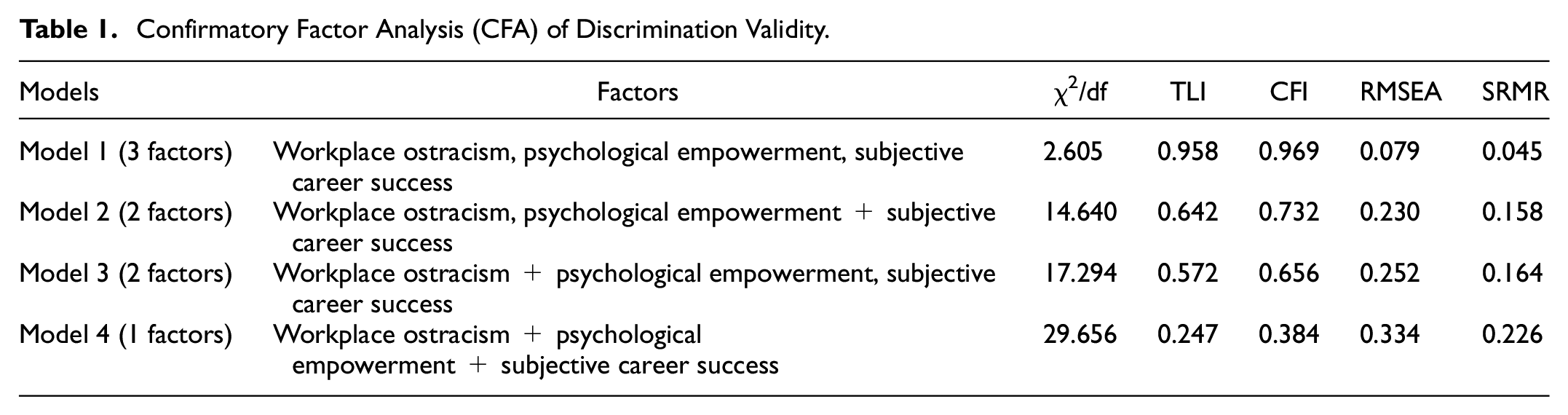
The three variables of workplace ostracism, psychological empowerment, and subjective career success involved in this research are all derived from the employee. This study uses process control and method control to minimize the common method bias caused by the same data source. (1) Process control. We elucidated the purpose of research (for academic research and not for commercial purposes) and promised confidentiality. (2) Method control. First, the confirmatory factor analysis results show that the single factor fitting index (χ2/df = 29.656, TLI = 0.247, CFI = 0.384, RMSEA = 0.334, SRMR = 0.226) is not flawless and is significantly inferior to other factor models. Second, following Podsakoff et al. (2003), this paper adopts the factor control method, adding method deviation latent variables to analyze the changes of fitting parameters. CFI changed by 0.003, TLI changed by 0.002, RMSEA changed by 0.002, and SRMR changed by 0.001. The changes of these indicators were all less than 0.02, which was within an acceptable range.
Means, Standard Deviation, and Correlations
Table 2 presents the means, standard deviations, and correlations. No significant correlation exists between workplace ostracism and psychological empowerment (r = 0.082, n.s.) and subjective career success (r = 0.084, n.s), which preliminarily shows that the association among workplace ostracism, psychological empowerment, and subjective career success is not a simple linear relationship. Psychological empowerment is positively correlated with subjective career success (r = 0.462, p < .01). These findings provided initial supports for our hypotheses.
Means, Standard Deviations, and Correlations of Study Variables.

Note. N = 257.
p < .05, **p < .01, ***p < .001, two-tailed test.
Hypothesis Testing
We used hierarchical regression analysis by STATA 14.0 to investigate the effects of employees’ perceived workplace ostracism on their psychological empowerment and subjective career success. The results are shown in Table 3 and the curvilinear relationship graph are shown in Figures 1 and 2.
Regression Analysis Results for Hypothesis Testing.

Note. n = 257.
Standard errors are in parentheses.
p < .05. **p < .01. ***p < .001.

The curvilinear effect of workplace ostracism on psychological empowerment.

The curvilinear effect of workplace ostracism on subjective career success.
Hypothesis 1 proposes the curvilinear relationship between workplace ostracism and psychological empowerment. The results of Model 3 in Table 3 have shown that the quadratic workplace ostracism term had a significant positive effect on psychological empowerment (M3, b = 0.195, p < .001), providing support for that the relationship between workplace ostracism and employees’ psychological empowerment is a curvilinear, curvilinear relationship, Hypothesis 2 was supported.
Hypothesis 2 posits the curvilinear relationship between workplace ostracism and subjective career success. Model 5 in Table 3 shows that the curvilinear term was significant (M5, b = 0.288, p < .001), and Hypothesis 2 was supported.
Hypothesis 3 posits an indirect effect of psychological empowerment between workplace ostracism and subjective career success. We conducted Bootstrapping analysis (Preacher & Hayes, 2008). It is necessary to satisfy that the quadratic independent variable term is significantly correlated with the mediator. We conducted a bootstrapping method in PROCESS (Hayes, 2013). In PROCESS, we used bootstrap 5,000 resamples with bias-corrected 95% confidence intervals (CIs). The mediation effect was supported when the mediator is significantly correlated with the dependent variable, while the confidence interval does not contain 0 after the bootstrapping test. Results show that the interaction between workplace ostracism and psychological empowerment was a significant curvilinear relationship (M3, b = 0.195, p < .001). Psychological empowerment was significantly positively correlated with subjective career success (M6, b = 0.847, p < .001). In addition, 95% confidence intervals calculated using bootstrap estimates were [−0.493, −0.009], excluding zero, which shows that psychological empowerment mediated the association between workplace ostracism and subjective career success. Simultaneously, there was also a curvilinear relationship between workplace ostracism and employees’ subjective career success (M5, b = 0.288, p < .001), that acknowledges that workplace ostracism affects employees’ psychological empowerment through the curvilinear curve effect, which stimulates workplace ostracism and the employees’ subjective career success. Therefore, Hypothesis 3 was supported.
Discussion
Despite workplace ostracism’s increasing prominence, its impact on employees has not been well investigated as the few studies on the topic provide contradictory arguments (Kwan et al., 2018; O’Reilly & Robinson, 2009). Considering the steady growth of workplace ostracism in recent years and its expected acceleration in the future, clarifying the relationship between workplace ostracism and the employees’ reaction is primarily important in understanding how firms can benefit from modifying the management method. We proposed a curvilinear relationship between workplace ostracism, psychological empowerment, and subjective career success based on the transactional theory of stress and coping.
The current study found a curvilinear relationship between workplace ostracism, psychological empowerment, and subjective career success. It is the same as previous studies that workplace ostracism is negatively related to psychological factors at the first stage in the U shape but opposite to the previous at the second stage. Previous studies found workplace ostracism led to negative psychological and work-related outcomes (e.g., Jiang et al., 2021; Mao et al., 2021; Yao et al., 2022). We determined that the quadratic workplace ostracism term was significantly and positively related to psychological empowerment (M3, b = 0.195, p < .001). Workplace ostracism first reduces the employees’ psychological empowerment and then increases it. This result expanded the workplace ostracism literature especially the outcomes of workplace ostracism.
With regard to the generalizability, this is on the basis of investigation from respondents from a company with more than 18,000 employees in the information technology (IT) industry in China. Employees in IT industry faced huge time and assignment pressure. Thus, the conclusion can be also generalized to other industries with stress, such as hospitality industry, tourism industry, medical industry. When an individual experiences ostracism, he or she is likely to suffer from impaired cognitive function (Mao et al., 2021), increased psychological distress (Qi et al., 2020), and engage in self-defeating behaviors (Twenge et al., 2002) and aggression toward others (Twenge et al., 2001).
Theoretical Implications
First, this study advances the workplace ostracism literature by adopting the transactional theory of stress and coping in the career development field, and no direct research linking workplace ostracism with the employees’ career development. Our study provides a theoretical mechanism for workplace ostracism literature based on the transactional theory of stress and coping. Our results indicate that workplace ostracism sends stressful social cues that affect the employees’ psychological empowerment and subjective career success and extends the argument of Mao et al. (2018) that “being ostracized threatens the psychological needs for meaningful existence” (p. 751). Our study indicates that gossip research may use the transactional theory of stress as a theoretical lens to link perceived workplace ostracism to other positive work outcomes, such as feedback-seeking behavior (Y.-F. Wang et al., 2011), task performance (Xia et al., 2019), and creativity (Tu et al., 2019).
Second, this study advances the research on workplace ostracism by investigating the curvilinear relationship between workplace ostracism, psychological empowerment, and subjective career success. Much of the work on ostracism has attempted to understand the negative impact of workplace ostracism on the employees’ proactive work behaviors and performance (Kaushal et al., 2020; Wu et al., 2016). Because the impact of workplace ostracism depends on appraisals of the stressful surroundings and the individual’s ability to cope with the stressor, we used the transactional theory of stress that allowed us to move the field toward a nuanced understanding of workplace ostracism (Biggs et al., 2017). We observed that although workplace ostracism resulted in low subjective career success first. The employees’ subjective career success will then recover and rise by the problem-focused coping strategies (Bliese et al., 2017). Individuals may conduct alternative solutions, choose the best plans, and actively engage in ostracism solving (Lu et al., 2017). This result is notable because it provides a new perspective to investigate the impact of workplace ostracism on employees’ outcomes, given that ostracism could desist normative, positive actions in previous studies (Gürlek, 2021; Howard, 2019; Xu, Huang, & Robinson, 2017; Zhang & Shi, 2017). Individuals feel the enormous pressure from the surrounding environment and expect to change the status quo and realize the rebound through efforts. Thus, we regard the impact of workplace ostracism on subjective career success may not be linear. We call on future research to investigate the curvilinear effect of workplace ostracism on positive psychological well-being (Zhang & Shi, 2017), positive behavior (Wang et al., 2021), and performance further (Ping et al., 2021).
Third, our study adds to the research on subjective career success by answering the call for research on the roles of informal interpersonal behaviors on career success (Judge & Bretz, 1994; Seibert et al., 2001) and the inhibitors of subjective career success (Ng & Feldman, 2014). Workplace ostracism as a stressor affects the hospitality workers’ subjective career success through the indirect effect of psychological empowerment. Such results expand on the existing work on the inhibitors of subjective career success, which identified formally primarily factors such as a lack of supervisors’ support, poor leader-member exchange, stressful tasks, and unfairness (Ng & Feldman, 2014). Compared with those factors, perceived workplace ostracism is much more informal and extends the call of Seibert et al. (2001) to study the influence on the career success of more informal interpersonal aspects, which are less visible, easily overlooked, and more interesting to identify.
Practical Implications
Considering the practical implications of our findings, employees should have a rational appraisal of workplace ostracism and turn pressure into motivation. Previous studies indicate that workplace ostracism costly for employees should be avoided or minimized. Increasing levels of workplace ostracism can create an increasingly dysfunctional and counterproductive behavior, which is a real-life demonstration that an extremely high level of workplace ostracism is harmful. However, depression and self-degradation after facing ostracism in the workplace are not the only ways. Our results indicate that high levels of workplace ostracism beyond a certain point may produce unexpected behaviors and attitudes among employees. Rational analysis and intentional efforts deserve to be used to dispose of the stressful environment and ultimately achieve subjective career success. Thus, the focal attention should be paid to the employees’ inner strength, as they are more sensible to ostracism and more likely to engage in a motivating process to make their efforts in performing proactive actions, such as mending their fences with colleagues or drawing up a sound work plan. Employees should regard the pain caused by workplace ostracism as a type of training and trial, wherein they can genuinely strengthen their hearts and undergo a complete change.
Second, both organizational researchers and practitioners have proposed psychological empowerment as a construct meriting critical inquiry (Thomas & Velthouse, 1990). A positive correlation exists between psychological empowerment and career success. When psychological empowerment is high, the employee’s subjective career success will increase; when the psychological empowerment is low, the employee’s subjective career success will decrease. Employees should take an active rather than a passive orientation to a work role in which individual wishes and feels able to shape his or her work context. Individuals should maintain a sunlight point of view to deal with this complex working environment. To circumvent the restricting effects of workplace ostracism, managers could use incentives to encourage employees to improvise or take the initiative and create an inclusive environment for various employees to take on new roles to facilitate more organic organizational processes, which should facilitate the empowerment process.
Limitations and Avenues for Future Research
This study presents several limitations that must be considered when generalizing its results. As a first limitation, the three variables of workplace ostracism, psychological empowerment, and subjective career success involved in this research are self-reported. Although the method of multi-wave design is adopted and the results show that the standard method deviation has no profound influence on the research results. This cannot completely rule out the influence of common method deviations. Thus, future research should consider multi-source collection (such as collecting workplace ostracism data from colleagues) or using field and laboratory experiments to verify the conceptual model of this research further.
Second, for the discussion of career success, this research refers to the existing authoritative literature, measuring subjective career success, that is, the employees’ perception and evaluation of career success. Objective career success (such as salary, status) can also be used as dependent variables in the future to explore the influencing mechanism of workplace ostracism on subjective and objective career success.
Third, this study explores the relationship between workplace ostracism and career success from the perspective of psychological empowerment and reveals the path through which workplace ostracism affects employees’ psychological cognition and thus career success. It further signifies that other scholars can explore the mediating role of other variables such as emotional commitment, turnover intention, and emotional performance. The discussion of these variables will help reveal the underlying mechanism of workplace ostracism on the relationship between career success.
Footnotes
Declaration of Conflicting Interests
The author(s) declared no potential conflicts of interest with respect to the research, authorship, and/or publication of this article.
Funding
The author(s) disclosed receipt of the following financial support for the research, authorship, and/or publication of this article: This work was supported by National Natural Science Foundation of China [grant numbers 72102033; 72172032; 72072110; 71972032]; the Fundamental Research Funds for the Central Universities of China [grant number N2206012]; Economic and Social Development Research Project of Liaoning Province [grant 2024lslqnkt-017].

Data Availability Statement
The data are available from the corresponding author on reasonable request.