



Abstract
This study focuses on understanding risk-aversion behaviours in sports science by examining system dynamics and network structures. Various network models for real-world sports were analyzed, leading to the development of a comprehensive computational algorithm that captures the interactive properties of networked agents. This algorithm dynamically estimates the likelihood of systemic risk propagation while optimizing principles related to failure, reward, and social learning within the network. The findings suggest that despite the inherent risks in sports-centric network structures, the potential for protection can be enhanced through strategically developed, interconnected methods that emphasize appropriate investment. Strong social learning interactions were found to reduce the probability of failure, whereas weaker interactions resulted in a broader distribution of eigenvector centrality, increasing the risk of failure propagation. The study highlights key conceptual and methodological advancements in applying system dynamics to sports science. Furthermore, advanced agent-based network simulations offer deeper insights into the protective potential of interconnected management strategies, offering solutions to mitigate instability and cascading risks in sports.
Plain Language Summary
• The practical applications of system dynamics were examined through an agent-based model tailored to various real-world sports networks. This model incorporated risk propagation assessments, sports network measurements, and an investigation into the effects of protective dynamics on risk.
• An inverse relationship was found between individual gains and failure. Without risk management investments, even minor factors or small probabilities could lead to widespread failure over time.
• The developed computation approach is expected to enhance decision-making proficiency, facilitating efficient management of complex sports system dynamics. It can be further expanded by formulating policies across different scales, offering a sophisticated perspective on systemic risks.
Introduction
In today’s sports world, success relies heavily on accurate real-time data interpretation and strategic decision-making, thus requiring a multitude of analytic approaches. This dynamic, interactive entity is continuously influenced by evolving information, which presents both challenges and opportunities (Smith & Sparkes, 2009; Wäsche et al., 2017). Uncovering underlying insights and projecting outcomes depend on the sophistication of tools and theoretical frameworks employed (Park, 2022). Although studies often focus on network constituents and their interconnections (Korte & Lames, 2018), factors such as cultural context, research ethics, data validity, and participant data collection can pose significant methodological challenges in sports science research. These factors may limit the capacity to discern behavioural shifts accurately in line with the intent of researchers (Narizuka & Yamazaki, 2018).
Following the complexities posed by dynamic data shifts in sports, understanding motor behaviours and their evolution involves examining both individual interactions (micro level) and the broader environment (macro level), which act as constraints (Newell, 1986). This requires a systemic approach that encapsulates dynamic shifts among myriad factors and multidimensional components that impact these behaviours (Park, 2018). With this in mind, this article proposes a comprehensive networked model that successfully translates these intricate concepts into sports contexts (Clemente et al., 2016). The model represents a significant step forward in leveraging complex data interactions to elucidate behaviours and optimize strategies in the field of sports science.
Dynamics in Sports Risk Management
The convoluted interplay of diverse elements within the human body and sports components results in a multifaceted, interconnected network. Autonomous elements, such as nerve pathways directing movement or players forming a team, shape these functional network structures (Sussillo et al., 2015). Even minor disruptions can trigger instability, underlining the fragile equilibrium within these systems. Network concepts, which use performance variables to identify patterns in these interactions, have become increasingly prevalent. This relational approach places the components within a specific context and integrates individual attributes such as age, sporting ability, experience, and team position into the network analysis. This closer inspection of the relationships between these features and their dynamics within the networks, coupled with frequent interactions between specific units and functions, underscores the potency of the network approach. It presents a robust analytical tool, emphasizing the importance of individual actors and their synergistic interplay (Wickelgran, 1969).
As mentioned earlier, even trivial perturbations can have ripple effects in delicate sports ecosystems. Systemic risks, originating from the unstable nature of interconnected elements, can catalyse far-reaching disasters, impairing performance, causing injuries, leading to team losses, and potentially precipitating industry downfalls. The widespread use of performance-enhancing drugs is a stark example of such systemic risk, undermining the integrity of the sports industry and eroding the trust of fans (Trimmer et al., 2011). To comprehend the mechanisms behind these phenomena, numerous studies have sought to identify and establish protection mechanisms against systemic risk patterns (Dehmamy et al., 2018; Lusher, Koskinen, et al., 2010; Park, 2020). Several studies have employed simulation methods to illustrate how the complexity of intertwined components can trigger real-world phenomena (Pastor-Satorras et al., 2015). In this context, graph theory has proven invaluable for understanding sports network structures and facilitating communication among network elements (Ribeiro et al., 2017).
Network Structures in Sports and Movement Systems
The systems regulating movement in sports exhibit a broad spectrum of network structures, each with unique characteristics (Kugler et al., 1980). Understanding these network architectures by analysing the structure and behavior of sports and movement systems can inform the development of effective coaching, training, and injury prevention programs. We explore five key network topologies relevant to sports and movement control systems: small-world, scale-free, random, regular lattice, and neuromuscular networks.
Small-world networks, marked by high clustering coefficients and short average path lengths, can model social interactions in sports, where players frequently form closely knit groups linked by sporadic long-distance connections (Watts & Strogatz, 1998).

This equation represents the conversion of a small-world graph (
Scale-free networks, typified by a power law degree distribution, consist of a few highly connected “hubs” and numerous sparsely connected nodes (Barabási & Albert, 1999). This structure is evident in competitive sports, where a select group of elite athletes dominates rankings and media attention.

This equation describes the process of converting a scale-free graph (
Random networks, where nodes are connected at a certain probability, display a Poisson degree distribution (Erdos & Rényi, 1959). They can model unstructured sports or recreational activities with random, unregulated participation.

This equation illustrates the conversion of a random graph (
Regular lattice networks, which form a structured grid-like pattern, can model organized sports teams with defined roles and positions for each player (Watts & Strogatz, 1998).

The equation indicates the conversion of a regular graph (
Neuromuscular networks in the human body connect neurons and muscles, comprising muscle fibres that contract upon signal reception and neurons that transmit these signals (Dayan & Abbott, 2001).

The equation signifies the transformation of a neuromuscular network (
Figure 1 illustrates the diverse network architectures under discussion, offering a detailed analysis of their interaction within sports and movement systems. This depiction emphasizes the capacity of these network models to cultivate novel approaches in coaching, training, and injury prevention. A thorough examination of these models within the context of sports science will enhance our understanding of intricate systems and assist in addressing challenges related to risk and resilience management.

Visual representations of diverse network structures. Left plot: Social interactions among members depicted as a small-world (SW) network, showing how closely-knit clusters can be interconnected to create short path lengths. Middle-left plot: Competition dynamics expressed as a scale-free (SF) network, highlighting nodes with high connectivity (hubs) that represent dominant competitors. Centre plot: A recreational sports team depicted by an Erdős-Rényi (ER) random network, highlighting the randomness of interactions in such an environment. Middle-right plot: A professional sports team visualized as a regular lattice (RL) network, emphasizing the structured and predictable connections between team members. Right plot: The neuromuscular (N) network is represented as a bipartite graph in which the cyan and magenta nodes represent neurons and muscles, respectively. For all networks, edge colours and widths indicate the strength of the connections, with darker and wider edges representing stronger connections.
Integration of Key Network Structures (Random)
The random network structure forms a fundamental model in sports science, incorporating the essential characteristics of small-world, scale-free, regular lattice, and neuromuscular networks. However, the potential rapid spread of misinformation or damaging behaviors, particularly evident in small-world networks, must be cautiously monitored within this integrated model (Watts & Strogatz, 1998). Incorporating the hub-centric structure of scale-free networks into the random network model can help identify and cultivate individuals who are critical for enhancing the network’s capacity to disseminate knowledge and innovation (Barabási & Albert, 1999). By equipping these hubs with the finest tools, data, and training, we can amplify their beneficial impact and subsequently uplift the entire network. Preparing for potential hub failures by establishing backup connections and alternate routes will ensure network resilience. Robust local connections and cooperative interactions, common in regular lattice networks, can be integrated into the random network model to enhance resilience, expedite information exchange, and promote recovery (Erős & Schweitzer, 2002). Efforts to improve global connectivity and shorten the average path length within the network are crucial to ensure the efficient reach of data and resources across all network sections.
To merge the merits of exploration with the need for stability and consistency in performance, social dynamics, such as imitation and exploration, can be incorporated into the random network model (Centola et al., 2007). By integrating these social dynamics with the reward dynamics of game theory, the random network model can more accurately portray the intricate relationships and decision-making processes that underpin success and resilience in sports and movement control systems (Von Neumann & Morgenstern, 1944). A random network model that amalgamates the core features of other network structures and dynamics, including failure, reward, and social interaction, could significantly enhance the optimization of performance and decision-making in sports science. By diligently considering these diverse elements, we can develop strategies that safeguard against failure and risk propagation.
One method to achieve this objective involves embedding elements of failure, reward, and social interaction dynamics within the random network model. This integration enables the establishment of approaches that bolster the resilience of the network to failure and risk dispersion. For instance, the random network structure could incorporate the rapid information dissemination characteristic of small-world networks, enabling prompt adaptability and response to shifts in the sports environment (Watts & Strogatz, 1998). In particular, a study examining the robustness and vulnerability of various network structures in team sports showed that elements of both random and small-world networks demonstrated enhanced resilience to failures and disruptions (Grund, 2012). Similarly, another study scrutinizing the interaction patterns among team players during games revealed that the teams exhibited a blend of random network properties (Sampedro, Prieto, & Sañudo, 2011). The researchers inferred that random network structures could inspire mitigation strategies and enhance performance by promoting adaptability and efficient communication.
Network Dynamics Through an Agent-Based Model
This research investigates intricate network architectures and their intrinsic dynamics, extending from the foundational elements of muscles and nerves in perception–action systems (Jordan, 1997) to the complex interactions within sports, exemplified by phenomena such as team spirit (Narizuka & Yamazaki, 2018). Each initiated phase progressively amplifies, building on the previous phase until culmination. These phenomena encapsulate the evolutionary rules governing behaviors in response to environmental stimuli. Behavioral adaptations, as heritable traits, follow a process in which successful behaviors are replicated and strategically propagated through learning; this process is known as cultural evolution (Fawcett et al., 2013). Hence, comprehending how these adaptations interact with the sports environment and associated physical and institutional tools is crucial.
Employing an agent-based model that involves these evolutionary traits provides a method for examining these interactions (Hulme et al., 2019). Such models integrate behavioural algorithms with network dynamics, unveiling natural patterns and facilitating a superior understanding of adaptation by capturing emergent phenomena. Autonomous agents, representing individuals constructed from the bottom up, can incorporate learning algorithms (Reynolds, 1987)). This enables the observation of rational decision-making based on potential interactions within an artificial system (Oliva, 2016). Prior research has used traditional statistical methodologies in agent-based network models to explore diverse topics, such as the role of different serial orders in movement (Jordan, 1997), tactical positions in team sports (Korte & Lames, 2018), and health-related issues (Shoham et al., 2012). However, understanding the complex relationships among “interactive factors on networks” (Bittencourt et al., 2016) is regarded as more crucial for mitigating risks related to motor behavior and team performance than identifying the causal effects of individual factors (Hulme & Finch, 2015).
In this study, we endeavored to harness system dynamics through a unique networked agent model constructed upon various real-world sports structures. Our investigation focused on understanding how protection dynamics at interconnected macro–micro scales influence risk and its subsequent interplay with the sports environment. We incorporated behavioural adaptations into a sports network and introduced a novel algorithm designed to deliver quantitative measurements capable of assessing factors that drive risk propagation. Our model is distinct from previous approaches in its unique integration of behavioral adaptations and its applicability to real-world sports structures. This study not only represents a step towards a deeper understanding of the complexity of sports science but also serves as a practical guide for constructing risk models and discovering insights.
Methods (Model)
We employed a rudimentary framework in which random properties delineated the foundational structure. This structure was extracted from a variety of sports observation data (refer to Figure 1), with each node defined as being interconnected in a random manner (refer to Appendix 1) by undirected connections. These random characteristics align with previous studies proposing that sports or motor behaviors form a network of significant systems in which interconnections are manifested by different components of the system, including muscles and nerves (Purves et al., 2001), social interactions, and tactical positions in team sports (Korte & Lames, 2018; see Appendix 2).
Subsequently, we harnessed an algorithm (Appendix 3) based on the concept that the impacts of major risks, such as failures, can be approximated by using the inherent potential of the network properties. Then, we integrated mechanisms for protection by incorporating both evolutionary and non-evolutionary parameters (Sigmund & Nowak, 1999). This integration is rooted in a comprehensive understanding of the interconnected scale that emanates from the various structures of sports. By encapsulating these multifaceted interactions, our model aspires to provide a detailed and refined understanding of the dynamics within sports networks and the potential risks they might pose.
Operating Principle
A proposal is presented for the developed protection mechanism and its potential impact on the agented network, followed by the subsequent steps for model implementation. First, nodes (vertices) serve as elements or individuals—functional structures that generate diverse movements (Haken, 2012) or interactive properties in a complex tactical team sports system—while links serve as edges that connect two nodes. A set [
Payoff and Failure Dynamics
Nodes represent each vertex in a functional or tactical unit characterized by capital and strategy using the dynamics presented below. For instance, in phenomena frequently observed in sports (e.g., motor learning and professional expertise), nodes receive a certain amount of payoff as a reward (trust, passing, and fitness), which is added to their function or capital c at each stage as [

Here, the protection mechanism
Evolved Strategy Dynamics
Each virtually created node in this model selects its protection level

where C is a measure of the centrality (derived from the data-driven network properties) of the node of the agent normalized to the interval (0,1). The protection level selected by each individual under the premise of fast decision-making (heuristic) becomes

In this mechanism, two strategies that can be selected by individuals are defined (

where

In this way,
Results
Our simulation of the model began with the basic data structure, establishing the functionalities of the mechanism through specific agent relationships. Using a parameter to assess the risk impact for networked agents and embedding the potential for protection, we could estimate the influence of the primary risk along the structure. This was considered a general failure property, emphasizing the dynamics of payoff, failure, and strategy.
Basic Structure (Realistic Sports Network)
In Figure 2, the upper set plot indicates that the functional metrics possess a random-network structure (Huang et al., 2019). We derived this network property by integrating various types of sports network characteristics (see Figure 1). This has also been recreated in previous data-driven team sports studies (the corresponding literature reported the random network structure characteristics of team sports), where each connection between elements was broken down into directions, and their values were normalized using the total scores of their respective metrics (Durham et al., 1998) (refer to Appendix 4 for further detail). The plot of the middle set in Figure 2 represents another essential property of this random network, as it no longer signifies the adjacency matrix (A); it continues to be marked as rows and columns with values of 1 and 0. The key feature here is the ability to exhibit the state of each node (1 = risk, 0 = absence of risk) based on the time step corresponding to its distribution. Realistically, using the defined random network structure (Erdos & Rényi, 1959) as the fundamental property of this model, we integrated a common account of the variations in the different sports network properties reported previously (Cui et al., 2021).

Prototype of random networks and their failure propagation distributions. Upper set: Displays the properties of the random network, parameterized by n = int (number of nodes) and p = int (number of edges from a new node to existing nodes). Middle-left matrix: Presents a time series (horizontal axis) of individual states (vertical axis). Middle-right plot: Shows individual states (0–9), ranging from non-failure (blue) to failure (red) with lines representing their connections (lines). The lines between the matrix and the networks indicate their relationships corresponding to their states at the time (nodes = 10, connection p = .5). Bottom plot: Depicts data gathered (asking team members who they trust most in difficult situations) from a professional athletic team (number of individuals n = 10, connection probability p = .9) and a social sports team (number of individuals n = 10, connection probability p = .2).
Failure With Realistic Dynamics
Given the properties of random networks, each node enters one of two states: failure or nonfailure. In Figure 2, the plot at the bottom shows that the node (1 ≤ j ≤ N) initially exists in the nonfailure state, and an array represents the failure probability
Comparison of Node Degrees and Eigenvector Centralities.
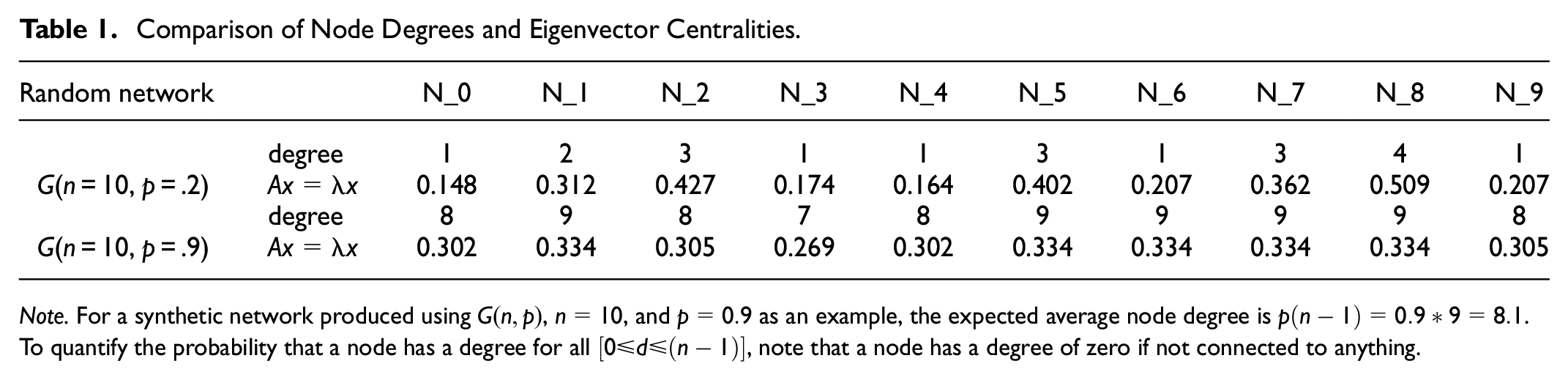
Note. For a synthetic network produced using

The simulation results are referenced by connectivity. Left plot: Illustrates a negative correlation between payoff (me-ca) and risk (failure). Right plot: Represents the long-term simulation, which reaches stationarity by the log-scaled failure probability (vertical-axis) by connectance (=degree/(n − 1)) (horizontal-axis). Error bars denote the standard deviation (interquartile range = IQR_1%–99%). Type of network = random (Erdős-Rényi_graph), Initialized parameters: number of nodes = 100, number of connections per node = 1–99, initial failure pn = 0.1, pl = 0.3, initial capital (c) = 1, time steps = 1–1,000 (periods 1–1,000).
Protection Dynamics With Interconnected Strategies
In this phase, the protection level

Representation of protection dynamic scenarios against risk probability. The plot shows how failure potential turns into a failure with probability 1-pp, depending on an agent’s investment in protection
Furthermore, Figure 5 presents the simulation results obtained by changing the probability of propagation (

Readjustments of evolution with strategy dynamics, applying imitation and exploration. Left section: The left plots show a matrix with the horizontal axis representing time steps (range 1–20) and the vertical axis representing individuals (20). The color of the matrix indicates the state: failure (red) or non-failure (blue); the right plots show the parameter values of each individual at the time step (
Discussion
In this study, we operated under the fundamental assumption that the failure of a single individual within a sports system has the potential to destabilize or even dismantle the entire network. At the micro level—comprising individual athletes or functional elements—sports systems are influenced not only by the interactions among their constituents but also by the behaviours and conditions of these individual components (Kugler & Turvey, 1987). At the macro level—comprising groups, organizations, and broader institutional scales—the psychological and behavioral variables of sports phenomena emerge from complex interactions among these entities (Rosen, 1987). Therefore, each individual element or actor within these contexts constitutes a critical component of the system, capable of triggering instability or disruption (Narizuka & Yamazaki, 2018).
Key Factors Influencing Sports Systems
Our proposed model provides a comprehensive framework for deciphering the fundamental principles underlying diverse and complex phenomena that arise from the interplay of inherent basic properties and external system dynamics. Specifically, the model encapsulates three key factors:
Contagion: When a problem arises in one element—such as a nerve pathway in a neuromuscular system or an individual athlete within a team—it can influence other elements or members connected through the network, leading to the propagation of the issue throughout the system. This reflects the interconnectedness of sports systems, where the state of one component can significantly impact overall performance (Borgatti et al., 2009).
Concentration: Even minor factors that garner significant attention owing to their centrality—such as a star player or a critical functional hub—can create substantial ripple effects within the sports arena. For instance, the injury or underperformance of a key player can disrupt team dynamics and strategy, illustrating how central nodes in a network have disproportionate influence (King et al., 2019).
Context: In the absence of social interaction mechanisms such as imitation and exploration, a failure in one individual operating within a general environment can lead to similar failures across all individuals or groups. This emphasizes the importance of social learning and adaptation in mitigating systemic risks. For example, if a team’s morale declines because of the failure of a single member, without mechanisms to adapt and learn from the situation, the entire team’s performance may deteriorate (Stevenson & Lochbaum, 2008).
Our model further reveals a negative correlation between individual outcomes (payoff) and risk (failure). This indicates that without proactive efforts to mitigate risk, every individual within the system may eventually fail. A critical factor in this scenario is social learning through cultural evolution. These mechanisms allow individuals to adapt their strategies based on the behaviours and successes of others within the network (Fawcett et al., 2013). The influence of these behaviours is governed by network properties, particularly eigenvector centrality, which determines the degree of connectivity and thus the potential for failure propagation.
Eigenvector Centrality and Social Learning
Eigenvector centrality is a measure of the influence of a node within a network, considering not only the number of connections of a node but also the quality of those connections (Bonacich, 1987). In our model, we found that nodes with higher eigenvector centrality are crucial drivers of failure potential because their state can significantly impact connected nodes. The dynamics of strategies accumulated in the network were examined concerning variables such as the selection between artificially devised strategies (
Our findings suggest that sports systems can be significantly affected by the behavioral eigenvector centrality of individuals, their exploration behaviors, and the distribution of these behaviors within the population (Hutchinson & Gigerenzer, 2005). Recognizing individual differences at the micro level is crucial, as these differences can substantially impact overall system outcomes and behaviors. Therefore, developing regulatory tools and strategies that acknowledge and accommodate individual variations is paramount (Horn, 2015). This includes establishing unbiased, agreed-upon goals and providing accurate information to all participants to facilitate effective decision-making and risk management (Rinehart, 2008). The effects of eigenvector centrality in relation to the conditions and normal distributions of imitation and exploration probabilities represent potent new insights into potential protection dynamics in sports systems. Specifically, our model indicates that the level of protection or risk mitigation can vary depending on the strategy adopted and the degree of interconnectedness within the system. For example, strategies that enhance social learning and encourage exploration can reduce the likelihood of systemic failure by promoting adaptability and resilience (Centola et al., 2007). This suggests that by adjusting protection levels and strategies based on interconnected ratios of centrality and social learning, more effective risk mitigation approaches can be developed.
Practical Applications of Agent-Based Models
The model in this study offers a comprehensive understanding of the intricate dynamics within sports systems, emphasizing the significance of contagion, concentration, and context on system functioning and stability. Integrating agent-based modelling with network theory, we can simulate and analyse how individual behaviors and interactions contribute to emergent phenomena within the system (Bonabeau, 2002). Agent-based models are particularly useful because they can capture the complexity of individual decision-making processes and how these processes influence collective outcomes (Oliva, 2016).
In practical applications, agent-based models have been utilized to simulate various aspects of sports performance and team dynamics. For example, in basketball, agent-based modelling has been used to simulate offensive and defensive strategies, enabling coaches to predict how changes in individual player behaviour can affect overall team performance (Fewell et al., 2012). By modelling each player as an agent with specific decision-making rules, practitioners can identify optimal strategies that might not be immediately apparent through traditional analysis. Moreover, our model underscores the importance of cultural evolution in sports, where successful behaviours are copied by other individuals, and strategies propagate through imitation and social learning (Fawcett et al., 2013). This process is evident in real-world sports scenarios when less experienced players adopt the training habits, communication styles, and strategic approaches of veteran teammates. For instance, in swimming, younger athletes often emulate the techniques and routines of elite swimmers, leading to overall improvements in team performance (Côté, Baker, et al., 2007). This model captures this phenomenon by illustrating how positive behaviours can spread through a network, enhancing resilience and reducing the likelihood of failure.
Individuals have evolved learning mechanisms that enable them to perform effectively across a range of circumstances. These mechanisms encompass imitation and exploration in response to current stimuli and include learning rules for adjusting behavior based on the actions of nearby individuals (Miller & Dollard, 1941). In team sports such as rugby or volleyball, players constantly adjust their positioning and strategies based on their teammates’ and opponents’ actions. Agent-based models can simulate these interactions, helping coaches develop training programs that enhance coordination, adaptability, and collective performance (Clemente et al., 2015; Duarte et al., 2012).
Developing Risk Mitigation Through Network
The structural components of the network, particularly the individual choices and opportunities available to members, play a significant role in reinforcing system dynamics (Powell et al., 2005). By applying our model to analyse team dynamics, practitioners can identify key individuals who act as hubs within the network. Recognizing the critical roles of these individuals enables the development of targeted strategies to enhance their decision-making skills and resilience, ensuring that the team’s performance remains stable even under pressure (Clemente et al., 2015).
These findings are highly relevant for practitioners in sports science and management. By utilizing agent-based models to simulate and understand the complex interplay of individual behaviours and network dynamics, coaches, managers, and sports scientists can develop targeted strategies to enhance performance and mitigate risks (Bittencourt et al., 2016). For instance, in injury prevention, understanding how an athlete’s movement patterns may lead to overuse injuries can inform personalized training adjustments, reducing the risk of cascading injuries throughout the team. In talent development programs, the model can help identify the most effective mentorship pairings, ensuring that positive behaviours and strategies are efficiently transmitted to developing athletes (Côté, Salmela, et al., 2007). Our model also underscores the relevance of network properties, particularly eigenvector centrality, in understanding the potential for systemic risk. The centrality of an individual or element within the network is a crucial determinant of failure potential. High-centrality nodes have greater influence, and their failure can have more significant repercussions throughout the network (Bonacich, 1987). These findings highlight the need for strategies that account for individual variations and emphasize the importance of maintaining a balanced network structure to prevent system-wide failures. Moreover, the model emphasizes the powerful influence of eigenvector centrality and social learning on the dynamics of potential protection within sports systems. The interconnected nature of these factors reinforces the idea that behaviours within systems are not isolated but are part of a complex, interdependent network (Park, 2024). By analysing these factors, more effective risk mitigation strategies can be developed, enhancing the resilience and stability of sports systems.
Our findings suggest that protection levels can vary depending on the strategy and the degree of interconnectedness within the system (Stacey, 1995). By understanding how different strategies and network configurations affect the propagation of risks and the effectiveness of protective measures, practitioners can devise more tailored and effective approaches to risk management. This includes fostering environments that encourage positive social interactions, adaptability, and the sharing of successful strategies, ultimately contributing to the optimization of resilience in sports science.
Conclusion
In this study, we developed an integrated random network model to simulate the interactions of individuals over time within sports systems. We aimed to facilitate an empirical understanding of the complex dynamics inherent in sports networks, highlighting how individual behaviours and interactions can influence overall system stability and performance.
To obtain a primary indication of a feasible level of protection in terms of the dynamic reactions of evolutionary and non-evolutionary variables—even within structures with high risk potential—we demonstrated that macro and microscale interactions mechanisms can be utilized to lower the propagation of negative sporting phenomena while increasing beneficial protection investments (Kellmann & Beckmann, 2017). Our findings suggest that understanding network properties is crucial in identifying nodes with high failure potential and in developing effective risk mitigation strategies. This understanding can improve decision-making competence, leading to more efficient handling of the complexities inherent in dynamic sports systems. The calculations and simulations presented in this study offer valuable insights that can be extended and applied by establishing policies at different scales. The implemented rules and their computations can assist decision-makers in gaining an advanced perspective on systemic risks within sports organizations.
A desirable system requires a balance of all components, and the emphasis on generality in our model aligns with the study of complex movements and sports phenomena. The mechanism of this model, which encompasses a few key dynamics, opens exciting directions for future research on systemic risks. By extending this research to analyses of various structures, individual differences (Quatman & Chelladurai, 2008), directionality, and field data, the prospects for more efficiently addressing problems related to the potential risks of sports phenomena—in terms of optimal strategies or decision-making aspects—could be significantly improved (Fortunato, 2010).
Supplemental Material
sj-docx-1-sgo-10.1177_21582440251316513 – Supplemental material for Optimizing Resilience in Sports Science Through an Integrated Random Network Structure: Harnessing the Power of Failure, Payoff, and Social Dynamics
Supplemental material, sj-docx-1-sgo-10.1177_21582440251316513 for Optimizing Resilience in Sports Science Through an Integrated Random Network Structure: Harnessing the Power of Failure, Payoff, and Social Dynamics by Chulwook Park in SAGE Open
Footnotes
Declaration of Conflicting Interests
The author declared no potential conflicts of interest with respect to the research, authorship, and/or publication of this article.
Funding
The author disclosed receipt of the following financial support for the research, authorship, and/or publication of this article: This work was supported by the Basic Science Research Program thorough the National Research Foundation of Korea (NRF) funded by the Ministry of Education (Grant Number: 2020R1l1A1A01056967, PI: Chulwook Park)
Geolocation Information
South Korea

Data Availability Statement
The data that support the findings of this study are available from the corresponding author upon reasonable request.
Supplemental Material
Supplemental material for this article is available online.
References
Supplementary Material
Please find the following supplemental material available below.
For Open Access articles published under a Creative Commons License, all supplemental material carries the same license as the article it is associated with.
For non-Open Access articles published, all supplemental material carries a non-exclusive license, and permission requests for re-use of supplemental material or any part of supplemental material shall be sent directly to the copyright owner as specified in the copyright notice associated with the article.
