




Abstract
In the last decade, the intersection of Environmental, Social, and Governance (ESG) principles with digital innovation has become a crucial area of research, highlighted by the United Nations’ Sustainable Development Goals and the emerging focus on Digital ESG (DESG). Despite rapid advancements, a unified theoretical framework for DESG remains undefined. This study conducts a bibliometric analysis on 455 Scopus-indexed documents to map the current landscape, themes, and future directions of ESG digitalization research. The review reveals a multidisciplinary interest, primarily within business management, with significant contributions from China, Malaysia, and the United States—indicating their leadership potential in ESG digitalization. This study spotlights key researchers and emphasizes foundational work’s critical role in enhancing understanding of DESG and ESG’s impact on consumer behavior, laying essential groundwork for deeper insights and future explorations into the effects of ESG values on consumer attitudes.
Introduction
In the past decade, rapid technological advancements, market shifts, and the pressing challenges of climate change have prompted nations to prioritize sustainable development. Central to these efforts is the Environmental, Social, and Governance (ESG) framework, which has emerged as a crucial measure shaping the future of nations, businesses, and consumers (Galbreath, 2013; Pérez, 2022). Unlike traditional financial metrics, ESG evaluates a company’s broader impact, incorporating environmental stewardship, social responsibility, and governance practices (Hou et al., 2023). As societies demand ethical consumption and social justice (Phan & Ninh, 2024), investors and consumers increasingly prefer companies with strong ESG performance, recognizing both financial and social benefits. Scholars, including Bruno and Henisz (2024), underscore ESG’s role in areas like municipal debt and community development, emphasizing its potential to enhance social welfare and reduce inequalities. With regulations now mandating ESG disclosures, these principles are becoming integral to corporate strategy, boosting long-term competitiveness and value (Arun et al., 2022; Zumente & Bistrova, 2021).
Current ESG research largely focuses on investment (Broadstock et al., 2021; Van Duuren et al., 2016), financial performance (Friede et al., 2015; Ma et al., 2023). Despite its growing importance, the digital transformation of ESG, commonly referred to as Digital Environmental, Social, and Governance (DESG), remains an underexplored area. DESG involves leveraging technologies such as big data, cloud computing, and artificial intelligence to enhance ESG practices across the value chain, driving greater outcomes for stakeholders (Wang et al., 2023). As more industries undergo digital transformation, the integration of these technologies into ESG frameworks is critical. However, current research specifically addressing DESG is limited (Puriwat & Tripopsakul, 2022), highlighting a significant gap in the literature.
This study is motivated by the need to bridge this gap, exploring the intersection of ESG and digital innovation. While existing ESG reviews have focused on traditional corporate ESG topics—such as disclosure impacts (Khan, 2022), determinants of ESG performance (T. T. Li et al., 2021; Tsang et al., 2023), and country-specific studies (Shen et al., 2023)—few have examined the digital evolution of ESG practices (Xu et al., 2024). This study seeks to address this omission by conducting a bibliometric analysis of 455 Scopus-indexed documents, mapping the landscape of ESG digitalization research. It also emphasizes DESG’s impact on consumer behavior, an area underexplored in prior studies. By investigating DESG, this research establishes a foundation for understanding how digitalization is reshaping ESG practices and perceptions, while also calling for a unified theoretical framework for DESG.
In summary, this study aims to clarify key contributors, themes, and trends in DESG and traditional ESG research, addressing three specific research questions: (a) What are the overall characteristics and publication trends in this field? (b) Who are the most influential authors, countries, journals, and articles? (c) What are the current key themes and future research directions? Following the review of bibliometric literature, the subsequent sections outline the methods employed, present the findings, and conclude with recommendations for future research.
Methodology
Research Design and Bibliometric Techniques
This study utilizes bibliometric analysis, a quantitative method increasingly acknowledged for its effectiveness in evaluating academic literature across diverse fields (Aksnes et al., 2019; Donthu et al., 2021). The research integrates multiple bibliometric techniques, notably performance analysis and scientific mapping, which encompass three distinct methodologies: co-authorship analysis, bibliographic coupling, and co-word analysis.
Performance analysis serves as a descriptive statistical method that aids in assessing the significance of various components within a research area (Cobo et al., 2015). Key indicators include the number of publications, reflecting productivity, and citation counts, indicating influence (Donthu et al., 2021). Conversely, scientific mapping techniques elucidate influential factors by revealing relationships among journals, authors, countries, and documents (Mubdir et al., 2024; Chen et al., 2015). For instance, co-authorship analysis uncovers collaborative relationships among authors and institutions (Donthu et al., 2021; Uddin et al., 2012), whereas bibliographic coupling highlights emerging trends in the field (Donthu et al., 2021; García-Lillo et al., 2019). In addition, co-word analysis focuses on the frequency of keywords in documents, facilitating the identification of trending topics and research themes (Donthu et al., 2021).
To enhance bibliometric mapping and visualize research networks, this study employs VOSviewer software (Van Eck & Waltman, 2010). This comprehensive approach aims to clarify the current state of research on ESG in the context of digitalization, thereby enriching the understanding of the evolving landscape in this field.
Search Strategy and Data Collection
The search strategy was designed to identify relevant articles on digital ESG (DESG) and traditional ESG. Data were sourced from Scopus, selected for its broad social sciences coverage and to minimize errors from manual intervention (Donthu et al., 2021). Although multiple databases could provide broader data, the use of a single database ensures consistency across formats. Journal articles were selected as the primary unit of analysis, representing peer-reviewed and validated knowledge, thereby ensuring credibility and reliability in the findings (Dadkhah et al., 2015; Donthu et al., 2021). To uphold a consistent standard of quality, other document types, such as conference proceedings, books, and trade journals, were excluded. To avoid capturing irrelevant studies from fields such as energy and bacteriology, abbreviations like ESG or DESG were not directly used in the search. Terms such as “diethylstilbestrol glucuronide” and “Electrospinogram” share similar abbreviations but are unrelated to the focus of this research. Although some scholars suggest that CSR is synonymous with ESG (Shen et al., 2023), the concept of ESG has evolved and gained consensus as an independent topic distinct from CSR. Therefore, CSR-related terms were excluded from the search to focus specifically on the digital transformation of ESG, rather than general or traditional ESG and CSR studies.
Given that this is a bibliometric analysis, the search was limited to article titles only, to ensure precision in identifying relevant publications. Abstracts and keywords were excluded to minimize noise in the dataset. The final search terms included “digital* environmental, social, and governance” and “environmental, social, and governance.” Non-English articles were excluded to maintain linguistic consistency, and no disciplinary filters were applied, allowing for a comprehensive review of ESG-related literature. The search covered all articles published up to November 18, 2023.
The data collected were analyzed using descriptive and relational bibliometric indicators, including publication year, language, country, institution, and author co-occurrence. These indicators provided a detailed overview of the research landscape, helping to identify key contributors and emerging trends, as well as guiding future research directions. Figure 1 outlines the detailed steps, detailing the whole searching strategy and data collection procedure.

Searching strategy and data collection procedure.
Results and Discussion
This research employed the aforementioned selection criteria to search the Scopus-indexed database. Subsequently, data extraction and analysis were performed on the retrieved 455 articles. The results and discussions are presented below.
Publications Per Year
As depicted in Figure 2, the distribution of articles across different time periods was observed. Despite the introduction of the ESG concept by the United Nations (UN) in 2004 (UN, 2004), this research, constrained by keyword limitations (explained in detail in the Limitations section), incorporates research from 2011. The results reveal that from 2011 to 2015, only 11 articles were disseminated, indicating an incipient stage in related research. This trend can be attributed to the establishment of the Climate Disclosure Standards Board (CDSB) in 2007 and the Sustainability Accounting Standards Board (SASB) in 2011, providing frameworks for ESG metric disclosure. During this period, articles published demonstrated innovativeness and pioneering contributions. The second phase, spanning from 2016 to 2020, witnessed an almost ninefold increase in the total number of papers, amounting to 93 articles. This surge is likely influenced by the introduction of the UN’s Sustainable Development Goals (SDGs) in 2015 (UN, 2015), intensifying global attention on sustainable development. Additionally, the release of the Sustainable Development Accounting Standards by SASB in 2018 (SASB, 2018) contributed to the substantial growth in related research publications. The third phase, from 2021 to 2024, experienced a significant spike in the number of published articles, totaling 351. This surge indicates widespread attention to the relevant topics. It is likely driven by the heightened global focus on sustainable development and ESG following extreme events post-2019, including the COVID-19 pandemic and environmental disasters. Major countries such as the United States, China, and the European Union enacted regulations, leading to a substantial increase in ESG-related publications after 2021. The growth rate reached an impressive 114% in 2022, with 192 articles published in 2023, reflecting a 277% increase compared to the preceding period. These findings underscore the current prominence and developmental trends in DESG and ESG research. Looking ahead, the trajectory suggests potential diversification into new research directions, exploration of previously limited domains, and addressing “conventional issues” through new frameworks. Additionally, delving into new international collaborations can contribute to expanding the scope of research.

Articles on DESG&ESG per year.
Countries of Publications
This study reveals that articles were submitted from 71 countries or regions, with a significant concentration of authors affiliated with diverse institutions in China, Malaysia, the United States, Italy, Australia, the United Kingdom, India, and Spain. Figure 3 illustrates author nationalities and collaborative relationships, emphasizing geographical and cultural clusters, particularly around China, Malaysia, and the United States.

Authors’ nationalities map.
The ESG market in China is rapidly advancing, driven by government advocacy for green, low-carbon, and inclusive prosperity (China Academy of Translation, 2015). Government agencies prioritize policy research, issuing comprehensive ESG-related documents to facilitate the green transformation of the economy. The ESG philosophy closely aligns with China’s modernization goals, addressing environmental issues like peak carbon emissions and biodiversity, social challenges such as rural revitalization and common prosperity, and governance concerns like anti-corruption and justice (The State Council of P.R. China, 2022). Furthermore, the Chinese government recognizes ESG as a critical indicator for assessing corporate sustainable development (China ESG30 Forum, 2022). China’s international collaboration efforts, exemplified by the Belt and Road Initiative, have contributed to a notable increase in scholarly publications on ESG.
While Malaysia may not emphasize ESG as heavily as more mature markets in Europe and America, it leads Southeast Asia in the proportion of companies adhering to environmental supply chain policies (68.8% in Malaysia, 66% in Thailand, and 58.6% in Singapore) (PricewaterhouseCoopers [PwC], 2023). The Malaysian government has maintained a focus on sustainable development, actively responding to global ESG and responsible investment principles. Its comprehensive ESG policy and regulatory framework, guided by the Sustainable and Responsible Investment (SRI) ecosystem introduced in 2014, effectively directs market participants (Securities Commission Malaysia, 2019). Malaysia, significantly positioned in the global Islamic finance market, integrates Islamic finance principles with SRI through interconnected funds that emphasize sustainable development, as demonstrated by the SRI Sukuk Framework (Azman & Ali, 2016). The country aims to become a regional center for SRI investment by adapting international best practices to align with its unique economic and cultural characteristics, potentially making it a pivotal nation for ESG research.
In contrast, the United States (U.S.) adopts a different approach to ESG than Asia and Europe, with fewer proactive federal initiatives. Local initiatives, especially in California, lead the way, as seen in Senate Bill No. 185 (U.S. Congress, 2015) and Senate Bill No. 964 (U.S. Congress, 2018), which guide pension fund investments. ESG disclosure requirements on securities trading platforms primarily focus on environmental aspects. Following the UN’s SDGs in 2015, the U.S. issued Interpretive Bulletin 2015-01 (U.S. Department of Labor, 2015), marking the first comprehensive ESG policy guidelines from the U.S. Subsequent Bulletins in 2016 and 2018 provided practical guidance on integrating ESG into investment practices (U.S. Securities and Exchange Commission, 2016; 2018), emphasizing fiduciary responsibility. Despite a lower level of federal initiatives and no exchange disclosure requirements, the U.S. remains a significant hub for ESG academic research due to its status as the world’s largest economy and financial market.
As a developed ESG investment market, the United Kingdom (UK) actively engages with the UN’s Sustainable Development Investment Initiative. Over the past decade, the UK has established a comprehensive ESG policy framework, reflecting its commitment to sustainable financial development (U.S. Department of State, 2015). Early initiatives in 2005 laid the groundwork, with subsequent revisions progressively expanding the applicability of ESG regulations within capital markets. By 2015, the UK’s SRI market had surpassed 21 billion euros, indicating increasing acceptance of ESG principles (U.S. Department of State, 2015). The UK has demonstrated its commitment to sustainable finance through biennial revisions of ESG policies since 2014. Regulatory requirements have become more explicit, emphasizing ESG responsibilities within corporate governance and fostering communication between investors and companies. Although the UK formally departed from the EU in 2020, it remains dedicated to sustainable financial development, positioning itself as a core nation for independent ESG research.
This research posits that the concentration of articles by country yields two key outcomes (Acedo et al., 2006): it facilitates the exploration of more in-depth regional research topics and creates opportunities for international collaboration. Notably, the top two contributors to DESG and ESG research are developing countries, indicating that these nations are actively engaging in ESG studies to identify strategic directions for future sustainable development. The future development and practices of ESG in developing countries warrant scholarly attention, as does the potential for international collaboration on ESG initiatives.
Major Related Journals and Subject Area
These 455 articles were published across 161 journals, with over 67% concentrated in just 62 specific journals. Moreover, more than 70% of the citations are attributed to 32 key journals. Table 1 provides the details of these journals. This data helps identify the most influential journals in the field, such as Journal of Cleaner Production (12 articles), Business Strategy and the Environment (32 articles), Corporate Social Responsibility and Environmental Management (44 articles), and Sustainability Switzerland (43 articles). These diverse journals offer multiple perspectives within the field.
Journals With Publications on DESG&ESG.
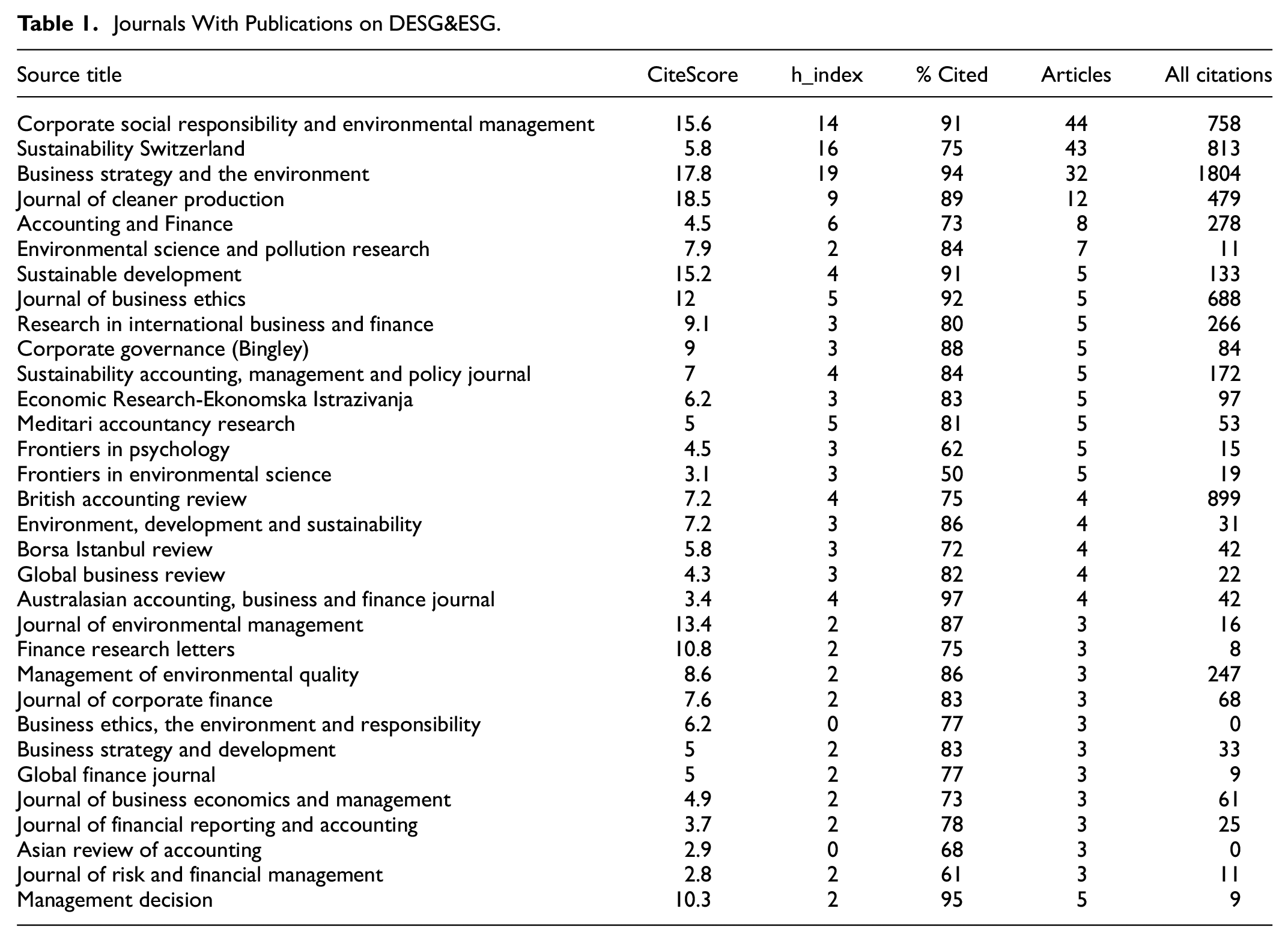
Identifying the core journals in this area also allows for integration with others approaching the topic from different angles. The map in Figure 4 visually represents the relationships between journals using bibliographic coupling analysis, showcasing their proximity and influence in constructing the knowledge structure of the field. Journals with higher publication and citation rates, particularly in management, occupy central positions. Other fields, like psychology and environmental science, are connected to this core, with specialized journals surrounding them.

Journals bibliographic coupling map.
As shown in Table 2, the majority of articles are concentrated in fields like “Business, Management and Accounting,”“Social Sciences,”“Environmental Science,” and “Economics, Econometrics, and Finance.” Articles published in other disciplines, while investigating corporate financial performance, investment strategies, and information disclosure, are classified based on the industry or journal category. For instance, Schneider et al. (2021) examined ESG investment among private German health insurers, publishing in the Journal of Medical Ethics, categorized under Nursing. Pirtea et al. (2021) studied ESG’s relationship with agricultural company performance in Agricultural Economics (Czech Republic), categorized under Agricultural and Biological Sciences.
Subject Areas of the Publications of DESG&ESG.

Some studies focus on foundational infrastructure, institutional aspects, and industry impacts related to ESG. For example, Zhai et al. (2023) explored urban digital infrastructure’s link to ESG development, while Maybee et al. (2023) discussed ESG risks in the mining life cycle. However, most research on digital ESG and ESG in general emphasizes corporate financial performance, investment strategies, and information disclosure, focusing on ESG’s application in specific countries and industries. The varying levels of ESG development across regions and the lack of a global standard framework have resulted in fragmented theoretical frameworks, tools, and scoring standards for ESG. Consequently, fewer studies explore the impact of ESG on energy and technology, with limited attention to the conceptual evolution of ESG, its foundational implementation structures, and the digitization of ESG practices.
Most Cited Articles
Literature from Scopus can be categorized in various ways, one of which is ranking articles by citation count to identify those that have garnered significant attention in the scientific community. Table 3 lists the top 20 most-cited articles among the 455 publications related to DESG and ESG, collectively accounting for over 40% of total citations in this area.
Top 20 Articles With the Highest Number of Citations Among the Selected 455 Articles.

The most-cited paper is the 2018 study on ESG disclosure by Li, Gong, Zhang, and Koh, published in The British Accounting Review, with nearly 422 citations. This article outlines five arguments for how ESG disclosure promotes value creation, including offering additional information, improving stakeholder relationships, reducing information asymmetry, enhancing transparency, and lowering agency costs. The study concludes that firms with better ESG disclosure exhibit higher firm value.
The second most-cited article is Brooks and Oikonomou’s (2018) editorial, which provides a comprehensive overview of ESG disclosure literature and its effects on firm value. It emphasizes the need for a detailed review of the research landscape, identifying knowledge gaps and future research opportunities.
Another highly cited work by Xie et al. (2019), with over 300 citations, examines the link between corporate efficiency and sustainability. The study identifies a positive correlation between ESG transparency and corporate efficiency, particularly at moderate disclosure levels. Additionally, five other influential papers, each with over 200 citations, focus primarily on ESG disclosure and its relationship with financial performance.
Most Productive and Influential Authors
Since the rise of “Digitalization and ESG” as a research topic, numerous scholars have made significant contributions to its development. This section introduces some of these researchers based on the volume of their publications, as retrieved from Scopus. The analysis highlights key contributors in the DESG and ESG fields, though it is important to acknowledge that alternative ranking criteria could bring other authors to the forefront.
Authors can be ranked by the number of publications or by citation frequency—both common methods in previous studies, such as Danvila-del-Valle et al. (2019), who ranked researchers using both the h-index and citation counts.
This paper adopts a dual approach. First, it presents the top 20 authors with the most publications among the 455 selected articles. Then, a separate list ranks 20 authors based on the number of citations their contributions have garnered, with each listed work cited at least 100 times. These lists highlight prolific researchers, frequently cited works, and influential figures in the DESG and ESG domains. The results are presented in Tables 4 and 5.
Top 20 Authors With the Highest Number of Published Articles Among the Selected 455 Articles.

Top 20 Authors With the Highest Number of Citations Among the Selected 455 Articles.

Topics on Digital ESG or ESG
Although ESG and DESG differ conceptually, DESG research remains in its early stages, with its scope and definition still lacking broad consensus. As a result, DESG has not yet emerged as a distinct, mature subfield independent of ESG studies. Currently, DESG is viewed more as an emerging research trend rather than a separate domain. Therefore, this paper does not distinguish between the two but instead focuses on mapping the landscape and trends in digitalization-related ESG research.
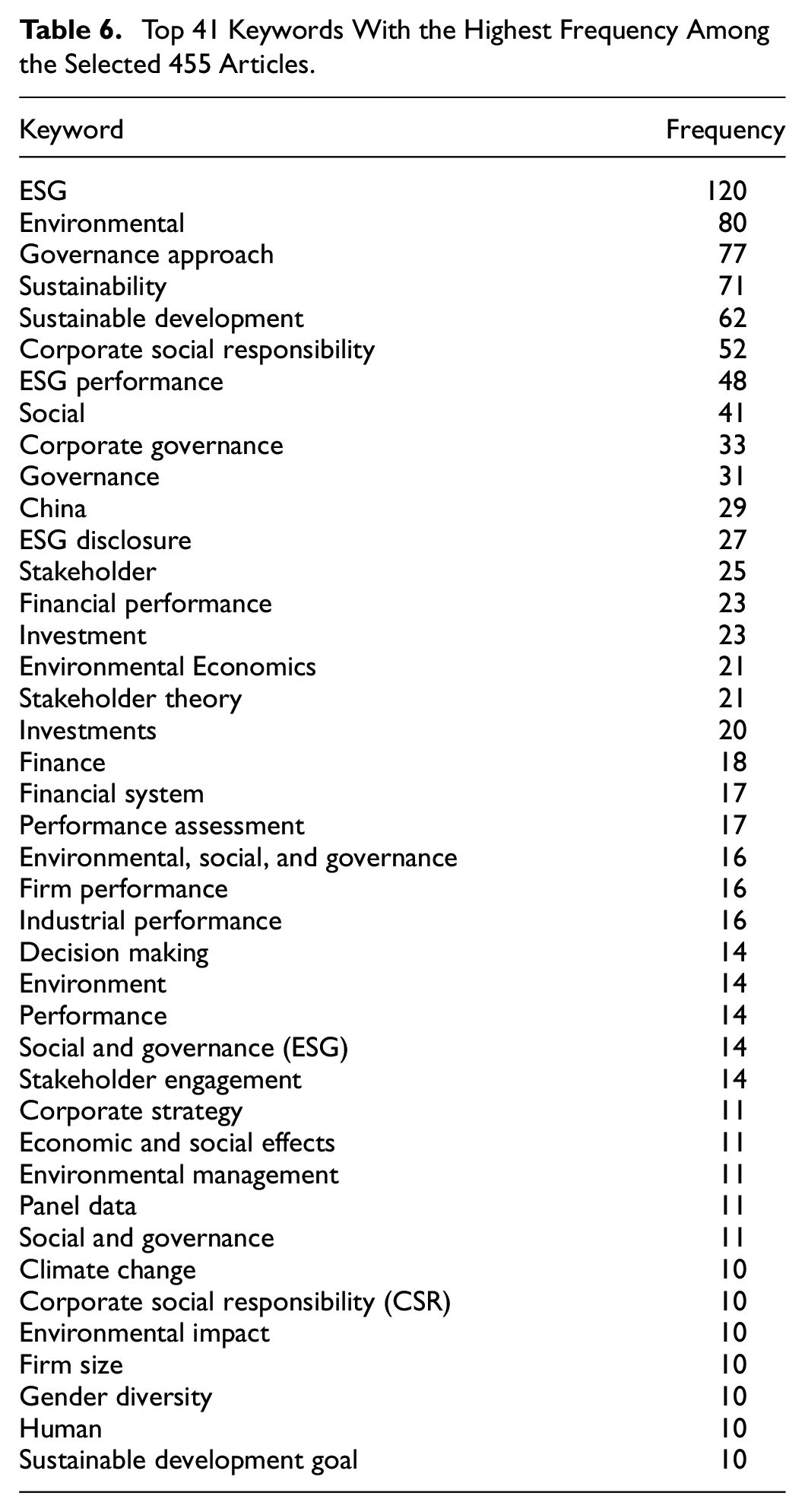
Within the analyzed literature, 1,749 unique keywords were used to classify the studies. Table 6 and Figure 5 display 41 keywords that appeared at least 10 times. The size of the nodes in Figure 5 represents the frequency of each term, while the lines and distances between nodes indicate the strength of the relationships between these terms. As expected, keywords such as ESG, environmental, social, and governance rank highly due to their function as selection criteria. The prominence of terms like ESG performance, investments, finance, financial performance, and performance assessment highlights that many scholars are investigating DESG and ESG from the perspectives of corporate management, financial practices, and asset evaluation. These findings align with the identified knowledge framework, key authors, and the most cited references within DESG and ESG studies.
Top 41 Keywords With the Highest Frequency Among the Selected 455 Articles.

Co-occurrence of keywords map.
China is notably the only regional keyword, which, when combined with the authors’ nationalities map in Figure 3, suggests that China plays a significant role in DESG and ESG research. Foundational contributions by scholars such as Mǎnescu, Weber, Camilleri, Ortas, Lee, Lokuwaduge, and Husted have shaped the early knowledge base, focusing on the relationships between ESG and stock returns, ESG’s application in various countries, and its ties to sustainable development. From its inception, ESG has been closely linked to topics such as investment, corporate asset evaluation, financial performance, strategic management, environmental governance, and sustainability.
As ESG evolves alongside technological advancements and market shifts, its subfields continue to expand and deepen, shaping the current research landscape for DESG and ESG. In terms of future trends, beyond the dominant themes of corporate management and financial performance, other subdomains—such as enhancing brand value and fostering consumer engagement—are likely to intersect with DESG and ESG, paving the way for new research directions and opportunities.
Future Directions
The future of research in Environmental, Social, and Governance (ESG) and Digital ESG (DESG) can be structured into three primary directions, each offering significant opportunities for advancement.
First, research should focus on refining the foundational elements of ESG, including principles, frameworks, disclosure requirements, and rating systems (Camilleri, 2015; Lokuwaduge & Heenetigala, 2017; Singhania & Saini, 2023; Whitelock, 2019). This involves adapting ESG evaluation standards to diverse economic and cultural contexts, expanding rating categories, and leveraging digital technologies to enhance the accuracy and transparency of ESG reporting. Key questions include: How can ESG rating systems be tailored to reflect regional differences? What role can technologies like AI and blockchain play in improving ESG reporting? How can ESG frameworks evolve to include emerging issues such as cybersecurity and digital infrastructure?
Second, the practical application of ESG in corporate strategy, performance, and operations should be explored. Future studies need to assess how companies can integrate ESG principles to boost both ratings and financial performance (Z. Chen & Xie, 2022; S. Chen et al., 2023; Friede et al., 2015). Research should examine the relationship between ESG performance and overall corporate success, including brand development, innovation, and governance (Piao et al., 2022; Velte, 2017). Important inquiries include: What strategies are most effective for integrating ESG into governance models? How do different industries approach ESG implementation? What risks arise from prioritizing ESG in corporate strategies, and how can firms mitigate these risks?
Third, the role of individuals—consumers, employees, and investors—must be addressed, as their engagement is vital for the success of ESG initiatives (Koh et al., 2022; H. J. Lee & Rhee, 2023). Future research should explore consumer attitudes toward ESG, the engagement of employees with ESG practices, and the factors influencing individual investors’ ESG investment decisions (Afeef & Kakakhel, 2022; Rabaya & Saleh, 2022). Key questions include: How do consumer perceptions of ESG affect purchasing behavior? What drives employee engagement with corporate ESG initiatives? How do ESG-aligned investments compare to traditional options in terms of performance?
Additionally, research on DESG should investigate how ESG practices are adapted in emerging markets, the scalability of ESG practices through digital transformation, and the inclusion of non-financial outcomes like social welfare and environmental justice within ESG frameworks (Puriwat & Tripopsakul, 2022; Wang et al., 2023).
These research directions underscore the expanding scope of ESG studies and highlight their potential to shape corporate governance, sustainable development, and the broader implementation of ESG principles. As the field evolves, these pathways will be crucial for advancing both academic knowledge and practical applications.
Conclusion
The analysis reveals a significant increase in ESG research publication trends, starting with 11 articles from 2011 to 2015, surging to 93 articles from 2016 to 2020, and reaching 351 articles from 2021 to 2024. This trajectory indicates a growing global interest in ESG-related topics.
Research on DESG and ESG demonstrates a geographically diverse and multicentric distribution, with China, Malaysia, the United States, and the United Kingdom emerging as key research hubs. This concentration enriches regional discussions and fosters international collaboration, showcasing contributions from both developed and developing countries.
The most impactful journals in this field are primarily based in the United States and the United Kingdom, including the “Journal of Environmental Management,”“Business Strategy and the Environment,” and “Journal of Cleaner Production.” Notable authors include F. A. Khatib, S. Hussainey, and K. Wasiuzzaman, while the most cited authors are Li, Y., Husted, B. W., and Yu, E. P. Y. Key literature identified for its productivity and influence includes works by Brooks and Oikonomou (2018), Y. Li et al. (2018), and Xie et al. (2019).
The findings underscore the expanding scope and relevance of ESG research, marked by increasing interest and publication rates. The identification of key geographic hubs and influential journals reflects the multifaceted nature of ESG studies, bridging both theoretical and practical contributions.
Theoretically, this research highlights the need for further exploration of underrepresented areas, such as consumer perspectives on ESG, technological acceptance, and the evolution of the ESG concept. These gaps present valuable opportunities for future scholarship aimed at deepening understanding and enhancing frameworks in the field.
Practically, the insights can guide policymakers, practitioners, and researchers in leveraging ESG principles for sustainable outcomes. As the ESG landscape evolves, sustaining momentum in popular domains while also investigating specialized areas, such as DESG and consumer values, will be crucial for advancing academic inquiry and practical applications in corporate governance and sustainable development.
Limitations and Future Research
This research has certain limitations. The search strategy encountered challenges in fields like energy studies and bacteriology, where ESG and DESG may refer to terms unrelated to “environmental, social, and governance,” such as diethylstilbestrol glucuronide (DESG) and electrically suspended gyro (ESG). Excluding literature from these domains that incidentally used the abbreviations posed difficulties, and outright exclusion was not feasible, as relevant research might still exist within these fields. Consequently, the decision was made not to incorporate DESG and ESG into the search strategy, which may have resulted in the omission of significant studies.
Future research should broaden its scope by utilizing multiple databases to enhance the representativeness and credibility of findings. Comprehensive scoping or systematic reviews of DESG and ESG literature, especially in business management and economics, can provide valuable insights into the evolution of indicators from diverse perspectives. These methodologies allow for manual selection of articles, addressing limitations of bibliometric analyses. Additionally, categorizing literature by specific sub-fields will deepen the understanding of both well-explored and under-researched areas within management studies. By addressing these limitations, future inquiries can effectively fill identified gaps, establishing a solid foundation for potential meta-analyses and further contributions to the field.
Footnotes
Acknowledgements
We sincerely thank our colleagues, mentors, and industry experts for their invaluable insights and guidance, which have been pivotal in advancing this research. Their commitment and constructive feedback have been essential to our study’s development.
Author Contributions
Each author has made substantial contributions to the research: this includes conceptualization and methodology design, development of the search strategy, data curation, results presentation (visualization), and discussion. The drafting of the original manuscript was primarily undertaken by Qin Lingda Tan, while Sharizal Hashim and Zhangwei Zheng provided critical review and editing. All authors have reviewed and approved the final version of this article.
Declaration of Conflicting Interests
The author(s) declared no potential conflicts of interest with respect to the research, authorship, and/or publication of this article.
Funding
The author(s) disclosed receipt of the following financial support for the research, authorship, and/or publication of this article: Financial support for publication from Universiti Kebangsaan Malaysia (GP-K024839).
Ethics Approval
This research did not collect empirical data so ethical approval was not required.

Data Availability Statement
Data sharing is not applicable to this review article since there was no generation or analysis of new data in the study.