




Abstract
Effective use of one’s mother tongue has a positive impact on an individual’s life, especially in mother tongue education at the K-12 level. During this period, students progressively learn to use the language more effectively, which is critical for fostering creativity. Therefore, emphasizing creativity in mother tongue education at the K-12 level is a crucial area. The present study aimed to systematically analyze articles that address creativity in mother tongue education at the K-12 level. Data for the study were collected by searching the Web of Science, Scopus, Ebsco, and the Education Resources Information Center (ERIC) databases based on specific criteria. The analysis included 18 articles. The study’s findings indicate that the examined studies were conducted using different methods and for different purposes. The methodological quality of the studies was evaluated, and it was determined that the average score for qualitative studies was lower than that of quantitative studies. Multiple data collection tools were used in most of the studies. The examined articles consisted of eight themes: writing skills, speaking skills, teaching methods, art, poetry, interculturalism, technology, and reading skills. The findings related to these themes emphasize the complexity of supporting students’ creativity and developing their language skills. The studies lacked significant focus on teaching processes and student-centered approaches, which could provide valuable guidance for future research.
Introduction
The language that an individual acquires naturally from birth, often referred to as the mother tongue, exerts a significant influence on their cognitive development, worldview, self-expression, and creativity (Mróz & Ocetkiewicz, 2021). Research has consistently demonstrated the importance of mother tongue education in fostering academic success (Kuzu & Durna, 2020).
This type of education emphasizes activities that promote comprehension and expression, and incorporating technological advancements into these skills can further enrich the language (Bouschery et al., 2023; Rasheed et al., 2021; Wong & Samudra, 2021). A stimulus-rich educational environment that encourages creativity is essential in mother tongue education, enabling the child to actively engage in the learning process (Bellanca & Brandt, 2010; Griffin et al., 2012; Sever et al., 2011).
Mother Tongue and Creativity
The relationship between an individual’s mother tongue and creativity is a current topic of interest in both educational science and psychology, particularly at the K-12 level of education. According to research, a person’s mother tongue plays a critical role in shaping their cognitive and emotional development as well as their communication skills (Dor, 2015). Therefore, it is important to investigate which educational strategies can support students’ creative thinking and problem-solving abilities. Studies that examine the connection between mother tongue education and creativity provide valuable insights that can be used to improve educational processes.
Mother tongue education is an essential tool for fostering students’ creative thinking skills. Through learning their mother tongue, students acquire the ability to understand and express complex ideas (Cummins, 2007). Research has shown that there is a strong relationship between language and creativity, and that this connection extends beyond language skills to cognitive and social skills as well. To enhance the effectiveness of mother tongue education, it is recommended to move beyond traditional teaching methods and instead implement more creative and participatory approaches (Ivcevic & Nusbaum, 2017).
The relationship between mother tongue and creativity has been extensively researched in the field of education. Barbot et al. (2015) found that students with strong language skills in their mother tongue exhibit higher levels of creativity. Mother tongue education is widely acknowledged to facilitate the development of extensive vocabulary, familiarity with intricate narrative structures, and critical thinking skills (Beaty et al., 2016). These skills are essential components of creativity and are directly related to education in the native language.
According to Runco and Jaeger (2012), creativity has two fundamental dimensions: originality and usefulness. The rich vocabulary and linguistic expressiveness that are developed through education in the mother tongue enable students to effectively utilize these two dimensions. For example, a large vocabulary allows students to use metaphors, analogies, and various forms of expression to find original ways of expressing themselves (Bialystok, 2016; Cenoz, 2009).
Another way in which the use of the native language in the educational process contributes to both individual and social creativity is by increasing students’ opportunities for self-expression. Since the mother tongue is the language in which students can most easily and accurately express their feelings and thoughts, education in this language allows them to maximize their creative potential. According to Yıldırım and Yılmaz (2023), individuals with heightened language proficiency and expressive abilities tend to exhibit greater creativity. In a study by Ivcevic and Nusbaum (2017), students were able to write more creatively and express more complex concepts more effectively in their mother tongue.
Recently, researchers have undertaken studies to explore the connection between an individual’s native language and their potential for creativity. For instance, Beghetto and Kaufman (2017) examined creativity using four models and explored how these models interact with the development of linguistic skills. The research indicates that linguistic complexity directly supports creative thinking and problem-solving processes. Similarly, studies on the “Bilingual Advantage” hypothesis suggest that bilingual individuals are more flexible and innovative in creative thinking and problem-solving (Adesope et al., 2010).
Another significant study examining the relationship between the mother tongue and creativity at the K-12 level investigated the effects of students’ linguistic and cultural diversity on creativity. García and Li (2014) assessed the impact of language and culture on creative expression and presented findings on how native-language-based instruction in multicultural classrooms fosters creativity. These findings demonstrate how multilingual and multicultural environments develop students’ creative thinking skills.
The relationship between mother tongue education and creativity at the K-12 level is multifaceted and supports students’ cognitive, emotional, and social development. The mother tongue is not only a means of communication, but also a foundation of creative thinking. Educators who consider this relationship in their programs play an essential role in increasing students’ academic achievement and creative thinking capacities (Sawyer, 2012). Educators who employ strategies that promote students’ psychological well-being and cultivate positive emotions in the classroom can augment the efficacy of education, as indicated by Sun (2024) in the domain of language instruction.
In relation to the purpose of this study, there are different studies addressing creativity in language education. In these studies, teacher views on creativity in language teaching (Coffey & Leung, 2020), the effect of creativity on semantic memory in foreign language teaching (Fernandez-Fontecha & Kenett, 2022), the relationship between creativity and children’s language skills and games (Holmes et al., 2022) were revealed.In addition, barriers to creativity and new methods to enable creativity in language teaching (Jones, 2020), the relationship between bilingualism and monolingualism with creativity (Lange et al., 2020), collective language creativity (Monakhov, 2021; Schneider, 2023), the effect of learning strategies on creativity (Shadiev et al., 2022) are among the topics studied. However, there is a lack of studies in the literature that comprehensively evaluate and systematically analyze the relationship between mother tongue education and creativity at the K-12 level. Unlike previous research, this study aims to fill this gap by providing a comprehensive perspective on the relationship between mother tongue education and creativity in terms of methodological approaches. Therefore, a more in-depth and comprehensive exploration of the relationship between mother tongue and creativity at the K-12 level will provide valuable sources of information for future educational policies and practices.
Purpose of the Study and the Research Questions
The purpose of this research is to comprehensively scrutinize the manner in which creativity is addressed in heritage language education at the K-12 level. This study does not aim to emphasize the significance of creativity in heritage language education at K-12 level, but rather to present the current state of the literature on the subject. In order to achieve this aim, the methodological quality of the reviewed studies and the themes under which the subject is addressed were identified. The research sought to answer the following questions:
(RQ1): What is the methodological quality of studies on the relationship between mother tongue education and creativity at the K-12 level?
(RQ2): In what thematic ways have studies examined the relationship between mother tongue education and creativity at the K-12 level?
The first research question aims to assess the methodological soundness and validity of studies examining the relationship between mother tongue education and creativity. This question intends to identify the methodological strengths and weaknesses of existing research. Methodological evaluation includes aspects such as research design, sampling, and data collection methods. The second research question aims to explore which themes are addressed in the studies examining the relationship between mother tongue education and creativity. For this purpose, themes were identified by analyzing the findings of the articles. Therefore, the themes were identified not based on predetermined themes, but rather on the content of the analyzed studies.
Materials and Methods
This study examines creativity in K-12 mother tongue education through systematic analysis. Systematic review involves critically evaluating studies in a specific field based on predefined research questions and synthesizing findings (Gough et al., 2017). The studies examined in this manuscript is related to mother tongue education at the K-12 level. A systematic analysis was conducted to reveal the relationship between studies in this field and creativity. The study rigorously applied the principles of the PRISMA Statement (Page et al., 2021) to determine the methods used. Throughout this study, the PRISMA Statement guided the literature review, article selection, analysis process, risk identification, and ensured the methodological integrity and reliability of the study. Additionally, researchers adhered to the CONSORT statement checklist adapted by Angosto et al. (2020) to establish the methodological standards of the selected quantitative studies. For determining the methodological standards of qualitative research, the Standards for Reporting Qualitative Research (SRQR) developed by O’Brien et al. (2014) were employed. The documentation for this systematic review has been deposited in OSF (Open Science Framework) and can be accessed through the following link:
Search Strategy
No year limitations were applied during the search process. A comprehensive search for peer-reviewed journal articles was conducted until August 1, 2023. To identify the studies for inclusion in the systematic analysis, focus was placed on those published in English within journals indexed in Web of Science, Scopus, the Education Resources Information Center (ERIC), and EBSCO. During pre-screening, specific keywords guided by experts in the field were used to facilitate the database search. Keywords like “Mother Tongue Education” OR “Mother Tongue Teaching” OR “First Language Education” OR “First Language Teaching” AND “Creativity” AND “Kindergarden” OR “Preschool” OR “Primary School” OR “Elementary School” OR “Middle School” OR “Secondary School” OR “High School” AND “Student” were used in the search process.
Eligibility Criteria
This systematic review includes all peer-reviewed empirical studies that address the relationship between mother tongue instruction and creativity in K-12. In order to ensure that the identified articles were relevant to the purpose of the study, inclusion and exclusion criteria were established for the selection of studies. Duplicate studies were excluded. Table 1 presents these criteria in detail.
Inclusion and Exclusion Criteria.
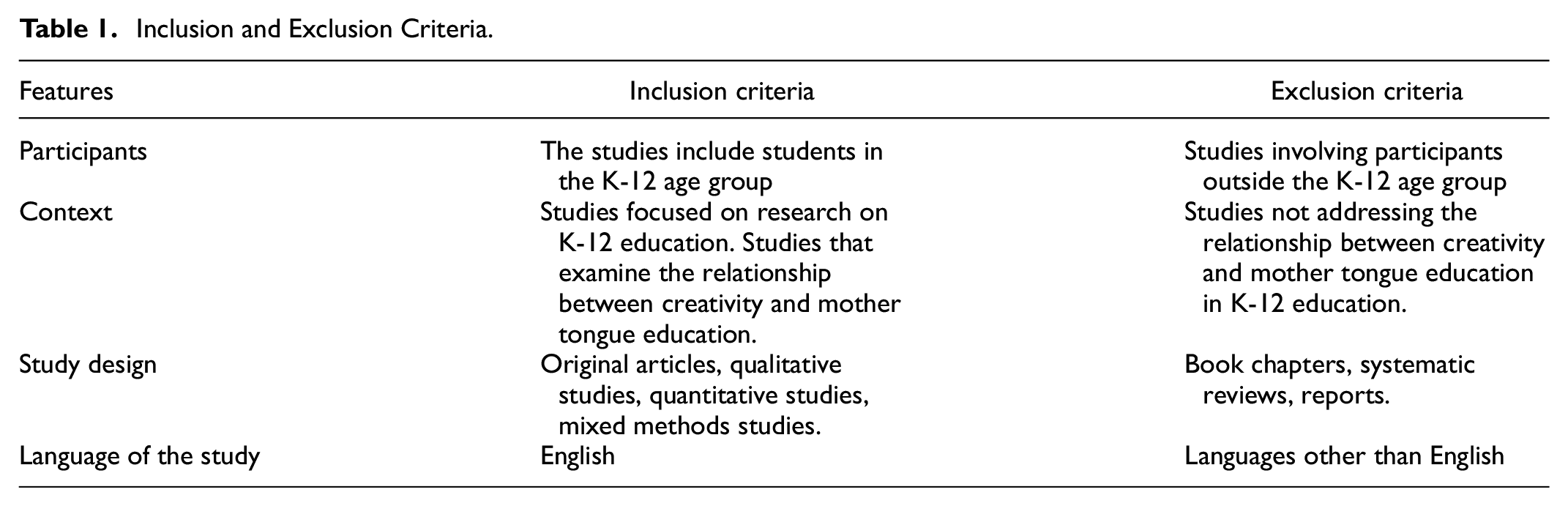
These criteria have been established to ensure integrity and consistency in the systematic review. Exclusion of studies involving participants outside the K-12 aims to clarify the specific age group and educational level the study focuses on. Similarly, the exclusion of conference papers, book chapters, and systematic reviews is made to enhance homogeneity and methodological consistency in the literature. The exclusion of articles written in languages other than English aims to maintain language integrity and prevent possible meaning shifts due to translation. The exclusion of studies not relevant to the research topic is intended to preserve the main focus of the study. Lastly, excluding repetitive studies is implemented to ensure data integrity and prevent duplicated data in the analysis. The article selection process was carried out in two stages. The first stage involved scanning the studies based on titles, abstracts, and full texts. In this stage, two experts independently conducted the selection and screening process without being aware of each other’s work. The second stage involved a comprehensive review of the selected articles to ensure compliance with inclusion criteria. The conflict between the two referees were resolved by a third expert. Studies that do not address the relationship between mother tongue education and creativity in the K-12 period have been excluded since they did not meet the inclusion criteria.
Search and Selection Process
In accordance with the objective of this systematic analysis, a total of 1,109 studies were initially identified. Out of these studies, only 540 English articles were included in the research. Out of the articles initially identified, 241 duplicates were found and removed. After reviewing the titles, 97 irrelevant articles were excluded. Following the abstract reviews, an additional 179 studies were excluded. Upon re-examination, five of the remaining 23 articles were excluded as they were review articles (Gfeller & Robinson, 1998; Karvonen et al., 2018; Kurbonova, 2022; Kydyrova et al., 2020; Lazzarich, 2021). After applying exclusion criteria, a total of 18 articles (Aladrović Slovaček et al., 2017; Auriac-Slusarczyk et al., 2020; Aydın, 2014; Chong & Lee, 2012; Chow et al., 2009; Cumming, 2007; Drandić & Lazarić, 2020; Holmes et al., 2015; Humble et al., 2018; Kalmar & Balasko, 1987; Maine, 2014; Nicolopoulou et al., 2009; Rubin, 2023; Spence & Kite, 2018; Türkel & Çetinkaya, 2020; Wang et al., 2021; Watson, 2015; Zupancic et al., 2015) met all specified criteria.
Data Extraction Processes for Analysis
A table (see Table 2) has been created to facilitate the understanding of information related to the 18 articles included in the final review. The table includes the following information in order: (a) author/authors, (b) title of the study, (c) year of publication, and (d) K-12 level.
Descriptive Register of Articles.
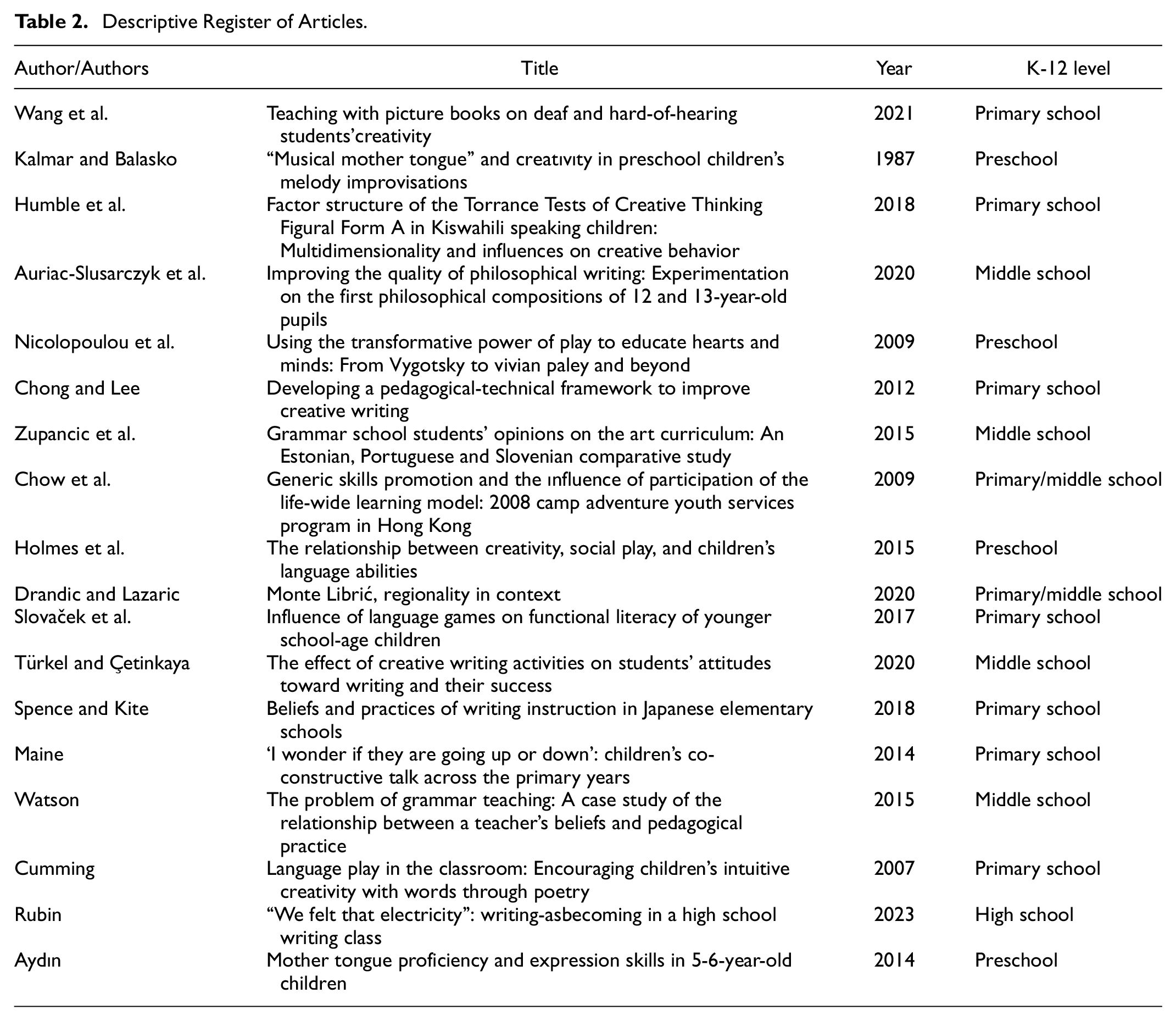
As observed in Table 2, the studies aligned with the study’s objective span from 1987 to 2023. Until 2007, there were notably few studies conducted in this field. It is noteworthy that there has been an increased intensity of research post-2009. The highest volume of studies was conducted in the year 2020. The studies were found to cover different educational levels. There were four studies in the preschool period, seven in primary school, four in middle school, two covering both primary and middle school levels, and one study focusing on high school level.
Analysis
Methodological Analysis
Specific tools were used to evaluate methodological quality. The articles included in the study were conducted using both quantitative (n = 12) and qualitative (n = 6) research methods. When assessing the studies’ compliance with methodological standards, the quantitative checklist (Angosto et al., 2020) and the qualitative checklist (O’Brien et al., 2014) were followed. These checklists comprise 20 items for quantitative methods, including “title and abstract,”“introduction,”“methods,”“results,”“discussion,” and “other information,” and 21 items for qualitative methods. Each study was individually evaluated by two reviewers who assigned scores of 1 if the studies met the criteria and 0 if they did not, across different sections of the studies. There were discrepancies between reviewers in four studies. The disagreement was resolved through the review and discussion of the original study until a consensus was reached. The results of the methodological quality assessment are available at OSF.
Thematic Analysis
To evaluate the potential bias in the identified studies, a subjective bias analysis was employed. The subjective bias analysis was chosen to enhance transparency in the review process by considering the likelihood of evaluations and results being influenced by researchers’ biases. This approach aims to increase objectivity in the assessment of studies, as each evaluator may reach different conclusions based on their own biases. First, criteria based on the purpose of the study and the research questions were defined. Each article was carefully reviewed and evaluated according to the identified criteria. During the subjective analysis process, each article was independently examined by the authors in line with the criteria. In particular, we tried to determine how each article contributed to the aim of the study. When subjectively analyzing the risk of bias, the authors held regular meetings, reviewed and discussed their assessments. This collaboration helped make subjective analysis more objective and reliable. The reviewed articles were evaluated through text analysis. Using independent coding and monitoring methods, all authors independently performed the assessment to ensure reliability in the coding of the reviewed articles. In addition, studies showing similarities were reviewed in detail and presented in relation to each other. This comparison aimed to evaluate the consistency of the findings with the literature.
Results
Study Flow
Figure 1 shows the flowchart of the current study from the inclusion of 18 articles out of 1,109 analyzed.

Flow Card.
During the data collection process, articles lacking explicitly stated methodologies were found to have insufficient methodological information. Therefore, articles with clear methodological information were included. In some instances, unclear information regarding the subject matter of the studies was encountered. These research studies were presented by providing detailed information about the study under the relevant theme.
Methodological Quality of Examined Articles
Qualitative and quantitative studies were evaluated separately to check the methodological quality of the studies. The methodological quality of the 12 quantitative studies evaluated in the current research was scored out of 20 points. One article received 17 points (Holmes et al., 2015); another article received 16 points (Auriac-Slusarczyk et al., 2020); one article received 15 points (Türkel & Çetinkaya, 2020); three articles received 14 points each (Aladrović Slovaček et al., 2017; Humble et al., 2018; Wang et al., 2021); two articles received 12 points each (Chow et al., 2009; Nicolopoulou et al., 2009); one article received 10 points (Zupancic et al., 2015); one article received 9 points (Drandić & Lazarić, 2020); one article received 8 points (Chong & Lee, 2012); and one article received 6 points (Kalmar & Balasko, 1987). The average score of the articles was found to be 12.25. In the evaluation of the six qualitative studies within the research, varying methodological data emerged. One article received 16 points (Spence & Kite, 2018), one article received 12 points (Maine, 2014), two articles received 11 points (Aydın, 2014; Watson, 2015), one article received 10 points (Rubin, 2023), and one article received 3 points (Cumming, 2007). The average score of the articles was found to be 10.5.
Among the examined studies, four studies (Auriac-Slusarczyk et al., 2020; Chow et al., 2009; Drandic & Lazaric, 2020; Kalmar & Balasko, 1987) were conducted using a single data collection tool, while fourteen of them (Aydın, 2014; Chong & Lee, 2012; Cumming, 2007; Holmes et al., 2015; Humble et al., 2018; Maine, 2014; Nicolopoulou et al., 2009; Rubin, 2023; Slovaček et al., 2017; Spence & Kite, 2018; Türkel & Çetinkaya, 2020; Wang et al., 2021; Watson, 2015; Zupančič et al., 2015) utilized multiple data collection tools. The majority of studies relied on multiple data collection instruments, which could potentially offer insights into the validity of the articles.
Thematic Analysis
Following the literature review, the reviewed articles were organized thematically, resulting in the identification of eight distinct dimensions. These encompass writing skills (Auriac-Slusarczyk et al. 2020; Rubin, 2023; Spence & Kite, 2018; Türkel & Çetinkaya, 2020; Watson, 2015), speaking skills (Aydın, 2014; Chow et al., 2009; Maine, 2014), teaching methods (Drandic and Lazaric, 2020; Holmes et al., 2015; Nicolopoulou et al., 2009; Slovaček et al., 2017), art (Kalmar & Balasko, 1987; Zupančič et al., 2015), poetry (Cumming, 2007), interculturality (Humble et al., 2018), technology (Chong & Lee, 2012), and reading skills (Wang et al., 2021). The next section provides a detailed description of each of the topics covered.
Writing Skills
Writing skills are crucial for the expression and development of creativity, as demonstrated by Auriac-Slusarczyk et al. (2020) and Türkel and Çetinkaya (2020). These researchers found that engaging in creative writing activities can enhance students’ language skills and creative thinking capacities. Auriac-Slusarczyk et al. (2020) investigated the factors that affect the quality of students’ written texts on philosophical topics, evaluating their language proficiency based on criteria such as logical coherence and creative expression. Creative writing activities can improve students’ abstract thinking and argumentation skills, thereby increasing their creative thinking capacity. Türkel and Çetinkaya (2020) examined the positive impact of creative writing activities on students’ writing attitudes and academic achievement. Rubin (2023) and Spence and Kite (2018) provide valuable insights into how the writing process should be managed in cultural and pedagogical contexts. Rubin (2023) emphasized that writing should be treated not only as a process but also as a tool for students to interact with each other and develop their creative thinking and social skills. This perspective suggests that the writing process can help students unleash their creative potential by supporting their social and emotional development. Spence and Kite (2018) explored how cultural writing instructional processes in Japan positively influenced students’ writing skills and creative thinking capacities within the context of history, culture, and teacher beliefs. Watson (2015) investigated the impact of teacher beliefs on the teaching of writing, revealing the role of teachers in shaping students’ writing skills and creative thinking capacities. These findings underscore the importance of developing writing skills as a means of enhancing students’ creative thinking capacities.
Speaking Skills
Speaking skills are essential for enhancing students’ creative thinking and problem-solving abilities. According to Aydın (2014) and Chow et al. (2009), developing speaking skills can increase students’ creativity. Chow et al. (2009) found that the Camp Adventure Youth Services (CAYS) program in Hong Kong significantly improved general skills such as cooperation, communication, creativity, and problem-solving. These findings highlight the importance of developing speaking skills for increasing students’ creative thinking capacities.
Aydın (2014) studied the mother tongue use of 5 to 6 year old children and found that children’s personal responses reflect their creativity, which is influenced by various factors such as family, environment, school, and television. According to Aydın, children’s speaking skills and creative thinking capacities are affected by the environmental factors they interact with.
Maine (2014) conducted a study on how language use changed over time and how it affected children’s creative thinking capacities in a primary school in England. The research revealed that at the beginning of the training process, children were more imaginative and fluent in their speech, whereas at the end of the training process, their language use became more structured and analytical. As a result, Maine (2014) suggests that developing speaking skills positively affects students’ creative thinking capacities.
Teaching Methods
Teaching strategies are of paramount importance in fostering students’ linguistic abilities and inventiveness. According to Slovaček et al. (2017), language games have a significant impact on literacy development, and creative teaching techniques have a favorable effect on the learning environment and student attitudes. Creative teaching methods and games serve as an indispensable tool for enhancing students’ language skills and nurturing their capacity for imaginative thinking. Drandic and Lazaric (2020) underscore the significance of raising awareness about linguistic diversity and cultural identity. This study reveals that linguistic and cultural diversity shape students’ inventive thinking skills.
Holmes et al. (2015) and Nicolopoulou et al. (2009) also concurred that creative teaching methods foster children’s language skills and creativity. Nicolopoulou et al. (2009) found that storytelling and role-playing activities improved low-income children from diverse ethnic backgrounds’ creative thinking and problem-solving skills. These findings indicate that creative teaching methods are effective in enhancing students’ language skills and creative thinking capabilities.
Holmes et al. (2015) investigated the link between social play and language skills and found that certain types of social play improve children’s creativity and language skills. The study demonstrates a positive correlation between children’s language skills, creativity, and play.
Art
Art education is essential for fostering students’ creative thinking abilities. Zupančič et al. (2015) highlighted the significance of incorporating modern themes and artistic techniques in art education and discovered that students perceive creativity in the arts as the most valuable aspect. Arts education is a vital tool for nurturing students’ artistic and creative thinking capabilities. Kalmar and Balasko (1987) established that cultivating children’s musical talents promotes creativity. Their research showed that melody creation processes influence both musical skills and creative thinking abilities in children.
Poetry
Poetry holds significant value in cultivating students’ language proficiency and imaginative thinking. As per Cumming’s (2007) findings, poetry instruction proves instrumental in fostering language skills and creativity among children. Poetry, being an innovative utilization of language, enables children to hone their creative thinking abilities via linguistic exploration. This conclusion underscores the indispensable nature of poetry education in enhancing students’ language skills and imaginative capabilities.
Interculturality
Interculturality plays an important role in developing students’ creative thinking capacities. Humble et al. (2018) demonstrated the link between interculturality and creativity by examining the applicability of cross-cultural creative thinking tests. This study shows that cultural differences affect students’ creative thinking capacities. Intercultural interactions and learning experiences develop students’ creative thinking skills and enable them to think from different perspectives.
Technology
Technology is important in developing students’ creative thinking capacities. Chong and Lee (2012) examined the development of creative writing skills through learning software and found that technology enhances creative thinking and expression skills. Technological tools and software are an effective tool in developing students’ language skills and increasing their creative thinking capacities. This finding suggests that technology plays an important role in developing students’ creative thinking skills and language skills.
Reading Skills
Developing students’ creative thinking capacities is crucial, and reading skills play a vital role in this process. As per Wang et al. (2021), regular reading has a significant impact on students’ writing and creative thinking skills.
Discussions
The primary objective of this research is to systematically investigate the methods by which creativity is addressed within heritage language education at the K-12 level. This study seeks to provide a comprehensive overview of the current state of the literature on this topic, rather than emphasizing the significance of creativity in heritage language education at the K-12 level. To achieve this, 18 articles were analyzed to evaluate the methodological quality of studies examining this relationship and to reveal the themes in which the issue is addressed. Previous literature reviews have generally focused on the relationship between mother tongue education and creativity. Review studies addressing the connection between mother tongue education and creativity in the literature have typically approached the relationship between mother tongue education and creativity within the confines of personal development (Kurbonova, 2022), instructional materials (Karvonen et al., 2018), elements of creative thinking (Kydyrova et al., 2020), language and culture (Gfeller & Robinson, 1998), and teaching method (Lazzarich, 2021). This study seeks to holistically address the relationship between native language instruction and creativity at the K-12 level, taking a more comprehensive approach than previous studies.
Based on the evaluation of the methodological quality of the reviewed studies, the overall average score of 12 quantitative studies was determined to be 12.25. Studies such as Auriac-Slusarczyk et al. (2020), Holmes et al. (2015), and Türkel and Çetinkaya (2020) received high scores, indicating solid methodological reliability. However, certain studies received low scores, which is noteworthy. In this regard, it can be said that some studies do not meet the methodological standards. Some studies may be methodologically weak in this regard. The average score of the six evaluated qualitative studies is 10.5. The studies include high scorers, such as Spence and Kite (2018), and low scorers, such as Cumming (2007). Generally, qualitative studies have lower scores than quantitative studies, suggesting that they may be more methodologically complex due to their nature. The literature supports the finding. Firstly, the approaches to defining the concepts of reliability and validity differ between quantitative and qualitative research (Yılmaz, 2013). Additionally, while quantitative research deals with numerical data and their statistical interpretations, qualitative research deals with non-numerical information and their phenomenological interpretations (Leung, 2015). Four of the studies used a single data collection tool, according to the findings. On the other hand, multiple data collection tools were used in 14 studies. The mother tongue is associated with various multifaceted aspects such as literacy skills, cultural identity, and cognitive development (Nishanthi, 2020). The same can be said for creativity. Creativity is related to students’ expressive skills (Marcos et al., 2020), culture (Karnilowicz Mizuno & Xu, 2022) and cross-cultural perspective (Dziedziewicz et al., 2014). Therefore, Lucas (2016) specifically draws attention to the difficulties encountered when evaluating creativity in students aged 11 to 16. Collecting data from various sources on creativity in first language education will increase the validity of the studies. Establishing a solid methodology to demonstrate the relationship between mother tongue education and creativity can provide a more concrete resource from both a scientific and pedagogical perspective. Additionally, it could offer a reliable foundation for enhancing the education system and refining classroom practices and teaching strategies. While the studies reviewed in this research have substantial foundations, they also exhibit certain weaknesses. These limitations should be taken into account in future research and addressed to improve methodological reliability.
Studies focusing on the development of language skills based on thematic findings highlight the complexity of supporting students’ creativity and improving their language skills. This finding is consistent with studies in the literature (Jones, 2020; Maley & Kiss, 2018). Studies on art and poetry highlight students’ natural inclination to enhance their creativity and suggest that supportive activities can positively influence the development of language skills. Similar findings have also been revealed in the literature (Chew & Eau, 2017; Johnson, 2019; Piscayanti, 2021). Another positive aspect differing from the findings of this study is the contribution of creativity to the development of higher-order thinking skills (Thakur, 2021). To observe this effect, it is necessary to align supportive practices with the formal curriculum and emphasize teaching various writing genres to students. Investigations into teaching methods indicate that student-centered approaches and creative teaching methods can contribute to the advancement of language skills. However, some argue that there should be a greater emphasis on student-centered approaches within teacher training programs to enable educators to effectively utilize these strategies. In the context of interculturality, it has been established that creativity can be transferred across cultures. However, further research is needed to understand how language skills develop within a cultural context and how cultural differences affect students’ creativity. Because creativity cannot be considered independent of culture (Csikszentmihalyi, 2005). The study by Niu and Sternberg (2002) demonstrated that creative expressions vary culturally and emphasized the importance of considering the cultural context when enhancing children’s creativity. In general, studies exploring the relationship between mother tongue education and creativity suggest the importance of focusing on individual student needs, cultural diversity, and effective teaching strategies. However, it is important to note that some studies have not placed enough emphasis on teaching processes and student-centered approaches. This should be considered in future research endeavors.
Conclusion
The eighteen studies reviewed collectively underscore the strong correlation between creative thinking and the acquisition of language skills. The average methodological quality of the quantitative studies amounted to 12.25 points, while the qualitative studies averaged 10.5 points. The utilization of multiple data collection tools in the majority of these studies enhances the methodological validity. The eight themes identified through thematic analysis expose the interconnection between creativity and mother tongue education at the K-12 level. In particular, writing and speaking abilities play a pivotal role in nurturing creative thinking capacities. Creative writing activities have been found to boost students’ language skills and creative thinking capabilities, while speaking skills have been determined to improve students’ problem-solving and creative thinking abilities. Additionally, it was established that employing creative teaching methods augments students’ language skills and fosters their creative thinking skills. The themes of art and interculturality also hold significance in cultivating students’ aesthetic and creative thinking abilities. Overall, the findings of this study emphasize the significance of creativity in mother tongue education at the K-12 level and demonstrate that creativity is an effective catalyst for developing language skills. The integration of creative writing, speaking, and teaching methodologies enriches the mother tongue teaching process by fostering students’ language skills and creative thinking abilities.
Implications
This systematic review has revealed certain limitations and unexplored areas in studies examining the complex relationship between mother tongue education and creativity. Therefore, there is a need for various recommendations for future research. As a result of the review, it may be useful for researchers who will study creativity in mother tongue education in the future to conduct studies especially at high school level. In the analyses, only one study was found at the high school level, and it was on creative writing. In the context of high school, research can be conducted on different topics and in a wider range. Future research should incorporate a combination of quantitative and qualitative studies to comprehensively examine the relationship between mother tongue education and creativity. There is also a need for mixed-methods research. This necessitates a research strategy designed to encompass a broad student population and multiple contexts. In addition, creativity is important in terms of being a subject that can be researched and applied not only at the K-12 education but also for individuals of all ages in mother tongue education. In addition, creativity is important not only at the K-12 level but also for individuals of all ages in mother tongue education, making it a subject that can be researched and applied. There is a need for studies focusing on the role of the cultural context for a deeper understanding of cultural interactions on creativity. Understanding how intercultural interactions affect students’ language skills and creativity can enhance teaching strategies. The scope of this study is restricted to examining the consequences of mother tongue instruction and creative thinking in monolingual students at the K-12 level. Future research could potentially explore the role of mother tongue education in fostering the creativity of multilingual students. Moreover, it is essential to determine which methods are most successful in promoting creativity in instances where the mother tongue is not the language of instruction. Given the current importance of technology, future research should closely examine the impact of technology on mother tongue education and creativity. Studies that specifically focus on how digital tools contribute to language skills and creativity development could be beneficial. The role of teachers is critically important in mother tongue education. Future research should evaluate the effectiveness of teacher training programs in fostering creativity and focus on how teachers can be supported to enhance their skills in this area. Longitudinal studies are needed to understand the long-term effects. Research that tracks the development of students in mother tongue education and creativity can assess the success of long-term strategies.
Limitation
Several limitations were taken into account when interpreting the findings of this study. The systematic review was limited to the Web of Science, Scopus, ERIC, and EBSCO databases. While these databases were chosen in line with the research’s purpose, this limitation may have affected the comprehensiveness of the study. In addition, the analysis was conducted with English-language articles only, which is another limitation to consider. Excluding various scientific documents may lead to an incomplete interpretation of the literature. Assessments of the methodological quality of studies based on the results of this systematic analysis may have limitations identified in the analysis. The sample size was limited to 18 articles, which may limit the generalizability of the results and may not cover the entire literature in this field. One of the limitations of our study is that in numerous countries, the mother tongue might not be the language of instruction.
Footnotes
Author Contributions
Conceptualization, ÖS; methodology, MB; formal analysis, ÖS, MB, YY; preparation of the original draft, ÖS, MB, YY; revision and editing, MB. All authors have read and agreed to the published version of the manuscript.
Declaration of Conflicting Interests
The author(s) declared no potential conflicts of interest with respect to the research, authorship, and/or publication of this article.
Funding
The author(s) received no financial support for the research, authorship, and/or publication of this article.
Ethics Approval
Ethics committee approval was obtained from the researchers for this study.
Informed consent
All authors consented to publish the article.
