




Abstract
Accreditation has witnessed a surge in popularity within K-12 settings, being perceived as a pathway to excellence and a testament to the pursuit of quality education. This study explored the perceptions of 423 educators (teachers, subject coordinators, and school leaders) from 10 Arab Sates focusing on the value of accreditation and its impact on school improvement, through their lenses. A survey with an open-ended question, was used to collect data. Quantitative data underwent statistical analysis using SPSS 25.0, while qualitative data from the open-ended question were analyzed using theme-based analysis. Findings reveal that participants expressed positive views toward accreditation, recognizing its role in ensuring compliance with standards related to safety, resource allocation, and infrastructure provisions. However, participants, particularly teachers, displayed more reserved perspectives on accreditation’s potential to enhance school improvement, expressing concerns that it may lead to cloned schools and diminish teachers’ creativity and autonomy. This study highlights the complexities and divergent perceptions surrounding accreditation’s impact on K-12 education, urging further reflection and dialogue to better align accreditation practices with the genuine pursuit of school improvement and educational excellence.
Plain language summary
Over the last decade, accreditation has gained traction in K-12 schools as a marker of excellence and dedication to quality education. This study investigated how teachers, subject coordinators, and school principals perceive accreditation. Findings indicate that while school principals viewed accreditation as linked to school improvement, teachers generally did not make this connection. Subject coordinators fell somewhere in between these perspectives.
Introduction
Accreditation in K-12 settings has gained a rising popularity in the last decade (Brown et al., 2016). A key reason for this booming relates to the perception that when a school is accredited, it entails that it has been vetted by an outside agency for the quality of its academic programs, and adherence to certain educational standards (Michelli & Karp, 2016). This is because accreditation involves rigorous checks to ensure a school meets set standards, and is thus qualified to teach students the programs they are offering (Johnsen et al., 2021).
However, the rise in demand in accreditation have raised the legitimate question about whether or not it has indeed led to improvements in the various aspects of schooling (Coutet, 2022). In fact, a growing body of research has shed light on accreditation, viewing it through a negative lens (Coutet, 2022; Hail et al., 2019; Hughes, 2004; Lewis, 2016; Romanowski, 2017, 2020, 2021, 2022a, 2022b; Romanowski & Alkhateeb, 2020). For example, Romanowski and Alkhateeb (2020) criticized international accrediting bodies for ‘McDonaldizing’ accreditation, stating that they led to replicas of American schools across the globe. ‘Macdonaldization’, is a term they borrowed from Ritzer (2000) who initially used it to draw an analogy between the sweeping of the famous McDonald fast-food industry across countries.
In the same vein, the cost of accreditation has been criticized in the literature as being highly expensive. McMurtrie (1999, cited in Gillen, 2020) stated that accreditations are “cumbersome, expensive, secretive and outdated” ( p. 5). Likewise, Neal and Alacbay (2018) and Wheelan and Elgart (2015) made similar critiques raising questions pertaining the degree accreditation was a cost-effective measure for achieving quality. Moreover, Romanowski (2020) criticized the Council for the Accreditation of Educator Preparation (CAEP) for being a tool for neocolonialism, by exerting pressure to control or influence other educational systems in other countries outside the US, by its standards, processes and procedures.
As such, accreditation has been viewed as disparaged for diluting academic freedom (Romanowski & Karkouti, 2024), and impinged institutional autonomy (Gaf, 2010; Gillen et al., 2010; Harvey, 2004). Additionally, and according to Harvey (2004), the accreditation procedures are not benign or apolitical, but represent a power struggle that imposes an extensive bureaucratic burden on educational institutions. In this line, accrediting bodies have been criticized for creating myth images about themselves, serving as abstract authorizing power, thus shifting the power from educators to bureaucrats (Harvey, 2004).
As for the impact of accreditation on learning and teaching, the published work is relatively limited. Many studies claim that accreditation impact positively on the quality of education offered in educational institutions (Ulker & Bakioglu, 2019). Moreover, there is a convergence on the finding that accreditation plays a critical role in influencing the public interest in making decisions pertaining their choice of schools for their children (Afriliandhi & Hasanah, 2023; Cura & Ahmed Alani, 2018; Ibrahim, 2014). Yet, some studies argue that accreditation acts a hurdle confronting innovation and impede pedagogic improvement processes (Harvey, 2004; Romanowski & Karkouti, 2024). Furthermore, accreditation is criticized for lacking the ability to incur a positive effect on outcomes in an educational context (Collins, 2015; van Kemenade & Hardjono, 2009), and for its deficiency in offering real evidences of its impact on educational improvement (Shah, 2012; Tamir & Wilson, 2005).
The majority of the cited studies above have been conducted in higher educational settings. This is because there is a scarcity in the literature of accreditation in K-12 settings. The interest in accreditation in K-12 settings is relatively recent. As such, this study attempted to explore the perceived value of accreditation in K-12 settings through the lenses of teachers, subject coordinators and school leaders, with emphasis on its impact on school improvement initiatives. It was guided by the following research questions:
What are the perceptions of teachers, subject coordinators, and school leaders regarding accreditation?
To what extent do teachers, subject coordinators, and school leaders link accreditation with school improvement?
Literature Review
Accreditation in Higher Education
Accreditation dates back to late 1800s/ early 1900s, where higher education institutions, with high academic standards, suggested this measure to distinguish themselves from institutions that claimed to be colleges whilst offering high school curricula (Alstete, 2004). Since then accreditation underwent continuous development because of the need for confidence in post-secondary degrees issued by the various institutions, especially that all jobs required college degrees for employment (Graves, 2021).
With this, accreditation developed further and gained momentum providing a sense of security, confidence, and serving as means for verification of credibility (Okulova & Shakina, 2022). It became an indicator of quality in higher education (Blanco Ramírez, 2015). Almost all funding provided for students interested in pursuing higher education is now dependent on accreditation. In fact, all governmental aid and scholarships are linked to the acceptance of students in accredited higher education institutions (Healey & Healey, 2023). Perley and Tanguay (2008) suggest that accreditation serve as a “gate keeper” for students, families, and governments providing an accountability mechanism that ensures that funds are well spent and that graduates will be able, post-graduation, to contribute to their societies and economies.
Thus, there are several reasons that underlie the decision of a higher education institution to seek accreditation. These include: (a) the opportunity to receive funds (Graves, 2021); (b) the ability to offer programs leading to certification (Acevedo-De-los-Ríos & Rondinel-Oviedo, 2022); (c) reputation (Stewart et al., 2021); (d) the ability to compete with other institutions and programs (Hou & Cheng, 2022); (e) the development of improvement of programs (Darling-Hammond, 2020); and (f) adhering to compliance requirements (Blanco Ramírez, 2015).
However, the recent trends in higher education including internationalization (Abasi et al., 2022; Romanowski, 2022a; Salto, 2022), global competition (Hou & Cheng, 2022; Nuryana, 2022; Romanowski, 2022b) and university rankings (Rybinski, 2022; Zierer, 2023) have all made a significant contribution to the recent popularity of accreditation. Today, many institutions worldwide request accreditation from US based accrediting bodies in order to attract international students, mainly due to the absence of national quality assurance systems in their own countries (Blanco-Ramirez & Luu, 2016), or because they believe that it is more prestigious to receive accreditation from a US accrediting body (Prasad et al., 2019).
Two points need to be raised at this stage pertaining to the revised literature. First, K-12 and higher education institutions in the Arab region seek accreditation from Western accrediting bodies to ensure global recognition and quality assurance (Al-Jammal & Ghamrawi, 2013, 2015; Ghamrawi & Al-Jammal, 2013, 2014). Prominent examples include the Council for the Accreditation of Educator Preparation (CAEP), which sets rigorous standards for teacher preparation programs and is based in the United States. Additionally, organizations such as AdvancED, now part of Cognia, provide accreditation for K-12 schools, emphasizing continuous improvement and accountability. Many Arab universities also pursue accreditation from other Western agencies such as the Accreditation Board for Engineering and Technology (ABET) and the Association to Advance Collegiate Schools of Business (AACSB), renowned for their comprehensive evaluation processes and international prestige. This reliance on Western accrediting bodies underscores a commitment to maintaining high educational standards and fostering international credibility. CAEP accreditation, being highly sought after, will be discussed in the next section.
On the other hand, the revised literature incorporates two distinct types of scholarly works: international literature (such as Andreani et al., 2022; Coutet, 2020; Haryati, 2014; Oldham, 2018; Perryman et al., 2018; Winterbottom & Piasta, 2014; Ulker & Bakioglu, 2019); as well as studies conducted within the Arab states region such as rich body of research generated by Michael Romanowski (Romanowski, 2017, 2020, 2021, 2022a, 2022b; Romanowski & Karkouti, 2024). Both sources emphasize the pivotal role of Western accrediting bodies in shaping educational standards. International literature often highlights the established practices and benefits of these accrediting organizations which are recognized for their rigorous evaluation processes and global prestige. Meanwhile, research from the Arab region underscores the growing trend of local institutions seeking accreditation from these Western bodies to enhance their educational quality and international credibility. This dual focus provides a comprehensive understanding of how Western accrediting bodies influence educational practices and policies in the Arab States.
CAEP Accreditation
CAEP’s accreditation process is designed to promote excellence in educator preparation through evidence-based evaluations with the dual objectives of enhancing candidates’ performance as practitioners in K-12 schools and elevating the overall stature of the teaching profession (Li & Ragin, 2016). To achieve CAEP accreditation, institutions seeking recognition must follow a comprehensive process, including application, self-study, alignment with CAEP’s standards, and submission of annual reports and program reviews, culminating in an on-site visit guided by CAEP’s handbook and various resources.
The accreditation process revolves around five key standards, defining and assessing quality in an institution’s performance: (a) content and pedagogical knowledge; (b) clinical partnerships and practice; (c) candidate quality, recruitment, and selectivity; (d) program impact; and (e) provider quality assurance and continuous improvement (Council for the Accreditation of Educator Preparation [CAEP], 2015). Additionally, there are 22 sub-standards, and CAEP may refer to supplementary standards like the Interstate New Teachers Assessment and Support Consortium (InTASC) Standards and Specialized Professional Associations (SPA) when necessary, as they represent exemplary teaching and best practices in education (Council for the Accreditation of Educator Preparation [CAEP], 2018).
Colleges of education are responsible for establishing efficient systems to collect, manage, and interpret reliable and valid evidence, which are essential for continuous improvement. This evidence includes program and student outcomes, teaching effectiveness, graduates’ impact on K-12 students, and feedback collected from completers and employers regarding hiring decisions (Council for the Accreditation of Educator Preparation (CAEP), 2020). The accumulation of such data serves to demonstrate program effectiveness and candidate quality, ensuring accountability and ongoing improvement within accredited institutions rates, licensure requirements, and other data (Council for the Accreditation of Educator Preparation (CAEP), 2021).
Criticism of Accreditation in Higher Education
Despite its popularity, accreditation in higher education has received a lot of criticism in the literature. In fact, initially, accreditation was hugely criticized for basing its judgments on quantitative factors such the number of books in a library, the number of available equipment, or the student-teacher ratios (Ulker & Bakioglu, 2019). This led to a shift in focus on students’ learning outcomes, which became an integral element of accreditation standards (Andreani et al., 2020). However, the adoption and focus on learning outcomes in accreditation standards became the center of a heated debate pertaining the extent they could be assessed (Romanowski, 2021), and their lack of influence on educational improvement (Volkwein, 2010). As a result, accreditation underwent another shift, and turned into focusing more on learning experiences (Ulker & Bakioglu, 2019). Despite that, accreditation continues to receive criticism for dealing with education as an industry, by adopting standards that focuses more on administrative processes and practices, with less emphasis on the learning and teaching processes (de Paor, 2019).
Another criticism to accreditation accuses it of idolatry (Romanowski, 2021), serving as an authority that can change and brush aside any existing epistemological formations, impose new adjustments, and infringes a range of negative influences on institutions, professors, education and academic disciplines (Romanowski, 2020). In this line, accreditation is considered to occupy an undeserving special esteem; giving it the privilege in costs above any other essential needs at an institution, and exhibiting the power to eliminate the original context of such an institution, rendering it with a totally new context and culture (Romanowski, 2021). Moreover, accreditation is often glorified for no more than the interest in it, becoming an end itself, rather than being means to improvement and effectiveness (Romanowski, 2021).
In the same vein, accreditation is viewed as a tool for neocolonialism (Romanowski, 2022a) and ‘Macdonaldization’ (Romanowski & Al-Khateeb, 2020) by cloning the American system through standardization and imposing it on institutions across the globe. Through this, accreditation tends to dilute and erode academic freedom in higher education institutions (Holt, 2020). Holt (2020) contends that accreditation impinges institutions by ‘distancing them from their defined academic responsibilities (free inquiry, free service, and free teaching/learning) and placing them in a subservient position of tedious task accountancy’ (p. 2006).
Accreditation in K-12 Settings
Accreditation, which has been developed by what is called now the U.S. regional accreditation agencies, is one form of England’s school inspections, organized by its Office for Standards in Education (Ofsted; Bernasconi, 2006). School inspections are famously known to be of British origin and continue to be the British practice for assuring and insuring quality in education (Ehren et al., 2013; Roberts & Abreu, 2018). It is worth mentioning that historically, British type inspection of schools is considered to be the initial attempts for judging quality in schools (Coutet, 2022; Elliot, 2015; Ladd, 2017; Snelling, 2017).
It is argued that all practices world-wide have been inspired by the British model in one way or another (Doherty, 2012). School inspection is a systematic approach used to evaluate a school by external experts pertaining curriculum offerings and enrichment; teaching, learning and assessment; personal and social development of students; health and safety provisions; student attainment and progress; and school leadership (Ghamrawi & Abu-Tineh, 2023; Zheng & Thomas, 2022).
Unlike the UK whose Ofsted is a governmental entity that reports to the British House of Commons (Roberts & Abreu, 2018); the USA favors the provision of QA to be carried out by non-governmental agencies (Doherty, 2012). The U.S. Department of Education has “…no oversight role with respect to school accreditation. Most states have laws requiring or encouraging accreditation for public schools and state-chartered private schools” (USNEI, 2017).
Because it is voluntary, schools do not have to become accredited in order to open their doors or offer their educational services in the US (USNEI, 2017). In this context, assurance that the services and operations of a given school system adheres to the pre-determined set of standards, is made by an external agency (UNESCO, 2015). If standards are met, then the school gets accredited, meaning that the external agency acknowledge that this school’s practices are in accordance with standards (Zheng & Thomas, 2022). Schools that possess accreditation and state approval by authorities recognized at the state level are considered to be recognized schools within the U.S. education system (USNEI, 2017). In addition, private schools that are accredited by other associations recognized by the federal Departments of Defense, Homeland Security and State are also considered to be recognized (USNEI, 2017).
Criticism of Accreditation in K-12 Settings
The demand for academic accreditation in K-12 settings is relatively recent, and has been primarily related to the multiplication of international schools worldwide in the first place (Machin, 2019). According to the ISC Research (2019), the number of international schools grew from 2,584 school in 2000, to 10,400 in 2019. Hayden and Thompson (2013) relate the booming of international schools to the fact that they are no more limited to expats children, but rather accommodate now children of locals who are not satisfied with the quality of educational offerings of their local systems. Therefore, the fact that K-12 accreditation has gained interest only during the past decade justifies the scarcity of research addressing it.
While accreditation is claimed by all accrediting bodies to be growth promoting (Mo & Ulmet, 2019), the validity of the self-evaluation that schools carryout prior to external visits raises concerns. Such concerns relate to the degree of the validity of school self-review reports and the potential fabrication they may undergo to provide a polished image for the accreditors (Haryati, 2014; Oldham, 2018; Perryman et al., 2018). Moreover, Winterbottom and Piasta (2014) argue that accreditation does not improve student performance, but rather ensure that the school is closer to the blue print set by the accrediting body, and is in a better stance to fit its molds.
In the same vein, Coutet (2022) suggests that accreditation in K-12 settings is incurring isomorphism, a concept that is comparable to neocolonialism (Romanowski, 2022a) and “Macdonaldization” (Romanowski & Al-Khateeb, 2022) used to criticize accreditation in higher education. Through isomorphism, Coutet (2022) suggests that all accredited schools become homogeneous in terms of how they both look and function, thus restricting competitiveness and innovation.
Methodology
Research Design
This study employed a survey methodology to investigate accreditation in K-12 settings, aiming to gather both quantitative data and nuanced insights. The survey was meticulously designed to solicit perspectives from a broad spectrum of participants, including teachers, subject coordinators, and school leaders, all concerning school accreditation. An open-ended question was strategically included at the conclusion of the survey to encourage participants to elaborate on their responses, thereby enriching the depth of data collected. The survey served as a pivotal tool in collecting quantitative data and capturing the perspectives of a diverse array of stakeholders, encompassing teachers, subject coordinators, and school leaders, in relation to school accreditation. Furthermore, recognizing the potential limitations of structured survey questions, an open-ended query was incorporated to provide participants with the opportunity to freely articulate additional insights beyond the scope of the structured questionnaire.
Research Instrument and Data Analysis
The survey, developed by the researchers, consisted of three sections. The first section collected demographic data about participants including gender, age, years of experience, and job position. The second section collected participants’ evaluation pertaining accreditation, using 20 items. A 4-points Likert Scale was used for this purpose (4 = strongly agree, 3 = agree, 2 = disagree, 1 = strongly disagree). The last section invited participants to respond to open ended question. In your opinion, what are the advantages and disadvantages of accreditation in K-12 settings?
The Accreditation and School Improvement Survey (ASIS), comprised initially 24 items covering educators’ perceptions pertaining accreditation regarding three domains: management of school facilities; learning and teaching; and school improvement. To ensure the validity and the reliability of the instrument, exploratory factor analysis (EFA) and reliability analysis were conducted. To determine the suitability of the data for factor analysis, Bartlett’s test of Sphericity and the Kaiser-Meyer-Olkin (KMO) measure were employed. The KMO values, which indicate the sampling adequacy, were 0.922 for domain 1, 0.924 for domain 2, and 0.909 for domain 3. These values above 0.60 demonstrate high consistency in the data. Additionally, Bartlett’s Test of Sphericity indicated a significant relationship between the variables (p < 0.05), supporting the appropriateness of the data for factor analysis. While quantitative data (fixed-choice survey items) was analyzed statistically using SPSS 25.0, qualitative data (open-ended survey question) was analyzed using thematic analysis.
The Sample and Gaining Access
The sample consisted of 423 participants (teachers, subject coordinators, school principals) who were members of a virtual community of practice (vCoP) serving Arabic speaking educators. A vCoP is an online platform where individuals with shared professional interests come together to learn, collaborate, and exchange knowledge (Ghamrawi, 2022; Ghamrawi et al., 2023, 2024a; 2024b). It serves as a dynamic space for members to connect, regardless of their geographical location, and engage in discussions, share resources, and support one another’s professional growth (Shal et al., 2018, 2024a, 2024b, 2024c). The board of the vCoP was approached requesting access to community members for the purpose of taking part in the study. The researchers submitted along their letter, the consent form, a copy of the survey, and an ethical clearance letter from the Institutional Research Board of the university the researchers belonged. The request was to administer the survey to all the 2000 plus members registered on the platform, such that the first 500 to respond satisfying the selection criteria would constitute part of the sample.
For a participant to be recruited for the study, he/she should satisfy all of the following conditions: (a) should be a teacher, a subject coordinator, or a school leader in a K-12 setting; (b) should be able to communicate in Arabic; (c) should belong to a school that has been accredited during the past 5 years; (d) should have been working in that particular school at the time where it got (re)accredited. The number of returned surveys during one month was 511, but many were dropped because they did not fit the selection criteria. Thus, the number of valid responses was 423, which was the number that constituted the sample (N = 423). As such, the sample consisted of 423 participants, with a slight female majority (55.1%). The majority of participants were aged between 36 and 45 years (53.7%) and had 11 to 20 years of experience (63.6%). The sample included various job positions, with teachers making up 48%, subject coordinators 34.5%, and school principals 17.5%. Participants were drawn from 10 countries, with the highest representations from the UAE (12.1%), Lebanon (11.1%), and Oman (10.9%), while the least represented country was Tunisia (7.3%).
The detailed characteristics of the sample are presented in Table 1.
Characteristics of the Sample.

Findings
Quantitative Data Analysis
Educators’ Perceptions Pertaining to Accreditation
Educators’ perceptions pertaining to accreditation was assessed using 20 items following a 4-points Likert scale from 1 “Strongly Diasgaree” to 4 “Strongly Agree” (Table 2). The top three items showing high perception were: (a) Accreditation procedures support an adequate learning technologies infrastructure at school (average score 3.35 over 4); (b) Accreditation procedures ensure that the provision of safety is adequate at school. (average score 3.32 over 4); and (c) Accreditation procedures support an adequate resource allocation at school. (average score 3.31 over 4).
Educators’ Perceptions Pertaining to Accreditation.

On the other hand, the three items showing the lowest perceptions were: (a) Accreditation procedures support faculty creativity and risk-taking (average score 1.77 over 4); (b) The participation in the accreditation process contributed to the development of a professional learning community at school (average score 1.85 over 4); and (c) Accreditation is a synonym for school improvement (average score 1.95 over 4).
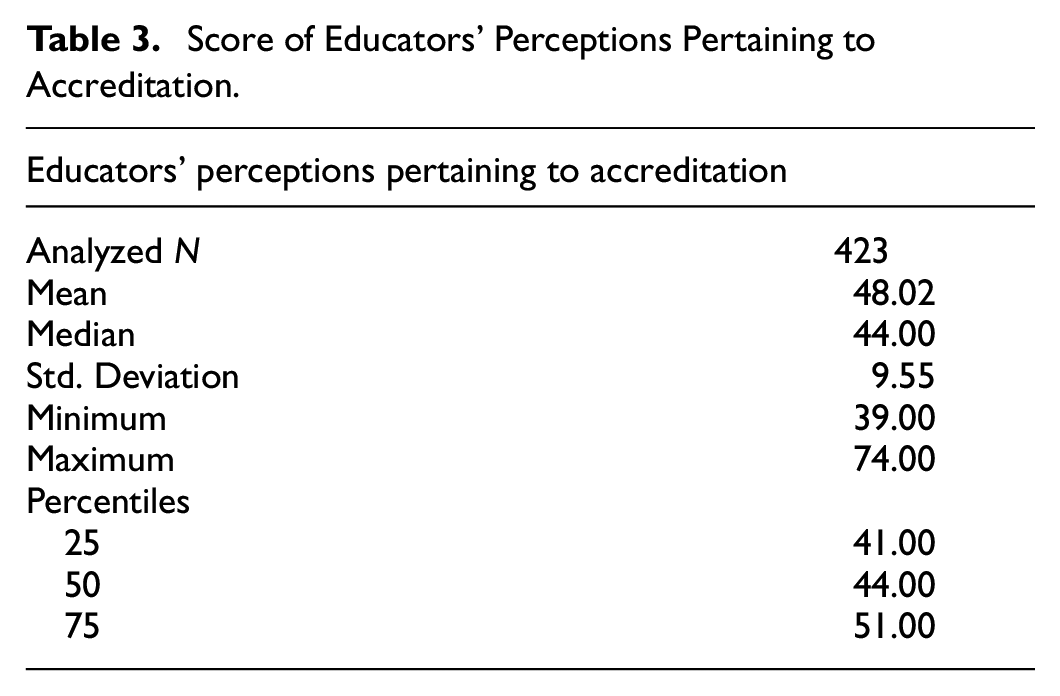
The EFA yielded a three-factor structure, explaining 76.69% of the variance in item relationships. The two factors demonstrated high reliabilities, with Cronbach’s alpha coefficients surpassing .823 for domain 1, and .897 for domain 2, and .899 for domain 3. Subsequently, four items were eliminated due to cross loading on more than one factor, resulting in a final questionnaire comprising 20 items (Table 3).
Score of Educators’ Perceptions Pertaining to Accreditation.
Factors Associated With Educators’ Perceptions Pertaining to Accreditation
Perception and Sociodemographic Characteristics
The association between educators’ perceptions pertaining to accreditation and teachers’ sociodemographic characteristics is represented in Table 4. Educators’ perceptions pertaining to accreditation was statistically associated with respondents’ sex (p = .005), age (p < .001), experience (p < .001) and job (p < .001). Results showed that educators’ perceptions pertaining to accreditation was higher in females compared to males, increased with increasing teachers’ age, and also increased with increasing teachers’ experience. Furthermore, educators’ perceptions pertaining to accreditation increased with increased job hierarchy: school principals scored (66.58 ± 4.05 over 80), followed by subject coordinators (46.10 ± 5.16 over 80), and finally teachers (42.64 ± 2.77 over 80).
Correlation Between Perceptions and Sociodemographic Characteristics.

Note. Independent t-test (a) and Anova test (b) were used in the analysis; Bold: Statistically significant correlation set at 5%.
Perception and Countries
Results showed that teachers from Saudi Arabia had the highest perception score with an average of 52.56 ± 7.35 out of 80, followed by teachers from Tunisia with an average score of 49.58 ± 13.47 out of 80. The least scores were for teachers from UAE (44.84 ± 7.35 over 80), and Qatar (45.49 ± 7.74 over 80). ANOVA test (see Table 4) showed a statistically significant association between perception and teachers’ nationality. Tukey and Bonferroni tests showed that a statistically significant difference exists where teachers from Saudi Arabia had higher significant perception compared to teachers from UAE (p = .004) and Qatar (p = .002).
Qualitative Data Analysis
As stated earlier, the survey included one open-ended question: In your opinion, what advantages and disadvantages of accreditation in K-12 settings?
Data derived from this question was analyzed using theme-based analysis. The analysis consisted of open coding, axial coding and then selective coding as recommended by the literature (Charmaz, 2014; Flick, 2009; Williams & Moser, 2019). Such coding was made against pre-determined two general themes: advantages and disadvantages of accreditation, as perceived by participants. Peer debriefing was utilized in order to ensure validity of codes and themes, whereby the coding was carried out by researchers independently, then compared and agreed on (Scharp & Sanders, 2019).
The themes arrived at are presented in Table 5. For ethical considerations, participants are identified using the formula XyC, where “X” can be T, S, or P accounting for teachers, subject coordinators or school principals respectively; while “z” is the number given to that participant. Moreover, C stands for the first letter of the country this participant came from. For example, T2E indicates an Egyptian teacher numbered “2”; while P3A designates an Algerian principal numbered 3.
Themes Emerging From the Analysis of the Open-Ended Question.

Table 5 shows that the key advantages of accreditation were almost identical amongst teachers, subject coordinators, and school principals. In fact, all three groups believed that accreditation supported their school in gaining recognition, increasing student enrollment, enhancing its infrastructure and safety measures; and amassing learning resources. However, school coordinators and school principals considered teacher professional development (TPD) and continuous school improvement as part of the advantages incurred by accreditation processes.
First, all groups believed that accreditation supported the recognition of their schools, believing that getting accredited by a foreign accrediting body was quite prestigious for the school.
Accreditation a prestige, a status, a way of telling your target audience that you are trustworthy for educating students (P23L).
Moreover, all groups believed that by virtue of the trust that accredited schools gain, student enrollment tends to increase.
Accreditation promotes increased student enrollment because it sends a strong message to parents telling them that this accredited school is offering quality education (S17S).
In addition, all groups elaborated on the positive impact of accreditation on schools’ infrastructure, safety measures, and learning resources. Participants suggested that schools under accreditation focus a lot on maintaining the school buildings and amenities, ensuring student safety around it, and stocking learning resources.
Accreditation is primer for ensuring that your school is well maintained, technologically equipped, safe for learners, and is rich with all sorts of learning resources (T351Q).
However, while almost 30% of subject coordinators and 70% of school principals contended that accreditation contributed to improved teacher professional development that is geared to their needs, not a single teacher among respondents converged on this point.
Accreditation is key for rendering teacher professional development more fit for teachers’ needs (P146J).
Likewise, 20% of subject coordinators and 80% of school principals believed that accreditation supported continuous school improvement.
Accreditation keeps us the school thinking of how to improve (S402T).
On the other hand, subject coordinators and principals views on the disadvantages of accreditation converged lightly with teachers’ views. In fact, all three groups believed that accreditation was costly and time consuming.
Accreditation is time consuming and very costly (T395M, S213O, P92U).
Moreover, teachers (almost 60%) and subject coordinators (almost 40%) believed that accreditation diluted teachers’ initiatives, because of the so many restrictions implied on them for complying with accreditation standards.
Accreditation puts a lot of restrictions on what teachers can do in class, and make them less creative. (S82O, T416E).
Besides, teachers (almost 75%) and coordinators (almost 40%) contended that accreditation cloned schools, rendering them facsimiles.
Accreditation uses strict standards and as such all schools tend to be copycats of one another (T34U). The problem with accreditation is that all schools tend to be similar (S181T).
Distinctively, only teachers thought that accreditation had no impact on learning and teaching (almost 90%), polished school realities (almost 60%), and was bound to (re)accreditation time only (almost 60%).
Accreditation impacts everything except learning and teaching (T339U). Schools show accreditors what they would like to see. It is not authentic, it is fake. (T72T). Accreditation is all about the time where external visitors will be arriving. Only at that time school becomes ‘la vie en rose’ [life in pink] and they remember standards (T263L).
Discussion
This study explored the perceptions of teachers, subject coordinators, and school leaders from 10 countries, focusing on their views in regards to the value of accreditation and its impact on school improvement. The findings presented intriguing variations in the evaluations provided by each group, with teachers expressing the lowest appraisal of accreditation, followed by subject coordinators, and school principals who displayed the highest evaluation.
Notably, all researched groups shared a consensus on one aspect—the recognition and status associated with accreditation positively influenced student enrollment, aligning with prior studies conducted by Afriliandhi and Hasanah (2023), Cura and Ahmed Alani (2018), and Ibrahim (2014). Additionally, the study revealed that accreditation processes encouraged schools to invest in their infrastructure, safety measures, and administrative protocols, echoing findings from Blanco Ramírez (2015) and Healey and Healey (2023) that highlight the positive influence of accreditation on these provisions. Nevertheless, the study also pointed out that accreditation was considered a resource-intensive endeavor, in line with the observations made by Blanco Ramírez (2015) and Oldham (2018).
School principals viewed accreditation as an emblem of high-quality education and an instrument for continuous school improvement- findings that resonate with prior research by Blanco Ramírez (2015), Healey and Healey (2023), Okulova and Shakina (2022), and Perley and Tanguay (2008)- which similarly emphasize the positive role of accreditation in fostering school improvement and enhancing educational quality. Conversely, teachers held contrasting views, perceiving that accreditation had little to no impact on school improvement initiatives and the provision of effective learning and teaching experiences, which corroborates the findings of studies conducted by Winterbottom and Piasta (2014), Oldham (2018), and Perryman et al. (2018), who found that accreditation had limited influence on student learning outcomes and overall school improvement efforts.
Moreover, teachers’ perspectives aligned with the concepts of isomorphism (Coutet, 2022), neocolonialism (Romanowski, 2022a), and “Macdonaldization” (Romanowski & Al-Khateeb, 2022), indicating that accreditation standards tended to replicate institutions in appearance and function, leading to cloned schools that stifled teacher initiatives, creativity, and risk-taking. Furthermore, teachers perceived the accreditation process as somewhat disingenuous, wherein schools presented polished images conforming to accreditation standards primarily during external visits. This finding aligns with the literature’s contention that institutions craft tailored images for accreditors, aiming to align with accrediting bodies’ blueprints and fit their molds (Haryati, 2014; Oldham, 2018; Perryman et al., 2018).
Lastly, subject coordinators’ perspectives displayed a mix of agreements and divergences with both school principals and teachers. Like school principals, subject coordinators acknowledged accreditation as a tool for enhancing teacher professional development and fostering school improvement. However, they also shared views similar to teachers, believing that accreditation could lead to the replication of schools and a dilution of teachers’ creativity.
In summary, this study’s reflective examination of educators’ perceptions on accreditation has unveiled a tapestry of diverse views and complexities. The contrasting perspectives across teachers, subject coordinators, and school principals offer valuable insights into the multifaceted nature of accreditation’s impact on school improvement initiatives. These findings call for a deeper contemplation and open dialogue between accreditation bodies, school leadership teams, and educators to craft an adaptive approach that acknowledges the contextual nuances of each institution while ensuring accreditation truly serves as a genuine catalyst for school improvement and educational excellence.
Conclusion
In this study, we explored the perspectives held by teachers, subject coordinators, and school principals within K-12 settings. Our primary objective was to delve into the significance of accreditation in education, particularly its impact on school improvement initiatives. The ensuing findings have unveiled a captivating tapestry of insights, prominently highlighting a discernible disparity in the viewpoints of these key stakeholders.
Remarkably, school principals emerged as the cohort harboring the most positive outlook toward accreditation and its potential to catalyze school improvement. Conversely, teachers expressed the least optimistic attitudes, casting doubt on whether accreditation procedures genuinely fostered positive advancements in school improvement. Some teachers even voiced concerns that these procedures might inadvertently promote uniformity and stifle the creativity and autonomy of educators.
The pronounced contrast in these perspectives among educators calls for immediate attention from both accreditation bodies and school leadership teams. School leadership teams, entrusted with safeguarding the institution’s vision and strategy, must resolutely prioritize student-learning outcomes and adopt a holistic perspective on accreditation, emphasizing its relevance to learning and teaching. Rather than confining their focus solely to operational management, they should place paramount importance on continuous enhancement within the learning and teaching domains.
Furthermore, accrediting bodies must acknowledge the diverse landscape of educational institutions globally, recognizing that a one-size-fits-all approach may not be suitable for every school. The pursuit of rigid uniformity can inadvertently encourage schools to present a superficial facade during the accreditation process, rather than genuinely embracing opportunities for improvement. The imperative, therefore, lies in embracing a flexible and context-sensitive approach to accreditation standards, permitting authentic educational excellence to flourish. Breaking free from the confines of inflexible molds and considering the distinctive characteristics of each school, can render accreditation a potent instrument for fostering meaningful school improvement.
The role of accreditation should not be limited to shaping schools into a standardized mold; instead, it should function as a catalyst for schools to tap into their creative reservoirs and promote innovative educational methodologies. Regrettably, the findings of this study indicate that prevailing practices tend to prioritize business-oriented considerations over the fundamental goal of accreditation as a tool for enhancing educational institutions.
Recommendations for Future Research
Future research endeavors should consider conducting a comprehensive study that explores the tangible impact of accreditation on learning outcomes, moving beyond the scope of self-reported opinions of school community members. While the insights from educators, subject coordinators, and school leaders provide valuable perspectives, an empirical investigation into how accreditation processes correlate with concrete measures of student achievement is crucial. Moreover, conducting a comparative research that examines the effectiveness of various accreditation models (e.g., regional, national, international) in fostering school improvement could offer valuable insights into the benefits and drawbacks of different approaches. Furthermore, it is worth carrying out in-depth case studies of schools that have successfully leveraged accreditation for meaningful improvement, as well as those facing challenges, as such case studies can offer practical insights for educators and accrediting bodies alike.
Footnotes
Acknowledgements
Open Access funding provided by the Qatar National Library.
Declaration of Conflicting Interests
The author(s) declared no potential conflicts of interest with respect to the research, authorship, and/or publication of this article.
Funding
The author(s) received no financial support for the research, authorship, and/or publication of this article.
Informed Consent
All participants in this study were informed of the purpose of the study and how data will be used. They were assured that their identities would remain anonymous across the study.
Ethical Approval
This study gained the approval of the IRB net at Qatar University (QU-IRB 1771-EA/22).

Data Availability Statement
Data sharing not applicable to this article as no datasets were generated or analyzed during the current study.