




Abstract
We scientifically evaluate the efficiency of green innovation in the industry, analyze its changes and development, and study the impact of industry heterogeneity on it. Which will help us grasp the efficiency of green innovation at the industry level, also provides a scientific basis for formulating relevant environmental regulations. Based on industry heterogeneity and green innovation efficiency, this first analyzes industry panel data from 2005 to 2014 in China for 35 industries. It then uses the entropy weight method to calculate the industry heterogeneity and green innovation efficiency of the industry in China. Then, environmental regulations are taken as threshold variables to empirically analyze the correlation between industry heterogeneity and green innovation efficiency. The study found a significant twofold threshold effect that links industry heterogeneity and green innovation efficiency, showing an “inverted N-type” result. Industry heterogeneity negatively impacts green innovation efficiency when the environmental regulation strength is at a higher interval rank and a lower level. However, industry heterogeneity negatively affects the intermediate level of green innovation efficiency.
Introduction
China’s current environmental policy is based on emission reduction orientation, emphasizing the importance of pollution control in environmental policy decision-making. The goal is to achieve a certain equilibrium between environmental pollution and industrial performance. However, at the macro-level, ecological policies based on emission reduction may restrict industrial performance improvement and limit the space for pollution reduction at this equilibrium point. At the micro-level, environmental policies based on emission reduction orientation can control the pollution discharge behavior of enterprises. They inevitably increase the cost of pollution control costs and affect the competitiveness of enterprises. Based on the above background, improving the efficiency of green innovation is the only choice for various industries in China under the current situation of increasingly stringent environmental regulations. Therefore, it is of great significance to study the influencing factors of green innovation efficiency.
Previously, the efficiency of technological innovation only considered innovation inputs and innovation outputs. After considering the degree of environmental pollution and energy consumption, the input and output of green innovation activities will include those related inputs and outputs of energy and the environment. The efficiency of green innovation refers to the input-output ratio relationship that provides for innovation activities, energy consumption, and environmental pollution. The different characteristics in various industries’ technology dependence, resource dependence, and production processes also determine the differences in the scientific research capabilities and ecological pressures, resulting in different green innovation-driven models.
Innovation ability is an essential driving force for the upgrading of industrial structures. Environmental regulation is a crucial tool to compensate for market failures in the environmental field. Green technological innovation can improve its innovation capabilities with the help of external control measures such as environmental regulations. Still, the immediate problem involved in this process is that the industry is heterogeneous at this stage. Optimizing the industrial structure has an intermediary effect on the impact of environmental regulations on economic development (Chen et al., 2020). We study the relationship between environmental regulation and green innovation efficiency from industry heterogeneity. We scientifically measure the degree of industry heterogeneity, the efficiency of green innovation, and the mechanism of its interaction with environmental regulations. These have important guiding significance for implementing the industrial structure upgrade, realizing the coordinated development of the environment and the economy under institutional innovation and technological innovation, and promoting the rationalization of the industrial structure. In addition, only by clarifying the impact of industry heterogeneity on the efficiency of green innovation and identifying the root causes of differences in innovation efficiency in different industries can the government better formulate environmental regulatory policies and improve the efficiency of green innovation. Therefore, this article aims to explore the efficiency of green innovation in 35 industries in China. And then analyze the non-linear effects of industry heterogeneity on the efficiency of green innovation to give constructive suggestions for the adjustment and reform of environmental regulations. To better economic development based on balancing environmental protection and industrial development.
To better organize the logical structure of this article, the research framework diagram of this article is produced as follows:
As shown in Figure 1, the other parts of this paper are organized. Section 2 is a literature review related to the efficiency of green innovation and industry heterogeneity. Section 3 is based on game theory to analyze the theoretical mechanism by which industry heterogeneity affects the efficiency of green creation of enterprises and thus proposes three hypotheses. Section 4 presents the data sources and model construction. The Data envelope analyze-Slacks-based model(DEA-SBM) is used to measure the efficiency of green innovation of 35 industries from 2005 to 2014. Then the entropy method is used to measure industry heterogeneity. Section 5 takes environmental regulations as the threshold, uses the threshold model to empirically test the non-linear effects of industry heterogeneity on the efficiency of green innovation, and then discusses and analyzes the empirical results; Section 6 provides the conclusion and future research directions.

Thesis research frame diagram.
Literature Review
Schumpeter (1954, p. 262) first proposed innovation theory and introduced the concept of technological innovation based on this theory. However, traditional technological innovation research aims to improve economic efficiency without considering environmental factors. Green innovation efficiency has evolved from conventional technical innovation efficiency. The book “Driving Eco-innovation: A Breakthrough Discipline for Innovation and Sustainability” first proposed the concept of ecological innovation. Since then, “ecological innovation”-has also been known as environmental, green, or sustainable innovation (Fussler & James, 1996). Specifically, green innovation refers to product and technological innovations that aim to protect the environment and reduce the negative impacts of economic activities on the environment (Blättel-Mink, 1998; Mirata & Emtairah, 2005). Green development needs support from technology. Under the premise of ensuring the maximum benefits of enterprises, improving the efficiency of green innovation can enhance the depth of economic development of the entire society (Banker et al., 1984; Kemp & Arundel, 2002). With increasingly stringent environmental regulations, the role of green innovation is increasing. It has become an essential means to break resource constraints, improve production efficiency, reduce environmental pollution, and increase economic growth (Byron et al., 2015; Ooba et al., 2015).
The indicator that can measure green innovation technology is the efficiency of green innovation. This indicator does not yet have a uniform definition. Most studies consider that the efficiency of green technological innovation is the efficiency relationship between the level of production input and technological output, which is usually obtained by adding technical indicators to the calculations of production efficiency in the social economy. There are many methods for measuring the efficiency of green innovation. It mainly includes four methods, stochastic frontier analysis(SFA), data envelopment analysis(DEA; Guan & Chen, 2010), entropy method (L.-Y. Sun et al., 2017), and geographical information system(GIS; Merem et al., 2010). Among them, the DEA model is most frequently used. DEA evaluates the relative effectiveness of multiple decision-making units through multiple-input and multiple-output indicators based on different dimensions (Fried et al., 2002). E. C. Wang (2007) and Tovar et al. (2010) used empirical evidence to measure the innovation utility ratios among industries. Kusz (1991) used a DEA model to measure the efficiency of green innovation by adding environmental factors to product innovation. Nasierowski and Arcelus (2003) used DEA to measure the efficiency of green innovation to verify the relationships between the inputs and outputs of green innovation technology. The Chinese scholars Feng et al. (2017), Zhu (2017), and Zhang et al. (2015) also used the DEA-SBM model to measure the green innovation efficiency of Chinese enterprises. They discussed the impacts of different factors on the green growth index. Frontier stochastic analysis can assess only the efficiency of technological innovation, and there is a certain degree of ambiguity. Therefore, more scholars use non-parametric settings to estimate the efficiency of green innovation accurately. Thanks to these precise estimations, many scholars have begun to explore the factors that influence green innovation efficiency. Scholars have found that the internal factors which affect innovation capabilities include knowledge integration capabilities, corporate absorptive capabilities, team learning capabilities, and corporate innovation rhythms. The external factors mainly include technologies, markets, and national policies. In addition, countries with different levels of development play different roles in green technological innovation.
Among the many influencing factors, most scholars believe that environmental regulations will promote the green technological innovation of enterprises. Porter and Van der Linde (1995) proposed the famous “innovation compensation theory” and “first-mover advantage theory.” Therefore, the governments of all countries are actively formulating environmental regulations to improve the efficiency of the green innovation of enterprises (L. L. Guo et al., 2017). To achieve economic growth and environmental protection simultaneously, increasing the efficiency of green innovation is the only choice for all industries in China under the current conditions of increasingly stringent environmental regulations.
However, different industries face environmental pollution, technology intensity, and resource pollution. The degrees of technological innovation achieved under ecological regulations are also other, which is the heterogeneity of the industry. The evolutionary economics school believes that the economic behaviors of heterogeneous enterprises cannot follow the same behavioral regulations and that there will inevitably be differences. The intensity of environmental laws in different industries is different in extreme values and elastic coefficients. The existence of ecological regulations causes the impact of industry heterogeneity on the efficiency of green innovation to be different. Alpay et al. (2002) believe that industry heterogeneity affects the relationship between environmental regulation and technological innovation. Chinese scholars have also found that environmental regulations in different industries have different impacts on technological innovation. X. Sun et al. (2014) measured industry heterogeneity using manufacturing industry data from 2000 to 2009. They found that the total factor growth rate has different roles in different industries. Shen (2012) measured the environmental efficiency of industrial enterprises. To determine the optimal level of environmental regulation in the industry, he tested the triple non-linear threshold characteristics between environmental regulation and environmental efficiency based on the assumption of industry heterogeneity.
In summary, increasing attention has been paid to environmental problems, and research on green technology innovation has achieved fruitful results. However, most research has focused on the non-linear relationship between environmental regulation and green technology innovation. There are still some shortcomings. First, few scholars have studied the efficiency of green innovation at the industry level. Different industries have different levels of technological innovation, and there will be significant differences in the efficiency of green innovation. Secondly, there is a lack of research on the relationship between industry heterogeneity and green innovation efficiency. Under the premise of considering the heterogeneity of industry, most scholars have only studied the degree of environmental pollution as a moderating variable while ignoring the degree of technology intensity and resource intensity. This paper uses data from 35 industries in China. It takes environmental regulations as the threshold to empirically test the non-linear effect of industry heterogeneity on the efficiency of green innovation. From the perspective of environmental regulation, it is of theoretical significance and practical value to study the influence of industry heterogeneity on the efficiency of green innovation. The main contributions of this article are as follows. In the theoretical part, we use game theory to establish a simple model that simplifies industry heterogeneity, environmental regulation, and green innovation efficiency into a game. Based on this, we analyze the effect of industry heterogeneity on the efficiency of green innovation and propose three hypotheses. Second, in the empirical part, with environmental regulations as the threshold variable, the threshold effect is used to empirically analyze the relationship between industry heterogeneity and green technology innovation efficiency. This work enriches the research on green innovation efficiency to a certain extent. It proposes new ideas to address the issue of improving green technology innovation in the industry.
Theoretical Development and Mechanism Analysis
Theoretical Development
Early neoclassical economic theory believed that the only effect of environmental regulation was to increase the production cost of enterprises. For enterprises, the increase of the expenses will inevitably lead to a decrease in profits. Enterprises will inevitably reduce research and development funds to obtain short-term gains, affecting technological innovation activities. The theory believes that environmental regulations, such as technical standards, environmental taxes, or emission rights, will force enterprises to reduce pollution. However, although this investment is beneficial to society, it is not helpful to enterprises. Most of the analysis of environmental regulation policies in classical economic theory is done from a static perspective. Carson et al. researched the costs and benefits of implementing environmental regulations without changing the technological level and consumer demand. In this static perspective, environmental regulations will inevitably have a particularly negative impact on the technological innovation of enterprises.
The “Porter Hypothesis” is an earlier challenge to a relatively mature theory of environmental regulation in neoclassical economics, which studies the impact of environmental regulation from a dynamic perspective. Porter and Van Der Linde (1995) did not completely deny the viewpoint of neoclassical economics. Still, he put forward a new view based on neoclassical economics. His more stringent but adequately designed environmental regulations can stimulate innovation and partially or even completely offset the cost of following environmental regulations, thereby giving manufacturers a more competitive advantage in the international market. Here, the environmental regulations can be market-based environmental policies such as taxation, pollution emission permits, etc. The government’s formulation of reasonable environmental regulations can bring about environmental performance and offset or even exceed the increase in enterprise costs to a certain extent. Porter and Van Der Linde (1995) believes that environmental regulations are conducive to improving the awareness of environmental protection of the entire society, creating a sound and relaxed environment, thereby reducing the investment risk of enterprises in green innovation or pollution control. At the same time, environmental regulations will also increase enterprises’ social responsibility and pressure.
Mechanism Analysis
Different industries have different product production cycles, resource uses, technological dependence, and environmental pollution levels, which leads to varying demands for green innovation efficiency in various sectors. There are two main mechanisms for the effects of industry heterogeneity on the efficiency of green industry innovation, the crowding-out development, and the compensation effect.
(1) Crowding-out effect: From the perspective of the crowding-out effect, to reduce the cost of environmental regulations, high pollution-intensive enterprises need to invest in emission reduction and pollution prevention. These investments only increase product costs without bringing extra benefits. The increased fees will inhibit the production activities of enterprises. Therefore, the investments by enterprises in innovative technologies will inevitably decrease. Excessive environmental regulation intensity may hinder the efficiency of the green innovation of enterprises.
(2) Compensation effect: From the perspective of compensation effects, based on Porter’s hypothesis, when the intensity of environmental regulations is certain, different industries respond differently to the same environmental regulations in different ways. To pursue maximum profit levels, highly technology-intensive enterprises will increase their investments in technological innovation and seek green innovation efficiencies to avoid high emission costs. In addition, improving green innovation efficiency can also improve the competitiveness of enterprises, and the market can also address the adverse external effects of pollution through price signals.
Different industries’ responses to environmental regulations will produce further efficiencies in green innovation. When the compensation effect is greater than the crowding-out impact, industry heterogeneity will promote the efficiency of green innovation. When the crowding-out effect is more significant than the compensation effect, industry heterogeneity will inhibit the efficiency of green innovation. The key to this is the intensity of environmental regulations that governments formulate.
Government environmental regulations affect the non-linear relationship between industry heterogeneity and green innovation efficiency. Governments adopt different environmental regulation intensities for various industries. The industry choice is whether pollution discharges bear the cost of environmental regulations or whether technical innovations avoid the cost of environmental regulation and increase production, which constitutes a game model.
Suppose that both the enterprises and government seek to maximize their benefits. The government’s goal is to increase social welfare, and the enterprise’s goal is to increase its benefits. In the game process among enterprises and governments, the government has two strategic choices, “low environmental regulation” and “high environmental regulation.” To simplify the model, we assume that the government’s cost is zero when the level of government environmental regulation is low. Under low levels of environmental regulation, if an enterprise chooses not to innovate, the social welfare loss is
Game Revenue Matrix of Enterprises and Governments.

The table shows the revenue results of the government and enterprises when they choose different strategies. According to the above analysis, when the government institutes low levels of environmental regulation, the profits of the enterprise’s pollution production and technological innovation are
Hypothesis 1: Environmental regulation is the decisive factor in the non-linear relationship between industry heterogeneity and green innovation efficiency, reflected by the degree of industry environmental regulation. Industries with high heterogeneity may have lower green innovation efficiency. When a particular sector’s pollution intensity and resource intensity increase in a given year, this will cause a “pollution effect.” Industries that require more resources as raw materials produce more industrial waste. The most representative wastes are three waste types: waste gas, wastewater, and destruction. At the same time, high emissions of these three wastes will lead to higher pollution intensity.
In contrast, low green efficiency will lead to high pollution. In other words, high pollution will lead to low green innovation efficiency. On the other hand, China has started to step up its environmental governance in recent years. Especially for heavily polluting industries, policies are tightening, and environmental regulations are becoming stricter. The environmental regulations of high-pollution and resource-intensive industries are more significant than the investment capital of green innovation. Then, these industries will choose to transform into high-tech intensive sectors, and higher industry heterogeneity will experience a more urgent demand for green innovation efficiency. When the technology-intensive weight of industry is much higher than the pollution-intensive weight, it will produce a “technical effect,” and the green innovation efficiency will be increased at this time. In addition, industries with low heterogeneity may be eliminated in this process, which would increase the barriers to entry from an environmental perspective. Based on this, there is a noticeable threshold effect between industry heterogeneity and green innovation efficiency. There may be more than one threshold value with different environmental regulation intensities. At different threshold intervals, industry heterogeneity affects green innovation efficiency. In conclusion, this paper proposes hypothesis 2 and hypothesis 3.
Hypothesis 2: When the weight of the ‘industry’s pollution intensity and resource intensity is greater than that of the technology intensity, the “pollution effect” of the industry is noticeable, the efficiency of green innovation is low, and heterogeneity of the sector will inhibit green technology innovation.
Hypothesis 3: When the weight of the ‘industry’s technology intensity is greater than that of pollution intensity and resource intensity, the “technical effect” of the industry is noticeable, the efficiency of green innovation is high, and the sector’s heterogeneity of the will promote green technology innovation.
Threshold Model and Variable Description
A threshold effect model is established to analyze better the effect of industry heterogeneity on the efficiency of green innovation while considering environmental regulations as a threshold variable. The threshold effect refers to the threshold variable area of the explanatory variable in different intervals, which will have different directions and degrees of influence on the explained variable. This paper uses Hansen’s (1999) threshold panel model to define environmental regulations threshold variables. It establishes threshold effect models to analyze the non-linear relationships between industry heterogeneity and green innovation efficiency. Since the number of threshold values cannot be determined, the multi-threshold panel data model with environmental regulation as a threshold variable is constructed as follows:

Where
The data used in this study are all derived from China Statistical Yearbook (2006–2015), China Environmental Statistics Yearbook (2006–2015), China Industrial Statistical Yearbook (2013–2015), China Industrial Economics Statistical Yearbook (2006–2012), and China Energy Statistics Yearbook (2006–2015).
The industry classification standard of the China Industrial Statistical Yearbook and the industry classification standard of the national economy are used to classify the industries being analyzed. These industries are the coal mining and washing industry; oil and gas mining; ferrous metal mining industry; non-ferrous metal mining industry; on-metallic mining industry; agricultural and sideline food processing industry; food manufacturing; beverage manufacturing; tobacco products industry; textile industry; textile and garment, shoes, and hats manufacturing industry; leather, fur, feather (velvet), and its products; wood processing and wood, bamboo, rattan, palm, grass products industry; furniture manufacturing; paper-making and paper products industry; reproducing printing and recording media; cultural, educational, and sports goods manufacturing industry; petroleum processing, coking, and nuclear fuel processing industry; chemical raw materials and chemical products manufacturing; pharmaceutical manufacturing industry; chemical fiber manufacturing; Plastics and rubber products industry; non-metallic mineral products industry; ferrous metal smelting and rolling processing industry; non-ferrous metal smelting and rolling processing industry; metal products industry; general equipment manufacturing; special equipment manufacturing; transportation equipment manufacturing industry; electrical machinery and equipment manufacturing industry; manufacturing of communication equipment, computers, and other electronic equipment; instrumentation and cultural, office machinery manufacturing industry; production and supply of electricity and heat; gas production and supply industry; and water production and supply. This paper selected data from 2005 to 2014 for these 35 industries to calculate the efficiency of green innovation, industrial heterogeneity, and environmental regulation intensity. The control variables were selected from many indicator data sources, also derived from the mentioned yearbook.
The explained variable is the efficiency of green innovation (
The model selects the industry’s wastewater emissions per unit sales value, waste gas emissions per unit sales value of the industry, solid waste emissions per unit sales value of the sector, and asset-liability ratio as the unexpected output. Enterprise’ investments in technological innovation necessarily include green innovation technology. From the data point of view, it is impossible to separate green innovation investment from all technological innovation. However, green innovation technology requires many research resources, and investment in research resources depends on research funds and researchers. Therefore, this paper selects indicators from the labor force and innovation capital, and uses the full-time equivalent of Research and Development(R&D) personnel, number of R&D projects, and internal expenditure on R&D project funds as the expected outputs. After logarithmic processing of these values, the expected output was taken as the output, the unexpected output was taken as the input, and the green innovation efficiency, which was based on the General Returns to Scale(GRS) index in the SBM model, was determined. Table 2 shows the efficiency of green innovation in sub-sector industries from 2005 to 2014.
Green Innovation Efficiency Values of Sub-Section Industries.

The closer the GRS index is to 1, the higher the efficiency of green innovation in an industry. The lower the GRS index is, the lower the efficiency of green innovation in an industry. The table data conforms to the essential nature of different industries. Industries with high green innovation efficiency include high-pollution sectors, such as the ferrous metal mining industry and the production and supply of electricity and heat. They also include high-tech intensive sectors such as water production and supply. Some industries have developed over time. Their green innovation efficiency has gradually increased in the coal mining and washing industry. It may be that highly polluting industries must invest heavily in green technology innovation in response to stronger environmental regulations. In some industries, the efficiency of green innovation has gradually decreased over time, such as in the paper-making and paper products industries. These industries have little incentive to innovate green technology because of low pollution emissions and low environmental regulation costs.
The explanatory variable is the degree of industry heterogeneity (
For the industry pollution intensity, this paper selects the average value of the “three wastes” to calculate the pollutant emissions of the industry. “Three wastes” refers to wastewater, waste gas
The first step is to evaluate the total unit value of the indicators to be measured by the decision-making unit:
The second step uses the method of dimensionless normalization without dimensioning:
Second, we calculate the ratio of the internal expenditure of R&D funds to the revenue of the central business and standardize it to obtain the technical intensity of the industry. Finally, we calculate the ratio of total energy consumption to industrial sales output and normalize it as the industry resource intensity. As a new comprehensive evaluation method, the entropy weight method is widely used in a non-dimensionalized method (X. Guo, 1996; Xian & Guodong, 2015). In this paper, the industrial pollution intensity indicators, technology intensity indicators, and resource intensity indicators of 35 sectors were processed by the entropy method to calculate the industry heterogeneity of 35 industries in China from 2005 to 2014. The specific steps for measuring industry heterogeneity using the entropy weight method are described below:
The first step is to calculate the proportion of the
The second step is to calculate the entropy value
The third step is to calculate the entropy weight
The threshold variable is the environmental regulation intensity (
Control Variables
The efficiency of green innovation in different industries is affected by many factors, such as their industrial characteristics, environmental regulation intensities, industrial structures of the market environment, and government support policies. To improve model accuracy, the control variables that are selected in this paper are as follows:
Industry technology innovation capability (
Labor input (
Pollution emission intensity (
Industry production and operation scale (
Net fixed assets (
All data were logarithmic-ally processed in this paper to eliminate the heteroscedasticity of related variables. The descriptive statistics of the related indicators in the threshold model are shown in Table 3.
Variable Selection and Descriptive Statistics.

Empirical Results
First, the number of thresholds necessary to determine the form of the model needs to be determined. By referring to the “self-sampling” method of the threshold model proposed by Lian and Cheng (2006), the model was estimated under no threshold, one threshold, and two thresholds. The “self-sampling” method obtained the p-value and critical value. As shown in Table 4, it was evident that the single threshold and double threshold model effects are significant at the 1%, 5%, and 10% significance levels, with corresponding p-values of .000 and .007, respectively. The triple threshold test is only significant at the 10% level, and the self-sampling p-value is .053.
Threshold Effect Test.
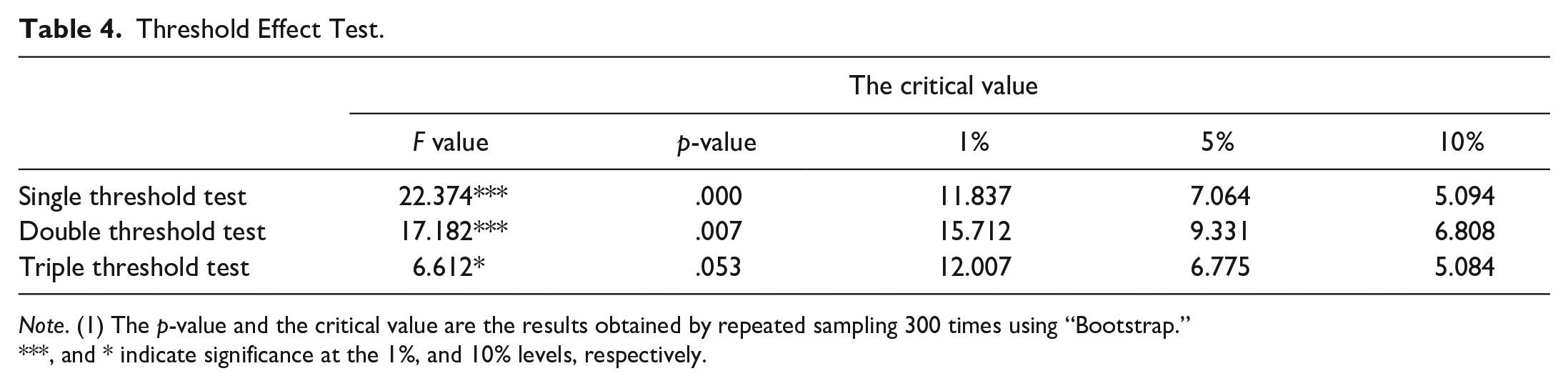
Note. (1) The p-value and the critical value are the results obtained by repeated sampling 300 times using “Bootstrap.”
, and * indicate significance at the 1%, and 10% levels, respectively.
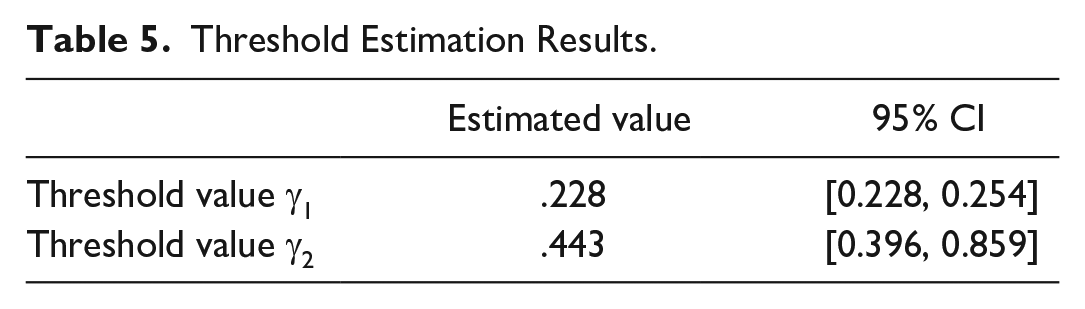
The results of the double threshold test are selected below for specific analysis. The least-square likelihood ratio statistic can identify the threshold value to observe the construction process of the threshold value when LR is zero is the threshold estimate. Figures 1 and 2 are graphs of the likelihood ratio functions of the double-threshold estimates. Table 5 shows the estimated value of the double threshold and the 95% confidence interval. The 95% confidence intervals for the two threshold estimates are [0.123, 0.154] and [0.216, 0.250], very respectively. These results show that the influence of industry heterogeneity on the efficiency of green innovation is non-linear (Figure 3).
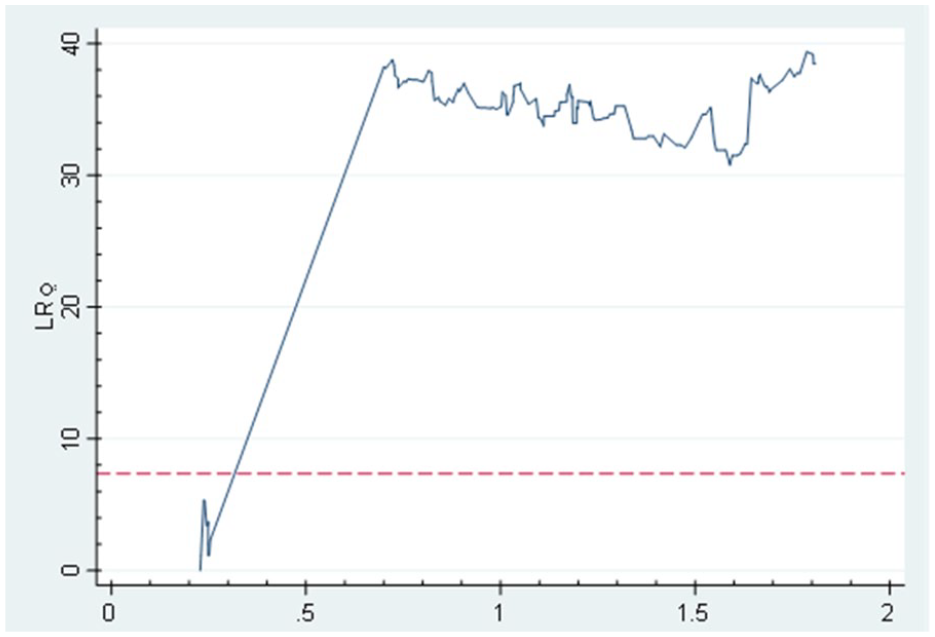
First threshold estimate and confidence interval.
Threshold Estimation Results.
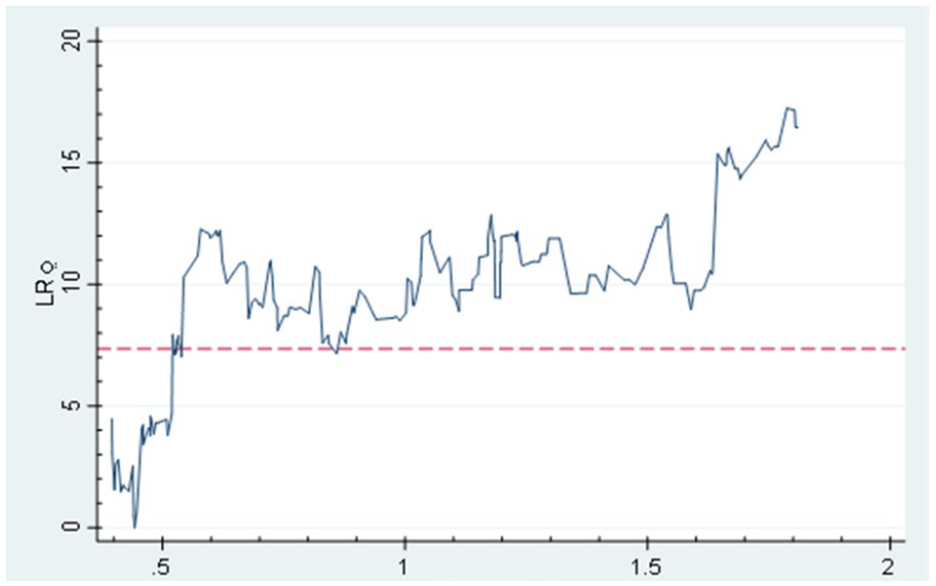
Second threshold estimate and confidence interval.
As shown in Table 5, a significant threshold effect is a complex linear relationship between industry heterogeneity and green innovation efficiency. The threshold variables’ estimated values are .228 and .443, respectively. The evaluation value of the double threshold can divide the degree of environmental regulation of Chinese industries into three segments, namely, low environmental regulation industries (
Specific Industry Names at the Threshold.

Note. Due to space limitations, only the industries in the threshold range in 2014 are listed.
Table 6 shows that the government has adopted different intensities of environmental regulation for various industries. Some manufacturing industries have low environmental negative externalization. For example, textile manufacturing and furniture manufacturing are all low-pollution-intensive industries. Therefore, the intensity of environmental regulation formulated by the government is also relatively low. The environmental regulations developed are of moderate passion for the agricultural and sideline food processing industry, tobacco manufacturing, and other industries. In addition, to encourage new energy technology innovation, the power of environmental regulations for the gas production and supply industry is not high. The most intense environmental regulations apply to heavy industries, such as coal mining and washing, paper and paper products, and pharmaceutical manufacturing. These industries are highly pollution-intensive and resource-intensive industries with very high annual emissions. Strict environmental regulations and policies must be formulated to reduce pollution emissions and encourage enterprises to improve the efficiency of green innovation.
Based on the above dual-threshold estimation results, the parameters of the double threshold model are estimated. The specific threshold regression results are shown in Table 7.
Estimation Result of Threshold Panel Model Variable Coefficient.
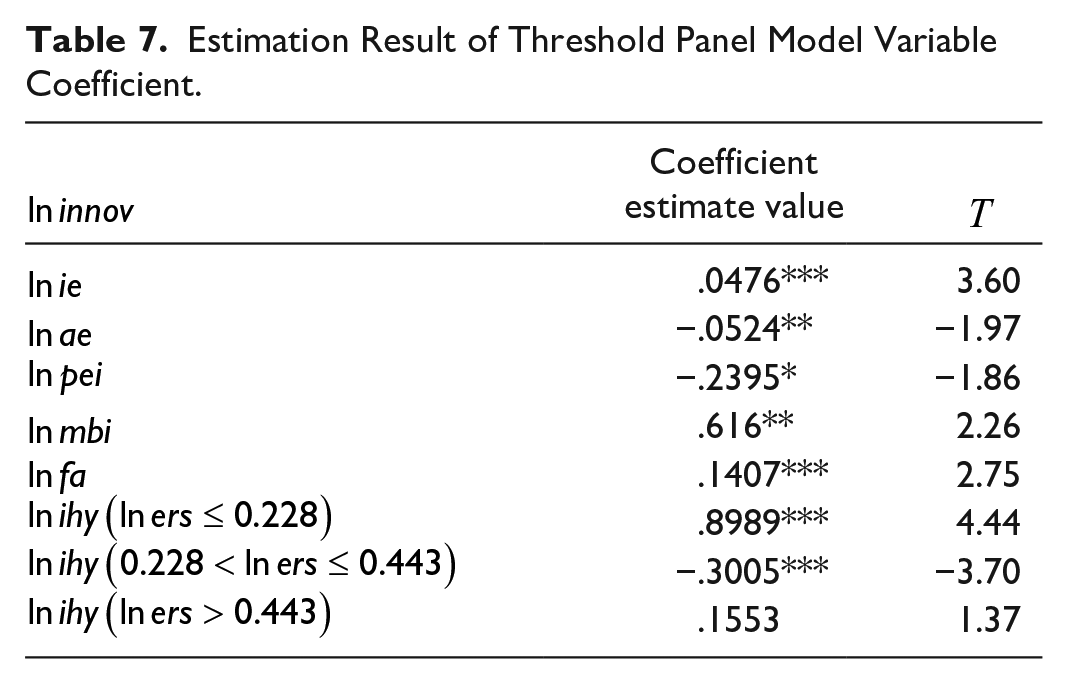
In the dual-threshold model, the environmental regulation intensity is taken as the threshold to distinguish different degrees of environmental regulation. The measurement results of the threshold effect show that when environmental regulations are in the first and third intervals, industry heterogeneity positively impacts green innovation efficiency. When the environmental regulation of the industry is in the first interval, the regression coefficient is .8989, and it passes the 1% significance level test. When the environmental regulations of industry are in the second interval, the regression coefficient is −.3005. Industry heterogeneity harms green innovation efficiency, passing the 1% significance level test. When the environmental regulations for industry are in the third interval, the regression coefficient is .1553. Still, it does not pass the 10% significance level test.
When the environmental regulation for the industry is in the third interval, the industry heterogeneity has little effect on green innovation efficiency. In other words, the impact of industry heterogeneity on green innovation efficiency in the industry is not monotonous, but there are two thresholds.
There is a non-linear relationship between industry heterogeneity and green innovation efficiency. There is an “inverted N-type” relationship between the two, and there is an inflection point in green innovation efficiency. When industry environmental regulation is in the first interval, and environmental regulation intensities are low, environmental regulation costs are inadequate. Enterprises can also invest more funds in green technology innovation for green technology innovation. At this time, the technical effect of the industry is greater than the pollution effect. When environmental regulations are in the third interval, and the degree is high, the cost of environmental regulations is much higher than the cost of green innovation. To reduce costs and increase profits, enterprises must invest more money in green innovation. With a higher degree of heterogeneity in an industry, the green innovation efficiency of the sector is more elevated. At this time, an enterprise’s pollution and technical effects are relatively high, but the technical effect is heightened. Therefore, industries with lower degrees and higher degrees of environmental regulation and industry heterogeneity positively impact green innovation efficiency.
When the intensity of environmental regulation is at an intermediate level, the higher the heterogeneity of the industry, the lower the efficiency of green innovation. Because enterprises can bear the costs of environmental regulation to obtain good benefits, no more capital is invested in green technology innovation. At this time, the industry’s pollution effect and technical effect are both high, but the influence of the pollution effect is more significant. In other words, the industrial heterogeneity increases by 1%, and the green innovation efficiency of enterprises decrease by 30%, which is a significant decrease.
In addition, from the perspective of the control variables, the operating scale of the industry has a positive impact on green innovation efficiency at a significance level of 5%. The larger the industry scale is, the higher the green innovation efficiency of enterprises. An increase in industry size will have an industrial agglomeration effect, which will reduce the cost of green innovation. The higher the efficiency of green innovation is, the lower the cost of environmental regulation, the more capital enterprises will invest in technological innovation. The lower price of green innovation technology will further expand the scale of industrial agglomeration. At a significance level of 1%, the technological innovation capacity and net fixed assets of the industry positively impact the efficiency of green innovation, which is in agreement with the practical significance. Labor input and pollution emission intensity have adverse effects on green innovation efficiency. For a long time, China’s economy has operated as an extensive economic development model, neglecting environmental protection to a certain extent. It has not paid attention to investments in innovative green technologies. There is a long way to go to improve the environment. From the industry perspective, enterprises should continue to adhere to the concept of innovative, green, and harmonious development and work with the government to protect the environment.
Conclusions and Recommendations
This paper uses industry data from 2005 to 2014 for 35 industries to discuss a non-linear relationship between industry heterogeneity and green innovation efficiency. First, industry heterogeneity is measured by the entropy weight method. In contrast, green innovation efficiency is measured by the GRS index in the SBM model. The environmental threshold is used as the threshold variable, and the non-linear threshold model is constructed for empirical analysis. The empirical results show that with an increase in environmental regulation intensity, the impact of industry heterogeneity on green innovation efficiency first changes from positive to negative. When environmental regulation crosses the second threshold, industry heterogeneity positively affects green innovation efficiency from negative to positive. According to the estimated coefficients, with environmental regulation as the threshold variable, industry heterogeneity has a significant “inverted N-type” relationship with green innovation efficiency. However, when environmental regulation is relatively high, the impact of industry heterogeneity on green innovation efficiency is not apparent. It does not pass the 10% significance test.
This research creatively emphasizes the influence of industry heterogeneity on the efficiency of green innovation from the industry level and finds a significant “inverted-N” relationship between industry heterogeneity and green innovation efficiency, which provides some insights for the scientifically setting of environmental regulations. As a whole, the current environmental regulation system has promoted the green growth of the industry to a certain extent. However, it has also restrained economic growth to a certain extent. Therefore, the government can appropriately adjust the intensity of environmental regulations within a reasonable range to provide a positive incentive for energy conservation, emission reduction, and technological innovation in the industry. Due to the apparent heterogeneity of different sectors, it is necessary to avoid uniform static standards in the industry and blindly increase the intensity of environmental regulations when formulating environmental regulations. The government should adopt flexible and rolling regulatory measures according to the characteristics and development realities of different industries and use various forms of environmental regulation to continue to play a vital role. Specifically, this article puts forward the following suggestions.
First, at the industry level, the state needs to improve the degree to which enterprises attach importance to the efficiency of green innovation. Industries heterogeneity should be appropriately enhanced for industries with low degrees of environmental regulation to encourage enterprises to carry out green innovation. For sectors with medium-level environmental regulation, enterprises should reduce heterogeneity. The government should provide certain economic compensations to enterprises to not reduce the environmental regulation. It can compensate for the costs brought by high degrees of environmental regulation. At the same time, it can provide favorable conditions for reducing pollution and improving green innovation efficiency.
Second, the state should improve the incentive mechanism for green innovation at the government level. The government should vigorously encourage the development of clean industries and allow clean energy to replace non-renewable energy gradually. At the same time, the government can also raise the barriers to entry for high-polluting and high-energy-consuming companies and assist companies in increasing investment in green technology innovation. Enterprises improve investment in green technology innovation, use low-pollution production factors to enhance industrial competitiveness, and eliminate outdated production capacity. At the same time, the intensity and implementation of environmental regulations are very different in different regions. This will affect the implementation effect of environmental laws and regulations, resulting in a certain degree of rent-seeking. Currently, it is imperative to improve the legislative system for environmental planning.
Finally, the environment is not only the responsibility of the government. Protecting the environment and reducing smog pollution should result from the joint efforts of the government, economy, and society. For example, the Chinese government has advocated green travel for residents to alleviate environmental pressure. This policy has achieved good results (Jia et al., 2017). Therefore, the government can encourage consumers to choose more environmentally friendly products, reject high-pollution products, start with themselves, and be aware of environmental protection. In this way, enterprises will seize the market with technological innovation to achieve a win-win situation among all three parties.
In addition, it is also possible to innovate environmental regulation models and link environmental regulation with market incentives. The standard error of technology evaluation is significant. We cannot evaluate technological innovations in different industries and even in various enterprises effectively. That is, the standards of environmental regulation are vague. Therefore, China should encourage the use of standard performance regulations to strengthen the innovation of environmental regulations. Enterprises need to invest a considerable workforce and resources in technological innovation. We can use market mechanisms to allow permits to be traded. In this way, enterprises with high green innovative technologies would benefit from environmental regulations. High-polluting enterprises would lose more profits. Therefore, the government encourages enterprises to develop green innovation and create a better ecological environment.
This article uses environmental regulations as a threshold variable to study the effect of industry heterogeneity on the efficiency of green innovation. This article has achieved some research results. However, some problems still need to be reviewed and perfected in the future. For example, the existing research content is complicated. The data are imperfect, our knowledge reserves and time are limited, and the research samples and period obtained are insufficient. Future research needs to expand the research space further. We need to capture the evolution and characteristics of Chinese green innovation efficiency. We can also scale down from 35 industries to the Chinese manufacturing industry. As the pillar industry in China, the manufacturing industry consumes a lot of energy every year. At the same time, the green innovation efficiency of the manufacturing industry is gradually improving. However, the Chinese manufacturing industry still has great potential for energy conservation and emission reduction (Qu et al., 2017). Future research can narrow the research object, further expand the research area, and refine the evolutionary trajectory of green technology innovation efficiency in China. In addition, fiscal decentralization can be a moderating variable to consider government support for different industries. Game theory can also be used to deeply explore the influence mechanism of industry heterogeneity on the efficiency of green innovation.
Footnotes
Declaration of Conflicting Interests
The author(s) declared no potential conflicts of interest with respect to the research, authorship, and/or publication of this article.
Funding
The author(s) received no financial support for the research, authorship, and/or publication of this article.
