




Abstract
This study presents a comprehensive bibliometric and systematic analysis of electroencephalography (EEG) studies in consumer behavior within marketing research while exploring its academic and practical implications. Following the PRISMA protocol, a rigorous examination of 53 articles from the Web of Science database (WoS) was conducted. The analysis highlights that EEG has predominantly investigated consumer behavior across various marketing stimuli, including products, advertising, pricing, and branding. Notably, advertising emerged as the primary focus, encompassing 49% of the analyzed articles (26). The USA emerged as the leading country in neuromarketing, with a notable contribution from the University of California System. Frontiers in Neuroscience emerged as the most prolific journal. EEG in marketing research enables scholars to bypass verbal biases and gain profound insights into consumers’ responses, significantly contributing to over 90% of their reactions toward marketing stimuli. This study provides valuable insights into the diverse applications of EEG in marketing research, with potential avenues for further investigation in areas such as consumer personality and social consumer neuroscience, which remain relatively underexplored.
Plain language summary
This study presents a comprehensive bibliometric and systematic analysis of electroencephalography (EEG) implementation in consumer studies toward marketing stimuli. This study has been designed to provide a bibliometric and systematic analysis of electroencephalography (EEG) studies in consumer behavior toward advertising, product, price, and brand. This study followed the Preferred Reporting Items for Systematic Reviews and Meta-Analyses (PRISMA) framework to select and analyze articles. In this study, 53 articles were extracted and analyzed from the Web of Science (WoS) database. The findings highlight that EEG has been predominantly utilized to investigate consumer behavior across various marketing stimuli, including advertising (e.g., spokesperson, online and offline ads), product (e.g., E-commerce of product,…, etc.), Price (e.g., price perception,…, etc.), brand (extension, disclosure,…, etc.). Notably, advertising emerged as the primary focus, encompassing 49% of the analyzed articles (26 articles). The USA emerged as the leading country in the field of neuromarketing, with a notable contribution from the University of California System. Frontiers in Neuroscience was the prominent journal in neuromarketing and EEG research. This study provides valuable insights into the diverse applications of EEG in marketing research, with potential avenues for further investigation in areas such as consumer personality and social consumer neuroscience, which remain relatively underexplored in the context of EEG implementation. The application of EEG in marketing research can help scholars to avoid verbal biases and gain valuable insights into consumers’ behavior to marketing stimuli. Therefore, the use of EEG equipment provides a more accurate and in-depth understanding of consumer behavior, leading to better marketing strategies and decisions.
Introduction
For a considerable duration, researchers have employed qualitative and quantitative methods to examine how consumers behave in the realm of business (Alsharif et al., 2021; Alvino et al., 2020). Qualitative methods in neuromarketing involve the collection and analysis of data through interviews and focus groups (Glerean et al., 2019; Hakim & Levy, 2019). These methods allow researchers to gain insights into consumers’ preferences and responses to marketing stimuli such as products, advertising, brands, and prices (Rawnaque et al., 2020). However, qualitative methods are still widely used in analyzing consumer interests, as they can provide an in-depth understanding of the motivations behind consumers’ behaviors (Crespo-Pereira et al., 2020). On the other hand, quantitative methods (e.g., surveys and questionnaires) are commonly used in neuromarketing to measure consumer behaviors, knowledge, opinions, or attitudes (Li et al., 2022). These methods are considered less effective in capturing the complex neural processes underlying consumer behavior (Ahmed, NorZafir, Shaymah Ahmed, & Ahmad, 2022; Oliveira et al., 2022). However, the limitations of self-report techniques, such as questionnaires or surveys, have led to the emergence of consumer neuroscience (Alsharif, Salleh, Baharun, Abuhassna, & Alsharif, 2022), which utilizes more objective and accurate tools from the fields of neuroscience and psychology (Sánchez-Fernández et al., 2021).
Incorporating quantitative methods and neuroimaging techniques can provide a more comprehensive understanding of consumer behavior (Hastie et al., 2020). For example, mixed methods research designs can be employed, starting with qualitative methods to identify relevant motivators or desires of consumers, and then testing the effectiveness of these factors using quantitative methods (Busalim et al., 2022). Neuroscience methods provide an alternative means to understand consumer behaviors by delving deeper into the cognitive processes and underlying mechanisms (M.-H. Lin et al., 2018). Accordingly, in the last decade, there has been a remarkable increase in the utilization of neuroimaging techniques (Lindsey et al., 2019), particularly electroencephalography (EEG), within the domain of business and marketing research (Casado-Aranda et al., 2019; Oliveira et al., 2022). Neuroscience techniques have been employed to investigate consumers’ thoughts and preferences regarding various marketing stimuli such as products, branding, advertisements, and pricing to predict consumers’ purchasing decisions (Ahmed, NorZafir, Mazilah, et al., 2023; Bazzani et al., 2020; Cherubino et al., 2019).
Neuromarketing is a growing field that utilizes neuroimaging techniques to understand consumer behavior and decision-making processes (Ahmed, NorZafir, Mazilah, et al., 2023; A. H. Alsharif et al., 2023). This field has gained significant interest in recent years (Ahmed, NorZafir, Rami Hashem, et al., 2023; Pilelienė et al., 2022). Smidts (2002) is the first business researcher who has coined the term “neuromarketing” in 2002 and defined it as the application of neuroscience techniques (e.g., EEG and fMRI) in business practices (Cherubino et al., 2019; Sánchez-Fernández et al., 2021). The adoption of neuroscience techniques, such as neurophysiological measures and EEG, has allowed researchers to explore both conscious and unconscious drivers of consumer behavior (Bazzani et al., 2020; Harris et al., 2018). Eye-tracking is another neuromarketing technique that has been used to study consumer behavior (Grigaliunaite & Pileliene, 2015; Hassan-Alsharif et al., 2021b). Accordingly, the field of marketing research has expanded significantly, primarily due to advancements in neuroscience and the adoption of state-of-the-art neuroimaging and physiological techniques (Ahmed, NorZafir, Wan Amira, & Ahmad, 2022; Oliveira et al., 2022). These techniques enable researchers to identify neural responses associated with consumers’ behaviors, such as buying decisions, pleasure or displeasure, recall, and recognition, triggered by marketing stimuli, including but not limited to advertisements (Oliveira et al., 2022). It is important to note that neuromarketing does not aim to replace traditional methods but rather complements them by offering valuable insights into consumers’ subconscious reactions that cannot be measured using conventional methods (A. H. Alsharif et al., 2023; Sebastian, 2014).
According to the existing literature, the utilization of neuroimaging and physiological techniques is crucial in conducting research within the field of neuromarketing. As a result, neuromarketing techniques have been categorized into two main types: (i) Metabolic brain tools, such as functional magnetic resonance imaging (fMRI) and positron emission tomography (PET), and (ii) Electrical brain tools, including electroencephalography (EEG) and magnetoencephalography (MEG) (Plassmann et al., 2007). Among these tools, EEG is considered the most favored and commonly used by researchers. This preference can be attributed to its relatively lower cost (W.-K. Cui et al., 2022), excellent temporal resolution, and reduced background noise (Hassan-Alsharif et al., 2020a).
Aware of the growing interest in neuromarketing, several studies analyzing scientific production on neuromarketing (Hassan-Alsharif et al., 2020b; Sánchez-Fernández et al., 2021); fMRI and fNIRS (Hassan-Alsharif et al., 2023) have already been published. Bazzani et al. (2020) have conducted an SLR study to present an overview of EEG applications in consumer neuroscience within the marketing mix, data extracted from SC, WoS, PubMed, Emerald, and EconLit SC between 2000 and 2020. In addition, Alsharif, Salleh, Pilelienė, et al. (2022) have conducted a bibliometric to provide the global academic trends of EEG studies used in neuromarketing, data extracted from the SC database between 2016 and 2020. However, no previous bibliometric and systematic analysis research was performed to map ([neuromarketing or consumer neuroscience] and [electroencephalography or EEG]) research production in the Web of Science (WoS) database. This study differs from other review papers in terms of concentrating on the global academic research trends of studies that used EEG in neuromarketing and consumer neuroscience research between 2010 and 2020 on the WoS database. To this end, this study tries to fill the gap in scientific literature. The present of this study is to identify the global academic research trends deeply in (neuromarketing OR consumer neuroscience) AND (electroencephalography OR EEG), as well as to provide a content analysis of selected articles for this study in a comprehensive and concise conclusion. The main contributions and steps of this bibliometric and systematic analysis study are summarized and listed as follows:
(1) To provide the growth of annual scientific publications based on journals’ outputs.
(2) To identify the overall performance (e.g., outstanding countries, institutions, journals, and authors).
(3) To identify the most prominent themes/keywords.
(4) To identify the most-cited articles to be considered in future studies.
(5) To provide a systematic analysis of selected articles in this study.
The structure of this research is as follows: Section “Theoretical Substantiation” provides the theoretical substantiation. Section “Materials and Methods” outlines the methodology employed in this study. Section “Results and Discussions” is concerned with a bibliometric and systematic analysis of findings. Sections “Practical and Theoretical Implications” provides a discussion of the study’s findings. Section “Conclusions” provides concise conclusions. Finally, Section “Limitations and Future Directions” presents the study’s limitations and potential future directions.
Theoretical Substantiation
During the early 1970s, researchers pioneered the use of electroencephalography (EEG) to measure consumers’ responses to television ads (Cherubino et al., 2019). EEG is a non-invasive and electrical tool that captures the cortical activity regions in the subject’s brain using multiple electrodes placed on the subject’s scalp (Beniczky & Schomer, 2020; Berger, 1969). EEG widely adopted 10 to 20 system (Badcock et al., 2013; Finn et al., 2019; Hinrichs et al., 2020), which facilitates the standardized representation of electrode locations on the scalp, including regions such as prefrontal (PF), frontal (F), occipital (O), parietal (P), temporal (T), and central (C). Additionally, when implementing EEG, ensuring an equal distribution of electrodes on both the right and left sides of the participant’s head (Rawnaque et al., 2020; Silverman, 1965). EEG electrodes allow us to measure the electrical signals within specific areas of the brain’s cortex by recording voltage differences between electrode pairs (Kane et al., 2017).
Electrodes used in electroencephalography (EEG) are typically made of conductive materials such as silver-silver chloride (Beniczky & Schomer, 2020; Breitenbach et al., 2023; Di Flumeri et al., 2019). These electrodes are connected to the EEG amplifier through conductive gel or paste (Bullock et al., 2021; di Fronso et al., 2019; Y. Fu et al., 2020; Hinrichs et al., 2020). The use of silver-silver chloride electrodes is widespread due to their advantageous characteristics, including low cost, high stability, reproducibility of potential, and electrochemical reversibility (Breitenbach et al., 2023). Gel-based silver-silver chloride electrodes are commonly used as a standard for electrophysiological measurements (Fiedler et al., 2022). Scalp electrodes, which are a type of EEG electrode, are made of non-polarized materials such as silver-silver chloride or gold (Beniczky & Schomer, 2020). While gel-based electrodes are commonly used, they have limitations such as extensive preparation time, cleaning requirements, and limited long-term stability, especially in out-of-the-lab conditions (di Fronso et al., 2019). To address these limitations, there have been advancements in the development of dry electrodes, including microneedle array electrodes coated with silver-silver chloride (Y. Fu et al., 2020).
The EEG tool offers precise temporal accuracy, enabling the measurement of cortical activity regions in the brain at the millisecond (ms) level (Cherubino et al., 2019; Tawhid et al., 2020). EEG data acquisition typically involves the use of 32 or 64 electrodes (Lun et al., 2020).
EEG analysis often involves exploring a broad range of EEG frequencies in a data-driven manner (Frohlich et al., 2019). However, it exhibits limited spatial accuracy, preventing the recording of distal activity regions within the deep brain structures, with an estimated coverage of approximately 1 cm3 in cortical areas (Telpaz et al., 2015; Zurawicki, 2010). To assess the brain’s response to motor, sensory, and cognitive stimuli, EEG can utilize Event-Related Potentials (ERPs) to detect small voltage changes (Blackwood & Muir, 1990). Existing literature identifies five frequency bands associated with this technique: delta (<4 Hz), theta (4–7 Hz), alpha (8–15 Hz), beta (16–31 Hz), and gamma (>32 Hz) (Wei et al., 2018). Despite its affordability and minimal noise, EEG is limited to capturing cortical activity and is unsuitable for recording distal brain regions (Morin, 2011). Its applications include the measurement of attention, memory, and emotional valence (Di Flumeri et al., 2016; Ohme & Matukin, 2012; Vecchiato & Babiloni, 2011). Additionally, the average preparation and execution time for EEG experiments is approximately 60 minutes (min), with a moderate level of integration potential when used in conjunction with other tools (Alvino et al., 2020).
A wearable EEG tool has a portable cap, a base station, and a pre-amplifier. Researchers and practitioners have used wearable EEG and classical EEG tools to measure consumers’ behaviors (e.g., attention, memory, emotional valence, and so forth) toward marketing stimuli (e.g., products, brands, ads). A wearable EEG is more convenient, cheaper (use less number of EEG channels), and easy to set up compared to classical EEG because it gives participants more freedom in movement/mobility (Badcock et al., 2013; Guo et al., 2018; Yadava et al., 2017). Several types of EEG headsets, such as Emotiv, OpenBCI, and NeuroSky (Lystad & Pollard, 2009), can be portable and wireless EEG (Sargent et al., 2020). In addition, the average time for participant’s preparation is less than classical EEG (estimated 5–6 min for Emotive, OpenBCI). According to the literature, wearable EEG can record neural activity signals (Qiu et al., 2019), more sensitive to muscle movements (Badcock et al., 2013; Ratti et al., 2017). Therefore, it has become possible to record the brain activity signal toward marketing stimuli such as ads, brands, and products; thereby, it is important for the early evaluation of marketing research.
In recent years, there have been advancements in electrode technology for EEG. The new development of flexible 3D-printed EEG electrodes has also incorporated silver-silver chloride coating to improve sensing performance (Velcescu et al., 2019). For example, a new 3D printed dry-contact electrode has been developed, composed of a conductive AgNWs/PDMS composite material and a support shell designed and manufactured using 3D printing technology (Abdullah & Al-Neami, 2021). Another development is the use of dry electrodes made from polyurethane and coated with Ag/AgCl, which allows for high-density EEG recordings (Fiedler et al., 2022). This advancement allows for personalized, and 3D printed on-skin electrodes that can be made using a variety of materials with distinct properties such as stretchability, conformal interfaces with the skin, biocompatibility, wearable comfort, and low-cost manufacturing (A. A. Alsharif et al., 2023). The use of silver-silver chloride coating on the electrodes enhances their sensing performance compared to earlier 3D-printed designs that used only silver for conductivity (Velcescu et al., 2019). The incorporation of this coating is part of the broader trend of flexible electronics and wearable devices, which have the potential to revolutionize the field of electrophysiological signal monitoring (Liu et al., 2021). The 3D printing process used to manufacture these electrodes is scalable and efficient, allowing for the creation of complex structures layer by layer (Qian et al., 2022). Additionally, the use of silver nanowires in the printing process enables the fabrication of flexible and stretchable devices, such as electrocardiogram (ECG) electrodes, demonstrating the versatility of this technique (Z. Cui et al., 2018). While silver-silver chloride electrodes have been the gold standard for EEG signal recording due to their reliable electrochemical characteristics, the development of new electrode concepts, such as the arch electrode, aims to improve wearing comfort without compromising performance (Vasconcelos et al., 2021). The incorporation of silver-silver chloride coating in flexible 3D-printed EEG electrodes represents a significant advancement in the field, offering personalized, low-cost, and high-performance solutions for electrophysiological signal monitoring.
Different types of electrodes have been used in EEG, including Ag/AgCl electrodes and flexible conductive polymer electrodes. Ag/AgCl electrodes combined with a conductive gel are the most widely used electrodes in EEG (L. Yang et al., 2022). They have been conventionally used as reliable interfaces for EEG recording (C. Wang et al., 2022). Ag/AgCl electrodes approach the characteristics of a perfectly non-polarizable electrode and are the most frequently used electrode material in clinical recordings of EEG (Kalevo et al., 2019). On the other hand, flexible conductive polymer electrodes, such as PEDOT: PSS electrodes, have been developed for flexible and stretchable electronics. These electrodes have shown promise in applications for wearable and flexible EEG devices (Fan et al., 2019). Additionally, there have been advancements in the development of dry electrodes for EEG recording. Dry electrodes offer advantages such as ease of use and comfort for the wearer. They have been shown to reach traditional wet electrode quality standards (Di Flumeri et al., 2019). Various materials have been explored for dry electrodes, including carbon nanofiber-filled conductive silicone elastomers (Slipher et al., 2018), graphene Nano-powder (Divya et al., 2023), and textile-based materials (Tseghai et al., 2021a). These dry electrodes have demonstrated comparable signals to standard wet electrodes (Tseghai et al., 2021b). Furthermore, there have been studies on the use of other types of electrodes, such as stainless steel and platinum electrodes, for EEG recording (Ku et al., 2018; Musteata et al., 2018). These electrodes provide reliable and accurate measurements of electrical activity in the brain. Advances in electrode technology have led to the development of dry electrodes and 3D printed electrodes, which offer improved comfort and convenience for EEG recordings (Abdullah & Al-Neami, 2021; Beniczky & Schomer, 2020; Fiedler et al., 2022). The choice of electrode material depends on factors such as the specific application, comfort, and signal quality requirements.
Materials and Methods
The preparation of a protocol is a fundamental for conducting systematic literature reviews. This paper aims to conduct a bibliometric and systematic review analysis of neuromarketing or consumer neuroscience and electroencephalography. This study has been designed to extract only articles from the Web of Science (WoS) database to fill the gap in the literature. The Preferred Reporting Items for Systematic Reviews and Meta-Analyses (PRISMA) protocol has been widely used in scientific research (Moher et al., 2015). This protocol has been developed later by M. J. Page et al. (2021). This study followed the guidelines outlined in the Preferred Reporting Items for Systematic Reviews and Meta-Analyses (PRISMA) protocol of M. J. Page et al. (2021), ensuring a meticulous identification of relevant articles that have used EEG in neuromarketing research (see Figure 1). PRISMA protocol is one of the most used protocols to report findings (Paul et al., 2023). Employing a bibliometric and systematic analysis method, the study aimed to uncover and examine global research trends within the field of neuromarketing or consumer neuroscience and EEG. To achieve this, five research questions, were formulated to guide the structure of the analysis and gain a thorough understanding of the existing scientific research in the analyzed domain. These research questions were thoughtfully designed to shed light on key areas of interest and contribute to advancing knowledge in neuromarketing or consumer neuroscience and EEG, as follows.
RQ1: Is there and what is the annual growth of scientific publications in the field?
RQ2: What is the most productive: (a) countries; (b) academic institutions; (c) journals; and (d) authors?
RQ3: What are the most prominent keywords in selected articles?
RQ4: What are the most-cited articles in neuromarketing and EEG?
RQ5: What relevant information can be found in the content of the selected articles?
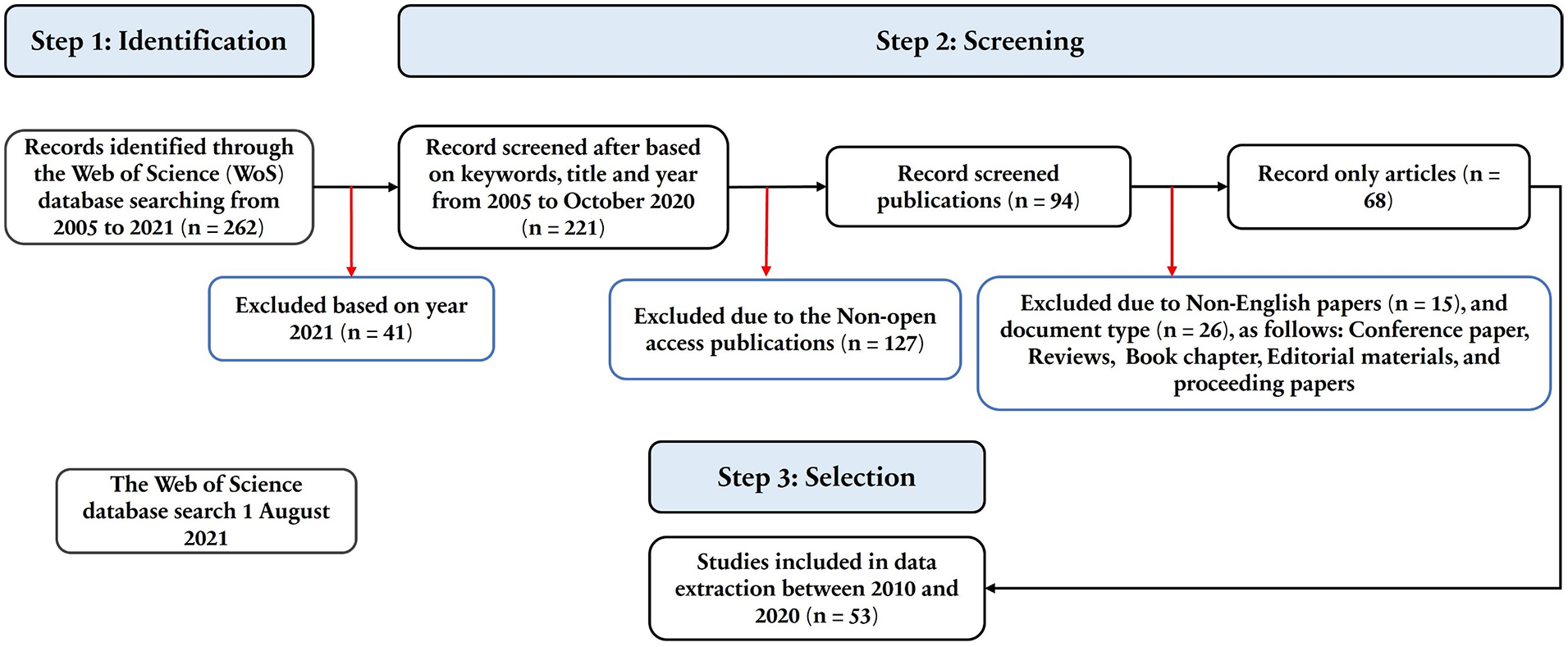
PRISMA process for selecting documents.
Search Criteria
Endeavoring to answer the research questions, the current study starts by extracting articles from the WoS database in August 2021. This study has selected 10 years (2010–2020) duration for extracting articles for this study because we have observed that the number of publications has increased gradually since 2010. Additionally, we believe that the utilization of a 10-year database is justified in this context as it aligns with the objectives and requirements of our research. Wherein it provides a substantial and meaningful dataset to effectively address our research questions. The key theme of this study was articles in neuromarketing, consumer neuroscience, and EEG research; the following query was applied to the title, abstract, and keywords: TITLE-ABS-KEY (neuromarketing OR consumer neuroscience) AND (electroencephalography OR EEG).
Data Selection
This study starts by selecting articles from the WoS database in August 2021. In addition, this study has followed the instructions of Ahmed, NorZafir, Mazilah, et al. (2023) and A. H. Alsharif et al. (2023) to present a thorough bibliometric and systematic analysis detecting and listing the most productive countries, academic institutions, journals, and authors; later on, a brief description of each analyzed parameter is provided. The inclusion and exclusion documents selected upon on the following criteria:
Inclusion: This study has included the English language articles that utilized the EEG tool in marketing research, which have been published the last decade (2010–2020).
Exclusion: This study has excluded documents such as reviews, book chapters, proceeding papers, and editorial materials.
Bibliometric and Systematic Tools in This Study
The present study adopts a bibliometric (VOSviewer tool) and systematic approach (PRISMA protocol) to map out the entire body of knowledge. While it’s true that the PRISMA protocol and VOSviewer software have been in existence for almost a decade, it’s important to note that their value and relevance have not diminished over time. The longevity of these tools is a testament to their effectiveness in their respective domains. However, there have been several important developments and contributions that have enhanced their utility and applicability. For instance, M. J. Page et al. (2021) have been developed the PRISMA framework. New versions often introduce improved features and functionalities, making them more powerful and user-friendly. Du and Chen (2022) have developed a new guiding procedure integrating the PRISMA guidelines into the bibliometric standard workflow and using Biblioshiny, VOSviewer, and NVIVO software as tools. Bibliometric studies have previously been conducted by using VOSviewer (Abbas et al., 2022; Ali et al., 2021a; Alsharif, Salleh, Baharun, Abuhassna, & Alharthi, 2022; Siddique et al., 2023), R-tool (Aria & Cuccurullo, 2017; Flores et al., 2023), and so forth. The VOSviewer tool was utilized in this study to create, visualization maps, which simplifies bibliometric research across various fields (Alsharif et al., 2021; Pilelienė et al., 2022). In particular, VOSviewer has been used in several studies to gain a comprehensive understanding of the development of a specific theme (Ahmed et al., 2021; Ali et al., 2021b). To enhance comprehension of the methods and instruments employed in this investigation, a more comprehensive outline is presented in Figure 2. This outline aims to provide a clearer insight into the processes and tools utilized.

The analytical structure of this study.
Results and Discussions
This study found a total of 53 academic journal articles have been published that focus on the utilization of EEG in neuromarketing and consumer neuroscience research. The earliest articles that employed EEG in the field of neuromarketing were published in 2010 by Vecchiato et al. (2010) and Treleaven-Hassard et al. (2010). These initial studies investigated the impact of commercial advertisements on consumers’ behavior. For instance, there were two original articles published in 2010, which then increased sixfold by 2020. This upward trend is expected to continue, given the significance of the topic and its status as a prominent area of research, focusing on understanding consumers’ subconscious and unconscious responses towards the marketing environment. Figure 3 illustrates the annual and cumulative original articles that have been used EEG tool in neuromarketing research between 2010 and 2020.

The number of annual and cumulative original articles during 2010 to 2020.
Scientometric Analysis
Prominent Countries and Institutions
The analysis revealed that the most productive countries, with a minimum of three original articles, can be categorized into four groups: (i) countries that have published more than 10 original articles, (ii) three countries that have published between 5 and 10 original articles, (iii) two countries that have produced four original articles each, and (iv) five countries that have produced three original articles each, as tabulated in Table 1. Notably, the United States, China, Spain, and Germany have emerged as the leading countries in neuromarketing research, collectively contributing to over 60% of the original articles published since 2010. The United States, for instance, stands out as the most productive country, with 13 original articles and the highest total citation count (156 TCs). Among the productive institutions in the United States, the University of California System has published four original articles, also accumulating the highest citation count (66 TCi). The 2nd productive country is China, with nine articles and 55 TCs, but its institute, that is, Universidad Politecnica de Valencia, is the most prolific academic institution with two articles and 27 TCi.
The Most Productive Countries and Academic Institutions Used EEG in Neuromarketing Research (Minimum Contributions of Two Articles).

Note. TPs = total publications; TCs = total citations; TPi = total publications by institution; TCi = total citation for an institution; ESP = Spain; DNK = Denmark; DEU = Germany; MYS = Malaysia; ITA = Italy; KOR = South Korea; CHN = China; AUS = Australia; JPN = Japan; ENG = England.
Although Spain has published six articles, it has the second-highest citation with 64 TCs, and its institute Universidad Politecnica de Valencia has published three articles with 39 TCi. Two countries, England and Japan, have produced two articles, each with 42 and 13 TC. Last but not least, Italy, Denmark, Malaysia, Australia, and South Korea have contributed three articles with 35, 62, 36, 30, and 4 TCs.
Only one academic institution (University of California System) published four articles, followed by Universidad Politecnica de Valencia with three articles. The remained academic institutions have published less than two articles.
Prominent Authors
Table 2 presents the top 10 contributing authors who have produced at least two original articles. Ten authors from six different academic institutions have contributed two original articles each, totaling 20 articles, indicating significant output. It is worth noting that only four authors have produced original articles with more than 35 citations. For instance, Granero, A. C.; Ornedo, V. N.; Raya, M. A., are affiliated with Universidad Politécnica de Valencia (Spain) and published two original articles with 38 citations each. This is followed by Babiloni, F. affiliated with Sapienza Università di Roma (Italy) with 35 citations. Ramsøy, T. Z., associated with Neurons Inc. and Copenhagen Business School (Denmark), as well as Singularity University (USA), produced two original articles with 22 citations. Goto, N.; Lim, X. L.; Schaefer, A.; and Shee, D., from Monash University (Malaysia), published two original articles with 19 citations each. Finally, Kim, S. P., from Ulsan National Institute of Science and Technology Unist (South Korea), had the lowest number of citations with four.
The Most 10 Productive Authors Used EEG in Neuromarketing Research.

Prominent Journals
Table 3 provides an extensive overview of the prominent productive journals in the neuromarketing/consumer neuroscience field, each containing a minimum of two original articles. Frontiers in Neuroscience emerges as the most prominent journal, featuring eight original articles and ranking second in total citations (TCs) (67 TCs). Notably, Y. P. Lin et al. (2014) authored this journal’s fourth-highest-cited article (33 citations). Conversely, the Journal of Marketing Research, despite publishing only two original articles, boasts the highest TCs count (203 TCs) and the most highly cited article (145 citations) authored by Venkatraman et al. (2015). This illustrates that the number of publications alone does not necessarily correlate with the citation count. Despite being ranked fifth with three original articles, the Scientific Reports journal published the third-highest cited article (39 citations) written by R. W. Wang et al. (2016). Similarly, Cognitive Neurodynamics, ranking seventh with two original articles, published the fifth-highest cited article (24 citations) by Kong et al. (2013).
The Prominent Journals on Neuromarketing (Minimum of Two Articles).
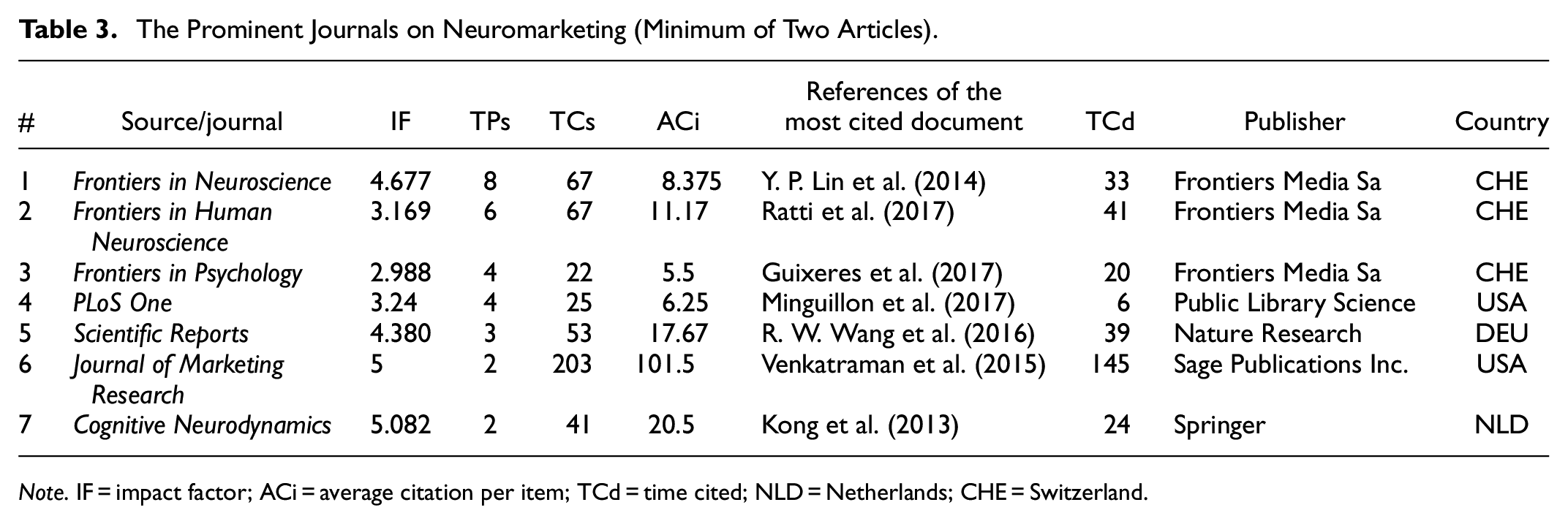
Note. IF = impact factor; ACi = average citation per item; TCd = time cited; NLD = Netherlands; CHE = Switzerland.
Considering the impact factor (IF) of the WoS database in 2020, two journals showcased an impact factor exceeding five. Interestingly, Cognitive Neurodynamics possesses the highest impact factor (5.082), yet ranks seventh among the most productive journals in the list. On the other hand, Frontiers in Psychology, with the lowest impact factor (2.988), published four articles. Hence, to assess the productivity and impact of journals publishing articles utilizing EEG in neuromarketing, two indicators were considered: the number of publications per author as a measure of productivity and the average citation per item (ACi) as an indicator of journal impact. ACi was calculated by dividing the TC/TP. Despite only two articles, the Journal of Marketing Research demonstrated the highest ACi (101.5 ACi) on the list with 203 TC, closely followed by Cognitive Neurodynamics with an ACi of 20.5.
Keywords Analysis
Keywords analysis is essential for providing a coherent and concise explanation of the content of articles (Pourhatami et al., 2021). Meanwhile, it is a useful technique to deal with future research directions and evaluate the spotlight subjects by inspecting the academic publications. Keywords analysis relies on the number of keywords appearing in one article (M. Wang & Chai, 2018). The link strength between two keywords can be expressed in numerical methods, wherein the link strength between two keywords is represented in the appearance number of keywords in one article, wherein the aggregate number refers to the appearance number of both keywords in one article; thereby, a higher number means higher link strength (Ravikumar et al., 2015). In this study, the authors used the VOSviewer software package to draw up the map/network of the keyword analysis. It has been used author keywords with two as the minimum occurrence that indicates keywords will include occurrences two times between both keywords in one article. The findings showed that 28 keywords from 53 articles had appeared. Figure 4 shows the visualization network of studies that have used the EEG tool in neuromarketing research to measure the consumers’ behavior such as attention, emotion, attitudes, and so forth toward marketing stimuli brands and advertising.
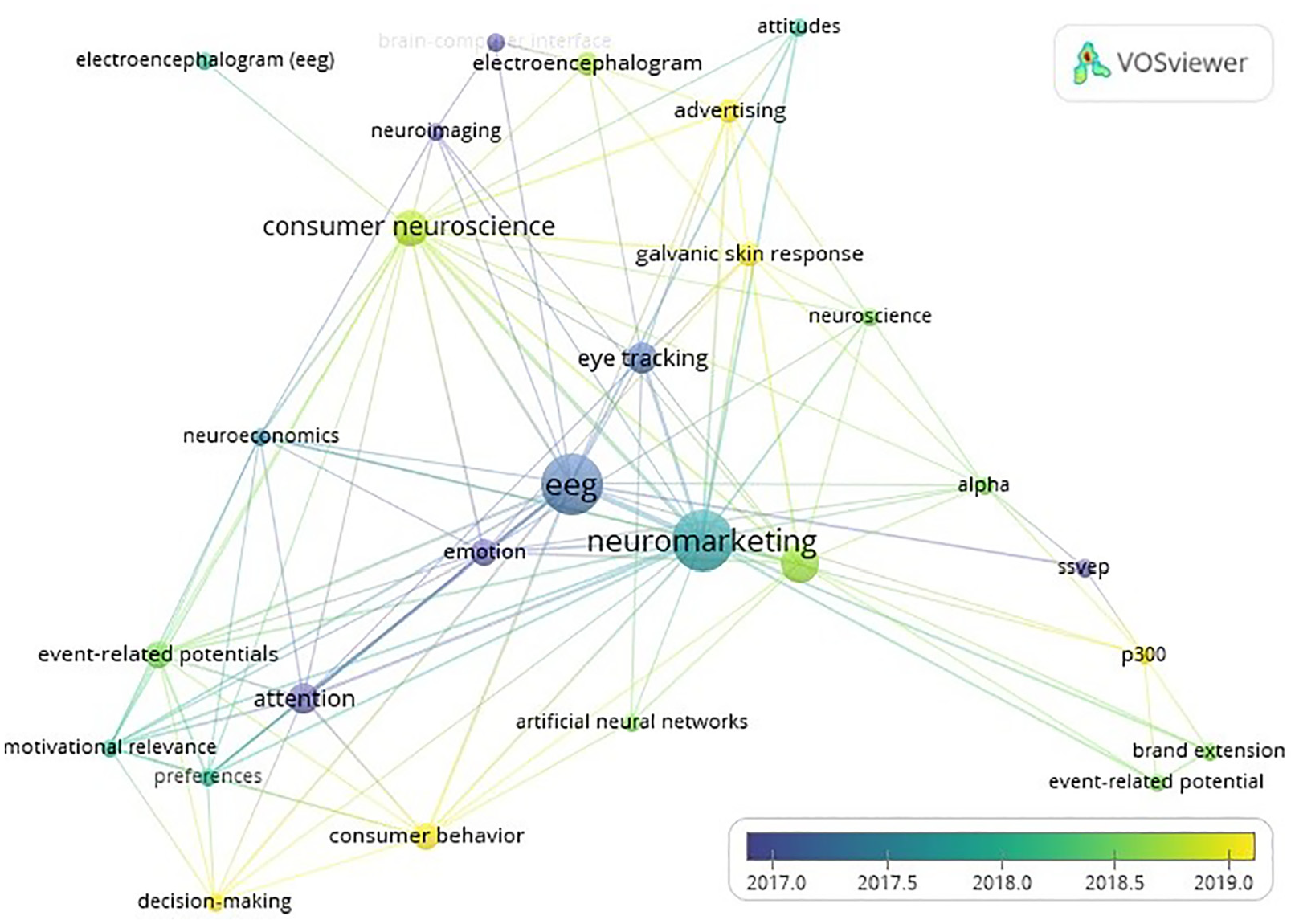
Map of authors’ keywords co-occurrence (with minimum of two occurrences).
Table 4 summarizes the most frequent keywords with a min. of two occurrences, wherein the highest keyword occurrence is electroencephalography (EEG). For example, neuromarketing uses neuroscience tools such as Electroencephalography (EEG) (35 occurrences, 67 TLS), Event-related potential (six occurrences, 25 TLS), Eye-tracking (five occurrences, 13 TLS), and Galvanic Skin Response (three occurrences, 13 TLS). Neuromarketing research that used EEG tool or event-related potential focused on consumers’ behaviors such as attention (five occurrences, 21 TLS), emotion (four occurrences, 17 TLS), and consumer behavior (four occurrences, 13 TLS). In addition, we can observe that the EEG tool in neuromarketing research has measured consumers’ behaviors towards marketing stimuli (i.e., advertising; three occurrences, 10 TLS). Finally, we expected that the EEG in neuromarketing research focused on measuring the consumers’ behavior such as attention, emotion, decision-making, attitudes, preferences, and motivation toward marketing stimuli such as advertising and brand.
The Prominent 10 Keywords with Three Occurrences At Least.

Note. TLS = total link strength.
Citation Analysis
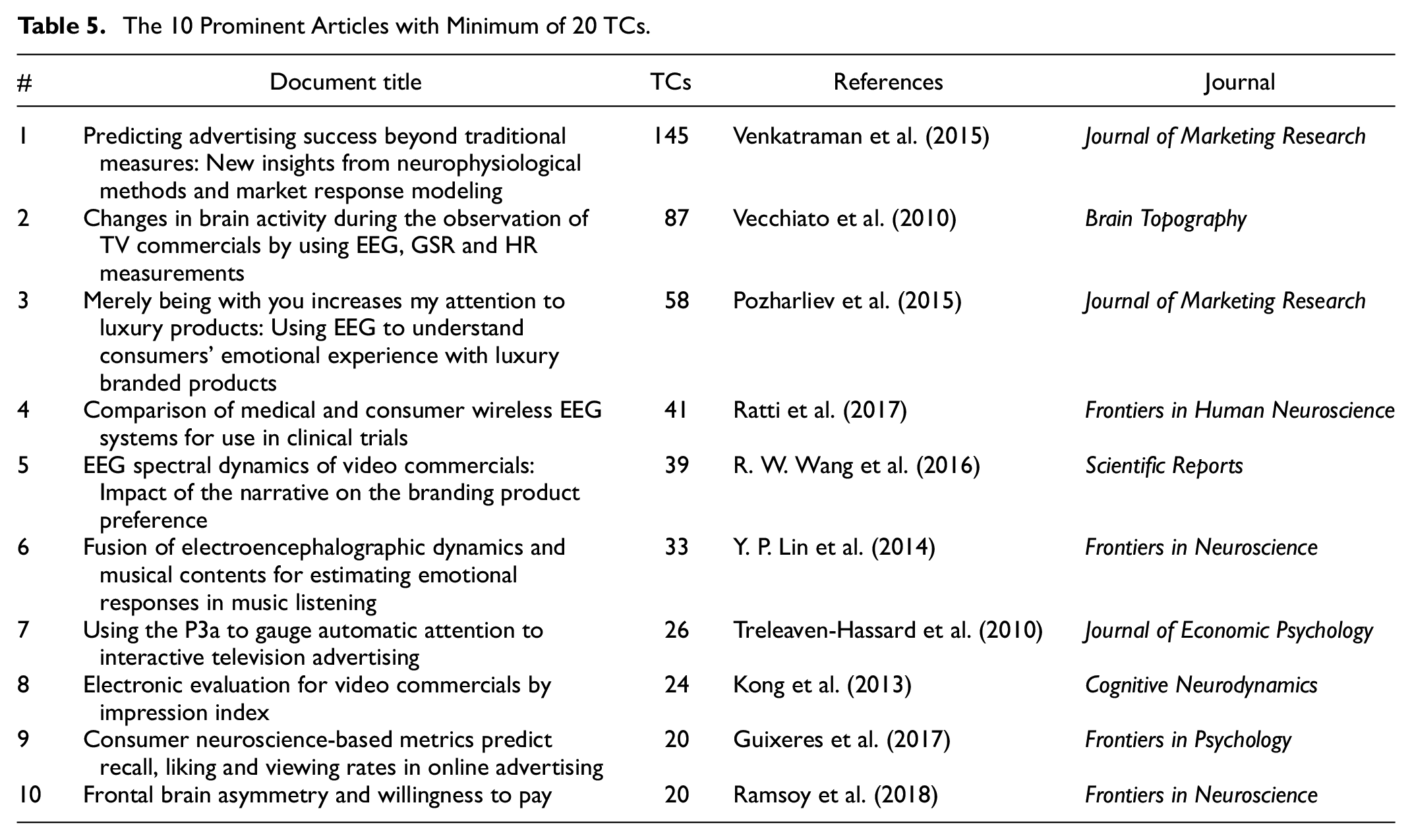
We conducted a citation analysis (CA) of original articles that utilized the EEG tool in neuromarketing studies to assess their impact. CA is a valuable method for identifying the most influential articles within a specific field by examining the number of times these articles have been cited by other researchers. We thoroughly examined and analyzed the total number of citations for the 53 original articles that employed the EEG tool in neuromarketing or consumer neuroscience research. In Table 5, we present the highly cited articles that have utilized EEG in neuromarketing research to investigate consumer behaviors, including emotions and attention, towards marketing stimuli such as advertising. Specifically, we focused on articles with more than 20 TCs. We have noted that three articles have higher than 50 TC. For example, the article title “Predicting Advertising Success Beyond Traditional Measures: New Insights from Neurophysiological Methods and Market Response Modeling” is the most-cited article (145 TC) written by Venkatraman et al. (2015). The article title “Changes in brain activity during the observation of TV commercials by using EEG, GSR and HR measurements” of Vecchiato et al. (2010) has the second-highest citations (87 TC), followed by Pozharliev et al. (2015) with 58 TC to their article title “Merely Being with You Increases My Attention to Luxury Products: Using EEG to Understand Consumers’ Emotional Experience with Luxury Branded Products.” The rest of the articles have less than 41 TC. For example, Ratti et al. (2017) published the fourth-highest article (41 TC), the manuscript title “Comparison of Medical and Consumer Wireless EEG Systems for Use in Clinical Trials.” The least-cited articles in the list are “Frontal Brain Asymmetry and Willingness to Pay” and “Consumer neuroscience-based metrics predict recall, liking and viewing rates in online advertising” with 20 TC each.
The 10 Prominent Articles with Minimum of 20 TCs.
Co-citation Analysis (Cited References)
We have followed co-citation analysis because its useful to identify the subject’s content by assessing/determining the most-cited authors together, which is considered an effective indicator to emerge pair of authors/references in one article. The VOSviewer package is a useful software to measure links between pair authors by recording the number of links between these pair of authors, which express the link strength between these pair of authors (Van Eck & Waltman, 2013).
From Table 6, the number between a pair of authors indicates the link strength between them; thereby, the higher the number between them, the stronger the correlation between them. We also found that the strongest link between two authors (seven links) was between (Ariely & Berns, 2010) and (Khushaba et al., 2013). The second-strongest link (five links) was between (Vecchiato et al., 2010) and (Vecchiato, Toppi, et al., 2011a); (Vecchiato, Toppi, et al., 2011a) and (Vecchiato, Toppi, et al., 2011b); (Ohme et al., 2010) and (Vecchiato, Toppi, et al., 2011a); (Boksem & Smidts, 2015) with (Plassmann et al., 2015) & (Ohme et al., 2010); (Vecchiato, Astolfi, et al., 2011) and (Vecchiato, Toppi, et al., 2011a). The rest of references have less than five links.
The Top 10 Cited References with the Highest Number of Link Strengths (Minimum Link Strength Three and Seven Citations).

We have used VOSviewer to analyze and draw the visualization maps of the co-citation of cited references with selected seven citations as the minimum cited reference. We found 12 cited reference that involve three clusters: (i) cluster 1 (red color), (ii) cluster 2 (green color), and (iii) cluster 3 (blue color). These groups illustrated a high correlation and incorporation between them, as depicted in Figure 5. The red cluster is the largest group that has been led by Vecchiato, Toppi, et al. (2011b). Boksem and Smidts (2015) dominated the green cluster. Red cluster had been controlled by Ariely and Berns (2010).

Map of cited references with a minimum of seven citations.
Despite these groups deal with different aspects of neuromarketing research, they are highly interrelated and complementary.
Content Analysis of Topics and Thematic Evolution
A comprehensive systematic review and analysis of 53 articles was conducted. The findings revealed that EEG has been utilized in four key marketing stimuli: products, advertising, pricing, and branding. Among these, advertising research emerged as the most prominent area of EEG utilization, with 26 articles, accounting for approximately 49% of the total articles reviewed. Products followed closely with 20 articles, constituting nearly 38% of the articles. Branding and pricing received comparatively lesser attention, with six and three articles, respectively. Figure 6 depicts the proposed framework of marketing stimuli and consumer behavior.
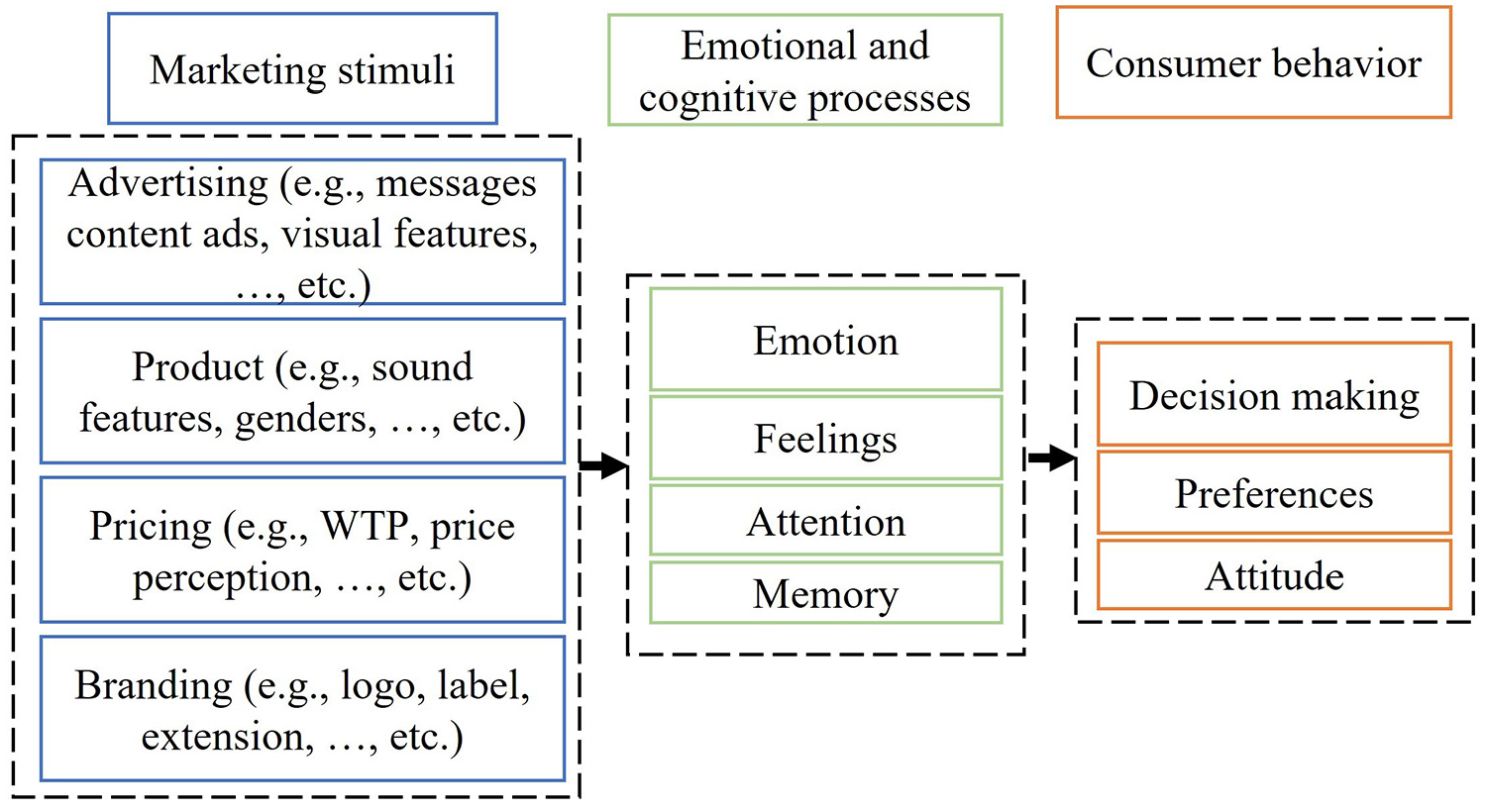
The proposed framework of the study.
Advertising
The majority of studies in the field focus on investigating the influence of advertising on consumer behaviors, cognitive and emotional responses. On the other hand, studies in the field of neuromarketing (NM) primarily concentrate on how consumers evaluate, process, and perceive ads (Cha et al., 2019; Hassan-Alsharif et al., 2021b; Morillo et al., 2016; Treleaven-Hassard et al., 2010). Advertising is defined as paid forms of communication that aim to inform or persuade specific target audiences about a firm, product, service, or even idea through various media channels (e.g., print media, broadcast media, and so forth; Alsharif et al., 2021; Hamelin et al., 2017; Kong et al., 2019; Vecchiato et al., 2013). EEG technology is employed in evaluating the effectiveness of advertising campaigns by measuring electrical brain signals with millisecond precision and assessing brain structures within a range of 1 cm (Vecchiato & Babiloni, 2011).
Consequently, the EEG tool has been employed to investigate the effects of both online and offline advertisements across various formats, including dynamic banners, print ads, YouTube ads, video scenes, representative features of ad effectiveness, public health ads, and narrative ads. For instance, Guixeres et al. (2017) identified a robust association between ad effectiveness and the number of views on YouTube. Cassioli (2019) found that the dynamic banner and reality theme in ads increased activity in the theta band (i.e., the left hemisphere), which had indicated a stronger emotional attachment. García-Madariaga et al. (2020) explored consumer responses to print ads, revealing that ads containing metaphors generated more positive reactions compared to non-metaphorical ads. Kong et al. (2013) observed that variations in cerebral activity during cognitive tasks, such as watching video ads, could serve as indicators of the effectiveness of those ads. Colomer Granero et al. (2016) identified interest index, memorization index, pleasantness index, and power spectral density (PSD) as representative features of ad effectiveness. Royo González et al. (2018) and R. W. Wang et al. (2016) found that narrative approaches in ads and exposure to branded products had a positive influence on consumer preferences and excitement. Cartocci et al. (2017) and Modica et al. (2018) demonstrated that anti-smoking campaigns employing symbolic communication styles attained the highest approach values. Harris et al. (2019) discovered that emotion-based advertisements outperformed rational-based ads, leading to positive changes in decision-making, increased donations, and greater liking. Wei et al. (2018) revealed that the percentage of purchasing the advertised product was relatively high after exposure to the advertising content.
Moreover, the EEG tool has been utilized to assess the neural responses associated with various consumer behaviors, including valence, arousal, emotions, recall, attention, and memory, towards advertisements. For instance, Vecchiato et al. (2010) identified that right frontal alpha activity was linked to pleasurable ads, while left frontal alpha activity was associated with displeasure. Eijlers et al. (2020) illustrated that a positive connection between arousal and prominent ads within the population, while also noting a negative relationship with consumer attitudes towards specific ads. Treleaven-Hassard et al. (2010) found that brands associated with interactive ads elicited stronger automatic attention. Morey (2017) demonstrated that increased activity in the gamma band directly influenced memory. Venkatraman et al. (2015) revealed that the ventral striatum activity could predict consumers’ responses to ads. Ramsoy et al. (2019) revealed that arousal and cognitive load were strongly linked to subsequent stated travel preferences, emphasizing that consumers’ subconscious emotional and cognitive responses may differ from their explicit preferences. Cuesta-Cambra et al. (2017) observed gender differences in visual activity, where recall of ads relied on emotional value and simplicity for men, while complex ads required more visual fixation, making them harder to remember. Boksem and Smidts (2015) conducted experiments to investigate whether neural measures could predict the success of commercial ads, specifically movie trailers or scenes. The findings demonstrated that neural responses could provide valuable insights into customers’ preferences and serve as indicators of successful ads. Other studies investigated whether EEG/ERP can predict/measure consumers’ responses’ accuracy (Badcock et al., 2013; Constantin et al., 2020; Shestyuk et al., 2019; Vecchiato et al., 2014; Williams et al., 2020).
Brand
In today’s, neuroscientific studies have shown that consumers are emotional decision-makers rather than rational decision-makers (Hassan-Alsharif et al., 2021a; G. Page, 2012). According to Hulten (2011), consumers rely on their emotional experiences toward brands, products, or services when making purchase decisions. Thus, consumers’ emotional experiences have a higher impact on consumers’ behavior and preference than the product and service itself (Camerer et al., 2005). Occasionally, consumers may find it challenging to provide a rational explanation for their preference of a particular brand over others, or they may struggle to articulate why they enjoy or purchase a specific brand and why it remains memorable to them (Ahmed, NorZafir, Mazilah et al., 2023). Lynch and De Chernatony (2004) define a brand as a combination of functional and emotional values that promise a distinct and favorable experience between a customer and a seller. Furthermore, the emotional connection between consumers and brands plays a significant role, as these experiences leave lasting impressions in the consumer’s memory, thereby influencing their loyalty and satisfaction (Reichheld & Schefter, 2000). Often, individuals base their product or service choices on the perceived value associated with a brand, focusing on what the brand represents rather than solely considering its tangible worth.
Currently, neuroscientific tools such as the EEG tool has been used to investigate the consumers’ preference (e.g., like/dislike) and disclosures to brands. For example, Camarrone and Van Hulle (2019) carried out an experiment to identify the brain associations with two TV brands (e.g., Netflix and Rex&Rio) and four clusters of words related to television, relaxation, and price. The findings illustrated that Netflix has the strongest associations (i.e., the smallest responses of N400) with a group of words linked to television, while Rex&Rio has the strongest associations with a group of words connected to relaxation. Bosshard et al. (2016) conducted a study that revealed how preferred brands elicit stronger motivational aspects and activity signals in the right parietal cortices compared to unpreferred brands. In a different study, Guo et al. (2018) examined the impact of brand disclosures on viewers’ responses. The results indicated that disclosures significantly influenced cognitive and emotional responses, including awareness, recognition, and attitude towards brand placement.
T. Yang et al. (2018) conducted an EEG investigation to explore the cognitive neural activity associated with different types of brand extensions, specifically service to service (S-to-S) and group to group (G-to-G) extensions. Their findings suggested that there may be differences in cognitive neural processing between these two types of extensions. Similarly, T. Yang and Kim (2019) found that the left frontoparietal P300 could serve as neural evidence for assessing the acceptability of new service to service brand extensions. In another study, Ma et al. (2019) examined the influence of ethnic culture on brand preference. Their findings indicated that the brand’s logo had a significant impact on Chinese participants’ preference for brands compared to African participants. Additionally, several studies have investigated the effects of brand disclosures on consumer responses, although further details regarding these studies were not provided.
Product
Despite firms relying on traditional methods (TM) like self-reporting to develop their products and services, many newly launched products fail within the first year (Jordao et al., 2017; Vecchiato et al., 2015). This has led researchers and marketers to explore new methods to better understand consumer behavior and address the limitations of TM (Schneider & Hall, 2011). One such method is the adoption of neuroscience tools, including EEG, to gain insights into consumers’ needs and preferences and design high-quality products at affordable prices (Rindova & Petkova, 2007). The literature distinguishes product characteristics into two categories: external factors such as color, material, packaging, and shape, and internal factors such as taste, durability, and ingredients (Plassmann et al., 2012). For instance, Schoen et al. (2018) utilized EEG and MEG to examine the impact of product features, such as the color and fit of sports shirts and brand logos, on consumers’ neural responses and preferences. Their findings revealed significant differences in neural reactions between positive and negative ratings of sports shirts, indicating a strong influence of brand logo. Moya et al. (2020) investigated the role of EEG, GSR (Galvanic Skin Response), and ET (Eye Tracking) in studying the effect of food packaging on consumers’ attention. Their study demonstrated that neuromarketing tools like EEG, GSR, and ET can provide valuable insights to brands regarding the design of food packaging. In a study by Sargent et al. (2020), EEG and EDA (Electrodermal Activity) were used to evaluate the efficiency of a market hot drinks machine based on self-reports, behavioral performance measures, and physiological responses. Significant differences were observed in arousal and valence metrics during the preparation and consumption of hot drinks, supporting the self-reported findings of the machine’s efficiency. Minguillon et al. (2017) conducted an experiment to explore the influence of blue lighting on post-stress relaxation compared to traditional white lighting. Their results indicated that blue lighting significantly accelerated the relaxation process, reducing the relaxation time from approximately 3.5 min to 1.1 min.
Several studies have utilized EEG to investigate consumer behavior in relation to products. For instance, Mengual-Recuerda et al. (2020) observed that food prepared by a chef positively influenced participants’ emotions, and dishes with unique presentations attracted more attention compared to traditional dishes. Pozharliev et al. (2015) and Zhang et al. (2019) is covered that social motivations played a crucial role in influencing the purchase of luxury products to fulfil social goals. Chew et al. (2016) identified that the rhythms recorded from frontal channels Fz, F3, and F4 were effective in predicting human preferences, such as preferences towards moving 3D shapes. Furthermore, Goto et al. (2019) demonstrated that EEG/ERP could be a reliable tool for accurately predicting consumers’ preferences for specific products. Stone et al. (2020) found that they exhibited lower levels of error and bias compared to traditional sleep staging methods when distinguishing between sleep and awake states.
Some researchers have utilized EEG to examine the impact of music on consumer preferences for products. For instance, Hsu and Chen (2019) and Y. P. Lin et al. (2014) found that music matched the sensory attribute of the product (i.e., wine) was significantly influenced participants’ product choices. While P. Wang et al. (2020) found that product images generated by EEG are preferred more than those generated without EEG. Shen et al. (2018) found that aggregated ratings significantly influenced consumers’ purchasing decisions. Furthermore, some studies have proposed models to better understand consumer behavior and preferences towards products. For instance, Yadava et al. (2017) revealed that the proposed model effectively predicted consumers’ preferences for the products.
Numerous studies have utilized EEG to investigate consumers’ neural responses to products. These studies have revealed various insights. Garczarek-Bak (2018) found that activity in the left frontal regions, associated with higher approach motivation, could predict purchase decisions. At the same time, it has observed no influence of price on consumer decisions. Demonstrated that subjective preferences strongly influenced subsequent purchasing choices, suggesting their involvement in conscious cognitive processes like selective attention. Touchette and Lee (2017) found that EEG can measure unconscious decisions. Chung et al. (2020) found that the increased P100 amplitude for face images compared to text in assessing a recommendation agent. In addition, the N170 amplitude was associated with human agent identity, whereas reversed N170 modulation was linked to AI agent identity. Kim et al. (2020) demonstrated that visual art induced high emotional arousal, potentially facilitating heuristic decision-making. Overall, EEG provides valuable insights for practitioners, researchers, and marketers to understand consumers’ perception, processing, and response to products, leading to the creation of more appealing packaging and products that meet consumers’ genuine needs.
Pricing
The price of a product has a direct impact on its quality and consumer decision-making (Dapkevičius & Melnikas, 2011). According to H. Fu et al. (2019), consumers generally prefer lower prices but associate them with lower quality, while higher prices are perceived as indicating higher quality. This relationship between price and quality significantly influences consumers’ decision-making and can lead to sellers selling lower-quality products at higher prices (Kunz, 2010). It is a challenge for companies and researchers to find the right balance of setting an affordable price while maintaining high quality (C. C. Wang et al., 2018). Some studies have utilized EEG to investigate the effects of different price levels and promotions on consumer responses (Linzmajer et al., 2011). For instance, Ma et al. (2018) and Ramsoy et al. (2018) found that stronger activity in the prefrontal gamma asymmetry was found to be correlated with willingness to pay decisions. Ma et al. (2018) found that price significantly influenced purchase decisions.
EEG can also be utilized to assess the effectiveness of promotion strategies such as discount prices, gift-giving, free shipping, and coupons (Alvino et al., 2020; Jones et al., 2012). Gong et al. (2018) found that discount promotions have a greater influence compared to gift-giving promotions. The findings of H. Fu et al. (2019) illustrated that price deception has an unfavorable influence on purchase decision-making. Interestingly, the price of private-label products was found to have no influence on consumers’ decisions. In summary, EEG provides valuable insights for practitioners, researchers, and marketers to gain a better understanding of how consumers perceive, process, and respond to pricing strategies, enabling the creation of high-quality products at affordable prices. Garczarek-Bak (2018) found that the price of private-label products has no influence on consumers’ decisions. To recapitulate, the EEG tool gives vantage to practitioners, researchers, and marketers to better understand how consumers perceive, process, and deal with prices, thereby creating high-quality products with affordable prices.
Practical and Theoretical Implications
According to the literature, the research implications of EEG techniques in marketing research can be divided into two-fold: (i) EEG techniques have an excellent temporal accuracy which stimulates researchers and scholars to use EEG techniques in investigating several types of stimuli such as T.V. ads, 3D products/stimuli, pricing of products or brands, mobile applications, banners, spokesperson (e.g., celebrity vs. regular), and message content ads. The ability of EEG to measure the brain’s neural activity toward marketing stimuli in milliseconds makes EEG techniques convenient for measuring the neural and behavioral processes (Bazzani et al., 2020). In the last decade, EEG techniques have developed and become portable or wearable tools (e.g., Emotive EPOC), which give a vantage point to combine with other tools such as eye-tracking, GSR, IAT, and so on. The advancement of EEG has highlighted to use of this tool in several areas, such as social consumer neuroscience (Pozharliev et al., 2017). (ii) EEG are non-invasive and cheaper techniques, which makes recruitment of volunteers/subjects easier and compliance higher than other tools such as fMRI, MEG, and PET. Thus, the number of participants in EEG investigation is larger than in fMRI or MEG experiments, which gives EEG an advantage over other tools.
The practical implications of EEG techniques can be summarized in two-folds: (i) EEG can help researchers, marketers, and advertisers to improve their marketing and advertising strategies to improve their communications with a customer by predicting the success of advertising campaigns or products/brands, as well as predicting the affordable price with maintaining the high-quality of products. In addition, increasing the effectiveness of marketing strategies can directly influence consumer behavior then induce their emotions to purchase the advertised products or brands. (ii) The EEG has been gradually developed since its first-time use. This technique allows measuring the neural responses of consumer decision-making processes, wherein it has provided valuable and reliable information immediately about investigating consumers’ behavior, emotional and cognitive processes (e.g., like/dislike, preference, experience, perception, purchase decisions, WTP, and so forth) toward the prominent of marketing stimuli such as brand, ads, price, product, service. Therefore, the application of EEG will help scholars and practitioners avoid verbal biases and gain valuable information about consumers’ subconscious responses, accounting for more than 90% of consumers’ responses toward marketing stimuli and in social life. It is impossible to collect this information by traditional methods, which rely on self-reports and verbal biases.
Conclusions
In the last decade, there has been a remarkable increase in the utilization of neuroimaging techniques, particularly electroencephalography (EEG) in neuromarketing research. EEG has been employed to investigate consumers’ behavior toward various marketing stimuli such as products, branding, advertisements, and pricing to predict consumers’ purchasing decisions. EEG is a non-invasive neuroimaging technique that records electrical activity in the brain by using electrodes made of conductive materials such as silver/silver chloride or gold. These electrodes are connected to the EEG amplifier through conductive gel or paste and placed on the subject’s scalp based on the 10 to 20 global system, allowing for measuring of voltages. Furthermore, EEG is used five frequency bands such as delta (<4 Hz), theta (4–7 Hz), alpha (8–15 Hz), beta (16–31 Hz), and gamma (>32 Hz) to measure the difference voltage between each place on the subject’s scalp. However, there have been advancements in the development of dry electrodes as an alternative to gel-based electrodes. For example, a new 3D printed dry-contact electrode has been developed, composed of a conductive AgNWs/PDMS composite material and a support shell designed and manufactured using 3D printing technology. In addition, the use of dry electrodes made from polyurethane and coated with Ag/AgCl, which allows for high-density EEG recordings. Wherein, the incorporation of silver-silver chloride coating in flexible 3D-printed EEG electrodes represents a significant advancement in the field, offering personalized, low-cost, and high-performance solutions for electrophysiological signal monitoring. These electrodes provide reliable and accurate measurements of electrical activity in the brain. Finally, the choice of electrode material depends on factors such as the specific application, comfort, and signal quality requirements.
This study followed the PRISMA framework, which allowed us to extract and analyze original articles that utilized EEG to explore and predict consumers’ responses, including preferences, emotions, attention, arousal, pleasure/displeasure, and more in relation to marketing stimuli. We conducted a thorough review and analysis of 53 original articles, unveiling that EEG has been predominantly employed in four key areas of marketing stimuli: advertising, which accounted for 26 articles (roughly 49% of the total), followed by products with 20 articles (around 38%). Branding and pricing accounted for six and three articles, respectively.
Furthermore, our analysis revealed a significant increase in the involvement of key players and publications in EEG-based marketing research, rising from a mere two original articles in 2010 to a substantial 26 original articles in 2020. Our recent study offers a comprehensive overview of global trends in the utilization of EEG as a tool in marketing research, including insights into leading countries, institutions, authors, and journals, along with the number of documents and citations associated with the selected publications. The United States emerged as the most prolific country, contributing 13 original articles and receiving 156 citations. The University of California System stood out as the most productive among academic institutions, generating four original articles and accumulating 66 citations. In terms of journals, Frontier in Neuroscience took the lead with eight original articles and a total of 67 citations, closely followed by Frontiers in Human Neuroscience, which also boasted six original articles and 67 citations. Among the most highly cited articles, “Predicting Advertising Success Beyond Traditional Measures: New Insights from Neurophysiological Methods and Market Response Modeling,” authored by Venkatraman et al. (2015) and published in the Journal of Marketing Research, garnered the highest number of citations with 145. This was followed by “Changes in brain activity during the observation of TV commercials by using EEG, GSR and HR measurements” by Vecchiato et al. (2010), published in the Brain Topography journal, which accumulated 87 citations. Additionally, we observed a strong connection between the references of Ariely and Berns (2010) and Khushaba et al. (2013), evidenced by seven linkages between the two. In summary, our findings demonstrate the widespread utilization of EEG as a valuable tool in marketing research to investigate consumer behaviors, encompassing aspects such as preference, perception, attention, recognition, pleasure/displeasure, and arousal towards various marketing stimuli, including products, advertising, branding, and pricing. This popularity can be attributed to the cost-effectiveness, excellent temporal resolution, and reduced noise levels offered by EEG technology.
Limitations and Future Directions
This research endeavor made significant efforts to address limitations in its methodology; however, certain constraints offer opportunities for future academic investigations. Specifically, this study focused exclusively on original articles employing EEG in marketing research published in English. As a result, it disregarded reviews, conference proceedings, book chapters, and editorial materials, potentially introducing biases. Future studies are recommended to encompass a broader range of literature by considering publications in different databases (e.g., Scopus, Google Scholar), thereby accommodating the diverse contributions of researchers worldwide.
Moreover, there is a call for scholars and researchers from emerging countries to actively contribute to neuromarketing publications, fostering a more inclusive and comprehensive body of work. It is essential for researchers and practitioners to carefully select and employ appropriate tools and methodologies to ensure the attainment of accurate and reliable outcomes in their studies. By doing so, the field of neuromarketing can advance its understanding and application of neuroscientific techniques in marketing research.
Footnotes
Acknowledgements
The authors would like to thank Zhejiang Technical Institute of Economics, Universiti Sains Malaysia (USM), Universiti Teknologi Malaysia (UTM), Universiti Kebangsaan Malaysia (UKM), and Al-Zaytoonah University of Jordan for supporting this study.
Declaration of Conflicting Interests
The author(s) declared no potential conflicts of interest with respect to the research, authorship, and/or publication of this article.
Funding
The author(s) received no financial support for the research, authorship, and/or publication of this article.

Data Availability Statement
Data sharing not applicable to this article as no datasets were generated or analyzed during the current study.