




Abstract
Although neuromarketing research has developed, the current studies lack to provide comprehensive insights into neuromarketing and marketing mix. Therefore, this study has designed to provide a comprehensive overview of neuromarketing, classification of neuroimaging and physiological tools are currently used in the marketing mix, and highlights the neural responses of consumer’s behavior (e.g., emotions, attention, motivation, reward processing, and perception) to be considered in the marketing mix. This study followed the Preferred Reporting Items for Systematic Reviews and Meta-Analyses (PRISMA) framework to select relevant documents for this article. In this study, 106 articles and review papers were extracted and analyzed from the Web of Science database to fill the gap in the literature. We found that 10 tools have been used in studying the marketing mix, such as advertising, brand, price, and product). For example, electroencephalography was the most applied tool, while advertising was the most marketing mix employed. We also found that the frontal and temporal gyri were correlated with pleasure/displeasure and high/low arousal. The occipital lobe is linked to attention processes, while the hippocampus relates to long and short-term memory. Such findings provide valuable insights into the neural responses in marketing mix research.
Introduction
Methods, Tools, and concepts have been remained unchanged in marketing research. For example, self-report has been used for a long time in traditional marketing research to assess, understand, predict, and analyze consumer behavior toward marketing mix (e.g., advertising, brands, and so forth). Consumers publicly and consciously report their feelings, experiences, and thoughts. On the opposite side of the spectrum, the unconscious processes of consumers’ behavior are primarily not measured by traditional methods such as surveys and interviews. Therefore, neuromarketing (NM) allows understanding the unconscious drivers of choices (e.g., purchase and impulsiveness decisions) (Harris et al., 2018; Plassmann et al., 2012). Consequently, the technological advancement in neuroscientific tools has led researchers and practitioners to use state-of-the-art technology in marketing research, such as electroencephalography (EEG), functional magnetic resonance imaging (fMRI), eye-tracking (ET), electromyography (EMG), galvanic skin response (GSR), which led to the novel multidisciplinary field named “neuromarketing” (e.g., Alsharif, Salleh, Baharun, Alharthi, Mansor, et al., 2021; Alsharif, Salleh, Baharun, & Mehdi, 2020; Bechara and Damasio, 2005; Casado-Aranda et al., 2018; Herrador et al., 2020; Krampe et al., 2018; Lajante et al., 2020; Venkatraman et al., 2015).
The term “neuromarketing” was coined in 2002 by Smidts (2002). Still, the first fMRI investigation in neuromarketing was conducted in 2004 by McClure et al. (2004), which shifted the neuromarketing field from a pure study to practical research. According to the literature, neuromarketing is a multidisciplinary area that involves neuroscience, marketing, and psychology (Javor et al., 2013; Sebastian, 2014). Therefore, NM is a promising field to provide valuable information about unconscious behavior to increase the effectiveness of marketing strategies (e.g., promotion, advertising, pricing). The underlying neural responses of consumers’ behavior toward marketing mix have been increasingly investigated in this field with diverse research foci, including advertising research.
The NM’s purpose is to study, understand, and analyze consumers’ behavior and decision-making mechanisms beyond the traditional method such as self-report (Stanton et al., 2017). Therefore, NM research employs neuroscience tools/methods to gage consumers’ behavior toward the marketing mix (Levallois et al., 2012). Lim (2018) has been divided neuroscience methods into three categories: (1) neural activity recording tools (inside the brain) such as EEG, fMRI, magnetoencephalography (MEG), Steady-state topography (SST), and positron emission tomography (PET); (2) neural activity recording tools (outside the brain) such as GSR, ET, EMG, and electrocardiogram (ECG); and (3) Interventions methods such as transcranial magnetic stimulation (TMS) and neurotransmitters. For Instance, neural activity recording tools (inside the brain) have been used to record the neural responses of the cognitive and emotional reactions (the activity inside the brain) such as arousal, pleasure/displeasure, engagement, approach/withdrawal toward marketing mix (Bakalash & Riemer, 2013; Izhikevich, 2003). Neural activity recording tools (outside the brain) have been used to record/measure the neural responses of consumers’ behavior (the activity outside of the brain), such as visual fixation, pupil dilation, eye movement, sweating level, and heart rate (Cherubino et al., 2019; Dimpfel, 2015). Moreover, during the experiment, these tools allow researchers and practitioners to explore, understand, analyze, and predict purchase behavior (e.g., engagement, excitement, approach, and avoidance) (Alsharif, Salleh, Baharun, Alharthi, Mansor, et al., 2021; Cherubino et al., 2019). Therefore, NM research is highly significant for the academic and industrial world to overcome the limitations in the traditional methods, such as consumer social bias (e.g., consumer choices can be affected by others) (Alsharif, Salleh, Baharun, & Mehdi, 2020; Fortunato et al., 2014; Morin, 2011).
Many studies concentrated on the advantages, disadvantages of neuromarketing research (Cherubino et al., 2019; Jordao et al., 2017; Lim, 2018a, 2018b; Plassmann et al., 2012; Ramsoy, 2015; Songsamoe et al., 2019), ethics (Fortunato et al., 2014; Morin, 2011; Stanton et al., 2017), food choice (Stasi et al., 2018), Customer engagement (Lim et al., 2021), Global academic research trends of neuromarketing (Alsharif et al., 2022; Alsharif, Salleh, & Baharun, 2020; Alsharif, Salleh, Baharun, & Alharthi, 2021). Other several studies provide an overview of the neuromarketing field (see Alsharif et al., 2021a; Jimenez-Marin et al., 2019; Morin, 2011; Pozharliev et al., 2017; Vecchiato et al., 2011; Y. Wang & Minor, 2008). Table 1 summarizes the key differences between the current study and the previous reviews studies).
A Comparison of the Current Study With Similar Research on Neuromarketing.

However, the most common marketing mix used in neuromarketing is still unclear in the academic literature. The studies about the neuroimaging and physiological tools that are currently used to explain the neural responses of brain processes are strictly limited. In addition, there is a lack of studies on the vital role of neural correlates of consumer behavior (e.g., choice, purchase decisions, impulsiveness decisions), emotional processes (e.g., reward, preference, engagement, arousal, pleasure/displeasure), and cognitive processes (e.g., perceptions, attractiveness/unattractiveness) toward marketing mix research. Hence, to dig deeper into neuromarketing and marketing mix research. Based on the literature mentioned above, this study contributes to the existing literature about neuromarketing and marketing mix by presenting an in-depth overview of the marketing mix used in neuromarketing research, the current neural and physiological responses recording tools that are used in marketing mix research, and the neural responses of brain processes to be considered in the marketing mix.
In this vein, we organized this study as follows—section 2, methodology and collecting data techniques that have been used in this review study. Section 3 presents the result of this review study, for example, the marketing stimuli used in neuromarketing, neural responses recording tools, and the neural responses of brain processes toward marketing stimuli. Discussion is addressed in section 4. Finally, section 5 presents the conclusion of this study.
Materials and Methods
This paper conducts a systematic review to provide a comprehensive understanding of the neural correlates of consumers’ behavior toward marketing mix (e.g., product, brand, advertising, and price). Table 2 illustrates the comparison among types of review articles. A systematic review has been introduced and carried out in this study, which will be explained in the following paragraphs.
Comparison Among Review Types.

Source. Lim and Weissmann (2021).
The current research has been designed to extract original and review articles from the Web of Science (WoS) database for answering the research questions (RQs). To this end, this paper has followed the instructions of the Preferred Reporting Items for Systematic Reviews and Meta-Analyses (PRISMA) protocol of Moher et al. (2015) to extract the original and review articles in neuromarketing research that used neuromarketing methods in the marketing mix (e.g., advertising, product, price, and brand) to fill the gap and to develop an in-depth understanding of neural responses of consumers’ mind toward marketing mix. The PRISMA is a suitable and rigorous protocol for review (Lim & Weissmann, 2021; Paul et al., 2021). Adopting a systematic literature review protocol is important to enhance the transparency and replication of review findings (Lim et al., 2021). The PRISMA protocol involves four stages, as depicted in Figure 1: (i) identification, (ii) screening, (iii) eligibility, and (iv) selection.

PRISMA flowchart for selecting publications for the current study.
Firstly, in the identification stage, the authors have identified the past documents through the WoS database searching. The search was carried out using the following query applied to the title, abstract, and keywords: “neuromarketing.” Secondly, in the screening stage, the documents have retained after screening the outcomes of searching in terms of year of publication, accessibility to documents (e.g., open access, non-open access), type of documents (e.g., article, review articles, book, book chapter, editorials), the language of documents (e.g., English, Spanish,…, etc.). Thirdly, in the eligibility stage, the authors only assess the eligible documents for selection if they throw light on the neuromarketing and marketing mix. Finally, during the selection stage, authors have carried out a quick review of selected documents to ensure that the selected articles and review articles involve neuromarketing and marketing mix studies.
This process would enrich our knowledge about the global academic research of neuroimaging and physiological methods that have currently been used in the marketing mix. That would provide an in-depth understanding of the most neuromarketing tools used in marketing mix research to identify the neural responses of brain processes to be considered when are conducting further research in marketing.
One hundred six articles and review articles (95 articles, 11 review articles) were selected from the WoS database relevant to this content analysis study. By exploring and analyzing the selected documents to develop this review study, it was possible to classify the global trends and advancements in neuromarketing themes as the following dimensions: (i) neuromarketing techniques used in marketing research; (ii) marketing stimuli used in the neuromarketing domain; and (iii) neural responses of brain processes toward marketing stimuli. The findings would guide researchers and practitioners who are interested in neuromarketing and marketing mix. In addition, reviewing the selected papers will improve our knowledge and accomplish our study objectives.
Results
An Overview of Neuromarketing Techniques Used in Marketing Studies
Beyond the innovative side of the neuromarketing concept, it has high applicability. The first goal of neuromarketing is to study, explore, and predict the neural responses of cognitive and emotional processes toward advertising (Alvino et al., 2020; Cherubino et al., 2019). This is expected to reduce the possibility of wasting budget on marketing research in general and advertising campaigns in specific and create more effective marketing and advertising strategies. It provides clear evidence of consumer behavior (e.g., decision-making), emotional processes, and cognitive processes. In today’s hyper-competitive environment, the benefits of these techniques and methods will overcome the persistent obstacles in marketing issues (Gurgu et al., 2020).
The findings revealed that the EEG is the most employed technique to record the voltage changes of frequencies at scalp regions toward marketing mix (e.g., products, branding, pricing, and advertising), followed by the fMRI that were used to measure the metabolic activity (e.g., oxygenated and deoxygenated blood) in the deep structure of the brain toward marketing stimuli.
Taxonomy of Neuromarketing Tools
NM tools have become possible to get the data in the form of neural signals activity and images from the individual’s brain (Di Flumeri et al., 2016) and the interactions between people and external environments such as machines (Zander & Kothe, 2011). NM techniques can be classified upon the sort of measurements (Fortunato et al., 2014; Harris et al., 2018; Lim, 2018a). Cluster 1, Harris et al. (2018) and Isabella et al. (2015) have divided NM techniques into two categories: (a) neurophysiological techniques and (b) physiological techniques. Physiological tools (e.g., electrocardiogram (ECG), Eye-tracking (ET), galvanic skin response (GSR), neurotransmitters, implicit association test (IAT), and facial electromyography (EMG)). Neurophysiological or neurological techniques such as functional magnetic resonance imaging (fMRI), electroencephalography (EEG), magnetoencephalography (MEG), and positron emission tomography (PET). Similarly, Plassmann, Ambler, et al. (2007) indicated two categories: (a) recording metabolic activity signals in the brain such as fMRI and PET, and (b) recording electrical activity signals in the brain such as EEG and MEG.
Cluster 2, Bercea (2012) and Boz et al. (2017) have classified these techniques into three categories: (a) recording metabolic activity signals in the brain, (b) recording electrical activity signals in the brain, and (c) recording non-brain/physiological activity signals. For instance, Bercea (2012) and Boz et al. (2017) identify two metabolic techniques such as PET and fMRI to measure/record the changes in chemical composition or changes in the oxygenated and deoxygenated blood in the brain, while EEG, MEG, Steady-state topography (SST), and transcranial magnetic stimulation (TMS) can record the electrical activity signals in the brain. In addition, ET, GSR, ECG, IAT, and EMG as non-brain/physiological techniques to measure the consumer behavior. Y. Wang and Minor (2008) identify three techniques to measure the blood flow in the brain, such as PET, fMRI, and MEG, and two techniques, such as EEG and SST to record the non-hemispheric brain wave and lateralization. Lim (2018a) divided neuromarketing techniques into techniques that record the activity signals inside the brain such as EEG, MEG, SST, fMRI, and PET and techniques recording activity signals outside brains such as ECG, ET, GSR, and EMG. As well as intervention techniques such as TMS and neurotransmitters. Neurotransmitters are chemical materials that transmit the neurological signals between neurons. Stanton et al. (2017) determine two techniques to measure brain activity such as fMRI and EEG, and also two techniques to measure the physiological reactions of consumers such as ET and GSR, and TMS and neurotransmitters.
Finally, cluster 3 includes four classifications: neuroimaging, behavioral, physiological, and self-report methods/tools. Self-report is deemed one of the oldest techniques to measure the consumer responses, such as attitudes and status of consumers toward marketing stimuli. Behavioral measurements such as reaction time depend on the speed of the consumer’s responses toward a task. While neuroimaging techniques record the brain activity signals toward a task. Eventually, physiological techniques can record the bodily response toward a specific task, such as pupil dilation, eye movement, facial muscle expressions, perspiration, and heart rate (Ramsoy, 2015).
As shown in Table 3, previous research has been classified NM methods into clusters based on the type of measurements; for example, cluster 1 includes, two classifications, cluster 2 includes, three classifications, cluster 3 includes, four classifications. The majority of researchers included techniques such as EEG, fMRI, MEG, PET, EMG, ET, ECG, and GSR as NM tools (Bercea, 2012; Harris et al., 2018; Isabella et al., 2015; Ramsoy, 2015; Stanton et al., 2017; Y. Wang & Minor, 2008). However, tools like TMS, functional transcranial doppler sonography (fTCD), SST, single-photon emission tomography (SPET), voice pitch analysis (VOPAN), functional near-infrared spectroscopy (fNIRS), self-report, and IAT have not been mentioned in all classifications. Therefore, some scholars referred to popular techniques as NM techniques employed in marketing research. In the following section, we will discuss the popular techniques used in marketing research.
Taxonomy of Neuromarketing Techniques.

The Popularity of Neuromarketing Techniques
We analyzed 106 documents in NM studies and found 10 techniques employed in studies to record consumers’ neural, physiological, and behavioral responses toward the marketing mix. Electrical and metabolic tools such as EEG, fMRI, and fNIRS have measured brain activity signals. Tools such as ET, GSR, and ECG have been used to measure physiological activity signals. We also found scant studies about other techniques such as SST, IAT, and EMG. However, it is worth mentioning that several studies have employed self-reports such as interviews and questionnaires to gage consumers’ responses. According to Lim (2018a), metabolic and electrical tools such as EEG and fMRI are the most popular tools in marketing research, followed by ECG, ET, GSR, and EMG. According to the literature, the most popular techniques between researchers and practitioners are EEG and fMRI (Cherubino et al., 2019; Lim, 2018a). For example, techniques such as EEG, fMRI, and fNIRS can measure the neural responses of brain processes toward marketing stimuli such as branding, products, advertising, and pricing, by identifying and evaluating the effectiveness elements in marketing stimuli to increase attractiveness, quality, emotional value, attention, memorable/unmemorable, purchase decision, sales, profits (Vecchiato & Babiloni, 2011).
Additionally, techniques such as ET, GSR, ECG enable to measure of visual attention such as eye movements (Venkatraman et al., 2015), emotional responses (e.g., sadness/joy, pleasure/displeasure), attention level, sweating level toward dynamic and static ads (Cherubino et al., 2019). Together, these techniques can gage the neural responses of emotions and feelings (e.g., pleasure/displeasure), attention (e.g., top-down/bottom-up), and memory (e.g., encoding/retrieving) toward marketing stimuli. Undoubtedly, each technique has advantages and disadvantages, for example, but not limited to the time of data analysis and cost.
Overall, we identified seven tools employed to record the consumers’ neural responses signals toward marketing stimuli. We suggest excluding some tools such as IAT, and SST, self-report in NM research due to fewer studies or not measuring neural responses of the brain. Therefore, the popularity of techniques is an important aspect of NM research. According to the literature, we proposed our neural response recording tools framework following Isabella et al. (2015) and Ramsoy (2015). Figure 2 depicts our proposed framework of neural response recording tools: (a) Neuroimaging such as fMRI, EEG, and fNIRS, and (b) Physiological tools such as ET, EMG, GSR, and ECG.

The proposed framework of neural response recording tools.
According to the literature, we found that the most popular neuroimaging technique used in marketing mix was EEG, which was used in 37 articles (almost 35% of total articles) (see Figure 3), followed by the fMRI techniques that appeared in 25 articles (approximately 24% of total articles). For physiological techniques, we found ET is the most popular technique used in the marketing mix that was appeared in 13 articles (almost 12% of total articles). Figure 3 shows the number and the percentage of studies that were used neural responses recoding tools.
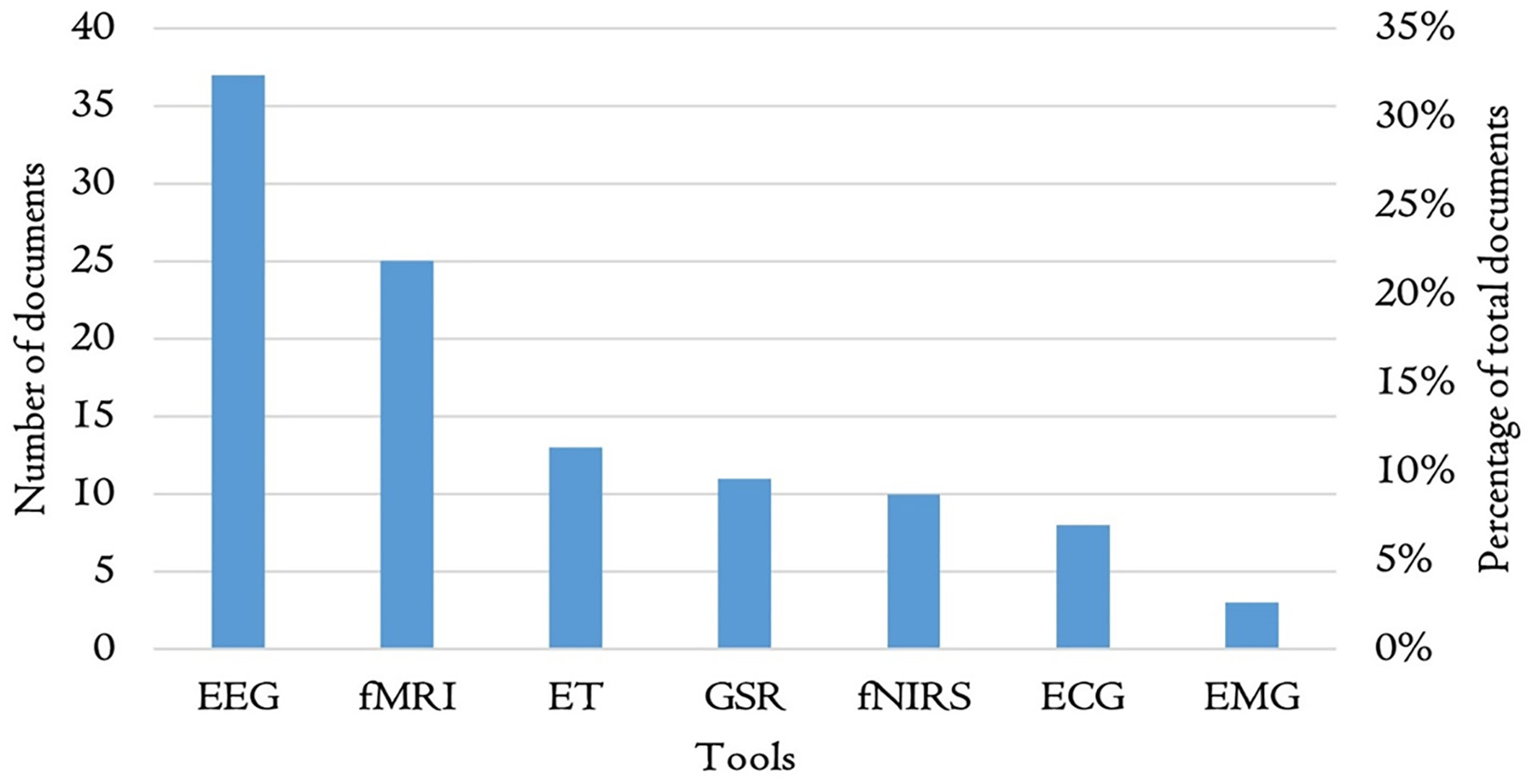
The number and percentage of studies used neural recording tools.
EEG is an electrical and also a non-invasive technique to gage the neural responses of emotional and cognitive processes of consumers toward marketing stimuli by recording the voltage changes of frequencies at scalp regions (Cherubino et al., 2019; Eijlers et al., 2020; García-Madariaga et al., 2020; Venkatraman et al., 2015). The literature has five frequency bands (e.g., delta, theta, alpha, beta, and gamma) (Wei et al., 2018). Additionally, EEG uses a 10 to 20 system, which is a globally recognized tool; this system is used to express the locations of electrodes on the scalp of the participants, such as prefrontal (Fp), frontal (F), occipital (O), parietal (P), temporal (T), and central (C). EEG uses an equal number of electrodes on the right and left parts of the head (Rawnaque et al., 2020; Silverman, 1965). Additionally, it has an excellent temporal accuracy (estimated in milliseconds [ms]) and a poor spatial accuracy (estimated 1 cm3 at the scalp regions) (Aditya & Sarno, 2018; Bazzani et al., 2020; Burle et al., 2015). As well, it is not expensive and noisy (Morin, 2011). fMRI and fNIRS are non-invasive and metabolic interesting neuroimaging techniques used to record oxygenated and deoxygenated hemoglobin (Alvino et al., 2020; Ernst et al., 2013; Jackson & Kennedy, 2013; Shimokawa et al., 2009). fMRI has a superior spatial accuracy (estimated in 1–10 mm3 of the deep structure of the brain) compared with fNIRS, which has poor spatial accuracy (estimated in 4 cm of cortical activity regions) (Burle et al., 2015; Krampe et al., 2018; Lloyd-Fox et al., 2010), meanwhile, both of them have acceptable temporal accuracy (estimated in seconds) (Kopton & Kenning, 2014; Sitaram et al., 2009). fMRI and fNIRS have been used in marketing research to record the neural responses of consumers’ behavior (e.g., preference, perceptions, purchase decisions, choices) toward marketing stimuli (Kopton & Kenning, 2014; Lloyd-Fox et al., 2010). fNIRS is a portable, novel, promising, and silent neuroimaging technique, cheaper compared to fMRI (Cakir et al., 2018; Ernst et al., 2013; Kopton & Kenning, 2014; Krampe et al., 2018; Plichta et al., 2011).
ET is a portable technique that is used to record eye movements, saccade, fixation, and pupil dilation toward marketing stimuli (Alsharif et al., 2021b). Therefore, it is a useful tool for experimental psychology and neurological studies because it records visual attention and eye movements (Hoffman, 1998). According to the literature, eye fixations last between 200 and 350 ms during reading text and watching video scenes, respectively, while 200 ms indicate the duration of saccadic eye movements (Rayner, 2009). The set of fixations and saccades is named the scan route and analyzes visual perception and cognitive purpose. Meanwhile, pupil dilation with a longer blink period tells us better information processing (Alsharif, Salleh, Baharun, & Mehdi, 2020). GSR and ECG have been used to measure the emotional responses toward marketing stimuli (Baraybar-Fernández et al., 2017). GSR is used to gage the sweating level, and ECG to measure the heart rate/heartbeat (Baraybar-Fernández et al., 2017; Guixeres et al., 2017). In addition, both of them can measure the autonomic nervous system and evaluate the internal emotional status of consumers (Barquero-Pérez et al., 2020). Therefore, GSR and ECG are convenient and reliable techniques for measuring the dimensions of emotions (e.g., valence and arousal) and changes in skin conductance (Boucsein, 2012).
Neuromarketing Tools Used in Marketing Mix
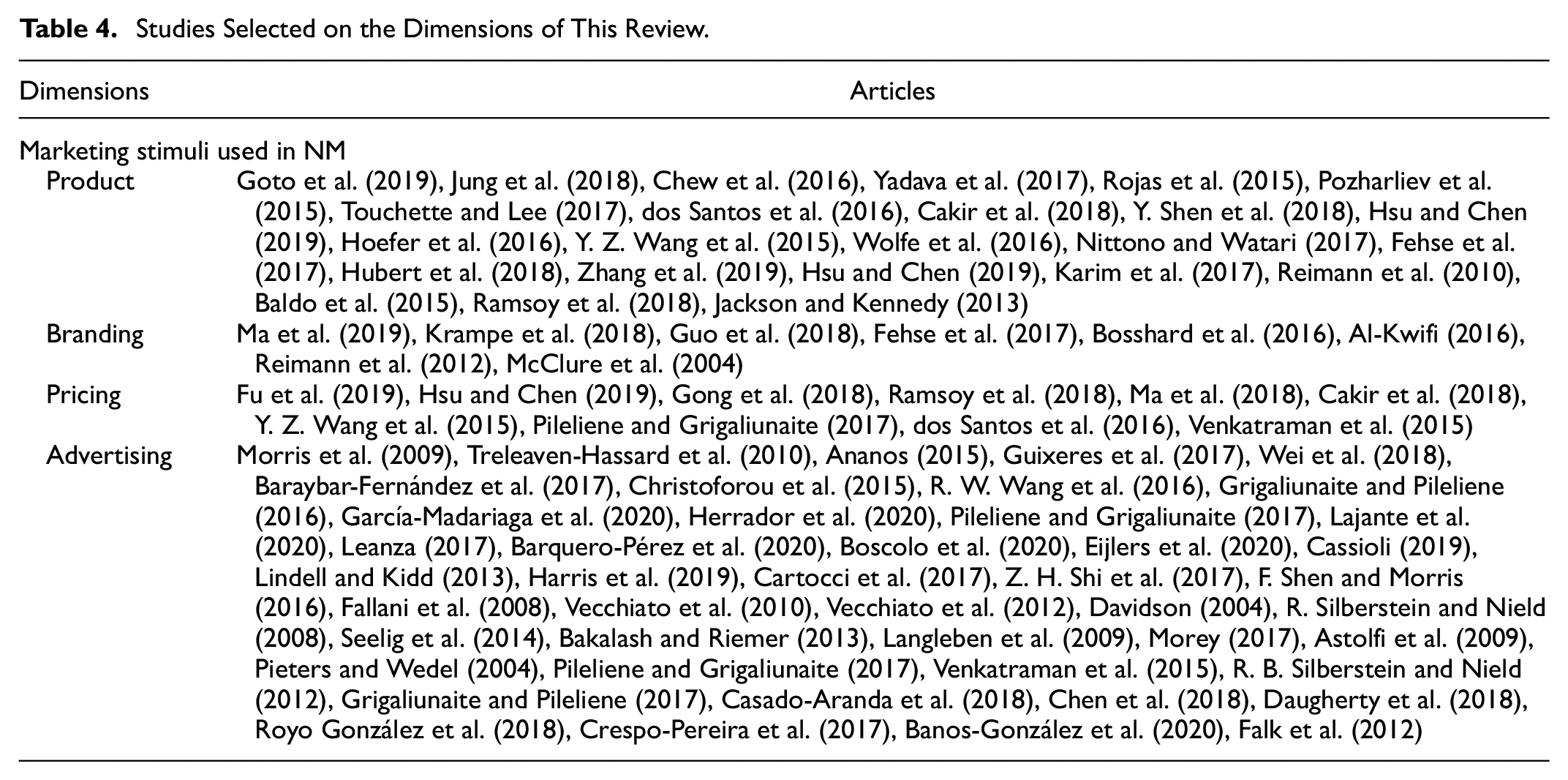
We have reviewed and analyzed 106 documents to know the most element of the marketing mix used in neuromarketing research. We found that marketing stimuli that have been used in neuromarketing research are product, branding, pricing, and advertising (see Table 4). In addition, we found the most marketing mix used in neuromarketing is advertising research, wherein advertising research appears in 45 articles (approximately 42% of total articles), followed by products in 23 articles (almost 22%).
Studies Selected on the Dimensions of This Review.
Product
Companies and firms are designing products, goods, or services based on the findings of the traditional methods (quantitative or qualitative methods), then designing the products and including all items that consumers have been chosen to buy (Ruskin-Brown, 2006). But most of the newly launched products fail dismally (Jordao et al., 2017; Vecchiato et al., 2015) when you hear most customers complaining about the newly launched product. Here NM helps the traditional marketing methods by assisting marketers to better understand the consumers’ minds toward products and services (Schneider & Hall, 2011). Therefore, NM techniques can help researchers and marketers to design desirable products before putting them in the marketplace by studying the consumer’s mind response toward product characteristics (Rindova & Petkova, 2007). Product characteristics have divided into two categories, external (e.g., color, material, packaging, shape) and internal (e.g., taste, durability, ingredients) (Plassmann et al., 2012).
According to Cherubino et al. (2019), Muñoz-Leiva et al. (2019), Plassmann et al. (2012), Ploom et al. (2020), and Touchette and Lee (2017), NM methods enable to help researchers and practitioners to identify how features of products impact consumers’ perceptions and preferences. The number of studies, that is, Y. Z. Wang et al. (2015), dos Santos et al. (2016), Wolfe et al. (2016), Cakir et al. (2018), Rojas et al. (2015), Hubert et al. (2018), Jung et al. (2018), and Reimann et al. (2010) have been used neuroimaging and physiological methods to identify the physiological and neural correlates of consumer behavior (e.g., purchase decisions, perception, preference) toward products/brands.
For purchase decisions, the EEG investigation of Pozharliev et al. (2015) and Zhang et al. (2019) recorded the brain responses of subjects toward Luxury products (motivations). The findings showed that social motivations have a vital role in influencing purchasing luxury products in order to satisfy social goals (at least one goal). Hoefer et al. (2016) investigated the brain reactions toward tactile stimuli of fabrics. The findings demonstrated that tactile stimuli of fabrics have immediately led to brain reactions and purchase decisions. Touchette and Lee (2017) conducted an experiment to investigate the effect of product attractiveness/unattractiveness on the neural of consumer decisions. The findings showed that the neural mechanisms of consumers had featured the difference in frontal asymmetry between attractiveness and unattractiveness; therefore, it is a good method to measure the unconscious decisions of consumers toward attractiveness. Y. Shen et al. (2018) investigated the consumer’s decision-making based on the review star rating (one to five-star rating) and aggregated ratings. The findings revealed the amplitude difference of LPP within one and five-star ratings, wherein one and five-star rating more sensitive and associated with emotional of consumers, for example, consumers classified one-star rating as negative reviews, meanwhile, five-star ratings as positive reviews. Therefore, review star rating has largely influenced decision-making on online shopping.
For consumers’ preferences, Chew et al. (2016) used EEG to investigate the regions of consumers’ preference toward 3D bracelets. The findings illustrated that the rhythms from frontal channels Fz, F3, and F4 are suitable for the identification/predicting human preference (e.g., like and dislike) toward moving 3D shapes. Additionally, Yadava et al. (2017) proposed a predictive modeling framework to understand consumers’ preference for E-commerce products (e.g., shirts, shoes, ties, belts, bracelets). The findings revealed that the proposed model effectively predicts consumers’ preferences toward the product. Goto et al. (2019) investigated if the EEG/ERP can predict the consumers’ preference toward specific products. The findings showed that EEG/ERP is a reliable technique to accurately predict consumers’ preferences toward specific products (prediction accuracy was estimated at 70.8%).
For consumers, perception is defined as “The process by which marketing stimuli are selected, organized, and interpreted” (Hogg et al., 2006). Nittono and Watari (2017) investigated the effect of tasting a food sample (e.g., chocolate or baked cake) or reading a leaflet on consumers’ perceptions. Their findings revealed that tasting a brand sample elicited a higher LPP than reading a leaflet; therefore, it has highly influenced consumers’ perception and makes a brand more salient than other brands in the same food category. A bipolar semantic scale and eye-tracking investigation by Rojas et al. (2015) to study consumers’ perceptions toward virtual and real representations of the product (i.e., beer bottle). Their findings revealed that the render quality of products, direction of the product, and presentation method had influenced consumers’ perception.
In other aspects, for example, Hsu and Chen (2019) investigated if music/songs have a priming impact on selecting products. The finding illustrated that the types of music have largely influenced the selection of products; for example, several participants have changed their preference from Spanish to French wine based on the French songs that matched the sensory attribute of the French wine. On the opposite side, Spanish songs had not had such a large impact to match the sensory attribute of the Spanish wine. Jackson and Kennedy (2013) used fNIRS to measure the effects of dietary components (e.g., caffeine, omega-3) on cerebral blood flow. The findings showed that fNIRS is a sensitive measure of change in hemodynamic response during cognitive tasks in acute and chronic treatment intervention paradigms. Baldo et al. (2015) experimented with predicting shoe sales performance before putting them on the market using EEG and self-report. The findings illustrated that EEG could provide almost 80% accurate prediction of shoe sales and increase profit by 36.4%, while self-reporting cannot accurately predict success.
Pricing
Price is one of the marketing mix elements, and it is considered the most important aspect that directly impacts the value of the products. According to the literature, a few studies have investigated the influence of price and promotion on the neural correlates of brain processes and regions—for example, dos Santos et al. (2016), Hsu and Chen (2019), Ramsoy et al. (2018), Cakir et al. (2018), Baldo et al. (2015), and Y. Z. Wang et al. (2015) have used price alongside the promotion or products. Neuroimaging and physiological tools can measure fair and premium pricing and promotion (e.g., discount, gift-giving, free-shipping, price cut). Fair pricing indicates to affordable price or not if a price is compared with one or more prices in the same categories (Xia et al., 2010). Undoubtedly, consumers like to pay less for a product, but they are correlated low prices with low qualities and high prices with high qualities (Fu et al., 2019). Therefore, establishments’ biggest challenge is setting an affordable price and maintaining high quality (Cakir et al., 2018; C. C. Wang et al., 2019). Hence, neuroimaging and physiological techniques can be employed to measure how consumers perceive, experience, and respond to different levels of prices (e.g., low, affordable, and high prices) (Linzmajer et al., 2011). Premium pricing has defined as selling products for a higher price than competitors. As a result abovementioned, higher prices connect to higher qualities; thereby, several studies have focused on how prices influence the experience of the product (Almenberg & Dreber, 2011; Sellers, 2016). Accordingly, NM studies investigate the influence of the same category products (e.g., higher and lower prices) on consumers’ enjoyment. For example, Dapkevičius and Melnikas (2011) experimented with investigating price influence on consumer satisfaction and decision-making. The experiment’s findings suggest that price can affect the quality of the product and decision-making as well. That might give the vendors to sell lower quality at a higher price (Kunz, 2010).
Neuroimaging and physiological tools can also be used to measure the promotion strategies (Gong et al., 2018; W. J. Jones et al., 2012; Muñoz-Leiva & Gómez-Carmona, 2019). Promotion strategies such as discount prices, gift-giving, free shipping, and coupons have largely influenced consumers’ decisions. Price discount has a great influence on encouraging consumer purchasing decisions (Gong et al., 2018). According to Z. Shi et al. (2013), discount and price cut promotions influence consumer purchasing decisions more favorably than free-shipping and gift-giving promotions. Gong et al. (2018) carried out an experiment to identify the influence of sales promotion (e.g., gift-giving, discount) on consumers’ perception and purchase decisions by using EEG/ERP. The findings revealed that discount promotions have more impact on purchase decisions than gift-giving sales promotions. Ramsoy et al. (2018) carried out an experiment to investigate the brain activity related to how much money consumers are willing to pay (WTP) for a specific product and service by using EEG. The findings revealed that stronger activity in the prefrontal gamma asymmetry was correlated to WTP decisions. At the same time, the activity in the frontal alpha asymmetry was not correlated to WTP responses. In another EEG/ERP Study, Ma et al. (2018) conducted an experiment to identify the relationship between emotional arousal and consumers’ perceptions of product price. The findings demonstrated that emotional arousal has largely impacted the consumers’ perceptions of product prices. Therefore, NM has a vantage point to help practitioners and marketers to understand what price means to the consumers and the difference among affordable, low, and high price products.
Branding
According to Baalbaki and Guzmán (2016), a brand is one of the most valuable assets to companies and organizations. Currently, brand management has shown a growing awareness of consumers as emotional choice makers and less rational (Page, 2012). According to the literature, neuroscientific studies have been revealed that emotions have a vital role in impacting consumers’ behavior and perception (Camerer et al., 2005), brand, and advertisement (Plassmann et al., 2012). Lynch and De Chernatony (2004) defined a brand as a group of functional and emotional values that promise a unique and welcome experience between a client and a vendor. In addition, emotional consumer-brand relationships are cemented, and experiences remain in the consumer’s memory, influencing consumer loyalty and satisfaction (Oliver, 1997; Reichheld & Schefter, 2000). Therefore, neuroimaging and physiological techniques can help researchers and practitioners to a better understanding of how and why consumers have loyalty, attitude, perception, and preference for a specific brand (Bosshard et al., 2016; Guo et al., 2018; McClure et al., 2004; Plassmann, O’Doherty, & Rangel, 2007; Reimann et al., 2012). According to the literature, brand memory can influence consumers’ preferences more than the product’s taste (Cherubino et al., 2019; Plassmann et al., 2012). Many investigations, that is, Reimann et al. (2012), McClure et al. (2004), and Fehse et al. (2017), have used neuroimaging tools such as fMRI to investigate the neural response of consumer behavior toward brands (e.g., preference, choices, perceptions).
Loyalty is a positive behavior/attitude toward brands (Ferrell & Hartline, 2012; Odin et al., 2001), wherein it is an important dimension for firms and organizations to create long-term relationships with customers, besides maintaining the current and attracting new potential customers. From a behavioral perspective, it has been reflected in the purchase choice of a particular brand (T. Jones & Taylor, 2007; Lam et al., 2004). Loyal means that consumers’ intention toward the brand is consistent and makes it the first choice (Reichheld & Schefter, 2000). Attitude is a positive or negative reaction/response toward any marketing stimuli such as brands, products, and advertisements (Baack et al., 2016; Schiffman & Kanuk, 2007; Shaouf et al., 2016). Franzen (2005) defined attitude as a scale of brand preference, which highly impacts consumers’ behavior (e.g., purchasing or not) and vice versa. According to several studies, there is a strong relationship between brand attitude and brand loyalty (Abimbola et al., 2012; Kruger et al., 2013). For example, the EEG investigation of Bosshard et al. (2016) conducted an experiment to measure consumers’ behavior (attitudes) toward liked/disliked brands. The findings revealed that liked brands reflect more motivational aspects and activity signals in the right parietal cortices than disliked brands. Krampe et al. (2018) investigated if the mobile fNIRS is appropriate for measuring “first-choice-brand.” The findings illustrated that the mobile fNIRS is an appropriate neuroimaging technique for predicting “first-choice-brand.”Guo et al. (2018) investigated the effect of disclosures on viewers’ brand responses by using ET and EEG. The findings revealed that disclosures have largely impacted cognitive and emotional responses (e.g., awareness, recognition, attitude) toward brand placement.
Perception processing relies on internal processes such as prior knowledge (experiences), current goals, beliefs, expectations, needs, moods, and external stimuli such as color, orientation, intensity, and movement (Plassmann et al., 2012). For example, Ma et al. (2019) experimented with using EEG/ERP to explore the influence of ethnic affiliation (e.g., black African and Chinese people) toward brand preference. The findings illustrated that the brand-logo recommender from the out-group (the recommender from a different race of a participant) has largely influenced the preference of Chinese participants over Black African participants compared with brand-logo recommender from the in-group (the recommender in the same race as a participant). Oliveira and Giraldi (2019) carried out an experiment by using ET to investigate the influence of well-known brands of beverages on selective visual attention. The findings revealed that the well-known brand has a stronger visual attention impact than others.
Advertising
Most studies examine the impact of advertising on consumers’ behavior, emotional and cognitive processes, wherein NM studies focus on how consumers evaluate, process, and experience advertisements (Cha et al., 2019; Morillo et al., 2016; Treleaven-Hassard et al., 2010). Advertising is defined as a paid communication to inform or persuade target audiences about an organization, product, brand, service, or idea by several media such as print media, broadcast media, network media, electronic media, and display media (Hamelin et al., 2017; Kong et al., 2019; Vecchiato et al., 2013). For example, neuroimaging and physiological techniques can be used to measure and evaluate the effectiveness of advertising. Neuroimaging techniques such as EEG can evaluate the effectiveness of advertising campaigns by measuring the electrical brain activity signals within milliseconds and 1 cm of brain structure (Vecchiato & Babiloni, 2011). fMRI is also a novel tool used to measure the distal activation of brain regions toward advertising within 5 to 10 s and 1 to 10 mm3 of deep structure (Kühn et al., 2016). Another interesting neuroimaging technique employed to examine the consumers’ reactions toward advertisements is fNIRS by measuring the metabolic activity in the consumers’ brain (e.g., oxyhemoglobin and deoxyhemoglobin) toward advertising within some seconds and 1 to 4 cm of brain structure (Jackson & Kennedy, 2013; Kober et al., 2014; Lloyd-Fox et al., 2010; Plichta et al., 2011; Yoo et al., 2008). Physiological technique such as ET employs to measure/record the consumers’ visual attention (e.g., eye movements, fixations, and pupil dilations) toward advertisements such as YouTube videos, trials, and images (Venkatraman et al., 2015). In addition, tools such as ECG, GSR, IAT, and EMG can be employed to measure emotional responses (e.g., sadness, pleasure, joy, fear, and stress) toward advertisements (Missaglia et al., 2017). Several fMRI studies, that is, Morris et al. (2009), F. Shen and Morris (2016), Chen et al. (2018), Padmanabhan et al. (2011), Bakalash and Riemer (2013), and Seelig et al. (2014) have studied the neural responses of the consumer emotional and cognitive processes toward advertising (e.g., TV ads, print ads).
For emotional processes, for example, Davidson (2004), Vecchiato et al. (2010), and Vecchiato et al. (2012) experimented by using EEG to investigate the activity of emotional processes (e.g., pleasure and displeasure) toward the content of TV ads. Their findings revealed that activity in the right frontal alpha is associated with pleasure and like ads; on the other side, the left frontal alpha correlated to displeasure ads. The EMG study of Lajante et al. (2020) measures the pleasure/displeasure of the consumer toward ads. Their findings revealed that pleasure and displeasure had been positively influenced the behavior/attitudes of consumers toward ads. Harris et al. (2019) examined the effectiveness of emotion-based ads in the public health sector. The findings revealed that emotion-based ads are more effective in decision-making than rational-based ads. Eijlers et al. (2020) used EEG to investigate the arousal evoked in response to advertisements. The findings showed that arousal is positively connected to prominent ads in the population at large and negatively to consumer attitudes toward these ads. The EMG investigation by Liaudanskaitė et al. (2018) measures the intensity of the consumer’s emotions toward static advertising. The findings showed that valence and arousal have a large impact on the effectiveness of advertisements. Guixeres et al. (2017) have experimented with investigating the effectiveness of ads (e.g., liking ads) and the number of views on YouTube channels by using neural networks and neuroscience-based metrics (e.g., brain response, ECG, and ET). Their findings suggest an important relationship between neuroscience metrics and self-report of ad effectiveness (e.g., liking ad) and the number of views on YouTube. The ECG and EDA investigation of Baraybar-Fernández et al. (2017) explores the correlation between emotions (e.g., surprise, joy, anger, disgust, fear, and sadness) evoked in advertising messages (audio and visual messages) and the influence of these messages on the memory of the participants. The experiment’s findings illustrated that the advertisement with sad messages was the most attractive commercial for participants. Similarly, Barquero-Pérez et al. (2020) experimented by examining seven different advertisements to obtain indices assessing the autonomic nervous system (ANS) by using ECG and EDA toward different emotional aspects. Their findings revealed that each advertisement transferred a different emotion (e.g., disgust, anger, surprise, rational, and sadness). The impulse test of Calvert et al. (2020) for exploring the emotional responses (e.g., joy, happiness, sadness) to dynamic visual stimuli (e.g., movie clip or TV ad). Their findings revealed the ability of impulse test to record a set of general emotions and specific feelings during watching visual stimuli.
For cognitive processes, Smith and Gevins (2004) found that the occipital lobe (OL) has connected to attention processes toward TV ads. A recent fMRI study found that the compatibility between advertising and gender voice (male, female) induces endogenous attention regions (Casado-Aranda et al., 2018). For example, the fMRI investigation of Treleaven-Hassard et al. (2010) examined the consumers’ attachment toward interactive and non-interactive TV advertisements of particular brands. Their findings showed that stronger automatic attention occurred with brands that were associated with interactive ads. Pilelienė and Grigaliūnaitė (2017) used ET to measure the influence of the advertisement’s color temperature on the visual attention of consumers. The findings showed that the warm color has a stronger impact on consumers’ visual attention than the cool color, thereby, purchase intention. The fMRI investigation of Langleben et al. (2009) investigated the content of ads and the activity of frontal regions and memory. The findings showed that the content of ads had increased the activity in the frontal regions and input function (encoding) of memory. Astolfi et al. (2009) and Fallani et al. (2008) carried out an EEG experiment to determine the brain regions triggered by successful memory-encoding of TV ads. They found more vigorous activity in the cortical regions. Morey (2017) used the EEG to investigate the impact of advertising messages on recognition memory. The findings revealed that the stronger gamma-band activity directly affects memory. The ET study of Pieters and Wedel (2004) identifies the relationship between eye fixation and memory. Their findings showed that the systematic fixations on the brand and pictorial features of the printed ads support brand memory, while text fixations do not affect subsequent memory.
In summary, it has been concluded that emotional and cognitive processes greatly impact consumers’ behavior (e.g., decision-making, choices, preference, perception, attitude) and advertising effectiveness.
Neural Correlates of Brain Processes Toward Marketing Mix
The brain processes and regions are highly significant for marketing stimuli such as advertising, products, branding, and pricing. Therefore, NM techniques can help researchers and practitioners to explore, study, and analyze the activity regions of the brain toward marketing mix, which have highly contributed to decision-making (Alvino et al., 2020; Cherubino et al., 2019).
The number of investigations, that is, Y. Z. Wang et al. (2015), dos Santos et al. (2016), Wolfe et al. (2016), Cakir et al. (2018), Hubert et al. (2018), Jung et al. (2018), and Reimann et al. (2010) have used neuroimaging techniques to measure the neural correlates of the brain processes toward products. For example, Y. Z. Wang et al. (2015) experimented by using the fMRI tool for predicting consumer behavior (purchase decision-making) toward products. Their findings illustrated that the stronger activity signals in the medial and superior frontal cortices are related to decision-making. Another fMRI investigation by Wolfe et al. (2016) identifies the difference in brain activity toward two categories of food products (e.g., familiar, unfamiliar). The findings revealed that both categories have led to a stronger activity in the cingulate gyrus and occipital regions in the brain; but the obvious difference have been noticed with unfamiliar category, for example, unfamiliar category revealed more activity in the insula and the parietal regions, while unfamiliar category with labels has a stronger activity in the prefrontal regions. Hubert et al. (2018) examined the difference between neural correlates of trust in online offers and the impulsiveness of consumers. The finding showed that impulsiveness has a large impact on the online-offers assessment; additionally, it has noticed more activity in the brain regions such as the dorsal striatum and anterior cingulate cortex (ACC), dlPFC, and Insula cortex, which are associated with impulsiveness and trust. Jung et al. (2018) conducted an experiment to identify the neural correlates of the influence of celebrity faces on product preference. The findings revealed more activity in the brain regions such as the left OFC, left anterior insula, and left higher-order visual cortex in the OL, linked to reward, memory, and attention. While no such activity has been observed with non-celebrity faces with car preference. The fNIRS investigation of Cakir et al. (2018) explored the neural correlates and developed an informed model of purchase behavior toward products. The findings revealed that positive purchase behavior had increased the neural activity in the frontopolar regions, which are closely linked to the OFC and the vmPFC, wherein can use the neural activation to predict the purchase or withdrawal behavior by 85%. For pricing, the fMRI investigation of dos Santos et al. (2016) explored the difference in brain regions toward the perception of brand products (national vs. own-label brands) and price influenced. Their findings showed that a stronger activity in the parietal regions are associated with prices information, in addition, the visual associative regions are involved in the brand products with switch prices and brand products with real prices. Plassmann, O’Doherty, and Rangel (2007) carried out an experiment by using the fMRI to examine the taste of the same wine with different prices, it was presented the wine with different prices $5 and $45, but in fact, they are the same wine. The findings revealed that the responsible brain’s region for pleasure (medial orbitofrontal cortex [mOFC]) was activated when they think they enjoy a more expensive wine (Plassmann, O’Doherty, & Rangel, 2007); the experiment has shown that the pleasure of wine was connected to the price, not the taste. That might give the vendors to sell lower quality at a higher price (Kunz, 2010).
A number of studies, that is, McClure et al. (2004), Fehse et al. (2017), Reimann et al. (2012), and Al-Kwifi (2016) have used the fMRI technique to investigate the neural correlates of brands and how consumers perceive, process, judge, and choice between two brands in the same category. For example, Fehse et al. (2017) experimented with investigating the neural correlates of the perceptions toward two types of brands (organic and popular brands). The findings illustrated a stronger activity in the medial prefrontal cortex (mPFC) with popular brands. In comparison, stronger activity in the dorsolateral prefrontal cortex (dlPFC), the lateral and medial PFC have a vital role in influencing decision-making. Al-Kwifi (2016) investigated the neural correlates of consumer judgment toward an image that reflects brand usefulness and pleasure. The finding showed stronger activity in the vmPFC during consumer judgment toward perceived brand usefulness and pleasure. Reimann et al. (2012) investigated how consumers relate to their beloved brands. The findings illustrated that more activity in the insula region, specifically, more activity in the caudate, the parietal lobe (PL), and the occipital lobe (OL), wherein caudate is linked to anticipation of reward, PL is connected to cognitive processing, OL responsible for visual processing. McClure et al. (2004) conducted an experiment to identify the neural correlates of why and how consumers make choices between two brands (Coca-Cola and Pepsi Cola). Blind tasting, all participants enjoyed drinking soda, and the researchers noticed the stronger activation in the orbitofrontal cortex (OFC), which connects with enjoying something such as art, music, and taste. Brand logo test, there were dramatic changes wherein the majority of participants said Coca-Cola is better than Pepsi Cola and the researcher noticed that the stronger activation in the hippocampus and the dorsolateral prefrontal cortex (dlPFC) which connect to memory (Touhami et al., 2011). Finally, the findings have shown that brand memory can influence the consumer’s preference more than the taste of the product itself. Accordingly, the Coca-Cola brand had many more associative memory processes in the brain which has an immense influence on behavioral preferences and decision making, can explain the dominance of Coca Cola brand in the market (Cherubino et al., 2019; Plassmann et al., 2012).
Several studies, that is, Morris et al. (2009), F. Shen and Morris (2016), Chen et al. (2018), Padmanabhan et al. (2011), Bakalash and Riemer (2013), and Seelig et al. (2014) have used fMRI to investigate the neural correlates of emotional and cognitive processes toward advertising (e.g., TV ads). The fMRI investigation of Morris et al. (2009) and F. Shen and Morris (2016) measure the activity regions in the brain that are relevant to the emotional dimensions (e.g., arousal, pleasure) evoked by TV ads. Their findings revealed that the pleasure and displeasure dimensions are correlated with more activity in the gyri regions (e.g., inferior frontal and middle temporal gyri). At the same time, low and high arousal is associated with gyrus regions (e.g., the right superior temporal and right middle frontal gyrus). In other investigations, Chen et al. (2018) conducted an experiment by using fMRI to examine the neural correlates of adolescents toward an e-cigarette advertising campaign. The findings revealed that e-cigarette ads had increased the smoking desire; additionally, e-cigarette ads have increased activity in the left middle frontal gyrus, the right medial frontal gyrus, the right parahippocampus, the left insula, the left lingual gyrus/fusiform gyrus, the right inferior parietal lobule, the left posterior cingulate, the left angular gyrus. The fMRI investigation of Bakalash and Riemer (2013) and Seelig et al. (2014) measured the brain regions of memory ads. The findings revealed that a stronger activity in the amygdala (AMY) and frontotemporal regions are associated with memorable and unmemorable ads. Padmanabhan et al. (2011) used fMRI to investigate the neural correlation between reward and cognitive processes. The findings revealed higher activity in the ventral striatum (VS) and orbitofrontal cortex (OFC), associated with reward. Ernst et al. (2013) investigated the cortical processes during the approach/avoidance reactions using fNIRS. The findings showed that both reactions caused stronger activity in the right dlPFC. Another fNIRS study by Plichta et al. (2011) investigated the relationship between emotional stimuli (e.g., pleasant/unpleasant and neutral sounds) and the auditory domain. The findings revealed that emotional stimuli such as pleasant and unpleasant sounds increased activity in the auditory regions in the brain compared to neutral sounds. Shimokawa et al. (2009, 2012) investigated the neural correlates of reward and risk prediction during decision-making using fNIRS. The findings revealed that brain activity was stronger in the mPFC related to price changes (loss prediction) and OFC associated with changes in reward prediction. According to the literature, we have proposed an integrative approach to emotional and cognitive responses measurements toward the marketing mix (Figure 4).

An integrative approach to emotional and cognitive measurement toward the marketing mix.
Discussion
We have followed the PRISMA framework to select the proper documents for this review, which were focused on the neural responses recording tools, brain processes, and regions to be considered in the marketing mix, such as products, pricing, branding, and advertising. The overall 106 documents have been reviewed and analyzed. We also found seven popular neural response recording tools that were used in the marketing mix. Accordingly, we proposed our framework of popular neural response recording tools as follows: (i) neuroimaging tools such as fMRI, fNIRS, and EEG; and (ii) physiological tools such as ET, GSR, EMG, and ECG (see Figure 2). For example, the most popular neuroimaging tool used in the marketing mix was EEG due to the less cost of this technique and excellent temporal resolution, which was used in 37 articles (approximately 35% of total documents), followed by the fMRI tool, which was appearing in 25 articles (almost 24% of total documents). For physiological tools, we found that the ET tool was used in 13 articles (nearly 12% of total documents), which was considered the most popular physiological tool. Finally, we found that GSR, fNIRS, ECG, and EMG are used in 11, 10, 8, and 3 articles. For studies that used marketing mix in neuromarketing studies, we found that advertising was the most marketing mix element used in neuromarketing studies. For example, the authors found 45 articles that have studied advertising (e.g., TV ads, print ads, online ads), which accounted for approximately 42% of total articles—followed by product, which appeared in 23 articles and accounted for approximately 22% of overall articles. The majority of product studies focused on the perceived value of products, preference (like/dislike), esthetics (attractiveness, unattractiveness), and an online product (review star rating).
We found that the inferior frontal and middle temporal gyri, the right superior temporal, and the right middle frontal gyrus correlate with pleasure, displeasure, and high and low arousal. The occipital lobe is linked to attention processes, while the hippocampus relates to long and short-term memory (see Table 5). Table 6 summaries the neural correlates of consumers’ behavior toward the marketing mix.
Summaries the Neural Correlates of Consumer Behavior Toward Marketing Stimuli.

Summarizes the Number and Classifications of Studies in This Paper.

Conclusion
The implication of the research findings for theory and practice: Theoretically, the current results can be divided into three folds, as follows: Firstly, neural responses recording tools of consumers’ behavior toward the marketing mix, such as product, pricing, branding, and advertising. For example, neuroimaging (e.g., fMRI, EEG, fNIRS) and physiological tools (e.g., ET, GSR, EMG, and ECG) can provide valuable information about neural responses of consumers’ brains such as decision-making, pleasure/displeasure, low/high arousal, recall and recognition reactions, pupil dilation, fixation, eye movements, saccade, heart rate, blood pressure, and sweating level toward marketing mix, which can be beneficial for researchers and managers to better-understanding consumers’ behavior. Secondly, researchers and managers will be able to identify the strengths and weaknesses of managerial and marketing strategies pre and post-application in real environments by identifying the negative aspects that caused avoidance attitude and addressing them, reinforcing the strengths aspects that generate the approach attitude, and making decisions. Third, most studies focused on detecting the neural responses of consumers’ behavior toward the marketing mix, such as presenter’s features (i.e., celebrity), gender voice, social initiatives (i.e., anti-smoking), and public health in marketing. Therefore, these three folds together can explain the neural responses of consumer behavior to be considered in managerial and marketing strategies. This research might explain how managerial and marketing strategies work in consumers’ minds, thereby creating more effective managerial and marketing strategies in several domains such as political, social, management, and business sectors.
General conclusion: Neuromarketing is a revolutionary field that is promising not only to study and solve marketing issues such as advertising effectiveness, product attractiveness, the perceived value of brands, and affordable price with high quality but also to create more effective marketing strategies. In today’s hyper-competitive environments among marketing companies and agencies, each agency seeks to find beneficial methods to beat competitors and prioritize consumers’ minds. Hence, marketers have been used neuroimaging tools such as fMRI, EEG, and fNIRS to study, explore, analyze the neural responses of the consumers’ behaviors (e.g., decision-making, choices, perception, preferences) that are highly contributed in making-decision toward the marketing mix, such as advertising, product, branding, and pricing. Meanwhile, physiological tools such as ET, GSR, and ECG have been used to measure visual attention, emotional arousal, and pleasure/displeasure toward the marketing mix. Therefore, both categories (neuroimaging and physiological tools) are completed to increase the effectiveness and profitability.
Brain processes and regions are highly significant for researchers, practitioners, and marketers to improve marketing strategies and stimuli. The majority of consumer behavior, for example, but not limited to decision-making, occurs unconsciously or subconsciously in the deep structure of the brain. Therefore, the neural correlates of brain processes toward marketing mix are largely significant in marketing research. For example, the inferior frontal and middle temporal gyri activity are connected to pleasure and displeasure. At the same time, the activity in the right superior temporal gyri has associated with high arousal and the right middle frontal gyri with low arousal. In addition, purchase behavior has been connected to more activity in the left dlPFC, OFC, and vmPFC. The reward is linked to the VS and OFC, the approach is linked to the left PFC and withdrawal is connected to the right PFC, and price changes (loss prediction) are connected to the mPFC. Finally, in accordance with the literature, it has been found that the OFC and vmPFC regions play a vital role in perception.
The findings suggested that neuroimaging and physiological methods/techniques are highly significant to capture/record consumers’ mental and physiological responses toward the marketing mix. For example, neuroimaging tools can measure the neural correlates of consumers’ behavior, while physiological tools can record physiological responses such as eye movements, sweating levels, and fixation toward the marketing mix. We believe that the current study provides a comprehensive overview of the current and main neuroscientific methods used in advertising research and the main mental processes to be considered in advertising research. We hope that the current study will help researchers to identify the proper mental processes for their research to get accurate and high-quality results.
Limitation and future agendas: We have attempted to minimize the drawbacks in methodology, but it still remains some limitations, which provide some future academic research opportunities. We have been focused on the English language published articles that used physiological and neurophysiological tools in marketing mix research (e.g., brand, product, price, and advertising). In addition, we have overlooked the books, chapter books, and so forth. Thus, the current study is not fully bias-free. For future directions, we suggest that researchers and marketers investigate the use of the physiological and neurophysiological tools in other factors such as place, people, and process in the marketing mix. Also, the influence of marketing mix on consumer persuasion, engagement, and excitement, alongside the contributions of neuromarketing research in other domains such as social sciences, public health, politics, and stock exchanges. We also encourage scholars from emerging countries to contribute publications in this area. Researchers and practitioners need to use and design an experiment well to get high-quality outcomes.
Footnotes
Acknowledgements
The authors would like to thank Azman Hashim International Business School (AHIBS), Universiti Teknologi Malaysia (UTM), Malaysia and Faculty of Business, Applied Science Private University, Jordan for supporting this study.
Declaration of Conflicting Interests
The author(s) declared no potential conflicts of interest with respect to the research, authorship, and/or publication of this article.
Funding
The author(s) received no financial support for the research, authorship, and/or publication of this article.
