




Abstract
The co-benefit business model innovation is a potential business strategy for pursuing value creation for multiple stakeholders and sustainable business development. Corporate social responsibility (CSR) has significant implications for the co-benefit business model innovation during crises. Using a grounded coding approach in multiple cases, this study elaborates on how pure commercial CSR, normalized CSR, advanced CSR, and pure CSR constitute different CSR combinations, and how CSR combinations influence the co-benefit business model innovation and bring about the ultimate effects. Using a fuzzy-set qualitative comparative analysis, this study draws the following conclusions: As enterprises grow in size and the social environment improves, enterprises gradually shift their focus from pure commercial CSR to high-level CSR, eventually placing greater emphasis on advanced CSR and pure CSR. Enterprises with strong economic goals should drive co-benefit business model innovation through highly normalized CSR and advanced CSR. Enterprises with general economic goals should promote co-benefit business model innovation through highly advanced CSR. Enterprises with high economic expectations of co-benefit business model should consider both highly commercial CSR and normalized CSR, while enterprises with highly advanced CSR and co-benefit business model innovation tend to generate high social benefits. Finally, the study provides recommendations for enterprises on how to scientifically undertake CSR based on the resource endowment and staged development needs and strike to achieve the co-benefit targets.
Keywords
The increasing phenomenon of idle bike-sharing, car-sharing accidents, and ride-hailing business interruptions shows that the social benefits and the sustainability of business model innovation can be damaged by excessive market competition, disorderly capital expansion, and lack of CSR (Bocken & Short, 2021). Guided by a proper CSR combination, business model innovation prioritizing the interests of multiple stakeholders can be sustainable. One example is the hiring of shared staff in restaurants, which has alleviated the labor cost pressures during the pandemic, has addressed the logistics explosion and understaffing caused by the surge in online shopping demand, and has refreshed historical sales records. Hongxing has adhered to technological innovation in product appearance and performance, and has obtained over 200 patents in the past 20 years. Despite a fire that destroyed its material warehouse and delayed product deliveries to consumers, Hongxing donated Y50 million to support flood relief in China’s Henan Province and conveyed a co-benefit philosophy to society. This timely act of kindness generated public support for the altruistic enterprise and sparked a spending frenzy for its products, resulting in a surge in daily sales of over 50 times. Such business success is closely linked to heart-warming CSR practices that address social issues, which highlights the importance of responding promptly to community needs.
In reality, many enterprises ignore stakeholder interests, and some enterprises perceive CSR as a profit-making tool. Even when cooperating with stakeholders, enterprises still prioritize shareholder interests. They take superficial or simplistic CSR actions solely to improve their image and reduce the adverse effects of crises such as environmental pollution and public criticism (Godfrey et al., 2009), rather than implementing advanced businesses that positively improve society and the environment (H. Omidi et al., 2017). Currently, the classification of CSR has evolved from a focus on creating profits solely for shareholders (Friedman, 1970), to Carroll’s pyramid model (Carroll, 1991), to Elkington’s triple bottom line model (Elkington, 1999) and Lim’s CSR framework (Lim, 2012). However, the content of CSR is oversimplified and lacks consideration of the holistic nature, coherence, and evolution. Scholars have primarily focused on the poor performance of CSR, the profit-driven motives of CSR, regulatory issues of unethical business practices, and the relationship between CSR and economic indicators such as financial performance (Kang & Kim, 2008). However, insufficient attention is given to maximizing the mutual benefits between enterprises and multiple stakeholders (Hiller, 2012). There have been limited empirical studies on the actual impact of CSR and its implementation in the business model. Scholars tend to view CSR as an optional tool rather than a voluntary commercialization action. The overall impact of joint research on CSR and business is rarely examined.
Business model innovation is a practice that is influenced by environmental factors, cultural factors, personal factors, and the evolution of CSR. Therefore, the balance between business model innovation and CSR, as well as the integration between business model innovation and the common benefits, are essential areas for future research. The reason is that the more severe the bottlenecks faced by enterprises and the greater the interference from multiple stakeholders, the stronger the need for decision-making of multiple stakeholders involving business model innovation. Therefore, business model innovation cannot be sustainable if it’s controlled solely by the profit-oriented enterprise itself (Boldrini & Antheaume, 2021). Enterprises that ignore CSR and social benefits expose themselves to great risks. They should not excessively pursue economic benefits at the expense of environmental or social responsibility (Maignan & Ralston, 2002; Matten & Moon, 2008; Unruh Gregory, 2010). Business model innovation needs to prioritize society, environment, and human health to achieve co-benefits and gain sustainable competitive advantages (Fisman & Miguel, 2007; Scherer et al., 2006). However, scholars primarily focus on disclosing the information regarding their fulfillment of CSR and its impact on stakeholder satisfaction, rather than integrating CSR into a business model to achieve co-benefit goals (Hiller, 2012). There is a lack of research on the implementation patterns, phases, and effectiveness of the CSR frameworks in business models.
In contrast to previous scholars who have predominantly viewed CSR as economic responsibility or simply maintaining cooperation with stakeholders (F. Omidi & Mohammad Shafiee, 2018), CSR is emerging as a prominent indicator in the evaluation of businesses for achieving co-benefits, and improving the quality of relationships with stakeholders (Mohammad Shafiee & Tabaeeian, 2022). The pursuit of co-benefits is not limited to the formulation of organizational goals, systems, and missions, but also involves interacting with other stakeholders and promoting the creation of multiple values (Fobbe & Hilletofth, 2021). Therefore, co-benefit business model innovation can be sustainable, which can be traced back to the co-benefit enterprise proposed by the American Co-Benefit Enterprise Laboratory in 2006 (Hiller, 2012). A co-benefit enterprise integrates CSR into its business structure and pursues a combination of economic and social goals. Co-benefit business model innovation is expected to create more long-term profits and become the mainstream of the business model in the future (Stubbs, 2019), which is more oriented to addressing social issues, rather than just supporting organizational vision (Chen & Marquis, 2022). It promotes stakeholders to participate in value chain innovation, integrates their diversified value demands, achieves and transfers the value to the outside world, and realizes the comprehensive value proposition extending from economic interest to social interests (Kirst et al., 2021).
The idea of value creation depends on the development of CSR practices, which can be transformed into valuable resources for enterprises (Tanimoto, 2019). The relationship between CSR and co-benefit business model innovation is inseparable. While current research focuses on external environmental conditions such as scientific and technological advances, market demand, and national policies, as well as internal factors such as entrepreneurship, corporate culture, and organizational learning ability, these are not the root causes of co-benefit business model innovation. Currently, there is a lack of a unified theoretical framework for CSR that can guide and explain best practices in co-benefit business model innovation. The absence of standardized and quantitative research methods also affects the evaluation of CSR effects in certain business practices.
Previous studies have mainly emphasized CSR as a means to maintain an external image and maximize shareholder interests, resulting in a disconnect between CSR and business practices. It is worth noting that some scholars have recognized the role of CSR in creating shared value by balancing both economic and social performance (Hiller, 2012; Porter & Kramer, 2011). However, verifying whether enterprises engage in illegal business activities under the guise of CSR and the banner of shared value creation, such as social responsibility rent-seeking and commercial fraud, remains challenging (Moon & Parc, 2019). Scholars rarely analyze how enterprises fulfill CSR and establish a business context that promotes co-benefits. There is a lack of empirical research on the staged evolution and effectiveness of CSR, as well as its integration into business model innovation. Furthermore, it is not clear how CSR can be effectively integrated into a specific business model of an enterprise. This study combines a multi-case analysis approach with the fsQCA method to examine the relationship between CSR and co-benefit business model innovation, and their impact on the economic and social benefits of business model. Based on CSR theory and a grounded theory approach, the study conducts a multi-case analysis to elaborate on how different CSR combinations are integrated into business model innovation. This study clarifies the connotation characteristics and action logic of these four kinds of responsibilities, and explores how enterprises can achieve co-benefits by integrating these responsibilities into different combinations. In addition, the study uses fsQCA to discuss the logical relationship between CSR and the co-benefit business model innovation. Through this study, we aim to propose a new classification of CSR based on the phased development of enterprises and their intention to undertake CSR. We also seek to explore a clearer, more coherent, and deeper understanding of CSR, and to explore the critical role of CSR in achieving co-benefit business model innovation. This study will build on the premise that CSR is a self-help behavior for uncertain future events, and encourage enterprises to choose appropriate CSR strategies based on different goal orientations. Furthermore, we aim to point out the key CSR directions for enterprises that emphasize economic goals but face immature development, development bottlenecks, and insufficient resources. Therefore, our study will motivate enterprises to generate practical motivation through self-driven CSR, guide enterprises to consciously pursue a combination of major CSR initiatives to satisfy a wide range of stakeholders, and inspire enterprises to transcend and reflect on CSR for implementing co-benefit business model innovation which achieves both economic and social benefits.
Literature Review
CSR
Enterprises have responsibilities not only in economic and legal realms, but also in society, communities, and the environment. The definition of CSR is often discussed from three perspectives. The first is the pyramid theory proposed by Carroll, who holds that CSR is the sum of obligations that society expects enterprises to fulfill, including economic CSR, legal CSR, ethical CSR, and charitable CSR in descending order of priority (Carroll, 1979). The second perspective is the social contract perspective, which refers to the legal and implicit contracts that enterprises form with society to regulate their obligations toward social and economic improvement (Dunfee & Donaldson, 2000). Finally, the school of stakeholders holds that CSR is about the ability to manage and concern all stakeholders (Clarkson, 1995). CSR serves as a means of constructing strategic resources for enterprises. Although CSR plays a crucial role in market competition, there is currently no methodology available to guide enterprises on how to make strategic choices that balance commercial CSR with other CSR.
Business Model and Business Model Innovation
The business model was first introduced by Gardner in 1960 and represents the manner in which enterprise value is created. Research on business model can be traced back to the construction of business model during the rise of the e-commerce industry, which broke organizational boundaries. Scholars have discussed business model from an operational, strategic, and value creation perspective. The operational perspective focuses on process design, transaction patterns, and resource allocation, and proposes a system of activity adjustments that transcends enterprise boundaries (Zott & Amit, 2009). The strategic perspective focuses on market positioning, competitive advantage, and long-term development, obtaining new value creation through the implementation of new strategies and architecture (Morris et al., 2005). The value chain perspective focuses on dismantling and re-integrating the original value chain to form a new connection model, or adding new elements to the basic value chain (Magretta, 2002; Timmers, 1998). Some scholars recognize the business logic is “how enterprises create and acquire value” (Yun & Yigitcanlar, 2017). Some scholars regard business model innovation as a new marketing model with a new value proposition that transmits value, as well as a new profit model that enables the capture of value (Al-Dmour & Eatedal, 2012; Clauss, 2017; Hosseini et al., 2020). Furthermore, business model innovation is a changing value creation system, but a sustainable business model is environmentally and socially responsible (Osterwalder & Pigneur, 2010). While achieving economic sustainability, enterprises are actively seeking to embed environmental opportunities into their business strategy and model. However, there is a lack of systematic clarification regarding the co-benefit tendency of sustainable business models, as well as an in-depth exploration of how to keep a new business model sustainable. Therefore, Alexandre and Raymond investigated the sustainability of business model innovation from the perspectives of the triple bottom line, stakeholders, strategy, organizational management, and resource integration, and the highest form of business model innovation is co-benefit innovation (Joyce & Paquin, 2016).
Numerous scholars have studied various types of business model innovation, such as efficiency, novelty, complementarity, and lock-in, or technology-driven, competition-driven, resource-driven, and organization-driven types (Zhang et al., 2015). However, the sustainability of business model innovation has attracted public attention due to the transmission of commercial value propositions to stakeholders through partnership networks, aiming to maintain transaction relationships among economic entities and create and share value-added by improving the efficiency of multi-resource integration (Chesbrough, 2010; Payne et al., 2008). The value chain perspective focuses on the value proposition and the sustainability of value acquisition ways (Tauscher & Wallmeier, 2016). The stakeholder and strategic CSR perspective emphasizes the multiple interests of shareholders, employees, suppliers, consumers, and the natural environment (Evans et al., 2017). Therefore, economic value creation under shareholder profit maximization is not the only objective. Enterprises should establish stable relationships with stakeholders for mutual support, mutual recognition, and long-term sharing, thus realizing the goals, such as multiple participants, value maximization, and sustainable innovation of business ecosystems (Schaltegger & Wagner, 2011; Velter et al., 2020). To create comprehensive value covering the fields of economy, society, and the environment based on multiple stakeholders, enterprises are participating in a worldwide CSR movement from profit value-driven to social value-driven. Research regards both profitability and social influence as the core purpose of corporate mission, value creation, and behavior practice (Luke, 2013). Moreover, Stubbs and Cocklin argue that enterprises should identify internal organizational capabilities and external environmental characteristics, institutionalize organizational sustainability concepts by changing organizational design and business processes, and share values with stakeholders. Enterprises that pursue co-benefit goal by taking into account both social and economic values provide significant scenarios for sustainable business model design. Pursuing co-benefit goals leads business model innovation to achieve the highest level of sustainability (Nidumolu et al., 2009). The sustainability of business model innovation is rooted in the interaction attitude and interaction level between enterprises and stakeholders. Integration of the value demands of multiple stakeholders in the process of value creation reflects the essence of co-benefits (Siebold, 2021). Co-benefit business model innovation will be of great value in future research on business model innovation.
The Internal Connection Between CSR and Business Model Innovation
The strategic choice of CSR involves decision-making activities that address the needs of stakeholders (Miles et al., 2006), which includes the presentation of the economic value of business model innovation (Porter & Kramer, 2011). CSR directly or indirectly affects financial performance through social performance and consumer reactions (F. Omidi et al., 2016; F. Omidi & Mohammad Shafiee, 2018). Through the implementation of CSR, enterprises provide guarantees for product sales and performance, contributing to the virtuous cycle of value co-creation and avoiding multi-value destruction in the business model (Ahen & Zettinig, 2015; Scandelius & Cohen, 2016). The evolution of CSR in different periods is related to the future pattern of business model innovation. The motivation, policies, and plans of CSR continually evolve in line with the expectations of stakeholders. Responsible enterprises will carry out a new round of social problem-oriented business model innovation (Vrontis et al., 2021). A higher level of CSR results in greater attention being paid to stakeholder interests and a higher likelihood of contributing resources within the industrial chain or ecological group (Cruz & Wakolbinger, 2008; Foss & Klein, 2018). This drives resource complementarity and restructuring, promoting stakeholders’ participation in the innovation interaction of the value chain (Bhattacharyya, 2010; Kim et al., 2018). Ultimately, the role of CSR is transformed from a financial burden to valuable resources (Ashrafi et al., 2020). There is an intrinsic correlation between CSR and business model innovation.
However, the existing literature on the causes of business model innovation mainly discusses internal factors such as technology, resources, leadership style, and strategy, as well as external factors such as market demand and industry competition. For example, Venkatraman and Henderson (2008) proposed that industry competition accelerates the business and technological change of enterprises, and the institutional background and technological change guide enterprises to reconstruct their business model (Venkatraman & Henderson, 2008). Sosna et al. (2010) and Velu (2015) emphasize that threats, such as demand shifts, can drive business model innovation (Sosna et al., 2010; Velu, 2015). Enterprises rely on strategic analysis to understand external changes, integrate resources, and innovate business models (Verhoeven & Johnson, 2017). Scholars have not systematically discussed the antecedents of business model innovation from the perspective of CSR strategies. Whether the different CSR combinations and co-benefit business model can jointly facilitate the optimization of stakeholder interests requires scholars to investigate the economic benefits and social benefits in the business ecology. Based on the above analysis, the research framework for this paper is shown in Figure 1.

Research framework.
This research aims to build a theoretical and analytical framework for driving the co-benefit innovation of the business model from a CSR perspective, addressing the following key questions: (1) What kinds of responsibilities does the CSR classification contain? (2) How can enterprises achieve co-benefit business model innovation through the strategic choice of the CSR combination? (3) What role do the CSR and co-benefit business model innovation play in economic and social benefits? How can enterprises strike a balance between these two types of benefits?
Exploratory Case Analysis of Co-Benefit Business Model Innovation
Research Method
The reasons for selecting a multiple case analysis are as follows: First, this study discusses the impact of CSR on the co-benefit business model innovation. This approach is suitable for answering such “how” and “why” questions (Yin, 2002). Second, there is a lack of theoretical support for business model innovation in the context of CSR strategies embedding. The exploration of laws from multiple cases involves replication, which is an effective way to build theory (Eisenhardt, 1989). In addition, the logical relations of research questions require repeated comparisons and inferences among multiple cases. Compared with a single case study, multiple cases analysis makes it easier to identify the influence process, clarify the causes and effects of phenomena, verify the theoretical reproducibility, accuracy, and extension repeatedly, enhance the validity of the research, and ensure that the research is reliable and the conclusions are well understood (Eisenhardt & Graebner, 2007).
Case Selection, Data Collection, Reliability, and Validity Analysis
This study uses Chinese A-share listed enterprises as case samples and applies the following criteria to further screen the case enterprises: Firstly, the sample enterprises are operated for more than ten years and stay a stable and mature stage, which makes it easy to obtain sufficient information for case analysis. Secondly, the sample enterprises must have a certain degree of typicality, focus on business model innovation, and have good development and high visibility in CSR practices. Finally, the selected cases need to be diverse and cover as many representative industries as possible to enhance the universality of the research findings. Therefore, this study further selected 38 Chinese A-share listed enterprises based on the above criteria, of which 30 enterprises were used as case studies and 8 enterprises as theoretical saturation tests.
The case data was obtained from official documents, authoritative newspapers, CSR reports, public financial information, etc. The data collection was carried out with the assistance of the Houyi data collection tool. At the same time, this study is designed to dig deeper into the case enterprises at multiple stages to explore how enterprises may achieve the evolution of their CSR practices and synchronize the adaptation of their business models throughout the phased development process while facing various macroeconomic environments. We gathered data on the CSR performance and commercial practices of enterprises throughout different stages of development, including the initial creation stage, growth stage, and mature and stable stage. By doing so, the richness of the data has cross-stage applicability and can be enhanced for potential comparative analysis. Case data was continuously improved by comparative analysis from multiple sources and validated through expert inquiry to ensure that the score data from the research team is reasonable. According to the calculation formula of content analysis reliability for the text reliability test, if the reliability coefficient is above 0.9, then there is strong acceptance and high mutual consent among the text judges, proving that the data has high credibility.
As an important part of qualitative research methods, grounded theory generally explains social phenomena or problems, explores the connections between things, and predicts their function patterns and development trends. Therefore, this study utilized NVivo qualitative analysis software to code and analyze the case data, aiming to explore the relationships between variables. Grounded theory was employed as an analytical tool for conducting a multi-case exploratory analysis. The process of grounded coding method is shown in Figure 2, and the main steps are as follows: (1) Using NVivo software for coding case text: develop the main categories and deputy categories through the spindle coding of the initial concept, (2) Compare concepts and categories, (3) Integrate the relationship of categories through selective coding, (4) Demonstrating theoretical category saturation if no new categories or relationships emerge after coding the remaining cases.

Coding process based on grounded theory.
Three-Level Coding
Open Encoding
Open coding involves the shredding of original text data and the integration of concepts according to their homogeneity. There are 26 deputy categories shown in Table 1.
Main Spindle Coding Results.

Spindle Encoding
Connections between each concept and the text are judged, and connections between the concept category and the main category are explored. The 26 deputy categories are generally summarized into four CSR paradigms, as well as co-benefit business model innovation, economic benefits, and social benefits.
Selective Encoding
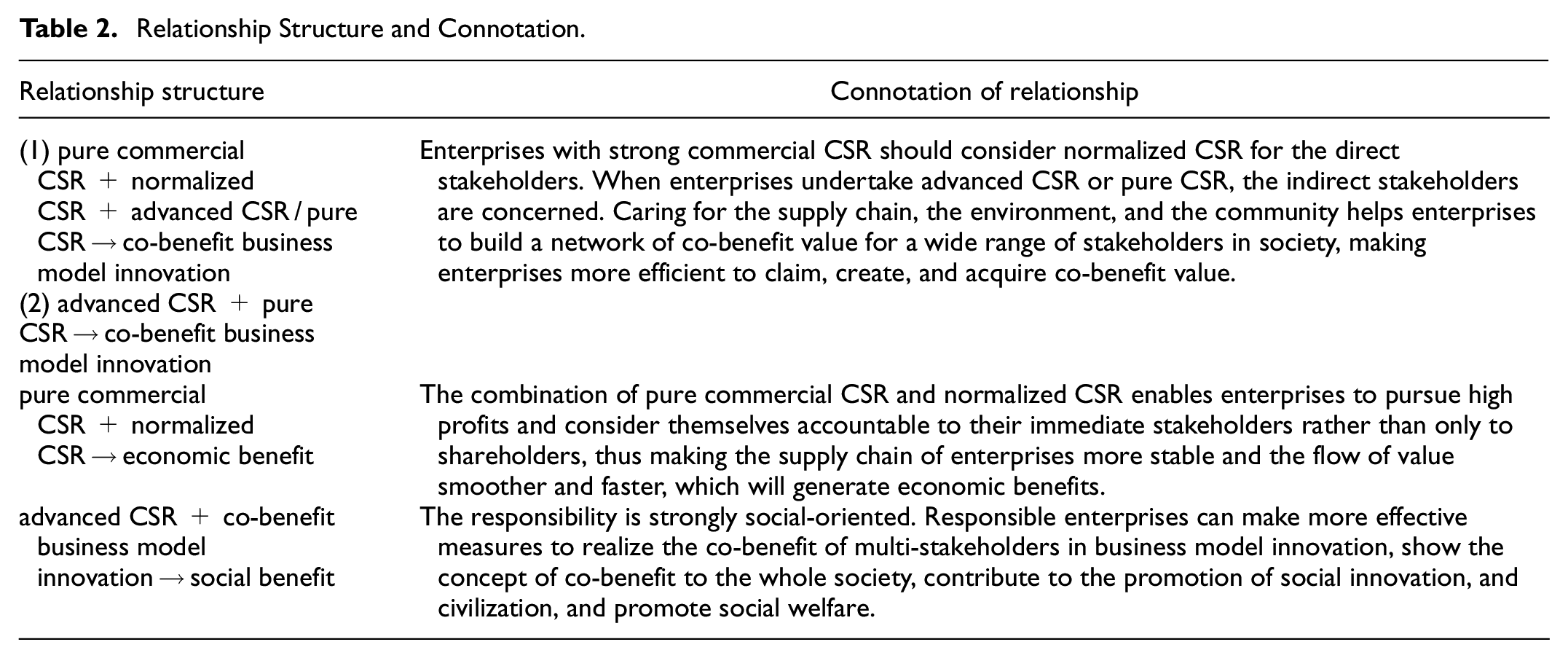
Selective coding is the process of unifying all the deputy categories around one core category. The other categories are always related to other core categories. The authors summarize the logical relations, which will be further tested in the empirical research below (Table 2).
Relationship Structure and Connotation.
Model Construction and Empirical Research of the Influence of CSR on Co-Benefit Business Model Innovation
Research Model Construction and Concept Definition
The strategic choice of the CSR combination determines the balancing degree of stakeholder interests (Mahmood & Humphrey, 2013), as well as the achievement of a win-win situation and sustainable economic value (Porter et al., 2011). Based on the ground coding study, CSR is classified into four categories: pure commercial CSR, normalized CSR, advanced CSR, and pure CSR. The higher the level of CSR, the more stakeholders are considered in the decision-making process (Figures 3 and 4).

Configuration model of CSR combination for the co-benefit business model innovation.
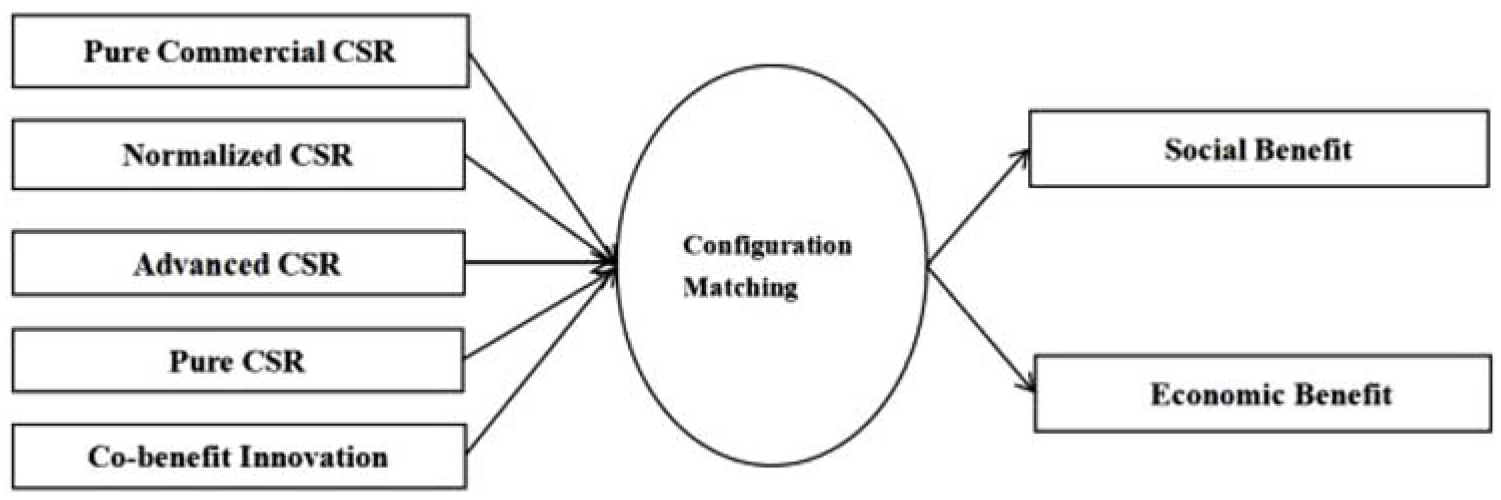
Configuration model of CSR and co-benefit business model innovation for benefit.
Our classification of CSR is based on enterprises’ self-awareness level in fulfilling CSR. We also draw inspiration from renowned CSR models such as Carroll’s pyramid theory, Elkington’s triple bottom line theory, and the two-class model proposed by a Chinese scholar based on the study of Donaldson and Dunfee (1994). Carroll’s pyramid theory is widely accepted. It categorizes CSR into economic responsibility, legal responsibility, moral responsibility, and philanthropic responsibility, in descending order of significance (Carroll, 1991). Elkington’s “triple bottom line” theory, a sustainable model of CSR, emphasizes the need for enterprises to achieve balance and sustainability across economic, social, and environmental aspects (Elkington, 1999). This guides businesses towards becoming socially and environmentally responsible. Drawing from these influential theories, Chinese scholars have further explored the CSR model and propose a CSR evolution from pure commercial CSR to pure CSR based on the integrated contract of Donaldson and Dunfee who hold that enterprise should focus on economic contract and social contract (Donaldson & Dunfee, 1994). Therefore, we position economic responsibility as pure commercial responsibility, legal responsibility as normalized responsibility, and philanthropic responsibility as pure social responsibility. This classification recognizes that responsibility towards society and the environment represents a high level of CSR, such as advanced CSR and pure CSR (Erdiaw-Kwasie et al., 2015). From the perspective of enterprise development history, when enterprises are established, they typically prioritize economic motives, making the pursuit of pure commercial CSR their primary focus. However, legal constraints require enterprises to adopt normalized CSR practices for the normal development of their activities. This kind of CSR practice can be considered as fulfilling normalized CSR. As enterprises aspire to achieve higher co-benefits in their business operations, they start to pursue a stronger sense of CSR, leading to the application of advanced CSR.
Normalized CSR
Lack of normalized CSR under business-driven objectives can result in rectification notices, property penalties, and admonitions. The discussion of normalized CSR benefits from the theoretical contributions of existing scholars. Carroll considers legal responsibility as the fundamental responsibility following economic responsibility, aimed at preventing potential disruption in commerce (Caroll, 1991). Elkington introduces basic legal responsibility and basic environmental responsibility in his triple bottom line model to ensure product safety, minimize environmental damage, and provide basic protection for employees (Elkington, 1999). Therefore, normalized CSR involves the responsibility to implement orderly internal production and operation, and to engage in fair external trade in accordance with laws and regulations. For example, (1) Providing good salary and welfare, a working environment, a training and promotion system, (2) Providing production safety, user safety, production norms and after-sales service, (3) Establishing a fair supply mechanism, (4) Avoiding environmental pollution, (5) Adjusting the internal structure (Berger-Walliser & Scott, 2018). This responsibility is commonly applied when enterprises face pressure from the government and society’s opinions, and requires enterprises to pay a short-term price. This responsibility enhances the enterprise’s legal status and reliable image in the long term, provides a guarantee for product sales and performance, and promotes the virtuous cycle of market value (Johnston et al., 2019).
Pure Commercial CSR
According to Friedman’s theory of shareholder supremacy, in which profit becomes the sole focus of CSR (Friedman, 1970). Enterprises have a responsibility toward their owners and investors, and they are responsible for the survival of the enterprise under the value orientation of maximizing shareholder profits (Beltratti, 2005). This responsibility includes capturing user information, reducing staff costs, holding shareholder meetings for information disclosure, huge advertising investments, socialized marketing, and expanding sales channels to facilitate transactions and achieve profitability. Due to the economic nature of enterprises, pure commercial CSR is generally applied throughout all stages of enterprise development, especially the startup and growth stages. Blind capital expansion can lead to the risk of damaging the interests of stakeholders.
Advanced CSR
Building on pure commercial CSR and normalized CSR, enterprises are committed to becoming demonstrative enterprises in the industry and implementing responsible behavior with positive external spillover effects. Advanced CSR aligns with the concept proposed by Elkington, which encompasses social and environmental responsibility (Elkington, 1999). Advanced CSR can also be associated with the shared value creation among multiple stakeholders that occurs in an enterprise’s business operations. According to Porter & Kramer, a high level of CSR includes commercial solutions for social issues, tracking implementation process, measuring results, and gaining insights into new values (Porter & Kramer, 2011). The integrated contract theory indicates that the highest level of CSR is to undertake the mission of social development (Donaldson & Dunfee, 1994). Therefore, advanced CSR is manifested in the following aspects: In terms of environmental protection and governance, enterprises realize certification and investment of environmental protection, and promote resource conservation and carbon emission reduction (Lyon & Maxwell, 2008); In terms of technological innovation, enterprises improve the quality of products and services through scientific and technological research and development, bringing technological innovation to society (Bocquet et al., 2015); In terms of mutual benefit, the enterprise builds a win-win reciprocal network with its partners, realizes the integration of multiple interests, and reduces the cost of network connections (Lassch & Yang, 2011); In terms of strengthening social development, enterprises invest in schools education or cooperate with schools to promote social knowledge progress and reserve human resources (Hua & Wong, 2020). Advanced CSR is commonly applied in the growing or maturing stage of enterprises. Enterprises pursue equal attention to economic benefits and social effects, promote society development and long-term enterprise development.
Pure CSR
This type of CSR behavior is considered less of a profit motive (Ketschau, 2017). Pure CSR is associated with the moral or philanthropic responsibility proposed by Carroll in his pyramid theory (Caroll, 1991). Drawing from the integrated contract theory of Donaldson & Dunfee, a two-class model developed by Chinese scholars suggests that CSR can take an extreme form of social supremacy, and some organizations focus on public welfare activities that are purely socially beneficial and do not seek direct economic returns (Donaldson & Dunfee, 1994). Inspired by the existing CSR theories, pure CSR contains social welfare programs and charitable donations that convey goodwill and altruism to the public, accumulate moral capital, and consume certain human and material resources of enterprises. Enterprises face various uncertainties regarding social feedback, mainly to promote social harmony and enhance the enterprise’s image.
Co-Benefit Business Model Innovation
Co-benefit business model innovation includes co-benefit value creation and co-benefit value transmission. Co-benefit value creation means that the enterprise joins different stakeholders to create new profit spaces, considers consumers’ demands or pain points, delivers beliefs through products, provides cost-effective and attractive products, pays attention to customer experience and multiple participants in value construction (Sjödin et al., 2020). Enterprises also pay attention to the differentiation of market layout and open up new blue oceans (Lüftenegger, 2020). To achieve this, they can integrate resources with strategic partners, reduce costs of intermediate transactions or logistics, open up new capabilities and resources, and maintain the continuity and value appreciation of the value chain (Boons & Lüdeke-Freund, 2013).
Co-benefit value transmission refers to the formation and improvement of network connections with consumers, platforms, or other stakeholders through risks diversification, subsidies and profits, and sharing platforms (Breuer & Lüdeke-Freund, 2017). For example, the identity of policies, manpower, capital, technology, and market can be converted into profit-giving opportunities that provide additional services to benefit consumers from product advantages to service advantages (Nair et al., 2013). Enterprises can also provide profit points to partners with technology or network flow and adopt flexible transmission channels while creating value. This can exchange higher and more lasting economic benefits, consolidate good relations with partners, and continue to obtain financial and technical support from partners.
Empirical Research on the Impact of CSR on Co-Benefit Business Model Innovation
Research Methods
Due to the multiple causes of the same result, this study systematically analyzes all possible combinations of conditions and how these combinations affect the result (Ragin, 2008). To verify the logical relationship, the study adopts the fuzzy set qualitative comparative analysis (fsQCA) method, and its analysis process is shown in Figure 5. The advantage of this method is that it considers each case as a configuration of conditional variables, allowing for an exploration of configuration effects in management practice by dealing with the degree of set membership of variables (Schneider & Wagemann, 2012). Each condition has a different meaning in different configurations and behaves as either a core condition or an edge condition. In contrast to traditional marginal effect analysis where only univariate effects influence a certain outcome, fsQCA overcomes the limitation of generalization and explanation of a case, and plays a large role in constructing and refining theories (Rihoux & Ragin, 2009). As the generation of co-benefit business model innovation depends on the condition configuration rather than a single condition, and is in line with the causality asymmetry of QCA research, it is more appropriate to explore the complex configuration causality by comparing cases (Ragin, 2008).

Research process.
Structure Assignment and Variable Calibration
This study examines complex causality in two studies. In Study 1, the four CSR combinations are used as antecedent conditions, and co-benefit business model innovation is the outcome variable. In Study 2, the four CSR paradigms and co-benefit business model innovation are used as antecedent conditions, and economic benefit and social benefit are the outcome variables, respectively. The measurement criteria based on literature and the original text were quantified using a 5-point Likert scale, ranging from 1 to 5 points (Likert, 1932) (Table 3).
The Construct Assignment.

Variables were calibrated to form fuzzy sets with values ranging from 0 to 1 (Ragin, 2008). Each variable was treated as a fuzzy set, and a determination was made to analyze whether the value in a given case belongs to that set. If a value scores 1, it is completely within the set, and if a value scores 0, it is completely outside the set. Data calibration requires three qualitative anchors, which are specified using the calibration function to convert each variable in a case into a fuzzy score, corresponding to full non-membership, interleaving points, and full membership (Fiss, 2011) (Table 4).
Descriptive Statistics and Data Calibration.

Necessity Test and Conditional Configuration Analysis
It is necessary to determine whether a single condition contributes to a certain level of the outcome variable. When the consistency of a condition and the outcome variable is 1, it indicates that the condition is a subset of the outcome variable and is an absolutely necessary condition affecting the outcome (Rihoux & Ragin, 2009). When the consistency is greater than 0.9, the condition is necessary for the outcome variable (Schneider & Wagemann, 2012). The necessary conditions tests for co-benefit business model innovation and the two types of benefits are as follows (Tables 5 and 6):
Necessary Conditions Test for Co-Benefit Business Model Innovation.

Necessary Condition Tests of Economic Benefit and Social Benefit.
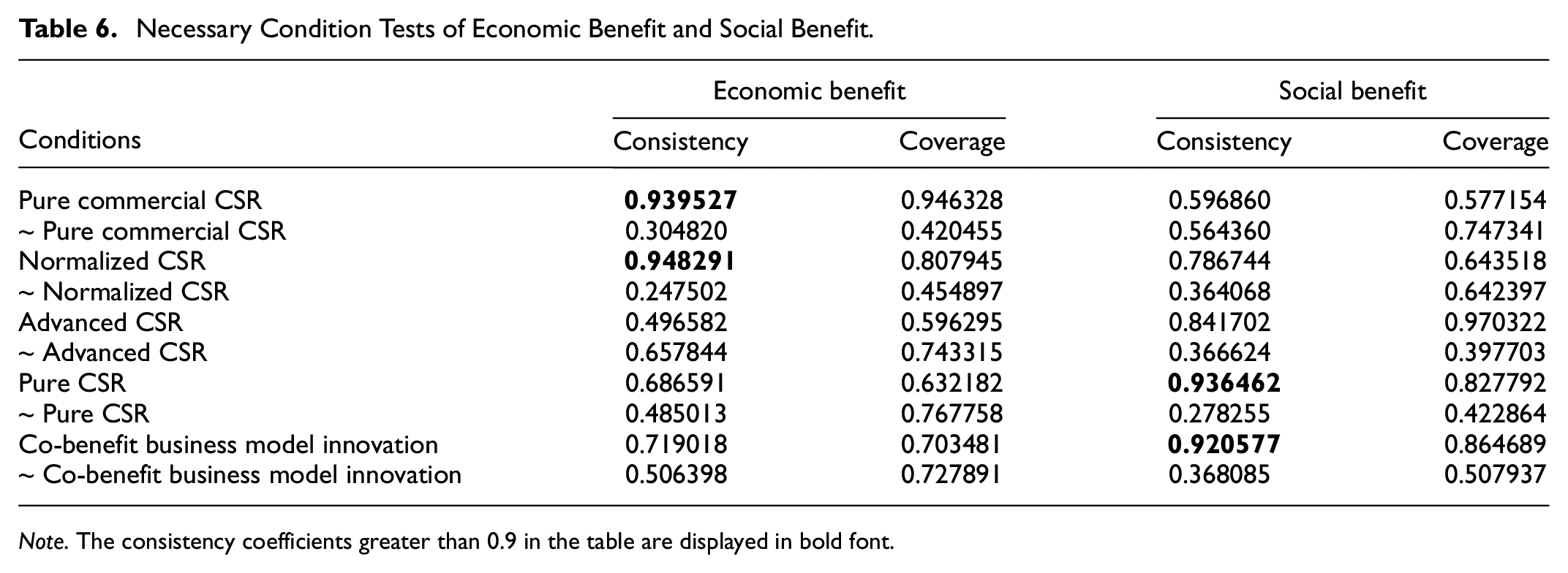
Note. The consistency coefficients greater than 0.9 in the table are displayed in bold font.
When using co-benefit business model innovation as the outcome variable, none of the conditional variables exceed 0.9, indicating that the conditional variables do not necessarily directly affect the outcome variable. However, when using economic benefit as the outcome variable, both pure commercial CSR and normalized CSR have consistency values above 0.9, indicating that they are necessary conditions for affecting economic benefit. Similarly, when using social benefit as the outcome variable, the consistency value of pure CSR and co-benefit business model innovation exceeds 0.9, indicating that they are necessary conditions for affecting social benefit.
Analysis and Illustration of Conditional Combination
After a standardized analysis to identify the conditional configurations affecting co-benefit business model innovation, and both economic and social benefits. The consistency threshold was set at 0.8, as recommended by Fiss (2011). The consistency and overall consistency of the three configurations were higher than 0.8, which provides an explanation of the logical relationship (Table 7).
Conditional Configurations of Co-benefit Business Model Innovation.
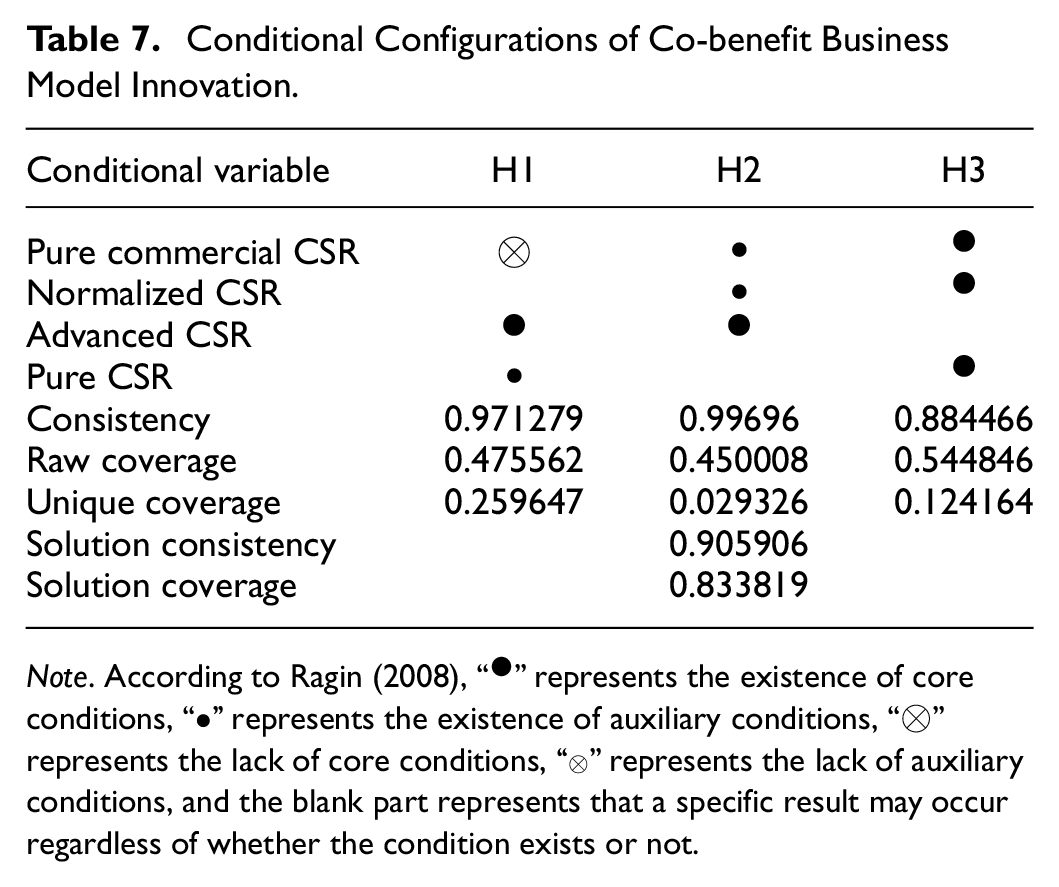
Note. According to Ragin (2008), “●” represents the existence of core conditions, “•” represents the existence of auxiliary conditions, “⊗” represents the lack of core conditions, “⨂” represents the lack of auxiliary conditions, and the blank part represents that a specific result may occur regardless of whether the condition exists or not.
H1: ~SYZR*DDZR*SHZR→GYCX
Non-high commercial CSR and high pure CSR are marginal conditions in the configuration, whereas highly advanced CSR is the core condition. When enterprises do not pursue commercial CSR to the extreme, they emphasize highly advanced CSR and pure CSR, which promotes co-benefit business model innovation. Pure commercial CSR is usually applied as the primary paradigm in the initial development stage of an enterprise. However, when profitability strengthens, enterprises tend to undertake advanced CSR and pure CSR, particularly technological innovation contributing to productivity and potential commercial value. This weakens the traditional commercial orientation and conveys a CSR signal to the environment and community, building a benefit value network with indirect stakeholders, ultimately achieving a high level of co-benefit business model innovation.
A typical example of the above configuration is JD, which initially focused on e-commerce operations to maximize economic benefits with limited resources. As JD continues to grow in size, it has started to fulfill CSR as the ideological source of its business philosophy, actively engaging in social innovation and public welfare activities. It has incorporated more CSR into its business inspiration, such as promoting rural e-commerce development and poverty alleviation through commerce. It also collaborates with the Dada Group to jointly recruit jobs for society and participates in the “Economy Action of Digital Platform for Employment Promotion and Poverty Alleviation”. JD has opened up logistics, micro-engineering, and other job opportunities in poor areas, attracting active participation from poor households. In addition, JD provides consumers with high-quality products and services with green and pollution-free features, achieving a win-win situation for poor households, consumers, and project implementation enterprises. It has formed a new infrastructure represented by intelligent supply chains, unmanned distribution, intelligent logistics, intelligent warehouses, and intelligent agriculture. Relying on a strong logistics infrastructure network and supply chain integration capabilities, it has integrated the green industrial chain to improve industrial operation efficiency and reduce social costs. Especially during the epidemic, JD ensured the supply and transportation of daily necessities and medicines, and drove retail and offline consumption of food and beverages. The JD Health platform has opened a free doctor consultation and service platform for psychological counseling, established an online JD pharmacy, and implemented the “Healthy China Pharmaceutical Subsidy Project” to achieve a higher level of co-benefit business model innovation. Therefore, when the motive of pure commercial CSR is weakened, the fulfillment of advanced CSR and pure CSR stimulates innovation in high co-benefit business models.
H2: SYZR*GFZR*DDZR→GYCX
The combination of high pure commercial CSR, normalized CSR, and advanced CSR contributes to high co-benefit business model innovation, which is common in the growth or maturity stage of an enterprise. The reason is that people’s legal awareness is weak in the initial stage of enterprises (Panwar, 2014), and enterprises mainly focus on pure commercial CSR, such as expanding their business to seek economic benefits (Areal et al., 2016). It is easy to make unsustainable profits due to poor risk control of tax evasion and pollution. Therefore, business operations should at least take into account the legitimacy in the initial stage of enterprises. With the increasingly mature development, enterprises pay attention to technology accumulation based on advanced CSR (Oh et al., 2017), and establish mutual benefit and win-win value networks with potential stakeholders.
A typical example of this configuration is Tencent, which provides internet services and products to maximize profits. Tencent drives the growth in its video platform, social advertising, overseas games, and other ventures. The aim is to help brand owners reduce their reliance on tools such as video platforms and mini-programs, thereby facilitating their advertising business and improving operational efficiency. As profitability improves and the focus on cost reduction and efficiency intensifies, Tencent is striving to normalize its operations. It prioritizes safety, health, inclusivity, and friendliness across its operations, and designs products with user needs in mind. To ensure profitability and comply with legal requirements, Tencent has enhanced its governance practices, including information disclosure and internal controls. Tencent has recognized its CSR position and invested in the construction of artificial intelligence and cloud infrastructure. It has applied AI capabilities not only to industrial quality inspection and intelligent manufacturing, but also to healthcare, education, elderly assistance, biodiversity, environmental protection, and agriculture to address social challenges. During the pandemic, Tencent has developed digital solutions such as Health Code, Tencent Medical Code, Tencent Conference, Tencent Classroom, Tencent Smart Campus, and WeChat Consumer Coupon. Tencent promotes public welfare initiatives and platforms, such as Tencent Village, Tencent Medical ME Conference, a new smart water IoT awareness platform, Tencent carbon neutral laboratory, digital education, smart medical solutions, green technology and more. Moreover, Tencent has launched cartoons and documentaries to raise awareness about global sustainable development issues such as marine pollution, climate warming and water conservation. Tencent pioneers business model innovations that create social value and achieve a win-win outcome for enterprises and society through agricultural artificial intelligence system. In summary, while pursuing high commercial interests, enterprises have the confidence and financial ability to assume higher levels of CSR, such as normalized CSR and advanced CSR, including carrying out standardized construction, integrating the resources of stakeholders in the value chain, conducting technological innovation, realizing comprehensive value creation, and consolidating the relationship network of co-benefit value among stakeholders, and eventually realize co-benefit business model (Areal et al., 2016; McIntosh et al., 2017).
H3: SYZR*GFZR*SHZR→GYCX
The combination of high level of pure commercial CSR, normalized CSR, and pure CSR can influence co-benefit business model innovation, which occurs in numerous stages, especially for enterprises engaged in low-intensive technological innovation (J. Huang et al., 2021). While ensuring commercial CSR for sustainable economic benefit, enterprises should continuously improve their relations with employees, suppliers, and other entities. Under the combination of pure commercial CSR and normalized CSR, enterprises do not cross the bottle line of legal responsibility, and fulfill higher pure CSR according to specific resource benefits (Windsor, 2006), thus laying a foundation for high co-benefit business model innovation.
China Mobile is a typical example of this configuration. As a leading mobile operator in China, China Mobile is committed to maintaining a competitive market share through its pure commercial CSR, which includes accelerating the construction and improvement of information solutions for beautiful family and community environments to create smart and comfortable living spaces. China Mobile also focuses on developing whole-house, scenario-based, and intelligent family services to achieve whole-home automation building upon the foundation of the “5G+ Gigabit” network. By offering comprehensive community digital services, China Mobile empowers government governance capacity through multi-platform and multi-scene services. China Mobile aims to promote the steady development of digital services in rural areas and enhance the convenience and happiness of urban and rural residents. They also emphasize standardized management and the implementation of the national deployment requirements, such as the “new infrastructure”, to support the government’s demand for smart community governance. In terms of improving social welfare, China Mobile actively participates in ecological protection projects, such as supporting the “ten-year fishing ban” on the Yangtze River. In addition, they have formulated the China Mobile Carbon Peak and Carbon Neutral Action Plan, which supports the collection, monitoring, mining, and analysis of ecological and environmental data to enhance the government’s capacity for environmental monitoring and governance. It can be observed that China Mobile’s business model aims to achieve co-benefits for consumers, communities, villages, and governments. From the above, high levels of pure commercial CSR, normalized CSR, and pure CSR can lead to a high level of co-benefit business model innovation (Table 8).
Conditional Configurations of Economic and Social benefit.

Note. According to Ragin (2008), “●” represents the existence of core conditions, “•” represents the existence of auxiliary conditions, “⊗” represents the lack of core conditions, “⨂” represents the lack of auxiliary conditions, and the blank part represents that a specific result may occur regardless of whether the condition exists or not.
The consistency and overall coherence of the four configurations alone are above 0.8, indicating that the configuration solution can effectively explain the theoretical logic that affects the co-benefit business model innovation of enterprises.
H4: SYZR*GFZR*~DDZR→JJXY
When the advanced CSR is not high but the other two responsibilities are, enterprises generate high economic benefits. The root cause is that enterprises driven by high economic interests participate in market competition and face various risks if they are not constrained by national policies and regulations or fail to meet the demands of stakeholders (Kim et al., 2018). To maintain stability in economic value creation, enterprises should assume at least a high level of pure commercial CSR and normalized CSR towards their immediate stakeholders, because both of these are core conditions for generating high economic value (Chung et al., 2018). The advanced CSR is not a marginally significant factor. While an enterprise assumes advanced CSR, such as green environmental protection and technological innovation, it may enjoy the potential economic value, but economic outcomes may be uncertain and long-awaited due to the long exploration cycle of technological innovation (J. Q. Liu, 2013; Y. Liu et al., 2021).
A typical example of this configuration is BYD, one of the world’s leading manufacturers of new energy vehicles. BYD places a strong focus on normalized CSR as follows: BYD actively adheres to relevant laws and regulations to ensure the legality of its businesses, and actively participates in industry standard formulation to promote standardization operations. BYD establishes the Intellectual Property and Legal Affairs Department to handle intellectual property and legal matters. The enterprise also sets up special legal departments or assigns personnel to supervise the compliance of their implementation with applicable laws and regulations. BYD emphasizes the principles of “fairness, transparency, and competition”, optimizes rules and regulations, addresses management loopholes, removes human interference factors, and eliminates rent-seeking opportunities. BYD has formulated the “Administration Measures of Suspected Benefit Transfer Activities” “Honesty Reward Measures” “BYD Supplier Requirements” “Audit Management Rules of Production Material Supplier” “Audit Management Rules of Non-Production Supplier” and “Corporate Social Responsibility Management Rules”. BYD prioritizes proactive intervention and implements comprehensive risk management. BYD also focuses on pure commercial CSR, such as establishing the Risk Management Committee and a procurement working group, and formulating the Procurement Risk Management Procedure. These measures are aimed at ensuring the enterprise’s accountability to investors, maintaining BYD’s strong market share, and achieving high economic benefits through regulated operations. Therefore, an enterprise with a high level of pure commercial CSR and normalized CSR can generate a high level of economic benefit even if it has a low level of advanced CSR in certain situations.
H5: SYZR*GFZR*GYCX→JJXY
The configuration H5 consisting of commercial CSR, normalized CSR, and co-benefit business model innovation, drives high economic benefits for enterprises. The reason is that enterprises pay attention to the demands of other social stakeholders, encourage other stakeholders to participate in the co-benefit business model innovation and make moderate profits with the mutual benefit motivation (Herrera, 2016). The high level of pure commercial CSR and normalized CSR as the core condition strengthens the acquisition speed of the economic benefits, so configuration H5 brings high economic benefits.
A typical example of this configuration is Wuliangye Company Limited, a famous Chinese liquor producer. The enterprise claims to protect the legitimate rights and interests of investors, unblock communication channels for investors, and create stable value-added for investors. This reflects the enterprise’s emphasis on pure commercial CSR. To deeply standardize enterprise operations, the enterprise actively promotes product quality management, corporate governance, standardization actions, and information disclosure reports. For example, in terms of food quality and safety, the enterprise disassembles and distributes the work objectives, signs related responsibility agreements with relevant departments, requires employee to implement specific tasks according to the hierarchical objectives, and strictly complies with national and local laws and regulations, such as the “Food Safety Law” and “Product Quality Law”. The enterprise established the Food Safety Self-inspection System covering test items from raw materials and semi-finished products to finished products through blind sample assessments, utilizing methods of blind sample evaluation and certification standard sample assessment. It established whole-process management systems such as the “food quality and safety management system” “finished wine quality management measures” and “packaging materials quality management measures”. In addition, the enterprise exercises stringent control over the quality and safety of exported wines and food products. It ensures that each shipment of exported goods complies not only with domestic standards but also with the standards of any destination country or region. This guarantees consistency in product standards across domestic and international markets. These measures reflect the enterprise’s dedication to upholding normalized CSR practices. The enterprise’s business concept emphasizes mutual benefits and promotes sustainable business projects such as the circular economy, resource conservation, energy conservation, and emission reduction. It aims to build a community of common destiny between the enterprise and its employees. It fosters a symbiotic and mutually prosperous relationship with manufacturers, upgrades its consumer experience, and comprehensively creates a development model that prioritizes resource conservation and environmental protection. In summary, the enterprise’s focus on pure commercial CSR and normalized CSR leads to better economic benefits in the co-benefit business model.
H6: ~SYZR*DDZR*SHZR*GYCX→SHXY
The combination of non-high pure commercial CSR, high advanced CSR, pure CSR, and co-benefit business model innovation has brought about high social benefits. When enterprises’ capital accumulation reaches a certain stage, they dilute self-interested commercial CSR and focus on advanced CSR and pure CSR. In this situation, enterprises open a dialog with indirect stakeholders, build an extensive co-benefit value network, bring convenience or direct benefits to the public (Arevalo & Aravind, 2015), accumulate scientific and technological achievements (Ho et al., 2016), promote the development of science and technology and civilization (J. Huang et al., 2021). This further proves that the co-benefit business model effectively prioritizes social benefits as its core goal (Sprinkle & Maines, 2010). Donation behavior may have a negative response from investors and may even result in a decline in corporate profits, primarily affecting social benefits (Kim et al., 2018).
A typical example of this configuration is GREE, a leading Chinese home appliance manufacturer. Unlike other enterprises focused on expanding market size and blindly pursuing sales leadership, GREE prioritizes investment of substantial R&D resources in green technology innovation and product development, improving technical content and product quality. This reflects GREE’s advanced CSR practices, which aim to benefit customers, society, and environment. For instance, GREE has introduced various technologies and products that show its commitment to environment sustainability, and these include the photovoltaic (storage) DC inverter multi-split system, air conditioning technology with zero carbon emission, intelligent power monitoring module. These innovations not only improve product performance but also contribute to reducing carbon footprints and promoting energy efficiency. In addition, GREE actively collaborates with suppliers to optimize technical processes and share the results of technological innovation. In addition, enterprises utilize information management tools such as intelligent supplier development management systems and supplier intelligent delivery scheduling systems to ensure secure and stable supply and demand relationships. These tools address core business aspects, including delivery, business, and contractual links, resolving any issues that may arise between the supply and demand parties. The above mentioned measures enhance the technical content and product value while fostering technological and industrial progress in the home appliance industry, and ultimately the enterprise achieves co-benefits and brings social benefits to multiple stakeholders including employees, suppliers, and customers through this business model. In addition to its focus on technological advancement, GREE places great importance on employee welfare. GREE offers a variety of programs to support its regional sales companies, including service support programs, such as “remote video training + technical assistance” designed to train frontline service personnel. This investment in employee development not only enhances customer satisfaction but also fosters a positive work environment. In addition, the enterprise actively participates in charitable projects and engages in pure CSR practices by donating funds, materials, and equipment. Overall, these measures demonstrate GREE’s commitment to advanced CSR practices and pure CSR, helping the enterprise aiming at co-benefit business model innovation to realize social benefits for multiple stakeholders such as employees, suppliers, customers, etc. As can be seen from the above, enterprises that achieve advanced CSR, pure CSR, and co-benefit business model innovation will gain high social benefits and play a positive role in promoting the sustainable development of enterprises and social progress.
H7: SYZR*GFZR*DDZR*GYCX→SHXY
Highly advanced CSR, as the core condition of the configuration, allows enterprises to achieve high social benefits. Highly advanced CSR is related to social sustainability and technological progress, and enables both internal and external stakeholders to enjoy technical benefits. Normalized enterprises consider the interests of consumers, employees and suppliers, which is conducive to the improvement of social benefits under a co-benefit relationship network (Sprinkle & Maines, 2010).
A typical example of this configuration is Ping An Insurance (Group) Company of China Limited. The enterprise strictly adheres to financial laws and regulations to protect the rights and interests of investors while maximizing profits by providing a comprehensive range of insurance and financial services. The enterprise also pays timely attention to social issues and actively participates in social welfare projects such as education, medical care, and poverty alleviation (Hassan et al., 2013). Through an innovative business model that combines insurance and financial services with CSR consciousness, the enterprise has promoted co-benefit businesses, such as health insurance and ring insurance. These innovative products and services meet the diversified needs of society and have led to growth in social benefits (Hassan et al., 2013). It is clear from the above that co-benefit business model innovation, complemented by pure commercial CSR, pure CSR and advanced CSR, can lead to a high level of social benefit.
Conclusion and Outlook
Study Conclusion
This study aims to examine the relationship between CSR and co-benefit business model innovation, and how this relationship affects the economic and social benefits. This study uses the fsQCA analysis to validate the existing theory and refine the theoretical logic. This study proposed seven configuration scenarios. Different enterprises have significant differences in terms of their economic development level, governance capacity, and innovation level. Therefore, there are variations in co-benefit business model innovation and the driving paths for economic and social benefits. Each enterprise should choose the appropriate path of co-benefit business model innovation based on its market environment, and development endowments to ensure sustainable development. The study’s conclusions are as follows:
Firstly, CSR can be classified into four types, namely pure commercial CSR, normalized CSR, advanced CSR, and pure CSR. Enterprises apply different CSR combinations at different stages with different goals, gradually shifting from an economic to a social orientation. Their concept of CSR has evolved gradually from purely commercial CSR to highly normalized and advanced CSR. Enterprises need to select different CSR combinations according to their resources and developing stages to respond to urgent social needs (Frederick, 1986). Based on longitudinal explorations of enterprise cases, as institutional environments such as markets and government regulations continue to improve, enterprises will pay more attention to CSR and co-benefit business model innovation. In the early stage, enterprises focus more on investor responsibility, and take measures to reduce institutional risk and protect their interests. As enterprises become relatively mature and accumulate certain resources, they tend to assume more responsibilities in areas such as environmental protection, and technological innovation. It is consistent with the idea of Chen and Marquis (2022) that enterprises are more oriented to addressing social issues.
Secondly, the different combinations consisting of pure commercial CSR, normalized CSR, advanced CSR, and pure CSR, are the ways to achieve maximum co-benefit business model innovation and both kinds of benefits. Low-level responsibilities do not necessarily contribute to the formation of co-benefit business model innovation. As scholars such as Carroll and Elkington have argued, the lack of normalized CSR results in rectification notices, property penalties, and admonitions. Normalized CSR is essential for enterprises to achieve high economic benefits. According to the “Triple Bottom Line” model, profit goals are considered the most basic bottom line and are considered in most periods. If enterprises want to achieve economic benefits more steadily, they should invest resources to ensure standardized operations, or undergo rectification due to poor management, which means that they should use a combination of pure commercial CSR and normalized CSR to promote sustainable economic benefits.
Thirdly, as Osterwalder and Pigneur (2010) hold that business model is environmentally and socially responsible, business model innovation requires an important combination of responsibility, which affects the generation of social benefits. When companies develop to a certain stage, they begin to pursue CSR for the environment, community, and public, establish platform partnerships, protect the common interests of more stakeholders, and pay more attention to the innovation of their core competitiveness, such as green environmental protection, scientific research innovation, etc., to promote sustainable social development. This helps enterprises consolidate a good win-win value network and make the entire value network closely connected.
Finally, regardless of the CSR combinations, pursuing a co-benefit business model is an inevitable choice for sustainable economic or social benefits in most situations. This confirms the prediction of Stubbs (2019) that co-benefit business model innovation is expected to create more long-term profits and become the mainstream. Pursuing an appropriate CSR combination and co-benefit business model innovation is key to balancing the economic and social benefits. While obtaining sufficient profits, enterprises should ensure compliance with local regulations and industry standards and assume their responsibilities in social and environmental aspects to maintain the sustainability of business operations. Enterprises need to consider the balance between profit and social benefits. Instead of blindly pursuing profits, enterprises should balance the expectations of different stakeholders and assume more CSR. If market demand is low or competition is fierce, enterprises need to sacrifice some profits to maintain their competitive advantage in the market.
Research Implication
The theoretical implications are discussed in three aspects. Firstly, we present and validate the new classification of CSR based on well-known CSR theories and grounded coding of enterprise practices. CSR classification considers that CSR should be optimized beyond commercial CSR, and focus on both normalized and advanced CSR that address the social and environmental pressures. We demonstrate the position of four distinct CSR to ensure enterprises make appropriate selections under varying resource endowments at specific development stages. Secondly, this study highlights how the strategic combination of CSR plays a crucial role in co-benefit business models, explores how the strategic combination of CSR and co-benefit business model work on two types of benefits, and gets valuable theoretical connections: In all configurations, normalized CSR is identified as a prerequisite for achieving high economic efficiency, while low-level CSR alone hardly stimulates the co-benefit innovation of business model. Finally, this study regards CSR as a strategic choice for businesses and endeavors to explore how different combinations of CSR can be tailored to achieve co-benefit value propositions and align with the differentiation objectives of each stage.
The practical implications are discussed in three aspects. Firstly, mature enterprises recognize the strategic significance of advanced CSR. For example, they consider the unmet demand of the social public, facilitate access to new markets, promote technology innovation ability, increase creativity, and productivity of employees, integrate resources, and engage in environmental protection. Moreover, enterprises should promote technology cooperation and knowledge sharing to improve the efficiency of enterprises, industries, and society, and then reduce industry costs. In most situations, enterprises should consider normalized CSR and pure CSR, such as providing fair wages and working conditions, protecting consumer rights, promoting social equity, and supporting local communities through charitable donations and volunteerism services. By engaging in strategic selection of CSR, enterprises not only build strong business relationships with the public or stakeholders, but also achieve co-benefit value. Secondly, managers consider the alignment of CSR combination with their organizational characteristics, resource endowment, stakeholder expectations, and regulatory requirements. To achieve sustainable development, economically oriented start-ups should focus on combining pure commercial CSR with normalized CSR, establish a legal compliance foundation to ensure zero deviation in the production and operational processes, and ensure the supply of products and services based on legal agreements. They can invest in marketing technology research concerning big data and artificial intelligence, implement accurate marketing strategies, and make breakthroughs in the market. Finally, enterprises should achieve both economic and social benefits. In the early stages of limited resources and immature development, enterprises focus on the essential combination of commercial CSR and normalized CSR within their capacity. However, to achieve a co-benefit business model, gradual efforts must be made to strengthen advanced CSR and pure CSR. For example, enterprises design the business outline and create sustainable comprehensive value by benefiting society and participating in social governance. Therefore, they become demonstrative enterprises in the industry, build co-benefit business networks with stakeholders, achieve sustainable development for both the enterprise and society, and promote the high-quality development of the national economy.
Limitation and Future Research
This research aims to explore the impact of diversified CSR combinations on business model from the perspective of enterprises in various industries, adopting a static analysis to investigate the relationship mechanisms of these impacts. Therefore, the present study did not conduct a comparative analysis of enterprises of different sizes or industries, nor did it consider a systematically dynamic analysis within a specific industry and other interfering factors.
Future research could explore the differences among various types of enterprises regarding superior CSR combinations, and the co-benefit degree of business model innovation. Scholars can select enterprises with rich developmental histories within specific industry as research subjects, identify different CSR issues that enterprises may face during each development stage, and examine how the selection of differentiated CSR initiatives can bring about stage-specific changes in benefits for enterprises. Therefore, scholars can carry out a case study or coupling mechanism study to realize an in-depth longitudinal research on how CSR makes the business model beneficial. In addition, individual, group, and government factors can be added to the research model based on this study to supplement the front-end research of CSR paradigms in the business model. The selection of CSR is a complex process of decision-making to optimize external situations, and managers play a crucial role in implementing CSR combinations, but they are not the sole determinants. It is also related to the identification of organizational culture, employee attitude, and public feedback. Nowadays, excellent enterprises are participating in social governance activities through co-benefit business model innovation, which cooperates with the government. Such interfering factors could be considered in the relationship between co-benefit business model innovation and CSR.
Footnotes
Acknowledgements
We would like to thank Huaqiao University Library for the literature search service.
Declaration of Conflicting Interests
The author(s) declared no potential conflicts of interest with respect to the research, authorship, and/or publication of this article.
Funding
The author(s) disclosed receipt of the following financial support for the research, authorship, and/or publication of this article: The author received national financial support for the research as follows: National Social Science Fund Project “Research on Co-benefit Business Model Innovation Based on Enterprise’ Economic Benefit and Social Responsibility” (20CGL003).
Ethics Statement
The study is not about animal and human.
Data Availability Statement
Data sharing not applicable to this article as no datasets were generated or analyzed during the current study.
