




Abstract
Online learning performance (OAP) serves as a critical determinant of educational quality and students’ academic success. In this study, we probe into the impact of faculty support (FS) on online learning performance among university students and assess the mediating roles of academic self-efficacy (ASE) and academic emotions (AE). A quantitative survey design was adopted, which involved public universities in Sichuan province in China. The participants consisted of 2,124 public university students who were selected via stratified sampling. Data were analyzed using partial least squares structural equation modelling (PLS-SEM) via Smart PLS 3.0 software. The analysis conducted using the standard bootstrapping procedure allowed for the estimation of both direct and indirect path coefficients in the study. Supported by the social support theory of faculty support, social cognitive theory of academic emotions, and self-efficacy theory of academic self-efficacy, Our results indicate that (1) a positive association between faculty support and students’ online learning performance, (2) the mediating effect of academic emotions between faculty support and online learning performance, and (3) the mediating effect of academic self-efficacy between faculty support and online learning performance. This study echoes prior research emphasizing faculty support as a pivotal component in enhancing student learning outcomes, while spotlighting the crucial role of academic self-efficacy and emotions in bolstering this relationship. This study, of noteworthy significance, foregrounds the importance of faculty support, academic self-efficacy, and academic emotions in optimizing online learning performance in higher education. Future research directions and implications are further discussed.
Keywords
Introduction
The learning performance of university students is a fundamental concern for nations globally. The contemporary world competition revolves around science, technology, and innovation, where the underlying principle lies in nurturing top-notch talents. In this regard, the learning performance of university students plays a pivotal role in the selection and cultivation of these talents (Malik, 2018; Pucciarelli & Kaplan, 2016; Serdyukov, 2017). Amid the COVID-19 pandemic, Chinese higher education has accomplished an “all-area, all-coverage, all-round” implementation of online teaching and learning (Xiao et al., 2020). After 3 years of this practice, the efficacy of online learning among students and its influencing factors have come into the spotlight (Kundu, 2020). Despite the survival of large-scale online education throughout the epidemic, it ultimately remains a reproduction of offline education, albeit a reproduction marked by attrition (Yuan, 2020). This underlines the deficiency in faculty support in online education, where a mere replication of traditional classroom formats failed to achieve the effectiveness of in-person teaching (Protopsaltis & Baum, 2019). Social support theory (Lakey & Cohen, 2000) emphasized that supportive actions are perceived to improve coping skills and job performance, while perceptions of available support lead to a reduction in potentially stressful situations. As online education evolves, faculty support (FS) has been recognized as one of the most crucial elements of a successful online learning program in higher education (Penna & Stara, 2007; Rohayani, 2015), significantly impacting students’ online learning performance (OAP).
The worldwide educational trend is progressively transitioning from teacher-driven education towards a student-centered learning paradigm (Bates, 1995). This trend is particularly accentuated within the sphere of online education, suggesting not only a shift towards “learner-centric” pedagogical methodologies but also illustrating that students are assuming unprecedented responsibility for their own learning processes in the online context. Numerous studies has revealed that intensive online coursework can challenge the autonomy and self-regulation large numbers of students have over their learning, potentially triggering a series of negative emotional states such as anxiety, frustration, and burnout, thereby complicating the assurance of optimal learning outcomes (Curelaru et al., 2022; Frenzel et al., 2021; Pekrun et al., 2017). Moreover, the educational procedure increasingly requires university students to demonstrate more autonomy, self-regulation, and self-control. This suggests that research on online learning performance will not only be contingent on faculty support but will also be heavily influenced by students’ own emotional regulation and self-efficacy (SE).
Numerous studies have elucidated the relationship between student learning performance, faculty support, academic emotions, and self-efficacy (Haddad & Taleb, 2016; Han et al., 2021; Ismayilova & Klassen, 2019; Morales & Pérez-Mármol, 2019). On one hand, according to social support theory (Lakey & Cohen, 2000) and social cognitive theory (Bandura, 2001), it has been found that students spend most of their time at university interacting with their faculty, whose support has been shown to be crucial for students’ academic development, not only in terms of learning performance, but also in terms of affective or emotional outcomes (Boekaerts & Pekrun, 2015; Deci & Ryan, 2016; Hewson, 2018). Multiple empirical studies illustrate a substantial positive correlation between faculty support and positive academic emotions (PAE) (e.g., happiness, interest, hope, pride, and relief) as well as negative academic emotions (NAE) (e.g., anxiety, depression, shame, anger, worry, boredom, and despair), although the magnitude of these effects varies across different studies (King et al., 2012; W. Liu et al., 2016; McMahon et al., 2013; Mitchell & DellaMattera, 2011; Skinner et al., 2008). Despite the pivotal role of emotions in learning, significant gaps exist in previous research. Roos et al. (2021) summarized previous research and found that the majority of past studies had focused on anxiety, particularly test anxiety, with little attention paid to other emotional aspects. Pekrun’s (2019) empirical study discovered that only 15% to 20% of emotional events are related to anxiety, implying that a large proportion of emotional events have been overlooked by researchers. Recently, numerous scholars have begun to gradually shift their focus to positive academic emotions, leading to some pioneering research in this area (Carstensen, 2021; Lomas et al., 2021; Rubio, 2021; Shao et al., 2020). Given the significant impact of the diversity of academic emotions on student learning performance, more in-depth studies are needed.
On the other hand, the role of students’ academic self-efficacy (ASE) as the main agent in the learning process in connecting faculty support to learning performance has garnered attention (Doo & Bonk, 2020; W. Lei et al., 2022; Ortlieb & Schatz, 2020; Yu & Deng, 2022). However, there is still an insufficient understanding of the relationship among the three. While most studies report positive correlations among these variables, some studies have found no significant impact of faculty support on academic self-efficacy (Li, 2019). This is primarily because there is a relative paucity of research on the relationship between teacher support, academic self-efficacy, and learning performance (Hajovsky et al., 2020; Perera et al., 2022).
In light of these gaps in prior research, this study aims to explore the mechanisms that influence university students’ online learning performance and to provide empirical evidence and corresponding recommendations for enhancing online teaching and learning at the university level. Based on these findings, the objectives are threefold: first, to delve into the relationship between faculty support and online learning performance; second, to investigate the mediating roles of academic emotions between faculty support and online learning performance; and third, to examine the mediating role of self-efficacy in the relationship between faculty support and online learning performance. This study not only fills a research gap but also furnishes theoretical support for further exploration of other variables and interrelationships related to academic emotions. It can aid teachers in gaining a better understanding of teaching activities and assist students in enhancing their online learning.
Literature Review
Faculty Support
Faculty support pertains to students’ discernment of whether educators express care, respect, empathy, and a willingness to assist (Patrick et al., 2007). The completion of tasks by individuals is dictated by their personal values, interests, and hobbies, yet it is the influence of surrounding individuals that modulates their relevant emotions and motivations (Ryan & Deci, 2000). Typically, faculty support is quantified via assistance offered in diverse domains: emotional, academic, instrumental, and behavioral (Babad, 1990; Malecki & Elliott, 1999; Ouyang, 2005). Furthermore, facets of faculty care and emotional support encompass the consideration, respect, and aid faculty bestow upon students (Black & Deci, 2000; J. Zhang et al., 2020). When analyzing faculty-student relationships empirically, higher scores denote superior relationship quality, inherently reflecting faculty support. Moreover, several empirical studies conducted to assess educational expectations and campus climate deploy faculty support or student-teacher relationship scales to represent faculty goals and the campus environment (Avery, 2022; He, 2019; Xia et al., 2018). While the terminologies of these above-mentioned concepts may differ, their common denominator is the care and support of students, thereby indicating shared core meanings.
Faculty support is fractionated into three dimensions: autonomy support, structure, and engagement. Support for autonomy involves faculty providing choices, relevance, or respect to the student. Structure implies clear expectations and unforeseen circumstances. Research utilizing this construct of faculty support has unearthed its impact on students’ emotional states (i.e., positive emotions and negative emotions) (H. Lei et al., 2018). At the same time, teacher support was also described as providing information, tools, and emotional or evaluative support to students in different contexts (Pitzer & Skinner, 2017).
The diversity and range of interpretations concerning faculty support indicate that none explicitly delineate a direct association with student academic affect. This obscures the identification of impactful intervention and support strategies. Hence, this study aims to amalgamate these varying research frameworks for a comprehensive analysis, thereby advancing the field.
Academic Emotions
Academic emotions are characterized as the emotional experiences associated with learning and teaching, encompassing a spectrum from happiness to despair, and boredom to anxiety and anger (Pekrun et al., 2002). These emotions significantly sway students’ learning outcomes (Dong et al., 2022).
Scholars tend to bifurcate academic emotions into positive academic emotions (PAEs) and negative academic emotions (NAEs) (Korpershoek et al., 2020; Li, 2020), albeit there is disagreement about where exactly to draw the line between these categories. As per Pekrun et al. (2002), primary emotional influencers include feelings of relief, hope, happiness, and pride, while secondary influencers encompass shame, anxiety, boredom, anger, and despair. Other research extends the umbrella of PAEs to include calmness and satisfaction or expands the NAEs to include depression and fatigue (Dong & Yu, 2007; Sorić, 2007). Further, PAEs may also envelop sensations of arousal and pleasure, while NAEs could include a sense of threat and fear (Dong & Yu, 2007).
Several scholars have pointed out in their studies that different learning emotions affect students’ learning performance in unique directions and mechanisms (Pekrun, 2006). However, the negative impact of negative academic emotions (e.g., anxiety) on learning performance has been overemphasized in previous studies (Li, 2020; Korpershoek et al., 2020; Kryza-Lacombe et al., 2019), while the impact of positive academic emotions on learning performance has been relatively under-researched. Therefore, the aim of this study was to investigate whether there is a difference between the effects of positive and negative academic emotions on online learning performance.
Academic Self-efficacy
In Bandura’s (1997) self-efficacy theory, self-efficacy (SE) is a key concept that refers to an individual’s beliefs in their capabilities to organize and execute the necessary actions to achieve specific goals or attainments. More specifically, academic self-efficacy represents an individual’s faith in their ability to successfully execute academic tasks at a specified competency (Schunk & DiBenedetto, 2016). This form of self-efficacy is a critical element in promoting learning. Prior research suggests that students exhibiting higher academic self-efficacy tend to demonstrate superior learning performance (Andres, 2020), while those with diminished academic self-efficacy display a greater degree of indifference in the classroom (Ozkal, 2019). This could be attributed to the motivational role of academic self-efficacy. Viewed through this lens, academic self-efficacy not only symbolizes one’s self-confidence in executing certain academic tasks, but it also functions as a motivational catalyst (Bandura, 1999).
Students boasting a higher degree of academic self-efficacy are generally more driven to employ an array of learning strategies and enhance their cognitive abilities (Hayat, et al., 2020). They are also more inclined to exert effort and display perseverance when confronted with learning challenges (Mrazek et al., 2018). Once students’ academic self-efficacy is stirred, triggering the initiation of strategic usage, learning effort, and perseverance (Britton, 2021), it inevitably paves the way for enhanced learning performance (Öqvist & Malmström, 2018). As such, it is plausible that the fulfillment of fundamental psychological needs forecasts learning performance via the medium of academic self-efficacy (W. Lei et al., 2022).
Online Learning Performance
Learning performance can typically be evaluated via test scores or academic grades. A more precise definition and assessment of learning outcomes can enhance the discovery of causative relationships (Cohen, 1987). However, online learning performance encompasses objective metrics like learning efficiency, effectiveness, and achievement, along with subjective experiences such as learning satisfaction(Jia, 2014). This subjective component not only constitutes a crucial aspect of learning outcomes, but also forms a significant part of the learning process.
Drawing from both subjective and objective indicators of comprehensive online learning performance, this study probes into five dimensions: academic achievement, learning satisfaction, competence and social interaction, personal knowledge, and input-output ratio. Academic achievement reflects the learners’ online learning goals; learning satisfaction mirrors the learners’ subjective sentiments about fulfilling their learning requirements (Abuhassna et al., 2020); competence and social interaction denote the learners’ expressive and communicative skills within the online learning environment (Mehall, 2020); personal knowledge pertains to the learners’ domain-specific knowledge and the expansion of their perspectives through online learning (Anderson & Rivera-Vargas, 2020); and input-output ratio represents the subjective resources that learners contribute to online learning compared to the perceived benefits (Lacka et al., 2021).
Nonetheless, extant research on the relationship between online learning performance has predominantly concentrated on the interplay between academic emotions and online learning performance (Camacho-Morles et al., 2021), the correlation between academic self-efficacy and online learning performance (Yokoyama, 2019), and the connection between faculty support/ faculty engagement and online learning performance (J. Liu et al., 2018), with the results largely being harmonious. It is therefore clear that faculty support/engagement, academic emotion, and academic self-efficacy significantly influence students’ online learning performance (Alston, 2022; Lloyd, 2022; Orona et al., 2022).
Faculty Support and Online Learning Performance
Faculty support emerges during the student learning process and represents the supportive actions students receive from faculty members in their academic pursuits and daily life (Ruzek et al., 2016). Social support theory suggests that supportive behaviors perceived or received from one’s social network are universally beneficial and promote individual psychological health and development (Rueger et al., 2016). Generally speaking, faculty support, as a type of social support system, can influence students’ learning performance. Students who receive more support from multiple faculty members tend to perform better academically (El-Alayli et al., 2018). Additional studies have found that faculty support significantly influences student learning performance and can directly and positively predict learning performance (Chen, 2018; Hernández et al., 2020; Sharma, 2016). An increased level of supportive behaviors from faculty members can enhance student learning performance to some extent.
Faculty support students by encouraging them, dedicating time to assist and support them, treating them equitably, and providing them opportunities to make choices (Gabriel, 2023). One study found that faculty influence ranked first in “personal academic-other academic” conflict situations (P. Q. Zhang et al., 2012). Actions such as learning support and emotional support provided by teachers to students have been demonstrated to be key factors affecting learning performance (Teng et al., 2017).
Some studies indicate a robust relationship between comprehensive faculty support and learning performance (Berkowitz et al., 2017; Blazar & Kraft, 2017; Boonk et al., 2018). However, the relationship between various aspects of faculty support and learning performance can vary depending on the manner in which the course is conducted. Literature review reveals a relative dearth of research on faculty support and online learning performance in the Chinese cultural context, causing a lack of in-depth exploration of the specific relationship between faculty support and online learning performance among educators. Therefore, this study will investigate the relationship between different types of faculty support and online learning performance (Figure 1). This study was based on the following hypotheses:
Hypothesis 1. Faculty support is positively related to students’ online learning performance.

A conceptual model of mediation framework. Academic emotions and academic self-efficacy mediate the relationship between faculty support and online learning performance.
Academic Emotions as the Mediator of the Relationship between Faculty Support and Online Learning Performance
Academic emotions potentially serve as a significant individual factor underlying the association between faculty support and online learning performance. According to Bandura’s (2001) social cognitive theory, academic emotions play an important role throughout the teaching and learning process by providing energy and motivation, directing attention, reacting to significant events, and initiating action-related intentions, and profoundly influence students’ cognitive processes, motivation, and behavior (Pekrun et al., 2002). While a myriad of emotions may surface in online learning environments, this study concentrates on three specific emotions—enjoyment, frustration, and boredom—as these are most frequently experienced by learners in educational settings (Park et al., 2017; Pekrun & Stephens, 2010). As a positive and proactive emotion, enjoyment augments task activity, bolsters motivation, and enhances learning performance (Zhou et al., 2023). Frustration, characterized as a negative activating emotion, often arises when students grapple with challenging tasks. Boredom considered a negative and deactivating emotion, may result in attention wandering, disengagement from the learning task, and a decrease in learning performance (Leung, 2020). Research has demonstrated that emotions operate continuously in cognitive processes such as memory, reasoning, problem-solving, and thought (Tyng et al., 2017), and negative emotions such as frustration, discouragement, and boredom during learning can occupy limited cognitive resources, resulting in decreased memory and concentration, interference with the learning process, and negative impacts on learning performance and student achievement (Camacho-Morles et al., 2021).
Moreover, the extent of faculty focus on and support for students’ needs, the clarity and organization of teaching objectives, classroom time management, and the harmony and inclusiveness of the classroom environment are all substantial influences on students’ emotional responses to online learning (Kara et al., 2019). A qualitative study on academic burnout among university students revealed that loose classroom management, subpar teaching efficacy, and insufficient faculty support were objective causes for inducing students’ negative academic emotions. Furthermore, a lack of self-control and learning autonomy were subjective causes for the emergence of poor academic emotions (Chang & Wu, 2016). Hence, based on these previous studies, this research posits that academic emotions may mediate the relationship between faculty support and learning performance in the context of online education (Figure 1). We hypothesized that
Hypothesis 2. Faculty support is positively related to students’ positive academic emotions and negatively related to students’ negative academic emotions.
Hypothesis 3. Students’ positive academic emotions is positively related to their online learning performance on one hand, as well as students’ negative academic emotions is negatively related to their online learning performance on the other hand.
Hypothesis 4. The relationship between faculty support and online learning performance would be mediated through academic emotions.
Hypothesis 4a. The relationship between faculty support and online learning performance would be mediated through positive academic emotions.
Hypothesis 4b. The relationship between faculty support and online learning performance would be mediated through negative academic emotions.
Academic Self-efficacy as the Mediator of the Relationship between Faculty Support and Online Learning Performance
Beyond academic emotions, academic self-efficacy may also act as a critical psychological factor influencing the relationship between faculty support and online learning performance (Saefudin et al., 2021; Wang et al., 2022). Furthermore, in accordance with the social cognitive theory (Bandura, 2001), a favorable learning environment can shape individuals’ psychological activities and in turn, motivate them to engage in academic tasks. Hence, individual psychological factors, such as online academic self-efficacy, could play a crucial role in the relationship between faculty support and learning performance.
Self-efficacy theory (Bandura, 1997) beliefs result from a complex self-persuasion process that relies on cognitive processing of dynamic, socially, and physiologically conveyed functional information. Once established, these functional beliefs significantly contribute to the level and quality of individual functioning. Research indicates that faculty support significantly influences academic self-efficacy within academic education and classroom settings (Alivernini & Lucidi, 2011). Some scholars have discovered that faculty’s emotional, competent, and academic support of students positively impacts their academic self-efficacy (Lazarides et al., 2021).
Online academic self-efficacy also predicts learners’ performance under online learning conditions. It is a crucial internal variable believed to influence individual behavior positively. Empirical studies have shown that learners with high online academic self-efficacy are more inclined to persist in and complete their courses, contributing to superior learning performance in online settings. Academic self-efficacy, represents an individual’s confidence in successfully executing academic tasks based on ability, attitude, and past experience (van Rooij et al., 2017). As Bandura (1978) asserts, the students’ belief about their competence profoundly impacts their behavior, and the more potent the expectancy of efficacy, the more positive the action and the stronger the learning motivation. One hypothesis regarding the relationship between academic self-efficacy and learning performance is that students with higher levels of academic self-efficacy demonstrate higher levels of academic goal setting, place higher value on learning performance, devote more time to learning, and thereby achieve higher learning performance. Based on the existing theoretical and empirical studies, it is reasonable to infer that online learning self-efficacy might mediate the relationship between faculty support and learning performance (Shown in Figure 1). We hypothesized that
Hypothesis 5. There would be a positive relationship between faculty support and students’ academic self-efficacy.
Hypothesis 6. There would be a positive relationship between students’ academic self-efficacy and online learning performance.
Hypothesis 7. The relationship between faculty support and students’ online learning performance would be mediated through students’ academic self-efficacy.
Method
Participants and Procedures
The study used a quantitative survey design involving students enrolled in public universities in Sichuan Province, China. A total of 2,181 public university students were selected using a stratified sampling method. This selection was based on the assumption that they had common characteristics representative of students in public universities in Sichuan Province in China who had experienced the epidemic in their 3-year online courses. We disproportionately stratified the population based on two factors: gender of participants and type of university (i.e., 985 project universities, 211 project universities, and general universities). Stratified sampling is a way of assuring the intended representation of relevant subgroups in the sample. In other words, some populations can be divided into subgroups, known as strata (one is referred to as a stratum). Stratified sampling is thought to be the best approach when a study’s goal is to compare participant behavior across various subgroups (Iliyasu & Etikan, 2021).
In particular, we obtained verbal informed consent before data collection, and participants were free to decide whether or not to complete the questionnaire. Survey completion was voluntary. From this cohort, 57 questionnaires were discarded due to incomplete responses. As a result, 2,124 questionnaires remained after the data collection process, indicating an approximate response rate of 97.4%. The remaining participant demographic comprised 1,075 males (50.61%) and 1,049 females (49.39%). Nearly an equal division was observed in academic fields, with about half the participants involved in social sciences and humanities (N = 1,057; 49.8%) and the remainder engaged in natural sciences and engineering (N = 1,067; 50.2%). The student body consisted of 26.70% freshmen, 48.82% sophomores and juniors, and the remaining 24.48% were seniors.
In order to reach out to potential participants, we contacted the deans and associate deans across the university’s twelve faculties, including mathematics, foreign languages, philosophy, and sociology, among others. With their endorsement, we distributed the online survey link via social media groups catered to the university community. This approach ensured the active involvement of faculty members from each department throughout the questionnaire dissemination process. In alignment with rigorous ethical practices, anonymity was stringently maintained in all responses, and all responses were handled under strict confidentiality protocols.
Instruments
To ensure linguistic equivalence, all measures in the survey were converted from English to Chinese and back to English by two bilingual experts using the back-translation methods outlined by Brislin (1980).
Faculty Support
Most extant studies measure faculty support from the standpoint of the learners, that is, students’ perception of faculty support. Aligning with this approach, our study utilized the subjects’ self-reported perception of faculty support within the online learning environment. The basis of this assessment was the student perceived teacher support questionnaire developed by Cai and Gong (2013). Measures of teacher support usually refer to some aspect of emotional, academic, instrumental, and behavioral support (Patrick et al., 2007). Teacher care and autonomy/emotional support also encompasses teacher care, respect, and support for students (Black & Deci, 2000). In empirical research on teacher-student relationships, higher scores indicate higher quality of teacher-student relationships, which necessarily includes teacher support. Following modifications to item wording to suit the online learning context, and after eliminating items incompatible with online learning, our refined questionnaire was validated as the Perceived Teacher Support Questionnaire for Online Learners. Following testing and revisions, the final product was the Perceived Teacher Support Questionnaire for Online Learners.
The questionnaire segregates faculty support into three distinct dimensions: autonomy support, cognitive support, and emotional support, and consists of 11 items, including 4 items for autonomy support (for example, “Give us enough time for self-study or independent thinking”), 4 for cognitive support (for example, “Extend what you have learnt, often by example”), and 3 for emotional support (for example, “Teachers know and care about me”). The questionnaire employed a 5-point scoring system ranging from 1 (not at all) to 5 (completely), with higher scores indicating a greater level of faculty support perceived by online learners. The original questionnaire demonstrated sound construct validity with high internal consistency coefficients between .75 and .89 across different subscales (Cai & Gong, 2013). In the current study, the internal consistency coefficients (Cronbach’s alpha) of autonomy support, cognitive support, emotional support dimensions, as well as the overall questionnaire were .916, .884, and .882, respectively. The overall reliability (Cronbach’s alpha) of the scale was .960, indicating strong reliability.
Academic Emotions (AEQ)
The Academic Emotions Questionnaire (AEQ), a widely recognized and reliable tool developed by Pekrun et al. (2011), was utilized in this study to measure the academic emotions experienced by students. The AEQ consists of three sections specifically designed to assess emotions related to classroom activities, study sessions, and exams. To gauge the academic emotions experienced by students throughout their educational journey, we employed an adapted version of the AEQ as suggested by Artino and Jones (2012). Our adapted AEQ included 14 items, targeting the academic emotions experienced by students during online learning; six items gauged positive emotions (α = .947), and eight examined negative emotions (α = .942). Example items from these subscales include: “I enjoy my online courses,”“I am frustrated with online learning,” and “I find online learning boring.” Each item was rated on a 5-point Likert scale, with 1 signifying complete disagreement and 5 reflecting complete agreement.
Academic Self-Efficacy
Based on Bandura’s (1997) self-efficacy theory and the concept of efficacy, scholars have developed some instruments to measure academic self-efficacy, which are divided into two main categories. The first category is to measure an individual’s confidence in his or her ability to perform a specific curricular task, such as Mathematics Self-Efficacy Scale (Usher & Pajares, 2009). The second category is self-efficacy scales that apply to more general academic behaviors, such as the one-dimensional Academic Self-Efficacy Scale by Yilmaz et al. (2007). Although the measures differ slightly, they were all developed based on Bandura’s (1997) concept of self-efficacy, and they were all developed based on the concept of self-efficacy in mathematics. We gauged this construct using the Perceived Ability Scale from the Maslach Burnout Inventory-Student Survey (Schaufeli et al., 2002). This portion of the scale encompasses eight items assessing students’ beliefs about their abilities and performance, rated using a 5-point Likert scale. An example item is: “I consider myself to be a good student,” with 1 and 5 indicating complete disagreement and agreement, respectively. This scale exhibited a robust Cronbach’s alpha value of .930.
Online Learning Performance
Learning performance was measured using the Learning Performance Scale developed by Long et al. (2017). Based on the educational objectives formulated in the Outline of Educational Development and related performance research propositions, the scale integrates students’ mastery of the theoretical knowledge system, the acquisition of skills in applying knowledge, and the enhancement of their ability to think independently to form a five-item measure of learning performance.
Customized to the online learning attributes of Chinese university students, this study pruned the questionnaire items through validated factor analysis, resulting in a single dimension with a total of five items. These items were self-assessed using a 5-point Likert scale (1 = completely disagree, 5 = completely agree), with higher scores indicating more effective online learning. The sample items included: “I was able to clearly grasp the theoretical framework and key points of the online course,”“I scored high on my test scores,” and “Online courses have helped me to improve my independent thinking and self-problem solving skills.” In this study, the Cronbach’s alpha coefficient for this scale was .924, exceeding the threshold of .70, thereby demonstrating high internal consistency.
Data Analysis
Data analysis involved utilizing SPSS 26.0 to compute Cronbach’s alpha coefficient to evaluate the reliability of the subscales. Descriptive statistics (mean and standard deviation) and Pearson correlations were calculated for all factors. Further, we employed Partial Least Squares-Structural Equation Modelling (PLS-SEM) (Hair et al., 2017) using Smart PLS 3.0 software (Ringle et al., 2015). PLS-SEM, as mentioned by Urbach and Ahlemann (2010), is suitable for analyzing non-normally distributed data and complex models, making it suitable for exploratory research.
Conforming to the guidelines for conducting and reporting PLS-SEM analyses (Hair et al., 2019), this study’s data analysis included assessing the measurement model (i.e., testing the reliability and validity of the latent constructs) and the structural model (i.e., testing the proposed relationships between the latent constructs).
Results
Descriptive Statistics and Correlational Analysis
The means, standard deviations, and bivariate relationships of the studied variables are presented in Table 1. The bivariate relationship between faculty support, academic emotions, academic self-efficacy, and online learning performance was statistically significant. Specifically, faculty support showed a positive correlation with positive academic emotions (r = .358, p < .01), online learning performance (r = .424, p < .01), and academic self-efficacy (r = .313, p < .01). However, faculty support correlated negatively with negative academic emotions (r = −.336, p < .01). Positive academic emotions had a significant positive association with online learning performance (r = .448, p < .01), while negative academic emotions exhibited a negative relationship with online learning performance (r = −.456, p < .01). Finally, a positive correlation was observed between academic self-efficacy and online learning performance (r = .495, p < .01). In short, all key variables in the study exhibited positive associations with each other, and these associations were found to be statistically significant.
Descriptive Statistics and Correlations.
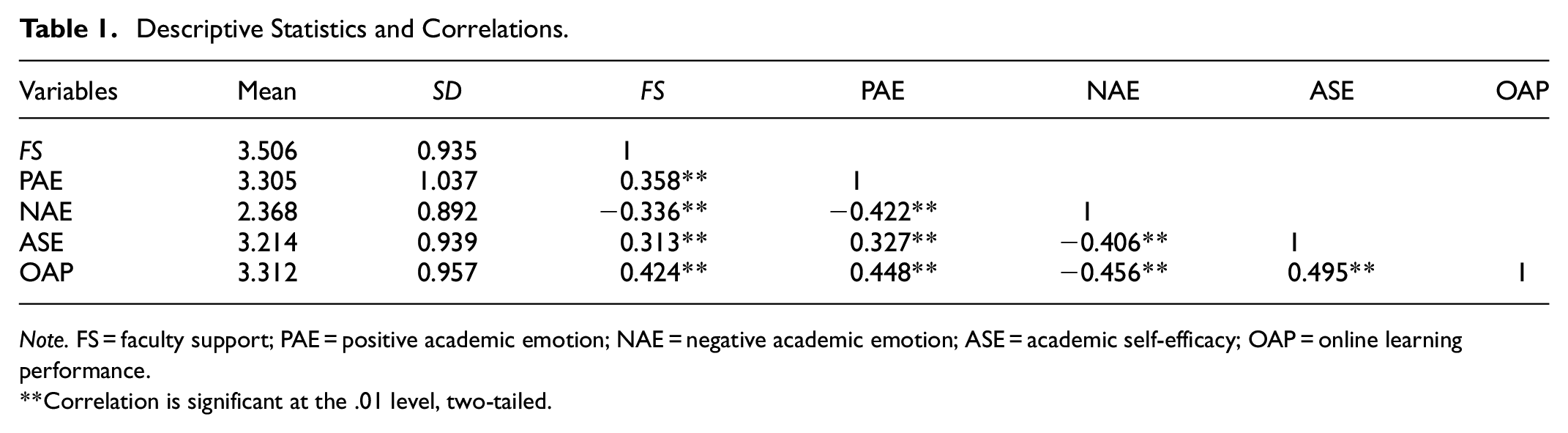
Note. FS = faculty support; PAE = positive academic emotion; NAE = negative academic emotion; ASE = academic self-efficacy; OAP = online learning performance.
Correlation is significant at the .01 level, two-tailed.
Measurement Models
The psychometric qualities of the scales for faculty support, academic self-efficacy, academic emotion, and online learning performance were assessed by using Smart PLS 3.0 software (Ringle et al., 2015). To establish convergent validity, the indicator loadings should exceed .70, and both indicator reliability and the average variance extracted (AVE) should surpass .50. Discriminant validity was assessed using the Fornell-Larcker criterion and cross-loadings. The Fornell-Larcker criterion states that the square root of the Average Variance Extracted (AVE) for each latent construct should be greater than the correlations between that construct and other latent constructs (Rönkkö & Cho, 2022). Furthermore, an indicator ought to exhibit higher outer loadings on the associated constructs than its cross-loadings with all other (Hair et al., 2017). Composite reliabilities and Cronbach’s alphas within the range of .60 to .70 suggest acceptable internal consistency for exploratory studies, with values from .70 to .90 indicating commendable reliability (Hair et al., 2019).
In terms of faculty support, the 11-item teacher support scale demonstrated adequate levels of convergent validity and reliability, significant loadings (>.80), impressive indicator reliability (>.90), acceptable AVE (>0.70), and high internal consistency across the three dimensions (namely, emotional support, autonomy support, and cognitive support). The scale’s composite reliability and Cronbach’s alphas between .738 and .811.
For academic emotions, the study indicated that the scales for positive and negative emotions were reliable with strong internal consistency (composite reliability and Cronbach’s alphas ranged from .942 to .958). They showcased acceptable convergent validity, that is, significant loadings (>.70), satisfactory indicator reliability, high AVE, and discriminant validity for both positive and negative emotions dimensions. Importantly, academic emotions constituted a second-order construct with robust composite reliability (α > .90), AVE (>0.70), and internal consistency (Cronbach’s α > .90).
As for academic self-efficacy, the eight items representing it in the ASE displayed high internal consistency (composite reliability α = .942 and Cronbach’s α = .930), satisfactory convergent validity with significant loadings (>.70), indicator reliability and AVE values above .60, and acceptable discriminant validity.
Finally, concerning online learning performance, the scale was found to be reliable, with high internal consistency (composite reliability α = .942, and Cronbach’s α = .924), significant loadings convergent validity (>.70), indicator reliability and AVE observed value above .70, in addition to acceptable discriminant validity. The results are consolidated and presented in Table 2.
Summary of the Quality of the Measurement Model.

Note. FS = faculty support; AE = academic emotion; PAE = positive academic emotion; NAE = negative academic emotion; ASE = academic self-efficacy; OAP = online learning performance.
Structural Model
The structural model’s validity was scrutinized after assessing the measurement model. The coefficient of determination (R2) represents the cumulative effect of exogenous latent variables on the intended endogenous latent variables (Hair et al., 2019). Ranging from 0 to 1, larger R2 values denote greater explanatory power of the model. As indicated in Table 3, the R2 values of positive academic emotions, negative academic emotions, and academic self-efficacy are deemed weak. In addition, the R2 values of online learning performance is deemed moderate. The effect size of faculty support on positive academic emotions R2 value was moderate (f2 = 0.152), on negative academic emotions the R2 value was weak (f2 = 0.133), on academic self-efficacy the R2 value was also weak (f2 = 0.113), and on online learning performance the R2 value was again weak (f2 = 0.052). The R2 values for the effect sizes of positive academic emotions, negative academic emotions, and academic self-efficacy on online learning performance were all weak (f2 = 0.051; f2 = 0.041; f2 = 0.114).
Structural Model Assessment.

Note. FS = faculty support; PAE = positive academic emotion; NAE = negative academic emotion; ASE = academic self-efficacy; OAP = online learning performance.
A standard criterion based on PLS-SEM is employed to evaluate the structural model of the higher-order constructs (HOCs) as suggested by Becker et al. (2012). To determine the significance of the path coefficients, a standard bootstrapping procedure with 5,000 samples, following the recommendation of Hair et al. (2017), is conducted using SmartPLS3 software. This analysis yields direct and indirect (mediation analysis) path coefficients, as depicted in Figure 2. The significance of the path coefficients was assessed by setting confidence intervals (CIs) for the path coefficients via a bootstrap procedure. Normality assumption is not necessitated for the sample distribution when using the bootstrap procedure. The path coefficient is considered significant if zero does not reside within the upper and lower 97.5% CIs (Lachowicz et al., 2018). The critical t-value for the two-tailed test, being larger than 1.96, suggested that the path coefficient was significant at p < .05. As represented in Table 4 and Figure 2, the direct and indirect effects of faculty support on online learning performance were estimated by employing mediators (i.e., positive academic emotions, negative academic emotions, and academic self-efficacy). The results signified that the indirect effect of faculty support on online learning performance through positive academic emotions, negative academic emotions, and academic self-efficacy was noteworthy (β = .073, p < .001; β = .063, p < .001; β = .094, p < .001), with a significant direct effect of .195, thereby validating hypotheses 1 to 7.

The structural model of the relationships among faculty support, academic emotions, self-efficacy, and online learning performance.
Significance Analysis of the Total, Direct and Indirect Effects.

Note. FS = faculty support; PAE = positive academic emotion; NAE = negative academic emotion; ASE = academic self-efficacy; OAP = online learning performance.
The variance accounted for (VAF) was employed to gauge the strength of the mediating effect (Carrión et al., 2017). It equals the indirect effect divided by the sum of the direct and indirect effects (i.e., total effect), with values of 0.244, 0.272, and 0.325, implying that 24.4%, 27.2%, and 32.5% of the effect of faculty support on online learning performance is elucidated by positive academic emotions, negative academic emotions, and academic self-efficacy. With the VAF value lying between 20% and 80%, this mediator was categorized as a partial mediator, with academic emotions and academic self-efficacy functioning as complementary mediators (Hair et al., 2017).
Discussion
This study aimed to examine the relationship between faculty support and online learning performance, with an emphasis on the underlying roles of academic emotions and academic self-efficacy. Specifically, we delved into the mediating role of academic emotions and academic self-efficacy within the relationship between faculty support and online learning performance.
The results of this study indicated that faculty support can directly and positively impact students’ online learning performance, which is aligned with several other studies (e.g., Daily et al., 2019; Mahoney et al., 2021; Ofori & Charlton, 2002; Perry et al., 2010; Teng et al., 2017). Our results support the positive relationship between faculty support and online learning performance. Within this framework, teachers provide three forms of support to students, suggesting that teacher support is an important behavior in the student learning process, which has a significant impact on student achievement, and that substantial steps can also be taken to improve student achievement. Hence, by offering various types of support and fostering a supportive climate via constructive teacher-student interaction, they can ultimately improve students’ online learning performance (Miao et al., 2022; Paschal & Mkulu, 2021; Reeve, 2013; Tan et al., 2021; Wentzel, 2016). Thus, the results of this study further support the first hypothesis (H1), and proved to be aligned with Lakey and Cohen’s (2000) social support theory.
Our findings of the study indicate that academic emotions played a mediating role in the relationship between faculty support and online learning performance, which is consistent with Pianta et al. (2012). Students who perceive substantial support and encouragement from faculty invest greater effort in their learning, exhibit heightened confidence (Uçar & Sungur, 2017), improve their creative thinking (J. Zhang et al., 2020), and develop more favorable attitudes towards subject matter (Rice et al., 2013). Moreover, positive emotions can assist students in maintaining their growing focus on the learning task and fostering their engagement (Hiver et al., 2024). Students can turn to teachers for support as a strategy to augment positive academic emotions and mitigate negative academic emotions when facing learning difficulties.
At the same time, for university students, the influence of their online learning status-control of learning activities and regulation of academic burnout in their online learning performance should not be ignored, and the total indirect effect of the two on the learning effect is even slightly larger than the direct effect. This may be related to the learning characteristics of university students and group characteristics. University students’ learning is a process of independent exploration of professional fields under the guidance of professional teachers, and the series of autonomous abilities such as self-control, self-management and self-regulation of university students may have a greater impact on learning performance than that of groups at other learning stages (Marantika, 2021). The maturity level of this group is higher, and negative academic emotions are not easy to outwardly express and expressed, and the isolated state of online learning may worsen this situation, thus bringing greater interference to the online learning of university students. Thus, our findings support the importance of faculty support and academic emotions in improving online learning performance, and providing backing for hypothesis H2 to H4. This finding establishes a foundation for future research on the relationship between variables related to academic emotions.
The results showed that self-efficacy (SE) mediates the relationship between faculty support and online learning performance, aligning with Bandura’s (1997) theory of SE and thus confirming H5 to H7 of this study. Self-efficacy as a self-motivational mechanism (Simbula et al., 2011), typically students with high levels of self-efficacy may tend to interpret needs and problems as challenges rather than barriers, which in turn would be associated with greater academic engagement and performance (Ventura et al., 2015). A strong sense of self-efficacy may also improve performance in academic engagement and contribute to improved learning performance (Wu et al., 2020). At the same time, aspects such as enjoying teacher-student interactions and observing student progress may also be important for teachers who provide support to increase student self-efficacy.
In addition, it is interesting to find in our results that more teacher support is associated with higher self-efficacy. This finding is consistent with most existing cross-sectional studies (Ayllón et al., 2019; Perera et al., 2022; Zheng et al., 2018). Teacher support reflects the teacher’s concern, trust, and positive evaluation of the student, while academic self-efficacy reflects the student’s subjective judgment of the environment as developed through interactions with the environment. Teachers can enhance students’ self-efficacy by providing supportive feedback (Bürgermeister et al., 2021). Our findings further support the role of teacher support in promoting student self-efficacy and can further motivate students to work harder to succeed.
Furthermore, the mediating role of academic self-efficacy implies that faculty support can amplify students’ academic self-efficacy and, in turn, academic achievement. This study revealed that academic self-efficacy exerted a more profound impact on online learning performance than faculty support. Xu and Qi (2019) proposed that academic self-efficacy acts as an intermediary variable between the perceived interpersonal environment and positive outcomes (e.g., learning performance).This suggests that students’ academic self-efficacy is one of the psychosocial constructs closely linked to learning performance, and that students’ efficacy beliefs are internal factors spurring positive behavior, hence having a more direct and potent impact on learning performance. Consequently, the findings of this study underscore the importance of this relationship for future researchers and university faculty. It suggests a valuable research and practical strategy to improve learners’ academic emotions and self-efficacy by enhancing teacher support in online learning environments, ultimately leading to improved learning performance.
Theoretical Implications
This study contributes to the existing literature by establishing links between these four key variables and evaluating the relationships between them. The importance of faculty support, academic emotions, and academic self-efficacy on the online learning performance of university students is an understudied area, and this study helps to highlight the critical role of academic emotions and academic self-efficacy in terms of overall university students’ learning performance. Furthermore, in contrast to previous research, the present study contributes to the literature in terms of the significance of the role of students’ academic emotions and self-efficacy as mediators of the predominant socio-cognitive tradition (Bandura, 1986). This implies that having a strong sense of academic self-efficacy and positive academic emotions may better utilize faculty support for becoming effective learners, and that the theoretical scaffolding of this study strengthens the scholarly discourse in the field of self-efficacy theory and social cognitive theory.
Practical Implications
The results of this study inspire educators to pay more attention to the unique role of affective factors while advocating the importance of teacher support in enhancing the learning performance of university students. More emotional and affective positive feedback should be given to students’ learning activities, and more affective teaching strategies should be applied to specific teaching activities. On the other hand, the results of this study also inspire educators to pay attention to the protective role of psychological quality in improving students’ learning performance, and to carry out educational activities according to the model of psychological quality training and implementation strategies, especially to cultivate students’ good psychological quality in combination with subject teaching.
Furthermore, this study bears essential implications for administrators, faculty members, and students who wish to comprehend the underlying psychological underpinnings that might bolster online learning performance, particularly within tertiary educational institutions. This investigation introduces both theoretical and practical insights that enrich the breadth of research in both international and local contexts, while concurrently suggesting potential limitations recommendations for future research. We eagerly anticipate additional research that will delve further into this intriguing phenomenon
Limitations and Future Directions
Despite the contributions of this study, certain limitations should be acknowledged. Firstly, the cross-sectional design only investigates at a single point in time, which may limit the causal interpretation of the results. Therefore, future studies may adopt a longitudinal design to identify changes and developments between the study variables with greater certainty. Secondly, considering the moderating effects of demographic factors such as age, gender, familial, and academic background may enrich our understanding of the focal relationships. Lastly, this study relied on self-reported data, which may be subject to bias, and the methodology used to measure the study variables could be further refined. Online learning performance was operationalized via student self-assessment reports. Future studies could incorporate student feedback, structured classroom observation protocols, and staged test scores alongside self-reported data. It also focuses on the academic emotions of university students studying online and provides timely interventions for negative academic emotions.
Conclusion
This research significantly augments the existing corpus of knowledge by scrutinizing (1) the direct correlation between university faculty support and students’ online learning performance, (2) the mediating effects of students’ academic self-efficacy between faculty support and online learning performance, and (3) the mediating role of students’ academic emotions in this relationship. The findings robustly endorsed all research hypotheses and offered substantial affirmation for key theoretical propositions. However, both academic self-efficacy and academic emotions emerged as equally consequential in shaping students’ online learning performance, acting as intermediaries in the relationship between faculty support and students’ online learning performance.
Although the COVID-19 epidemic has passed, online teaching has become a more popular teaching method in China. In this study, 2,124 college students who experienced the entire online learning process were selected as research subjects in order to further explore whether students’ online learning performance would be affected by teacher-side support and individual students’ psychological factors. In the long run, online teaching will be more demanding for teachers and require them to give more care and support to students and pay attention to students’ learning emotions to improve students’ online learning performance.
Footnotes
Authors’ Contributions
All authors contributed to the conceptualization and design of the study. Questionnaires and data collection were carried out by Mao Zhao, Siti Mistima Maat, data organization and data analysis were carried out by Mao Zhao and Siti Mistima Maat. The first draft of the manuscript was written by Mao Zhao, Norzaini Azman. The overall paper editing and journal submission tasks were carried out by En Zheng. All authors commented on previous versions of the manuscript. All authors read and approved the final manuscript.
Declaration of Conflicting Interests
The author(s) declared no potential conflicts of interest with respect to the research, authorship, and/or publication of this article.
Funding
The author(s) received no financial support for the research, authorship, and/or publication of this article.

Data Availability Statement
The raw data supporting the conclusions of this article will be available from the corresponding author on reasonable requests.