



Abstract
As academic pressure continues to rise, college students’ academic performance has attracted increasing attention. Although previous studies have examined emotional regulation, learning motivation, and self-efficacy, limited research has distinguished the roles of specific regulation strategies or explored the moderating function of social support. This study integrates the emotional regulation model, self-determination theory, and self-efficacy theory to propose a theoretical model with both mediating and moderating mechanisms. The study gathered data from 866 students across several Chinese universities. Validated instruments were employed to assess cognitive reappraisal, expressive suppression, learning motivation, self-efficacy, social support, and academic performance. Data analysis was conducted using partial least squares structural equation modelling (PLS-SEM). Cognitive reappraisal, expressive suppression, and learning motivation were significantly associated with academic performance. Self-efficacy mediated these effects, and social support moderated the relationship between self-efficacy and academic performance. This study develops an integrated model of academic adaptation by linking emotional regulation, motivation, and support resources, thereby extending the theoretical scope of self-efficacy and social support. The findings suggest that students who report higher levels of emotional regulation, self-efficacy, and social support also tend to show better academic performance, highlighting potential areas for future support efforts in higher education.
Introduction
In higher education, academic performance (AP) is commonly recognized as a primary measure of college students’ scholastic success (Mappadang et al., 2022). It is not only closely related to students’ current academic experiences but is also associated with their future career development trajectories (Kell et al., 2013). Moreover, it often serves as a core criterion for evaluating individuals' academic competence and potential for growth (Hanushek, 2020; Sothan, 2019). However, in real-world educational settings, AP among college students is shaped by the joint influence of multiple factors, with noticeable individual differences in how students adapt to academic demands and cope with learning stress (Meng & Zhang, 2023; Najimi et al., 2013).
Existing research has explored the key correlates of AP from various perspectives, which can be broadly categorized into internal psychological constructs and external environmental resources. At the individual level, constructs such as emotional regulation (ER) strategies, learning motivation (LM), and self-efficacy (SE) have consistently been identified as psychological factors associated with AP (Benítez-Núñez et al., 2024; Han et al., 2022; Yu et al., 2022). Among these, effective ER strategies can help students set clear goals, enhance emotional control, and improve attentional focus, which are in turn associated with higher academic engagement and perceived mastery of knowledge (Enguídanos et al., 2023; C.-B. Li et al., 2024). In the academic context, LM strengthens AP by instilling a commitment to learning tasks and driving long-term engagement (Formento-Torres et al., 2022; Muntean et al., 2022). As for external factors, constructs such as social support (SS), the quality of parent-child relationships, and social media usage behaviors have also been found to be significantly related to AP (Khulbe & Bartwal, 2024; J. Li et al., 2022; Mou et al., 2024). SS is commonly related to the development of positive emotional and cognitive strengths, greater adaptability in learning environments, and stronger academic self-beliefs. These characteristics are typically associated with higher levels of academic performance (Khulbe & Bartwal, 2024; Wen & Li, 2022). Notably, accumulating evidence suggests that SE functions as a central mediator in the process by which ER and LM are associated with AP (Dominguez-Lara et al., 2024; Supervía & Robres, 2021; Wu et al., 2020). Nevertheless, few studies have systematically examined or empirically tested how SE functions differently in the associations between distinct ER strategies and AP, or whether SS moderates the relationship between SE and AP. Therefore, the present research combines the emotional regulation model with self-determination theory (SDT) and self-efficacy theory (SET) to propose a conceptual framework encompassing mediating mechanisms as well as moderating processes. Specifically, it aims to examine whether SE mediates the effects of cognitive reappraisal (CR), expressive suppression (ES), and LM on AP, and whether SS moderates the relationship between SE and AP. This framework enhances comprehension of the psychological processes that are associated with students’ academic adjustment and offers both theoretical insights and practical implications for designing targeted interventions in higher education.
Emotional Regulation and Academic Performance
According to the emotional regulation model proposed by Gross (1998), ER describes how individuals, either deliberately or automatically, adjust their emotional experiences and expressions according to different situational demands (Gross, 1998). Studies consistently show ER is positively linked to AP (Diotaiuti et al., 2021; Ivcevic & Eggers, 2021; C.-B. Li et al., 2024). In their 2021 study involving American college students, Ivcevic and Eggers (2021) observed a positive association between elevated levels of ER and enhanced AP. The connection between ER and AP was explored by Supervía and Robres (2021) in a Spanish setting. Their findings pointed to SE as a pivotal intermediary factor within this dynamic. Similarly, evidence from investigations in China also verifies the link, showing that ER represents a key psychological dimension connected with students’ academic outcomes (C.-B. Li et al., 2024). Most prior investigations have focused on ER at an aggregate level, while the unique contributions of individual strategies have seldom been examined. CR and ES, as two principal ER strategies (Gross, 2013), may be differentially associated with AP. CR is generally viewed as a constructive strategy for managing academic stress and has been positively associated with AP, while frequent use of ES has been linked to lower levels of AP (Jarrell et al., 2022). Nevertheless, research by Cifuentes-Ferez and Fenollar-Cortes (2017) highlighted that students who adopted ES strategies were observed to have higher scores in translation learning than those who frequently expressed negative emotions Therefore, gaining a deeper understanding of the mechanisms underlying different ER strategies may provide more targeted and effective guidance for educational practice. Derived from the preceding discussion, the current research puts forward the ensuing hypotheses:
Learning Motivation and Academic Performance
SDT, proposed by Deci and Ryan (2000), posits that LM consists of intrinsic motivation and extrinsic motivation. Intrinsic motivation stems from students’ curiosity and genuine interest in learning, whereas extrinsic motivation is influenced by rewards or external pressure (Deci & Ryan, 2000). Motivation is a dynamic and complex psychological construct that is closely related to how individuals direct their behaviors and pursue goals (Constantin et al., 2009). Within educational contexts, students who report stronger LM often show greater academic engagement, and this tendency appears to be linked to variations in their academic performance (Gordeeva et al., 2014; Mondal & Mondal, 2013). Studies have found LM to be strongly associated with AP in college students (Benítez-Núñez et al., 2024; Kreménková, 2019; Kusnierz et al., 2020; Usán et al., 2019). To illustrate, Kusnierz et al. (2020) found in a cross-cultural study conducted in Ukraine and Poland that LM was significantly associated with AP. Furthermore, Kamberi (2025) showed that intrinsic motivation focused on knowledge significantly predicted college students’ AP by encouraging the adoption of deep learning strategies. In addition, Kafkova and Urban (2024) investigated creative performance among college students and found that SE mediates the link between LM and creative outcomes. Therefore, LM is considered a key psychological construct that has been linked to academic engagement, learning quality, and academic achievement. Grounded in the earlier discussion, this study puts forward the following hypotheses:
The Mediating Role of Self-Efficacy
SET, proposed by Bandura (1977), describes individuals’ perceptions of their capability to accomplish goals and manage challenges. The association between higher SE and better academic performance (AP) has been supported by empirical evidence gathered from diverse societies worldwide (Christy & Mythili, 2020; Meng & Zhang, 2023). Higher levels of SE have been associated with stronger motivation for success and better self-regulatory capabilities, and are further linked to higher levels of AP (Abdel-Khalek & Lester, 2017; Han et al., 2022; Zeng et al., 2021). ER and LM are two psychological constructs that demonstrate a strong association with SE. Empirical evidence indicates that employing ER strategies is linked to more effective management of negative emotions. This regulatory capacity is subsequently connected to higher levels of SE, and further correlated with improved AP (Grazzani et al., 2015; Luberto et al., 2014; Ramos-Cejudo et al., 2024). LM, through its associations with intrinsic drive and goal orientation, has been found to be positively related to SE, which is also associated with AP (Affuso et al., 2025; Basileo et al., 2024; Wu et al., 2020). In summary, the existing literature points to SE as a potential intermediary that may connect ER and LM with AP. Yet, it remains ambiguous whether the mediating pathway of SE differs between CR and ES, the two predominant forms of ER. Further investigation is required to specify the different pathways by which these strategies are differentially associated with academic outcomes via SE. On the basis of the prior analysis, this study proposes the following hypotheses:
The Moderating Role of Social Support
SE, as a psychological mechanism associated with both ER and LM, may show differential associations with AP depending on the availability of external resources. Within this conceptual framework, SS is often regarded as a significant variable that exerts a moderating effect. The concept of SS encompasses two primary forms: affective sustenance and practical assistance. These resources are typically available to an individual through their connections with family members, friends, and educators (Cohen, 1985; Khalid, 2021; W. Liu, Zhang, et al., 2024). Numerous investigations have established a positive relationship between SS and AP (Carmeli et al., 2021; Kuzminska et al., 2024; J. Y. Liu, Ye, et al., 2024; Tinajero et al., 2020; Wright & Wachs, 2021). A cross-national study covering several countries, including the United Kingdom, Germany, and Italy, reported that in multicultural contexts, SS and SE are important predictors of AP (Lyrakos, 2012). As an illustration, in a longitudinal study incorporating objective academic outcomes, Wright and Wachs (2021) observed that college students perceiving greater SS often showed relatively favorable academic outcomes, with this trend sustained across different educational stages. Carmeli et al. (2021) further noted that SS was positively associated with AP and student vitality. According to Social Support Theory (Deutsch, 1983; Thoits, 1995), SS has been linked to stronger coping abilities and may condition the effectiveness of internal psychological resources in relation to external challenges. According to the proposed model, SS may function as a moderator in the association between SE and AP, with the potential to enhance the strength of this positive relationship. Thus, SS has been associated with academic adjustment and may also influence the strength of associations between internal psychological mechanisms and academic performance. The current inquiry is designed to advance scholarly understanding by exploring how SS conditions the association of SE with AP, a question that remains underexplored. Building on the preceding analysis, this research puts forward the following hypotheses:
Current Study
This research draws upon the emotional regulation model, the SDT, and the SET (Bandura, 1977; Deci & Ryan, 2000; Gross, 1998). Building on previous research on the psychological mechanisms among ER, LM, and AP, this study develops a theoretical model that incorporates the mediating role of SE and the moderating effect of SS (Figure 1).

Research model.
Method
Participants
Data were collected using stratified random sampling from December 2024 to February 2025. Several universities of different types, including key universities and general undergraduate institutions in China, were randomly chosen. We randomly chose participants from different academic years within each selected university to enhance the representativeness of the sample. We created the survey using Wenjuanxing (https://www.wjx.cn/) and distributed it to the intended participants via internal university systems, social media platforms, and email communication. Two strategies were adopted to reduce potential self-selection bias. Before distributing the questionnaire, academic affairs offices at each university helped contact the randomly selected students, ensuring that the participants were not limited to those with particularly high LM. Second, demographic data were gathered to explore possible systematic variations in the course of data analysis. Participants signed informed consent after being informed of the study’s purpose and data usage.
Following the Kline (2018) guideline of 10 participants per questionnaire item, this study’s 50-item instrument required an initial sample size of 500. Considering an estimated attrition rate of approximately 20%, the final required sample size was 600 participants (50 items × 10 participants + 20% of 50 items × 10 participants). To address the sampling goal, we sent out 930 surveys and collected 901 responses. After screening the data, we discarded 35 entries that did not meet the criteria for analysis. Reasons for exclusion included having more than 10 unanswered items. Valid questionnaires were defined as those with at least 80% of items completed; thus, questionnaires with more than 20% missing data were considered invalid. In addition, cases where participants selected the same extreme option (e.g., “strongly agree” or “strongly disagree”) for 80% or more of the items were excluded, as such response patterns may distort the results and compromise the validity of the analysis (Wang et al., 2012). In total, 866 valid questionnaires were retained, comprising 476 male and 390 female respondents. A summary of the sample’s descriptive profile is shown in Table 1.
Demographic Characteristics of the Sample.

Measurement Instruments
Academic Performance
AP was assessed using the scale validated by Raza et al. (2020). Comprising four items such as “I gain knowledge from course learning,” this instrument uses a 5-point Likert format (1 = strongly disagree, 5 = strongly agree). It achieved acceptable reliability, with Cronbach’s alpha reported at .760.
Emotional Regulation
The ER construct was evaluated with a validated scale by Kahwagi et al. (2021), using a 7-point Likert format (1 = strongly disagree, 7 = strongly agree). The instrument contains two key factors (CR and ES) across 10 items. Greater ER skills are reflected by higher scores. CR is measured with six items (e.g., “When seeking to feel happier emotions like joy, I shift my thoughts”), capturing emotional management through cognitive shifts, and demonstrated strong internal consistency (Cronbach’s α = .856). ES includes four items (e.g., “I hold back my emotions”), assessing emotional suppression, with reliability at Cronbach’s α = .784.
Learning Motivation
LM was assessed using the scale developed and validated by Tu and Chu (2020), which was based on prior research and dimensions related to LM. This scale includes 10 items (e.g., “I am confident in achieving excellent academic results”), designed to evaluate the extent to which college students engage in careful and proactive learning in their daily academic activities. Items are rated on a 5-point Likert scale ranging from 1 (strongly disagree) to 5 (strongly agree), with higher total scores indicating stronger LM. The scale showed strong internal consistency, with a Cronbach’s alpha of .866.
Social Support
The Multidimensional Scale of Perceived Social Support, adapted from Sun and Guo (2024), was applied to measure the extent of SS experienced by participants in both academic and everyday settings. This instrument contains 12 items (e.g., “My family tries to help me”) and captures perceived support from three domains: family, friends, and significant others, with four items for each domain. Responses were recorded on a 7-point Likert scale ranging from 1 (strongly disagree) to 7 (strongly agree), where higher scores reflect stronger perceived SS. The internal consistency of the scale was high, with a Cronbach’s alpha of .901.
Self-Efficacy
SE was evaluated with the updated General Self-Efficacy Scale developed by N. Li et al. (2023), consisting of 10 items (e.g., “If I put in enough effort, I can overcome difficult challenges”), rated from 1 (strongly disagree) to 5 (strongly agree) on a Likert scale. A higher total score signifies stronger SE. The instrument demonstrated excellent reliability, with Cronbach’s alpha reaching 0.903.
The translation of the measurement tools was carried out collaboratively by two experts. One was a subject-matter specialist fluent in English and Chinese, while the other was a linguist with expertise in Chinese language. The English questionnaire was translated into Chinese to ensure both content accuracy and linguistic clarity. Any inconsistencies between the two versions were resolved through discussion, and a consolidated version was produced. This version was subsequently pilot tested with 20 Chinese college students to detect and address possible translation problems, completing the Chinese adaptation of the scale.
Data Analysis
This study used partial least squares structural equation modeling (PLS-SEM) as the main approach for data analysis. PLS-SEM is a variance-based nonparametric statistical approach with several advantages. First, it is prediction-oriented. Second, the method continues to yield reliable results with limited sample sizes and remains stable under conditions where the data deviate from normal distribution. Third, it can handle complex model structures efficiently (Hair et al., 2021). Given these strengths, PLS-SEM was deemed suitable for the purposes of this research. Conversely, covariance-based structural equation modeling (CB-SEM) is generally more suitable for theory-driven research with relatively simple model structures and data distributions close to normality. However, the model in this study included multiple mediators and potential pathways, with the primary goal of exploring underlying mechanisms rather than achieving optimal model fit. Preliminary normality tests also indicated skewed distributions for several variables. For these reasons, PLS-SEM aligned better with the theoretical objectives and data characteristics of this study, and CB-SEM was not adopted. The testing of hypotheses was carried out in three phases. In the first stage, a baseline model was constructed including only the independent variables, dependent variables, and control variables to examine the direct effects, thereby testing H1, H2, and H3. In the second stage, mediating variables were added to the baseline model to assess mediating effects, thus testing H4, H5, and H6. In the third stage, the moderating variable was introduced into the mediation model to evaluate H7.
Results
Common Method Bias
We assessed common method bias (CMB) using Harman’s single-factor test. The results showed that the first factor accounted for approximately 27.122% of the variance. This is below the critical threshold of 40% (Podsakoff et al., 2003), indicating that CMB was not a serious concern in this study.
Confirmatory Factor Analysis
Confirmatory factor analysis (CFA) was employed to assess the structural, convergent, and discriminant validity of the final measurement model. As presented in Table 2, all fit indices satisfied the recommended thresholds, demonstrating that the model exhibited an acceptable fit (Hu & Bentler, 1998).
CFA Results for the Final Model.
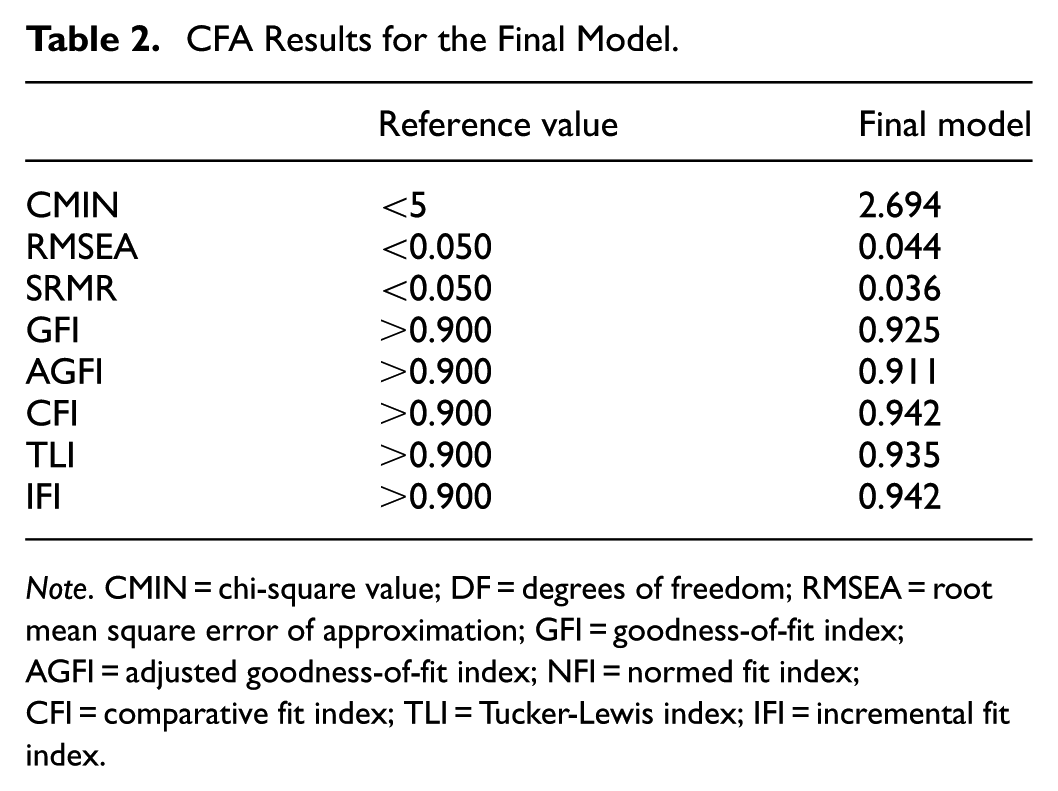
Note. CMIN = chi-square value; DF = degrees of freedom; RMSEA = root mean square error of approximation; GFI = goodness-of-fit index; AGFI = adjusted goodness-of-fit index; NFI = normed fit index; CFI = comparative fit index; TLI = Tucker-Lewis index; IFI = incremental fit index.
Measurement Validation
Reliability was assessed using Cronbach’s alpha together with composite reliability, and convergent validity was evaluated on the basis of the average variance extracted (AVE) (Hair et al., 2021). As presented in Table 3, all Cronbach’s alpha coefficients were at or above .7, and the composite reliability values were higher than .8, indicating satisfactory reliability. Moreover, the AVE for each construct exceeded .5, confirming adequate convergent validity (Hair et al., 2021).
Reliability and Validity Assessment.
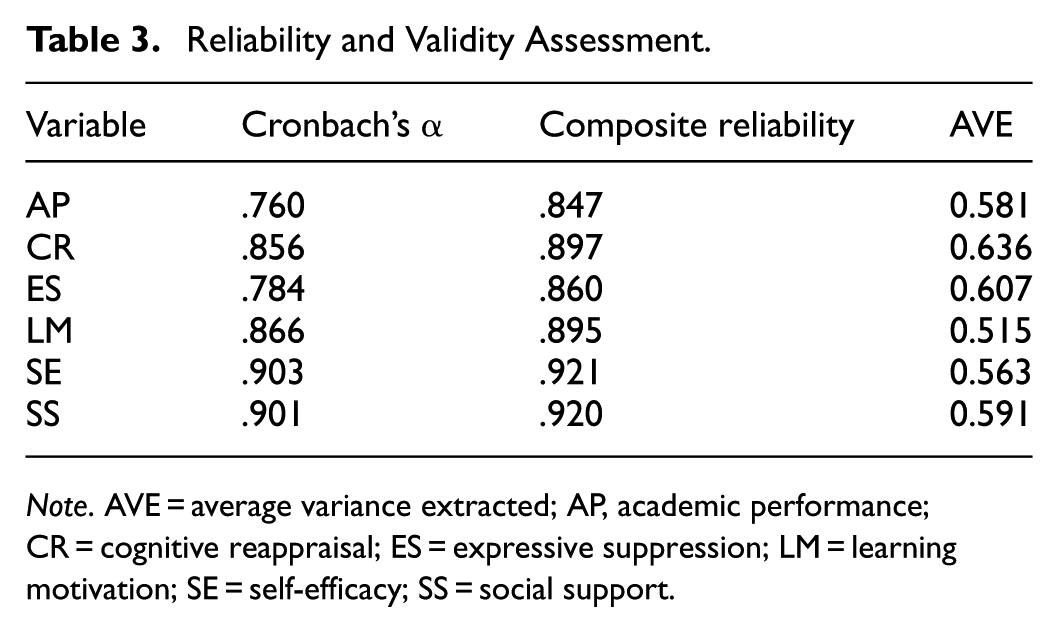
Note. AVE = average variance extracted; AP, academic performance; CR = cognitive reappraisal; ES = expressive suppression; LM = learning motivation; SE = self-efficacy; SS = social support.
We evaluated discriminant validity using the heterotrait–monotrait ratio (HTMT) and the Fornell–Larcker criterion. All HTMT values were below the threshold of 0.85 (Table 4) (Hair et al., 2021), and the correlations among constructs were lower than the square root of their AVEs (Table 5), satisfying the criterion proposed by Fornell and Larcker (1981). Together, these results support the reliability and validity of the measurement model and confirm the structural soundness of the constructs.
Heterotrait–Monotrait Criterion.

Note. AP = academic performance; CR = cognitive reappraisal; ES = expressive suppression; LM = learning motivation; SE = self-efficacy; SS = social support.
Fornell-Larcker Criterion.

Note. AP = academic performance; CR = cognitive reappraisal; ES = expressive suppression; LM = learning motivation; SE = self-efficacy; SS = social support.
Each bolded diagonal value represents the square root of the AVE.
Structural Model
Collinearity Test
Based on Hair et al. (2021), variance inflation factors (VIF) was used to check multicollinearity. As displayed in Table 6, all VIFs (1.047–1.789) were below 3.3, indicating no multicollinearity.
VIF of the Structural Model.

Note. AP = academic performance; CR = cognitive reappraisal; ES = expressive suppression; LM = learning motivation; SE = self-efficacy; SS = social support.
Analysis of Direct Effects
The direct effects of CR, ES, and LM on AP were examined using the baseline model. This model demonstrated an acceptable level of fit under the PLS-SEM fit indices (NFI = 0.869, SRMR = 0.055). Together, CR, ES, and LM explained 23.1 % of the variance in AP, indicating a moderate level of explanatory power. As reported in Table 7, all three independent variables had significant positive effects on AP. Specifically, CR (β = .273, p < .001), ES (β = .172, p < .001), and LM (β = .197, p < .001) were positively associated with AP. Therefore, H1, H2, and H3 were supported.
Direct Effect Estimates.
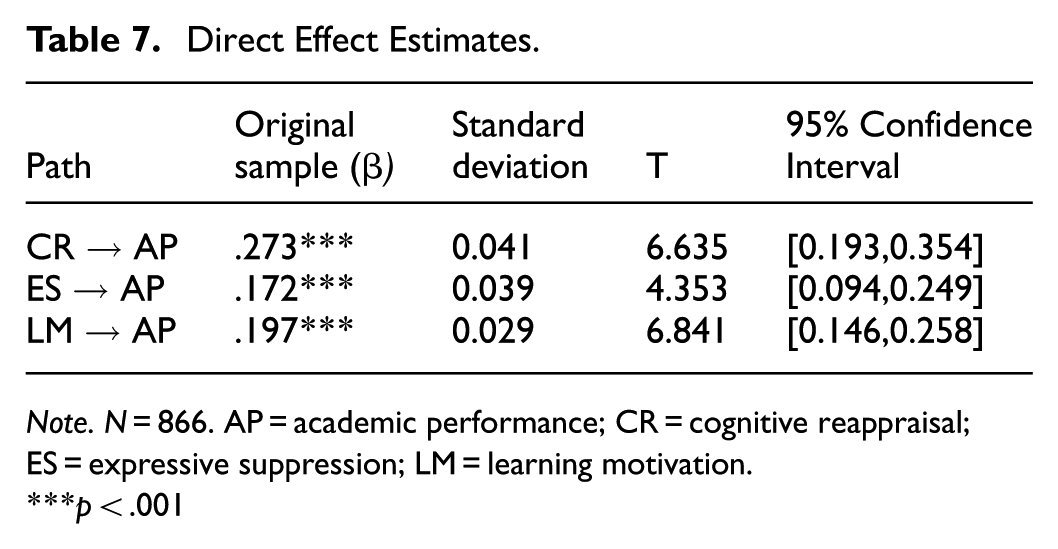
Note. N = 866. AP = academic performance; CR = cognitive reappraisal; ES = expressive suppression; LM = learning motivation.
p < .001
Analysis of Mediating Effects
As shown in Figure 2, SE was introduced into the baseline model to examine its mediating role in the relationships between CR, ES, LM, and AP. The PLS-SEM fit indices (NFI = 0.826, SRMR = 0.052) indicated a good model fit. CR, ES, and LM together accounted for 20.8 % of the variance in SE. Approximately 25.2% of the variation in AP was captured by the mediation model, showing strong explanatory power.

Results of the mediation model.
Further analysis revealed that both ER (β = .275, p < .001) and LM (β = .310, p < .001) had significant positive effects on SE, with the effect of LM being stronger.
Moreover, CR (β = .238, p < .001), ES (β = .153, p < .001), LM (β = .135, p < .001), and SE (β = .178, p < .001) all were positively and significantly related to AP. Among them, CR exerted the strongest influence, followed by LM, SE, and ES. Regarding control variables, gender (β = −.024, p > .05), age (β = .024, p > .05), academic year (β = .043, p > 0.05), and academic major (β = .028, p > .05) were not significantly related to AP.
The mediation effects were examined through bootstrapping with 5,000 resamples. As shown in Table 8, the mediation effect of SE in the relationship between CR and AP was significant (β = .036, p < .001, 95% confidence interval [0.021, 0.054], which does not include zero). Similarly, SE significantly mediated the relationship between ES and AP (β = .018, p < .01, 95% confidence interval [0.007, 0.033], which does not include zero). In the relationship between LM and AP, the mediation effect of SE was also significant (β = .055, p < .001, 95% confidence interval [0.032, 0.086], which does not include zero). Therefore, H4, H5, and H6 were supported.
Direct Effect Estimates.
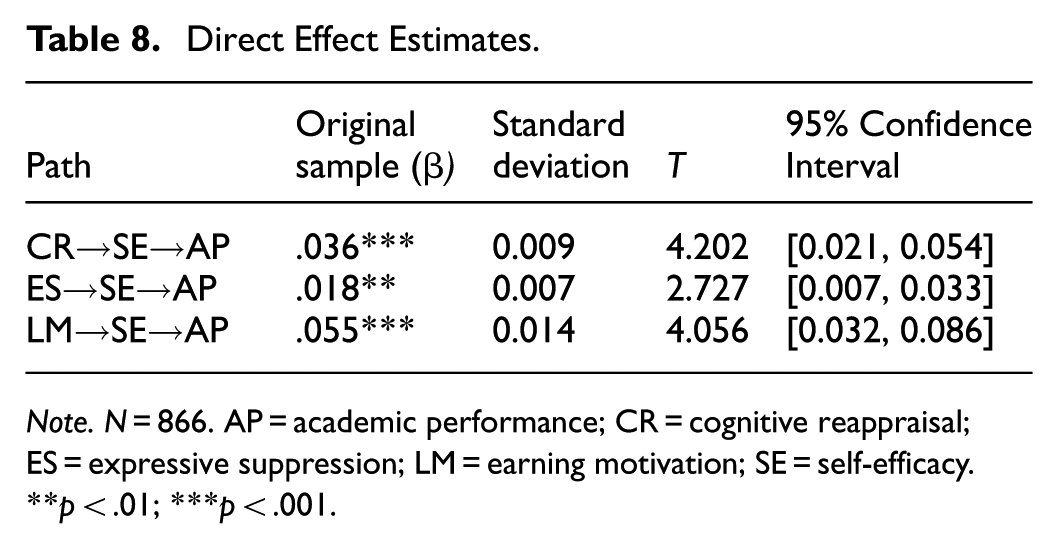
Note. N = 866. AP = academic performance; CR = cognitive reappraisal; ES = expressive suppression; LM = earning motivation; SE = self-efficacy.
p < .01; ***p < .001.
Analysis of Moderating Effects
As shown in Figure 3, SS was incorporated into the model as a moderating variable. The PLS-SEM fit indices indicated good model fit (NFI = 0.843, SRMR = 0.048). The results revealed that SS significantly moderated the relationship between SE and AP in a positive direction (β = .078, p < .001). Figure 4 visually illustrates the moderating effect. For college students reporting stronger SS, the positive association between SE and AP was stronger. In contrast, for those with lower levels of SS, the positive impact of SE on AP was relatively weaker. As shown in Figure 4, among college students with higher levels of SS, the positive predictive effect of SE on AP was more pronounced, whereas this effect was relatively weaker among those with lower levels of SS. Although AP increased with higher SE in both groups, the regression slope for the high SS group was noticeably steeper than that for the low SS group. Therefore, H7 was supported.

Estimated moderating effect model.

Moderating effect of social support.
Discussion
Based on the process model of emotional regulation, SDT, and SET, this study investigated how emotional regulation strategies and learning motivation are related to the academic performance of college students. It further tested the mediating role of SE and the moderating role of SS. The results showed that all hypotheses were statistically supported. These findings are consistent with the theoretical expectations of this study, suggesting that ER and LM are positively associated with AP, and that these associations may be partially explained by SE, and that the presence of external resources such as SS may strengthen these positive associations. The following section provides a detailed discussion of these results.
Emotional Regulation and Academic Performance
The analysis revealed that CR was positively related to AP at a significant level, echoing Jarrell et al. (2022) and providing evidence in support of H1. This study highlights a key perspective within the emotional regulation framework: through CR, students tend to reframe academic challenges in ways that are associated with changes in how they emotionally engage with these experiences. Students who frequently use CR tend to report fewer disruptions from negative emotions such as anxiety and frustration and greater attunement to positive emotional resources. As a result, students are able to focus more effectively on learning tasks, which in turn is associated with improved AP (Gross, 1998). More importantly, the positive association between CR and AP in this study was not limited to an emotional buffering effect. It also reflected that, during the process of reappraisal, students reassessed and adjusted their learning goals and strategies, which were associated with stronger planning and persistence in their learning (Xiao et al., 2024). This study’s findings suggest that universities could incorporate CR training into academic support programs to help students develop more adaptive cognitive frameworks in high-pressure learning environments, which is further associated with better AP.
For college students, ES was positively linked with AP at a statistically significant level, confirming H2. The result corresponds with the conclusions of Cifuentes-Ferez and Fenollar-Cortes (2017), suggesting that ES is not necessarily a maladaptive ER strategy and may be associated with adaptive outcomes in specific educational contexts. On the one hand, it reduces the outward display of negative emotions and the interpersonal costs of conflict, which may support classroom order and sustained attention, and could be linked to greater learning efficiency (Gross, 2013). This mechanism explains why ES showed a positive relationship with AP in the present sample. On the other hand, the results of this study differ from the conclusions of Jarrell et al. (2022) in STEM education, which pointed out that ES may hinder students’ emotional expression and social interaction, leading to negative learning outcomes. This difference suggests that the role of ES is context-dependent. In teaching environments centered on knowledge acquisition and individual task completion, ES may be associated with improved concentration and task execution. In contrast, in collaborative learning environments that emphasize emotional exchange and group interaction, ES may restrict emotional sharing and group cohesion, and thus be related to lower AP (Jarrell et al., 2022). In addition, cultural factors may also shape the functional role of ES. In collectivist cultural contexts, emotional restraint is often regarded as a behavioral norm for maintaining interpersonal harmony and group order. Such social expectations may lead students to view ES as a strategy consistent with situational demands in educational settings, which may, to some extent, be associated with positive learning outcomes (Costa & Faria, 2024). In sum, the findings of this study indicate that ES should not be regarded solely as a negative ER strategy. Instead, it should be understood in relation to disciplinary characteristics and cultural contexts, providing a basis for re-examining the diverse functions of ER strategies.
Learning Motivation and Academic Performance
LM was significantly and positively associated with AP among college students, supporting H3. The result corresponds with the conclusions of Benítez-Núñez et al. (2024), further highlighting the consistent association between LM and AP. LM is not only positively associated with learning engagement but also linked to stronger goal orientation and persistence, which in turn are related to higher learning efficiency and academic outcomes (Meng & Zhang, 2023; Saeed et al., 2021). From a theoretical perspective, SDT emphasizes differences in the quality of motivation, noting that intrinsic motivation and autonomous extrinsic motivation often stimulate more enduring and higher-quality learning behaviors (Deci & Ryan, 2000). Within the academic climate shaped by intense competition and test pressure, the data suggest that learning motivation that is both intense and self-directed may be particularly relevant in competitive academic climates. Upcoming investigations might consider how culturally and pedagogically varied settings shape the relationship between distinct motivational orientations, LM, and AP, which may help clarify the ways these constructs interconnect.
The Mediating Role of Self-Efficacy
The analysis showed that SE functioned as an important mediating mechanism linking ER and LM to AP, supporting H4, H5, and H6. Specifically, as a proactive ER strategy, CR has been associated with more positive evaluations of learning abilities, which are linked to higher levels of SE (Doménech et al., 2024). Students with higher SE tend to pursue academic goals with greater determination and report more strategic approaches to learning, which are in turn associated with better AP (Supervía & Robres, 2021). In addition, the findings indicate that ES, as a key ER strategy, was positively associated with AP and indirectly related to academic outcomes through SE (Supervía & Robres, 2021). During the learning process, ES has been linked to greater emotional stability and classroom discipline, which are further associated with more positive self-evaluations of capability. When students believe they can effectively manage emotional challenges in academic settings, they tend to report higher involvement in learning activities and greater commitment to their goals. Therefore, SE appears to serve as a psychological bridge in the pathway linking ES and AP, strengthening their observed association. Meanwhile, higher LM has been associated with stronger beliefs in academic capability and higher levels of SE (Affuso et al., 2025). Students with stronger SE tend to invest more effort and report greater use of effective learning strategies, which are associated with higher AP (Bahari et al., 2022). Overall, the outcomes highlight that SE acts as a pivotal mediating mechanism in the pathways through which ER and LM relate to AP. It functions as a key mechanism that links CR, ES, and LM to academic outcomes. Accordingly, universities may consider incorporating strategies that foster SE in academic support and counseling programs to help students better utilize ER and motivational resources for academic engagement.
It should be noted, however, that the explanatory power of the model for AP was only about 25%. This means that although SE played a key role across several pathways, part of the variance remained unexplained. This finding indicates that AP could be associated with additional psychological and contextual elements, including learners’ strategy use and academic field. Subsequent studies could integrate these factors to develop a broader explanatory model. Taken together, the present research identified SE as a statistically significant mediator in the associations between multiple psychological constructs and AP, underscoring its relevance in higher education settings. At the same time, these results suggest the need for careful consideration when evaluating the model’s explanatory capacity, emphasizing restraint in drawing broad conclusions.
The Moderating Role of Social Support
SS significantly moderated the positive effect of SE on AP, confirming H7. Specifically, among students with higher levels of SS, the association between SE and AP was stronger, suggesting that the benefits of SE may be more pronounced when external support is available. In contrast, among students with lower levels of SS, the association between SE and AP was weaker; even when students held strong beliefs in their own abilities, they might not fully realize their potential due to a lack of external resources (Lin et al., 2020). This difference suggests that SS may not only function as an independent protective resource but also serve as a contextual factor that strengthens the observed association between SE and AP. However, attention should be paid to the “optimal zone” of support, as excessive reliance on external assistance has been associated with reduced independent problem-solving (S. Liu, H. Liu, et al., 2024), and may be linked to weaker associations between efficacy beliefs and academic behavior. Therefore, providing high-quality, appropriately balanced, and autonomy-supportive forms of support may be beneficial for students’ academic engagement and performance.
Research Implications
Theoretical Implications
Drawing on SDT, SET, and the emotional regulation model, this study confirmed that in higher education contexts, both CR and ES are associated with AP. It further verified the mediating pathway in which ER influences AP through SE. At the same time, from the perspective of SS as an environmental resource, the analysis indicated that SS moderated these relationships, with the effect of ES being context-dependent rather than uniformly negative when support levels were high. These findings contextualize and refine previous conclusions, providing supplementary evidence regarding effect strength and applicability. Even so, the interpretations of these findings should remain cautious due to the particular features of the sample and the conditions under which the data were collected. They may nonetheless serve as a valuable reference for future replication studies and cross-contextual comparisons.
Practical Implications
At the student level, this study suggests that college students should actively enhance their ER and LM to strengthen academic adaptability. First, students can participate in psychological workshops such as CR training or expressive writing sessions to improve emotional processing and stress-coping skills. Second, goal setting and self-monitoring activities (such as using study-planning apps, tracking learning progress, or joining peer review sessions) should be promoted to enhance motivation and achievement. Finally, students are encouraged to join academic interest groups or learning communities, where collaborative engagement fosters intrinsic motivation and academic identity, promoting sustained and proactive learning.
At the teacher level, instructors play a vital role in promoting AP. First, ER strategies should be deliberately integrated into teaching practices. For instance, guiding students in cognitive restructuring after academic failures, incorporating emotional check-ins, or offering brief relaxation activities. Second, classroom feedback should emphasize emotional support, with timely encouragement and recognition to foster students’ confidence and SE. Finally, teachers are advised to receive training in psychological support, improving their ability to identify students with low motivation or emotional difficulties and provide appropriate guidance or referral when needed.
At the institutional level, universities should provide systematic and structured support for students. First, integrated platforms that combine academic advising and psychological services should be established, including tools for emotional self-assessment, personalized intervention suggestions, and accessible counseling services. Second, a “peer support ambassador” program can be implemented, training senior students to offer academic help and emotional companionship to juniors, creating a positive peer-support network. Finally, general education courses on academic motivation and psychological resilience should be introduced to help students develop self-regulation and coping strategies in a systematic manner, thereby enhancing their psychological resources for future academic challenges.
Limitations and Directions for Future Research
Although this research systematically examined the mechanisms through which CR, ES, LM, SE, and SS influence the AP of college students, several limitations should be noted. Initially, this study relied on a questionnaire survey, in which AP was measured using a brief self-report scale rather than objective indicators such as standardized test scores. This may have limited the validity of the conclusions to some extent. Future studies might consider including objective indicators of academic achievement and complementing them with qualitative methods like interviews or case studies to provide more nuanced and credible insights. Second, the scope of this research centered on selected psychological constructs, which resulted in a framework with only moderate explanatory strength. Expanding future research to incorporate factors like self-esteem and personality dimensions could enrich the theoretical model. Lastly, the cross-sectional nature of the current research precludes tracking changes in ER, LM, SE, and AP over time, making longitudinal approaches a valuable recommendation for future inquiries.
Conclusion
This study constructed and validated an integrated model examining how CR, ES, and LM contribute to AP, with SE functioning as a mediator and SS serving as a moderator. The findings highlight the central role of SE in connecting emotional and motivational factors with AP, and they further reveal that SS amplifies this linkage by strengthening the pathway from SE to AP. These results underscore the importance of distinguishing between different regulation strategies, as CR was positively associated with AP via SE, whereas ES was associated with lower SE levels and, in turn, with reduced AP. At the same time, LM was found to promote AP both directly and indirectly through SE, reaffirming the relevance of perceived competence in linking motivation with academic outcomes. Taken together, these findings contribute to a more nuanced understanding of students’ academic adaptation processes. Practically, the study suggests that cultivating SE, fostering adaptive regulation strategies, and building supportive environments are effective approaches to enhance students’ academic success. Educators can consider integrating reappraisal training into learning contexts, reducing suppression-prone climates, and strengthening peer or faculty support networks to help students convert efficacy beliefs into tangible academic outcomes. Looking ahead, future research should employ longitudinal methods to capture the temporal dynamics of these mechanisms, incorporate objective measures of AP to complement self-reports, and examine subgroup differences and potential non-linear effects.
Footnotes
Abbreviations
ER = Emotional Regulation; AP = Academic Performance; CR = Cognitive Reappraisal; ES = Expressive Suppression; LM = Learning Motivation; SE = Self-efficacy; SS = Social Support; SDT = Self-Determination Theory; SET = Self-efficacy Theory; AVE = Average Variance Extracted; VIF = Variance Inflation Factor; CFA = Confirmatory Factor Analysis; CMIN = Chi-square Value; DF = Degrees of Freedom; RMSEA = Root Mean Square Error of Approximation; SRMR = Standardized Root Mean Square Residual; NFI = Normed Fit Index; CFI = Comparative Fit Index; TLI = Tucker-Lewis Index; IFI = Incremental Fit Index; PLS-SEM = Partial Least Squares Structural Equation Modeling.

Ethical Considerations
The researchers confirms that all research was performed in accordance with relevant guidelines/regulations applicable when human participants are involved (e.g., Declaration of Helsinki or similar). This study was approved by the Ethics Committee of Weifang University (Approved no. WU-2024-007).
Consent to Participate
The participants received oral and written information and provided written informed consent before participating in the study.
Author Contributions
Conceptualization: Yongbo Wang, Xinxian Wang; Methodology: Yongbo Wang; Formal analysis and investigation: Yongbo Wang; Writing - original draft preparation: Yongbo Wang; Writing - review and editing: Yongbo Wang; Supervision: Yongbo Wang. All the authors have read and agreed to the published version of the manuscript.
Funding
The authors received no financial support for the research, authorship, and/or publication of this article.
Declaration of Conflicting Interests
The authors declared no potential conflicts of interest with respect to the research, authorship, and/or publication of this article.
Data Availability Statement
The data that support the findings of this study are available on request from the corresponding author.