




Abstract
This study examined the impact of lecturer incivility on students in Vietnam and the moderating role of social support in academic settings. Using a quantitative approach, surveys were conducted among 1,158 students in Ho Chi Minh City who regularly faced lecturer incivility. Results showed a significant link between lecturer incivility and decreased academic performance (β = .123) and self-efficacy (β = −.354), but not with emotional exhaustion. Student performance was also directly influenced by self-efficacy (β = .451). Furthermore, the effect of lecturer incivility on self-efficacy was moderated by support from friends (β = −.103) and significant others (β = −.061), but not from family. This study highlights the importance of addressing lecturer incivility and the unique role of social support in higher education.
Introduction
Education is a fundamental pillar of societal development, influencing not only the intellectual and professional growth of individuals, but also the overall well-being, stability, and progress of societies at large (Apple, M.W, 2012). In the higher education context, in addition to the mutual responsibilities of lecturers and students toward each other, an alternative perspective on the requisite actions should be undertaken within learning and teaching dynamics to ensure the efficacy of the learning process and improve academic performance (Regan, 2012). The multifaceted nature of the lecturer’s impact on student well-being encompasses dimensions such as support, benevolence, competence, availability, interaction, and attitudes toward professional duties (Eloff et al., 2023).
However, the escalation of incivility within college faculties globally is a matter of pressing concern (Knepp & Knepp, 2022; G. Shin et al., 2024). Alarmed by the rise in uncivil behavior in universities, scholars have recognized the need to address and reduce these incidents (Fontenot et al., 2024; Segrist et al., 2018). Previous discussions of academic incivility in higher education have primarily emphasized the necessity of curbing such behavior because it poses a significant threat to effective learning and compromises the overall educational environment (Cahyadi et al., 2021; Campbell et al., 2024; Knepp & Knepp, 2022). Academic incivility extends beyond mere disrespectful behavior; it encompasses disregard, insolence, and any action that disrupts a harmonious and cooperative learning environment (Andersson & Pearson, 1999; Campbell et al., 2024).
According to prominent scholars, uncivil behavior can engender a spectrum of adverse consequences, including burnout (Bani-Melhem, 2020), retaliatory intentions (Wang et al., 2022), acts of sabotage (Y. Hwang et al., 2022), and diminished performance levels (Yue et al., 2021). These implications are of paramount significance in higher education. Numerous scholars have focused on student incivility (Irwin et al., 2021; Orfan, 2023) or faculty incivility (Clark et al., 2013; Mrayyan et al., 2024; Peters, 2014), but this research examines a facet of academic incivility within higher education known as “lecturer incivility,” which was studied by Ndukaihe et al. (2023), and explores its immediate impact on student academic performance outcome.
There has been a surge in the prevalence of incivility across diverse domains from service sectors to non-service operations (Eka & Chambers, 2019; Sliter et al., 2010). Extensive research has been conducted on workplace and customer incivility in various industries, including banking (e.g., Sliter & Jones, 2016), hospitality (e.g., Zhan et al., 2023), tourism (e.g., Boukis et al., 2020), and retail (Szczygiel & Bazińska, 2020). However, there is a noticeable gap in research on the upper education sector, particularly in terms of lecturer incivility.
Second, extensive scholarly investigation has been conducted on incivility in the realm of nursing education, centering on instances of discourteous behavior by patients and directed at nursing students and faculty members (Clark & Springer, 2007; Eka & Chambers, 2019; Mrayyan et al., 2024). Conversely, the few studies that have examined non-nursing educational contexts have primarily adopted qualitative methods (Cahyadi et al., 2021; Turnipseed & Landay, 2018); there is thus a dearth of standardized models pertaining to “lecturer incivility” within the non-nursing educational framework that adopt a standard quantitative methodology.
Third, in Asian societies and cultures\, there are distinctions within the higher education system (Cahyadi, 2021; Fontenot et al., 2024; Turnipseed & Landay, 2018), especially among social roles (i.e., family, friends, and significant others) in this context, lacking in advanced nations such as the United States and the European Union. Accordingly, this study considers social support as a moderator in the relationship between lecturer incivility and students’ adverse emotional responses and motivations in an emerging economy with an Asian cultural backdrop, particularly Vietnam.
This study employed the Conservation of Resources (COR) theory (Hobfoll, 1989) to analyze the impact of lecturer incivility on academic performance outcomes via mediators like student emotional exhaustion and self-efficacy. Furthermore, following Bakker and Demerouti’s (2007) Job Demands-Resources (JD-R) model, the research explored the moderating influence of social support within this conceptual framework. Employing a holistic methodology that includes comprehensive data analysis and advanced statistical techniques this study has advanced the theoretical framework and deepened our understanding of the complex interactions among various factors related to academic incivility at the upper education level. The current investigation aims to examine and clarify additional aspects of lecturer incivility encountered by students in Vietnamese colleges and universities, thereby laying the groundwork for future research in other regions of Asia. This exploration is situated against the backdrop of an emerging economy with the primary objective of addressing three specific research questions:
What are the repercussions of lecturer incivility toward students?
To what extent do students’ emotional exhaustion and self-efficacy function as mediating factors in the relationship between lecturer incivility and academic performance?
What moderating role does social support play in the associations of lecturer incivility with students’ emotional exhaustion and self-efficacy?
To address these questions, this study examined the impact of lecturer incivility on higher education institutions in Vietnam. These results can aid colleges and universities in developing and enhancing training programs to help lecturers effectively understand and respond to students, particularly under stressful conditions. Additionally, these insights can aid institutions in recognizing how supportive relationships, including friendships and other significant connections, can mitigate stress and improve students’ academic performance.
Literature Review and Hypothesis Development
Theorical Background
This investigation is grounded in the COR theory (Hobfoll, 1989), a widely employed framework for comprehending human reactions to stress and the preservation of resources in the face of environmental challenges. The primary focus of this study was to characterize lecturer incivility as a substantial determinant of student perceptions and behaviors in higher education. The uncivil conduct of lecturers plays a pivotal role in the emergence of adverse consequences for students. Consequently, students may resort to coping mechanisms, such as emotional exhaustion, self-efficacy, and low academic performance outcomes, to mitigate stress-induced effects.
Social support, whether from family, friends, or significant others such as boyfriends/girlfriends or faculty members (Zimet et al., 1988), serves as a moderating factor that influences how students respond to perceived lecturer incivility. This aligns with prior research underscoring personal resources in the JD-R model proposed by Bakker and Demerouti (2007), who posited a multilevel JD-R model pertaining to perceived lecturer incivility, student emotional exhaustion, and self-efficacy. In this model, the role of social support is implicit: Students perceive their family, friends, or others as valuing their well-being and contributing to a more positive emotional state, as discussed by Malecki and Demaray (2006) and Cheng and Chan (2004).
Lecturer Incivility
The prevailing scholarly comprehension of incivility emanates from the seminal work of Andersson and Pearson (1999), a study that has gained widespread recognition and considerable citations within academic literature over the past few decades. Incivility is a relatively mild manifestation of deviant behavior, often characterized by ambiguous intentions to inflict harm, that breaches established norms of workplace conduct rooted in the principles of respect (Eka & Chambers, 2019). This conceptual framework encompasses a spectrum of unfriendly and disrespectful actions ranging from mild impoliteness to overtly discourteous behaviors, which may or may not be motivated by the desire to cause harm (Turnipseed & Landay, 2018). Notably, within the realm of education, academic incivility extends beyond academic interactions, encompassing instances wherein patrons display uncivil behavior toward students in college or university settings (Akella & Eid, 2021; Cahyadi et al., 2021; Campbell et al., 2024). Consequently, research has increasingly focused on higher education, where students frequently encounter high-stress situations involving uncivil lecturers (Fontenot et al., 2024; Heffernan & Bosetti, 2021).
Lecturer incivility, as defined by patrons’ low-intensity deviant behaviors with unclear intentions to harm students, contravenes the societal norms of respect (Ndukaihe et al., 2023). Students experience lecturer incivility when they exhibit hostility, impoliteness, or disrespect (Clark & Springer, 2007; Tsuno et al., 2017), including inappropriate behavior, rudeness, verbal aggression, excessive demands, and derogatory comments, all of which negatively affect them. In the higher education sector, this phenomenon has significant implications for both students and institutions, transcending lecturer satisfaction (Campbell et al., 2024; Turnipseed & Landay, 2018).
This study posits that lecturer incivility challenges students because of mistreatment, deficient interpersonal skills, and an evolving educational landscape, making it increasingly relevant (Hodgins & McNamara, 2019; Ndukaihe et al., 2023). This study employs COR theory, which explains individuals’ motivation to protect and acquire resources (Hobfoll, 1989), to argue that lecturer incivility is not just a consequence of inadequate teaching but also a trigger for negative emotional responses and adverse student outcomes. These include increased stress, a tendency toward deviant behavior, and reduced academic performance, highlighting the multifaceted impact of lecturer incivility on academic interactions.
Emotional Exhaustion
Burnout is a prolonged response to chronic emotional and interpersonal stressors that manifests along three recognized dimensions: exhaustion, cynicism, and professional inefficacy (Maslach & Leiter, 2016); emotional exhaustion is thus considered a core symptom of burnout (Seidler et al., 2014). Widely used in work-related literature, terms such as emotional exhaustion and stress have spurred numerous studies on their prevalence and effects on students in higher education (Hu & Schaufeli, 2009). Students experiencing emotional exhaustion face psychological challenges including depression, diminished quality of life, academic achievement, abandonment of educational and career aspirations, and suicidal ideation (Devine & Hunter, 2017; Li et al., 2018). The repercussions of poverty on academic achievement are significant, including cognitive and literary challenges for students from poor backgrounds (Li et al., 2018).
Emotional exhaustion, characterized by the depletion of affective energy and resources, has gained prominence in national educational policies globally, especially among adolescent and university populations (Hunter & Devine, 2016). Students experience emotional exhaustion because of the expenditure of emotional resources within the academic setting, which exerts a detrimental influence on their behavior and academic achievement (Devine & Hunter, 2017; Worly et al., 2019). Concurrently, lecturer incivility indirectly precipitates emotional exhaustion, as the suppression of negative experiences compels affected individuals to project a façade of positivity (Li et al., 2018). Moreover, uncivil behavior exhibited by lecturers directly affects emotional exhaustion (Ndukaihe et al., 2023).
Research on COR and stress has established a significant link between emotional exhaustion and depressive symptoms, underscoring the influence of resource availability on mood (Hobfoll, 1989). According to Worly et al. (2019), students subjected to lecturer incivility experience varying levels of emotional exhaustion, which in turn influences their emotional reactions and subsequent behaviors. As Ndukaihe et al. (2023) asserted, limitations in students’ emotional resources constrain their responses, leading to exhaustion due to uncivil actions and the disrespectful attitudes of lecturers. Thus, Hypothesis 1 (H1) was proposed.
Self-Efficacy
Yeo and Neal (2006) and Bandura et al. (1999) defined self-efficacy as confidence in one’s ability to effectively organize and implement the actions necessary to achieve specific accomplishments. Self-efficacy constitutes one of the three dimensions of self-esteem, alongside self-worth and self-authenticity (Stets & Burke, 2014). Burgeoning interest in this construct has stimulated investigations into the potential biological pathways through which self-efficacy, as part of self-esteem, may alleviate the impact of stress on the development of diseases (Hoge et al., 1990). According to Wright et al. (2016) and Schunk (1995), conviction in one’s worthiness, competence, and capability may cultivate a positive internal self-perception, thereby enhancing an individual’s capacity to navigate challenging life events and stressors. Elevated levels of self-efficacy have been correlated with diminished hopelessness, indicating that the protective role of self-efficacy may serve as a multi-faceted buffer against adverse psychological experiences (Li et al., 2018; Judge et al., 2007; Wright et al., 2016).
In recent decades, student self-efficacy has garnered substantial attention in various academic disciplines (Panadero et al., 2023; Yeo & Neal, 2006). In addition, the deleterious consequences of lecturer incivility may make it exceedingly challenging for students to enhance their confidence (Ndukaihe et al., 2023). Therefore, it is imperative to investigate the precursors and intrinsic factors that contribute to this phenomenon. Students who perceive inequitable treatment and encounter suboptimal interpersonal exchanges may find themselves subject to lecturer incivility, which precipitates stress and a subsequent decline in self-efficacy within the context of higher education (Clark & Springer, 2007; Palumbo, 2018).
COR theory posits that uncivil behavior exhibited by lecturers can result in adverse psychological outcomes for students. This process involves emotional exhaustion, fostering a pessimistic mindset, lowering self-efficacy, and leading to unfavorable intentions (Pietsch et al., 2003; Stets & Burke, 2014). Students’ responses to such incivility may not be immediate; they often engage in emotional and cognitive processes to cope, which can further reduce their self-efficacy and impair their decision-making, leading to behavioral disorders in certain situations (Lane et al., 2008; Palumbo, 2018). Based on these insights, we propose Hypothesis 2:
Academic Performance Outcome
Academic performance is commonly gaged through grades or standardized test scores and is measured by Grade Point Averages (GPAs; Hoge et al., 1990; Malecki & Demaray, 2006). In contrast, academic performance outcomes specifically refer to the ultimate achievements resulting from academic endeavors, such as graduation rates, degrees conferred, and final grades or scores (Damnjanovic et al., 2015). While academic performance includes the ongoing process and progress of learning, academic performance outcomes focus on the quantifiable endpoints of academic achievement. This factor is a pivotal determinant of students’ overall life satisfaction (Lane et al., 2008; Mackinnon, 2012) and strongly influences their perceived performance (Damnjanovic et al., 2015). This achievement is a fundamental criterion for gaging success in higher education (Li et al., 2018) and often serves as an initial indicator of students’ quality of life. Thus, university students grapple with multifaceted pressures related to academics, interpersonal relationships, and job searches (Honicke & Broadbent, 2016; Winne & Nesbit, 2010). Recognizing these dynamics is essential for comprehensively understanding and addressing the challenges faced by university students.
Regan (2012) highlighted mutual obligations in the learning-teaching relationship for effective outcomes. Drawing on COR theory (Hobfoll, 1989), this study posits that lecturer incivility is not merely a result of inadequate lessons but also a precursor to adverse effects on students, including poor academic performance outcomes (Knepp & Knepp, 2022; Ndukaihe et al., 2023). Hypothesis 3 (H3) concerns these dynamics, underscoring the crucial role of positive lecturer-student interactions in shaping academic performance outcomes.
Emotional exhaustion, characterized by emotional fatigue and depletion of resources, leads to a decline in overall life satisfaction (Hu & Schaufeli, 2009). In higher education, exhaustion significantly affects academic performance and quality of life (Li et al., 2018; Lane et al., 2008). Grounded in COR theory, this study posits that lecturers’ disrespectful conduct depletes essential resources, causing emotional exhaustion, which in turn diminishes students’ academic achievement outcomes. Consequently, Hypothesis 4 (H4) was proposed.
Students’ self-efficacy serves as a motivational force for achieving academic objectives, with higher self-efficacy fostering greater aspirations and confidence, thereby enhancing academic performance outcomes (as measured through GPAs; Kristensen et al., 2023; Li et al., 2018; Pietsch et al., 2003). The reciprocal relationship between academic performance and self-efficacy proposed by Yeo and Neal (2006) and Hoge et al. (1990) highlights their mutual influence. Expanding on COR theory, this study posits that while students strive to acquire and preserve resources, a lack of these resources due to lecturer incivility can decrease self-efficacy. This diminished self-efficacy leads to poorer performance outcomes, as evidenced by lower scores and unmet academic goals (Honicke & Broadbent, 2016; Palumbo, 2018; Stets & Burke, 2014). Hence, we propose the following Hypothesis 5.
Mediator: Emotional Exhaustion
In the expansive body of literature addressing academic incivility, students grappling with such challenges experience a range of adverse affective experiences, including reduced energy, heightened anxiety, and a pervasive sense of hopelessness (Hu & Schaufeli, 2009; Lane et al., 2008). The escalating emotional exhaustion resulting from these encounters precipitates shifts in behavior that have deleterious consequences for academic achievement. COR theory (Hobfoll, 1989) serves as a theoretical framework to explain how emotional exhaustion functions as a mediator in establishing a connection between instances of lecturer incivility and subsequent academic performance outcomes. We thus propose Hypothesis 6 in the context delineated above.
Mediator: Self-Efficacy
Students who perceive inequitable treatment and experience suboptimal interpersonal interactions may become targets of lecturer incivility, which can lead to increased stress and a subsequent decline in self-efficacy in the higher education context (Palumbo, 2018). However, instances of lecturer incivility drain students’ cognitive and emotional resources, resulting in a noticeable reduction in their self-efficacy (Li et al., 2018; Stets & Burke, 2014). According to COR theory, this decline is expected to be associated with lower academic performance and the setting of less ambitious achievement goals. Accordingly, we propose the following hypothesis.
Moderator: Social Support
As defined by Zimet et al. (1988), social support refers to an individual’s perception of supportive actions within their social network, which encompasses parents, teachers, classmates, close friends, and the school environment. Malecki and Demaray (2006) elaborated on this concept, highlighting its multi-sourced nature (parents, friends, and teachers) and emphasizing its bidirectional nature: Social support can be given or received, and it may be actualized or simply available. In this study, social support was operationalized as students’ perceived availability of support from three dimensions: family support, friend support (e.g., support from classmates or close friends), and support from significant others such as instructors, psychotherapists, romantic partners, or loved ones. The term “significant others” refers to relationships that are neither familial nor platonic. In doing so, this study emphasizes the crucial role of social support in buffering individuals from adverse outcomes and enhancing their overall functioning (Cheng & Chan, 2004).
Social support is directly correlated with reported psychological and physical symptoms and acts as either an independent influencer or a protective buffer during stressful life events (Zimet et al., 1988). While evidence suggests the potential direct positive effects of social support, some studies have argued that its primary function is to buffer and safeguard individuals from stress-induced harm (Cheng & Chan, 2004). In service industries such as hospitality and retail, social support moderates the relationship between customer incivility and employee emotional exhaustion (J. Hwang et al., 2021; Kuriakose & Sreejesh, 2023). Extending this line of inquiry to higher education, Li et al. (2018) emphasized its direct impact on student self-efficacy, while Malecki and Demaray (2006) established a significant association between academic achievement and social support. Therefore, the moderating role of social support in higher education merits investigation, particularly in the context of academic incivility.
Moderator in the Relationship of Lecturer Incivility and Students’ Emotional Exhaustion
This study posits that strain results from an imbalance between the demands placed on individuals and the resources available to address those demands in accordance with the JD-R model (Bakker & Demerouti, 2007). According to Zimet et al. (1988), social support is crucial for enhancing students’ emotional well-being by promoting health maintenance and health-promoting behaviors. Positive and supportive relationships with parents, friends, and significant others have been shown to influence students’ affective responses to stressors and enhance positive emotional experiences (Li et al., 2018). This alignment with the JD-R model in higher education highlights the importance of investigating the moderating effects of perceived social support while considering its multifaceted dimensions. Consequently, the following discussion presents the moderation hypotheses regarding perceived social support across the three distinct dimensions: H8a, H8b, and H8c.
Moderator in the Relationship of Lecturer Incivility and Students’ Emotional Exhaustion
Employing the JD-D model, this study hypothesizes that strain emerges when there is a discrepancy between the demands placed on individuals and the resources available to meet those demands. Cheng and Chan (2004) and Zimet et al. (1988) indicated that positive and supportive relationships with parents, friends, and significant others can influence students’ affective responses, thereby enhancing their self-efficacy to foster health maintenance and health-promoting behaviors. This study aligns with the JD-R model within the context of higher education, underscoring the necessity of examining the moderating effects of perceived social support, given its multifaceted nature. Consequently, the following discussion proposes the following moderation hypotheses regarding perceived social support across three distinct dimensions: H9a, H9b, and H9c.
Methodology
Research Context
In 1986, the Vietnamese government implemented a policy known as “doi-moi,” marking a significant shift from a centrally planned economy to a market-oriented one; the profound alterations in Vietnam’s economic framework prompted a corresponding need for reforms in the realm of education, particularly in higher education (Huong & Fry, 2002). Furthermore, Vietnam has recently emphasized the need for a comprehensive overhaul of its higher education system, driven by swift digital transformation (Hayden & Thiep, 2007). This initiative seeks to align with the escalating significance of knowledge, research, and innovation on the global stage and address shifts in higher education concomitant with discourses on knowledge societies at the national, regional, and global levels (Välimaa & Hoffman, 2008). Consequently, concerted efforts must be made to enhance students’ academic performance given the escalating prevalence of lecturer incivility in contemporary academia.
According to Mori et al. (2024), adolescents in Asian countries, including Vietnam, China, and India, exhibit higher levels of emotional and behavioral problems and are more likely to seek formal assistance than their counterparts in European or American regions. This trend is particularly evident when compared to Nordic countries, where a significant number of individuals with similar issues pursue professional help (Mori et al., 2024). This study aimed to explore Vietnamese students’ experiences of lecturer incivility, their coping mechanisms, and how they manage to balance their academic performance. This study also examined the moderating effect of social support in the context of academic incivility.
Participants and Sampling
An offline survey methodology was employed to assess the proposed hypotheses. To ensure linguistic and semantic uniformity, qualified translators translated all the English constructs into Vietnamese. Data were collected from 15 colleges and universities across various districts of Ho Chi Minh City, Vietnam, yielding a comprehensive dataset comprising 1,158 questionnaires. To curtail redundancy, deliberate efforts were made to restrict participation and to randomize the selection of no more than 100 individuals per school, including freshmen and senior students. Participants were required to have prior experience with lecture incivility and to express their willingness to complete a survey on this experience before proceeding. If they indicated a lack of such experience or were unwilling to participate, the survey was discontinued. The privacy of individuals who voluntarily participated in our research was of the utmost importance. Before the survey, the research team provided participants with detailed information regarding the study. The data collection process was designed to ensure that no identifying information about the respondents was disclosed, thereby safeguarding their human rights. The survey was anonymous and did not include any data that could potentially identify the participants.
Instrument
Measurement
The survey was structured into two distinct sections. The initial segment was dedicated to primary variables, incorporating items sourced from previous assessments, and the subsequent segment focused on pivotal demographic characteristics. Various scale items were used to assess singular antecedents. The evaluation of lecturer incivility (comprised of five items) was adopted from Tsuno et al. (2017). The scale used to measure students’ emotional exhaustion (comprising five items) adhered to the framework proposed by Hu and Schaufeli (2009), and the assessment of student self-efficacy (with five items) was adopted from Pietsch et al. (2003). Furthermore, academic performance outcomes were appraised using three items from Damnjanovic et al. (2015), and three dimensions of social support (i.e., family, friends, and significant other support) were evaluated using a total of 12 items drawn from Cheng and Chan (2004). A rigorous methodology was employed to ensure the precision and reliability of the measurements. Language equivalence was meticulously maintained through a process involving the back-translation of measurements from English to Vietnamese and then back to English, following the recommended guidelines outlined by Brislin (1970).
Data Tools and Analytical Techniques
This study employed structural equation modeling (SEM) to assess model fit, conduct a correlation analysis, and test the hypotheses. SEM has emerged as an appropriate methodology for research and is characterized by the involvement of multiple constructs and variables, thereby facilitating a comprehensive correlation estimation, as emphasized by Hair et al. (2011). SmartPLS was used to conduct the variance-based SEM statistical analysis by applying the Partial Least Squares (PLS) approach. Specifically, SmartPLS 3.0, which employs the PLS path modeling method, was chosen for the data analysis phase. This software provides a user-friendly interface featuring graphical representations, thereby enhancing the visualization of the SEM model, as elucidated by Hair et al. (2021). The authorization to employ various data collection instruments in this study was obtained from the original authors.
Results
Demographic Information
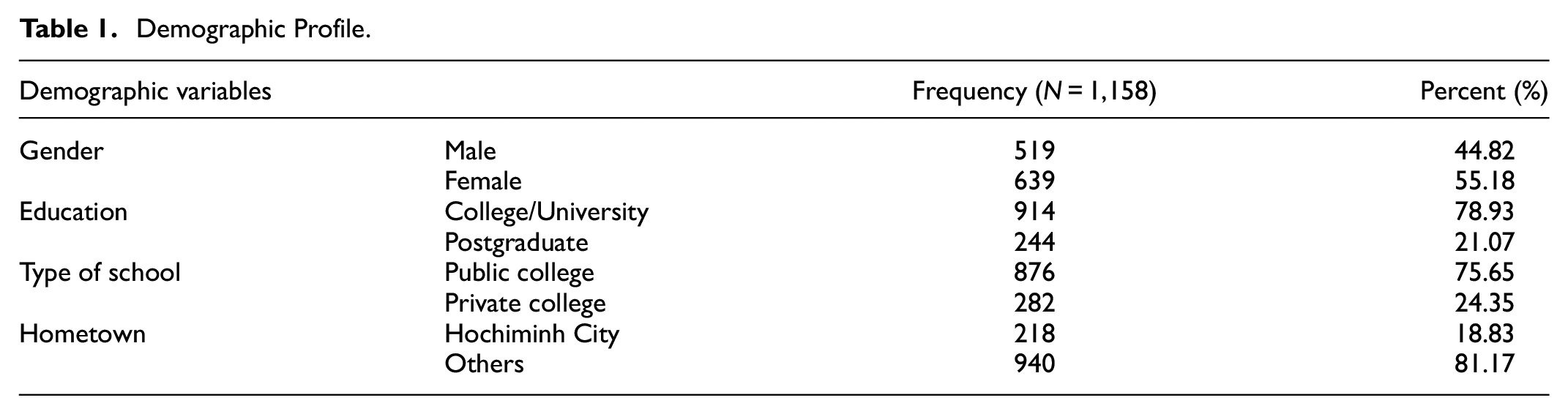
Over a 10-week period from late September to early December 2023, 1,500 questionnaires were distributed, resulting 1,158 valid responses for a robust response rate of 77.2% after intentional exclusions. Notably, by exceeding Hair et al.’s (2017) recommended minimum of 200, this sample size was deemed suitable for SEM analyses. Female students in the bachelor’s degree program constituted over 50% of the respondents, with more than 75% affiliated with public colleges and originating from locations other than Ho Chi Minh City. Detailed demographic information is presented in Table 1.
Demographic Profile.
Measurement Model Evaluation
This study uses a cross-sectional research design to examine two distinct methodologies for evaluating Common Method Bias (CMB). Univariate analysis was used to assess the degree of influence exerted by CMB. The results indicated that the predominant factor accounted for less than 30% of the total variability, signifying the non-significance of CMB in this study (Babin et al., 2016). Additionally, a rigorous collinearity test was performed to assess the presence of CMB, and the variance inflation factor values ranged from 1.000 to 1.557, consistently below the accepted threshold of 3.3. For the comprehensive evaluation of the CMB, a collinearity check was performed, which yielded Variance Inflation Factor (VIF) values consistently below the established thresholds, thereby affirming the absence of noteworthy CMB concerns (Hair et al., 2017).
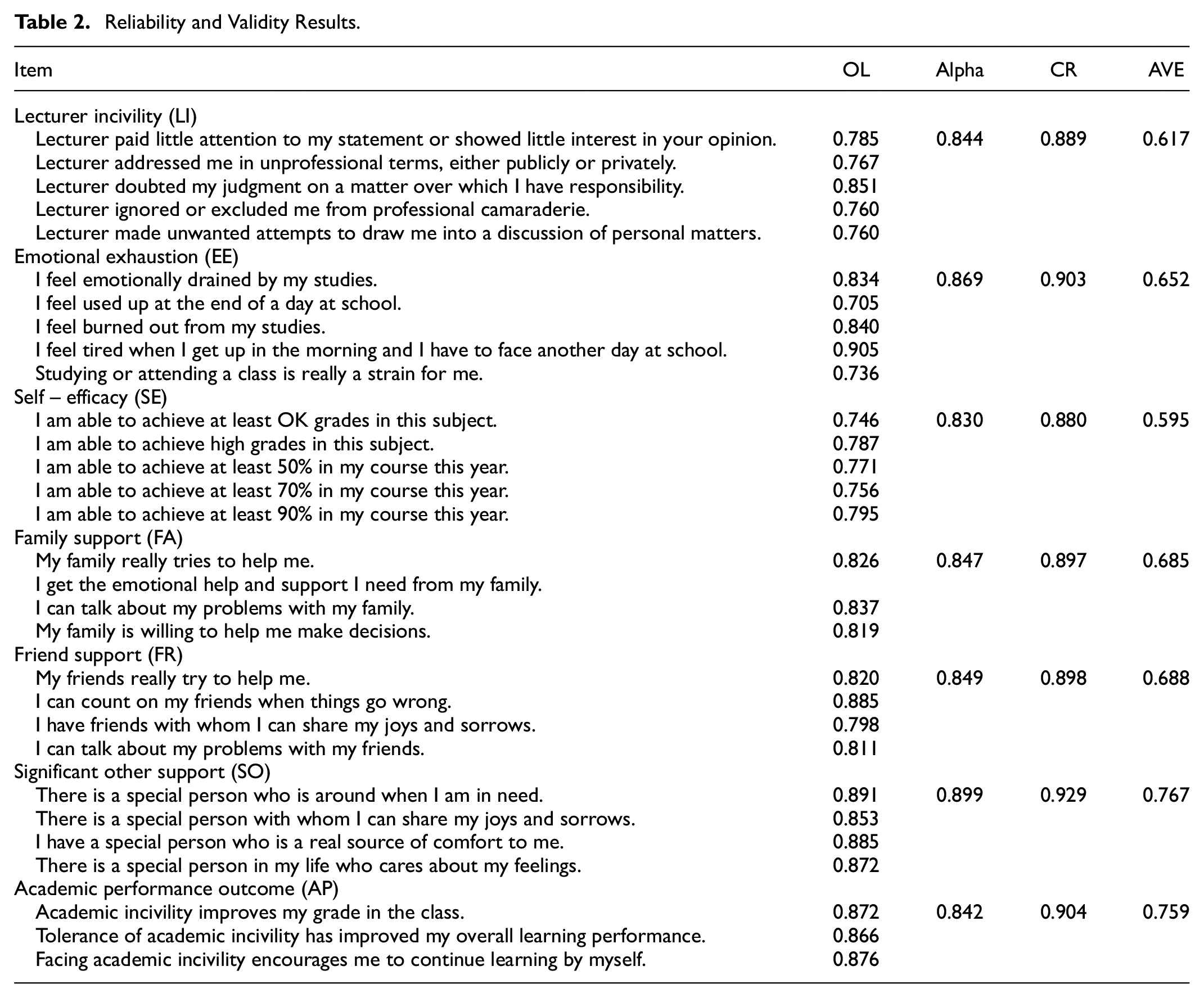
The assessment of the measurement model encompassed various dimensions. Internal consistency was evaluated through alpha values, all of which surpassed the 0.7 criterion (Hair et al., 2021). Composite reliability (CR) validated the reliability of the constructs, with values exceeding the recommended threshold of 0.70 (Hair et al., 2011). Convergent validity was ascertained through Average Variance Extracted (AVE) and factor loadings, with AVE values comfortably surpassing 0.5 and item loadings exceeding 0.70, indicating the presence of convergent validity (Hair et al., 2017), as presented in Table 2. Discriminant validity was established by comparing the square root of the AVE to the inter-construct correlations (Hair et al., 2021); satisfactory discriminant validity was established because the correlations between the variables were all less than the square root of the respective AVE, as shown in Table 3. Consequently, this study’s findings offer substantial evidence supporting the convergent and discriminant validity and reliability of the measurement models employed.
Reliability and Validity Results.
Discriminant Validity Results.

Note. Diagonal elements with heightened emphasis represent the square root of the variance jointly encompassed by the constructs and their respective measures; off-diagonal elements denote the correlations existing among the constructs.
Structural Model Assessment and Hypothesis Outcomes
The initial phase of SEM involves evaluating the R2 value, which indicates the degree to which external factors contribute to the observed variability in the internal variables. In the context of the current study, the R2 values provide insights into the interconnections among the variables. Specifically, lecturer incivility (LI) accounted for 1.2% and 41.1% of the variance in students’ emotional exhaustion (EE) and self-efficacy (SE). Conversely, LI, EE, and SE contributed 48.3% of the variance in academic performance outcomes (AP). The Q2 value was computed using user-blinded folding instructions to further examine the validity of the model. Q2 values of 0.05, 0.24, and 0.36 for EE, SE, and AP, respectively, indicate the model’s average predictability for the independent variables. These values aligned with the criteria proposed by Hair et al. (2017). To assess the model fit, the Standardized Root Mean Square Residual (SRMR) value was used to compare the observed correlations with the model-predicted correlations. The obtained SRMR value was 0.05, which suggests a good fit, as it was well below the recommended cutoff of 0.08 proposed by Henseler et al. (2015).
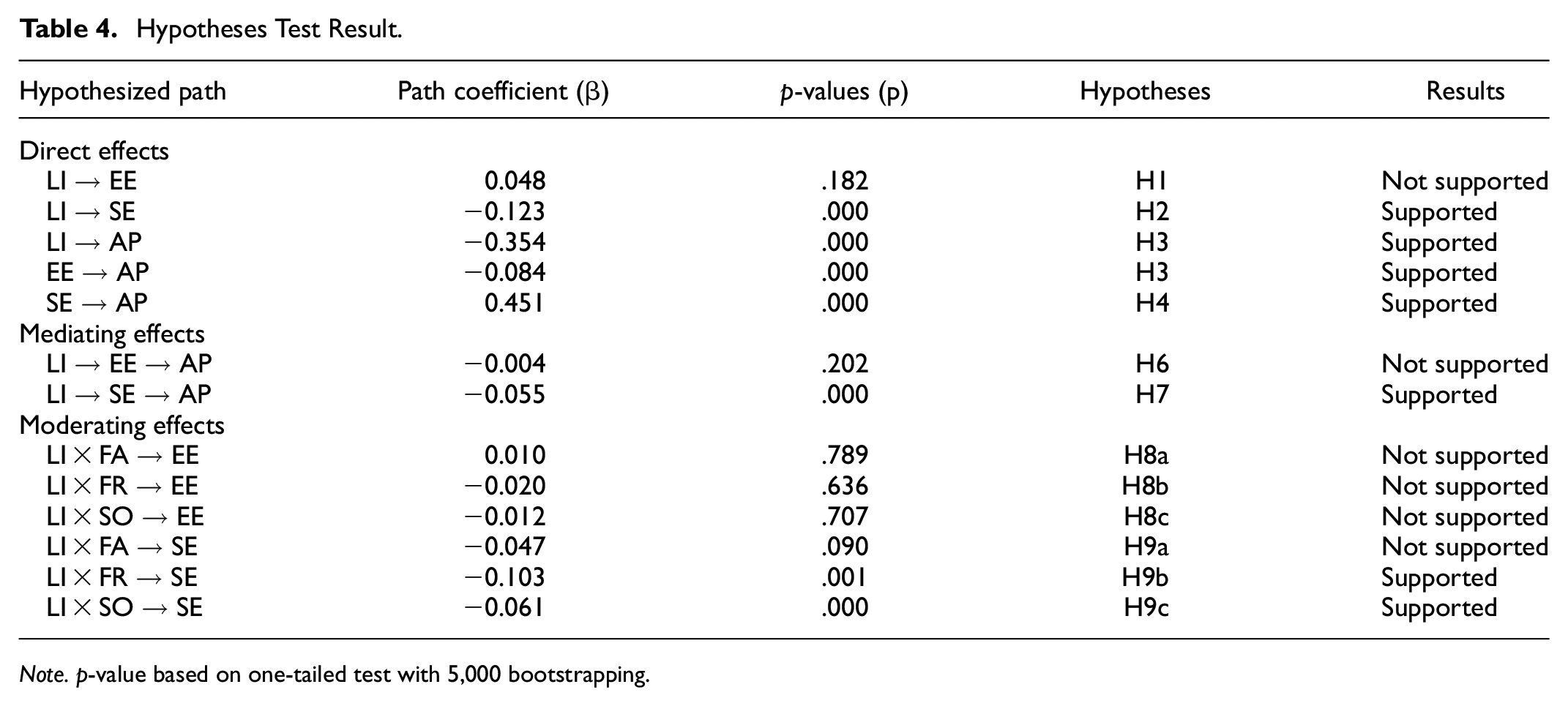
Following this, the precision of the measurement model was evaluated by calculating path coefficients and t-values through bootstrapping (α = .05) with 5,000 sub-samples. This methodological approach enhances our understanding of the relationships between the independent and dependent variables, facilitating hypothesis evaluation. This study examined the mediating roles of EE and SE and their indirect effects on the link between LI and AP. Additionally, the model incorporated the outcomes confirming the positive impact of LI on SE (β = .123, p < .01), and negative impact on AP (β = −.354, p < .01), thereby supporting Hypotheses 2 and 3. Furthermore, the study validates the influence of EE on AP (β = −.084, p < .01) and the effect of SE on AP (β = .451, p < .01), providing support for Hypotheses 4 and 5. However, Hypothesis 1 regarding a direct relationship between LI and EE was not supported because of the non-significant p-value (p > .1).
The intermediary influences of EE and SE on the relationship between LI and AP were analyzed using parameters such as path coefficients, p-values, and Variance Accounted For (VAF), as outlined by Hair et al. (2011). The results revealed that EE had a p-value exceeding .01 and SE a VAF value less than 0.2, despite a valid p-value, suggesting no mediation in the relationship between LI and AP, leading us to reject Hypotheses 6 and 7. Further, the results for Hypotheses 8 and 9 indicated a significant moderating role of social support including family support (FA), friend support (FR), and significant others’ support (SO) in the associations between LI and EE (pFA > 0.05; pFR > 0.05; pSO > 0.05) and between LI and SE (pFA > 0.05; βFR = −0.103, pFR < 0.05; βSO = −0.061, pSO < 0.05). Thus, only Hypotheses 9b and 9c were substantiated; Hypotheses 8a, 8b, 8c, and 9a were rejected because of their non-significant p-values. (Please refer to Table 4 and the graphical representation of the model in Figure 1 for a comprehensive examination of the correlations). Due to the presence of numerous non-significant hypothesis paths, the direct, indirect, and moderating effects were indicated as “NS” (non-significant) within the model.
Hypotheses Test Result.
Note. p-value based on one-tailed test with 5,000 bootstrapping.

Structural model results.
Discussion
Besides exploring the consequences of academic incivility in Vietnamese higher education using COR theory (Hobfoll, 1989) and the JD-R model (Bakker & Demerouti, 2007), this study aimed to investigate three research objectives concerning the direct and indirect effects on academic performance outcomes. We also examined the moderating role of social support in these relationships. Several hypotheses were tested, revealing non-significant values, particularly regarding the relationship between lecture incivility and students’ emotional exhaustion. Lecturer incivility was not determined to be a key factor driving students’ emotional exhaustion, which is inconsistent with the perspectives presented by Ndukaihe et al. (2023); however, the novelty of this study is its discovery of a direct relationship with low self-efficacy. Furthermore, academic performance was directly influenced by lecturer incivility, students’ emotional exhaustion, and self-efficacy, which aligns with Y. Shin et al. (2022), Wright et al. (2016), and Pietsch et al. (2003), albeit within the context of higher education. These results completely contradict the indirect effects of students’ emotional exhaustion and self-efficacy on academic performance outcomes resulting from lecturer incivility. Notably, the study revealed that only friend support and significant others’ support (e.g., boyfriends/girlfriends or instructor) played moderating roles in the relationship between lecturer incivility and student self-efficacy, which provides an in-depth examination of the study by Malecki and Demaray (2006). However, social support did not have a significant impact on emotional exhaustion in this study’s context. This finding highlights the moderating role of social support in academic incivility, and implies differences in its dimensions toward Vietnamese students.
Implications
Theoretical Implications
The results of this study hold three significant theoretical implications. First, it emphasizes the direct impact of academic incivility, especially by lecturers, on negative student outcomes, including low self-efficacy and academic performance, thus expanding the results of Turnipseed and Landay (2018). In the context of Asian cultural values and the “revered master” tradition, Vietnamese higher-education students exhibit notable respect for their lecturers, even in the presence of academic incivility. Surprisingly, this seemed to buffer the direct impact of lecturer incivility on student burnout, especially emotional exhaustion, contrary to the findings of Ndukaihe et al. (2023) and other major studies in the service sector, as exemplified by Y. Shin et al. (2022) and Al-Hawari et al. (2020). The responses of Generation Z to incivility, particularly in higher education settings, can be understood through their distinctive mindset. Vietnamese university and college students, who possess a high level of education, tend to manage stress through proactive measures, including ignoring the offensive behavior, seeking retribution, or withdrawing from the situation rather than internalizing and harboring negative emotions. Concurrently, students’ emotional exhaustion and self-efficacy levels emerged as pivotal factors that directly contributed to diminished academic achievement. These empirical findings partially align with those of Worly et al. (2019) and Pietsch et al. (2003).
Second, the extended model elucidates a pathway through which lecturer incivility and student academic performance outcomes are not mediated by emotional exhaustion and self-efficacy, which theoretical implications enhance our understanding of mediating factors in the context of academic incivility. It appears that emotional exhaustion is not caused by lecturer incivility; therefore, it does not mediate the relationship between lecturer incivility and academic performance outcomes. Additionally, Vietnamese students exhibit a pronounced inclination toward self-directed study and place substantial importance on academic accomplishments, as evidenced by their emphasis on GPAs. Despite encountering various challenges that contribute to their diminished self-efficacy, they demonstrate a remarkable ability to rebound and recover, allowing them to refocus on their academic pursuits. Furthermore, this study highlights the crucial role of friends and significant others, such as romantic partners and loved ones, in moderating the link between lecturer incivility and student self-efficacy. This finding diverges from previous research that emphasized family support (Li et al., 2018; Cheng & Chan, 2004). In Vietnamese culture, as well as in other Asian cultures, adolescents rely heavily on their families until they leave their hometowns to pursue higher education in larger cities, which creates a physical distance. This transition is also associated with changes in adolescent relationships, particularly in Ho Chi Minh City, where young individuals increasingly seek emotional support from friends and peers instead of their parents. This trend highlights a growing generational gap.
Third, while scholars have extensively examined the concept of customer incivility across various sectors, such as tourism (Boukis et al., 2020), healthcare (Yue et al., 2021), hospitality (Bani-Melhem, 2020), banking (Sliter et al., 2010), and retail (Kern & Grandey, 2009), there has been a noticeable dearth of investigations into academic incivility within the specific context of higher education. These results suggest that victims’ responses to incivility in educational settings differ from those observed in other sectors. Specifically, frontline employees exhibit a proclivity toward heightened emotional exhaustion and diminished performance after experiencing customer incivility. By contrast, students demonstrate a capacity for self-regulation in the face of incivility, and it is challenging to attribute academic performance outcomes solely to students’ emotional exhaustion or self-efficacy following instances of lecturer incivility. Consequently, this study plays a pivotal role in broadening the scope of research and enhancing the existing knowledge base by addressing this issue in Vietnam, an emerging Asian nation.
Practical Implications
This study offers valuable insights and practical guidance for educators and higher education administrators in dealing with academic incivility. This underscores the fact that lecturer incivility is directly correlated with reduced self-efficacy, poor academic performance, and poor performance outcomes irrespective of its impact on emotional well-being. This implies that students who prioritize negative lecturer behaviors while maintaining high GPAs are more likely to face academic challenges. Conversely, those concentrating solely on performance outcomes may find lecturer incivility less impactful. Given the widespread issue of academic underachievement, collaborative efforts by educators and school psychologists are imperative for devising interventions to prevent adverse student outcomes (Malecki & Demaray, 2006). To address incivility, university management is urged to recommend specialized training and implement policies that discourage such behavior among lecturers (Ndukaihe et al., 2023). Multiple workshops that focus on self-care strategies should be conducted to assist lecturers in managing stress and preventing burnout. Additionally, these workshops can enhance lecturers’ understanding and responsiveness to students’ needs and concerns, which may help mitigate uncivil behavior. Simultaneously, policies promoting student-centric values and behaviors conducive to academic motivation should be introduced and enforced. The study also advocates for heads of schools and departments to instill and sustain a strong commitment to student-centric values (McCabe & O'Connor, 2014), incorporating specific guidelines for student interaction to shift toward a more student-centered educational environment.
Second, this study highlights the significance of recognizing that students frequently contend with feelings of low self-efficacy following lecturer incivility. Fostering higher self-efficacy may lead individuals to set more ambitious goals, persevere in the face of challenges, and employ more effective strategies. The successful implementation of such interventions has the potential to expedite student learning rates and may concurrently lead to elevated performance asymptotes (Yeo & Neal, 2006). In the higher education context, while the role of family or parents in supporting students may not be as pronounced, there is a strong emphasis on friends and significant others (e.g., mentors and boyfriends/girlfriends) playing a pivotal role in mitigating deviant mindsets through open communication and active listening to students’ concerns at school. Comprehensive support from close relations rather than family is essential to alleviate stress and restore students’ mindsets before the onset of negative intentions. This highlights the need for schooling efforts to promote mutual support among students through extracurricular activities to encourage teamwork, learning clubs, and peer tutoring (Moliner & Alegre, 2022). Institutions can promote effective support systems through structured peer mentoring and extracurricular activities by matching mentors and mentees with interests or goals. Encouraging interdisciplinary collaboration can foster a culture of learning and innovation.
Third, within the realm of incivility, while extensive research has been conducted internationally that holds practical implications for various industries, particularly the service sector, a notable gap remains in the context of non-service sectors like higher education. This study provides novel insights into academic incivility with distinct implications for approaches to address it. Certain conclusions of previous scholars, whether in the higher education domain or not, failed to align with the present findings, such as those related to emotional exhaustion and the implications of family support. This underscores the need for university management to exercise caution when contemplating new policies or approaches aimed at enhancing students’ academic performance. This caution is particularly warranted, given the delicate mindset of adolescents concerning instances of lecturer incivility, not only within the landscape of Vietnamese higher education but also in other Asian regions.
Limitation and Future Directions
This study had certain limitations that hold significant implications for future studies. First, the data collected from 1,158 students at several key colleges and universities in Ho Chi Minh City limited the precision of the results. To enhance methodological robustness, future research should incorporate a more extensive and diverse sample from various schools with different study fields in Vietnam or other Asian zones and conduct cross-cultural testing to broaden the generalizability of the findings. Furthermore, this study recognizes the importance of exploring the antecedents of lecturer incivility, which provides a broader view of and implications of this phenomenon. To investigate this research area comprehensively, future studies should strive to encompass diverse antecedents, outcomes, mediators, moderators, and control variables in their extended models, thereby providing a more holistic understanding of the complex dynamics of academic incivility in the higher education sector. Finally, given the presence of several non-significant hypotheses concerning emotional exhaustion and its moderators, it is necessary to reevaluate the conceptual framework. This re-evaluation should be followed by the implementation of a more sophisticated approach to capture the complexity of the relationships within the model more accurately and afford scholars the opportunity to delve deeper into the implications of non-significant findings.
Conclusion
The findings of this study indicate that lecture incivility has both direct and indirect effects on students’ academic performance outcomes via their self-efficacy. Higher education institutions can address this issue by adopting strategies that enhance the support from friends and significant others. Additionally, the study revealed that while lecture incivility does not directly lead to emotional exhaustion among students in Vietnamese universities, it does impact their academic performance outcomes. This underscores the need to cultivate a supportive academic environment among peers and secure support from other significant relationships such as supervisors and romantic partners to mitigate the adverse effects of lecture incivility and improve overall academic performance.
Footnotes
Author Contribution
The contributions of each author to this research are as follows: Nguyen-Viet Bang conceived the research idea and designed the study. Nguyen My Phuc collected and analyzed the data. All authors collaborated on the manuscript preparation, contributed to critical revisions, and approved the final version for publication
Declaration of Conflicting Interests
The author(s) declared no potential conflicts of interest with respect to the research, authorship, and/or publication of this article.
Funding
The author(s) disclosed receipt of the following financial support for the research, authorship, and/or publication of this article: This research is funded by the University of Economics Ho Chi Minh City, Vietnam (UEH).
Ethical Approval
Our study focuses on employee-related topics and does not involve ethical considerations.
Informed Consent
All participants in this study provided informed consent before their involvement. They were informed about the study’s purpose, procedures, potential risks, and benefits. Participants were assured of the confidentiality of their information and their right to withdraw from the study at any time without consequences.

Data Availability Statement
The data supporting the findings of this study are available upon reasonable request. Researchers interested in accessing the data can contact Nguyen-Viet Bang at bangnv@ueh.edu.vn. We are committed to promoting transparency and facilitating data sharing to further scientific inquiry