




Abstract
This study uses doctrinal, empirical, and case analysis methods to examine one of the most important yet controversial issues in franchising systems: information disclosure. It aims to demonstrate the current status of franchise disclosure laws in China, identify related problems, and propose legislative reforms to resolve such problems. In this study, cases heard in Chinese courts from 2017 to 2021 were analyzed. The results suggest that, despite their increasing importance, the current disclosure laws provide insufficient guidance, as courts create discrepancies in applying the laws, resulting in uncertainty. Considering this, and to strike a fine balance between the compliance burden on the franchisor and protection of franchisees, this study proposes a new legal framework in which the disclosed information is classified into two types: a closed record of core information to improve cooperation between the franchisor and franchisees and an open record of general information to promote good faith negotiations. Furthermore, regulation of full disclosure and the liability of its non-compliance with respect to the two types of information can be distinguished. This framework can provide courts with guidance in solving disclosure disputes in a more systematic, transparent, and consistent manner.
Introduction
Franchising is a contractual business relationship whereby an established brand (the franchisor) allows an independent business owner (the franchisee) to use its branding, intellectual property, and business model (Francine & Blair, 2009; Spencer, 2013). Through this relationship, the franchisor can quickly expand their network in a cost-effective way and the franchisees can directly benefit from the established brand name and other resources to realize their entrepreneurial dreams (Barkoff et al., 2015). Since this business model originated in the United States at the end of the 19th century, franchising has flourished worldwide (Barkoff et al., 2015). In the 1980s, China introduced franchising, and it has since played an increasingly important role in China’s growing economy. According to the reports from the China Chain-Store & Franchise Association (hereafter, “CCFA”), in, the total sales amount of the top 100 franchise enterprises reached 588.5 billion yuan, a year-on-year growth of 23.6%, taking up 1.3% of total retail sales; there were 366,000 stores in total, with a 9.9% year-on-year growth of the number of stores, and these stores provided about 5 million jobs (CCFA, 2022).
Information disclosure is an important regulatory tool in franchising systems. It requires the franchisor to provide potential franchisees with essential information about the roles of both parties involved in the franchise, the franchising system, and the franchising contract they will sign. Theoretically, full and accurate disclosure can not only adjust informational asymmetry to help franchisees make informed investments but also promote cooperation between the franchisor and franchisees (Spencer, 2010). Because of this, lawmakers have been devoted to devising effective disclosure laws (Pilegoff, 1989; Sugar, 2019). In China, in addition to the general information duty of the contractual parties in civil law (see “The Information Duty in the PRC Civil Code,” below), franchise-specific regulations also state that “A franchisor shall provide authentic, accurate, and complete information to its franchisees, and shall not hide any relevant information or provide false information” (Article 23 of Franchise Regulation).
Despite its importance in franchising systems, the issue of disclosure is controversial in Chinese legal practice. Feng (2019) examined 1,169 cases concerning disputes in franchising systems from 2007 to 2016, and cases involving the issue of disclosure significantly outnumbered other disputes in franchising systems, accounting for 29.66% of the cases in the dataset. Additionally, Zhonglun Law Firm and CCFA (2022) jointly released the annual White Paper on the Adjudication of Franchising Contract Disputes in China. In this White Paper, the courts reporting the four classical cases adopted divergent criteria for the liability of non-compliance with disclosure obligations. As such, both the large number of disputes and the inconsistent rules of adjudication call for further review on disclosure laws in China.
Literature Review
Information disclosure is a much-employed regulatory tool. Within the literature, three prominent themes of discussion have emerged concerning the dual function of franchise disclosure laws, the problems of full disclosure, and the balance between the compliance burden on the franchisor, such as the information costs borne by the franchisor, and the protection of franchisees.
First, the function of franchise disclosure laws has evolved in the modern world. Traditionally, the purpose of disclosure laws was to enhance the prospective franchisees’ ability to make informed decisions, thereby bolstering their autonomy. Scholars such as Emerson and Meiselles (2021), Dub (2020), Sugar (2019), Yang (2016), Zaidi (2014), Abell (2013), Garvin (2005), and Eisenberg (2003) all hold such opinions. Currently, the dual function of disclosure laws has been proposed in the literature. In addition to helping franchisees make better decisions, Spencer (2010) found that many countries take the improvement of social welfare and the achievement of substantive fairness as the fundamental goal of disclosure laws. This is because franchising systems feature cooperation between the parties (Yang, 2016). Furthermore, to promote such cooperation, L. Wang (2017) proposed the construction of the assisting obligation, while Abell (2013) and Emerson (2013) argued that the fiduciary duty ought to be identified in franchising systems.
Second, the above dual function of disclosure laws dictates full disclosure, which may result in a lose–lose situation. Information is a valuable asset for the franchisor, yet its generation is costly (Kronman, 1978). Because of this, full disclosure would not only delay or frustrate information generation (Fleischer, 2001) but could also force the franchisor to quit franchising (Arnold, 2009). For the franchisees, the impute of excessive information leads to information overload. Additionally, information overload renders the franchise disclosure document unreadable (Benoliel & Zheng, 2018), resulting in a low reading rate (Benoliel, 2022; Ning, 2020). In this situation, Schulz (2015) posited that franchisees’ bargaining disadvantages will be further strengthened.
Third, scholars have put forward a variety of proposals to strike a balance between the compliance burden on the franchisor and protection of franchisees. For example, Feng (2021) proposed the establishment of an exemption system to reduce franchisors’ information costs, and Karp and Stern (2016) argued for the use of a summary disclosure document from a user-friendly perspective. Additionally, to systematically redress the issue, Sugar (2019) suggested that the scope of information to be disclosed should be further limited. Nevertheless, the criteria by which information is distinguished vary. Specifically, Kronman (1978) argued that casual information instead of deliberate information should be disclosed, Cooter and Ulen (2012) proposed that redistributive information rather than productive information should be disclosed, and Shavell (1994) opined that information carrying private value, not social value, should be disclosed. However, none of this typification of information features disclosure in a franchising system in the context of Chinese disclosure laws.
In summary, to find a compromise between furthering the evolving function of disclosure laws (the compliance burden on the franchisor) and avoiding problems caused by information overload (the protection of franchisees), the research on franchise disclosure laws in China needs to be furthered. This study aims to fill this gap.
Research Questions
This study was conducted to answer the following research questions:
(1) What is the legal framework for franchise disclosure in China? This question will be answered by comprehensively analyzing disclosure laws not only in franchise-specific regulations but also in the Civil Code
(2) How do judges apply disclosure laws in judicial practice?
(3) How to maintain a balanced franchising system through reforming the disclosure laws in China?
Methods
This study combines doctrinal, empirical, and case analysis methods, as described in detail below, to analyze disclosure laws and related judicial practice and propose a new legal framework to improve franchise information disclosure.
First, this study mainly used doctrinal research to analyze the existing disclosure laws in China and propose a new legal framework. The formulation and development of rules in the Civil Code and franchise-specific regulations reflect the evolving function of franchise disclosure.
Second, we used an empirical analysis to describe the actual state of adjudication on franchise disclosure in China. All of the judicial opinions concerning franchise disclosure reported from 2017 to 2021 were collected, coded, and statistically analyzed.
Third, we adopted the case analysis method to examine the robustness of the proposed legal framework by applying it to rationalize the relevant cases in Chinese judicial practice.
Findings and Discussion
Disclosure Laws in China
In China, two branches of law regulate information disclosure in franchising systems. First, a franchising contract, though unnamed in the Civil Code of the People’s Republic of China (hereafter, “PRC Civil Code”), must conform to the general contractual principles (see, e.g., Article 23 of Franchise Regulation; Li, 2017; L. Wang, 2017). Accordingly, contractual parties bear general information duty as found in PRC Civil Code (2021). Second, a franchising contract must comply with franchise-specific requirements established and developed in several administrative regulations promulgated by the State Council of the PRC and its departments. Below, we outline and evaluate the current framework of disclosure laws in these two branches of law.
Information Duty in the PRC Civil Code
To alleviate information asymmetry and thereby achieve freedom of contract, based on the principle of good faith, the PRC Civil Code prescribes two kinds of information duties to regulate information disclosure in forming a contract. If the party bearing the information duty fails to comply, liabilities or undesirable consequences follow. Thus, compliance with the information duty is important in successfully concluding a contract. As inherited from the previous Contract Law (Herbots, 2021), clear provisions on the information duty can be found in Articles 500 and 496(2) of the PRC Civil Code.
Article 500 of the PRC Civil Code states that “A party shall be liable in damages if it has caused losses to the other party under any of the following circumstances in contracting: … (2) Deliberately concealing important facts relating to contracting or providing false information ….” This Article simply states that the information duty discourages two kinds of conduct—deliberate non-disclosure of important information and mere misrepresentation of information. Furthermore, it is at the pre-contractual phase when the parties bear this information duty. This is because it is necessary for the parties to be aware of material facts so as to start a healthy relationship on the grounds of mutual trust. As scholarship contends, this pre-contractual information duty aims to strike a fine balance between freedom of contract and reliance protection (Zhu, 2018).
Article 496(2) of the PRC Civil Code provides that “Where standard terms are adopted for contracting, the party furnishing the standard terms shall … remind in a reasonable manner the other party to note the terms excluding or limiting the liability of the party furnishing the standard terms or otherwise related to the material interest of the other party, and explain the terms upon request of the other party.” This information duty is distinctive in that only the party furnishing standard terms bears the duty to disclose information that is related to the material interest of the other party to ensure that the party with greater bargaining power, in most cases, “defines the rights and obligations between the parties under the principle of fairness” (Article 496(2) of PRC Civil Code). As standard terms are often used in commercial contexts, this information duty is argued to achieve informed decision-making at the micro level and the efficient functioning of a free market at the macro level (Ma, 2014).
Despite the importance of the above two kinds of information duties in contract negotiation, we argue that they seem inadequate to properly regulate the franchising relationship for three reasons. First, Articles 500 and 496(2) of the PRC Civil Code fail to identify the specific scope of information to be disclosed, as the information related to the material interests of the other party is ambiguous or controversial by nature. The uncertainty surrounding the scope of information can potentially break the functional underpinnings of the information duty. Second, the pre-contractual duty in Article 500 of PRC Civil Code is equally imposed on both franchisors and franchisees, which seems to overlook the imbalance in bargaining power between them (Fifth Tribunal of the Second Intermediate People’s Court of Beijing, 2010; Klein & Saft, 1985; Macaulay, 1966; Williamson, 1971; Xu, 2019; Yang, 2016). Third, the liability for non-compliance with the disclosure obligation in Article 496(2) is limited, as the franchisees may merely argue that “the terms are not a part of the contract” (Article 496(2) of PRC Civil Code).
The Regulatory Regime in Franchise-Specific Regulations
The increasing prosperity of franchising activities in China has seen the introduction and progress of franchise-specific regulations. In general, this process has two phases. The first phase begins with the Measures for the Administration of Commercial Franchises (for trial implementation), which was promulgated by the Ministry of Domestic Trade of PRC in 1997 (hereafter “1997 Trial Measures”; the 1997 Trial Measures are now expired; Measures for the Administration of Commercial Franchising, 1997). After the institutional reform in 2004, the Ministry of Commerce issued Measures for the Administration of Commercial Franchises in 2004 (hereafter “2004 Measures”), replacing the 1997 Trial Measures (the 2004 Trial Measures are now expired; Measures for the Administration of Commercial Franchising, 2004). The second phase started in 2007 when the State Council promulgated the Franchise Regulation (Regulation on the Administration of Commercial Franchises, 2007). Subsequently, to properly interpret the rules and regulations of the Franchise Regulation, the Ministry of Commerce issued Administrative Measures for Commercial Franchise Information Disclosure (2012; hereafter, “Franchise Disclosure Measures”; enacted in 2007 and amended in 2012 and currently in effect). We will now examine the development of a regulatory framework for franchise disclosure during these two phases.
The First Phase (Before 2007): The Continuation of the Pre-contractual Information Duty
Two administrative documents regulated franchise disclosure in the first phase: the 1997 Trial Measures and the 2004 Measures. Although expired, they created a franchise-specific disclosure system in at least three ways.
First, they specified the procedural requirements for franchise disclosure. The 1997 Trial Measures required the franchisor to timely disclose written information at least 10 days before concluding a franchising contract (Article 12). The 2004 measures further prolonged the time requirement of disclosure before the conclusion of the contract to 30 days (Article 12) and required continuing disclosure “during the process of franchised business operations” (Article 18).
Second, the scope of the information to be disclosed was specified. The 2004 measures adopted the legislative mode of open enumeration to regulate information disclosure (UNIDROIT, 2002). It listed eight specific types of information commonly significant to running a franchised business. Further, in order to embrace other important information, unforeseeable or foreseeable, but that lawmakers fail to foresee, a miscellaneous provision that “other information or materials that shall be disclosed by a franchisor upon the request of a franchisee” (Article 19(1) of 2004 Measures) was used to keep the list open.
Third, the liabilities of non-compliance with the disclosure obligations were legally specified. As established in the 2004 Measures, a party failing to disclose required information might incur both administrative and civil liabilities. Administrative liabilities include an order to correct, fine, or revoke the licenses of businesses (Article 39 of 2004 Measures), and the franchisor might also be subject to civil liabilities such as damages (Article 19(2) of 2004 Measures).
The franchise-specific disclosure system can clearly guide parties to comply with the obligations, but we argue that this disclosure system is, by nature, the continuation of the pre-contractual information duty in PRC Civil Law. This is because the disclosure obligations are imposed not only on the franchisor but also on the franchisees. Both Article 12 of the 1997 Trial Measures and Article 20 of the 2004 Measures provide that “upon the request of the franchisor, the franchisee shall also provide true information on its business capacity, including but not limited to legal qualification certificate, credit certificate, and property right certificate.” This Article suggests that lawmakers regard the franchising relationship between the franchisor and franchisee as a civil relationship between equal parties.
The Second Phase (After 2007): An Independent Tool of Regulation
The prescriptive regulations in the second phase, the Franchise Regulation and its supporting document, Franchise Disclosure Measures, in a hierarchical level second only to national laws, established the current statutory framework of franchise disclosure in China. Compared with the administrative regulations in the first phase, the franchise-specific disclosure system in the second phase was greatly improved.
First, the scope of information to be disclosed was further expanded and is more accurate. In addition to the increased types of information, from 8 to 11 types, as enumerated by the Franchise Regulation (Article 22), one more type of information, the text of the franchise contract, was added to the list by the Franchise Disclosure Measures (Article 5). Additionally, certain types of information were expanded. For example, information on technical support was expanded from specific technical support content to forming and implementing plans, “including the name and type of business resources, and the type of products or equipment” (Article 22 of Franchise Disclosure Measures). Additionally, to keep the enumeration open, the miscellaneous provision was applied to include “other information prescribed by the commercial administrative department of the State Council” (Article 22(12) of Franchise Regulation). Compared with the 2004 Measures, which empowered the franchisee to request unlisted information, the Franchise Regulation grants this power to commercial administrative departments. This change is essential because it can standardize the disclosure laws in practice.
Second, administrative interference in franchising businesses has decreased because administrative liabilities comprise only orders to correct and fine (Article 28 of Franchise Regulation), excluding the revocation of business licenses.
Finally, franchise disclosure in the second phase seems to be divorced from the pre-contractual information duty in the PRC Civil Code and has become an important mechanism for regulation. Regulative documents in the first phase endorsed disclosure as a pre-contractual information duty by allocating obligations between franchisors and franchisees. This endorsement played an important role in safeguarding the fundamental value of private autonomy but overlooked the imbalance in bargaining power between parties. The regulations in the second phase adjusted the function of franchise disclosure. Article 20 of the Franchise Regulation provides that “A franchisor shall, according to the provisions prescribed by the commercial administrative department of the State Council, establish and implement a perfect information disclosure system.” Key aspects can be summarized as follows: First, it is only the franchisor, rather than both parties, who bears the disclosure obligation. Second, from a policy perspective, franchise disclosure carries the government’s responsibility for regulating the franchise market and promoting fair business practices (General Office of the State Council, 2007).
Even though the above improvements were important in establishing a modern disclosure system, confusion remains about the criteria by which non-compliance with disclosure obligations gives rise to civil liabilities. The Franchise Regulation provides that any non-disclosure or misrepresentation of the prescribed information, irrespective of deliberation or carelessness, would result in the rescission of the contract (Article 23). In contrast, Franchise Disclosure Measures make a distinction in considering the distinguished effects of non-disclosure and misrepresentation on the performance of contracts. Their Article 9 provides that “If a franchisor conceals information that affects the fulfillment of the franchise contract and leads to a failure to realize the purpose of the contract, or discloses false information, the franchisee may rescind the contract.” The inconsistency between the Franchise Regulation and Franchise Disclosure Measures might result in the incoherence of judicial decisions regarding which criteria the court should comply with to determine the rescission of a franchising contract. (This hypothesis has been verified by the empirical research of this study; see the “Non-compliance with Disclosure Obligations” section, below).
A Brief Summary: The Evolving Function of Disclosure Laws and Its Problems
Although the information duty in the PRC Civil Code and the disclosure obligations in franchise-specific regulations are statutorily required in forming a franchising contract, they differ in nature. Specifically, the former belongs to private law, and its internal mechanism lies in maintaining private autonomy and good faith. However, the latter features the obligation of public law, and its core purpose is to perform the regulatory function of realizing cooperation between the parties. Figure 1 presents the legal framework for franchise disclosure in the two branches of law.

Disclosure laws in China.
This legal framework opens with the following question: Which law and to what extent do the PRC Civil Code or franchise-specific regulations regulate franchise disclosure? This is a difficult question to answer, and it requires some analysis. The State Council and the Ministry of Commerce of PRC seem to provide somewhat general answers: The normative purpose of the Franchise Regulation is confined to governing franchising activities to limit the excessive intervention of administrative power in civil activities. Furthermore, the legal practice of franchising ought to be subject to civil law (General Office of the State Council, 2007). As noted earlier, administrative intervention is indeed reduced through lighter administrative liabilities following non-compliance with disclosure obligations (see “Second Phase (After 2007),” above). However, the extent to which disclosure obligations provided in franchise-specific regulations shall regulate franchised businesses as a regulation tool to ensure that enough room for private autonomy can be left for the parties remains unclear.
Disclosure Laws in Judicial Practice
This section objectively and statistically examines the current state and existing problems of disclosure laws applied in judicial practice. It starts by collecting and coding cases containing disclosure disputes. The cases were collected from the PKULAW database (a well-known database in China) without interfering with the results. The resulting dataset was then coded for further analysis from different perspectives. The findings of the data analysis suggest that, although cases involving franchise disclosure occur with greater frequency, dispute adjudications are far from satisfactory. The swing between courts about the applicable law can potentially erode the important functional underpinnings of franchise disclosure in maintaining a healthy franchising system.
Database
The search was conducted on May 30, 2022, in the PKULAW.CN database, with the goal of gathering all the reported decisions that satisfy the following three conditions. First, the decisions were dated between January 1, 2017, and December 31, 2021. The timeframe of 2017 to 2021 was selected to examine cases over a substantial length of time, despite certain potential distorting effects regarding the number of cases caused by the COVID-19 pandemic and control measures. Second, decisions containing the words “franchise” in the title and “disclosure” in the facts ascertained by the courts were used to locate all cases involving franchise disclosure. Third, the decisions were further confined to those in which the word “disclosure” appears at least twice in the full text to exclude cases where the courts merely refer to the word “disclosure” in passing in the facts instead of discussing the topic. The search returned 294 decisions, of which four were repeated, and 28 were identified as false positives (so franchise disclosure was not disputed), leaving 262 decisions for coding and further analysis.
Summary of Overall Findings
Of the 262 decisions analyzed, 108 resulted in at least one successful claim regarding franchise disclosure. The average success rate was 41.22%.
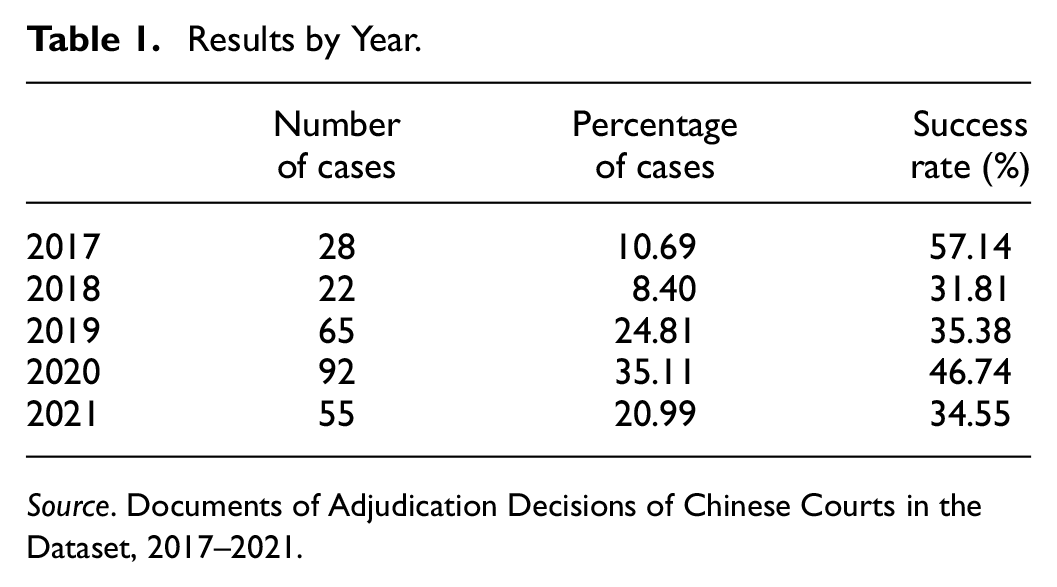
The overall distribution trend during the reported timeframes increased. In 2017, 28 cases were reported; however, by 2021, 55 cases were reported. The surge in 2020 and the sharp decline in 2021 in the number of cases might be explained by the distorting effects of the COVID-19 pandemic, as, it can be speculated, could have caused more litigation due to the suddenness of the pandemic, and then fewer new franchised business were opened due to the increasingly rigid pandemic control measures in China (Huifeng, 2020). In contrast to the growing trend in the number of disclosure cases, the success rate was somewhat volatile during this timeframe. The success rates were as high as 57.14% in 2017 and as low as 31.81% in 2018. Table 1 presents the number of cases, percentage of all cases, and success rate in each reported year.
Results by Year.
Source. Documents of Adjudication Decisions of Chinese Courts in the Dataset, 2017–2021.
It is worth noting that of the 262 cases analyzed, there were 41 in which the courts did not respond to the issue of franchise disclosure, even though the parties were in dispute. One explanation might be that the courts saw no need to respond to the issue because the franchising contract could be terminated within the cooling-off period (Article 12 of Franchise Regulation; See also Huang Haibin & Jin Zezhen vs. Shanghai Xianglian Catering Management Service Co., Ltd., 2020) or on the grounds of a fundamental breach of contract (Article 563 of PRC Civil Code; see also Liang Yukun vs. Guangzhou Langyi Catering Management Service Co., Ltd., 2021; Ye Qing vs. Guangzhou Jiulongjiu Catering Management Service Co., Ltd., 2019). Such cases are referred to here as “unresponsive,” and they account for 15.65% of all cases. The years 2020 and 2021 reported the most unresponsive cases, accounting for 70.73% of the 41 unresponsive cases. Table 2 presents the number of unresponsive cases by year and percentage.
Unresponsive Cases by Year.

Source. Documents of Adjudication Decisions of Chinese Courts in the Dataset, 2017–2021.
Compliance with Disclosure Obligations: Legal Standards and Burden of Proof
Even though both the franchisor and franchisee bear the pre-contractual information duty in concluding a franchising contract as required by the PRC Civil Code, in judicial practice, the area of contention centers around the franchisor’s disclosure obligation. The first fundamental issue in judicial practice is whether the franchisor has complied with the obligation. After excluding the 41 unresponsive cases, there were 221 decisions left for the courts to assess the legal standard of franchise disclosure, accounting for 84.35% of all decisions in the dataset. The analysis of these cases reveals three different legal standards: the Formalistic Standard, Substantive Standard, and Comprehensive Standard.
The Formalistic Standard is the general rule according to which a signed receipt for the franchise disclosure document is the decisive factor in a court’s adjudication on full disclosure. For example, in Kewen Zhao vs. Chi Plus (Shanghai) Automotive Supplies Trading Co., Ltd. (2017), the IP court of Shanghai ruled that “the franchisor has disclosed required information because the franchisee has signed the receipt of disclosure.”
The Substantive Standard is a higher standard, as it requires the franchisees’ knowledge of the information to be disclosed rather than relying on a mere receipt signed by the franchisees. In other words, when a franchisee signs a receipt but is not fully aware of the disclosed information, courts applying the substantive standard might hold that the franchisor has not disclosed information as required and, therefore, does not properly comply with the obligation of disclosure. The Haidian District People’s Court of Beijing Municipality held in Xiaohong Ren vs. Liuhe Chenfang International Investment (Beijing) Co., Ltd. (2018) that “a mere receipt for franchise disclosure document is insufficient to prove the information that the defendant has disclosed to the franchisee.”
The Comprehensive Standard is the highest standard and uses a combined formalistic/substantive approach. Consideration shall be taken not only of the presence or absence of a signed receipt but also of the knowledge of the franchisee regarding the disclosed information. In Guangzhou Yishang Hotel Investment Management Co., Ltd. vs. Jingmen Juncheng Business Hotel (2021), the Baiyun District Court took this standard to assess the disclosure obligation, holding that “the franchisee has on the one hand signed the receipt for franchise disclosure document and, on the other hand, should have been fully aware of the essential information of the franchised business because of the facts that the franchisee has accepted the franchisor’s material support, including but not limited to trademark, informational system, and market.”
Table 3 presents the number of cases, percentage of cases, and success rate that adopted the Formalistic Standard, Substantive Standard, and Comprehensive Standard. This finding suggests that a significant majority of cases, 81.45%, explicitly or implicitly applied the Formalistic Standard. It is typically not an evidentiary difficulty for franchisors to prove that their disclosure has met the Formalistic Standard, thereby rendering a success rate as high as 55%. Fewer cases applied the Substantive Standard, accounting for 15.38%. As the Substantive Standard objectively inquires about a franchisee’s state of mind, it is likely more difficult to satisfy. Unsurprisingly, cases applying this standard produced a success rate of only 26.47%, which is significantly lower than that of the Formalistic Standard. A significant minority of cases, merely 3.17%, adopted the Comprehensive Standard. In the dataset, no case applying this highest standard succeeded in claims of franchise disclosure.
Results by Legal Standards for Assessing Franchise Disclosure.

Source. Documents of Adjudication Decisions of Chinese Courts in the Dataset, 2017–2021.
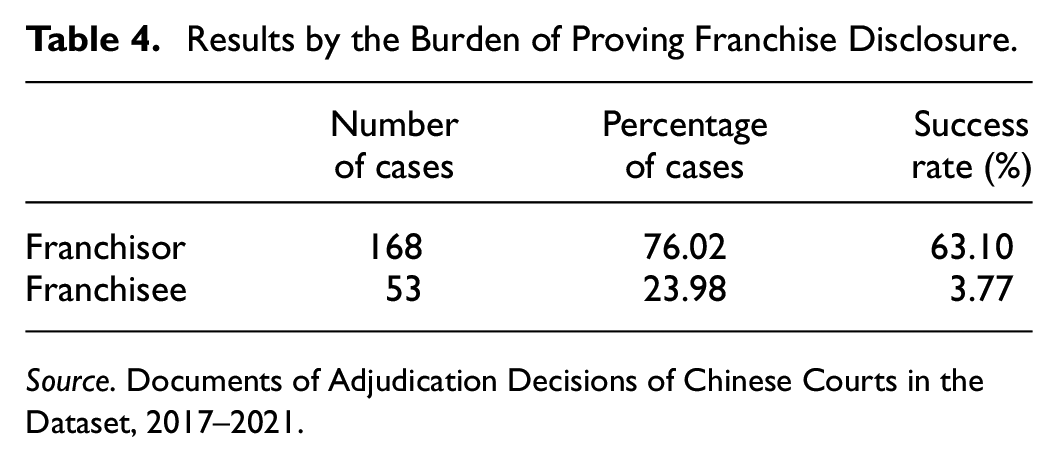
In addition to the standards that were articulated in these cases, the first fundamental issue also centers on the burden of proof as to which party bears the burden of proving the franchisor has or has not fully disclosed information as required. Table 4 presents the coding results. A significant majority of cases, accounting for 76.02% of the 221 cases, opined that franchise disclosure is a franchise-specific obligation and that the franchisor bore the burden of proof, rendering a success rate of 63.10%. By contrast, 23.98% of the cases in the dataset placed the burden of proving non-compliance with disclosure obligations on the franchisee, reflecting the requirement of the information duty in PRC Civil Code. In judicial practice, as it is often difficult for a franchisee to prove the franchisor’s failure to disclose, the success rate was as low as 3.77%. The divergence regarding burden of proof reflects courts’ discrepancies in applying the laws.
Results by the Burden of Proving Franchise Disclosure.
Source. Documents of Adjudication Decisions of Chinese Courts in the Dataset, 2017–2021.
Non-Compliance with Disclosure Obligations: Legal Criteria and Civil Liabilities
As franchisees participate in judicial practices, the second important issue lies in the civil liability of non-compliance with disclosure obligations. As the Franchise Regulation and Franchise Disclosure Measures indicate, franchisors failing to perform the obligation of disclosure may be subject to the rescission of a contract. To investigate the criteria by which a franchising contract is rescinded in Chinese judicial practice, we excluded 41 unresponsive cases from the dataset, leaving 221 cases for further review. Generally, there are four basic criteria.
Criterion I complies with Article 23 of the Franchise Regulation that any non-disclosure or misrepresentation regarding the prescribed information to be disclosed would result in the rescission of the contract.
Criterion II features not only the facts of non-disclosure or misrepresentation but also the frustration of the contract as a result. Article 9 of the Franchise Disclosure Measures provides that a franchisee may rescind a franchising contract in situations where the non-compliance with disclosure obligations has led to the failure of the purpose of the contract.
Criterion III regards franchise disclosure as a pre-contractual duty and it requires the extent of non-disclosure or misrepresentation to affect investment decisions.
Criterion IV is embodied in the flaws of the declaration of intention, requiring non-compliance with disclosure obligations to reach the extent of misrepresentation, fraud, coercion, or unconscionability.
Table 5 illustrates the number of cases, percentage of cases, and success rate for each legal criterion in judicial practice by which a court decides to rescind a franchising contract. It also highlights cases that did not justify rescinding a franchising contract. Slightly fewer than half of the 221 cases adopted Criterion II. Interestingly, cases adopting Criterion II generated the lowest success rate, 31.19%. Compared with Criterion II, a significant minority of cases applied Criterion I, Criterion III, and Criterion IV but produced substantially higher success rates, at 93.33%, 87.5%, and 88.24%, respectively. In addition, 17 cases adopted three basic criterion variations: Criteria II and III, Criteria II and IV, and Criteria II, III, and IV. Of these 17 cases, 88.24% adopted Criteria II and III, producing a success rate of 53.33%.
Results by Criteria for Rescinding Franchise Contracts.

Source. Documents of Adjudication Decisions of Chinese Courts in the Dataset, 2017–2021.
As provided by Article 566 of the PRC Civil Code, a franchisee with the right to rescind a contract can request full or partial restoration of royalties, considering the performance status and the nature of the contract. Of the 221 cases in the dataset, 107 required the franchisor to refund royalties due to the rescission or termination of contracts on the grounds of non-compliance with disclosure obligations.
The results that contain the number of cases requiring the restoration of royalties on different scales and bases are listed in Table 6. There were 39 cases reporting full restoration of royalties, constituting 36.45% of the cases. On three different bases, a higher percentage of cases, 63.55%, reported partial restoration of royalties. Cases relying on the first basis, according to which part of royalties were unrefunded because the franchisor had provided some services, accounting for 10.28%. Of the 107 cases, 25.23% considered the second basis, which means that the franchisee as a commercial party ought to bear the duty of care to conduct diligent research on material information and thereby that the franchisee failing to implement that duty of care loses the right to request full restoration of royalties. The third basis is a combination of the above two, based on which 28.04% of the cases required partial refund of royalties. This finding suggests that courts in 53.27% (25.23% plus 28.04%) of the 107 cases regarded franchise disclosure as the information duty imposed on both parties rather than a franchise-specific obligation.
Results by Restoration of Royalties.

Source. Documents of Adjudication Decisions of Chinese Courts in the Dataset, 2017–2021.
Three Observations
Thus far, the overall findings, legal standards and burden of proof for compliance with disclosure obligations, and legal criteria and civil liabilities for non-compliance with disclosure obligations have been statistically and comprehensively investigated. On this basis, to enrich the understanding of the current state of franchise disclosure in Chinese legal practice, three observations are concluded as follows.
First, the increasing number of cases and the relatively high success rate suggest that information disclosure is increasingly important in maintaining a healthy franchising system. The changes in the number of cases in the dataset by year are illustrated in Table 1. Although there was some volatility during the reported years, especially the declines in 2018 and 2021, the overall trend in the number of cases increased from 28 reported cases in 2017 to 55 in 2021. In addition, 108 out of 262 cases succeeded in at least one claim of franchise disclosure, producing an average success rate of 41.22%.
Second, despite its importance, the empirical research suggests that the legal framework for franchise disclosure provides insufficient guidance in judicial practice. For example, neither the PRC Civil Code nor franchise-specific regulations craft clear rules on the legal standard for assessing the performance of disclosure obligations, even if it directly affects the outcomes of a dispute to a large extent. In judicial practice, the Formalistic Standard seems to be a general rule. As suggested in Table 3, 81.45% of cases adopted the Formalistic Standard, producing a high success rate of 55%. However, 18.55% of cases adopted the Substantive Standard and Comprehensive Standard, with a success rate of only 21.95%. Additionally, perhaps as a consequence, 15.65% of cases in the dataset are unresponsive cases, as illustrated in Table 2.
Third, the swing between courts in applicable laws creates discrepancies in at least three ways. The first is the party bearing the burden of proof for compliance with disclosure obligations. As indicated in Table 4, the majority of cases, 76.02%, determined against the guiding principle in civil procedural law that the party has a burden of proof with regard to any claims they make, allocating the burden of proof to the franchisor. The second discrepancy lies in the legal criteria for rescinding franchising contracts. Table 5 presents the four basic criteria. Both Criterion I and Criterion II are derived from the rules of administrative regulations, together accounting for 56.11% of cases. The third discrepancy can be found in Table 6, where courts in 38 cases (27 cases featuring duty of care, 11 featuring duty of care and performance status) attribute partial restoration of royalties to the franchisees’ duty of care, constituting 35.51% of the 107 cases in which the franchisor was required to refund royalties due to the rescission or termination of contracts on the grounds of non-disclosure. These discrepancies illustrate that, although franchise disclosure is more likely to be treated as a public law obligation in judicial practice, some courts hold it otherwise.
Legislative Reforms: A New Legal Framework for Franchise Disclosure
The previous sections have outlined the framework of disclosure laws in China, investigated its current state in Chinese judicial practice, and further identified the problems; this section proposes legislative reforms to address these problems. We argue that not all types of information should be disclosed to the same extent under the guise of either good faith in private law or of improving the balance of bargaining power between franchisors and franchisees in public law; rather, different types of information should be treated differently.
Typification of Information
Information should be disclosed, but to different extents. German scholar Breidenbach proposed the theory of information hierarchy (Abstufung), which states that the obligation of disclosure varies according to the importance of information on the formation and performance of a contract (Shang, 2016). Specifically, information that has a direct bearing on the purpose of a contract and thus affects the decision of a relevant party to enter the contract ought to be disclosed as a mandatory rule; the extent of disclosure that does not impede the purpose of a contract but is not of no account shall be considered on a case-by-case basis, and more general information relating to market relationships is only required to be disclosed in exceptional cases (Shang, 2016).
The information hierarchy has been partially adopted by the current legal practices in China. As noted previously in the legal framework for franchise disclosure, the information duty in the PRC Civil Code requires the disclosure of material information; however, it fails to identify which kinds of information are of material importance (Articles 496(2) and 500), resulting in uncertainty surrounding the scope of information to be disclosed. The Franchise Regulation (Article 22) does a better job of listing an open enumeration of the required information. However, due to the lack of regard for the varied importance and hierarchy of information, the Franchise Regulation regulates that non-disclosure or misrepresentation regarding all kinds of information might lead to the rescission of a franchising contract (Article 23). To avoid a contract being rescinded based on non-disclosure of trivial information, the Franchise Disclosure Measures has raised the bar for rescission, namely, that non-disclosure must reach the extent of the frustration of the purpose of contracts (Article 9). The Higher People’s Court of Shanghai (2012) accepts this point. Therefore, the current legal framework has acknowledged the distinctive legal effects of information on the purpose of contracts but without regard to their particular types and their effects on the performance of disclosure obligations and liabilities of non-compliance with those obligations.
This study argues that information hierarchy lies in the unique nature of a franchising contract. A franchising contract differs from an exchangeable contract by which one party loses what the other party gains and from an organizational contract that aims to aggregate interests. By nature, a franchising contract, in the middle ground between an exchangeable contract and an organizational contract, is called a “common interest contract” in the literature (Terré, 2018). In this type of contract, the common interest will be realized by both the franchisor, who provides business resources and other supporting services, and the franchisee, who operates the franchised business under the guidance of the franchisor. In this regard, a franchising contract features long-term cooperation and control, thus forming a symbiotic arrangement (Schanze, 1993).
Franchise disclosure, as a regulatory tool, is capable of fulfilling the function of cooperation in franchising systems. On this basis, we argue that the information for improving cooperation between the parties is “core information,” including information on business resources and training support; investment costs; supervision and vertical integration; exclusive or non-exclusive authorization; and litigation, arbitration, or penalty. Information other than core information is “general information,” including but not limited to basic information on the franchisor and its relevant party, business experiences, and text of the sample franchise contract. Figure 2 presents the typification of information. The scope of the core information is proposed to be closed to achieve certainty, whereas the required general information is open to embrace a wide range of situations.
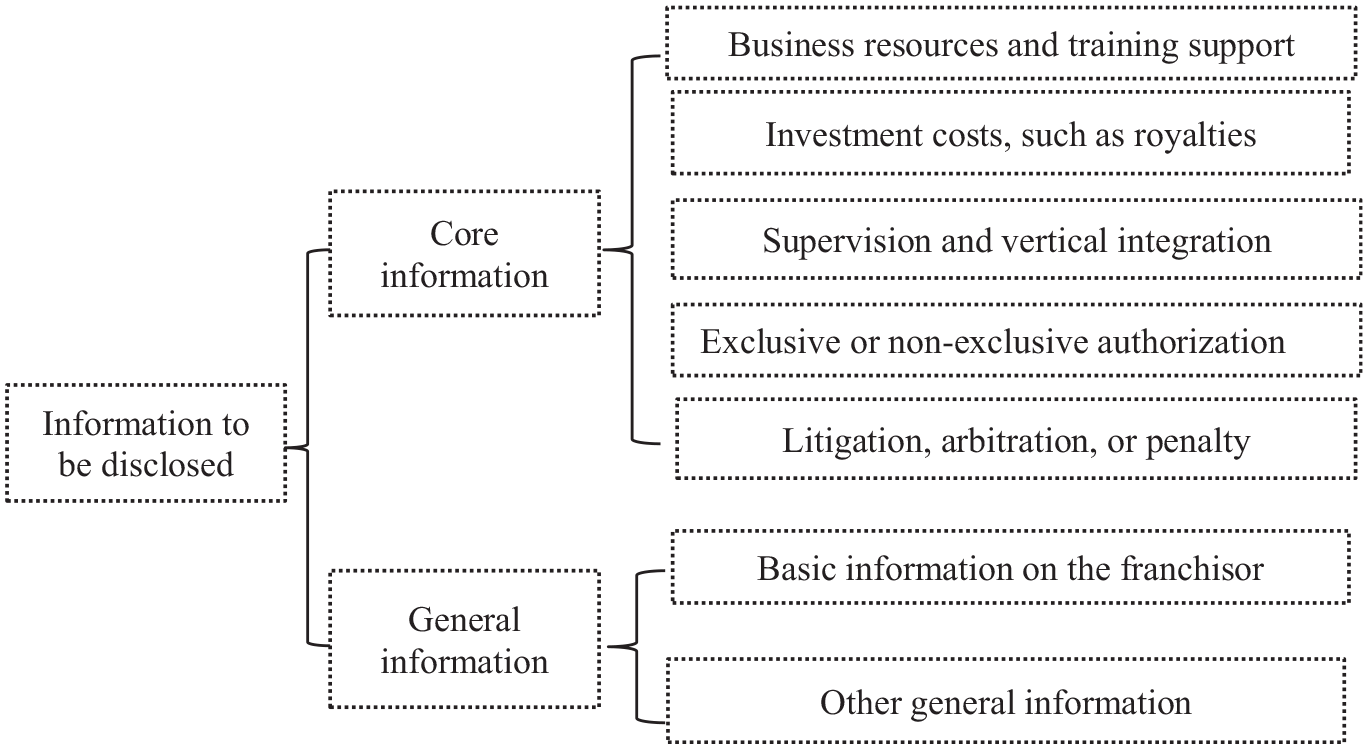
Types of information to be disclosed.
There are five types of core information. The first is the information essential for the franchisee to start a franchised business: business resources and training support. Business resources play a key role in franchising systems (Franchise Disclosure Measures). The Higher People’s Court of Beijing Municipality (2011) offers guiding opinions on this point, holding that the fact that “the franchisee uses the franchisor’s business resource” (Article 13(2)) is the fundamental character of a franchise and that the information on business resources is relevant to the purpose of a franchising contract (Articles 15 and 16). In addition to business resources, the guidance of the franchisor, such as business training and other supporting services, is equally essential (Article 5(5) of Franchise Disclosure Measures). This is because the mere provision of business resources is often insufficient for the franchisee, who is likely to be the layperson of a specific business model, to start and operate the franchised business.
The second type of core information is information on investment costs, including royalties and deposits (Article 5(3) of Franchise Disclosure Measures). Such information is ordinarily considered when franchisees make informed investments because of its importance in assessing the risk of investment, profit margin, and return on capital expectations. Whether the franchisee makes profits is not the fundamental purpose of a franchising contract unless otherwise agreed upon (Higher People’s Court of Beijing Municipality, 2011, Article 13(2)), but it directly affects the conclusion of a franchising contract.
Third, information regarding restrictions on freedom of business also belongs to core information. To maintain the quality of products or services of the franchised business, ensure consistency of the franchising system, and improve the efficiency of business operations, franchisors usually place certain restrictions when allowing franchisees to use their business resources. While franchisors create a supervision mechanism to retain a wide range of control over the franchising system (Article 5(6) of Franchise Disclosure Measures. See also Anonymized, 2020), they reduce supervision costs through vertical integration, in the sense that franchisees must purchase products or services from franchisors (Article 5(4) of Franchise Disclosure Measures. See also W. Wang, 1999). Given that such restrictions directly affect the operation of the franchised business, information on these restrictions is at the core of a franchising contract.
Fourth, information on profits also plays a key role in a franchisee’s decision-making process. Although there are many contributing factors to profits, the most important factor for a franchised business is the presence or absence of exclusive authorization in certain areas and, if so, the expected concrete range of such areas (Article 5(8) of Franchise Disclosure Measures). Exclusive authorization seems to be the best way to eliminate intra-brand competition and thereby integrate all of the benefits in certain areas; thus, information about the scope of authorization should be classified as core information.
The last type of core information relates to the value of the franchising system. Litigation or arbitration has often had an adverse effect on the value of the franchising system; therefore, such information must be disclosed so that the franchisee can make prudent decisions. The Higher People’s Court of Beijing Municipality (2011) points out that “Where the franchisor conceals any lawsuit, arbitration or administrative penalty which may directly affect the franchisee’s decision to sign the franchise contract or may significantly affect the franchisee’s realization of the purpose of the franchise contract, or provides any false information thereabout, the franchisee may rescind the contract according to law” (Article 16(2)).
A New Legal Framework Based on Typification of Information
The typification of information reflects a dichotomy in the function of information disclosure: Core information is disclosed to improve cooperation between the parties, whereas general information is disclosed to promote good faith negotiations. Based on the distinction between core and general information, this study further proposes a new legal framework to distinguish regulation of full disclosure and the liability of its non-compliance with respect to the two types of information as a response to judicial inconsistency.
Specifically, the disclosure of core information reflects the performance of public law obligations. The franchisor must demonstrate that the disclosure has met the Substantive Standard; otherwise, the franchising contract might be rescinded on the grounds of non-compliance with disclosure obligations, and the franchisor assumes full liability. To rescind a franchising contract, Criterion I or Criterion II are applied in this case. In comparison, the disclosure of general information dictates civil-law duties. The franchisee, as the party who claims to rescind a contract on the grounds of non-compliance with disclosure obligations before the court, must demonstrate not only that the Formalistic Standard for disclosure has been satisfied but also that the franchisor’s non-compliance has reached the extent of affecting the purpose of a contract or investment decision-making (Criterion III or Criterion IV). More importantly, even if a contract has been rescinded, the franchisee can hardly claim a full refund of royalties because the franchisee bears the duty of care to be aware of the general information.
This new legal framework can improve the certainty and predictability of adjudication on disclosure disputes. The influence of core information on the fundamental purpose of a franchising contract as a class of contracts and the franchisee’s decision-making process has already been taken for granted in this framework. It creates a bright-line rule for the liability of non-disclosure of core information in the sense that the mere fact of performance or non-performance of disclosure gives rise to a concrete outcome. In contrast, the liability of non-disclosure of general information should consider the franchisee’s duty of care; therefore, the influence of general information on the franchising contract as a particular contract should be proved on a case-by-case basis.
The proposed framework can be used to rationalize cases in judicial practice. For example, in Jieying Zhang vs. Guangzhou House Catering Management Co., Ltd. (2018), the franchising agreement was set up by the franchisor, Guangzhou House Catering Management Co., Ltd (hereafter, “GHCM”), who owned the brand “Takeaway Sushi at Drive” and the franchisee, Jieying Zhang (hereafter, “Jieying”), who was authorized to create a business associated with GHCM’s brand. After the conclusion of the contract, Jieying paid royalty fees to GHCM and made huge investments in the early stages. However, Jieying was not aware before signing the contract that GHCM was not qualified to run a franchised business because it did not have two company-owned units operating in China for 1 year (Article 7 of Franchise Regulation), and probably because of this, GHCM did not file the relevant documents to the Ministry of Commerce PRC as required by the Franchise Regulation (Article 8). Jieying then brought a lawsuit before the court, claiming the rescission of the franchising contract on the grounds of non-compliance with the disclosure obligation.
The court rejected Jieying’s claim on two reasoning levels. First, GHCM bore the burden, demonstrating that it had disclosed information as required. According to the records, however, GHCM offered no evidence, such as a signed receipt for the franchise disclosure document, to prove its disclosure. Therefore, the court opined that GHCM did not disclose the information as a matter of fact. Second, Criterion II was applied by the court to determine the rescission of a franchising contract. This means that a contract will not be rescinded unless the non-disclosure is proven to frustrate the purpose of the contract. The court further pointed out the purpose of the contract that “the franchisee uses the franchisor’s business resource to operate the franchised business” (Jieying Zhang vs. Guangzhou House Catering Management Co., Ltd., 2018). The information on qualification and filing has nothing to do with this purpose; therefore, GHCM’s non-disclosure was not legally sufficient to rescind the contract.
We have doubts about the court’s second reasoning level. That the franchisee uses the franchisor’s business resources to operate the franchised business is the purpose of the franchising contract as a class of contracts, not the particular contract in the case. The court’s reliance on the general purpose to make a decision leads to two problematic consequences. First, it seems that only the non-disclosure of information on business resources might legally affect the rescission of contracts. The scope of information that gives rise to the rescission of contracts due to non-disclosure is quite limited. Second, the court seems to exercise its discretionary power to decide whether non-disclosure, in this case, meets Criterion II. The franchisee’s procedural opportunity to prove this fact in a particular case was improperly excluded.
Our framework can predictably address these problems. First, the information on the qualification of a franchisor and filing should be classified as general information because, as the court opined, it is not related to the fundamental purpose of a franchising contract as a class of contracts. Second, the fact that the information was not disclosed was not disputed, although Jieying, who bears the burden of proving the Formalistic Standard for disclosure, did not do so according to our framework. Third, in addition to the facts of non-disclosure, Jieying must demonstrate the extent of non-disclosure to frustrate the purpose of the contract or influence her decision-making. Suppose that Jieying can prove before the court that she would not have signed the contract if she knew the information. For example, in negotiating the franchising contract, Jieying might have explicitly expressed her concerns about the qualification of the franchise. The court should have made a judgment in consideration of this fact. Finally, even though the contract was rescinded, Jieying could only claim a partial refund of royalties because she herself also bore a duty of care to be aware of such general information.
The practice of disclosure varies between different jurisdictions. We argue that the new legal framework could also benefit other jurisdictions. For example, in Hong Kong, although a misrepresentation is legal grounds for the rescission of a contract, there is no specific law regulating non-disclosure of information in franchising systems. Hong Kong Franchise Association published a Code of Ethics that states the requirement of disclosure, but it is mere guidance without regard to any legal consequence of its non-compliance. In this situation, the proposed framework could be used to assess the importance of information in disputes and its impacts on the purpose of the contract or investment decision-making.
Conclusion
Given its unique business model, the franchise model is accompanied by an imbalance in bargaining power between franchisors and franchisees (Fifth Tribunal of the Second Intermediate People’s Court of Beijing, 2010; Yang, 2016). Information disclosure is one of the most important regulatory tools in a franchising system. This study analyzed the practices and problems of disclosure laws in China and proposed legislative reforms to address these problems. Both normative and methodological considerations are included. Normatively, based on the theory of information hierarchy, we propose that the information to be disclosed can be classified into core and general information. The list of items constituting core information is closed to improve the cooperation between the parties, while the list of items constituting general information is open to ensure good faith negotiations.
Methodologically, this study proposes a new legal framework that distinguishes regulation of full disclosure and the liability of its non-compliance with respect to the two types of information. The empirical analysis suggests that franchise disclosure is important as a legal ground on which franchisees rely to claim the rescission of contracts. However, the existing legal framework is insufficient to guide the judiciary system, leading to discrepancies in the applicable laws. Under the proposed framework, however, the typification of information operates to draw a bright-line rule in that the mere non-disclosure of core information gives rise to the rescission of contracts without regard to the franchisee’s duty of care. Regarding general information, franchisees have the procedural opportunity to prove that the non-disclosure has reached the extent of affecting the purpose of a contract or investment decision-making. This framework provides courts with guidance in solving disputes involving franchise disclosure in a certain and predictable manner.
Despite its normative and methodological implications, this study has some limitations. As noted previously, cases from 2017 to 2021 were collected to conduct a comprehensive empirical study. However, the surprisingly strict COVID-19 pandemic control measures enacted from 2019 to 2021 may have had certain potential distorting effects regarding the number of cases. Moreover, although the liability framework for general information has some procedural implications, and the openness of general information creates flexibility, it also creates uncertainty. Thus, this demonstrates the scope for further research to achieve certainty while maintaining flexibility in assessing franchise disclosure of general information.
Footnotes
Declaration of Conflicting Interests
The author(s) declared no potential conflicts of interest with respect to the research, authorship, and/or publication of this article.
Funding
The author(s) disclosed receipt of the following financial support for the research, authorship, and/or publication of this article: This work was supported by the Youth Project of the National Social Science Fund under Grant [Number 22CFX073]; the General Project of the Guangzhou Social Science Fund under Grant [Number 22GZYB56].

Data Availability Statement
The datasets generated during and/or analyzed during the current study are available from the corresponding author on reasonable request.