




Abstract
This study explores the challenges faced by Netflix subtitlers and the strategies used to translate Jordanian dialectal expressions into English in the Netflix miniseries AlRawabi School for Girls. The corpus of this study consists of 50 authentic examples extracted from the series. Adopting a descriptive approach to translation studies, as suggested by Gideon (1995), our analysis reveals three major findings relevant to subtitling Jordanian dialectal expressions in English: (a) Some dialectal expressions are omitted or altered by replacing them with standard language to fit the Netflix target audience; (b) the Netflix subtitler applied a variety of subtitling strategies, most commonly pragmatic translation; and (c) the subtitling in most of the examples conveyed the intended meaning, albeit with a considerable loss of cultural context from the source language. Finally, this study concludes that the Netflix subtitler adopted a target-oriented translation, thus depriving the target audience of experiencing the cultural characteristics of the Jordanian dialect.
Introduction
Watching a film or a television series creates an opportunity to learn more about the world around us and can inspire individual and social transformation. What makes this experience even more exceptional is when humans are exposed to foreign films and television series that gives them a glimpse of different cultures and languages. In these instances, subtitles become very important, as language barriers are the main obstacle for viewers to enjoy this type of media (James, 2001). Audiovisual translation (AVT), that is, subtitling, interpreting, and dubbing, is a medium that helps viewers understand foreign films and television series. It is crucial to have an adequate understanding of the source language (SL) as language always reflects the culture of the people who speak it and is an integral part of culture (Gamal, 2008; Menacere, 1999).
Subtitling is a relatively new field, having only recently taken form. As De Meo (2010, p. 19) points out, AVT “has only recently fully been recognized in translation study research as previously it was merely considered as an inferior form of adaptation.” Gottlieb (1992) defines subtitles as “transcriptions of film or TV dialogue, presented simultaneously on the screen [and] usually consist of one or two lines of an average maximum length of 35 characters.” Subtitlers face many constraints, not only linguistically, but also technically; they are often required to take into account the length of time that their subtitles will appear, as well as how much space their subtitles can occupy on the screen, while still possessing all the other skills related to language, context, and subject knowledge (Kruger, 2008).
Since its push for international in 2016, Netflix has become one of the biggest streaming platforms worldwide offering an unlimited number of foreign films and television series for an international audience. The BBC also reported that in 2020, during the COVID-19 pandemic, Netflix soared in popularity as lockdowns around the world kept people at home and in need of entertainment. According to VICE, Netflix revolutionized the way humans consume culture, becoming one of the most popular resources for analyzing subtitles. Netflix owes part of its success to the HERMES test, which helps the streaming company choose the finest translators to produce quality subtitles.
This study focuses on subtitling Jordanian dialect for an anglophone audience, particularly the urban dialect spoken in the Netflix miniseries AlRawabi School for Girls. We also describe the subtitling process and explain the difficulties inherent to creating subtitles that are accessible to a foreign audience, while also preserving lexical and cultural differences in light of their social context. Additionally, this study highlights the strategies used by the Netflix subtitler to translate Jordanian dialects into English. We analyze how the subtitler approached dialectal expressions, determining whether the Arabic content was translated into English by applying a target-oriented translation, or whether Arabic terms were retained to give English speakers a taste of the source culture.
Review of Related Literature
Audiovisual Translation
As modern forms of art and media have developed, the translation process has evolved as well. AVT is one of the most promising domains of translation studies and is gaining the attention of academics, scholars, and researchers. AVT is defined as the translation of verbal components in a video; its principal characteristic is that verbal and non-verbal components operate simultaneously (Matkivska, 2014). Chiaro (2012) states that feature films, television programs, musicals, web pages, and video games are just some examples of audiovisual products that require translation. Gamal (2008) defines AVT as “the written interpretation of a spoken message” on screen (p. 1). Audiovisual translation is made to be heard (audio) and seen (visual) simultaneously, with an emphasis on visuality (Chiaro, 2012).
What is Subtitling?
Subtitling is the presentation of audiovisual dialogue translation in the form of titles, usually placed at the bottom of an image or shot (Hurt & Widler, 1998). Subtitling is a process where the words spoken by source language characters are translated and presented in the lower part of the screen (Díaz-Cintas & Remael, 2007). In some cases, subtitles may appear elsewhere on the screen, such as in Japan where “subtitles are sometimes placed vertically on the side of the screen” (Gottlieb, 2001, cited in Pedersen, 2017, p. 10). Subtitles might be also known as “captions,” the “transcriptions of film or TV dialogue presented simultaneously on-screen” (Gottlieb, 2001, p. 244). However, captions are intended as a visual aid for an audience in the source language whereas subtitles are meant for target language viewers.
Unlike translators who typically do not have a word limit, subtitlers are limited to a specific number of characters on the screen at one time. Subtitling is the technical process of converting SL audiovisual media to target language (TL) audiovisual media, which is synchronized with the original verbal message (Gottlieb, 2005). According to O’Connell (2007), subtitling is “supplementing the original voice soundtrack by adding written text on screen” (p. 169).
Constraints of Subtitling
Pavesi (2002) argues that subtitling suffers from several constraints since interlingual subtitling typically involves reducing the original script to fit the screen. Technical limitations of subtitling include the length of the subtitle, the amount of time it appears on screen, space limitations, and the degree to which the text on screen complements visual components (Bogucki, 2019). When it comes to the length of subtitles, Orero (2004) notes one of the more pressing obstacles facing subtitlers: “The translator is given a maximum number of 35 characters for each subtitle in accordance with the time it will be on screen” (p. 15). According to Pedersen (2010), characters, which are the basic unit in subtitling, include “commas, full stops, dashes, exclamation marks and blank spaces, etc.” (p. 15). Subtitles may consist of either one or two lines, called “one-liners” and “two-liners,” respectively (Pedersen, 2010, p. 10).
The constraints that affect subtitlers can substantially limit the range of possible words as well as the number of words that can be used. According to Díaz-Cintas and Remael (2007), this can result in subtitlers selecting synonyms that contain fewer characters but are less accurate. When it comes to time limitations, “subtitles should not contradict what the characters are doing on-screen,” meaning that the translated text should appear simultaneously with the source audio (Díaz-Cintas & Remael, 2007, p. 9). In other words, if characters are talking, subtitles should be present on screen. Subtitles that consist of two lines should appear for no more than 6 s so the viewer does not read the subtitles twice, which might cause some confusion (Abdelaal, 2019). Similarly, short subtitles should appear for at least 1.5 s to avoid a “flashing effect” caused by subtitles changing too quickly (Zojer, 2011, p. 399). Another constraint is the visual context which controls how the verbal element is limited to what is not presented on screen, to reduce repetition (Debbas & Haider, 2020).
Subtitling and Streaming
Human relationships and interactions were drastically affected by the COVID-19 pandemic (Soga et al., 2021) . Necessary lockdown measures were taken by governments around the world, requiring that people work from home and spend most of their time indoors. According to media watchdog Ofcom, these lockdown measures introduced a surge in television and online streaming viewership. Streaming is the latest technological development to have a significant impact on the production of audiovisual material including subtitles (Campos & Azevedo, 2020).
In recent years Netflix has become the most popular video streaming service in the world, opening new doors for viewers around the world to experience films and television in hundreds of languages. However, producing high-quality subtitles is not an easy task; professional subtitlers encounter difficulties when attempting to replicate the impact of cultural and social references that are unfamiliar to foreign audiences. Coupled with the technical constraints of subtitling explored in the previous section, these difficulties necessitate a process for identifying the most skilled subtitlers, such as the aforementioned HERMES test used by Netflix (Rafik, 2020). As a result, researchers and scholars prefer to study Netflix subtitles, gaining insight into the strategies employed by the Netflix translation team and the issues they encounter while subtitling.
Few publications investigate subtitles of different languages on Netflix from different approaches. Among those that do, Kuşçu Özbudak (2019) investigates the English subtitling of Netflix’s first Turkish original series, The Protector, with a focus on how cultural references are translated in subtitles. Özbudak aims to determine if the “source cultural tone” is preserved or if the meaning is recast for the target culture. The results showed that cultural references were highly domesticated by the subtitler and the cultural Turkish tone was sacrificed in favor of audience-friendly subtitling. The study also showed that the timed Text Style Guide provided by Netflix uses a target language-oriented approach.
Campos and Azevedo (2020) analyze subtitles from the first season of the Netflix series Outlander in Brazilian Portuguese. The paper focuses on the issue of restricted deadlines and insufficient revision time, which may affect the subtitling process. If subtitlers do not have enough time to follow best practices, the translation process itself is affected. The results show that outdated translation concepts reappeared, including total translation and word-for-word translation. Campos and Azevedo also stated that such results ignore the constraints of subtitling and the complexities of the audiovisual field.
In 2016, Netflix attempted to attract millions of Arab viewers, with Todd Yellin, vice president of products at Netflix, expressing the company’s desire to boost production in the Middle East and North Africa. Netflix released Jinn, its first Arabic original series in June 2019. A six-episode dramatic series, Jinn was shot in Jordan and released to an uproar among Jordanians who took to Twitter to express their anger and call for censorship (Aljazeera). One social media user described Jinn as an “obscene” drama that sought to “distort the conservative Jordanian society.” In 2021 Netflix released AlRawabi School for Girls, directed by Tima Shomali and produced by Filmizion Productions (on behalf of Netflix). The series primarily revolves around the impact of bullying on young women. According to Gaith (2021), AlRawabi School for Girls received mostly positive reactions from Jordanians, despite some critics who claimed that the series did reflect the Jordanian community.
Unfortunately, most research papers that investigate subtitling on Netflix focus on European language pairs, while studies on Arabic subtitles are limited. Furthermore, most research focuses on English programs that are subtitled for an Arabic audience. Studies that examine translation from Arabic into English are rare; because Arabic films and television programs are not as well-known internationally, they are rarely subtitled or dubbed.
The increasing demand for subtitling keeps industry professionals busy even while research in the field, particularly in the Arab world, continues to lag. As a result, the quality of many subtitles has been questioned. Industry professionals claim that pressure to reduce costs and meet strict deadlines for Netflix results in poor-quality translations that negatively affect viewer experiences.
Subtitling Dialects
Film and television simultaneously reflect how people interact within a society and shape a culture’s beliefs. Culture is reflected in many forms, including sociolect, dialect, and slang (Zojer, 2011). Since most films and television series have moved toward using dialect, subtitling becomes more challenging as subtitlers are faced with dialectal expressions that need to be rendered as close as possible to the source dialogue.
Trudgill (2000) argues that the term dialect is not easy to define. He proposes that from a linguistic point of view, dialect refers to the different vocabulary, grammar, and pronunciation that a speaker uses in everyday life. However, Trudgill (2000) also notes that the assessment of dialect is based on social rather than linguistic factors, and varieties in dialect occur due to various geographical, social, and ethnic factors. He explains that there is a relationship between regional dialect and social class. For example, Trudgill points out that people from lower social classes tend to use non-standardized varieties of language, whereas educated people are more likely to use standardized language. Furthermore, women are more likely to use standardized language than men. This is clear in films, for example, when certain characters communicate in a way that allows the viewer to implicitly gather information about their backgrounds. As such, information about a character does not need to be explicitly stated, as the audience can infer this information from the character’s speech (Hodson, 2014, p. 5).
Dialect is one of the most challenging areas of translation. Translators usually adopt three strategies to translate dialectal expressions: (a) removing dialectal expressions and substituting them with more well-known words in the target language; (b) replacing dialectal expressions with the closest equivalents to the source text found in the target language; and (c) omitting problematic expressions or replacing them with more formal expressions (Berezowski, 1997).
Dialect translation becomes even more challenging in subtitling due to the time and space constraints of AVT. Still, dialect plays a significant role in films and television, despite no established, clear-cut criteria for successful audiovisual dialect translation. This may result from the “pressure of censorship,” which frequently imposes the use of a formal standard in the target language since the translation of foreign linguistic varieties may not be well received by the target text (TT) readership (Pinto, 2009).
Without question, dialect in translation and subtitling can be problematic, as it is difficult to capture the spirit and cultural impact of dialect in another language. Alwan (2011) investigates the subtitling of the Emirati dialect in the third season of the Emirati cartoon Freej. The study concludes different cultural expressions, metaphors, poetry, and code-switching which are taken from the first, sixth, and ninth episodes of the third season of Freej. Alwan demonstrates that context determines which subtitling strategy is the most appropriate and that the loss of cultural color in dialect translation leads to cultural misconceptions.
Dialect translation requires translators who are not only proficient in multiple languages but are also knowledgeable of multiple cultures. Hence, we hope that this study spurs further research in this field and brings increased attention to how subtitling dialectal and cultural expressions can bridge language culture gaps. Therefore, this study aims to answer the following questions:
What strategies are used by Netflix subtitlers in translating Jordanian dialects?
Were Netflix subtitles of Jordanian dialects source-oriented or target-oriented?
To what extent was Jordanian culture preserved in the subtitles?
Methodology
This study uses the Jordanian Netflix series AlRawabi School for Girls as a case study in subtitling Arabic audiovisual content for an anglophone audience. The plot of AlRawabi School for Girls revolves around three high school girls in West Amman. Mariam, Nouf, and Dina are constantly bullied by Layan and her squad of mean girls, Roqayya and Rania. As a result, the bullied girls plan to enact vengeance against their bullies. The series tackles issues including bullying, women’s rights, psychology, reputation, sexual assault, and relationships. The actors use an urban Jordanian dialect mostly used by the inhabitants of Amman, the capital of Jordan, which creates an authentic source of data for this specific kind of study.
This study used the following research procedures:
Watch every episode of Al-Rawabi School for Girls. The six-part miniseries premiered in 32 languages and 190 countries on Netflix on August 12, 2021 (Homssi, 2021).
Download and read the teleplay script to understand how scenes are played out on the page and the screen.
Meticulously watch each episode multiple times to collect examples of Jordanian dialectal expressions.
Review scenes multiple times to compare the English subtitled version with the original version, looking for scenes that were omitted or truncated.
Collect fifty examples that reflect the Jordanian dialect in the series. This study collects examples that highlight the linguistic, cultural, and social differences between Arabic and English. These differences create a problem for subtitlers when the Arabic dialect is translated into English.
Capture stills from each example to provide additional context. Meaning cannot be established without references to images, sound, movement, body language, and gestures, references which help viewers read subtitles in context and understand situated meaning. The researchers were able to bypass Netflix’s digital rights management software by installing the Video Screenshot extension for Google Chrome and clicking the camera icon below the video player.
Classify Jordanian dialectal expressions into the following categories: culture-bound expressions, colloquialisms, hyperbolic expressions, idiomatic expressions, and bad language or swearing. The researchers negotiated the difference between these categories, and when disagreement occurred, a native speaker of Jordanian Arabic was consulted.
Translate Jordanian cultural expressions into English and compare the translations with the subtitles. The translations were then reviewed and verified by specialists in the field of cultural studies and translation.
Data Analysis
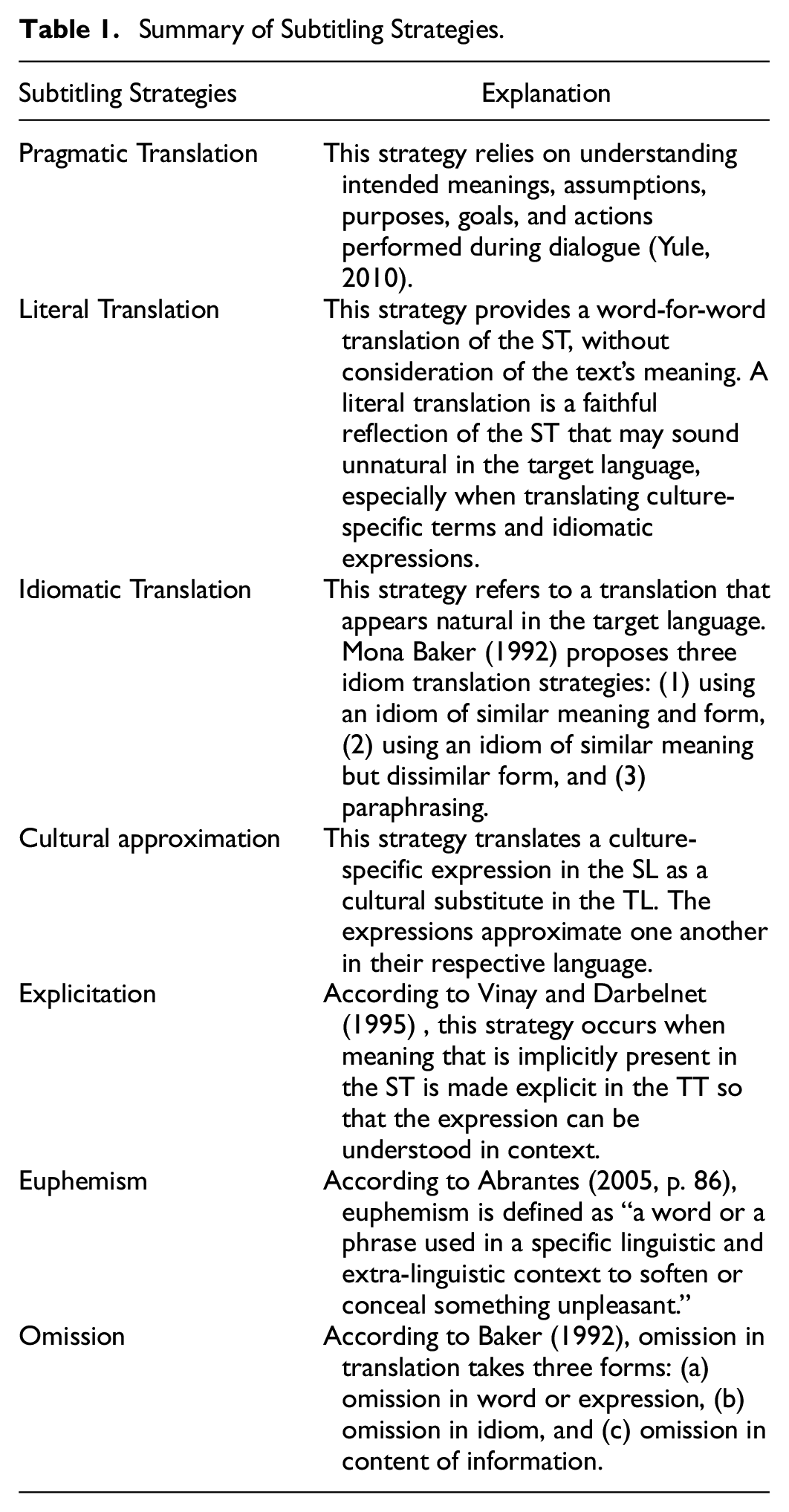
The Jordanian dialectical expressions used in AlRawabi School for Girls are detected and compared with their English subtitles. Each dialect-bound expression is analyzed according to the subtitling strategies explained in Table 1. As the current study aims to describe and explain the subtitler’s behavior rather than prescribe rules to judge the quality of translation, the descriptive approach is adopted. This theoretical framework is suggested by Gideon (1995) who identifies two translation strategies: “source-oriented” translation and “target-oriented” translation. According to Toury’s words, a source-oriented translation pays more attention to the source text and focuses on producing a text that follows the norms and structure of the source language. A target-oriented translation adapts the text to fit the culture and norms of the target language and audience. Accordingly, the strategies combined with the type of dialect classification, are investigated to determine which strategy is most commonly used for each dialect classification and whether they successfully conveyed the intended meaning. Pragmatic translation, literal translation, idiomatic translation, euphemism, and omission are the subtitling strategies used by Netflix subtitlers to translate the linguistic and cultural differences between Arabic and English. Furthermore, the analysis reveals the subtitler’s tendency for target-oriented translations over source-oriented translations.
Summary of Subtitling Strategies.
Findings and Discussion
Fifty examples were collected from AlRawabi School for Girls to investigate the strategies used in subtitling the Jordanian dialect according to linguistic, social, and cultural contexts. The Jordanian dialectal expressions extracted from the series were assigned five categories: culture-bound expressions, colloquialisms, hyperbolic expressions, idiomatic expressions, and bad language or swearing.
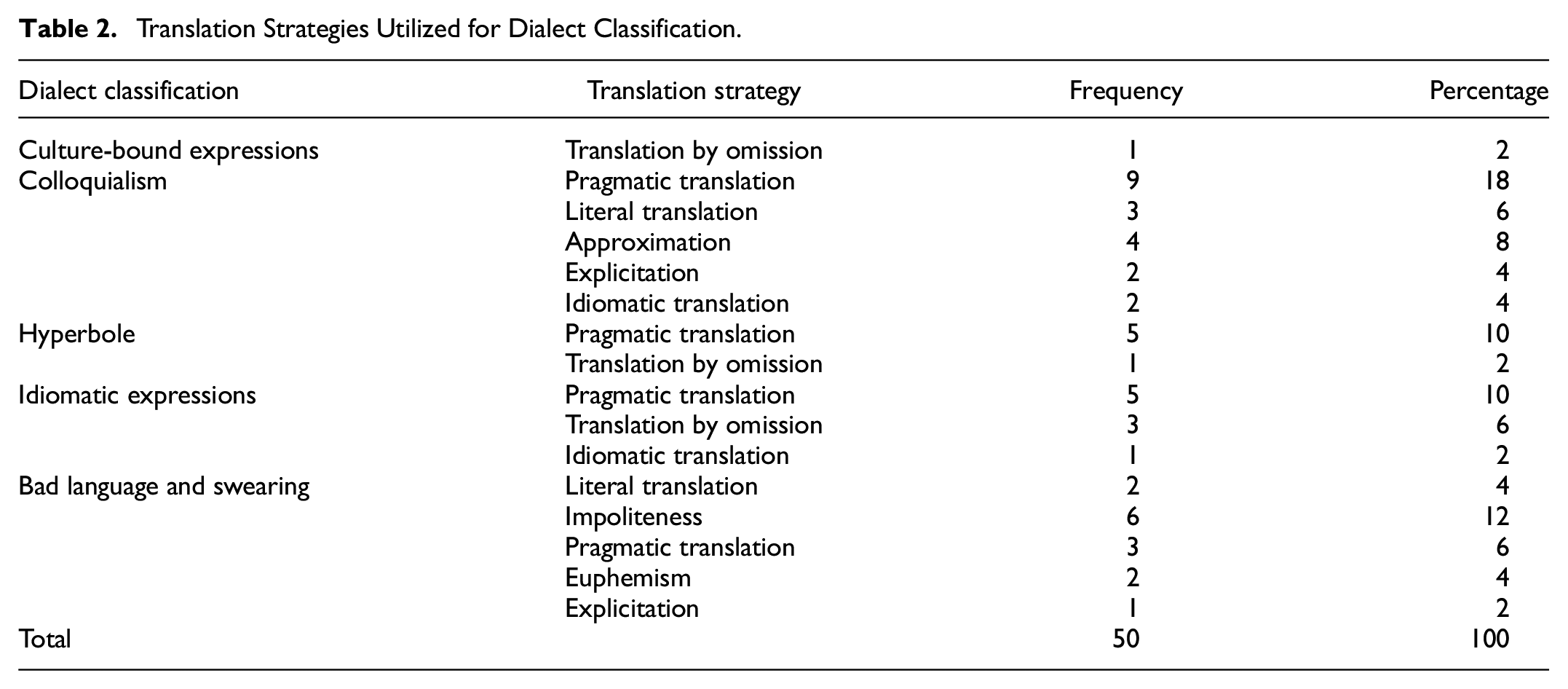
Table 2 shows that in subtitling colloquial expressions, the subtitler adopted many strategies. Pragmatic translation was the most applied strategy at 18%, approximation at 8%, literal translation at 6%, followed by explicitation and idiomatic translation at 4% each. In subtitling hyperbolic expressions, the most applied strategy was also pragmatic translation at 10%, followed by translation by omission at 2%. When translating idiomatic expressions, the subtitler adopted three strategies: pragmatic translation was the most frequently used strategy at 10%, followed by translation by omission at 6%, and idiomatic translation at 2%. When it comes to subtitling bad language and swearing, the impoliteness strategy was the most applied at 12%, followed by pragmatic translation at 6%, euphemism at 4%, and explicitation at 2%. As most culture-bound terms might be difficult to translate, the subtitler opted to remove the Jordanian culture-specific term, adopting the translation by omission strategy 2% of the time. Given the limited space of this paper, selected examples from AlRawabi School for Girls are pictured with their English subtitles.
Translation Strategies Utilized for Dialect Classification.
Culture-Bound Terms and Expressions
Culture-bound terms and expressions have no equivalent in a target reader’s culture, so translators encounter many challenges when transferring them from ST to TT (Samakar, 2010). According to Hatim and Mason (as cited in Samakar, 2010), the translator is considered a mediator between cultures; their responsibility is not only to translate words but also cultures. Thus, translators must have an excellent knowledge of the languages and cultures they work with.
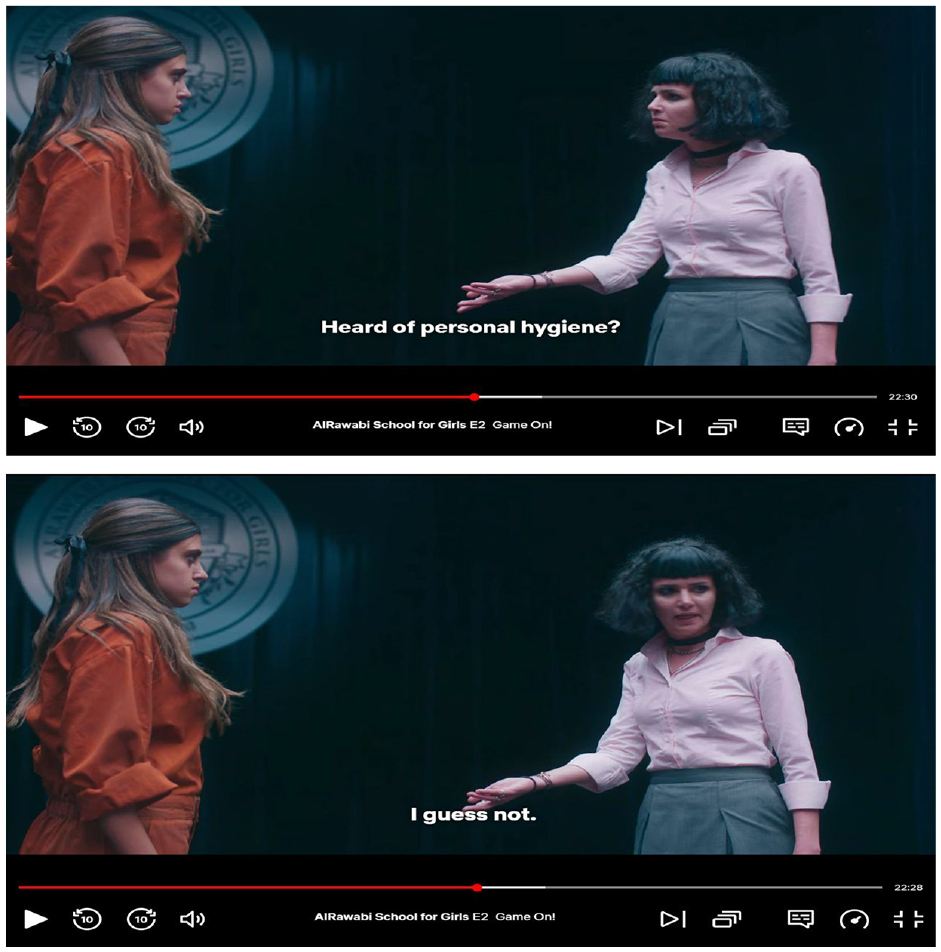
In the example above, Nouf is making fun of Layan during a school assembly involving a bully roleplay. She is using the culture-bound Jordanian expression “على العيد” (lit. on Eid) when she is asking about the last time Layan took a shower. Muslims celebrate two Eids every year, Eid al-Fitr and Eid al-Adha, and in the Middle East Hammam al-eid is an ironic cultural concept used to imply that someone smells bad and is in desperate need of a bath: “When was the last time they bathed? On Eid?” Nouf is giving Layan a taste of her own medicine, making fun of her as a part of an educational scene about school bullying.
The subtitler opted for the omission strategy and did not translate the culture-bound expression “على العيد”. This expression can be an issue for subtitlers, as the target audience is not familiar with the concept. Thus, the cultural meaning is overlooked, and the target audience is deprived of the specific reference.
Colloquialism
Colloquialisms are any informal words or expressions used by different social classes in conversation (Nofalli, 2012). The following are culture-bound colloquial expressions that the translator might find difficult to render in the TT.

In the example above, Nouf is talking to Dina after Rania bullied her during gym class for being out of shape. Nouf tries to lift her spirits, saying that Rania is jealous of Dina, using the colloquial term “اللزاليز”/āllzālyz/, literally meaning “chubby girls with curves.” In Jordanian culture, this colloquialism has a positive connotation, used to describe women who have fleshier faces, hips, and thighs. Nouf is trying to make Dina feel better about herself, saying that other girls in the school are jealous of her body shape and that Dina should not feel insecure about her body even when she is bullied by Layan and her friends.
The subtitler opted for a pragmatic translation, using the term “curves.” This TT term also has a positive connotation, as having curves means having an attractive body. Thus, the intended meaning is expressed, at the expense of the ST cultural tone.

In the example above, Layan is talking to her boyfriend Laith with whom she snuck out of a school event. Layan uses the colloquial terms “الله ستر” /āllh str/ and “يلئطونا” /ylʾṭwnā/. In Jordanian society, the word “ستر” means “to cover, or to veil something;” when added to āllh (God)/”الله”, the expression takes on additional meaning according to its context. Arabic cultures are very connected to their religious heritage: the word “cover” here conveys the sense of God’s concealment. As Muslims, they are thankful for the concealment of God, who provides the best concealment and knows everything, even if hidden. In this example, Layan is thankful to God that they were not caught. The subtitler applied cultural approximation and rendered the Arabic expression as “Jesus,” adopting an expression of the target audience. The term “ يلئطونا “ is a colloquial term, literally meaning “to catch someone or something unexpectedly.” When Layan and Laith snuck out of the event, Miss Abeer noticed Layan’s absence and went to look for her. Layan and her boyfriend hid in one of the classrooms and were lucky not to get caught.
The subtitler opted to explicitate the expression, expressing the intended meaning, implicitly presenting the dialectal term “يلئطونا” as “they nearly came in and caught us.” The intended meaning was expressed, although the ST culture and dialect are sacrificed for the TT culture.
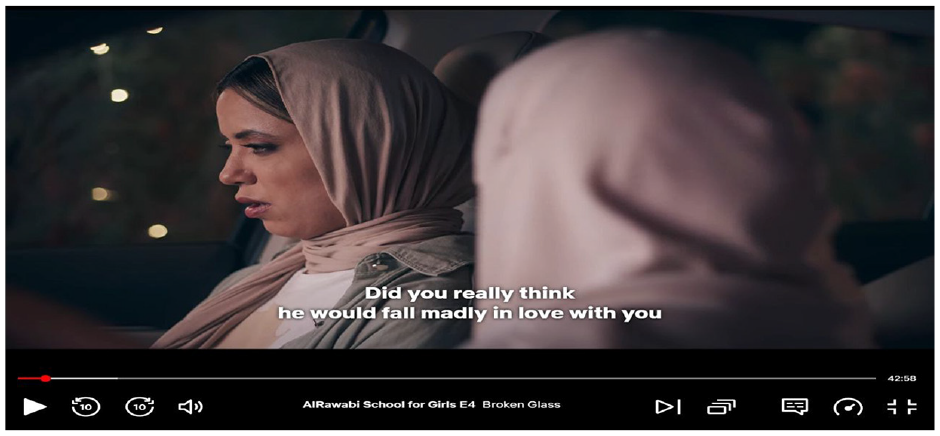
In the example above, Roqayya’s mother is telling her daughter that the stranger she sent her hijab-less picture to is not going to love her just because she sent him those pictures. She uses the dialectal expression “يموت بدبابيبك” /ymwt bdbābybk/. This expression combines “دبابيب” meaning “cheeks” and“يموت” meaning “to die.” This expression is used when a man is so in love with a woman that he is dying with longing and eagerness to kiss her rosy cheeks and express his love. This expression is used to mock women who think their partners are infatuated with them. Roqayya’s mom is giving her a reality check: the stranger she met online only used her and does not actually love her.
The subtitler translated the Jordanian dialect by using the idiomatic expression “fall madly in love with you.” In the TL this expression conveys intense and passionate love toward someone. The subtitler successfully communicated the SL meaning, albeit at the expense of the cultural tone.

In the example above, Zaid is joking with his friend Yazan, using the colloquial term “طقعتلك” /ṭqʿtlk/. This context-dependent expression is of unknown origin in Arabic, primarily used by young people in Jordan, especially students. In this context, the dialectal term is used when someone is ignored, especially by a romantic interest. Yazan appears at the school charity event to profess his love for Mariam and hang out with her. Instead, Mariam ignores him, telling him she is busy and that they will catch up some other time. His friend Zaid laughs at him, telling him that Mariam “طقعتلك”. Humiliated, the boy walks away.
The subtitler applied the approximation strategy, rendering the dialectal term as the informal English “ditched you,” which has a similar meaning “to get rid of or leave someone who is no longer wanted.” The subtitler also adds the expletive “damn,” used to express surprise or disbelief. The intended meaning is expressed, as the dialectal Arabic term is replaced with the closest equivalent found in the target culture. Once again, Jordanian culture and dialect are sacrificed in this example.

In the example above, Nouf is telling Dina to ignore Rania’s comments about her body. Throughout the TV show, the gang terrorizes Dina, even going so far as to pour red nail polish on her white trousers and circulate pictures of her “accident.” The colloquial term,"فكك"is context-dependent, originating from"يفك" /yfuk/, literally meaning “to untie something.” In Jordanian culture this term is used to refrain from unpleasant people who drain energy and morale. In this context, it is used to tell someone to just ignore the other person, rather than stooping to their level.
The subtitler opted for the pragmatic translation strategy, using the phrase “ignore her” to express the intended meaning. The subtitler also omits the discourse marker “اسمعي” used in Arabic to grab someone’s attention, functionally similar to “listen” in English. The subtitler may have believed that omitting the discourse marker would not affect the intended meaning.

In the example above, Ahmad, Rania’s boyfriend, tells Nouf to “فكيها” /fkyhā/, which literally means “to untie something.” In Jordanian culture, it describes someone frowning with contracted eyebrows and wrinkled forehead as if to signal disapproval or displeasure. As in the previous example“فك” has a specific meaning in this context. Here the term is used to tell someone to loosen up when they are tense or uneasy. It is also used by men when a woman doesn’t show any reaction to his advances. When Ahmad starts flirting with Nouf and she doesn’t reciprocate, he tells her to “chill out” and have some fun.
The subtitler opted for the pragmatic translation strategy, rendering the term in the English slang, “chill out,” expressing the intended meaning. The subtitler also omitted the colloquial term “شوي” meaning “a little,” while adding “come on.” The subtitles successfully convey the intended meaning, as it is clear that Nouf is being harassed by Rania’s boyfriend.

In the above example, Dina is talking to Mariam about the appearance of a guy they know. Dina uses the colloquial term “شقفه” /šqfh/, translated into English as “so hot.” Literally meaning “a piece of something such as cloth” in Arabic. Embroiders in Jordan often use /šqfh/ to create embroidered thaob (traditional dresses) or decorated designs inspired by the local environment. Traditionally, they use threads, sequins, and colorful stones. Embroidery in Jordan has its significance in preserving cultural identity and heritage throughout generations. Jordanian youth use this phrase to refer to someone’s physical appearance as being very attractive or “hot.” This Arabic colloquialism would be confusing for the target audience if translated literally.
The subtitler adopted the pragmatic translation strategy, a justifiable decision even though the cultural flavor was lost. We suggest using another slang TL expression: “He is a 10.” This expression is used to describe a very attractive person and provides a similar SL cultural effect for the target audience.
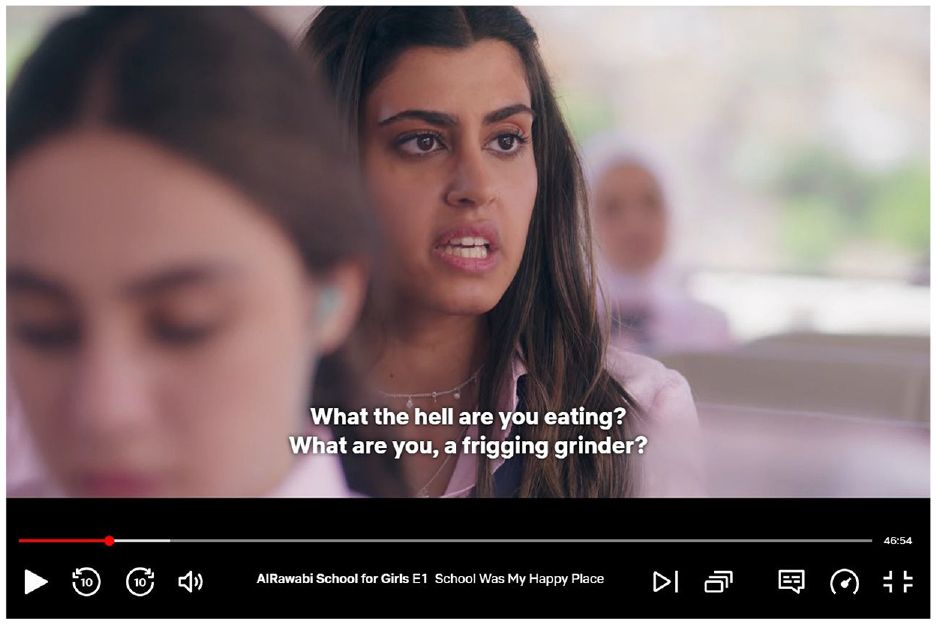
In the above example, Layan is again making fun of Dina’s eating. Layan ironically uses the metaphor “مطحنة شغالة” /mṭḥnh šġālh/, a Jordanian expression intended to describe someone who never stops eating, like a machine. This metaphor has its origin in Jordan where agriculture remains substantial to expand the country’s economic growth. Therefore, the use of grinder restores images of whirlwind mills in traditional farming grinding wheat as they run non-stop all day. Metaphorically, the equivalence is achieved through literal translation, even though the expression “a frigging grinder” is not used in English to describe a person who eats a lot. In the TL, “a grinder” is a kind of machine, a power cutting tool, and “frigging” is an intensifier used to express annoyance with someone or something. We suggest using the target culture idiom, “stop eating like a horse,” to describe someone who is always eating and is never full. However, the subtitler decided to allow the target audience to experience the ST culture and dialect.
The subtitler also omitted the Arabic expression “ارحمينا” /ārḥmynā/, meaning “have mercy on us.” The subtitler may have believed that omitting the term would not affect the whole meaning. Layan is sick of seeing Dina eating all the time and wants her to stop. The subtitler added the phrase “What are you doing,” conveying an emotional overtone that expresses the speaker’s disapproval.

In the example above, Rania uses the expression “العصر الحجري” /ālʿṣr ālḥǧry/ to describe her friend Roqqaya. This expression is used in Jordanian society to describe someone whose behavior is backward as if they are from a remote area and not familiar with modern cultural norms. The person is also described as if they are still living in the Stone Age. Roqayya is uncomfortable with Layan showing so much skin in the pictures she sends to Laith and expresses her disapproval. Rania makes fun of her, accusing Roqayya of being narrow-minded and still living in the Stone Age.
The subtitler opted for a literal translation, allowing the target audience to experience the ST culture and dialect.
Hyperbolic Expressions
Hyperbole serves as an exaggeration or an overstatement to add emphasis or invoke humor. The exaggeration is outrageous without the intention of being true. The purpose of hyperbolic expressions is to add depth and color for a powerful effect (Figurative Language, 2022). AlRawabi School for Girls makes frequent use of hyperbolic expressions, particularly when characters are threatening or warning others.

In the example above, Miss Faten, the headmistress of the school, is talking about Layan’s father, a powerful man, and what he will do if anything happens to his daughter. The Jordanian expression “بهد المدرسة على رووسنا” /bahid ālmdrsh ʿla: rwwsnā/ literally translates to “tear down the school over our heads.” This hyperbolic expression is not meant to be taken seriously but is intended to show that Layan’s father will be very angry and severe. Mariam informs the teachers that Layan skipped school to hang out with her boyfriend Laith, yet Miss Faten lets Layan off the hook because of who her father is. One of the teachers, Miss Abeer, disagrees saying that Layan’s family should be informed. Miss Faten responds by saying that her father will be very angry and the consequences would be severe if he knew.
The subtitler rendered the Arabic expression as “would ruin the school” in English, applying the pragmatic translation strategy. The term “ruin” expresses the physical destruction of something, thus preserving the ST meaning even though the subtitling did not reflect the Jordanian dialect.

The example above is also of Miss Faten discussing the consequences of Layan’s father finding out his daughter skipped school. She is using the expression “بقلب الدنيا تحتاني فوقاني” /bqlb āldnyā tḥtāny fwqāny/, meaning “turn life upside down.” In Jordanian culture, this hyperbolic expression expresses the severity of potential consequences. Miss Faten states that Layan’s father will turn the lives of people around him upside down, potentially costing Miss Faten her respectable life as headmistress of a very prestigious school.
The subtitler applied the pragmatic translation strategy, using the phrase “go ballistic,” meaning “to get very angry or upset.” This subtitle describes the emotional state of Layan’s father but does not reveal the exact consequences of his anger. Thus, only part of the intended meaning is expressed, and the cultural flavor is lost in translation. We suggest applying literal translation, using the expression “turn our lives upside down,” which conveys a similar meaning in both cultures.

In the example above, Layan is referred to using the Jordanian expression “بحسبلها ألف حساب” /bḥsblhā ālf ḥsāb/, literally “counts for her a thousand accounts.” This hyperbolic expression poses a challenge for subtitlers; the expression is used to show that someone is very powerful and should be feared by the people around them. Students at AlRawabi turn a blind eye to Layan’s actions out of fear, going so far as to support her in her mischievous tactics. For example, Miss Faten frequently lets Layan off the hook because of her father and the control over him that Layan exerts.
The subtitler only rendered the first part of the expression, omitting the hyperbolic expression, perhaps because the intended meaning is already expressed in the first part. As a result, the ST culture and dialect are not expressed in the TT.

In the above example, Rania asks Layan about the financial status of the boy she is going to meet, referring to his family with the hyperbolic term ”مقرشين”/mqršyn/. The word “مقرش” originates from “قرش”, meaning “piaster” in English, a monetary unit used in Jordan. In Jordanian culture, this term refers to someone very wealthy. Layan’s college boyfriend Laith comes from an affluent family, as demonstrated by their date at an expensive restaurant.
The subtitler applied a pragmatic translation strategy, achieving an equivalence by translating the dialectal term as “loaded,” a term used to describe someone who is filthy rich, according to Urban Dictionary. Meaning is brought closer to the target culture, justifiably so, as the Arabic dialectal term is substituted for a TT slang term that preserves some of the ST cultural flavor.
Idiomatic Expressions
An idiom, also referred to as an idiomatic expression, is a set of words or phrases that has a figurative meaning conventionally understood by native speakers. The contextual meaning is different from the idiom’s literal meaning. In other words, idioms do not mean exactly what the words say (Jabbari, 2016).

In the example above, Summaya, the school janitor, states that she needs her job to feed and take care of her family, using the expression “برقبتي عيلة” /braqbaty ʿēleh/. In Jordanian culture, the idiomatic expression “برقبتي عيلة” literally translates to “I have a family on my neck.” The word “raqba” is associated with different situations to express different meanings. We may know the “Neck” as an organ of the body which supports the head, but in the Jordanian society it also carries different social connotations: رقبتي سدادة، وعد بالمساعدة بكل ما يملك, عظام الرقبة، محسوب على الاقارب، من المعارف and برقبتي عيلة. It is used to express family ties, family responsibilities, and social and financial support. Using the term “neck” in (برقبتي عيله) also indicates the speaker’s social class (poor, rich). As most people who use the expression “braqbaty ʿēleh”, are suffering financially and share the responsibility of feeding and taking care of their own family, comparing this responsibility to a heavy load around one’s neck. While in the bathroom stalls, Layan and her friends remain determined to use their familial ties to get out of punishment and are overheard by Summaya. Summaya, the school janitor comes from a poor background and she feels inferior toward those in a higher-class position. Layan threatens Summaya, promising to make sure Summaya is expelled from school if she tells anyone of their plans. That’s why she is begging Layan to show mercy telling her she has a family to feed.
The subtitler omitted the dialectal term “برقبتي” and instead applied a literal translation. “I have a family to feed” expresses the intended ST meaning at the cost of the ST cultural flavor. We suggest using an idiomatic expression from the target culture, such as “I have mouths to feed.”

In the example above, Layan criticizes her friend Rania for the positive relationship she has with her teacher. Layan expresses her disagreement through the Arabic idiom “مسحتيلها جوخ” /msḥtylhā ǧwx/. The word “مسح” means “to wipe” in English and “جوخ” is the plural form of “جوخة”, meaning “a type of wool/velvet.” The origin of the word “جوخ” is Turkish, referring to those who served the Sultan in the Ottoman Empire. Those cloth wipers wanted to reach the Sultan and get closer to him by wiping the dust from his velvet cloak and the shoes he wore, hoping to be favored by the Sultan, rewarded, and given money in return. Hence, the term becomes much used in the context of social hypocrisy. In Jordanian culture, it refers to people with no dignity, who are desperate to achieve their desires regardless of their way. This metaphor holds a negative social connotation, and thus people, who are given this description, are usually referred to as manipulators and hypocrites. In the Jordanian society, many people rely on fake compliments and mere flattery even at the expense of their morals and dignity. Rania is not worried about making the soccer team, because, as Layan explains, Rania knows that the coach likes her and Rania is always doing favors to win the teacher’s approval.
The subtitler overlooked the cultural meaning and opted for the pragmatic translation strategy, rendering the Jordanian expression as “you fangirled over her,” which does not reflect Jordanian social context and does not imply the same degree of negative connotation as the ST. Thus, the subtitler did not communicate the intended meaning. “Fangirling over” someone expresses excessive excitement for a person and does not have the same negative connotation as “مسحتيلها جوخ”. We suggest using the informal English phrase “you are kissing up to her,” which expresses the same ST meaning. The subtitler did not faithfully translate the dialectal expression idiomatically and culturally as the hypocritic sense was overlooked.
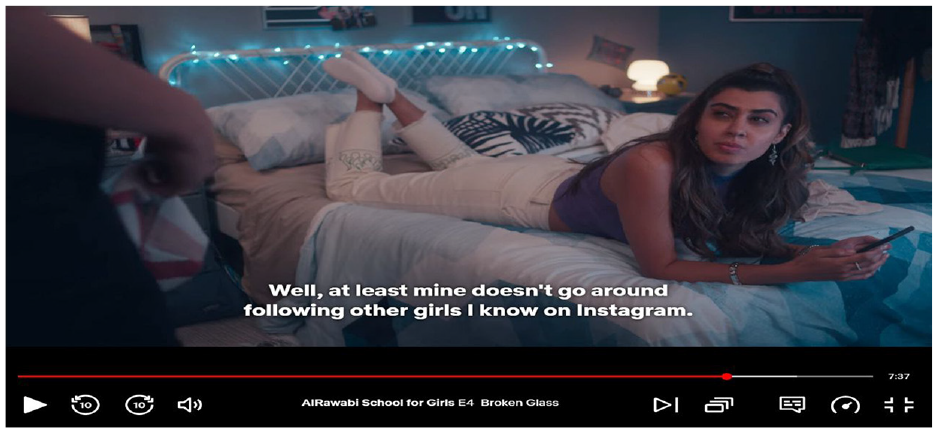
In the example above, Layan is talking to Rania about her boyfriend, using the metaphor “ما بلعب بذنبو” /mā blʿb bḏnbw/, which literally means “doesn’t play with his tail” in English. In Jordanian culture, this expression is used to describe someone who is mischievous and might trick you behind your back; it also refers to men who cheat on their wives. Layan jokingly tells her friend Rania that at least her boyfriend is loyal to her and would not cheat behind her back, whereas Rania’s boyfriend plays around, following other girls on social media, like Nouf. This interesting idiomatic expression would sound abnormal to the target culture.
The subtitler applied the omission strategy and did not translate the Arabic idiomatic expression, neglecting both the cultural and metaphorical meaning. As a result, the target audience was deprived of experiencing the ST culture and dialect.

In the example above, Nouf argues with Mariam, using the idiomatic expression “بوز المدفع” /buz ālmdfʿ/, literally meaning “in front of the cannon.” This metaphor is used to describe someone who is always having others take the blame for their actions. Being in front of the cannon means you are the first one to get hurt. Mariam feels she is always blamed for everything by her friends, especially after Nouf has second thoughts about their plan for revenge against Layan and Rania. Earlier in the show, Nouf witnesses Layan assaulting Mariam but remains silent when Layan frames Mariam, resulting in Mariam’s suspension from school. Mariam then confronts Nouf for being silent when she took the blame. Nouf reveals that even though she wanted to speak up, she didn’t want to risk expulsion and protected herself at Mariam’s expense.
The subtitler translated the Arabic expression using an idiomatic expression from the target culture, “throwing you under the bus.” This expression also describes a situation where someone else is left to take the blame for another’s actions. The TT expression expresses the intended ST meaning.

In the example above, Nouf uses the idiomatic expression “أجر طاولة” /iǧr ṭāwleh/. This Arabic idiom, “اجر طاولة”, literally means “table’s leg” in English, which would sound abnormal to the target culture. It is used in Jordanian culture when someone’s opinion does not matter and is ignored. The person is compared to the part of an inanimate object that is insignificant on its own. Nouf is angry at Mariam for telling Dina about their revenge plan, believing that their plan has been compromised. Nouf uses the Arabic expression “اجر طاولة” to show that Mariam disregarded her opinion.
The subtitler opted for the pragmatic translation strategy, rendering the Arabic expression as “Does my opinion not matter?” The subtitler conveyed the intended meaning but ignored the cultural meaning, which is lost in the TT.
Bad Language and Swearing
The value of “badness” in all languages is constantly changing, which is why there are various classification systems of “bad language” (Jdetawy, 2019). Variation and distinction between these different classes are required to enhance linguistic variety and expand the knowledge of each category of this non-standard language (ibid).
Using the classification adopted by Jay (as cited in Jdetawy, 2019), bad language is divided into swearing, slang, insults, and slurs. Swearing is part of every culture and dialect and can be used for various reasons, such as expressing strong emotions like anger and frustration, or insulting others and causing them emotional harm (Jdetawy, 2019).

In the above example, Rania calls her boyfriend “كلب” /Kalb/ after she finds out he was flirting with Nouf behind her back. Calling someone a dog may not seem particularly bad in English, as dogs are loved and admired in the West, however, calling someone a dog in Arabic is offensive and can start a fight. Unlike in African American Vernacular English, where calling someone “dog” or “dawg” has the same cultural connotation as calling someone “brother,” in Jordanian culture “Kalb” is used as an insult. People also use the expression “ابن كلب”, or “son of a dog,” insulting not only the target but their father as well. Rania conveys her anger by calling her boyfriend “Kalb” when she finds out he cheated on her.
Due to the contrasting connotations in Arabic and anglophone cultures, the subtitler opted for the pragmatic translation strategy, translating “كلب” /kalb/ as “prick,” meaning “a despicable man, or a fool” in English slang. The subtitler is aware that the term “dog” carries a different connotation in the target culture and decided to use “prick” instead. As a result, the subtitler was successful in expressing the intended meaning.

In the example above, “يدعسلك على طرف” /yidʿaslik ʿla: ṭaraf/ literally translates to “meaning to step on your tip.” This idiomatic expression is used in Jordanian culture to show that a person is not a pushover who allows others to disrespect or step on them. During a school trip, Nouf and Layan are in a spa together when a man appears and begins inappropriately touching Nouf. Surprisingly, Layan comes to her aid, comforting Nouf and warding off her harasser. Much to Layan’s displeasure, Nouf does not report the man when Miss Abeer arrives and later scolds Nouf for remaining silent.
The subtitler applied a pragmatic translation strategy, using the vulgar slang expression “a girl who doesn’t take shit from anyone” to express the intended meaning. This English expression describes someone who does not allow themselves to be treated unfairly or disrespected. The intended meaning of the idiom is expressed, while the cultural and idiomatic meaning of the expression is ignored.
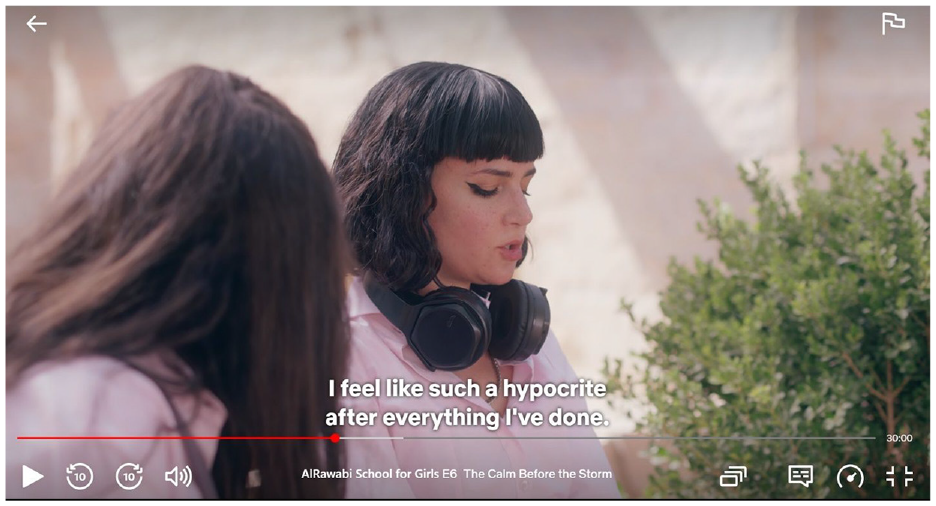
In this example, the idiomatic expression “بوجهين” /ibwǧhēn/, literally meaning “with two faces,” is used in Jordanian culture to call someone a hypocrite; the person has two faces, one saying unpleasant things about you to others, the other saying pleasant things to your face. At the end of the series, Nouf tries to persuade Mariam against following through with her revenge plan after Layan saves Nouf from being harassed. Nouf feels like a hypocrite because she is the one who encouraged Mariam to support the vengeance that Nouf no longer desires.
The subtitler opted for the omission strategy and only retained the first part of the sentence, which already expressed the intended meaning. However, the subtitler could have rendered the Arabic idiom using an equivalent idiom, such as “two-faced.”
Conclusions
Dialectal terms and expressions reflect Jordanian culture in the Netflix series, AlRawabi School for Girls. Dialects, particularly Arabic ones, serve as one of the most challenging areas of translation. The present study finds that dialects abound with culture-bound terms and expressions that cannot be translated without understanding their social context. Understanding context is important for producing acceptable subtitles that reflect the SL culture. As shown in the discussion section, the Netflix subtitler understood the contextual meaning of colloquial terms and was able to express the intended meaning of ST using pragmatic translation, approximation, and explicitation. Literal translations, however, were a less effective strategy for subtitling dialectal expressions. A critical examination of subtitled dialectal expressions reveals that the Jordanian cultural flavor was sacrificed in favor of subtitles that were friendlier to the target audience.
The idiomatic meaning of most dialectal expressions found in the series was omitted, overlooking the cultural importance of these expressions. The subtitler’s decisions prevented Netflix viewers from experiencing Jordanian culture in most of these expressions. Moreover, some culture-bound expressions and colloquial terms that we detected were omitted entirely.
This study also reveals that in most cases bad language and swearing were either literally translated or subtitled with swearing from the target language. There are two possible reasons for this: Netflix’s policy against censorship (Alsharhan, 2020), or the subtitler’s desire to keep the flavor of SL. Swearing is common in all dialects and provides an authentic presentation of culture. Most Arabic swearing was replaced with English swearing. Finally, in most cases, the TT smoothness was achieved at the expense of the SL culture. The subtitles did not feature any words of Jordanian origin or any form of transliteration. The subtitles appear to be dominated by target culture norms and thus, the SL culture is almost nonexistent.
Footnotes
Declaration of Conflicting Interests
The author(s) declared no potential conflicts of interest with respect to the research, authorship, and/or publication of this article.
Funding
The author(s) received no financial support for the research, authorship, and/or publication of this article.

Data Availability Statement
The data that support the findings of this study are available on request from the corresponding author.