




Abstract
The present paper explores all the cultural references (CRs) and sensitive elements (SEs) found in the English and Arabic subtitles of the two films available on Netflix, entitled: “عسل أسود” (Bittersweet) and “Holidate,” examining the subtitling strategies adopted for translating them and analyzing the translation issues associated with their translations. The paper uses a mixed method, conducting both quantitative and qualitative analyses. The paper claims that different CRs and SEs found in the two films under study have been translated, using diverse subtitling strategies. Their translations in both the two films have caused translation loss, particularly in the cultural references attached thereto. Such loss is mainly due to the inappropriate use of the subtitling strategies adopted for the translation of CRs and SEs. Certain translations of CRs and SEs are justifiable due to different factors, such as multimodality, time and space restrictions, cultural religious sensitivity, translator ethics, and so on.
Introduction
Translation is considered a crucial means for communicating human thoughts and cultures (Alwazna, 2014b). Hence, it has been and is still being employed among nations for enhancing and enriching one another’s languages, cultures, thoughts, and so on (Shirinzadeh & Tengku Mahadi, 2014). It is claimed that the most intricate and acute problem confronting the translator during the translation process is the translation of culture-specific elements (Joji, 2008), which should be treated on their own merit (Alwazna, 2014b). Indeed, the translation task is performed within the context of culture.
Although a bulk of research has covered the translation of cultural references (CRs) and sensitive elements (SEs) from Arabic into English and vice versa, little research has addressed the translation of these elements in subtitles between the languages concerned, specially on the widely watched platform: Netflix. CRs refer to culture-bound terms, signs, gestures, symbols, and so on. They are related to culture-specific context, such as history, sociolinguistics, geography, and so on (Abdelaal, 2019). On the other hand, SEs or taboo words point to a religious or a social tradition preventing a specific practice or prohibiting association with a particular place or person (Alsharhan, 2020). They are often employed to express the speaker’s emotional feelings, such as vexation, contempt or anger (Hawel, 2019). This paper aims to fill in a gap by discussing Netflix subtitles from Arabic into English and vice versa. It seeks to cast light on the subtitling strategies utilized in Netflix subtitles between the aforementioned languages. Analysis of Netflix subtitles is motivated by (1) the growing Arabic/English translation industry on Netflix and (2) the fact that translated subtitles occur within the non-existence of censorship policy (Alsharhan, 2020), hence the importance of exploring how CRs and SEs are translated between the said languages.
There are certain factors and challenges governing the translation decisions, that is, overall strategies in the case of subtitling CRs and SEs; amongst these are lexical and conceptual densities of subtitles. Due to space restriction in subtitling, certain translation strategies are affected, such as explicitation, explication, addition, and so on. Other extra linguistic factors or communicative aspects bring about particular restrictions on the strategies which can be selected for implementation (Shirinzadeh & Tengku Mahadi, 2015). Other challenges include special and temporal restrictions. For instance, “the particularity of rendering speech in writing, the presence of the image and the presence of the ST are some of the challenges that subtitlers must face” (Díaz Cintas & Remael, 2014, p. 145). Other challenges lie chiefly in the distinctive multimodal nature of films and the complex interaction with their four modes: the visual-auditory, the non-verbal-auditory, the verbal-visual and the non-verbal visual (Kress, 2004). Gambier and Gottlieb (2001) put a pressure on the subtitlers as they are required to present the information of these interacting modes to the viewers in succinct and simple words to cater for a wide variety of reading levels and abilities. Text reduction (e.g., the elimination of taboo) and simplification (e.g., paraphrasing of a CR) are translation strategies that are often adopted when confronting texts that comprise CRs (Díaz Cintas & Remael, 2014). Therefore, the present paper seeks to answer the following research questions: (1) What are the types of CRs and SEs specific to both Arabic and English and why are they difficult to translate in subtitling? (2) Which translation strategies are mostly used in subtitling CRs and SEs on Netflix from Arabic into English and vice versa? (3) What are the translation issues that arise from subtitling CRs and SEs on Netflix from Arabic into English and vice versa?
Different hypotheses can be formulated based on the research questions above: (1) The CRs specific to both Arabic and English are: proper name, material culture, social culture, foreign language reference, religion, literature, history and entertainment, whilst the SEs particular to the aforementioned languages are: profanity, profanity (foreign language reference), sex, alcohol, drug and name of Prophet. Such CRs and SEs are difficult to translate in subtitling on account of the differences in culture between Arabic and English. (2) The CRs specific to both Arabic and English are: proper name, material culture, social culture, foreign language reference, religion, literature, history and entertainment, whilst the SEs particular to the aforementioned languages are: profanity, profanity (foreign language reference), sex, alcohol, drug and name of Prophet. Such CRs and SEs are difficult to translate in subtitling due to the restrictions imposed in subtitling, including time limitation and space restriction along with the interpretation of the multimodal elements. (3) The translation strategies which are mostly used in subtitling CRs and SEs on Netflix from Arabic into English and vice versa are: retention, direct translation and substitution. (4) The translation strategies which are mostly used in subtitling CRs and SEs on Netflix from Arabic into English are: retention, direct translation and substitution, whilst those which are mostly used in subtitling CRs and SEs on Netflix from English into Arabic are: direct translation, retention, specification: explicitation and substitution. (5) The translation issues that arise from subtitling CRs and SEs on Netflix from Arabic into English and vice versa are: the inaccuracy of Arabic sound transcription, the Arabic errors in grammar and the use of inappropriate equivalent in the TL. (6) The translation issues that arise from subtitling CRs and SEs on Netflix from Arabic into English and vice versa are: the lack of knowledge with regard to the process and steps of cooking, the use of direct translation for translating social culture: popular saying, the inconsistency in English Islamic terminology use and the absence of approved Islamic term bank in English.
The present paper studies the subtitles of two films available on Netflix; one of which has been translated from Arabic into English, entitled: “عسل أسود” (Bittersweet), whilst the other has been rendered from English into Arabic, entitled: “Holidate.” “عسل أسود” (Bittersweet) (2010), an Egyptian social comedy, starring Ahmed Helmy, Idward and Amy Samir Ghanem, tells the story of a photographer who returns to Egypt after 20 years in the USA. He loses his passports and is stuck without identification in an unfamiliar culture (IMDb, 2010). “Holidate,” starring Luke Bracy and Emma Roberts (2020), is an American romantic comedy film about two strangers who are fed up with being single on holidays. They then agree to be each other’s platonic plus-ones all year long, only to catch real feelings along the way (IMDb, 2020).
The paper at the outset provides a relatively succinct account of CRs and how they are defined by different scholars. It then offers an integrated list of widely recognized typologies for CRs which can also be used for SEs proposed by different scholars, such as Newmark (1988), Gambier (2004), Ripoll (2005), Díaz Cintas and Remael (2007) and Pedersen (2011). Other scholars, such as Andersson and Trudgill (1990), Allan and Burridge (2006), Allan (2018) and Alsharhan (2020), who have specific typologies for SEs are then indicated, highlighting the SE typologies employed in the films in question. A complete section is devoted to addressing a diverse set of strategies used in translating CRs and SEs, placing special emphasis on Pedersen’s (2005) classification of subtitling strategies as such classification will be adopted in the analysis of the films under study. The paper then addresses the method through which the research questions will be answered, elucidating how both quantitative as well as qualitative data are analyzed. The largest section of the present paper deals with the data analysis and discussion, arriving at specific findings drawn from both the quantitative and qualitative data and aligning such findings with previously published research. The paper then presents some concluding remarks. The present paper argues that different CRs and SEs found in the two films under study have been translated with the use of diverse subtitling strategies. Their translations in both the two films have caused translation loss, particularly in the cultural references attached thereto. Such loss is mainly due to the inappropriate use of the subtitling strategies adopted for the translation of CRs and SEs. Certain translations of CRs and SEs are justifiable due to different factors, such as multimodality, time and space restrictions, cultural religious sensitivity, translator ethics, and so on.
Cultural References: Definition and Concept
Aixela (1996) points out that the process of defining CRs seems problematic as every element related to language is culture-specific, including language per se. CRs can be defined as the lexical elements found in the original text, which designate concepts which are not present in the TL culture or which differ denotatively or connotatively from equivalent terms found in the TL culture (Olk, 2001). CRs are expressions related to cultural elements which are not considered amongst the language system components (Pedersen, 2005, 2007). Cultural elements are deemed names of people, institutions, places, food, and so on (Pedersen, 2007, 2011).
Mailhac (1996) defines CRs as any cultural element which is described by having a considerable degree of unclarity for the target audience due to its distance from the TL culture. Within the same line of thought, Finkel (1962) claims that CRs stand out from the typical vocabulary and are distinctive by their heterogeneity, and therefore demand careful treatment so as to be decoded as they are deemed amongst the most challenging cultural bumps (Alfaify & Ramos Pinto, 2021). However, it is sometimes difficult to distinguish the CRs from those which are not deemed culture-specific. This is given credence by Tomaszczyk (1983), who holds the view that the boundary between culture-specific items and those which are non-culture-specific is not crystal clear, rather it is fuzzy and is primarily contingent on a matter of degree. This is particularly true even if the culture-specific items comprise only the elements that represent ideas, objects, phenomena, and so on, which are distinctive and belong to a particular speech community.
Typologies for Cultural References and Sensitive Elements
In translation studies in general, and in audiovisual translation (AVT), which refers to the conveyance of the verbal elements of audiovisual work from one language into another (Matkivska, 2014; Thawabteh et al., 2022), in particular, different scholars have different typologies for CRs and SEs. Among the scholars who have well-recognized and widely used CRs classifications are: Newmark (1988), Gambier (2004), Ripoll (2005), Díaz Cintas and Remael (2007) and Pedersen (2011). Pedersen’s (2011) classification offers the most inclusive list. However, an integrated list of the typologies that have been given by the above scholars will be provided. Furthermore, certain typologies that are not included in these classifications will be added to the analysis as they fit the CRs specific to the films under study. Below is the integrated list of CRs:
Ecology (flora, fauna, hills, winds, plains and weather);
Weight, measure and currency;
Proper name (personal names, geographical names, names of places and residents of a country, government and institutional names, brand names, professional titles, names of domestic animals and objects and names of body parts);
Material culture (Food and beverages, clothes, houses, towns and transports);
Social culture (customs, traditions, leisure and feasts);
Literature;
Politics (socio-political references);
Economy (economic institutions and organizations);
Law (legal systems and administrations);
History (references to historical characters and events);
Religion and mythology;
Education;
Entertainment (music, arts, singing, dancing, games and sports)
Adopted from Díaz Cintas and Remael (2007, p. 201); Gambier (2004, p. 159); Newmark (1988, pp. 94–103); Pedersen (2011, pp. 59–60); Ripoll (2005, pp. 77–78).
In addition to the different typologies discussed above, which may be applicable for both CRs as well as SEs, films contain many SEs, also known as taboo words that are worth discussing in the present paper. SEs have been widely discussed in AVT by scholars and institutions. For instance, in films, many scholars and institutions have proposed different typologies for SEs, taboo or bad language; among those are: Andersson and Trudgill (1990), Allan and Burridge (2006), Allan (2018) and Alsharhan (2020). From the existing available classifications of these SEs, the most common categories found in the films under investigation are:
Profanity (foreign language reference);
Sex;
Drug;
Alcohol;
Name of Prophet.
Strategies for the Translation of Cultural References and Sensitive Elements
A number of translation scholars have addressed the problems and challenges of translating CRs; among those are: Ivir (1987), Newmark (1988), Baker (1992), Mailhac (1996) and Koller (2004). However, particular studies have confirmed that there is a prevailing inconsistency among translation scholars in the way they have treated CRs within a particular text (Davies, 2003; Desmet, 1999; Olk, 2013). In the case of translating CRs, it is claimed that the task of the translator is not to explain, uncover or clarify the intended meaning of the CRs, but rather to offer a certain detail that would enable the target reader to realize and recognize the function of the CRs concerned, even if he/she does not comprehend the semantic sense thereof (Saldanha, 2008).
It is claimed that all obsolete institutional terms which have no corresponding terms in the TL need to be transcribed. These are the words that give the flavor and color of a particular period, which, if translated, would sound strange and alien to the target reader (Cobb, 1969; Newmark, 1981). Within the same line of thought, Nida (1975) contends that the attempt at translating every term is considered amongst the translator’s worst defects. He goes on to claim that a translation should only be exercised if the new term describes and identifies the original work function.
Cultural equivalent is employed to provide a succinct detail to the target reader who is not familiar with the SL culture (Newmark, 1988). The ST term is formulated in such a way that imparts a particular message that exists in the social reality of the TL (Alwazna, 2014c; Šarčević, 1985). The several degrees pertaining to cultural equivalence need to be taken into consideration and live up to the expectations of the target audience (Newmark, 1981). Functional cultural equivalents are indeed more limited in use within the field of translation studies, however, they may at times be utilized if the term in question is of little significance in a well-known article. Functional cultural equivalents are used in drama as they can produce any instant effect (Newmark, 1988). It is argued that function is more crucial than both composition and description (Newmark, 1981). Functional equivalent is used in the translation of CRs; it demands the use of culture-free element, which could be a new particular term. Hence, it results in generalizing and neutralizing the term used in the SL (Newmark, 1988). The procedure of deculturalizing culture-bound terms, that is, analysis of cultural components, is arguably the most precise method of translating CRs. This procedure is also used when the SL technical term has no one-to-one correspondence in the TL (Newmark, 1988). This is in line with the claim that one of the effective translation methods used in the case of terminological incongruency is the use of the neutral form of the TL that can easily be comprehended by the target reader (Alwazna, 2016; Šarčević, 1997).
Key scholars in translation studies in general, and in AVT in particular, such as Klingberg (1986) and Newmark (1988, 1991) have discussed various strategies in translating CRs. Díaz Cintas and Remael (2007) and Pedersen (2005, 2007, 2011) have provided a list of common strategies used in translating CRs. Newmark (1991) presents three options to the translator when confronting CRs; the translator can transfer the SL CR as it is to the TL. Contrariwise, he/she can convert the SL CR to the TL culture through adapting it to the TL cultural setting. Alternatively, the translator can utilize a neutral international term to express the meaning of the SL CR in the TL. Within each of the aforementioned options, two or three strategies may be adopted.
Díaz Cintas and Remael (2007) provide different strategies used for translating CRs, including loan translation, literal translation, calque, explicitation, substitution, transposition, lexical recreation, compensation, omission and addition. On the other hand, Pedersen (2005, 2007, 2011) proposes a variety of strategies that may be adopted in the case of rendering CRs into different languages. These include official equivalent, retention, specification, direct translation, generalization, substitution, omission and addition. It is this classification that will be followed as it is amply comprehensive and applicable for the analysis of the present paper.
Pedersen’s (2005) first strategy is known as the official equivalent. Such strategy differs from other strategies in that the process specific to it is bureaucratic rather than linguistic. According to Hermans (2003), the equivalent becomes official when official decisions by people in authority over this equivalent are taken. Leppihalme (1994) holds the view that official equivalent may be regarded as a “standard translation,” that is a performed TL version of the SL CR. Another strategy proposed by Pedersen (2005) for the translation of the CRs is termed as retention also known in Newmark’s (1988) typology as “transference.” It is the most SL biased strategy as it keeps the SL CR intact in the TT. It is either placed in quotes if it is a proper noun or italicized if it is not (Pedersen, 2005). This is crystallized by Alwazna (2019), who asserts that transliteration, which is another term for retention, refers to the transcription of the ST term using the TL alphabets and is usually italicized or placed between two inverted commas. It is deemed one of the most commonly used strategies in rendering CRs though it may not be the most appropriate one (Pedersen, 2005). Specification is an important strategy proposed by Pedersen (2005), which refers to the transliteration of the CR, followed by certain exegeses that do not exist in the ST, thus making the CR in the TT more specific than that stated in the ST. This is achieved, according to Pedersen (2005), through either explicitation or addition. This is considered over-translation or translation gain, and since such lexical expansion involves two elements: the transliterated term alongside the added detail, it is known as translation couplet (Alwazna, 2014c; Šarčević, 1985). Explicitation points to the technique that involves lexical expansion, or to the strategy that makes implicit detail in the ST explicit in the TT (Alwazna, 2023; Krogsgaard Vesterager, 2019; Pedersen, 2005). Addition, on the other hand, refers to certain materials added to the TT, the content of which is implicit and latent in the CR concerned. Adopting such strategy, the translator can act as a source of guidance to scaffold and assist the TL audience. Nonetheless, this strategy is space consuming and could be viewed as patronizing (Pedersen, 2005).
The fourth proposed strategy for the translation of CRs is known as direct translation. It is often employed for rendering names of institutions, companies, high-tech gadgetry, and so on. Direct translation is barely adopted for translating proper names. Unlike the strategies of generalization and specification, the strategy of direct translation involves neither addition, nor omission. No extra detail would direct the target reader to what the translator intends to say. Moreover, no effort is made on the part of the translator to convey the connotative meaning of the ST into the TL (Pedersen, 2005). This strategy can be divided into two subcategories on the basis of the strategy results: calque as well as shift. The former is the inevitable consequence of strict adherence to literal translation where the TT looks alien, exotic and foreign to the target reader. On the contrary, the latter, which is considered less SL-oriented than the former, is performed by translators on the ST CR, thus making it unobtrusive and producing “shifted direct translation” (Pedersen, 2005, p. 5). Based on the foregoing, it can safely be claimed that the strategy of direct translation strikes a balance between domesticating, that is TL-oriented method and foreignizing, that is SL-oriented method. The fifth strategy suggested by Pedersen (2005) for rendering CRs is termed as generalization. This strategy points to the replacement of the CR, that is a specific element by an element in the TL which is deemed general. This may involve the use of hyponymy, albeit in the broad sense. There are, however, similar features between the strategies of generalization and addition in that the detail existed in the latter is often represented in the former by a hypernym. Indeed, the strategy of addition may be regarded as the inevitable consequence of the strategies of generalization and retention. The difference between these strategies lies crucially in the linguistic criteria and is grounded in the perspective of the CR found in the ST. In the strategy of generalization, there is a shift towards a hyponymy scale, creating an element in the TT, which is considered less specific and more general than the ST CR. Contrariwise, when adopting the strategy of addition, there exists an opposing shift producing the strategy of meronomy rather than hyponymy.
Another important strategy proposed by Pedersen (2005) is known as substitution. Such strategy involves the replacement of the CR in the ST by another CR in the TT or by a paraphrase which does not necessarily comprise a CR (Pedersen, 2005). In other words, the translator makes use of a cultural equivalence that is known to the target reader and is part of his/her culture to render the ST CR into the TL. The use of paraphrase when adopting substitution is often exercised when literal rendering of the CR seems impossible (Alwazna, 2014c; Šarčević, 1985). Paraphrase is another strategy presented by Pedersen (2005), which refers to rephrasing the CR either by what is called “reduction to sense” (Leppihalme, 1994, p. 125) or through dispensing with all the traces of the CR and employing instead a paraphrase that runs in line with the given context (Alwazna, 2019; Arntz, 1993; Pedersen, 2005). Omission is another strategy proposed by Pedersen (2005) for the translation of CRs. It is considered a valid strategy, as asserted by Toury (1995) and is termed as “translation by omission” by Dickins et al. (2002), who point out that translation by omission takes place when the ST comprises a textual element which is simply not present in the TT. Leppihalme (1994) holds the view that the translator may opt for omission, bearing the responsibility for his/her choice, after testing and rejecting the other strategies available to him/her. Conversely, he/she may adopt omission, bearing no responsibility for his/her choice, but resorting to omission simply to avoid looking up a linguistic element unknown to him/her.
Methods
The present paper makes use of a mixed method represented by empirically-based research, employing both quantitative as well as qualitative analyses. The data used in this paper is two films available on Netflix; the first of which has been translated from Arabic into English, entitled: “عسل أسود” (Bittersweet), whilst the second has been rendered from English into Arabic, entitled: “Holidate.” The samples examined in the current study are the Netflix English subtitles of all the CRs and SEs stated in the first film and the Netflix Arabic subtitles of all the CRs and SEs found in the second film. The samples also include all the subtitling strategies adopted in both the two films based on Pedersen’s (2005) classification.
The study carries out quantitative analysis to explore all the CR types found in both the two films, the frequency of their occurrences and their percentages. The CR types have been taken from the integrative list of CR typologies mentioned above. Such analysis is also utilized to specify the CR subtitling strategies adopted in both the two films, the frequency of their occurrences and their percentages. The same procedure has been carried out on the SEs. The SE types have also been taken from the list of SE typologies given above. The analysis has adopted Pedersen’s (2005) classification of CR and SE translation strategies as it is sufficiently comprehensive and serves the purpose of analyzing the two films subtitles. Tables with numbers and percentages have been made use of to present all the quantitative data. Qualitative analysis has also been conducted succinctly whenever a translation issue emerges. Certain instances pertaining to specific CR and SE types in both the two films have been qualitatively analyzed, uncovering the translation issues involved therein, justifying the subtitler’s decisions or suggesting more appropriate translation strategies. Whenever possible, the subtitler’s translation strategies are aligned with previously published research to show whether the subtitler’s translation strategies run in line with previous studies or otherwise. For space restrictions, the instances of CRs and SEs on which the qualitative analysis has been carried out may serve as representative samples for other similar instances that involve the same translation issues.
Data Analysis and Discussion
As shown in Table 1 above, there are 19 CR types found in the film in question, which have been used about 71 times throughout the film. The Table also indicates that the most frequently used CR type in the film is “material culture: food,” which has been used 13 times with a percentage of 18.3%. This is followed by “religion: religious statement,” which has been utilized 10 times with a percentage of 14.1%. “Foreign language reference” has been employed eight times with a percentage of 11.3% and “proper name: personal name” has been made use of seven times with a percentage of 9.9%. The Table also shows that “social culture: cultural statement” has been adopted six times with a percentage of 8.5%, then comes “proper name: object,” which has been mentioned five times with a percentage of 7%. “Social culture: popular saying” has been used four times with a percentage of 5.6%. This is followed by “religion: religious term,” which has been employed three times with a percentage of 4.2%. Around four CR types: “proper name: name of place,” “social culture: feasts,” “religion: supplication” and “literature: word play” have been made use of in the film concerned two times with a percentage of 2.8%, whilst about seven CR types: “proper name: name of domestic animal,” “proper name: metonymy,” “proper name: institutional name,” “proper name: professional title,” “material culture: footwear,” “material culture: drink” and “social culture: greeting” have been stated one time with a percentage of 1.4% in the film in question. On the other hand, Table 2 demonstrates that six subtitling strategies have been adopted in 71 subtitling instances to render the CRs found in the film in question from Arabic into English. The most commonly used subtitling strategy is “retention,” which has been adopted 27 times with a percentage of 38%. This is followed by “direct translation,” which has been employed 19 times with a percentage of 26.8%. “Substitution” has been exploited 13 times with a percentage of 18.3%, then comes “generalization,” which has been resorted to eight times with a percentage of 11.3%. “Specification: explicitation” has been adopted three times with a percentage of 4.2%, whereas “paraphrase” has been utilized one time with a percentage of 1.4%.
The CR Types Found in “عسل أسود” (Bittersweet), the Frequency of Their Occurrences and Their Percentages.

The CR Subtitling Strategies Found in “عسل أسود” (Bittersweet), the Frequency of Their Occurrences and Their Percentages.

Table 3 shows that there are two SE types found in the film concerned, which have been used 15 times throughout the film. “Profanity” is deemed the most frequently used SE where it has been employed 13 times with a percentage of 86.7%. This is followed by “profanity (foreign language reference),” which has been stated two times with a percentage of 13.3%. Table 4, on the other hand, reveals that about six subtitling strategies have been adopted in 15 subtitling instances to render the SEs found in the film from Arabic into English. The most commonly adopted subtitling strategy is “substitution,” which has been utilized seven times with a percentage of 46.7%. This is followed by “direct translation,” which has been exploited three times with a percentage of 20%, then comes “retention,” which has been used two times with a percentage of 13.3%. “Generalization,” “specification: explicitation” and “omission”; each of which has been resorted to one time with a percentage of 6.7%.
The SE Types Found in “عسل أسود” (Bittersweet), the Frequency of Their Occurrences and Their Percentages.

The SE Subtitling Strategies Found in “عسل أسود” (Bittersweet), the Frequency of Their Occurrences and Their Percentages.

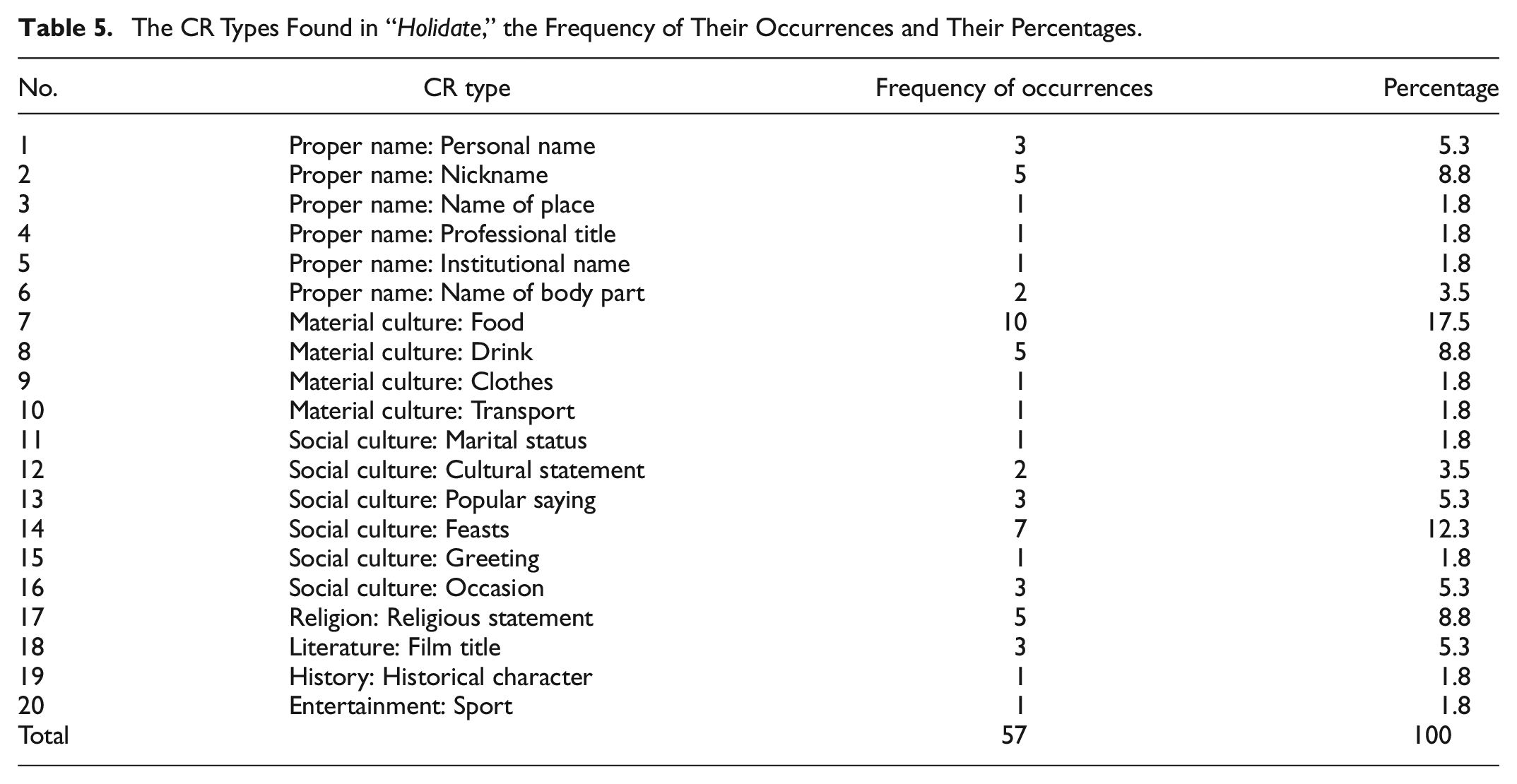
Table 5 above presents 20 CR types found in the film concerned, which have been used about 57 times throughout the film. The Table also indicates that the most frequently used CR type in the film is “material culture: food,” which has been used 10 times with a percentage of 17.5%. This is followed by “social culture: feasts,” which has been made use of seven times with a percentage of 12.3%. “Proper name: nickname,” “material culture: drink” and “religion: religious statement” have equally been adopted five times with a percentage of 8.8%, whilst “proper name: personal name,” “social culture: popular saying,” “social culture: occasion” and “literature: film title” have identically been used three times with a percentage of 5.3%. This is followed by both “proper name: name of body part” and “social culture: cultural statement,” which have been utilized two times with a percentage of 3.5% alike. About nine CR types: “proper name: name of place,” “proper name: professional title,” “proper name: institutional name,” “social culture: marital status,” “social culture: greeting,” “material culture: clothes,” “material culture: transport,” “history: historical character” and “entertainment: sport” have all been adopted one time with a percentage of 1.8% in the film in question. On the other hand, Table 6 shows that six subtitling strategies have been used in 57 subtitling instances to translate the CRs found in the film in question from English into Arabic. The most commonly used subtitling strategy is “direct translation,” which has been adopted 24 times with a percentage of 42.1%. This is followed by “retention,” which has been utilized 12 times with a percentage of 21.1%. “Specification: explicitation” has been employed nine times with a percentage of 15.8%, then comes “substitution,” which has been exploited seven times with a percentage of 12.3%. “Official equivalent” has been resorted to three times with a percentage of 5.3%, while “generalization” has been adopted two times with a percentage of 3.5%.
The CR Types Found in “Holidate,” the Frequency of Their Occurrences and Their Percentages.
The CR Subtitling Strategies Found in “Holidate,” the Frequency of Their Occurrences and Their Percentages.

As shown in Table 7 above, there are five SE types found in the film in question, which have been used 41 times throughout the film. “Sex” is considered to be the most frequently used SE as it has been adopted 23 times with a percentage of 56.1%. This is followed by “profanity,” which has been employed 11 times with a percentage of 26.8%, then comes “name of Prophet,” which has been utilized three times with a percentage of 7.3%. Both “alcohol” as well as “drug” have equally been made use of two times with a percentage of 4.9%. Table 8, on the other hand, demonstrates that about 4 subtitling strategies have been adopted in 41 subtitling instances to render the SEs found in the film from English into Arabic. The most commonly adopted subtitling strategy is “direct translation,” which has been employed 18 times with a percentage of 43.9%. This is followed by “substitution,” which has been used 17 times with a percentage of 41.5%, then comes “specification: explicitation,” which has been exploited five times with a percentage of 12.2%. “Generalization” has been resorted to one time with a percentage of 2.4%.
The SE Types Found in “Holidate,” the Frequency of Their Occurrences and Their Percentages.

The SE Subtitling Strategies Found in “Holidate,” the Frequency of Their Occurrences and Their Percentages.

Cultural References
Different translation issues have emerged from the translation of the CRs in both the two films in question. Below are different translation issues arising from the translation of different CR types in both the two films concerned.
Proper Name
Under this umbrella, various issues are associated with different types of “proper name.” One of such issues is related to “proper name: personal name.” In the first film, “منعم” (time 27:49) has been rendered as “Menhem,” making no distinction in pronunciation in Arabic between “هـ,” which is often transcribed in English as “h” and “ع,” which should be transcribed differently to uncover the difference in Arabic pronunciation between the two cases using something like “ʿ.” The same applies to “حماسة” (time 58:01) in the first film, which has been rendered as “Hamasa,” paying no attention to the difference in pronunciation in Arabic between “هـ” which is usually transcribed in English as “H,” as mentioned above, and “ح” which should be transcribed in such a way that distinguishes it from the former by using “Ḥ,” for instance. Although this inaccuracy in transcribing different Arabic sounds may be justifiable due to the possible unavailability of the appropriate transcription symbols to the subtitler, the target reader may be confused as he/she would hear different Arabic sounds which are subtitled identically. Abdelaal (2019) claims that transliteration may occasionally contain errors concerning readability and acceptability. Above all, scholars agree, including Newmark (1988), Pedersen (2005) and others that “retention” according to Pedersen’s (2005) terms is the appropriate subtitling strategy for rendering “proper name: personal name” into different languages. The issue of lexicalization may play a substantial role in choosing the subtitling strategy that would best render “proper name: name of place” from one language into another in certain situations. For instance, “retention” has been utilized as a subtitling strategy whenever the name refers to a specific place which has not been lexicalized in the TL, such as “قصر النيل” (time 25:11), which has been rendered as “Kasar El Nile” in the first film and “Victoria Secret” (time 28:57), which has been rendered as “فيكتوريا سيكريت” back-translated as (Victoria Secrets) in the second film. Conversely, “direct translation” has been adopted as a subtitling strategy when the name, albeit referring to a specific entity, has been lexicalized in the TL, such as “الهرم” (time 16:35) which has been translated as “The Pyramids” in the first film. It can be argued that there is no completely agreeable strategy that can be adopted in rendering CRs (Alwazna, 2014b). Different strategies have been used to address cultural issues yielding different results and presenting distinct methods of coping with CRs (Carbonell, 2004).
What has been said with regard to the use of “direct translation” in rendering “proper name: name of place” does also apply to the translation of “proper name: institutional name.” However, “official equivalent” as a subtitling strategy is usually adopted when translating names of international organizations, such as “Greenpeace” (time 32:45) in the second film, which has been rendered as “منظمة السلام الأخضر” back-translated as (The Greenpeace Organization). This equivalent, according to Leppihalme (1994), is deemed a standard rendition of the ST CR. A prominent translation issue has emerged in rendering “proper name: professional title” “العمدة” (time 1:28:15) as “The dean.” As clearly understood from the first film context, “العمدة” does not refer to the academic dean who is “someone in a university who is responsible for a particular area of work” (Summers, 2005, p. 402), rather it points to the mayor who “has been elected to lead the government of a town or city” (Summers, 2005, p. 1019). This clearly causes translation loss in meaning as a result of not using the appropriate equivalent word in the TL, which may stand as a result of not understanding the intended meaning of the term concerned by the subtitler. It may also be due to the lack of knowledge of how to use certain TL lexis by the subtitler. Dickins et al. (2002) point out that translation loss refers to the incomplete rendering of the textual and cultural features of the ST in the TT.
An Arabic grammatical error has appeared in rendering “proper name: name of body part” “Fuck you finger” (time 49:47) in the second film as “إنه أصبعي الوسطى” back-translated as (It is my middle finger). The subtitler should have used the masculine adjective “الأوسط” to match the masculine noun“أصبع.” This is in line with Alhawary (2016), who asserts that in an Arabic noun-adjective phrase, the adjective should always agree with the noun in gender, number, definiteness and case ending. “Generalization” as a subtitling strategy has inappropriately been used in rendering “proper name: object” “كشك” (time 47:35) in the first film as “booth.” The subtitler could have instead employed “direct translation” and rendered “كشك” with the use of the term “kiosk.” This term refers to “a small structure with one or more open sides that is used to vend merchandise (as newspapers) or services (as film developing)” (Mish, 2002, p. 642). On the other hand, “booth” points to “a stall or stand (as at a fair) for the sale or exhibition of goods” (Mish, 2002, p. 132). Obviously, there is translation loss with regard to the nature of the object structure as the ST CR “كشك” means a small structure with an open side as conveyed by the term “kiosk,” while the subtitler has employed a more general equivalence “booth” which does not convey such openness at the side.
Material Culture
Under this category, different issues are linked to certain types of “material culture.” One important type, which has been commonly used in both the two films and the translation of which has obviously given rise to evident translation issues is “material culture: food.” It is mostly associated with a number of cultural/religious celebrations in the Arab world, such as Sham Al-Nassim and Eid in the first film, whereas around half of it is associated with Western celebrations, such as Thanksgiving and Christmas in the second film.
In the first film, a translation issue is associated with the process and steps of cooking “ملوخية” (Molokhia), which is deemed a soup or stew dish dating back to the Ancient Egyptians. In this film, “أنا اللي قطفتها، وأنا اللي خرطتها، وأنا اللي شهقت عليها” (time 59:00) has been rendered as “I picked it up, I minced it, I supervised its cooking.” “Direct translation” has appropriately been adopted with the exception of the last part of the ST: “وأنا اللي شهقت عليها,” which requires “specification: explicitation.” Unfortunately, the subtitler has also used “direct translation” to translate the part concerned as “I supervised its cooking.” This has unequivocally resulted in a loss in the cultural reference of this item and the funny element intended in the dialogue about the number of people who took part in cooking this dish. An acceptable yet adequate candidate may read as “I added the final seasoning (garlic and dried coriander fried in oil) to finish it up before serving,” thus familiarizing the target reader with what is intended by “وأنا اللي شهقت عليها.” In the same film, the subtitler has rendered“فسيخ” (time 1:45:42) as “Fesikh,” thus employing “retention” as a subtitling strategy. Needless to say, “retention” is usually considered the most commonly used strategy in rendering “material culture: food.” However, such strategy fails in this particular instance to relay the cultural element associated with “Fesikh,” which resides in “fermented, salted and dried gray mullet,” thus “specification: explicitation” should have been exploited. It is worth noting that “specification: explicitation” may not have been employed in this instance and in other relevant instances due to the subtitling limitations and challenges, as pointed out by Abdelaal (2019), such as space restrictions and word count. What is more, context and multimodal elements may compensate for the possible loss involved in translating such items. However, in this particular instance, “retention” has clearly not given justice to the cultural reference included even with the multimodal aspect of image (Kress & van Leeuwen, 2006), showing the main character closing his nose with a peg because of the strong nasty smell of the fish.
Another CR type the translation of which has undergone some loss in meaning is “material culture: drink.” At times although the subtitler may adopt “specification: explicitation” to ensure complete conveyance of the meaning of the CR type to the TL, some part of the meaning may be lost as it needs more clarification. For instance, in the second film, the subtitler has rendered “shot” (time 40:30) as “جرعة المشروب” back-translated as (drink shot). Given that the term “shot” refers to either an alcohol shot or a coffee shot, the target reader may be confused as to whether the referent is alcohol shot or coffee shot. The lack of precision with regard to the shot of the drink can clearly be avoided through adding the term “alcohol,” so that the TT would read as “جرعة المشروب الكحولي” (alcoholic drink shot).
Social Culture
Under this classification, different issues have resulted from the translation of certain types of “social culture.” One important type the translation of which has involved such issues is “social culture: cultural statement.” In the first film, “المتحرش الرسمي بتاع الخط ده” (time 1:23:44) has been rendered as “he is the official aggressor of this line,” utilizing “generalization” in translating “المتحرش” as “the aggressor.” Such translation fails to identify the exact meaning of the term in this scene of sexual harassment in the bus. A more adequate candidate for the Arabic term is the term “harasser,” which keeps the element of sexual harassment intact in the TL, thus using “direct translation” rather than “generalization.”
“Social culture: popular saying” is another important CR type that is worth discussing here. “عزومة مراكبية” (time 1:04:22) has been rendered in the first film as “false invitation,” using “specification: explicitation.” This example represents the Egyptian old saying which literally means “the fishermen/ferrymen invitation” who used to invite people for food. It is not a serious invitation as it is impossible to invite someone standing on the shore for food in the boat anyway. This saying is currently used in the Arab culture to refer to those who are stingy or are not serious in their invitation. The use of “specification: explicitation” as a subtitling strategy for translating this instance has been adequate in imparting the intended communicative meaning of this saying, though the popular saying itself has not been rendered to the target reader. This rendering may be justifiable as it is impossible to give the background of the saying in subtitles.
Conversely, the subtitling strategy may not be adequate in conveying the communicative meaning of a particular “social culture: popular saying.” For instance, in the second film, “you don’t have to lift a finger” (time 51:25) has been rendered as “ليس عليك تحريك أصبع” back-translated as (you do not have to move a finger). The subtitler has followed “direct translation” though “substitution” could have been a better candidate for conveying the communicative meaning of such CR, that is “شيء أي فعل عليك لي” (you do not have to do anything).
At times the translation of certain CR types, such as “social culture: feasts” may show domestication of certain terminology in the TL culture (Venuti, 1995). For instance, in the second film, “Mother’s Day” (time 43:35) and “Happy Mother’s Day” (time 45:07) have been rendered as “عيد الأم” back-translated as (Mother’s Celebration) and “عيد أم سعيد” back-translated as (Happy Mother’s Celebration) respectively. Although the overall subtitling strategy adopted in these two instances is “direct translation,” the subtitler has evidently substituted the literal equivalent of the term “day,” namely: “يوم” by a domesticated Arabic term: “عيد” “celebration.” Such substitution indicates the importance of such celebrations in the TT culture, particularly among the youth.
Religion
A pivotal type of “religion” the translation of which involves certain issues is known as “religion: religious statement.” Two different instances of “religion: religious statement” in the first film have been translated using the same TL equivalence and adopting the same subtitling strategy, namely: “substitution.” For instance, both “في رعاية الله” (time 17:34) and “في أمان الله” (time 1:13:09) have been rendered as “Godspeed” respectively. Such religious statements are deemed Islamic cultural statements which require the translator to be cognizant of Islamic culture to be able to interpret them. Next, the translator needs to transfer such statements with their cultural nuances and connotations, ensuring proper reception and comprehension by the target reader (Alwazna, 2017). However, the subtitler has opted for “substitution” in rendering these statements as “Godspeed,” conveying the communicative meaning, albeit suppressing the Islamic cultural connotations attached thereto. This may be justifiable as both Arabic religious statements fulfill the same communicative function, serve the same purpose and are used in the same linguistic situation in which two persons are leaving one another. Moreover, the space restriction specific to subtitling may well stand as a justifiable reason behind not differentiating between the two Arabic religious statements in the TT.
Contrary to the preceding case, the subtitler has rendered “الله أكبر” (time 1:45:21) three times as “God is Almighty (once) God is great (2 times),” thus employing “substitution” and translating the religious statement three times in the TT differently. This shows apparent inconsistency in the terminology used as well as the lack of approved Islamic legal term bank in English that can be referred to in such situations. Alwazna (2013) points out that the lack of agreement among scholars on the appropriate English choice of Islamic term if more than one option is available is a prominent aspect of Islamic terminology. Hence the subtitler might not be blamed for the variation of the terms used though his/her use of “Almighty” once and repetition of “Great” may seem unjustifiable.
Literature
An important CR type related to the category of “literature” the translation of which has revealed some loss is “literature: word play.” Word play is viewed as a general term for the diverse textual phenomena where the structural aspects of the language used are employed to create communicative confrontation of two or more structures that have more or less identical forms but different meanings (Delabastita, 1996). In the first film, the subtitler has rendered “يا عم فسبة هنية تكفي مية” (time 1:04:27) as “you can fit.” Although the subtitler has appropriately adopted “paraphrase” as a subtitling strategy, the proper saying is indeed lost in the TT. The original saying is “لقمة هنية تكفي مية” (a little meal prepared with love can feed a hundred people). Evidently, the original saying is lost in the TT for space limitation though the subtitler has managed to impart the communicative meaning thereof. “Literature: film title” is another CR type that is worth noting. Evidence suggests that “retention” is used for translating such CR type in the second film when it is not lexicalized in the TL, such as rendering “Crocodile Dundee” (time 8:35) as “كروكودايل داندي” back-translated as (Crocodile Dundee). By contrast, “official equivalent” is employed for rendering this CR type when it is lexicalized in the TL, such as rendering “Friends with Benefits” (time 34:55) as “صديقان بمنافع متبادلة” back-translated as (Friends with Dual Benefits) and “Black Panther” (time 1:04:49) as “الفهد الأسود” back-translated as (The Black Panther) in the same film.
Sensitive Elements
Different translation issues have arisen from the translation of the SEs in both the two films under study. Below are different translation issues emanating from the translation of different SE types in both the two films concerned.
Profanity
Although there have been recent studies addressing the translation of offensive words between Arabic and English, such as Alsharhan (2020) and Al-Adwan and Thawabteh (2021), the way of tackling such issue still remains controversial. A substantial issue which is associated with the translation of the SE “profanity” is the omission of “ممكن أكفر” (time 1:35:55) in the TT in the first film. Clearly, the subtitler has adopted “omission” as a subtitling strategy for cultural religious sensitivity and translator ethics, though he could have rendered it as “I could become blasphemous.” This is lent credence by Phelan (2001) and Alwazna (2014a), who assert that if translators are confronted with sensitive or offensive texts; having to translate offensive words to particular religions and so on, which are contrary to the translator’s personal ethics, the translator may omit such elements or withdraw from such situation. The same SE has occurred in rendering “holy shit” (time 33:56) as “تبا” back-translated as (damn), thus dispensing with the term “holy” in the TT in the second film. The subtitler has exercised “substitution” with partial omission and euphemism (Jing-Schmidt, 2019) to eliminate the use of the term “holy” in such swearing context as such term indicates sacredness and is associated with sacred places, such as the Two Holy Mosques in Makkah and Madinah. Again, due to religious sensitivity and translator’s personal ethics, the subtitler has preferred to remove such term for the previous considerations. This, though may seem justifiable, runs contrary to Díaz Cintas (2001), who claims that whenever omission and euphemism are resorted to, certain important details of characters are lost, which may result in some loss of the film intensions experienced by the target audience. Nonetheless, this does not apply to the current situation as the element deleted “holy” is not associated with the characters’ detail, nor does it describe them.
Sex
Although the “sex” is deemed a sensitive element in the Arab culture and an issue which the Arab reader expects the translator to avoid in his/her translation in normal circumstances, the subtitler has unexpectedly specified such element through explicitating the sexual reference in the TT which is implicit in the ST. For instance, in the second film, the subtitler has rendered “I will take my hand job in the car park” (time 31:17) as “أريدك أن تقدمي لي جنس يدوي في موقف السيارات” back-translated as (you will give me sex with your hand in the car park). The subtitler may have intended to explicitate “hand job” as “sex with your hand” to ensure full comprehensibility by the target reader through employing “specification: explicitation,” however, such explicitation may be counted as inappropriate in view of the TL culture and audience. It is due to the conservativeness of the Arab culture that the subtitler may encounter real challenges when relaying SEs into Arabic (Al-Yasin & Rabab’ah, 2019). What is more, translation is arguably viewed as an ineluctable domestication where the ST is adapted to the linguistic and cultural norms of the TL and can therefore be understood within the TL culture (Venuti, 1994). Another issue related to “sex” appears in the following instance in which “generalization” has inappropriately been employed as a subtitling strategy when “direct translation” fits the situation concerned properly. For instance, “ejaculation” (time 47:36) has been rendered in the second film as “الاستمناء” back-translated as (masturbation). In this example, the subtitler has unnecessarily used “the part for the whole” modulation (Alwazna, 2022; Vinay & Darbelnet, 1995), which is equivalent to “generalization” in the current debate. Although this leads to what is termed as “translation gain” (Dickins et al., 2002), as the meaning of “masturbation” comprises the meaning of “ejaculation” amongst other meanings, the target reader will still lose the specific referent intended by the term “ejaculation.”
Concluding Remarks
It seems evident that subtitling CRs and SEs between originally unrelated languages, such as Arabic and English is a real challenge and an arduous task that requires careful treatment on the part of the subtitler. Acquaintance with both languages, their cultures, the element of multimodality and other factors affecting the understandability in subtitling does not appear amply sufficient for ensuring full and proper conveyance of the CRs and SEs to the target audience. Indeed, specifying the target audience and knowing what is acceptable of CRs and SEs in the TL culture alongside taking into account both space and time limitations are substantial factors that should be considered by the subtitler when rendering CRs and SEs into a different language. Knowledge of such factors would also lead the subtitler to adopt the appropriate subtitling strategy(s) in translating CRs and SEs.
This research has adopted a mixed method with both quantitative as well as qualitative analyses to explore all the CRs and SEs found in “عسل أسود” (Bittersweet), an Arabic film that has been translated into English, and “Holidate,” an English film that has been translated into Arabic, and investigate the subtitling strategies used to translate the CRs and SEs found in the aforementioned two films available on Netflix based on Pedersen’s (2005) classification. The present paper shows that there are 19 CR types found in the first film and 20 CR types used in the second one where the most frequently used CR type in both the two films is “material culture: food.” On the other hand, six subtitling strategies have been used in both the two films where the most commonly adopted ones for translating CRs are “retention” in the first film and “direct translation” in the second one. The paper also indicates that only two SE types are found in the first film in which “profanity” is the most frequently used type, whilst five SE types exist in the second film where “sex” is the most commonly used type. Around six subtitling strategies have been utilized for translating SEs in the first film where the most frequently adopted one is “substitution,” whereas about four subtitling strategies have been employed for translating SEs in the second film with “direct translation” as the most commonly used subtitling strategy.
The investigation has also revealed several translation issues associated with the English and Arabic subtitles of the CRs and SEs found in the two films under study. Some of such issues have led to translation loss in cultural references, linguistic references or both. Amongst such issues are: the inaccuracy of Arabic sound transcription, the Arabic errors in grammar and the use of inappropriate equivalent in the TL. It is the last issue that has been the result of employing the inappropriate subtitling strategy to render CRs and/or SEs in the two films concerned, which has ipso facto led to translation loss. Although lexicalization may play a substantial role in determining the type of subtitling strategy used in subtitling CRs and SEs, it is still not sufficient to rely thereon individually. For instance, if the ST CR is not lexicalized in the TL, “retention” will be used. However, if it is lexicalized, “direct translation” will be used as in “proper name: name of place” or “official equivalent” will be adopted as in “proper name: institutional name” and “literature: film title.” However, a complete set of criteria is required to guide the subtitler to the appropriate subtitling strategy applicable for the rendition of CRs and SEs.
The lack of knowledge with regard to the process and steps of cooking may result in losing cultural references based on the use of the inappropriate subtitling strategy. The use of “direct translation” for translating “social culture: popular saying,” the inconsistency in English Islamic terminology use and the absence of approved Islamic term bank in English are all significant issues that may affect the quality of the translation of CRs and SEs between the said two languages. Although complete “omission” and partial “omission” are exercised in translating SEs for cultural religious sensitivity and translator ethics, translation loss, albeit justifiable, may arise. Finally, exoticism and cultural inappropriateness may emerge when “specification: explicitation” is adopted to render “sex,” for instance, into the Arab culture.
The present paper has explored the subtitles of all the CR and SE types found in “عسل أسود” (Bittersweet) and “Holidate” and has examined all the subtitling strategies used for their translations based on Pedersen’s (2005) classification. It has also analyzed important instances of CRs and SEs that involve translation issues, justifying the subtitler’s strategies or suggesting appropriate subtitling strategies when the strategies used are not suitable. Other research is required to explore the subtitles of CRs and SEs found in films translated between different languages other than Arabic and English, investigating the subtitling strategies used to see whether or not the findings arrived at resemble the results of the current study. Endeavors should also be made to examine other elements related to subtitling, such as the element of reception, extra linguistic factors affecting the strategies adopted in subtitling, and so on.
Footnotes
Declaration of Conflicting Interests
The authors declared no potential conflicts of interest with respect to the research, authorship, and/or publication of this article.
Funding
The authors disclosed receipt of the following financial support for the research, authorship, and/or publication of this article: The researchers have obtained funding from the Grants for Studies and Research in the field of translation, provided by the Arabic Observatory of Translation under the Alecso Organization & Literature, Publishing and Translation Commission, Ministry of Culture, Kingdom of Saudi Arabia, to complete this research study, grant number [2023-197].
