




Abstract
This study investigates Netflix translation of English movie lyrics into Arabic. It examines and categorizes the subtitles of the movie lyrics based on the translation options proposed by Franzon. Translation options refer to the different methods or approaches a translator can use when translating a song. A parallel corpus of 60 lyrics extracted from 10 musical movies was compiled by aligning the English script and Arabic subtitles. The researchers found that Netflix’s subtitlers employed four options for rendering English lyrics into Arabic. These are neglecting the music in translating the lyric (literal subtitling), which was used in rendering 60% of the investigated lyrics, not translating the lyrics (deletion), which was observed in 17% of the cases, and adapting the music to the translation (esthetic subtitling) was followed in rendering only five lyrics (8%). Finally, incorporating the three previous options (blended subtitling), which was adopted in subtitling 15% of the investigated data. This study recommends further research on the audience reception of the different subtitling options of lyrics. The findings of the current study can be useful for subtitlers and translation students, especially those interested in literary translation and musical movie translation.
Introduction
Movie lyrics are a means of entertainment that give movies a form of oral musical fluency. Kennedy and Gioia (2005) defined lyrics as “a short poem expressing the thoughts and feelings of a single speaker” (p. 10) The lyricists address the target audience directly, expressing their feelings, thoughts, and observations. Hui-tung (2019) stated that “the word ‘lyrics’ is more commonly associated with popular music rather than serious music” (p. 351). The word lyric is a generic term that refers to any short poem having a single speaker, not necessarily the poet, who conveys personal emotions and ideas (Frederik, 1988). Greenall et al. (2021) defined song lyrics as “predominantly oral texts meant for singing” (p. 16). Therefore, the movie lyric can be defined as poetic words in a short rhymed poem that conveys the feelings or thoughts of a cinematic character.
The advancement of technology within the realm of entertainment media has resulted in the widespread distribution of movies in numerous languages, catering to the varied tastes of diverse societies. Consequently, the role of translators has grown increasingly complex and demanding, tasked with meeting the burgeoning demand for AV materials. Furthermore, the emergence of musical films, replete with a plethora of musical instruments and sound effects at the turn of the new millennium, has prompted production companies to create productions wherein the dialogues are intricately woven into the lyrics, thereby contributing significantly to the filmic plot. However, the challenge of translating such lyrics from one language to another is indeed formidable, owing to their unique characteristics, including the intricate interplay of meter, rhyme, and rhythm.
There are quite a number of studies that have examined the translation of lyrics in different languages. Some of these studies focused on opera songs (Gorlée, 1997), art songs (Low, 2003), or DVD subtitled songs (Franzon, 2015). Moreover, several studies focused on. Different aspect of songs/lyrics translation, including, reception of subtitled song lyrics (Aleksandrowicz (2019), song translation options (Franzon, 2005, 2008, 2015), opera and music translation (Gorlée, 1997), lyrics in contexts (Greenall et al., 2021), lyrics translation procedures (Irawan & Mundriyah, 2022), Principles of song translation (Low, 2003, 2005), techniques of translating lyrics (Poluwa, 2021), and others. However, it seems that the study of lyrics translation options into Arabic is not a common research area in the context of audiovisual translation studies, a gap that this study attempts to fill.
Aleksandrowicz (2019) stated that “there is relatively little academic research into the topic of translating song lyrics in films.” Furthermore, Franzon (2008) argued that songs had received little attention in translation studies due to the lack of clarity about the identity of those who translate the songs professionally. Lyrics can be a challenging task for translators as they include some poetic elements like meter and rhyme, as well as a range of poetic forms, such as metaphor, metonymy, wordplay, and simile, to mention a few. In addition, the elements of culture should also be demystified to retain as much of them in translation (Al-Khalafat & Haider, 2022; Haider & Hussein, 2022). Consequently, maintaining the form and content in translation is a challenging task that may lead translators to prioritize one over the other. According to Jing and Amini (2019), translating literary genres, particularly lyrics, is a challenging procedure that relies heavily on the translator’s style and requires cleverness in making complicated decisions.
The translation of song lyrics includes a unique set of difficulties in terms of semantic closeness. Franzon (2005) asserted that “a song translation that strives to be semantically accurate can hardly be sung to the music written for the original lyrics, and a song translation that follows the original music must sacrifice optimal verbal fidelity” (p. 377). Furthermore, Jin (2021) expressed that “fidelity of song lyrics translation is founded upon a harmonious lyric-tune match which requests concerns from quite a lot of perspectives” (p. 9). Therefore, pursuing a sober translation of the lyrics requires achieving most of the musical features, such as melody, rhyme, rhythm, and sense, to ensure the molding of musical harmony. Numerous scholars agreed upon a principle to achieve a good translation of the lyrics, which is singability (see Dürr, 2008; Franzon, 2015; Low, 2003). Singability is explained as “a striving for unity in a musical/textual diction (note/word relations), minding the intentions of the source some composer” (Franzon, 2015, p. 334).
Audiovisual translation has many modes, such as subtitling, dubbing, and voiceover, to mention a few (Al-Abbas & Haider, 2021; Debbas & Haider, 2020; Hayes, 2021). Each mode demands many requirements that compel the translator, willingly or unwillingly, to choose the appropriate translation technique to the degree of inclusion of the form and the content. Thus, the translation mode partly influences the choice to prioritize either the form or the lyric’s content. Subtitling, as an AVT mode, requires practical experience and a comprehensive understanding of translation strategies and procedures. For example, subtitlers are expected to develop a script that suits the spatial and temporal constraints where they have limited space with a limited number of characters that should be synchronized with what’s being said on screen. Therefore, subtitlers must pay attention to many features to achieve the lyric’s function, cinematic context, and linguistic aspects, to name a few. Niskanen (2021) argued that “it is clear that the function of the song plays a vital part in its composition and lyric writing process” (p. 5). On the other hand, Aleksandrowicz (2019) stated that “subtitlers are not so constrained by the formal requirements of the mode and have much more freedom when choosing the approach to song translation” (p. 175)
To the best knowledge of the researchers, this study is among the first to investigate the translation of English movie lyrics into Arabic within the context of audiovisual translation. The use of an English-Arabic parallel corpus of lyrics will make the process of examining the subtitling options easier. Adopting a corpus-assisted translation approach to examine English movie lyrics and their Arabic equivalents within the subtitling mode of Audiovisual Translation is novel. The current study investigates the translation options followed by Netflix subtitlers in rendering 60 English lyrics extracted from 10 Arabic musical movies.
Literature Review
This section provides the theoretical background of the current study, reviews the related literature, and discusses some empirical studies.
Theoretical Background
Translation of lyrics is deemed an intersection of music, literature, and translation. The translator’s choices, in general, are based on the desired function of the lyrics, whether they are printed, subtitled, or sung. Salmon (2010) asserted that the target text (TT) is relatively free from extra-linguistic aspects, while in other cases, the translator will have to pay attention to the musical background. Thus, preserving the poetic elements of lyrics, such as melody, rhyme, and rhythm, depends on the purpose of the translation, the skill of the translator, and the available time to achieve the task. Songs and audiovisual translation have a robust intersemiotic interaction since the TT is read and interpreted simultaneously. Risso (2016) stated that a fairly typical scenario in which a “singable” translation is required is the worldwide distribution of musical films. Consequently, a greater interest in translating lyrics into their musical and semantic context has grown with the fast expansion of the musical movie genre. Paolinelli and Di Fortunato (2005) outlined three distinct situations in which songs appear in movies, first, songs featured on the original soundtrack (OST) with a plot-related text; second, an actor performing a song during a scene in the movie, and third, musical movies in which song lyrics are integrated within the dialogue.
The decision to translate movie lyrics depends on whether the lyric is part of the filmic plot and contributes to the general understanding of the content of the scene. In other situations, lyrics serve as an accompanying element of entertainment during the movie with no significant impact on the plot. For instance, if it is a familiar melody or comes from another source besides the voice of the actor, then the lyric words are neglected in the target language (Risso, 2016). In subtitling, Georgakopoulou (2009) classified the challenges faced by the subtitler into three categories, namely, technical, textual, and linguistic constraints. Therefore, Spatio-temporal constraints are unavoidable during subtitling since readability is the main parameter.
Franzon (2008) conducted a study on the translation of song lyrics and explored the concept of “singability” from a functional perspective. To understand how translators make strategic decisions when rendering lyrics, Franzon (2008) proposed five translation options for determining if a lyric is appropriate for translation. Translation options refer to the different methods or approaches a translator can use when translating a song. When selecting a translation option, the primary consideration is whether the translated song is intended to be sung in the target language or understood. For example, a close prose translation may suffice if the purpose is to understand the lyrics. However, a singable translation is necessary if the song is to be performed in the target language (Franzon (2008). These options, along with their descriptions, are presented in Table 1.
Franzon (2008) Framework of Song Lyrics Translation.

Franzon (2008) framework provides a valuable tool for researchers studying the subtitling of English movie lyrics into Arabic. The framework offers a range of options that can guide translators when dealing with song lyrics in AVT. By considering these options, researchers can ensure that the subtitling process is effective and appropriate for the target audience. The framework is particularly relevant because it offers various options suited to different audiovisual translation methods. For example, the first three options may be more suitable for subtitling, while the last two may be more appropriate for dubbing. This information can help researchers choose the most appropriate translation method for their study.
Furthermore, the framework offers insights into the challenges faced by translators when rendering song lyrics. The second option, for instance, highlights the tension between content and form, while the third option emphasizes the importance of cultural and linguistic differences in the translation process. Researchers can develop strategies for overcoming these challenges in their own research by considering them. Using this framework, researchers can ensure that best practices in AVT guide their research and that their findings are relevant and useful to the broader translation community.
Content and form are the two main elements that are considered when looking at lyrics translation. Many researchers examined the translation of songs/lyrics and outlined its difficulties, principles, aspects, and issues (see M. J. Apter, 1989; Dürr, 2008; Franzon, 2015; Low, 2005). M. J. Apter (1989) discussed the difficulties encountered by a song translator. These include “the physical limitations of the vocal apparatus, the metrical rigors of a rigidly pre-set prosody, and the need to match verbal sense to musical color” (p. 27). Similarly, Low (2005) suggested an approach for “singable” translations based on his Pentathlon Principle. The researcher asserted that a successful song translation is obtained by meeting five criteria. These are singability, sense, naturalness, rhythm, and rhyme (Low, 2005).
Moreover, Dürr (2008) offered a list of seven aspects to be considered by the translator, namely: singability, meter, syllable count, rhyme, vowels of suitable kind and length, keywords, and metaphors. Music supports some of these aspects, including rhyme, keywords, and metaphor. In addition, the remaining aspects are related to poetic features such as meter, syllable count, and vowels. Consequently, Dürr (2008) focused on the elements that can be challenging for translators bearing in mind that translation transfers the meaning and emotional state of the lyrics and not only the poetic form.
Furthermore, Franzon (2015) suggested three issues to consider while translating songs. These are (a) prosody—the sentence melody that occurs naturally when a language is sung to music, (b) the poetic rhetoric format—the abnormal patterning of a text through techniques that depart from plain prose and impart structure and focus, and (c) musico-semantic values—the text’s substance interacting with the musical sensation (Franzon, 2015, p. 335). Franzon (2015) highlighted the vital elements that make the lyrics an entire literary genre that the translator should carefully scrutinize to be comfortably received by the audience.
The theoretical background of the study of lyrics and their translations is replete with many details. This results in creating a vast area of research to be filled with new empirical studies that explore the translation of lyrics in different AV modes, including subtitling.
Empirical Studies on Movie Lyrics Translation
The investigation of lyrics and their translation is taking an increasing resonance among researchers. Musical movies include an abundance of lyrics. Franzon (2015) stated that “most variation is found in the subtitling of feature films, especially musicals” (p. 336). Few studies examined the translation of lyrics in movies. Isfahani (2011) examined the translation quality of subtitles in “Music and Lyrics” movie and investigated how lyrics were rendered. The data included lines of the English lyrics and their translation in Bahasa Indonesia and the score and assessment of the raters. According to the findings of this study, the subtitler used four translation techniques to render song lyrics. They included the translation of the common and the figurative choices from the SL to the TL. From the target audience’s point of view, the interpretation of the lyrics was nearly satisfactory, with 83% acceptance and 67% accuracy.
Another study that examined the subtitled lyrics was conducted by Penilaras (2016) on “The Princess and the Frog” movie. The data were extracted from www.subscene.com. The researcher found that the translators employed six techniques when interpreting song lyrics. These are literal, modulation, reduction, established equivalent, borrowing, and generalizing. The findings concluded that the subtitles had high acceptability and quality. Similarly, Supardi and Putri (2018) examined the translation technique used in subtitling and dubbing Frozen: Let it Go. The data collection process involved reading the source and target languages, choosing and comparing the Dubber’s techniques, and then marking, categorizing, and analyzing them according to Molina and Albir’s theories of translation technique. The findings showed that the subtitled version used literal translation; however, the dubbed version often employed modulation and reduction.
In the same vein, Aleksandrowicz (2019) examined how translated song lyrics in nine musicals are received in AVT. The results revealed that the audience’s ability to discern the musical match was intangible. Furthermore, the surveys showed a lack of attention to the presence of rhymes. Similarly, Pidhrushna (2021) investigated the translation of songs in films by adopting the functional approach. The data proposed five distinct levels of congruence between the source and target songs in film translation. These include pragmatic, semantic, stylistic, cinematic, and esthetic. Poluwa (2021) examined the translator’s techniques for creating Indonesian subtitles for the original lyrics of Shelter—a collaborative music video project. The study employed audiovisual translation theory, especially the linguistics of subtitling, the technical procedures of translation, and song translation options. The findings showed that the lyrics were mainly translated verbatim. On the other hand, the subtitles were crafted with little regard for the music, suggesting that they were created to enhance rather than replace the original lyrics.
In the context of English-Arabic translation studies, some researchers examined the translation of lyrics from Arabic into English (Al-Azzam & Al-Kharabsheh, 2011; Shunnaq & Abul-Kas, 1998). Shunnaq and Abul-Kas (1998) examined the English translation of Jordanian folkloric songs. The researchers asserted that the complex structure of folkloric songs plays a crucial role in the transmission of culture and found that it is beneficial to investigate various issues in translating these rhyming texts, which represent certain cultural elements (social, political, and ecological, among others). The study recommended including some information about the nature of translation and translatability, as well as literary translation, with reference to semantic vs. communicative translation. In the same vein, Al-Azzam and Al-Kharabsheh (2011) examined the challenges that folkloric songs may bring in translation and provided insights on Abdu Mousa’s culture-bound song Marren Wa Ma Mma’hin Hada. The study relied on Low (2005) Pentathlon Approach. The study focused on the challenges of translating folkloric songs and the specific nature of doing so. These include the need to account for the song’s sense, naturalness, cultural references, and intricate connections between all of these aspects. The findings demonstrated that colloquialism had made its way into the original text, adding another layer of difficulty to the abridgment procedure.
This study aims to contribute to the research on subtitling English movie lyrics into Arabic. Specifically, it examines the subtitling options employed by Netflix’s subtitlers in translating 60 English lyrics. Through an analysis of the English-Arabic parallel corpus of movie lyrics, this study seeks to identify the options the subtitlers utilize in conveying the meaning and impact of the original lyrics in the target language. The study focuses on determining the subtitling options employed by Netflix subtitlers in rendering English movie lyrics into Arabic. Additionally, this study explores whether Netflix subtitlers utilized any new subtitling options not included in the translation options framework proposed by Franzon (2008). This analysis provides insight into the subtitlers’ creativity and adaptability in finding suitable translation solutions and their potential impact on the quality and accuracy of the translated lyrics. In pursuit of these objectives, the study aims to answer the following key questions:
What are the subtitling options used by Netflix subtitlers to render 60 English movie lyrics into Arabic?
Considering the translation options proposed by Franzon (2008), did the subtitlers resort to any new options that are not included in the adopted framework?
Methodology
The present study adopted a rigorous process for selecting a representative sample of musical films. Specifically, a parallel corpus of 10 musical movies was compiled by aligning the English script and Netflix Arabic subtitles. Several criteria were employed to ensure the selection of appropriate films for the corpus. First, the chosen movies were required to belong to the musical genre, allowing for a cohesive analysis of the translation of song lyrics. Second, the films needed to be translated by Netflix’s subtitlers, ensuring the sample’s consistency in terms of translation quality and approach. Finally, including lyrics that played a significant role in the film’s plot was deemed essential. Through this meticulous selection process, the researchers created a parallel corpus that provided valuable insights into subtitling English movie lyrics into Arabic. The selected movies are included in Table 2.
The Investigated Movies.

After selecting the movies, the lyrics and subtitles were extracted from Netflix’s official website and saved as an Aegisub file, as Figures 1 and 2 show.

The Aegisub file of the English source text extracted from Netflix.

The Aegisub file of the Arabic target text extracted from Netflix.
To ensure the comprehensive investigation of the subtitling of English movie lyrics into Arabic, the present study selected 60 lyrics from the chosen musical movies. Table 3 provides an overview of the number of lyrics analyzed for each movie. For the purposes of this study, a lyric is defined as all words included in a single song featured in the movie, including those that were only partially sung. Specifically, the study operationalized the definition of lyrics as the lines or parts of the song included in the movie. For instance, in the movie “Jingle Jangle A Christmas Journey,” a song titled “Over and Over” is only partially presented, with only 27 out of 55 lines included in the source script. Therefore, only these lines were examined in the study, as the researchers were primarily interested in investigating the translation of the movie’s source text into Arabic. The present study’s painstaking selection process facilitated a meticulous examination of the subtitling of English movie lyrics into Arabic.
The Investigated Lyrics in This Study.

As Table 3 shows, some movies include 13 lyrics, while others only have one. The English and Arabic data were copy-pasted to an excel sheet. Each lyric is saved in a sheet with two columns; the first column contains the English source text, while the second column contains the Arabic target texts. The following step was segmenting and aligning the data, as Figure 3 shows.

Alignment of the source and target texts.
The procedures to be followed in this study are as follows. First, the researchers compiled a corpus of English-Arabic lyrics subtitles. Second, they examined and categorized the subtitles of the movie lyrics based on the translation options proposed by Franzon (2008), which include not subtitling the lyric, neglecting the music in translating the lyric, writing a new lyric to the music without resembling the original lyric, adapting the music to the translation, and adapting the translation to the music. Back translation, that is, translating the Arabic target text into English, is provided to make things clear to non-Arabic speakers and enable them to see what the Arabic lyrics mean and whether the claims of the researchers concerning the translation options are true. Third, the researchers conducted a critical analysis of the data based on the previous literature and checked if the subtitlers resorted to any new options that were not mentioned in Franzon’s framework.
Findings and Discussion
Lyrics, distinct from other forms of linguistic expression, are marked by poetic elements, harmonious forms, and evocative sensations. Consequently, it is imperative to approach the translation of lyrics with creativity and innovation, preserving both their form and content across source and target languages and cultures. To this end, the present study aims to delve into the intricacies of subtitling lyrics, using a parallel corpus of lyrics as its primary focus of inquiry. The study will draw upon the lyrics translation options Franzon (2008) put forth, as detailed below.
Not Subtitling the Lyric (Deletion)
Lyrics’ rendering cannot be marginalized and neglected for any reason. The total removal of the original text from the translated version is unwelcome and criticized. Table 4 shows that Netflix’s subtitler did not render the lyric “Right Round” extracted from “Pitch Perfect” movie into Arabic.
Subtitling the English Lyric “Right Round” Into Arabic.
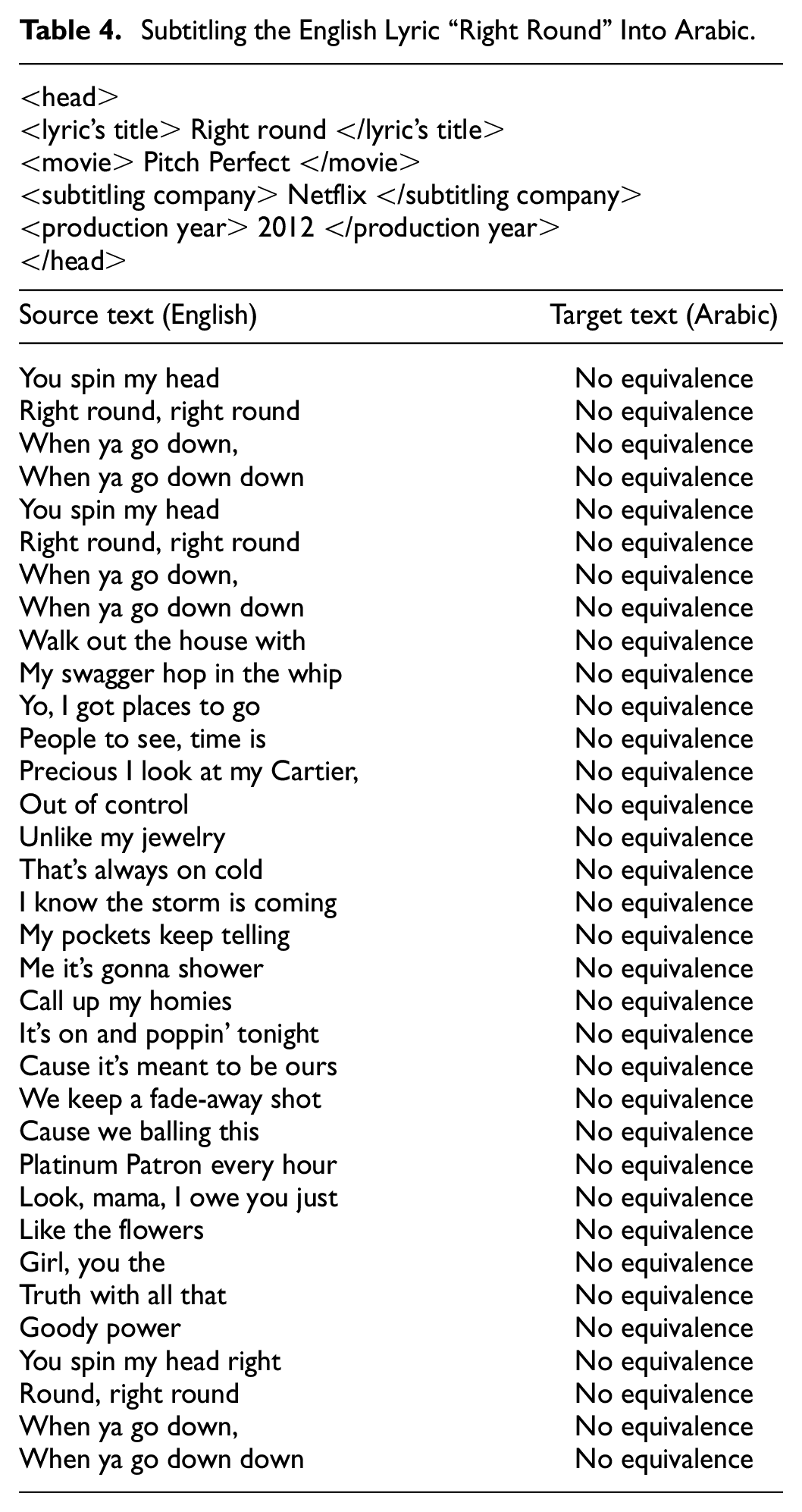
The “deletion” option seems easy to the subtitlers and does not expose them to the linguistic and cultural constraints that accompany the lyrics. Aleksandrowicz (2019) confirmed that “this option is the most commonly used in audiovisual translation (AVT)” (p. 175). Netflix is one of the world’s leading companies that add subtitles in different languages to AV products in order to attract international audiences. Thus, subtitling the content, with minimum deletions, may reduce the criticism that is addressed to subtitlers for not translating some scenes/parts of the movies.
It is widely accepted that subtitling is necessary to transmit all forms of language used in the original text, including lyrics, poems, and proverbs, to ensure that the audience enjoys all elements of the film translation while reading the original text. Failure to translate any part of the filmic plot risks the integrity and coherence of the translation, and hence, it should be avoided. The investigated corpus of this study involves musical movies, where lyrics are an integral part of the filmic plot, contributing to the narrative and character development. Therefore, subtitling the entire content is a must to ensure that the meaning is clear and complete to the viewers. However, the subtitlers still need to translate ten lyrics, representing around 17% of the investigated lyrics. This omission constitutes a criticism of Netflix as a leading streaming platform in the subtitling industry. According to Garwood (2006, p. 93), lyrics are “narrational devices,” meaning they are critical narrative elements that may have vital information to move the plot forward. In line with this, Aleksandrowicz (2019) argues that lyrics must be translated in musicals, as they are crucial elements that contribute to the emotional and narrative aspects of the story. The findings of this study support the assertion of R. Apter and Herman (2016), who stated that omission might falsify lyrics translation.
In light of the above arguments, the failure to subtitle the lyrics in musicals undermines the narrative and character development of the movie, and it is a critical issue that should be addressed. Therefore, it is recommended that subtitlers, especially those affiliated with big production companies and streaming platforms like Netflix, should provide their subtitlers with written guidelines concerning this aspect. Furthermore, it is essential to ensure that subtitling keeps the quality and integrity of the translation intact.
Considering the linguistic and cultural values that the lyrics add to the filmic plot, it cannot be left without subtitling. Hence, subtitlers are recommended to transmit all forms of language, such as poems, proverbs, idioms, and lyrics, to ensure that the audience enjoys all elements of the film translation while reading the original text. It is also worth noting that the subtitlers have not translated ten lyrics representing around 17% of the total number of investigated lyrics. This act constitutes a criticism of Netflix, as it is currently at the fore in the subtitling industry. Not subtitling the lyrics, which could be an integral part of the filmic plot, should be avoided by subtitlers, especially those affiliated with big production companies and streaming platforms. Netflix should also provide their subtitlers with written guidelines with regard to this aspect. According to Garwood (2006, p. 93), lyrics are “narrational devices,” which means that they are critical narrative elements that may have vital information to move the plot forward. In line with this, Aleksandrowicz (2019) stated that lyrics cannot be left untranslated in musicals. The findings also go in harmony with R. Apter and Herman (2016)who stated that omission may falsify lyrics translation.
Neglecting the Music in Translating the Lyrics (Literal Subtitling)
Neglecting music in subtitling movie lyrics (literal subtitling) gives subtitlers the freedom to translate them without sticking to poetic elements such as meter, rhyme, and rhythm. In the investigated corpus, the subtitlers rendered the meaning of 36 lyrics literally without paying attention to the music, representing 60% of the investigated data. This option almost represents the translator’s desire to evade the limitations of form and keep only the content. Table 5 shows an example of Netflix subtitling of the lyric “Another Day of Sun” extracted from the musical movie “La La Land.”
Subtitling the English Lyric “Another day of Sun” Into Arabic.

Table 5 reveals that the subtitler opted for a literal translation of the English lyrics into Arabic, with little consideration for the musical features that underpin the original lyrics, such as melody, rhyme, and rhythm. Furthermore, the subtitler prioritized accuracy in conveying the meaning of the lyrics, almost to the point of replicating the source text word-for-word. Consequently, the subtitled Arabic text falls short of capturing the esthetic and artistic dimensions inherent in the original lyrics. It is crucial to note that, in the realm of translation, form is just as significant as content, and subtitlers must strive to maintain a balance between the two without prioritizing one at the expense of the other.
The “Literal subtitling” option could be relatively easy for subtitlers and does not place them under severe criticism, as is the case in the first option, that is, not translating the lyrics. Various studies demonstrated that lyric translators adopt the literal approach of translation. For example, according to Irawan and Mundriyah (2022), the most often employed procedure for translating “things will get better” by Agnes Monica’s song lyrics into Indonesian was the literal translation. Literal subtitling that ignores the music is plain and uncomplicated since the translator concentrates mainly on the content and pays little attention to the form (Aleksandrowicz, 2019). Furthermore, Franzon (2008) asserted that the semantic-reflexive match focuses on rendering the lyrics without deliberating the music. Therefore, the prosodic match is removed entirely, and all or some elements of the poetic match are given optional consideration. Thus, the final product should be satisfactory since the subtitler has the option to choose one lexical choice over another.
Literalism in translation is a controversial issue, and whether it is appropriate or not has been thoroughly discussed by several scholars (Chironova, 2014; Lomaka, 2017; Lu & Fang, 2012). Such an approach does not take into account the cultural and linguistic differences between the source and the target texts. Following this approach in translating lyrics somehow delivers the meaning but at the same time may not meet the ambition of some viewers who look forward to the esthetic aspects of the text. Moreover, the translator’s choice of the literal approach also depends on the lyric itself, whether it contributes to the filmic plot or not. It is worth noting that lyrics constitute a particular case of language because of their form and content. Therefore, subtitlers should consider these two aspects when rendering lyrics or songs from one language into another.
Adapting the Music to the Translation (Esthetic Subtitling)
Translation requires a multifaceted approach, demanding a high level of inventiveness and resourcefulness from translators. The art of esthetic subtitling lies in skillfully conveying rhetorical, figurative, and semantic components in the translated text. As lyrics are a form of sung poetry, retaining the poetic elements during the translation process is imperative. The corpus used in this study provides a rich source of examples featuring meter, rhythm, and rhyme, with the latter being the most apparent component. Subtitlers employ various phrases to achieve a consistent rhythm. Upon closer scrutiny, the researchers uncovered several instances where the lyrics were rendered poetically. Table 6 illustrates the subtitled version of the “over and over” lyric, extracted from the “Jingle Jangle a Christmas Journey” movie, where the subtitler adroitly retained the poetic elements.
Subtitling the English Lyric “Over and Over” into Arabic.

Table 6 exemplifies the successful preservation of the rhythmic flow and rhyme in the Arabic subtitles, which are crucial elements of esthetic subtitling. The “rhythmic flow” refers to the systematic arrangement of sound and silence, and its preservation is achievable through creative translation rather than a literal one (Franzon, 2015, p. 339). The Arabic version of the lyric not only maintains the literary style but also captures the meaning in an esthetically pleasing manner. Rhyme, a crucial component of Arabic poetry, is also evident in the Arabic subtitles. The current study recommends implementing the use of rhyme when suitable, even if it requires a partial modification in the target text, to ensure the preservation of the poetic elements in Arabic subtitling.
Following this option, the translator prioritizes rhyme and rhythm above the content of the original lyric. This may lead to selecting words that did not fit the context but were used to achieve the form. It is worth noting that considering both the form and content should be the maximum goal of subtitlers. Esthetic subtitling of the lyrics is strongly connected to the subtitlers’ creativity and their ability to think beyond the boundaries of the text to give the target audience a unique esthetic experience. A recent study by Negmatova (2022) stressed that a successful translation of lyrics requires the translator’s creativity. As. rhythm is considered one of the poetic elements that should be maintained in translating the original lyric in esthetic subtitling, Díaz-Cintas and Remael (2014) argued that “subtitles that respect the rhythm of a song are easier to read because of the parallelism or synchrony between words and soundtrack” (p. 211). In the same vein, R. Apter and Herman (2016) stated that “literary translations of sung lyrics attempt to reproduce formal elements of the original text, such as rhyme and meter.”
Blended Subtitling
Following this approach, the translator may incorporate all of the previous options, including deletion, literal subtitling, and esthetic subtitling, in rendering a single lyric. Therefore, this approach gives the subtitler the freedom to switch between the different options, taking into account the cultural, temporal, and special constraints. Table 7 shows the subtitled version of the lyric “Ultraluminary,” from the “Over The Moon” movie, which combines different subtitling options.
Subtitling the English Lyric “Ultraluminary” Into Arabic.

Table 7 showcases an innovative approach to subtitling known as blended subtitling, characterized by utilizing various subtitling options. In this approach, the subtitler aims to strike a balance between the form and content of the lyrics, even if the number of syllables in the source text lines is different. This option is highly suitable for subtitling movie lyrics, as it demands a command of both the source and target language vocabulary, a sense of musicality, and an understanding of the range of available options for rendering musical movie lyrics.
The study’s data analysis revealed that the blended subtitling approach translated nine lyrics (15%). Subtitlers may, for instance, choose to omit to subtitle certain lyrical lines, particularly if they are repetitive, unclear, or irrelevant to the filmic plot. Additionally, the subtitler may adopt a literal approach in translating some lines while rendering other lines creatively and poetically, preserving both their semantic content and poetic form. Blended subtitling, therefore, allows subtitlers the flexibility to experiment with different options and techniques in translating one lyric, which is a safe and reliable option.
Examining Netflix subtitling of the compiled lyrics, the researchers found four options that can be considered when subtitling lyrics from English into Arabic in a manner that communicates the meaning to the target audience. Figure 4 shows the options that Netflix subtitlers adopted in translating English movie lyrics into Arabic.
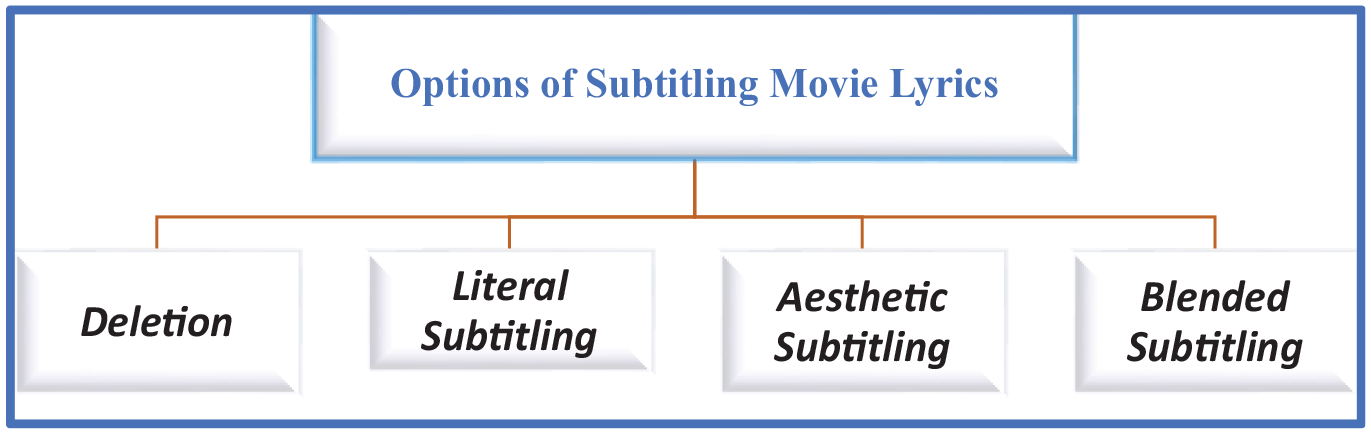
The options for subtitling English movie lyrics into Arabic.
Since the lyrics are extracted from 10 movies and to examine whether different options were used in the same movie, the researchers classified each lyric based on the subtitling option (Table 8).
Subtitling Options for Each Lyric in Each Movie.

Table 8 provides insights into the stylistic features adopted by subtitlers when subtitling movie lyrics from English into Arabic. A noteworthy example is the “Jingle Jangle a Christmas Journey” movie, where the subtitler showcased creativity by incorporating poetic elements such as melody, rhythm, and rhyme into the Arabic translation, thus preserving the lyrical structure while conveying its intended meaning to the audience. Conversely, movies such as “School of Rock,”“The Prom,” and “La La Land” featured numerous lyrics that were all translated using the literal subtitling option. In contrast, the translation of the lyrics in the “Pitch Perfect” movie was completely omitted, raising concerns about Netflix’s subtitling policy and the existence of comprehensive guidelines that subtitlers should adhere to. The percentage of each subtitling option is further shown in Figure 5.

Lyrics subtitling options in the investigated data.
Figure 5 shows that the subtitlers mainly rendered the lyrics literally (60%). In contrast, esthetic subtitling was the least used option, with 8% of the incidents. “Not translating the lyric” option was adopted in 17% of the investigated data, while subtitlers used “blended subtitling” in rendering 15% of the lyrics. Therefore, it can be inferred that “the literal translation” option is frequently used by Netflix subtitlers, most likely because it is uncomplicated and does not take much time when compared to esthetic subtitling. On the other hand, since the lyric is a poetic form governed by some constraints related to melody, rhythm, and rhyme, their preservation in the target text requires subtitlers to have a poetic sense. Furthermore, not translating the lyrics (deletion) should be avoided, bearing in mind that the data are extracted from musical movies.
Conclusion
It is worth emphasizing that translating lyrics in musical films presents distinctive obstacles that demand translators to have a firm grasp of both the source and target languages, as well as a keen sense of musicality and a comprehensive understanding of the various approaches for subtitling musical movie lyrics. The findings of this study provide valuable insights into the various subtitling options that can be employed by professional subtitlers, such as the creative use of poetic elements in translating lyrics or the deletion of lyrics that may not contribute to the filmic plot.
Future studies could explore the impact of subtitling options on the audience’s emotional response to musical movie lyrics. This could involve measuring the audience’s reactions to the different subtitling options using various metrics, such as self-reported emotional responses or physiological measures like heart rate and facial expressions. Additionally, investigating the impact of subtitling options on the cultural transfer of musical movie lyrics could be a fruitful avenue for further research.
Overall, the present study highlights the importance of considering multiple subtitling options when subtitling musical movie lyrics and provides valuable insights into the approaches used by professional subtitlers. Furthermore, the findings can inform the development of guidelines for subtitlers, providing them with the tools and knowledge necessary to create accurate and effective translations of musical movie lyrics for audiences worldwide.
Footnotes
Declaration of Conflicting Interests
The author(s) declared no potential conflicts of interest with respect to the research, authorship, and/or publication of this article.
Funding
The author(s) received no financial support for the research, authorship, and/or publication of this article.
