




Abstract
The present study aims at investigating the strategies of translating cultural expressions from Arabic into English. The study also attempts to identify the types of cultural expressions and the strategies employed by the translators when rendering them into English. The data is collected from the Jordanian TV comedy series
Background
The paper examines the challenges of translating cultural expressions in the Jordanian T.V. comedy series الجار قبل الدار. This T.V. comedy, known by the English translation “My American Neighbor” and transliteration “al jar gabl al dar” on YouTube and Facebook, was podcasted in 2017 on Roya T.V Channel. Roya is a Jordanian-free-to-air widely viewed television channel in Jordan. It features various cultural issues laden with meaning that pose lots of challenges to translators into English due to their complex nature on the one hand and the inappropriate strategies used to render them. This is the case, cultural expressions may be unclearly communicated or erroneously conveyed to the English receivers. This, in turn, motivated conducting this research to shed light on this problem and attempt to investigate the cause(s) behind it.
Furthermore, this study investigates the subtitled translation of cultural expressions from Arabic into English but does not investigate the translations from English into Arabic. The conversations rendered into Arabic are in standard Arabic and are very natural. However, the Arabic into English renderings mostly do not read smoothly and are unbalanced in terms of purpose, that is, some of the renderings are communicative, but others are word-for-word and do not read smoothly. Accordingly, this lack of balance in terms of the Arabic and English renderings encouraged the researcher to focus on the renderings of the cultural expressions, which usually do not lend themselves easily and literally to the target language (TL) receivers. As such, the assumption is that the Arabic cultural expressions rendered into English fail to convey the message encapsulated in them to the TL audience, leading to a breakdown in communication.
The purpose of this study is to investigate and identify the types of cultural expressions, and the strategies translators opted for while subtitling cultural expressions in “al jar gabl al dar” (My American Neighbor) into English. The significance of the present study stems from shedding more light on subtitling Arabic cultural expressions into English. The study also addresses the following questions: which types of cultural expressions are the most recurrent? And what are the translation strategies employed by the subtitles when encountering cultural expressions?
The study attempts to employ a communicative approach to investigating the cultural expressions in the Jordanian T.V. comedy series “al jar gabl al dar” (My American Neighbor) and highlight the strategies employed by the translators. As such, the study explores the plausibility of the strategy type opted for and whether it captures the encapsulated message of the source text via the application of Gottlieb’s (1992) subtitling model.
Review of Related Literature
Concerning the scope of culture, Newmark (1988a, p. 94) defines culture as “the way of life and its manifestations that are peculiar to a community that uses a particular language as its means of expression.” This concept may be motivated by ideological beliefs by a culture that shapes the dos and the don’ts, right and wrong, acceptable, and unacceptable, prohibited and allowed, good and evil, etc., by the speech community of that culture. This, in turn, has played a unique role in language and communication in the proper cultural context. For people from different linguistic and cultural structures to communicate and share knowledge, translation flows to the surface as a bridge for expediting the communication process across cultures. However, cultural awareness of both the source language (SL) and the TL is a prerequisite to the process of cultural mediation. Accordingly, culture and translation are interrelated.
The pioneers of the cultural approach to translation are Bassnett, 1990, Bassnett and Lefevere (1998), Lefevere (2002), and Venuti (1994); the approach highlights the cultural influence of translation in the TL. Unlike the traditional approaches, the cultural approach seeks to convey to the TL audience a message not skimmed from its cultural context (Yan & Huang, 2014). This approach paved the way for the rise of the manipulation theory, which entails manipulating the source text (ST) to make it socially acceptable to the target audience (Hermans, 2014). This theory allowed translators to select the appropriate translation strategy and technique to obtain cultural acceptance. Thus, the translator should have a broader view of the cultural and ideological disagreements to attain a sensible and plausible translation into the TL. Emphasizing the significant role of ideologies in translation, Chung-ling (2010) also suggests that translators need to consider the target audience’s ideological beliefs, hence implying that translators need not ignore the TL audience norms and principles.
It is worth mentioning that there is a strong bond between language and culture (Mey, 2001; Trudgill, 2000; Wardhaugh, 2010). In the context which labels comedies in the category of literature, it is worth shedding some light on the significance of the linguistic and stylistic features employed by the author, such as cultural expressions, including idioms, sayings, religious expressions, and dialect, to mention but a few (Rivkin & Ryan, 2004). In fact, according to Malmkjær (1992) and Fowler (1996), the language of literature is not unique and may be spotted in our conventional use of language.
On the other hand, conveying comedy poses another challenge to translators as humor is mainly cultural, and the TL texts tend to be shorter than the SL ones (Jankowska, 2009). This may have to do with the flexibility of the linguistic system in reformulating humor in the TL (Mahdjoubi & Djafour, 2015). In fact, as humor is mainly cultural and is intended for a particular audience, it may be so hard to convey it to a different audience and still have a similar effect (Bucaria, 2006). As comedy and humor sometimes include strong language forms, some scholars suggested down toning and euphemizing as translation strategies (Al-Adwan, 2015; Al-Yasin & Rabab’ah, 2019; Koponen, 2018). Regarding the challenges of translating dialect, Farghal and Shunnaq (1992) propose the standardization and neutralization strategy, which reduces dialect markers in the SL and renders it into standard TL. This explains the constraints that Arab translators should consider while translating into English.
Commenting on the role of media in shaping cultures, Delabastita (1990, p. 97) indicates that translation in the media domain plays a pivotal role in the “shaping of cultures.” As one of the dominating forms in translation studies, it points to the role of audiovisual translation (AVT) in intercultural communication. It is argued that media productions exemplify one aspect of conveying information to receivers who are unacquainted with the SL “through which common places, stereotypes, and manipulated views about social categories (women, blacks, Arabs, homosexuals, religious minorities) are conveyed.”
As for applied research on subtitling, numerous studies tackled subtitling strategies and constraints, including the following by Abdelaal and Al Sarhani (2021), Alfaify and Ramos Pinto (2022), Gach et al. (2021), Gedik (2020), Liang (2020), Mehawesh and Neimneh (2021), and Postigo (2020) to mention but a few. Abdelaal and Al Sarhani (2021) investigated the strategies used in the subtitling of taboos and swearing words into Arabic in the “Training Day” movie; their study revealed that the most recurrent strategies were either euphemizing the expressions or omitting them (c/f Gedik, 2020 below). Likewise, Alfaify and Ramos Pinto (2022) addressed the shortcomings surrounding subtitling culture reference reception on films subtitled into Arabic, focusing on the effect of foreignization and domestication within the Saudi context. Along the same lines, Gach et al. (2021) explored the subtitling strategies of some Ukrainian culture-specific information showing that the renderings were poor and lacked the proper effect in the TL. Gedik (2020) conducted a study on subtitling swearing words from Turkish into English whereby the strategies dealing with the rendering of the swearing words included either omitting or softening them in the TL; thus there was an inevitable loss of meaning. Within the same context, Debbas and Haider (2020) conducted a study to investigate the constraint of subtitling from English into Arabic; they classified the cultural constraints into three main categories including religious expressions, humor, and taboos; their study reveals that the strategies used are deletion of scenes and omission of words, their study concludes that the receivers cultural and ideological backgrounds govern the types of subtitling strategies. Along the same lines, Mehawesh and Neimneh (2021) aimed at investigating the subtitling strategies of culture-bound terms of the Jordanian movie “Theeb”, which involved two main challenges, including understanding the cultural expressions within Arabic as they were in the Jordanian local Bedouin “nomad” dialect and rendering this culture into English; their findings show that all subtitling strategies were used. Adopting a relatively different approach based on a cognitive and contrastive perspective, Postigo (2020) investigated the subtitling of metaphorical idioms; her findings showed a reduction of metaphorical expressions and employing the explicit meaning strategy.
Subtitling
Subtitling was introduced in the film industry in the early 20th century to translate Hollywood to audiences who do not understand English which focuses on transferring oral speech into writing that is controlled to appear on the screen simultaneously while the speaker talks (Egoyan & Balfour, 2004). Basically, Subtitling involves replacing an audio source text with a written on-screen text comprehensible by the receivers (Gambier & Suomela-Salmi, 1994; Kapsaskis, 2008; Luyken et al., 1991; O’Connell, 2000; Shuttleworth & Cowie, 1997, to mention but a few). Gottlieb (2004a) defines subtitling as the “diasemiotic translation [i.e., translating speech into writing] in polysemiotic media (including films, TV, video and DVD), in the form of one or more lines of written text presented on the screen in sync with the original dialogue.” Gottlieb (2004b) propounds that subtitling refers to replacing verbal signs using orthographic text on the screen while the verbal sign occurs; Gottlieb (2004b) indicates that subtitles could help promote programs, foreign languages, and reading skills.
The studies which investigated the challenges that subtitles encounter are numerous; some highlighted the strategies which could help maintain a similar effect on the TL audience (Alkadi, 2010), others investigated coping techniques of the cultural and political factors that played a significant role in subtitling (Altahri, 2013). Concerning the role played by AVT in conveying the message to the receivers, Luyken et al. (1991) propound that AVT represents a process through which the T.L. audience forms comprehension of the S.L. In the same context, O’Connell (2000), and Coelh (2003) reflect on the role of subtitling as a medium that employs written text instead of audio texts to facilitate communication to the receivers and viewers of films without unclear thinking.
Subtitling Constraints and Strategies
Subtitling has some constraints concerning replacing the visual factor, which has the limitation of the text appearing on the screen, which should not cover large parts of the image, the quality factor, which tolerates lower levels of the language, short and simple sentences to be easily read and comprehended, the space factor, and the time factor, (Gottlieb, 1992; Jaskanen, 1999). Subtitling is in the realm of translation studies, which involves two primary restraints, including what Gottlieb (1992) labeled as “quantitative,” which has to do with the technical part of subtitling that are the limited 35 digits available to the subtitler and the two lines and “qualitative” which is textually related. About subtitling challenges, Schwarz (2003) pinpoints two crucial issues: the speed of the audio text versus the speed in reading the subtitle, which in one way or another necessitate the condensed texts.
Gottlieb (1994) implies that subtitling switches mode from spoken/oral into written; this shift may sometimes complicate the communication process in terms of coherence of ideas; this could fail to capture a similar effect on the TL audience.
Jaskanen (1999) also stresses the necessity of producing target audience-oriented subtitles to harmonize the T.L. culture; this is important, especially when dealing with cultural expressions and references, to avoid annoying the audience with odd renderings that may confuse them (Sandford, 2015). Along the same lines, Rahman (2014) implies that sometimes subtitles may disrupt the humor in jokes, puns, and homophones due to poor, irrelevant subtitles. As such, and due to the relatively quick disappearance of the visual texts, Gutt (1998) draws attention to a very significant issue in subtitling, which has to do with the effort to be exerted by the audience in order to process the message and reach a relevant comprehension of it.
As for the translation strategies, Lörscher (1991, pp. 67–81) defines a translation strategy as “a potentially conscious procedure for the solution of a problem which an individual is faced with when translating a text segment from one language to another”; he scrutinizes strategies into four elements (1) procedures carried out by an individual; (2) planning; (3) goals; and (4) a sequence of actions for reaching a goal. This implies that translators need in the first place to identify the translation challenge prior to embarking with handling it utilizing the scheme proposed by Lörscher.
With regard to dealing with cultural challenges, several scholars, including for instance (Díaz-Cintas et al., 2007; Ramière, 2006; Zojer, 2011), discussed cultural references, which may include “culture-specific contexts such as geography, sociolinguistic aspects, and history, among others, remain at the fore of the challenging areas to subtitlers” (Abdelaal, 2019). Linking this to subtitling, Zojer (2011) states that the subtitler may opt for editing the SLT, may delete some parts of it, resort to simplifying the syntax due to space limitations, and synchronize the difference in the nature of the spoken language on the one hand and the written on one the other in terms of style lexical items selection, and structure to maintain the gist and color of the original. Zojer (2011) criticizes the tendency shown by some scholars, including (Pedersen, 2005), regarding the strategies they propose for the handling of cultural references comprising literal transfer and adopting a similar approach to written text when rendering spoken ones; he points out that sometimes it may be challenging to understand the ST message and the existence of opaque incoherent spoken texts.
As for assessing subtitles, Gottlieb (2001) highlights that the unit of subtitles may be assessed semantically and syntactically. Bittner (2011) complicates things arguing that assessing the subtitles is difficult due to several reasons: the form of the text, culture, translator, ST, politics, and client; he resumes that one possible assessment may be achieved via the receivers judging the appropriateness of the context of the subtitle implying that the subtitle ought to be TL oriented. On his part, Guerra (2012) suggests opting for compensation, addition, and deletion. On a more complex level, Pedersen (2017, p. 7) proposed a three-parameter model for analyzing and assessing subtitles which he called FAR. The acronym FAR stands for functional equivalence, acceptability, and readability. In his model, Pedersen categorized errors as “minor,” which may not be easily observed, “standard,” which may spoil the subtitle, and “serious,” which distorts the subtitle and annoy the viewers to which he proposed scores 0.25, 0.5, and 1, respectively. This model, though at face value, sounds good; it is very subjective in terms of assessing the subtitles as the scores may vary from one viewer to another, and this is one of the reasons why the researcher did not adopt it for this study.
Theoretical Framework
As the present study has set out to investigate the subtitling strategies of the Jordanian TV comedy series from Arabic into English, it bases its theoretical framework on communicative translation and the subtitling model Gottlieb (1992), who emphasized producing target audience-oriented subtitles.
To begin with communicative translation, Nida and Taber (1982) indicate that the “translator must attempt to reproduce the meaning of a passage as understood by the writer.” Moving this discussion further and hence clearer, Newmark (1988b, p. 26) indicates that naturalizing the linguistic units, including “syntactic structures and idioms” represents a significant role in terms of the appropriateness of usage; this becomes a reality when the translator detaches themselves from the source language text (SLT). This is the case, communicative translation involves the usage of the linguistic units which you feel are natural and thus close to you, unlike sematic translation whereby you eco what the author who produces the ST. This, in turn, may lead to creating a target language text (TLT) that is not natural (Newmark, 1988b, p. 36). Newmark, however, emphasizes that in their free quest for the naturalness of TT, translators do not have a cart blanch in doing so; instead, they have revolved around producing a TT that goes in harmony with the ST contextual information and the TT receivers. In this context, Newmark (1988b, p. 41) indicates that communicative translation is suitable for “vocative” or literary texts, which usually include “stock and dead metaphors, normal collocations, technical Terms, slang, colloquialisms, standard notices, phaticisms, ordinary language.” To achieve a natural rendering of those mentioned above, the translation should be TT-oriented to ensure the receivers easily understand the intended message. In the same vein, Hatim and Munday (2019) propound that translation involves reproducing the SL text into a TL text. This implies producing a communicative TL text to the receivers.
Thus, communicative translation represents the sum of procedures translators adopt to capture the ST message and reformulate a natural, smooth, unmarked TT as if it were original in the TL.
As for Gottlieb’s (1992) subtitling model, he proposed 10 subtitling strategies which are considered foundational to the analysis of subtitling (Ghaemi & Benyamin, 2010; Taylor, 2000); Gottlieb highlights that subtitling involves replacing a verbal-linguistic unit with one or two lines on the screen simultaneously; Gottlieb (1992, p. 166) proposes 10 subtitling strategies to do so:
Transfer, rendering the whole ST linguistic unit into an acceptable TT linguistic unit,
Imitation, involves opting for loan word rendering into the TL,
Transcription, the TL reflects a literal presentation of the SL peculiarities and specificities,
Deletion, considered the omission of some parts of the ST when rendering it into TT,
Expansion, delivering additional information into the TL to ensure clear and comprehensive rendering of the ST,
Paraphrase, modifying the ST when rendering it into TL to produce acceptable TL text,
Dislocation, simplifying the ST message to capture a similar acceptable effect on the TL audience,
Condensation, concentrating the message of the ST without any loss of gist,
Decimation, reducing the ST message along with its significant parts, and
Resignation; being unable to translate the ST message which entails no TL rendering.
Gottlieb’s (1992) subtitling model implies producing target language-oriented renderings which, in one way or another, go in harmony with the implications of the communicative approach to translation. However, some scholars expressed some criticism of these strategies because they are sometimes overlapping, interrelated, and difficult to separate (Jaskanen, 1999; Schwarz, 2003).
Methodology
The method and procedures of the current study are qualitative in nature. The study sample includes Arabic linguistic units featuring cultural expressions and their English subtitles. The data of this study has been collected from the episodes of the Jordanian TV comedy show “My American Neighbor” season four which was broadcasted on Roya TV station in 2017. The ST utterances of the selected subtitles, which include cultural expressions, were transcribed and presented along with their rendered subtitles to determine Gottlieb’s strategies. The qualitative approach clarifies the qualitative research, methods, and procedures (Nanda et al., 2000). In the same context, Creswell (2009) indicates that applying the qualitative approach represents a subjective reflection on the data via considering them in the context of occurrence and elaborating them.
Data Collection
The data of this study consisted of all of the cultural expressions and their English subtitles which occurred in the Jordanian comedy “al jar gabl al dar” (My American Neighbor) season 4, which was aired in English and Arabic subtitles on Roya TV channel in 2017. The number of the cultural expressions collected was 66. The subtitles examined in this study are based on the translations taken from the episodes of season 4 in particular since all seasons and episodes were available and accessible on Roya TV website (https://roya.tv/program/370/episodes). The data of this study consists of both the audio scripts and their subtitles. The data were collected as follows:
Firstly, the researcher watched the TV comedy series to familiarize himself with it. Secondly, the utterances comprising cultural expressions were identified and transcribed. Thirdly, cultural utterances were transcribed and aligned with their subtitles. Fourthly, the cultural expressions were categorized. Lastly, the subtitling strategies of the cultural expressions were identified based on Gottlieb’s (1992) model.
Data Analysis
The data were analyzed based on Gottlieb’s (1992) subtitling strategies model by comparing the subtitles of the cultural expressions to their original utterances. The unit of analysis has been limited to the frame, which comprises the cultural expression; a frame refers to the subtitle which (dis)appear altogether on the screen (Ghaem & Benyamin, 2010).
The 66 Arabic cultural expressions were categorized stylistically and semantically according to the topic, including idioms, dialect sayings, religious expressions, dialect, and standard proverbs. The challenges encountered and the strategies employed in the English subtitles and translations of these expressions were scrutinized and classified according to Gottlieb’s (1992, p. 166) model of analysis, which includes but is not limited to paraphrase, imitation, deletion, expansion, and transfer. Source text literal translation (STLT) was also provided for each mentioned example since it is a very effective method to use while paying particular attention to critical translation difficulties across cultures. It helps keep a close eye on the conceptual and cultural correspondence of the source and target texts.
The procedures and steps the researcher followed were: (1) watching the episodes, (2) Comparing the English subtitled version of with the original speech, (3) identifying and classifying the cultural expression that occurred in the original speech and their English renderings, (4) examining and analyzing the strategies that the translators opted for when rendering the Arabic cultural expressions into English according to a scale based on acceptability which entails the pervasiveness of the target culture norms (Toury, 1995, p. 57); the scale consists of three main elements including acceptable, that is, the TT text captures both the ST intended message and effect and is communicative, semi-acceptable, that is, the TT partially captures the ST intended message and is partially communicative, and unacceptable, that is, the TT fail to capture the ST intended message and is erroneously non-communicative.
Analysis and Discussion
Analysis
As shown in Figure 1 below, the findings of the study exhibit that the 66 cultural expressions taken from the Jordanian TV comedy series “al jar gabl al dar” (My American Neighbor) constituting the data of this study were distributed as follows: idioms (41%), dialect sayings (27%), religious expressions (15%), dialect (11%), and standard proverbs (6%), respectively.

Cultural expressions and their translation strategies.
Figure 2 above shows that the subtitlers utilized five translation strategies, which the researcher classified based on Gottlieb’s (1992) model comprising 10 subtitling strategies: transfer, imitation, transcription, deletion, expansion, paraphrase, dislocation, condensation, decimation, and resignation. The strategies employed in the English subtitles of these Arabic expressions include the following: “paraphrase”; this strategy which constituted the central part, that is, 60.61% of the strategies in this study aimed at conveying a communicative and natural message in terms of structure and style to the TL audience. The percentages of the acceptable, semi-acceptable, and unacceptable renderings utilizing this strategy were 33.33%, 12.12%, and 15.15%, respectively. Subsequently, the strategy “imitation,” which relies on maintaining the same forms, equivalent renderings of proper nouns and international greetings, etc., came second with 22.73% of the rendering employing it. The percentages of the acceptable, semi-acceptable, and unacceptable renderings utilizing this strategy were 4.54%, 3.03%, and 15.15%, respectively. These findings reveal that the percentage of the unacceptable rendering employing this strategy was significantly higher than that of both the acceptable and the semi-acceptable rendering; this implies that resorting to this strategy was not a wise decision by the subtitlers. Next, “Deletion”; this strategy which formed 12.12% of the translation strategies, refers to the complete omission of parts of the SL text; it was used to deal with repetition and, in some cases, opaque dialectical expressions which were hard to render in the TL though this might affect the semantic or stylistic content; some cultural expressions could be omitted considering the norm of the target society. The percentages of the acceptable, semi-acceptable, and unacceptable renderings utilizing this strategy were 00%, 1.66%, and 10.60%, respectively. The unacceptable renderings entail the subtitlers had no justifiable reasons to opt for this strategy as most of these expressions do not constitute non-tolerable content to the TL audience.

Degrees of acceptability of the translation strategies.
Furthermore, “Expansion,” which accounted for 3.03% of the strategies, constituted the expanded explained expression and, to some extent, plausible rendering of cultural expressions. It occurred in cases where a minor sequence of the linguistic unit was expanded to a more extensive sequence to be entirely understandable to a foreigner. The translations employing this strategy were semi-acceptable, with a percentage of 3.03%. Finally, “transfer” formed only 1.51% of the translation strategies used in this study. “Transfer” refers to a complete and natural rendering of the SL into the TL; it constituted only one instance that was rendered acceptable in the TL.
Discussion
The following discussion is based on the translating, and subtitling strategies opted for when processing Arabic cultural expressions into English. The renderings of the cultural expressions have been measured on a three-point scale: unacceptable renderings 40.91%, semi-acceptable 19.70%, and acceptable renderings 39.39% (see Figure 2 above). The results show that the unacceptable renderings is significantly failed to take into consideration capturing the communicative value of the message included in the ST cultural expression (Newmark, 1988b; Nida & Taber, 1982), nor they produced target audience-oriented rendering based on the viewpoints of Alkadi (2010), Guerra (2012), Gottlieb (1992, 2004a), Jaskanen (1999), Lörscher (1991), Zojer (2011), to name but a few. Accordingly, a significant sum of the ST cultural expressions was not conveyed appropriately and communicatively to the TL audience. This negligence of the significance of adopting a communicative approach when handling cultural expressions, on the one hand, and not keeping in mind the time, space, and readability constraints of subtitling (see Gottlieb, 1992; Jaskanen, 1999; Schwarz, 2003), does not give the viewers enough time to thoroughly process the received rendering and arrive at the encapsulated inferences about those cultural expressions (see Gutt, 1998), on the other. For more illustration, consider the following illustrative examples, which are based on Gottlieb’s (1992) subtitling model:
Paraphrase, as mentioned earlier, refers to reformulating the S.L. expression into an acceptable communicative phrase in the TL This strategy was the most frequently used by subtitlers (60.61%), see Figure 2 above. As for the scale of acceptability adopted by this study, the findings show that 55% of the renderings were acceptable, 20% were semi-acceptable, and 25% were unacceptable; see Figure 3 below shows. For more illustration, consider the following examples:
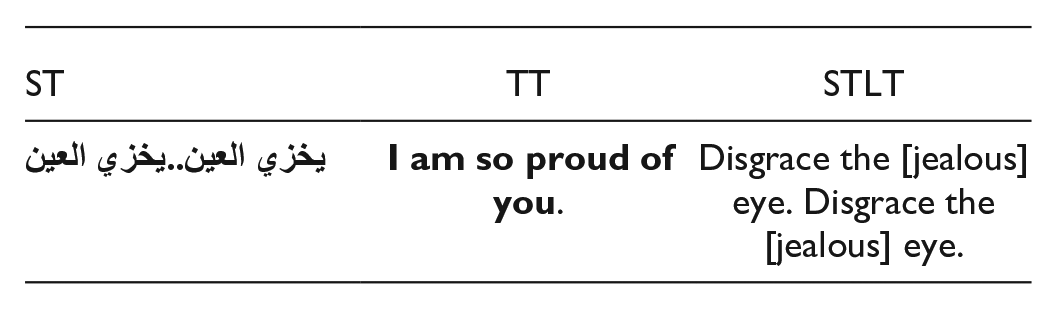
(a) In episode 10 (19: 19–19: 22), Ricky says that the little girl and grandma do not know each other’s language and culture, yet they make a perfect team together. Aya tells them the new English words she learned from grandma. Um Trad is thrilled with her little daughter; she replies:

The scale of Paraphrase which occupied 60.06% of the renderings.
The idiom used by Um Trad is meant to show that she is delighted with her little daughter, who started to learn and speak English. Culturally speaking, for many people in the Arab world, this idiom is very commonly used to expel the evil spirits which, according to their belief, may be so jealous of the exemplary achievements, possessions, or perceived advantages that may be ruined if not saying so. Thus, the idiom carries an encapsulated message which, in one sense, shows the content and happiness of such an achievement by Aya, the little girl. The subtitle was acceptable as it captured the idea and conveyed it to the S.L. audience.
(b) In Episode 13 (16: 08–16: 11), Abu Trad argues with Um Trad about his share in her new business; she talks back at him, saying that he did not do anything to deserve a share in the business. Unhappy with her not appreciating his role in the business, he says:
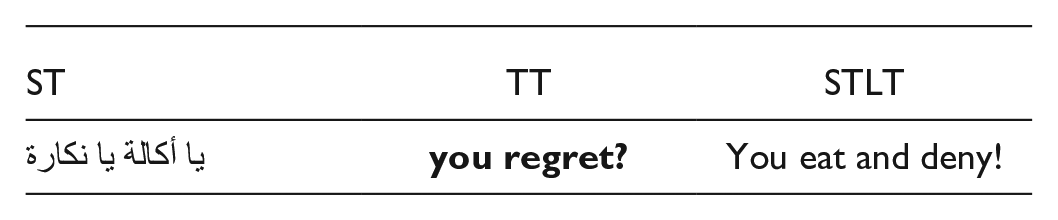
This dialect saying by Abu Trad entails that he blames his wife, implying that he had always been there for Um Trad, who now turns her back to him. Unfortunately, the TT paraphrase text does not convey a similar message to the TT audience; hence the TT is unacceptable. This means that neither the message nor the effect has been communicated to the receivers. This rendering does not go in harmony with Jaskanen’s (1999) emphasis on producing target audience-oriented subtitles.
(c) In Episode 14 (2: 34–2: 44), in the morning, Um Trad walks into the kitchen saying good morning to grandma, who in turn gives her the cold shoulder and ignores her. Um Trad gets upset by that, she says:

This dialect saying by Um Trad implies that she is not very comfortable with a grandma who shares with her the small business she started in grandma’s house; Um Trad cannot do anything about it, and she has to tolerate grandma’s bad manners toward her. The TT has to some extent, conveyed a semi-acceptable message that the audience may retrieve but with some extra processing effort.
Imitation refers to opting for literal equivalent renderings of expressions, proper nouns, international greetings, etc. This strategy was the second most frequently used by subtitlers (22.73%); see Figure 2 above. As for the scale of acceptability adopted by this study, the findings show that 20% of the renderings were acceptable, 13.33% were semi-acceptable, and 66.67% were unacceptable, see Figure 4 below. For more illustration, consider the following examples:
(a) In Episode 15 (4: 49- 4: 56), Abu Trad and his family are fighting about the money they have just earned from Jeffrey; Abu Trad holds the cheque discusses the issue with Shaima and blames Um Trad for not being careful with the money she inherited from her mother; he says:

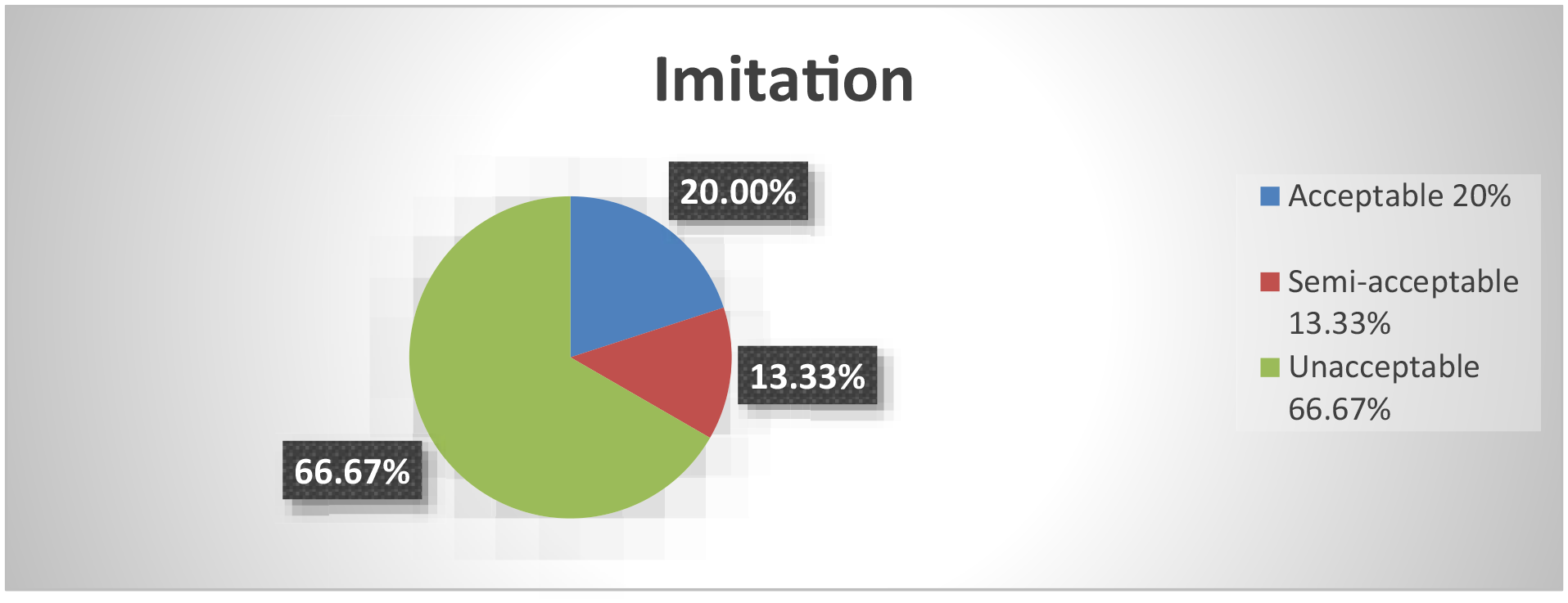
The scale of Imitation, which occupied 22.73% of the renderings.
In this example, the idiom used by Abu Trad to convince his daughter that her mother lacks the right vision of the future implies that the mother cannot consider other interrelated problems and obligations. The subtitler opted for imitation as a translation strategy and produced an acceptable translation. Luckily for the subtitler, both the wordings of the ST and TT idioms are very similar and convey a similar message, too.
(b) In Episode 7 (15: 17–15: 22), Abu Trad and his family are packing up their luggage and preparing themselves to travel to the U.S.; Abu Trad asks them if they are happy or not, and Um Trad responds to his question. She joyously says:

Here, Um Trad expresses her state of extra joy through an idiom that conveys this message. The English translation partially communicates this message to the TL audience. In English, the idiom “heart stopping” sometimes conveys mixed feelings, which may include excitement and fear, for instance. As such, the subtitle may be labeled as semi-acceptable since the message conveyed to the TL audience may be easily retrieved.
(c) In Episode 14 (9: 30–9: 33), Um Trad is unhappy with grandma giving Abu Trad some cookies; she mumbles that no one is taking care of her; she asks her little daughter to bring her some. She says:

In the Arabic idiom, it is vivid that Um Trad complains about being ignored by a grandma who did not offer her any cookies. The Arabic idiom conveys the message of describing someone as being worthless. However, the subtitler imitated the Arabic idiom by literally rendering it into English. However, the message was lost entirely, and the rendering is unacceptable as it leads to a breakdown in communication. To fix this problem, the subtitler could have opted for the English idiom “to give someone the cold shoulder” or “to leave someone out of the picture,” for instance.
Deletion implies omitting the S.T. expression(s), or there will be no verbal content in the TL This strategy came third in frequency by (12.12%), see Figure 2 above. As for the scale of acceptability adopted by this study, the findings show that subtitlers did not very successfully use this strategy as no acceptable renderings justify the use of this strategy, only 12.50% of the renderings were semi-acceptable. A high percentage of the renderings 87.50% were unacceptable, see Figure 5 below. For more illustration, consider the following examples:
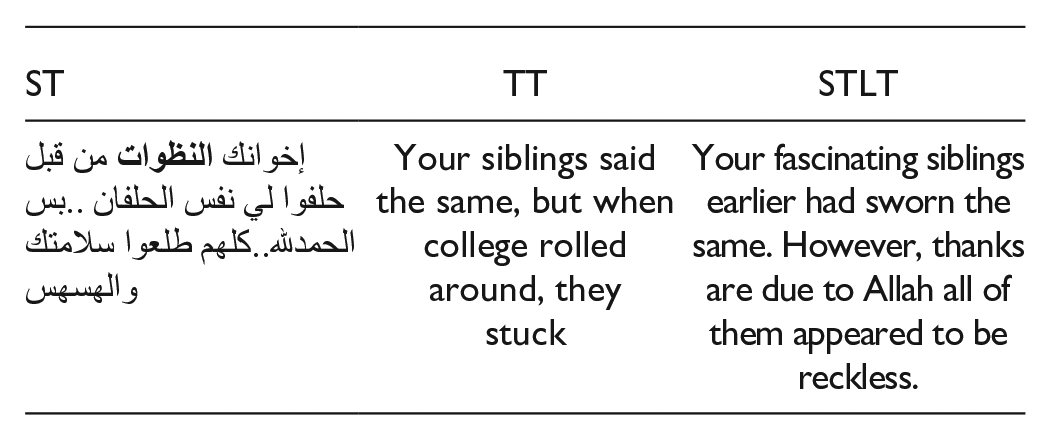
(a) In Episode 15 (15: 18–5: 23), after having fought about the money they have just got from Jeffrey, Abu Trad ironically talks to his daughter about pledges her siblings have made about studying hard once joining college. He says:

The scale of Deletion, which occupied 12.12% of the renderings.
This example includes an ironic description of the siblings as fascinating when they have been not. The subtitler deletes this description which may have been difficult to understand in Arabic as it is not commonly used in daily conversations, especially by the younger generations. Nevertheless, the message has not been distorted as the context entails this kind of ironic description when Abu Trad says Thanks are due to Allah. . .they suck in college. As such, the deletion of the Arabic ironic description may be considered semi-acceptable as it does not cause harm to the intended message.
(b) In Episode 8 (8: 00–8: 08), Abu Trad and his family finally arrive in the U.S., but unfortunately, they lost their little daughter, Aya. They are furious about what has happened and start blaming each other for not keeping an eye on her. When Trad arrives to pick them up, his father rebukes him for what happened. Abu Trad says:

Parents usually use the Arabic idiom
Expansion denotes expanding the expression to achieve an adequate and plausible rendering. This strategy came forth in frequency by (3.03%), see Figure 2 above. As for the scale of acceptability adopted by this study, the findings show that all instances featuring this strategy, in particular, were labeled as semi-acceptable, implying that subtitlers tried to approximate the cultural expressions to the TL audience. However, they did not try very hard, as their renderings were semi-acceptable. Nevertheless, luckily, they managed to push their renderings away from being unacceptable. The semi-acceptable renderings utilizing this strategy were 100%, see Figure 6 below. For more illustration, consider the following example:
(a) Um Trad is unhappy with her nosy neighbor in Episode 6 (5: 52–5: 55). She argues with him over being an opportunist, annoying neighbor. He tries to justify his position when he lends Abu Trad some money, saying that he is kind but, unfortunately, misunderstood. The neighbor defends himself, saying:


The scale of Expansion which occupied 3.03% of the renderings.
The Arabic dialect saying
(b) In Episode 6 (13: 22–13: 25), Abu Trad is having this monolog regarding being hen picked by his wife and just a follower of her; he complains about his wife, saying:

The Arabic cultural expression
Transfer signifies providing a communicative rendering of that into the TT. This strategy came fifth in frequency by (1.51%), see Figure 2 above. As for the scale of acceptability adopted by this study, the findings show that the sole instance featuring this strategy, in particular, was labeled acceptable (100%), see Figure 7 below; this implies that subtitlers managed to capture a communicative translation into the TL which encapsulates both the cultural and the semantic features included in the ST. For more illustration, consider the following example:
(a) In Episode 1 (7:37–7:39), Abu Trad is arguing with his wife; he complains about her attitude, saying:


The scale of Transfer which occupied 1.51% of the renderings.
In the example above, the religious expression
Conclusion
The study concludes that the cultural expressions retrieved from the Jordanian comedy TV series ‘al jar gabl al dar’ (my American neighbor) season 4 are distributed in the following categories, including idioms, dialect sayings, religious expressions, dialect, and common proverbs. It is vivid that Arabic cultural expressions represent a real challenge to subtitlers who struggle with various and different strategies to render them into English, which is in harmony with this study’s hypothesis. As for the English subtitles of these cultural expressions, the study relied on Gottlieb’s (1992) model of subtitling strategies, which revealed that the subtitlers only opted for five strategies, including paraphrase (60.61%), imitation (22.73%), deletion (12.12%), expansion 3.03%), and transfer (1.51%), respectively. This indicates a heavy reliance on paraphrase as a translation technique 60.61% of the renderings opted for it and very insubstantial reliance on transfer with only 1.51%. The findings indicated that strategies proposed by Gottlieb applied to Arabic-English subtitles.
The study also concludes that using understandable items in the receptor language, that is, opting for communicative translation, is a way to move toward the naturalization and localization of the subtitled TV comedy. Further, the study reveals that in order to help minimize loss of meaning when subtitling cultural expressions from Arabic into English, translators may need more extensive training in this domain, in particular to improve their skills, especially knowing that the percentages based on the scale of acceptability revealed by this study were as follows: unacceptable renderings 40.91%, semi-acceptable 19.70%, and acceptable renderings 39.39%.
Finally, this study has set the scene for subtitling and cultural approximation by highlighting the various interrelated elements, including but not limited to subtitling techniques, constraints, strategies, models, and translation approaches to dealing with cultural expression. The study has adopted Gottlieb’s (1992) subtitling model along with the communicative approach to translation led by Newmark (1988b), which has pinpointed a significant issue regarding cultural approximation, one that, if kept in mind by translators and subtitlers, would have been a good bridge builder to bring cultures together.
Footnotes
Acknowledgements
The author wishes to thank Yarmouk University for funding this paper.
Declaration of Conflicting Interests
The author(s) declared no potential conflicts of interest with respect to the research, authorship, and/or publication of this article.
Funding
The author(s) received no financial support for the research, authorship, and/or publication of this article.
