




Abstract
Based on the panel data of 30 provinces from 2016 to 2020, this study empirically analyzes the relationship between regional digitalization level and innovation performance, as well as the moderating effect of three environmental factors: regional science and technology investment, regional educational level, and the development degree of regional intermediary market and legal system. The analysis found that: (1) Different dimensions of digitalization level (digital infrastructure level, digital technology application level, and digital industrialization level) promote innovation performance together. (2) The development of digital-driven innovation is affected heterogeneously by different functional boundary conditions. Regional science and technology investment level, regional education level, and the degree of regional intermediary market and legal system show strengthen effect on the majority relationships between three dimensions of digitalization and innovation performance. Excepting that high regional education level weakens the role of digital industrialization in promoting innovation performance, and the degree of regional intermediary market and legal system show insignificant moderating effect on digital infrastructure level and innovation performance. This research is the first to systematically study the boundary conditions of the relationship between regional digitalization and innovation performance, revealing the necessary conditions for digitalization-driven innovation, deepening the research on the impact of digitalization level on innovation performance, and providing feasible suggestions for policy design and optimization.
Keywords
Introduction
The rapid growth of the digital economy has given rise to new business models and modes of production, energizing innovation in several fields (Ansong & Boateng, 2019; Olifirov et al., 2019; Pan et al., 2022). This trend extends to finance, health care, education, communications, entertainment, and many other areas, driving growth on the social output and efficiency (W. Chen, 2023; Niu, 2022). However, the development of digitalization has significant regional differences (Haefner & Sternberg, 2020). Differences in the level of digitalization due to uneven levels of development, resource allocation, and technology adoption across regions would significantly affect innovation performance (Haefner & Sternberg, 2020). Then research on the impact of regional digitalization on innovation not only helps to provide a deeper understanding of the dynamics of innovation in different regions, but also helps to provide insights into possible changes in the process of the development of the digital economy, which can provide important references for future policy-making and economic development.
Existing researches investigate the effect of digital economy on innovation from a multi-dimensional perspective which includes the micro level (Andriushchenko et al., 2020; Ansong & Boateng, 2019; Olifirov et al., 2019; Pan et al., 2022), meso level (Fang, 2021; Su et al., 2021), and macro levels (M. Li, 2023; Tian et al., 2023), and based on different theoretical lenses, such as knowledge management theory (Costa & Monteiro, 2016), open innovation (Alexy et al., 2016) and etc. Micro level studies have focused on indicating how digitalization can translate into better innovation productivity gains and corporate performance (Andriushchenko et al., 2020; Olifirov et al., 2019; Pan et al., 2022). Meso level studies primarily focus on the technological upgrading of the digital economy and the technological diffusion to other industries (Yang, 2020; Ziming & Kharchenko, 2023). The macro-level studies are mainly researched on the role of the digital economy in high-quality development from the perspective of economic growth (Czernich et al., 2011; J. T. Guo & Luo, 2016; Mallick, 2014; B. Ren, 2020; T. Zhang & Jiang, 2021), factor productivity (Xun et al., 2019; Yang & Jiang, 2021), and broader economic and social gains (e.g., Brynjolfsson, 2011; Burtch et al., 2018; Katz et al., 2014; Kenney & Zysman, 2016; Kraus et al., 2021; Nambisan, 2017).
Concentrated in the last 2 years, scholars realized that innovative development is of significance toward high-quality development, thus more scholars have paid attention to the impact of the level of digitalization on innovation performance in the past 2 years (M. Li, 2023; Tian et al., 2023; H. Wang & Ling, 2022; Wen et al., 2020). However, there remains disagreement on the impact of regional digitalization on innovation performance. Many research indicated that digital economy promote region technological innovation capability (M. Li, 2023; Su et al., 2021; Tian et al., 2023). while other studies found that there is a step difference in the degree of regional digitalization and which affects innovation efficiency heterogeneously (Lyu et al., 2023; Peng & Tao, 2022; L. Wang & Shao, 2023; Zeng & Lei, 2021; Zhao et al., 2022). For example, Q. Zhang and Li (2019) found a significant inverted U-shaped relationship between informatization and regional innovation performance. Zhou et al. (2020) empirically examined the impact of different dimensions of regional digitalization level on innovation performance in Zhejiang counties and found that the improvement of regional digital access level is beneficial to enhance innovation performance, and the impact of regional digital equipment, platform construction, and application level on innovation performance shows an inverted U-shaped relationship. Table 1 summarized representative researches on regional digitalization level and innovation performance.
Representative Research on Regional Digitalization and Innovation Performance.

Generally speaking, existing studies found controversy relationship between the level of digitalization and regional innovation performance (Lyu et al., 2023; Peng & Tao, 2022; L. Wang & Shao, 2023; Zeng & Lei, 2021; Zhuang & Wang, 2022), and they mostly focus on the direct impact, ignoring the boundary conditions of the level of digitalization affecting innovation performance. However, the development of regional digitalization is inevitably influenced by the regional environment such as technology, education/human capital, intermediary market and legal system in the process of innovation, but existing studies have not yet investigated the influence of regional environmental factors on the relationship between regional digitalization level and innovation performance.
Therefore, to investigate the influence of regional digitalization level on innovation performance systematically, this study analyzed the regional digitalization from three different dimensions and further explores the boundary effect of digitalization-driven innovation development by empirically analyzed the moderating effect of three factors: the level of regional science and technology innovation investment, the level of regional higher education, and the level of regional intermediary market and legal system, based on the contingent theory. This study enriches the empirical research on digitalization and innovation development and provides confidence for industry and academia to promote digitalization; more importantly, it is the first systematic study on the boundary conditions of relationship between regional digitalization and innovation development, revealing the boundary effect of environmental factors on digitalization—innovation relationship and providing feasible suggestions for policy design and implementation.
This research chose Chinese as research context for three reasons. Firstly, China’s digital economy is developing at an impressive pace and is still in a period of rapid development, facing many opportunities and challenges, such as rapid development in emerging application technologies, big data, artificial intelligence and other areas, while some strategic foundational technology innovation is underdeveloped (Pentland et al., 2022), such as the development of lithography (P. Chen et al., 2024). This particular research context is distinctive and also typical for deepening the impact of the digital economy on innovation. Secondly, China is a vast territory country, and there are big differences in the level of development and policy making among regions (Tian et al., 2023), and significant differences in the level of development of the digital economy, which provides a good context for studying the impact of regional differences on innovation. Thirdly, China has a unique policy environment and development priorities, and China’s “14th Five-Year Plan” clearly regards the digital economy as an important means to market China’s economic development in the future, especially to drive innovation strategy toward high-quality development. Thus the country, provinces and cities have intensively introduced relevant policies to support digitalization and innovation-driven development strategies. However, there are still many unsolved problems in the practice, and studying the impact of digitalization on regional innovation in China can provide important insights for the formulation of national and local policies.
Research Concepts and Hypothesis Development
Regional Digitalization and Innovation Performance
Regional Digitalization and Its Measurement
Digitalization emphasizes the use of digital technologies for a comprehensive transformation of the economic environment and economic activities, such as the digitalization of infrastructure (Q. Zhang & Li, 2019), the digitalization of production processes (Olifirov et al., 2019), and the development of digital industries (M. Li, 2023). There is no consensus on the definition of digital transformation in existing studies (Peng & Tao, 2022). Different definitions highlight different characteristics of digital transformation (Vial, 2019), based on which there comes different measurements (Busulwa et al., 2022; X. Guo et al., 2023; L. Guo & Xu, 2021; J. Liu et al., 2022; Magazzino et al., 2021; Orłowski et al., 2022). This study separated these measurements into three different approaches: the first measurement approach is based on the development history of digitalization. Early studies used the level of Internet development to measure digitalization, such as Hu (2019) proposed using the ratio of the number of regional websites to the number of legal entities to measure Internet resources as the level of Internet development. The second approach is measured according to the content and areas of digitalization carried out. For example, Fan and Wu (2021) constructed a digital indicator system from production digitalization, consumption digitalization, and circulation digitalization aspects. The third approach is carried out based on the connotation dimensions of digitalization. For example, Zhou et al. (2020) conducted an empirical study on regional digitalization level in four dimensions: digital access level, digital equipment level, digital application level, and digital platform construction level. Through the comparison of different classifications, it can be seen that many studies on the measurement of regional digitalization level mainly focus on the construction of information infrastructure and the degree of application of information technology, which have relative rationality as well as wide applicability. Therefore, this study selects three widely used indicators to measure the regional digital level: digital infrastructure level, digital application level, and digital industry level, to comprehensively reflect the connotation of digitalization.
Digital Infrastructure Level and Innovation Performance
The level of digital infrastructure is a prerequisite for conducting digital driven innovation. Some studies have also found that digital infrastructure significantly contributes to the ambidextrous innovation capability of enterprises. Firstly, the rich digital infrastructure provides efficient communication and cooperation tools for innovation agents in the region to realize the interconnection, which improves the efficiency of knowledge sharing among innovation agents, deepens R&D cooperation, and strongly promotes innovation activities; X. Liu and Hui (2021) discussed the digital economy’s linear and nonlinear effect and constraint mechanism on the high-quality development of China’s manufacturing. Constantinides et al. (2018) pointed out that digital infrastructure can collect, store and utilize data across multiple systems and devices, provide companies with the necessary network resources, strengthen the link between product supply and demand, and provide information and technical support for companies to grasp information about users’ needs and develop products in a targeted manner. Secondly, digital infrastructure breaks the limitation of time and space, realizes the effective allocation of production factors such as human resources, technology, and materials under the adjustment of the market, and ensures the full utilization of resource factors (Ma & Ning, 2020), which can improve the ability of innovation agents to attract partners, help expand the breadth of cooperation among innovation agents, and increase the innovation portfolio (Han et al., 2020). Thirdly, a high level of digital infrastructure also corresponds to a large amount of resource investment, indicating that the region attaches a high degree of importance and support to the development of digital driven innovation and can create a favorable environment for innovation development. Therefore, the level of digital infrastructure can contribute to the improvement of the overall regional innovation level, and hypothesis 1 is proposed.
H1: The increase in the level of digital infrastructure facilitates the improvement of regional innovation performance.
Digital Technology Application Level and Innovation Performance
The level of digital technology application reflects the extent to which information technology influences the innovation process in the region and is a necessary path to digital driven innovation. Firstly, digital technology application can provide new ways of value creation for firms, which promote innovation through the integration of information technology and physical components (Pan et al., 2022). Secondly, the use of information technology improves the innovation efficiency of innovation agents, reduces management costs, and helps to improve innovation performance (Zeng & Lei, 2021; Zhuang & Wang, 2022). Digital technologies can enhance organizational information search and integration capabilities, promote heterogeneous knowledge and resource integration, and foster innovation capabilities (Tian et al., 2023; Wen et al., 2020), thus expanding innovation boundaries. Thirdly, digital technology applied to the whole process from production to consumption can not only promote the development of industries such as e-commerce, but also empower the flow and full utilization of regional economic elements, scientific and technological elements, knowledge elements and talent elements (J. T. Guo & Luo, 2016; B. Ren, 2020). With the frequent communication between digital technology-supported enterprises and users, the “weak relationship” between firms and users achieves “strong connection,” which helps heterogeneous knowledge sharing and learning and enhances the existing knowledge system, thus providing a good opportunity for innovation. Studies have also empirically tested the positive impact of IT adoption on innovation performance (Zhao et al., 2022). Therefore, the level of digital technology application can contribute to the overall regional innovation performance, and hypothesis 2 is proposed.
H2: The increase in the level of digital technology application facilitates the improvement of regional innovation performance.
Digital Industry Level and Innovation Performance
The level of digital industry represents the degree of development of digitalization in the relevant industries, and it reflects the scope and level of using digitalization to create value. The digital industry level provides digital technologies, products, services, corresponding solutions, and various digital products and services that completely rely on digital technologies and data elements for innovation development in the region, emerging information technologies are used to achieve Internet of Things and service connectivity, deep integration of business processes and engineering processes, and more flexible and efficient production methods, bringing more possibilities for corporate innovation, especially breakthrough innovation, as studies showed that technology exchange has a significant positive impact on innovation (J. T. Guo & Luo, 2016; Zhao et al., 2022). Thus this study proposed H3.
H3: The increase in the level of digital industry is conducive to the improvement of regional innovation performance.
The Moderating Effect of Regional Environmental Factors
The process of digital driven innovation development cannot be achieved without the strong support of financial, talent, institutional and other resources in the specific region. Among them, regional investment in science and technology reflects both the level of support for digital driven innovation development and provides financial guarantee for innovation development. Digital driven innovation development requires high-level professional talent support, and whether the regional education level matches the needs of overall regional innovation development will significantly affect the efficiency and effectiveness of regional innovation (Chi & Qian, 2010). In addition, digital driven innovation is an open innovation ecology with multiple subjects and multiple factor combinations, and the efficiency of multiple subjects, reasonable distribution of innovation benefits, and effective protection of intellectual property rights all affect the final innovation performance. Therefore, the level of regional intermediary market development and the legal environment constrain the level of digitally driven innovation performance. Thus, this study investigates the moderating effect of regional science and technology investment, regional education level and regional intermediary market development and the legal environment.
The Moderating Effect of Science and Technology Investment
The level of regional science and technology investment represents the level of resource and attention allocation of local government to science and technology activities, and has a strong synergistic effect of resources which could affect the development of science and technology. On the one hand, the resource allocation brought by local government science and technology investment increases the investment in digitalization and innovation infrastructure, leads the development direction of digital technology, provides strong support for digital technology development, promotes the quality and efficiency of digital industry, and also promotes the optimization of innovation development environment, which offers strong support for the process of digital driven innovation development. On the other hand, local government science and technology investment represents the government’s attention allocation (Li, Gao et al., 2023), and regions with higher level of science and technology investment budget reflect the degree of local government’s support for digital transformation to drive innovation development, and the government can organize resources from all parties to support and stimulate science and technology development, which solves the resource scarcity and benefit distribution problem in the process of digitalization toward innovation. Thus,
H4a: Regional science and technology investment enhances the positive relationship between digital infrastructure level and regional innovation performance.
H4b: Regional science and technology investment enhances the positive relationship between digital technology application level and regional innovation performance.
H4c: Regional science and technology investment enhances the positive relationship between digital industry level and regional innovation performance.
The Moderating Effect of the Regional Education Level
The level of education can improve not only the level of workforce’s overall skill, but also the overall humanistic quality. This promotion effect would be more prominent with higher education level. With the increasing of the higher education level, the workforce’s reception rate and efficient to information technology would higher, and then strengthen the level of communication and connectivity with the support of digital infrastructure, which could create new digital innovation development opportunities. Higher levels of higher education lead to more technically proficient applied skills in the process of digital technology application, enabling smoother transition and transformation of new business models and economic development models. In addition, employees with higher levels of knowledge and skills can enhance the productivity-enhancing effect of ICT (information and communication technology; de Grip & Sieben, 2005). In general, digital development is based on a certain knowledge base, and the higher the education level, the richer the knowledge base among the digitalization process, thus a higher level of education helps to enhance the digital infrastructure and digital technology applications to drive innovation.
However, the higher the level of higher education, the higher the overall technological quality of workforce, the more specialized utilization of digital tools, and the more highly skilled workforce are able to use digital infrastructure and technology to carry out innovative activities autonomously (Quazi & Talukder, 2011), instead of relying on purely IT service personnel, which lead to a substitution effect on the benefit of digital industry level toward innovation performance.
H5a: The higher education level enhances the contribution of digital infrastructure level to regional innovation performance.
H5b: The higher education level enhances the contribution of digital technology application level to regional innovation performance.
H5c: The higher education level weakens the contribution of digital industry level to regional innovation performance.
The Moderating Effect of the Regional Intermediary Market and Legal System
Building a legal guarantee system that is conducive to clarify the responsibility of relevant institutions to protect the privacy rights of enterprises and consumers will promote enterprises to implement smart manufacturing more firmly and effectively control the risks of digital transformation of the manufacturing industry (Reier Forradellas & Garay Gallastegui, 2021).
Therefore, a perfect intermediary market and legal system strengthen the motivation of digital technology application, protect digital property rights, and improve the benefit distribution mechanism (Bliznets et al., 2018), which promote the transformation of digital innovation model in the process of digital infrastructure implementation and digital technology application. What’s more, the better intermediary market and legal system itself plays an important protection role in the process of digital development (Gromova et al., 2022), and becomes an important support and backing for the development of related digital industries. In the process of digital industry promoting innovation development, the perfect intermediary market and legal system provide multiple supports such as information, resources and revenue guarantee for digital industry services (Gromova et al., 2022). Therefore, this study proposes that:
H6a: High level of intermediary market and legal system could enhance the contribution of digital infrastructure level to regional innovation performance.
H6b: High level of intermediary market and legal system could enhance the contribution of the digital technology application level to regional innovation performance.
H6c: High level of intermediary market and legal system could enhance the contribution of digital industry level to regional innovation performance.
The theoretical framework can be seen in Figure 1.

Theoretical framework.
Research Methodology
Sample Selection and Data Collection
This study explores the relationship between regional digitalization level and innovation performance, and provides an in-depth analysis of the moderating effect of boundary conditions such as regional science and technology investment, regional higher education level, and regional level of intermediary market and legal system. Therefore, this study chose 30 Chinese provinces (Tibet is not included due to the insufficient data) as research samples, and collected data of digitalization and innovation from 2016 to 2020. The data sources are China Statistical Yearbook, China Industrial Statistical Yearbook, China Marketization Index Database by Province, etc.
Measurements
In summary, the variables and their measures for the empirical study are shown in Table 2.
Variables and Their Measurement.

Model Setting
This study establishes a multiple regression model to test the relationship between digitalization level and innovation performance and its boundary effects in different regions. Among them, Equation 1 analyzes the relationship between digitalization level and innovation performance, and Equations 2 to 4 analyzes the effects of regional science and technology investment, regional education level and regional intermediary market and legal system level on the relationship between different digitalization level dimensions and innovation performance, respectively.


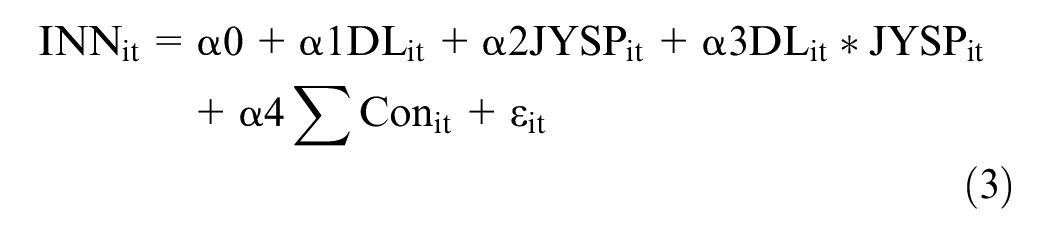

(Note: The meaning of abbreviation can be seen in Table 3)
Table of Abbreviations/Symbols.

Empirical Analysis and Results
Descriptive Analysis
We firstly performed the descriptive analysis of the data, from which it can be seen that the average number of patent applications in each province from 2015 to 2020 is 133,839 pieces, and the overall innovation output level is high; however, the variance of innovation performance, regional development level, population size, digital technology application level and digital industrialization level are all large, indicating that the economic and social development and the digitally driven innovation performance are uneven in different provinces. We also examined the correlation among different variables and the results showed that variables are all significantly correlated. The results in Table 4 satisfied the requirements in this research.
Descriptive Analysis.

p < .01
Panel Data Regression Analysis
This study analyzes the sample panel data with Stata13.0 to verify the relationships among innovation performance, level of digital infrastructure, level of digital technology application and level of industry digitalization, and the three moderating variables of regional science and technology investment, regional higher education level, and regional intermediary market and legal system level, respectively. The panel regressions are conducted using fixed-effects models to get the results shown in Table 5.
Regression Analysis Results.

p < .01, **p < .05, *p<.1; standard errors are in parentheses; some data with * are retained to 2 decimal places only to ensure page cleanliness.
The regression model (1) (2) (3) shows that regional innovation performance is positively related with the level of digital infrastructure (β = .18, p < .01), the level of digital technology application (β = .39, p < .01), and the level of digital industrialization (β=.27, p < .01), separately. Indicating that the improvement of digital infrastructure, digital technology application, and digital industrialization is beneficial to the improvement of regional innovation performance, which verifies H1, H2, and H3.
The regression models (4) (5) (6) examined the moderating effect of the level of regional science and technology investment. The results showed that the interaction of science and technology investment and digital infrastructure (β = .21, p < .01), the interaction of science and technology investment and digital technology application (β = .10, p < .01), and the interaction of science and technology investment and digital industrialization (β = .12, p < .01) are positively related to innovation performance, and H4a, H4b, and H4c are supported. Then from the regression models (7) (8), it is clear that the interaction of regional education level and digital infrastructure (β = .13, p < .01), and the interaction of regional education level and digital technology application (β = .13, p < .01) are positively related to innovation performance, H5a, and H5b are supported. But as shown by the regression model (9), the interaction of regional education level and digital industrialization level is negatively correlated with innovation performance (β = −.07, p < .05), which supported H5c. Finally, the regression model (10) (11) (12) were used to test the moderating effect of the development degree of intermediary market and legal system. The results showed that the interaction of the intermediary market and legal development and the digital infrastructure (β = .10, p < .01), and the interaction of the intermediary market and legal development and the digital technology application (β = .08, p < .01) are positively related to innovation performance. Thus, H6a and H6b hold. From the regression model (12), we can see that the interaction of the development degree of intermediary market and the digital industrialization are insignificantly related to innovation performance, which not support H6c.
Discussions and Conclusion
Research Findings
This study empirically tests the impact of different dimensions of digitalization level on innovation performance and explores the boundaries of the role of digitalization level in influencing innovation performance, drawing the following main conclusions.
Different Dimensions of Digitalization Level All Contribute to Innovation Performance
Firstly, the level of digital infrastructure is positively related with innovation performance. In recent years, Chinese government have attached significant importance to the construction of digital infrastructure, and the level of digital infrastructure has been improved prominently. “The 14th Five-Year Plan” for the development of digital economy points out that the optimization and upgrading of digital infrastructure construction should be continuously promoted. The improvement of digital infrastructure construction provides efficient communication and cooperation tools for innovation agents, enhances the degree of connection of innovation agents, and improves the cooperation and sharing of knowledge.
Secondly, the level of digital technology application is positively related with innovation performance. The application of digital technology such as “Big Data, Artificial Intelligence, Mobile Internet, and Cloud Computing” empowers new capabilities to innovation activities, optimizes the operation system, improves the efficiency of enterprises, and reorganizes the enterprise structure processes, enabling companies to create more value at lower costs, which help to enhance innovation efficiency and create innovation opportunities.
Thirdly, the level of digital industrialization is positively related with innovation performance. The development of digital industrialization transforms digital knowledge and information into production factors, which are integrated with management innovation and business model innovation to promote the innovation performance.
Heterogenious Moderating Effect of Boundary Factors
In general, the level of regional science and technology investment, regional education level and the degree of regional intermediary market and legal system improvement can strengthen the positive effect of different digitalization dimensions toward innovation. However, the regional higher education level weakens the contribution of digital industrialization to innovation performance, while the development degree of intermediary market and legal system did not significantly affect the relationship between digital industrialization and innovation performance. The findings of this study extend the analysis of the boundary effect of digitalization in affecting innovation performance and deepen the research on the impact of digitalization on innovation performance.
In detail, with a higher level of science and technology investment, local governments will devote higher resources and attention to digitally driven innovation, and more policies resources will be tilted to relevant innovation activities; therefore, innovation agents are more willing to fully use digital infrastructure for cooperation and sharing, and use digital technology in innovation activities to improve efficiency, reduce costs, and promote innovation.
But high level of higher education is the concentration of regional educational resources and quality, which provides a solid backing for the supply of digital talents and innovation talents. High level of talent enhances the level and utilization efficiency of digital infrastructure and technology, and improves the efficiency and quality of innovation. Then the cultivation of talents in higher education can improve the utilization of digital facilities and technologies, thus creating a certain substitution effect on professional digital industrial services.
Well-developed market intermediary and legal system are important indicators of a good market-oriented environment and an important connotation of the regional business environment, creating a good supporting environment for the efficient use of digital infrastructure and digital technology, while guaranteeing the good operation of the benefit distribution mechanism in the process of digitally driven innovation development. The degree of intermediary market and legal system development does not significantly support the role of digital industrialization in promoting innovation performance, probably because the degree of intermediary market and legal system development plays a similar role to that of digital industrialization in promoting innovation development, which is to provide more professional services to relevant subjects.
Theoretical Contribution
Firstly, this study meticulously explores the impact of different dimensions of regional digitalization level on regional innovation level. Consistent with some existing studies (Lyu et al., 2023; L. Wang & Shao, 2023; Zhao et al., 2022; Zhou et al., 2020), this study finds that the level of digital infrastructure, the level of digital technology application and the level of digital industrialization are all positively related to regional innovation performance. This result not only verifies the facilitating effect of regional digitalization level on innovation and enriches the empirical evidence on digitalization level and regional innovation; it also helps to reconcile the existing research controversy and clarify the logic of digitalization affecting regional innovation from a more detailed discussion.
Second, this study constructs a systematic model of moderating effects by introducing regional science and technology investment, regional education level and the degree of regional intermediary market and legal system improvement to systematically test the boundary effects of regional digitalization level on innovation performance. On the one hand, it responds to the call for more research on boundary conditions (Zhuang & Wang, 2022), and advances the existing research on the relationship between regional digitalization and innovation by focusing on the boundary conditions in specific contexts, in addition to focusing on the direct effect, in order to refine the understanding of the relationship between regional digitalization level and innovation and deepen the research on the mechanism of regional digitalization affecting innovation. On the other hand, this study integrates regional digitalization research with regional environment optimization, which help to systematically understand the mechanism of regional digitalization’s impact on regional innovation, and also promotes the deepening of regional innovation environment research.
Management Insights
Firstly, local government should focus on the overall planning of digital construction, increase investment in science and technology, and promote the deep integration of digitalization and innovation. Local governments have set digital development goals, continued to promote the digital infrastructure level, and closely integrated digital infrastructure with smart city construction. During the construction process, local governments should pay attention to the coordination of digitalization and innovation development in addition to considering the level of digital construction to avoid the mismatch between digital infrastructure and innovation infrastructure demand.
Secondly, the enterprise should make full use of digital technology to improve the innovation environment and stimulate innovation momentum. The application of digital technology is conducive to improving the innovation environment, reducing the cost of the innovation process and improving the efficiency of innovation. It can also make full use of digital technologies such as the Internet of Things, Cloud Computing and Big Data to stimulate new innovation momentum, strengthen the level of digital development, change or optimize the original organization structure and innovation management routines, and expand the influence of digitalization on regional innovation development.
Thirdly, regional innovation development should also focus on talent development to stimulate the role of digital talent as a catalyst for innovation. The improvement of education level strengthens the role of digital infrastructure and technology application in promoting innovation. In addition to the overall improvement of the level of education, the regional innovation development needs to strengthen the top-level policy design and enhance the overall effectiveness of the digital talent policy system. For example, for cultivating digital management, application and technical talents needed in the process of digital development, emphasis should be placed on establishing school-enterprise cooperation and other ways to build a training system for different types of digital talents.
Fourth, improving the integrity of the intermediary market and law system to provide adequate support and protection for innovation development is also important. We should promote the cultivation of intermediary market to provide professional services in the fields of digital platform, technical services, investment and financing, and then enhance the efficiency of innovation. What’s more, a joint multi-sectoral regulatory mechanism should also be established to improve the legal and institutional environment to provide guarantees for the behavior of innovation agents, enhance the incentive to innovate and protect the benefits of innovation.
Footnotes
Acknowledgements
We are very grateful to the relevant business leaders for inspiring us with their interviews, and we want to acknowledge the Key Laboratory of Behavioral Science and Public Policy of Shaanxi Higher Education Institutions for its support.

Ethical Approval
We use secondary data obtained from publicly available databases. We also report this process to our university and get approval from the ethics committee of University Chang’an University. The procedures used in this study adhere to the tenets of the Declaration of Helsinki.
Funding
The author(s) disclosed receipt of the following financial support for the research, authorship, and/or publication of this article: This work was supported by the Shaanxi Provincial Social Science Foundation (Grant Number: 2024R030) as interim results. And this authors are extremely grateful to a youth project of the National Natural Science Foundation [72102022], a key projects of the National Social Science Foundation of China [20AGL004], and the Fundamental Research Funds for the Central Universities [300102114609].
Declaration of Conflicting Interests
The author(s) declared no potential conflicts of interest with respect to the research, authorship, and/or publication of this article.
Data Availability
The datasets generated during and/or analyzed during the current study are available from the corresponding author only on reasonable request.