




Abstract
Pakistan is one of the progressing countries in the world. Its education system is yet in the stage of development. Students from towns and far flung areas come to advanced cities for higher education. This has made the university classrooms a mix of students having a diversity of age, gender, exposure, language, and family backgrounds. To facilitate all these students with personal differences under the same roof, a teacher has to adapt curriculum and lesson plans while bringing innovations in his teaching methods. This study aims to find out the use of innovative strategies by the teachers to respond to students’ diversity at higher education level in public and private sector of Pakistan. The research is based on the assumption that innovative teaching has a positive impact on the performance of students’ diversity. A survey of higher education teachers was conducted for the research. Statistics were applied for the analysis. The results are found to be significant in favor of innovative teaching. The analysis shows that the use of innovative teaching is more in private sector and also has different impact on different disciplines.
Introduction
Classrooms nowadays are exemplified by student diversity. The students in universities are diverse in different aspects such as culture, religion, family background, region, and schools where they have been studying (this is very important in Pakistani scenario). Due to such diversities, students’ learning needs are also becoming increasingly diverse. A new challenge is to look for the teaching ways that can address their needs. To respond to such diverse needs of the students at higher educational levels, different innovative teaching and differentiated strategies and methods are being used by the teachers in their classes. Since the last three decades, innovative teaching methods to deal with the diversity of today’s students are widely being used worldwide (Barakzai, 2004).
In recent decades, global trends in cultural and economic development have also brought forth reforms in educational paradigms. These reforms have been accompanied by changes in the ways educational practitioners or educators design the curriculum. Compared with subject-centered approaches, learner-centered and problem-centered designs are often described as having greater potential to impart to the next generation. Over the years, there has been a big change in the thinking process of educational theorists. Major policies are more concerned about equality of opportunity for education and employment opportunities for graduates (Teichler, 2004). Worldwide government and private education institutions are focusing on the need of meeting diverse needs of students, and they are more focused on learner-centered teaching. Teaching methods and strategies are more flexible now. There seems to be close interrelation between the diversification and flexibility patterns of higher education. The more diversified and flexible higher education systems are, the more they will exercise a universal access policy to meet diverse needs of the students (Guri-Rosenblit, 2006).
Erik Erikson (1946-1956) gave the concept of identity and argued that late adolescence is an important time when adults show a sense of personal and social identity which is formed. As each adult at higher educational level shows a blend of different personality traits, institutions of higher educational levels can provide opportunities to them to experiment with the new ideas, new relationships, and new roles. Peer influences play an important role in this development, and students are able to explore options and possibilities. All institutions of higher education do not serve this developmental function equally well (Terenzini & Pascarella, 1991). In the learning framework of Pakistan, where the stern schedule of the course outline did not allow many eloquent assignments in the classroom, project based learning (PBL) is the best way of allowing an out-of-class activity that may not be related to the syllabus (Sarwar, 2001) but still considers the students’ learning needs by providing them choice to learn (Pillay, 2002).
Pakistan, being a developing country has less civic facilities in its cities. Its remote areas are yet deprived of basic needs including education. Higher education is limited to some big cities only, due to which people from small cities and far-off areas are compelled to travel to big cities for higher education. This situation has made university classrooms overcrowded and a blend of masses with different socioeconomic backgrounds and having different levels of intellect and mental abilities. These situational and dispositional barriers created by institutional inflexibility (Billingham, 2009) have made it difficult for students to adjust in a totally new environment with their diverse needs. If higher education institutions want to focus on student learning outcomes and success, then they need to implement innovative teaching strategies and methods as several Australian universities have accepted the requirement of provision of English courses for their international students (Morris & Hudson, 1995).
Experts of U.S. tertiary education are of the opinion that the strict implementation of policies can confirm the provision of the best possible learning environment for the diverse students (Gurin, Dey, Hurtado, & Gurin, 2002). It is not possible to effectively teach these students with all diverse backgrounds while remaining in a settled specific curricula and syllabus format. Similarly, a teacher with uniform lesson plans for each and every student of his class cannot achieve the target of effective learning process and his students will suffer badly.
To keep students from these sufferings, a teacher should have a flexible and creative mind. Students increasingly demand flexibility from their institutions (McDonald & Reushle, 2002). Flexibility is a key factor in effectively catering to the learning needs of diverse student cohorts (Yorke & Thomas, 2003). In terms of how flexibility, variety, and choice might be achieved while maintaining appropriate standards, the use of technology, a variety of teaching strategies, and choice and flexibility in assessment are required.
van den Broek (2012) along with various aspects of learning suggested that students must acquire the skill to find out the matches between an assignment in hand and former capabilities and knowledge. Research clearly demonstrates the importance to students of feeling valued and respected and the impact this has on the development of a greater sense of belonging and a positive self-concept (Midobuche, 1999).
A significant part of valuing students and facilitating their success lies in knowing them. Stromer (1991) argued that to know how to teach students, we must first understand them. Teachers should be capable of adapting curricula and syllabus while remaining within the main theme of subject. They should be innovative in their teaching methods and should adopt different strategies to facilitate every single individual of their classroom according to the capabilities and differences of students (Guri-Rosenblit, Šebková, & Teichler, 2007).
Torres (2001) and King (2011) emphasize on the need of better teacher training, in-service training, and preservice training worldwide, which has been reflected in conference of “education for all” background documentation. It is very important to have trained teachers at higher educational levels who can use different innovative teaching methods by using their skills to make students get ready for future challenges. Pakistan is one of those countries where there is a mismatch between graduates’ skills acquired in higher education institutions and the skill sets needed in industry. Many of the graduates are found to be lacking in communications skills, analytical and critical thinking, and problem-solving skills (Tan, 2003; Teo & Wong, 2000). As such, there is much need for institutions to introduce and use such innovative teaching techniques which will focus on training future graduates to be more efficient and a productive part of the society.
The use of innovative teaching strategies has been a hot topic from the last decade. Creative and skilled teachers are being found using different innovative teaching methods at higher education levels. Many studies consider creativity as a personal trait and intellectual ability of different individuals, associating creativity with genius and intelligence (Albert & Runco, 1999), or with knowledge (Weisberg, 1999). Therefore, the work of Picasso, as well as Einstein, Marie Curie, and Newton, can be seen as creative because at the same time point during their lives, these geniuses came up with something original, new, and at the same time valuable and appropriate (Ala-Mutka, Punie, & Redecker, 2008).
The focus of innovative teaching is based on the trust that every student has the capacity to learn and be successful in life. A teacher should perceive each student as possessing unique personality characteristics that can be more polished by using creative and innovative teaching methods. Having an awareness of the process of learning is very helpful for teachers to identify the problems students are facing in some of the subjects (Westwood, 2013). Vescio, Ross, and Adams (2008) suggested that the idea of professional learning communities (PLCs) has been developed as a way of supporting the model of change. As this era is very truly called an era of science and technology, following the scientific method, one would have the first interest to know about, what are innovative teaching strategies? When they are needed to be adopted? What are their applications? And what are the best innovative teaching strategies to address students’ diversity? There are many innovative strategies being used in higher education classrooms to address the diversifying needs of students coming from different socioeconomic, religious, and ethnic backgrounds having different levels of experiences, cognition, and prior knowledge about subject matter.
Being the direct source of information, teachers need to be loaded with updated information related to content and other resources, that is, use of technology. Literature and research suggest that technology is endowed with a potential to innovate education (Blandow & Dyrenfurth, 1994). However, teachers need to bring changes in their teaching methods so that they can accommodate the changed interaction patterns. Using technology is a useful innovative technique to teach students, which can only be done when the teachers are trained in using the technology. Teachers’ proficiency in using technology is another issue (Shaffer, 2006). Shaffer argues that if a teacher cannot read, it would be difficult for him or her to identify whether the text material in that book is bad or worth reading. When it comes to technology, similar behavior is noted. For innovative teaching to take place, if teachers are not aware of the available resources, then there will not be any innovative teaching.
Innovative teaching involves using innovative methods and teaching learning materials for the benefit of students (Mandula, Meda, & Jain, 2012). According to Anderson and Neri (2012), innovative teaching can involve virtual labs: learning activities based on real-life problems; learning environments with equipment, furnishings, materials, and audiovisual resources; and learning guides for students and the teacher. All of these are combined with methodologies that promote the use of active teaching techniques that help teachers develop their students’ learning abilities. The key advices to teachers teaching students from diverse backgrounds are to know and respect their students; offer students flexibility, variety, and choice; make expectations clear; use accessible language; scaffold students learning; be available and approachable to guide student learning; and be a reflective practitioner (www.lowses.edu.au).
There are many strategies, such as personalization, small learning communities, student advisories, multidisciplinary curricula, peer tutoring, peer instruction, and team teaching, which are used by teachers at different higher levels of education. They may be personalization, small learning communities, student advisories, multidisciplinary curricula, peer tutoring, peer instruction, team teaching, and so on. The rapid growth of availability and competence of emergent technologies have provided many ways and methods of making the classroom teaching the innovative one (Hussain, Niwaz, Zaman, Dahar, & Akhtar, 2010).
Objectives of the Study
Do teachers know these strategies?
Are they using them in their classrooms?
Which sector of higher education is more involved in utilization of innovative teaching?
Research Hypothesis
The aim of the study is to understand the moderating role of innovative teaching on the performance of a diverse body of students. Following are research hypotheses:
Assumptions of the Study
The following assumptions were made for the study:
The population of the study is normally distributed, and respondents are expected to respond objectively.
Good practices and a wide variety of innovative teaching methods are being used to teach diverse students.
Teachers are properly trained and aware of innovative teaching strategies in universities.
Teachers are skillful in dealing with a diverse classroom at a higher education level.
Limitations of the Study
The study is limited to the public and private universities of Lahore only.
The study is limited to the teachers and students of postgraduate level only.
Method
The present study is quantitative in nature. A survey has been conducted to find out the answers of the hypothesis.
Population of the Study
The target population for the study was the postgraduate teachers of public and private universities of Lahore, the provincial capital of Punjab province of Pakistan. Lahore is the biggest city of Punjab. It has renowned private and public higher education institutions. Students from different regions of Punjab come here to get higher education.
Sample Size
Two public and two private universities were selected by using stratified random sampling. A sample of 200 teachers was taken (50 teachers from each university).
Research Instrument
A closed-ended questionnaire was developed to conduct the survey. A pilot study was conducted to find out the validity and reliability of the questionnaire.
The value of Cronbach’s alpha is .7, which confirms the reliability of the instrument.
To ensure the validity of the instrument, the questionnaire was administrated by trained investigators.
Procedure
The data were collected, tabulated, and analyzed for the research purpose.
Statistical analysis was conducted by using SPSS (version 23) and AMOSS (version 23).
Hierarchal regression was used to test the moderating effect of innovative teaching on the performance of a diverse body of students.
The researchers are thankful to the University of Management & Technology, Lahore, for the technical assistance and the permission provided to work on statistical software.
Analysis and Discussion
Null Hypotheses 1 and 2
There is no negative relationship between students’ diversity and their performance.
The innovative teaching is not the moderator between students’ diversity and their performance.
The high negative value of −.374 shows (Table 1) that the diversity of students has a significant effect on the performance of students but this value although negative but has been reduced with the use of innovating teaching methods. Thus, the both hypotheses are rejected. This tells very clearly that if teachers use innovative teaching methods, they can work effectively on students’ diversity and will be able to enhance their performance. This can further be seen in the Figure 1.
Statistical Tests for the Moderated Effects of Innovative Teaching in Dealing With Diversity.

Note. Dependant variable: performance perception.

Effect of innovative teaching on student diversity.
It shows the number of questions on innovation, diversity, and performance. The values clearly are the strongest evidence of the moderated effect of innovative teaching in dealing with the diversity among the students.
Null Hypothesis 3
There is no difference in the use of innovative teaching methods in private and public sector (Table 2).
Statistical Tests for the Use of Innovating Teaching in Public- and Private-Sector Universities.
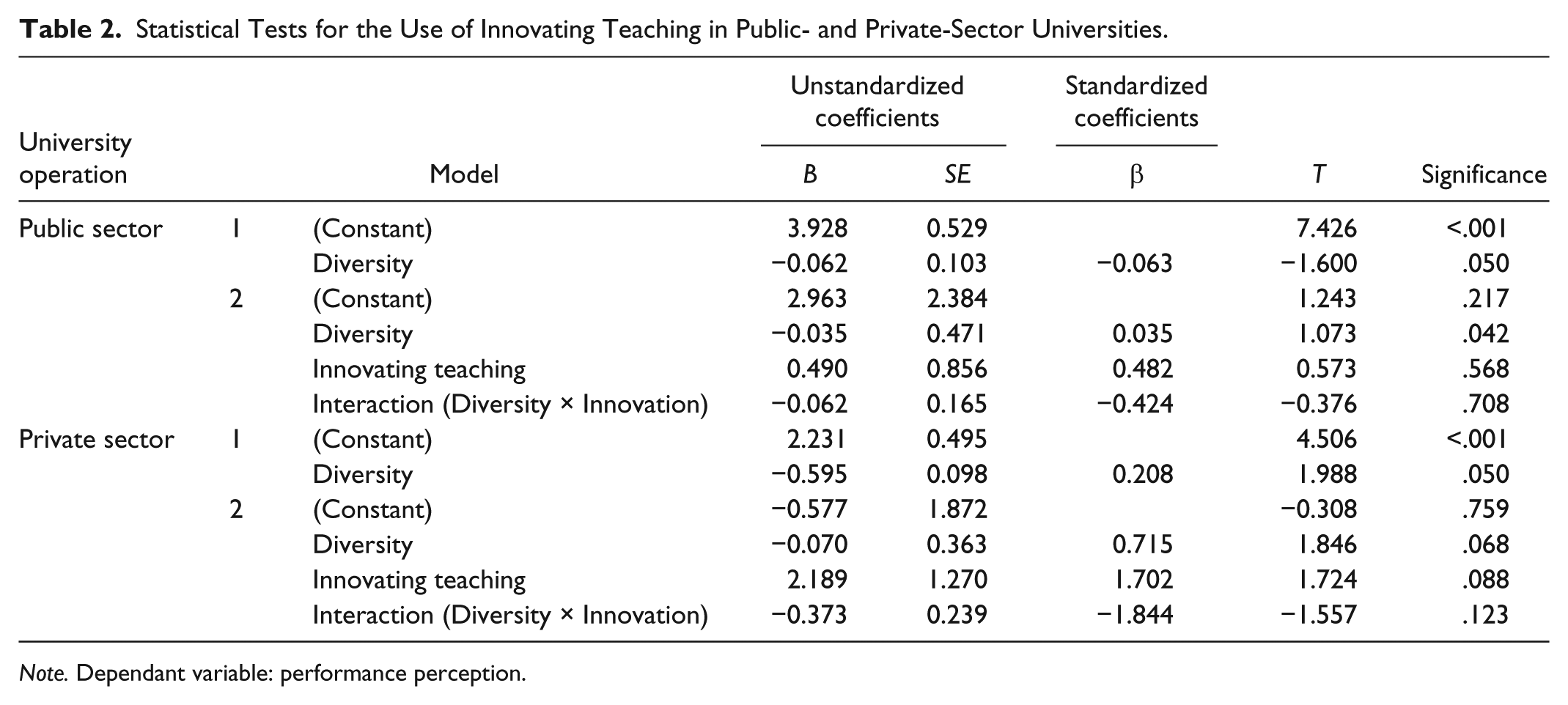
Note. Dependant variable: performance perception.
The statistical values depict that the innovation is more applied in private-sector universities than the public-sector universities (Table 2). This reject the hypothesis and statistically accept the use of innovative strategies more in the private sector than the public. It is also pointing toward the contribution and efforts of private sector for the improvement of education. This sector seems more conscious not only about imparting good education but also to meet the diversified needs of students.
Null Hypothesis 4
There is no difference in the use of innovative teaching in various disciplines (Table 3).
Statistical Tests for the Use of Innovative Strategies in Various Disciplines.

Note. Dependant variable: performance perception.
The statistical values reject the hypothesis and accept that in different disciplines, different levels of innovative strategies are being used. It has been found that the use of innovative strategies is more and highest in the discipline of humanities through mathematics which has the least value (Table 3). This may be due to the perception of the teachers of various disciplines. Teachers of humanities may find these strategies more effective and easy to use while the mathematics teachers are not aware of such strategies in their subject.
Hypothesis 5
There is no impact of class size on the effect of innovative teaching (Table 4).
Shows the Statistical Tests for the Impact of Class Size on the Effectiveness of Innovative Teaching.

Note. Dependant variable: performance perception.
The values shown in the table clearly talk about the impact of class size on the effectiveness of innovation, thus rejecting the hypothesis and agreeing that the class size decreases the effect of innovating strategies of teaching. The more the class size, the less will be the impact of innovative teaching.
Impact of Innovative Teaching at Higher Level of Education
Traditional teaching strategies clearly do not meet the needs of students’ diversity in a productive way. In a class where lecture is still the centerpiece of instruction and assessment is based on those specific lectures, it provides such an environment which supports learning only at surface (passive) level rather than at the deep (active) level (Marton & Säljö, 1976). According to Must, Jacques, Dallal, Bajema, and Dietz (1992), the traditional format encourages students to concentrate only on superficial indicators rather than on fundamental underlying principles, thus neglecting deep (active) learning. Active learning refers to experiences in which students have a deep understanding of the subject matter as they interact with the instructors as well as with each other (Gamson, 1991; McKeachie, 1999). Innovative teaching strategies such as active learning refer to a variety of collaborative classroom activities ranging from long-term simulations to 5-min comparative problem-solving exercises (Bonwell & Eison, 1991; Bonwell & Sutherland, 1996). Learning development is the process of meeting these needs. When teachers are more focused on subject matter and provide a structured learning support to the students, then more students with diverse needs show their interest and enhance their knowledge. Structured learning support is designed to provide assistance to help students’ learning development. For some, this means developing their IT skills, and for others, their language skills, employability skills, and so on (Cottrell, 2001). Many other innovative teaching strategies have been discussed by the researcher above, which serve as a solution for teachers to cater to the diverse needs of the students.
Conclusion
Runco and Albert (1990) say that the thinking of the children at all levels of ability is significantly influenced by the type of opportunities they are given. Offering learners the right chances to develop their cognitive and creative potential should be a priority in the design of curricula. A curriculum is the way in which domains of knowledge are made available to students (Craft, 2005), and it establishes a vision of the kind of the society which policy makers want and envisage for the future (Williamson & Payton, 2009). To foster innovative teaching, curricula need to undergo a skillful and thorough development, where teacher can adopt different innovative teaching strategies according to the diverse needs of the students. More students are now in Pakistan higher education than ever before, and they are also more diverse than at any time in the past. Students vary in their financial status, social class, family circumstances, and age; their previous educational experience, reasons for attending higher education, and aspirations and ambition; their religion, ethnicity, and nationality; and their abilities, disabilities, and special needs. The innovative strategies need to be implemented and should be modified according to the students’ needs.
Footnotes
Authors’ Note
Ms. Sonia Fareed is the author but the contributor
Declaration of Conflicting Interests
The author(s) declared no potential conflicts of interest with respect to the research, authorship, and/or publication of this article.
Funding
The author(s) received no financial support for the research, authorship, and/or publication of this article.