




Abstract
The purpose of this longitudinal study was to critically evaluate the updated Turkish reading curricula to determine whether they enable teachers to design instructional sequences that are highly cognitively demanding. This study was designed as a qualitative inquiry using document analysis to estimate the pedagogically oriented intellectual demands of the reading field’s curricular objectives. A total of 1,542 reading objectives were thoroughly examined and the generic picture of the longitudinal analysis shows that the objectives at the understand level dramatically dominate (49.3%) the reading instruction at the elementary and middle school levels. Approximately one-third of the objectives in the curricula were categorized at the remember level, indicating that the intellectual demands of the reading curricula predominantly focus on lower-order cognitive skills from elementary to middle school. None of the 1,542 reading objectives were classified at the create (0%) level. Only 9.26% of all objectives could potentially be utilized to design educational sequence requiring higher cognitive processing, such as at the analyze level. Similarly, only 3.04% of all objectives could be translated into instructional episodes that necessitate cognitive processes at the evaluate level by teachers. Educational recommendations are offered to teachers, curriculum developers, and educational policymakers.
Keywords
Introduction
Reading and comprehension are fundamental skills crucial for initiating learning and achieving academic success. These skills support content-area learning across all subjects (R. Smith et al., 2021), and students’ academic and career development hinge significantly on their reading abilities (Snow, 2002). The role of reading curricula is pivotal in guiding students toward attaining their reading goals (Crowe et al., 2009). In Türkiye, the curricula implemented before 2005 approached reading education primarily from a behaviorist standpoint, focusing on decoding and recognition skills. However, these earlier curricula lacked an analytical perspective essential for developing comprehensive reading skills. Consequently, a radical change was introduced in the Turkish curriculum in 2005, aimed at aligning with contemporary educational outcomes and ensuring students acquire proficient reading skills. This reform adopted a constructivist approach, and subsequent updates were made to the curriculum in 2006, 2015, and 2017. Despite these updates, it remains unclear to what extent the revised curricula over the years have integrated cognitive demands into reading instruction—a topic that has not been thoroughly explored in the literature.
One of the strongest predictors of reading achievement is the quality of reading curricula (Horning, 2007), as it establishes the framework within which students’ reading success is fostered. Despite the critical importance of reading skills, numerous studies indicate that students in Turkey, like their counterparts elsewhere, often fail to achieve desired proficiency levels (Elleman & Oslund, 2019; Irwin et al., 2022). For instance, results from the PISA exams since 2009 consistently show that fewer than 20% of Turkish students reach higher proficiency levels, consistently scoring below the OECD average (Bozkurt, 2016; Ministry of National Education [MoNE], 2019b, 2019c). Similarly, the ABIDE study conducted by MoNE in 2016 found that only 6.4% of eighth-grade students were categorized as advanced readers (MoNE, 2017b). These findings underscore the need for a critical examination of the role of the curriculum in shaping these outcomes and prompt a thorough evaluation of how reading is taught in Turkey.
Students’ cognitive performance is profoundly influenced by the instructional tasks teachers design, underscoring the importance of evaluating curriculum objectives and their impact on classroom practices. Exposing students to cognitively demanding tasks has the potential to enrich their cognitive engagement, highlighting the critical need to clearly define expectations and objectives. However, comprehensive studies exploring the intellectual demands of curriculum objectives in reading are notably lacking (Stevens et al., 2015).
Previous research on Turkish reading curricula (Büyükalan Filiz & Yıldırım, 2019; Çerçi, 2018; Erol & Kavruk, 2021) has been somewhat limited, often concentrating on individual curricula or comparing current and previous versions. Continuous comparative analyses are necessary to comprehend the evolving cognitive demands of curricula over time. This study aims to longitudinally examine Turkish reading curricula to track changes in their intellectual capacities, providing valuable insights for curriculum developers.
The purpose of this study is to assess whether the objectives of reading curricula enable teachers to create lessons that foster the development of enhanced cognitive capacities in students. This study is motivated by the understanding that the effectiveness of teaching methods and the intellectual rigor embedded within curriculum objectives profoundly influence students’ cognitive performance. Through an examination of the intellectual capacities embedded in the curricula, this study aims to ascertain the expectations set for students and evaluate the degree to which the curricula promote higher cognitive functions in reading.
Based on the above-mentioned justifications for the study, two research questions were addressed in this study:
Research Question 1: What are the intended reading curricula presumed or probable intellectual capacities to translate them into challenging in-class reading-based instructional activities?
Research Question 2: Were there embedded patterns or fluctuations in the intellectual demands of reading objectives from the initial to the latest curriculums?
Theoretical Framework
The theoretical framework of this study is grounded in theories (Kintsch & Kintsch, 2005; Kucer, 2014; Pearson & Fielding, 1996) that conceptualize reading as an interaction among text, reader, criterion task, and socio-cultural context, drawing upon Bartlett’s (1995) perspectives on meaning construction. This framework is aligned with the reading curricula in Türkiye from 2005, 2006, 2015, and 2017. These theories propose that the interplay of these four elements introduces complexity into reading (Stevens et al., 2015) and underscores the significant influence of socio-cultural context (Elleman & Oslund, 2019). For instance, while a reader might comprehend simple texts effortlessly, they may struggle with more complex texts on unfamiliar topics due to the impact of socio-cultural factors (Elleman & Oslund, 2019). These factors encompass cultural norms, societal expectations, linguistic variations, and the social context of both the author and the reader (Arya & Maul, 2021; Smagorinsky et al., 2020).
Reading comprehension extends beyond mere text decoding; it involves a dynamic process influenced by internal meaning-making and social interactions (Vygotsky, 1978). Readers construct meaning through internal dialogs shaped by their background knowledge, goals, and social context (Yang & Wilson, 2006). Social interactions with teachers, peers, and the text itself further enrich understanding (Nicholas et al., 2021). This highlights the crucial role of social and verbal interactions, as well as support from teachers and peers, in the development of reading skills, a perspective emphasized in the Turkish curriculum revisions (MoNE, 2005, 2006, 2015, 2017a). Teachers are pivotal in translating curriculum objectives into strategies that enhance students’ reading abilities, thereby creating and implementing intellectually challenging tasks. However, for this process to succeed, the curriculum itself must provide pedagogical opportunities. Therefore, this study critically evaluates whether the updated reading curricula enable teachers to design reading sequences that demand higher cognitive engagement.
In this study, to critique of the reading curricula integrates the concepts of target, task, and demand, examining how these aspects operate within the curriculum. Thus, the curricula are not viewed merely as static documents but as a dynamic guide (Schmidt et al., 2001) that direct teaching processes and serve as planning tools, including the development of effective teaching materials. Teachers rely on these guides to translate curriculum objectives into actionable classroom practices and tasks (Kim, 2019). Therefore, the current study defines the curriculum concept as encompassing both the plan for the learning experiences that learners will encounter and the actual experiences they engage with (Remillard & Heck, 2014, p. 707).
The intellectual demand inherent in teaching tasks designed by teachers reflects the level of cognitive processing required for students to engage in these activities (Tekkumru-Kisa et al., 2015). These teaching tasks, structured in accordance with curriculum objectives, function as organizational guides and cognitive tools (Remillard & Heck, 2014). The intellectual demand of a task is assessed by the complexity articulated in its stated objective. Evaluating the intellectual capacity of each curriculum involves scrutinizing its objectives and establishing connections between teaching tasks and these objectives (Lee et al., 2017).
Curriculum objectives can also be transformed into teaching tasks with different levels of intellectual demand (e.g., Objective-1: “… determines title(s) appropriate to the content of the text.” and Objective-2: “… produces different solutions to the problems addressed in the text.”). In brief, teachers’ design and execution of teaching tasks, in other words, classroom-based activities, are influenced by the pedagogical objectives underlying the curriculum. However, this influence is directly related to what the teacher may create with an objective that has low or high cognitive demands when it is transformed into a teaching process.
The revised Bloom’s taxonomy (RBT), as outlined by Anderson et al. (2001), provides a framework for assessing the cognitive processes required by curricula. This taxonomy categorizes cognitive tasks into six levels: remembering, understanding, applying, analyzing, evaluating, and creating. These levels are hierarchically structured, with lower cognitive demands (e.g., remembering and understanding) forming foundational skills that must be mastered before progressing to higher-level cognitive demands such as analyzing, evaluating, and creating. Tasks that require lower cognitive demands act as building blocks or prerequisites for engaging in more complex, higher-level tasks. The specifics of each category within the revised Bloom’s taxonomy will be detailed in the Methods section under the subsection titled “Determining the Embedded Intellectual Demands of the Curricular Objectives.”
Methods
Research Design
A qualitative inquiry method employing document analysis was chosen to investigate the intellectual demands embedded within reading curricular objectives. This method was selected to conduct a critical examination of how these objectives facilitate teachers in designing, planning, and implementing teaching sequences that require higher cognitive engagement. To put it differently, the purpose of this research was not only to depict a general description of the curricula objectives or to quantify the proportion of cognitive demands associated with them. Instead, the document analysis is geared toward emphasizing the theoretical underpinnings (Karppinen & Moe, 2019) and representing the substance of the curriculum in a nuanced manner. Given this objective, a theory-based analysis was employed to scrutinize the relationships among curricular objectives, instructional tasks, and the cognitive demands necessary for implementing intellectually challenging teaching practices.
Organizing Data Corpus
First and foremost, official permission was obtained from the responsible authorities before initiating the data-collection process. Subsequently, to gather the Turkish course reading objectives, the official website of the National Ministry of Education was accessed. Given the longitudinal nature of the study, efforts were made to compile data from multiple iterations of the curriculum. Therefore, reading curricula spanning from the first to the eighth grade announced in 2005, 2006, 2009, 2015, 2017, 2018, and 2019 were scrutinized through the lens of the revised Bloom taxonomy’s intellectual demands. A total of 1,542 curricular objectives were meticulously examined, with varying percentages attributed to each curriculum year: 2005 (18.26%), 2006 (3.41%), 2009 (18.26%), 2015 (12.37%), 2017 (15.90%), 2018 (15.90%), and 2019 (15.90%). The initial phase of the analysis involved data extraction and reduction. Despite official announcements of curriculum updates over the years, some objectives were found to be replicated either partially or entirely. For example, the 2009 curriculum largely duplicated objectives from the 2005 curriculum. Similarly, the 2018 and 2019 reading curricula included objectives similar to those in the 2017 curriculum. To ensure data accuracy, duplicated curricular objectives were identified and removed from the dataset, resulting in a final data pool prepared for meticulous analysis.
The Determine the Embedded Intellectual Demands of the Curricular Objectives
The revised Bloom’s taxonomy (RBT), as revised by Anderson et al. (2001), was employed in this study to assess the potential intellectual demands embedded within the reading curricula across various years. RBT consists of two dimensions: knowledge and cognitive processes. This study specifically utilized the cognitive process dimension, which includes six higher-order categories: remembering, understanding, applying, analyzing, evaluating, and creating. These categories are hierarchically differentiated based on the cognitive tasks they require Anderson et al. (2001). Additionally, within these six main categories, there are nineteen subcategories defined by specific action verbs that describe the cognitive processes involved. These subcategories further delineate the cognitive demands associated with each category (Figure 1).

The cognitive process dimension of the Revised Bloom's Taxonomy.
A person reaches a low cognitive demand, such as remembering, and then must try to process for attaining a high cognitive demand, such as analyzing or evaluating. To reach high-order cognitive demands, first, low intellectual demands must first be achieved. The tasks operated to success low cognitive demanding serve as a step to climb high order one. Therefore, an inner systematic was embedded in the RBT.
Remembering objectives focus on recalling factual information (e.g., answering basic questions from a passage). Understanding objectives require students to interpret, paraphrase, and represent information (through writing, speaking, or visuals). This level may also involve applying the content (e.g., giving examples, classifying, summarizing), making inferences, comparing concepts, or explaining cause-and-effect relationships. For instance, an objective might be: “… Students can infer the meaning of new vocabulary based on context clues in a passage …” This involves encountering an unfamiliar word, analyzing its relationship to the sentence, and then using context to guess its meaning.
Applying objectives require higher-order thinking. Students are expected to execute or apply processes, familiar or novel, to complete tasks. Teachers design activities that go beyond mere comprehension or recall. For example, an objective might be: “… Students can follow instructions to complete a multi-step task …” This involves understanding directions and executing them sequentially. Teachers can create lessons where students apply this by making instructional booklets (e.g., tool usage) or brochures outlining procedures (e.g., bicycle tire repair).
Analyzing objectives demand a high level of thinking. Students must deconstruct information, concepts, or ideas, identify their components, and understand their relationships within the whole structure. This includes distinguishing relevant from irrelevant details and identifying key points. For example, an objective like “… Students can identify contradictions in a text’s meaning …” requires analyzing relationships between parts of the text. Teachers can promote this by guiding students to understand the text’s meaning structure (word choice, fluency, coherence) to identify inconsistencies. This may involve separating contextually significant elements from irrelevant ones to build a cohesive understanding.
Evaluating objectives involve high-order thinking skills. Students make judgments based on criteria, evaluating, critiquing, or justifying concepts, arguments, or meaning-construction in written work. This includes assessing internal consistency (flaws within the text) and external consistency (alignment with external standards). For example, an objective like “… Students can assess how transitions contribute to a text’s meaning …” requires evaluating the effectiveness of transitions. Instruction can involve guiding students to analyze the text’s argument and supporting evidence, ensuring alignment and internal logic. This may involve both identifying inconsistencies and selecting appropriate evidence to justify their evaluation.
Creating objectives demand the highest cognitive level. Students generate new ideas or products, such as explanations, solutions, or hypotheses. Teachers can guide students to analyze information, identify problems, and propose evidence-based solutions. This goes beyond summarizing; students must create and justify original ideas. Furthermore, when students are engaged in a course built around a curricular objective at the level of creating, they may be required to create a cognitive product from a book they read. Students are required to establish an opinion essay when a teacher adopts a curricular target such as “… can evaluate the text in terms of content and design for improvement and reconsideration of the text based on its evaluation.” teaching process. For example, in one of the default teaching sequences, teachers might ask students to compose a critical and effective passage about the content of the text they read before and provide background reasons for why they composed such a passage. To do so, learners must develop a unique idea and define it. Students may need to use inductive and deductive reasoning to mentally create a critical and effective paragraph about the text’s subject. Creating a critical and effective passage about the content of the text is much more than composing a summary as a whole. Students must justify the passage’s required arrangement they create by attributing premises and inferences in inductive and deductive reasoning. As original critics, this may necessitate making connections between parts and wholes and from within and without the text while writing a section.
For some reason, the RBT was favored, including other evaluation tools. For example, Marzano and Kendall’s (2006) taxonomy was modified for maths by taking the rationality of Bloom’s taxonomy into account like G. Smith et al. (1996). Also, the Structure of the Observed Learning Outcome (SOLO) taxonomy (Biggs, 1995) was not maintained for this current research for some justifications. To begin with, the RBT is a widespread instrument because researchers use it to investigate various elements of mental processing or intellectual demand (e.g., Elmas et al., 2020; Toledo & Dubas, 2015). Second, teacher educators working in various inquiry sectors have a good understanding of the RBT. Third, RBT offers both a diagnostic and a bird’s eye picture of reading curricula’s intellectual potential.
Furthermore, educational investigators can rummage into each curricular objective individually using an analytical approach. On the other hand, RBT takes a holistic method and depicts trends in cognitive demand incorporated into the curriculum objectives.
Data Analysis and Trustworthiness of the Study
The data analysis consisted of three interconnected phases. First, the researchers carefully scanned an objective set in a reading curriculum. Researchers then made educational, experiential decisions to assess intellectual needs embedded in a goal. Finally, the researchers suggested the rationale for matching an objective proposition with the potential intellectual need when translating the goal into face-to-face teaching. Two researchers performed an initial analysis by pursuit the code assignment procedure as scan-estimate-justify. From grades 1 to 8, randomly selected 350 pedagogical objectives (n = 1,542; approx. 22.7%) from different curricula were analyzed, taking into account the scan-estimate-justify order. Technical disagreements were resolved through steady judgment and discussions of different interpretations from the triad (scan-estimate-justify): consideration/scanning of a target> teaching translation: identification of a presumed class-internal implementation based on the structural, semantic and pedagogical content of the objectives> determination of a valued intellectual demand to the goal. The left-over 1,192 objectives were analyzed individually by two researchers. Conclusively, 350 arbitrarily chosen thinking-determining diagrams, comprising personally justified representations of the analyzed objectives, were reconsidered for predicting anticipating inter-coder reliability. At the outset, inter-coder reliability consistency was 79%. Significantly, the coders had trouble assigning codes to the objectives pitched at the evaluate and create levels. Some contradictions were solved by considering exclusively mutual meanings on the identical objective (final consistency coefficient: 92%).
To confirm the validity of the analyses and interpretations, two educational researchers willingly checked the analyzed data, replacing them with external audits. External audits served as a peer review, ensuring that data analysis and interpretation were controlled. Audits acted as the devil’s advocate (Morse, 2015) and honestly corresponded coders. Auditors took notes on comments and asked exact questions, using analysis booklets to pressure corresponded coders to review their initial comments. As a result, auditors checked both the account’s process and its product, continually assessing its correctness (Morse, 2015). After receiving revision proposals from external audits, final determinations were made considering the scholastically positioned cognitive demands of the curriculum objectives. Eventually, systematic remarks were quantified to obtain a more comprehensive picture of the cognitive demand’s distribution through the reading curricula. This was important to provide a general view of the distributions of intellectually demanding curriculum objectives that were low, medium, and high.
Limitations
Even though the research was designed with a holistic approach, only the reading curricula released between 2005 and 2019 were considered in the study. This means that curricula between the first curriculum of the Republic of Türkiye in 1924 and the 1997 curriculum, which was the last curriculum before 2005, were excluded. Although this provides comprehensive information about the curricula of the last 18 years, it does not allow for a complete picture.
In addition, this study was conducted by focusing on only one of the four basic language skills (the reading curriculum). This makes it necessary to examine the other language skills chronologically using a similar method. A longitudinal and critical study of Turkish writing curricula conducted by Tavsanli et al. (2023) and mentioned the importance of examining reading curricula as well. In this respect, it is thought that these studies, which will be conducted by considering different language skills, are important in terms of providing a more holistic perspective.
Results
Results Related to the RQ1
To address this question, we analyzed the 2005, 2006, 2015, and 2017 reading curricula, focusing on how their cognitive demands have evolved over time and their potential to support challenging instructional activities.
Trajectory of Reading Curricula Over the Years
2005 Reading Curriculum
The 2005 reading curriculum included 279 objectives. The analysis revealed a strong emphasis on lower-level cognitive skills (remembering and understanding) in grades 1 to 3. Grade 4 maintained a similar distribution but showed an increase in analytical objectives. Grades 4 and 5 displayed a balanced distribution with understanding still dominant, but also opportunities for applying and analyzing skills (around 25% each). However, higher-order thinking skills such as evaluation and creation were absent. Over 87% of all objectives were categorized as “remember” and “understand,” while only 12% supported higher cognitive demands (“apply” and “analyze”). There were no objectives that facilitated “evaluate” or “create” skills (see Table 1 and Figure 2).
The Accumulation of the Objectives in the 2005 Curriculum Regarding Intellectual Demand.

*Weighted averages.
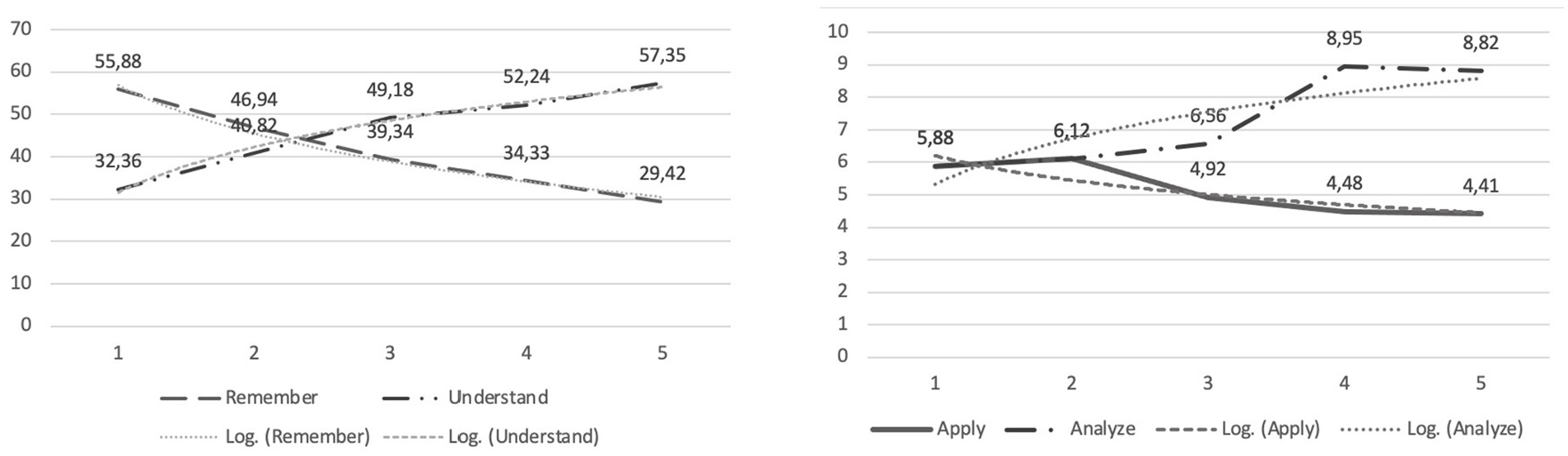
Presumable cognitive levels of the reading objectives observed in the 2005 curriculum.
2006 Reading Curriculum
The 2006 curriculum for grades 6 to 8 showed a similar trend, with 75% of objectives dedicated to lower-level skills (remembering and understanding). Although there was a slight presence of applying (10%) and analyzing (10%) skills, the curriculum still lacked objectives promoting creating skills, with only 4% of objectives involving evaluation (see Table 2 and Figure 3).
The Accumulation of the Objectives in the 2006 Curriculum Regarding Intellectual Demand.

*Weighted averages.

Presumable cognitive levels of the reading objectives observed in the 2006 curriculum.
2015 Reading Curriculum
The 2015 curriculum (195 objectives) continued to focus on lower-level cognitive skills in grades 1 to 4. In these grades, perception objectives (remembering and understanding) dominated at around 90%. A slight shift was observed in grades 5 and 6, where “analyze” objectives appeared (9% in fifth grade, 19% in sixth grade). However, “apply” and “create” objectives were still rare. Grades 7 and 8 showed a reduction in higher-order thinking skills, with a decrease in “analyze” objectives and continued absence of “apply” and “create” objectives (see Table 3 and Figure 4).
The Accumulation of the Objectives in the 2015 Curriculum Regarding Intellectual Demands.

*Weighted averages.

Presumable cognitive levels of the reading objectives observed in the 2015 curriculum.
2017 Reading Curriculum
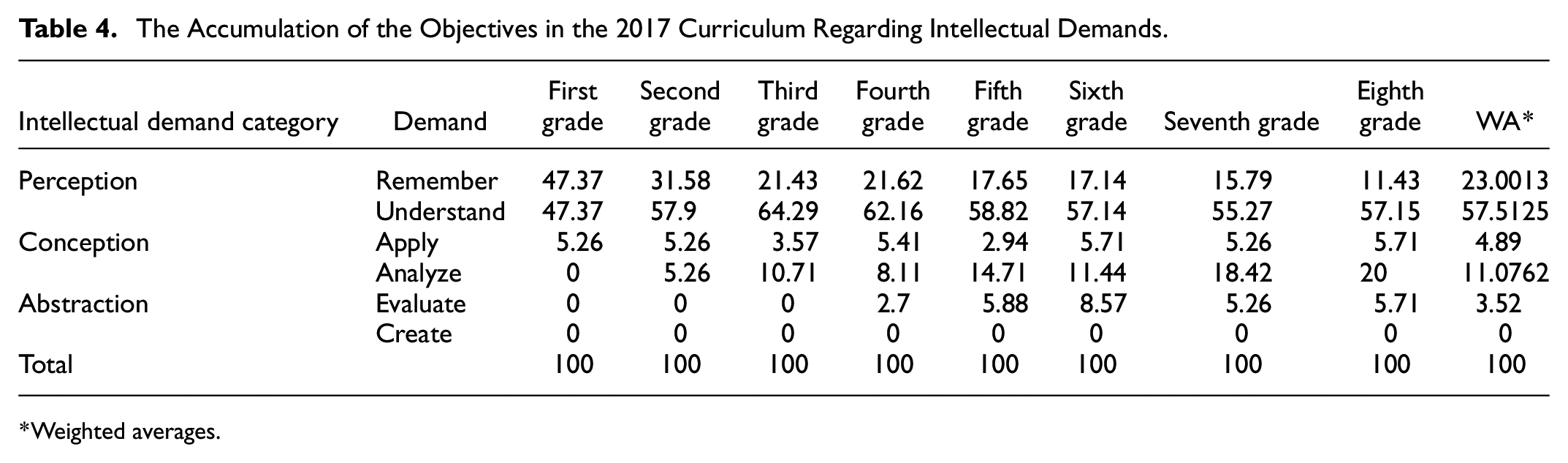
The 2017 curriculum followed a similar pattern, with lower-level skills (remembering and understanding) dominating in grades 1 to 4. In grades 5 and 6, there was a slight decrease in perception objectives and a rise in analyzing and evaluating objectives (around 20% combined). However, opportunities for applying and creating skills remained limited across all grades (see Table 4 and Figure 5).
The Accumulation of the Objectives in the 2017 Curriculum Regarding Intellectual Demands.
*Weighted averages.

Presumable cognitive levels of the reading objectives observed in the 2017 curriculum.
Vertical Interpretations Across Years
Across all years, a consistent trend was observed where lower-level cognitive skills were emphasized, especially in early grades. There was a gradual introduction of analytical skills in upper grades, but higher-order skills like evaluation and creation remained significantly underrepresented. This trajectory indicates a persistent gap in the curricula’s ability to develop advanced cognitive skills required for challenging in-class activities.
Horizontal Interpretations Across Years
When comparing the horizontal distribution of cognitive demands across different years, a noticeable trend is the persistent dominance of lower-level skills. The “remember” objectives showed a decrease from grades 1 to 5, while “understand” objectives increased. However, the progression was not systematic. The “apply” and “analyze” categories showed fluctuations, with no clear pattern emerging across different curricula. The “evaluate” objectives increased slightly in the later grades, but the absence of “create” objectives was consistent across all curricula, indicating a lack of support for the highest cognitive demands.
Results Related to the RQ2
Figure 6 provides an overview of the accumulation of cognitive capacities in the reading curricula. Analyzing 1,542 reading objectives, it was found that objectives at the “understand” level dominated (49%) the teaching of reading from primary to middle school. Approximately one-third of the objectives were at the “remember” level, indicating a low overall cognitive demand. Only 9% of the objectives supported higher-order cognitive processes (“analyze” level), and 7% could be used for “evaluate” level intellectual demand. No objectives supported the “create” level.

Dispersion of potential intellectual demands across the explored curricula.
Vertical and Horizontal Accumulations
Figure 7 illustrates the trendlines of curricular objectives’ cognitive demands over the years. The domination of lower-level cognitive skills (“remember” and “understand”) remained steady. Higher-order cognitive demands (“analyze” and “evaluate”) showed inconsistencies, suggesting that curriculum developers did not systematically consider these distributions when revising the curricula. The lack of objectives supporting the “create” level across all years further highlights this gap.
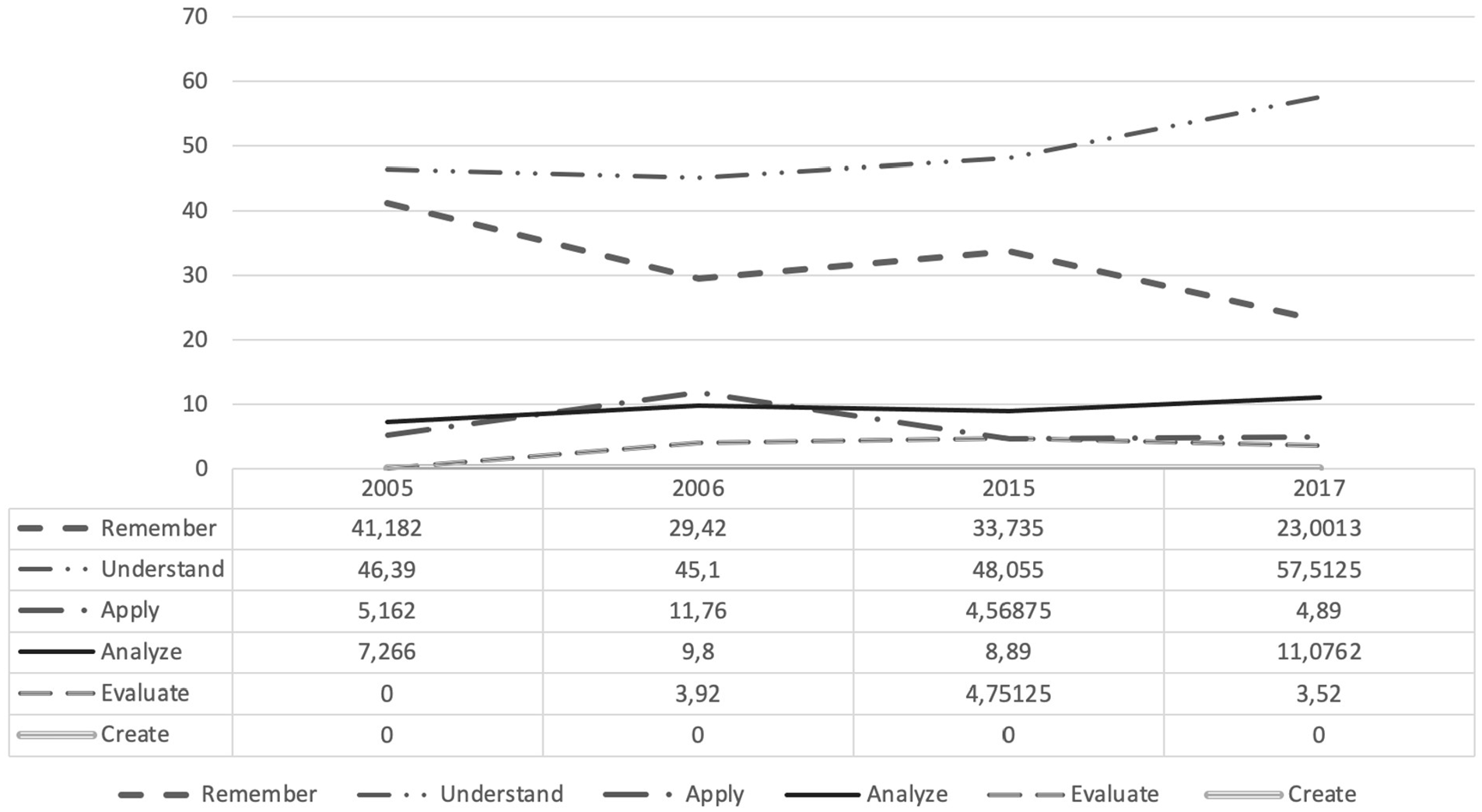
The reading curricula s estimated intellectual demands over years.
Discussion
The analysis in this study reveals that since 2005, the reading curriculum has been dominated by objectives focused on perception, specifically remembering and understanding. The 2005 curriculum primarily emphasized these lower-level cognitive skills, resulting in limited opportunities for students to develop higher-level mental processing abilities. Subsequent curricula maintained this focus, with objectives in the perception category continuing to dominate. Studies by Kara and Ulutaş (2018) and Çerçi (2018) confirm that the 2018 Turkish curriculum largely targets the understanding level, while Aslan and Atik (2018) observed that objectives for first to fourth grades in the 2015 and 2017 curricula also primarily aim at remembering and understanding. Additionally, textbooks and workbooks for second to fourth grades lack cognitively challenging tasks (Ulum & Taşkaya, 2019). This trend indicates a curriculum that prioritizes lower-level cognitive skills, potentially impeding the development of critical thinking and higher-order abilities essential for success in the 21st century. Therefore, a curriculum revision to encompass a broader range of cognitive demands is necessary to enhance student engagement and learning outcomes.
Durukan and Demir (2017) discovered that the cognitive demands of activities in sixth, seventh, and eighth-grade student workbooks predominantly fall within the perception category. Their findings suggest that curriculum-based objectives, especially those related to reading skills, may not effectively translate into cognitively demanding tasks, activities, or instructional processes. Consequently, reading curricula developed since 2005 may not adequately support teachers in designing instruction that challenges students cognitively. This limitation significantly impacts the quality of the reading instruction process (Tekkumru-Kisa et al., 2015). These insights highlight the critical need for a comprehensive review of curricula, emphasizing the incorporation of higher-order thinking skills. Such a review should also focus on equipping teachers with the necessary resources and support to effectively implement these objectives and create engaging and intellectually challenging learning experiences for students.
Given the findings of this study, it appears that the cognitive demands outlined in reading curricula may adversely affect students’ higher-level cognitive functions, such as organizing, planning, judging, monitoring, self-regulating, making connections, questioning, summarizing, and inferring (Bereiter & Scardamalia, 1987) during their reading process. Analysis, evaluation, and creation categories, considered higher levels of cognitive processing, are notably underrepresented in the distribution of curricular objectives over the years. This current scenario appears inconsistent with the Turkish Qualifications Framework (TCF), integrated into the curriculum since 2017. The framework’s first domain emphasizes mother tongue communication, encompassing expressive and interpretive skills across various contexts (MoNE, 2017a, 2018, 2019a), which are integral to the current reading curriculum. Mastery of these skills requires the acquisition of complex abilities, yet the study reveals that the curriculum inadequately guides teachers in designing instructional tasks that foster high cognitive demands necessary for effective reading-to-learn practices.
The distribution of “apply” level objectives in reading curricula shows a declining trend, especially noticeable after the 2006 curriculum release. The 2017 curriculum reveals a significant decrease in objectives requiring this level of cognitive demand. However, reading skills necessitate cognitive processes such as applying reading strategies, analyzing texts, synthesizing information, and understanding text structures. It would therefore be expected that more objectives at the “apply” level would be included in reading curricula.
Aslan and Atik (2018) noted numerous “apply” level objectives in primary school Turkish lesson curricula from 2015 and 2017. Büyükalan Filiz and Yıldırım (2019) found a substantial presence (34.20%) of “apply” level objectives in the 2018 middle school Turkish course curriculum. Similarly, Çerçi (2018) discussed that 28.42% of the 2018 curriculum objectives were at the application level, across different learning areas. However, inconsistencies in these findings may reflect discrepancies between curriculum developers or evaluators.
A detailed examination of reading curriculum objectives reveals that certain verbs or sentence structures may mislead researchers in assessing cognitive demands. For example, a fourth-grade objective in the 2017 curriculum states “… reads with attention to emphasis, intonation, and pronunciation.” While this may imply an application-level cognitive demand, a closer analysis according to Bloom’s Revised Taxonomy indicates it primarily requires remembering rules of stress and intonation.
This decline in “apply” level objectives within reading curricula raises concerns. While some argue for their inclusion due to inherent cognitive demands in reading comprehension, current wording may overstate the actual cognitive challenge. Aligning objective language with Bloom’s Revised Taxonomy is essential to ensure clarity and promote the development of critical “apply” level skills in students.
When the distribution of the objectives, which are considered to be at the analyze level, according to years, is examined, it is seen that there is an incremental tendency, albeit partial. While the rate of objectives at this cognitive demand level was 7.26% in the program published in 2005, this figure increased to 11.07% in the curriculum published in 2017. In the curricula published since 2005, it has been determined that the limited number of objectives at the cognitive demand evaluate level show a decremental tendency. The incidence of both the analyze and the evaluate cognitive demand level shows that the intellectual demands of the objectives included in the reading curricula are heterogeneously distributed. This study assumes that a more homogeneous distribution of cognitive demand levels of objectives throughout the reading curriculum should be provided by program developers (Peterson & Taylor, 2012). Thus, it is envisaged to detect an incremental tendency in the objectives observed at the analyze and evaluate levels to implement more homogeneous curricula. However, as stated above, the number of objectives with high cognitive demands seems to have decreased gradually, and it has been determined that intellectual demands show a heterogeneous distribution. This finding is inconsistent with directing students to “research, discover, interpret, evaluate, analyze and mentally construct knowledge through reading and writing” (p. 12), expressed in the 2017, 2018, and 2019 curricula. Kara and Ulutaş (2018), Erol and Kavruk (2021), and Çerçi (2018) found in their studies that the 2018 Turkish language curriculum objectives are heterogeneously distributed in terms of cognitive demand. Similarly, Aslan and Atik (2018) concluded a few objectives with high-level intellectual demands in the 2015 and 2017 Turkish language curricula. Various studies (Durukan & Demir, 2017; Karakaş Yıldırım, 2020; Ulum & Taşkaya, 2019) show that official textbooks published in Türkiye were filled with lower demanding activities. Therefore, the studies carried out in the literature confirm the heterogeneity thesis of the current study.
This uneven distribution of cognitive demands across analyze and evaluate levels within the reading curricula is concerning. While a slight increase in analyze-level objectives is observed, the overall trend remains inconsistent with the stated curriculum goals of fostering higher-order thinking skills. This disconnects between stated intentions and the actual cognitive demands placed on students necessitates a curriculum redesign that prioritizes a balanced distribution of objectives across Bloom’s Revised Taxonomy, ensuring students develop the critical thinking skills necessary for deeper comprehension and knowledge construction.
Similar results have been reached in research conducted in countries outside of Türkiye. In their study, Rahpeyma and Khoshnood (2015) examined the learning objectives of Iranian junior high school English textbooks according to Bloom’s taxonomy and found that there were very few objectives with higher-level intellectual demands. Researchers (Muhayimana et al., 2022) who analyzed the cognitive demands of questions assessing reading comprehension in the native language on exams conducted with primary school students in Rwanda, according to Bloom’s taxonomy, also discovered that no questions were posed to students in the analysis, evaluation, and creation categories. Similarly, Dalkılıç and Büyükahıska (2021), who examined the Secondary School English Curriculum in Türkiye, discussed that all reading skill acquisitions were located in the remember and understand categories.
Studies on reading and comprehension emphasize the need for cognitive activities like detecting inconsistencies and evaluating the author’s language (Cooper et al., 2015; Serravallo, 2015). However, the current study reveals a theory-practice gap in the curriculum’s ability to develop these skills. Objectives at the evaluate and create levels are particularly scarce, undermining the development of crucial higher-order skills.
No objectives were observed at the create level in the reading curriculum. It is understood that some objectives that will be at the create level in curricula are replaced with low cognitively demanding objectives (e.g., remember, understand). Studies examining the cognitive demands of activities and questions in Turkish textbooks (e.g., Durukan & Demir, 2017; Karakaş Yıldırım, 2020; Ulum & Taşkaya, 2019) reached similar results and found that there were very few in-class activities or questions recommended to teachers at the create level. This trend is also evident in reading curricula. These findings suggest that in the national context when moving from one reading syllabus to the next, the former did not undergo critical evaluation for the development of intellectual capacity. Turkish reading curriculum developers or evaluators might also be quite aware of the above-mentioned cloning process. The complete absence of “create” level objectives in the reading curriculum is particularly alarming. This not only hinders the development of crucial creative thinking skills but also suggests a lack of critical evaluation during curriculum revisions. A shift toward objectives that encourage students to generate new ideas, solve problems, and construct knowledge is essential to foster deeper learning and prepare students for the demands of the 21st century.
The study mentioned above’s findings could significantly impact reading instruction. The results of national and international studies (MoNE, 2019b, 2019c; OECD, 2014, 2016, 2019) show that Turkish students’ reading comprehension achievement levels are not at the expected level, they do not have the qualities of “good readers,” they do not spare time to read books other than the time they spend at school, and they remain indifferent to reading. The 2016 and 2018 reports (MoNE, 2017b, 2019b, 2019c) of the ABIDE project, in which the academic achievements of students studying at the fourth and eighth-grade levels are monitored and evaluated, revealed that approximately 7% of Turkish students exhibit high-level reading skills. PISA results also support the finding. In the evaluation carried out in 2015, it was determined that 6.30% of Turkish students had high-level reading skills, and this rate increased to 16.80% in 2018.
Although there is an increase in the rate of students displaying high-level reading skills, the rate of students who exhibit basic skills in reading or fall below this cognitive demand is striking. It was determined that 72.60% of Turkish students in the 2015 PISA report and 56.30% in the 2018 PISA report were at this level. In other words, most Turkish students either exhibit basic skills or have difficulties understanding what they read. Although there are other possible reasons for the emergence of this picture, it is thought that the tasks of the curriculum that do not require high cognitive demand are also effective. Considering all these, it can be said that the present study also produces a sharper depiction of reading instruction in the national context.
Although the cognitive demands of the objectives in the curricula show a heterogeneous distribution, it has been observed that there are partial increases in the curriculum objectives with high cognitive demands. Still, there is no break, and the trends do not differ sharply. In other words, it can be said that curriculum developers perceive the curriculum development process as a cloning activity in updating and developing the curriculum. Learner competencies determined at national and international levels emphasized the importance of verbal and written communication in the mother tongue (MoNE, 2017a, 2018, 2019a; Queensland Curriculum and Assessment Authority, 2022). However, the current study shows that the reading curricula published since 2005 are not a qualified instrument for teachers to upskill oral and written communication competence in the mother tongue to their students. It is also known that Turkish teachers have little knowledge about the content of the curriculum, how to use it effectively, or how the objectives should be evaluated (Yıldırım et al., 2017). Therefore, it is estimated that teachers most likely implement their latent reading curriculum in their classrooms. However, this is not just a curricular problem. Updating the curriculum and incorporating more cognitively demanding objectives alone is not enough. Both curriculum developers and teacher educators need to provide teachers with professional-pedagogical development on designing high-level reading tasks and choosing the best way to implement them.
The study also addresses the lack of methodologically sound research focusing on the intellectual demands of reading curricula (Kaldirim & Tavsanli, 2023; Tavsanli et al., 2023). Previous evaluations of curricula have been limited in scope and lacked a comparative analysis over time (Çerçi, 2018; Durukan & Demir, 2017; Ulum & Taşkaya, 2019). The study aimed to provide a holistic understanding of the curricula’s intellectual capacity by conducting a longitudinal examination of a pool of curricula and the current study concludes that the reading curricula fail to provide teachers with intellectually challenging tasks for teaching higher-order reading skills. It strongly recommends conducting a needs analysis and intentionally including intellectually demanding curriculum objectives.
Conclusions and Educational Implications
This study concludes that the current reading curriculum does not effectively support teachers in creating intellectually challenging tasks that promote critical thinking, hypothesizing, self-evaluation, identifying key points, evaluating language, and detecting inconsistencies—skills requiring high-level mental processing. There is a pressing need for a thorough needs analysis and intentional integration of intellectually demanding objectives into future curricula revisions. Curriculum development and evaluation must be research-based to provide insights for Turkish curriculum developers, educational researchers, and teacher educators. Immediate action is required to ensure that curricular objectives explicitly align with classroom practices that foster higher-order reading skills. A prioritized task is to re-examine all curriculum objectives from a design-based and objective-oriented perspective to ensure they adequately reflect the cognitive demands expected and facilitate structured course sequences.
Teachers are the first implementers of the curricular objectives. It is highly recommended that teachers do not become isolated members of the curriculum development and evaluation society. Teachers should be trained as reflective practitioners of the curricula (Schön, 1987). Thus, teachers should be able to critically read, interpret and analyze curriculum objectives to create more effective learning designs for students within the scope of curriculum goals. Teachers should be expected to be recognized as critical analysts, just like researchers, and to be able to identify and interpret the cognitive demands of a reading curriculum. However, we are also very aware that curriculum-based teacher noticing (Sherin & Jacobs, 2011) would be more attainable by engaging teachers in longitudinal professional development programs. Thus, teachers altered into inspectors, adjudicators, critiquers, and legitimators of the reading curriculum.
Footnotes
Declaration of Conflicting Interests
The author(s) declared no potential conflicts of interest with respect to the research, authorship, and/or publication of this article.
Funding
The author(s) received no financial support for the research, authorship, and/or publication of this article.

Data Availability Statement
Data sharing not applicable to this article as no datasets were generated or analyzed during the current study.