




Abstract
This study attempts to explore how Entrepreneurial Orientation (EO), Customer Orientation (CO), and Technology Orientation (TEO) affect Mass Customization Capacity (MCC) where the Intellectual Capital (IC) is considered as a mediating variable in this model. Considering that MCC equips companies with the agility, integration, and resource flexibility needed to thrive in a dynamic business landscape, this is the first study which aims to contribute to the dynamic capability theory and resource-based view by developing new conceptual model which incorporates IC as a competitive resource of the firms. This is also the first study that aims to develop a conceptual framework by adding TEO as a key dimension of strategic orientation in order to improve MCC. While prior studies have explored the independent effects of these elements, this work unveils how a firm’s strategic direction can influence the effectiveness of its intellectual capital in bolstering its ability to deliver customized products. This novel framework provides deeper insights into how firms can strategically leverage their intellectual assets to achieve success in the dynamic landscape of mass customization. Cross-sectional data were collected from 175 Iranian manufacturing firms. The Confirmatory Factor Analyses (CFA) is used to check the validity of the multiple-item measures and Structural Equation Modelling (SEM) is applied to test the research hypothesis. The results indicated that EO, CO, and TEO have a positive and significant effect on MCC. It is also found that IC partially mediates the relationships among all dimensions of strategic orientation and MCC. Our findings suggest that a company with higher intellectual capital can improve MCC by choosing the best type of strategy according to the industry in which they are active. Insights from findings also enable policymakers to design policies that encourage innovation in production processes and technologies, investing on research & development in relevant technologies or infrastructure projects that support efficient MC logistics and create regulations that protect consumer data and encourage sustainable practices within MC processes.
Keywords
Introduction
Today, competition in all industries continues to increase significantly, and organizations understand that achieving profitability is difficult in a volatile and competitive market. In the late 19th century, the emergence of mass customization as a new paradigm led companies to be able to meet their customers’ needs perfectly through fundamental changes in the processes of production, design, delivery, and recycling (Bosr & Dulio, 2007). Pine (1993) explained the paradigm shift of companies from mass production to mass customization by observing nine industries. He argued that mass customization would become the dominant new economic production system that will increasingly segment markets. Mass customization offers products and services with high volume, high variety, and low cost to the customer in such a way that the customer can personally modify and adjust the basic elements related to the products and services within the types of models that are already offered by a brand (Bosr & Dulio, 2007; Sandrin et al., 2014; M. M. Tseng & Jiao, 2001).
Although several studies (Migdadi, 2022; Sandrin et al., 2014; M. M. Tseng & Jiao, 2001; N. Wang, 2021) have been conducted on mass customization capacity (MCC), few have focused on the relationship between an organization’s type of strategy and MCC (Pollard et al., 2008; Q. Wang et al., 2015). A strategic orientation creates the basic principles that have a special application in the operational activities of a business (Tutar et al., 2015). Combining these principles with suitable behaviors can lead to companies achieving their desired results. In other words, strategic orientation ensures the performance of companies in terms of operations and their position in the market (C. H. Tseng et al., 2021). Q. Wang et al. (2015) stated that a company should study and analyze factors encountered in the external and internal environments of the organization to improve customization ability and balance operational goals. Indeed, producers should endeavor to choose an appropriate strategic orientation to help them offer high-quality customized products in the market.
However, increased competition, technological advances, the development of new sectors in organizations, and the unique economic conditions of the last decade have meant that the competitive advantage of an organization is no longer tied to tangible assets (Pechlivanidis et al., 2022). Intellectual capital enables a company to use employees’ knowledge and expertise to the relevant market and customers to create flexible production systems and launch new products tailored to the needs of customers, thereby improving operational capabilities and MCC (Madhavaram & Hunt, 2017; Piening & Salge, 2015; Trentin et al., 2012; Zhang et al., 2017). Many firms in Iran fails to participate in an increasingly competitive global market since they are far behind from tremendous technological leaps, the lack of appropriate strategy and inadequate attention to the intangible resources. Besides, small and medium firms in Iran often fail to compete in the domestic market since they have more limited financial resources compared to the well-known companies. Therefore, the high attention to intellectual capital as an important intangible asset of the firms, the broader the scope for gaining competitive advantage.
Several research has found that the firms can enhance MCC by investing in flexible manufacturing systems that can adapt to a wider range of product variations (Margherita & Braccini, 2020). Additionally, leveraging technologies such as customer relationship management (CRM) software (Ullah & Narain, 2020) and online design tools (Mourtzis et al., 2014) can streamline the customization process and improve efficiency. However, there is room to determine what is the optimal strategic approach for the firm’s customization offering? Does intellectual capital improve customization capacity through optimizing an appropriate strategic approach? Does a firm’s strategic orientation influence the development and utilization of its intellectual capital?
Unlike previous study conducted by Q. Wang et al. (2015), this is the first study that aims to develop a conceptual framework by adding technology orientation as a key dimension of strategic orientation in order to improve MCC. This is also the first model that attempts to explore and test the mediating role of intellectual capital among three types of strategic orientation and MCC in which human capital and customer capital have been used to measure intellectual capital that have been neglected in previous research (Madhavaram et al., 2021). Developing from resource-based view (RBV) (Herden, 2020) argue that knowledge creation, transfer and integration which are discussed as knowledge-based view, enable firms to gain sustainable competitive advantage by involving intangible assets within an organization (Lakshman et al., 2023; Tarighi et al., 2022; Teng, 2011). By drawing insight from knowledge-based view, to theorize that IC is essential for manufacturing companies to develop and implement appropriate strategies for competitive advantage, this paper enriches the RBV literature by indicating different effects of IC on MC capacity. This paper also aims to contribute to the dynamic capability theory by exploring how customization capability allows a company to adjust its offerings, processes, or even organizational structure for catering and evolving customer needs, technological advancements, or market fluctuations. We also contribute to the RBV literature by exploring how three components of SO effect on MCC through which IC could be utilized to mediate the relationships among variables within the proposed model. In so doing, the results of this paper finally offer critical insights by indicating that Iranian manufacturing firms could benefit from their competitive resources such as IC in order to develop an appropriate SO to enhance their MCC and respond quickly the customer specification better than their competitors.
By considering the role of intellectual capital, the present study targets Iranian companies that are customizing their products in a large scale to answer how they can improve their customization capacity by implementing the ideal type of strategic orientation. For this purpose, the relationships among the three dimensions of strategic orientation (entrepreneurial, customer, and technology orientation) and MCC are analyzed, and intellectual capital is measured as a mediating variable. Below, this paper provides a comprehensive and detailed discussion of the relevant literature in order to develop a conceptual model (see Figure 1). The paper subsequently clarifies the research methodology and design, and the analysis results are presented and discussed in detail. Finally, several implications based on the findings are outlined, followed by limitations and suggestions for future research.

Conceptual model.
Literature Review and Hypothesis Development
In the dynamic and competitive market condition, every company has to advance its position and strategies in line with the market changes and apply its potential internal and external resources in order to success among competitors The hypothesis development in the current study has been stablished on two main theories of dynamic capability and resource based view. Dynamic capability is conducted by Teece et al. (1997) and refers to the firm’s ability to integrate, build and reconfigure internal and external resources for responding to the rapidly changing environments (Pitelis et al., 2023). From the dynamic capability view (DCV), the first step for adoption to the dynamic market is identifying market demands, creating opportunities, and lightening threats which is defined by sensing capacity (Al-Darras & Tanova, 2022; Pitelis et al., 2023). The next step which is taking advantage of these opportunities refers to seizing capacity (Teece, 2023). Finally, continued renewal of resources and business model, knowledge generation, and organizational structure refers to the reconfiguring capacity. These elements are considered as the foundation for hypothesis development in the current study.
On the other hand, according to the resource-based view (RBV), competitive advantage is driven from valuable, rare, imitable, and non-substitutable resources of the firm (Sa et al., 2020). Inspired by that RBV attempt to clarify the relationship among firm’s resources and offer an appropriate combination of those resources in order to boost competitive advantage (Estensoro et al., 2022), this paper relies on the intangible assets to develop hypothesis which will be disused by following sections.
Mass Customization Capacity (MCC)
The concept of customization was first introduced by Davis (1989), who described it as a company’s ability to provide flexible and integrated products and services through a separate product design for each customer. Compared to mass production, which offers a high volume of standard goods, mass customization offers a large volume of customized goods according to the specific needs and tastes of its customers (Ullah & Narain, 2021). The number of papers focusing on mass customization has increased since the publication of a review article by Da Silveira et al. (2001). Fogliatto et al. (2012) claimed that the development of customer interaction strategies and emerging web-based configurators and advanced technologies (Hakala & Kohtamäki, 2011) reveal the importance of the operational (Kortmann et al., 2014; Liu et al., 2012) rather than the conceptual (Piller, 2004) aspects of mass customization.
M. M. Tseng and Jiao (2001) stated that identifying customer needs related to functional requirements is indispensable for all businesses. Therefore, a company that wishes to offer customization must be able to understand customers’ needs and preferences well and turn them into functional requirements. According to scholars in the field, mass customization effects some aspects of organizational goals in particular such as customer value creation, customer satisfaction, firm performance, and product innovation (Jitpaiboon et al., 2013; Kortmann et al., 2014; Liu et al., 2012). Reichwald et al. (2000) and Ullah and Narain (2021) noted that the goal of mass customization is to produce and deliver goods and services that can best meet the needs of customers in line with their specific tastes, as well as be able to make the optimal link between efficiency and economies of scale. Researchers have developed a consensus view that MCC indicates the ability of a company to produce and deliver a high volume of products with wide variety in the shortest time possible such that no exchanges in costs, quality, and delivery occur (e.g., MacCarthy et al., 2003; Sandrin et al., 2014; Tu et al., 2004; Zhang et al., 2019).
Strategic Orientation and Mass Customization Capacity
Recently, globalization and the competitive environment have led organizations to adopt a particular strategy in order to survive in the volatile market. The kinds of strategies companies adopt to suit their organizational goals have always represented an important challenge for decision-makers in these firms.
Strategic orientation was first developed by Kohli and Jaworski (1990) who suggested that companies could achieve a competitive advantage by analyzing the market and implementing market-oriented and innovative strategies. Adams et al. (2019) defined strategic orientation as the strategic direction and decisions that a firm pursue to achieve better business performance through appropriate behaviors. Tutar et al. (2015) indicated that companies should use strategic behavior in order to compete in a volatile market and create a competitive advantage (Di Zhang & Bruning, 2011) through identifying and analyzing intelligence (Cacciolatti & Fearne, 2013) and use them to create new knowledge within the firm (Adams et al., 2019).
According to the previous research (e.g., Basu & Gupta, 2013; Hakala, 2011; Morgan & Strong, 2003), there are three approaches to strategic orientation. The first is the narrative approach, which entails verbally explaining the general nature of the strategy and is related to the unique characteristics of a given situation and organization. This type of approach emphasizes quantitative analysis through case studies (Basu & Gupta, 2013). Another approach involves categorizing companies’ strategies based on conceptual and empirical arguments that have been made in the past (Morgan & Strong, 2003). Finally, a comparative approach aims to capture different dimensions of business strategy according to the features that are common to all organizations (Chatzoglou et al., 2011). Since this approach considers the specific dimensions of strategic orientation, it overcomes the empirical limitations of the classification method (Morgan & Strong, 2003). Q. Wang et al. (2015) consider the customer, the competitor, and innovation as the key features of strategic orientation. Tutar et al. (2015) considered the three dimensions of entrepreneurial orientation, market orientation, and technology orientation, believing that strategic-oriented companies rely on entrepreneurial orientation and market orientation (Tang & Tang, 2003) and strive to utilize their internal resources (Kanaan-Jebna et al., 2022) in order to enhance firm performance. The focus of the present paper is the three dimensions of customer orientation, entrepreneurial orientation, and technology orientation.
In marketing terms, customer orientation as a business philosophy seeks to increase the profitability and productivity (Voigt et al., 2011) of a firm by collecting and promoting market intelligence in order to meet customer needs (Feng et al., 2019). A customer-oriented firm attempts to disseminate information about customers throughout the organization (Tajeddini, 2010), utilizing this knowledge to carry out the ideal strategies and tactics for meeting customers’ needs (Blocker et al., 2011; Kanaan-Jebna et al., 2022). Customer orientation as a behavioral component of market orientation (Tutar et al., 2015; Zhao, 2022) triggers employees’ learning and reinforces firms’ knowledge about the market, customers, and competitors (Q. Wang et al., 2015). From the dynamic capability view, El Hanchi and Kerzazi (2020), believe that monitoring, capturing and disseminating market opportunities are strongly linked with innovation concept which can foster the growth of employees’ courage to offer innovative solutions in terms of new product developments. Various studies have been conducted to investigate the effect of strategic orientation and its dimensions on MCC. In their research, Q. Wang et al. (2015) indicated that the effects of strategic orientation on MCC are tied to both the growth and maturity stages of the product life cycle (PLC). For instance, they found that competitor orientation had a stronger effect on MCC at the maturity stage of a product’s life cycle, while the effects of customer orientation on MCC were significant in both the maturity and growth stages, highlighting the key role of customer orientation in the context of MCC. Customer-oriented firms with deep knowledge of their customers and those customers’ preferences are able to improve the performance of their new products (Voigt et al., 2011) since they can offer customizations to meet customer requirements better than their competitors. Such processes may thus enable firms to reinforce their capability in customizing products. Consistent with these arguments, we suggest the following hypothesis:
H1a. Customer orientation positively affects mass customization capacity.
Entrepreneurship creates suitable opportunities to the producers to gain a competitive advantage in the market (Dollinger, 2008). An entrepreneurial firm creates the conditions and innovative atmosphere (Hassan et al., 2021) necessary to allow employees as entrepreneurs to perform all individual and group activities in an innovative manner (Prajogo, 2016). Miller (2011) identified the following three characteristics of firms with an entrepreneurial orientation: (a) continuous innovation in products and services, (b) risk-taking, and (c) active behavior. Hassan et el. (2021) noted that proactiveness, innovativeness, and risk-taking as the key features of entrepreneurial orientation (Anwar et al., 2021; Covin & Wales, 2012; Lumpkin et al., 2010) should be further considered at an individual rather than firm level to enable employees to facilitate innovative activities within the firm (Aljanabi, 2018; Gupta & Gupta, 2015). Indeed, innovation which is the unique feature of entrepreneurial orientation (Covin & Wales, 2012; Song et al., 2019) helps manufacturers utilize new knowledge and methods for offering products to their customers (Mostafiz et al., 2023) through product and process innovation (Kim et al., 2012). Since entrepreneurial-oriented firms possess a high capability to adopt new products for improving MCC (Jitpaiboon et al., 2013; Q. Wang et al., 2015; Z. Wang et al., 2016), they can benefit from both innovative and common customer ideas by engaging their employees in process innovation (Ogawa & Piller, 2006). According to the review of the literature above, we hypothesized the following:
H1b. Entrepreneurial orientation positively affects mass customization capacity.
Using DC terminology, sensing and seizing capacity have been used as an empirical yardstick to enable firms for learning, integration and reorganization (S. Min & Kim, 2022; Mikalef & Pateli, 2017) through adopting with new technology in order to enhance the speed and effectiveness of the organizational response to the unpredicted changes in market condition. A firm with a technology orientation focuses on R&D investment in order to enhance their innovation capability (Masa’deh et al., 2018). Deshpandé et al. (2013) stated that technology-oriented companies focus on R&D and strive to launch new products using new technologies. In their research, Shan and Jolly (2013) stated that R&D units in companies that pursue technology orientation will be able to meet customer needs (Hemmert et al., 2023; Sun & Lee, 2022) through new product development. Subsequently, the importance of adopting this type of strategy becomes more apparent for companies attempting to customize their products, as they would be able to introduce new processes, products, and services to their customers (Al-Ansari et al., 2013) and meet their customers’ specific needs on a large scale. Margherita and Braccini (2020) have suggested that flexible manufacturing technologies lead to switching between product lines with minimum cost penalty, thereby enhancing flexible production processes and product variety while maintaining high production volume and high-quality products. Johnson and Ettlie (2001) stated that firms with high R&D expenditures are able to ameliorate customer specifications because of emerging new technology. They found that customization becomes a more notable approach in these firms since the role of technological advances becomes more apparent in improving customer requirements. Kirner et al. (2009) inferred that medium- and high-tech firms (R&D expenditure > 3%) focus more on process innovation in order to improve customer preferences, which helps them to launch customized products. Consistent with these arguments, we hypothesized the following:
H1c. Technology orientation positively affects mass customization capacity.
Intellectual Capital and Mass Customization Capacity
With the passage of the traditional economy, most scientific attention is directed toward a knowledge-based economy in which wealth is created through the optimal use of knowledge (Beltramino et al., 2020), which means the effects of financial capital on firm performance has faded over time (Pulic, 2004). Indeed, the competitive success of companies depends to a lesser extent on their physical resources and to a greater extent on their strategic allocation of intellectual capital. Intellectual capital is defined as an intangible and knowledge-based asset, which was first proposed and developed by Galbraith (1969). Using intellectual capital as a form of knowledge, organizational technology, practical experience, professional skills, and customer relationships can be combined to create a competitive advantage and show the intangible value of a given organization (Beltramino et al., 2020; Bontis, 2001; Lu et al., 2021; Singh & Rao, 2016; Tarighi et al., 2022). Human capital as part of intellectual capital (Rehman et al., 2022) refers to the knowledge, skills, and attitudes of the individuals within an organization (Edvinsson & Malone, 1997; Obeidat et al., 2021; Russ & Catasùs, 2014), created by the competence of employees and offering innovative solutions for various problems (Obeidat et al., 2021). Human capital is particular to each organization and cannot be replicated by other firms, which can provide a competitive advantage for an organization (Bontis, 2001). Since human capital reflects the level of awareness and knowledge of employees as well as their technical expertise and skills, it enables firms to enhance their positioning in the market and with customers (Zhang et al., 2017). Customer capital as another dimension of intellectual capital is closely related to individual and organizational levels including group knowledge, which is derived from a communication network (Jalali et al., 2014) and tends to convert intellectual capital into market value and thus firm performance (Stewart, 2010). Researchers have identified some items such as market share, customer information, customer relationships, market-related knowledge, and distribution channels as components of customer capital (e.g., Bontis, 2001; Walsh et al., 2008). The third dimension of intellectual capital is structural capital, which refers to the efficient structure and system of a firm, which increases the ability of an organization to be creative (Beltramino et al., 2020) and allows employees to reach their highest intellectual capacity (Torres et al., 2018). Scholars believe that a given firm’s set of strategies, work systems, internal processes, organizational charts, and other assets not related to human capacity fall into the category of structural capital (e.g., Al-Jinini et al., 2019; Beltramino et al., 2020; Edvinsson & Malone, 1997). The current research attempts to use these dimensions to measure intellectual capital as a construct for the proposed model.
The specialized knowledge and skills of employees and their experiences with the market and customers (Lee, 2011) enable producers to continually seek to develop new processes based on customer needs (Zhang et al. 2015) and use them to improve customization capacity (Migdadi, 2022). Söllner (2010) noted that the level of innovation in a company is associated with human capital resources. Accordingly, firms benefiting from high levels of intellectual capital driven by efficient processes and structures (Rehman et al., 2022) are able to strengthen their innovation capacity so that they can achieve process innovation (Beltramino et al., 2020) and offer new products to meet customer requirements better than their competitors. This finding is consistent with the previous research conducted by Zhang et al. (2017), who concluded that human capital enhances MCC in a firm by boosting the employees’ ability to offer innovative solutions, generate new ideas, and provide a better environment for innovation activities (Latifah et al., 2022), thereby ensuring the launch of customized products and meeting of specific customer needs. Madhavaram and Hunt (2017) and Madhavaram et al. (2021) also found that the knowledge of a firm’s employees about customers that falls into a firm’s intellectual capital has a direct and significant impact on product customization and thus the enhancement of MCC. Hence, we hypothesized the following:
H2: Intellectual capital has a positive effect on mass customization capacity.
Strategic Orientation, Intellectual Capital, and Mass Customization Capacity
Firms can achieve a competitive advantage in the market when they properly adopt a suitable strategy according to external and internal factors. Scientists have recently sought to theorize a resource-based approach, paying particular attention to knowledge-based assets (e.g., Barney, 2001; Edvinsson & Malone, 1997; Obeidat et al., 2021). Intellectual capital enhances an organization’s ability to modernize their database and foster their dynamic capability to compete in the industry (Rodrigo-Alarcón et al., 2018). The type of firm strategy can affect the firm’s intellectual capital and ameliorate their MCC in different ways.
First, a customer-centric firm actively gathers customer insights through surveys, feedback mechanisms, and market research (Zhao, 2022). This information becomes valuable knowledge about customer preferences and buying behaviors which can be used to train employees based on specific customer needs. Therefore, it fosters innovation in product design, production processes (Mostafiz et al., 2023), and marketing strategies to cater to those needs which causes for developing new processes and systems that facilitate customization. This could involve designing modular products, creating flexible production lines, or implementing efficient order processing for customized goods. Indeed, customer insights empower employees to develop solutions, operate flexible production systems (Madhavaram et al., 2021), and interact effectively with customers during the customization process. Sa et al. (2020) examined the impact of customer orientation on the knowledge creation process and the firm’s performance in the tourism industry. They found that a customer-oriented company can obtain a new business perspective by creating new knowledge and combining it with existing knowledge. Accordingly, this type of intangible asset provides ideal awareness of customer requirements (Hanifah et al., 2022) so that a firm can offer new and customized products and improve its MCC. Hence:
H3a: Customer orientation positively affects intellectual capital.
H3b: Intellectual capital explains the relationship between customer orientation and mass customization capacity.
Second, an entrepreneurial-oriented company endeavors to focus on being innovative and taking risks (Anwar et al., 2021), seeking to implement innovative processes to achieve the highest level of firm performance (Morgan & Strong, 2003). Scholars believe that these types of firms use aggressive and high-risk methods in decision-making and have a strong tendency to embrace new ideas to gain new resources (e.g., Zhou, Gao, Yang, et al., 2005). Innovation and proactiveness, which are unique features of an entrepreneurial-oriented firm (Kanaan-Jebna et al., 2022; Lumpkin et al., 2010), enhance innovative activities among employees by involving them in production processes (Vidic, 2018), leading to the strengthening of the knowledge-based resources and intellectual capital of the firm. In essence, EO improves knowledge creation (Vidic, 2018), which is then captured and leveraged by intellectual capital to enhance a firm’s mass customization capabilities. EO also leads to the development of new processes, designs, and technologies (Yu et al., 2023) that are stored as structural capital and encourages employee to struggle for increasing their knowledge about mass customization. Indeed, intellectual capital acts as a bridge, translating the innovative spirit of EO into practical tools and processes for mass customization. Madhavaram et al. (2021) found that knowledge-based resources provide a lucrative opportunity for a manufacturer to launch customized products according to the needs of consumers through the knowledge and skills available in the company, thereby potentially developing MCC in the organization. According to these arguments, we hypothesized the following:
H4a: Entrepreneurial orientation positively affects intellectual capital.
H4b: Intellectual capital explains the relationship between entrepreneurial orientation and mass customization capacity.
Finally, a technology-centric firm prefer to equip employees with the necessary technical skills to utilize and innovate with new technologies (Margherita & Braccini, 2020). This builds a strong knowledge base within the organization which can be a powerful tool for problem-solving and exploration. When a company prioritizes technology, it often fosters a culture of experimentation and critical thinking, further enriching human capital (Latifah et al., 2022; Sumiati et al., 2023). Such firms necessitate investment in infrastructure like software, hardware, and data management systems that becomes a core asset, part of an organization’s structural capital. A strong technology orientation alone might not guarantee successful mass customization. This is where the role of intellectual capital becomes part of the deal. It helps transferring competitive technology into practical capabilities (Keskin et al., 2022) through skilled employees who can operate and maintain the new technologies, and develop innovative ways to use them for customization. In other word, a firm can better exploit the potential of new technologies for mass customization which allows them to efficiently produce a wider variety of customized products while maintaining economies of scale. On the other hand, high R&D intensity, a unique feature of technology-oriented firms (Masa’deh et al., 2018), can boost firms’ value and intangible assets (B. S. Min & Smyth, 2016). These companies attempt to use new equipment in products and operational processes to produce new goods and achieve a competitive advantage in the market (Alerasoul et al., 2022; Masa’deh et al., 2018). They focus more on R&D investment in order to gain competitive advantage so that they can become more successful in knowledge creation and product innovation (Padgett & Galan, 2010; Wu et al., 2008) and consequently more efficient in MCC enhancement compared to their competitors. According to these arguments, we hypothesized the following:
H5a: Technology orientation positively affects intellectual capital.
H5b: Intellectual capital explains the relationship between technology orientation and mass customization capacity.
Methodology
Sampling and Data Collection
The target population in this research included manufacturing companies in Iran. The list of active companies in Iran was prepared by the Ministry of Industry, Mine and Trade (S.A.M.T Organization, 2020), which indicated 31,243 companies in total; the sample size was calculated as 380 based on Cochran’s formula (Cochran, 1977).


The data collection period in this study was from January to Jun, 2022 and based on single respondents, known as key informants in industrial marketing research (Balloun et al., 2011). Researchers using this method attempt to engage highly knowledgeable employees in a given organization to conduct data collection (Marshall, 1996). Accordingly, top-level managers were targeted since they are more informed about the relevant research constructs. In keeping with this, we sent a contribution letter to 380 companies randomly in order to determine if they were willing to participate in this survey. After receiving responses from 356 companies (see Table 1) willing to participate, a questionnaire along with the research’s conceptual model and a cover letter were sent to the participants through email and on-site presence. The interview method was also used for those participants who found ambiguities in some measurement scales in the questionnaire. Finally, 192 questionnaires were returned, of which 175 were usable; a response rate of 53.9% was obtained, which is above the 20% reasonable rate according to Malhotra and Grover (1998).
Profile of Respondents.

We divided the sample into two groups, with the early respondents assumed to be the participants who responded to the questionnaire before the first reminder and the late respondents assumed to be those who replied after the first reminder. A paired t-test was conducted to identify response bias (Armstrong & Overton, 1977), and the results revealed no significant differences between the early and late responses (p > .05).
Measures
The measures in this survey are perceptual, as in the previous research (e.g., Huang et al., 2008; Tu et al., 2004; Q. Wang et al., 2015; Zhang et al., 2017). To measure MCC, six items developed by Tu et al. (2001) and Q. Wang et al. (2015) were used. For measuring customer, entrepreneurial, and technology orientation as the dimensions of strategic orientation, three, six, and five items were used, respectively, also similar to previous research (e.g., Q. Wang et al., 2015; Zhou, Yim, Tse, 2005). Finally, to measure the intellectual capital included in human, customer, and structural capital, four items were used for each of them that were similar to those used in previous surveys (Cegarra-Navarro & Sánchez-Polo, 2008; Zhang et al., 2017). All items were measured on a 5-level Likert scale, and the respondents were asked to determine how intensely they agreed with each statement, with a 1 indicating “strongly disagree” and a 5 indicating “strongly agree” (see Appendix A).
In addition, the questionnaire has designed to collect data on the firms’ demographic profile such as gender, age and industry sector. The size of companies is not considered in our proposed model since the previous research (Q. Wang et al., 2015; Z. Wang et al., 2016; Zhang et al., 2017) found non-significant effect for the firm size as a control variable.
Data Analysis and Results
Confirmatory factor analysis (CFA) was applied to check the validity of the multiple-item measures. CFA is a method that shows how many items of measurement of a given structure have been properly selected. In the present work, this method was used to determine whether the questions selected in a questionnaire to measure each factor were appropriate (Harrington, 2009). Structural equation modeling (SEM) using bootstrapping with 5,000 resamples was also run to test the hypotheses and the mediating role of intellectual capital. SPSS 26 and SmartPLS 3 were used to analyze the data in this survey.
Measurement Model
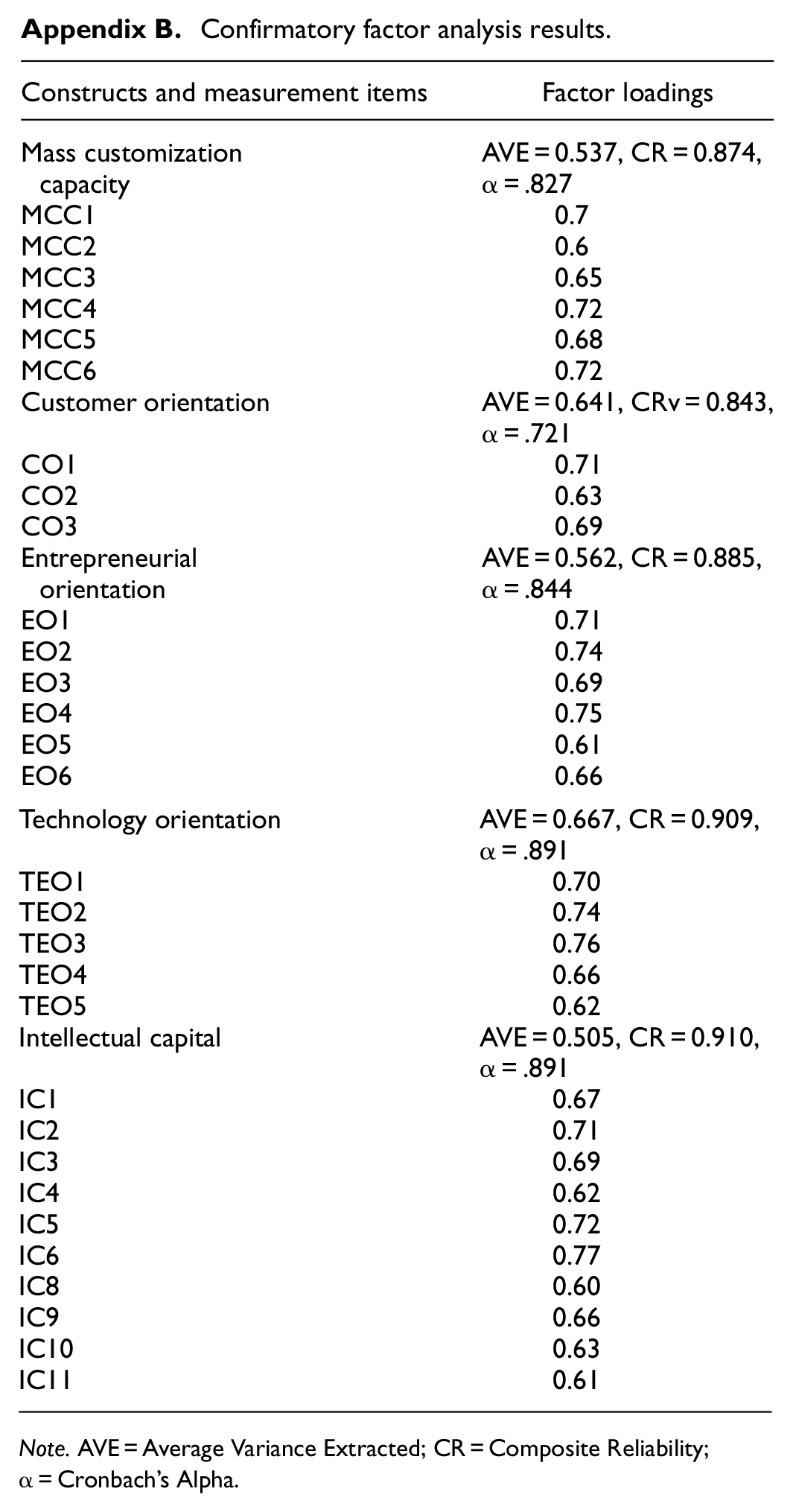
The results of the CFA model indicated that all factor loadings were significant (p < .001) and above the 0.6 suggested by Awang et al. (2015), excepting IC7 and IC12 by 0.54 and 0.40, respectively. Therefore, these questions were eliminated from the model, and the new results are presented in the Appendix B. The overall model fit indices (CFI = 0.986, CMIN/DF = 1.082, RMSEA = 0.022, PCLOSE = 1.000, NFI = 0.932) were accepted according to the relevant literature (e.g., Carmines, 1981; Bentler & Bonett, 1980). The values of the average variance extracted (AVE) were above the recommended value of 0.5 suggested by Fornell and Larcker (1981). These findings illustrate good convergent validity.
The Cronbach alpha values ranged from 0.721 to 0.891, and the composite reliability values were 0.874 for MCC, 0.843 for customer orientation, 0.885 for entrepreneurial orientation, 0.909 for technology orientation, and 0.910 for intellectual capital (see Appendix B). These values were all greater than the threshold value of 0.70 suggested by Bruton et al. (2000) and Hair Jr et al. (2021) and demonstrated that the construct was reliable.
In addition, the heterotrait–monotrait (HTMT) Test was established to check discriminant validity. The results (see Table 2) demonstrated that discriminant validity was met, as all values were below 0.85 (Franke & Sarstedt, 2019).
Discriminant Validity—Heterotrait-Monotrait Ratio (HTMT).

Note. MCC = Mass Customization Capacity.
Structural Model
Structural equation modeling was run to test the hypotheses and demonstrate the relationships among the variables (see Figure 2). Smart-PLS software through both Consistent PLS Algorithm and Bootstrapping has been used for further analysis. Table 3 reports the results by which the R-squared for intellectual capital and mass customization were .450 and .711, respectively, and indicates that the model explained 45% of the variance of IC and 71.1% of the variance of MCC. We have also run Consistent PLS Algorithm to check the effect size (F-squared) in the structural model and indicated that the

The results of structural model.
Direct Relationship Results.

Note. MCC = Mass Customization Capacity; CO = Customer Orientation; EO = Entrepreneurial Orientation; TEO = Technology Orientation; IC = Intellectual Capital.
To check the mediation role of intellectual capital, bootstrapping analysis was performed to find the indirect and total effects among the variables (see Table 4). The indirect effect of customer orientation on MCC through intellectual capital was significant (t = 2.069, p < .05). Hence, there was partial mediation through intellectual capital since the direct effect in this path was significant. The indirect effect of entrepreneurial orientation on MCC through intellectual capital (t = 2.852, p < .01) and that of technology orientation on MCC through intellectual capital (t = 3.738, p < .001) were significant. Therefore, partial mediation was also found in these relationships. These findings demonstrate that H3b, H4b, and H5b were supported.
Mediation Analysis Results.

Note. MCC = Mass Customization Capacity; CO = Customer Orientation; EO = Entrepreneurial Orientation; TEO = Technology Orientation; IC = Intellectual Capital.
Robustness Checks
Since the process of data collection in management and social sciences studies is typically based on a questionnaire and from a single source (Lee et al., 2011), researchers seek to increase the confidence of their research findings and prevent biased results. In the current research, we used two means of increasing confidence in our findings. First, we checked for the effect of common method variance (CMV), defined as “systematic error variance shared among variables measured with and introduced as a function of the same method and/or source” (Richardson et al., 2009, p. 763). Based on Harman’s single factor test (Podsakoff et al., 2003), the results revealed that the unrotated first factor was 34.88%, which was lower than the threshold values of 50%. Thus, we can conclude that CMV was not an issue in the model. We also conducted a full collinearity test (Kock & Lynn, 2012) in order to assess common method bias by measuring variance inflation factors (VIFs). According to Kock (2015), if VIFs in the inner model are equal to or lower than 3.3, we can assume that the model is free of common method bias. The results generated by Smart-PLS showed that all VIFs in the inner model ranged from 1.412 to 1.847, showing no indication of common method bias in our model.
Second, the nonlinearity effects (Svensson et al., 2018) among the relationships in the model were tested using a quadratic effect model. The results of bootstrapping for nonlinear effects—between (a) CO, EO, and TEO on intellectual capital (IC); and (b) CO, EO, TEO, and IC on MCC—were not significant (see Table 5), thereby rejecting nonlinearity effects among all relationships in the structural model. Consequently, we can assume that the linear effects model was robust.
Nonlinear Effect Results.

Discussion
Theoretical Contribution
Achieving a competitive advantage in a volatile and dynamic market has become a vital goal of organizations in order to survive among competitors. After a detailed discussion about the relevant literature, we found customization to be one of the sources of competitive advantage (Madhavaram et al., 2021) that can be an effective solution to the challenges (highly sophisticated technologies, unpredictable demands, extremely large production systems, intense competition between companies, etc.) a manufacturer faces in the production process. We also found that firms willing to offer customized products should implement suitable strategies based on their potential and existing resources to enhance their customization capacity. Accordingly, we attempted to examine factors such as strategic orientation and IC in strengthening and increasing mass MCC. Although a prior study (Q. Wang et al., 2015) found that customer orientation increased MCC both directly and indirectly through organizational learning, they neglected the impact of technology orientation as a vital dimension of strategic orientation. Accordingly, our findings contribute to the existing literature related to strategic orientation and its role in improving MCC, whereby technology orientation is included in the proposed model. The results revealed that customer orientation (CO), entrepreneurial orientation (EO), and technology orientation (TEO) have direct impacts on MCC.
From the resource-based view, our findings advance the current literature by indicating that firms with entrepreneurial and technology orientation could seek out market opportunities and strengthen the advantages of knowledge-based resources (Wiklund & Shepherd, 2003) through innovation and creative behaviors among individuals if they consider intellectual capital and actualize their rare, imitable and unique resources. Furthermore, the high level of risk-taking and the desire to use new technologies as well as high R&D intensity in these types of organizations (Kirner et al., 2009; Wu et al., 2008) were shown to persuade them to try new production processes and launch risky investments, facilitating product and process innovation which improve flexibility and responsiveness of operations and enhancing MCC (Zhang et al., 2017).
From the dynamic capability theory, the firms with high focusing on their strategic orientation can develop dynamic capabilities—the ability to sense, seize, and reconfigure resources—to effectively implement mass customization by embracing experimentation and opportunity. This adaptability allows them to respond swiftly for changing customer preferences and market trends, ultimately strengthening their competitive advantage in the dynamic landscape of mass customization. Customer feedback also allows for continuous improvement of the customization process, ensuring it remains aligned with evolving desires. This iterative cycle of understanding, designing, and refining driven by customer orientation, strengthens a company’s dynamic capabilities, allowing them to adapt and thrive in a competitive environment.
On the other hand, since the employees of a customer-oriented firm are always communicating with customers to obtain the highest level of knowledge about their specifications (Voigt et al., 2011), they may be able to develop organizational operations such as MCC and respond quickly to their customers’ requirements. This is also the first study that contribute to the intellectual capital literature by clarifying insights into how different levels of intellectual capital affect customization capacity among companies with various types of strategies. From the knowledge-based view, our findings provide supporting evidence for not just focusing on tangible and financial resources but using intellectual capital as the valuable resources that are unique to the firms and individual levels in order to build a strong framework for enhancing MCC. In other word, expert employees with high level of knowledge about market and customers, cooperative relationship among employees and customers and written operational procedure as the competitive resources within the firms enable manufacturers how to creatively design and develop new products (Karadag et al., 2023) based on customer specifications and providing insights into the current understanding on how to improve MCC (Huang et al., 2008; Liu et al., 2012; Migdadi, 2022; Sandrin et al., 2014; Trentin et al., 2012; Ullah & Narain, 2021; N. Wang, 2021; Zhang et al., 2017). Indeed, we can conclude that firms with a high level of intellectual capital and knowledge-based assets are more efficient at building MCC by choosing and implementing appropriate strategies that are proportionate to their organizational goals.
Practical Implications
Based on the results of this study, we offer some suggestions for manufacturers. First, we suggest that the needs and preferences of customers should be well identified; these needs should then be properly incorporated into new processes and designs. For this purpose, firms should have high investment and allocate more resources to R&D in order to boost the processes of knowledge creation and transfer the resulting knowledge to the employees. In doing so, they can launch new products and respond to their customers faster than their competitors in a dynamic market, which leads to gaining competitive advantage. Second, firms should increase the level of organizational innovation through boosting individual involvement and using the creative ideas of employees as innovative solutions for the issues that may occur in production processes so that they can offer new and customized products to meet customer requirements in a competitive market. Third, manufacturers should apply a suitable platform based on online systems in order to involve customers in the production process and benefit from their ideas and opinions in all stages of production. Fourth, managers should be able to measure their potential and existing intellectual capital to facilitate innovation processes and consequently improve their capacity for customizing products. Finally, considering several issues—such as being up to date with new technologies, establishing innovation teams, building flexible production systems, and using social technology and online interactive product configurators—allow firms to be more effective in increasing and improving MCC.
Limitations and Future Directions
This study has several limitations. First, intellectual capital and its mediating role were comprehensively considered, with human capital, structural capital, and customer capital used to measure intellectual capital; it would be useful for the effects of each dimension to be separately included in a model for future research. Second, features and characteristics such as risk-taking, proactiveness, and autonomy (Covin & Wales, 2012) belonging to entrepreneurial orientation were not included in the model; however, in future research, it would be interesting to include such measurements. Third, the data collection in this study was based on single respondents, which may affect the results. Therefore, using a multiple-respondent technique could be interesting for future researchers. Fourth, a questionnaire was used in this research, which can have flaws and lead to biased results. Hence, the findings would gain more credibility by using other methods such as interviews and using deeper case studies in subsequent research. Finally, this research has only focused on manufacturing firms; hence, investigating the impact of these variables on service companies, especially the tourism and hotel industries, would be suitable for future research.
Footnotes
Appendices
Confirmatory factor analysis results.
| Constructs and measurement items | Factor loadings |
|---|---|
| Mass customization capacity | AVE = 0.537, CR = 0.874, α = .827 |
| MCC1 | 0.7 |
| MCC2 | 0.6 |
| MCC3 | 0.65 |
| MCC4 | 0.72 |
| MCC5 | 0.68 |
| MCC6 | 0.72 |
| Customer orientation | AVE = 0.641, CRv = 0.843, α = .721 |
| CO1 | 0.71 |
| CO2 | 0.63 |
| CO3 | 0.69 |
| Entrepreneurial orientation | AVE = 0.562, CR = 0.885, α = .844 |
| EO1 | 0.71 |
| EO2 | 0.74 |
| EO3 | 0.69 |
| EO4 | 0.75 |
| EO5 | 0.61 |
| EO6 | 0.66 |
| Technology orientation | AVE = 0.667, CR = 0.909, α = .891 |
| TEO1 | 0.70 |
| TEO2 | 0.74 |
| TEO3 | 0.76 |
| TEO4 | 0.66 |
| TEO5 | 0.62 |
| Intellectual capital | AVE = 0.505, CR = 0.910, α = .891 |
| IC1 | 0.67 |
| IC2 | 0.71 |
| IC3 | 0.69 |
| IC4 | 0.62 |
| IC5 | 0.72 |
| IC6 | 0.77 |
| IC8 | 0.60 |
| IC9 | 0.66 |
| IC10 | 0.63 |
| IC11 | 0.61 |
Note. AVE = Average Variance Extracted; CR = Composite Reliability; α = Cronbach’s Alpha.
Declaration of Conflicting Interests
The author(s) declared no potential conflicts of interest with respect to the research, authorship, and/or publication of this article.
Funding
The author(s) received no financial support for the research, authorship, and/or publication of this article.
Ethical Approval
Not applicable.
