




Abstract
The purpose of the study was to critically evaluate the updated Turkish writing curricula to decide whether they permit teachers to design higher intellectually demanding teaching sequences. This study was designed as a qualitative inquiry through a document analysis to estimate the pedagogically oriented intellectual demands of the curricular objectives in the writing field. A total of 935 writing objectives were deeply analyzed, and the generic picture displays that the objectives at the understand level dramatically dominate (65.2%) the elementary and middle school writing instruction. About one out of four objectives in the curricula were observed at the remember level showing that from elementary to middle school, the writing curricula’s intellectual capacities stay at the bottom. None of the writing objectives was evaluated at the apply (0.09%) or create (0%) levels. Only 8.46% of all objectives might be used to design and conduct an instructional sequence demanding higher intellectual processing, such as at the analyze level. Teachers could translate only 2.14% of all objectives into instructional episodes to require intellectual processes at the evaluate level. Recommendations are offered to teachers, curriculum developers, and educational policymakers.
Keywords
Introduction
Researchers have explored methods to teach and enhance students’ writing skills (Graham et al., 2018), mainly focusing on two approaches: product-oriented writing and process-oriented writing (PBW). Product-oriented writing, rooted in behaviorist psychology, emphasizes the final written product. In contrast, process-oriented writing aligns with (co)constructivist discursive psychology and prioritizes the writing process. PBW, influenced by Emig (1971), Flowers and Hayes (1981), and Graves (1983), enables effective and fruitful writing. Various studies, including experimental and meta-analyses, have demonstrated the effectiveness of PBW in areas such as writing success (Tavsanli, Bilgin, Yildirim, Rasinski, et al., 2021), beliefs about writing (Hsiang et al., 2020; Pritchard & Honeycutt, 2006; Tavsanli, Bilgin, Yildirim, et al., 2021), motivation (Clippard & Nicaise, 1998), and writing anxiety (Bayat, 2014). For instance, research with Chinese language arts teachers indicated a positive correlation between teachers’ beliefs and students’ effective writing. Similarly, meta-analyses have shown PBW’s impact on attitudes toward writing, particularly among second-grade Turkish students. PBW has also been found to enhance motivation to write. However, further research is required to fully understand PBW’s effect on student motivation (Graham & Sandmel, 2011). Studies conducted in Turkey have highlighted PBW’s ability to reduce writing anxiety significantly.
The state-of-the-art meta-analysis and experimental studies also conducted in different countries verified the effectiveness of process-based writing on writing achievement (Bayat, 2014; Breetvelt et al., 1994; Graham et al., 2012; Graham et al., 2022; Graham & Perin, 2007; Graham & Sandmel, 2011). These studies emphasized that writing skills are developed through cognitive tasks, engagement in the social environment, and peer cooperation. Peer support, self-assessment, and scaffolding from the social environment are substantially proliferating for writing skills (Bright, 2007; Calkins, 1986; Graham & Sandmel, 2011).
Instructional approaches to writing have influenced writing curricula. The current study critically examines the writing curricula (Ministry of National Education [MoNE], 2005, 2015, 2017, 2018, 2019) to test whether the intended documents let teachers design intellectually demanding instructional tasks of writing. The current study holds a critical stance since, for instance, the pre-2005 curricula focused only on getting students to write (MoNE, 1981, 2000). Any instructional scaffolding such as revision, feedback, or extra working sessions had not been recommended in the pre-2005 curricula. There was, therefore, radical change in the pre-2005 curricula to meet the contemporary acquirements of teaching how to write effectively within the scope of process-based writing.
After the 2005 curriculum, the focus is on the PBW, recommended in teaching writing worldwide (e.g., Grove, 2018; Tavsanli & Kaldirim, 2020), in which the papers are created. In the PBW, students focus on having written documents and gaining core cognitive operations by writing (MoNE, 2005). The work in the PBW is framed incorporating a series of tasks such as determining the subject/purpose of writing and planning for writing, effective feedback and peer collaboration, self-evaluation, and communicating writing (MoNE, 2015). Therefore, students may be able to monitor, regulate, control, and check their or peers’ writings (Schuldt, 2019). These procedures may encourage students to notice the vitality of receiving constructive feedback to have a revised version of an amateur written draft (Koenig et al., 2016).
Writing is an essential skill in education systems globally, offering academic, social, and daily life benefits (Graham, 2006; Seban & Tavsanli, 2015). Teaching writing has been found to improve reading comprehension (Collins et al., 2017; Graham & Hebert, 2011). However, educators and large-scale studies have highlighted that students often lack mastery-level writing skills (Elfiyanto & Fukazawa, 2021; National Center for Education Statistics, 2012; Veiga Simão et al., 2016). In the Turkish context, students demonstrate insufficient writing skills (Babayigit, 2019; Kırmızı & Aydın, 2019; Kurudayıoğlu & Karadag, 2010; Tavsanli, Bilgin, Yildirim, Rasinski, et al., 2021), with writing performance consistently below expectations (Altunkaya & Topuzkanamis, 2018; Balantekin, 2019; Şahin & Polatcan, 2019). This necessitates a critical evaluation of teaching writing as a core skill. The current study analyzes the intended curriculums’ objectives’ cognitive instrumentalities that may influences on Turkish students’ writing skills when they are translated into in-class teaching activities by teachers.
Justification for the Study
The study aims to evaluate writing curricula to assess whether the objectives allow teachers to design instruction that demands higher cognitive abilities from students. The justification for the study lies in the understanding that students’ cognitive performances are influenced by the quality of teaching processes and the intellectual demands embedded in curriculum objectives. By examining the intellectual capacities of curricula, the study seeks to reveal the expectations placed on students and how far the curricula push them to demonstrate higher cognitive operations in writing. The study also addresses the lack of methodologically sound research focusing on the intellectual demands of writing curricula (Corbett & Strong, 2020; Graham et al., 2020; Nielsen, 2019; Nückles et al., 2020). Previous evaluations of curricula have been limited in scope and lacked a comparative analysis over time (Çerçi, 2018; Coşkun & Narinç, 2018; Durukan & Demir, 2017; Erdoğan, 2017; Ulum & Taşkaya, 2019). The study aims to provide a holistic understanding of the curricula’s intellectual capacity by conducting a longitudinal examination of a pool of curricula. Furthermore, the study acknowledges the need to consider each skill area individually since different skills require diverse intellectual demands from students. The study outcomes will benefit teachers in designing instruction that aligns with the intellectual demands of curricula and will provide curriculum developers with a comprehensive understanding of the intellectual capacity of writing curricula. Ultimately, the study aims to contribute to teachers’ academic knowledge, vision, and cognition, enabling them to make informed decisions in planning, designing, implementing, and evaluating instructional processes. The study’s outcomes will be valuable for teachers and educators to critically analyze the objectives of the curricula and enhance their pedagogical practices.
Based on the above-stated justifications for the study, two research questions were addressed in the present study:
Theoretical Framework
The Teachers as Curriculum Technicians
The current study’s theoretical framework is primarily based on Vygotskian theories of teaching, which view writing as an activity influenced by individual and social factors. This perspective is closely related to the zone of proximal development (ZPD), defined as the gap between a learner’s current development level and their potential development level with guidance from an adult or more skilled peers (Vygotsky, 1978). Vygotsky emphasizes the role of language as a tool that connects the external social environment with internal cognitive processes in writing development. Within the ZPD, individuals can acquire higher mental functions by receiving support from a more knowledgeable adult or peer, leading to the development of competence through rehearsal and internalization of actions and thinking patterns.
Writing development involves social and individual processes (Graham, 2019). When students learn to write, they often receive guidance from more knowledgeable adults or peers (Vattoy et al., 2021). The support and feedback of community members are crucial for developing writing skills. In process-based writing (PBW), peers and adults provide constructive feedback to improve novice writers’ skills. Writing is seen as a cognitive and community activity, with constant generation and regeneration of writing within the community (Graham, 2018, 2019, 2020).
In the current study, teachers, as more knowledgeable/capable other of writing, are accepted as the translators of the curricular objectives into instructional strategies to boost students’ writing capabilities. However, it should be kept in mind that the writing curricula must permit educational opportunities for the teachers to compose and implement higher intellectually demanding instructional tasks to promote students to gain multifaceted (individual, social; Addison, 2018) aspects of writing. Thus, the purpose of the present study is to critically evaluate the updated writing curricula to decide whether they can permit teachers to design higher intellectually demanding writing sequences.
Framing Intellectual Demand in the Context of the Present Study
In the present study, three operational concepts, objective, task, and demand, are connected to analyze the writing curricula critically. Teachers are the translators of the curricular objectives into teachable in-class implementations/tasks (Elizabeth et al., 2016; Kim, 2019). In the present study, a curriculum is not seen as only a document. Instead, curricula guide collections/planning tools, including effective teaching materials (Schmidt et al., 2001). Curricula as a written pedagogic composition incorporate diversifying contents where students’ learning opportunities are indicated (Milner, 2011). The current study defines the curriculum concept as a “plan for the experiences that learners will encounter, as well as the actual experiences they encounter” (Remillard & Heck, 2014; p. 707).
The intellectual demand refers to the cognitive processing that students are expected to demonstrate to complete a task (Tekkumru-Kisa et al., 2015). The structure of a lesson is based on the objectives stated in the curriculum, which serve as a tool for regulating thinking (Remillard & Heck, 2014). The level of sophistication in a task determines its intellectual demand, which can be estimated through written objectives. Understanding the intellectual capacity of a curriculum involves exploring its objectives individually or analytically. The connection between teaching processes and objectives is established by transforming curricular objectives into instructional tasks requiring different cognitive abilities (Lee et al., 2015). Teachers’ execution of instructional tasks is influenced by the underlying pedagogical aim of the curricular objectives, whether they involve low or high intellectual demands.
The intellectual demand embedded in a curriculum’s objectives refers to the cognitive rigor and complexity required of students in order to achieve those objectives. It encompasses the level of thinking, problem-solving, analysis, and synthesis expected from students when engaging with the curriculum. Intellectual demand is often aligned with Bloom’s Taxonomy, which categorizes cognitive skills into six levels: remembering, understanding, applying, analyzing, evaluating, and creating. A curriculum’s objectives may specify the desired level of cognitive engagement for students, such as analyzing and evaluating information, rather than just remembering or understanding it (Whittington & Tekkumru-Kisa, 2020).
By embedding intellectual demand into curriculum objectives, educators aim to challenge students and foster higher-order thinking skills. This approach encourages critical thinking, creativity, and the ability to transfer knowledge to real-world situations. It also promotes deeper understanding and mastery of the subject matter, as students are required to engage with concepts at a more advanced level. The intellectual demand can vary across different subjects, grade levels, and educational contexts. It is influenced by the curriculum’s goals, learning outcomes, and the developmental stage of the learners (Tekkumru-Kisa & Schunn, 2019). Ultimately, it aims to promote intellectual growth and prepare students for higher education, career success, and lifelong learning.
Methods
Research Approach
A document analysis was conducted to estimate the writing curricula’s objectives’ intellectual demands. A critical exploration was conducted to determine whether the objectives provide an instructional space for teachers to design intellectually demanding instruction. Theory-ladenness was centralized in the present study introducing a document analysis (Karppinen & Moe, 2019). Some theoretical perspectives were taken in analyzing, interpreting, and critiquing the curricular objectives. A theory-based analysis was conducted since the purpose of this document analysis was to represent the curricular content differently. The reciprocal determinism between the objectives, instructional tasks, and intellectual demands was constantly tested to make the investigated contents more readable.
Organizing Data Corpus
The current study examined the writing curricula from the first to the eighth grade, released in 2005, 2006, 2009, 2015, 2017, 2018, and 2019 based on the revised Bloom taxonomy’s cognitive levels. A total of 935 curricular objectives were explored. Cumulative percentages of the curricular objectives across the years are changeable 2005 (21.28%), 2006 (10.59%), 2009 (21.28%), 2015 (16.04%), 2017 (10.27%), 2018 (10.27%) and 2019 (10.27%). Therefore, extraction/reduction of the data was essential. It was noticed that some writing curricula were replicated partially or entirely over the years even though the curriculum was subjected to a change that had been declared officially. For example, the 2009 curriculum was replicated from the 2005 curriculum. The 2018 and 2019 writing curricula incorporated the same curricular objectives as the 2017 curriculum. After checking the accuracy of the data corpus by eliminating the replications, a finalized data pool was created for further analysis.
The Evaluative Tool for Identifying the Embedded Intellectual Demands of the Curricular Objectives
The study employed the revised Bloom’s taxonomy (RBT) to assess the intellectual demands present in writing curricula. The RBT was chosen over other evaluation tools (e.g., Biggs, 1995; Marzano & Kendall, 2006; Smith et al., 1996) due to its versatility in exploring various aspects of cognitive processing and intellectual demand (Elmas et al., 2020). It is widely recognized by researchers and teacher educators across different fields of inquiry in education. The RBT enables an analytical examination of individual curricular objectives and a holistic understanding of the overall intellectual capacity within writing curricula. This allows educational researchers to delve into specific objectives while capturing broader intellectual demand trends across the curriculum.
The study utilized the cognitive process dimension of the revised Bloom’s taxonomy (RBT) to evaluate cognitive processing in the curricula. The dimension consists of 6 higher-order categories (remembering, understanding, applying, analyzing, evaluating, and creating) and 19 sub-categories defined by specific action verbs. The categories exhibit a hierarchical structure, with lower-demand tasks (such as understanding) serving as prerequisites for higher-demand tasks (such as applying and analyzing; Anderson et al., 2001). This internal systematic within the RBT ensures a progression from simpler cognitive processes to more complex ones when assessing curricular objectives.
An objective at the remembering level involves the lowest cognitive processing, such as recalling information from memory, like using capital letters and punctuation in appropriate places. Moving up to the understanding level, an instructional sequence may require students to derive meaning from instructional messages or metamessages, which can involve oral, written, or visual communication. For example, an objective like determining an appropriate title for a piece of writing would prompt students to analyze the content and its key components to decide which aspects should be emphasized when creating a concise heading.
Applying level consists of relatively sophisticated cognitive processing expected to be created or demanded by the instructional sequence. Students may be anticipated to execute a procedure to a (un)familiar task at the applying level. Therefore, teachers are expected to implement in-class implementations where students may use procedural operations beyond understanding or remembering them. For example, the objective presented as “… can write instructions for the processing steps of a work.” requires students to compose comprehensible directions for someone to handle work. In this sense, teachers may plan and carry out teaching sequences where students are asked to prepare brochures describing the stages of using a tool.
At the analyzing level of cognitive processing, students are tasked with breaking down materials, concepts, or ideas into their components and understanding how these parts relate to each other and contribute to an overall structure or purpose. This process involves establishing a part-whole relationship and engaging in iterative processes to fully grasp the connection between the parts and the whole system. An instructional sequence aligned with an analyzing-level curricular objective would require students to differentiate between relevant and irrelevant parts or determine the importance of different elements in presented materials, opinions, or contents. For example, a curricular objective focused on writing narrative texts could be transformed into an instructional design that creates an analyzing-level demand for students. Teachers would guide students in crafting narratives where the sequence of events is written in the order they occurred, allowing students to demonstrate their ability to analyze a narrative’s structure and chronological flow.
At the evaluating level, students use criteria and standards to judge ideas, meanings, positions, or arguments presented in written communication. They are expected to generate criterion-based principles for judging and critiquing, ensuring internal consistency within a process or product, and judging external consistency with external criteria. This involves detecting inconsistencies and fallacies and assessing the strength of arguments. For example, students may need to identify and refer to counter-arguments, along with justifications and evidence supporting their views. They are also expected to select appropriate evidence from a pool of available evidence to support and reinforce their written arguments persuasively. Simply including relevant evidence is insufficient; students must present ample evidence to substantiate their claims effectively.
At the creating level, students are challenged to combine different elements to form a cohesive and purposeful whole. They are expected to generate alternative hypotheses or explanation systems using reliable criteria. Additionally, students may need to invent procedures to accomplish writing tasks and create original written products. For example, teachers may ask students to propose a hypothesis, identify supporting and opposing elements with evidence, and make logical claims relating to everyday life. This instructional approach encourages students to think creatively and develop unique ideas, such as composing a slogan and providing the reasoning behind its creation, requiring them to develop original concepts and descriptions.
Data Analysis and Trustworthiness of the Study
First, the researchers carefully scanned an objective stated in a writing curriculum. Then, the researchers made pedagogically-oriented and experienced-based decisions to estimate the intellectual demand embedded in an objective. Finally, the researchers proposed their decisions’ justifications. Two researchers conducted an initial analysis by following the scan-estimate-justify triadic. From first to eighth grade, 200 randomly selected objectives (n = 935; about 21.4%) from different curricula were analyzed. Technical conflictions were eliminated through the constant comparisons and discussions of different interpretations deduced through the triadic (scan-estimate-justify): considering/scanning an objective > instructional translation: identifying a presumptive in-class implementation by taking the objective’s structural, semantic, and pedagogical content into account > determining an estimated intellectual demand of the objective. The remaining 735 objectives were analyzed independently by three researchers. Finally, 200 randomly selected thinking-deciding diagrams, including personally justified representations of the analyzed objectives, were reconsidered for predicting inter-coder reliability. At the outset, inter-coder reliability was 70%. The coders had trouble assigning codes to the objectives pitched at the evaluate and create levels. Some contradictions were resolved by discussing exclusively mutual meanings on the same objective (final reliability coefficient: 90%). The kappa statistic as an indicator of per cent agreement was calculated based on the following formula (McHugh, 2012): [(nagreed codes)/(nagreed codes + ndisagreed codes) × 100].
As external audits, three experts in educational sciences voluntarily controlled the analyzed data to ensure the validity of the analyses and interpretations. The external audits acted as peer reviews by checking the data analysis and interpretations. The audits played the devil’s advocate role (Morse, 2015) and made the primary coders honest. The audits jotted down explanations and posed rigorous questions using the analysis documents to press the primary coders to revise their initial interpretations. Therefore, the audits could peruse both the process and the product of the account by constantly assessing their accuracy (Morse, 2015). After taking suggestions from the external audits, final decisions were made regarding the pedagogically-oriented intellectual demands of the curricular objectives. Finally, the systematic observations were quantified to have a more holistic portrayal of the distributions of the intellectual demands across the writing curricula. This was needed to draw a generic picture of the distributions of the low, moderate, and high intellectually demanding curricular objectives.
Results
As mentioned above, the current study has two research aims: first and foremost, exploring, identifying and quantifying the presumable embedded intellectual demands in the writing curriculums conducted in Turkey both within past and present years (addressed by the research question 1); second, representing a longitudinal portrayal of the intellectual demand fluctuations that might be changed over time (addressed by the research question 2).
Findings on the 2005 Curriculum
Vertical Interpretations
Accumulations of the curricular objectives are displayed in Table 1. The curricular objectives at the remember and understand level dominate the first grade objectives. This implies that the 2005 curriculum might expect basic intellectual demands from the first graders. In the second grade, there is a different dispersion of intellectual demands. Even though two intellectual demand levels, remember and understand, still dominate the second grade objectives, approximately 1 out of 10 objectives are observed at the analyze level. This confirms a mostly heterogeneous distribution of intellectual demand in the first 2 years of schooling. In the third grade, there is a more homogeneous dispersion of the objectives. Although third graders are mostly intellectually demanded at the understand level, at least four different intellectual demand levels are also detected in the 2005 curriculum. A similar dispersion and homogeneity are observed for the fourth grade. However, for fourth graders, the curriculum lets teachers design more intellectually demanding tasks. There is a slight decrease in the objectives pitched at the remember and understand levels or a slight increase in the intellectual demands at the analyze and evaluate levels compared to the former three grades. The most homogenous dispersion in intellectual demand is observed for the fifth grade objectives, and regarding the intellectual demand, the fifth-grade and fourth-grade confirm a very similar pattern.
The Accumulation of the Objectives in the 2005 Curriculum Regarding Intellectual Demand.

WA, Weighted averages.
Weighted averages (see Table 1) imply that more than 6 out of 10 objectives are at the understanding level across the grades. One out of four objectives requires the lowest intellectual demand. This confirms that approximately 90% of all objectives pitch at the perception category (“remember”+“understand”). Only about 8% of all objectives permit teachers to design instructional tasks that may demand higher intellectual demands from students (conception level: “apply + analyze”). The 2005 curriculum includes very few objectives (about 2% of all objectives), permitting teachers to generate instructional settings in which students can transfer their knowledge-based and skill-based acquisitions (abstraction level: “evaluate + create”; Figure 1).

Presumable cognitive levels of the writing objectives observed in the 2005 curriculum.
Horizontal Interpretations
Regarding the perception category (“remember”+“understand”), a sharp decrease is observed from the first to fifth grade for the objectives that stayed at the remember level. However, a sharp increase is revealed in the understanding level across the grades. A slight increase in the trendline for the objectives stayed at the analyzed level. This implies that curriculum developers had augmented the cognitive capacity of the 2005 curriculum regarding the conception category (“apply”+“analyze”). However, this is only valid for the objectives at the analysis level that is not observed frequently as the objectives at the level of remember or understanding. Across teaching grades, there is a very slight increase in the objectives pitched at the abstraction category (“evaluate”+“create”) that may not be significant in demanding students to execute higher mental functions.
Findings on the 2006 Curriculum
Vertical Interpretations
This was designed as a middle school curriculum covering sixth, seventh, and eighth grades. However, the curricular objectives were not differentiated by grade level. In other words, all curricular objectives are uniform for these grade levels. All grade levels recognize the curricular objectives in the same way. Roughly 80% of the objectives for the mentioned grades are at the remember and understand level (Table 2). The curriculum expects students to meet the most basic intellectual demands. It was observed that the objectives pervasively dominated the 2006 middle school curriculum pitched at the understanding level. However, it should be noted that the objectives were observed but less frequently within the three intellectual demand levels, including remember, analyze, and evaluate. The distribution of intellectual demand is mostly heterogeneous. The curriculum does not include the curricular objectives that meet “apply” and “create” cognitive levels.
The Accumulation of the Objectives in the 2006 Curriculum Regarding Intellectual Demand.

WA, Weighted averages.
Six of the 10 objectives are dedicated to the understand level across the grades. Approximately one-fifth of curricular objectives require the lowest intellectual demand, for example, remember level. Approximately 80% of all curricular objectives fall into the perception category. Although no curricular objectives meet the apply intellectual emand observed for the 2006 curriculum, about 15% of all curricular objectives allow the teaching processes to incorporate higher intellectual demands (concept level: “apply + analyze”). One of the essential aspects of the 2006 curriculum is that it incorporates fewer curricular objectives (about 6% of all objectives), enabling designing teaching where students transfer their skill-based acquisitions (abstraction level: “evaluate + create”) to unfamiliar situations (Figure 2).
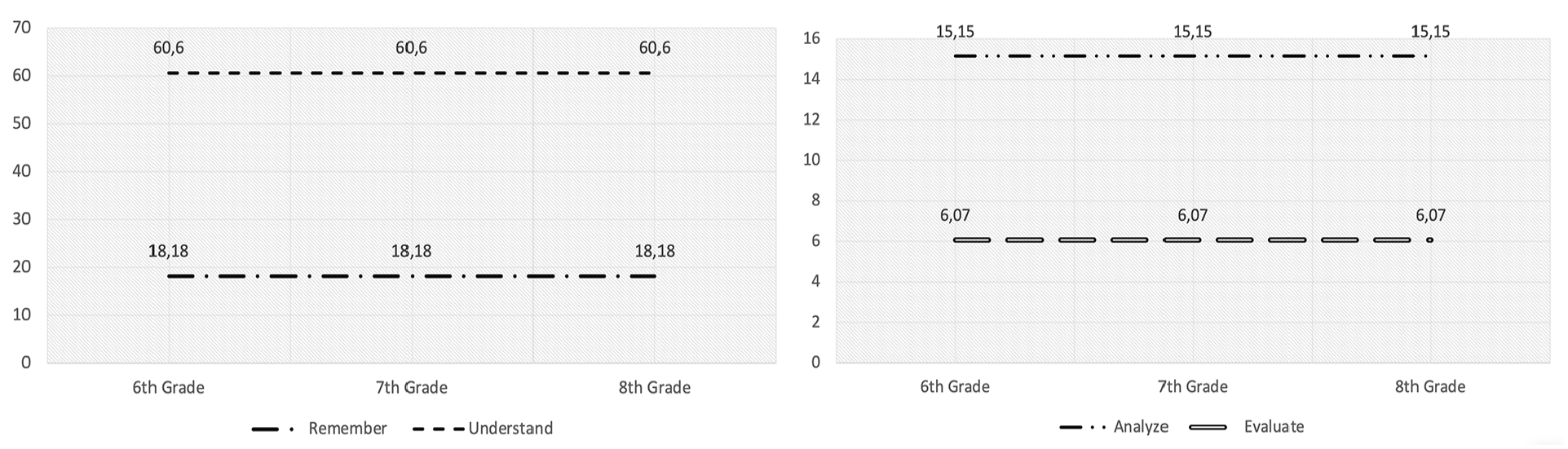
Presumable cognitive levels of the writing objectives observed in the 2006 curriculum.
Horizontal Interpretations
The plateau-like trendlines, represented in Figure 2, imply that curriculum developers tend to improve students’ cognitive abilities related to category perception, conception, and abstraction. However, curricular objectives only meet the intellectual demands at remember, understand, analyze, and evaluate levels. Furthermore, while curricular objectives in the curriculum require a greater intellectual demand, these were not observed frequently. This indicated the lack of a homogenous curricular objective distribution to enable students to perform higher mental functions as they progress through the grade levels. The observed repetition would be a barrier for teachers to design better learning environments allowing them to boost students’ cognitive capacity.
Findings on the 2015 Writing Curriculum
Vertical Interpretations
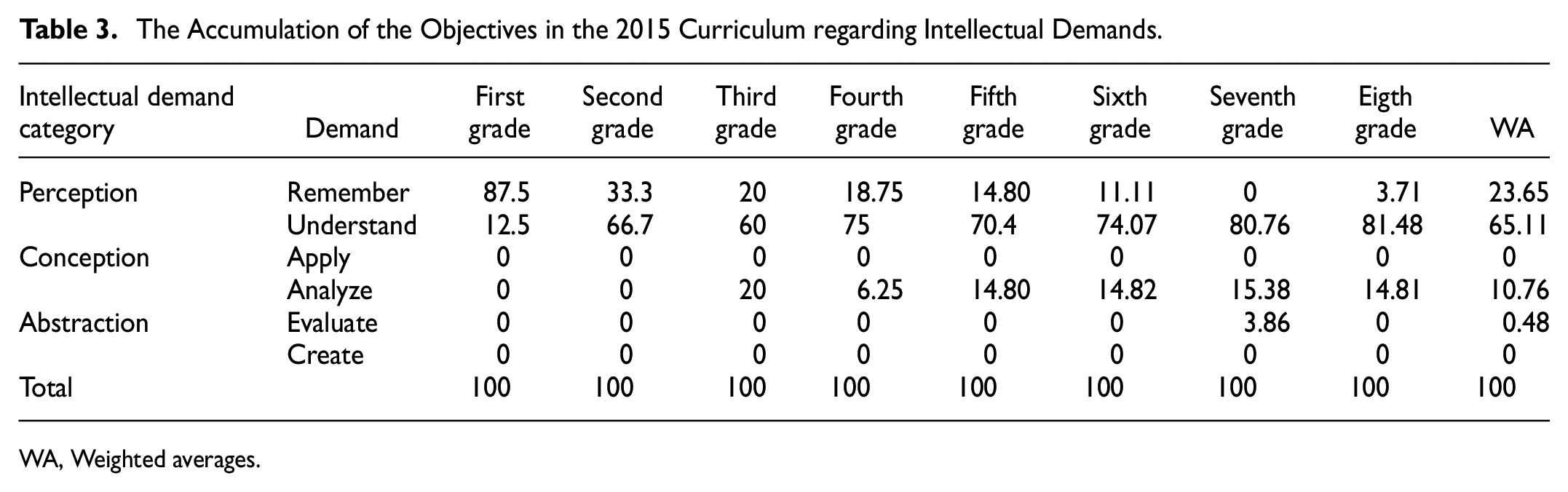
The curricular objectives at the remember and understand level dominate the first grade objectives (see Table 3). This curriculum may demand a basic level of cognitive execution from first graders. This situation is similar in the second grade. However, while remembering (87.5%) is the most common level in first grade objectives, understanding (66.7%) is the most common in second grade objectives. This implies a heterogeneous distribution of intellectual demands in the first 2 years of schooling. Although the intellectual demands (“remember” and “understand”) in the perception category still dominate the curriculum in the third grade, 2 out of 10 objectives were observed at the analysis level. The curriculum permits teachers to build more cognitively demanding instructional processes for the third grade. However, the fourth grade curriculum seems not to give instructional scene staging changes to teachers to guide students to engage in higher-order cognitive processing. There is a sharp decrease in the intellectual demand at the remember level in the fourth grade compared to the third grade. The dispersion in the intellectual demand observed for the third and fourth grades is similar to the fifth and sixth grades. However, compared with the fourth grade, the curriculum for sixth and seventh graders may allow students to engage in more cognitively demanding tasks. A moderate increase in the number of objectives was found at the analysis level from the fourth to fifth and sixth grades. There is a different intellectual demand for seventh grade curricular objectives; however, as in other grades, there is a heterogeneous distribution of intellectual demands in this grade. The curricular objectives at seventh grade require intellectual demands such as understanding, analysis, and evaluation as the curriculum includes evaluate-levelled objectives that guide teachers to design more cognitively demanding tasks than the objectives of the sixth grade. Although 8 out of 10 objectives are observed at the understanding level, curricular objectives at the analysis and evaluation levels may allow intellectually demanding teaching. However, while higher intellectual demands are expected in eighth grade, the curricular objectives at this grade require intellectual demands at remember, understand, and analyze levels. More than 8 out of 10 objectives in eighth grade are dedicated to the understanding level. About 3.71% of the curricular objectives were observed at the remembering, while 14.81% were dedicated to the analysis level.
The Accumulation of the Objectives in the 2015 Curriculum regarding Intellectual Demands.
WA, Weighted averages.
More than 6 out of 10 objectives are dedicated to understanding levels across grades similar to the 2005 and 2006 curricula. More than 2 of 10 objectives require the lowest intellectual demand, for example, remember. Approximately 90% of the 2015 curricular objectives stay in the perception category (“remember”+“understand”). Although there are no curricular objectives at the application level, as observed in the 2005 and 2006 curricula, about 10% of all curricular objectives, mat allow for the creation of higher cognitively demanding tasks (concept level: “apply + analyze”). The 2015 curriculum incorporates very few (about 0.5% of all objectives) curricular objectives in the abstraction category. This may hinder the possible instructional opportunities of teachers to force students to make transcendental generalizations of the learned skills in unfamiliar contexts (Figure 3).

Presumable cognitive levels of the writing objectives observed in the 2015 curriculum.
Horizontal Interpretations
In the perception category (“remember”), there is a sharp decrease from first to eighth grade for the objectives that stay at the remembering level. On the other hand, the level of understand shows a sharp increase from first to eighth grade. Although the dispersion fluctuates linearly, there is a sharp increase and decrease in the trendline for the objectives at the analysis level. The cognitive capacity of the 2005 curriculum regarding the conception category (“apply”+“analyze”) was fostered. However, this is not valid for the abstraction category; the objectives in this category were only observed at the seventh-grade level. This displays a linear fluctuation. Although there is a minimal increase in the trend line, this may not demand students to perform higher mental functions.
Findings on the 2017 Curriculum
Vertical Interpretations
The curricular objectives stay at the remember and understand level in intellectual demand (see Table 4). The 2017 curriculum may expect a basic level of cognitive operations from students from first to eighth grades. Remember (87.5%) is the most common level in the first grade, and understand (66.7%) is the most common from the second to eighth grades. Although intellectual demands at the understanding level dominate the curricular objectives in the second grade, about 3 out of 10 objectives were observed at the remembering level. The curriculum allows building more cognitively demanding instructional sequences for the second grade.
The Accumulation of the Objectives in the 2017 Curriculum regarding Intellectual Demands.

WA, Weighted averages.
It should be noted that the curriculum permits students in third grade to engage in learning processes that are more cognitively demanding. There is a moderate increase in the intellectual demand at the understanding level compared to the second grade; the dispersion observed in the second grade is similar in the fourth and fifth grades. The curricular objectives in sixth grade require intellectual demands such as remembering and understanding with a similar proportion. Nine out of 10 objectives in sixth grade are dedicated to the understanding level (see Table 4). Thus, it can be said that students are expected to experience more cognitively demanding processes. Although there is a slight decrease, the curricular objectives at the understanding level still dominate the seventh to eighth grade objectives.
Seven out of 10 objectives remain at the understanding intellectual demand across the grades. About three-tenth of curricular objectives incorporate the lowest intellectual demand. This shows that all curricular objectives fall into the perception category (“remember”+“understand”). There are no curricular objectives that pitch at conception (“apply + analyze”) or abstraction (“evaluate + create”) zones. It can be said that this may have prevented the development of in-class implementations that demand higher intellectual operations (Figure 4).

Presumable cognitive levels of the writing objectives observed in the 2017 curriculum.
Horizontal Interpretations
Although there are some breaks in the trendlines shown in Figure 4, there is a sharp decrease in the objectives observed at the remember level from first to eighth grade. On the other hand, the level of understanding shows a sharp increase across the grades, although the outlook fluctuates linearly. However, no curricular objectives are detected at the conception or abstraction categories. It can be concluded that the curriculum developers seemed to focus only on amplifying the cognitive capacity of the 2017 curriculum regarding the category of perception (“remember”+“understand”).
Once 935 writing objectives were explored, the portrayal displays that the objectives at the understand level dramatically dominate (65.2%) the elementary and middle school writing instruction. Secondly, about one out of four objectives in the curricula were observed at the remember level showing that from elementary to middle school, the writing curricula’s intellectual capacities stay at the bottom. Nearly none of the 935 writing objectives were evaluated at the apply (0.09%) or create levels (0%). Only 8.46% of all 935 objectives might be used to design instruction demanding higher cognitive processing, such as at the analyze level. Teachers could translate only 2.14% of all objectives into instructional episodes to require cognitive processes at the evaluate level (Figure 5).
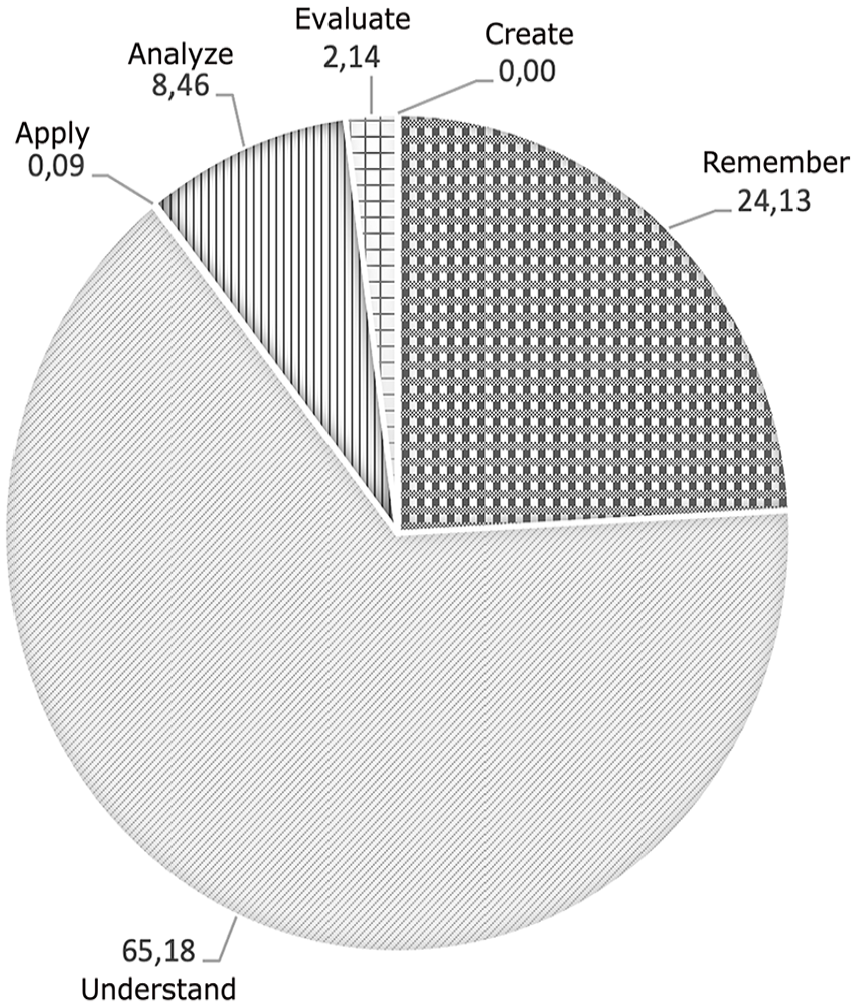
Dispersion of potential intellectual demands across the explored curricula.
It can be inferred from Figure 6 that the dominative tendency of the low cognitively demanding objectives is stable. This domination of the writing curricula has been consistent throughout the years. On the other hand, some inconsistencies were detected for the objectives at the analysis and evaluation levels. Their accumulations across years or curricula are inconsistent, implying that the curriculum developers might not consider and use these kinds of distributions of the writing curricula’ low or high intellectual capacities to tune the curricula about the intended learning outcomes.

The writing curricula’s estimated intellectual demands over years.
Discussion
The study concludes that writing curricula have been predominantly focused on objectives at the remember and understand levels, limiting students’ development of higher-order thinking skills. Even after implementing the 2005 curriculum, these lower-level objectives remained prevalent, creating barriers to students’ cognitive growth. A separate investigation found that activities in Turkish language teaching preparation books were also primarily geared toward remembering and understanding (Durukan & Demir, 2017). It’s important to note that the study examined activities for all four language skills at the secondary school level, providing insight into the distribution of activities based on Bloom’s taxonomy. However, this research specifically focused on writing objectives within primary and secondary school settings.
The study conducted by Ulum and Taşkaya (2019) focused on primary school books and found that the tasks aligned with curricular objectives in the second, third, and fourth grades were less cognitively demanding. Similarly, Çerçi (2018) found a similar trend for sixth-grade objectives. These findings suggest that curriculum-based objectives are not effectively translated into intellectually challenging instructional activities, particularly in the context of writing. As a result, the design of highly demanding tasks for writing curricula may not be encouraged among teachers. This issue is closely related to the instructional quality and process of teaching writing, as highlighted by Tekkumru-Kisa et al. (2015).
The current study reveals that the intellectual demand in writing curricula has negative implications for students’ higher-order mental functions required for high-quality writing. This includes reasoning, logical thinking, planning, organizing, constructing arguments, critique, evidence-based, and reasoned writing (Mokhtar et al., 2020). Teachers are crucial in translating curricular objectives into teachable activities that align with their pedagogical content knowledge. However, considering the prevalence of lower-level intellectual demands in the observed objectives, it raises questions about how Turkish teachers would approach these objectives. To promote transformative pedagogy and enhance teachers’ pedagogical content knowledge, providing better curricula with more objectives at higher cognitive levels is essential. This would enable teachers to increase the task complexity and promote effective learning through writing.
The current extracted picture of the writing curricula seems incompatible with the Turkish Competencies Frame as Turkish educational policymakers, curriculum developers, and teachers have officially adopted its principles. The first competency area is “being able to express and interpret concepts, thoughts, opinions, feelings, and facts both orally and in writing,” which is inserted in the intended writing curricula (MoNE, 2017, 2018, 2019). At the least, acquiring such a sophisticated cluster of skills, the curricula should be incorporated into highly intellectually demanding in-class tasks. However, as detected in the present study, the curricula have no orientation in scaffolding teachers to handle such sophisticated tasks to teach writing-to-learn effectively.
Except for the 2006 curriculum, none of the objectives in the remaining writing curricula was pitched at the application level. Writing skills require practice-based cognitive executions (e.g., decision-making, planning, drafting, revising, and correcting; Graham & Sandmel, 2011; Rosenblatt, 2018; Tompkins, 2014). Therefore, it is inherently expected that more objectives might be at the apply level. Çerçi (2018) discussed that Turkish curricula include intensive objectives at the application level (25%). However, this is only valid when all objectives in different learning areas (writing, reading, speaking, and listening) in the curricula are aggregated. Erol and Kavruk (2021) reported that 18.2% of the curricular outcomes of the 2018 curricula were found at the apply level in different teaching stages, such as fifth to eighth graders.
The writing curricula in the Turkish language show a lack of objectives at the “apply” cognitive level, which may suggest a misconception among curriculum developers and evaluators. Some objectives may appear to have an “apply” level demand based on their wording, but a closer analysis reveals they involve constructing meaning from instructional messages. This study found that all objectives labelled as “apply-like” were classified as lower-level intellectual demands. This contradicts previous literature, possibly due to a more comprehensive examination in this study. Other researchers may have overlooked the context, leading to misconceptions about the intellectual demands of curricular objectives.
Expectedly, there would be some cost of this pattern of intellectual demanding regarding the apply level on the side of students. As the current study implies, teachers may lack a comprehensive understanding, such as holding a curricular-based teacher noticing about the curricula’s intellectual capacity. Graham et al. (2022) found that Turkish teachers may allocate less time to writing-to-learn, conduct fewer in-class activities for reinforcing students’ writing or overlook the curricular objectives in designing in-class teaching sequences for fostering writing skills.
The study observed decreased objectives at the “analyze” and “evaluate” cognitive levels in the writing curricula, particularly after the 2006 curriculum. The findings suggest a need for a more balanced distribution of intellectual demand levels across the curricula. However, the study found a significant decrease in high-level cognitive objectives, indicating a lack of support for the intellectual aims stated in the recent curricula. The 2017, 2018, and 2019 curricula emphasize activities that promote research, interpretation, evaluation, analysis, and knowledge construction through reading and writing, but they were less effective in achieving these objectives.
Coşkun and Narinç (2018) found that the 2017 writing-based and speaking-based activities proposed in the official textbooks were dispersed heterogeneously regarding intellectual demand by explicitly guiding teachers to handle low cognitively demanding instructional episodes. Durukan and Demir (2017) and Ulum and Taşkaya (2019) reported that official textbooks were filled with lower-demanding activities. The above-summarized studies support the heterogeneity thesis mentioned earlier in the present study.
Previous research (e.g., Ferretti & Graham, 2019; Graves, 1983; Rosenblatt, 2018) proposed that PBW demands some specific procedures such as reviewing a written document, clarifying errors in a written document, making a critical evaluation of conceptual streaming of a paper, then, suggesting corrections to foster the paper’s quality. Indeed, mentioned sub-skills are the core components of an intellectually demanding writing process. These are also explicitly stated by the 2015 writing curriculum. However, the current study implies a theory-practice contradiction since the general-purpose statements of the writing curricula are considerably discordant with the dispersion of intellectual demands. For instance, the evaluate level contains cognitive processing such as checking, detecting, monitoring, testing, or critiquing. However, significantly less place for the objectives stayed at the evaluate level.
No objective stayed at the create level across the writing curricula. Some objectives that might stay at the create level in intellectual demand seem to be replaced with the low cognitively demanding objectives across the writing curricula. Turkish textbooks contain very few in-class activities proposed to teachers at the level of create in terms of writing (e.g., Durukan & Demir, 2017; Karakaş Yıldırım, 2020; Ulum & Taşkaya, 2019). This tendency is also copied across the writing curricula. Therefore, in the national context, the transition from one writing curriculum to another did not consist of any critical evaluation of the previous one to enhance the latter regarding intellectual capacity. Turkish writing curriculum developers might also be aware of the cloning process.
The findings of this study have significant implications for writing instruction in Turkey. Turkish students have average reading comprehension skills (OECD, 2010, 2016), and there is a strong relationship between reading comprehension and high-quality writing (Berninger et al., 2017). The objectives in the Turkish reading curricula also exhibit lower intellectual demands on students. A national report indicates that Turkish students’ writing skills, particularly higher-order skills, are below the desired level, with only a small percentage demonstrating proficiency (Durukan & Demir, 2017; Karakaş Yıldırım, 2020; MoNE, 2020; Ulum & Taşkaya, 2019). This study provides a more detailed picture of the country’s writing instruction status.
The present study indicates some increases in highly cognitively demanding curricular objectives, but the changes were insignificant. The development of the curriculum is perceived as a repetitive activity by the developers, lacking effectiveness in fostering practical oral and written communication skills. Turkish teachers show limited awareness of what constitutes a writing curriculum and how to use it effectively (Tavsanli & Kaldirim, 2020). There is a need for professional development opportunities for curriculum developers and teacher educators to support teachers in implementing best practices for high-quality writing instruction.
Conclusions and Educational Implications
The current study concludes that the writing curricula fail to provide teachers with intellectually challenging tasks for teaching higher-order writing skills. It strongly recommends conducting a needs analysis and intentionally including intellectually demanding curriculum objectives. Curriculum development and evaluation should be research-based and consider the in-class implications of objectives. Curriculum developers, educational researchers, and teacher educators must align curricular objectives with instructional practices that promote higher-order writing skills. A re-exploration of all curricular objectives is necessary to ensure a parallel between the intellectual demands of the objectives and the instructional sequences designed around them.
Teachers play a crucial role in implementing and interpreting curricular objectives. It is recommended that teachers are not isolated from the curriculum development process. They should be educated as reflective practitioners (Schön, 1987) who critically analyze and interpret curricular objectives to teach writing effectively. Engaging teachers in longitudinal professional development programs can enhance their ability to notice and evaluate the intellectual capacity of a writing curriculum (Sherin & Jacobs, 2011). This transformation empowers teachers to become evaluators, critics, and champions of the writing curricula.
The curricular objectives in writing have a significant impact on the development of textbooks, activity books, preparation books, writing prompts, and teacher-led in-class questions (Coşkun & Narinç, 2018; Durukan & Demir, 2017; Erdoğan, 2017; Karakaş Yıldırım, 2020; Uğur, 2019; Ulum & Taşkaya, 2019). The intellectual capacity of the writing curricula plays a crucial role in shaping these instructional materials and methods. Therefore, it is essential to recognize that the current intellectual capacity of the writing curricula can significantly influence these writing-related resources. A well-designed and implemented change in the core writing curricula can positively ripple effect on the quality of instructional materials and methods in writing education.
Footnotes
Declaration of Conflicting Interests
The author(s) declared no potential conflicts of interest with respect to the research, authorship, and/or publication of this article.
Funding
The author(s) received no financial support for the research, authorship, and/or publication of this article.
