




Abstract
Nigeria has witnessed significant efforts to promote the digitalization of her economy through the implementation of the cashless policy using Naira redesign and cash withdrawal limits as instruments. However, while Digital Financial Literacy (DFL) is crucial for farmers to cope with monetary policy shocks, DFL has not been in favor of households in rural Nigeria where farmers reside thus exacerbating their economic vulnerabilities. This study thus examined the relationship between rural farmers’ DFL scores and economic vulnerability outcomes specifically food security and mental health, 3 months post-enactment of the last nationwide cashless policy using the Multidimensional Digital Financial Literacy Index (MDFLI), Household Food Insecurity Access Scale (HFIAS), the Generalized Anxiety Disorder Scale (GAD-7) and the multinomial regression model. A 4-stage method of random sampling was employed to choose 432 rural farming households from three states in the southwestern geopolitical zone of Nigeria namely: Lagos, Ogun, and Osun. The result revealed that the DFL score of farmers in rural southwestern Nigeria is generally low (31.13%). The multinomial analysis results revealed a strong inverse relationship between the DFL scores of rural farmers and their GAD-7 scores, a proxy to measure their mental stability. In addition, rural farmers’ food security status was hampered following the cashless policies enactment with an average HFIAS score of 14.49, only 3.24% of the households were food security with the remaining 97% being food insecure at different degrees. It is therefore recommended that efforts should be geared towards closing the financial literacy gap in rural Nigeria.
Introduction
The digitalization of the Nigerian economy has received significant attention through the implementation of the cashless policy (Nwakpa, 2023; Otitoju et al., 2023). Nationwide implementation of the policy commenced in 2015 but was not effectively executed. To revive this policy, the Central Bank of Nigeria (CBN) introduced the naira redesign which took effect on 15th December 2023. Subsequent daily cash withdrawal limits were also put in place with effect from February 2023 (Fourchard & Sikiru, 2023). The term “cashless economy” refers to a system in which cash transactions are kept to a minimum rather than eliminated (Marszałek & Szarzec, 2021). It encourages the use of electronic payment systems as opposed to cash transactions (Kusuma & Darma, 2020). Although the cashless policy aims to boost the usage of electronic payment systems and decrease the amount of physical cash in circulation, it was a form of shock to Nigerian rural farmers (Nwakpa, 2023).
Digital Financial Literacy (DFL) is crucial for farmers to cope with monetary policy shocks. However, Financial Inclusion and Digital Financial Literacy have not been in favor of households in rural Nigeria where farmers reside thus exacerbating their economic vulnerabilities (Tay et al., 2022; Twumasi et al., 2022). The availability and use of financial services by people and enterprises, including banking, credit, and insurance, is referred to as financial inclusion (Ndassi Teutio et al., 2023).
Over the years, rural farming households have experienced a low level of financial inclusion, which makes them more economically vulnerable. Farmers in many rural areas lack access to bank branches preventing them from receiving crucial financial services. They are consequently forced to rely on impromptu, frequently pricy cash sources (Aziz & Naima, 2021). These farmers struggle to make investments in their agricultural businesses, embrace new technologies, or handle financial reverses without access to loans (Yindenaba Abor, 2023). They experience Limited access to formal financial services, inadequate educational opportunities, and a lack of awareness about financial tools that can hinder their ability to optimize resources, plan for the future, and cope with financial shocks (Russell et al., 2020).
Another economic vulnerability is the Food security state of the farmers, Food security encompasses not only thee access to sufficient and nutritious food but also the stability of this access over time (Grote et al., 2021). Farmers are at the forefront of food production, and their well-being directly affects food security at the individual, household, community, and national levels (Amoak et al., 2022). The lack of financial inclusion exacerbates food security issues in rural farming households (Adegbite & Machethe, 2020). Without access to credit and savings, farmers cannot make necessary investments in their agricultural practices or adopt climate-resilient techniques (Kaur et al., 2023), which makes them more susceptible to crop failures, and raises persistent concerns about food security (Week & Wizor, 2020).
Also, the demanding nature of agriculture, coupled with factors such as climate change, market fluctuations, and financial stressors, can significantly impact the mental health of farmers (Das & Ansari, 2021). Farmers are faced with common mental health challenges like depression, anxiety, and stress due to the high risks and uncertainties in agriculture (Padhy et al., 2020). These challenges not only affect the well-being of individual farmers but can also have cascading effects on their families, communities, and agricultural productivity (Middendorf et al., 2022).
Therefore, financial literacy, food security, and farmers’ mental health are interconnected in a complex web of dependencies. When farmers lack financial literacy, they may find it difficult to set aside money for necessities like seeds, fertilizer, and equipment which in turn makes them more susceptible to economic instability and food insecurity (Murdad et al., 2022). This financial stress can take a toll on their mental health, which can result in anxiety and despair, food insecurity on the other hand can exacerbate mental health issues, as the constant worry about providing for family needs can contribute to stress and anxiety. Before the implementation of cashless policies, it is essential to consider its potential effects on food security and mental well-being, particularly among vulnerable populations like rural farming households. Thus, understanding the interplay between financial literacy, food security, and mental health among farmers is essential for crafting effective policies and interventions to enhance their overall welfare.
In light of the foregoing, the study seeks to answer these research questions:
RQ1. What is the financial literacy profile of rural farming households in south western Nigeria?
RQ2. Does financial literacy affect the mental well-being of rural farming households in south western Nigeria?
RQ3. What is the effect of the cashless policy on farming activities and food security of rural farming households in south western Nigeria?
Research Hypothesis
H0a: Farmers mental health is not affected by their digital financial literacy scores
H1a: Farmers mental health is significantly affected by their digital financial literacy scores
H0b: Farmers mental health is not affected by their State of food security (captured by the HFIAS scores)
H1b: Farmers mental health is significantly affected by their State of food security (captured by the HFIAS scores)
Null Hypotheses (H0a and H0b) represent the default assumption that there is no effect or relationship. They are typically stated to be tested against the alternative hypotheses (H1a and H1b) which represent the researcher’s hypothesis, suggesting that there is a significant effect or relationship.
Hypothesis Set A
H0a: Farmers’ mental health is not affected by their digital financial literacy scores.
Null Hypothesis (H0a): This statement proposes that there isn’t a meaningful connection between farmers’ mental health and their digital financial literacy scores. In other words, the digital financial literacy scores have no impact on the mental health of farmers.
H1a: Farmers’ mental health is significantly affected by their digital financial literacy scores.
Alternative Hypothesis (H1a): This statement suggests the null hypothesis’ opposite. It suggests that there is a noteworthy connection between farmers’ mental health and their digital financial literacy scores. If this hypothesis is supported by data, it would imply that farmers with higher or lower digital financial literacy scores experience different levels of mental health stability has measured by their GAD-7 Score.
Hypothesis Set B
H0b: Farmers’ mental health is not affected by their Food security Status (captured by the HFIAS scores).
Null Hypothesis (H0b): This hypothesis states that there is no significant association between farmers’ mental health and their Food security Status, as measured by the Household Food Insecurity Access Scale (HFIAS) scores. In essence, it suggests that the mental health of farmers is not influenced by their food security status.
H1b: Farmers’ mental health is significantly affected by their Food security Status (captured by the HFIAS scores).
Alternate Hypothesis (H1b): The alternate hypothesis, which opposes the null hypothesis, suggests that there is a substantial correlation between the food security status of farmers and their mental health. If this hypothesis is supported by data, it would indicate that farmers experiencing different levels of food security, as measured by HFIAS scores, also experience varying levels of mental health.
Theoretical Framework
Food security, financial literacy, and mental health nexus is complex and multidimensional. However, several theories can help explain the interconnections among food security, financial literacy, and mental health. This study is thus hinged on two of these theories namely: The theory of Maslow’s Hierarchy of Needs and the Social Cognitive Theory.
Theory of Maslow’s Hierarchy of Needs
According to Abraham Maslow’s hypothesis, people have different needs at different levels, with fundamental physiological needs like clothing, food, and shelter coming first. According to this theory, if an individual’s basic needs are not met, they may experience distress and anxiety (Maslow, 1943). Food security is a fundamental physiological need, and financial literacy can play a crucial role in ensuring access to food (Anisman & Zacharko, 2016). Financial literacy can enable individuals to make informed decisions about their finances, manage their money effectively, and secure access to food. In turn, access to food can contribute to mental well-being by reducing anxiety and distress related to food insecurity (Wilson & Cook, 2016).
Social Cognitive Theory
Social cognitive theory asserts that individuals learn from their environment through observation and modeling (Bandura, 1977). Financial literacy can be acquired through social learning, and it can influence behaviors that contribute to food security, such as budgeting and shopping for nutritious and affordable food options. Food security, in turn, can impact mental health by reducing financial strain and improving overall well-being (Luszczynska et al., 2011). This theory highlights the importance of social and environmental factors in shaping behaviors and outcomes related to food security and mental health.
Food Security and Mental Health
Food security is a critical determinant of mental health in farming communities. Food insecurity is associated with increased stress, anxiety, and depression (Jones, 2017). Farming communities often experience food insecurity due to various factors such as climate change, market volatility, and economic pressures, which can exacerbate mental health issues (Barrett et al., 2019; FAO, 2020). On the other hand, food security can promote mental well-being by reducing stress and anxiety related to hunger and malnutrition (FAO, 2020; Whitaker et al., 2006).
Financial Literacy and Mental Health
Financial literacy is the ability to comprehend and use a variety of financial skills, including investing, saving, and budgeting (Lusardi & Tufano, 2009). Financial stress and uncertainty can negatively impact mental health, while financial knowledge and confidence can promote well-being (Lusardi & Mitchell, 2011; Lusardi & Tufano, 2009). For farmers, financial literacy is crucial in managing financial risks, accessing credit, and making informed investment decisions, all of which can influence their mental health and resilience (Barrett et al., 2019; FAO, 2020).
Food Security, Financial Literacy, and Mental Health
The interplay between food security, financial literacy, and mental health is complex and multifaceted. Studies have shown that financial literacy can enhance farmers’ ability to manage financial risks, which can, in turn, improve food security and mental health (Barrett et al., 2019). Additionally, mental health can influence financial decision-making and the ability to cope with financial stress (Lusardi & Mitchell, 2011; Lusardi & Tufano, 2009). Thus, promoting mental health among farmers is crucial for enhancing their financial and food security.
Materials and Methods
Study Area
The research was conducted in southwest Nigeria (see Figure 1). Figure 1 illustrates the map of Southwest Nigeria as shown by Popoola and Magidimisha (2020) in their study on the roles played by selected agencies in infrastructure development in the southwest region of Nigeria.
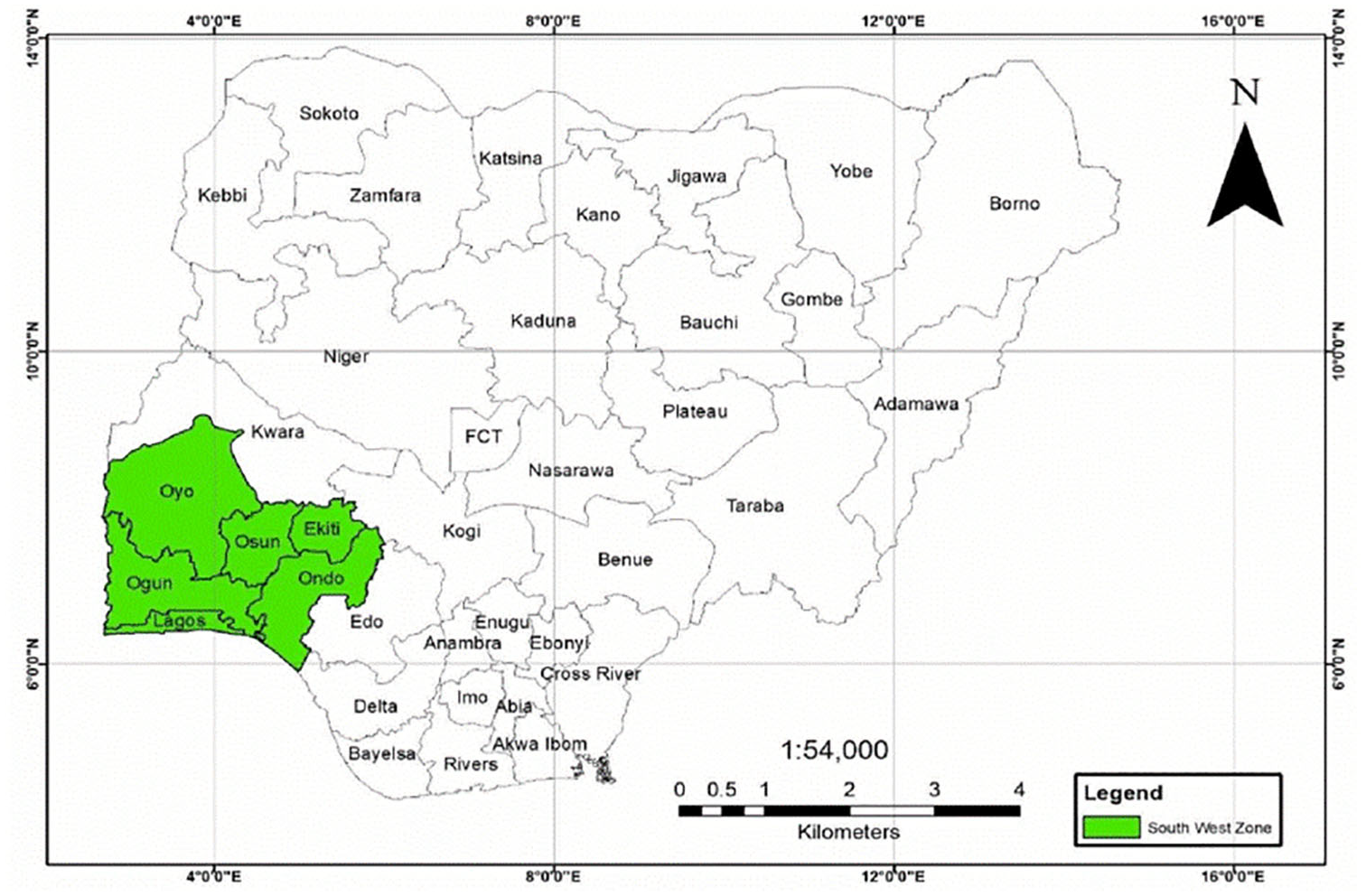
Map showing southwestern Nigeria.
The region is known for its rich agricultural activities, diverse ecosystems, and significant contributions to the country’s agricultural sector. This region encompasses several states, including Lagos, Ogun, Oyo, Osun, Ekiti, and Ondo. The region is a hub of agricultural activities with a focus on crops like cocoa, oil palm, yam, cassava, rubber, and cashews.
Agriculture is important in the southwestern zone of Nigeria due to its significant contribution to the region’s economy, food security, and rural livelihood. According to Adekunle et al. (2018), agriculture accounts for over 30% of the region’s GDP and employs a large portion of the population. Additionally, the region accounts for over a hundred and fifty-five thousand (155,000) tons of cocoa yearly, which represents 85% of Nigerian supplies (Kehinde et al., 2021).
Sampling Technique
A 4-stage sampling technique was used to select samples for the study. In the first stage, three states namely: Osun, Ogun and Lagos states were selected at random from the six states in Southwestern Nigeria. In the second stage, there was a random selection of two Local Government Areas (LGA) in each state. In the third stage, three rural communities were selected from each LGA making a total of 18 rural communities in south-western Nigeria. In the last stage, a total of 432 rural farming households we drawn using a proportionate random sampling technique based on the population of each community. The inclusion criterion is that the household must be a rural farming household in the targeted study location. Moreover, the selected communities were rural farming communities where most households depend on agricultural practices as their primary occupation. The study used a random sampling technique, which gives every unit of the population equal chances of being selected… This reduces the likelihood of introducing bias by systematically excluding or including certain groups
The study employed a Multidimensional Digital Financial Literacy Index (MDFLI), this includes financial behavior, knowledge, and attitude to assess rural farming households’ degrees of digital financial literacy. A multinomial regression model was utilized to analyze the relationship between digital financial literacy and farmers’ mental health which was captured by the Generalized Anxiety Disorder Scale (GAD-7). The Household Food Insecurity Access Scale (HFIAS) was used to measure how the policy affected farmers’ levels of food security.
Source of Data
Cross-sectional data was gathered through semi-structured interviews conducted in the farmers’ native tongue because most farmers have little to no formal education. The questionnaire was deployed by the Kobo toolbox app. The study utilized the semi-structured interview method of data collection so that participants could have the chance to communicate using their own words, providing a more authentic representation of their perspective for areas that might not have been captured in the questionnaire
The Kobo Toolbox app is a free and open-source platform for designing and managing data collection forms for mobile devices. It allows for the creation of custom survey questions, polls, and data collection forms that can be used on smartphones, tablets, and other mobile devices. All the respondents were adults who gave verbal consent. Participation in this study was entirely voluntary.
The Kobo toolkit was utilized to capture quantitative data for efficient enumerator monitoring and data quality verification, which served as the foundation for this investigation. The software functions as a data-gathering instrument for computer-assisted personal interviews (CAPI). Using the loaded Kobo Toolbox on Android mobile devices, the following activities (see Figure 2) were carried out: form creation, validation/testing, training, data collection, collation (data aggregation and cleansing), and data analysis. The original household questionnaire was a 7-page, 67-item interviewer-administered tool divided into four subsections. Figure 2 illustrates the application of smartphone-based tools in marine resource management, as detailed by MACBIO (2017). The report highlights how innovative technologies, such as Kobo Toolbox, are being utilized to enhance data collection and analysis.

Steps in Kobo toolbox.
A consent page attesting to the provision of informed consent; GPS tracking of the household’s location; camera photos; socioeconomic data; questions about financial literacy, the effect of the adoption of the cashless policy on farming activities; questions about the respondents’ coping mechanisms, Household Food Insecurity Access Scale Module and Generalized Anxiety Disorder Scale were utilized in the development of this Kobo toolkit form.
Six enumerators completed a one-day training on the specifics of the research and the data requirements for each state. The enumerators were accustomed to using Android phone apps for electronic surveys (such as the Kobo Toolbox). During the training, participants learned about the goals and questions of the study, reviewed how to collect data using the Kobo Toolbox application, and more. The training components were facilitated by the researchers.
In each State, two Android smartphones were utilized to gather data. Completed forms are uploaded by field enumerators into a secure server. The data was cleaned in order to find and fix errors and anomalies. The data entries were downloaded in Microsoft Excel format and data inputs were exported to STATA (version 15) for additional analysis after first undergoing a descriptive analysis on the server platform.
Indicators for Measurement of Variables
Financial Literacy
Indicator: Digital Financial Literacy Scores
A person’s comprehension and handling of many financial issues are included in the multifaceted idea of financial literacy. Financial attitude, financial knowledge, and financial behavior are the three main criteria that are frequently used to assess financial literacy.
Financial attitude refers to an individual’s feelings, beliefs, and perceptions about financial matters. It reflects their emotional and psychological orientation toward financial activities. It is measured using Likert Scale Surveys, Participants are asked to express their agreement or disagreement with statements reflecting financial attitudes. For example, “I feel confident about managing my finances.”
Financial Knowledge refers to an individual’s understanding of financial concepts, products, and principles. It assesses the level of factual knowledge about various financial topics.
Measured using Multiple-Choice Tests; Participants were presented with questions covering a range of financial topics, and their correct answers reflect their financial knowledge. A higher level of financial knowledge is often linked to better financial decision-making.
Financial behavior refers to the actions and choices individuals make with reference to their financial resources. It encompasses budgeting, saving, investing, debt management, and other financial practices measured by Surveys and Self-Report; Participants provide information about their financial behaviors, such as spending habits, savings practices, and investment choices.
Food Security
Indicator: Household Food Insecurity Access Scale (HFIAS) Scores
The HFIAS was developed using a rigorous process that involved qualitative research to ensure that the scale adequately captures the complex dynamics of food insecurity.
It covers aspects such as anxiety about supply of food, insufficient quality or variety of food, and adjustments made by households to cope with food shortages
Farmers’ Mental Health
Indicator: Generalized Anxiety Disorder Scale (GAD-7) Scores
The Diagnostic and Statistical Manual of Mental Disorders’ (DSM-IV) criteria for generalized anxiety disorder served as the foundation for the development of the GAD-7. The scale is designed to accurately reflect the features of generalized anxiety disorder since it includes items that address important characteristics of anxiety such as excessive concern, restlessness, and difficulties concentrating.
Analytical Technique
The study made use of novel methodologies like the Household Food insecurity Access Scale (HFIAS) and the Generalized Anxiety Disorder (GAD-7) scale because they give farmers the ability to express themselves. The Household Food Insecurity Access Scale (HFIAS) helps to determine food insecurity level and also measures its severity. Analytical tools used in the research include;
Descriptive statistics—The study made use of general statistics such as mean, median, and range for each question covered in the financial literacy assessment.
Household Food Insecurity Access Scale (HFIAS)—This was used to measure and assess the severity of food insecurity at the household level. It provides a standardized approach to identify and classify households based on their access to food and the extent to which they experience food insecurity. The HFIAS questionnaire consists of nine statements or questions covering different facets of food availability and access; the overall score, which ranges from 0 to 27, indicates the extent of food access. The respondents are typically individuals within the household, such as the head of the household or another knowledgeable adult
The Household Food Security Survey Module (HFSSM), which was created by Food and Nutrition Technical Assistance in 2007 for developing or poor countries to ascertain whether households had trouble obtaining food in the previous 30 days, was modified to become the Household Food Insecurity Assess scale (HFIAS). Rather than 18, it includes nine elements to document experiences on different intensities of food insecurity. It stands for three categories that are thought to be a prerequisite for experiencing food insecurity across cultural boundaries: (i) worries about food supplies at home; (ii) poor quality; and (iii) inadequate food supply and consumption, together with the resulting health effects (Coates et al., 2007).
It is a very important tool for comparing access to food amongst various demographic groups. The recall period of this was 4 weeks (30 days) instead of the 12 months used in HFSSM. Instead of focusing on the past or future status of food insecurity, HFIAS offers data on the current condition of food insecurity. This method splits households into 4 groups according to their level of food security: food secure, mildly food insecure, moderately food insecure, and severely food.
The Generalized Anxiety Disorder Scale (GAD-7)—This was used to measure different anxiety levels of farmers in rural households. The Generalized Anxiety Disorder Scale (GAD-7) is a self-report measure that is commonly used to screen for generalized anxiety disorder (GAD) in adults (Terlizzi & Villarroel, 2020). The intensity of symptoms including feeling tense or worried, worrying excessively, and having difficulties relaxing are evaluated using the GAD-7, which consists of seven items. Each item is scored on a scale from 0 to 3, with higher scores indicating greater severity of symptoms. The total score ranges from 0 to 21, with scores of 0–4, 5–9, 10–14, and 15 above representing minimal, mild, moderate, and severe levels respectively.
Multinomial logistic regression—This was used to Explore Factors Influencing Anxiety Levels. In multinomial regression, the dependent variable can take on three or more categories, and the goal is to predict the probability of each category given a set of predictor variables. The dependent variable is the anxiety level with the independent variables being (age, gender, education in years, household size, digital financial literacy score (DFLS), Household Food Insecurity Access Scale (HFIAS), and primary source of income). The Household Food Insecurity Access Scale (HFIAS) and Digital Financial Literacy Score (DFLS) are the variables of interest for the multinomial regression analysis.
The dependent variable can be categorized in to four groups. Hence the use of multinomial regression was appropriate for analysis. Using the no anxiety group as the base outcome category, the multinomial regression model can be explicitly stated as follows:
Multinomial regression model
GAD Status = F(X1 + X2 + X3 + X4 + X5+ X6 + X7 + X8 + X9 + X10 + X11 + X12)
The outputs have three equations; since the response variable has four categories and category 1 (no anxiety) is used as baseline or reference category. Hence the first equation is given as follow:


Thus, if the multinomial regression model generates significant relationships on any of the two proxy variables (HFIAS and DFLS), the study will conclude that farmers mental health is significantly affected by their financial literacy and food security status.
Results and Discussion
The field survey conducted yields compelling results highlighting the intricate interplay between financial literacy, food security, and farmer’s mental health. The result sheds light on the crucial relationship between these three factors, offering insightful information that can be used to develop well-informed policies and actions targeted at improving the welfare of Nigerian farmers in rural areas. The financial literacy profile of rural farming households in south western Nigeria is presented in (Table 1).
Financial Literacy Profile of Rural Farming Households in South Western Nigeria.

Source. Field Survey (2023).
Note. SWN = South Western Nigeria.
The data shows that Lagos State exhibits the highest average Financial Attitude score at 62.96, indicating a more favorable outlook towards financial matters, which can be attributed to the state’s high degree of development. In contrast, Osun State reports the lowest score at 18.5, implying a less positive financial attitude, while Ogun State falls in between with a score of 58.5 and also trailing closely behind Lagos, which may be a result of its proximity to Lagos State. These variations reveal that farmers in Lagos tend to have a more optimistic view of financial matters, which can positively influence their financial decision-making and planning.
Financial knowledge measures the degree of awareness and comprehension of financial concepts. Ogun State has the lowest average score in this area (1.74), while Lagos State records the highest average score with (19.44), Osun State has an average score of (9.37) which places it in the middle. The differences in Financial Knowledge scores suggest that farmers in Lagos State may understand financial concepts better than farmers in Ogun and Osun State, allowing them to potentially make more educated financial decisions.
Finally, Rural farming households’ actual financial behaviors and habits are evaluated through financial behavior. The average score for Ogun State is (41.61), while the average score for Osun State is (21.72). Lagos State again has the highest average score of (42.36). These variations show disparities in monetary habits, with Ogun and Lagos States displaying better monetary habits like saving and careful money management. Angeles (2022) revealed that while financial literacy and digital technology have a major impact on owners’ financial behavior, they do not encourage owners to save, borrow, or invest.
The Digital Financial Literacy Scores of the farmers in the study area was presented in Figure 3. Osun State gets the lowest score, 16.97, while Lagos State is in first place with a score of 41.66. Ogun State received a 34.75. The significant difference in digital financial literacy scores suggests that rural farming households in Lagos State are better at using digital financial instruments, which could improve their access to financial services.

Digital financial literacy score chart.
Table 2, Examines the food security level of rural farmers by employing the Household Food Insecurity Access Scale (HFIAS) to assess various food security levels among rural farming households in southwestern Nigeria. The survey revealed a spectrum of food security levels among the surveyed rural farming households. The categories ranged from “Food secure” to “Severely Food Insecure.” The data provides insights into the distribution of households across these categories, shedding light on the potential consequences of the cashless policy on their access to food.
Food Security Status of Rural Farming Households in South Western Nigeria.

Source. Field Survey (2023).
The data indicates that a minor proportion (3.24%) of the households were food secure. These households demonstrated a mean score of 3.24 on the HFIAS. A substantial portion (39.58%) was classified as mildly food secure, this category suggests a certain level of food security, albeit with room for improvement. The mean score for this group was 39.58.
The majority of the rural households (53.01%) were Moderately Food Insecure. This category signifies a heightened level of food insecurity, with households facing notable challenges in accessing adequate nutrition. The mean score for this category was 53.01. Households categorized as “Moderately Food Insecure” typically exhibit behaviors and coping strategies that indicate a certain degree of food insecurity, such as reducing meal sizes, cutting back on certain types of foods, or limiting the number of meals consumed. A small yet significant percentage (4.17%) of households were Severely Food Insecure. The mean score for this group was 4.17. The variation in food security categories underscores the importance of considering vulnerable populations’ needs when designing and implementing policies. In conclusion, the findings reveal that the households experienced a critical level of food insecurity proving that economic vulnerabilities like low financial inclusion can affect food security, which bolsters the premise made by Moniruzzaman (2022) that economic vulnerabilities play a crucial role in household food security by having a substantial impact on food security conditions.
Table 3, Unveils the Impact of the Cashless Policy on the Mental Well-being of Rural Farming Households in southwestern Nigeria, which was gauged using the Generalized Anxiety Disorder 7 (GAD-7) scale to measure anxiety levels. A minor percentage (11.57%) of the rural farming households experienced Minimal Anxiety (19.91%) of the households experienced Mild Anxiety. The majority (41.90%) of the rural households experienced Moderate Anxiety while a significant proportion of the households (26.62%) were classified as experiencing “Severe Anxiety.” The distribution across anxiety categories reveals a concerning pattern within rural farming households. The prevalence of “Moderate Anxiety” and “Severe Anxiety” categories underscores potential mental health implications resulting from the cashless policy implementation. This result which aligns with the findings of Ani and Ajayi-Ojo (2023) who state that in Nigeria, psychological well-being is influenced by money shortage in a mediating way (Table 4).
Anxiety Level Rural Farming Households in South Western Nigeria.

Source. Field Survey (2023).
Effect of Financial Literacy and Food Security on Farmer’s Mental Health.

Note. Figures in parenthesis represent the Relative Risk Ratios (RRR) of the variables. Number of observations = 428; LR χ2(21) = 237.06; Prob > χ2 = 0.0000; Log-likelihood = −431.22885; Pseudo R2 = .2156. HFIAS = Household Food Insecurity Access Scale; DFLS = Digital Financial Literacy Score.
p < .05.
This analysis examines the relationship between several independent variables (age, gender, education in years, household size, DFLS, HFIAS, primary source of income) and the likelihood of experiencing different anxiety levels (mild, moderate, and severe anxiety) compared to the reference category, which is “No Anxiety.” which serves as the baseline for comparison. The significance of these coefficients was assessed using asterisks (***) and (**) to indicate the level of confidence in the results. Specifically, *** denotes p < .01 (highly significant), and ** denotes p < .05 (moderately significant). These significance levels help to gauge the strength and reliability of the relationships between the independent variables and anxiety levels.
As shown in the table, the results of the multinomial logistic regression established that for mild anxiety, two variables were significant which include Digital Financial Literacy Score (DFLS) at 1% and Household Food Insecurity Access Scale (HFIAS) at 5%. Moderate anxiety shows age, Digital Financial Literacy Score (DFLS), and Household Food Insecurity Access Scale (HFIAS) are significant at 1% and education is significant at 5%. The significant variables for severe anxiety are age, gender, and education at 5% and Digital Financial Literacy Score (DFLS), Household Food Insecurity Access Scale (HFIAS) at 1%.
Age was significant for moderate and severe anxiety at 1% and 5% significant levels respectively. It indicates that the older the respondent, the higher the anxiety level, as the increase in age may decrease their adaptability to ongoing financial changes and innovations which supports (Omojolaibi et al., 2019) assumption that the older individuals become, the less eager they are to use the internet or mobile banking, resulting in technical isolation from financial services.
The positive and significant coefficient of gender depicts that the male gender is severely anxious with males having significantly higher odds of experiencing Severe Anxiety compared to their female counterparts. This is due to their major involvement in different occupations and provision of household needs which requires the performance of financial transactions. This finding underscores the importance of gender-specific interventions in addressing mental health disparities in farming communities.
The negative and significant coefficients of the variable for education imply that as the educational years of respondents decrease, it becomes more likely that they experience moderate and severe anxiety. Lower education therefore hurts anxiety as higher education has been associated with better mental health which prevents anxiety disorder. This result highlights the potential role of education in conducting financial activities thereby mitigating anxiety levels among farmers. This aligns with the findings of Ani and Ajayi-Ojo (2023) which revealed that those with greater educational levels had easier access to cash during the cashless policy implementation compared to those with limited or no formal education. Household size does not appear to be a significant predictor of anxiety levels among farmers. This suggests that the number of individuals in a household may not directly influence an individual farmer’s anxiety levels, at least within the scope of this analysis.
Likewise, Digital financial literacy emerges as a strong protective factor against anxiety. The Digital Financial Literacy Score (DFLS) is negatively significant across all anxiety levels suggesting that as digital financial literacy level decreases, there is a higher likelihood that the anxiety of the respondents will increase. Aisaiti et al. (2019) revealed that being digitally literate in the financial aspect will tend to prepare farmers for growing financial adjustments and hence reduce their anxiety.
The Household Food Insecurity Access Scale (HFIAS) variable was identified as a positive significant factor at a 1% level of significance affecting the anxiety level of respondents. This implies that as the measures of the severity of household food insecurity increase, it affects the anxiety level for mild, moderate, and severe in a direct proportion, as food insecurity is associated with depression, anxiety, and stress. This highlights the crucial role of food security in mental well-being among farmers, indicating that interventions addressing food security may contribute to lower anxiety levels.
Conclusion and Recommendation
The study concludes that rural farmers’ mental health, food security, and financial literacy are all intertwined and can have an impact on one another. The study have significantly contributed to the existing literature by examining the interplay between food security, digital financial literacy, and mental health among farmers in the context of a recent policy change. While previous studies have explored the impact of digital financial inclusion on various populations, few have investigated its potential effects on rural farmers in a developing country concerning a specific policy change, in this case, the cashless policy. Moreover, the study’s focus on mental health adds a critical dimension to the understanding of the multifaceted impact of digital financial inclusion.
Additionally, the study’s findings contribute to the academic literature on digital financial inclusion and its effects on vulnerable populations. It provides insights into the potential mental health implications of digital financial inclusion policies, highlighting the importance of considering psychological well-being in the design and implementation of such policies.
Furthermore, the study’s conclusions have significant applications for financial service providers, legislators, and development professionals. The results suggest the need for targeted interventions to enhance digital financial literacy among rural farmers, particularly in the context of the cashless policy. Moreover, the study underscores the importance of considering the mental health implications of digital financial inclusion policies, emphasizing the need for a holistic approach that addresses the multifaceted needs of vulnerable groups.
Importantly, the findings of this have direct implications for policies aimed at promoting digital financial inclusion and enhancing food security. The results suggest the need for policies that support digital financial literacy among rural farmers and consider the potential mental health effects of digital financial inclusion. Moreso, the study highlights the importance of inclusive policy-making that involves rural farmers in the design and implementation of monetary policies
Initiatives that support financial education geared toward the requirements of rural farmers should therefore be given top priority by policymakers and financial institutions to mitigate the adverse effects of policy implementation and contribute to the overall well-being of rural farming households.
Footnotes
Declaration of Conflicting Interests
The author(s) declared no potential conflicts of interest with respect to the research, authorship, and/or publication of this article.
Funding
The author(s) received no financial support for the research, authorship, and/or publication of this article.

Data Availability Statement
The data for this study is available upon request from the authors.