




Abstract
The goal of this study was to predict the preservice physical education teachers’ (PPETs) occupational socialization (OS) by their pedagogical content knowledge (PCK) and to investigate the relationship between them. The participants were 56 PPETs from a physical education teacher education (PETE) undergraduate program in the northeastern United States. This research work utilized the mixed-methods research design. An online survey with the PCK standard test, the teachers’ occupational beliefs survey, and a semistructured interview were used to collect data. The PPETs’ PCK significantly predicted their OS. More PCK would lead to more positive and professional OS development. Furthermore, the methods classes were the most important resource to learn PCK and develop the OS of the PPETs. There is a close and direct relationship between PPETs’ PCK and OS, and early field experience (EFE) is a common carrier. It is possible to use PPETs’ PCK to infer their OS development, and quantitative methods are effective for examining both factors. PETE programs should purposefully set up EFEs to improve PPETs’ PCK and OS simultaneously.
Keywords
Introduction
In the teaching profession, occupational socialization theory (OST) focuses on how people become teachers, from birth to the end of their career (Lortie, 1975). In addition, Lawson (1983a, 1983b) introduced OST to physical education (PE) and physical education teacher education (PETE) and defined OST as “all kinds of socialization that initially influence persons to enter the field of PE and that later are responsible for their perceptions and actions as teacher educators and teachers” (Lawson, 1988, p. 107). The professional socialization phase covers the 4-year PETE study period, which is one phase of the occupational socialization (OS) system (Lawson, 1988). OST could be used to explain most issues a PETE program would face, such as enrolment and teacher training (Richards et al., 2020). In terms of PE teacher training, the OS development of preservice physical education teachers (PPETs) was influenced by their background and experiences in their PETE programs (Richards & Gaudreault, 2016). PPETs’ background impacts their decisions to choose a career in PE or choose between teaching and coaching (Ferry, 2018). Furthermore, scholars could identify a PE teacher’s value orientation based on the curriculum design (Prior & Curtner-Smith, 2020). Other than that, the practice teaching experience, cooperating teachers, and PETE program faculty’s philosophies all profoundly influence PPETs’ OS (Adamakis & Zounhia, 2016; Flory & Burns, 2017; MacPhail & Hartley, 2016). Moreover, the PPETs’ acculturation and professional OS development would affect their philosophy and understanding of specific instructional models (Deenihan & MacPhail, 2013).
To ensure quality teaching, teachers must master multiple types of knowledge, including content knowledge (CK), general pedagogical knowledge, curriculum knowledge, pedagogical content knowledge (PCK), knowledge of the learners, educational context, and educational values and philosophies (Shulman, 1987). PCK has been defined as “how particular topics, problems, or issues are organized, represented, and adapted to the diverse interest and abilities of learners, and presented for instruction” (Shulman, 1987, p. 8). In the field of PE, to better explain PCK, Ball et al. (2008) classified CK into common content knowledge (CCK), which refers to the knowledge and skills to perform a task, and specialized content knowledge (SCK), which is the knowledge and skills to teach CCK. In this case, PCK can be understood as the advanced implication of SCK, which must choose and modify the SCK based on different purposes and contexts (Ward, 2009).
Recently, Ward et al. (2015, p. 131) explained that “PCK is a focal point, a locus, defined as such as an event in time (and therefore specific contextually) where teachers make decisions in terms of content based on their understandings of a number of knowledge bases (e.g., pedagogy, learning, motor development, students, contexts, and curriculum).” It is usually evaluated through observations or interviews (Kim, 2021; Ward et al., 2015), but it can also be measured through quantitative methods (Meier, 2020). Scholars have identified the significance of improving and assessing the PCK of PPETs in PETE programs (Ward & Ayvazo, 2016). Methods courses, fieldwork, and supervised practice teaching effectively improve PPETs’ PCK (Chang et al., 2020; Sutherland et al., 2016). CK has a profound influence on PPETs’ PCK, and strong CK leads to more mature PCK (Kim, 2021).
Although PCK and OS are concepts from seemingly different fields, they are strongly connected in research on PE and PETE. For instance, PPETs’ backgrounds influence their OS development in major selection and value orientation (Richards & Gaudreault, 2016) and also impact their PCK base (Meier, 2021). More generally, researchers of PCK and OS are interested in the practice teaching that happens during PPET training. Tsuda et al. (2019) highlighted that successful practicum experiences would positively impact PPETs’ professional socialization development. Through a practice teaching experience based on the teaching personal and social responsibility model, the researchers found that PPETs understood and reflected on their own practices more when teaching students from different cultural backgrounds (Richards et al., 2020). Moreover, early field experiences (EFEs) would change the PPETs’ PCK by increasing their CK as well as students’ knowledge, which would lead to better student learning outcomes (Chang et al., 2020; Kim, 2021).
It is reasonable to conclude, based on both PCK and OS research, that experiences in PETE programs, especially those involving teaching practice, would impact both the OS and PCK of PPETs. Yet, despite the interesting and logical connection between PCK and OS, limited research has investigated the relationship between the two. Scholars have focused instead on how methods classes, EFEs, and internships impact PPETs’ PCK and OS or how PETE programs should reform or improve their curriculum or teaching practicum (Iserbyt et al., 2017; Kim et al., 2018). However, researchers have failed to consider the potential interaction between PCK and OS in PETE. Can we infer PPETs’ PCK from OS or conversely? If PPETs’ PCK and OS are strongly connected, could we develop a teaching practice task to improve them together? These are the questions that inspired this study.
The primary purpose of the current study was to investigate how PPETs’ PCK influenced their OS. To achieve the purpose, the researcher set up a quasi-experimental study to examine the statistical correlation between PPETs’ PCK and OS and the deep reasons behind the relationship. The research questions are as follows: (1) Could PPETs’ PCK be a factor to predict their OS? (2) What is the relationship between PPETs’ PCK and OS? The researcher assumed that PPETs with higher PCK would have more mature perspectives of the PE teaching profession. By showing evidence of the connection between PPETs’ PCK and OS, this study may be helpful to administrators of PETE programs to reconsider the purpose and format of methods classes or other teaching practice tasks. Furthermore, it might be useful for the PPETs or PETE program evaluation, which could use their PCK test performance partly representing their OS development.
Methods
Designing a mixed-methods study, the researcher used an online survey to collect the quantitative data. However, the quantitative data would only reveal the statistical relationship between the PPETs’ PCK and OS, the researcher hoped to find out the reasons about why and how the relationship was built. Thus, eight participants were interviewed, and the qualitative data were used to provide narrative explanations for the test results.
Participants
In total, 56 out of 80 PPETs completed the survey. The participants were naturally assigned into four groups based on their academic years: Group 1 (n = 11), Group 2 (n = 20), Group 3 (n = 14), and Group 4 (n = 11). Table 1 shows the participants’ grades, groups, and methods classes they took. Meanwhile, 15 participants agreed to be interviewed. Based on the schedule of the researcher and volunteers, eight participants, two from each group, were interviewed. All participants came from a PETE program in a college in the northeastern United States.
Methods Class Curriculum and Participation Assignment.

Instruments
This study used an online survey to collect the quantitative data. The survey included the PCK standard test and the teachers’ occupational beliefs survey (TOBS) (Quinn, 2011). The researcher developed the PCK standard test to assess the PPETs’ PCK, and the TOBS is an existing survey to assess the teachers’ OS.
PCK Standard Test
Because of the lack of a pre-existing PCK standard test, the researcher developed one based on the existing PE CK exams (Supplemental Material). The Praxis test is administrated by the Educational Testing Service for the American teacher certification exam. Praxis II Physical Education: CK (5091) (PrIIPhysEdCK-5091) Exam is one of the most popular licensure exams for PE teachers and is the official test in several US states. The researcher chose PrIIPhysEdCK-5091 as the resource to develop the PCK standard test for two reasons. First, many states have officially recognized PrIIPhysEdCK-5091. Second, the participants in this study were most likely not familiar with the items on this exam because their licensure exam for teachers belongs to another system.
According to the definitions of PCK (Shulman, 1987; Ward et al., 2015), CCK, and SCK (Ball et al., 2008), the researcher decided that a PE PCK question should test at least three kinds of knowledge: CCK, SCK, and knowledge of the students or environment. The criterion for selecting a PE PCK question was whether it tested how to choose SCK to teach CCK under a specific student context. Based on the principle, the researcher selected 50 questions from the PrIIPhysEdCK-5091 preparation materials to make the PCK question pool and contacted four PETE professors (all earned a PhD degree in physical education) to read and rate the questions. The professors were asked, “Do you agree this question is appropriate to test PCK?” and rated each question on a five-point Likert scale: 1 (Strongly Disagree), 2 (Disagree), 3 (I Do Not Know), and 4 (Agree), and 5 (Strongly Agree). When the professors rated a question as 4 or 5, they then rated that level of PCK that a PPET needs to achieve to answer the question correctly, 1 (Beginning), 2 (Practice), or 3 (Mastery). A question rated either 4 or 5 by all professors would be remained to be a potential question for the PCK standard test.
Finally, by synthesizing all professors’ results (Table 2), 12 questions were selected for the PCK standard test. Each question is worth 10 points, and the maximum score of the test is 120. A student who earned a higher final score indicated to have a better PCK performance. By surveying the relevant experts and creating the test based on the survey data, the validity of the PCK standard test was established.
Rating Results of the PCK Question Pool.

Teachers’ Occupational Beliefs Survey
TOBS was crafted by Quinn (2011) in his dissertation, which is based on the OST and aimed to examine pre- and in-service teachers’ occupational beliefs. The TOBS includes two parts, namely, the demographic questionnaire and the main survey. The researcher only used the main survey of the TOBS but made the demographic questions specifically for this study. The main survey has seven factors with a total of 10 questions. A 4-, 5-, or 6-point Likert scale is used to measure the answer to each question. Table 3 gives the measurement principles for each factor.
Teachers’ Occupational Beliefs Survey Items.
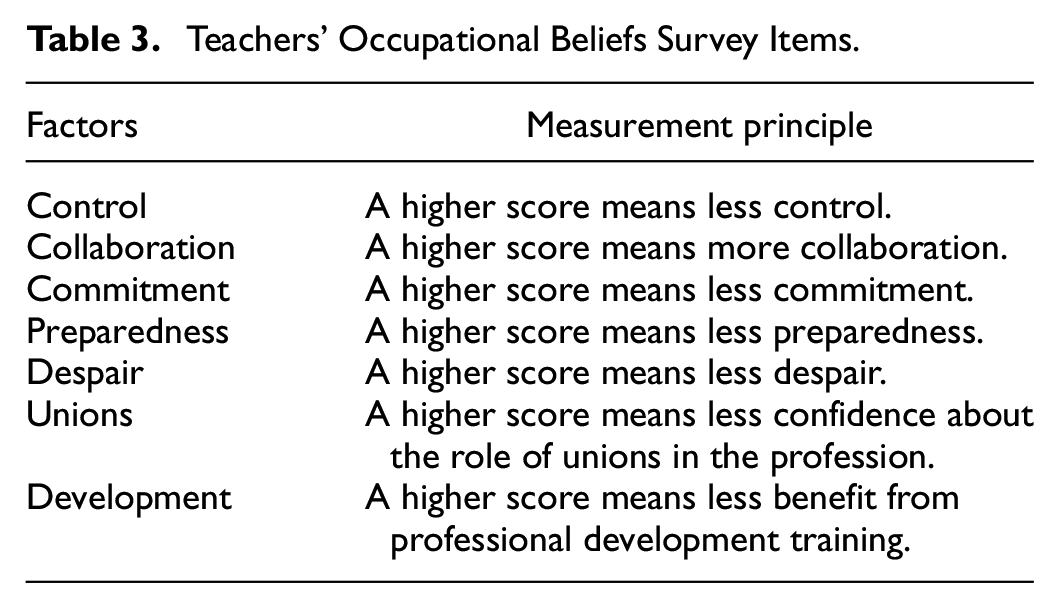
Quinn (2011) suggested that TOBS is made to assess the teachers’ OS at the professional and organizational phases. The questions would be the same, but the inclusion of grammar is different for the pre- and in-service teachers. For example, for the TOBS version used in this study, one question of the Control factor was “For each action below, please indicate how much control you feel will have during your first year of teaching over,” which is for the preservice teachers. For the in-service TOBS version, this question would be asked, “For each action below, please indicate how much control you feel you have.”
Reliability Test of the Survey
The online survey included the TOBS and the PCK standard test. Quinn (2011) established the validity by reporting the face, content, construct, and discriminant validity of the TOBS. However, the TOBS’ reliability test was missed. Meanwhile, the PCK standard test was made by the researcher for the first time, and the reliability test was needed, too. Therefore, the researcher recruited the PPETs (n = 26) from other institutions, to avoid the test effect and to complete the survey twice with a 1-week interval. Then, the researcher used the Pearson correlation coefficient to assess the correlation between the two results. All factors were significantly positively correlated at the α = .05 level (Thomas et al., 2023), PCK (r = .55, p = .004), Control (r = .41, p = .003), Collaboration (r = .77, p = .0001), Commitment (r = .78, p = .0001), Preparedness (r = .73, p = .0001), Despair (r = .58, p = .002), Unions (r = .67, p = .0001), and Development (r = .54, p = .004). The results indicated that the survey is reliable. Thus, the data collected from the survey were valid and reliable.
Interview Guideline
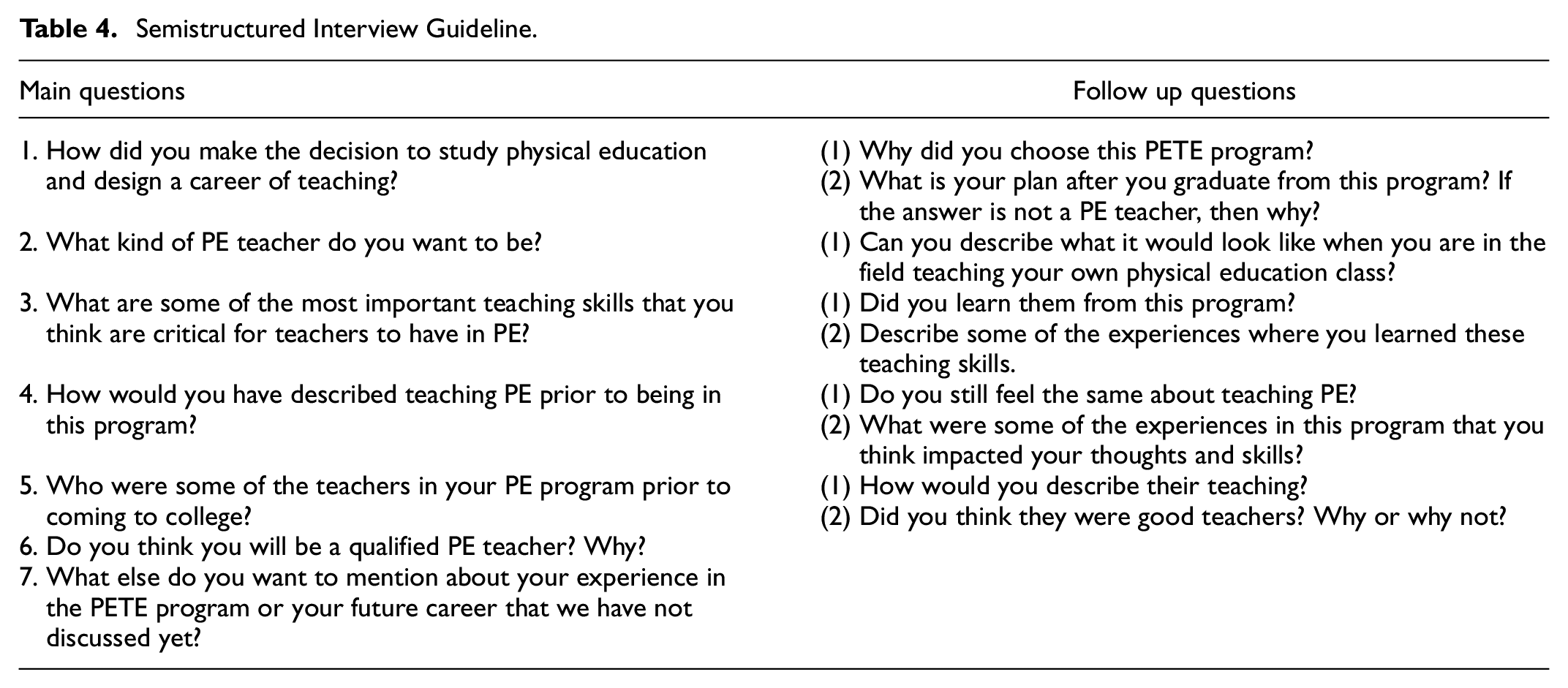
The interviews were semi-structured, with a guideline that includes the main questions, and it is flexible to change the questions or the sequence during the interviews (Merriam & Tisdell, 2016). The interview had two main purposes, namely, understanding the PPETs’ experience in learning PCK and exploring if the PPETs changed their perspectives of the PE teaching profession and how. Table 4 gives the interview guidelines.
Semistructured Interview Guideline.
Data Collection
Data were collected after the Institutional Review Board of the researcher’s institution approved this study. There were two parts of data in this study. The quantitative data were collected from the survey, and the qualitative data were collected from the interviews.
Quantitative Data Collection
The researcher emailed the target PETE department chair to gain permission to recruit the PPETs. With the chair’s and the instructors’ permissions, the researcher went to the classes, in person and online, to recruit the PPETs and ask them to do the online survey. The latter contained a signature box for the informed consent form that the participant needed to sign before taking the survey. The period to collect the data was the last few weeks, including the final exam week, of the semester. Theoretically, the students would have learned everything they needed from the courses when they completed the survey, and the last few weeks of classes would not have largely influenced their knowledge and experiences. Finally, 56 out of 80 PPETs in the program completed the online survey in 3 weeks.
Qualitative Data Collection
The researcher contacted the potential interviewees by email. With the participants’ agreement, the researcher set up online meetings with them. All interviews were recorded simultaneously by Zoom and a smartphone to avoid malfunction of either device. Finally, all eight interviews were successfully recorded by both devices. The researcher used an online service to transcribe all interviews to text initially and listened through the interview records to modify all the transcribing mistakes by the software. Then, the researcher analyzed the interview data and identified themes.
Data Analysis
Statistical Analysis
The researcher used the multivariate regression analysis to test if the PCK standard test score could significantly predict any factors of the TOBS. The factor “Unions” was not the focus of this study, so only six factors of TOBS were analyzed. The alpha level was set to .05.
Qualitative Analysis
The method of analyzing the interview data was inductive. Because the values and weight of all data are equal, the process of laying out all the data is horizontalization (Merriam & Tisdell, 2016). The researcher aimed to find deep reasons and sum up the themes to explain how PCK might influence the OS of the PPETs. The process to analyze interview data includes: (1) first reading the transcripts; (2) the open coding process into extract all potentially useful information; (3) the analytical coding process to group similar codes into categories; and (4) connecting and relating categories to build themes.
The first approach of the interview data analysis was to have a rich and thick exploration and description of the participants’ OS. The individual’s perceptions were analyzed and summarized as groups; the themes spoke as groups but not individuals. The researcher expected the differences existing among the four groups. The second part of the data analysis was about how PCK influenced students’ OS. The data were analyzed to explore how PPETs’ OS changed before and after taking the PCK courses; the differences were expected.
Trustworthiness
The researcher used the PPETs from other institutions for the PCK standard test’s reliability to ensure that the PPETs in the target PETE program would not be affected by the testing effect. Also, the researcher processed the data screen before the data analysis, and no outlier was found under the range of SD = ±3.29. Multiple participants in each group were interviewed to improve representativeness. Moreover, the researcher emailed the transcripts back to and double-checked with the interviewees to avoid transcription mistakes.
Results
The current mixed-methods study includes quantitative and qualitative data. Two subsections of the results are reported. The first subsection tackles the statistical analysis results of the survey data, while the second subsection discusses the results of the qualitative data, which includes three themes.
Quantitative Results
The researcher aimed to see if the PCK standard test score could significantly predict any factors of the TOBS. Because there was only one predictor and six outcomes, the multivariate regression analysis was appropriate. The predictor of the analysis was the PCK standard test. The criteria of the analysis were the six factors of the TOBS: Collaboration (M = 16.57, SD = 3.85), Commitment (M = 8.52, SD = 3.03), Control (M = 5.98, SD = 1.86), Despair (M = 33.39, SD = 7.03), Development (M = 8.80, SD = 2.58), and Preparedness (M = 21.20, SD = 5.16). Result shows that the PCK standard test score (M = 67.5, SD = 17.08) significantly predicted the TOBS, Wilk’s Lambda = .076, F (6, 49) = 2.57, p = .03,
Table 5 shows the regression analysis results between the PCK standard test score and TOBS factors. The factors of Commitment, Control, and Development were significantly predicted by the PCK standard test score. Based on the questionnaire, the results indicated that a PPET with a higher PCK standard test score would feel more desirable and comfortable to teach (Commitment), have more control of the classes (Control), and are more likely to trust the benefits of professional development.
Multivariate Regression Analysis Results Between PCK and TOBS Factors.

p < .05. **p < .01.
Although the other three factors of the TOBS were not significantly predicted by the PCK standard test score in this study, their relationships were also positive. A PPET with a higher PCK standard test score may feel more comfortable working with other teachers and faculty members (Collaboration; B = .016), may feel less despair when facing the challenges of teaching (Despair; B = .018), and may be more prepared for the teaching career (Preparedness; B = −.078).
Qualitative Results
Through the interviews, the PPETs described their development, future career plans, and PE teaching experiences. The qualitative data indicated how the relationship between PPETs’ PCK and OS was formed. Similar to the quantitative results, the interviewees who had more teaching experiences showed higher confidence in being qualified PE teachers and had clearer career plans. Based on the data, the researcher extracted four themes: (1) PCK, OS, and the methods classes; (2) PCK and career plan; (3) PCK and self-confidence, and (4) PCK and perspective of the PE profession.
PCK, OS, and the Methods Classes
During the interviews, all participants mentioned their experiences in methods class in almost every question and answered the question about where they learned the teaching skills. The researcher did not use PCK directly because some young PPETs might not be familiar with this terminology, but the participants’ answers led to PCK. For examples, “I learned all these (PCK) from Dr. M’s (instructional strategies) and Dr. S’s classes (PE Design Methods and Pre-Practicum). What I learned would make me a great PE teacher, I believe.”“In the (methods) classes, we learned and practiced how to deal with different students. It is very helpful.”
On the other hand, the methods classes were also the key to modify the PPETs’ perspectives of PE teaching. A second-year PPET said: “I did not think PE is complicated. After I came here (the PETE program), I took the methods classes and I taught students. I realized PE is not that easy like I thought, I must know much knowledge and skills.” A senior claimed the methods classes showed her different career paths: “I think the teaching experiences (in the methods classes) helped me find my way out. I found I wanted to teach instead of coach. I want to be a PE teacher to make enjoyable PE classes.”
Generally, the data showed that the methods class is the most important intermediary for the PPETs to learn PCK and develop the OS at the same time. The internal connection is the teaching practice, which is the delivery format of the methods class. Therefore, there is a connection between PPETs’ PCK and OS because they gain them from the same experience.
PCK and Career Plan
For the participants in the study, more PCK led to more definitive career plans. Based on the interview data, the more methods classes the PPETs took, the clearer pictures they had of their future career plans.
PPETs in Groups 1 and 2 did not have a professional language to discuss their plans after graduating from the program. They used language such as “I do not know,”“I am not sure,” and “maybe.” In addition, there were gaps in their post-graduation plans. One interviewee from Group 1 noted: “I am not sure where I want to go. Because I do love little kids and like the energy is a huge part of that, but I also like how much of a role that being upper middle school and high school can play.” A similar language style was observed in another young PPET: “I want to teach. I am thinking more secondary. I do not know. Like if I am gonna coach in high school or if I get a job as a coach in the college … am not sure how it is going to play out.”
Conversely, interviewees from Groups 3 and 4 had clear future career plans and felt confident about them. They stated: “I am getting ready to be back here for a two-years athletic training graduate program for my master’s. My plan is to teach PE in high school and coach as well.” Generally, most new PPETs struggled to determine at which level they would prefer to teach. The reasons that caused the uncertainty included less understanding of the profession and change of opinions after teaching in the schools. Based on the findings, the PPETs believed that more methods classes they took helped or would help them make precise plans. When a PPET has enough PCK, he/she knows what it will look like to teach different ages of students.
PCK and Self-Confidence
The interviewees who have taken more methods courses showed more confidence to be a qualified PE teacher than those who have taken fewer methods classes. The PPETs in their senior year have taken all methods classes and, normally, successfully passed the licensure exam for PE teachers in the state. When the participants were asked if they thought that they would be qualified PE teachers, they not only answered affirmatively but also justified their beliefs. The PPETs claimed that the teaching experiences made them more confident, especially with the feedback from the professors, cooperating PE teachers, and students: I do [think I will be a qualified PE teacher] because of how confident I am in front of the class, my skills, and after learning everything through this program… after I go through both placements and forming great relationships with those teachers and learning from them… they gave me advice and basically telling me they are not worried about me at all.
Compared with the seasoned PPETs, the younger ones thought that they would be qualified PE teachers, too. However, their confidence came from their future education, instead of the teaching experience the seniors already had. “By the end, by the time I graduate, I definitely think so. These classes are definitely preparing me to know how to teach. I will be more prepared with all the teaching courses with the methods classes.”
The seniors thought that the experiences in the methods classes helped them build confidence; the new PPETs believed that they would be qualified because they would take more methods classes. Like the interviewees mentioned, it is crucial to learn PCK from their own mistakes and improve themselves.
PCK and Perspective of PE Profession
This theme incorporates changes in the PPETs’ perspectives on the PE teaching profession during their time in the PETE program. Most of the interviewees felt different after taking the methods classes. After learning in the program and reflecting on their K–12 experiences, the participants articulated that their PE teachers could improve their teaching. One participant mentioned that the students seemed to negotiate the accountability and the teacher was complacent in letting them merely “stay active.” She went on as follows: It was definitely way more laid back and not much instruction. Looking back on everything that we are taught in school. No, I do not think he was a good teacher. We played stuff that you are not supposed to do. Sometimes in the class [methods class], I am like, “wow, we did this in high school [what we were not supposed to do].”
The PPETs believed that some of their PE teachers did not use appropriate methods to teach PE classes. Because of this, a conflict between the subject matter taught in the methods courses and the participants’ prior experiences in PE classes was manifested. After studying in the program, especially the methods classes, the PPETs had a clearer and more accurate perspective of the PE profession.
Furthermore, one interviewee mentioned that he found the purpose of teaching PE in the methods courses, “Maybe in the K-5 module being in elementary school … finding the purpose of why I am teaching these kids is why we are learning dance.” He was a student-athlete and never danced or been taught dance in his K–12 PE classes, making him think that dance is unnecessary for PE. It is understandable for some PPETs to feel that certain sports or activities are meaningless for PE, depending on their background. Some PPETs had one-sided perspectives of PE, like “throwing a ball and letting them play,” before they came to the program. By teaching in the methods classes, the PPETs saw the bigger picture of the PE profession and considered what they wanted to do differently from their school PE teachers.
Generally, the qualitative data indicated that PPETs developed their PCK and OS in the methods classes. The experiences of practice teaching help the PPETs to gain a thorough understanding of the knowledge they learned to build PCK. Moreover, the PPETs reformed their understanding of the PE profession by interacting with the children and PE teachers.
Discussion
The primary purpose of the study was to examine how PPETs’ PCK influenced their OS. A mixed-methods research design was conducted to answer the questions. The quantitative and qualitative results showed high consistency. The PPETs with higher PCK standard test scores led to less commitment, more control of the class, and higher beliefs in professional development. Meanwhile, the qualitative data further supported the quantitative results. From the interviews, the PPETs who took more methods classes understood deeper of the PE profession and had clearer career plans; they believed the methods class is the main way to learn PCK, which would increase their confidence to be qualified PE teachers; moreover, they believed the PETE program should support more teaching practices to prove PPETs’ PCK.
The most significant finding of this study is the positive connection between PPETs’ PCK and OS. Limited research in the PETE area has directly connected PCK and OS, as this study has, rather than discussing them separately. Some researchers have supported the improvement of PPETs’ PCK after participating in methods classes and early field experience (EFE), using qualitative evaluation methods such as interviews and observations (Fletcher & Casey, 2014; Ingersoll et al., 2014). To clarify, in many studies, EFE indicates or includes methods classes. Although PPETs could learn teaching skills from other sources, such as CK courses and skill classes (Chang et al., 2020), EFE and methods classes are more effective ways to teach PCK to PPETs (Ingersoll et al., 2014; Iserbyt et al., 2017).
Although the quantitative data in this study did not show significant correlations between the PCK score and all six TOBS factors, it does not imply that such a relationship does not exist. From the interviews, PPETs who had more teaching experiences also expressed more positive feelings towards working in the school setting and with cooperating PE teachers. PPETs felt more confident teaching PE classes and facing challenges because of their rich teaching practices. Field teaching helps students understand the realities of teaching, recognize the role of a PE teacher, prepare for school life, and transform from student-teachers to in-service teachers; these experiences make PPETs appreciate the value of other professional development opportunities, such as EFEs (Richards et al., 2014). The sample size of this study was relatively small, which could be the reason to lead the insignificant correlations.
Previous studies provided evidence that teaching experiences improve PPETs’ PCK or OS, leading researchers to consider the possibility of inferring that EFEs have a positive influence on both PPETs’ OS and PCK development. What this study did was reform the connection from ‘EFEs to PCK’ and ‘EFEs to OS’ to ‘PCK to OS in EFEs.’ The point of making this new connection is to reveal and support the idea that a PETE program could develop PPETs’ PCK and OS together during EFEs or other teaching practices.
However, it does not imply that any methods classes or EFEs could ideally help PPETs develop their PCK and OS; it is also influenced by the structure of methods classes. No study has been found comparing the effectiveness of methods classes in authentic and simulated settings. It was an unexpected finding from this study, during the period of conducting this study, most schools were closed due to the COVID-19 pandemic. Thus, sophomore students in the PETE programs could not teach children in their elementary and secondary methods classes, although they had taught children in their freshman year. Although the researchers did not inquire, some interviewees raised concerns about feeling they learned less by teaching peers in the methods classes. Furthermore, communication with cooperating PE teachers is a critical way for PPETs to understand the PE teaching profession (Flory & Burns, 2017). Some participants claimed that teaching each other in college does not feel like real teaching; they still see themselves as students instead of teachers and learn almost nothing about how a PE teacher operates. Therefore, it is suggested that a methods class may not be practical enough to impart PCK and OS if PPETs cannot teach in a school setting.
Limitations and Future Study Suggestions
First, the current PCK standard test only includes 12 questions, which might not be sufficient to reflect the PPETs’ PCK. Second, the sample size is small, and all participants came from the same PETE program, which limited the external validity of the result.
Future studies could focus on developing a PCK writing test, consisting of more practical questions than the current one, to reflect the PPETs’ PCK. In addition, researchers could apply the new PCK writing test to a larger sample group to test the mean differences among different groups. It is valuable to use this writing test to assess the PPETs and in-service PE teachers, which would be deemed more effective than the traditional qualitative measures. Moreover, future researchers could apply this research design to studies on in-service PE teachers to examine if a similar positive relationship exists.
Supplemental Material
sj-docx-1-sgo-10.1177_21582440241300528 – Supplemental material for The Pedagogical Content Knowledge and Occupational Socialization in Preservice Physical Education Teachers
Supplemental material, sj-docx-1-sgo-10.1177_21582440241300528 for The Pedagogical Content Knowledge and Occupational Socialization in Preservice Physical Education Teachers by Dong Zhang, Zhenyu Shi and Yafei Cheng in SAGE Open
Footnotes
Declaration of Conflicting Interests
The author(s) declared no potential conflicts of interest with respect to the research, authorship, and/or publication of this article.
Funding
The author(s) received no financial support for the research, authorship, and/or publication of this article.

Data Availability Statement
Data sharing not applicable to this article as no datasets were generated or analyzed during the current study.
Supplemental Material
Supplemental material for this article is available online.
References
Supplementary Material
Please find the following supplemental material available below.
For Open Access articles published under a Creative Commons License, all supplemental material carries the same license as the article it is associated with.
For non-Open Access articles published, all supplemental material carries a non-exclusive license, and permission requests for re-use of supplemental material or any part of supplemental material shall be sent directly to the copyright owner as specified in the copyright notice associated with the article.
