




Abstract
The national curricula for physical education teacher education (PETE) in Norway require that practicum is carried out in a partnership between student teachers, cooperating teachers, and teacher educators. The aim of this article is to get insights into how cooperating teachers and teacher educators express and understand their educational partnership and mutual contribution to the practicum in PETE. Focus group interviews with cooperating teachers and physical education teacher educators (teacher educators) were analyzed by drawing on sensitizing concepts from figurational sociology. As such, the study has intended to identify networks between the two groups, as well as the interdependent nature, and consequent power relations in the partnership. The research may shed light on understanding why it seems difficult to reach the aim in the national curriculum of a mutual partnership of the two groups in practicum.
Introduction
Research into the education of physical education (PE) teachers has been a growing field of interest over the last couple of decades. Practicum—that is, the periods of school placement that student teachers have in the course of their education—is considered an essential aspect of physical education teacher education (PETE) (Chambers & Armour, 2012; Larsson, 2009; Mordal-Moen & Green, 2012; Velija, Capel, Katene, & Hayes, 2008; Wang & Ha, 2012). In an ideal setting, student teachers are supported during the practicum by both teacher educators and cooperating teachers. These three groups are referred to as the practicum triad (e.g., Belton, Woods, Dunning, & Meegan, 2010).
Although practicum in PETE has been an object for investigations, this line of research has mainly focused on the student teachers’ points of view (e.g., Booth, 1993; Dunning, Meegan, Woods, & Belton, 2011; Jenkins, Garn, & Jenkins, 2005; Lamb, Lane, & Aldous, 2013; Moen & Standal, 2014; Ovens, 2004; Standal, Moen, & Moe, 2014; Stidder, 2012; Stidder & Hayes, 2006; Tinning, Jenkins, Collins, Rossi, & Brancato, 2012). These investigations have established that student teachers value the practicum aspect of their education considerably higher than the university-based aspect of their teacher education programs. In fact, it is reported that student teachers claim to have difficulty seeing the relationship between these two contexts (Larsson, 2009; Mordal-Moen & Green, 2012; Velija et al., 2008). One reason suggested for this situation is that student teachers find it difficult to make meaningful connections between the theoretical coursework and its practical application in the teaching of PE during practicum (Bulger et al., 2001; Larsson, 2009).
In two recent articles, Standal et al. (2014) and Moen and Standal (2014) have explored what and how student teachers learn during the PETE practicum. Similar to earlier findings, Moen and Standal (2014) found that the students were not inclined to reflect on the practicum experiences with a socially critical perspective, but it was also found that the students were inclined to think critically about their own teaching performance as well as on the cooperating teachers’ way of teaching. That is, contrary to earlier research (e.g., Dowling, 2011; Moen, 2011; Mordal-Moen & Green, 2012; Velija et al., 2008), the practicum was not found to be a site where student teachers uncritically digest everything they are told or shown.
Compared with research on the student teachers, the perspectives of teacher educators and cooperating teachers have received lesser attention in the literature. Although teacher educators appear highly appreciative of the significance of the practicum element of PETE, studies reveal that they play a very distant role during the practicum period (Larsson, 2009; Moen, 2011; Mordal-Moen & Green, 2012; Velija et al., 2008). In the Norwegian context, teacher educators are involved in the practicum in the role as a “contact teacher,” which means that they visit schools when student teachers do their practicum (Moen, 2011). However, Moen (2011) found that the teacher educators question the suitability and viability of the role as contact teacher. For example, some view practicum visits as a needless use of time because they already know the cooperating teacher and, by implication, know what and how the mentors will perform their roles.
Regarding the cooperating teachers, research has indicated that—much like student teachers—cooperating teachers express a need for the students to spend more time in teaching practice to adequately prepare them for their future role as PE teachers (Hynes-Dusel, 1999). It has also been shown that the mentoring process is hierarchical in the sense that the mentors played the dominant role and the student teachers were subservient (Wang & Ha, 2012). Thus, power is an aspect of the mentoring process, and a topic we will return to later. Other studies report that the student teachers’ pre-conceived beliefs about what constitutes a qualified PE teacher are not challenged by cooperating teachers during the practicum (Dowling, 2011; Larsson, 2009; Mordal-Moen & Green, 2012, 2014; Velija et al., 2008). For instance, as Velija and co-workers argue that if students are not adequately supported to make the connections between theory and practice, student teachers may end up accepting “the ideologies of those whose knowledge they value and which will help them get by school-based mentors” (Velija et al., 2008, pp. 403-404).
Based on the reviewed literature, it appears that teacher educators have a distant role in the practicum. This is also underscored through research findings indicating that it is the knowledge preferences of cooperating teachers, such as the procedural, knowledge-in-practice (Hegender, 2010), which dominates the mentoring process in practicum. Thus, questions can be raised about the nature and extent of the cooperation between the three parts of the practicum triad. As a consequence, there have been calls for improved cooperation between the parties to ensure the students’ learning outcomes (e.g., Moen & Standal, 2014). Chambers and Armour (2011) argue that “in order to support PETE student learning more effectively in Ireland, school and university personnel must work in an effective partnership to educate PETE students” (p. 541). To meet this challenge, an Irish research team has investigated the impact of a program designed to enhance the cooperation by supporting the members of the practicum triad. In three articles, presenting the perspectives of the student teachers, teacher educators, and cooperating teachers, respectively, the program was found to support the cooperating teachers in defining their role (Belton et al., 2010). It also provided a framework to support the role of university supervisor (teacher educator; Meegan, Dunning, Belton, & Woods, 2013), and it led to better learning experiences for the student teachers (Dunning et al., 2011).
The purpose of the present study was to explore the perceptions and viewpoints of teacher educators and cooperating teachers on the practicum aspect of PETE in Norway. As such, our study can be seen as an attempt to cross-validate the findings from the Irish research just presented. In addition, research on the practicum in PETE has been compartmentalized, dealing with the different groups of the practicum triad in relative isolation. To the best of our knowledge, no research has been reported that has examined the perspectives of both teacher educators and cooperating teachers in the same study.
Research Question and Perspective
It is well known that there exists a theory–practice fragmentation in PETE (e.g., Hegender, 2010; Moen & Standal, 2014), where the practical aspects of teaching performances, such as planning and delivering lessons or class management, are highly valued whereas the more theoretical aspects of PETE are given less value. Spendlove, Howes, and Wake (2010) suggest that the different roles of school and university “represent a division of labour, which can be characterised as theory on the one hand, and practice on the other” (p. 66). More precisely, they describe theory and practice as belonging to separate worlds. Given that the official PETE curriculum in Norway (Utdannings- og forskningsdepartementet [UFD], 2003a, 2003b, 2010) stipulates that the practicum is intended to be carried out in a partnership between student teachers, cooperating teachers, and teacher educators, our research interest has been in the relationship between the cooperating teachers and teacher educators. Our interest—as researchers and teacher educators—has been in how teacher educators and cooperating teacher best can enable the student teachers to learn from the relationship between practicum and the other parts of the educational program. More specifically, we have been interested in how teacher educators and cooperating teachers see themselves as participants in a network (or not). Therefore, our research question has been how do cooperating teachers and teacher educators express their educational partnership and (potential) mutual contribution to the practicum of PETE in relation to the networks, interdependencies and power relations they are a part of?
For the purpose of this study, we have drawn on resources from figurational sociology (Elias, 1978; van Krieken, 1998). Figurational theory emphasizes the need to locate people, in this case, teacher educators and cooperating teachers, as parts of various networks or figurations. Figurations are the networks or “webs” of social relations (Elias, 1978) of which people are inevitably a part. In other words, people are related to a large number of other individuals, groups and processes, past and present, which may be recognized or unrecognized and which amount to “a structure of mutually oriented and inter-dependent people” (Elias, 1978, p. 261). At the local level, teacher educators as well as cooperating teachers are likely to have complex professional figurations, and they are involved in a web of relationships, which will influence their professional life and development. In the context of PETE, this web of relationships is a process that has been formed from early childhood and school experience (acculturation), in sport training, during education (professional socialization), and on-the-job experiences (occupational socialization; Moen, 2011). As such, the webs of relationships have formed a framework not only for the person’s habitus but also for their socialization.
To discuss the research question and empirical material generated for this article, we have found sensitizing concepts from figurational theory; networks, interdependencies and power relations (Elias, 1978) to be relevant. In addition, the more mainstream sociological term roles served as a sensitizing (Roberts, 2009). Although figurational theory has become increasingly commonplace in the sociology of sports over the last quarter of a century, it was only applied to PE research a decade or so ago (Green, 1998, 2000, 2002, 2003; Green, Smith, & Roberts, 2005). Nonetheless, there has been a steady subsequent growth of figurational studies on PE teachers (Keay, 2006) as well as on PETE (Moen, 2011; Velija et al., 2008). The sensitizing concepts applied on this particular study will be elaborated in the discussion.
PETE in Norway
In the academic year 2011/2012 when this study was undertaken, there were three different educational routes to become a PE teacher in Norway. The first was to acquire 30 or 60 credits PE as a part of general teacher education (GTE). The route enables the graduates to teach PE in primary and elementary school (ages 6 to 16). Another route was to take a bachelor’s degree in PE and sports (BAPE), a 3-year course of stud PE full-time in which students acquired the title subject teacher in PE. The route enables the graduates to teach PE in primary, elementary, and upper secondary schools as well as at the “folkehøgskole.” 1 The third route to graduating as a PE teacher was to take a bachelor’s degree in, for example, sports sciences, outdoor studies, or fitness and then complete a further 1-year (60 credits) Practical and Didactical Education (PDE) qualification, which qualifies the students as subject teachers in PE. The students are qualified to teach in primary, elementary, and upper secondary schools, but not at the folk high school.
All three routes into PE teaching are based on the national curriculum for teacher education (UFD, 2003a, 2003b, 2010). The practicum period accounts for approximately 12 to 14 weeks of the 3-year BAPE program, 100 days of the 4-year GTE program, and 12 to 14 weeks of the 1-year PDE program.
The national curriculum for GTE (UFD, 2010) states that there is a common responsibility between the cooperating teacher and the teacher educators regarding practicum and assessment of the student teachers in the practicum. In terms of the various roles of those involved in the practicum, it is a requirement that the institutions develop a plan for the practicum in cooperation with the practicum school. The responsibilities of the university teacher, the cooperating teacher, and the students have to be clarified in the local curricula, which each institution has to develop based on the national curricula.
Method
The findings presented in this article are part of a larger study that investigates the practicum aspect of PETE at three institutions in Norway. More specifically, the overall study has investigated the perceptions, experiences, and viewpoints of teacher educators, cooperating teachers, and student teachers, respectively. Whereas our two previous publications (Mordal-Moen & Green, 2014; Standal et al., 2014) have explored the student teachers’ perspective, this article explores how cooperating teachers and teacher educators understand or express their educational partnership (mutual contribution) in PETE.
Participants
Three different university colleges (UC; called UC 1, 2, and 3 for anonymity) were enrolled in the umbrella study, which consisted of focus group interviews of student teachers, cooperating teachers, and teacher educators in each of the three UCs participating in the study. The institutions invited to participate in the study were chosen on the basis of (a) providing at least two of the three routes to become a PE teacher in the academic year 2011-2012, (b) the size of the UC including both small and large university collages, and (c) geographic location so as to include UCs located in both urban and rural settings. Two of the UCs were located in more rural areas of Norway whereas the third was situated in a large city. The size of three UCs varied considerably; however, the size of the PE teacher educations programs was somewhat similar. The rationale for this sample was to cover the complexity in the Norwegian higher education system in PETE.
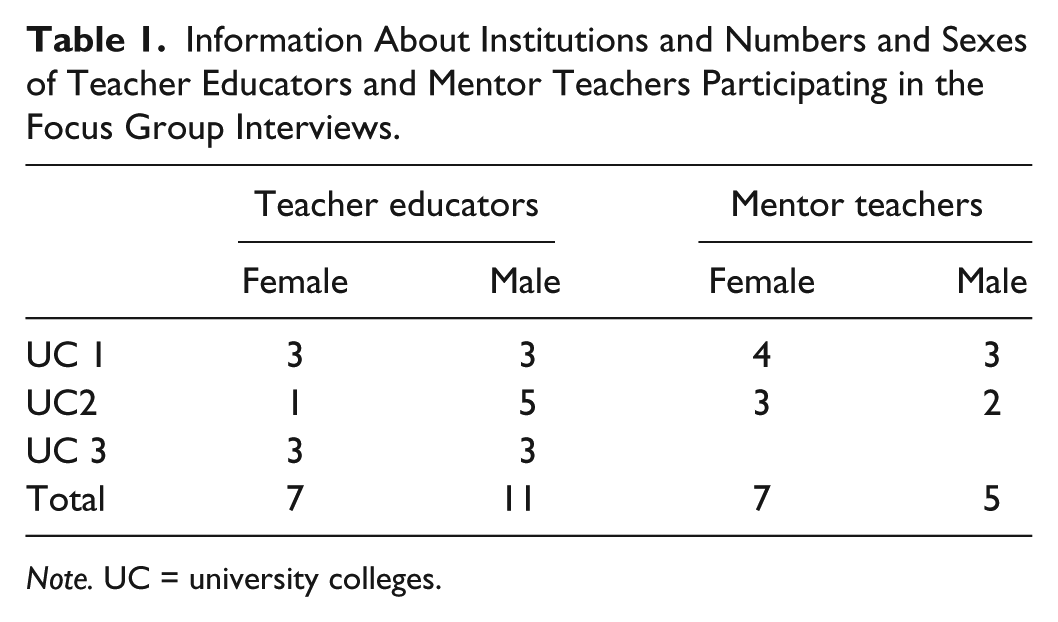
Here, we draw on two focus group interviews of cooperating teachers and three focus interviews of teacher educators. The cooperating teachers at the two UCs were all informed about the study by our contact person at the UC, and invited to take part in the study. From those who volunteered to participate, we randomly drew a selection of eight participants at each institution, four from each gender. Of the 16 cooperating teachers asked to take part in the interviews, 12 (seven women and five male) actually took part in the study (see Table 1).
Information About Institutions and Numbers and Sexes of Teacher Educators and Mentor Teachers Participating in the Focus Group Interviews.
Note. UC = university colleges.
The head of department at the three different UCs were contacted by the first author. Subsequently, the head of department gave information about the study to the teacher educators and invited them to participate in the study. Among those who volunteered to take part in the study, we made a random selection of eight participants from each institution, who were asked to attend the group interview. Of the 24 teacher educators asked to participate in the interviews, 18 (seven women and 11 male) took part in the study (see Table 1).
The group sizes of the focus group interviews with both cooperating teachers and the teacher educators varied from five to seven participants (see Table 1). This is fewer than we had intended, but the numbers are still within the group size recommended for focus group interviews (Malterud, 2012).
Although we were able to facilitate focus group interviews of teacher educators from all three UCs, it was difficult to get hold of cooperating teachers to attend the focus group interviews. We experienced difficulty for the cooperating teachers to find time to meet for group interviews, not least because of the long distances from their schools to the UC (some had to travel more than 1 hr to attend), as well as busy timetables in their everyday lives as teachers. Consequently, we only managed to complete focus group interviews of cooperating teachers at two of the UCs.
Interview Procedure
The focus group interviews with the teacher educators and the cooperating teachers were semi-structured. Two key themes (and related questions) formed the basis of interviews: (a) the teacher educators’ and the cooperating teachers’ ideas about and perceptions of PE and PETE and (b) their viewpoints and experiences regarding the practicum in PETE. These themes are grounded in the research questions of the study and our knowledge of the research literature on the topic. One researcher conducted all five interviews. The interviews took place in quiet meeting rooms and were audiotaped with the teacher educators’ and cooperating teachers’ oral consent. All three interviews with the teacher educators lasted 1 hr and 30 min, whereas the two interviews with the cooperating teachers lasted 1 hr and 10 min. Before starting the interview, the interviewer gave a brief, standardized explanation of the nature of the research. Furthermore, all participants signed a consent form where they agreed that the information supplied could be used in publications by the research group if anonymized. This is in accordance with the ethical guidelines of the Norwegian Social Sciences Data Service who had previously endorsed the project.
Data Analysis
The interviews were transcribed verbatim and subjected to an explorative thematic analysis (Kvale & Brinkman, 2009). The analyses were performed jointly by the two authors and took place in steps where we independently read the transcripts and met on several occasions to discuss re-current themes in the interviews. In the first stage, we independently read the transcripts with the aim of doing a meaning condensation (Kvale & Brinkman, 2009). This meant that relevant quotes from the interviews were highlighted and the immediate meaning in them expressed in shorter sentences. The research questions for the project as well as the main themes in the interview guide were guiding this first and initial step in our analysis. On the basis of our separate meaning condensation, we agreed on five main focused codes supporting the next step in the analyzing process: “just visiting,” “the different roles,” “competence,” “cooperation and control,” and “problems and conflicts.”
In the next step of the analysis, all interviews were re-read by the researchers independently having these five focused codes and the sensitizing concepts roles, networks, interdependencies, and power relations as a background, before we met again to discuss the analyses. Thus, at this stage, the analytical story moved in a theoretical direction. As a result of this process, we decided on two main themes, “just visiting” and “cooperation—polarization,” as relevant to present our findings. In the final part of the analysis, we discussed what quotations could best guide the story revealed from the analyses.
Trustworthiness
To ensure the trustworthiness, our use of investigator triangulation (Brantlinger, Jimenez, Klinger, Pugach, & Richardson, 2005), as described in the “Analysis” section of this article, strengthens the credibility of the study. The present article is part of a larger research project involving other researchers. We discussed the conceptualization of the study as well as the analyses and results with other members of the research team as well as colleagues who work in PETE. This has functioned as a form of peer debriefing (Brantlinger et al., 2005). During the analyses, we were all the time looking for disconfirming evidence (Brantlinger et al., 2005) in all stages of the analyzing process, for example, by trying to find statements that contradicted or nuanced the emerging codes and categories. However, observational studies on the practicum visits would have improved our study, and we suggest future studies to implement observational elements. Multiple interviews of the subjects could also have increased the trustworthiness of the study. However, we opted for interviewing several groups of teacher educators and cooperating teachers, thus enabling us to explore their viewpoints and experiences across different UCs.
Findings
Just Visiting?
One way of facilitating the cooperation between cooperating teachers and teacher educators is to organize meetings such as practicum preparation where cooperating teachers gather at the UC prior to practicum. Another meeting point was commonly referred to as “practicum visits,” where teacher educators went to practicum schools to observe students holding lessons as well as take part in evaluations of these lessons. The purpose of the latter visits was described as to “see that it actually works and that the cooperating teacher takes the students seriously and does what we expect them to do” (Teacher educator [TE]-UC3).
The focus of the teacher educators during these visits is not so much on the individual lesson, as to get an overall impression about how things work for the students and to see how the cooperating teachers follow up the students: “I often think that the supervision sessions are more interesting than the lessons, because there I get the impression of how things are going” (TE-UC3) or “When we visit practicum we are more interested in what they have worked with in the entire period, not necessarily what went on in the specific lesson we got to see. More how the students have developed through period” (TE-UC1).
“Visiting” can be thought of as an expression that does not have any meaning beyond it being an innocent notion used by all groups about the teacher educators’ appearance at the practicum site. However, the word visit also contains implications about the interdependency between cooperating teachers and teacher educators. For instance, our analysis clearly shows that the teacher educators are much more concerned about these visits than the cooperating teachers. This is evident in the sense that discussions about the visits were more prevalent in the interviews with teacher educators. When cooperating teachers talked about visits, it was in relation to rare cases where students were seen as unfit as teachers, and they had to report this to the teacher educators.
For the teacher educators, these visits had a different meaning. The visits meant that they had to leave their home institution and travel to the practicum site. It involved more of an effort for the teacher educators as compared with the cooperating teachers. More importantly, however, we find that the teacher educators’ experience being away from home in the sense that they have to behave as visitors. This becomes particularly salient when difficulties arise: The moment I visit their home court—I am visiting!—then I don’t want to step on their toes. I feel in a way that I come from the university college and—Mrs. know-it-all! . . . I can ask questions, but in a way I have to laugh at the same time. I don’t want to provoke them. (TE-UC1)
The teacher educator has a distinct sense of not wanting to offend the hosts that she visits and that she is afraid to use her competence both because she does not want to be perceived as someone who knows better and because she does not want to insult the cooperating teacher(s) she visits. This was found in all the interviews with teacher educators: “I have sometimes wondered about issues that have come up, but I haven’t confronted it in the situation” (TE-UC2). Their strategy is rather to discuss it with colleagues when they come back to the UC and possibly say that this or that cooperating teacher is not suitable for the job: “If it is a serious problem, then we raise it internally [at the UC] and we don’t request [that teacher] next year” (TE-UC2)
Cooperation or Polarization?
The national curricula describe an ideal practicum as a joint enterprise carried out in cooperation between teacher educators and cooperating teacher (UFD, 2003a, 2003b, 2010). Previous research, however, has portrayed what goes on at the university and in practicum as two separate worlds (Larsson, 2009; Mordal-Moen & Green, 2012). This has been framed in terms of a theory–practice distinction. This was to some extent also the case in our material: “Lots of theory is relevant, but the paradox is that we still have the separation. For many it is only logical that theory is here [at the university college] and practicum out there in the school” (Cooperating teacher [CT]-UC2). In addition, one cooperating teacher stated that I would have liked them [the students] to visit us prior to the practicum. Now, they just jump right in and it is quite hectic. They could have been prepared by seeing what we do and we could have discussed and shown them different stuff . . . Because it is like theory and practice. Some of those who teach here [at the university college] have hardly been working in the schools. It is lots of theory. The everyday is very different. (CT-UC1)
The last quote illustrates not only the view taken by many cooperating teachers that the students should have been obliged to visit them prior to their practicum, it also expresses a commonly held skepticism among cooperating teachers toward the degree to which teacher educators have much practical experiences with teaching PE. It is clear from the material we have analyzed that from the cooperating teachers’ perspective, an essential purpose of the practicum is to experience and see what it is like to really be a teacher. As such, cooperating teachers manage a very important knowledge resource for the students’ learning. It is also important to note that this view is held not only by cooperating teachers, but also by teacher educators: “[The purpose of practicum] is to practice the role as a teacher with everything that goes with it . . . You have to be in a school to practice the role as teacher” (TE-UC2), or as another teacher educator put it, For me, the cooperating teachers are not colleagues, but important informants. Because it is many years since I worked as a PE teacher . . . I learn a lot from the cooperating teachers either from practical tips or whatever, really. (TE-UC1)
In line with the view expressed in the last quote, that particular teacher educator was quite critical toward the academization of PETE: In the pursuit of doctoral degrees and professors, we have missed out on that close contact with the field of practice and with the cooperating teachers. We had one guy working here, whose contract wasn’t extended because he didn’t have [a PhD], but he was working well with the cooperating teachers and was writing popularized texts about practical activities . . . And that was shame because it was really a man who was focusing on all this and really had something we needed. But most [teacher educators] are concerned with teaching other subject areas or qualifying for a higher academic level. I think it is a loss. (TE-UC1)
Thus, an opposition toward theory and an academic perspective on PE(TE) is not only found among cooperating teachers, but also among the ranks of teacher educators. Although some cooperating teachers emphasize the usefulness of theoretical perspectives—“one should approach the practical everyday work with theory . . . so a combination of both theory and practice belongs [to practicum]” (CT-UC3), teacher educators at all institutions expressed a view that the cooperating teachers to a larger extent should provide students with a meta-perspective on teaching PE: How can you [i.e., the student] develop as a PE teacher in terms of who you are in a given school context. . . . Being able to see beyond one’s daily work as a cooperating teacher seems to be challenging. (TE-UC1)
Or as another said, The cooperating teachers should familiarize themselves with what the students work with theoretically, what they should know and what should be expected from the student. That it is not only “you did this and that well,” but also reflect “why did you this or that,” That is, make them reflect instead of always giving them the answer. (TE-UC2)
In opposition to the quote above where one teacher educator stated that cooperating teachers are informants and not colleagues, the notion of a collegial relationship between the two groups was expressed by other teacher educators as well as by cooperating teachers. Some of the teacher educators have backgrounds as PE teachers as well as cooperating teachers, “so I definitely feel like a colleague” (TE-UC3). Others again express this collegial relationship as grounded in their common efforts to educate future PE teachers. However, there are different understandings as to how the partnership is implemented and realized. One teacher educator said, Before practicum we have a discussion between [us] and cooperating teachers and students. The cooperating teachers always ask “what are we going to focus on in this period. What is the order?” The experience is that when they get guidelines . . . they are quite open to try them out. If we have wishes, then they take care of them quite well. That’s at least what I feel. (TE-UC1)
The intention to pull in the similar direction was also found among cooperating teachers: “so I have to read their curricula and their plans for what we should focus on” (CT-UC2). However, it was also expressed in the interviews that the teacher educators give the cooperating teachers rather free reins: “They do it differently, and we have given them free reins as well. We have the overall [responsibility], but the cooperating teachers do it their way and have their own priorities” (TE-UC2). On one level, this might be an expression of different ways teacher educators work with the cooperating teachers. It was for instance expressed that “it is a goal that there should be close contact [between us] in order to have understanding and respect and so on” (TE-UC2). However, it might also be understood in the sense that the content and the purpose of the practicum are unclear, or as we have highlighted above, that the different groups have different views about what is most important during practicum. This disagreement is, for instance, expressed through the emphasis put on trying out the everyday work of PE teachers in contrast to the need for reflection and meta-perspective on the practicum experiences.
Discussion
In this study, our interest has first and foremost been how the teacher educators and cooperating teachers understand or express their educational partnership in PETE. Based on our findings, we argue that the teacher educators and the cooperating teachers are involved in networks at a national level in the sense that they refer to reading the national curricula. In earlier articles reporting student teacher data from this project, we found, however, that the practicum was organized differently not only between, but also within, the various UCs (Moen & Standal, 2014; Standal et al., 2014). This suggests that the national guidelines result in highly different practices across UCs. In this present study, the most prevalent network identified between the cooperating teacher and the teacher educators was at a local level in the sense that networks between teacher educators and cooperating teachers seem to exist as personal cooperation between the two groups. However, we have identified different types of personal cooperation between the two groups as well as within the groups in how these networks are expressed. Before discussing the nature of these networks, we want to discuss how the two groups perceived their roles in relation to practicum.
Considering the roles, a concept that in sociological terms is understood as “the pattern of behaviours and expectations associated with a position” (Roberts, 2009, p. 240), our study shows that the teacher educators and the cooperating teacher first and foremost have a common understanding that the teacher educators take care of the students’ theoretical knowledge development, whereas cooperating teachers focus on the reality aspect of teaching. This is consistent with what earlier research describes as the theory–practice fragmentation in teacher education. The fragmentation is addressed in the national curricula where the aim of an integrated teacher education is highlighted (UFD, 2003a, 2003b, 2010). However, despite such aims in policy documents, our study shows that there still is a polarization on how cooperating teachers and teacher educators expressed their contribution to the practicum in PETE. This came to the surface with regard to how the teacher educators were more inclined to take a meta-perspective on the practicum experiences, whereas the cooperating teachers focused on the everyday life of teaching. Thus, based on our analysis, it can be suggested that despite intentions in the national curricula, the roles expressed by cooperating teachers and teacher educators, respectively, seem to reinforce a traditional theory versus practice dichotomy.
The traditional theory–practice fragmentation expressed in our material is one where there is a sharp, but rather naïve, separation of theory belonging in UCs and practice in the schools where practicum takes place. This is indeed also a finding from other studies of practicum (Hegender, 2010). Our point here is not to analyze the epistemological assumptions held by the groups involved in the practicum, but to discuss whether and how this way of talking about theory and practice can be seen as an expression of an educational partnership. One issue we would like to raise here is that in the context of PETE, there is an added dimension to such a theory–practice discussion as compared with GTE, because the line of conflict between theory and practice proponents (to use an overly crude distinction) does not only run between the prioritization of pedagogy and subject matter. In PE(TE), it is also a point that the subject matter is itself practical (that is, PE is one of the practical–aesthetical subjects). This, we suggest, may make the polarization between theory and practice slightly different from that in GTE. Hence, the point of our analysis is not how our informants talk about theory and practice but that this talk expresses commitment to the roles as “someone taking care of theory” or “someone taking care of practice.” PE in higher education has, similar to other professional groups, seen an increased academization in the sense that there has been a growing number of PhDs and more focus on research (Backman & Larsson, 2013). What we found in this study was a tension between those who align themselves with this academization and those who are more concerned with the craftsmanship of teaching. Despite the most common finding of polarization between the two groups, some cooperating teachers and teacher educators highlighted the need for more collegial relationship between these two groups. Hence, some of them expressed their roles as providing mutual contribution toward PETE in line with the expectations in the national curricula (UFD, 2003a, 2003b, 2010). In addition, we also found that the academization of PETE was criticized not only by cooperating teachers (e.g., the point that teacher educators have little or no real experience teaching PE) but also by teacher educators. Thus, when it comes to the power struggles of what PETE should be about, it is not so much the roles that are in opposition to each other as it is the viewpoints held by members of the two groups.
Our study revealed differentiated understandings of how the cooperating teachers and teacher educators view their roles and respective contribution in PETE. On a practical level, our study identified differentiated forms of personal cooperation or networks between the two groups. In figurational theory, interdependency is a central concept (Elias, 1978). Focusing on interdependencies within particular networks enables the researcher to conceptualize the relationships between various people, in this case, between teacher educators and cooperating teachers. The most obvious cooperation or network we identified was the meetings that took place during practicum: the practicum visits of the teacher educators. In line with the differentiated understanding of their roles, our findings suggest that the cooperating teachers and teacher educators also had different understandings of the intention or relevance of these visits. Although the cooperating teachers rarely talked about these visits, the teacher educators experienced the visits as important to check out how the students were taken care of in practicum. However, if they experienced problematic issues, they did not address these during the visit. Hence, a clear finding in our study is the interdependent nature and consequent power relation between the two groups.
In figurational theory, power is viewed as an inevitable aspect of all human relationships and exists within all figurations (de Swaan, 2001; Elias, 1978; van Krieken, 1998); power is viewed as an aspect of relationships between people. There is always a certain balance of power within a network, involving struggles between interdependent and more-or-less powerful groups. Supporting earlier research (Mordal-Moen & Green, 2014; Velija, Capel, Katene & Hayes, 2008), our study shows that the cooperating teachers and, to some extent, the teacher educators, think the cooperating teachers manage the most important knowledge base for the students to achieve in PETE. This is also in line with the findings from, for instance, Hegender (2010) who found that in the context of practicum, it was the procedural knowledge in practice that was prioritized over propositional knowledge for practice. In this sense, it appears that the cooperating teachers are the ones in position of power in the cooperating teacher–teacher educator relationship.
Our study also shows that the cooperating teachers have much autonomy in defining their role. To capture the reality of day-to-day power relations and interdependencies within communities, Elias has developed a model for social relations resolving around the concept of relations between established and outsider groups, which refer to uneven power balance between these two groups, where the former group is the powerful (van Krieken, 1998). Related to our study, two issues are relevant. On one hand, the teacher educators explicitly expressed that they were in charge of practicum and that they gave instructions to the cooperating teachers of what to focus on in practicum. This might be an indication that they viewed themselves as the insiders and powerful players in the cooperating teacher–teacher educator network. However, a much more prevalent finding, which gives an impression that the teacher educators were more of an outsider in the network, was the fact that they gave the cooperating teachers rather free reins when it came to the content in practicum. This impression of the teacher educators being the outsiders was also strengthened by the emphasis teacher educators put on being and acting as visitors at the practicum schools. Adding to this, it appears that teacher educators avoid conflicts if they experience difficult issues when visiting in practicum. On the other hand, teacher educators have a certain possibility to end the contract with schools or cooperating teachers who do not fulfill the requirements expected, as one teacher educator mentioned. However, this requires that the UCs indeed can pick and choose which schools and cooperating teachers they send students to. In cases where the UCs are in shortage of schools and cooperating teachers, the threat implied by the teacher educators is not very real.
It is an aim that PETE has to be an integrated teacher education where teacher educators and cooperating teachers act in mutual partnership. We question whether the uneven power balance between the outsiders (teacher educators) and the established groups (the cooperating teacher) identified in this study is productive to fulfill the aim of an ideal practicum as a joint enterprise carried out in cooperation between teacher educators and cooperating teachers (UFD, 2003a, 2003b, 2010). Earlier research shows that it is left to student teachers to integrate practical experiences and theoretical knowledge in PETE (Larsson, 2009; Mordal-Moen & Green, 2012, 2014; Velija et al., 2008). The findings from our study of the power imbalance between cooperating teacher and teacher educators may shed light on why the students are left alone to make the connection between theory and practicum (practice).
Concluding Remarks
A limitation of the present study is that it only involved focus group interviews of cooperating teachers from two of the three UCs in our sample. Another limitation is the fact that the focus groups interviews were held separately between the two groups. Although we experienced that both cooperating teachers and teacher educators were willing to share their experiences, arranging focus groups with the two groups together may have revealed more in-depth understandings of their contrasting viewpoints regarding their educational partnership. However, putting them together may also have limited their opportunity to speak freely about the viewpoints and experiences of the other group, as we think they have been able to in this project. For further research, we suggest focus group interviews of teacher educators and cooperating teachers together in the same interview to be an interesting project, as well as observational studies, which emphasize the practicum visits of the teacher educators.
Although practicum emerges as an important part of PETE, little research is devoted to specifically investigate the practicum, and research on how cooperating teachers and teacher educators understand or express their educational partnership, or mutual contribution, to the practicum aspect of PETE is absent from the literature. The aim of this project has been to shed light on the interdependent networks between these two groups. Drawing on sensitizing concepts from figurational sociology, our study has identified that the cooperating teachers are the powerful players (insiders) in the cooperating teacher–teacher educator network. Hence, the aim of a mutual cooperation between the groups in practicum seems not to be fulfilled. Our research may help us understand why it seems hard to reach the aim in the national curriculum of a mutual contribution (partnership) in practicum. In particular, we want to draw attention to our findings showing the power struggles between the two groups, as well as the differentiated understandings the cooperating teachers and the teacher educators have of their roles related to practicum. In this regard, our study highlights many of the same challenges for cooperation as found in the Irish cooperating physical education teacher program (COPET) (Belton et al., 2010; Dunning et al., 2011; Meegan et al., 2013). Organizing the cooperation around shared workshops and documents appears to be a promising route to follow. What our study has contributed with is the realization that the teacher educators and cooperating teachers do not necessarily represent two isolated and polarized camps: There are commitments to ideas about the nature and purpose of practicum that cut across membership to the groups. This, in our view, increases the need to develop programs and models similar to COPET. However, such models must take into account national and local policies.
The policy implications of this kind of research appear clear-cut: For teacher educators to have greater influence—in the sense of being more involved about what student teachers experience during practicum—it may be necessary for them to be more involved in teaching in the schools their student teachers are placed, perhaps even alongside the student teachers and cooperating teachers. Further, we suggest that inviting the cooperating teachers to teach on campus may help reduce the gap between the insiders (cooperating teachers) and the outsiders (teacher educators) identified in this study.
Footnotes
Declaration of Conflicting Interests
The author(s) declared no potential conflicts of interest with respect to the research, authorship, and/or publication of this article.
Funding
The author(s) received no financial support for the research and/or authorship of this article.