




Abstract
This study aims to analyze the convergence of evaluative results between future teachers and their respective training institutions, based on the outcomes obtained in the Chilean National Diagnostic Evaluation of Initial Teacher Training, specifically focusing on the section of pedagogical knowledge for Mathematics Education programs nationwide as a case study. These data were contrasted with the indicators associated with Chilean higher education system access, major accreditation, and university accreditation levels. A distribution analysis and multiple correspondence analysis were performed, considering relevant sociodemographic variables. Results show a strong convergence between university selection scores and institutional accreditation, but not with program accreditation or individual variables. This suggests a misalignment between institutional prestige and the actual formative outcomes of future teachers. Evaluation instruments appear to be disconnected from the realities of teacher training, favoring standardized, decontextualized models. Significant performance gaps persist between different program types, revealing structural and pedagogical biases in the current system.
Introduction
Among the crucial monitoring measures tracking the formative work of Chilean universities which offer pedagogy programs, the National Diagnostic Evaluation of Initial Teacher Training (END FID) is implemented following the enactment of Law 20,903. This law mandated that future teachers must take this evaluation within 12 months before the final year of their program. While the test is not yet mandatory for qualification, its completion is obligatory and it is a graduation requirement for pedagogy programs. The END FID plays a pivotal role in tracking the progression of new teachers in training, thereby constituting a significant milestone formulating and evaluating public policies in initial teacher training in Chile.
The END FID is designed to assess how new teachers approach the “Guiding Standards for Teacher Training” elaborated by the ministerial authority, which are considered desirable performance levels for proper educational system functioning. These standards were first published in 2011 and were recently updated in 2021, providing a general description of the pedagogical and disciplinary didactic knowledge that should guide the professional work of teachers in Chile. In previous research, a limited correlation was observed between the mandatory accreditation results of pedagogy programs conducted by the National Accreditation Commission (CNA) and the scores obtained by students in the INICIA Test (currently known as END FID; Bastías-Bastías & Iturra-Herrera, 2022). This observation prompted an exploration of the current correlation using a methodological approach that analyzes the interdependence of the phenomena reflected in the available data.
Although END’s test assesses different teaching programs, our intention is to focus on mathematics as a case study, due to the Chilean context, where the evidence suggests a lack of mathematics knowledge as evidenced by Gaona et al. (2024), and previously by UNESCO (2011).
Contextual Background
Over the last two decades, Chile has implemented policies to significantly improve Initial Teacher Training (FID). These measures include the creation of instruments targeting tuition-free education for applicants with high scores, specific scholarships, stricter admission requirements, and other measures to enhance teacher training in evaluation and standards. Additionally, mandatory accreditation of institutions and pedagogy programs has been established, along with conditions to retain teachers in their professional practice through the Teacher Professional Development System (Law 20,903; Avalos, 2014). The marketization of the Chilean education system has been extensively described by Bellei (2015), leading to the emergence of one of the largest educational “quasi-markets” globally (Verger et al., 2016, 2017). This has led to a profound precariousness in teachers’ working conditions, accompanied by a significant reduction in their social value (Zurita, 2021). These processes have had a pervasive impact on the quality of the educational system, and the interest of young people in pursuing pedagogy programs.
The unregulated growth of educational offerings, a consequence of the marketization in higher education (Avalos, 2014), and the subsequent accountability policies that link public funding to the fulfillment of minimum requirements and achievement of results by both public and private entities, have been key factors in the consolidation of a market-driven model with some social adjustments to access and financing. In response to this issue, recent research has shown that school principals consider further improvement of FID to be a priority in education public policies (Weinstein et al., 2018), although they express that the accreditation requirements for training universities and the increased minimum score for pedagogy program applicants seem to be insufficient (Weinstein et al., 2019), a finding that our research seems to confirm. This accountability model has sparked diverse opinions, as endorsed by Fernández et al. (2021) and Medina and Gónzalez (2020), leading, in some cases, to radical resistance measures against a model perceived by a sector of teachers and management as homogenizing.
This article also complements the findings made in the study by Gaona et al. (2024), which articulates the notion of the “indebted teacher,” making a link between the history of neoliberalism in Latin America and debt as a mechanism of domination that, according to Lazzarato (2013, 2015), has become one of the foundations of the modern neoliberal economy. State presence is weakened, and work is appropriated via two ontological factors associated with the concept of debt, obedience, and the moral component that makes it possible, which is generating disciplined behavior. All these elements undoubtedly play an essential role in the pedagogical field and therefore in forming subjectivities (Olivares & Salinas, 2017).
Nevertheless, at the Latin American level, recent studies (Cox et al., 2021) show Chile’s case leads to perceived improvements in the valuation of the teaching profession over countries such as Peru, and very far from what has been observed in Brazil or Mexico. This improvement can be attributed to the policies developed in the last 15 years regarding professional teaching majors, trying to compensate for the imbalances inherited from dictatorship-era deregulation.
Regarding the Accountability Model
When analyzing accountability policies in Chile, it is essential to consider the influence of international recommendations from organizations such as the Organisation for Economic Co-operation and Development [OECD] and United Nations Educational, Scientific and Cultural Organization [UNESCO] in their design. Accountability has been defined as a process that “addresses the challenge of holding different actors at multiple levels responsible for their actions” (Tracey et al., 2016, p. 5). The OECD also offers a similar definition, stating that accountability systems specify responsibility to facilitate establishment educational goals and standards in education (Tracey et al., 2016). In this regard, Avalos (2014) mentions that the OECD has focused its recommendations on recruiting, developing, and retaining effective teachers. This aspect is observed in Law 20.903, which creates the Teacher Professional Development System, aimed at attracting students with a vocation for teaching and the necessary skills, recognizing teaching performance, and promoting teachers’ continuous development. This law can be considered a response to global trends in accountability mechanisms, as well, as to the sense of disorientation in educational policies and the need to improve standardized test results after a decade of significant efforts in financing, teaching resources, and expanding enrollment (Donoso Diaz et al., 2015).
However, the OECD has highlighted possible deficits in accountability systems, such as the difficulty of standardized tests in measuring a broad range of educational outcomes, including social skills, social inclusion, and preparation for the workforce (Tracey et al., 2016). These systems incentivize short-term achievements, which may divert attention from long-term goals and overall educational quality. Such deficits in an accountability system can generate tensions at different levels of educational governance, significantly increasing pressure on universities and moving from a paradigm of unregulated market to a high-stakes accountability model (Carrasco-Aguilar & Figueroa Varela, 2019). Another widely cited document, the McKinsey Report, emphasizes the importance of the teacher training system as a key factor in the success of an educational system, stating that “the quality of an education system cannot exceed the quality of its teachers” (Barber & Mourshed, 2007, p. 19). It also points out that high-performing educational systems recruit their teachers from the top third of each graduating class, while low-performing systems rarely attract suitable teachers (Barber & Mourshed, 2007).
Impacts of Sociodemographic Segmentation
The issue of social inequality has deeply influenced education research in Latin American countries in recent decades (Gentili, 2019), a persistent phenomenon for decades despite efforts made by governments of different political persuasions. In this context, and particularly in the case of Chile, the problem of educational system segmentation (Miranda, 2022), both at the school and university levels, has been a recurrent factor when analyzing various gaps in standardized test results and the comprehensive evaluation of outcomes, such as graduates’ employability (Espinoza et al., 2018; González Fiegehen, 2018). This is despite Chile having one of the highest enrollment rates in higher education, in the region and internationally.
Given this context, variables associated with historical gaps in educational outcomes become relevant for this analysis. These include variables territorial distribution, institutional educational factors, and family background. Specifically, factors such as both parents’ educational level, the administrative dependence of the schools where students completed their secondary education (strongly associated with socioeconomic status), and their correlation with the average scores in the university selection test (Prueba de Selección Universitaria, usually called PSU) are analyzed (Ruffnelli, 2014).
Given that this segmentation and the progressive weakening of public higher education arose as a result of neoliberal policies inherited from the dictatorship, its slow recovery in the post-dictatorial period, and the significant presence of public debate on the need to strengthen public higher education, it is essential for this analysis to closely observe state institutions’ performance.
Due to profound implications of this discussion and its potential impact on the Chilean educational system, and considering the various available data and background information, we propose a compelling research question: What is the correlation degree between individual and institutional evaluation results in Mathematics teaching majors in Chile? Is there a convergence in these results? To delve into this question, we will focus on the case of Mathematics Education students across the country from 2017 to 2019. This is because it is the teaching program that reports the most previous research focused on the results of the END FID test (e.g., Gaona et al., 2024; Rodríguez-Alveal et al., 2019; Rodríguez-Alveal & Díaz-Levicoy, 2021), which provides frameworks of reference for comparing and discussing perspectives.
Emphasizing this important component of the national higher education system allows for a deeper understanding of sociodemographic factors’ impact on educational outcomes.
Methodological Approach
This study addresses the issue of Initial Teacher Training and its National Diagnostic Evaluation based on quantitative data analysis. The emerging analysis is interpretive, involving two stages of data analysis. The selection of this approach stems from its relevance for analyzing large-scale assessment results and articulating databases from various sources (Plewis & Mason, 2005). The first stage is descriptive, while the second stage is interpretive-correlational, using Multiple Correspondence Analysis (MCA). In the descriptive techniques, a distribution analysis of the results obtained in the END-FID test is conducted, crossing them with other variables of interest, such as sociodemographic variables and entrance scores to higher education. Our findings are presented in tables and boxplot-type graphs. In the second analysis stage, Multiple Correspondence Analysis (MCA) is employed. This technique aims to represent associations on axes (or factors) that configure a factorial plane, allowing the calculation of distances between individuals and variables in a Cartesian space projection, as well as their organization around gravity centers. One strength of this technique is that it facilitates the relationship of multiple categorical variables and allows the interpretation of association patterns between sets of variables and/or dimensions that can be theoretically comprehensible. This interpretation is examined in depth, leading to a critical response to the implementation of quality mechanisms and their underlying logics. In our study, this stage is designed as shown in Figure 1.

Second analysis stage, Multiple Correspondence Analysis (MCA).
Data Sources
To study the distribution of results of future teachers in general pedagogical Themes, seven databases were used:
END FID Results 2017 (CPEIP)
Complementary END FID Questionnaire 2017 (CPEIP)
END FID Results 2018 (CPEIP)
Complementary END FID Questionnaire 2018 (CPEIP)
END FID Results 2019 (CPEIP)
Complementary END FID Questionnaire 2019 (CPEIP)
Undergraduate Indexes 2017-2019 (CNED)
Data collection regarding the END FID test was conducted through an online information request in the Open Data Portal of Chile’s Ministry of Education (MINEDUC), the entity responsible for administering this test. The years 2017, 2018, and 2019 were chosen because the databases have the same structure and contain a considerable amount of equivalent sociodemographic variables. Information was also obtained from the Undergraduate Indexes of Higher Education Majors from the National Council of Education portal (INDICES), including average PSU scores per institution, program, and year of admission. Results obtained by institutions and programs in their accreditation processes with the National Accreditation Commission (CNA) were also incorporated into a database designed for this study.
Variables
Individual Variables:
Results and Discussion
For an initial analysis, we considered it relevant to provide a comprehensive overview of the triennium 2017 to 2019. We observed a highly significant disparity in the distribution of mathematics teacher training opportunities across the country. Notably, there was a complete absence of students in the regions of Arica and Parinacota, Atacama, O’Higgins, Aysén, and Magallanes. On the other hand, the Metropolitan Region (N = 682) stood out as the central hub for this program, followed by Biobío (N = 254) and Valparaíso (N = 221), albeit with a considerable difference. Upon analyzing the results by region and program modality (regular or continuation), we calculated a cumulative simple average for the period 2017 to 2019 in three Themes on general pedagogical knowledge: learning and development of high school students, teaching design and implementation, and the teaching profession and the Chilean education system. The fraction of students who achieved results above 60% in the regular training modality was relatively small. To be precise, two regions had just over 60% of students achieving scores above 60%, specifically in the continuation program modality. Only in one region (Antofagasta) were the results in the regular modality better than those in the continuation program modality. This could be attributed to the possibility that general pedagogical knowledge might be more consolidated among students in the continuation program modality, as they are already employed in the educational system. A high dispersion of results was also observed for achievement levels across the country.
Results by Gender and Study Modality
On another note, during the 3 years under analysis, there was a decrease in the number of students who took the END FID, particularly in the regular training and private universities, in contrast to an increase in this number in the continuation program modality. We also observed that Pedagogy in Mathematics is a field with a similar presence of both men and women (841 men out of 1,640 or 51.3%), although there are differences between private universities, where men are predominant (and where the total enrollment is higher), and state universities, where a higher number of women took the test. In terms of modality, by a large margin, the majority of future mathematics teachers undergo regular training.
Regarding the results obtained by gender and modality, despite a slight advantage for men over women, no significant differences were observed in the distributions of the results by gender (Kruskal-Wallis test, statistic = 3.362, df = 1, p-value = .067), unlike the results in the items of disciplinary didactic knowledge, where the difference becomes more pronounced (Gaona et al., 2024).
Results According to Institutional and Sociodemographic Variables
One of the most interesting findings of this study is observed in the breakdown of results by institutional and family educational variables, which persistently reflect the significant structural inequalities of the Chilean educational system. In the data obtained from the END-FID, although some differences can be observed based on the parents’ highest educational attainment, these differences become more evident only in the case of those with postgraduate studies, a segment representing a small number of future teachers (see Figure 1). Higher levels of parental education are also observed to correspond to greater dispersion of results, except for postgraduate level, which could be a relevant predictor to analyze in other studies. In the continuation program modality, for the case of paternal education, in most levels of education, over 60% achieved performance above 60%. With maternal education, an improvement in performance is observed as the level of maternal education increases. However, this is not observed in the regular training modality, where, regardless of paternal and maternal education (Figure 2), results often do not exceed the 50% threshold. Another relevant result of this analysis suggests that mastery of pedagogical knowledge may require more contact time with professional reality in practical terms, and this process would likely occur once the individual is professionally engaged in the field.
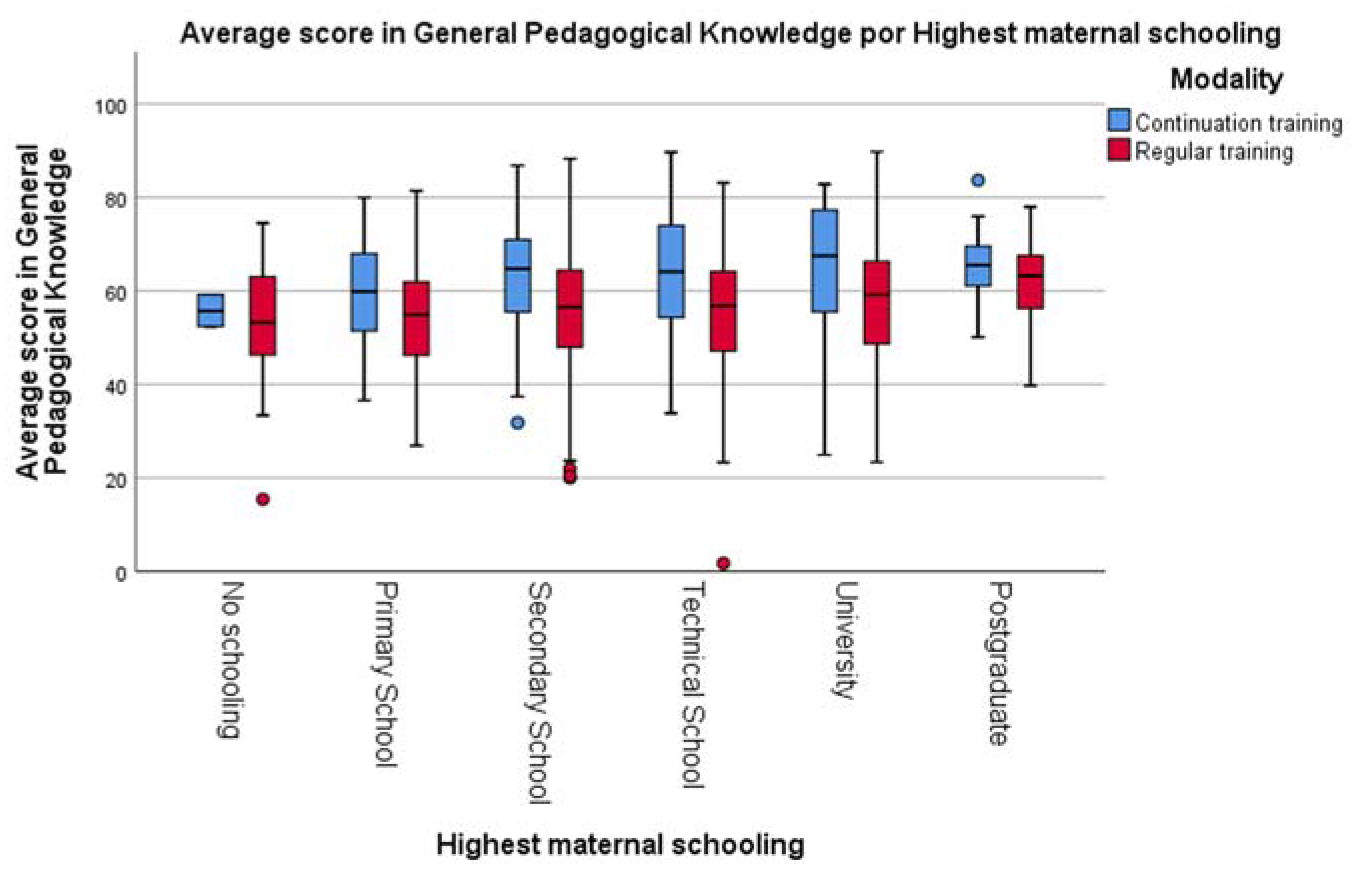
END-FID results according to maternal schooling.
Results by Administrative Dependence of the High School
After analyzing the results according to the administrative dependence of the high school from which the students graduated, Table 1 shows higher results for students who graduated from private schools, representing only 6% of the students in the regular training modality.
Percentage of Achievement Higher Than 60% (2017–2019), According to Secondary Education Establishment.

Source. Open Data MINEDUC; Author.
Regarding the continuation program modality, 61% of continuation students achieve high scores versus 39% in regular mode. Moreover, for graduates from paid private schools, 75% of students exceed this threshold (a gap of 12%–22% dif.). For the other two cases, these percentages are only 55% for municipal schools and 63% for charter schools.
Exploring the Correlation With Admission Scores
As a way to delve deeper into this analysis, we cross-referenced the results of each major and institution with the average PSU (University Selection Test) score of each analyzed major and institution. This allowed us to observe how the END-FID results behave in relation to this traditional “predictor” of academic achievement in Chilean universities. The results obtained from this cross-referencing are quite surprising. In the case of regular training, a positive performance change appears only at the lower limits for those students whose major recorded an average score of over 750 points in the university admission test, which means it applies to only a small fraction of pedagogy programs in the system (Figure 3).

END-FID results according to PSU average (2017–2019).
Results by Theme in the General Pedagogical Knowledge Test
For regular training, the results do not vary significantly between the tests, except for Theme 1, “Learning and Development of High School Students” 58% of students obtained good results (above 60%) in 2017 and 2018, but this figure was reversed in 2019. For Theme 2, “Design and Implementation of Teaching,” the results are more encouraging. Both study modalities showed an improvement in 2019, reaching 82% and 63% of students with results above 60% for the prosecutorial and regular education programs, respectively. However, in Theme 3, “Teaching Profession and the Chilean Education System,” the results have seen a worrisomely decline over 3 years, with only 34%, 37%, and 35% of future teachers obtaining good results or demonstrating a good level of knowledge in this dimension.
Analyzing Data Structure With MCA
Multiple Correspondence Analysis (MCA) was used to analyze the data structure conceptually, drawing from the methodological contributions of Pierre Bourdieu (Bourdieu, 1979). This approach moves away from the concept of causality and utilizes correlational models to generate an interpretive framework of the data based on analyzing variances (or inertias, as referred to by Bourdieu). The MCA technique allows for graphical visualization with spatialization criteria and aims to represent associations in axes (or factors) that configure a factorial plane. This helps us understand the distance between individuals and variables projected in a Cartesian space, as well as their organization around gravity centers. On this basis, we established the correlation structure between the variables included in our study, in line with our theoretical framework.
Along with the main variables, we incorporated complementary variables such as modality, institution, gender, and region into the MCA analysis after conducting a detailed distribution analysis. To facilitate the analysis with the chosen technique (MCA), we recoded all the aforementioned variables into a scale with values from 1 to 4, using quartiles of obtained scores for the distribution in the case of PSU variables, and quartile distribution scales in the case of END thematic variables. After completing this procedure the MCA was conducted, generating two spatial dimensions (see Figure 4) based on the contribution of each variable and the correlations of their variances to each dimension of the MCA.
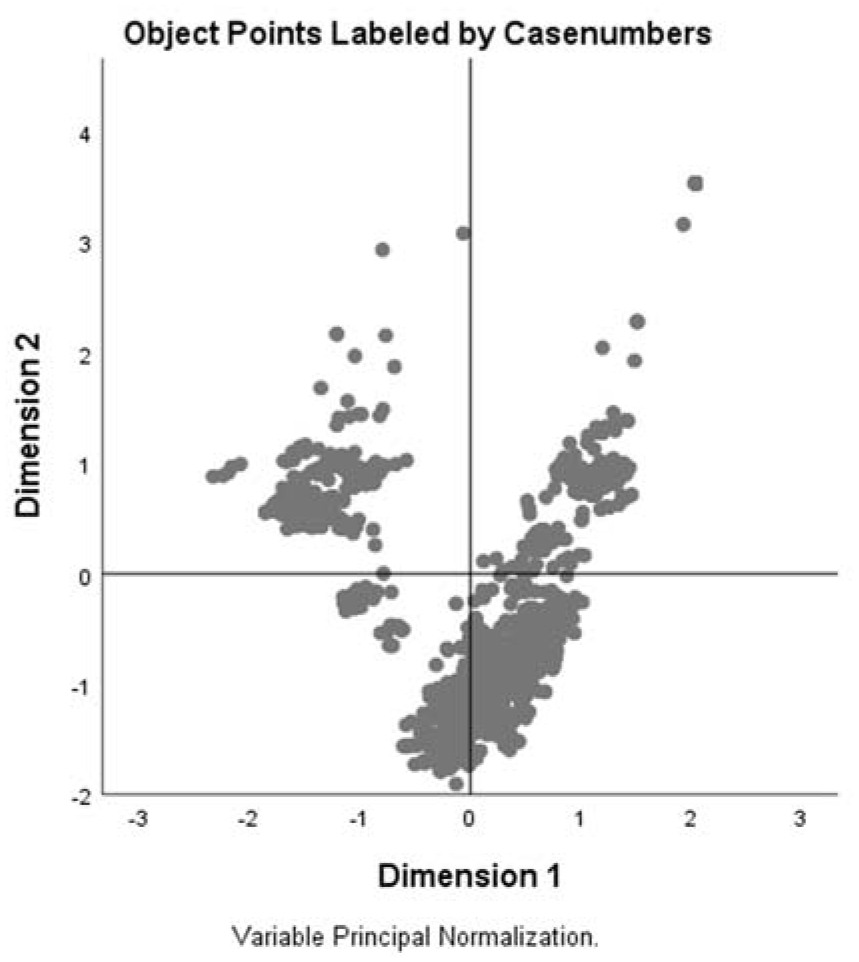
MCA—Graph of object points by case.
Two axes were also added on the “0” levels of each dimension to aid interpretation. The value “0” represents the absence of inertia and is not interpretable. The cases of our study are distributed as follows:
Model Reliability Tests
By incorporating the six main variables and the three supplementary variables of the recoded questions into the Multiple Correspondence Analysis in SPSS, we obtained the following elements to evaluate the reliability of the model (Table 2). Firstly, it is evident that the Cronbach’s α indicator reaches an acceptable level (mean of 0.75), indicating that the model can be considered reliable. This allows us to calculate the percentage of variance explained in the obtained data cloud, as will be seen after analyzing the following summary of the model:
Summary.

The median Cronbach’s α is based on the median autovalue.
To analyze the model summary, we need to relate the inertia of each dimension (0.382 and 0.282) to the total variance, which is calculated as follows: The total variance of the data cloud is Φ2 = (K/Q) 1 = ((4 × 3 + 3 × 3)/6)−1 = (21/6)−1 = 3.5−1 = 2.5. Once we have obtained the variance, we can associate it with the inertia associated with the first principal variable, which is 0.382. The percentage of variance explained by the first principal variable or dimension is thus (0.382/2.5) × 100 =
Both dimensions therefore explain 25.8% of the total variance of the data cloud. In terms of quantifications, the following consolidated table is obtained with each variable and category, which details their contribution to each dimension. Notably, the results show higher values in themes 1 and 2 of the END test for dimension 2. The values obtained in the categories of theme 3 are also all very low for both dimensions (Table 3).
Quantifications.

Source. Own elaboration.
This lets us create a scatter plot associated with each category and variable, where trends and relative distances between them can be visualized. This representation also allows us to observe non-discriminating categories, which are located near the center of the plot, such as categories 3 and 4 of Theme 3 of the END test (Figure 5).

MCA—Category Point Chart.
Finally, we obtain the most illustrative graph of the MCA for this study (Figure 6), which provides discriminant measures. This graph allows us to observe how the data clusters based on the inertia generated from their different categories and variables, which aligns consistently with the literature and theoretical framework of this study. For instance, we can observe convergences between the PSU scores and the respective institution where the degree was obtained. We can also see how the highest scores achieved in the PSU test are closely related to the institutional accreditation levels obtained by the universities, but they are not close to major accreditation levels. These two features represent the strongest data reflections in the analysis and precisely define the characteristics that shape the university system in Chile.

MCA—Graph of Discriminant Measures.
We can also identify at least two more features in the graph of discriminant measures. These are the variables shaping dimension 2, which correspond to Theme 1 and Theme 2 of the END test. The major accreditation variable also strongly contributes to dimension 1. This finding is noteworthy as these variables should ideally align in a convergent manner, given that they reflect public policy constructs focused on measuring the quality of undergraduate educational processes. The tension in the results regarding these variables is closely related to the research question of our study. This observation highlights the complexity of the relationship between educational policy and educational outcomes, and it warrants further investigation and consideration in future studies.
The discriminant measures (Table 4) provides a detailed overview of each variable, including the supplementary variables, with the institution being the most prominently distinguished. Regarding the interpretation of dimensions, variables with higher correlation to dimension 1 (modality, major accreditation, institution, institutional accreditation, and minimum, maximum, and average PSU scores) suggest that it might be associated with concepts such as
Discriminant Measures.

Complementary variable.
In conclusion, in terms of the most relevant results, we can interpret this distribution as reinforcing the existence of a gap between the END test, which assesses teachers in the final stage of their training, and the quality measurement system of the programs that train them. Closing this gap would enhance coherence between public accountability policies and the training processes analyzed in this study. The same gap is also observed for the entry and selection mechanisms for higher education, which are convergent with the accountability model. The latter is linked to funding mechanisms and impacts the regulation of the educational market.
These findings underscore the complexity and interplay of various factors that influence educational outcomes, demanding a holistic approach to address the disparities and ensure a more effective alignment between educational policies and their implementation. Further research and ongoing evaluation are crucial to continually improve and refine policies aimed at enhancing the overall quality of education and promoting equal opportunities for all students and educators.
Limitations of the Study
It is important to acknowledge the limitations of this study in two aspects. First, all data sources are secondary, therefore it is not possible to influence the design of the items considered in the research variables. Additionally, analysis based on results obtained at individual or institutional levels does not allow for examination of more specific aspects of the findings, as occurs within qualitative variables that have been operationalized quantitatively, incorporating the use of recoding techniques, or other relevant elements for addressing educational quality measurement. Nevertheless, the use of statistical techniques such as MCA (Multiple Correspondence Analysis) allows us to address the research question to initiate discussion regarding the diversity of instruments used to measure educational quality, particularly in the critical context of teacher training, and the high consequences of the accountability model.
Conclusion
Our results consistently align with the existing literature and theoretical framework of this study: convergences between scores achieved in the PSU test are closely related to the institutional accreditation levels obtained by the universities, but they are not close to major accreditation levels, and do not show convergence with the individual variables analyzed in this study. This finding is noteworthy because these variables should ideally align in a convergent manner, given that they reflect public policy constructs focused on measuring the quality of undergraduate educational processes, conditioned by the student selection mechanism, in a high consequences accountability system. This is consistent with other studies on the END-FID that show there is no correlation between accreditation and student results on the Inicia test (Bastías-Bastías & Iturra-Herrera, 2022).
The observed difference between individual results and institutional results suggests a gap between the “inputs” (the institutions) and “outputs” (the future teachers) of the system, where the individual results of the formative process, with their wide variance, do not seem to account for the results obtained by the institutions. As noted by Ávalos (2014), this logic aligns with broader accountability policies influenced by international agendas that prioritize institutional performance over pedagogical depth. Rather, the institutional accreditation results, and their respective variable requirements for selectivity, position the institutions in an educational market in terms of prestige. This variable, as the literature shows, strongly influences the employment positioning of graduates (Espinoza et al., 2018), and therefore, their decision to enter a training institution, providing feedback to the strongest actors in the educational quasi-market. Carrasco-Aguilar and Figueroa Varela (2019) further argue that this shift from a deregulated market to high-stakes accountability has intensified pressures on institutions, reinforcing inequalities and privileging those actors better positioned within the educational market.
Regarding the dimensions derived from the MCA analysis, we have determined that the most appropriate interpretive labels are “prestige and selectivity” (dimension 1) and “pedagogical outcomes” (dimension 2). This configuration, based on our results, confirms our research intuition concerning the lack of convergence between institutional quality assessments and the pedagogical outcomes achieved by students in items measuring pedagogical knowledge. This provides a critical perspective on the imperative need to articulate evaluation instruments in a more coherent, relevant, and careful manner—both for students in pedagogical programs and for institutions experiencing significant stress due to exhaustive quality evaluations within a high-stakes model.
Additionally, as observed in a previous study (Gaona et al., 2024), evidence suggests that the test is designed for a very uncommon student profile in the country. This gives way to a “debt” composed of mostly disciplinary elements, although they are also pedagogical, impacting the teaching identities of future teachers and training institutions (Cárcamo, 2008; Rubilar et al., 2020; Ruffnelli, 2014). Another important aspect of analysis is the persistent and recurring gap in results between students in the continuation programs and those in regular education programs. Perhaps the gap we observed regarding knowledge of the system (Theme 3) can only be addressed through advanced practical experience for those with lower social and/or cultural capital. These biases are likely conditioned by the factors addressed in the theoretical framework of this study, namely the pressure exerted by the accountability system on institutions, a consolidated educational quasi-market and the socio-educational gaps that manifest due to the sociodemographic structure of Chile.
Alternative interpretations of these findings refer to the need for transparency in the design and validation processes of these types of instruments, which assume a cognitive and decontextualized perspective of teacher knowledge. Given that the main advantage of these cognitive perspectives lies in the development of reliable instruments that allow for the evaluation of professional teacher knowledge independent of their behavior and context (Depaepe et al., 2020), the legitimacy of the standardization processes underlying the application of the END test must be questioned from the types of validity that support the instrument. This information remains opaque at the level of university institutions.
These findings emphasize the need for a more cohesive, transparent, and integrated approach to teacher education policy and evaluation, taking into account the diverse contexts and regional variations in the system. Addressing the challenges in teacher training and evaluation requires a more nuanced understanding of the complexities of the education system, along with effective coordination among all stakeholders to foster meaningful improvements in teacher education and, ultimately, enhance education quality for all students.
Our findings decisively illuminate the imperative for evidence-based policy interventions that address the multifaceted structural inequities permeating contemporary educational systems, and the need for comprehensive policies addressing the structural barriers and inequalities in the education system. Policymakers should focus on promoting equal access to quality teacher education across all regions and socioeconomic backgrounds to foster a more inclusive and equitable education in general terms. Also, to enhance the role of postgraduate education and exploring strategies to improve teacher training and support in this context can also be instrumental in improving overall educational outcomes and bridging the existing gaps in the system.
Undoubtedly, this complex scenario heavily influences the successful development of the education sector, affecting both its national and international performance and its impact on quality of life for the population. Future research and policy initiatives should therefore prioritize integrated approaches that address these challenges through collaborative stakeholder engagement, sustainable funding mechanisms, and evidence-based interventions. By strategically investing in teacher professional development, institutional capacity building, and equitable resource allocation, stakeholders can potentially transform these educational constraints into opportunities for systemic improvement. The advancement of this agenda represents not only an academic imperative but a societal commitment to educational excellence as a fundamental catalyst for sustainable socioeconomic development and enhanced collective wellbeing.
Footnotes

Funding
The authors disclosed receipt of the following financial support for the research, authorship, and/or publication of this article: The Chilean National Fund for Scientific and Technological Development, FONDECYT INICIACION ID 11251892, 11230953, 11240839, and FOVI 240274 supports this research.
Declaration of Conflicting Interests
The authors declared no potential conflicts of interest with respect to the research, authorship, and/or publication of this article.
Data Availability Statement
Data sharing not applicable to this article as no datasets were generated or analyzed during the current study.