




Abstract
This study investigated physical education teachers’ competencies in virtual classroom management. The study was designed as a cross-sectional study using quantitative research methods and included 726 physical education teachers working in different secondary and high schools in Turkey. The study data were collected using the “Teachers’ Virtual Classroom Management Competence Scale.” The research found that physical education teachers were still deciding about their competence in managing relationships with students in the virtual classroom. Still, they were competent in the dimensions of virtual classroom activities and virtual classroom management. Further research analyzed the effects of some sociodemographic variables on teachers’ competencies in transitioning from traditional classroom management to virtual classroom management. The analysis showed that gender and work experience had a medium effect, virtual classrooms had a significant impact, and school level had a weak effect on teachers’ virtual classroom competencies. The educational level variable did not significantly impact teachers’ online classroom management competencies. In conclusion, in modern classrooms with a shift from traditional classrooms to online classrooms, physical education teachers are expected to be more effective in their relationships with students in online classrooms.
Plain language summary
The purpose of this study was to investigate physical education teachers’ competencies in virtual classroom management. The study was designed as a cross-sectional study using quantitative research methods and included 726 physical education teachers working in different secondary schools and high schools in Turkey. The data of the study were collected using the “Teachers’ Virtual Classroom Management Competence Scale.” The research found that physical education teachers were undecided about their competence in managing relationships with students in the virtual classroom, but they were competent in the dimensions of virtual classroom activities and virtual classroom management. Further research analyzed the effects of some socio-demographic variables on teachers’ competencies in the transition from traditional classroom management to virtual classroom management. The analysis showed that gender and work experience had a medium effect, virtual classroom had a large effect, and school level had a weak effect on teachers’ virtual classroom competencies. The educational level variable had no significant effect on teachers’ virtual classroom management competencies. In conclusion, in modern classrooms where there is a shift from traditional classrooms to virtual classrooms, physical education teachers are expected to be more effective in their relationships with students in virtual classrooms.
Introduction
Although distance learning has been integrated into education systems worldwide, depending on their level of development and policies, the COVID-19 pandemic has accelerated the transition from traditional to online classrooms (UNESCO, 2020). It can be conducted synchronously or asynchronously, with students and teachers usually in separate locations. Online learning is an educational system that allows for personalized learning to occur through the use of educational technologies (Anderson, 2008). The online classroom is an online learning environment that replaces the traditional face-to-face classroom (İşbilir et al., 2023; Martin & Parker, 2014). The integration of technology into physical education classes is a subject of considerable debate. The suitability of virtual classrooms for physical education classes, especially those focusing on psychomotor skills, is a matter of concern (Daum, 2020; Gibbone & Mercier, 2014). Physical education classes differ from general knowledge-based courses in that they primarily focus on physical activity and require the delivery of motor content that necessitates practice and movement. Consequently, the delivery and implementation of online physical education classes necessitates a distinct approach that demands specialized preparation and study (Ekberg, 2020; Jeong & So, 2020). In contrast, face-to-face physical education classes typically involve close relationships and physical contact, with the learning environment characterized by the use of open spaces such as classrooms, gyms, schoolyards, or outdoor areas, contingent on the physical movements involved. Online physical education classes, which are designed to achieve the same goals and objectives as traditional physical education classes, take place in virtual classrooms over the internet (Jana et al., 2021; Ünlü, 2022; Varea & González-Calvo, 2021). At this juncture, online learning in physical education is regarded as an alternative or supplement to traditional face-to-face learning modalities (Murtagh et al., 2023).
The Shape of the Nation report (NASPE, 2012), jointly produced by the American Heart Association (AHA) and the National Association for Sport and Physical Education (NASPE), recognized the first example of online physical education (OLPE) in 2006. OLPE was widely offered to middle school students, enabling them to earn credit for physical education classes (NASPE, 2014). However, the effectiveness and quality of online physical education (OLPE) courses are still being questioned (Daum & Woods, 2015). Teaching and learning online applied courses in physical education, which focus on improving individual health and physical skills through movement-based topics, can be challenging. Several studies have reported that student engagement is more challenging in online courses due to the reduced interaction between students and educators compared to the traditional classroom environment (Biddle et al., 2004; Meyer-Peyton, 2000; Purcell-Robertson & Purcell, 2000; Steinbeck, 2001). The pandemic-induced shift to online education presented numerous challenges for physical education teachers. Those with little or no training in this traditionally marginalized subject resorted to trial and error methods when teaching remotely (Jeong & So, 2020; Richards et al., 2018). According to the Society of Health and Physical Educators of America (SHAPE) (SHAPE America, 2018), online physical education should have the same purpose and goals as traditional face-to-face physical education.
Successful transition to the online learning environment requires teacher support and guidance for students who are accustomed to the physical classroom experience and the student-teacher relationship in physical education (Murphy et al., 2020). It is important to consider students’ diverse learning and physical activity needs when designing online resources that complement and support quality face-to-face programming, and physical education teachers’ perspectives can be valuable in this regard (D’Agostino et al., 2021). Currently, managing online classrooms is just as important as conducting instructional activities in traditional classrooms (Can, 2020). The challenge of teaching physical education and sports courses in online classrooms by teachers is also related to the teacher’s competence (Ivanov & Tzankova, 2020). According to the Ministry of National Education (MoNE, 2017) in Turkey, teachers’ competence refers to the knowledge, skills, and attitudes required to effectively and efficiently carry out the teaching profession. Teacher efficacy, on the other hand, pertains to the qualities and competencies necessary for physical education teachers to transfer knowledge, skills, and attitudes to their students while also being a researcher and learner themselves (Demirhan, 2013).
Teacher competence is related not only to meeting students’ learning needs but also to the organization and management of the classroom as a social system, organization, and management of the classroom as a social system (Arı & Saban, 2000; Henson, 2001). Classroom management is the process of organizing and maintaining classroom activities with a focus on learning and guiding student behavior (Turan, 2020). It is also applicable to online classrooms, as it establishes and maintains positive student-teacher relationships (Brophy, 2006). Online classroom management involves creating a supportive classroom environment, addressing students’ emotional needs, and fostering positive interaction between students and teachers (Ho & Lin, 2016). However, the online learning system provides a workspace equipped with the necessary technological tools for teachers to manage online classrooms. As shown by Kiseleva and Pogosian (2021) and Yang and Liu (2007), teachers can manage their classrooms and students’ online classrooms practically and effectively by designing an appropriate learning environment with these tools.
Effective learning and teaching in the online environment depend on teachers’ management competencies in the online classroom. Therefore, their effective management of the online classroom is crucial (Can & Gündüz, 2021). However, teachers’ perceptions of online learning, their knowledge, attitudes, and skills related to the teaching method, significantly influence their effective management of the online classroom in the distance education process (Ertmer & Ottebbreit-Leftwich, 2010). Classroom management has become increasingly important for instructional quality in online environments, especially after the COVID-19 pandemic (Huber & Helm, 2020). To ensure student success in the online classroom, effective participation is crucial, and educators must be competent in online classroom management strategies (K. Allen et al., 2020).
Many national studies have been conducted on teachers’ online classroom management in different subjects (Akdeniz & Uzun, 2022; Akgöl et al, 2022; Y. Arslan & Şumuer, 2020; Çakır et al., 2023; Can & Gündüz, 2021; Çayırlı, 2022; Ceylan, 2021; Kavrayıcı, 2021; Kaya & Dilekçi, 2021; Sargın, 2022; S. Şeker et al., 2022; Uçar & Acar, 2022; Uçar & Mazlum, 2020). However, although there are some studies investigating classroom management among physical education teachers, research on online classroom management competencies is limited (Bektaş & Pepe, 2022; Çar & Aydos, 2022). Further research will be needed in this area. Concerns remain regarding the applicability of increasingly popular online learning to psychomotor-based physical education (E. Allen & Seaman, 2016; Daum, 2020; Mohnsen, 2012). It is observed that online learning primarily focuses on cognitive and academic-oriented courses. The purpose of this study is to contribute to the academic literature and physical education teachers by examining, on the basis of scientific data, the current status of physical education teachers’ competencies in online classroom management.
The purpose of this study is to examine the competencies of physical education teachers in managing online classrooms. Specifically, it seeks to answer the following questions
Are physical education teachers competent in the management of online classrooms?
Are there socio-demographic variables such as gender, school level, education level, tenure, and online classroom experience that significantly affect physical education teachers’ online classroom management competencies?
Materials and Methods
This study, which investigates physical education teachers’ competencies in the online classroom, was designed as a cross-sectional study using quantitative research methods. The study’s research group comprises 726 physical education teachers who were reached through the online link “Google.docs form” during the spring semester of the academic year 2022 to 2023 using the snowball method. In the snowball sampling method, the maximum number of participants is tried to be reached through reference participants related to the subject of the study (Patton, 2002). This method was preferred to collect the data online to get the participants more efficiently and to finalize the investigation faster.
The physical education teachers who participated in the study were 67.2% male and 32.8% female. 62.0% of the teachers work in secondary schools, and 38% work in high schools. 66.1% of the teachers have a bachelor’s degree, and 33.9% have a postgraduate degree. 16.1% of teachers have 1 to 5 years of work experience; 16.3% have 6 to 10 years of work experience; 21.8% have 11 to 15 years of work experience; 20.2% have 16 to 20 years of work experience; and 25.6% have 21 years or more. While 90.2% of teachers have experience with online classrooms, 9.8% have yet to experience them. The demographic characteristics of the participants are shown in Table 1.
Sociodemographic Characteristics of Participants.

The data were collected through the use of a demographic information form created by the researcher and the “Teachers’ Online Classroom Management Efficacy Scale.” The “Teachers’ Online Classroom Management Efficacy Scale,” developed by Can and Gündüz (2021), is comprised of three subdimensions: The scale comprises three subscales: “Relations with Students (11 items),”“Online Classroom Activities (8 items),” and “Online Classroom Management (5 items),” with a total of 24 items. In the “Relations with Students” sub-dimension, things such as “I can provide effective communication with students in online classrooms; I can use time effectively in online classrooms; I ensure students’ participation in lessons at the highest level in online classrooms” in the “Online Classroom Activities” sub-dimension “I determine online classroom rules together with students; I make the necessary announcements about online classroom lessons to students in advance,” in the “Online Classroom Management” sub-dimension “I think I am sufficient in the management of online classrooms, I have the competence to use the necessary technology for online classrooms” can be given as examples.
The items of the scale were on a five-point Likert scale ranging from “1—strongly disagree” to “5—strongly agree.” Data were interpreted using the point scale: “1.00 to 1.80: Disagree at all,”“1.81 to 2.60: Disagree,”“2.61 to 3.40: Undecided,”“3.41 to 4.20: Agree,”“4.21 to 5.00: Strongly Agree.” The researchers found that the 3-factor structure of the scale explained 52.53% of the total variance and showed good agreement with the model (X2/SD = 3.04, AGFI = 0.80, GFI value 0.84, CFI = 0.97, NFI = 0.95) formed as a result of confirmatory factor analysis. The internal consistency coefficients of Cronbach’s alpha of the scale ranged from .76 to .91 in the subdimensions and .90 in the total value (Can & Gündüz, 2021). In the present study, internal consistency coefficients of Cronbach’s alpha for the 3-factor structure of the scale were calculated between .83 and .94 for the subdimensions and .93 for the total scale.
Descriptive statistical procedures were used in the data analysis, the t-test for independent samples, and the one-way analysis of variance. The studies first tested the conformity of the data to the normal distribution using the skewness and kurtosis values. As a result of the test (Table 2), it was assumed that the distribution was expected because the values for skewness and kurtosis were between ±2 (George & Mallery, 2010). Levene’s homogeneity test results were considered for the t-test, one-way analysis of variance, and Welch and post hoc tests (Dunnett-T3) were used in one-way analysis of variance. To determine the effect size in pairwise comparisons, the analysis used Cohen’s d formula. According to Cohen’s general recommendation, an effect size is considered weak if the d value is less than 0.2, medium if it is 0.5, and strong if it is greater than 0.8 (Cohen, 2013). For multiple comparisons, eta-squared (η2) was used as the effect size formula, with .01 indicating small, .06 medium, and .14 large effects (Green & Salkind, 2021). The analyses were performed using the SPSS 27 software package.
Descriptive Statistics of Participants’ Management Competencies in the Online Classroom.

Findings
The descriptive statistical results of the competencies of the physical education teachers participating in the study with online classroom management are shown in Table 2. Examination of the results reveals that the physical education teachers were undecided in the subdimension of relationships with students (M = 3.09, SD = 0.86) but considered themselves adequate in the subdimensions of online classroom activities (M = 3.623, SD = 0.70) and online classroom management (M = 3.77, SD = 0.69).
The results of the t-test on the competencies of physical education teachers in the online classroom according to gender are shown in Table 3. The results indicate no significant difference between teachers’ online classroom management competencies by gender when the relationship with the student scale is analyzed [t (724) = 1.94, p = .052]. However, in the online classroom activities dimension, male teachers (M = 3.71, SD = 0.71) had higher scores than female teachers (M = 3.46, SD = 0.63) [t (724) = 4.72, p = .000, d = 0.36]. In the online classroom management dimension, male teachers (M = 3.86, SD = 0.70) had higher online classroom management competencies than female teachers (M = 3.58, SD = 0.63) [t (724) = 5.35, p = .000, d = 0.42]. Gender was significant in both subdimensions, with a moderate effect on teachers’ ratings of online classroom management competencies (Cohen’s d = 0.36 and 0.42).
T-test Results on Online Classroom Participants’ Management Competencies by Gender.
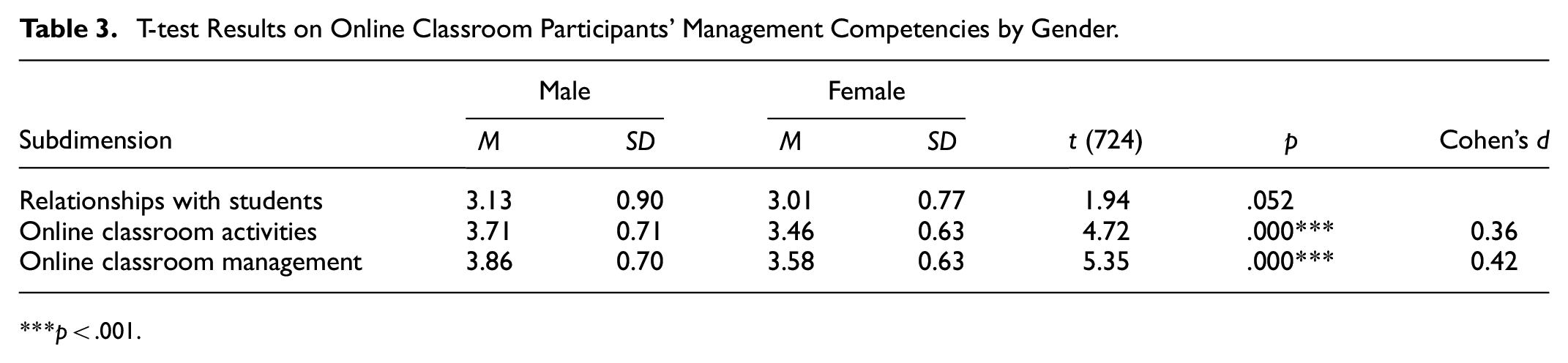
p < .001.
The results of the t-test on physical education teachers’ competencies in managing the online classroom as a function of the school variable are shown in Table 4. Examining the results, there is no significant difference between the online classroom management teachers’ scores depending on the school variable in the dimension of online classroom management [t (724) = −1.91, p = .056]. In the dimension of relationships with students, teachers working at a high school (M = 3.18, SD = 0.82) have had higher scores than teachers working at a level intermediate school (M = 3.04, SD = 0.88) [t (724) = −2.11, p = .035, d = −0.16], and in the “online classroom activities” dimension, high school teachers’ management competencies (M = 3.70, SD = 0.67) were higher than middle school teachers’ (M = 3.58, SD = 0.71) [t (724) = −2.09, p = .037, d = −0.16]. In both subdimensions, the effect size of the school-level variable on teachers’ online classroom management scores is significant but weak.
T-test Results of Participants’ Management Competencies in the Online Classroom by School.

p < .05.
Table 5 shows the results of the t-test on the physical education teachers’ ability to manage the online classroom according to their level of education. Examination of the results indicates that there is no significant difference in the online classroom management ability of physical education teachers regardless of their level of education (p > .05).
T-test Results of Participants’ Management Competencies in the Online Classroom by Educational Level.

Table 6 presents the results of the online classroom management competencies of physical education teachers as a function of seniority, analyzed using one-way analysis of variance. To compare the means, Welch’s test was used due to the non-homogeneous variances (p < .001). The analysis of the results indicates that seniority significantly affects the online classroom management competencies of physical education teachers in the subdimensions of relationships with students (F(4, 721) = 13.28, p = .000), online classroom activities (F(4, 721) = 9.05, p = .000), and online classroom management (F(4, 721) = 20.03, p = .000). In post-hoc comparisons using the Dunnett-T3 HSD test, in the “relationships with students” subdimension, teachers with 1 to 5 years (M = 3.25, SD = 0.97) and 6 to 10 years (M = 3.53, SD = 0.97) and teachers with 11 to 15 years (M = 2.86, SD = 0.81), 16 to 20 years (M = 2.83, SD = 0.84), and more than 21 years (M = 3.11, SD = 0.61) in the “online classroom activities” subdimension; teachers with 6 to 10 years (M = 3.98, SD = 0.75) and teachers with 11 to 15 years (M = 3.57, SD = 0.69), 16 to 20 years (M = 3.53, SD = 0.75) and over 21 years (M = 3.51, SD = 0.61), and in the subdimension “online classroom management”; teachers with over 21 years (M = 3.49, SD = 0.47) and teachers with 1 to 5 years (M = 3.92, SD = 0.63), 6 to 10 years (M = 3.93, SD = 0.69), 11 to 15 years (M = 3.92, SD = 0.70), and 16 to 20 years (M = 3.71, SD = 0.85) of professional affiliation.
The One-Way Analysis of Variance Results of Participants’ Competencies in Online Classroom Management by Professional Seniority.

The Welch test was included because homogeneity of variance was not established.
p < .001
As teachers gain seniority, their competencies in online classroom management decrease. In the subdimensions “relationships with students (η2 = .08)” and “online classroom management (η2 = .07),” the effect size of the variable “professional seniority” was at a “medium” level. In the subdimension “online classroom activities (η2 = .05),” the effect size of the variable “professional seniority” was at a “small” level.
The results of the t-test on the management competencies of physical education teachers in online classrooms as a function of the variable “experience with online classrooms” are shown in Table 7. Examining the results, in the dimension of relationships with students, the values of teachers with experience (M = 3.14, SD = 0.87) differ significantly at a medium level from those of teachers without knowledge (M = 2.62, SD = 0.55) [t (724) = 7.02, p = .000, d = 0.61]. In contrast, in the dimension of activities in the online classroom, the values of teachers with experience (M = 3.70, SD = 0.67) than inexperienced teachers (M = 2.90, SD = 0.44) [t (724) = 13.81, p = .000, d = 1.23], and in the dimension of the online classroom; it can be seen that the values of experienced teachers (M = 3.87, SD = 0.63) compared to the inexperienced teachers (M = 2.86, SD = 0.58) differed significantly in magnitude [t (724) = 13.90, p = .000, d = 1.62].
T-test Results on Participants’ Online Classroom Management Competencies as a Function of Online Classroom Experience.
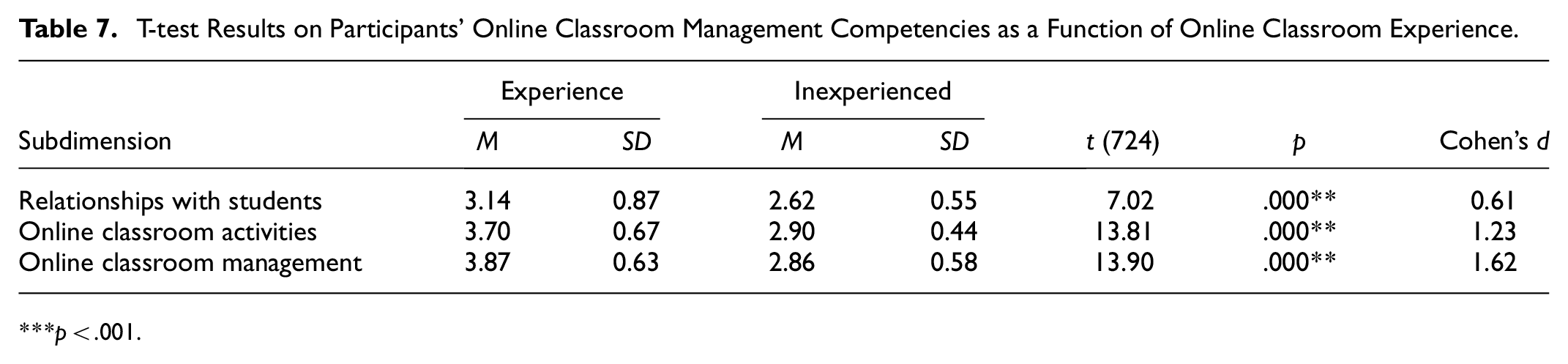
p < .001.
Discussion
In this study, online classroom management competences of physical education teachers were examined using a sample of 726 participants. According to the study results, physical education teachers remain undecided on the size of relationships with students, while they see themselves as adequate in the dimensions of online classroom activities and online classroom management. According to Apak et al. (2021), most teachers are highly prepared for 21st-century classroom management. In reviewing the literature, although there are research findings (Araz et al., 2023; Can, 2020; Can & Gündüz, 2021; Karakaya et al., 2020; Sönmez & Recepoğlu, 2019; Yılmazsoy et al., 2018) that teachers are competent in both traditional and online classroom activities and dimensions of online classroom management, there are also findings that there are difficulties in relationships with students in online classrooms. As a matter of fact, in one of the current studies, Araz et al. (2023) found that teachers were undecided about their online classroom management competencies in the sub-dimension of relationships with students, and Can and Gündüz (2021) found that teachers were competent in online classroom management but scored low in the sub-dimension of relationships with students.
Similarly, Y. Arslan and Şumuer (2020) found that 26.25% of teachers had difficulties in managing instructional time, 22.05% in academic learning time, and 42.26% in student-student and teacher-student communication. Furthermore, they observed that the lack of communication in online classroom management negatively affected students’ achievement compared to traditional classrooms. Virtual teaching environments should include variables that facilitate learning, organized according to the individual differences of the student, with the provision of interaction and communication (Bayındır, 2022). At this point, classroom communication is affected by factors such as the technological infrastructure, teacher and student competencies, online classroom climate, and e-learning motivations. The literature contains various research findings that support this idea.
Akdeniz and Uzun (2022) found that during distance learning, teachers considered the lack of student feedback during the lesson, turning off the video and microphones, entering and leaving the assignment late, lack of interest, interest in extracurricular situations, and not participating continuously in class as significant problems.S. S. Şeker (2020) found that students’ speaking, listening, and nonverbal communication skills were interrupted in online classrooms, and teachers could only communicate with parents and students outside of live classes. This can be explained by students’ interest in online classroom courses and their online classroom communication skills. The lack of communication in online classroom management also reflects students’ achievements. Lack of communication in online classroom management causes students to become distracted, disengage from the lesson, and decrease their motivation and interest in the lesson, which is reflected in the academic success of the students (Nguyen & Yukawa, 2019). Albayrak (2017) notes that students’ inability to participate in online classrooms (e.g., speaking aloud, asking questions, etc.) is a significant problem for student success. A. P. Arslan et al. (2021) cited lack of communication, students’ difficulty in expressing themselves in online classrooms, and the fact that some students who are comfortable in the traditional classroom remain passive in the online classroom as problems in classroom management in online classrooms.
Since physical education classes are primarily face-to-face, the atmosphere created by student relationships is natural in traditional classrooms. In online classrooms, on the other hand, the fact that communication is not face-to-face poses a challenge that is reflected in the management of online classrooms (Almonacid-Fierro et al., 2021; Can, 2020; Sabancı & Yılmaz, 2021). In addition, technical problems in the online classroom environment, the teacher’s body language and the attractiveness of the materials used in the classroom environment, the number of students, etc., may also negatively affect communication with students (Cornelius, 2014; Çoruhlu & Uzun, 2021; Göktaş & Sırakaya, 2021; Hilli, 2020; Kalelioğlu et al, 2016; Phelps & Vlachopoulos, 2020; Yılmaz et al., 2022; Yüksel, 2021). To effectively manage online classrooms, in different subjects concern is to keep the number of students manageable (Schlusmans et al., 2009).
The study found that the online class competencies of physical education teachers by gender did not change significantly in the sub-dimensional of relationships with students. It was observed that online classroom activities and online classroom management are changing significantly, with male teachers scoring higher than female teachers in their sub-dimensions. The impact of gender on teachers’ online classroom management competencies was found to be moderate in both sub-dimensions. To the best of our knowledge, no previous study has examined the virtual classroom competencies of physical education teachers in terms of the gender variable. In other fields of inquiry, studies that examine the virtual classroom competencies of teachers yield disparate findings with regard to the gender variable. In their study, Çayak and Erol (2022) found that the virtual classroom management competencies of teachers according to gender variable did not differ in the sub-dimension of relationships with students. Nevertheless, the study revealed that male teachers exhibited significantly higher virtual classroom management competencies than female teachers in the sub-dimensions of virtual classroom activities and virtual classroom management. This result is in exact alignment with the findings of our study. Conversely, the results indicate a discrepancy in the findings regarding teachers’ virtual classroom competence, with differing outcomes observed between male and female teachers. Can and Gündüz (2021) found that teachers’ virtual classroom management competencies differed significantly in terms of gender variable only in the sub-dimension of virtual classroom activity, and that female teachers had higher competencies in managing virtual classroom activities than male teachers. In some recent studies (Aktaş & Aktaş, 2023; Araz et al., 2023; Demir & Çetin, 2022; Ersin & Yoldaş, 2023), it was found that the virtual classroom management competencies of classroom teachers did not change according to gender. Similarly, Çayırlı (2022) found in his study that the virtual classroom management competencies of classroom teachers did not differ in all three subdimensions, but the median difference between males and females in the mean was in favor of males.
In fact, social and demographic characteristics are factors that can influence the adoption of technology-driven learning processes, with gender one such factor. As noted byZhang et al. (2018), gender is a key variable in the context of technology-based education. Indeed, researchers have been studying gender differences in teachers’ beliefs about technology for years (Scherer & Teo, 2019). This research has identified gender as a significant indicator of the digital gender gap (Saikkonen & Kaarakainen, 2021). In fact, numerous studies have indicated that men tend to demonstrate greater confidence in their abilities related to technology than women. (Ergen et al., 2019). Similarly, Üstün et al. (2020) conducted a study examining teachers’ readiness for e-learning. The results indicated that male teachers exhibited significantly higher levels of e-learning readiness, self-competence in the use of information and communication technologies (ICT), confidence in e-learning’s importance, and positive attitudes towards e-learning compared to female teachers. A recent meta-analysis study (Qazi et al., 2022) examined potential gender differences in the use and skills of information and communication technologies (ICTs). However, the study found a small positive dimension in favor of men. Therefore, it can be hypothesized that teachers’ preferences for technology in general, and online learning in particular, their readiness, empowerment, and self-confidence are also reflected in virtual classroom management.
The study found significant differences in online classroom management competences, relationships with students and online classroom activities sub-dimensions as a function of the school tier variable that physical education teachers are serving. Teachers working in high school received higher scores than teachers working at the secondary school level. However, the impact of the school level variable on teachers’ online classroom management scores in both sub-dimensions is weak. Conversely, in the online classroom management sub-dimension, the teachers’ scores did not significantly change depending on the school variable. It is believed that the varying sample groups in which the studies were conducted led to additional findings. Can and Gündüz (2021) found that high school teachers scored lower on online classroom activities competency and higher on online classroom management. This is partially consistent with our study. It is hypothesized that managing the online classroom will become easier for high school teachers as students’ technological literacy and sense of responsibility increase with age.
The study revealed that the online classroom management competencies of physical education teachers did not undergo significant changes in all sub-dimensions according to their level of education. While the existing literature indicates that teachers’ virtual classroom management competencies do not generally vary according to the education level variable, the findings also indicate that there are disparate results. Similarly, Can and Gündüz (2021) found that teachers’ virtual classroom management competencies did not change significantly in all sub-dimensions according to the level of education. Similarly, in the studies of Araz et al. (2023) and Çayırlı (2022), it was concluded that the education level variable was not a specific factor affecting virtual classroom management competence. The findings of both this study and other studies indicate that teachers’ level of education has no effect on their competencies in managing online classes. Conversely, Aktaş and Aktaş (2023) discovered that the virtual classroom management competencies of classroom teachers differed in all sub-dimensions according to the educational level variable. Moreover, the virtual classroom management competencies of postgraduate classroom teachers were found to be higher than those of undergraduate classroom teachers in all sub-dimensions. These findings, which are either consistent or inconsistent with our study findings, were obtained from a sample of teachers other than those in the physical education branch. The diversity of the sample groups studied may be thought to cause different results. In addition to the knowledge, skills, and attitudes in classroom management that teachers acquire in undergraduate and graduate education, virtual classroom experiences also significantly affect classroom management competencies (Can & Arslan, 2018).
The study found that the online classroom management competencies of physical education teachers changed significantly in all sub-dimensions as a function of professional seniority, according to one-way analysis of variance. The results suggest that online classroom management competencies weaken with an increase in professional seniority. Professional seniority has a moderate effect size on student relations and online classroom management, and a minor effect size on online classroom activities. According to Araz et al. (2023), teachers with low seniority demonstrate significantly better competencies in online classroom activities compared to those with high seniority. Çelik (2019) found that the general classroom management competencies of an average teacher gradually decrease after working in schools for 11 to 15 years. According to Aktürk and Delen (2020), teachers’ adoption of technology and adaptation to their courses can be affected by various factors, such as their perception of technology, age, education, past experiences, and professional self-efficacy. Teachers’ perceptions, acceptance, and competencies regarding the use of technology, which constitute the structure of the online classroom, may weaken with increasing age and professional seniority. Additionally, it is important to note that new teachers receive necessary training in the field of information and communication technologies during their pre-professional education. This may be due to their age, as they adapt more quickly to rapid changes and transformations in educational technologies. Research shows that teachers who receive training in distance education and online classroom management before starting their profession improve their classroom management competencies and gain understanding and competence in supporting students (Milliken, 2019).
The study shows that physical education teachers have significant changes in online classroom management competencies across all sub-dimensions based on online classroom experiences. Teachers with online classroom expertise demonstrated significantly higher competencies in medium and large dimensions compared to those without experience. This outcome is consistent with previous research. Online reality environments can enhance the classroom management competencies of teacher candidates and in-service teachers, according to Seufert et al. (2022). Similarly, Can and Gündüz (2021) found that teachers with online classroom experience had higher levels of online classroom management than teachers without online classroom experience. Research has shown that teachers who received training in distance education and online classroom management before entering the profession improve their classroom management competencies and gain a better understanding of how to support students (Asim et al., 2020; Milliken, 2019). Frazier’s (2022) research indicates that inadequate preparation of teachers significantly impacts their education and professional development in effectively managing the online classroom.
Limitations and Future Work
The present study is subject to several potential limitations, which must be considered when interpreting the results. Firstly, the study is limited to physical education teachers working in middle and high schools in Turkey. Consequently, the outcomes of this study may differ when applied to other countries. Nevertheless, the objective of this study is not to generalize the results to a broader population or to demonstrate the typical through the atypical. Rather, it is the intention of this study to obtain a theoretical generalization. Consequently, the empirical findings of this study should be understood as a theoretical generalization derived from a quantitative study of a sample in Turkey, rather than as an example that can be generalized to the entire population. Further international research on larger sample groups is required to enhance the generalizability of the findings. Secondly, the study is based on cross-sectional data from a specific time period. It is recommended that longitudinal studies be conducted in parallel with the advancement of educational technology. Third, it was anticipated that participants would respond to the scales in an honest manner. As the scales utilized in the study lacked fillers, it was not possible to exclude participants who did not respond to the scale items in an honest manner. Fourth, no study in the national literature addresses the traditional and online classroom management competencies of the sampled physical education teachers. Consequently, it was not possible to compare this study with similar studies. In light of these limitations, the findings are interpreted in line with the findings of previous studies on the classroom management competencies of physical education teachers and teachers in other disciplines in both traditional and virtual environments. The assumption is that the results can be extrapolated from both the study’s selection process and the composition of the sample population. This was designed to represent the study population at large. It is recommended that future studies endeavor to validate the main contribution detailed in this research in different contexts. Despite the aforementioned limitations, it is anticipated that this study will contribute to the existing corpus of literature, elucidating the competencies of physical education teachers in virtual classroom management. It is recommended that future studies address the aforementioned limitations.
Conclusions
This study concluded that physical education teachers adequately managed online classrooms in the dimensions of online classroom activities and classroom management. Still, they needed to be more acceptable in the size of communication with students. Another study result is that female physical education teachers, physical education teachers with high professional seniority, and physical education teachers without online classroom experience must improve in managing online classrooms. In light of the research results, the following suggestions were made: (1) To increase teachers’ competencies in managing online classes, focusing on servant training and taking necessary incentive measures would be appropriate. (2) Professional disinformation in the use of technology should be prevented. (3) The research was conducted with the quantitative method. The research can be repeated with qualitative methods to obtain more in-depth findings.
Footnotes
Declaration of Conflicting Interests
The author declared no potential conflicts of interest with respect to the research, authorship, and/or publication of this article.
Funding
The author received no financial support for the research, authorship, and/or publication of this article.
Ethical Approval
Participants signed a voluntary consent form informing them they could end the interview without any valid reason. Ethical rules were followed in all processes of the study.

Data Availability Statement
The data that support the findings of this study are not publicly available due to ethical restrictions but can be obtained from the corresponding author upon reasonable request.