




Abstract
The purpose of this study was to analyze and explore the experiences of eight first-year physical education teachers who have taught African refugee students. Interviews were conducted at the end of each participant’s first year of teaching. The findings of this study highlight the vast different learning styles of students from Africa and the strategies that these teachers trialed and incorporated into their lessons in an attempt to minimize the disruptions they experienced when first introduced to the students. The results of this study, together with information from the literature, suggest that the training and education of teachers in Australia must incorporate strategies for teaching students from different backgrounds, cultures, and living situations to better facilitate the inclusion of them in school-based activities and learning.
Beginning Physical Education Teachers
In their first year, physical education teachers become aware of the many complexities and difficulties that are involved in the teaching profession. Not only must they overcome these, but they must also grapple with the additional intricacies that are part of being a first-year teacher beginning their teaching career (Hardy, 1999).
Physical education teachers’ induction into the teaching profession differs slightly from that of other teaching subjects. Physical education may be less stressful, because in previous research there has been no mention of the reality shock that tends to accompany the experiences of other subject classroom teachers (Sparkes, Templin, & Schempp, 1993; Thevenard, Haddock, Phillips, & Reddish, 2009; Tinning, McCuaig, & Hunter, 2006).
The role of physical education teachers has been questioned on various occasions citing the subject’s usefulness and appropriateness for modern day teaching. Keay (2006) looked at the professional development opportunities provided during the induction process for physical education teachers. Results of the study suggest that new teachers were able to call upon their previous experience to guide their instruction in schools; however, it was also suggested that school managers, heads of departments, and external school providers do have a need to ensure adequate learning opportunities are provided to teachers so they can continually challenge their own practice.
Following on from the subject area of physical education being questioned over its appropriateness, the teaching of physical education to pre-service primary school teachers has also been questioned in the literature because of the difficulties primary school teachers often encounter with teaching physical education. Morgan and Hansen (2007), in their study of 189 teachers discovered that teachers were not planning, implementing, reporting, or evaluating physical education programs. The authors suggest that due to the lack of confidence in primary-based teachers to teach physical education programs, professional development and pre-service education needs to be strengthened and made more suitable for primary school teachers’ needs and skill set. The confidence of non-physical education specialists to teach physical education was investigated by Morgan and Bourke (2008). The study found that many teachers were dissatisfied and disgruntled with teaching physical education, and teacher educators needed to find ways to challenge these perceptions and reinvigorate teachers to want to teach physical education for the benefit of their students as well as the teachers.
Inadequate instruction of pre-service teachers has been suggested as one of the reasons why physical education is failing in primary schools (Elliot, Atencio, Campbell, & Jess, 2013). In this study, they interviewed 327 non-specialist primary teachers regarding their experiences with their pre-service university teaching course in physical education. The study concludes that the teachers in the courses were only given a basic starting point that was inadequate for teaching physical education effectively. Recommendations are made for more critical and reflective learning opportunities and experiences in physical education.
Although numerous challenges have been identified in the teaching of physical education, it has been suggested that one of the biggest challenges lies in understanding what physical education is (Coulter & Chroinin, 2013). In their study, where participants were asked to write down what physical education is to them, results suggest that for a large proportion of the pre-service teachers involved in the study, their knowledge and understanding of physical education were largely based on their own school experiences. The researchers acknowledge that although previous knowledge and experience are valuable, physical education needs to move beyond reproducing dominant sport and health ideologies.
The initial years of teaching for beginning teachers are extremely important in their development of knowledge and understanding in the classroom environment (Mtika, 2010). These early years in beginning teachers’ career determine whether they will remain in the profession as well as what kind of teacher they will become (Thevenard et al., 2009). Researchers have suggested that the first years of a teacher’s career are actually learning years for the teacher out on the job (Hardy, 1999; Ibrahim, 2012; Thevenard et al., 2009). The first years of teaching are acknowledged as often being the hardest. Shoffner (2011), in her study looked at beginning teacher’s experiences and what they perceived as being some of the hardest aspects of teaching to come to terms with. The participants in Shoffner’s study identified these aspects as adjustment to the profession, acceptance of students, and management of emotion. Shoffner suggests that teacher educators need to prepare beginning teachers for the existence of these concerns in the classroom and one way that they may be achieved in an ongoing sense is through the teaching and practice of reflection.
Research has suggested that beginning teachers are not always provided the necessary support they need and as a result can suffer from reality shock which can lead to their premature departure from the teaching profession (El baz-Luwisch, 2005). “Beginning teachers have real learning needs that cannot be grasped in advance or outside the context of the classroom” (Ibrahim, 2012, p. 540). Classroom management, motivation of students, juggling workload, assessment and marking, reports, parent interviews, and dealing with individual difference are just some of the day-to-day tasks that today’s teachers have to deal with.
Teaching Students From Diverse Cultural and Linguistic Backgrounds
The ability to successfully teach students from diverse cultural and linguistic backgrounds is underpinned by the knowledge and training of the teacher in question (Zozakiewicz, 2010). Training programs vary greatly from institution to institution, so much so that Zozakiewicz (2010) in her study suggested that one of the more successful ways of preparing teachers for the challenges of teaching diverse students is through in-school mentoring programs. Zozakiewicz acknowledges that culturally responsible mentoring helps teachers become critical thinkers about the culturally diverse contexts with which they work, in turn assisting them develop inclusive practices for their students.
The ability of teachers to balance the ever changing classroom dynamics with the demands of school policies, curriculum, and other constraints is a hugely difficult task (Miller, 2011). Couple this challenge with students from diverse cultures and with varying degrees of linguistic ability and you have an even tougher job as a teacher. Miller’s (2011) study addressed this challenge in one school in Melbourne where the spectrum of conflicts the school’s teachers dealt with was so great, the teachers themselves often felt isolated and disempowered. The study concludes that there is a greater need for schools to support and retain their teachers, and one way of doing this is ensuring there is the support and training provided in the teaching of literacy, especially to non-English speaking students.
Trent (2011) further supported this notion by adding that beginning teachers often have rigid views about themselves and about their teaching abilities; add to this the complexities of teaching students with limited or no English and linguistic abilities and these conceptions multiple tenfold. Trent argues that future research needs to address the way teachers construct their teaching identity and how this identity moves and changes over the course of a teaching career.
Malewski, Sharma, and Phillion (2012) took this point further in their study, indicating that before we even address the schools the beginning teachers are teaching in, we need to look at their overall professional experience (practicum). Their study acknowledges that students who accessed the opportunity for an international field experience component to their university study were more likely to be aware of, and sensitive to, the needs of diverse students in the classroom.
Teaching in a Global World—The New Challenge for Beginning Teachers
The ever increasing migration rate, along with an ever increasing numbers of refugees seeking asylum and residency status in countries free from war and oppression, has meant that education systems across the world have had to become more accommodating for students attending schools from non-native backgrounds (Knoblauch, 2001). Although many schools and governing institutions of schools have begun to make arrangements and put policies and procedures in place for dealing with these students, pre-service education programs have maintained their traditional stance of teacher training; meaning teachers are not trained and equipped to deal with students who arrive in their classes from these often traumatic backgrounds (Australian Government, 2007).
In Australia, a country that has a history of migration (Australian Bureau of Statistics, 2008), education has tended to be “inter-cultural” (Turner & Fozdar, 2010). Much existing research has focused on ethnic minorities from non-refugee populations (Turner & Fozdar, 2010). Little or no research has attempted to look at refugee populations and how the educating of students from refugee populations is carried out, or how teachers dealing with refugee students manage to teach these students the curriculum. Turner and Fozdar (2010) acknowledged that low levels of literacy, significant cultural difference, and possible trauma related to displacement experiences make educating refugee students quite difficult and challenging for teachers, schools, and their fellow classmates alike.
The teaching of basic literacy skills to migrant students has been identified as a difficult task (Cross, 2011). The ability of teachers to understand the concept of teaching literacy, when the students they are teaching are not native speakers of the language, was the nature of Cross’s (2011) article. The article concludes that here in Australia, as well as other countries, we have a premised idea that all students share a common language for their engagement with literacy and that is not the case. Cross suggests that we need to revisit these assumptions regarding the teaching of literacy if we are to engage with the contemporary school system.
Since 1996, Australia has resettled more than 20,000 African-born individuals (Australian Government, 2007). Many of these individuals have been students; some of them enter schools throughout Australia. Their traumatic upbringing in Sudan where many have witnessed atrocities performed on parents, siblings, friends, and even strangers presents the teachers who will be teaching these students with great challenges. This article looks at eight beginning teachers in Sydney, Australia, who teach physical education in primary and secondary schools. Their experiences with teaching African refugee students and the challenges and triumphs they experienced during their first year of full-time teaching forms the basis for this research.
Purpose of the Study
The purpose of this study was to understand how first-year physical education teachers engaged with African refugee students in their physical education lessons. The questions that guided this study were as follows:
How do physical educators, who are in the first year of their teaching deal with students from different cultures, specifically Africa?
What on-site measures are in place to assist first-year teachers deal with the different dynamics of learning styles present in students from Africa?
How do first-year physical educators describe their experiences with teaching African refugee students?
Method
The primary source of data for this study was interviews conducted with the new beginning teachers at the end of their first full year of teaching.
In-Depth Interviewing
The researcher carried out multiple open-ended questions with multiple interviews used (Alvarez & Urla, 2002; Kvale, 1996, 2007). All interviews were digitally recorded and transcribed. The raw transcribed interviews constituted the primary data set for subsequent analysis (Berg, 2009; Clandinin & Connelly, 1994; Elliott, 2005; Rubin & Rubin, 2005; Sparkes, 1995; Wengraf, 2001). The use of teacher experiences as a way of learning is not something new; Orland-Barak and Maskit (2011) discussed that the use of story sheds light on the often hostile and adverse sides of teaching. The stories also “shed light on the human side of teachers and teaching, reflecting the plots, heroes and dramas that surround any teacher . . . ” (Orland-Barak & Maskit, 2011, p. 435).
Each of the beginning teachers was interviewed twice at his or her home or a mutually convenient and acceptable location during the summer schools holidays (December-February). The purpose of the first interview with the beginning teachers was to establish autobiographical contexts for understanding the participants’ reasons for becoming a physical education teacher, their experiences during their teacher training course, and their goals for the next 12 months with respect to their teaching. The information collected in this first interview informed lines of questioning for the follow-up interview.
At the end of the first interview, the second interview was scheduled to be conducted approximately 2 to 3 weeks later, which allowed enough time for the first interview to be transcribed and a preliminary analysis done. The second interview concentrated on what each participant’s first year as a physical education teacher was like, and how their teaching had to “change” to enable the inclusion of the African refugee students in their classes. Questions included the following:
Moving on to your teaching this year, tell me about your first day/week of the school year.
How did you come to be placed in this school?
Were you aware of the schools intake of African refugee students?
Compare how you taught in the beginning of the school year with how you teach now.
How did you learn to teach the way you do now?
Upon reviewing your first year of teaching and the university teaching course that you recently completed, do you feel like your teacher training adequately prepared you for teaching? Why/why not?
This is only a brief sample of the questions used in the interviews with the beginning teachers. A number of additional questions were asked to elicit responses from the participants that addressed what their actual first year of full-time teaching was like and how as teachers they were called upon to modify and adapt their classes to cater for student needs.
Participants
The participants for this study were eight physical education teachers who completed their first year of teaching during the 2012 school year. They taught full-time at the primary or secondary school level in Sydney, Australia. The physical education teachers were selected to ensure representation by gender and level (primary and secondary), public and private, and small and large schools.
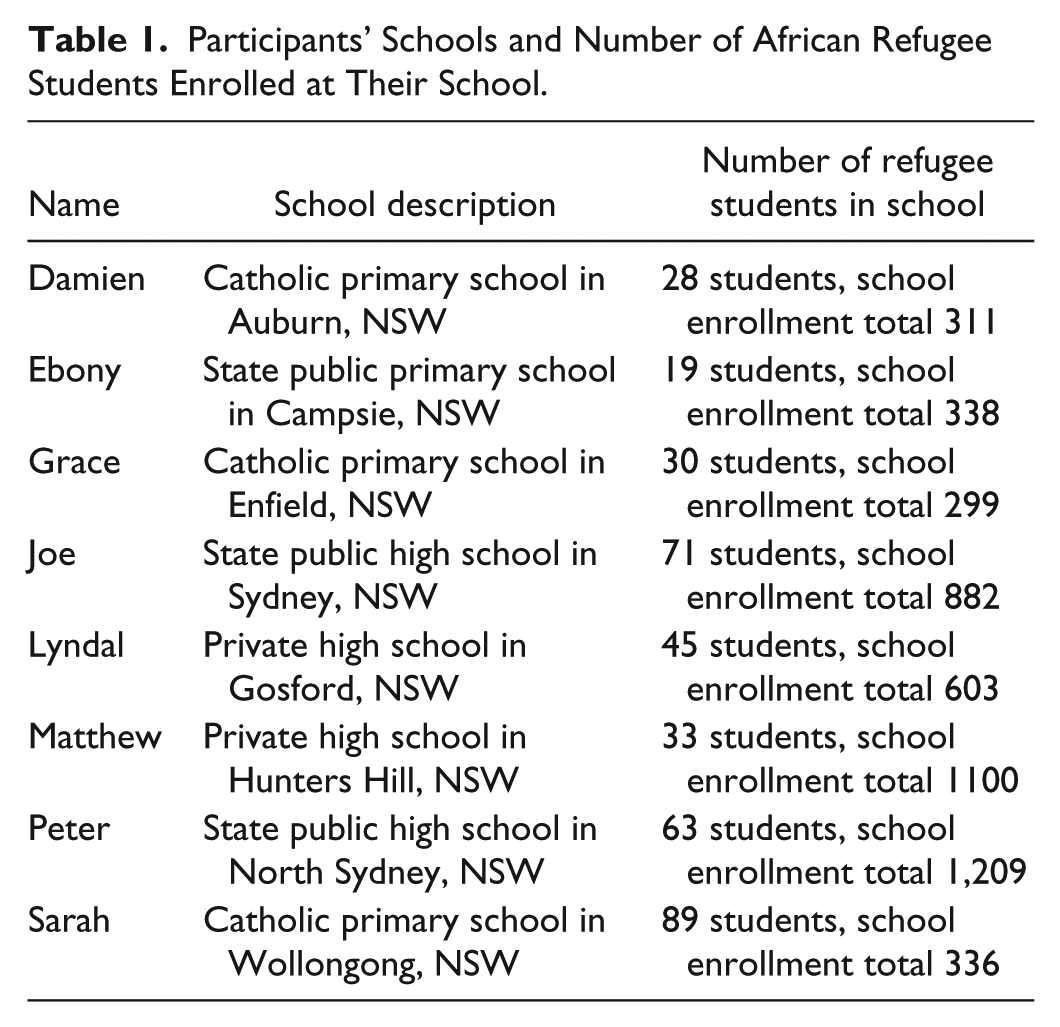
Recruitment of participants for the study was done by contacting physical education teacher educators and school administrators throughout Sydney, Australia. A list of potential participants who fulfilled the requirements noted above was generated and then used as the basis for the selection process (Table 1).
Participants’ Schools and Number of African Refugee Students Enrolled at Their School.
Working with the data
The transcripts were read and carefully reviewed for thematic elements that were common to each participant’s case. Profiles were then created that described how their particular experiences in their schools shaped their first year of physical education teaching.
The transcripts were divided into data units for each research question, which represented a single point of information pertaining to each individual teacher’s experience in their school. The transcripts were then reviewed again to identify thematic elements that appeared to be common across individual cases (Clandinin & Connelly, 1994; Miles & Huberman, 1994). Categories, themes, and tentative hypotheses about relationships were developed as the intermediate products of inductive reasoning (Buchbinder, 2011; Mello, 2002; Seale, 2003).
Trustworthiness
To ensure trustworthiness of procedures used while conducting this project, two methods described by Guba and Lincoln (2004), peer debriefing and member checking, were utilized. The peer debriefer, with whom I met biweekly throughout the period of data collection and analysis, had access to all the data that were collected, this included research logs and interview transcripts. The central purpose of periodic meetings with the peer debriefer was to ensure that the findings were grounded in the data, rather than in my own expectations and dispositions. Member checks were possible in that follow-up interviews were conducted. In addition, participants were given their own profiles to review and were invited to provide written feedback.
Analysis and Interpretation of Data
The analysis and interpretation of this study are reported in two sections. The first section provides profiles of two of the eight teachers and how their particular schools operated and supported, or did not support, their first year of teaching. The two selected participants to be reported in this article were chosen due to the variety of experiences they had. One teacher, Joe, was challenged daily and found his first full year of teaching frustrating and tiresome. Sarah, the other teacher, had lots of support and actively shaped aspects of her classroom teaching. The second section of the article summarizes the themes common to all participants. Collectively, these are brought together to relate the purpose of the study and respond to the research questions.
Teacher Profiles
Joe
Joe’s first year of teaching took place at a state public high school in Sydney. He taught health and physical education to students in years 7 to 10. The isolation and lack of support he encountered from his fellow colleagues in his first full year of teaching made his ability to plan engaging and innovative lessons for his students quite difficult. He acknowledged that he was assigned to the “beginning teacher support team” where first-year teachers at his school would meet to discuss issues with senior staff. Overall, he still felt that he had a difficult time trying to implement a curriculum that would move students toward his goals of knowledge and skill acquisition for lifelong participation in physical education. The problem was manifested further by the inclusion of three African refugee students in his classes. He admitted he had no idea how to teach them and engage them in his lessons.
Joe felt confident as he began his first year of teaching, as he felt that his student teaching experience had provided him with the opportunity to become acquainted with the school routine as well as the necessary lesson planning and behavior management. As a student teacher, however, he had not had to deal with faculty peers, parents, and administrators, as well as classes that contained students with extreme learning needs. In addition, he had not been responsible for the curriculum, and above all, he had not been alone in a classroom environment.
Joe was not completely alone in his first year of teaching. Along with the beginning teacher support team, he also met regularly with a colleague, roughly once a fortnight. John, a senior physical education teacher, taught at Joe’s school, and was assigned as his mentor teacher for the year. Both teachers taught lessons together on Wednesdays and Fridays, which allowed Joe to develop some confidence in the planning, preparation, and execution of physical education lessons.
Joe’s biggest challenge in his first year of full-time teaching was dealing with students from non-English speaking countries which is something he had not had to do at all during his teaching practicum. He was now in a school that had a student population of 882 students of whom 71 were classed as refugee students. These refugee students had little or no education background, nor did any of them understand the concept of sitting in a classroom and listening to the teacher talk. He was now suddenly responsible for three of them in his classes, and he needed to ensure that they were learning and participating in the lessons and not distracting or interfering with his teaching or the learning of the other students.
Health and physical education in the school Joe is teaching is not a strong priority as he commented during his interview. “Some of the other teachers, the principal, and even the parents do not place a lot of emphasis on physical education, which can often make planning and preparing for lessons difficult.” He discussed how in his beginning teacher support group he has made mention of the difficulties in catering for the African refugee students in his class. He discussed how other beginning teachers in the group had also discussed their difficulty in engaging them in classes.
I was frustrated at my lack of success in engaging and teaching these students in my health and physical education class, so I brought it up at our meeting and it turned out I was not the only one. The deputy principal, who chairs these meetings, however was not very helpful and became dismissive of our problems citing that we just need to get a grip with teaching and get the job done. We were like, but we have not had any training or professional development in how to teach these students.
Joe fought very hard to maintain his goals during his first year of being a physical education teacher. Although he wanted his students to enjoy physical activity like any teacher, he also wanted them to learn something in his classes, not just play games, and his fear was that because he lacked the skill to teach and engage the refugee students who were in his class, his classes turned into just mere games. He also lacked the ability to communicate with the parents of the African students. When he called parents at home to discuss problems with what their child was doing in class, he was confronted with a language barrier that he or the school could not break, giving further rise to frustration.
Joe’s experiences were further compounded by the inability of the African students in his lessons to concentrate on the task at hand. He commented, I would often be giving instruction to the students on technique, such as how to hold a cricket bat, or how to dribble the basketball and the African students would be talking to each other or looking elsewhere . . . It was very off-putting for me. I would chat to them and tell them to pay attention but a minute or two later they would be doing it again.
Despite the negative experiences, including the lack of training, professional development, professional support from the school, and the inability to communicate effectively with parents, Joe persevered with his efforts to provide what he considered to be a sound physical education program. He indicated that while it has not been easy, and he has often gone home at the end of the day wondering what he had achieved, he felt that he had made sufficient progress in getting to know and understand the African students and the experiences that they bring to the classroom. He discusses that it’s a trust thing, it took a long time to establish with the students, and partly because for a lot of them they come from such a traumatic background, and are used to running and hiding. PE and sport seems to be a great “break out” time for them to play and have fun, something I imagine they have not had a lot of opportunity to do in their lives.
Asked about his thoughts on his education and being properly trained to deal with these types of students, Joe remained fairly positive and upbeat about his course: Look, on one hand it is easy to say that Uni did not properly prepare me for the world of teaching, but then that is true of any job; it’s not until you’re put there that you really learn the ropes and start to gain valuable experience and knowledge about what you need to do. It would have been nice to have some knowledge and background on what to do and how to engage these students but Uni can’t prepare you for everything!
Sarah
Sarah taught physical education to students in Grades K-6 at a Catholic primary school in Wollongong. Sarah’s experiences during her first year were in stark contrast to that of Joe’s. The facilities at the school were amazing for a primary school: two large gymnasia, a 33-m swimming pool, two tennis courts, two outdoor basketball courts, and three spacious multi-purpose playing fields. The facilities, in conjunction with the variety of equipment available, allowed Sarah to teach virtually any activity that would be appropriate for primary-age school children.
Sarah had freedom to design her own physical education program. She explained that as a result of her autonomy, she had found it easy to adapt her teaching methods and goals of cooperation, skill acquisition, and enhancement of students’ self-esteem to her new environment. She was also able to address the African refugee students in her classes quite well. Unlike Joe, who taught 15 of the 71 African refugee students who attended his school, Sarah as a primary physical education teacher would teach all 89 African refugee students across the week. The school where Sarah was teaching was well prepared for the specific and special learning needs that the African refugee students would require. A specialist African teacher was placed at the school all week in the role of a support aid, but, as described by Sarah, this teacher was also very much like a “tribal/elder” figure to the students and was a member of the local African community. She was a contact between the school and the parents, as well as doubling as a translator for both the students and parents when communicating with the school and teachers.
Sarah, being a physical education specialist in the school, was the only physical education teacher present. She acknowledged that at times this was difficult but nevertheless made good friends and contacts with the other teachers who were teaching at the school. Sarah added, It could get a little lonely sometimes with no other teachers to talk to on the subject matter of PE; but most of the time it was fine; and there were always an abundance of students willing to come up and chat and want to play.
Although there were good support structures in place within the school and with the aid of a local African community liaison officer also placed in the school, Sarah acknowledges that she did have some challenging moments. One such challenge which she recalls quite freely was a lunch time playground duty that she was doing, and a large school yard fight broke out between a number of the older African and Lebanese boys on the playground. She felt quite intimidated at attempting to step in and break up the fight as not all of the boys were small and tiny. She comments, This one day when I was on playground duty I was quite scared and intimidated for both myself and the boys fighting in case one of them got seriously hurt. Attempting to move in and break up the fight was also quiet confronting.
Asked about her thoughts on her education and being properly trained to deal with these types of students, Sarah was very complimentary and praise-worthy of her pre-teacher education training: I really enjoyed my Uni course and I believe that it properly prepared me for the students that I would be teaching. It gave me a great core knowledge set that, of course, I have added to since beginning teaching, but I was never led to believe that my Uni course would provide me with all of the answers . . . and guess what, it didn’t! But I believe it provided me with the necessary skill set to get my job done and done well!
Beginning Teacher’s Common Experiences for All Participants
Each of the beginning teachers described how throughout their first full year of teaching physical education in the various schools they encountered difficult and confronting moments, not only with the African refugee students in their classes but also the mainstream White Anglo-Saxon students. Although each case was different, there were some similarities that occurred among all eight teachers. Six factors were identified as being the most significant characteristics common to each of the beginning teachers: the physical education facilities; the presence or absence of teaching colleagues; the scheduling of physical education classes; the community environment; communication among staff, students, and parents; and the actual students.
In addition to the six significant factors that were explicitly identified by the participants as influential during their first year of teaching, important contextual conditions could be inferred from close examination of the interview transcripts. Unarticulated factors (Clandinin & Connelly, 1994) were implicit in many of the stories, and some of these appeared to be sufficiently common to the first-year experience to represent additional themes of influence in the process of learning to teach physical education in schools. These unarticulated factors included the following: the role of physical education in the schools, the teachers’ sense of efficacy, the teachers’ understanding of refugee students, and the realities of teaching in school versus what the teacher expected while at university (see Table 2).
Common School Factors for All Participants.
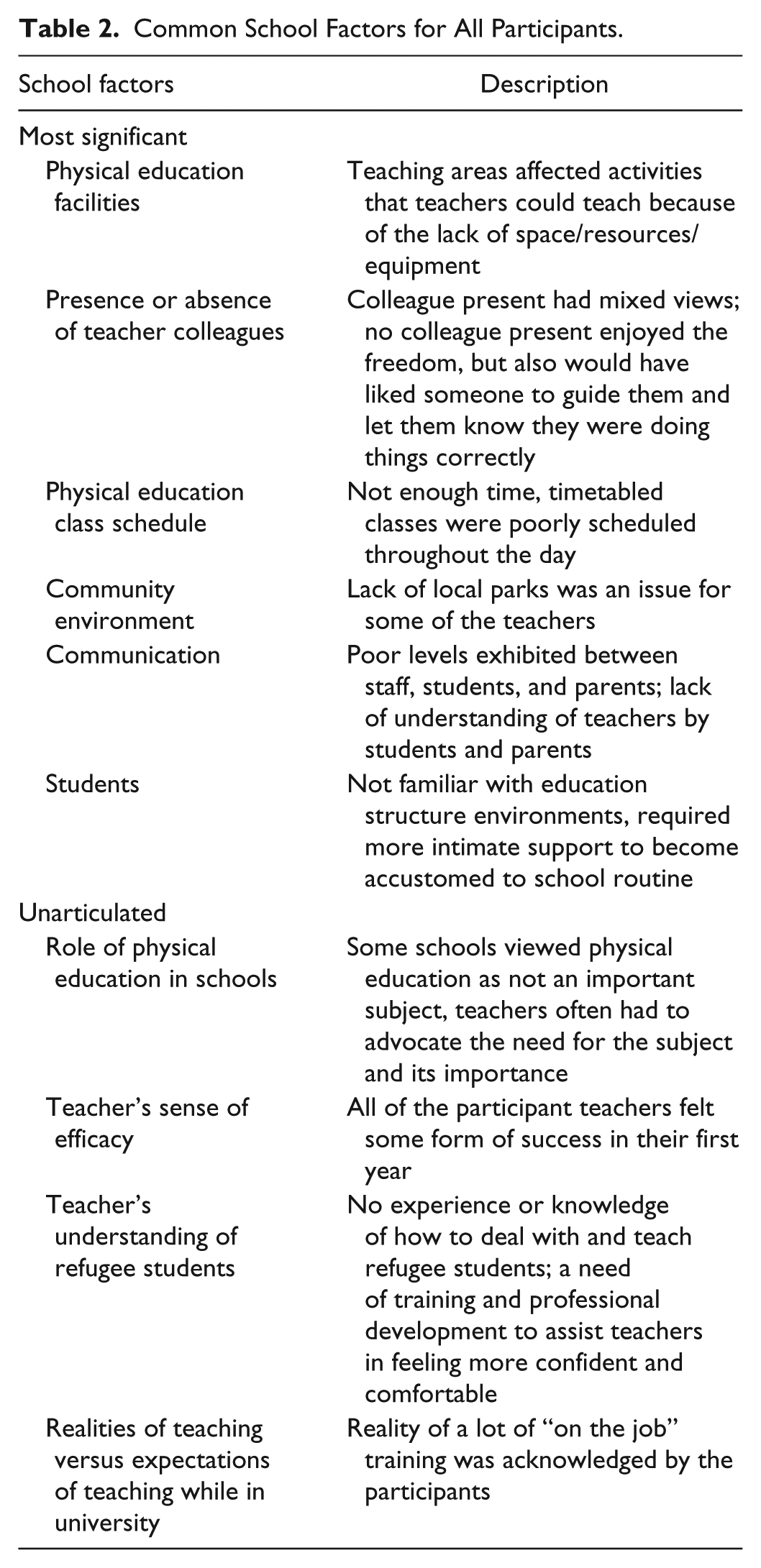
The themes in Table 2 summarize the results of this study and respond to the research questions. The discussion that follows does not attend to the themes individually, but focuses instead on several subtle points within the themes. The beginning teachers in this study were characteristic of many first-year teachers in that they were expected to perform the same duties as a seasoned veteran in the education system. Although many of the participants were assigned mentors, the participants found these mentors to be of little help beyond learning the daily routines of the school.
Also, like other beginning teachers, most of the novices experienced “reality shock” (Ibrahim, 2012), but in the case of these beginning teachers, there was an additional cultural shock with the teaching of African refugee students. Nearly all participants reported that they had not anticipated such inadequate facilities, their rigorous teaching schedules, or the lack of support received from supervisors and colleagues, especially in terms of how best to include and cater for the diverse learning needs of the refugee students. Moreover, with few exceptions, their stories indicate that they were not prepared to confront the social and cultural forces within the school community with respect to the refugee students.
The nature of physical education and its consequent place within the school and wider community clearly indicated to a number of the beginning teachers that they were teaching a subject which is not regarded as having a high status. In terms of facilities, a number of the teachers were forced to conduct their classes in areas and with time allocations that were less than adequate for instruction and were forced to do so with fewer resources than would be considered minimally adequate in the classroom. Sarah seemed to be the only teacher in the group who had adequate equipment and facilities to conduct her lessons. The remainder spoke quite poorly of their physical education setups. Grace and Damien’s situation exemplifies their beliefs that facilities strongly influence their curriculum and their goals for their students. Grace and Damien’s reactions to their facilities were typical of many participants in this study: The conditions in the school for teaching and assessing physical education are a total joke. I have a lopped sided basketball court that is on a 45degree slope, a small cow paddock oval that I am not allowed to use as it seems there may have been asbestos buried underneath it, and I have a hall that swelters in the heat because there is no air-conditioning, not to mention the hand me down bats and balls I have which pre-date World War II. (Grace) It’s a concrete jungle, I have next to no room at all to do practical classes on site, which means for most of my classes I have to take the students down to the local park which is a good 10 minute walk down and 10 minute walk back, which means I’m spending 1/3 of my lesson traveling to and from the oval. It’s just not good! (Damien)
Mixed messages were reported about the presence of a colleague teacher. Some of the participants who did not have a colleague teacher present indicated that this allowed great flexibility for them as a teacher in how they taught and programmed their classes. This absence was generally reported in primary schools. These teachers who did not have a colleague present also indicated that it would have been nice for someone to let them know that what they were doing in class was correct. The participant teachers that did have a colleague present were a little uncomfortable as they indicated it was like they were back doing their practicums and needed to be supervised at all times. Lyndal and Matthew indicated their feelings on a colleague teacher being with them during some of their lessons: It was kind of a catch twenty-two situation. On one hand I didn’t like it because I am a qualified teacher now and don’t need to be supervised at every point of my lesson, while on the other hand it was handy to have someone there at different times to support me and back me up, so yeah, difficult to give a definitive positive or negative attribute to it. (Lyndal) Having completed my practicums already and had supervising teachers and university supervisors sitting in on my lessons, I thought I had done and completed all of that, so to have someone back in my lessons again was quite daunting and difficult. (Matthew)
The scheduling of classes while not a hugely negative area for the beginning teachers still proved to have some frustrations. Generally, these surrounded the lack of communication surrounding the timing of classes. This tended to be an issue more so with the high school teachers who taught a combination of theory and practical-based lessons. The primary school teachers did not have a choice in classes as they taught practical lessons all day. The community environments were also not a hugely negative experience for the students; however, two participants did mention that this was the worst part of their physical education lessons, when taking the students down to the local park. Ebony and Peter commented, Taking 12-year-olds down the road to the park is hard enough at the best of times, combine this when you have a group of students that have never been able to walk down the road in their own country for fear of being chased or attacked and you can imagine that a simple 5 minute walk can end up taking the better part of the entire lesson because they stop at every house to look and stare and talk. (Ebony) Whilst it is not ideal having to walk students down to the local park for their PE lessons I guess it is what it is so I try and make the most of it; using this walk as part of, or, your warm-up and cool-down activities. This is one way I have tried to make the most of it, but in all honesty I hate it! 20 minutes of my lessons are wasted doing this and to make matters worse the students sometimes need to get changed as well which wastes even more time. (Peter)
Communication proved to be a critical issue that all of the beginning teachers identified as needing to be improved in the schools where they were teaching. Whether it was communication between colleagues and themselves, between students and themselves, or parents and themselves, overall the participants felt that this was an area that let them down considerably. The participants responded to these problems in ways that reflected individual skills and dispositions, as well as the unique features of each school. For example, conversations in the interviews often touched on the participants’ need to feel some sense of success in their day-to-day exchanges and encounters with the staff and students. At many of the schools, however, it was difficult to sustain any such practical sense of accomplishment due to the high degree of non-English speaking backgrounds that many of the refugee students brought to the schools.
It’s just that some days I feel like I have wasted my time and that everything I have said and taught in a lesson has not been heard or taken in by the students. I leave school utterly exhausted and I feel like I have nothing to show for all of the effort I have put in. (Lyndal) It can be a very frustrating job at times, I’m reminded of the old saying you can lead a horse to water but you can’t make it drink because there are some days I feel like that after having taught a class, just really frustrated and like, I thought I had explained myself fully but nope they still didn’t get it. (Peter)
The participants reported they consciously altered both their teaching behaviors and their teaching objectives so that they would be more congruent with what they perceived to be the norms of their schools. Indeed, all of the participants who reported having to adjust their teaching styles and goals also indicated the firm belief that if (or when) their situation changed, they would (and could) return to their earlier teaching methods.
The participants’ commitment to the teaching profession was a constant powerful message that came through the interviews, despite the many challenges that the beginning teachers faced. Joe acknowledged that his intentions were to keep trying to get the best out of all of his students: It’s been a long and challenging year . . . there have been times when I have felt like it wasn’t worth it, but overall I feel as though I did achieve something . . . and it can only get easier from here!
Joe’s sense of efficacy in his teaching was not attained through his students’ level of achievement and participation, but rather by his feeling that he had made a difference in their personal lives and instilled some thought of the importance of physical education.
Many of these beginning teachers were able to look beyond the limitations of their schools, their university education, and their experience and feel at least some sense of having done worthy work. Although it may have been necessary to modify their initial intentions and plans of what would work in the classroom with the students, many of these teachers were able to look forward to a second year in the same school with a degree of optimism. There were, however, some teachers who believed the cultural and social climates and difficulties that they encountered in their first year within the school and community were just too difficult and would not improve. Those teachers decided not to leave teaching but to leave their present posting in search of a school that might provide better support.
I’ll be back next year, bigger and stronger and more prepared, it’s a challenge, but life isn’t easy and I like a challenge! And now that I have some experience under my belt it can only get easier from here. It has been a tough year, I have often questioned myself during the year if teaching was in fact the right career choice for me, and after this year I think the answer is no. I don’t know if it is the stress, the work demands, the students, or all of it combined, perhaps it has just been this school and if I went to some other school things may be different? I don’t know what I will do next year. (Joe).
Conclusion
The results of this study, when added and compared with the information provided in the literature, suggest that despite some modest efforts, many primary and secondary schools provide inadequate support for beginning teachers. First-year physical education teachers, like other beginning teachers, still learn the ropes alone, especially if they are employed as a physical education specialist in a primary school. Moreover, the subject matter of physical education presents unique problems in accomplishing the transition to professional teaching because of its need on equipment and timetabling, and its constant need to advocate itself against other key learning areas (Hardy, 1999; Sparkes et al., 1993).
This study has highlighted the challenges beginning teachers face; in particular, the uniqueness of integrating and including a number of African refugee students into their classes which this study has highlighted. The study provides insight into how eight first-year physical education teachers engaged with African refugee students in their physical education lessons.
The study has also highlighted the need for further investigation into the area of refugee education in Australian schools especially given the vast number of refugee students that migrate to Australia. There is limited research that focuses on linking experiences with refugee education and the area of physical education. The current study has highlighted the benefits of integrating refugee students into school-based education and therefore, this issue needs further, more detailed, research to investigate the benefits on a larger, more long-term, scale.
At the time of the last interview, six of the participants had intended to remain at their schools. Ebony and Joe had sought and found employment as physical education teachers at other schools. Despite their struggles to reconcile what was promoted in their teacher education programs with what was possible in their schools, all participants wanted to continue teaching physical education.
Footnotes
Declaration of Conflicting Interests
The author(s) received no financial support for the research and/or authorship of this article.
Funding
The author(s) received no financial support for the research and/or authorship of this article.