




Abstract
Despite the widely recognized positive nature of ethical leadership, recent studies have reported inconsistent findings in the link between ethical leadership and employees’ behavior. Drawing on the social cognitive theory, this study seeks to address this gap by investigating the paradoxical influence of ethical leadership on unethical pro-organizational behavior among employees. Additionally, the study aims to explore the mediating mechanism of employees’ psychological capital and the moderating effect of moral identity. Three time intervals data were collected from nursing professional from public and private hospitals in Pakistan. The data were evaluated employing PLS SEM. Interestingly, the findings contradict the hypothesis and demonstrate a positive link between ethical leadership and unethical pro-organizational behavior among employees. Moreover, the relationship is mediated by employees’ psychological capital. Furthermore, employees’ moral identity moderates this relationship. These findings furnish important insights into the paradoxical impact of ethical leadership within organizations and challenge its universal perception of positive leadership style having significant theoretical and practical implications.
Keywords
Introduction
Leadership plays a fundamental role in organizations, exerting significant influence on various aspects of organizational functioning and performance. Effective leadership is characterized by providing a clear vision and direction for the organization, ensuring that decisions are strategic, well-considered, and aligned with organizational goals (Bakker et al., 2023; Northouse, 2021; Yukl et al., 2019). Leaders are responsible for identifying and developing talent within the organization, fostering a positive work environment that encourages learning, growth, and development. Through guidance, mentorship, and creating opportunities for skill enhancement, effective leaders cultivate a culture of continuous improvement (Avolio & Drummey, 2023; Plachy & Smunt, 2022). Furthermore, leaders shape the organizational culture and climate through their behaviors, values, and actions. They establish the tone for ethical conduct, collaboration, innovation, and performance expectations, influencing employee behavior, attitudes, and norms. Strong leadership contributes to the creation of a positive work culture that fosters teamwork, trust, and organizational effectiveness (Banks et al., 2022; Vera et al., 2022).
Ethical leadership (EL) holds critical importance for organizations as it establishes a positive ethical climate, shapes employee behavior, and contributes to long-term success (Banks et al., 2023; Ng et al., 2021). EL serves as role models, promoting high moral standards and influencing employees to adopt ethical behaviors. Building trust is another crucial aspect, as ethical leaders foster trust within the organization through integrity and transparency (Alkhadra et al., 2023; Bush et al., 2021). Moreover, EL enhances employee engagement and commitment by creating a positive work environment. With their moral principles, integrity, and fairness, ethical leaders are recognized as catalysts for fostering ethical behavior among employees (Al Halbusi et al., 2022; Arar & Saiti, 2022; Banks et al., 2021). EL mitigates unethical behavior and reduces risks by establishing ethical standards and fostering accountability. Additionally, it encourages organizational citizenship and pro-social behaviors, which benefit the organization beyond formal job requirements (Kleshinski et al., 2021; Nelson & Stout, 2022; Nguyen et al., 2021).
The existing literature has consistently reflected a positive relationship between EL and various employee behaviors (Bedi et al., 2016; Brown & Treviño, 2006; Ko et al., 2018; Lemoine et al., 2019). However, the link between EL and unethical pro-organizational behavior (UPB) among employees, which involves beneficial actions for the organization and its stakeholders but violate ethical principles or societal norms, has yielded inconsistent findings (Ahmed & Khan, 2023; Hsieh et al., 2020; Kalshoven et al., 2016; Miao et al., 2013, 2020; Tang & Li, 2022). This inconsistency highlights the need for further investigation in this area.
To address this gap, this study proposes examining the mediating mechanism of employees’ psychological capital (PsyCap), which encompasses self-efficacy, hope, optimism, and resilience. Drawing on social cognitive theory (SCT), it is hypothesized that EL can enhance employees’ PsyCap, thereby reducing the likelihood of engaging in UPB. By investigating the explanatory role of PsyCap, this research aims to furnish a nuanced comprehension of the underlying mechanisms through which EL influences employees’ behavior (Bouckenooghe et al., 2015; Clarence et al., 2021; Daraba et al., 2021).
Furthermore, moral identity (MID), which reflects individuals’ self-perception as moral individuals, is proposed as a moderator in this study. It is posited that MID may interact with EL, influencing the link between EL and employees’ PsyCap. Exploring MID as a moderator between EL and employees’ PsyCap will shed light on how individual differences in moral self-perception may shape the influence of EL on employees’ PsyCap, ultimately affecting their propensity for engaging in UPB (Ahmed & Khan, 2023; X. Chen et al., 2021; Moore et al., 2019; Shaw & Liao, 2021).
By building on SCT (Bandura, 1986) and incorporating these key variables, this study offers a comprehensive examination of the link of EL and UPB among employees. By incorporating the explanatory role of PsyCap and the moderating influence of MID, this research aims to offer a nuanced comprehension of the complex dynamics in the linkage of EL and UPB among employees. The findings will contribute to theoretical understanding in the field of EL and organizational behavior, providing practical insights for organizations and leaders. These insights can inform strategies aimed at fostering ethical conduct, mitigating unethical behaviors, and creating positive work environments. Ultimately, this study aims to make a positive influence on employees, leaders, and organizations as a whole by promoting ethical behavior and responsible organizational cultures.
Theoretical Development
The proposed research model, featuring EL as the exogenous construct, employees’ UPB as the endogenous construct, with employees’ PsyCap serving as a mediator between EL and employees’ UPB, and MID as a moderator between EL and employees’ PsyCap, is underpinned by SCT. This theory, advanced by Bandura (1986), suggests that human behavior is shaped by the interaction between cognitive processes, environmental influences, and individual characteristics.
Firstly, SCT (Bandura, 1986) emphasizes observational learning, suggesting that individuals acquire behaviors by observation and imitation of others. In the context of the research model, employees observe the behaviors and actions of their leaders, particularly EL. When leaders exemplify ethical behavior, employees are more likely to model these behaviors, leading to a reduction in UPB within the organization. Conversely, negative examples of unethical leadership may inadvertently reinforce or normalize UPB among employees.
Secondly, SCT (Bandura, 1986) points out the role of self-efficacy, which refers to the beliefs and values held by individuals for performance of specific objectives and accomplishment of desired outcomes. In the research model, EL influences employees’ perceptions of their own efficacy to adhere to ethical standards. When leaders demonstrate integrity, fairness, and competence, employees may develop higher levels of self-efficacy in resisting unethical behaviors, even in the face of organizational pressures.
Thirdly, SCT (Bandura, 1986) underscores the motivational aspect of behavior, suggesting that individuals are driven to act based on their beliefs, goals, and incentives. PsyCap, serving as a mediator between EL and employees’ UPB in the research model, influences employees’ motivation to uphold ethical norms. Employees with elevated PsyCap, characterized by attributes such as resilience and optimism, are more likely to be motivated to prioritize ethical behavior over unethical actions, thereby reducing the occurrence of UPB.
Lastly, SCT (Bandura, 1986) emphasizes human agency, highlighting individuals’ capacity to exert control over their actions and environment. MID, representing employees’ personal values and ethical beliefs, interacts with both EL and employees’ PsyCap. As a moderator between EL and employees’ PsyCap, MID shapes how individuals interpret and respond to EL behaviors. Employees imbued with an elevated MID are more prone to internalize the values demonstrated by ethical leaders, leading to higher levels of PsyCap and a decreased propensity for UPB.
Hence, SCT (Bandura, 1986) provides a comprehensive framework to understand the complex dynamics of leadership, individual characteristics, and organizational behavior, thereby supporting the proposed research model.
Ethical Leadership (EL) and Employees’ Unethical Pro-Organizational Behavior (UPB)
The widely recognized definition of EL is furnished by Brown et al. (2005), as “the demonstration of normatively appropriate conduct through personal actions and interpersonal relationships, and the promotion of such conduct to followers through two-way communication, reinforcement, and decision-making” (p. 120). EL is a crucial aspect of effective leadership that emphasizes ethical decision-making, integrity, and moral behavior. It involves leaders who prioritize organizational success while demonstrating a commitment to ethical principles and values (Al Halbusi et al., 2021; Böhm et al., 2022; Brown & Mitchell, 2010). EL is characterized by leaders who make morally sound decisions and exhibit ethical behavior. Scholars have explored the cognitive processes and moral reasoning underlying ethical decision-making by leaders (Al Halbusi et al., 2022; Kleshinski et al., 2021; Treviño et al., 2006). Research reflects that EL positively influences various organizational outcomes and behaviors (Brown & Treviño, 2006; Bush et al., 2021; Egorov et al., 2020; Tsai, 2024). Studies have also found a link between EL and reduced misconduct and unethical behavior of employees (Brown et al., 2005; Mayer et al., 2012; Peng & Kim, 2020).
The scholars define employees’ UPB as “actions that are intended to promote the effective functioning of the organization or its members and violate core societal values, mores, laws, or standards of proper conduct” (Umphress & Bingham, 2011, p. 622). The literature explores the phenomenon of employees’ engagement in unethical behavior for organizational benefits and investigates the underlying motivations and ethical considerations involved in such behaviors (Y. J. Chen & Tang, 2006; Umphress et al., 2010; Umphress & Bingham, 2011). Scholars presented a typology of deviant workplace behaviors, including unethical behaviors, based on a multidimensional scaling analysis. This framework provides an understanding of the various forms and dimensions of unethical behaviors employees may engage for organizational benefits (Robinson & Bennett, 1995). Scholars also discuss various perspectives and theories on ethical decision-making, including factors contributing to employees’ unethical behavior in organizational context (Kish-Gephart et al., 2010; Moore & Gino, 2015; Tenbrunsel & Smith-Crowe, 2008; Trevino, 1986; Treviño et al., 2006; Trevino & Nelson, 2021).
Various leadership styles are considered to impact employees’ UPB through distinct underlying mechanisms and boundary conditions within the organizations (Inam et al., 2021; Liu et al., 2021; Shaw et al., 2020; Shaw & Liao, 2021; Uymaz & Arslan, 2022). EL has also been shown to affect employees’ ethical behaviors within organizational context (Brown & Mitchell, 2010; Brown & Treviño, 2006; Bush et al., 2021; Lemoine et al., 2019; Ng et al., 2021). Similarly, several studies highlight the complex linkage between EL and employees’ UPB. EL, when perceived as genuine and consistent, has been found to reduce unethical behavior and promote pro-organizational behavior through various mechanisms such as moral attentiveness, moral disengagement, coworker ethical behavior, and ethicality neutralization/amplification. However, findings regarding this relationship have been found inconsistent (Hsieh et al., 2020; Kalshoven et al., 2016; Miao et al., 2013, 2020; Tang & Li, 2022).
For instance, Miao et al. (2013) identified a curvilinear link, where employees’ UPB increased at moderate EL levels but decreased at high EL levels. However, Kalshoven et al. (2016) reported an insignificant relationship between EL and UPB among employees, emphasizing that this connection hinges on followers’ job autonomy. In contrast, Miao et al. (2020) found that ethical leaders foster reflective moral considerations, reducing employees’ UPB. Hsieh et al. (2020) observed that the disengagement of morally inclined employees weakens the link of EL and UPB among employees.
Tang and Li (2022) uncovered the varying effect of EL on UPB among employees at individual and group levels. At the individual level, EL unintentionally promotes reciprocity beliefs, increasing employees’ willingness for UPB. On the contrary, at the group level, EL deliberately diminishes employees’ willingness for engagement in UPB by exerting influence over the political climate. Similarly, Ahmed and Khan (2023) identified a positive correlation between EL and UPB among employees within organizational context. Lastly, the study by Park et al. (2023) suggests that EL negatively influences UPB among employees through affective commitment but positively impacts through continuance commitment. Collectively, these studies underscore the complex and multidimensional facet of the link between EL and UPB among employees.
The mixed findings in the literature, ranging from curvilinear relationships to nuanced influences at individual and group levels, highlight the intricate nature of this association. While EL consistently demonstrates a positive impact on ethical behavior, the link with UPB among employees appears contingent on various contextual factors and individual considerations. These diverse findings emphasize the need for a nuanced and context-specific approach when applying EL principles to curb UPB among employees.
According to SCT (Bandura, 1986), EL can be argued to have a negative linkage with UPB among employees. The theory suggests that individuals’ behavior is influenced by a complex interplay of personal cognitive processes, social factors, and environmental factors. SCT proposes that EL, through role modeling (Bandura, 1986), rewards and reinforcement (Bandura, 1986), enhancing self-efficacy and moral agency among employees (Bandura, 1991; Latham & Locke, 1991), stimulating their cognitive processes such as moral reasoning and ethical decision-making (Treviño et al., 2003), cognitive dissonance reduction (Bandura, 1991), trust and psychological safety (Ahmad et al., 2023; Eluwole et al., 2022), and promotion of intrinsic motivation and MID (Aquino & Reed, 2002), can contribute to mitigate UPB among employees in the organization. By cultivating an ethical climate and promoting ethical values, leaders can help shape the attitudes and behaviors of their followers, leading to a decrease in unethical behaviors. Therefore, based on SCT (Bandura, 1986, 2018) and existing literature, we propose the hypothesis as below:
Mediating Role of Employees’ Psychological Capital (PsyCap)
PsyCap denotes a person’s constructive psychological state of growth, comprising four primary components: self-efficacy, optimism, hope, and resilience (M. Goswami & Goswami, 2023; Newman et al., 2014; Nolzen, 2018). The scholars define PsyCap as: “an individual’s positive psychological state of development and is characterized by: (1) having confidence (self-efficacy) to take on and put in the necessary effort to succeed at challenging tasks; (2) making a positive attribution (optimism) about succeeding now and in the future; (3) persevering toward goals and, when necessary, redirecting paths to goals (hope) in order to succeed; and (4) when beset by problems and adversity, sustaining and bouncing back and even beyond (resilience) to attain success” (Luthans et al., 2007, p. 3).
Each component of PsyCap—hope, self-efficacy, resilience, and optimism—is considered conceptually distinct (Bandura, 1997; Dawkins et al., 2013; Luthans et al., 2007; Luthans & Jensen, 2002; Luthans & Youssef-Morgan, 2017) and has been supported by empirical evidence demonstrating discriminant validity (M. Goswami & Goswami, 2023; Luthans, 2002; Luthans et al., 2007, 2015; Luthans, Avey et al., 2006). Employees’ PsyCap is regarded as a critical psychological resource and asset for organizations (Luthans, Youssef, & Avolio, 2006; Luthans & Jensen, 2002; Schmidt & Flatten, 2022).
Furthermore, employees’ PsyCap is identified as a crucial mechanism that the link of leadership and employees’ attitudes and behaviors is mediated (Clarence et al., 2021; Fang et al., 2019; Gyu Park et al., 2017; Maykrantz et al., 2021; Novitasari et al., 2020; Qian et al., 2020; Schuckert et al., 2018; Seo & Chung, 2019; Wang et al., 2017). Moreover, employees’ PsyCap has also been shown to mediate the link between EL and its outcomes. Specifically, PsyCap acts as a mediator between EL and organizational citizenship behaviors (Jabeen & Munir, 2018), job satisfaction (Katircioglu et al., 2022), creativity (Hussain & Niu, 2019), and in-role job performance (Bouckenooghe et al., 2015).
These studies collectively demonstrate the crucial role of PsyCap as a mediating mechanism in the link between various leadership styles and attitudes and behaviors among employees. By understanding the mediating role of PsyCap, organizations can gain insights into how leadership influences employee outcomes and develop strategies to enhance employees’ psychological resources for better performance and well-being.
Drawing on SCT (Bandura, 1986), EL serves as role models by displaying ethical behaviors, ethical decision-making, and fostering a culture of transparency and trust. EL can enhance self-efficacy, optimism, hope, and resilience of employees to effectively address ethical dilemmas through support, guidance, and feedback (Bouckenooghe et al., 2015; Hussain & Niu, 2019; Jabeen & Munir, 2018). When employees view their leadership as ethical, they are more inclined to engage in ethical behaviors themselves, leading to pro-social rule-following. However, in certain situations, employees may engage in pro-social rule-breaking when they believe it serves a greater good (Grabowski et al., 2019; Morrison, 2006; Umphress & Bingham, 2011).
Therefore, it can be argued that employees’ PsyCap serves as a mediating mechanism between EL and employees’ UPB link (A. K. Goswami & Agrawal, 2023; M. Goswami & Goswami, 2023; Katircioglu et al., 2022; Loghman et al., 2023). Based on SCT (Bandura, 1986, 2018) and the extant literature, we postulated the hypothesis as under:
Moderating Role of Employees’ Moral Identity (MID)
MID has been acknowledged as a significant personal trait and individual difference that influences the connection between different leadership styles and psychological processes and behaviors of individuals (Aquino & Reed, 2002). The scholars define MID as “an individual’s self-conception organized around a set of moral traits” (Aquino & Reed, 2002, p. 1424). It governs moral cognition and conduct within organizational settings (Aquino et al., 2011; Kuenzi et al., 2020; Shao et al., 2008; Weaver, 2006). Moreover, it has also been found to impact ethical choices in the workplace (Hannah et al., 2020).
MID has a pivotal role in assessment of individuals’ moral and ethical behaviors as they endeavor to harmonize their actions with their MID (Kuenzi et al., 2020; McFerran et al., 2010). Engaging in immoral actions causes cognitive dissonance by conflicting with the moral self, which is a core part of identity of an individual (Blasi, 1984; Miles & Upenieks, 2022; Yan et al., 2023). A meta-analytic study further confirms the significant relationship between MID and moral behavior (Hertz & Krettenauer, 2016). While MID has been associated with moral behavior (Krettenauer, 2020), it can also compromise ethical conduct in certain situations (Krettenauer, 2022).
Research suggests that employees with elevated MID are more likely to demonstrate morally upright behaviors and less inclined for engagement in immoral conduct (Aquino et al., 2007, 2009; Reynolds & Ceranic, 2007). Similarly, those with elevated MID are more prone to behave in alignment with their perceived moral beliefs (Hardy & Carlo, 2011; Qin et al., 2018).
Several studies have demonstrated that MID exhibits a moderating effect in the relationship between various leadership styles and psychological processes and behaviors among employees. The evidence suggests that MID significantly influences how leadership affects employees’ psychological mechanisms and behaviors (Shaw & Liao, 2021). Moreover, MID also acts as a moderating factor in the link between EL and psychological processes and workplace behavior among employees (Ahmed & Khan, 2023; Chuang & Chiu, 2018; Moore et al., 2019; O’Keefe et al., 2019; Taylor & Pattie, 2014; Zhu et al., 2016).
Employees’ MID has the potential to enhance the beneficial effects of EL on their psychological processes and behaviors. Chuang and Chiu (2018) observed a positive moderating impact of MID on the link between EL and organizational commitment. Similarly, O’Keefe et al. (2019) illustrated that MID of employees strengthened the connection between EL and affective commitment. Additionally, Moore et al. (2019) found that MID of employees positively influences the relationship between EL and job satisfaction. Furthermore, Ahmed and Khan (2023) discovered that employees with elevated MID have a stronger influence on the link between EL and employees’ psychological empowerment. Likewise, studies by Amber et al. (2022), Yazdanshenas and Mirzaei (2023), and Zhang et al. (2022) have also provided empirical evidence supporting the amplification of the linkage between EL and PsyCap for individuals with a strong MID.
On the contrary, MID may attenuate the favorable effects of EL on the psychological processes and behaviors among employees. Taylor and Pattie (2014) discovered a negative moderating effect of MID on the link between EL and job satisfaction. Likewise, Zhu et al. (2016) showed that employye’ MID reflected a detrimental moderating effect in the correlation between EL and organizational citizenship behavior.
Drawing on SCT (Bandura, 1986), it can be argued that employees’ perception of MID moderates the link between EL and employees’ PsyCap, with a stronger link observed among individuals with a higher MID. The alignment of values (Reed & Aquino, 2003), enhanced ethical role modeling (Detert et al., 2008), ethical decision-making orientation (Reynolds & Ceranic, 2007), and ethical identity activation (Treviño et al., 2006) all contribute to strengthening the linkage between EL and PsyCap for individuals with a strong MID. Based on the theoretical framework of SCT (Bandura, 1986, 2018) and the existing literature, we propose the hypothesis as under:
Method
Population and Sampling
The basic objective of this research was to investigate the link between EL and UPB of employees within the healthcare sector in Pakistan. The research sample comprised registered nursing professionals in both public and private hospitals throughout Pakistan. To enhance the generalizability of the study, one public and one private hospital were selected from both the federal and provincial capitals of Pakistan.
The sample size was calculated utilizing the G*Power formula, with parameters including an effect size of 0.05, a power of 0.90, and the presence of a maximum of one predictor for the endogenous construct. As per the G*Power calculator, a minimum sample size of 150 was deemed necessary for this research. Nevertheless, Memon et al. (2020) advised a sample size ranging between 160 and 300 for the application of multivariate statistical analysis methods like PLS-SEM.
Aligned with the existing scholarly work on SEM, 515 respondents were considered suitable for analyzing the research model (Becker et al., 2023; Hair et al., 2019, 2022; Ringle et al., 2020). Consequently, this study included a total of 515 participants, consisting of registered nursing staff from both public and private hospitals.
Measurements
The study model comprises four key constructs: EL as the exogenous construct, UPB as the endogenous construct, PsyCap as the mediating mechanism, and MID to act as the moderating factor. Each of these constructs was assessed using a five-point Likert scale, where 1 indicated “strongly disagree” and 5 indicated “strongly agree.” The measurement instruments employed were self-reported, with employees providing their perceptions of the study constructs. To reduce the risk of common method bias, data were collected in three distinct waves (Podsakoff et al., 2003). Some of the instruments items were adapted to suit the hospital context of this research (Heggestad et al., 2019). This approach ensures the relevance and accuracy of the measurement tools within the healthcare environment.
Ethical Leadership (EL): To assess EL at Time 1 (T1), this research utilized the 10-item Ethical Leadership Scale (ELS) developed by Brown et al. (2005). This scale includes items that evaluate the ethical behaviors and attitudes of supervisors. An example item from the ELS is, “My supervisor has the best interests of employees in mind.” The reliability of the EL scale in this research was confirmed with a Cronbach’s alpha coefficient of .919, indicating high internal consistency.
Unethical Pro-Organizational Behavior (UPB): To measure UPB at Time 3 (T3), this study utilized the 6-item scale developed by Umphress et al. (2010). This scale assesses the extent to which employees are willing for engagement in unethical actions for organizational benefits. A representative item from the UPB scale is, “If it would help my organization, I would misrepresent the truth to make my organization look good.” The UPB scale demonstrated high reliability in this research, with a Cronbach’s alpha coefficient of .883, indicating strong internal consistency.
Psychological Capital (PsyCap): At Time 2 (T2), this study employed the 12-item shorter version of the PsyCap Questionnaire (PCQ-12), developed by Martínez et al. (2021), to measure employees’ PsyCap. Originally, the PCQ-24, comprising 24 items, was developed by Luthans et al. (2007). The PsyCap construct encompasses four dimensions: efficacy, resilience, hope, and optimism. Representative items from the PCQ-12 include: Efficacy: “I feel confident in analyzing a long-term problem to find a solution.” Resilience: “I usually manage difficulties one way or another at work.” Hope: “I have several ways to accomplish the work goal.” Optimism: “At work, I always find that every problem has a solution.” The Cronbach’s alpha coefficient for PsyCap in this study was calculated to be .937, indicating high internal consistency and reliability of the scale.
Moral Identity (MID): At Time 1 (T1), the study employed the 5-item MID scale, focusing on Internalization, as developed by Aquino and Reed (2002), to assess employees’ MID. An example item from the MID scale is: “It would make me feel good to be a person who has these characteristics.” This item reflects the individual’s internalization of moral traits as part of their identity. The reliability analysis indicated a Cronbach’s alpha coefficient of .915 for the MID scale, suggesting strong internal consistency and reliability across its items.
Data Collection
The study collected data through survey-based self-administered questionnaires among registered nursing professionals in both public and private hospitals located in federal and provincial cities across Pakistan, following contemporary management guidelines (Aguinis et al., 2021; Memon et al., 2023; Podsakoff et al., 2024). The researchers initiated contact with hospital management through personal and professional networks, providing them with an overview of the study’s objectives and a university authority letter authorizing data collection. This approach facilitated prompt support from top management. Registered nursing staff meeting the criteria of holding at least a bachelor’s degree and 1 year of experience were randomly chosen from lists furnished by designated persons in each hospital to participate in the study.
Considering that English serves as the medium of instruction in colleges and universities and is also the official language of both public and private sectors in Pakistan, the questionnaires were distributed in English. This approach is consistent with standard research practices in management sciences within the country (Abbas & Raja, 2015; Amber et al., 2022; Haq et al., 2022). Alongside the questionnaires, a letter addressed to the respondents elucidated the study’s purpose and assured the confidentiality of their responses. It underscored that individual responses would be aggregated and used solely for research purposes, with participation being voluntary and respondents having the option to withdraw at any stage without obligation to provide personal identifiers or signatures.
Each questionnaire contained the operational definition of study constructs, enhancing respondents’ comprehension. Furthermore, the letter included the researcher’s email address and contact number for any clarifications regarding the questionnaire. The questionnaires were designed to be completed within a 4-week timeframe, affording respondents ample opportunity to record their responses at their convenience without pressure. Dispatched and returned in sealed envelopes, each questionnaire was assigned a unique three-digit code for anonymity across surveys administered at T1, T2, and T3.
The data collection procedure comprised the dissemination of questionnaires to participants across three distinct time points, with a 4-week interval between each wave. This approach aimed to establish temporal precedence and mitigate common method bias. During T1, a total of 900 questionnaires were distributed to solicit demographics and gauge respondents’ perceptions of EL and MID. Subsequently, 751 completed questionnaires were collected, yielding a commendable response rate of 83.44%. Moving to T2, the same cohort of participants received 751 questionnaires, focusing on their perceptions of PsyCap. Of these, 649 questionnaires were returned, reflecting an impressive response rate of 86.41%. Lastly, during T3, 649 questionnaires were distributed to the same respondents from T2, eliciting their perspectives on UPB. The response rate at this stage was notably high, with 591 completed questionnaires received, representing a response rate of 91.06%.
To uphold data integrity, 47 questionnaires were omitted from analysis due to missing information, while an additional 29 questionnaires were disregarded because of invalid responses. As a result, a total of 515 questionnaires remained viable for comprehensive data analysis. Assessing the response rates across all three data collection waves, the overall response rate was calculated at 65.66%. However, when factoring in the excluded questionnaires, the valid response rate stood at 57.22%. These response rates are considered suitable for a study employing a time-lagged data collection approach and instill confidence in the reliability and robustness of our study outcomes.
Sample Characteristics
The research sample comprised 515 nursing professionals drawn from both public and private healthcare facilities situated across six key urban centers in Pakistan. Descriptive statistics revealed that the majority of respondents were female (57.5%), married (68.3%), and had a master’s degree (42.9%) or a bachelor’s degree (41.6%). In terms of age, most respondents fell in the age bracket of 31 to 40 years (50.1%), while in terms of hospital experience; the majority had 1 to 5 years of experience (44.7%). These demographics reflect the working class of Pakistan, as reported in the Economic Survey of Pakistan 2021/2022. The high representation of women in nursing staff is notable and is likely due to the perception of nursing as a suitable job for women and its social prestige in Pakistan.
Data Analysis
The initial and in-depth analyses were performed deploying SPSS and PLS-SEM with Smart PLS 4 software. SPSS served as the primary tool for data entry, coding, and initial data processing tasks. This involved screening the data for accuracy, generating descriptive statistics, and conducting frequency analyses. Furthermore, assessments for normality and common method bias were carried out to ensure the robustness of the dataset. Subsequently, PLS-SEM, specifically with Smart PLS, was employed for constructing the measurement model, testing the structural model, and evaluating the study hypotheses. This sophisticated statistical technique allowed for the simultaneous examination of mediation and moderation effects within the theoretical framework. Additionally, the predictive capabilities of the theoretical model were evaluated employing PLS-SEM, providing valuable insights into the links between study constructs (Hair et al., 2019; Ringle et al., 2020).
Results
Measurement Model
Before proceeding to test the structural model and hypotheses, the reliability and validity of the measurement model, also referred to as the outer model, were meticulously assessed. This evaluation, informed by established methodologies (Becker et al., 2023; Hair et al., 2019, 2022; Ringle et al., 2020), aimed to ensure the soundness and accuracy of the research constructs. All constructs within the research model were reflective, and the reflective measurement model underwent comprehensive analysis using the PLS algorithm (Memon et al., 2021). The intricacies of the measurement model, delineating the interrelationships between constructs, are depicted in Figure 1, providing a visual representation for enhanced comprehension and interpretation.

Measurement model.
The indicator reliability, also called as internal consistency, of the measurements was meticulously assessed through a multifaceted approach, encompassing factor loadings, Cronbach’s alpha, composite reliability, and Rho_a. Notably, with the exception of PC 11 and PC 12, all items within the study constructs exhibited factor loadings surpassing .708, elucidating over 50% of the variance in the indicators. Consequently, no items were deemed necessary for removal from any of the study variables, underscoring the robustness of the measurement model. Complementing these findings, the analysis revealed that Cronbach’s alpha, composite reliability, and Rho_a all surpassed the threshold of .708 for all study constructs, indicative of strong internal consistency and reliability across the board. A comprehensive overview of these reliability metrics is provided in Table 1, offering a comprehensive depiction of the stability and trustworthiness of the measurements employed in the study.
Construct Reliability and Convergent Validity.

Note. EL = ethical leadership; MID = moral identity; PC = psychological capital; UPB = unethical pro-organizational behavior.
The assessment of convergent validity entailed an examination of the average variance extracted (AVE) for each construct. Across all study variables, the AVE surpassed the threshold of 0.50 yet remained below 0.85, underscoring the robust convergent validity of the measurements employed in this study. A detailed presentation of the AVE values for each construct is provided in Table 1, reaffirming the coherence and consistency of the constructs under investigation.
Discriminant validity of the measurements was rigorously assessed through two complementary methods: the Fornell and Larcker criterion and the Heterotrait-Monotrait (HTMT) ratio of correlations. According to the Fornell and Larcker criterion, the square root of the AVE for each construct exceeded its correlations with other study constructs, conclusively confirming discriminant validity. Moreover, employing the HTMT ratio of correlations, it was observed that the correlations between respective study constructs remained below the conservative threshold of 0.85, further affirming the discriminant validity of the measurements. This comprehensive evaluation, detailed in Table 1, robustly validates the distinctiveness of each construct within the research framework.
Structural Model
The evaluation of the structural model, also called as the inner model, encompassed an array of metrics to ensure robustness and predictive power. These metrics included an examination of lateral collinearity, determination coefficient (R2), effect size (F2), predictive relevance (Q2), as well as the relevance of path coefficients and statistical significance. To gauge the model’s out-of-sample predictive capability, the PLSpredict procedure was employed. This comprehensive evaluation approach recommended by leading scholars in the field ensured the reliability and validity of the structural model (Becker et al., 2023; Hair et al., 2019, 2022; Ringle et al., 2020).
The results of the model’s explanatory and predictive relevance, along with pertinent statistical indicators, are presented in Table 2, providing insights into the model’s effectiveness in explaining and predicting the observed phenomena. Furthermore, the structural model is visually depicted in Figure 2, offering a graphical representation of the hypothesized relationships among the constructs within the research framework.
Explanatory and Predictive Relevance of the Model.
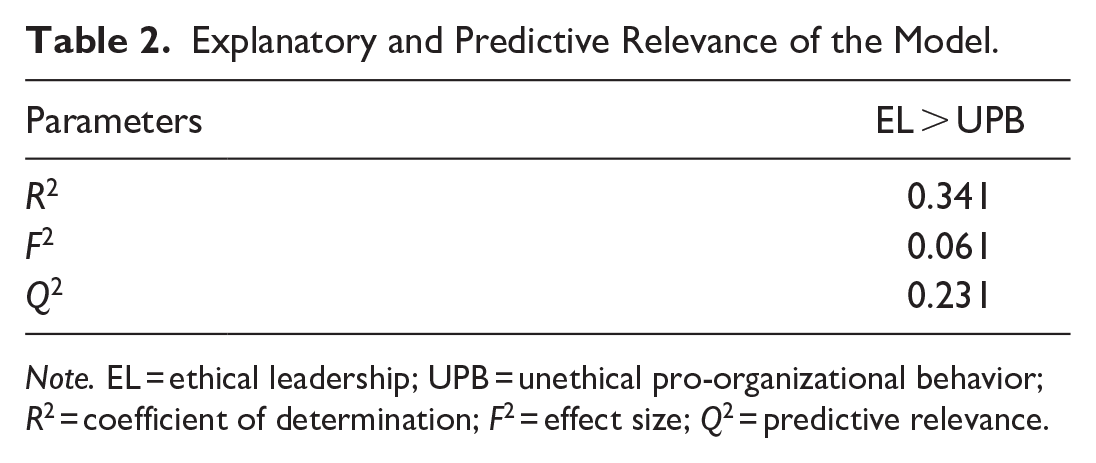
Note. EL = ethical leadership; UPB = unethical pro-organizational behavior; R2 = coefficient of determination; F2 = effect size; Q2 = predictive relevance.

Structural model.
The Variance Inflation Factor (VIF) values for all indicators were below 3.0, signifying that there is no collinearity among the constructs under study. To assess the model’s in-sample explanatory power, the coefficient of determination (R2) was examined. Specifically, the R2 value for employees’ UPB was determined to be 0.341. This suggests that EL accounted for 34.1% of the variance in employees’ UPB, indicating a moderate level of explained variance. Assessing the effect size (F2) shed light on the variance attributed by each single exogenous construct in the endogenous construct. Notably, the effect size of EL on employees’ UPB was calculated to be 0.176, reflecting a moderate effect size of EL on employees’ UPB.
Moreover, the model’s predictive accuracy was scrutinized through Q2, computed employing the blindfolding procedure. For employees’ UPB, the Q2 predict value was determined to be 0.231, indicative of a moderate level of predictive relevance for the model. These findings collectively underscore the model’s capability to elucidate the link between EL and UPB among employees while offering insights into its predictive accuracy.
The model’s out-of-sample predictive capability was evaluated employing the PLSpredict procedure. Given the symmetrical distributions of the data, Root Mean Square Error (RMSE) values served as the basis for assessing predictive power. A comparison between PLS-RMSE and LM-RMSE values revealed that PLS SEM analysis yielded lower prediction errors across most indicators. This outcome suggests a moderate level of predictive power for the model, affirming its capacity to make reliable predictions beyond the sample data.
Hypotheses Testing
The outcomes of hypothesis testing are delineated in Table 3, providing insight into the model’s predictive and explanatory prowess.
Hypotheses Testing.

Note. EL = ethical leadership; UPB = unethical pro-organizational behavior; PC = psychological capital; MID = moral identity.
Hypothesis 1 proposed a negative impact of EL on UPB of employees within the organizational context. However, contrary to expectations, the findings unveiled a significant and positive correlation between EL and UPB among employees (β = .222, t = 4.774, p = .001, LLCI = .136, ULCI = .317), indicating a divergent link from the hypothesis. Consequently, Hypothesis 1 failed to garner support from the finding.
Hypothesis 2 suggested that employees’ PsyCap mediates the link between EL and UPB among employees within the organizational setting. Analysis of the results unveiled a significant total effect of EL on employees’ UPB (β = .404; t = 8.952; p = .001), with a 95% confidence interval (LLCI = 0.315; ULCI = 0.489), indicating a substantial influence. Additionally, the total indirect effect between EL and employees’ UPB was also significant (β = .182; t = 6.216; p = .001), with a 95% confidence interval (LLCI = 0.13; ULCI = 2.430), underscoring a notable mediation effect. Further analysis revealed a significant specific indirect effect of employees’ PsyCap on the link between EL and UPB among employees (β = .11; t = 4.557; p = .001), with a 95% confidence interval (LLCI = 0.069; ULCI = 0.165), indicating employees’ PsyCap’s role as a mediator.
Consequently, employees’ PsyCap was identified as a partial mediator in the link between EL and UPB among employees, with both direct and indirect effects exhibiting positivity. Thus, the mediation of employees’ PsyCap in the link between EL and UPB among employees was confirmed as a complementary partial mediation, providing support for Hypothesis 2.
Hypothesis 3 proposed that employees’ MID moderates the link between EL and PsyCap among employees, with a stronger link expected among employees with higher MID compared to those with lower MID. Analysis of the path coefficients revealed a significant direct effect of EL on employees’ PsyCap (β = .407; t = 7.851; p = .001), supported by a 95% confidence interval (LL = 0.301; UL = 0.506), indicating a substantial impact of EL on employees’ PsyCap. To assess the moderating influence of employees’ MID, an interaction term (MID X EL) was introduced into the direct link between EL and employees’ PsyCap. The results revealed that even in the presence of the interaction term, the direct effect remained statistically significant (β = .16; t = 2.58; p = .01), with a 95% confidence interval (LL = 0.032; UL = 0.274), indicating the significance of the interaction term. Moreover, the R2 value increased from .221 to .279 with the inclusion of the interaction term, suggesting that employees’ MID accounted for a change from .221 to .279 in employees’ PsyCap, thereby confirming the positive moderation influence of MID on the link between EL and employees’ PsyCap.
Further analysis involved plotting the interaction effects of employees’ MID on the link between EL and employees’ PsyCap. The interaction plot illustrated that employees’ MID at +1 standard deviation exhibited a steeper upward trend compared to employees’ MID at −1 standard deviation, reflecting that MID strengthens the link between EL and employees’ PsyCap to a greater extent among those with elevated MID. Hence, the significant interaction coefficient (β = .16; t = 2.58; p = .01; LL = 0.032; UL = 0.274) and the interaction plot provided backing for Hypothesis 3, as illustrated in Figure 3.
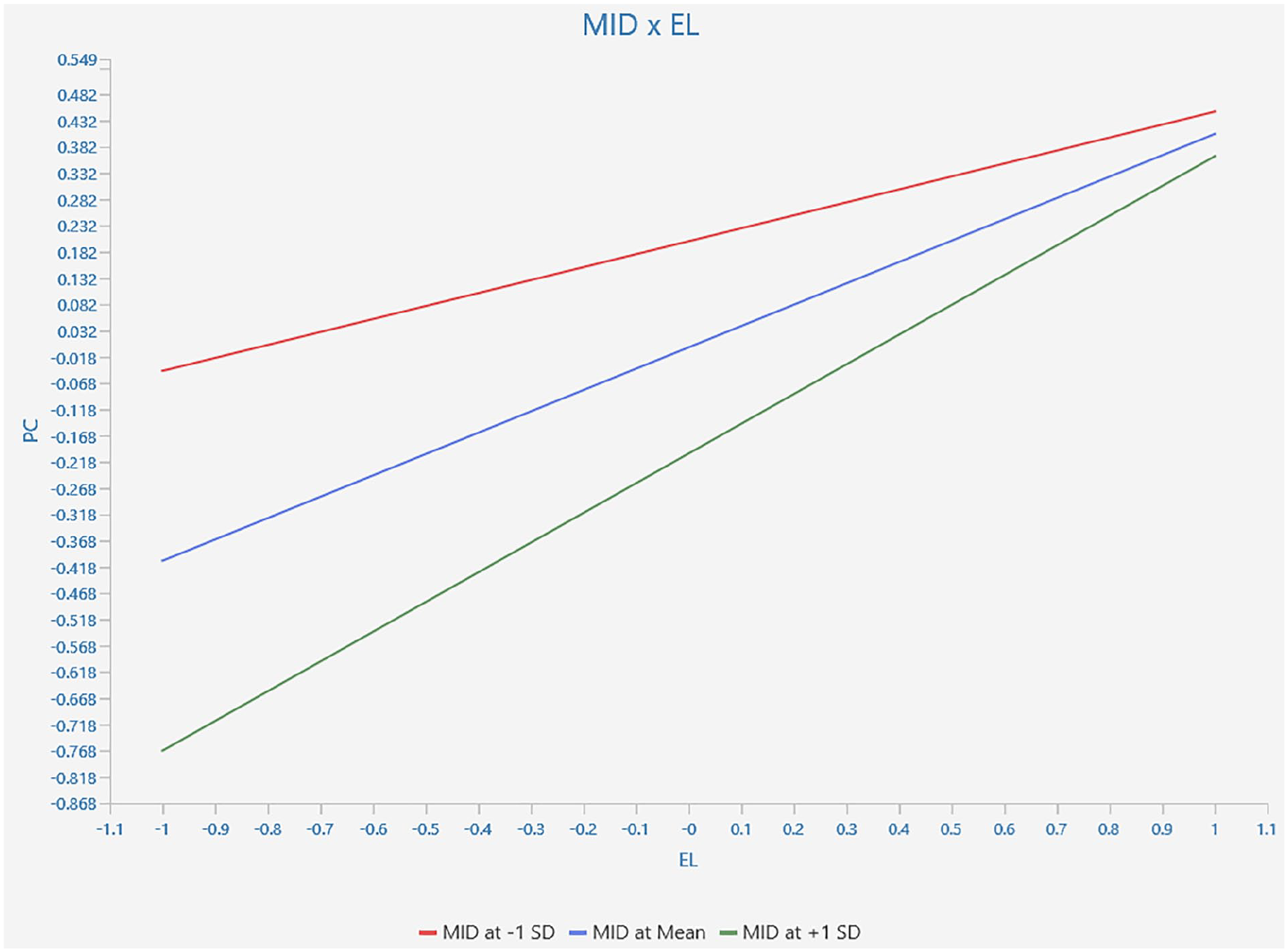
Moderation graph.
Discussion
Ethical Leadership (EL) and Employees’ Unethical Pro-Organizational Behavior (UPB)
Hypothesis 1 proposed a negative correlation between EL and UPB among employees within organizations. However, the results of this study unveiled a counterintuitive pattern, revealing a positive correlation between EL and UPB among employees, thus contradicting the hypothesis. This unexpected outcome diverges from conventional expectations and highlights the complexity inherent in the link between leadership style and employee behavior. Previous investigations conducted across diverse geographical settings have yielded inconsistent findings about the influence of EL on employees’ behavior, particularly UPB (Hsieh et al., 2020; Kalshoven et al., 2016; Miao et al., 2013, 2020; Tang & Li, 2022). Such disparities underscore the need for a nuanced understanding of EL’s effects within different organizational contexts.
Interestingly, the present study’s findings align with a growing body of literature that reflects on the nuanced dynamics of EL, emphasizing its potential dark side (Bolino & Grant, 2016; Itzkovich et al., 2020; Landay et al., 2019; Palanski et al., 2021; Vriend et al., 2020). The findings of this study are also consistent with those of Ahmed and Khan (2023), who also discovered a positive link between EL and UPB among employees. These studies challenge the prevailing notion of EL as a uniformly positive leadership style, suggesting that under certain conditions, EL may inadvertently stimulate behaviors contrary to ethical norms. Such revelations underscore the imperative for cross-cultural research to validate and contextualize the concept of EL further. By examining EL’s impact across diverse cultural and organizational settings, researchers can uncover subtle nuances that shape its effects, thereby advancing our understanding of this crucial leadership construct.
The inconsistency between our hypothesis and the observed results can be attributed to several factors. Firstly, while the literature on EL suggests a negative association with employees’ UPB, our study uncovered a positive influence of EL on UPB of employees. This unexpected finding may stem from the complexity of organizational contexts, wherein perceived ethical norms and leader behaviors interact in nuanced ways to shape employee behavior (Bedi et al., 2016; Brown & Treviño, 2006; Ko et al., 2018; Morrison, 2006; Umphress & Bingham, 2011). Additionally, methodological differences across studies, such as sample characteristics and measurement instruments, may contribute to divergent results.
Several mechanisms may underlie the positive impact of EL on UPB of employees. Firstly, perceived ethical norms within the organization may shape employees’ perceptions of the acceptability of UPB. If employees perceive a disconnect between espoused ethical values and actual behaviors exhibited by ethical leaders, they might indulge in UPB as a means of navigating this inconsistency. Additionally, employees’ psychological contracts with the organization may be breached if EL is perceived as not being upheld, leading to negative emotional responses that manifest as UPB (Kuenzi et al., 2019; van Gils et al., 2015; Velez & Neves, 2018).
Furthermore, EL behaviors aimed at promoting fairness, transparency, and justice may inadvertently create conditions that encourage employees to challenge the status quo, potentially resulting in UPB (Cheng et al., 2019; Ismail et al., 2021; Shahalizadeh et al., 2022). Employees may perceive UPB as serving a greater good or as a means of rectifying perceived injustices within the organization, thereby justifying their actions (Grabowski et al., 2019; Morrison, 2006; Umphress & Bingham, 2011).
Mediating Role of Employees’ Psychological Capital (PsyCap)
Hypothesis 2 advanced the notion that employees’ PsyCap would mediate the link between EL and UPB among employees. The study’s outcomes lend credence to this hypothesis, revealing that employees’ PsyCap reflects a partial mediating mechanism in the connection between EL and UPB among employees within the organizational context. These results are consistent with prior research findings, which have similarly highlighted the mediating influence of employees’ PsyCap on the link between leadership styles and employees’ behavior (Bouckenooghe et al., 2015; A. K. Goswami & Agrawal, 2023; Katircioglu et al., 2022; Loghman et al., 2023).
The observed mediation suggests that employees’ PsyCap acts as a mechanism through which EL exerts its influence on employees’ UPB. Specifically, EL may foster the positive psychological resources among employees, such as resilience, optimism, hope, and self-efficacy, which, in turn, mitigate the inclination toward engaging in unethical behaviors. This nuanced understanding underscores the importance of considering individual psychological factors in elucidating the complex interplay between leadership and employee conduct within organizations.
The findings of the study unveil a nuanced relationship dynamic wherein employees’ PsyCap acts as a partial mediator in the connection between EL and UPB of employees. Notably, both the direct effect (total effect) and indirect effect (specific indirect effect) of EL on employees’ UPB were observed to be positive. This intriguing discovery suggests that rather than mitigating the influence of EL, employees’ PsyCap amplifies its positive impact on employees’ UPB, indicating a synergistic relationship.
In essence, the mediation of employees’ PsyCap in the EL-employees’ UPB linkage can be construed as a complementary partial mediation. This implies that while EL independently exerts a beneficial effect on employees’ UPB, a portion of this relationship is elucidated by the mediating mechanism of employees’ PsyCap. Thus, the presence of high levels of PsyCap among employees appears to bolster the favorable outcomes associated with EL, underscoring the intricate interplay between leadership, individual psychological resources, and employee behavior within organizational settings. Such insights underscore the importance of considering both the direct and mediated pathways through which leadership influences employee conduct, providing valuable implications for organizational management and leadership development initiatives.
Moderating Role of Employees’ Moral Identity (MID)
The study’s outcomes provide compelling evidence in favor of hypothesis 3, suggesting that employees’ MID acts as a moderating factor in the link between EL and employees’ PsyCap. The findings elucidate that this association between EL and employees’ PsyCap is significantly accentuated among individuals exhibiting higher levels of MID, as opposed to those with lower MID. This revelation underscores the intricate role of employees’ MID in shaping the impact of leadership on employees’ psychological resources within organizational contexts.
This noteworthy discovery is consistent with prior scholarly investigations that have underscored the moderating influence of employees’ MID in various leadership-related dynamics and employee outcomes (Ahmed & Khan, 2023; Chuang & Chiu, 2018; Moore et al., 2019; O’Keefe et al., 2019; Taylor & Pattie, 2014; Zhu et al., 2016). By highlighting the differential effects of employees’ MID, this study contributes to a deeper understanding of how individual moral orientations interact with leadership behaviors to influence employees’ psychological well-being and adaptive behaviors.
The implications of these findings extend to leadership development initiatives and organizational practices, emphasizing the importance of considering individual moral orientations when implementing EL interventions. Moreover, the recognition of employees’ MID as a potent moderator underscores the need for tailored approaches in fostering EL practices and enhancing employee outcomes, catering to the diverse MIDs prevalent among organizational members.
The outcomes of this investigation offer compelling insights into the intricate dynamics among EL, employees’ MID, and their PsyCap. The study reveals that employees’ MID acts as a crucial moderator in shaping the link between EL and employees’ PsyCap, with individuals exhibiting elevated MID displaying a heightened receptiveness to EL behaviors, thereby experiencing a more pronounced enhancement in their PsyCap levels.
These findings hold substantial implications for organizational practices, emphasizing the necessity of accounting for employees’ individual characteristics and values when implementing EL initiatives. By tailoring EL practices to align with employees’ moral orientations, organizations can foster a conducive environment that nurtures the development of employees’ PsyCap, ultimately contributing to enhanced employee well-being and performance.
Furthermore, the recognition and utilization of employees’ MID can serve as a strategic asset for organizations seeking to cultivate a culture of EL and positive psychological resources. By harnessing the potential of employees’ MID, organizations can not only bolster employees’ PsyCap but also foster a sense of purpose and alignment with organizational values among employees, thereby fostering a more resilient and engaged workforce.
In essence, this study underscores the importance of integrating considerations of employees’ individual characteristics, such as MID, into organizational leadership frameworks and practices. By doing so, organizations can unlock the full potential of their workforce and cultivate a culture of EL that promotes both individual flourishing and organizational success.
These findings carry profound implications for both scholarly understanding and practical application. They underscore the imperative for organizations to meticulously assess the ramifications of EL behaviors on employee conduct and organizational performance. Furthermore, our research accentuates the significance of conducting cross-cultural investigations to validate leadership constructs, as cultural intricacies may profoundly influence the efficacy and repercussions of diverse leadership approaches.
By acknowledging and confronting the potential adverse effects of EL, organizations can cultivate ethical climates and mitigate the risks associated with employees’ UPB. Our study’s expanded discourse offers a nuanced exploration of the multifaceted interplay between EL and employees’ UPB, reflecting on the underlying mechanisms and contextual factors shaping employee behavior within organizational settings.
Moreover, these findings prompt organizations to reevaluate their leadership frameworks and practices, emphasizing the importance of fostering environments that promote ethical conduct while simultaneously addressing any unintended consequences that may arise. By integrating these insights into their organizational strategies, entities can cultivate cultures of integrity, resilience, and accountability, thus fostering sustainable success and positive outcomes for both individuals and organizations alike.
Theoretical Contributions
This research makes substantial theoretical strides in the realm of EL and UPB in organizations. Firstly, it delves into the paradoxical link between EL and UPB among employees, challenging the traditional wisdom of EL as exclusively positive form of leadership (Ahmed & Khan, 2023; Bush et al., 2021; Egorov et al., 2020; Kleshinski et al., 2021). By unraveling this intricate dynamic, the study reflects on the multifaceted nature of EL’s impact, thereby contributing to a more nuanced understanding of its effects within organizational contexts.
Secondly, the research enriches theoretical understanding by evaluating the mediating mechanism of employees’ PsyCap in the EL-employees’ UPB link. Through this exploration, it advances our understanding of how EL shapes employee behavior and highlights the significance of PsyCap of employees in influencing employee responses (Clarence et al., 2021; Daraba et al., 2021; Fang et al., 2019; Schuckert et al., 2018). This expansion of theoretical frameworks provides deeper understandings into the underlying mechanisms by which EL operates, thereby enriching theoretical complexity.
Moreover, the study contributes to theoretical advancement by probing the moderating influence of MID on the EL-employees’ PsyCap linkage. By acknowledging the influence of individual differences and personal values on how EL affects employee behavior, it underscores the necessity of taking contextual factors into account to fully grasp leadership dynamics (Ahmed & Khan, 2023; Moore et al., 2019; O’Keefe et al., 2019; Shaw & Liao, 2021). This emphasis on employees’ MID broadens our theoretical horizons by highlighting the nuanced interplay between individual characteristics and leadership effects.
Lastly, the research adopts a social cognitive perspective to elucidate EL and its proposed relationships, integrating concepts such as self-regulation processes, self-efficacy, and motivation (Bandura, 1986, 2018). By aligning with Bandura’s seminal work, the study offers a holistic understanding of EL, addressing criticisms of transactional theoretical perspectives often used in explaining EL (Palanski et al., 2021). This theoretical framework advances our understanding of the cognitive mechanisms underlying EL and furnishes a more comprehensive lens through which to analyze its implications.
Overall, this study enriches our comprehension of the intricate link between EL and employee behavior, contributing significantly to theoretical advancement. It broadens the scope of existing theories by integrating the explanatory dimension of employees’ PsyCap and the moderating influence of employees’ MID. By encompassing these additional factors, the research offers a more comprehensive framework for understanding the complexities of EL dynamics within organizational contexts.
Managerial Implications
The study presents several noteworthy managerial implications that merit attention from organizational leadership. Firstly, it reveals a nuanced and paradoxical influence of EL on UPB of employees, underscoring the imperative for managers to recognize the potential unintended ramifications of EL initiatives. It cautions against overreliance on EL as a panacea for fostering positive employee conduct and urges managers to remain vigilant in addressing ethical dilemmas that may arise despite the cultivation of an EL culture.
Secondly, the study underscores the critical role of employees’ PsyCap in mediating the link between EL and employee behavior. This insight underscores the importance for managers to actively cultivate and nurture employees’ PsyCap, encompassing dimensions such as self-efficacy, resilience, optimism, and hope. By fostering a positive PsyCap among employees, managers can adeptly alleviate the negative repercussions of unethical behavior and cultivate a culture conducive to ethical behavior within the organizational milieu.
Thirdly, the research reflects on the moderating influence of MID on the connection between EL and employees’ psychological resources. Managers are urged to recognize the significant impact of individual moral values of employees on their response to EL initiatives. By taking into account the diverse MIDs of their workforce, managers can tailor their leadership strategies and interventions to resonate with employees’ personal convictions, thereby fostering a robust ethical climate and mitigating the occurrence of unethical behaviors.
Fourthly, the results challenge the prevailing notion of EL as unilaterally positive, prompting a reassessment of managerial assumptions and expectations. Managers are encouraged to adopt a more nuanced perspective that acknowledges the multifaceted nature of EL and anticipates potential contradictions and unintended consequences. This may entail implementing supplementary measures to reinforce ethical standards and address ethical ambiguities within the organizational framework.
Overall, these managerial insights underscore the importance of a holistic approach to EL, one that encompasses an understanding of its complexities, considers individual differences, and actively fosters ethical behavior among employees. By embracing these recommendations, managers can effectively navigate the intricacies of EL and cultivate an organizational culture that upholds ethical principles and fosters positive employee behavior.
Limitations and Future Research Directions
Given the results and limitations of this study, several avenues for future research can be identified. Firstly, it is significant to note that the research focused on nursing staff from public and private hospitals in Pakistan, limiting the generalizability of the findings to other industries or cultural contexts. Therefore, it is important to exercise caution when generalizing the findings of this study to different sectors and industries.
Secondly, while the study collected data at three time intervals, it was still cross-sectional in nature, limiting the ability to establish causal relationships and capture changes over time. Future research might utilize a longitudinal approach to explore these relationships over time, thereby capturing the evolving dynamics between ethical leadership and employee behavior. Longitudinal studies would provide insights into the stability, changes, and potential causal directions of the investigated relationships.
Thirdly, the study relied on self-report measures to capture employees’ perceptions about the study constructs and necessary steps were taken to avoid common method bias. However, still, they may be subject to social desirability and response biases. To enhance the validity and reliability of the findings, future research could consider using objective measures, multiple sources of data, or alternative data collection methods.
Fourthly, the study’s findings contradicted the hypothesis, demonstrating a positive link between EL and UPB among employees. Further investigation and replication of the study are necessary to verify and better understand this observed contradiction. It is important to explore potential factors such as the reliability and validity of the measures, sample characteristics, or unaccounted-for confounding factors that may have contributed to this unexpected result.
Fifthly, enhancing the study’s generalizability could be achieved through replication across diverse samples and contexts. Exploring varied industries, cultures, and job roles would provide insights into whether the paradoxical impact of EL on UPB among employees and the managerial capacity to reduce the detrimental effects of unethical behavior persist across different environments.
Sixthly, while this study primarily focused on investigating the mediating influence of employees’ PsyCap and the moderating effect of MID on the linkage between EL and employees’ UPB, it is important to acknowledge the potential contribution of other factors or variables to this intricate relationship. Future research could explore additional individual factors such as moral development, moral disengagement, and personality traits, as well as contextual factors such as national culture, organizational culture, ethical climate, and social norms. Incorporating these factors would offer important insights into the intricate relationship between EL and UPB among employees.
Seventhly, future research endeavors could expand upon the paradoxical impact of EL by investigating its effects on other forms of constructive deviance behaviors, such as PSRB, as well as employees’ whistleblowing tendencies. Moreover, researchers might investigate how different moral leadership styles, such as authentic leadership and servant leadership, influence employees’ involvement in UPB and other types of constructive deviance. These avenues of investigation hold promise for advancing our comprehension of the overall impact of moral leadership on employees’ constructive deviance behaviors.
Finally, a promising avenue for future research lies in exploring the political implications of EL in organizational settings. This entails investigating how governmental policies, regulatory frameworks, and political ideologies influence EL practices and their impact on employees’ behaviors, particularly UPB. Additionally, comparative research across different political contexts can shed light on how political systems and cultures shape leaders’ ethical decision-making approaches and their ability to mitigate UPB.
Conclusion
This research enriches the existing literature by offering valuable insights into the paradoxical effects of EL on UPB among employees. The findings challenge the conventional understanding of EL and highlight the need for a more nuanced approach in promoting ethical behavior within organizations. By considering the mediating mechanism of employees’ PsyCap and the moderating effect of employees’ MID, this research paves the way for further research and offers practical implications for leaders striving to create ethical and responsible organizational cultures. By addressing the limitations and pursuing the suggested future research directions, researchers and practitioners can work toward fostering ethical behavior within organizations and creating a positive influence on employees, leaders, and society as a whole.
Footnotes
Data Availability Statement
The data that support the findings of this study are available on request from the corresponding author.
Declaration of Conflicting Interests
The author(s) declared no potential conflicts of interest with respect to the research, authorship, and/or publication of this article.
Funding
The author(s) received no financial support for the research, authorship, and/or publication of this article.
Ethics Statement
This study obtained ethical approval from the University Ethical Review Board. The informed consent was also obtained from all study participants.
