



Abstract
Unethical pro-organizational behavior (UPB) refers to unethical behavior that employees engage in to benefit their organization. Although UPB has received great attention from management scholars, little research has tested the influence of negative and destructive behavior from supervisors, such as abusive supervision, on UPB. Using conservation of resources theory, this study examines when and how abusive supervision affects UPB. Data were obtained from Chinese enterprises, and 368 time-tagged questionnaires were analyzed to test the moderated mediation model. Results revealed that abusive supervision positively influences UPB and that status challenge mediated this relation. Furthermore, the indirect effect of status challenge was moderated by leader–member exchange (LMX). Specifically, this effect was stronger when LMX was high. We discuss the theoretical and practical implications of our findings, and propose future research directions.
Keywords
Introduction
Nowadays, the public is exposed to increasing corporate scandals. These scandals raise one serious issue—that incidents of employees engaging in behaviors that are illegal or morally unacceptable to society have increased (Thau et al., 2015). This phenomenon has been conceptualized as unethical pro-organizational behavior (UPB), which refers to unethical behavior that employees engage in to benefit their organizations (Umphress et al., 2010). Although UPB seems to be beneficial to the companies in the short term (Miao et al., 2013), it will inflict considerable harm on the long-term development of the enterprises and damage the public interest (Bryant & Merritt, 2021). Given that UPB plays a destructive role in the sustainability of both organizations and society, research topics related to the antecedents and mechanisms of UPB have attracted increasing attention from management scholars and practitioners alike (Chen et al., 2016).
However, whether and how leadership style affects UPB remain unclear. Previous studies have shown that leadership style is one of the most important antecedents of UPB. For example, Miao et al. (2013) proposed a curvilinear association between moral leadership and UPB; Effelsberg et al. (2014) claimed that transformational leadership positively influences employees’ UPB. However, most of these studies concern the effect of constructive leadership on UPB (Mishra et al., 2021). Unfortunately, there have been relatively few investigations of the mechanism underlying the relationship between destructive leadership and UPB. As one typical type of destructive leadership, abusive supervision is ubiquitous in the workplace and may have deleterious effects on subordinates’ well-being and job performance (Rousseau & Aubé, 2018; S. Xu et al., 2018). Most related studies concern the influence of abusive supervision on employees’ regular behavior, such as deviance (Liu et al., 2021), but ignore employees’ UPB. Exploring such an effect is crucial because knowledge of the potential destructive effect of abusive supervision on UPB can be used to inform interventions that reduce UPB. Thus, there is value in exploring whether abusive supervision affects UPB and, if so, why and when such effects are likely to be harmful.
To address these questions, we draw upon conservation of resources (COR) theory because it is particularly relevant and useful for understanding actors’ behavioral consequences. COR theory posits that individuals always strive to protect their resources and acquire new resources (Hobfoll, 1989). Drawing upon COR, we propose that status challenge is a key underlying mechanism linking abusive supervision to UPB. We consider status challenge because it contributes to people’s core resources (Huberman et al., 2004). Status is an important social resource, so employees will pursue status to balance the number of resources when exposed to abusive supervision. Under this circumstance, fierce status competition and the risk of exclusion reduce ethical recognition and stimulate UPB. As a source of stress, abusive supervision can cause resource loss (Aryee et al., 2008). This resource loss further challenges the resources of status.
Moreover, COR posits that relationship characteristics shape people’s resource conservation and resource-generation processes. In particular, COR suggests that coping behaviors elicited by resource loss, which we argue includes abusive supervision, are more beneficial if they do not cause additional stress. Accordingly, we theorized that the relationship between supervisors and employees (i.e., leader–member exchange [LMX]) would moderate the harmful effects of abusive supervision. Empirical studies have shown that employees who possess high-quality LMX with the leader are more sensitive to abusive supervision (A. J. Xu et al., 2015). With this enhanced sensitivity, employee’s motivation for status challenge will be likely strengthened. Therefore, we propose a moderated mediation model that specifies the mechanism and condition through which abusive supervision affects UPB. By integrating COR with UPB literature, our moderated mediation model uncovers the hidden detrimental effect of abusive supervision on UPB, and the boundary condition of this detrimental effect. Although the literature has hinted at possible destructive effects of abusive supervision on UPB, our study is an initial attempt to explicitly theorize and empirically explore how and when abusive supervision increases UPB and when it affects organizational sustainability.
Theoretical Background and Hypotheses
COR theory, proposed by Hobfoll (1989), holds that individuals are concerned about losing resources and always strive to obtain, maintain, nurture, and protect their resources. One basic principle of COR is resource investment—that is, individuals will constantly protect existing resources by acquiring new resources to supplement resource loss (Hobfoll et al., 2018).
Using COR, we posit that abusive supervision is one such behavior that may bring resource loss, challenging subordinates’ status. Moreover, COR suggests that employees are likely to engage in behaviors that conserve their resources after resources loss. UPB serves as one such behavior that regains supervisors’ trust and decreases the abusive supervision. Thus, status challenge may account for an indirect effect of abusive supervision on UPB, which threatens the core long-term interests of organizations. Through this resource perspective, we are able to achieve a coherent picture of the deleterious effects of abusive supervision on UPB.
The Deleterious Effects of Abusive Supervision on Status Challenge and UPB
Drawing on COR, individuals strive to protect their current resources. When facing abusive supervision, individuals try to conserve resources to avoid resource loss. Abusive supervision is one form of destructive leadership, which is conceptualized as “the extent to which supervisors engage in the sustained display of hostile verbal and nonverbal behaviors, excluding physical contact” (Tepper, 2000, p. 178). Under abusive supervision, persistent hostility from leader will elicit employees’ negative emotions and exhaustion (Aryee et al., 2008). Owing to mistreatment or negative signals from the leader, employee may feel the threat of resource loss (S. Lee et al., 2018); these resource losses are specified as status challenge.
Status is a valuable resource in organizations (Huberman et al., 2004). Loch et al. (2000) proposed that employees not only have the desire to pursue tangible resources, such as materials, but are also inclined to intangible resources, such as status. Thus, Hays (2012) argued that employees’ status can also be granted by others’ views and expectations outside the system of the organization. Status challenge is the action to change the status hierarchy to influence the allocation of resources and gain more benefits. Employees usually initiate status challenges by asserting the superiority of their own views, underlying the dominant position relative to others, or by questioning the contributions of others.
In the circumstance of abusive supervision, sustained hostile behaviors of leaders indicate that employees’ precious resources may be lost at any time (Hobfoll et al., 2018). This fear of losing resources triggers individuals’ anxiety about their current status (Greenbaum et al., 2017). According to COR theory, employees will make greater efforts to consolidate and develop their existing organizational status. In addition, on the basis of the principle of resource investment, employees must take action to acquire resources and avoid further loss of their own resource (Holmgreen et al., 2017). Resource investment will lead to status-seeking behavior, which is an effective way to obtain new work resources (Bakker & Demerouti, 2007). Therefore, the threat of losing resources (caused by sustained abusive supervision) will make employees engage in status challenges.
In summary, abusive supervision triggers employees’ status challenge. Then, the stress and expectation of winning the status competition drives them to exhibit UPB. Therefore, we assume that:
According to COR, when faced with resource loss, employees need to self-adjust and prevent the occurrence of additional resource loss. Hobfoll et al. (2018) argued that the defense mechanism and self-protection instinct of employees will be triggered by status challenge, and individuals may display irrational behaviors. UPB is defined as the irrational behavior that is illegal or violates standards of ethical behavior, judged in terms of justice, law, or widely held social norms (Umphress & Bingham, 2011). Based on these arguments, we further argue that the level of status challenge will affect employees’ UPB.
First, resource loss motivates individuals to engage in UPB. This argument is supported by recent findings. Zhu and Zhang (2019) discovered that the stress caused by resource loss motivates employees to improve organizational performance to meet leaders’ expectations and prevent further harm in the future (Oh & Farh, 2017). UPB serves as a behavior that helps employees protect their current resources and acquire new resources by meeting leaders’ and organizations’ expectations.
Second, resource loss makes rational individuals pursue lofty goals to acquire new resources. Pursuing lofty goals of organizational performance may reduce ethical recognition, which leads to UPB. For example, employees may achieve aspirational goals through immoral behaviors (Barsky, 2008).
Third, status challenge also prompts employees to perceive risk of exclusion from the leader and organization. Hence, the pursuit of status will prompt employees to exhibit greater pro-organizational behavior, demonstrating their values in the organization (Eisenberger & Aselage, 2009). However, limited to time and ability, employees may achieve this pro-organizational goal through unethical means. The stress of status challenge might blur the ethical boundaries of individuals’ cognition and they may commit moral disengagement in the process of behaving in a pro-organizational manner (Fida et al., 2015). Status challenge not only contributes to inspiring employees’ pro-organizational motivation, but also possibly results in unethical behavior. Therefore, status challenge has a positive effect on UPB.
In sum, when status challenge is high, individuals are motivated to engage in UPB to protect their resources. When status challenge is low, individuals lack the motivation and reason to engage in UPB. Thus, status challenge may relate to UPB. On the basis of Hypothesis 1 (abusive supervision improves the level of status challenge) and the above argument that status challenge improves UPB, we expect that abusive supervision has a positive indirect effect on UPB via status challenge. Thus, we propose that,
The Moderated Mediation Role of Leader–Member Exchange
LMX reflects the quality of the relationship between superiors and subordinates in the organization (Graen & Uhl-Bien, 1995). Employees who maintain high exchange relationships with leaders are regarded as the “in-group.” They gain greater attention and support from leaders. Employees who have low exchange relationships with leaders are regarded as the “out group.” They engender less support and trust from leaders (Dienesch & Liden, 1986).
Scholars have proposed that abusive supervision is more threatening to employees’ valuable resources in high-quality LMX relationships (Agarwal, 2019; Valle et al., 2019). This is because high-quality LMX reflects committed social relationships that are respectful and supportive (Thiel et al., 2018). High-quality LMX employees are more sensitive to leaders’ abusive behaviors and feel greater threat of losing resources (Agarwal, 2019). Thus, when encountering abusive supervision, they will devote themselves to engage in status challenge to obtain more resources. Moreover, they still own good-quality resources, which allows them to conduct greater status challenges than employees in the “out group,” such as trust and support from the leader. These will help them gain a stronger reputation and build advantages in the status competition.
In contrast, low-quality LMX relationships are mainly based on employment contracts rather than on the reciprocal exchanges of valued behaviors (Graen & Uhl-Bien, 1995). Hence, the two sides in low-quality LMX do not have a high degree of mutual respect and support. When faced with abusive supervision, employees with low-quality LMX are less likely to experience confusion and cognitive dissonance and are insensitive to the threat of losing resources. Because such a threat is not obvious, they will not show obvious resource protection behavior and continue work as usual. They do not have insufficient back-up from the leader and organization to support their status challenge, so they show low motivation to engage in status competition. Therefore, we assume that:
Combining Hypotheses 2 and 3, the model of the relationship between abusive supervision and UPB can be further represented as a moderated mediation model. Specifically, status challenge mediates the influence of abusive supervision on UPB, and the mediating effect is moderated by LMX. When LMX is high, the role of abusive supervision in promoting status challenges will be stronger. Status challenge drives employees to engage in more UPB by triggering employees’ moral evasion (Moore et al., 2012). In contrast, when LMX is low, the positive impact of abusive supervision on status challenges is weak, such that the effect of abusive supervision on UPB is less transmitted through status challenges. Therefore, we assume that:
This study proposes a moderated mediation model of the abusive supervision–UPB relationship, in which status challenge is a mediator and LMX is a moderator (see Figure 1).

The hypothesized moderated mediation model.
Methods
Sample and Procedure
Data used for analysis were derived from a survey of large corporations in China. The survey was conducted in Chinese. Before the investigation, we recruited researchers from personal relationships and social networking with the help of research assistants. Participants were provided with informed consent so that their answer could be analyzed for research purposes.
To minimize common method bias, questionnaires were distributed in a two-phase survey. At Time 1, we invited 480 employees to evaluate their department heads’ abusive supervision, their status challenge, LMX, and their demographic information. In all, 452 questionnaires were returned, a response rate of 94.2%. One month later, at Time 2, we invited the 452 participants who had participated in the Time 1 survey to report their UPB. At this stage, we received 375 responses, a response rate of 82.96%. After data collection, we filtered the data and deleted incomplete questionnaires. The valid sample consisted of 368 employees, resulting in a final response rate of 76.67%. Among the 368 employees, 45.9% participants were male, and 50.8% participants were married. The mean age of the sample was 31.44 years (SD = 9.59), and mean tenure was 9.17 years (SD = 9.39). For educational background, 18.2% had a high school degree or below, 31.0 % had a junior college degree, 45.1% had a bachelor’s degree, and 5.7% had a master’s degree or above. In terms of position, 4.3% were senior executives, 14.4% were middle managers, 31.3% were first-line managers, and 50% were general staff. Regarding enterprise property, 22.6% worked for state-owned enterprises, 42.1% worked for private enterprises, 16.3% worked for foreign-owned enterprises, and 19% marked “other.”
Measurements
Abusive supervision
Abusive supervision was assessed using Mitchell and Ambrose’s (2007) 5-item measure. One sample was “My boss puts me down in front of others.” Responses were on a 5-point scale from 1 (“strongly disagree”) to 5 (“strongly agree”). Cronbach’ s alpha was 0.93.
UPB
UPB was assessed using Umphress et al.’s (2010) measure. Owing to cultural differences between China and the West, this scale was localized by domestic scholars (Lin & Cheng, 2016) to exclude “If my organization needed me to, I would give a good recommendation on the behalf of an incompetent employee in the hope that the person will become another organization’s problem instead of my own.” The final measure had five items; one sample was “If it would help my organization, I would misrepresent the truth to make my organization look good.” Responses were on a 5-point scale, ranging from 1 (“strongly disagree”) to 5 (“strongly agree”). Cronbach’ s alpha was 0.88.
Status challenge
Status challenge was assessed using Hays’s (2012) three-item measure. One sample was “How often do you compete with higher status group members for influence over group tasks and decisions?” Responses were on a 7-point scale, from 1 (“never”) to 7 (“frequently”). Cronbach’ s alpha was 0.82.
LMX
LMX was assessed using Hui et al.’s (1999) 7-item measure. One sample was “How well do you feel that your immediate supervisor understands your problems and needs?” Responses were on a 5-point scale. Cronbach’ s alpha was 0.87.
Control variables
To conduct a conservative test of our hypotheses and rule out alternative explanations, we controlled gender, age, tenure, education background, position, enterprise property, and marital status (Zhu & Zhang, 2019).
Results
Construct Reliability
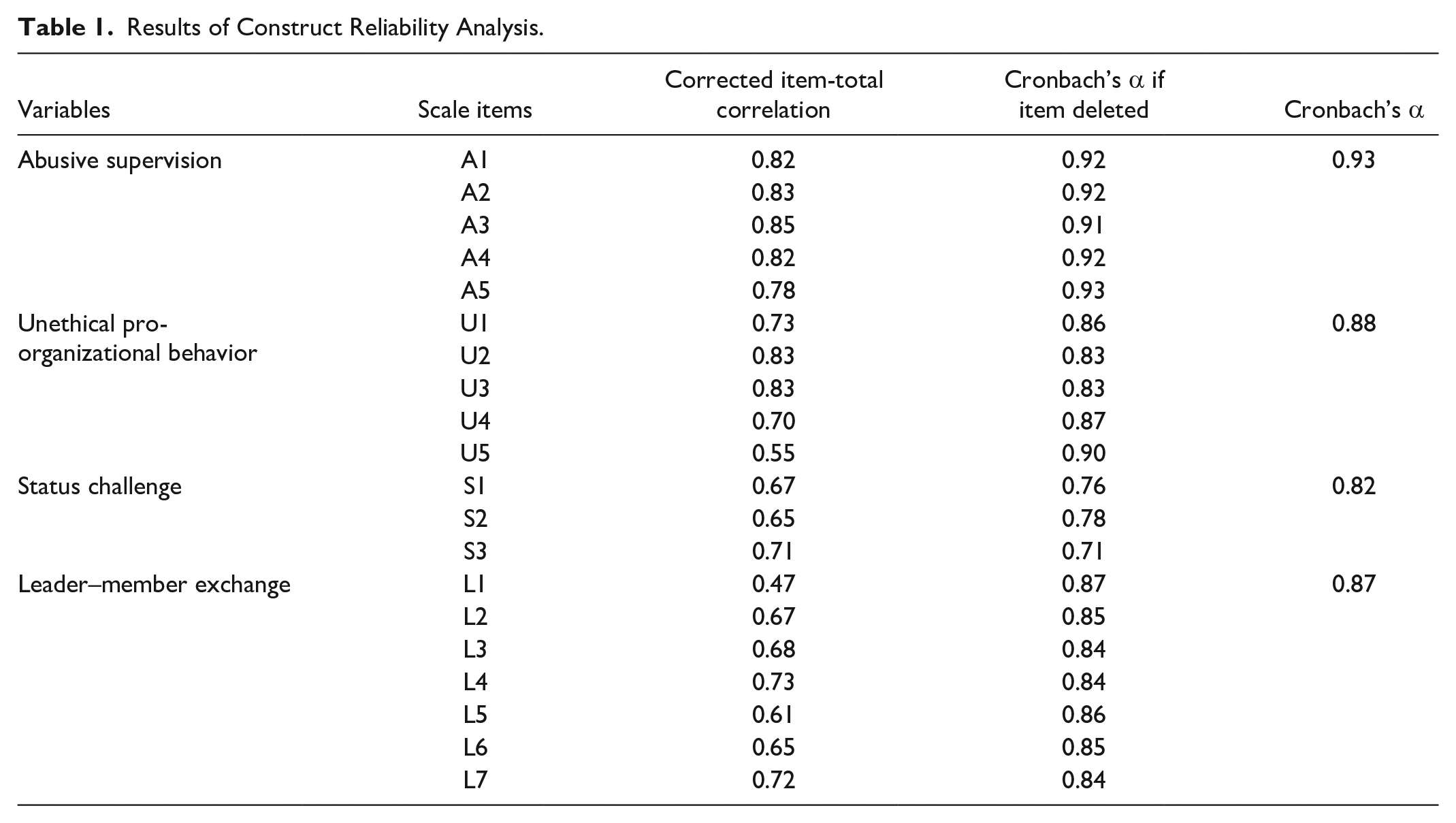
As shown in Table 1, the corrected item-total correlation (CITC) values of all items were greater than 0.5, except for L1 (.47) and Cronbach’s alpha was greater than 0.7, indicating that the reliabilities of these variables were sound. Although “Cronbach’s α if item deleted” values of items U5 and L1 were greater than their corresponding overall Cronbach’s α, the values of CITC and Cronbach’s alpha showed that the UPB and LMX both had good reliability. Thus, we retained items U5 and L1 to enable the valid variability of the final data.
Results of Construct Reliability Analysis.
Discriminant Validity
A series of confirmatory factor analyses were conducted to confirm the discriminant validity of the variables using Mplus. As shown in Table 2, the 4-factor model yielded a better fit than the other constrained models (χ2/df = 2.80, root mean square error of approximation [RMSEA] = 0.07, root mean square residual [SRMR] = 0.05, comparative fit index [CFI] = 0.93, Tucker–Lewis Index [TLI] = 0.92). Thus, the results confirmed discriminant validity of our focal variables.
Results of Confirmatory Factor Analyses.
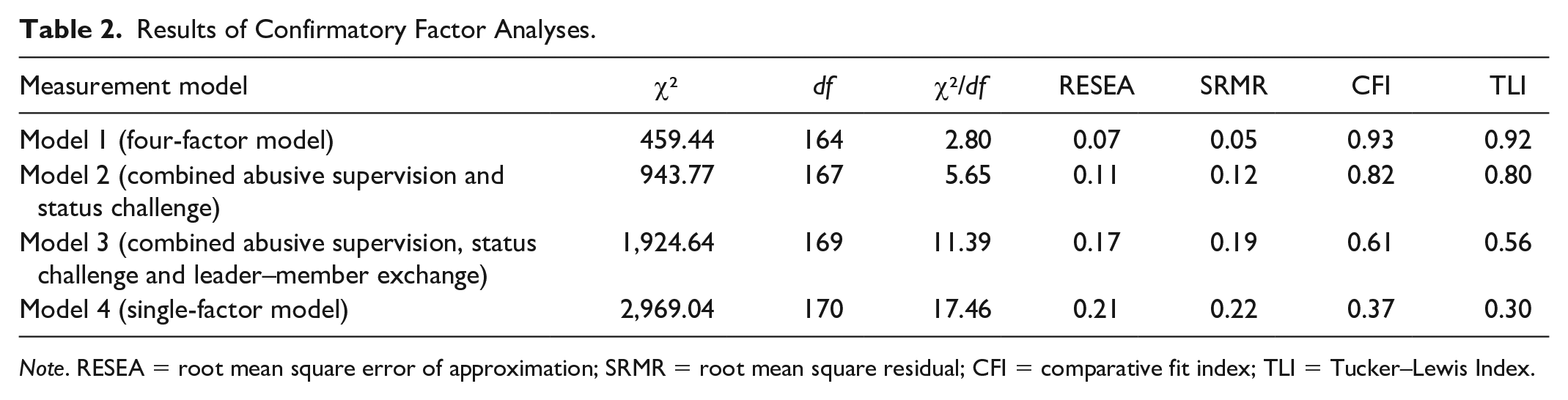
Note. RESEA = root mean square error of approximation; SRMR = root mean square residual; CFI = comparative fit index; TLI = Tucker–Lewis Index.
Common Method Variance
To examine common method variance, we conducted Harman’s one-factor test using SPSS. The first emerging factor accounted for 25.88% of the explained variance (<40%). Therefore, the results suggest that common method bias was not a significant problem in this study.
Preliminary Analysis
Descriptive statistics and correlation matrix for all variables are shown in Table 3. Abusive supervision was positively related to status challenge (r = 0.21, p < .01) and UPB (r = 0.20, p < .01), negatively related to LMX (r = −0.23, p < .01). In addition, status challenge was positively correlated with LMX (r = 0.24, p < .01) and UPB (r = 0.48, p < .01).
Descriptive Statistics and Correlations Between Variables.

Note. N = 368. Composite reliabilities are inside parentheses and presented along the diagonal. LMX = leader–member exchange; UPB = unethical pro-organizational behavior.
p < .05. **p < .01.
Hypotheses Testing
Hypothesis 1 predicted that abusive supervision was positively related to status challenge. Abusive supervision positively predicted status challenge (β = 0.21, p < .01). Thus, Hypothesis 1 was supported.
Hypothesis 2 predicted that status challenge mediated the relationship between abusive supervision and UPB. To confirm the mediating effect of status challenge, we performed an indirect effect test with SPSS macro PROCESS (Model 4) by Hayes (2017) (see Table 4). Furthermore, 95% of the confidence interval of the indirect effect that was repeatedly bootstrapped 10,000 times did not include 0, and the indirect effect was verified as statistically significant (indirect coefficient = 0.11, bootstrapped standard error = 0.03, 95% bias-corrected confidence interval = [0.05, 0.18]). Based on these results, Hypothesis 2 was supported (Table 4).
Conditional Process Analysis (N = 368).
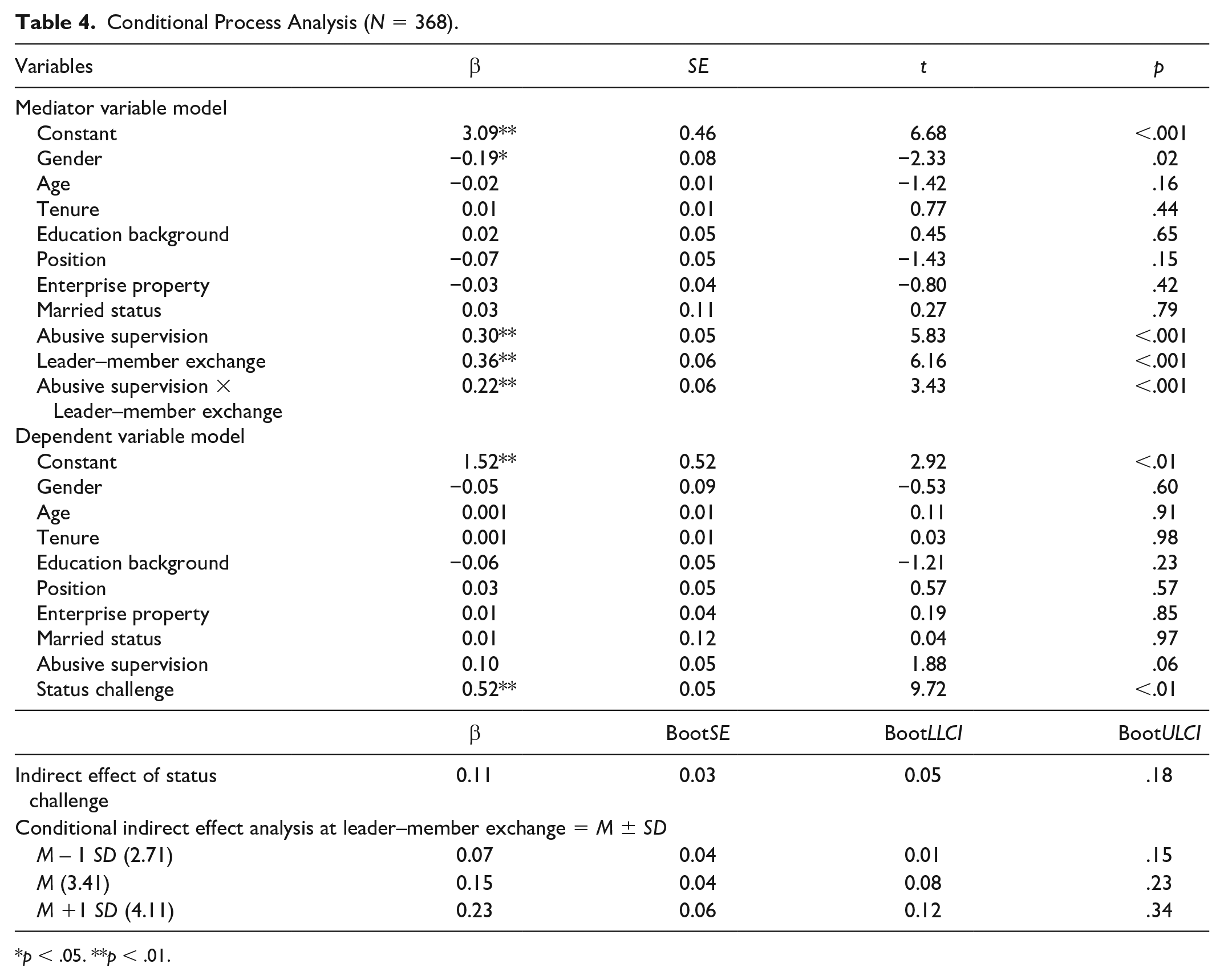
p < .05. **p < .01.
Hypothesis 3 predicted the relationship between abusive supervision, and status challenge is stronger when LMX is high (vs. low). We used PROCESS macro (Model 1) to test this hypothesis. There was a significant interaction predicting status challenge (β = 0.22, p < .001). This interaction, depicted in Figure 2, was such that the relationship between abusive supervision and status challenge was significant when LMX was low (β = 0.14, p < .05) and when LMX was high (β = 0.45, p < .001). Thus, Hypothesis 3 was supported.

LMX as a moderator on abusive supervision and status challenge.
Hypothesis 4 predicted that LMX moderates the mediation effect of abusive supervision on UPB via status challenges—the mediation effect is stronger when LMX is high rather than low. We tested this hypothesis using PROCESS macro (Model 7) analysis. Abusive supervision and LMX were centered around the pooled grand mean before calculating the interaction term, the purpose of which was to reduce multicollinearity. As shown in Table 4, under a low level of LMX, the point estimate of the indirect effect of abusive supervision on UPB via status challenge was 0.07 (bootstrapped standard error = 0.04) and statistically significant (95% bias-corrected confidence interval = [0.01, 0.15], did not include 0). Furthermore, under a high level of LMX, the point estimate of the indirect effect of abusive supervision on UPB via status challenge was 0.23 (bootstrapped standard error = 0.06) and statistically significant (95% bias-corrected confidence interval = [0.12, 0.34], did not include 0). The point estimate of the indirect effect increased from 0.07 to 0.23 when the level of the moderator (LMX) changed from “low” to “high” (Table 4). Therefore, Hypothesis 4 was supported.
Discussion
Drawing upon COR theory, we developed and tested a moderated mediation model explaining how and when abusive supervision affects employees’ status challenge and UPB. Using a questionnaire survey to gather data, our results show that abusive supervision has detrimental effects on status challenge and increases UPB. Moreover, these effects were constrained by LMX, such that the effect among abusive supervision, status challenge, and UPB were stronger when LMX was high. Our findings extend the understanding of the relationship between abusive supervision and UPB, make several key theoretical contributions to the mechanism and the boundary condition of how UPB might occur, and contribute to practical implications.
Theoretical Implications
First, by showing that abusive supervision indirectly affects employees’ UPB through status challenge, our study broadens understanding of the antecedents of UPB. While previous studies have established the impacts of constructive leadership on UPB, the impacts of destructive leadership on UPB have been largely overlooked. Moreover, along with developing research on organizational behavior, an increasing number of scholars pay attention to the sustained effect of destructive antecedent variables on UPB (Bryant & Merritt, 2021; Kang-Hwa & Hung-Yi, 2018). We developed a moderated mediation model to explore the effect of one of the most destructive leadership styles (abusive supervision) on UPB. Our study extends the research that focuses on the relation between destructive leadership and UPB. It answers calls from scholars to delve deeper into our understanding of influencing factors on UPB (Grabowski et al., 2019; A. Lee et al., 2019).
Second, our study further contributes to the abusive supervision and UPB literature by revealing when abusive supervision is more or less detrimental for status challenge and UPB. For a comprehensive understanding of the effects of UPB, it is important to delve beyond its antecedents to examine the boundary conditions under which abusive supervision has stronger or weaker effects. Based on COR, we theorized that LMX serves as the boundary condition of the association between abusive leadership and UPB. LMX plays a key role in the effect of abusive supervision on subsequent behaviors. When suffering from abusive supervision, “in-group” employees are inclined to act by conducting status challenge because of a loss of resources to further improve their status in the group and enhance their abilities to cope with resource loss. Conversely, “out-group” employees have little motivation when facing resource investment and their own resources are insufficient to support status challenge. This discovery echoes Lian et al.’s (2012) and A. J. Xu et al.’s (2015) works—high-LMX employees are more likely to be affected by abusive supervision than are lower LMX workers, helping people better understand how to manage the relationship between leadership and LMX.
Third, this article also expands the exploration of abusive supervision from the perspective of COR. Prior studies mainly focused on the unethical nature of abusive supervision (Valle et al., 2019). Using these studies, we further theorized that abusive supervision may cause unethical behavior that benefits the organization. According to COR, we demonstrated that abusive supervision could inspire employees’ resources investment. To maintain resources and consolidate support from the organization, employees will engage in status challenges when faced with abusive supervision, leading to UPB. It not only unpacks the “black box” between abusive supervision and UPB but also gives empirical support to the resource investment principle of COR, in that individual will constantly acquire new resources to supplement the resource loss (Hobfoll et al., 2018).
Practical Implications
The findings of this study have important practical implications. Our conclusions warn that sustained abusive supervision may lead to long-term negative effects. Thus, it is crucial for managers to find suitable ways to mitigate the detrimental effects. For example, organizations can offer training and mentoring programs for leaders to improve personal attributes and manage employees humanely. When interacting with employees, leaders should encourage, appreciate, and inspire employees rather than abuse them. In addition, managers should clearly emphasize the importance of ethical values and intricately link organizational ethical practices with daily activities.
Our findings also indicate that employees with high-LMX relationships are more sensitive to abusive supervision than are others. Employees may have the potential to blindly engage in immoral behaviors, guided by organizational interests. Therefore, we encourage managers to pay specific attention to this crowd. It is significant to establish the moral example of leader and emphasize the importance of professional ethics. Organizations should try to create ethical atmospheres to guide employees to implement pro-organizational behaviors in line with ethical standards.
Finally, our findings also provide practical implications for the UPB. Researchers have reached consensus that UPB is beneficial to companies in the short term (Miao et al., 2013). However, it is destructive to the long-term interests of the enterprises and the public (Bryant & Merritt, 2021). Thus, understanding the antecedents of UPB that could help stop it is important (Chen et al., 2016). Our study showed that abusive leadership and status challenge were critical antecedents of UPB. These relationships were further enhanced by LMX. These findings can be used by management scholars and practitioners to help stop UPB.
Limitations and Future Directions
Drawing upon COR, we theorized and empirically verified that abusive supervision has detrimental effects on status and increases UPB and the associated boundary condition. Although this study has a variety of strengths (e.g., theory-driven moderated model and corporate employees as participants), some limitations and directions for future research are worth noting.
First, the data of this study were collected by questionnaire survey, which may lack causal evidence. Thus, we suggest that future studies explore the causal effect of abusive leadership on UPB through experimental methods.
Second, our study did not investigate the emotional mechanism between abusive supervision and UPB. Future research can focus on the employee’s emotional state when they encounter abusive supervision. Both mechanisms of emotional infection and transmission can be explored.
Third, we discussed the moderating effect of LMX. There are other moderating factors between abusive supervision and UPB that need to be considered. Future studies can explore other moderated variables, such as personal control (Ju et al., 2019). Furthermore, research can also explore this relationship under other cultural environmental contexts.
Conclusions
Our study represents an initial attempt to explore the destructive leadership antecedents of UPB. Specifically, managers’ abusive leadership positively affects employees’ status challenges, which in turn enhances UPB. It was further found that LMX strengthened the indirect effect of abusive supervision on UPB via status challenges. This knowledge about the destructive effects of abusive supervision on status and UPB can be leveraged to effectively reduce UPB via interventions that target status challenge and LMX. We hope our study fuels scholars’ interests to further investigate the relationship between leadership and UPB to reduce short-term self-interest and increase long-term interests of corporations and the public in a sustainable way.
Footnotes
Declaration of Conflicting Interests
The author(s) declared no potential conflicts of interest with respect to the research, authorship, and/or publication of this article.
Funding
The author(s) disclosed receipt of the following financial support for the research, authorship, and/or publication of this article: This research was supported by the National Natural Science Foundation of China (grant nos. 71901097 and 71801109), the National Natural Science Foundation of Guangdong Province, China (grant no. 2019A1515010722), Guangzhou Social Science Planning Youth Project (grant no. 2018GZMZQN05) and National College Students’ Innovative Entrepreneurial Training Plan Program, China (grant no. 202010574010)
