




Abstract
The purpose of the study is to uncover how and when ethical leadership impacts knowledge hiding behavior. First, by examining the individual level morality-based characteristics (moral identity and reflective moral attentiveness) as separate and serial mediators concerning ethical leadership and knowledge hiding (level 1). Second, by investigating the moderating role of team- level relational climates in relation to ethical leadership and knowledge hiding (level 2). Time- lagged design was used to collect data through a structured questionnaire from 300 employees of Information Technology (IT) organizations in Pakistan. Level 1 findings revealed a significant and negative relationship of ethical leadership with knowledge hiding. Follower’s individual level morality-based characteristics served as individual and serial mediators to ethical leadership and knowledge hiding. Level 2 of the study only found the moderating role of team communal sharing climate in relation to ethical leadership and knowledge hiding. The study brings to fore the “morality-based perspective” for understanding knowledge hiding at the workplace.
Plain Language Summary
The purpose of the study is to uncover how and when ethical leadership impacts knowledge hiding behavior. First, by examining the individual level morality-based characteristics (moral identity and reflective moral attentiveness) as separate and serial mediators concerning ethical leadership and knowledge hiding (level 1). Second, by investigating the moderating role of team-level relational climates in relation to ethical leadership and knowledge hiding (level 2). Time-lagged design was used to collect data through a structured questionnaire from 300 employees of Information Technology (IT) organizations in Pakistan. Level 1 findings revealed a significant and negative relationship of ethical leadership with knowledge hiding. Follower’s individual level morality-based characteristics served as individual and serial mediators to ethical leadership and knowledge hiding. Level 2 of the study only found the moderating role of team communal sharing climate in relation to ethical leadership and knowledge hiding. The study brings to fore the “morality-based perspective” for understanding knowledge hiding at the workplace.
Keywords
Introduction
Knowledge is considered a vital strategic resource for organizations to gain a competitive advantage and sustainable development (Grimsdottir & Edvardsson, 2018; Mustika et al., 2022). In order to achieve and maintain optimal performance, organizations need to motivate their employees toward knowledge sharing (Son et al., 2020). Thus, the predominance of knowledge management literature had extensively focused on crucial drivers promoting or hindering knowledge sharing behaviors (Abbasi et al., 2021). However, another component of knowledge management, such as knowledge hiding, has gained less attention, and the factors enhancing or reducing knowledge hiding demand further investigation (Koay & Lim, 2022). Knowledge sharing (i.e., equivalent to lack of knowledge sharing) and knowledge hiding are not opposite of one another but rather distinct independent constructs. Knowledge hiding refers to “the intentional attempt by an individual to withhold or conceal knowledge that has been requested by another person” (Connelly et al., 2012, p. 65). It is a crucial element in the social foundation of workplaces and is extensively practiced at work. It is considered unethical and negative workplace behavior (Men et al., 2020) that hinders the efficiency of knowledge flow (Hernaus et al., 2019), damages employee creativity (Xiong et al., 2021), and harms interpersonal relationships (Anser et al., 2021).
Previous research has found that ethical leadership positively affects employee’s psychological capital (Goswami & Agrawal, 2023), psychological ownership (Saeed et al., 2022), and positive reciprocity (Su et al., 2021), which subsequently promotes knowledge sharing behavior. Likewise, several pieces of research in the existing literature (e.g., Anser et al., 2021; Koay & Lim, 2022; Mohsin et al., 2021) have contributed significantly by revealing that ethical leadership is adversely related to knowledge hiding, implying that employees’ knowledge hiding might be discouraged by modeling ethical conduct and pro-social actions. Scholars have begun to investigate the intervention processes of knowledge hiding as research has progressed, yielding several important findings including emotional exhaustion (Zhao & Jiang, 2022), psychological safety (Agarwal et al., 2022), and psychological contract breach (Gul et al., 2021). However, research on the mediators and moderators of the negative relationship of ethical leadership with knowledge hiding is still scarce. Employee cognition processes as mediators and context-driven climates as moderators, in particular, are overlooked and underexplored. These omissions reveal a gap in our understanding of why and when ethical leaders discourage employees from engaging in knowledge-hiding. Therefore, scholars He et al. (2022) and Batistič and Poell (2022) have called for further exploration of the cognitive factors that can mediate and contextual factors that can moderate the linkage of ethical leadership with knowledge hiding respectively. Thus, the aim of the present research is to fill this gap by introducing individual moral characteristics (i.e., moral identity and reflective moral attentiveness) as mediators and relational climates as boundary conditions by contextualizing the proposed hypotheses in informational technology firms.
For examining the influence of ethical leadership on knowledge hiding behaviors, this study is embedded in the social learning theory (Bandura & Walters, 1977) and social cognitive theory (Bandura, 1986). Social learning theory by Bandura (1986) suggests that employees view and learn what defines proper and improper workplace behavior from their leaders. Ethical leaders use rewards and penalties to motivate employees to act ethically. Because knowledge hiding is deemed unethical behavior, individuals who report to ethical leaders are less likely to hide knowledge when requested from a co-worker to avoid penalties. This assumption, however, has not been thoroughly validated, leaving an incomplete understanding of the process mechanisms that allow for social learning. We readdress this assumption in this study, suggesting that not all followers would perceive the same leader as an individual moral leader, limiting the leader’s influence on minimizing followers’ unethical conduct. We apply social cognitive theory to the role of followers’ individual moral characteristics, asserting that followers emulate their ethical leaders via moral identity (i.e., how they identify with ethics) and reflective moral attentiveness (i.e., how chronically they are aware of ethical issues), thereby impeding their knowledge hiding behavior. Therefore, we postulate that moral identity and reflective moral attentiveness can serve as potential mediators between the relationship of ethical leadership and knowledge hiding.
Level 2 of our study model based on the relationship of ethical leadership and knowledge hiding can be elaborated by examining essential moderators (relational climates) embedded in relational model theory (Fiske, 1992). Studies have shown that knowledge hiding depends on situations, specifically the surrounding environments, and climates; however, very few studies have considered them (Batistič & Poell, 2022). Aligned with this call, exploring how relational climate combined with leadership style can initiate the employee’s knowledge hiding is vital in understanding how knowledge hiding works in relational contexts. In specific terms, we have associated the dyadic nature of knowledge hiding with organizational climate focusing on workplace relationships.
Our study seeks to make significant contributions to leadership as well as knowledge management literature. Firstly, our study is among the few to take the “morality-centric lens” to knowledge hiding and enriches the knowledge hiding literature. This is done by providing an in-depth answer to an important question, whether people who follow ethical leadership have enhanced morality-related individual characteristics, which helps refrain from knowledge hiding practice. By doing this, our study will depart from previous studies and make its second contribution by representing individual differences as stable and trait-like constructs (Rieger et al., 2017). We tend to show that reflective moral attentiveness and moral identity are malleable traits that can be affected by other vital constructs in the context (e.g., stronger ethical leadership). The study is of importance in both theoretical and empirical terms as it exhibits that ethical leadership can affect follower’s ethical characteristics which fuels their attentiveness to ethical issues (e.g., knowledge hiding) as well as the way they think of themselves as moral persons. Thirdly, on level 2 the study enriches knowledge hiding literature by exploring the extent to which relational climates (team-level) variables act as a boundary condition between ethical leadership and knowledge hiding. By doing this, our study aims to contribute in understanding how contextual influence (relational climates) interacts with leadership style (specifically ethical leadership) in shaping knowledge hiding. Finally, this study used time-lagged survey approach and cross-level analysis, which facilitated getting relevant and vigorous results. Figure 1 below exhibits study’s theoretical framework:

Theoretical framework of the study.
Literature Review
Ethical Leadership and Knowledge Hiding
Ethical leadership is defined as “the demonstration of normatively appropriate conduct through personal actions and interpersonal relationships, and the promotion of such conduct to followers through two-way communication, reinforcement, and decision-making” (Brown et al., 2005, p. 120). There are two dimensions of ethical leadership. First is the moral person dimension, where ethical leaders have individual attributes and attractive qualities like integrity, genuineness, and trustworthiness. The second is the moral manager dimension, where ethical leaders attempt to impact the moral conduct of their followers, including empowering normative conduct and forbidding deceptive conduct (Brown & Treviño, 2006). Therefore, ethical leaders can deliberately or unknowingly impact the employees’ behavior via role modeling, a procedure embedded in social learning theory (Bandura & Walters, 1977).
Social learning theory advances from learning approaches based on reinforcement and argues that by observing others, people can learn to adapt to appropriate behaviors via role modeling techniques (Bandura & Walters, 1977). Role modeling includes an exhibition of proper behaviors and guidance of followers through punishment and reward. It has been observed to be effective in developing positive attitudes and behaviors in followers. Employees may pay attention to attractive and reliable individuals while choosing role models for demonstrating appropriate behavior (Bandura & Walters, 1977). Considering their workplace status, followers view ethical leaders as attractive and credible sources for emulating normative behaviors. Interactions of ethical leaders with their followers are purely based on openness, honesty, loyalty, and care which allows these leaders to express themselves authentically without the fear of negative consequences pertaining to their workplace status, image, or career (Koay & Lim, 2022). According to Brown et al. (2005), in such a manner, ethical leaders provide employees with significant signs indicating them to take part in ethical behaviors rather than unethical behaviors (i.e., knowledge hiding). Also, by reinforcement of punishment and reward in the workplace, ethical leaders clarify to their followers what the moral thing is to do in the working environment and urge them to engage in expected moral behavior. This means they can reward the employee who demonstrates good social behaviors like knowledge sharing and punish the employee who showcases deceptive behaviors like knowledge hiding. Thus, based on these notions we argue that ethical leaders can negatively affect employees who indulge in knowledge hiding behavior. Therefore, we propose:
H1: Ethical leadership is negatively related to knowledge hiding.
Follower Moral Identity as a Mediator
Moral identity is defined as “the mental representation of individuals’ moral character held internally as a cognitive self-schema and expressed to others externally through their actions.” (Aquino & Reed, 2002, p. 1424). People with high moral identity have feelings of being truthful, fair, friendly, compassionate, hard-working, sympathetic, just, and generous as vital definitions of their identity. Moral identity is viewed as moderately stable however it is subjected to the social impact and manifested through institutional settings and social communication with peers and guardians (Shao et al., 2008). For instance, a leader’s utilization of moral language should shape the followers’ moral sense of self. Leaders impact followers’ self-concept by creating situations that activate certain aspects of their personalities, such as morality, creativity, and ethicality (Lord & Brown, 2003). Drawing from social-learning theory, we contend that the most significant moral impact in the organization can be made by a strong ethical leader as he/she can impact the followers’ behavior and attributes. Also, followers’ ethical personality is relatively plastic and is likely to be subjected to social impact (Roberts et al., 2006). For instance, if a leader stands up for what is ethically right and gets the job done successfully, the followers try to follow the ethical rules, which ultimately becomes part of their identities. Also, followers will be motivated to emulate the behavior of ethical leaders, and the morally embedded values and behaviors of the leader become the targets of emulation. By admiring and emulating their leaders, follower try to view themselves differently, that is, as individuals who consider the moral aspect crucial.
As previously stated, moral identity explains how significant are moral traits to a person’s self-concept. Individuals whose moral identity is high tend to behave ethically because they want their behavior to be consistent with their moral traits (Aquino & Reed, 2002). In addition, the socio-cognitive theory points out that moral identity increases the availability of knowledge structures and schemes that guide self-regulation and promote moral action (Lapsley & Hill, 2009). For example, if an individual has a high moral identity, he is expected to have enhanced engagement in moral action and approving work behaviors (Hardy & Carlo, 2011). In contrast, employees with low moral identity to whom behaving ethically is less important to their self-concept are more inclined toward knowledge hiding.
Furthermore, followers of ethical leaders who give more importance to their moral traits have a strong ability to process moral information and make moral judgments. It makes them not quickly assimilated by the self-interest of external situations, leading to indulging in less knowledge hiding. Subsequently, followers of ethical leaders having low moral identities are less sensitive to moral information and have poor ability to moral judgment. Such followers are easily assimilated by external self-interest circumstances leading to unethical behavior such as knowledge hiding (Ge, 2018). Consistent with this reasoning, we propose that:
H2: Follower moral identity acts as mediator between the relationship of ethical leadership and knowledge hiding.
Follower Reflective Moral Attentiveness as a Mediator
Moral attentiveness is the “extent to which an individual chronically perceives and considers morality and moral elements in his or her experiences” (Reynolds, 2008, p. 1028). It functions as a tool for inducing moral sense in people and helping them in categorizing information as moral or immoral. Moral attentiveness consists of two dimensions, that is, perceptual and reflective moral attentiveness. The degree to which moral matters are taken into account when making decisions is referred to as reflective moral attentiveness. In contrast, perceptual moral attentiveness is the ability to recall moral content in surroundings (Reynolds, 2008). Despite having greater awareness about moral content, perceptual moral attentiveness exhibits weaker effects when it comes to making decisions and cognitions ethically than reflective moral attentiveness (Reynolds, 2008). Thus, in the present study, we draw our attention to reflective moral attentiveness in place of perceptual moral attentiveness because RMA holds a moral component that is more action-oriented moral component and is well aligned with behavior of knowledge hiding.
Furthermore, Reynolds (2008) contends albeit reflective moral attentiveness is seen as a reasonably stable individual characteristic, it is not fixed at all because variation exists in levels of attention individual paid to a moral stimulus. Being consistent with social learning theory, it can be argued that when leaders engage their employees in discussing moral and ethical effects of their decisions, the follower will not only think about the impact of morality but also apply it in their daily life even when their leader is not present (Eva et al., 2019). Also, when moral challenges occur at the workplace, ethical leaders shed light on ethical matters, educate employees about values that direct their moral actions and decisions and provide constructive feedback to followers. All these interventions ultimately enable followers to solve unethical dilemmas in moral ways. Thus, ethical leaders can shape the reflective moral attentiveness of their followers since when leaders repetitively pay attention to ethical issues, followers try to reciprocate their leader’s reflective attentiveness and tend to become more morally attentive in their day-to-day activities.
Empirical evidence from previous studies has shown that reflective moral attentiveness reduces employee’s unethical behavior. For instance, Culiberg and Mihelič (2016) argued that reflective moral attentiveness reduces employees’ inclination toward unethical pro-organizational behavior. Similarly, Sturm (2017) argues that RMA tends to curb unethical decision-making via employee’s moral awareness. In theoretical terms, high reflective moral attentiveness makes employees focus more on morality and ethical issues in their day-to-day activities. Therefore, playing a vital role as a predecessor in the ethical decision-making process. Furthermore, it is contended that even when employees do not recognize a situation as a moral situation explicitly, reflective moral attentiveness holds the propensity of shaping a person’s evaluation of behavioral opinion that automatically leads to moral behavior (Reynolds, 2008). In this way, we can associate reflective moral attentiveness with specific ethical behaviors (i.e., less knowledge hiding) that occur on a day-to-day basis. The study further contends that followers whose reflective moral attentiveness is high are less likely to engage in knowledge hiding as they can reflect upon and think about moral matters and consider knowledge hiding counter to their morality.
Furthermore, based on social cognitive theory, we argue that reflective moral attentiveness will mediate between ethical leadership and knowledge hiding, thereby reducing this negative behavior. Specifically, when making decisions independent of their leader, followers will consider and reflect upon moral issues as they have learned this ability from their leaders through behavioral modeling and by taking part in discussions about acting ethically. Consequently, such followers will find it hard to engage in knowledge hiding as it works counter to their morality. Based on the above connotation, it can be hypothesized that:
H3: Follower’s reflective moral attentiveness mediates the relationship between ethical leadership and knowledge hiding.
Follower Moral Identity and Follower Reflective Moral Attentiveness as Serial Mediators
Moral identity is a sense of self-formed around moral traits and associated moral characteristics such as moral pride, moral sensitivity, and moral awareness (Reynolds, 2008). Based on it, we can argue that the strength of moral traits is based on moral attentiveness. The degree to which an individual is morally attentive makes these moral traits more prominent and more evident. Employees for whom these moral traits (moral identity) are at the core of their self-concept will be more attentive toward moral issues around them. They will be better able to reflect upon these issues due to heightened moral identity. Building on it, we can argue that moral identity is required to develop and strengthen reflective moral attentiveness. Thus, we propose that despite playing the role of separate mediators between ethical leadership and knowledge hiding, both the mediators, i.e., moral identity and reflective moral attentiveness, can also have a relationship with each other. Therefore, we hypothesize:
H4: Follower moral identity and follower reflective moral attentiveness serially mediates the relationship between ethical leadership and knowledge hiding.
Relational Climates as Moderators
Knowledge hiding is effectively a dual interchange among employees and takes contextual signals into account while responding to co-workers’ queries of knowledge (Connelly et al., 2012). Thus, high-level contexts are vital for sharing and exchanging information. Fiske’s (1992) relational model theory argues that everyday exchanges of people and their related practices can be summarized in relational climates providing schemata to form work relations. Relational climates are defined “as shared employee perceptions and appraisals of policies, practices, and behaviors affecting interpersonal relationships in a given context” (Mossholder et al., 2011, p. 36). While researching relational climates, we emphasized two extreme climates of the theory: communal sharing and market pricing climates. Having such an approach leads to a clear recognition of the focal phenomenon’s central constructs, relationships, and logic (Eisenhardt & Graebner, 2007). Also, in past research, this polar strategy has effectively been utilized, where communal sharing and market pricing climate were studied, believing that this striking contrast could prompt better advancement theoretically (Batistič et al., 2016). Hence this study proposes that relational climates (i.e., communal sharing climate and market pricing climate) and ethical leadership will work synergistically with one another in an interactive manner, decreasing knowledge hiding behaviors of employees.
Communal Sharing Climate as a Moderator
The communal sharing climate is where individuals collaborate on the grounds that they belong to a similar group (Fiske, 1992). Individuals in the communal sharing model see one another as equals and willingly share information getting without financial benefit. Thus, a robust communal climate helps to promote positive and ethical behavior at work. Under the communal sharing scenario, the group’s knowledge is collectively owned and shared for the collective benefit instead of individual gain (Faraj & Wasko, 2001). Thus, a communal sharing climate will discourage knowledge hiding (Fiske, 1992).
Furthermore, positive behavior initiated by this constructive climate can be fostered with the practices of ethical leadership. High moral reasoning arising from ethical leadership might encourage less negative behavior, that is, knowledge hiding, and replace it with positive behaviors. Thus, communal sharing and ethical leadership both foster positive and ethical behavior which results in compatibility between context and leadership, called “fit situation. In this ‘fit-situation’ employees” values are in harmony with the leader’s values and they achieve cognitive assonance and positive behavior (Cable & Edwards, 2004) while decreasing knowledge hiding tendencies (Lee & Cole, 2003). To summarize, during high communal sharing, followers of ethical leaders would not indulge in knowledge hiding. Therefore, we hypothesize:
H5: Communal sharing climate moderates the negative relationship amongst ethical leadership and knowledge hiding, as such hat this negative association will be much more/less pronounced when communal sharing climate is higher as compared to when it is low.
Market Pricing Climate as a Moderator
Market pricing relationship climate refers to a climate where individuals objectively think about cost-benefit analysis and has a basis on the proportionality model when it comes to social relationships (Fiske, 1992). According to French et al. (1982), this climate is grounded on the psychological-need fulfilment perspective; individuals cognitively compare their desired rewards and supplies from the organization. In the market pricing climate, cost-benefit analysis and rational calculation are done while enacting interpersonal practices such as knowledge sharing or knowledge hiding behaviors (van Baalen et al., 2013). Research has shown that extrinsic rewards were directly proportional to knowledge sharing as people sell their knowledge to get something they want from the organization or recipient (Cabrera et al., 2006; van Baalen et al., 2013; Watson & Hewett, 2006). We can conclude from the above arguments that employees under a strong market pricing climate would practice more knowledge hiding as people will perceive that they will be receiving no or lower benefits (either physical or non-physical returns). In the market pricing climate individuals strive to maximize their own benefits and weigh the costs and benefits of their social interactions with others. In this type of climate, social relationships are viewed as transactions, and individuals aim to receive a fair return on their investments (Boer et al., 2011). However, this focus on individual gains and cost-benefit analysis may lead to a lack of trust and cooperation in social interactions, including within the workplace. Employees in such a climate may be more likely to view knowledge as a commodity to be traded for personal gain rather than as a resource to be shared for the benefit of the organization (Bartol & Srivastava, 2002).
Additionally, in a market pricing relationship climate, individuals may be more likely to engage in opportunistic behaviors, such as withholding information or knowledge, to gain a competitive advantage over others. This can ultimately undermine the effectiveness of the organization, as it impedes collaboration and hinders the development and sharing of new ideas. Furthermore, negative behaviors yielded by this cost-benefit analysis will be amplified when leadership practices are not rooted in morality (Jain, 2018). Leaders who are not ethical cause their employees to be dishonest and show deviant behavior (Asnakew & Mekonnen, 2019). Thus, we propose that in situations of high market pricing, self-interested employees facing less ethical leadership will be more prone to knowledge hiding. Therefore, we hypothesize:
H6: Market pricing climate moderates the negative relationship amongst ethical leadership and knowledge hiding, as such that this negative association will be much less/(more) pronounced when market pricing climate is higher as compared to when it is low.
Methods
Sample and Procedure
We surveyed employees working in Pakistani information technology (IT) organizations as these can be classified as knowledge-intensive organizations (Labafi, 2017). We chose this sector because the exchange of information and knowledge is at the core of such business models. A total of 678 IT companies can be found in the directory of Pakistan software export board (PSEB, 2022). The authors included only those IT companies that were offering knowledge intensive services, for example, the company was involved in project conceiving, developing, analyzing and testing software applications. Out of 678 only 61 companies fulfilled our criteria as the rest were offering general IT services. The researchers’ personal networks were used to approach the IT companies for the participation of their employees. However, only 10 IT companies approved to take part in our survey. We then approached several teams working in these 10 IT companies through their HR department, and participants were selected based on their willingness to participate. To analyze a multi-level structure, a team must compose of three members and have a single supervisor (Hox et al., 2017). To minimize for the common method bias, we gathered data at two different points (T1 and T2) using convenience sampling technique. At T1, participants were requested to assess ethical leadership, moral identity, and moral attentiveness. We designed a unique number to the participants such as we asked them to make a code with their name and date of birth both at T1 and T2 (e.g., HS1603). However, we ensured the participants that this unique number will only be used for matching their responses at T1 and T2 and would not be used for their identification. Confidentiality and anonymity of the responses was made sure as the survey instrument did not require them to write their full names and likewise this was communicated to the participants through verbal informed consent. At Time 2, after 4 weeks, those employees who have provided assessments at Time 1 were again approached. This time they provided assessments of knowledge hiding, their perception of their organizations’ communal sharing climate and market sharing climate. By adopting a researcher administration survey strategy, all survey questionnaires were disseminated to study participants on their respective workplaces and upon completion they were returned to the research team.
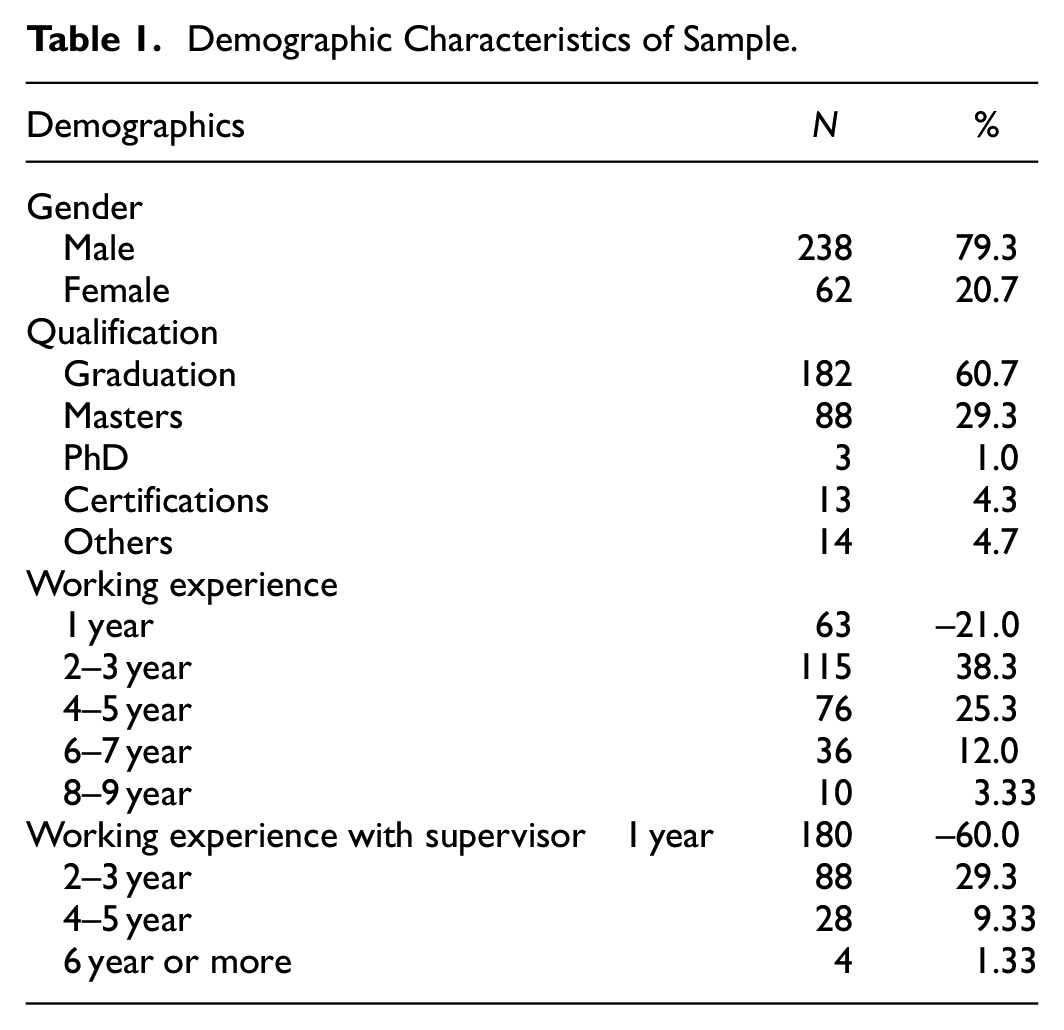
A total of 400 questionnaires were circulated to employees at time 1, of which we received 355 complete responses (88.75% response rate). At time 2 we contacted all those employees who have returned their questionnaires at Time 1. The final sample yielded a total of 300 employees (a response rate of 84.50%) nested within 51 teams. On average, there were 5.95 employees per team. A demographic study of the sample was carried out to see the probable areas of diversity (see Table 1).
Demographic Characteristics of Sample.
Measures
Participants responded on a 5-point Likert scale ranging from (1 = strongly disagree to 5 = strongly agree) to all measures except for relational climates; participants rated their relationship with coworkers on a 7-point Likert scale ranging from 1 (strongly disagree) to 7 (strongly agree).
Ethical Leadership (EL)
We measured EL using Brown et al. (2005) 10-item scale. A sample item was, “My supervisor can be trusted.” Cronbach alpha for EL was .891.
Knowledge Hiding (KH)
A 12-item scale developed by Connelly et al. (2012) was used to measure individual knowledge hiding. A sample item was, “I said that I did not know, even though I did.” Cronbach alpha for the individual knowledge hiding scale was .70.
Moral Identity (MI)
A 5-item scale developed and validated by Aquino and Reed (2002) was used. Participants were given a list of 9 moral character traits (e.g., caring) and were asked to picture themselves with those traits while responding to statements. Sample items include “I strongly desire to have these characteristics.” Two of the items were reverse coded. Cronbach alpha for MI was .858.
Reflective Moral Attentiveness (RMA)
Reynolds (2008) developed a 5-item scale to assess RMA. Sample items include “I like to think about ethics.” Cronbach alpha for RMA was .838.
Communal Sharing Climate (CSC) and Market Pricing Climate (MPC)
A 15-item scale developed by Fiske (1992) was used to measure the two relational climates. Participants were asked to keep team members as the referent other while assigning rating to the responses. Sample items for CSC include “We make decisions together by consensus.” A sample item for MPC has “This team divides things up according to how much each member pays or contributes.” Cronbach alpha for CSC and MPC were .827 and .664, respectively.
As perceived relational climate reflects employees’ shared perceptions, we measured CSC and MPC at the team level by combining individual scores of all team members (Batistič et al., 2016). To validate the aggregations, we calculated the intraclass correlations (ICCs). For the study sample, ICC1 was .37. and ICC2 was .83 (F = 6.31, p = .000) for communal sharing and ICC1 at .40 and ICC2 at .82 (F = 7.50, p = .000) for market pricing climate. ICC1 generally ranges from 0 and .50. The values obtained are between this range, indicating a significant between-group variance in communal sharing and market pricing climates. Nonetheless, no definite parameter is provided to determine acceptable values (James et al., 1984).
Data Analysis
Common Method Bias and Multicollinearity
To avoid common method bias, this current study used a cross-lagged time design to collect data from respondents. However, we still check for common method bias by employing Harman’s one-factor test in exploratory factor analysis. By loading all the items into one factor, the results revealed that a single factor extracted only 21.2% variance, which is lower than the threshold of 50% variance (Harman, 1976). Also, while using principle component analysis, six different factors were produced by items altogether which accounted for only 61.30% variance, which is above the threshold of 50%, signifying no issues pertaining to common method bias (Podsakoff et al., 2003).
Collinearity diagnostics were run to access the degree of multicollinearity among the independent and dependent variables. Tolerance values revealed no issue of multicollinearity as all values were above the threshold of 0.20. Also, the variance inflation factor (VIF) revealed no multicollinearity problem as all values were less than the threshold of 5 (Hair et al., 2010) (Table 2).
Multicollinearity Diagnostic Results.

Note. Dependent variable: Knowledge hiding.
Confirmatory Factor Analysis (CFA)
Measurement Model
To measure the convergent, discriminant validity, and composite reliability of the measures, a two-step approach suggested by Anderson and Gerbing (1988) and Hair (2014) was used by employing the Analysis of Moment Structures technique (AMOS 22). In step 1 we lookout for items with low factor loading. A total of seven items (four items of KH, one item of EL, and two items of MPC) that were below the threshold value of 0.50 were removed from the analysis to have a good measurement model (Kline, 2011). Table 3 presents the results of six-factor confirmatory factor analysis (χ2 = 1129.28; df = 670; χ2/df = 1.68; p = .000; RMSEA = 0.048; TLI = 0.893; CFI = 0.901). The six-factor model indices represented a good fit, and the factor loadings were >0.50. The error terms which had higher values in modification indices were correlated. We decided to use these measuring instruments for further analysis in the study. After achieving a model fit, we next calculated convergent validity through average variance extracted (AVE) and composite reliability for each construct. For all the constructs, composite reliability was higher than the suggested value of 0.60 (Byrne, 2001; Hair et al., 2010), and all constructs have AVEs greater than 0.5 except AVE for relational climates, and knowledge hiding was below the suggested threshold of 0.5 (0.38, 0.35, and 0.34 respectively). Since the values are on the lower side, Hair et al. (2010) recommended removing items with low factor loading to increase AVE; however, even after deleting the items mentioned above AVEs were below the threshold. But since VIF indicated no problem and composite reliability/Cronbach alpha for all climates and knowledge hiding were above the threshold of 0.6, we decided to continue with the analyses (Banagou et al., 2021). According to Fornell and Larcker (1981), convergent validity can still be established if a construct has an AVE value <0.5, but the value of composite reliability of the same construct is >0.6 (See Table 4). Thus, we were able to establish convergent validity for relational climates and knowledge hiding.
Model Fit Results of Confirmatory Factor Analysis.

Note. The grouping of two factors into one factor is represented by +. EL = ethical leadership; MI = moral identity; RMA = reflective moral attentiveness; KH = knowledge hiding; CSC = communal sharing climate; MPC = market pricing climate.
p < .001.
Correlations, Discriminant Validity and Reliability.

Note. Square root of AVE are represented by red diagonal values. Columns represent the correlations. As square root of AVE > corresponding correlations discriminant validity is established. Last column is depicting composite reliability (CR) values for study variables. Correlations were significant: **p < .01, *p < .05 (two-tailed). Values of relational climates in table represent individual employee perceptions. Mean and S.D for team-level CSC (M = 43.38, SD = 3.04) and Mean and S.D for team-level MPC (M = 20.21, SD = 3.14).
To calculate discriminate validity, we utilized two methods. In the first method, we compared the square root of AVEs of all the constructs with their respective intercorrelations as proposed by Fornell and Larcker (1981). As the square root of AVE was greater than inter-construct correlations for all constructs, our results were acceptable (see Table 4). In the second method, we ran CFA based on five different models. When compared, the six-factor model was a better fit with the data than all the alternative models, based on the model fit indices and significance chi-square test (see Table 3). Hence discriminate validity was established that the six constructs are different. The details of descriptive statistics are given in Table 4.
Hypothesis Testing
Mediating Effect Test
To test Level 1 of the hypothesized model this study uses structural equation modeling (SEM) in AMOS, following the guidelines of Anderson and Gerbing (1988) and Iacobucci et al. (2007). The study utilizes the most commonly used maximum likelihood estimation in SEM (AMOS). Direct and indirect standardized path coefficients from independent variables to dependent variables were drawn to examine the extent of mediation (partial or full).
First, the direct effect of ethical leadership on knowledge hiding is −0.345 (p < .01), which suggests that EL exerts a statistically significant negative effect on KH. Hence, we accept H1. Second, the direct effect of EL on MI is 0.234 (p < .01), implying a statistically significant positive impact between EL and MI. Third, the direct effect of MI on KH is −0.292 (p < .01), which implies a negative but statistically significant relationship between MI and KH. Fourth, we found that both a direct effect and indirect effect are significant, which indicates that MI plays a role of significant partial mediator between EL and KH (b = −0.068, 95% CI of 5,000 bootstrapping samples is [−0.1680, −0.0170], not including zero). Therefore, we found support for H2.
Fifth, the direct effect of EL on RMA is 0.249 (p < .01), implying a statistically significant positive impact between EL and RMA. Sixth, the direct effect of RMA on KH is −0.206 (p < .01), Seventh, we found that both a direct effect and indirect effect are significant, which indicates that RMA plays a role of significant partial mediator between EL and KH (b = −0.051, 95% CI of 5,000 bootstrapping samples is [−0.1135, −0.0120], not including zero). Therefore, we found support for H3.
Lastly, the direct effect of MI on RMA is 0.441 (p < .01), implying a statistically significant positive impact between MI and RMA. Furthermore, combining the above analysis, a statistically significant serial mediation of MI and RMA between EL and KH was found (b = −0.026, 95% CI of 5,000 bootstrapping samples is [−0.0690, −0.0060], not including zero). Hence, hypothesis 4 is supported (Table 5).
Direct effects and Bootstrapping Mediation Effect Test for Serially Mediated Model.

Note. n = 300 and random 5,000 bootstrapping samples. The cell values are standardized regression weights. Values in parenthesis are the standard errors. EL = ethical leadership; MI = moral identity; RMA = reflective moral attentiveness; KH = knowledge hiding.
Significance values at two-tailed test: **p < .01, *p < .05.
Multilevel Analysis Results
To analyze level 2 of our research model, we collected data for relational climates from teams comprising individual members who were nested within that team. This makes our data to be evaluated at an individual level and team level. A single comprehensive score representing all individuals of a team was calculated. As we aggregated the data for moderators at Level 2 (team level), it calls for multilevel analysis. This technique permits us to split residual variance and components amongst different levels (individual and team), since they may have an impact on the focal outcomes (Hox et al., 2017). As the unit of analysis in traditional regression analysis is treated as an independent observation, it fails to recognize the nested structure, which causes standard error’s underestimation and statistical significance’s overestimation, therefore we opted for multilevel analyses. Klein and Kozlowski (2000) suggested this technique for higher-level contextual constructs. Previous studies on knowledge hiding based on data nested in teams have used a similar approach to ours (Banagou et al., 2021). Thus, this approach can be seen as more accurate than traditional regression techniques. We conducted analysis at multilevel by using Hierarchal Linear Modeling in SPSS version 25, with restricted maximum likelihood estimation as suggested by (Heck et al., 2013).
Moderation Effect Test
First, we tested the intercept model to check for the need for multilevel modeling. In Model 1, we tested for any difference at the group level, and we added knowledge hiding as an outcome variable. The intercept model was statistically significant (γ = 2.03, SE = 0.03, p = .000). We found a statistically significant chi-square test (χ2 = 17.63, df = 4, p = .001) indicating variation of KH at the higher team level grouping. Thus, the analysis required multilevel modeling. In Model (2), at level 1, we added a predictor variable (ethical leadership) to knowledge hiding and control variables (gender, education, and experience). EL was found to have a statistically significant negative effect on KH (γ = −0.190, SE = 0.04, p = .000). Third, at level 2, we tested for the cross-level effects of CSC and MPC toward the outcome variable (knowledge hiding) while keeping control variables as constants in Model (3). Path coefficient was statistically significant for CSC (communal sharing climate) and insignificant for MPC (market pricing climate) (γ = −0.033, SE = 0.012, p = .009; γ = 0.013, SE = 0.011, p = .259, respectively). CSC and knowledge hiding were negatively related, whereas MPC and knowledge hiding were positively related.
Model (4) tested for the interaction of ethical leadership and communal sharing toward knowledge hiding while keeping control variables as constants. Model 4 was tested by utilizing a random intercepts model and a slopes model. We found a statistically significant interaction term between EL and communal sharing climate at a 0.10 significance level (γ = −0.027, SE = 0.014, p = .064). We also conducted a simple-slopes test to set lower and upper values +1 SD above and −1 SD below the mean. We found a significant slope for communal sharing climate, at the lower boundaries, (w (1) =−0.236, SE = 0.063, t = −3.69, p = .0003) while it was insignificant at the upper boundaries w (2) = −0.066, SE = 0.068, t = −0.977, p = .329). Figure 2 depicts the slope graph. Hence, we found partial support for hypothesis 5, suggesting that under low CSC, people hide more knowledge.

Cross-level moderation of communal sharing climate between ethical leadership and knowledge hiding.
Model (5) tested for the interaction of ethical leadership and market pricing climate toward knowledge hiding while keeping control variables as constants. We found a statistically insignificant interaction term between EL and market pricing climate (γ = −0.002, SE = 0.015, p = .882). Based on the results, Hypothesis 6 was not supported (Table 6).
Multilevel Analysis for Team-Level Relational Climates.

Note. Results depict fixed effects estimates along with standard errors. Pseudo R2 values are obtained by using online calculator developed by H. Michael Crowson, PhD (2018).
Significance values at two-tailed test: **p < .05, *p < .10.
Discussion
Level 1 (individual level) of the current study embedded in social learning and social cognitive theory answers an important question: whether ethical leadership can influence followers’ individual moral characteristics and subsequently make them avoid knowledge hiding in a workplace context. Our findings revealed a negative association amongst ethical leadership and employee knowledge hiding. Furthermore, the study examined two moral cognition-based individual-level process mechanisms, that is, follower moral identity and follower reflective moral attentiveness. We found that MI and RMA both act as individual and serial mediators between ethical leadership and knowledge hiding. Ethical leadership behaviors can instigate a sense of moral identity in followers. When leaders consistently demonstrate ethical behaviors, it sends a message that morality is important and valued in the organization. This can lead followers to adopt ethical principles and define themselves in terms of their moral beliefs. Individuals with a strong sense of moral identity are more likely to be attuned to moral issues and pay attention to ethical considerations in their decisions and actions. They are more likely to recognize moral dilemmas and feel a sense of responsibility to act ethically. Finally, when highly attuned to moral issues, individuals may be less likely to engage in unethical behaviors such as knowledge hiding. They may feel a greater sense of responsibility to share information and knowledge with others, especially when doing so serves the greater good.
Taken together, this results in a serial mediation process in which ethical leadership behaviors lead to moral identity, which in turn leads to moral attentiveness, and finally to less knowledge hiding behavior. Overall, this process highlights the importance of ethical leadership in creating a culture of ethical behavior and moral responsibility in organizations. By modeling ethical behaviors and instilling a sense of moral identity in followers, leaders can help create a more ethical and transparent workplace where knowledge is shared openly and ethically
Level 2 (team-level) of our research model was drawn from Relational Model Theory which tested the extent to which these two key boundary conditions team relational climates (CSC and MPC) moderate the relationship between ethical leadership and knowledge hiding (Fiske, 1992). Multilevel analysis was applied to test this hypothesized model. We found the cross-level relation between CSC and KH was significantly negative, while a positive and significant cross-level relation between MPC and KH. Regarding the moderating role of both relational climates, we only found a significant interaction term among communal sharing climate and ethical leadership toward predicting knowledge hiding. Also, our finding of the moderation effect suggests that when communal sharing climate is low, team members perceive that their team mates are less likely to share knowledge and resources with them, they are more likely to engage in knowledge hiding behaviors. Team members in such an environment may not perceive sharing as a norm or value. Therefore, even if leaders exhibit ethical behavior and encourage sharing, members may still be less likely to share knowledge because they do not see it as a priority or as something that is rewarded or valued in their work environment. In such situations, ethical leadership may play a critical role in reducing knowledge hiding by setting an example for team members to follow and creating an environment of trust and openness.
Theoretical Contributions
The research has several theoretical contributions to the literature on ethical leadership and knowledge hiding at two levels (individual and team). First, our study highlights the importance of the role played the moral leadership in dismantling knowledge hiding behavior. Previous work has exclusively focused on understanding moral leadership in relation to knowledge management by exploring positive knowledge behaviors such as knowledge sharing (Goswami & Agrawal, 2023; Saeed et al., 2022). However, the current literature between moral leadership style (i.e., ethical leadership) and negative knowledge behaviors (i.e., knowledge hiding) seems to be generally unresearched in terms of investigating probable process mechanisms and boundary conditions. More specifically the current knowledge hiding literature lacks empirical investigation pertaining to individual moral characteristics and context-based climates (Anser et al., 2021; Koay & Lim, 2022; Mohsin et al., 2021). By studying individual morality-based characteristics and relational climates (i.e., communal sharing and market pricing climate) in relation to ethical leadership and knowledge hiding, this study not only makes a strong empirical contribution to the literature on knowledge hiding but also makes a novel theoretical contribution to it. The study makes its first contribution by taking the “morality-centric perspective” of knowledge hiding and illuminates that ethical leadership shapes knowledge hiding behavior by enhancing individual morality-based characteristics that is, moral identity (MI) and reflective moral attentiveness (RMA).
Second, our study responds to the call asking to explore potential mediators of knowledge hiding (Anser et al., 2021) to better understand the underlying process mechanism of knowledge hiding behaviors. Our research by responding to the call of He et al. (2022) has foregrounded MI and RMA as a process mechanism that explained why ethical leadership negatively influences knowledge hiding behavior of followers and thus has contributed to the scant literature (Koay & Lim, 2022; Men et al., 2020; Mohsin et al., 2021) exploring process mechanisms (individual attitudes and behaviors) through which ethical leadership can impact knowledge hiding. Doing this initiates a new conversation regarding “individual moral characteristics” as a processual mechanism of knowledge hiding. The findings of the study supported our hypotheses that followers of ethical leaders that are high in moral identity and reflective moral attentiveness, avoid hiding knowledge as they are persistently attentive toward moral issues and regard morality as their core self-concept. Due to these heightened morality-related individual characteristics, these followers consider knowledge hiding a negative, destructive and unethical workplace behavior. Our findings are in line with past research suggesting attenuating effects of moral identity and reflective moral attentiveness on the unethical behavior of followers (Reynolds, 2008; van Gils et al., 2015; Wurthmann, 2013). Our morality-based process mechanism is also supported by Zhu et al. (2016) who found RMA as a significant mediator in relation to ethical leadership and unethical pro-organizational behavior. Moreover, moral attentiveness plays the role of a key moderator between the relationship of ethical leadership and unethical behavior (van Gils et al., 2015). In contrast, our study has conceptualized RMA as a process mechanism, which is consistent with the original conceptualization of Reynolds (2008). By doing this, the study argues that albeit reflective moral attentiveness and moral identity are stable traits as shown by prior work, they have the potential to be malleable under the exposure of a strong ethical leader through role modeling, which frames our third contribution.
Lastly, the current study contributes by exploring multi-level moderation of relational climates (CSC and MPC) between the relationship of ethical leadership and knowledge hiding indicating that knowledge hiding is resultant of a complex combination of leadership style (e.g., ethical leadership) and contextual factors (e.g., communal sharing climate). Since according to Connelly et al. (2012) knowledge hiding happens to be a situational behavior, our study found it to be controlled under an ethical leadership style as it was supported by the suitable context of climate. Our research is aligned with studies highlighting the significance of context for understanding the phenomenon of knowledge hiding (Banagou et al., 2021; Batistič & Poell, 2022). Our results suggest that ethical leadership, with its nurturing aspect, can give rise to a team’s communal sharing climate and values leading to enhanced employee ethical behavior. Thus, leaders exhibiting ethical leadership discourage followers to hide knowledge. Also, a communal sharing climate provides a solid foundation for ethical beliefs, values, and decisions of followers, such as not hiding knowledge. These findings are in line with Banagou et al. (2021), who also found a significant interaction of openness to experience and CSC toward predicting knowledge hiding in his Dutch sample. However, our findings showed insignificant moderation of market pricing climate in relation to ethical leadership and knowledge hiding. Our results reflect that the market pricing climate embedded in the cost-benefit philosophy promotes individual competition and supports the behavior which contributes toward an individual gain. Also, the individual gain and self-centered philosophy of marketing pricing climate do not sit aligned with the normative moral dimension of ethical leadership, which fosters social exchange grounded in integrity, trustworthiness, and selflessness (Brown et al., 2005). Based on the results supported by Banagou et al. (2021), this study argues that despite practicing ethical leadership, the marketing pricing climate promotes self-centered behavior and amplifies knowledge hiding among followers.
Practical Implications
Knowledge hiding behavior has the capacity to damage the organization significantly and needs to be tackled. By highlighting how ethical leadership decreases the knowledge hiding intention of employees, this study proposes some practical recommendations for managers and organizations. Firstly, it recommends that for reducing knowledge hiding behavior, organizations should execute ethical leadership development training programs that bring into light the significance of ethical role modeling behaviors and reassures managers about the importance of acting ethically with their subordinates. Also, these training programs compel leaders to opt for a leadership style that motivates subordinates to ponder the moral and ethical issues they face at their workplaces. Such ethics training can help them understand the organization’s ethical requirements as well as how to encourage their employees to become more ethical (Hsieh et al., 2020).
Second, managers should be trained to support and build their subordinates’ moral identities by providing opportunities for them to act ethically. This might be accomplished by explaining the importance of ethical concerns to their subordinates and engaging with them to find practical and feasible solutions. Through diligently monitoring their leaders, employees will learn how to cope with ethical difficulties. Thirdly, organizations must pay close attention to the moral identities of their employees. Employees that are honest, corporative, prosocial, and helpful should be given priority in the recruiting and selection processes. Moreover, the recruitment of employees (both leaders and followers) with high moral identity and high reflective moral attentiveness can be achieved by using ethical questionnaire surveys, psychometric testing, and case-based scenarios. These tools will help in determining the potential employees’ moral identity and reflective moral attentiveness.
Lastly, our study highlights the vital role of relational climate in predicting knowledge hiding behavior. Thus, for curbing knowledge hiding under the relational climates, organizations must apply those HR practices made to lower cost-benefit oriented social-exchange environment and promote sharing and helping behavior. Also, for building a communal sharing climate, organizations may offer rewards to team members for maintaining a high level of knowledge sharing. Lastly, organizations can promote a communal sharing climate by adopting a commitment-based HR system, cultivating openness and transparency, encouraging sharing across departmental teams, making sure that managers are leading from the top down, and providing constructive feedback and offering rewards to team members for maintaining a high level of knowledge sharing (Mossholder et al., 2011).
Limitations and Future Directions
This study, like many other, comes with certain limitations. First, even though knowledge hiding and perceptions of relational climates were measured 4 weeks apart from reflective moral attentiveness, ethical leadership, and moral identity, the independent/mediating variables and dependent/moderating variables were measured simultaneously. This causes difficulty in conclusively determining the casual effect between ethical leadership, reflective moral attentiveness, and moral identity. The experimental design could be used in future studies where ethical leadership is manipulated in a field setting to determine the causal effect of ethical leadership on moral identity and reflective moral attentiveness. Nonetheless, our model results were in line with our theoretical groundings, that individual’s moral orientated characteristics are driven by social factors, which subsequently influence their behavior.
Second, since the responses for a team level variable, that is, relational climates, were being matched with other team members’ perception for the same relation climates, team members may have responded under the influence giving responses in a particular manner to the survey. Although we tried to minimize this influence of responding in a specific direction by making our surveys confidential and anonymous, we still cannot rule out its existence which framed the second limitation of the study. Thus, to overcome this limitation, we again suggest future studies use experimental design.
Third, conducting the present study only in information technology organizations may have cause issues of generalizability. Therefore, we recommend future studies to collect data from other organizational and industrial contexts as well. Fourth, this study measured knowledge hiding generally; future studies should examine various dimensions of knowledge hiding such as rationalized hiding, evasive hiding, playing dumb. It might be possible that underlying mechanisms and consequences differ for these three dimensions of KH.
Fifth, the study utilized survey design involving self-report data, and as knowledge hiding is considered a negative and an unethical behavior (Connelly et al., 2012); employees might have underreported the actual level of their negative behavior. Future research can expand self-report measures (e.g., multi-source data) that might provide interesting insights into knowledge hiding phenomena. Lastly, our study has improved understanding about knowledge hiding by considering organizational context (i.e., relational climates) within which ethical decision-making occurs. Nevertheless, other possible boundary conditions such as ethical work climate may be explored in future studies. Future research can also explore various antecedents (e.g., organizational and individual characteristics) explaining how, when and why employees intentionally hide knowledge from their co-workers. Along with the antecedents and moderators, it will be viable to examine the consequences of knowledge hiding (e.g., individual or team performance) as they can enrich knowledge management literature and practices.
Conclusion
To conclude, this study explored individual moral characteristics as two individual and serial process mechanisms that drive the relationship between ethical leadership and knowledge hiding. More precisely, follower’s moral identity and follower’s reflective moral attentiveness can be established by ethical leadership in a manner that it decreases followers’ readiness to be involved in knowledge hiding. We further examined how much team-level communal sharing and market pricing climates can act as boundary conditions in relation to individual-level ethical leadership and knowledge hiding. Only team communal sharing climate acted as moderator between individual-level ethical leadership and knowledge hiding. By taking in account morality-based individual level process mechanisms and team level boundary conditions in the context of Information Technology organization, we laid a foundation for upcoming studies to examine other potential variables as the underlying mediators and boundary conditions that hinder knowledge hiding. Thus, our study enriched knowledge management literature by taking “morality-based perspective” of knowledge hiding which allows to better understand the ways in which organizations can manage different knowledge management processes effectively.
Footnotes
Declaration of Conflicting Interests
The author(s) declared no potential conflicts of interest with respect to the research, authorship, and/or publication of this article.
Funding
The author(s) received no financial support for the research, authorship, and/or publication of this article.

Data Availability Statement
Data sharing not applicable to this article as no datasets were generated or analyzed during the current study.