




Abstract
This study was to examine the big-fish-little-pond effects (BFLPE) on mathematics achievement by the students’ positive attitude toward mathematics (PATM) of Taiwanese eighth-grade students in the Trends of International Mathematics and Science Study (TIMSS). The SLM (students like learning mathematics), SVM (students value mathematics), and SCM (students confident in mathematics) have been three critical factors of students’ PATM. The sample comprised 5,042 Taiwanese eighth-grade students from 150 schools that participated in the TIMSS. The two-level hierarchical linear model analysis extends the BFLP positive association between students’ individual mathematics achievement with SCM to include SLM and SVM levels. In addition, the BFLPE negative correlations between school-average mathematics achievements and aggregated self-concepts have also been confirmed with these three variables. The interaction study indicated that students with high achievements experienced a greater BFLPE on SLM and SCM scores than did students with low achievements. Implications of the findings and suggestions for future study are discussed.
Introduction
SLM (students like learning mathematics), SVM (students value mathematics), and SCM (students confident in mathematics) in respectively reflecting affections, expectancy and confidence of students’ positive attitudes toward mathematics (PATM) have been three critical factors for learning mathematics. Counter-intuitively, high levels of SLM, SVM, and SCM would not always ensure a comparable set of high levels of mathematics performance. The big-fish-little-pond effect (BFLPE) on SCM levels (Marsh, Kuyper, et al., 2014; Nagy et al., 2010) demonstrated evidently varied negative correlations of SCM on mathematics achievements. While confidence (SCM) is important for learning and performing, affections (SLM) (e.g., Zan et al., 2006) and expectancy (SVM) (e.g., M. T. Wang & Degol, 2013) of learning mathematics may play equally critical roles and will be examined by the BFLPE theory in this study.
As explained by Fang et al. (2018), Marsh et al. (2019), Pekrun et al. (2019), and Stockus and Zell (2023), the BFLPE theory addresses the positive relation between students’ individual ability to their academic self-concepts paired with the contrastingly negative relation of average classroom abilities with its aggregated academic self-concepts. Furthermore, equally capable students can exhibit lower academic self-concepts when attending high-ability classrooms than when attending low-ability classrooms (e.g., Koivuhovi et al., 2022; Marsh et al., 2021; Zell & Lesick, 2021). Not only BFLPE can occur at classroom levels, studies suggested that it may occur at school levels as well (e.g., Marsh, 2004; Marsh et al., 2007).
The major components of positive attitudes toward mathematics include affection, expectancy-value, and confidence in learning mathematics. Each successive surveys of Trends in International Mathematics and Science Study (TIMSS) has had three scales, including SLM, SVM, and SCM based on motivational constructs (Martin et al., 2012) to collect students’ affection, expectancy-value, and confidence in learning mathematics. The SCM scale collecting responses from questions like “I usually do well in mathematics” is intended to examine students’ self-confidence in their ability to learn mathematics (Martin et al., 2012). In fact, SCM and SCM-alike scales have produced the major portion of BFLPE literature in the mathematics education research. Thus far, few studies have investigated the BFLPE on the expectancy-value and affection of mathematics and even less done for the Taiwanese students. The current study examining associations between mathematics achievements and SLM, SVM, and SCM scores in Taiwanese eighth-grade students can enrich the BFLPE literature in general and also benefit the practical educational research specifically.
The BFLPE studies of self-confidence (SCM) on individual mathematics achievement paired with school-average mathematics achievement have been seen in many areas (e.g., Chen et al., 2013; Chiu, 2012; Marsh, Abduljabbar, et al., 2014; Parker et al., 2013; Z. Wang, 2015). Using TIMSS 2007 data for the U.S. American and Saudi Arabian eighth-grade students, Marsh, Abduljabbar, et al. (2014) examined the psychometric properties of mathematics self-concept, positive affect, and mathematics achievement, showing self-confidence to be positively associated by individual student achievement but negatively correlated by average class achievement in the two countries. Z. Wang (2015) applied multilevel latent-variable modeling to test the BFLPE on the mathematics self-confidence of students in 49 countries. Results showed that a pure, within-level effect existed, consistent with earlier findings, in all 49 countries. By contrast, a between-level effect did not exist in 12 countries. Chiu (2012) also indicated a strong positive relationship between confidence (SCM) and mathematics achievement of Taiwanese students.
Expectancy-value literature (e.g., M. T. Wang & Degol, 2013; M. T. Wang et al., 2015; Wigfield & Eccles, 2000) shows that how students value a subject in relating to, for example, enter a university and/or get a career can determine their efforts spent in that subject. M. T. Wang and Degol (2013) summarized that high school occupational aspirations are predictive of college majors; furthermore, occupational preferences are also important predictors for their STEM career selections. The major literature in the expectancy-value research has been focused on individual student level (e.g., Guo et al., 2015) yet to examine the BFLPE and if the expectancy-value effect affected group-level mathematics achievement. The TIMSS SVM scale that had questions like, “I need to do well in mathematics to get the job I want,” can be analyzed to examine relation between the BFLPE and expectancy-value theory.
The general belief (e.g., DeBellis, & Goldin, 2006; Zan et al., 2006) that affection can energize internal motivation to boost efforts and result subsequent achievements can be alternatively disclosed if BFLPE also had an effect on SLM. Lewis (2016) summarized that a student that decides mathematics does not interest them may disengage from the subject and make less effort (i.e., low SLM), which will lead to lower achievement and satisfaction. Furthermore, “students can then attribute apparently permanent characteristics either to themselves (‘I am not interested in maths’) or to the subject (‘maths is boring’)” (Lewis, 2016). Similarly, DeBellis and Goldin (2006) concluded that “aspects of affect within individual children,” that is, “local affect has implications for the development of an individual’s global attitudes and beliefs toward mathematics.” Lewis (2016) and DeBellis and Goldin (2006) emphasized the positive correlation of individual level affections and its mathematics achievements. If the BFLPE were found in the group-level, newly revealed BFLPE negative relations of SLM and mathematics could enlighten the mathematics education literature significantly.
Although previous studies have generally agreed regarding the BFLPE on SCM scores, the relationship of mathematics achievement with SLM and SVM scores at the student and school levels has been less fully discussed. The aim of the current study was to investigate further the effect of mathematics achievement on SCM scores and the relationship of mathematics achievement with SLM and SVM scores in Taiwanese eighth-grade students at the student and school levels by using TIMSS data.
Research Questions
The presumption that positive attitudes toward Mathematics correlate positively with mathematics achievement warrants critical examination through the lens of the Big-Fish-Little-Pond Effect (BFLPE) among eighth-grade Taiwanese students. This study will investigate the BFLPE across three domains: SCM, SLM, and SVM. Specifically, the research questions are formulated as follows:
Comparing the mathematical performance of Taiwanese and international students.
Is the BFLPE on SCM scores verifiable in Taiwanese eighth-grade students of the TIMSS survey?
Can the BFLPE be found on SLM scores in Taiwanese eighth-grade students of the TIMSS survey?
Can the BFLPE be found on SVM scores in Taiwanese eighth-grade students of the TIMSS survey?
Can the interaction of individual student math achievements and average school math achievements be a significant predictor to the PATM (SCM, SLM, & SVM)?
Methods
Participants and Data Collection Procedure of the Study
This study was based on an analysis of TIMSS secondary data collected by the International Association for the Evaluation of Educational Achievement (IEA). The data for the current study pertained to 5,042 Taiwanese eighth-grade students (age, 15 years) at 150 schools. The TIMSS, an international standardized assessment, is conducted by the IEA every 3 years. The TIMSS measures trends in mathematics and science achievement and collects extensive information on the family and school experiences of fourth- and eighth-grade students in participating countries worldwide (Foy et al., 2013). More details on data and sampling procedures are included in the user guide for the TIMSS international database (Foy et al., 2013).
Measures Used in the Study
Student mathematics achievement: The TIMSS database does not provide a single value to represent student mathematics ability. Five plausible values are used to measure student mathematics ability to prevent inferences regarding population characteristics from being biased. Therefore, the five plausible values were used as dependent variables in this study. A multiple-imputation HLM procedure was employed, and results from the analysis of the five plausible values were combined to estimate the parameters of the correlates of mathematics achievement (Tsai et al., 2015).
Affection-SLM: The SLM score was one of the dependent variables in this study. The students were scored according to their degree of agreement with the five items on the SLM scale (Mullis et al., 2012b). The content of the five items that were used for students are listed in Table 1. All items were scored on a four-point Likert-type scale: (1) disagree a lot, (2) disagree a little, (3) agree a little, and (4) agree a lot. The second and third items required reverse coding. Thus, a higher score was associated with a greater interest in mathematics. The Cronbach’s alpha reliability coefficient of the SLM scale in Taiwanese eighth-grade students was .92. In addition, students who scored a minimum of 10.1 on the scale were considered to like learning mathematics; those who scored a maximum of 8.1 were considered students who do not like learning mathematics; and all other students were considered to somewhat like learning mathematics (Mullis et al., 2012a).
The Content and Reliability of SLM, SVM, and SCM.

Expectancy Value-SVM: The TIMSS SVM scale, which is provided only for the eighth grade, addresses six aspects of valuing mathematics. The content of the six items that were used for students are listed in Table 1. All of the items were rated on a four-point Likert-type scale: (1) disagree a lot, (2) disagree a little, (3) agree a little, and (4) agree a lot. Thus, a higher score was associated with a higher student value of mathematics. The Cronbach’s alpha reliability coefficient of the SVM scale in Taiwanese eighth-grade students was .85. In addition, students who scored a minimum of 10.3 on the scale were considered to value mathematics; those who scored a maximum of 7.9 were considered students who do not value mathematics; and all other students were considered to somewhat value mathematics (Mullis et al., 2012a).
Confidence-SCM: The SCM scale contains nine items. The content of the nine items that were used for students are listed in Table 1. All items were scored on a four-point Likert-type scale: (1) disagree a lot, (2) disagree a little, (3) agree a little, and (4) agree a lot. The second, third, and ninth items required reverse coding. Thus, a higher score was associated with higher student confidence in mathematics. The Cronbach’s alpha reliability coefficient of the SVM scale in Taiwanese eight-grade students was .93. Students who scored a minimum of 12.0 on the scale were considered confident in mathematics; those who scored a maximum of 9.4 were considered students who are not confident; and all other students were considered somewhat confident in mathematics (Mullis et al., 2012a).
Statistical Analysis
Two-level HLM analyses were conducted to account for the TIMSS hierarchical data structure, in which individual students are nested within schools. If a one-level statistical analysis model (e.g., linear regression) were used to analyze these structural data, it would subject inferences regarding the population characteristics to bias. In addition, it would also violate the assumed independence of regression (Seaton et al., 2010). In this study, individual students constituted Level 1 and schools constituted Level 2. Therefore, the student-level variable (e.g., mathematics achievement) was aggregated at the school level by averaging the data from all students within a school (Tsai & Yang, 2015). The model is shown as follows:
Level 1: Student level

Level 2: School level


In Level 1,
The five plausible values for mathematics achievement and SVM, SCM, and SLM scores were standardized with zero mean and one standard deviation. A school average score in mathematics achievement was calculated for each plausible value by averaging each value separately within each school (Seaton et al., 2010).
The analysis involved using three models. In the first model, the SLM score was the dependent variable, and student mathematics achievement was the only independent variable for Level 1. In Level 2, school-average mathematics achievement was the independent variable. This model provided a measure of the proportions of variance within and between schools for the SLM score. The outcome variables in the second and third analyses in Level 1 were the SVM and SCM scores, respectively. The predictor variable in Levels 1 and 2 was the same as that in the first model. The significance level was set at p < .05 in all of the analyses. To prevent inferences regarding the population characteristics from bias, a total student weight and school weight were used at Level 1 and Level 2, respectively (Tsai & Yang, 2015; Tsai et al., 2015).
Results
The average mathematics achievements versus the three PATM levels of the Taiwanese and TIMSS international averages are presented first. The hierarchical relations between individual mathematics achievements and each of SLM, SVM, and SCM are presented at the second section.
Average Math Performance of Taiwanese and TIMSS International Students
Affection-SLM: Figure 1 presents the percentages of students in the defined SLM and the student average mathematics achievement. Among Taiwanese eighth-grade students, only 14% expressed a liking for learning mathematics, yet they achieved high scores in mathematics achievement, with an average score of 681. One-third (33%) of the students somewhat like learning mathematics and 53% of the students did not like learning mathematics. The average scores of the students in somewhat like and do not like categories were 645 and 568 scores, respectively. Internationally, approximately only a quarter (26%) of the students liked learning mathematics, and another 42% somewhat liked learning mathematics. Approximately one-third (31%) did not like learning mathematics. The mathematics achievement scores of the students in the like, do not like, and somewhat like categories were 504, 467, and 433, respectively.

PATM versus math scores for Taiwan and international averages.
Expectancy Value-SVM: Among Taiwanese eighth-grade students, only 13% valued mathematics but they achieved highly in TIMSS mathematics (658 scores). The other students were divided equally between those who somewhat valued mathematics (41%) and those who valued mathematics (46%). The average achievement scores of the students in thesomewhat value and do not value categories were 633 and 574, respectively. Internationally, 46% of eighth-grade students valued mathematics, and 39% somewhat valued it. Only 13% of students did not value mathematics. The mathematics achievement scores of the students in the value, somewhat value, and do not value categories were 482, 463, and 439, respectively.
Confidence-SCM: Again, only 7% of Taiwanese eighth-grade students had confidence in learning mathematics yet they had earned high 709 scores in mathematics. Nearly 70% (67%) of the students did not have confidence in learning mathematics. Students who were confident in learning mathematics typically had higher achievement than did students who were only somewhat confident and those who were not confident. The mathematics achievement scores of the students in the somewhat confident and not confident were 670 and 575, respectively. Internationally, only 14% of eighth-grade students showed confidence in learning mathematics. Nearly half of the students were somewhat confident in learning mathematics; this proportion is substantially greater than that of students who were not confident in learning mathematics (45% vs. 41%). The mathematics achievement scores of the students in the confident, somewhat confident, and not confident categories were 539, 478, and 435, respectively.
Hierarchical Analysis of the Variables
Affection-SLM: The proportion of variance (intraclass correlation, ICC) in the SLM score within schools was calculated as follows:

The result indicated that school-level difference accounted for 9.4% of the total variance in the SLM score.
Individual mathematics achievement was significantly positively associated with the SLM score (

School average mathematics achievement versus PATM.
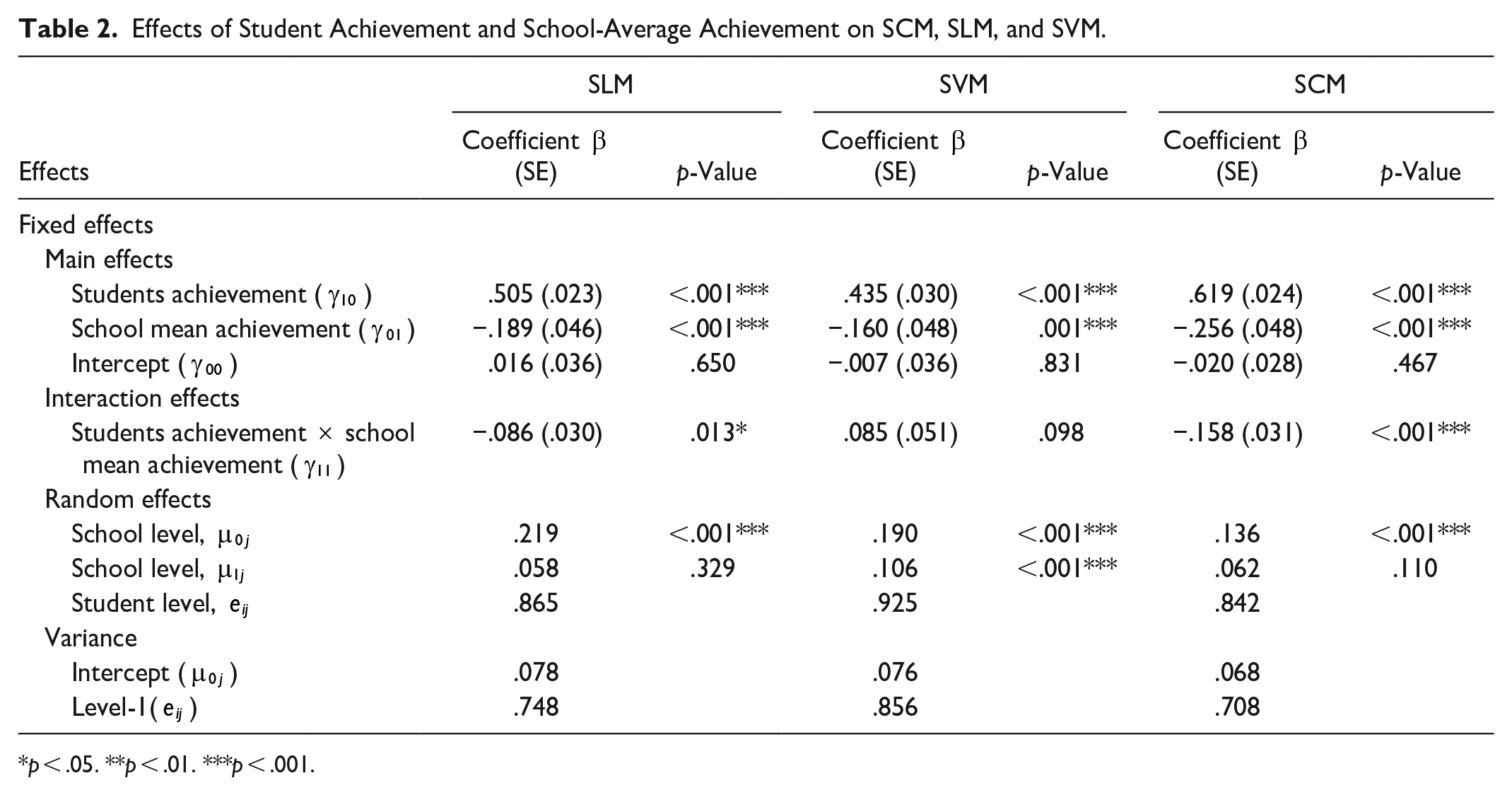
The interaction term between student achievement and school-average achievement in the prediction of the SLM score was negative (−0.086) and statistically significant (p = .013). This cross-level interaction effect is shown in Figure 2. Students high in mathematics achievement had higher SLM scores than those of their peers in low-achievement schools, evidencing the positive effect of student achievement. The slopes for the high (+1 SD), average, and low (−1 SD) students were −0.416, −0.331, and −0.246, respectively. The difference in the SLM score between low- and high-achieving environments was greater for students high in achievement; the regression line was steeper. Consequently, students with high achievement had a greater BFLPE than that of their peers with lower achievement.
Expectancy Value-SVM: The HLM analysis results pertaining to Question 2 are presented in Table 2. The proportion of variance in the SVM score within schools was calculated as follows:

This result indicated that approximately 8.2% of the variance in the SVM score was between schools.
Effects of Student Achievement and School-Average Achievement on SCM, SLM, and SVM.
p < .05. **p < .01. ***p < .001.
Similar to the trends observed in the SLM results, individual mathematics achievement was found to be significantly positively associated with the SVM score (β = .435, p < .001), as evidenced by the observation that an increase of one standard deviation in mathematics achievement increased the SVM score by 0.435 of a standard deviation. School-average mathematics achievement was also a significant negative predictor of the SVM score (
Regarding interaction, the effect between student achievement and school-average mathematics achievement was not a significant predictor of the SVM score (
Confidence-SCM: The proportion of variance in the SCM score within schools was calculated as follows:

The result showed that school-level difference accounted for 8.8% of the total variance in the SCM score.
Individual mathematics achievement was significantly positively associated with the SCM score (
The interaction term between student achievement and school-average mathematics achievement in the prediction of the SCM score was negative (−0.158) and was statistically significant (p < .001). This cross-level interaction effect is shown in Figure 2. Students high in mathematics achievement had higher SCM scores than those of their peers in low-achievement schools, indicating the positive effect of student achievement. The slopes for the high (+1 SD), average, and low (−1 SD) students were −0.598, −0.474, and −0.350, respectively. The difference in the SCM score between low- and high-achieving environments was greater for students high in achievement; the regression line was steeper. Consequently, students with high achievement had a greater BFLPE on the SCM score than did their peers with low achievement.
Discussion and Conclusion
This study extends the Big-Fish-Little-Pond Effect (BFLPE) to three Positive Attitudes Toward Mathematics (PATM) factors: SCM, SLM, and SVM. It investigates how individual student math achievements interact with school-level math achievements in predicting PATM. The findings indicate that not only does BFLPE impact students’ confidence, as previously noted, but it also affects their affections and expectancy-values. Specifically, schools with higher math achievements tend to have students with lower affections and values toward mathematics. This could be due to the competitive environment, where peers perform at similar or superior levels, potentially reducing individual students’ confidence in their mathematical abilities. Currently, the analyses suggest a concerning scenario in which the average affection and value of mathematics within a school may deteriorate, despite the school achieving high mathematics scores. As affections and values can exert long-term effects on students’ future development, such as career choices, these results should serve as a crucial message for teachers and school administrators to enhance students’ attitudes toward mathematics.
Individual Versus School Levels
While the major BFLPE studies and internal/external reference models (e.g., Chiu, 2012) based on social comparison theory stated that when individuals evaluate their own abilities by comparing outstanding others, they will lower their self-concepts. Social comparisons may ultimately lead high-achieving students, often referred to as “big fishes,” to experience the “little-pond effect,” where they perceive their abilities as less significant due to the lower average PATM levels at their schools. The effects were once again confirmed; nevertheless, the current study also found the positive correlations of individual math achievements with all its three positive attitude toward mathematics (PATM’s) at the personal levels. The students within high competitive schools still earn better performance if they have had higher PATM’s. The BFLPE may look discouraging by the school level negative-correlations (e.g., Chiu, 2012), but the individual-level positive effects of mathematics achievements and PATM’s exist across all type of schools, that is, little and big ponds. Previous results hinted that individual inspiration might increase this tendency in selective settings, the current results confirmed and suggested that parents and teachers should always encourage their children and improve their PATM’s. At the individual or personal level, PATMs consistently demonstrated a positive correlation with high achievements in mathematics.
Extending School Level to Educational/Cultural System
This study provides a novel extension of the BFLPE to a national level, specifically examining the collective impact across all Taiwanese schools. By aggregating the schools into a single third-level analysis, Figure 1 reveals a notable trend: as overall mathematics achievements increase, positive attitudes toward mathematics (PATM) including students’ confidence, liking, and value of mathematics (SCM, SLM, SVM respectively), tend to decrease. This pattern contrasts with the international trends observed in TIMSS data, where such a stark inverse relationship is not as evident. For instance, internationally, about 25% of students like learning mathematics, whereas in Taiwan, over 50% of the students, despite achieving an average score above 550, do not like learning mathematics. This disparity grows even more pronounced among the top achievers; a mere 14% of Taiwanese students like mathematics yet score nearly 700, outperforming their global peers. These findings suggest that the BFLPE, typically observed at school levels, is also applicable on a larger scale within the educational systems of high-performing countries. This insight opens up possibilities for future studies to explore BFLPE in other culturally similar high-achieving nations like Korea, Japan, and Hong Kong, to understand if similar patterns prevail.
Non-consistent Student-School (Fish-Pond) Interactions
How did individual student math achievements interact with average school math achievements in predicting the PATM (SCM, SLM, & SVM)? Statistical analyses showed that both SLM and SCM can be reversely predicted significantly but not SVM. This implied that the BFLPE on affection (SLM) and confidence (SCM) might work inconsistently across different math-levels of students combined with different math-levels of schools while the inconsistence disappeared in value (SVM). The interaction study indicated that students with high achievements experienced a greater BFLPE on SLM and SCM scores than did students with low achievements. School administrators should consider the results carefully when they are placing/grouping their students into classrooms/schools according to students’ mathematics performance.
Some studies refer to “self-concepts” as a general term when broadly discussing the SCM, SLM, and SVM collectively. This study worked with a set of more precisely defined and distinguishable PATM’s and established a more detailed relation map of affections, expectancy-values, and confidences for further academic research and practical applications. While some popular convictions for “positive” effects from the field of positive psychology may confront with the typical negative effects of BFLPE, the current study found balanced explanations between the positive effects of individual/personal levels and negative averaging school effects. Some recent controversial reviews/critiques in literature of overusing positive psychology in classrooms and education environments may be inspired by the current findings to initiate further research studies.
Implications
The findings indicate significant implications for educational practice and policy. It is evident that schools with higher mathematics achievements may inadvertently cultivate lower affection and value toward the subject among students. This can have detrimental long-term effects on students’ career choices and overall development. Educators and school administrators need to be mindful of these dynamics and consider implementing strategies to counteract these effects, such as developing programs that promote positive attitudes toward mathematics regardless of the school’s performance level. Furthermore, these results underscore the importance of fostering an educational environment where students can appreciate and value their learning without feeling overshadowed by the collective achievement level of their peers.
Limitations and Future Directions
Despite the valuable insights provided by this study, several limitations should be acknowledged. First, secondary data from the Trends in International Mathematics and Science Study (TIMSS) limits the scope of variables and data points we could examine. For example, other unmeasured factors such as teaching practices or cultural attitudes toward mathematics may have influenced students’ positive attitudes toward mathematics (PATM) and were not included in the analysis. Future studies should consider incorporating additional qualitative or longitudinal data to capture a more comprehensive range of influencing factors.
Additionally, the hierarchical linear modeling approach, while effective in accounting for the nested structure of the data, assumes that relationships between variables are consistent across schools. However, regional or school-specific differences may exist, and a more localized analysis could offer additional nuances. Future research should explore how BFLPE interacts with specific school environments and educational policies in more detail, potentially using mixed-method approaches to understand the underlying mechanisms more deeply.
Finally, as this study focuses solely on Taiwanese students, it may limit the generalizability of the findings to other educational contexts. Comparative studies across different countries or regions with diverse educational systems may yield further insights into how the BFLPE manifests in different cultural settings. Extending this research to include cross-national comparisons or longitudinal designs could help confirm and expand upon the patterns observed in this study.
Footnotes
Declaration of Conflicting Interests
The author(s) declared no potential conflicts of interest with respect to the research, authorship, and/or publication of this article.
Funding
The author(s) received no financial support for the research, authorship, and/or publication of this article.

Data Availability Statement
Data sharing not applicable to this article as no datasets were generated or analyzed during the current study.