




Abstract
Kuwait, has participated in international TIMSS test for many years, however, there has been little systematic effort to compile and assess changes between genders. This study attempts to look at the results of Kuwaiti students on the TIMSS mathematics assessments in general and according to gender in particular and the views of supervisors on the relatively low performance of Kuwaiti students. The study employed a mixed method approach in which data analysis of test results, IEA-issued documents, and statistics and official reports were used. Two focus group interviews were conducted with a convenience sample of nine educational supervisors from mathematics and science. The results show that the performance of Kuwaiti students in both the fourth and eighth grades was extremely low on the TIMSS mathematics assessments in general and in content areas in particular, since the first participation in 1995, even though the performance of eighth graders showed a slight improvement in 2015 in all areas. The TIMSS results also show that the higher the level of thinking that was assessed, the lower the performance of Kuwaiti students was. The data indicate that throughout all years, Kuwaiti girls outperformed boys, considering the slight improvement especially in 2015, yet both performances lagged behind international norms. Focus group transcript analysis reveals that supervisors perceived that students’ low performance on the TIMSS assessment test is related to a number of reasons as lack of interest in TIMSS test, unfamiliarity with TIMSS questions, and students’ weakness in the Arabic language. The paper concludes the need to systematically evaluate the TIMSS results, and develop interventions and a competent national curriculum in Kuwait.
Introduction
Mathematical knowledge and competence is indispensable as it is fundamental to the development of science and technology (Kusmaryono, 2014), and relates to the everyday activities and transactions of people (Rudhumbu & Rudhumbu, 2018). Mathematics can also help in promoting critical thinking skills, reasoning, and problem solving (Firdaus et al., 2015). Moreover, it fulfills many critical needs of society in applied scientific fields, as mathematics is the basis of, and entry to, all other sciences, including astronomy, physics, environmental study, and engineering. With the importance of mathematics comes the need to evaluate students’ performance; this is key to gauging the relative level of mathematical competence, the educational systems efficacy, and associated pedagogy in any country. Mathematical education includes factors related to the curriculum, students, and teachers. Assessment of all of these factors is important in the evaluation of progress—or lack of progress—in mathematics in comparison with other countries.
Within the context of globalization, education and the direction of assessment has shifted from a national local focus into relative international competence (Rigas, 2013; F. Singer et al., 2014). Many countries have a strong interest in competing and raising their educational standards and students’ achievement through international assessment tests. One of the foremost associations focused on evaluating the levels of students’ attainment worldwide is the International Organization for the Evaluation of Educational Achievement (IEA). This organization designed the Trends in International Mathematics and Science Study (TIMSS) and since 1995 has administered a global testing system every 4 years to evaluate students’ levels in the subjects of mathematics and science in any given country. The testing is designed to inform educational policies and practices, and monitor national curriculum. International assessment allows researchers, policymakers, and administrators to better evaluate their educational systems and guides reform efforts focused on curriculum enhancement and professional development (Moses & Allulu, 2012; Nelson, 2002; Wiberg, 2019). In addition, such assessments allow countries to benchmark their progress over time and against their peers, and may help improve education performance and economic outcomes (Kijima & Lipscy, 2016, p. 2).
Kuwait was the first Arab country to take part in these tests when they were first introduced in 1995. This study aims to analyze and discuss the results of Kuwaiti students throughout the TIMSS assessments with the hope that it helps governments and educational administrators to effectively evaluate and reshape their education system so as to enhance mathematics achievement.
Purpose of the Study
Kuwait has a future vision to become a financial and commercial international center that attracts foreign investments and increases the wellbeing of its citizens (General Secretariat of the Supreme Council for Planning and Development [GSSCPD], 2007); however, Kuwait has failed to meet the international educational assessment standards. Study of educational performance of Kuwaiti students in TIMSS reveals low scores in comparison to TIMSS performance of all other participating countries in these tests in years 1995, 2007, 2011, and 2015. We could find little evidence that these test results received much attention in Kuwait. Since Kuwait’s first participation over 20 years ago, the results have not been systematically analyzed, and students’ weaknesses in mathematics have remained largely undiscussed and unaddressed. This study aims to remedy this failure by identifying Kuwaiti fourth- and eighth-grade students’ performance in mathematics on the TIMSS assessments during the years in which Kuwait participated. We also investigated the perceptions of educational supervisors as to the reasons for these results and analyze the importance of these results in reforming the educational process and meeting the future expectations.
Using data analysis of test results and focus group interviews, the study attempts to answer three main questions:
Literature Review
The international assessment (TIMSS) provides an opportunity for participating countries to compare students’ educational achievement in mathematics and science across nations (Neuschmidt, 2018) and chronologically. Such comparisons inform educational systems and are used to guide reform and to identify and remediate areas of low(er) students’ performance. Researchers and national educational authorities have analyzed and discussed mathematics and science curriculum and student performances and attempted to extrapolate factors related to TIMSS test performances in Middle Eastern countries and in other nations around the world. These results have proven useful not only to help improve mathematics and science learning but also to inform politicians and decision-makers (Grønmo & Onstad, 2013).
Participation in TIMSS has provided a consistent picture of mathematics as a school subject, and has provided important information for recent changes in mathematics in school as well as in teacher education in mathematics (Grønmo & Onstad, 2013). Studies have found that TIMSS was used as a tool for evaluating the effectiveness of different instructional practices (Ericsson et al., 2018). TIMSS have been employed as a benchmark to measure school effectiveness and school reform and also used to inform system-level policies for the further monitoring and evaluation of the education system (Gustavo & Topper, 2017; Tobin et al., 2015; Wang, 2001).
Evidence from international differences in students’ achievement suggests that what matters is not so much the amount of input that school systems are endowed with, but rather how to use their resources (Woessmann, 2016). TIMSS results are used by researchers to compare educational effectiveness-enhancing factors in the countries of the Gulf Cooperation Council (GCC), including Kuwait (Neuschmidt, 2018).
The results from TIMSS research in different years show that in general, in most countries, there are no significant gender differences in math test results (Ghasemi & Burley, 2019; Ghasemi et al., 2019; Mullis et al., 2008, 2012, 2016). When difference exists, it tends to be in favor of boys (Mejía-Rodríguez et al., 2020; Smith, 2014). Only in few countries, small effect size gender differences were found in favor of girls such as Qatar, Kuwait and Thailand, and Malaysia (Ismail & Awang, 2009; Mejía-Rodríguez et al., 2020; Reilly et al., 2017; Smith, 2014).
The studies that discussed the causes for the decline of students results in TIMSS revealed many points such as the lack of curriculum (Wijaya, 2017), insufficient subject knowledge of some teachers, teacher-centered activities, socioeconomic status (Ceylan & Akerson, 2014; Mlachila & Moeletsi, 2019), school climate (Barakat & Hirzallah, 2010), attitude toward math, and math self-concept (Kiamanesh & Mohsenpour, 2010). There is also strong evidence to suggest that “teachers’ understanding and implementation of school curriculum, their expectation and ability to inspire students, and their collaboration with other teachers play a significant role in improving students’ academic achievement” (Badri et al., 2019, p. 32). Finally, parents’ and students’ attitudes and aspiration toward mathematics, self-confidence in learning mathematics, and school-related characteristics have a significant effect on students’ achievement (Ismail & Awang, 2009).
Many studies such as Barakat and Hirzallah (2010), Al-Fares and Al-Hela (2014), and Sumaida and Grace (2014) have evaluated the results of Arabic countries that participated in TIMSS 2011, and identified some variables that might explain the low scores of Arab students’ achievement.
Conceptual Framework
Careful analysis of student assessment results can help schools plan instructional improvements (Murnane et al., 2005). Studies showed that large-scale international assessments can be a valuable resource for studying global trends and evolving systems in education, and provide important data for studying the context and processes of education and development (Johansson & Hansen, 2018; Strietholt & Scherer, 2018; Torney-Purta & Amadeo, 2013). Braslavsky (2005) states that increased participation of developing countries in large-scale assessment programs coincides with a shift in global focus from educational quantitative indicators such as enrolment rates to focus more on quality of education. A huge body of research has used international large-scale assessments (ILSAs) data to conduct secondary analysis to explain student performance using background factors such as gender (Kaplan, 2019). Lockheed and Wagemaker (2013) indicate that ILSAs can provide comparative information about the effectiveness and efficiency of education systems when their results are appropriately analyzed. Many ILSA studies (Lindblad et al., 2015; J. D. Singer et al., 2018; Tobin et al., 2015) provide evidence on the impact of this type of test, such as shaping discourses about education, in terms of discussions about educational quality, changes in educational policy, changes in curriculum and teaching, track changes over time, and as an accountability tool. International achievement testing is one component of a conceptual model that identifies factors assumed to impact academic and related political, educational, and economic issues.
Based on many related studies, Ababneh et al. (2016) discussed the impact of international tests in five different areas and recommended the “TIMSS Impact Model” (Figure 1). The model suggests that international tests have a significant impact on the process of policymaking in many participating countries through reviewing, assessing, and formulating education policies, reforms, and recommendations. In addition, it shows that international tests helped to develop teacher-training guides that would affect teachers’ development and support their teaching practices in the classroom and consequently improve students’ learning skills. Another direct impact of these tests, as suggested by the model, is the revision and assessment of the school curriculum and the content of textbooks. International tests promoted some countries to establish high quality standards at the national assessment level. Finally, countries are seeking to improve the capacity of researchers and educators in the analysis of international test results through attending training workshops in order to benefit from and apply international knowledge in the local context.

TIMSS conceptual model based on Ababneh et al. (2016).
This model formed a base on which the researchers rely during the conduct of this study, as this study can help the educational policymaker in Kuwait to review, evaluate, and reformulate policies related to mathematics in terms of content, method of teaching, and challenges facing its teaching. The results of this study can also add important value to the professional development of mathematics teachers, allowing them to understand the weaknesses of their students in this subject, their causes, and the differences that occur in academic achievement between boys and girls. The results of this study can also help in the process of reviewing the content of teaching of mathematics in Kuwait, the neighboring Arab countries, and the world generally. Finally, the researchers of the present research gain support in terms of strengthening and building their research capabilities in the field of dealing with such research issues, and it also helps them to train their academic counterparts and teachers on issues related to how to deal with the results of Kuwaiti students in TIMSS tests and how to read these results with scientific and accurate indications.
Method
This study employed a mixed-method approach whereby data analysis of test results was used and focus group interviews were conducted. We analyzed IEA-issued documents, surveys, statistics, and official reports specific to the performance and results of fourth- and eighth-grade Kuwaiti students on the TIMSS mathematics tests (these included Mullis et al., 1997, 2008, 2012, 2017). These documents were categorized and analyzed through content analysis, which is a tool focused on logical and organized description, and quantitative and qualitative data analysis (Saber & Khafaja, 2002). A procedure was developed to ensure the reliability and stability of the content analysis tool to classify, explain, and analyze the data through tables and figures. This procedure included the steps of data analysis discussed by Ritchie and Spencer (1994), which are identifying data, determining the framework of information, indexing or determining certain categories, filling in tables, and drawing and explaining maps.
To answer the third research question relating to supervisors views on the relatively low performance of Kuwaiti students on the TIMSS assessments, we used two focus group interviews with a convenience sample of nine educational supervisors from mathematics and science. In Kuwait, educational supervisors are employed at the Ministry of Education to monitor and evaluate teacher performance, perform supervision, improve curriculum and teaching methods, and guide the educational process. The first group consisted of four supervisors, and the second group consisted of five supervisors. Each interview lasted from 45 to 60 min and the process was recorded and transcribed. We used an interview schedule consisting of two main research questions but allowed and encouraged diverse responses and discussion among participants.
Two open questions were asked in the focus group interviews: the first question was about supervisors’ perception of the reasons behind the low results of students on the TIMSS assessments, and the second question was about the ministry’s preparations and support for this assessment. During the interview other sub-questions emerged which are related and linked to the two main questions mentioned earlier. A copy of the interview questions is shown in Table 1.
Interview Questions.

Note. TIMSS = Trends in International Mathematics and Science Study.
An inductive content analysis approach was used to analyze content of the interviews, in which categories of analysis were derived from the data (Kibiswa, 2019). A thematic unit of analysis was chosen and the transcripts were classified using both themes from the research questions and emergent themes. After that the data were categorized and coded and recoded again until the researchers achieved sufficient coding consistently and consensus. Finally, the coded interview data was grouped into major themes and the trustworthiness of the qualitative content analysis in this study was ensured by following the steps suggested by Elo et al. (2014). In this study the trustworthiness was checked in different phases of preparation, organization, and reporting.
Study Results
We first turn our attention to Research Question 1: What are the results of Kuwaiti students on the TIMSS mathematics assessments over the years the test has been used? Several issues emerge from this main question.
Average Kuwaiti Student Performance From an International Perspective
Table 2 shows that the highest performance of fourth-grade students on the TIMSS assessments in mathematics occurred during Kuwait’s first participation in 1995; however, this score was low in comparison to the average international score. In 2007, fourth-grade students’ performance was the lowest among all the years that Kuwait participated in these assessments. In 2015, fourth-grade students reached 353 points, indicating that the performance was still low; the score was the lowest among all 49 participating countries, as the Kuwaiti students came in the last place.
Performance of Kuwaiti Students (4th and 8th grades) in Mathematics on the TIMSS 1995, 2007, 2011, and 2015 Assessments.

Note. TIMSS = Trends in International Mathematics and Science Study.
For the eighth grade, Kuwait did not participate in 2011 but only in the years 1995, 2007, and 2015. The performance of eighth-grade students was also low in comparison with international performance. In 1995, eighth-grade Kuwaiti students’ average score was 392 points, putting them in the last place with the weakest performance among the participating countries. In Kuwait’s second participation in 2007, the students’ performance fell lower than the first performance. In 2015, eighth-grade students showed improvement in comparison to the previous eighth-grade performance in 2007 but was similar to the performance in 1995.
Table 2 clearly shows that the performance of Kuwaiti students in both the fourth and eighth grades was extremely low on the TIMSS mathematics assessments. This result was apparent from Kuwait’s first participation in 1995 and remained the case throughout its participation in 2007, 2011, and 2015.
Average Kuwaiti Student Performance in the Mathematics Content Areas
Table 3 shows the following details regarding the average performance of fourth- and eighth-grade Kuwaiti students in the key mathematics content areas in 1995, 2007, 2011, and 2015.
Average Performance of Kuwaiti 4th and 8th Grade Students in the Mathematics Content Areas on the TIMSS 1995, 2007, 2011, and 2015 Assessments.

Note. The algebra content area was administered to 8th-grade students only. TIMSS = Trends in International Mathematics and Science Study.
Table 3 shows that in areas of Numbers and Data Display in grades 4 and 8, scores were constantly increasing, although the results remained low. For example, the result of the fourth grade student in Numbers increased from 321 in 2007 to 333 in 2011 and then 356 in 2015. In Geometric forms, the results of fourth-grade students increased slightly during the years of participation, and the result of the eighth grade did not change, although the results generally remained very low. The score for eighth graders in Algebra rose slightly.
Average Kuwaiti Student Performance in the Cognitive and Skill Domains
The data in Table 4 show the performance of fourth- and eighth-grade students in 2007 in the cognitive domain and in the area of knowledge was much lower than the international average. In the area of deduction, the results were not calculated accurately in 2007 because of the extremely low points; therefore, the results are not shown for this area. However, the performance of both fourth- and eighth-graders improved in 2015 compared with that of 2011, yet it was still weak in comparison to the international average. We note that the higher the level of thinking that was assessed, the lower the performance of Kuwaiti students.
Average Performance of 4th- and 8th-grade Kuwaiti Students in the Cognitive and Skill Domains on the TIMSS 2007, 2011, and 2015 Assessments.

Note. TIMSS = Trends in International Mathematics and Science Study.
Question 2: What are the results of Kuwaiti students on the TIMSS mathematics assessments according to gender?
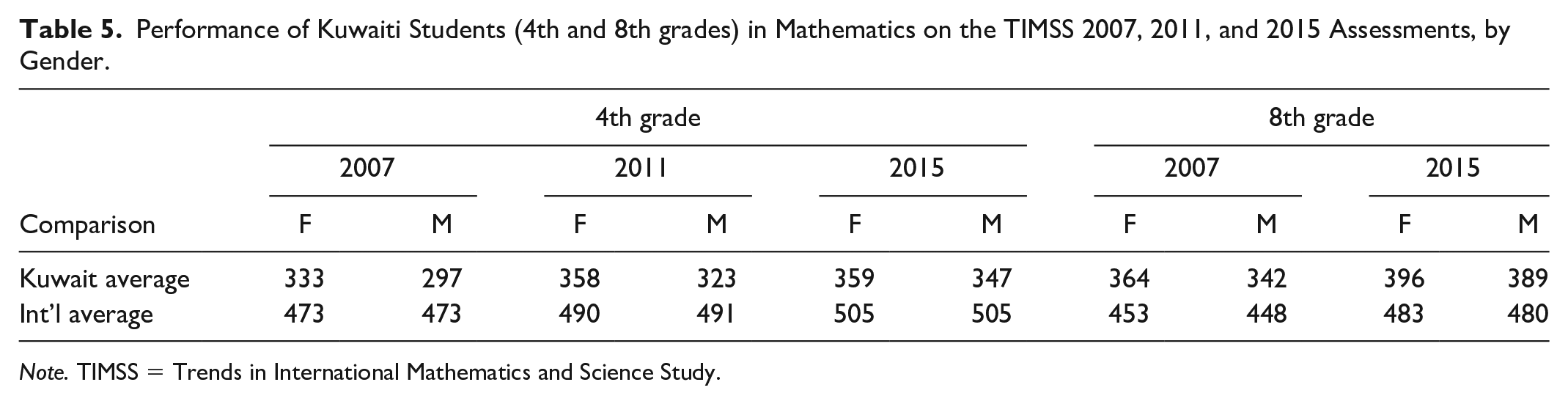
Alongside our examination of the international aspect of Question 1, we looked at the performance of fourth-grade students on the TIMSS assessments in 2007, 2011, and 2015 by gender. The results appear in Table 5.
Performance of Kuwaiti Students (4th and 8th grades) in Mathematics on the TIMSS 2007, 2011, and 2015 Assessments, by Gender.
Note. TIMSS = Trends in International Mathematics and Science Study.
The data show that throughout all years, girls outperformed boys, considering the slight improvement especially in 2015, yet both performances lagged behind international averages. We deepen our examination of the average performance in the mathematics content areas by focusing on the gender variable. Our results are presented in Table 6.
Average Performance of Kuwaiti 4th- and 8th-Grade Students in the Mathematics Content Areas on the TIMSS 2007, 2011, and 2015 Assessments, by Gender.

Note. The algebra content area was administered to 8th-grade students only. TIMSS = Trends in International Mathematics and Science Study.
The data show fourth-grade female students outperformed male students in all areas. Although the performance of Kuwaiti boys and girls improved in each subsequent year of participation, it remained low, compared to international averages. In 2015, girls’ performance improved in the areas of numbers and geometry but dropped in the area of data display as compared to 2011. As for the male and female performances in the mathematics content areas for eighth-grade students, girls outperformed boys in the areas of geometrical forms, data display and algebra. Despite female students’ outperformance of male students and the improvement in male students’ performance, the average scores for both genders was still low in comparison to the international scores. However, in the area of numbers, eighth-grade boys scored 1 point higher than eighth-grade girls in 2007, in 2015, both genders performed similarly, with male students outperforming female students.
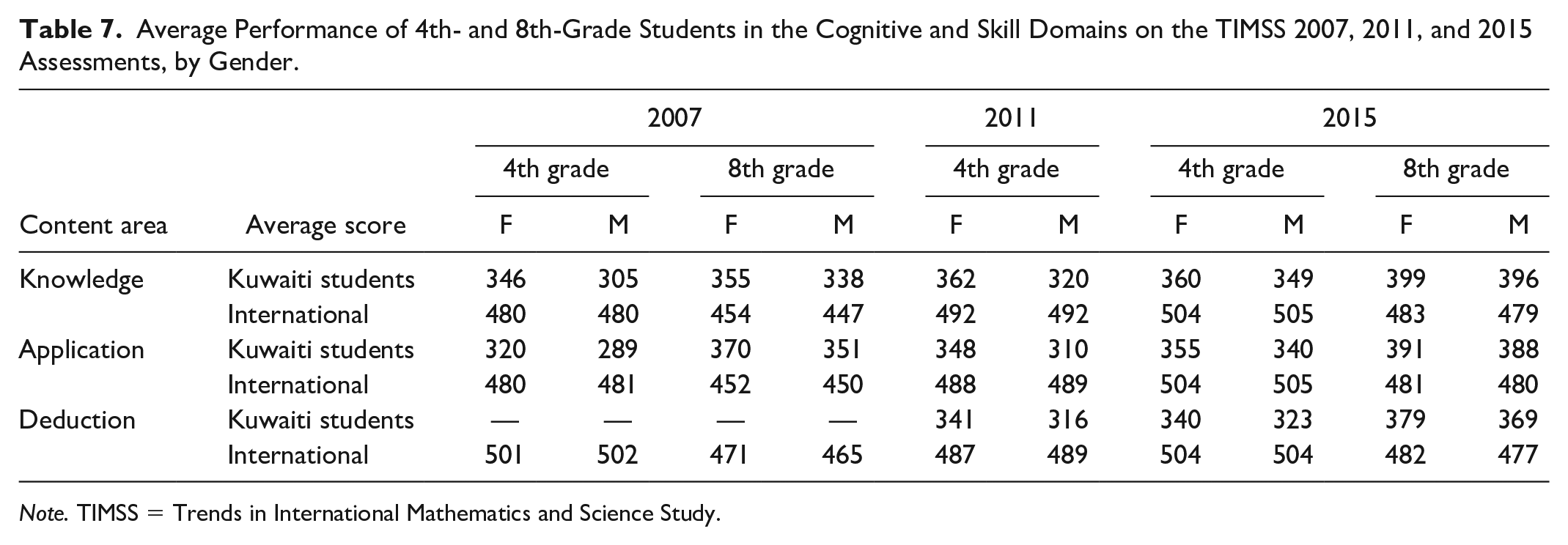
Finally, the average performance in the cognitive and skill domains focusing on the gender variable presented in Table 7.
Average Performance of 4th- and 8th-Grade Students in the Cognitive and Skill Domains on the TIMSS 2007, 2011, and 2015 Assessments, by Gender.
Note. TIMSS = Trends in International Mathematics and Science Study.
In general, the performance of fourth- and eighth-grade Kuwaiti students of both genders in the cognitive and skill domain was very low in 2007, 2011, and 2015, despite female students’ outperformance of male students. The performance of female students in the fourth grade showed slight improvements in the areas of knowledge and application between 2007 and 2011, but the performance level deteriorated quickly in the area of knowledge in 2015. A slight improvement occurred in boys’ performance in 2011 compared to 2007, and they also showed improvement in 2015, although their performance was still extremely low compared to the international average.
Question 3: What are the views of supervisors on the relatively low performance of Kuwaiti students on the TIMSS assessments?
Two open questions and subsequent follow up questions were asked in the focus group interviews (Table 1).
First, the analysis of responses showed that supervisors perceived that students’ low performance on the TIMSS assessment test is related to a number of reasons, including the following.
Lack of interest in the test
All supervisors agreed that the test is not taken seriously by all parties in the educational process: not school administration, teachers, students, nor their parents. Students are not interested in performing well on the TIMSS assessment because the assessment does not count toward their grades and students do not perceive that it is linked to their success or failure; likely teachers imply such notions to students. Therefore, students do not pay much attention to preparing for and completing the repeated TIMSS assessments, nor do they exert much effort with challenging questions. One of the supervisors provided an example of students’ lack of interest in the test: Students and their parents do not show enough interest in the pilot test that we use to prepare students for the TIMSS assessment test as some students are absent on the test day. The number of unanswered questions is large; students’ answers to the TIMSS pilot test is a tragedy.
Lack of student knowledge about or appreciation of the value of testing
Supervisors perceived that teachers are not sufficiently familiar with the nature of the TIMSS tests nor of the value that the tests results can be to administrators, teachers, or students themselves. One of the supervisors commented, “I was a teacher for more than 20 years, and I do not know anything about it. We only receive test papers and hand them over.”
Style of the TIMSS questions
The respondents mentioned that students are not familiar with the type and nature of the TIMSS questions; the questions that teachers generate and students work through in classroom study, differ significantly from those they experienced on the TIMSS. The supervisors believe that some of the teachers themselves lack the skills and experience to solve the TIMSS questions. In addition, there are many questions the students perceived as boring or perhaps too challenging. Many of the TIMSS questions focus on higher thinking skills. However, the mathematics curriculum in Kuwait generally focuses on lower cognitive skills, such as memorizing and remembering; this finding is aligned with Alajmi’s (2009) conclusions that the Kuwaiti mathematics curriculum “focuses on procedural knowledge, following procedures and finding exact answers” (p. 266).
Weakness of students in Arabic language skills
The respondents agreed that the cumulative weakness of students in the Arabic language influences their ability to read and thoroughly understand the test questions. The TIMSS test contains 26 detailed questions, and the students are supposed to be able to answer most or all of the questions in 45 min. However, many students suffer from poor reading skills and, therefore, cannot finish reading the questions in the designated time. One of the supervisors mentioned, We have a problem in the language. A fourth-grade student can hardly read the questions in the allotted time. The eighth-grade students sometimes do not understand the meanings of the questions. There is also a problem in translating the questions from English to Arabic.
Second, although Kuwait first participated in the TIMSS assessments 20 years ago, student preparation for the test only began to take place in 2018 when the ministry formed a committee for science and mathematics. One of the supervisors clarified that “for the latest TIMSS test, the ministry began serious preparations earlier this summer, unlike previous years in which teachers and administrators had no idea about TIMSS. As a committee we feel pressured.”
The respondents mentioned examples of the ministry’s preparations, such as the publication of TIMSS test introductory booklets, the inclusion of curricula activities and tests for questions similar to the TIMSS test questions, additional time allocated during school, the selection of outstanding teachers to teach fourth and eighth graders, and the participation of supervisors, department heads and some teachers in training courses on issues related to the test. One of the supervisors elaborated, TIMSS introductory booklet included similar questions to the real TIMSS test, and supplementary material that is elaborated and taught in extra periods, however, there was a shortage of experienced teachers, and some administrators did not allow extra periods for TIMSS.
In addition, two TIMSS pilot tests were conducted in 2019 with a random sample of students, as a way for students to become familiar with TIMSS test questions and prepare them for the real test. However, the results were not promising.
The supervisors mentioned that the period tests at the end of the first semester included questions similar to the TIMSS test patterns, but they noted that there has been no independent or systematic analysis of questions and responses to identify the quality of students’ answers, as one of the supervisors commented that “analysis of the answers of some questions are based on personal judgments.”
The supervisors’ responses in the focus group revealed that the recent interest of the ministry has focused on trying to improve the competitiveness of the students in the upcoming test rather than focusing on reviewing the teaching methods, the pattern of questions, changing the curriculum content, or improving or focusing on teacher professional development. One of the supervisors added “we need to have an accountability system, and focus on improving the quality of education.”
Discussion
The results of the TIMSS assessments show low performance of Kuwaiti students in both the fourth and eighth grades, with a continuing weakness (compared to international averages) since Kuwait’s first participation approximately two decades ago, up to 2015 (the last participation). The low performance was most apparent in the cognitive and skill domains, in all content areas for mathematics, and in comparison, with international averages overall. Despite the slight improvements in the performance of students in 2007, 2011, and 2015, there were no changes in the performance of Kuwaiti students relative to their international peers, despite Kuwait being one of the first countries to participate in the TIMSS assessments.
Participation in the TIMSS assessments is intended to identify the strengths and weaknesses of an educational system in terms of the curriculum and teaching methods and other variables so as to focus on the strengths and overcome any challenges. However, in Kuwait the evaluation of the results and meaningful response was not within the policy or priorities of the ministry of education. According to the participants in the focus group interviews, interest in the test and the results did not start until this year. Therefore, the lack of a common and shared vision in the ministry about the aim and benefits of participation in the TIMSS may have contributed to the continuous low results throughout the participation period. Huffman (2001) points out that creating a shared vision based on common values is considered as a critical component of any change process. Therefore, governments, including Kuwait and other Arab countries, need to develop and share an understanding of the role and value of these international benchmarking tests in the reform process.
In addition, the lack of student interest is in line with House’s (2006) study, which emphasized the importance of the relation between personal beliefs and educational achievement—he found that students who scored low on the TIMSS assessments tended to believe that mathematics was a boring subject. In addition, it seems that students usually pay more attention to the tests and assignments that they are evaluated on, but if the test has nothing to do with their evaluation such as TIMSS, then they usually do not take it seriously in terms of preparation and answering all questions. This is in line with studies of Abu Tayeh et al. (2018) and Yahya and Ayasrah (2018), who found that there is a lack of interest in Jordan’s students and their families in the TIMSS test, and they often do not have the awareness of the significance of these tests for students or the country . These results showed that students did not care about doing required assignments and did not care about test results that did not affect their achievement. Also, the study of Butakor et al. (2017) attributed the cause of Ghanaian students’ low performance in TIMSS 2011 to the lack of students’ interest and confidence in mathematics and students’ lower educational aspiration. From our discussions with educational supervisors in the focus groups as well as our own experiences in Kuwaiti classrooms, these problems related to student commitment to the tests are also a concern in Kuwait.
Another reason for Kuwaiti students’ low performance is that the curriculum does not include sufficient skills and exercises that focus on higher order thinking skills, deductive ability, and more abstract mathematical concepts. As Sumaida and Grace (2014) note, students of Arab countries suffer from weak performance in general due to the inability of students to apply their knowledge to solving matters with which they are unfamiliar, whereas most mathematical modes of learning, mentioned in documents and school books, aim at achieving some mathematical tasks more than helping to do a mathematical activity aiming to delve deeper into mathematical concepts, linking them, and applying them in different domains . . . Concentrating the curriculum . . . on the knowledge content more than focusing on developing mathematical competencies. (pp. 84–86)
In the era of globalization, international assessments have a significant impact on education policymaking and educational quality, accountability, and outcomes (Kijima & Lipscy, 2016) and are noted as prerequisites for economic and political development (Kamens, 2015). Such international tests help educational systems determine their strengths and weakness, as well as address their future agenda (Rigas, 2013). Schools, administrators, and teachers can also reflect on the global test results and make recommendations for good practices (Cambridge Assessment International Education, 2017) and reform plans.
Conclusion
Despite all the efforts done in this study, the small number of supervisors interviewed is a clear limitation, which does not allow generalizations. It could have expanded more to include those from different disciplines. However, the use of mixed methods provided a better and deeper understanding of the issues related to the performance of Kuwaiti students on TIMSS assessment. Also, this study made a significant and meaningful contribution to the literature concerning international testing. Kuwait was the first Arab country to participate in TIMSS assessment, yet it showed very poor performance since its first participation. Conceptual models for school improvement consistently show the valuable role of international tests and benchmarking in driving educational reform. In particular, our results show the need in Kuwait for consideration of curriculum content areas and the cognitive and skill domains. In addition, the need to systematically evaluate the performance of Kuwaiti students on TIMSS assessment over a number of years, as we have begun in this study, will help educational officials to invest in human and education resources and improve accountability. Education policymakers in Kuwait need to carefully evaluate the national mathematic curriculum for all grades and improve it with reference to international standards so that it aligns with the intent of increasing quality of life and living in Kuwait through participation in the TIMSS assessments. We also see this step as one in the development of a new competence-based curriculum.
We hope that the explicit presentation of these results will be at least a small motivation to improving education in Kuwait. We also hope that this work inspires, rather than depresses Kuwaiti teachers, governments, and educational leaders to continue to actively assess student performance, to systematically discuss results, and to design and test remedial interventions. Finally, we hope that others will suggest solutions and proposals that would improve the performance of Kuwaiti students in mathematics, and study and present results from other curricular areas and on related international education studies in the Arab world and in other non-Western countries.
Footnotes
Declaration of Conflicting Interests
The author(s) declared no potential conflicts of interest with respect to the research, authorship, and/or publication of this article.
Funding
The author(s) received no financial support for the research, authorship, and/or publication of this article.
