



Abstract
This article uses the concurrent mixed methods design to explore the errors made by 171 Grade Seven learners in algebraic problem-solving within the Assin Central Municipality in Ghana. The participants were categorized into low-achieving and high-achieving groups based on their performance in a pretest, to help provide a detailed examination of the discrepancies in error occurrence between these groups. The Newman error analysis framework was used to unveil distinct patterns of errors among learners when tackling algebraic tasks. Quantitative data from the test were complemented by qualitative insights employing the Think Aloud Protocols (TAP). The analysis revealed that low-achieving learners struggled with reading, comprehension, and transformation errors, while high-achieving learners mainly encountered transformation and process skill errors. The findings contribute valuable insights into learners’ challenges in mastering algebraic concepts, offering implications for educational interventions and curriculum development in mathematics education. The study recommends implementing differentiated instruction strategies and providing additional support for comprehension, and problem-solving skills to improve algebraic proficiency among learners.
Plain language summary
This study sought to explore algebraic word problem-solving errors among 171 learners in Ghana, categorising the learners into low- and high-achieving groups based on a pretest. Employing the Newman Error Analysis as the analytical framework, the research identifies common errors in reading, comprehension, transformation, process skills, and encoding when tackling algebraic tasks. Transformation errors were identified as the most prevalent, affecting both groups significantly. The research design employs a mixed-methods approach, combining quantitative data from a Mathematics Achievement Test (MAT) and qualitative insights from Think Aloud Protocols (TAP). The results reveal that both low- and high-achieving groups struggle with comprehension errors, indicating difficulties in understanding mathematical notations. Process skill errors, involving miscalculations and heuristics, contribute substantially to overall errors. Reading errors, related to word recognition, were identified, as well as encoding errors, where learners failed to express the final answer correctly. Addressing the second research question, differences in computational errors are identified between low- and high-achieving groups. The low-achieving group faces challenges with basic arithmetic operations, while the high-achieving group demonstrates better proficiency but relies on memorisation, impacting their conceptual understanding. Both groups struggle with misinterpreting problem statements, hindering effective comprehension and problem-solving. This study offers valuable insights into algebraic problem-solving errors among Ghanaian learners, emphasising the importance of targeted interventions based on achievement levels. The findings contribute to refining educational strategies and interventions to enhance algebraic comprehension among learners in Ghana.
Introduction
The overarching educational objective of a nation is to equip learners with problem-solving abilities. Consequently, learners undergo various skills and techniques to cultivate these problem-solving skills. Enhancing problem-solving skills is viewed as the ultimate aim of the New Ghanaian Mathematics Curriculum (Ministry of Education [MoE], 2019a, 2019b, 2020), aligning with the broader goal of preparing individuals to address challenges in their daily lives. Integral to achieving this goal is mastering algebraic expressions, which form a foundational aspect of logical reasoning and mathematical proficiency.
Algebraic expressions serve as fundamental building blocks in mathematics education, requiring learners to manipulate symbols and variables to represent relationships and solve equations (Namkung & Bricko, 2021). This foundational understanding not only enhances mathematical literacy but also cultivates analytical thinking essential for practical problem-solving. One aspect of algebra that provides learners with real-life scenarios to practice in the classroom is word problems.
As defined by Powell et al. (2022), word problems represent a combination of numbers and words, requiring learners to apply reading, comprehension, and mathematical skills in solving them. The study of word problems is recognized for playing a significant role in the teaching and learning of mathematics. Notably, the Common Core State Standards (CCSS) for mathematical practice argues that word problems position learners to evolve into problem solvers capable of reasoning, applying, justifying, and effectively using appropriate mathematical vocabulary to demonstrate understanding in everyday situations (Common Core State Standards Initiative (CCSSI), 2010). However, as argued by Di Leo and Muis (2020), Matthews (2018), and, McDonald and Smith (2020) word problems remain a source of apprehension and increasing difficulty for many learners as they progress through different grades in mathematics.
Equally, studies have shown that learners make different types of mistakes when solving mathematical problems. These mistakes, if left unchecked, become errors which means a lack of proper knowledge consequently affecting the rationale for teaching and learning mathematics in elementary and middle schools. From this perspective, researchers need to examine learners’ various errors when solving word problems. In addition, as educators strive to equip learners with the tools necessary for critical thinking and practical problem-solving, understanding the specific errors made by learners in tackling algebraic tasks related to real-world scenarios becomes paramount (Newton et al., 2014). Studies also indicate that conducting studies along achievement levels is highly useful in decision-making (Armstrong et al. 2008). Understanding the errors made by learners is crucial for informed decision-making and proposing effective interventions to assist them.
In the context of Ghanaian literature on learners’ achievement in algebra, Adu et al. (2015) have underscored the prevalence of errors made by middle school learners when solving algebraic tasks. Despite the acknowledgement of these errors, there appears to be a gap in the literature concerning a comprehensive understanding of the specific nature of these errors. This study emphasizes the critical need to identify and analyze these errors in alignment with learners’ achievement levels. This focus aims to go beyond merely recognizing the mistakes made by learners, seeking to delve into the underlying reasons and patterns associated with different proficiency levels.
The existing body of research in Ghana seems to have identified the errors made by learners in algebra but falls short of providing a detailed understanding of these errors based on learners’ achievement levels. This gap in the literature hinders the development of targeted interventions that can effectively address the distinct challenges learners face at various proficiency levels. Consequently, this study aims to fill this void by offering valuable insights that can guide decision-makers in tailoring interventions specifically designed to meet the unique needs of learners in Ghana at different levels of achievement in algebra. Through a more detailed understanding of the errors aligned with learners’ proficiency levels, the research seeks to contribute to the enhancement of educational strategies and interventions to promote improved algebraic comprehension among Ghanaian learners.
The study therefore was guided by the following research questions:
What types of errors do learners make when solving word problems?
What distinguishes the error patterns in solving word problems between low-achieving and high-achieving learners?
Literature Review
Algebraic Problem-Solving Errors
Algebraic problem-solving is a critical component of mathematics education, requiring learners to manipulate symbols and solve equations. Research has identified various errors that learners commonly encounter in algebraic tasks. These errors are commonly categorized as conceptual, procedural, or computational (Agustyaningrum et al., 2018; Al-Mutawah et al., 2019). Conceptual errors often stem from misunderstandings of algebraic concepts such as variables and equations, while procedural errors involve incorrect application of algebraic rules and operations and computational errors occur during arithmetic calculations. (Barbieri & Booth, 2020). While these categories provide a foundational understanding of learners’ errors, they can sometimes overlap and lack specificity, making it challenging to pinpoint the exact nature of a learner’s difficulties.
Studies have also highlighted that the Newman Error Analysis (NEA) framework offers a more comprehensive and precise approach by categorizing errors into five stages: reading, comprehension, transformation, process skills, and encoding (Pomalato et al., 2020). This detailed breakdown aligns closely with the actual steps students take when solving problems, particularly word problems. By addressing each stage of the problem-solving process, Newman’s framework not only identifies where errors occur but also provides actionable insights for targeted interventions. For instance, if comprehension errors are prevalent, educators can focus on enhancing reading and interpretation skills. The application of Newman’s framework in studies, such as that by Adu et al. (2015), underscores its effectiveness in diagnosing and addressing specific error patterns, thereby improving educational outcomes and supporting curriculum development in Ghanaian middle schools.
The Need for Analyzing Errors Across Achievement Levels
Error analysis is a vital tool in educational research and practice. It helps educators identify specific misunderstandings and procedural mistakes that impede learners’ learning (Singh etal., 2010) . Differentiated instruction is a pedagogical approach that aims to tailor teaching methods to meet the diverse needs of learners (Tomlinson, 2001). Analyzing errors across achievement levels is integral to this approach, as it allows educators to understand the unique challenges faced by learners. This approach helps cater to the diverse needs of learners and promotes equitable learning opportunities. For instance, Armstrong et al. (2008) found that learners who are proficient in mathematics often make errors due to carelessness or advanced conceptual misunderstandings, whereas those who are less proficient in mathematics struggle with fundamental procedural knowledge and conceptual understanding. By identifying these distinct patterns, teachers can provide more effective support tailored to each group’s needs.
Analytical Framework
Newman Error Analysis
To gain insight into learners’ errors within the domain of algebraic word problems, this study employs the Newmann Error Analysis (NEA) framework. Recognizing the pivotal role of error analysis in refining pedagogical approaches, the Newmann framework provides a systematic and comprehensive method for understanding the diverse challenges faced by learners in algebraic problem-solving (Reid O’Connor & Norton, 2022). By adopting this analytical tool, the study aims to not only categorize and identify errors but also delve into the underlying reasons behind these errors, offering a detailed perspective on learners’ cognitive processes.
The NEA framework is also classified as a diagnostic procedure which comprises five distinct stages, each contributing to a detailed examination of errors in algebraic word problems. These stages are reading, comprehension, transformation, processing, and encoding. The reading stage seeks to identify errors that occur when learners struggle to accurately recognize words or phonemes while reading. It can include misreading words leading to incorrect comprehension and subsequent errors. It also includes misreading numbers, symbols or mathematical expressions. The second stage, however, discusses errors that occur when learners misunderstand or misinterpret the meaning of a text. They can result from difficulties in understanding vocabulary, grammar, context, or symbols leading to inaccurate comprehension and potential errors in subsequent stages.
The third stage highlights the errors learners make when translating the text into mathematical equations. This according to Hegarty et al. (1995) is due to a lack of proper strategies. Errors associated with the steps or procedures used to solve a problem are categorized at the fourth stage which is the process errors. It involves errors in calculation, failure to follow the correct order of operations, or inaccurately applying mathematical algorithms. The final stage of the NEA is the encoding which involves how learners present their final answer. Incorrect answers and/or omission of appropriate units are regarded as errors at this stage.
Apart from using the answers the learners provided when solving the algebraic task to identify the errors they made, the TAP was also employed based on the NEA prompts. The verbal responses (data) obtained from the learners were transcribed to explain the errors the learners made to help delve deeper into the root causes of these errors, exploring the recurring patterns and misconceptions among the learners. This multi-stage approach allows for a comprehensive exploration, unveiling the complexities that underlie learners’ struggles in mastering algebraic problem-solving. A summary of the NEA prompts or parameters for identifying learners’ errors is presented in Table 1.
Parameters for Newman’s Error Analysis Framework.

Empirical Review of Studies Using Newman Error Analysis in Algebraic Word Problems
This review examines empirical studies that employ the Newman Error Analysis (NEA) framework to identify and categorize errors made by learners when solving algebraic word problems. The studies span various educational contexts, most especially the Basic Schools, and Senior High School levels. These studies highlight the distinct error patterns and instructional needs of different learner groups. For example, Siskawati (2021) conducted a study to describe the types of errors learners encounter in solving word problem questions in mathematics, utilizing the Newman Error Analysis (NEA) framework. The study employed a descriptive qualitative method with 40 learners as research subjects. The key findings indicated that the majority of errors for male students (41.29%) were in the encoding stage, while female students primarily struggled with process skills and encoding (28.64%). Additionally, the study highlighted that learners at the upper-grade levels exhibited the most errors in process skills and encoding (36.31%), whereas those at the lower-grade levels had significant errors in encoding (32.27%). The study identified several causes for these errors, including difficulty in identifying information in questions, mistakes in writing formulas, lack of understanding of concepts, and incorrect answers.
Despite its strengths, such as the effective use of the NEA framework and the detailed analysis of errors across gender and grade levels, the study has limitations. The relatively small sample size of 40 learners restricts the generalizability of the findings. Moreover, the descriptive nature of the study, while providing depth, lacks the ability to establish causal relationships. Additionally, the recommendations for addressing errors are somewhat general and not sufficiently tailored to the specific needs of different learner groups identified in the study. It is for these reasons that this study is conducted by combining both qualitative and quantitative methods to provide a more comprehensive understanding of the errors and their underlying causes focusing on high-achieving and low-achieving learners in one of the Municipalities in the Central Region of Ghana.
Research Methods
A concurrent mixed-methods design served as the research design for this study. This is a mixed-methods research approach in which quantitative and qualitative data are collected concurrently or simultaneously, with equal priority, to solve a research question or problem (Creswell & Creswell 2017; Creswell & Clark, 2017). With this approach, researchers gather data and analyze them independently but combine them throughout the interpretation step to provide a more thorough picture of the problem under study (Teddlie & Tashakkori, 2003). The goal is to get a more comprehensive grasp of the research problem by approaching it from numerous angles and using varied data collection instruments and strategies.
Sample and Sampling Procedure
The multi-stage sampling technique was employed to select a sample of 171 grade seven learners with an average age of 13 years as a representative of the diverse academic spectrum within the Assin Central Municipality. The sample comprises 90 learners from low-achieving classes and 81 learners hailing from high-achieving classes. These participants were obtained after the cluster sampling techniques were adopted to select a circuit to represent the Municipality. A purposive sampling approach was later employed to specifically select two main classes based on their performance in a pretest, to categorize them into high and low-achieving classes. In this case, two schools with the highest average scores on the pretest were selected and categorized as the high-achieving classes and two schools with the lowest average scores on the pretest were also selected and categorized as the low-achieving classes.
This deliberate approach ensures a comprehensive representation of learners across different achievement levels, offering a detailed exploration of algebraic problem-solving errors in both low-achieving and high-achieving contexts. The utilization of a multi-stage sampling methodology enhances the study’s external validity and allows for meaningful insights into the specific challenges faced by learners at varying proficiency levels (Rahman et al., 2022).
Data Collection Instruments
Two primary instruments were employed for data collection to address the research questions: the Mathematics Achievement Test (MAT) and Think Aloud Protocols (TAP). The MAT consists of five test items derived from past Basic Education Certificate Examination (BECE) questions. BECE is a standardized academic examination conducted nationwide in Ghana for learners at grade 9, the terminal grade to transition into any of the country’s Senior High Schools (SHSs).
The mathematics paper written during the BECE aims to assess the mathematical proficiency of students in key concepts covered in the Ghanaian Middle Schools Mathematics Curriculum. BECE questions undergo rigorous development processes to ensure they are consistent, reliable, and aligned with curriculum standards and educational objectives. Therefore, algebraic word problem questions from past BECE were selected following an expert review that confirmed their consistent difficulty levels. The specific concepts assessed included a range of topics such as sharing, fractions, equations, measurements, ratios, patterns, and relations. These areas were selected because they run through all the strands and sub-strands of the new Junior High School (JHS) mathematics curriculum. The test items used in this study were adapted from BECE past questions and were validated by subject experts to ensure appropriate language levels for the learners. Terminologies unfamiliar to learners were simplified after a pretest during the pilot study, which may explain the lower frequency of reading errors. This supports Ghauri et al. (2020) who argue that an instrument selected for data collection should cover the actual area of investigation. The uniform difficulty levels of the selected items ensure that the MAT provides a fair and consistent measure of students’ mathematical abilities, allowing for meaningful comparisons and evaluations of their achievements in the relevant curriculum areas.
The MAT aimed to provide quantitative data on learners’ mathematical proficiency. On the other hand, the TAP method involved prompting learners to verbalize their cognitive processes while tackling the problems, offering qualitative insights into their problem-solving approaches (Ericsson, 2017). The TAP questions were derived from Newman Error Analysis prompts, facilitating a deeper understanding of how individuals navigate and overcome challenges in mathematical tasks. Both instruments were employed to authenticate the data collected through different methods which enhance the credibility, accuracy and reliability of the interpretations. In addition, to ensure dependability, a comprehensive audit trail was maintained throughout the research process, including detailed documentation of all procedures from data collection to analysis, ensuring that the study’s process was logical and traceable. Furthermore, regular peer examination sessions were held to review the research process and findings, providing critical feedback and identifying potential biases or inconsistencies. The researcher also maintained a reflexive journal, recording thoughts, decisions, and reflections throughout the study, which helped in maintaining transparency and accountability.
Results
1. What are the Errors Learners Make When Solving Word Problems?
The first research question sought to unveil the errors learners make when solving word problems.Top of Form In the quest to answer this research question, we employed five MAT test items with each test item measuring all the five levels of the NEA to determine the number of errors a learner makes in each question. For example, if a learner is unable to read, understand, translate, calculate and present a correct answer for item one the learner is adjudged as experiencing all the errors in that question. Notwithstanding, some of the learners may experience just two or three of the errors depending on their abilities on a particular question. For example, most of the high-achievement group could read but had challenges with their transformation skills causing them to experience a lot of errors at that stage. Details of the NEA findings after administering the test to both groups are presented in Table 2.
Descriptive Analysis of Errors Made by Learners from Both Groups.

From Table 2, it was realized that transformation errors were the most common errors that were made by the learners from both groups. The low-achieving class alone had 89 (97.8%) learners falling prey to this error and 67 (83.75%) learners from the high-achieving class also experienced this error. It was observed that both groups had about 91.22% of their members making transformational errors.
For example, for question four which is; “on one side of a scale are three honey pots and a 100g weight. On the other side, there are 200g and 500g weights. If the scale is balanced, what is the mass of a pot of honey”? For this question, the learners were expected to assume the mass of a pot of honey is say, x grams. Therefore, the total mass on the left side of the scale is
Solving for

However, Figure 1 shows how some of the learners solved the question.

Evidence of comprehension and transformational errors.
In an attempt to understand the learner’s cognitive processes, the TAP was employed and the following conversation between the researchers and the learner shows evidence of how the learner solved the questions:
So how were you able to arrive at this answer?
Sir, the question wanted us to find the mass of one honey pot so I added all the masses of the other items and I got 800 g.
So, if 800 g is the mass of one honey pot then what is the mass of all three honey pots?
Smiled (She did not provide any answer)
Do you think the scale would balance if one honey pot is 800 g?
Yes sir.
From the vignette, the learner exhibited that she lacks an understanding of what the question requires of her and most importantly lacks effective strategies to translate the text into mathematical equations. Besides judging from her reasoning, computing or adding figures in a text is the surest way of solving mathematical word problems without taking notice of the rudiments of the question. This was realized when she failed to provide an answer to whether the scale would balance if a pot weighed 800 g as per her answer. Participants for the TAP were randomly selected based on their problem-solving approaches during the test. This random selection ensured a diverse representation of strategies and perspectives among learners, allowing for comprehensive insights into the cognitive processes involved in solving algebraic word problems. By observing and analyzing the verbalizations and actions of randomly selected participants, the study aimed to capture a broad range of problem-solving techniques and challenges faced by learners across different proficiency levels.
Similarly, about a third of the participants were seen just manipulating the figures in the text. Evidence of their manipulations is shown in Figure 2.

Evidence of learners’ wrongful manipulations.
Learners who were seen merely manipulating figures in their problem-solving processes displayed a range of errors when the NEA was employed. These errors typically may be reading errors, where students misunderstand or misread the problem statement, leading to incorrect information being used. Comprehension errors could also be accounted for when learners struggle to grasp the underlying mathematical concepts and relationships within the problem. Transformation errors could also be a factor as the learners failed to correctly translate the word problem into appropriate mathematical operations or equations as well as process skill errors when the learner failed to apply the correct mathematical rule. To help outline the cognitive reasoning of the learners and point out the error, the TAP was employed to engage the learners in a conversation.
For the same example, the following conversation went on between the researchers and the learners:
So, tell me how you translated the question into this expression.
Sir, it is 100 plus the pots of honey equal to the 200 g and the 500 g weights.
Okay, so show me how you wrote that. (The learner showed her expression to the researcher.) So tell me why you multiplied the 100 by an
(She looked at the researcher for a while and replied with a question) “Sir, or should I add it”?
(both laughed).
Evidence of how the learner translated and solved the question is presented in Figure 3.

Evidence of how the learner translated and solved the question.
Comprehension errors came next to transformation errors with 60.23% of the learners making these errors. However, 71 (78.02%) and 32 (40%) of the low-achieving class and the high-achieving class respectively exhibited these errors. For example, question five reads: “One morning, Janet bought forty oranges at a supermarket. She gave
However, about 23 of the learners expressed one-eighth as a whole number thereby representing one-eighth as eight whereas about 37 of the learners were as usual seen manipulating the figures in the text. This suggests that this group of learners did not understand the mathematical notations and terminologies used in the text. Evidence of learners’ computations is presented in Figure 4.

Evidence of comprehension error.
The data also revealed that the majority of the learners had problems with computations. The third in terms of ranking of the errors learners experienced is the process skill errors with 69 (75.82%) of the learners from the low-achieving class and 30 (37.50%) of the learners in the high-achieving class making this type of error. In all, 57.89% of the learners from both classes made these errors. This could have emerged from the lack of an effective strategy which could have helped learners to track their computations.
For example, from the same question five which reads: “One morning, Janet bought forty oranges at a supermarket. He gave
Good work, you were able to find one-eighth of the total number of oranges, but how come you obtained 3?
I got 5 from dividing 40 by 8 so I subtracted the two she ate after launch from the 5 to obtain 3.
oh! I see
It is quite obvious the learner made a mistake in his computations. Instead of subtracting the 5 which is the result of finding the one-eight of the 40 from the 40 before subtracting the 2 out of the remaining figure, the learner rather subtracted the 2 from the 5. This and other examples were seen among other several learners in the study. An example is shown in Figure 5.
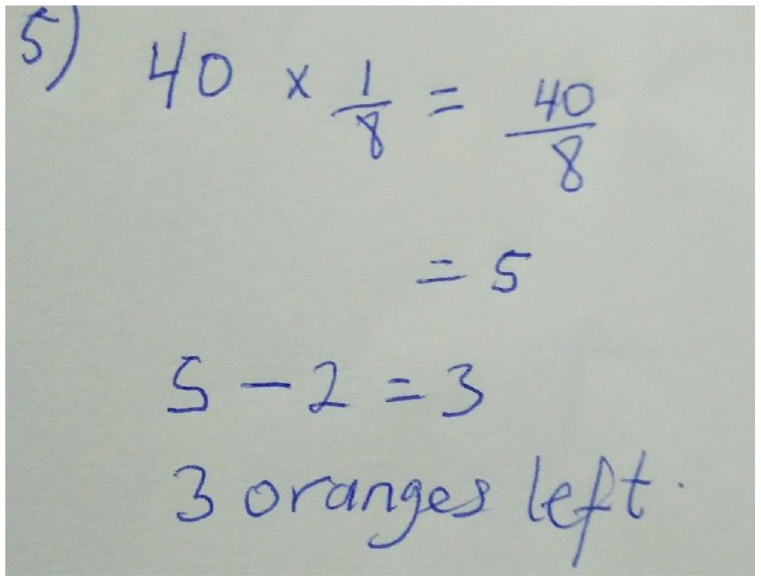
Evidence of learner’s process skill error.
In the same example, another learner got a negative 75 as the answer. So, we went on to ask how he got that answer. This is the conversation between the learner and the researcher:
Researcher: Can you please explain how you obtained −75?
Sir, I first tried to clear the fractions so I found the L.C.M. of eight and one and I got eight.
okay continue.
(laughed) And I worked it out to obtain
−75 oranges? How possible? Have you heard of a negative orange before?
(both laughed) No sir.
Evidence of how the learner solved the question is shown in Figure 6.

Evidence of learner’s process skills error.
In a similar fashion, from question 2: “Bodwoase D/A JHS 1 learners were given an amount of GH

Evidence of learner’s process skills error.
Reading errors were also identified as the fourth most common error the learners experienced. This error was identified when the learners were made to read the text. The data indicated that 18 (22.5%) of the high-achieving class and 61 (67.03) of the low-achieving class could not read the text properly. In the course of obtaining evidence for this error, it was realized that the learners could not pronounce most of the words in the text though most of the items were taken from their textbooks. For encoding errors, 26 (15.20%) of the learners from both the high-achieving and low-achieving were seen experiencing these errors. It was realized that about 27 (33.75%) learners of the high-achieving group and 15 (16.48%) of the low-achieving group were able to present their final answer although some of the learners had had some issues with their computations. Out of this number, 16 (20%) of the learners from the low-achieving class and 10 (10.98%) from the high-achieving class experienced this error.
This research question sought to investigate and understand the specific ways in which learners in different achievement levels approach and make errors in solving word problems. This research question aims to uncover patterns of mistakes and variations in problem-solving strategies between low-achieving and high-achieving learners. This is to help identify educational needs which includes designing instructional methods to improve educational outcomes.
Differences in error patterns between the low-achieving and high-achieving groups reveal significant insights. The low-achieving group struggled with basic computational skills, such as addition, multiplication, and division, leading to frequent miscalculations and errors in applying mathematical rules and symbols (see Figure 7). These learners expressed difficulties in adapting memorized formulas to new algebraic tasks, indicating a reliance on rote learning rather than conceptual understanding.
However, the high-achieving group demonstrated some level of proficiency in basic computational skills, with fewer errors related to fundamental arithmetic operations. Their understanding of the mathematical symbols and operations was better than their counterparts in the other group. Notwithstanding some them of were also identified to have been accustomed to memorization of formulas. This made them struggle to adapt their memorized strategies and formulas to some of the algebraic tasks presented to them. This was made known through some of the conversations between the researchers and some of the learners when the TAP was used to engage some of them in a conversation. The following are some of the conversations between the researchers and the learners:
Do you understand word problems?
No sir
Do you do well on word problems?
(shakes his head and replies) No
Why
They are very tricky and difficult
What makes it tricky and difficult?
Sir, they do not have one formula.
Can you explain that further?
Sir, it seems every task has its own formula; getting them is very tricky and difficult.
From the conversation, it is obvious that overreliance on memorization has caused the majority of the learners not to have a deep conceptual understanding of algebraic principles. Again, some may even arrive at correct answers without truly comprehending the underlying mathematical concepts, limiting their ability to transfer knowledge to new contexts. In addition, overreliance on memorization not only leads to rote learning but also makes them vulnerable to errors in unfamiliar situations especially when questions deviate from familiar scenarios (Zambak et al., 2023).
Another major setback for both groups was the misinterpretation of the problem statement. Learners in the low-achieving group had difficulty understanding the context, requirements, or relationships presented in word problems. This led to misinterpreting the information provided and, consequently, arriving at incorrect solutions. Errors in this group may stem from a deficiency in understanding fundamental mathematical concepts relevant to the word problems. For instance, learners may struggle with applying appropriate mathematical principles or formulas. However, the challenge was later identified as a result of their reading disability. More than half of the low-achieving group had reading difficulty. It is this notion that Intsiful and Davis (2019) recommend that mathematics teachers pay extra attention to the linguistic features in the study of mathematics. This is evident in the following vignettes:
Do you enjoy solving word problems?
No, please
why?
Sir, sometimes I do not understand some of the terms they use in the questions.
In another conversation with another learner, the following took place:
Do you find word problems challenging?
Yes (nods heavily and smiles)
Why?
“Sir when you read you do not know what the question is saying”
can you please explain further?
“Sir, reading and understanding what the question wants you to do is my major problem.”
These two conversations buttress the point that to assist learners to be effective problem solvers, attention must be paid to their reading skills and grounding them with enough vocabulary.
The high-achieving group had little or no problem in reading the text which was expected of them to have a better grasp of what is being read however they also had errors related to misunderstandings of core principles in solving the task. Most of them after reading the text properly did not know what strategy to employ to solve the problems read. This was also seen as a lack of effective strategies to help the learners translate the word problem into mathematical notation to solve.
These findings underscore the importance of addressing fundamental mathematical skills and effective problem-solving strategies in educational interventions. Strategies to improve reading comprehension and vocabulary skills are crucial for enhancing low-achieving learners’ ability to understand and solve word problems effectively. For high-achieving learners, interventions should focus on developing flexible problem-solving strategies that can be applied across various mathematical contexts. In conclusion, this research highlights the complex nature of error patterns in algebraic word problem-solving among learners of different achievement levels.
Discussion
The main purpose of this study was to unveil the types of errors exhibited by learners in solving word problems. Since learning and teaching go hand in hand (Borromeo Ferri, 2018; Atkinson, 2002) it is important to identify how learners think and the various understandings they have developed of a particular concept. The results from the study, analyzed using the NEA framework revealed several errors exhibited by learners in solving word problems. The results indicated that learners from both high-achieving and low-achieving groups experienced all five types of errors with the low-achieving class experiencing most of the errors. Reading and comprehension errors were made when learners failed to identify what the text items required of them. Transformation errors were also identified when the learners were expected to translate the text items into mathematical forms which best fit the demands of the question. Process skills errors and encoding errors occurred during the computation phase and when learners provided their final answers, respectively.
The most frequent errors observed were transformation errors, followed by comprehension errors, process skills errors, encoding errors and finally reading errors. This pattern aligns with the findings of Abdullah et al. (2015), Adu et al. (2015), and Suseelan et al. (2022). The findings are also in harmony with the claim by Jiang et al. (2020), which suggests that learners made a lot of transformational errors as a result of improper use of learned heuristics. In contrast, Raduan (2010) found that comprehension errors were the most frequent, likely due to the different types of word problems, the test items and the sample employed in Raduan’s study.
This study involved low-achieving and high-achieving learners in addressing non-routine word problems with high cognitive demands. Although low-achieving learners frequently have poor mathematical representational skills (Montague, 2014), it may be particularly very challenging for them to translate word problems into mathematical equations when not introduced to the use of proper heuristics (Xin et al., 2005).
Reading errors were the least encountered by both groups although 23 (46%) of the low-achieving class experienced this error. This finding is consistent with Abdullah et al. (2015) and Suseelan et al. (2022), who observed in their study that most learners could read the words and symbols but struggled to understand the problems’ demands, hence could not proceed with the subsequent stages to solve the problem. The numbers of the low-achieving class in terms of reading errors could be a result of limited vocabulary acquisition, dyslexia and other related factors. The implication of this finding is that the teaching of mathematics should go beyond the acquisition of some procedural skills. Mathematics teachers should support in development of the literacy skills of their learners so they have the facility for solving word problems.
The prevalence of transformation, process skills, and encoding errors over reading and comprehension errors suggests that learners’ content knowledge and mathematical proficiency were significant factors. Chan and Kwan (2021) found that learners’ content knowledge and reading skills impact their ability to solve word problems. Supporting this, Fuchs et al. (2021) linked transformation, process skills, and encoding errors to content knowledge, while reading and comprehension errors were linked to language proficiency (Lin, 2021; Singh et al., 2010). Therefore, the higher proportion of subject knowledge-related errors experienced by the learners in this study could be due to low proficiency in mathematical content knowledge, consistent with studies by Clements and Ellerton (1996) as well as Suseelan et al. (2022).
The findings from this study suggest that the challenges faced by the learners in this study, and by extension learners who struggle with solving word problems are not entirely mathematical but also, a language issue. Additionally, the linguistic features of these word problems can present challenges to learners. The significant challenges faced by learners in mastering algebraic concepts are evident from the types of errors they make. Addressing these issues requires targeted educational interventions such as reading and vocabulary skills (both everyday and academic language) support to improve learners’ reading skills. Also, the more traditional way of teaching problem solving focusing on the identification of keywords, “the word hunt approach” should give way to an approach that enables learners to make mathematical sense of these tasks. A teaching for conceptual understanding approach may help eliminate the focus on the surface features of the tasks thereby improving their comprehension skills.
Conclusion
In conclusion, this study aimed to explore the challenges faced by learners when solving algebraic word problems. Our findings have highlighted a spectrum of errors, with transformation errors emerging as the most prevalent. This challenge could be a result of the difficulty in reading and understanding what the task requires of the learners. Furthermore, the lack of effective strategies to assist learners in translating text items into mathematical equations was a significant challenge. As a result, the majority of learners struggled to achieve satisfactory grades when solving word problems. These findings underscore the need for targeted interventions and instructional strategies to address and rectify the root causes of this particular challenge. The Newmann Error Analysis Framework has provided a valuable lens through which to dissect and understand the multifaceted nature of these errors. Understanding these potential differences in detail can inform educators, curriculum developers, and policymakers about the specific challenges faced by different groups of learners, guiding the development of targeted interventions and instructional strategies to address these challenges.
Moreover, as we reflect on the implications of our study, it becomes evident that a holistic and integrated approach to algebraic word problem-solving is paramount. By recognizing and addressing the diverse array of errors highlighted in our analysis, educators can cultivate a more supportive learning atmosphere that nurtures both conceptual understanding and procedural fluency. Through targeted interventions and ongoing assessment, the educational community can collectively strive toward enhancing the proficiency of learners in tackling algebraic word problems, ultimately equipping them with the essential skills needed for success in mathematics and beyond. Finally, the researchers therefore recommend that further studies be conducted to help mathematics learners translate word problems into mathematical notations.?
Footnotes
Appendix
Acknowledgements
We acknowledge Solomon Essel a graduate student with the Department of Mathematics and ICT Education, UCC, for his support in preparing this manuscript.
Declaration of Conflicting Interests
The author(s) declared no potential conflicts of interest with respect to the research, authorship, and/or publication of this article.
Funding
The author(s) received no financial support for the research, authorship, and/or publication of this article.
Ethics Statement
This research was conducted following ethical guidelines and principles. The study protocol and procedures were reviewed and approved by the University of Cape Coast Institutional Review Board with an approval number of CES-ERB/ucc.edu/v6/22-62, ensuring compliance with ethical standards. All participants provided informed consent, and their anonymity and confidentiality were strictly maintained throughout the study. Any potential risks to participants were minimised, and the research was carried out with the utmost respect for ethical considerations

Data Availability Statement
Data sharing not applicable to this article as no datasets were generated or analyzed during the current study.