



Abstract
Notwithstanding the important role that agricultural services play in cocoa production, not much is known about the drivers of adoption intensity as well as the synergies between these services. This study seeks to fill this void by investigating the drivers of cocoa farmers access to essential agricultural services (ASs) in Sefwi Wiawso municipal of Ghana using cross-sectional data collected from 253 farmers. Multivariate probit (MVP) analysis was used to estimate the determinants of farmers’ access to these services, while generalized Poisson regression model was used to assess the degree of access. The research found that synergies exist between the ASs. Furthermore, factors such as years of education, household size, farm size, involvement in off-farm work, and revenue from cocoa cultivation drive access to ASs. The degree of access is influenced by sex, years of education, farm size, revenue from cocoa production, and the value of farm assets. Also, farmland ownership influenced both access and the degree of access. The study recommends enhancing collaboration between public and private agricultural service providers to improve access to ASs to boost cocoa production in Ghana. Other policy measures include incentivizing extension agents to reach more farmers and encouraging farmers to join farmer groups since these groups are important linkages between farmers and extension agents and researchers.
Plain Language Summary
The study investigated smallholder cocoa farmers'’ access and intensity of access to agricultural services, and the factors driving access to these services. The study included a cross section of 253 farmers from Sefwi Wiawso Municipal of Ghana in the analysis. A multivariate probit model was used to assess the determinants of access to agricultural services while a generalized Poisson regression model was used to estimate the determinants of intensity of access. It was observed that there were synergies between the services implying that having access to multiple services is expected to lead to improved farm performance. Agricultural extension service was the most accessed agricultural service, while the least accessed service was access to farm credit. Factors such as years of education, household size, farm size, involvement in off-farm work, and revenue from cocoa cultivation drive access to agricultural services. The degree of access is influenced by sex, years of education, farm size, revenue from cocoa production, and the value of farm assets. Also, farmland ownership influenced both access and the degree of access. The study recommends enhancing collaboration between public and private agricultural service providers to improve access to agricultural services to boost cocoa production in Ghana. Other policy measures include incentivizing extension agents to reach more farmers and encouraging farmers to join farmer groups since these groups are important linkages between farmers and extension agents and researchers.
Introduction
Ghana ranks second in terms of global cocoa production and export (Verter, 2016), with more than 800,000 households engaged in cocoa production, usually on a small scale. Cocoa is Ghana’s most important cash crop (Nimo et al., 2021) and has historically been the bedrock of the country’s economy, alongside gold. Ghana recently discovered oil, the export of which is expected to shift the dynamics in the country’s foreign exchange earnings. According to Asubonteng et al. (2018), the production of cocoa is a significant source of foreign exchange, accounting for around 13% of Ghana’s gross domestic product (GDP). Cocoa is also a major source of tax revenue (Aneani et al., 2017).
The importance of cocoa to Ghana’s economy has necessitated efforts by the government to support farmers with services such as agricultural extension, subsidized input supply, cocoa mass spraying exercise (CMSE), among others. These agricultural services (ASs) are intended to offer support to farmers to enhance production and sustain the production of the crop for national development. There are several arguments in support of government support services for agriculture and the cocoa sector in particular. First, most cocoa farmers are located in rural areas and lack several key agricultural services to enhance production. In addition, farmers are among the poor segments of the population and research shows that poverty levels are high among cocoa farming households in Ghana and Côte d’Ivoire (van Vliet et al., 2021). The provision of agricultural services such as agricultural extension is critical to enhance the knowledge and expertise of rural farmers who are typically less educated and lack the ability to read and write.
A wide range of organizations, including national research institutions and non-governmental organizations (NGOs), have over the years assisted cocoa cultivation in Ghana by providing them with essentials services such as credit, extension advice, disease control programs, among others. The Sustainable Tree Crop Programme (STCP), Conservation International (CI), and CARE International are among the non-governmental organizations that have worked closely with cocoa farmers in Ghana, while the Cocoa Research Institute of Ghana (CRIG), the Forestry Research Institute of Ghana (FORIG) and the Ministry of Food and Agriculture (MoFA) are some of the government research institutions providing several services to Ghanaian cocoa farmers.
The cocoa sector is a hugely important sector because of its contribution to foreign exchange earnings and the economy in general and therefore tends to receive considerable attention and support in the form of service provision and dissemination of technologies. This study was motivated by the recognition that even though agricultural services are critical in promoting cocoa production, farmers still lack access to these critical services which constrain output levels and does not allow rural farm households to come out of poverty.
Notwithstanding the important role that agricultural services play in cocoa production, not much is known about the intensity of adoption as well as the synergies between these services. Moreover, empirical studies on the drivers of cocoa farmers’ access to ASs remain limited. Most of the existing studies on cocoa farmers’ access to ASs have focused on a single service, without a focus on the intensity of access and the synergies that exist between the different services. For example, Falola et al. (2013) assessed the determinants of Nigerian cocoa farmers’ access to agricultural insurance while Anang and Kudadze (2019) investigated Ghanaian cocoa farmers’ access to the government-sponsored cocoa mass spraying exercise to control cocoa pests and diseases. In other studies, Lawal et al. (2009) investigated cocoa producers’ access to credit in Nigeria. In a similar study, Kehinde (2022) investigated cocoa farmers’ access to trade credit in Nigeria. Apart from Anang and Asante (2020) who investigated simultaneous access to agricultural services by farmers in Ghana, there is none that took into account the multiplicity of services that farmers are able to access to enhance their production, leaving a research gap that must be filled. Also, the study by Anang and Asante (2020) focused on rice production, whereas the current study focuses on Ghana’s key cash crop, cocoa. Hence, the uniqueness and relevance of this study cannot be overstated.
From the foregoing, the study seeks to access the drivers of cocoa farmers’ access to agricultural services in the Sefwi Wiawso district, as well as the determinants of intensity of access. As stated earlier, empirical evidence of the determinants of cocoa farmers’ access to ASs remains scant, especially in terms of the intensity of access, and this study is among the first of its kind to establish the synergies between these services. The study makes a major contribution to the literature on smallholder farmers’ access to multiple agricultural services and the synergies between these services which will help to guide AS provision to farmers.
The current study is important in several ways. First, the study will highlight the most accessed and least accessed agricultural services among cocoa farmers in order to guide policymakers on how to improve accessibility. Second, the study will highlight the synergies between these services to guide policymakers on how to effectively provide agricultural services as a bundle to derive maximum advantage. Third, the study will highlight the factors driving access and intensity of access, which are necessary to formulate strategies to promote access to ASs among cocoa farmers.
The study is organized in the following format. Section 1 is the introduction, while section 2 provides a brief literature review on agricultural support services. Section 3 provides information about the study’s methodology which covers the study area, sampling, method of data analysis. Section 4 presents the results of the study alongside a discussion of the major findings, while the conclusion and recommendations are covered in section 5.
A Brief Literature Review on Selected Agricultural Support Services for Cocoa Farmers
The case for public financing of agricultural support services for farmers is very crucial for low-income countries such as Ghana because of the importance of the agricultural sector and high dependence of rural farm households on agriculture for their livelihood. In most rural areas of Ghana, and other African nations, agriculture is the dominant occupation, hence success of the agricultural sector is linked intricately to overall economic wellbeing of the community and nation as a whole. This view has led to proponents arguing for national governments in Africa to devote a significant portion of their gross domestic product to agriculture to spur grow of the sector which is expected to have a rippling effect on other sectors such as the manufacturing and services sectors.
Cocoa production in Ghana was at its nadir in the early 1980s due to structural challenges in the economic front and natural disasters such as drought and bush fires. Support services to the agricultural sector has contributed to an upsurge in cocoa production in Ghana since that era. For example, in the early 2000s, the cocoa sector began to witness growth in productivity through the introduction of improved varieties, input subsidy and a free government-sponsored spraying program (Vigneri & Kolavalli, 2018). The cocoa high technology (hi-tech) program, and the cocoa and pest control program, known as CODAPEC have been credited for the growth of the cocoa sector in Ghana (Vigneri & Kolavalli, 2018). Through the hi-tech program, farmers have been provided with subsidized fertilizer and improved seeds to boost production. In the same vein, the public-sponsored free pest and disease control program has helped to reduce crop loss thus boosting output. We detail below some of the key agricultural support services for the cocoa sector which are intended to increase output and income of cocoa producers in Ghana.
Farmer-Based Organizations
In recent times, farmer groups have gained prominence due to their critical role in bringing farmers together and giving them a voice, while serving as a platform for peer learning and a source of critical agricultural information. Participation in farmer-based organizations is also anticipated to improve farmers’ access to other agricultural services. Farmers receive instruction and training from extension agents through these self-help groups, which has been demonstrated to positively impact technology adoption (Kassie et al., 2009). Farmers that organize into cooperative organizations have better access to information and education, which enhances their ability to receive agricultural inputs and services. The likelihood that a farmer will learn about and ultimately use vital agricultural services is increased by having a high level of social capital and membership in farmers’ organizations. An important source of knowledge on agronomic methods and distribution of cocoa production inputs among cocoa farmers in Ghana is licensed cocoa buying companies and cooperative societies. This underscores the crucial role of farmer groups in information dissemination which is essential to improve farmers’ access to agricultural services and improve productivity of farm households.
Agricultural Credit
Access to credit remains one of the most critical constraints confronting farmers in Ghana, and cocoa farmers are no exception. Credit enables farmers to expand the area under production by enhancing their capacity to acquire production inputs and pay for services such as land preparation and harvesting. Access to credit allows farmers to hire-in labor to carry out essential and time-bound production activities. Access to credit also enables farm households to acquire productivity-enhancing technologies to increase output and enhance farm profit levels. Most farmers in rural areas are averse to borrowing from formal institutions particularly commercial banks for various reasons such as high interest rates, stringent collateral requirements, as well as cumbersome and bureaucratic administrative procedures, thus relying on informal credit providers who usually charge higher interest rates and can only provide little amounts of credit. Also, there is the notion that financial institutions are less enthusiastic to extend farm credit to farmers. According to Anang and Asante (2020), a major reason why financial institutions are reluctant to lend to farmers is the inherent risks involved in farming. Studies further show that farmers’ credit worthiness is a key factor influencing access to credit and is affected by factors such as repayment and savings history, value of assets owned, social capital, and other socioeconomic factors (Asante-Addo et al., 2017; Chandio et al., 2020). In recent times, licensed cocoa buying companies (LBCs) have assumed an important role in providing credit to farmers as a way to lure farmers to sell to them after harvest. An effective and reliable credit market is therefore required to serve the needs of farmers to boost cocoa production in the country. However, as indicated earlier, not many farm households have access to credit to carry out their farm operations. According to Danso-Abbeam and Baiyegunhi (2017), 47% of Ghanaian cocoa producers received credit to support their farming activities. Measures are therefore required to enhance credit access among farm households in Ghana.
Agroforestry (AF) Training
In recent times, cocoa agroforestry adoption has gained prominence and assumed a key role in cocoa production due to changing weather patterns. Deforestation, rise in daily temperatures, incidence of droughts and flooding, and variation in rainfall intensity and patterns have all been linked to climate change and variability, compelling policymakers and scientists to devise measures to mitigate the effects of these climatic factors. Cocoa agroforestry has been described as beneficial to cocoa production. For instance, cocoa agroforestry has been shown to reduce the impact of climate change and land degradation (Kouassi et al., 2021), increase the productivity of cocoa (Amponsah-Doku et al., 2022), increase family income (Cerda et al., 2014; Paudel et al., 2019), and prevents deforestation (Wainaina et al., 2021). In recognition of these benefits of agroforestry, measures have been put in place by governmental and non-governmental organizations to train farmers on cocoa agroforestry. The notion is that training increases farmers’ level of competency, which invariably aids adoption of technologies and good agronomic practices in cocoa production. Training enhances farmers’ knowledge and sharpens their skills, thereby enhancing adoption of technologies as confirmed by Meenambigai and Seetharaman (2003).
Cocoa Mass Spraying Exercise (CMSE)
A major constraint facing cocoa farmers in the tropics is high incidence of pests and diseases due to high humidity and high average daily temperatures. As such, the control of pests and diseases is a major feature of cocoa production in the country with the state providing support service through the national CMSE. While technically every farmer is expected to be a beneficiary, logistical and administrative challenges make this impossible, with significant number of farmers not having access to this important service. Abdul-Hanan and Anang (2018) reported that 67.5% of Ghanaian cocoa farmers had access to the government spraying exercise. The authors identified sex, farming experience, household size, and access to agricultural extension as the factors affecting access to the mass spraying exercise. In another study by Anang et al. (2013), farmers’ expressed dissatisfaction with the program with 68.3% expressing dissatisfaction with the work of the spraying gangs. Also, the spraying regime was not followed, thus reducing the effectiveness of the exercise. However, a study by Duker and Sakpaku (2011) revealed that 78% of the respondents indicated that the spraying exercise led to an increase in their farm income. Despite the promising response, the study found that the exercise had some fundamental issues including insufficient supply of pesticides to the spraying teams, the absence of adequate spraying gang members to manage the program, political intervention, and organizational issues.
Agricultural Extension Services (AESs)
One of the most important services needed by farmers is agricultural extension services. This is due to several factors. First, agricultural extension workers have been trained with the requisite skills and possess the right technical knowledge to advise and assist farmers to raise farm productivity. Second, most smallholder farmers do not possess high level of education and often require the services of technical experts such as agricultural extension agents to facilitate their production and farm operations. Third, agricultural extension agents are the conduit between farmers and research institutions, hence their roles are critical to farmers in disseminating technologies to farmers and bringing feedback to research institutions to improve agricultural production. There is, however, a huge imbalance between the number of extension agents and the number of farmers they serve. The extension worker to farmer ratio of 1:1300 (McNamara et al., 2014) is very worrying, and calls for measures to improve access to extension services. The possibility that farmers will accept new farming methods increases as agricultural extension personnel visit farms more frequently. According to Kyere (2018), this is due to the fact that extension agents act as conduits for the dissemination of innovative agricultural techniques among farmers. Anang and Asante (2020) showed that years of farming experience and association membership are key factors influencing farmers’ access to agricultural extension services in northern Ghana.
Agricultural Insurance
A vital agricultural service but very limited in its adoption in Ghana is agricultural insurance. High risk exposure is a feature of agriculture especially among small-scale farmers in developing countries (Musonda, 2012). Farming can be risky due to natural disasters like droughts, floods, and pest and disease infestations (Kumar et al., 2011). Natural disasters like droughts are becoming major hazards to agricultural output and profitability. Consequently, a mechanism that uses risk management instruments like agricultural insurance to assist in lowering risks and uncertainties is required (Kumari et al., 2017). Farmers, however, have less access to risk management tools that are necessary to deal with unforeseen events and natural disasters when they arise (Rola & Aragon, 2013).
Agricultural insurance is a risk management strategy designed to balance agricultural risks and lessen the impact of natural disasters, particularly for small-scale farmers. Agricultural insurance is a crucial instrument for safeguarding agricultural revenue because it promotes farm investment, the use of technology, and the flow of financing in agriculture (Kumar et al., 2011). It insures farmers against unintended losses that may arise in their farming business, thus ensuring that farm risks are shared and not borne by only the farmers. While agricultural insurance has gained prominence in more advanced countries, the practice is still at the infant stage in most developing countries such as Ghana. Nyaaba et al. (2019) stated that 48% of farmers knew about crop insurance in Ghana’s Tolon district. The authors further indicated that incidence of pests and diseases was the foremost threat to agricultural production identified by the respondents. Such catastrophic events call for a vibrant agricultural insurance market to provide cover for farmers to avoid losing their source of livelihood when they encounter a disaster. A community’s vulnerability to climatic unpredictability and extremes increases with the degree to which its livelihood is dependent on the weather. Cocoa production relies on rainfall and thus dependent on the weather conditions, making it difficult to cope with climate variability (Cooper et al., 2008). A risk-management tool such as agricultural insurance is therefore critical to insure cocoa farmers against catastrophic weather events.
Input Subsidy
Another agricultural service beneficial to farmers is input subsidy, especially subsidy on agrochemicals and improved seeds. Agricultural input subsidies have gained prominence in the extant literature and are regarded as one of the most contentious development issues in Sub-Saharan Africa (Jayne et al., 2018). Input subsidies divide opinion among policymakers. One school of thought views input subsidies as necessary to encourage rural farmers to adopt improved technologies, particularly chemical fertilizer to increase productivity and reduce rural poverty (Dorward et al., 2008; Gautam, 2015). On the other hand, another school of thought views subsidy on inputs to be less effective in reducing poverty, costly in implementation, and a disincentive to existing domestic markets for these inputs (Morris, 2007). Input subsidies are also perceived to be bedeviled with abuse and corruption, and place a huge burden on developing countries’ economies. Notwithstanding these controversies, agricultural input subsidies remain popular among many African countries carrying out pro-poor development agendas (examples include Ghana, Malawi, Tanzania, among others). The most popular input subsidy program in Ghana is the Planting for Food and Jobs (PFJ) initiative which has recently entered into its second phase of operation (PFJ 2.0). Under PFJ, the government of Ghana provided subsidized fertilizer and improved seeds to farmers. In the cocoa sector, the cocoa hi-tech program is intended to enhance the adoption of chemical fertilizer and improved cocoa varieties to enhance productivity. This is because declining soil fertility has been identified as a key factor constraining cocoa production in Ghana. Through the hi-tech program, insecticides, herbicides, and fungicides are made available to farmers to help in pest control. However, just like other agricultural support services, the hi-tech program has its own challenges and many farmers are unable to access inputs under the program.
Materials and Methods
Study Area
The investigation was conducted in Sefwi Wiawso Municipality in Ghana’s Western North Region. Western North Region is one of the country’s top cocoa-producing regions. Sefwi Wiawso Municipal was chosen for the study because it is one of the most important cocoa-producing districts in the Region. According to Ghana Statistical Service (2021), the municipality has 151,220 residents, composed of 75,905 men (representing 50.2%) and 75,315 women (representing 49.8%), with a population density of 152.4 km2. The study area experiences year-round temperatures between 25 and 30 °C and yearly rainfall between 1,524 and 1,780 mm due to its location in the tropical rainforest climate zone. Rainfall peaks are in June-July and September-October, while humidity is relatively high, approximating 90% at night and 75% during the day. Agriculture is the main economic activity in the district, which is largely rural. For agricultural households in the municipality, cocoa cultivation is a major income source. Among the most commonly grown crops are maize, plantains, cassava, and cocoyam. Other significant economic activities in the region include trading and small-scale mining.
Sampling and Data Collection
We relied on Green’s (1991) sample size formula to arrive at the total number of respondents for the study. The formula indicates that the minimum sample size required for this investigation is
Method of Data Analysis
The Multivariate Probit (MVP) Model
A simple, binary probit model (Bliss, 1934) comprises a binary (dichotomous) dependent variable and associated explanatory variables. However, there are instances where a number of binary dependent variables are connected or correlated such that they must be estimated simultaneously. Under such situations, a multivariate probit (or logit) model becomes appropriate for the estimation. In this study, access to selected agricultural support services for cocoa farmers are determined simultaneously, and follow a multivariate framework, requiring a multivariate probit (MVP) for the analysis. Under this framework, a farmer may have access to a mix of services, and access to a particular service does not in any way make the farmer ineligible to access other services. Thus, each farmer may have different likelihood of access to each of the services. The validity of the MVP model is usually ascertained by examining the significance of the correlation coefficient for the analysis, where a significant value of the correlation coefficient indicates that the estimated equations are interrelated and thus must be estimated jointly.
The unobserved continuous variable

where

The likelihood of obtaining the outcome of interest is given as

where
The MVP model takes the following form

The empirical MVP model to be estimated is given as

where
Choice of variables for the study was predicated on the extant literature and a priori expectations. From the extant literature, certain socioeconomic, institutional and demographic factors have been highlighted to play critical roles in farmers’ access to services. For instance, Dontsop-Nguezet et al. (2016) and Kuwornu et al. (2017) highlight the role of sex in accessing ASs. Male farmers in rural farm households in developing countries typically have greater access to services. This is often explained by the patriarchal nature of most rural communities. However, Anang et al. (2016) showed that women farmers in northern Ghana had greater access to credit because lenders consider them to be more credit-worthy. Other factors highlighted in the literature to affect access to agricultural services include access to education (Gebrehiwot, 2015; Wossen et al., 2017), number of household members (Khonje et al., 2015; Sodjinou et al., 2015), farmers’ land area (Danso-Abbeam et al., 2018; Kuwornu et al., 2017), and number of years of farming experience (Bidzakin et al., 2018; Danso-Abbeam et al., 2018). Educated and more experienced farmers are expected to have greater access to services. This is because education enhances the ability of farmers to seek information, while experienced farmers are expected to be more knowledge about the existing service providers in their communities.
The Generalized Poisson Model
Count data refers to data where the dependent variable is a count, such as the number of services accessed by a farmer. The farmer faces a mix of services, and could access a range of the services depending on several factors. Several count data models exist, and their applicability is based on factors such as the dispersion of the count variable. Count data may exhibit equi-dispersion, under-dispersion, or over-dispersion, based on whether the mean of the count data variable exceeds the variance or not. Over-dispersion occurs when the variance of the count variable exceeds the mean. Poisson regression (Poisson, 1837) is one common approach used to analyze count data. Standard Poisson regression is suitable for data showing equi-dispersion (the variance equals the mean) but unable to deal with under-dispersed data, while the generalized Poisson (GP) model has the ability to handle under-dispersed data. Other forms of count data models such as the negative binomial, zero-inflated Poisson and zero-inflated negative binomial models are suitable when the data is over-dispersed. This study leaned toward the generalized Poisson model because the data demonstrates under-dispersion (Anang & Asante, 2020; Awuni et al., 2018; Harris et al., 2012). Estimation of the degree (or extent) of access to agricultural services is crucial especially because if the services are perfectly complementary, access to the total number is expected to exert a positive effect on farm performance.
Given that

where

where
The log-likelihood function of the GP model is presented as

The explanatory variables enter the regression model as follows (Consul, 1989; Consul & Famoye, 1992):

where
The empirical GP model is indicated in equation (10):

where
Results and Discussion
Description of the Sample
Table 1 presents a description of the sample. Majority of the respondents are male farmers with an average of 22 years of cocoa production experience and 8 years of formal education. This shows that the farmers have been engaged in cocoa production for a considerable period of time. The respondents had an average of 6 household members and cultivated an average of 6 acres of cocoa, with an average revenue of GH¢ 12,640 from cocoa cultivation. The farm sizes are relatively small for a commercial crop like cocoa, which highlights the peasantry of cocoa production in Ghana as well as other West African cocoa-producing countries like Cote d’Ivoire, Nigeria and Cameroon (Roldan et al., 2013). Cocoa production, which is the primary source of income for many households in developing countries, is centered on small farms that are no more than four hectares (Roldan et al., 2013). Close to half of the farmers engaged in off-farm activities to generate additional income, while about 82% of them cultivate cocoa on their own farms, with the rest being settler farmers or farmers operating on rented land.
Variable Description.

1.0 US $ = 5.9 Ghana cedi (GH¢) in 2021.
Cocoa Farmers’ Access to Agricultural Services
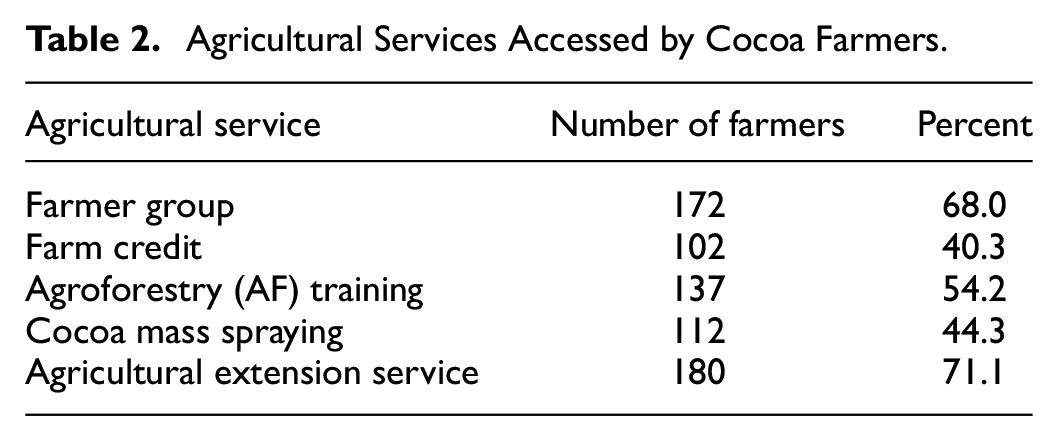
Table 2 depicts the frequency of access to each of the agricultural services included in the study. Agricultural extension was the most accessed service in the study area, followed by farmer-based organization membership. Extension agents help to extend technologies to cocoa farmers, while farmer groups help farmers to access inputs and other agricultural services such as credit and extension advice. The relatively high percentage of farmers having access to agricultural extension augurs well for cocoa farming as it is expected to enhance training and technology transfer to cocoa farmers to improve productivity and income from cocoa cultivation. This is supported by the finding of Attipoe et al. (2021) who observed a positive relationship between cocoa farmers’ participation in agricultural extension program, farm productivity and household income in Ghana. Training in agroforestry practice ranked third among the services accessed by cocoa farmers. Cocoa agroforestry is regarded as an important practice that has environmental, income and yield benefits (Amponsah-Doku et al., 2022; Kouassi et al., 2021; Wainaina et al., 2021). Mass spraying and farm credit were the least accessed services. Even though CMSE is a state-sponsored activity intended to cover all cocoa farms, not all farms are covered due to several challenges involved with implementation. Access to credit remains a general challenge for the agricultural sector, with lending to agriculture considered to be risky thus constraining access.
Agricultural Services Accessed by Cocoa Farmers.
Correlation Between the Agricultural Services Accessed by Cocoa Farmers
Table 3 presents the correlation matrix of the ASs accessed by Ghanaian cocoa farmers. According to Sharma et al. (2011), when the correlation coefficient is positive and significant, this indicates a complementary relationship between the two services (they are accessed together), while a negative sign indicates that the services are mutually exclusive.
Correlation Matrix of the Services Accessed by Cocoa Farmers.

p < .1. **p < .05. ***p < .01. Figures in parentheses are standard errors.
The results reveal that access to agricultural extension is positively correlated with all the other services. The finding is revealing as it indicates a complementary relationship between agricultural extension and the other agricultural services. What the findings imply is that enhancing cocoa farmers’ access to agricultural extension services is a key strategy to improve access to other agricultural services. Prioritizing agricultural extension service delivery and incentivizing extension agents to work in rural areas are therefore essential to promote agricultural production. In recent times, farmer groups have become a conduit for extending agricultural extension services and innovation to farmers, and belonging to one has been shown to have a positive relationship with access to extension service by Anang et al. (2020). The study further revealed that farmer group membership portrayed a positive association with access to credit and training in agroforestry, indicating a complementary relationship. This finding is also revealing as it buttresses the key role of farmer groups in promoting access to credit and farmer participation in agricultural training programs (Anang & Asante, 2020).
It is important to note that correlations above 0.5 are classified as high, while those between 0.25 and 0.5 are classified as medium, and those below 0.25 are low (Mensah-Bonsu et al., 2017; Sharma et al., 2011). Hence, the correlation coefficients for farmer group membership and farm credit, extension service and farm credit, as well as farmer group membership and extension service indicate medium correlation between these services. None of the agricultural services recorded a high correlation between them, which is reflective of the low level at which most agricultural services are provided to farmers. The correlations between extension service and AF training, farmer group membership and AF training, as well as extension service and mass spraying were all classified as low.
Factors Affecting Cocoa Farmers’ Access to Agricultural Services
Table 4 shows the estimates of the MVP model of the factors influencing cocoa farmers’ access to agricultural services. The significance of the likelihood ratio test (at 1% significant level) indicates that the five agricultural services are correlated and that the model is well fitted. We proceed to discuss the factors influencing access to each of the agricultural services.
Factors Affecting Cocoa Farmers’ Access to Agricultural Services.

p < .1. **p < .05. ***p < .01. Likelihood ratio test of rho21 = rho31 = rho41 = rho51 = rho32 = rho42 = rho52 = rho43 = rho53 = rho54 = 0: chi2(10) =39.041 Prob > chi2 = 0.0000.
Farmer Group Membership
Farmer groups and cooperative organizations are popular channels for reaching out to farmers in recent times due to the power of social capital and the strength in cooperative action. Farmer groups play important roles in information dissemination and technology adoption among farmers (H. Ahmed & Anang, 2019). The results reveal that belonging to a farmer organization is positively influenced by years of formal education, own cultivation and revenue from cocoa production but negatively associated with the second-order term of the farm size variable. Education enhances farmer’s knowledge and awareness of the benefits of social groups and could enhance the decision to join farmer groups. According to Wollni et al. (2009), literacy enhanced the probability of Honduran farmers to join groups. Similarly, Addai et al. (2014) observed that education enhanced the propensity of farmers to join farmer groups in Ghana. The results also highlight the role of farm revenue in group membership. It may be argued that farmers with high income from cocoa production may be willing to engage in groups as a form of social capital and could be able to meet the obligations associated with group membership. Also, farmers who cultivate their own farms may be indigenes with social ties who may be desirous to join social groups such as farmer associations as a form of social capital.
Access to Credit
Credit is an essential service needed by farmers to make critical farm investments. The results indicated that revenue from cocoa production and access to credit were positively correlated. This is in sync with the findings of Anang and Asante (2020), who showed that household income correlated positively with access to ASs such as provision of credit, irrigation, and fertilizer input subsidy among Ghanaian farmers. Also, access to credit initially decreased with farm size, but increased with its quadratic term. This is most likely explained by the fact that farmers with larger farms may have greater access to farm credit because of the possibility to provide the needed collateral. Also, farmers producing on a large scale have much greater need for credit, hence more likely to push for credit facilities. Lending to farmers with larger farms may also be more appealing to commercial entities, which may boost the chance of large farm operators to access credit.
Agroforestry Training
Participation in agroforestry training increased with farm size, value of farm assets and revenue from cocoa production. It however decreased with household size at 10% significant level. Farmers with larger acreages are more likely to participate in cocoa agroforestry training in line with expectation. This is because cocoa farmers with very small farms may not be motivated to plant shade trees, unlike when the farms are large and can accommodate more shade trees. According to A. U. Ahmed et al. (2016), farmers with larger acreages are less risk-averse, hence more willing to experiment with innovative technologies such as agroforestry. Also, farmers with greater farm assets are anticipated to be relatively more resource-endowed hence more likely to embrace agroforestry training while richer cocoa farmers are more likely to receive agroforestry training due to their social ties and influence as opinion leaders. A similar finding was reported by Anang and Asante (2020), who found that access to ASs such farm loans, irrigation, and fertilizer input subsidies in northern Ghana was positively related to household income. The study, however revealed a lower participation in agroforestry training for larger households, a result supported by Adeyanju et al. (2021) in their study on engagement of Nigerian youth in agricultural training programs.
Participation in Cocoa Mass Spraying Exercise
Access to CMSE increased with household size, participation in off-farm work, revenue from cocoa production, and farmer being male. In a typical rural setting, men usually have greater access to resources and higher propensity to engage in agricultural programs compared to their female counterparts partly because of the patriarchal nature of most farming communities in Ghana. The findings are supported by a study by Abdul-Hanan and Anang (2018) which showed that male farmers had higher participation in the CMSE in Ghana. With regards to household size, the result suggests that having more household members correlates positively with participation in CMSE. Also, farmers who engage in off-farm work have a higher propensity to benefit from CMSE. Furthermore, farmers with higher income from cocoa production have a higher propensity to have their farms sprayed under the mass spraying exercise. Usually, richer farmers have social ties in the community and are well-known and may be opinion leaders who are well acquainted with extension officers and spraying gang leaders, hence more probable to get access to ASs including CMSE. The outcome is consistent with Anang and Asante's (2020) research, which showed that household income in northern Ghana was positively correlated with access to agricultural services.
Access to Agricultural Extension Service
Access to agricultural extension service had a positive relationship with years of education, own cultivation, and revenue from cocoa production. The result suggests that more educated cocoa farmers have a higher likelihood to access agricultural extension services. The outcome is anticipated because schooling improves farmers’ reading and writing abilities, as well as their ability to search for information. The outcome is consistent with Wossen et al.'s (2017) conclusion from their investigation in Nigeria. The study also shows that farmers who cultivated their own land have a higher likelihood to receive agricultural extension services. A possible explanation for this is that farmers who cultivated their own lands may be indigenes who have social ties and are better known in the community and acquainted to extension workers. The results further reveal that farmers with higher cocoa revenue have a higher likelihood to access extension services. This result is expected because richer farmers have social ties and are better known and well acquainted with extension workers, and therefore more likely to access extension services. The finding is in sync with that of Anang and Asante (2020), who found that access to ASs in northern Ghana had a positive relationship with household income.
The Degree of Access to Agricultural Services by Cocoa Farmers
Table 5 depicts the degree of access to agricultural services in the study area. The degree or extent of access was measured as the number of services accessed in tandem by the farmers during the crop year. About 32% of the respondents accessed three services at a time, followed by 23% of them who accessed two practices. Also, close to 20% accessed four services, 14.6% accessed a single service, while 9.9% had no access to any of the five agricultural services. It is revealing that no farmer was able to access all five agricultural services in the study area. Also, even though minority of the farmers could not access any of the services, this is of great concern to cocoa production because of the critical role agricultural services play in promoting access to inputs, farm yield, income and rural livelihoods (Anang & Asante, 2020). There is therefore the need for effective collaboration between government agencies and other stakeholders responsible for the provision of these services to ensure that farmers are adequately served.
Extent of Access to Agricultural Services by Cocoa Farmers.

Factors Influencing the Degree (Extent) of Access to Agricultural Services
Table 6 provides empirical estimates of the factors influencing the extent of cocoa farmers’ access to ASs. As indicated previously, the mean of the response variable exceeds the variance implying that the data exhibits under-dispersion which warrants the use of the generalized Poisson (GP) model since the standard Poisson model cannot deal with under-dispersion. Furthermore, the dispersion parameter in Table 6 is less than zero, implying a rejection of the null hypothesis of equi-dispersion. We therefore estimated a GP model in line with Anang and Asante (2020) and Awuni et al. (2018) and present the standard Poisson model as a comparison.
Factors Influencing the Extent of Cocoa Farmers’ Access to Agricultural Services.

p < .1. **p < .05. ***p < .01.
Sex was a significant determinant of the extent of access to agricultural services, with female farmers having greater access to services. What the result suggests is that agricultural services are reaching more female farmers than their male counterparts. This is a positive development since women farmers are generally considered to be less resource-endowed in most patriarchal societies. In a study that supports the finding of this research, Anang et al. (2016) showed that in northern Ghana, credit access was higher for female rice farmers compared to their male counterparts. This was attributed to credit-worthiness of women farmers.
The extent of access to agricultural services by cocoa farmers increased with years of formal education of the farmer, as expected. Educated farmers who can read and write tend to have more information about innovations and services provided by governmental institutions, which can enhance their access to services and participation in programs. The study’s finding agrees with that of Anang and Kudadze (2019), who showed that educated farmers were more likely to participate in Ghana’s fertilizer subsidy scheme.
The degree of access to agricultural services increased at a decreasing rate with farm size. This portrays a nonlinear relationship and means that an initial increase in farm size increases the degree of access to agricultural services, while beyond a certain threshold, further increases in farm size result in a less than proportionate increase in the degree of access to ASs. The result is expected because farmers with larger acreages are considered “better-off” households while land-less households tend to be less-endowed. In most farming communities, “better-off’ households are anticipated to have greater access to services like credit, extension, and participation in training programs.
The results further indicated that the degree of access to agricultural services was higher for farmers who owned and cultivated their own farms compared to settler farmers or farmers who rented their farmlands. Thus, the form of land tenure system correlates with cocoa farmers’ access to agricultural services. Farmers who own and cultivate their own farms are more likely to be indigenes whose social ties and informal relationships in the community could predispose them to greater access to agricultural services. Usually, tenant farmers and non-indigenes do not have such strong social ties and may be disadvantaged when it comes to access to agricultural services.
The extent of access to ASs also correlated positively and significantly with revenue from cocoa production (at 1% level of significance) and the value of farm assets (at 10% level of significance). In other words, farmers with higher income from cocoa production tend to have greater access to ASs, the same as those with higher total farm assets. This suggests that being a wealthier farmer is likely to lead to greater access to agricultural services, all things being equal. The results align with the outcome reported by Anang and Asante (2020), who showed that smallholder farmers’ access to farm credit, irrigation and input subsidy correlated positively with the level of household income.
Conclusion and Recommendations
The study assessed smallholder farmers’ access to agricultural services and the degree of access, using cross-sectional data from northern Ghana. The study’s novelty is in the examination of multiple services as opposed to most of the previous studies that focused on access to individual services. The study found that smallholder farmers accessed a multiple of ASs in order to improve their farm performance. Most of the ASs complement each other implying that the use of multiple ASs is expected to enhance farm performance. The most accessed agricultural services were those provided by agricultural extension agency and farmer groups. The study also identified a gender dimension in access to services with women farmers more likely to access multiple services compared to men. Similarly, access to ASs was related to income level, with high-come farmers more likely to access ASs, whether as individual services or a bundle of services.
Based on the findings of the study, it is recommended that efforts should be made to improve smallholder farmers’ access to agricultural services. In particular, farmers need a multiple of services to enhance farm performance due to the complementarity between the services. Due to this complementarity, there is the need for greater collaboration between government agencies responsible for the delivery of these services to ensure that farmers are adequately served. Furthermore, stakeholders such as non-governmental organizations engaged in providing agricultural services to farmers should collaborate with other agencies, especially the public institutions, to improve service delivery to farmers.
With regards to specific policy measures, the study recommends that extension agents should be incentivized and adequately resourced to be able to visit more farmers as well as increase the number of visits to help farmers improve their farm performance. Farmers should also be encouraged to join farmer groups since these groups are important linkages between farmers and extension agents and researchers. Similarly, there is the need to train more farmers on agroforestry and other agronomic practices to enhance cocoa production in Ghana. In addition, it is crucial to increase smallholder farmers’ access to cocoa mass spraying exercise and farm credit to enhance farm performance.
Recommendations for Future Research
In terms of recommendations for future studies, we recommend that further studies should be carried out using a larger sample size, considering that this study used a small sample size. Also, future studies should consider a wider geographical area to shed more light on access to agricultural services in different geographical zones. In addition, a gendered analysis of access to services is essential to guide policy makers on agricultural services provision that accounts for gender.
Footnotes
Acknowledgements
The authors acknowledge the hardworking farmers who participated in the study and offered useful information to make the study possible. We are grateful for the time they spent to answer our questions and the patience they exercised during the interviews.
Declaration of Conflicting Interests
The author(s) declared no potential conflicts of interest with respect to the research, authorship, and/or publication of this article.
Funding
The author(s) received no financial support for the research, authorship, and/or publication of this article.
Ethics Statement
Not applicable

Data Availability
Data for the study is available upon request from the corresponding author.