




Abstract
In sub-Saharan African countries, rice is grown through different rice farming systems (RFSs). Despite the growing interest of policymakers and significant research in ensuring sustainable rice production, little is known about the factors that underline the choice of the different RFSs. This study empirically examines key determinants of RFSs choice with Côte d’Ivoire, a case study, where three rice production systems are distinguished. Considering that farmers can make multiple choices, we use a Multivariate Probit model. Data were collected from 588 rice farmers randomly sampled in seven rice areas. The results show that the determinants of the choice of RFSs vary from one production system to another. More specifically, land tenure, presence of an irrigation system, intercropping system, access to extension services, membership in a rice farmers’ organization, access to credit, paddy rice marketing, rice farm size, farming experience, off-farm income, gender, and household size influence the choice of the different RFSs. Our results suggest increasing investment in irrigation infrastructure, strengthening technical and organizational support to rice farmers, and defining guidelines for the intercropping system.
Keywords
Introduction
In sub-Saharan Africa (SSA), in addition to being a food commodity of strategic significance for food security and social stability, rice is a food crop that generates income and contributes to poverty alleviation. Therefore, in SSA countries, rice is a pivotal commodity to achieve the two first goals of the Sustainable Development Goals (SDGs) entitled “No poverty” (SDGs 1) and “Zero hunger” (SDGs 2). Rice consumption in this region is increasing faster than any other food commodity, and the rice demand growth rate is the fastest one in the world (Arouna, Fatognon, et al., 2021). The rapid growth of the population and the change in dietary preferences are the main reasons for the rising demand for rice. However, local rice production in SSA is failing to meet the increasing demand of the population (Arouna, Devkota, et al., 2021). This makes SSA countries, including Côte d’Ivoire, major rice importers to fill the gap in rice consumption demand.
In Côte d’Ivoire, despite the new commitment of policymakers in the aftermath of the 2007 to 2008 global food crisis, the local rice production struggles to keep pace with national consumption demand. The productivity level of paddy is commonly pointed at as one of the reasons. Although the country’s average paddy yield (2.79 t/ha) in 2020 was slightly higher than that of the entire SSA region (2.28 t/ha), it remains low compared to the world average (4.61 t/ha in 2020; FAOSTAT, 2022). Paddy rice production in Côte d’Ivoire, like in SSA countries, is mainly grounded on three Rice Farming Systems (RFSs) (Dossou-Yovo et al., 2020; Futakuchi et al., 2021; Tanaka et al., 2017). The Rainfed Upland Rice Farming (RURF), the Irrigated Rice Farming (IRF), and the Rainfed Lowland Rice Farming (RLRF). In RURF, rice is cultivated without soil surface flooding, under crop rotation systems with other crops (Saito et al., 2018). Shifting cultivation and slash-and-burn cultivation of fallow land or new clearings are carried out with rudimentary tools. Upland rice farms are exposed to climatic hazards (especially drought). For IRF, rice is grown in the areas where lands are developed for rice cultivation. In these areas, water is totally or partially controlled. Hydro-agricultural dams, diversion from rivers (construction of the main river bed with diversion channels), and tube wells are the primary sources of water in this production system. The rainfed lowland rice is cultivated in floodplains by rivers, without water control. Therefore, droughts and floods are potential threats to this rice production system. Compared to the two other production systems, the irrigated production system is the most intensive in capital and inputs (Ouattara et al., 2020; Zenna et al., 2017) and also in water (Nawaz et al., 2022; Thapa & Rahman, 2021). Concerning the rainfed upland rice production, it accelerates deforestation and soil erosion (Zenna et al., 2017).
A number of studies have assessed the sustainability of these RFSs (Arouna, Devkota, et al., 2021; Devkota et al., 2019; Roy et al., 2014, 2016). This sustainability assessment is mainly based on the “Standard for Sustainable Rice Cultivation and Performance Indicators (PIs)” developed by the Sustainable Rice Platform (SRP, 2020). For instance, Arouna, Devkota, et al. (2021) have quantified five sustainability PIs (grain yield, labor productivity, net profit, and nitrogen (N) and phosphorus (P) use efficiencies) of the SRP to compare RFSs in 12 SSA countries, including Côte d’Ivoire. These different studies have classified the IRF as the most sustainable among the three production systems (Arouna, Devkota, et al., 2021; Roy et al., 2014, 2016).
Furthermore, studies on paddy yields from the three RFSs in SSA, including Côte d’Ivoire, have reported better paddy rice yields in IRF than the other two RFSs (Dossou-Yovo et al., 2020; Tanaka et al., 2017). For example, in 20 SSA countries, including Côte d’Ivoire, Dossou-Yovo et al. (2020) reported average paddy rice yields of 3.8, 2.6, and 1.7 t/ha in IRF, RLRF, and RURF, respectively. Likewise, the findings of Niang et al. (2017) in West Africa, including Côte d’Ivoire, concur with studies in SSA. Some reasons probably explain the highest yield in IRF over the other two RFSs (Futakuchi et al., 2021; Ouattara et al., 2020): (1) the uptake rate of High-Yielding Varieties (HYVs) and other agricultural inputs such as fertilizer in IRF is higher than the other production systems, (2) most technologies and genetic materials have been designed for the benefit of IRF, and (3) face to climate change such as droughts and floods, this production system is more secured. Besides, two production cycles per year can be achieved in IRF. Researchers, practitioners, and policymakers are all unanimous that IRF is the one that can contribute the most to meeting the increasing demand for rice, especially in developing countries.
Yet, rainfed upland and rainfed lowland rice productions are still predominant in SSA countries. In Côte d’Ivoire, rainfed upland rice production is even the most widespread. For example, upland rice accounted for 72% of cultivated areas and 28% for the other two production systems in 2016 (Saito, Touré, et al., 2019). The country has the largest upland rice area in Africa (Diagne et al., 2013; Saito et al., 2018). Meanwhile, paddy yields reported in the upland rice cultivation by many studies are less than 2 t/ha (Saito et al., 2018). The low paddy yield levels in SSA countries, particularly in Côte d’Ivoire, are principally explained by the large share of the rice area cultivated in low-yielding rice production systems. Therefore, the concern raised by this research is the following. What are the main factors that guide rice farmers regarding the choice of RFSs in SSA, singularly in Côte d’Ivoire?
Despite the growing interest of policymakers and significant research to ensure sustainable rice production in SSA, including Côte d’Ivoire, little is known about the factors that underline the choice of RFSs. Most previous studies carried out in SSA, including Côte d’Ivoire, have either focused on the paddy yields and its variation in the three RFSs (Dossou-Yovo et al., 2020; Niang et al., 2017; Tanaka et al., 2017) or on the adoption of inputs and technologies (Arouna & Akpa, 2019; Saito, Touré, et al., 2019; Saito, Vandamme, et al., 2019; Tsujimoto et al., 2019). Some studies have assessed the potential resources for rice production, characterized the RFSs, and provided an overview of the challenges and technical opportunities in developing RFSs in SSA (Balasubramanian et al., 2007; Defoer et al., 2004). Other studies have also assessed rice self-sufficiency (Arouna, Fatognon, et al., 2021) and rice production sustainability in SSA (Arouna, Devkota, et al., 2021), including Côte d’Ivoire. Few studies like that of Ozaki and Sakurai (2020) have focused on the determinants of the choice of RFSs. Ozaki and Sakurai (2020) identified the determinants of upland rice cultivation in Madagascar using a binary econometric model. However, this empirical study is limited to a single rice production system (RURF). Thus, it seems rather complex and inappropriate to extrapolate these results or even less to limit research on the determinants of the choice of RFSs to the previous studies’ conclusions. Further empirical research, in a context with more than one RFS as in Côte d’Ivoire, and taking into account that rice farmers’ decisions to choose one of these production systems are inherently multivariate could be relevant.
We carry out this study in the context of Côte d’Ivoire. The RFSs mentioned above all contribute to local rice production and are essential for producers’ livelihoods. These rice producers are smallholder farmers estimated at two million (NRDS, 2012). They practice family agriculture with rice plots averaging around 1 ha (Ouattara et al., 2020). Rice farming constitutes a reliable source of food and economic activity for these smallholder farmers. The determinants of the choice of RFSs remain poorly understood in SSA countries in general, and particularly in Côte d’Ivoire, despite the implementation of policies to boost rice production in this region (Arouna, Fatognon, et al., 2021; Demont, 2013). Through this study, we contribute to this gap by empirically examining the key determinants of the choice of RFSs. The results of this research could serve as a decision basis for policymakers in the design of rice development policies and rice production technologies aimed at promoting sustainable rice production in Côte d’Ivoire and, more broadly, in SSA. Our study uses an econometric analysis based on the Multivariate Probit model (MVP). By applying this econometric model, we capture at the same time the influence of all the explanatory variables on each of the different RFS choices while considering the probable correlations between the unobserved disturbances and the interactions concerning the choices of these different rice production systems (Tarekegn et al., 2017).
The remainder of the study is structured as follows. First, the studies on factors influencing the choice of agricultural or cropping systems and practices are reviewed. Second, the methodology used in this study is exposed. Third, the results followed by the discussion are presented. Fourth, we conclude the study and provide policy implications and recommendations based on the findings.
Literature Review
The existing literature regarding the choice of cropping systems and practices in general shows that several factors determine farmers’ decisions. These earlier studies, which have been carried out for the most part in developing countries, can be broadly grouped into two parts. One strand of studies has analyzed the determinants of the choice of crop varieties, while a second strand has analyzed the determinants of the choice of crops and cropping adaptation strategies in response to climate change.
In line with the first strand, Greig (2009) investigated crop choice factors and assessed decision-making between subsistence and commercial farmers in Tanzania. The results showed that seasonality, water availability, machinery availability, crop marketability, and potential profit determine the choice of crops. Moreover, the author found that commercial farmers were more oriented toward the economic aspects of the crop, while subsistence farmers were more oriented toward the taste of the crop. In Ethiopia, Asrat et al. (2010) used the random parameter logit model to identify farmers’ preferences for major cereal varieties (teff and sorghum). The results revealed that yield stability and environmental adaptability are significant attributes for the choice of crop varieties. Furthermore, the authors reported that resource endowments such as land and livestock, farming experience, and access to extension services influence farmers’ preferences of crop variety. Using the Seemingly Unrelated Regression model, Yang et al. (2017) reported that ethnicity, farmland altitude average, labor productivity, family size, and yield are factors that influence the planting of two rice varieties (red rice and hybrid rice) in Yuanyang county, Yunnan Province. For their part, Appau et al. (2020) applied the multinomial logit model to investigate the determinants of Tobacco crop production in three African countries (Malawi, Kenya, and Zambia). The results show that the perceived economic viability and access to markets are determinants of tobacco production. In the same vein, Talukder et al. (2020) examined the factors influencing tobacco production in Bangladesh using two-level logistic regression. The authors found that age, education, market access, access to credit, and profits from tobacco crop are factors that shape farmers’ decisions in tobacco production. In Madagascar, Ozaki and Sakurai (2020) identified the determinants of upland rice cultivation using a binary Probit model. Their results showed that the availability of upland, the lack of irrigation in lowland, weather-related risk in lowland, French literacy of household, and the opportunities of non-agricultural earning determine the choice of the upland rice production. In Mozambique, Ismael et al. (2021) used cluster analysis to classify rice farming systems in four typologies: the subsistence farming system, specialized rice farming system, mixed crops farming system, and rice–livestock farming system. Then, using the multinomial logit model, the authors found that age, resource endowments, and labor availability are the determinants of the choice of these different farming systems. In Nepal, Thapa and Rahman (2021) investigated the determinants of crop choice in irrigated agriculture. The results showed that the determinants of crop choice are age, crop marketed, crop intensity, and some irrigation system-level variables (tail-section of the irrigation system and size of the irrigation sources). A significant influence of irrigation and extension services on crop choices was also reported in Tajikistan (Buisson & Balasubramanya, 2019).
According to some studies, the investments required by the crops are also decisive in the choice of a crop. Along these lines, Porgo et al. (2018) showed that faced with credit constraints, farmers in Burkina Faso allocate more land to crops requiring lower fertilizer investments, notably sorghum and millet, at the expense of those requiring high fertilizer investments (maize and cotton). Using a random parameter logit model, Aravindakshan et al. (2021) quantified farmers’ preferences for the intensification of cropping systems in Bangladesh. The results revealed that farmers prefer crops requiring low irrigation and investment rather than those requiring high irrigation and investment. Researchers also mentioned that crop choice is an important factor in intercropping (Panda et al., 2020). In other words, the intercropping system can determine the choice of crop. Some authors support that the intercropping system provides a number of advantages (Maitra et al., 2019; Shah et al., 2021).
In accordance with the second strand, Doumbia and Depieu (2013) found that faced with the challenges of climate change, rice farmers in the rainfed upland rice system choose other rice varieties or other food crops (cassava, maize, yam, or plantain) at the expense of rice crop in the Center-West of Côte d’Ivoire. These authors also found that rainfed upland rice is mostly grown by women in this part of the country. Furthermore, the binary Logit model results showed that factors such as experience in rice farming, age, and early sowing influence rice farmers regarding the abandonment of rice cultivation for the benefit of other crops. Kinuthia et al. (2018) identified the factors influencing the choice of cropping strategies or practices in the face of climate change in Narok East Sub-County, Kenya, using the multivariate Probit model. The econometric model results showed that age, household size, education, land tenure, mean annual rainfall and onset of rains, and weather information were significant determinants in the choice of the strategies. Likewise, using a multivariate Probit model, Nyang’au et al. (2020) assessed the determinants of the choice of climate-smart agriculture practices in Masaba South Sub-County, Kisii, Kenya. They found that access to credit, household size, farm income, perception of climate change, farm size, extension services, social group membership, education, and weather and climate information are the determinants that influence farmers’ choices in this region of Kenya. Eshetu et al. (2021) identified the determinants of the choice of adaptation strategies to climate change in Southwest Ethiopia using a binary logit model. Factors such as education, age, farm size, coffee income, formal extension services, and agro-ecological setting were reported to influence farmers’ decisions. In Nigeria, Anugwa et al. (2022) investigated rice farmers’ preferences for climate-smart agricultural technologies using a binary Probit model. The authors found that explanatory variables such as age, gender, education, access to credit, farm size, extension services, and social group membership are significant determinants of farmers’ choices.
Following this review, factors that influence the choice of cropping systems and practices could be classified into four categories: Household and farm, environmental, economic, and institutional factors. However, despite extensive and relevant literature, a lack of consensus emerges regarding the factors that influence the choice of crops. The difference in the findings of empirical literature might be related to the crop or the local context. There is also a lack of research on the determinants that could drive farmers to choose between the different RFSs, despite being the same final product whatsoever the production system. The present study enriches the existing literature as follows. First, it is one of the first studies that investigates the determinants of the choice of the three major RFSs in SSA, especially in Côte d’Ivoire, using this econometric approach. Second, by using primary field research data collected from a key actor (rice farmers) in important paddy-producing areas in Côte d’Ivoire, this study undoubtedly best reflects rice farmers’ preferences regarding the rice production systems. Indeed, smallholder farmers’ point of view is significant since agricultural policies and technologies are mostly designed for them, and they are the end-users of these technologies. Therefore, their behaviors could be a determining factor in the success of all innovations.
Research and Data Analysis Method
Justification of the Study Areas Choice and Sampling Method
Since the 2007 to 2008 world food crisis, Côte d’Ivoire rice policy has been redefined. Indeed, the rise in rice prices during the global food crisis has caused economic instability and social unrest in several SSA countries, particularly in Côte d’Ivoire. In the aftermath of this crisis, several SSA countries, including Côte d’Ivoire, made a commitment to improving rice production by adopting documents entitled “National Rice Development Strategy (NRDS)” (Arouna et al., 2021). As part of the implementation of the NRDS, the state-owned institution (National Rice Development Agency [NRDA]) in charge of promoting the rice sector has divided the country into 48 rice-growing areas. Consistent with this policy, seven rice strongholds were selected (Figure 1). Agriculture is the main economic activity of rural households, and rice production is important in these areas (FAO, 2019). More precisely, Korhogo, Yamoussoukro, Katiola, and Sakassou are in medium rice production areas, whereas Daloa, Man, and Gagnoa are in high rice production areas (NRDS, 2012). Furthermore, significant rice development projects have been implemented in these regions.

Map of the study area.
Our study relies on cross-sectional data collected from a sample of rice farmers during a field survey with a structured questionnaire (see Supplemental Material). More specifically, questions were related to (1) Household characteristics, (2) Rice farm characteristics, (3) Labor and production equipment, (4) Capacity building and environmental resources, and (5) Sources of income and agricultural credit. To form a representative sample, we used a two-stage sampling technique to select rice farmers in the study areas. In the first stage, we selected three villages in each study area. The intensity of rice production, as well as accessibility, were the main factors underlying the choice of villages. In the second stage, rice farmers were randomly sampled using lists of rice farmers from each village. Due to the lack of a national database of rice farmers, we relied on master lists provided by extension structures and rice farmers’ associations. Using Yamane’s formula (Yamane, 1967), the sample size for this study was estimated at 600 rice farmers. However, after removing invalid questionnaires, such as missing key variables and severe inconsistencies, 588 valid questionnaires were used. Sampling details are provided in Supplemental Material.
Theoretical and Analytical Framework
The theoretical background of this study relies on the neoclassical microeconomic theory. This theory postulates that economic agents make their decision to maximize their utility. Therefore, the random utility model is used to conceptualize the choice of rice production system that a rice farmer makes. We postulate that the choice of producer (i) between (j) choices procures the latter with a certain level of utility (

This study uses the MVP model to identify the determinants of the RFSs choice. This model was developed during the 2000s to analyze multiple choices (Aurier & Mejia, 2014). Unlike the multinomial Logit and Probit models, which assume that utility maximization results in a single choice among available alternatives (categories), the MVP model assumes multiple choices. Indeed, observation of behavior shows that the choices are often of multiple types. Viz, an individual can choose two, three, or more units within the existing categories. For example, in the present case, a rice farmer can simultaneously choose two or three rice production systems during an agricultural season. Based on the empirical studies reviewed (Nyang’au et al., 2020; Tarekegn et al., 2017), the MVP is used to jointly estimate several correlated binary outcomes. The functional form of the MVP model is specified as follows:

Where

In the multivariate model, where the choice of several rice production systems is possible, the error terms (

Where
Empirical Specification of the Econometric Model and Variables
In the current study, we have three equations with the following dependent variables: RURF

Where
Table 1 summarizes the variables (dependent and explanatory) used in this study. Following the previous studies, we grouped the explanatory variables into three components: The first category includes household and farm characteristics, the second one concern the institutional and environmental factors, and the third one refers to economic factors. Access of rice farmers to agricultural credit is used as a proxy for the extent of paddy rice production costs or investments since in Côte d’Ivoire, credit for rice cultivation is also provided directly in the form of inputs (Ouattara et al., 2022). Variables such as irrigation systems (hydro-agricultural dams, diversion from rivers) and land availability (measured by land tenure) are a proxy for environmental factors. Although knowing the price of paddy rice per kilogram, this variable was not retained in our analyses because once the paddy rice is at the market, its price is the same whatsoever the production system. Stata (ver. 14.0, StataCorp) is used for estimations. The parameters of the MVP model were estimated using the Simulated Maximum Likelihood (SML) approach (Cappellari & Jenkins, 2003). To account for heteroskedasticity that might be due to measurement error, model specification errors, or subpopulation differences, we used the robust option in Stata to get robust standards errors for the estimate of the MVP model. Additionally, examination of the Variance Inflation Factor (VIF) and its reciprocal (Tolerance) made it possible to assess the multicollinearity among predictors.
Definition of Variables and Descriptive Statistics of Grouped Data.

Source. The authors.
This variable is not used in the econometric estimate.
Empirical Results
Descriptive Statistics
As shown in Table 1, the distribution of rice farmers by rice production system is as follows: 44.2% of irrigated rice farmers, 42.0% of rainfed upland rice farmers, and 26.8% of rainfed lowland rice farmers. We noted that during the survey year, some rice farmers grew two RFSs. Nevertheless, none rice farmer was engaged in the three RFSs. With reference to household and farm characteristics, statistics reveal a predominance of men in rice farming. Rice farmers in Côte d’Ivoire are 46 years old on average, with seven people per household on average. The average number of years of formal education is below 6 years, that is, lower than the number of years required to complete the primary cycle in Côte d’Ivoire. But their average farming experience, which is over 15 years, is relatively good. In addition to rice farming, almost all rice farmers sampled grow other food crops. Overall, the average size of rice farms is 1.14 ha, and 37.7% of rice farmers practice intercropping system. Regarding institutional and environmental factors, more than half of the respondents receive extension services (51.0%) and are members of a rice farmers’ organization (63.0%). Besides, 69.8% of rice farmers reported that they are owners of farmed land, and 46.4% have reported the presence of an irrigation system for rice production. Pertaining to the economic factors, 60.0% of rice farmers have had access to credit at least once during the last two farming seasons. Less than half of rice farmers sell paddy (43.7%) and have a non-agricultural income-generating activity (23.8%). During the survey year, the average paddy rice yield for the three production systems combined was 2.188 t/ha.
The difference in characteristics between the three groups is exposed in Table 2. The results reveal that the characteristics of households, notably gender, age, household size, education level, and farming experience are similar for rice farmer groups. Concerning farm characteristics, there is a difference according to the RFS. The average size of farms in RURF is the highest (1.46 ha), followed by the RLRF (1.06 ha) and 0.88 ha for IRF. Besides, 89.0% of upland rice growers intercrop other food crops with rice. In contrast, the intercropping system is seldom practiced in the two other production systems (i.e., in rainfed lowland and irrigated rice production).
Difference in Characteristics Between Rice Farmers According to the RFS.

Source. The authors.
Note. SD = Standard deviations in parentheses.
The institutional and environmental factors, such as access to extension services, presence of irrigation systems, and membership in FBOs present some differences between rice farmers depending on the RFS. Four-fifths of rice farmers involved in IRF have access to extension services. While in the other two RFSs, less than half receive extension services. Regarding the FBOs membership, 90.0% of irrigated rice farmers are members, 56.9% of rainfed lowland rice farmers, and 45.7% of rainfed upland rice farmers. Moreover, 100% of irrigated rice farmers have mentioned the presence of irrigation systems in their locality. This statistic is conceivable and was predictable since irrigation systems are the source of water used for this production system. Though rice farmers do not use irrigation systems for the other two RFSs, 34.1% and 13.3% of rice farmers, respectively, involved in the RLRF and RURF, have declared the presence of this infrastructure in their locality.
With respect to the economic factors, there also exist some differences according to the RFS. Rice farmers involved in IRF have a higher proportion of access to credit (93.4%) than those involved in rainfed upland rice production (31.9%). Similarly, rainfed lowland rice farmers have a higher proportion of access to credit (65.1%) than rainfed upland rice farmers (31.9%). Besides, most irrigated rice farmers (87.3%) market their products, while only 2.0% of those who grow rainfed upland rice do so. Overall, the proportion (56.3%) of rice farmers who grow rice only for family consumption reveals the importance of this food crop in the food basket of rice farming households. Statistics show that almost all rice farmers (98%) who practice rainfed upland rice production save (keep) their paddy rice for family consumption. Concerning the paddy yield per production system, it is noticeable that during the survey year, IRF had the best yield (3.151 t/ha), followed by the RLRF (2.210 t/ha), and the RURF had the lowest paddy yield (1.316 t/ha).
Main factors underlying the choice of RFSs
The main reasons driving the choice of RFSs were collected from rice farmers through the following open question: What are the factors behind your choice of RFS? As indicated in Figure 2, decision factors are classified into three factors. Among these reasons, it appears that environmental factors such as land availability and water availability are the most relevant in the choice of RFS. Land availability reflects the rice farmer’s access to farmlands (upland or lowland areas), and water availability denotes that the rice farmer has access to water through irrigation systems (hydro-agricultural dam or diversion from rivers). Economic factors composed of paddy rice marketing, RFS yield, and production costs are the second most relevant factors mentioned by rice farmers. Production costs are mainly financial expenses made by the rice farmer on the one hand for the acquisition of inputs (HYVs, fertilizer, herbicide, etc.) and on the other hand for activities related to rice production such as ploughing, transplanting, weeding, harvesting, and threshing. These different activities frequently require the rental of labor, agricultural equipment, and often fuel purchase. Moreover, rice farmers highlighted other equally important causes, such as farming experience and the intercropping system practice.

Factors underlying RFSs choice.
Intercropping system in rice farming
Intercropping system technique consists of cultivating two or more crops on the same plot and simultaneously (Maitra et al., 2019). Smallholder farmers in Côte d’Ivoire widely practice this agricultural technique. In rice farming, particularly, the intercropping system is mainly practiced in the rainfed upland rice system (Table 2). Indeed, the quasi totality (98%) of rice farmers are also producers of other food crops among with the widespread are tubercles, cereals, legumes, and vegetables. In Côte d’Ivoire, most of these food crops are cultivated in upland areas. In other words, there is a competition between the production of rainfed upland rice and these crops in the upland areas. Therefore, rice farmers face a trade-off (whether or not to intercrop other crops with rice). Those who decide to do so must eventually choose the number and type of crop that may be intercropped. Statistics reveal that rice farmers often intercrop one, two, or three food crops with rice (Figure 3). Maize is the food crop most frequently intercropped with rice, followed by legumes, cassava, and plantain. We focused on food crops as these crops are, in most cases, annual crops. Based on rice farmers’ comments, farmland constraints, saving time, reducing costs, and generating income are the diverse reasons for intercropping system practice.

Number and type of food crops frequently intercropped with rice.
Determinants of RFSs choice
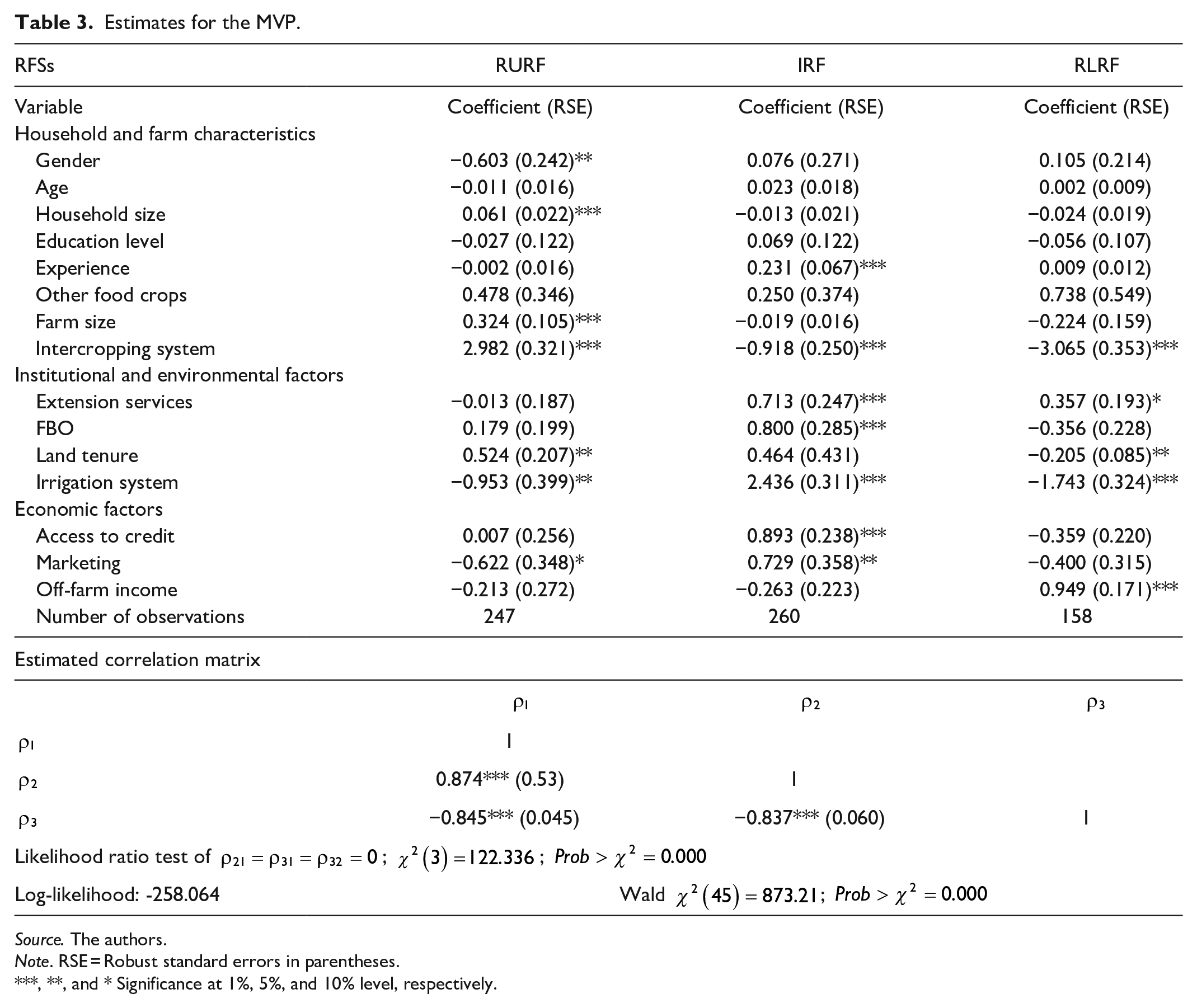
Based on the numerical values of VIF and Tolerance shown in Table A1, we conclude that there is no extreme multicollinearity in the dataset (O’Brien, 2007). As indicated in the bottom part of Table 3, the Wald test (Wald
Estimates for the MVP.
Source. The authors.
Note. RSE = Robust standard errors in parentheses.
, **, and * Significance at 1%, 5%, and 10% level, respectively.
By analyzing the outcomes of the MVP estimate (Table 3), we observe that the determinants of the choice of rice cultivation systems vary from one system to another. First, the choice of rainfed upland rice system is significantly and positively influenced by variables such as household size, rice farm size, intercropping system, and land tenure; while the variables gender, the presence of irrigation system, and the participation in the paddy rice market influence significantly and negatively the choice of this rice production system. Second, the choice of irrigated rice system is significantly and positively influenced by the following variables: farming experience, extension services, FBO, presence of irrigation system, access to credit, and participation in the paddy rice market. However, the intercropping system practice influences significantly and negatively the choice of irrigated rice system. Third, the choice of rainfed lowland rice system is significantly and positively influenced by explanatory variables such as extension services and off-farm income. Whereas land tenure, intercropping system, and the presence of an irrigation system influence significantly and negatively the choice of this rice cultivation system.
Discussion
In Côte d’Ivoire, rice is cultivated in both upland areas (rainfed upland rice) and lowland areas (rainfed lowland rice and irrigated rice). Therefore, understanding the determinants of the choice of these different production systems is essential for sustainable rice production in the country. The results of the econometric analysis show that, overall, the determinants of the choice of RFSs vary from one cultivation system to another. However, the econometric approach cannot justify this variation. To do so, we refer to previous research and economic theory. In the following discussion, emphasis will be placed on the differences that have come out from these findings.
The significant influence or relevance of environmental factors (land and water) in the choice of RFSs can be explained by the fact that land and water resources are the primary production factors in agriculture. On the one hand, in SSA countries such as Côte d’Ivoire, the galloping urbanization and the high demographic growth reduce farmlands, notably in upland areas. Therefore, the availability of farmland is key for rice farmers, and they must make their choice of the RFS by considering the endowment of farmland. The MVP results show that rice farmers who own land are more likely to grow rainfed upland rice and are less likely to grow rainfed lowland rice. In other words, all other things being equal, if there is farmland in upland areas, rice farmers choose RURF to the detriment of RLRF. This choice of landholder rice farmers could be stemmed from the fact that the work in the lowlands is tougher (laborious) than in the uplands. Indeed, for the production of rainfed lowland rice, farmers must transform the land themselves (i.e., clearing, ploughing, making the drainage channels, etc.) for the production of rice. Thus, landowners prefer to exploit upland areas and rent the lowland areas to landless farmers. Likewise, studies elsewhere found that land endowments influence the choice of crops (Asrat et al., 2010; Ozaki & Sakurai, 2020). In rice farming, Ozaki and Sakurai (2020) found that the availability of upland influences significantly and positively upland rice production in Madagascar. On the other hand, rice farmers are also concerned with the availability of water. Rice crop is a water-intensive crop (Nawaz et al., 2022; Thapa & Rahman, 2021). Accordingly, water sources (hydro-agricultural dam, diversion from river, tube wells) are important in rice farming. Based on the econometric results, rice farmers are more likely to choose IRF and less likely to choose the other two production systems (RURF and RLRF) in the presence of an irrigation system. This result signifies that ceteris paribus, in the presence of irrigation infrastructure, irrigated rice production can gain momentum at the expense of the two other production systems in Côte d’Ivoire. The irrigation system allows rice farmers to control water, thereby alleviating the problems of drought and flood that are inherent threats in the other two production systems. In the same way, studies of Greig (2009), Kinuthia et al. (2018), Buisson and Balasubramanya (2019), Ozaki and Sakurai (2020), and Thapa and Rahman (2021) found that water availability, particularly irrigation systems, is a key determinant of the choice of crops in Tanzania, Kenya, Tajikistan, Madagascar, and Nepal, respectively. Ozaki and Sakurai (2020) reported that the presence of irrigation in lowlands influence significantly and negatively the choice of upland rice production. On their part, Thapa and Rahman (2021) reported that in the presence of irrigation systems that have good water delivery systems, farmers choose rice crop over the other crops.
Economic factors are significant determinants of the choice of RFSs. First, access to credit positively determines the choice of IRF. Among the three RFSs, the IRF is considered the most input and capital intensive (Ouattara et al., 2020; Zenna et al., 2017). In IRF, improved agricultural inputs and technologies such as HYVs, fertilizers, power-driven tillers, threshers, and harvesters are mostly used. For instance, Ouattara et al. (2022) reported that ploughing activities in irrigated lowlands require machines with ploughing costs around XOF 80,000/ha in Côte d’Ivoire. Access to credit relieves financial constraints faced by farmers, thereby allowing them to choose the input and capital intensive rice production system. In Burkina Faso, Porgo et al. (2018) also argued that relieving credit constraints can allow farmers to allocate more farmland to fertilizer-intensive crops, notably cotton and maize. Our findings corroborate those of Anugwa et al. (2022), Nyang’au et al. (2020), and Talukder et al. (2020) in Nigeria, Kenya, and Bangladesh, respectively. This suggests that the availability of credit for rice farmers could guide them toward irrigated rice production in Côte d’Ivoire. Second, we observe that participating in the paddy rice market influences significantly and positively the choice of IRF and negatively the choice of RURF. Paddy production has become the main source of income for some farmers in the country. Therefore, those who cultivate rice for commercial purposes (market-oriented rice farmers) mostly choose the irrigated rice system because, according to scientists and previous research (Arouna, Devkota, et al., 2021; Dossou-Yovo et al., 2020; Niang et al., 2017; Tanaka et al., 2017), this production system has a high paddy yield compared to the other two RFSs. While the majority of rice farmers practicing the RURF grow rice for the purpose of family consumption. Consistently, studies by Greig (2009), Appau et al. (2020), Talukder et al. (2020), and Thapa and Rahman (2021) reported the influence of marketing purpose or market access in the choice of crop. Our result infers that all else being equal, the existence of an attractive paddy rice market would attract rice farmers to IRF at the expense of RURF. Third, we discover that rice farmers involved in a non-agricultural income-generating activity are more likely to grow rainfed lowland rice. An off-farm activity probably generates income that allows rice farmers to cope with the production expenses involved by this rice production system. However, contrary to our result, Ozaki and Sakurai (2020) reported a significant and negative influence of a non-farm income source on the choice of rainfed upland rice production in Madagascar.
From the results, extension services and FBOs are positive determinants of the choice of RFSs, in particular, the IRF and RLRF. The access of rice farmers to extension services as well their membership in FBOs strengthen to some extent their human capital. Extension agents are directly in contact with farmers; therefore, they may counsel rice farmers on the technical itineraries of irrigated and rainfed lowland rice production. Our findings are consistent with reports by Buisson and Balasubramanya (2019) and Eshetu et al. (2021) who found a positive influence of extension services in the choice of cropping systems and practices in Tajikistan and Ethiopia, respectively. Nevertheless, this contradicts the findings of Nyang’au et al. (2020) and Anugwa et al. (2022) who found a negative effect of extension services on the choice of agricultural technologies in Kenya and Nigeria, respectively. According to these authors, information about agricultural practices or technologies are probably not transmitted frequently or are poorly transmitted or misunderstood. This implies that extension services must be frequent and more understandable in order to achieve their objectives. Regarding the influence of FBOs, we could explain that FBOs are a melting pot of mutual aid for rice farmers. Rice farmers can learn from their peers on technical itineraries for irrigated rice. For example, during our survey in the department of Sakassou, we witnessed a training day during which a peer rice farmer shared his experience with other farmers on the System of Rice Intensification (SRI) technology. FBOs also give rice farmers a better chance of getting support from the NRDA, such as agricultural input subsidies and other agricultural equipment. Indeed, in line with the ongoing rice policy (NRDS), the NRDA provides rice farmers with some inputs through the FBOs. Furthermore, in the case of irrigated rice, where rice is grown using water from hydro-agricultural dams, rice farmers are compelled to join a FBO for optimal use of some shared production factors such as water, power-driven tillers, harvesters, and threshers. Similarly, in Kenya, Nyang’au et al. (2020) found that in the face of climate change, FBOs were one of the important determinants influencing crop choice. In Nigeria, membership of FBO has also been reported as a determinant factor in the choice of cropping practices (Anugwa et al., 2022).
Additionally, household and farm characteristics shape rice farmers’ decisions. Among these characteristics, know-how (experience) is essential in any activity. Especially in the agricultural sector, where farmers must deal with other crops’ production, master the agricultural seasons, and the technical itineraries of each crop, the farming experience remains a fundamental asset. Following the econometric estimate, it is found that experienced rice farmers prefer to farm irrigated rice. In this production system, the nursery and transplanting method, as well as the management of the irrigation system, require certain skills that could influence the yield. Experience represents skills or knowledge accumulated during years of rice cultivation. It is, therefore, an indicator of the human capital of rice farmers. Previous studies like Asrat et al. (2010) have also reported its importance in the choice of crops. Regarding the variable gender and based on our codification, female rice farmers are more likely to choose RURF. We could explain that upland rice production is easier for women than the other two production systems in terms of physical strength. This finding corroborates that of Doumbia and Depieu (2013) who found that in the center-west of Côte d’Ivoire, women engaged in rice farming grow more upland rice. A household with large size of family is more likely to choose RURF. One could explain by the fact that the activities (ploughing, sowing, weeding, and harvesting) required for upland rice production are mostly carried out manually in Côte d’Ivoire. Therefore, this production system is labor-intensive. Compared with the other two RFSs, the areas of rice farms in RURF are large. Accordingly, the large size of family is an essential labor force for these different activities. The influence of the quantity of family labor on farmers’ crop choice decisions was also reported by Porgo et al. (2018) in Burkina. A positive influence of farm size on the choice of upland rice production was also found in Madagascar (Ozaki & Sakurai, 2020).
Finally, the intercropping system is a significant determinant of the choice of RFSs. This agricultural technique is a common practice in Côte d’Ivoire, particularly in rainfed upland rice system (Saito et al., 2018). The findings show that rice farmers applying the intercropping system are more likely to choose the RURF and less likely to choose the two other ones (i.e., the IRF and RLRF). This result suggests that other factors being equal, when a rice farmer intends to intercrop other food crops with rice, the latter will choose the RURF at the expense of the two other production systems. The intercropping system has some advantages. Economically speaking, this agricultural technique enables rice farmers to save time, space (farmlands), and reduce costs. Indeed, on the same plot and at the same time, farmers diversify the production and apply technologies such as fertilizer or weed control for all the crops present. In terms of livelihoods, in addition to contributing to the food security of rice farming households, intercropped food crops contribute to their income. For illustration, we noticed that in some areas, most of the maize intercropped with rice is marketed since the maize matures before rice. Agronomically, researchers (Maitra et al., 2019; Panda et al., 2020) argued that the intercropping system provides additional returns, reduces climatic hazards and likelihoods of crop failure, and improves soil quality and biodiversity. For instance, in rice farming, Shah et al. (2021) found that intercropping beans with rice under the SRI decreases weed infestation, increases rice yield, and increases the net income of farmers. However, this agricultural technique increases interplant or intercrop competition for resources. Therefore, the choice of crops and the combination of crops (the number of crops, time of planting, and way of planting) are determining to take advantage of the intercropping system (Maitra et al., 2019; Panda et al., 2020). For example, intercropping legumes such as beans with rice can be a suitable intercropping system (Shah et al., 2021).
Conclusion and Policy Implications
Rice is an essential food crop for food security, income generation, and poverty alleviation in SSA countries. Therefore, this crop is the target of policymakers through agricultural development policies in these developing countries. As this food crop is grown through different production systems in SSA countries, including Côte d’Ivoire, the study of the determinants of the choice of RFSs is fundamental for sustainable rice production in such countries. This research paper examined key determinants of the choice of RFSs, with Côte d’Ivoire a case study. The empirical results showed that the following variables significantly determined the choice of RFSs in Côte d’Ivoire: extension services, FBOs, land tenure, presence of irrigation system, access to credit, farming experience, marketing of paddy rice, intercropping system, size of rice farm, off-farm income, gender, and household size.
The results of the current study suggest that policymakers should increase irrigation infrastructure since the country has an important hydrographic network and a potential for irrigable lands. Investments in irrigation infrastructures such as hydro-agricultural dams, diversion of water from rivers, and tube wells can be beneficial in many ways. First, these irrigation infrastructures could facilitate water control, thus mitigating drought and flood problems that are recurrent in rice farming. Second, the exploitation of irrigable land could increase rice farmlands on the one hand, and alleviate farmlands issues on the other. Indeed, these areas are not suitable for certain major crops (yam, cassava, cocoa, coffee, cashew, etc.) grown in the country. The main crop that most suits these lowland areas is rice. Third, investments in irrigation infrastructure could be conducive to the expansion or development of IRF. We also recommend inclusive rice development policies for all rice farmers. This could be facilitated by first nudging rice farmers to join FBOs. Through these FBOs, policymakers should reinforce extension services and provide training programs to enhance rice farmers’ human capital. Furthermore, policymakers should facilitate the access of rice farmers to agricultural credit and promote paddy market participation. In this regard, we suggest the strengthening and extension of the input credit programs under the NRDS. The local rice market must be organized and attractive to rice farmers. Regarding the intercropping system, agronomists should guide rice farmers on suitable agronomic technologies (type of crops to intercrop with rice, plant densities, crop arrangements, and planting time) depending on agro-ecological conditions. On the one hand, these agronomic guidelines could allow farmers to increase the yields of the different crops concerned by the intercropping system. On the other hand, agronomic guidelines could help improve soil quality and reduce climate risks, thus ensuring sustainable agriculture.
Supplemental Material
sj-doc-1-sgo-10.1177_21582440221094605 – Supplemental material for Econometric Analysis of the Determinants of Rice Farming Systems Choice in Côte d’Ivoire
Supplemental material, sj-doc-1-sgo-10.1177_21582440221094605 for Econometric Analysis of the Determinants of Rice Farming Systems Choice in Côte d’Ivoire by N’Banan Ouattara, Xueping Xiong, Chenguang Guo, Lacina Traoré and Zié Ballo in SAGE Open
Supplemental Material
sj-docx-2-sgo-10.1177_21582440221094605 – Supplemental material for Econometric Analysis of the Determinants of Rice Farming Systems Choice in Côte d’Ivoire
Supplemental material, sj-docx-2-sgo-10.1177_21582440221094605 for Econometric Analysis of the Determinants of Rice Farming Systems Choice in Côte d’Ivoire by N’Banan Ouattara, Xueping Xiong, Chenguang Guo, Lacina Traoré and Zié Ballo in SAGE Open
Footnotes
Appendix
Collinearity Statistics.

| Variables | Tolerance | VIF |
|---|---|---|
| Gender | 0.94 | 1.06 |
| Age | 0.64 | 1.55 |
| Household size | 0.81 | 1.23 |
| Education | 0.93 | 1.07 |
| Experience | 0.58 | 1.71 |
| Rice farm size | 0.82 | 1.22 |
| Other food crops | 0.88 | 1.13 |
| Intercropping system | 0.46 | 2.13 |
| Extension services | 0.67 | 1.49 |
| FBO | 0.71 | 1.40 |
| Land tenure | 0.84 | 1.18 |
| Irrigation system | 0.55 | 3.80 |
| Access to credit | 0.52 | 1.92 |
| Marketing | 0.32 | 3.10 |
| Off-farm income | 0.86 | 1.16 |
Source. The authors.
Acknowledgements
The authors gratefully acknowledge the College of Economics and Management, Huazhong Agricultural University. We are also grateful to the NRDA (particularly Moussa Bakayoko), rice farmers, and extension agents of the National Agency for Rural Development Support for their availability and support. We particularly appreciate and acknowledge the technical support by Akane Somian Marc, Kouakou Philipps, and Mel Vianey. The authors express their gratitude to the anonymous reviewers and editors for their constructive comments, which have led to improvements in the manuscript.
Declaration of Conflicting Interests
The author(s) declared no potential conflicts of interest with respect to the research, authorship, and/or publication of this article.
Funding
The author(s) disclosed receipt of the following financial support for the research, authorship, and/or publication of this article: This work was supported by the Fundamental Research Funds for the Central Universities, China (Grant No. 2662020JGPY005).

Supplemental Material
Supplemental material for this article is available online.
References
Supplementary Material
Please find the following supplemental material available below.
For Open Access articles published under a Creative Commons License, all supplemental material carries the same license as the article it is associated with.
For non-Open Access articles published, all supplemental material carries a non-exclusive license, and permission requests for re-use of supplemental material or any part of supplemental material shall be sent directly to the copyright owner as specified in the copyright notice associated with the article.
