




Abstract
This study uses CiteSpace, a bibliometric and visualization-analysis tool, to present a systematic analysis of literature in the Web of Science database on physiological-synchrony evoked by attentional engagement. It reviews the publication timeframe, authorship, keywords, and leading institutions and regions, along with burst terms and highly cited papers that represent key research trends and hotspots. The key findings are discussed below. While there is a general rising trend in the number of publications on this subject, the distribution of authors is fragmented. The University of California and City University of New York in the U.S. are the two most productive institutional systems. The United States, Germany, and China are the three most productive countries. In research hotspots, investigators tend to focus on brain-to-brain synchrony, eye-movement synchrony, heart-rate synchronization, and other physiological indicators. Future research may continue to investigate fields related to the synchronization of brain and eye movements.
Introduction
Rapid advances in modern psychology, physiology, and cognitive science have driven the development of physiological psychology techniques, such as hyperscanning techniques across most neural recording technologies (e.g., electroencephalography [EEG], functional near-infrared spectrography [fNIRS], etc.). These have led to the mainstream use of physiological signals to assess individuals’ psychological states and to explore physiological mechanisms. Human psychological states are difficult to reliably describe or quantify using exclusively behavioral measures, prior studies have shown that individuals sharing the same stimulus situations have similar physiological signals (Danyluck & Page-Gould, 2019; Palumbo et al., 2017); this is known as physiological synchrony (PS). Using this indicator of physiological activity as a proxy provides a more effective reflection of an individual’s cognition, emotion and behavior (Anders et al., 2011; Kinreich et al., 2017; N. Liu et al., 2016; Lu & Hao, 2019; Nguyen, Abney et al., 2021; Nguyen, Schleihauf et al., 2021; Stratford et al., 2012; Zhang et al., 2018). Such synchronization exists between familiar individuals, such as parents and children (Abney et al., 2021; Z. Li et al., 2020; Woody et al., 2016) or therapist and client (Marci et al., 2007; Tschacher & Meier, 2020), as well as strangers (Danyluck & Page-Gould, 2018; Tomashin et al., 2022), they are ubiquitous social processes and can be informative of social interactions (Palumbo et al., 2017). The Inter-Subject Correlation (ISC) analysis is typically used to analyze such phenomena.
ISC is a method of data analysis based on temporal patterns of brain activity (M. Liu et al., 2017). When subjects with the same psychological processing are exposed to the same stimuli, their functional brain regions should display similar activation patterns. By calculating the consistency of brain-region activity between subjects receiving the same stimuli, researchers can explore the relationship between cognitive processing and brain-region function (Hasson et al., 2012). Such research can provide insights that complement traditional analyses by circumventing the need for a pre-defined response model and allowing experimenters to measure the consistency of neural responses to complex, naturalistic stimuli across individuals (Hasson et al., 2004, 2010). For example, Jääskeläinen et al. (2008) collected data on subjects’ brain activity during free viewing of a movie and found that two separate components located in the upper left temporal lobe of the brain had specific activation in response to speech stimuli. Nummenmaa et al. (2012) have used MRI to measure the brain activity of subjects watching films that depict different emotions; the researchers collected serial ratings of participants’ pleasant and arousal experiences and showed that their negative valence was associated with increased ISC in the emotion-processing and default-mode networks. High arousal was associated with increased ISC in the somatosensory cortices and visual and dorsal attention networks. Then, Abrams et al. (2013) used ISC analysis to identify relevant brain regions involved in music processing, including the temporal cortex and subcortical auditory areas, attention and neural networks associated with motor planning. Lahnakoski et al. (2017) found that the posterior temporal and dorsomedial prefrontal cortices, as well as the cerebellum and dorsal precuneus, support integration of events into coherent event sequences.
Neural, physiological, and behavioral signals are synchronized between subjects in various contexts, such as eye movements (Foulsham & Sanderson, 2013; Hutson et al., 2022; Kang & Wheatley, 2017; Loschky et al., 2015; Shin et al., 2015; Tang Poy & Woolhouse, 2020), electrodermal activity (EDA, Coutinho et al., 2019; Ekman et al., 2012; Karvonen et al., 2016; Y. Liu et al., 2021; Misal et al., 2020), heart rate variability (HRV, Helm et al., 2012; Murata et al., 2021; Reed et al., 2013; Vanutelli et al., 2017; Wilson et al., 2018), and respiration (Bachrach et al., 2015; Helm et al., 2012; McFarland, 2001; Müller & Lindenberger, 2011; Stellar & Keltner, 2017). In addition to brain-to-brain synchrony, ISC analysis can also be applied to the above physiological signals. For example, an ISC analysis of eye movements can explore the characteristics of cognitive processing in stimulus contexts. Based on studies of ISC differences between young and old nervous-activity subjects, Davis et al. (2021) investigated whether eye-movement ISC in response to natural stimuli (movie viewing) decreased with age and was associated with remembering movies. The results showed that ISC did not decline with age; higher ISC levels were associated with more internal details and less false information being recalled. Nakano et al. (2009) investigated the blink synchrony of subjects during video viewing and found that humans possessed a mechanism that controlled blink timing and found an appropriate implicit time to minimize the chance of losing critical information when viewing a series of visual events. Current research has shown that the ISC of physiological signals relates closely to an individual’s attentional-engagement state in a stimulus situation; in other words, attentional engagement guides physiological synchrony. For example, Ki et al. (2016) show that the level of ISC in an EEG is strongly modulated by attention. Stuldreher, van Erp, and Brouwer (2023) have used experiments to identify a high correlation between heart-rate synchronization and task performance, confirming the relationship between physiological synchrony and attention. Ou et al. (2022) using movie events detecting reveals ISC difference of functional brain activity in autism spectrum disorder, found that under the movie event focusing on objects and scenes shot, the dorsal and ventral attentional networks of ASD had a strong synchronous response. These findings all point to the role of attention in the regulation of physiological synchrony.
However, few studies have summarized research findings on physiological synchrony evoked by attentional engagement; related studies offer little analysis of progress, hotspots, or trends. The present study uses CiteSpace, a bibliometric method, to systematically summarize the status of relevant research and various hotspots, using the “burst term” a CiteSpace analysis function to analyze frontier developments and trends in this research area.
Materials and Methods
Bibliometrics is the quantitative, interdisciplinary study of all knowledge vectors using mathematical and statistical methods. It is a comprehensive system of knowledge that integrates mathematics, statistics, and bibliography, with a focus on quantification. By using bibliometrics to analyze a large number of papers, researchers can show the overall state of research on a topic. The present study applies a bibliometric approach, using CiteSpace as a research-review visualization tool to map keyword clusters, explore relevant research burst terms, and co-occur basic information about the literature in order to achieve an overall grasp of research trends and hotspots.
By mapping keyword clusters in the relevant literature, CiteSpace can analyze the main research themes of relevant studies; by exploring burst terms, it can reflect the evolution of key research themes over time. The circles in the map represent each node of analysis, while the length of the circle radius indicates the frequency and centrality of the node label in the research literature. The presence of a larger circle around a node indicates that the node label has been extensively investigated; a line between two nodes indicates a connection.
The present study analyzes the relevant literature by timeframe, authorship, leading regions and institutions, keywords, burst terms, and highly cited papers. It draws on relevant literature in the core Web of Science database to determine the current status of research on physiological-synchrony evoked by attentional engagement and to summarize various hotspots and research trends. Regarding the specific search terms, the core Web of Science database was searched using the formula: “(TS=(ISC or inter-subject correlation or synchrony or synchronized or synchronization or inter- subject consistency)) AND TS=(attention or attentional)” between January 1, 2000 and April 25, 2023 for journals from the sources “SCI” and “SSCI,” with “article” or “review” as the literature type. A total of 6,931 results were returned, with manual screening used to exclude those not relevant to the study topic. Articles that matched the study topic were cleaned using CiteSpace to eliminate duplicates. A total of 248 articles relevant to this study were ultimately used as the basis for this analysis.
Results
Characteristic Analysis of Literature Publication Time
The number of publications can indicate a field’s importance and changing trends. As There has been an overall upward trend in the number of publications related to the research topic (as of 25 April 2023); this shows that more and more researchers are focusing on this topic (Figure 1). Since 2000, the number of publications has shown a fluctuating but increasing trend, with a significant increase between 2018 and 2021. Between 2000 and 2009, relatively few studies were published on this topic. From 2010 onward, there was a gradual and visible increase in the number of publications. We can therefore conclude that studies of this topic began to be published somewhat late, due to the progress of the discipline and equipment limitations. In line with the development of these objective conditions, a certain number of studies on the topic are published every year. The field of research is gradually becoming relatively independent; in recent years, it has received increasing attention and expanded its influence.

Trend in published articles related to physiological synchrony evoked by attentional engagement.
Analysis of Leading Authors
To some extent, a CiteSpace cooperation network analysis reflects changes in a subject and its status, as well as updates on core-subject “leaders” in the field; it covers three types of cooperation: author, institution, and region of publication. The author of an article represents micro-level cooperation in a CiteSpace cooperation network analysis. When the current literature was examined using statistics, there were 424 authors in total, including first authors and co-authors. According to Price’s Law, authors with N(N = 0.749* Nmax1/2 or more publications (with Nmax being the number of papers published by the author with the highest number of publications) are core authors in a field. Thus, authors with three (N = 2.247) or more publications in the relevant literature were the core authors; 21 authors had three or more publications and four authors had at least five publications. The core authors and those with more than two publications are shown on the cooperative map in Table 1 and in Figure 2. below. The four most published scholars in the literature were Parra, Jaaskelainen, Campbell and Hasson. They are leaders in this field. The nodes in which Parra, Jaaskelainen, Sams, Hyona, Glerean, Lahnakoski, Hari, Nummenmaa, and Dmochowski are located appear as purple outer circles, implying that these scholars have a high degree of centrality and make significant contributions to the field. The cooperative map of authorship shows that scientific cooperation is generally found among leading authors with a high number of publications, while most scholars lack cooperative relationships. In general, researchers are scattered, with few long-established academic communities, indicating that the subject is still a relatively new research topic in development.
Frequency Table of Published Authors of Articles.


Frequency of published authors and a map of cooperative relationships in research articles.
Analysis of Leading Institutions
Publishing institutions occupy the mid-level section in the CiteSpace cooperation-network analysis. A visual analysis of this level shows a total of 271 institutions included in the analysis. Table 2 presents the top 20 institutions by numbers of publications (ranked by centrality). The institutional systems with the most publications were the University of California and the City University of New York, with the University of California publishing the first article in 2005 (earlier than most of the top publishers) and achieving a total of 12 relevant articles. Centrality is a measure of the importance of a network node and the University of California system has the highest centrality of all the top-20 institutions (0.21), indicating that it has more institutions to cooperate with; thus, a cooperative group of research institutions centered on the University of California system may emerge in future. The two remaining institutions with centrality over 0.10 are New York University, ranked fourth by number of publications, and the University of London, ranked seventh by number of publications. These three institutions have a central position in the field and can play a leading role. The centrality of all other institutions is less than 0.10, indicating even more space between them and other institutions. The data also show that most institutions publishing in this area are national universities, with other types of institutions being slightly less common. In a cooperative map of collaborative relationships between institutions publishing in the research literature (Figure 3), Aalto University and the City University of New York system both appear in the purple outer circle on the bridge path of different institutional clusters; thus, both play a role in facilitating cooperation between institutions.
Frequency Table of Institutions With Published Articles.


Cooperative map, showing top 20 institutions’ publication frequency and cooperative relationships leading to research articles.
Analysis of Leading Regions
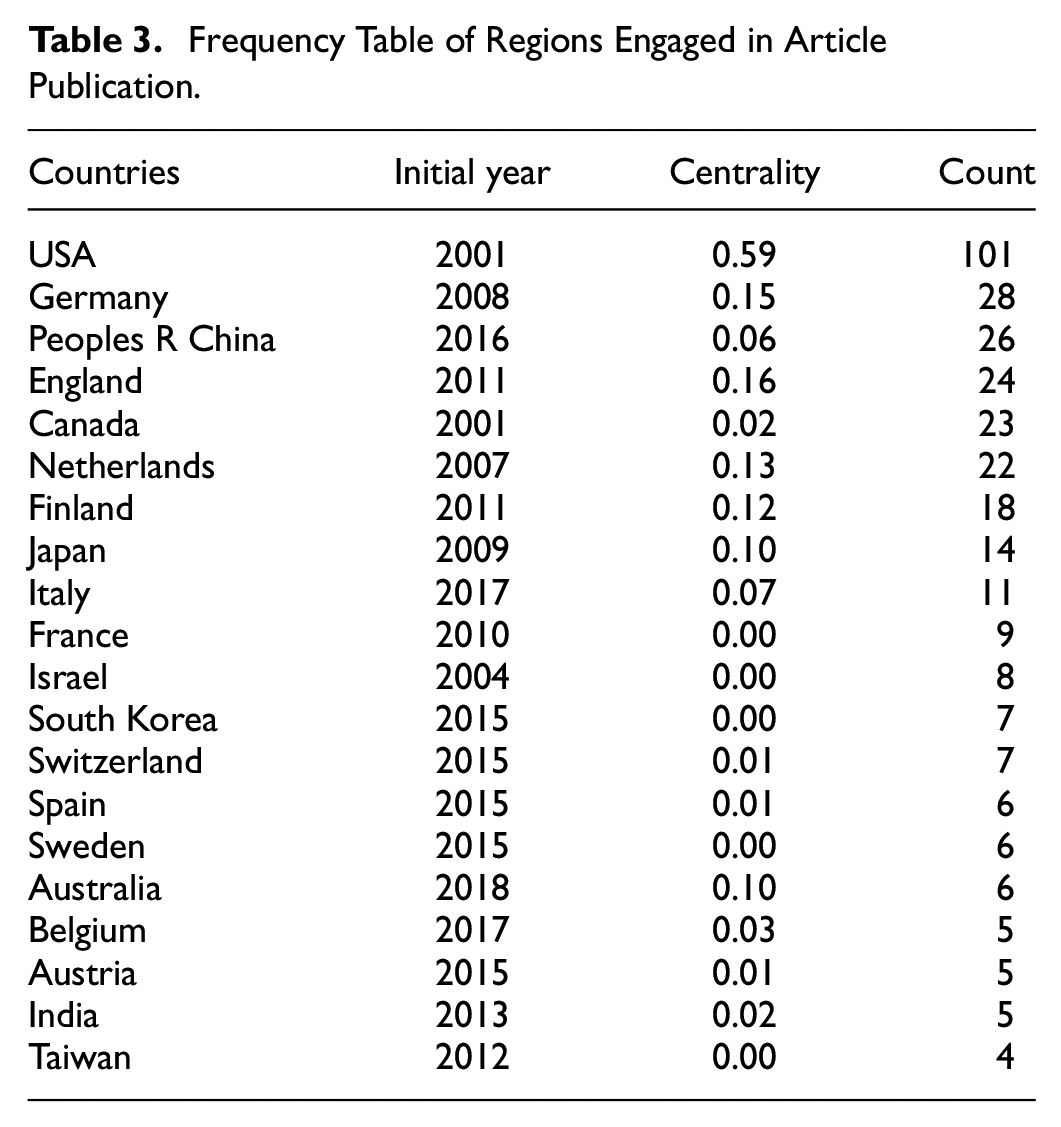
The region of publication occupies the macro-level section of the CiteSpace cooperation-network analysis. A summary of the regional distribution of publications reveals the main countries and regions where the research topic is studied. We conducted a visual analysis of regional cooperation in the literature, involving 38 posting regions, of which the top 20 regions cooperation map are shown in Table 3, Figures 4 and 5. This figure shows that most publications in this field are concentrated in the U.S., Germany, China, the U.K., Canada, and some other European countries, with the U.S. as the largest contributor— with 101 publications. Germany and China are in second and third place, with 28 and 26 publications, respectively. As this figure also shows, the top 20 regions all feature closer cooperation between major powers, which can help to advance research in this area.
Frequency Table of Regions Engaged in Article Publication.
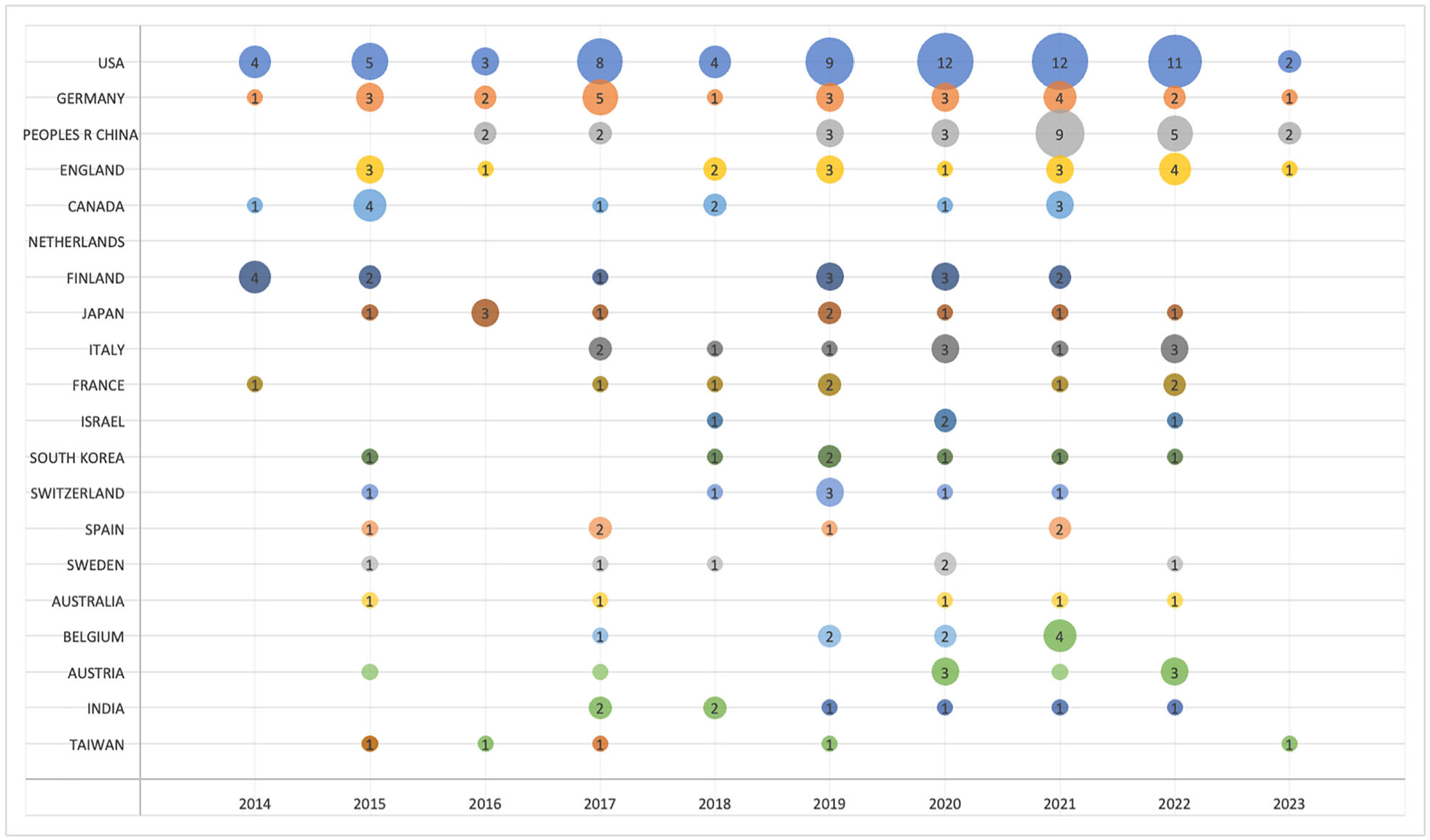
Bubble chart of the top 20 regions by number of articles published in the last 10 years.

Cooperative map of top 20 regions’ publication frequency and cooperative relationships leading to research articles.
The literature included in this study dates back to 2000. As the trajectory of the 38 regions shows, all of the top regions (by number of publications) entered the field relatively early, with the exception of China. It is worth noting that Australia, despite its late start (its first article was published in 2018) is already in the top 20 by total number of publications. Centrality can be used as a reference indicator for articles published in a country or region in a given year. Using this indicator, the U.S., which has the highest number of publications, is far ahead of other countries and regions, with a centrality of 0.59. Germany and the U.K. rank second and third, with centrality levels of 0.15 and 0.16, respectively. Although Belgium got a late start and has only five articles, it has a higher level of centrality than some of the top regions and potential for development. In addition, four countries—the U.S., Germany, Finland and France—are in the bridge path, which facilitates cooperation and exchange between regions.
Research Hotspots and Trends
A research hotspot is an academic topic explored by an inherently connected and large group of studies over a period of time. Using the CiteSpace clustering mapping-visualization function, it was possible to identify relevant research hotspots over a period of time. Keywords are a reflection of the current state of research and hotspots which play an important role in analyzing future trends (Fang et al., 2021; Garfield, 1970; L. L. Li et al., 2009). The keyword was selected as the node and 248 Web of Science articles were co-occurred and clustered by CiteSpace, with 451 keywords and 2,017 cooperative links (Figure 6). Keywords that appeared more than five times in the keyword co-occurrence were, in descending order: information, perception, brain activity, eye-tracking, dynamics, gaze, age differences, empathy, fmri, functional connectivity, inter-subject correlation, joint attention, behavior, oscillations, communication, meta-analysis, activation, comprehension, cooperation, default mode, mechanisms, physiological synchrony, social interaction, working memory, amygdala, children, cortical activity, emotions, heart rate, movements, coordination, engagement, human brain, model, neuroscience, and recognition. A cluster is a node of multiple, closely related keywords. The CiteSpace keyword-clustering function reflects the main research topics in a field; the smaller the number, the more keywords are included in the cluster. This function clustered all extracted keywords and obtained the following domain-clustering tags (Figure 7): emotion, eye movements, eye-tracking, older adults, binding, receptive fields, Alzheimer’s disease, brain activity, brain-to-brain coupling, performance, interbrain synchrony, independent components analysis and effect size. The clustering results Q (Modularity) = 0.5761 and S (Silhouette) = 0.842 show that the clustering structure is significant and convincing. In addition, the clustering labels above can be used to summarize subject terms and keywords in the included literature. Based on the keywords and their clusters, research topics were grouped into the following three categories, based on the type of physiological signals used in ISC studies.

Keyword co-occurrence map of research articles.

Keyword-cluster map of research articles.
Research topics in the first group revolved around brain-to-brain synchronization. Studies in this category focused on the ISC of brain activity evoked by attention. In general, EEG is one of the most temporally accurate neural recording devices and is also portable and suitable for the natural environment (Dick et al., 2014; Lindenberger et al., 2009), but while EEG characterizes the functional activity of nerves, other neural recording techniques are more informative about the regional localization of neural activity, such as fMRI (N. Liu et al., 2016). Thus these two methods are preferred in such studies. Two or more subjects were placed in the same stimulus situation and EEG or FMRI techniques were used to show the synchronization in time and space, revealing the similarity in attention-evoked brain activity between two or more individuals exposed to the same stimulus or interaction. As the ISC analytical method is widely used in the field of brain activity (Nastase et al., 2019), it was more heavily represented than other methods. To give some examples, part of the study focused on whether ISC differs according to the individual’s perspective. Lahnakoski et al. (2014) used FMRI to record the brain-activity data of subjects viewing films that represented different psychological perspectives. They showed that when individuals adopted a similar psychological perspective during natural viewing sessions, their brain activity became synchronized in specific brain regions. Bacha-Trams et al. (2020) measured brain hemodynamic activity and eye-gaze patterns, while participants viewed a shortened version of the movie “My Sister’s Keeper” from two perspectives (potential organ donor and recipient). The results showed that areas of stronger ISC of brain activity varied by perspective, with a higher proportion of subjects fixating on potential organ recipients. This indicated that different brain areas could be flexibly recruited, depending on the nature of the perspective. Some other studies have extended ISC analysis to the frequency domain. Hasson et al. (2004) found that ISC measured by fMRI is high in visual areas, Kauppi et al. (2010) suggest that several regions within the frontal and temporal lobes show ISC predominantly at low frequency bands, whereas visual cortical areas exhibit ISC also at higher frequencies. then, Chang et al. (2015) and some previous researchers reported finding ISC in the low frequency band—below 12 Hz, Perry et al. (2015) reported gamma band oscillations—30 to 90 Hz—are highly stimulus-driven in visual cortex. To complete these findings, Chen and Farivar (2020) carried out both ISC estimation and a novel inter-subject representational correlation analysis across six frequency bands extracted from MEG data of 24 subjects, found that low-frequency bands are significantly synchronized in visual areas and that gamma band has low temporal correlation. There are also studies that focus on narratives (Cohen et al., 2017; Jääskeläinen et al., 2020; Rosenkranz et al., 2021; Schmälzle et al., 2015; Song et al., 2021), where researchers want to explore the involvement of attention in narratives and look for factors that affect the effectiveness of narratives.
Research topics in the second group revolved around eye-movement synchronization. Studies in this category focused on the ISC of eye movements evoked by attention, highlighting eye-movement similarly among individuals. As one of multiple physiological indicators, an ISC analysis of eye movements can be used to collect the eye movements of subjects in the same stimulus situation through eye- tracking techniques. By calculating ISC, researchers can explore the characteristics of cognitive processing in stimulus situations and the consistency of subjects’ responses to stimuli, providing a reliable basis for practical applications, including games, movies, and music. For example, Kirkorian and Anderson (2018) set out to discover whether comprehension-related top-down cognitive processes drove eye movements during the sequential processing of video montage. They used attentional synchrony as a dependent variable to show commonality in video processing. The eye movements of 4 year olds and adults were recorded as they watched a video with the same constituent shots in either a normal or random sequence. The results suggested that gaze position and attentional synchrony between children and adults were driven by salient visual features and also by their understanding of the video montage. Gannon and Grubb (2022) recorded subjects’ eye movements while watching commercial movie clips with different average shot lengths (ASL; movie length/number of shots) and showed that ASL was negatively correlated with eye movement synchrony, with shorter ASL clips having higher eye movement synchrony than longer ASL clips, suggesting that ASL can modulate viewers’ eye movements. Farmer et al. (2021) used inter-subject correlations of eye movements to measure attentional synchronization during video viewing. They investigated whether the high level of immersion provided by a head-mounted display (HMD) would encourage participants to synchronize their attention during viewing and found that the ISC was significantly higher in the HMD group compared to the tablet group, demonstrating the value of HMDs in improving attentional synchronization and providing a basis for producers of 360° content on how to encourage or discourage synchronization in the viewing direction.
Research topics in the third category revolved around heart rate (HR), electrodermal activity (EDA), respiration, and the synchronization of other physiological indicators. There were fewer relevant research topics in this category than in the other two. Studies on this topic typically collect multiple physiological indicators simultaneously to explore the synchronization of attention-evoked physiological signals between individuals in the same stimulus situations or interactions. Some studies also collect EEG data from individuals, providing strong support for physiological synchronization. Stuldreher, van Erp, and Brouwer (2023) recorded HR and EDA and then calculated ISC while their subjects watched six 10-min movie clips. They found a significant correlation between higher HR synchrony and the number of correct answers to questions about the movie, confirming that physiological synchrony was related to attention. Pérez et al. (2021) found a significant ISC in heart rate when subjects were presented with an auditory or audiovisual narrative, and a reduction in ISC-HR when subjects were distracted from the narrative, with higher ISC-HR predicting better recall of the narrative.
The CiteSpace burst term analysis function reflects the relative change in term frequency, which can be used to analyze frontier developments and trends in the research field. Figure 8 shows the distribution of the 20 most significant burst terms, revealing that the following burst terms remain relevant to the research topic: eye-tracking, connectivity, EEG, cooperation, neuroscience, meta-analysis, inter-subject correlation, and phycological synchrony. These burst terms suggest that the field will continue to emphasize and investigate ISC between various brain functions, brain activity, and eye movements in the future.
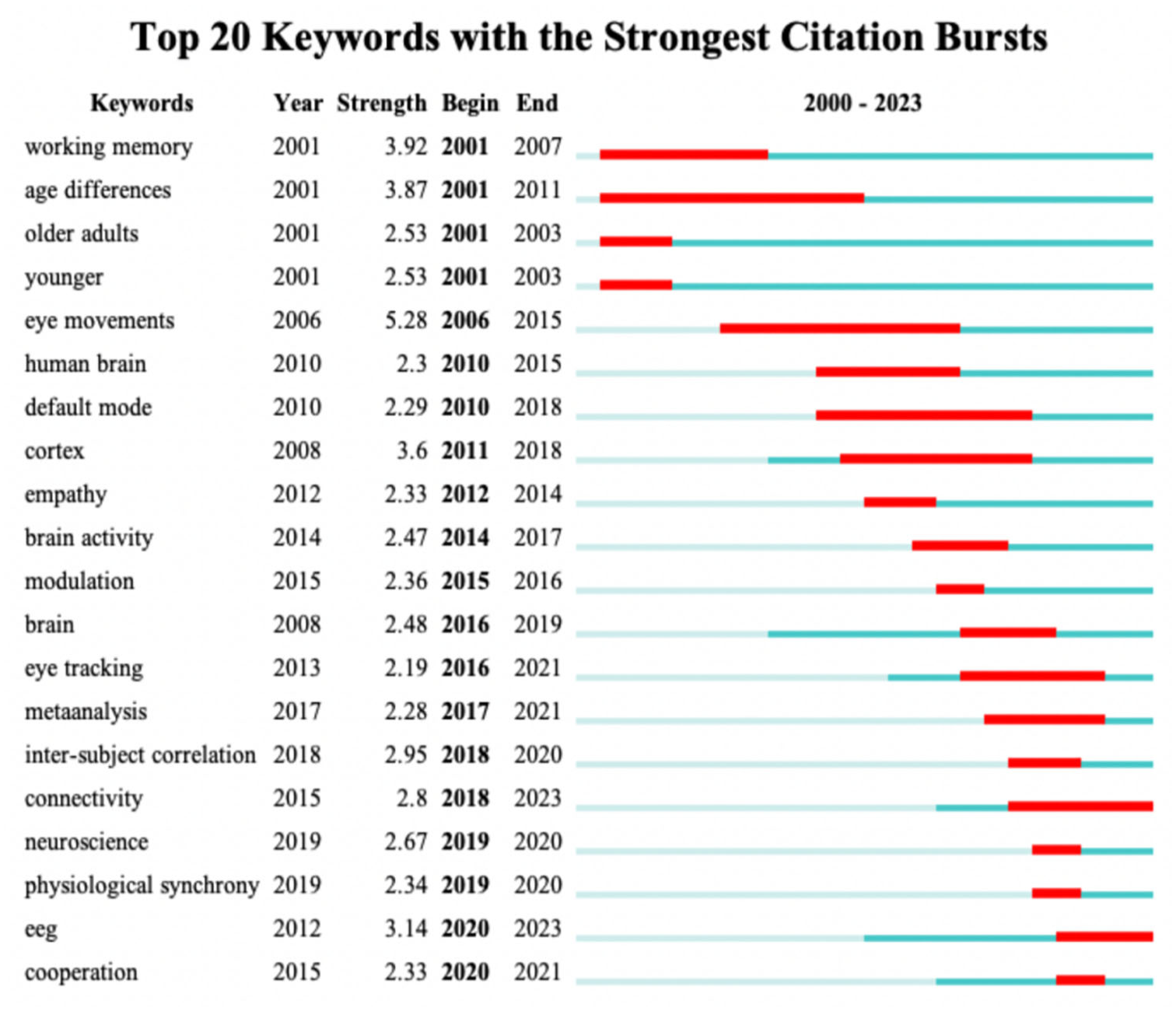
Burst term distribution chart of research articles.
Analysis of Highly Cited Papers
Citation frequency is a common method of assessing the quality of academic papers; two highly cited articles of high academic value emerged in the course of this study (Table 4). Both focus on brain-to-brain synchronization, revealing the extent to which this analytical method can feasibly predict activity participation and social interaction and reaffirming the unique position of brain-to-brain synchronization in this field of research.
Highly Cited Papers of Included Research.

Dikker et al. (2017) expanded the limitations of previous experimental settings. They used EEG to simultaneously record the brain activity of 12 high-school students during a term of regular classroom activities; this study explored the neural markers of group engagement during dynamic real-world group interactions. The results showed that the degree of synchronization of students’ brain activity predicted classroom engagement and social dynamics, suggesting that such synchronization may be driven by common attentional mechanisms.
Nummenmaa et al. (2012) used MRI to measure the brain activity of subjects as they watched films depicting different emotions. They collected serial ratings of their pleasant and arousal experiences and found that the participants’ brain activity was fairly synchronized. Negative valence synchronizes the brain areas that support emotional sensations and the ability to understand the actions of others. By contrast, high levels of arousal direct individuals’ attention to similar features of their shared environment. By enhancing the synchrony of brain activity across individuals, emotions can promote social interaction and facilitate interpersonal understanding.
Discussion
As the discipline and technology have developed and progressed, studies related to the physiological synchrony evoked by attentional engagement have produced valuable findings. The influence of this field is expanding; it is gradually becoming relatively independent. However, the results of the cooperative-network show that the distribution of researchers in this field is still fragmented. There are few long-term stable academic communities and most scholars lack solid cooperative relationships. Only well-developed regions and top institutions of learning are taking the lead. There is thus much room for development, with more in-depth research needed in this field.
The results of the hotspot analysis show that current research topics in the field focus on a range of different physiological indicators, including brain-to-brain synchronization, eye-movement synchronization, and the synchronization of other physiological indicators. In some of these studies, scholars have focused on the application of physiological-signal synchronization to social domains such as education, film, video, and other media. Poulsen et al. (2017) used EEG to record the ISC of students in the classroom, applying a video stimulus to verify the relationship between ISC and attentional engagement. The results confirmed that attention-evoked ISC could be tracked via students’ simultaneous EEG acquisition and predict their attentional engagement. This was an important step toward inferring classroom engagement in real time. Cohen et al. (2018) later applied this approach to online education and found that attentional engagement with online educational videos predicts learning performance for individual students, it shows EEG may be used as a tool to design and assess online educational content. Madsen et al. (2021) then extended the field of online education with eye-tracking, remotely assessing the attention that students paid to instructional videos by tracking their eye movements. The results showed that attentive students had much higher eye-movement ISC than inattentive students; in addition, synchronized eye movements could still be used to predict student test scores on the material presented in the videos. This finding has made a valuable contribution to online education. In addition to predicting learning performance, ISC can be used to predict subjects’ learning desire as well (Zhu et al., 2019). In terms of learning enhancement, Fasano et al. (2020) proposed the role of multimodal learning in enhancing brain synchronization using musicians as subjects. It has also been shown that both ISC and academic performance are influenced by the teacher-student relationship (Bevilacqua et al., 2019) and therefore the teacher-student relationship is a direction for future research. These results provide potential neurophysiological suggestions for pedagogical practices. Sauter et al. (2022) subsequently investigated whether attention measures based on eye-movement synchrony in groups of students could be applied to sampled webcam-based eye-tracking data. They found it impossible to use this relatively unreliable sampling data to reproduce early findings that predicted test scores based on synchronized eye movements. Their results highlight the challenges of webcam-based eye-tracking in practice and provide some direction for future research. In media fields, ISC analysis is based on voxel-wise correlation between the time series of the subjects, it very suitable for naturalistic stimulus paradigms such as movie watching (Pajula et al., 2012). In regard to imaging methods, not only can fMRI be used, but Chang et al.’s (2015) study also show that movies can be utilized as naturalistic stimuli in MEG/EEG similarly as in fMRI studies. Somech et al. (2022) used comedy movie to validate a naturalistic approach and the ISC are feasible using functional near-infrared spectroscopy (fNIRS)—the imaging method particularly suited for populations of patients and children, and results also suggest a potential role of the prefrontal cortex in humor appreciation. In media applications, Nakano and Miyazaki (2019) found that blink synchrony could be used as an involuntary index to assess a person’s interest. Their experiments examined the extent to which subjects blinked in sync while watching various video clips as a reflection of their levels of interest. They found that blink synchrony increased with the subject’s level of interest and decreased when the subject was disinterested, providing viewer feedback on movie and videos. Schmälzle and Grall (2020) discovered the relationship between the audience’s ISC and suspense in suspenseful movie, creates new possibilities for studying the mechanisms of suspense and other entertainment phenomena. Dmochowski et al. (2014) used participants’ ISC during video viewing to provide predictive information about the post-air preference rating of each advertisement. Imhof et al.’s (2017) research supports strategies for evaluating the effectiveness of real-life health or public interest messages. With the recent rise of e-commerce, Yu et al. (2022) found that the strong enthusiasm and readiness shown by anchors in live e-commerce can increase consumer neural engagement, so by testing ISC in rehearsals before a live broadcast, it is possible to use a scientific approach to improve the anchor’s performance. In spite of the media sector, ISC is also widely used in the music field (Dauer et al., 2021; Lillywhite et al., 2022; Madsen et al., 2019), contributes to relative research under the field of auditory stimulation.
Alongside research on social applications, another group of scholars has further explored the mechanisms and influences associated with physiological synchronization. According to Lahnakoski et al. (2014), when individuals adopt a similar psychological perspective during natural viewing, their brain activity becomes synchronized in specific brain regions. This study suggests that synchronized brain activity may be an important neural mechanism. Tei et al. (2019) has shown that the synchronization of temporoparietal junction (rTPJ) activity in the brains of individuals may be related to conflict scoring patterns and conflict experience. Subsequently Nan et al. (2022) have suggested that high- or low-brain ISC during emotional-video viewing could be a reliable marker for anxiety. ISC has the advantage of exploring the cognition of special populations such as people with disorders neural activity, and therefore some researchers have focused on the use of ISC to investigate brain mechanisms in special populations. For examples, studies found that autistic individuals do not have ISC in most brain area activity when watching movies compared to normal subjects (Hasson et al., 2009; Salmi et al., 2013). Stuldreher, Kaneko et al. (2023) showed that attention toward food-related stimuli measured by ISC vary with food neophobia. In schizophrenic patients, inter-subject correlations were lower than normal subjects for most brain area activities in the auditory task experiment (Kim et al., 2008). The use of ISC to calculate the consistency of brain activity between disordered and normal subjects can provide a basis for clinical diagnosis of cognitive function disorders. It has also been suggested that individual oxytocin secretion (Mu et al., 2016), odors (DeGuzman et al., 2020), long-term use of social media (Hu et al., 2022), emotions of moral elevation (Englander et al., 2012) and prosocial behavior (Balconi & Fronda, 2020) can act as important influences on brain-to-brain synchrony. It is clear that many research points remain to be explored in depth in future studies; this research area points to the future.
In this study, CiteSpace was used to visualize and analyze SCI and SSCI literature drawn from the core Web of Science database. The articles, which were published between 2000 and 2023, focused on physiological synchrony evoked by attentional engagement and attained the following results. There is a rising trend in the number of publications on the subject. The four most published scholars in the literature are Parra, Jaaskelainen, Campbell, and Hasson. In addition, Parra, Jaaskelainen, Sams, Hyona, Glerean, Lahnakoski, Hari, Nummenmaa and Dmochowski have a high degree of centrality. The University of California and City University of New York in the U.S. are the two most productive institutional systems. While the University of California system has the highest centrality, New York University and the University of London both have levels of centrality over 0.10. Most publications in this field are concentrated in the U.S., Germany, China, the U.K., Canada, and some other European countries, with the U.S. having the highest level of centrality at 0.59. The top 20 regions are all characterized by closer cooperation between major powers. Although Belgium started late and has not published many articles, it has a relatively high level centrality and shows outstanding academic merit. The keywords can be grouped into three categories related to brain-to-brain synchrony, eye-movement synchrony, heart-rate synchronization, and other physiological indicators; they reflect hotspots in this field. Future research may identify new fields related to the synchronization of brain and eye movements.
Footnotes
Authors’ Contributions
All authors made a significant contribution to the work reported, whether that is in the conception, study design, execution, acquisition of data, analysis and interpretation, or in all these areas; took part in drafting, revising or critically reviewing the article; gave final approval of the version to be published; have agreed on the journal to which the article has been submitted; and agree to be accountable for all aspects of the work.
Declaration of Conflicting Interests
The author(s) declared no potential conflicts of interest with respect to the research, authorship, and/or publication of this article.
Funding
The author(s) disclosed receipt of the following financial support for the research, authorship, and/or publication of this article: This work was supported by the National Social Science Fund of China (21CSH088): “Research on key elements and path optimization of improving the intervention mechanisms of social psychological crises under a new development pattern” and Zhejiang University of Technology Basic Research Operations Fund - Outstanding Young Scholars Special (GB202202005). This work was also supported by the Humanities and Social Science Research Youth Fund Project of the Ministry of Education of China in 2019 (No19YJC190028) and the Fundamental Research Funds for the Central Universities, Xidian University (RW210418). The authors would like to express their gratitude for the support of these projects.
Consent for Publication
Not applicable.

Availability of Data and Materials
All data, models, and code generated or used during the study appear in the submitted article.