




Abstract
In the field of archaeology, music archaeology has emerged as a significant area of scholarly interest. Despite over 40 years of development in Chinese music archaeology, there remains a lack of systematic bibliometric analysis within the academic community. This study addresses this gap by using core journal articles from the China National Knowledge Infrastructure (CNKI) as the data source, selecting 719 high-quality articles through keyword searches. We utilized software such as CiteSpace and VOSviewer to perform cluster analysis and burst word analysis on the keywords, identifying the historical research status, key journals, major research institutions, and emerging research frontiers in Chinese music archaeology. The findings reveal three distinct developmental stages in Chinese music archaeology: the initial stage, development stage, and peak stage. The research model is predominantly driven by universities with institutional support, though collaboration between research institutions remains limited. The central themes of music archaeology revolve around two main aspects: unearthed musical instruments and the ritual music systems and culture. Additionally, three frontier research areas have been identified: Liu Fei’s tomb, ancient qin, and decorative patterns. Future research is expected to further explore instruments such as Bianzhong and Bianqing. This study represents the first application of bibliometrics in Chinese music archaeology research, providing a structured framework for existing research in this field and offering valuable insights for future scholars exploring potential directions in music archaeology.
Introduction
In recent years, the academic significance of music archaeology has gained increasing recognition. The establishment of the international academic journal “Journal of Music Archaeology” by the Austrian Academy of Sciences in 2023 underscores this growing interest. Music archaeology not only deepens our understanding of ancient musical cultures but also offers unique perspectives on the interaction between music, society, and history. As musical artifacts continue to be discovered, scholars have expanded their research beyond specific instruments (Tang, 1998) to explore broader connections between music culture and social history (X. Fang, 2019). The development of music archaeology enriches our understanding of musical traditions and provides critical references and insights for global music history research.
Chinese archaeology has roots tracing back to the 20th century (Wei, Lou, Li, Yang, and Li, 2023). The discovery of bronze bells in the tomb of Marquis Yi of Zeng in Hubei, China, in 1978 captivated the global archaeological and scientific communities (Tang, 1998). This discovery accelerated the progress of Chinese music archaeology, which has since become a mainstream field in the study of ancient Chinese music history (Y. Chen & Shen, 2017). Scholars advocate incorporating music archaeology into the study of intangible cultural heritage to broaden research perspectives (Ma, 2022). The unearthed artifacts from Chinese music archaeology provide a profound reflection of Chinese culture (Y. Liu & Kong, 2022).
In recent decades, the development of quantitative analysis techniques has been primarily evident in three areas: bibliometrics, scientometrics, and informetrics (Wei, Lou, Li, Yang, Liang, et al., 2023). Bibliometrics, as a widely accepted method, has been employed in various academic disciplines, both in the natural and social sciences (Pritchard, 1969). It is effective in describing and evaluating the historical and performance aspects of individual disciplines, institutions, or countries in academic production and knowledge dissemination (Potter, 1988).
Bibliometric methods are applicable in archaeology, often used to review the development of disciplines or subfields (Lin, 2016; Mays, 2010; Palomar et al., 2009). In 2023, bibliometric methods were applied in Chinese archaeology research to provide a comprehensive overview of the overall characteristics and development trends, effectively describing and evaluating the historical and performance aspects of individual disciplines, institutions, or countries in academic production and knowledge dissemination (Potter, 1988).
However, there is a noticeable lack of research utilizing bibliometric analysis in Chinese music archaeology. Early 20th-century studies offer only brief overviews of the discipline (Shao, 2000; Tang, 1998), lacking quantitative tools and depth. A review reveals that, over 20 years later, quantitative research in Chinese music archaeology remains scarce, both domestically and internationally. Thus, there is a pressing need for bibliometric research in this field.
Chinese music archaeology is highly interdisciplinary, with scholars conducting extensive research from various perspectives and methodologies. This research spans the humanities and social sciences, such as musicology, archaeology, and history, and extends into the natural sciences, including physics and materials science. As research in this field becomes more specialized, it is essential to review the methodologies employed in Chinese music archaeology over recent decades.
Moreover, music archaeology is particularly valuable for the study of Chinese history. Renowned Chinese musicologist C. Li (1986) has emphasized that the musical materials uncovered through archaeology are vital for the study of ancient Chinese music history due to their objectivity, authenticity, and precision. Music archaeology holds irreplaceable academic significance in understanding human cultural history (Q. Wang, 2013), underscoring the importance of our research in Chinese music archaeology. Therefore, reviewing and summarizing existing research, while anticipating future trends, is crucial for guiding the discipline’s development. Summarizing the current status of Chinese music archaeology not only enhances our understanding of ancient Chinese music traditions but also provides important references and insights for global music archaeology research. This study aims to address the following questions:
RQ1: What are the development trends of Chinese music archaeology research over the past 40 years?
RQ2: How is productivity distributed among authors, institutions, and journals in the field of Chinese music archaeology research?
RQ3: What are the research topics and future research hotspots in Chinese music archaeology?
Research Design
This study employs the most comprehensive academic paper database in China, encompassing core journals indexed by CNKI (China National Knowledge Infrastructure) and CSSCI (Chinese Social Sciences Citation Index). Utilizing the knowledge mapping analysis capabilities of CiteSpace, the study aims to analyze the development trends and research hotspots in the field of Chinese music archaeology over the past 40 years from a literature metrics perspective, minimizing subjective researcher intervention.
Data Source
An advanced search was conducted in the CNKI database, which is widely recognized as one of the most authoritative and comprehensive databases in China. The data were sourced from core journals indexed by CNKI and CSSCI, which are highly authoritative in the country (J. Chen & Li, 2023). To capture a broad dataset, search terms extended beyond single subject terms and included ‘
Literature Selection
The search yielded a total of 1,018 articles. Non-academic documents, such as notifications, speeches, and reports, were manually excluded, resulting in 719 research papers covering the period from 1982 to 2022. The final dataset was downloaded and exported in REFWORKS format, serving as the data source for this study.
Research Method
The study primarily employs literature metrics and text mining methods, which have been widely utilized in fields such as computer science, engineering, electronics, and agriculture, and are gradually expanding into the humanities and social sciences (C. Wang et al., 2024). However, few scholars have used CiteSpace software to study fields like Chinese music and archaeology.
In 1969, British scholar Pritchard introduced “bibliometrics,” which has since become an independent discipline in scientific quantitative research. CiteSpace, a bibliometric analysis tool, was developed in the JAVA language by Professor Chaomei Chen of Drexel University, USA. CiteSpace uses metric and visualization techniques to explore the evolutionary path and knowledge turning points of disciplines, analyze potential dynamics, detect disciplinary frontiers, and visually display the overall status of research fields. It is one of the most widely used knowledge mapping tools (X. Wang, 2014). This study utilizes CiteSpace (version 6.2.R4), employing visualization analysis techniques, statistical metrics, and other methods to analyze data such as paper titles, authors, abstracts, and keywords, examining the development trends and research hotspots in music archaeology.
Discussion
Journal and Publication Analysis (RQ1)
The annual volume of publications provides a visual reflection of a field’s development trends and serves as a critical gauge of its status and context. As illustrated in Figure 1, research in music archaeology from 1982 to 2022 can be divided into three distinct developmental stages, each marked by fluctuating growth.
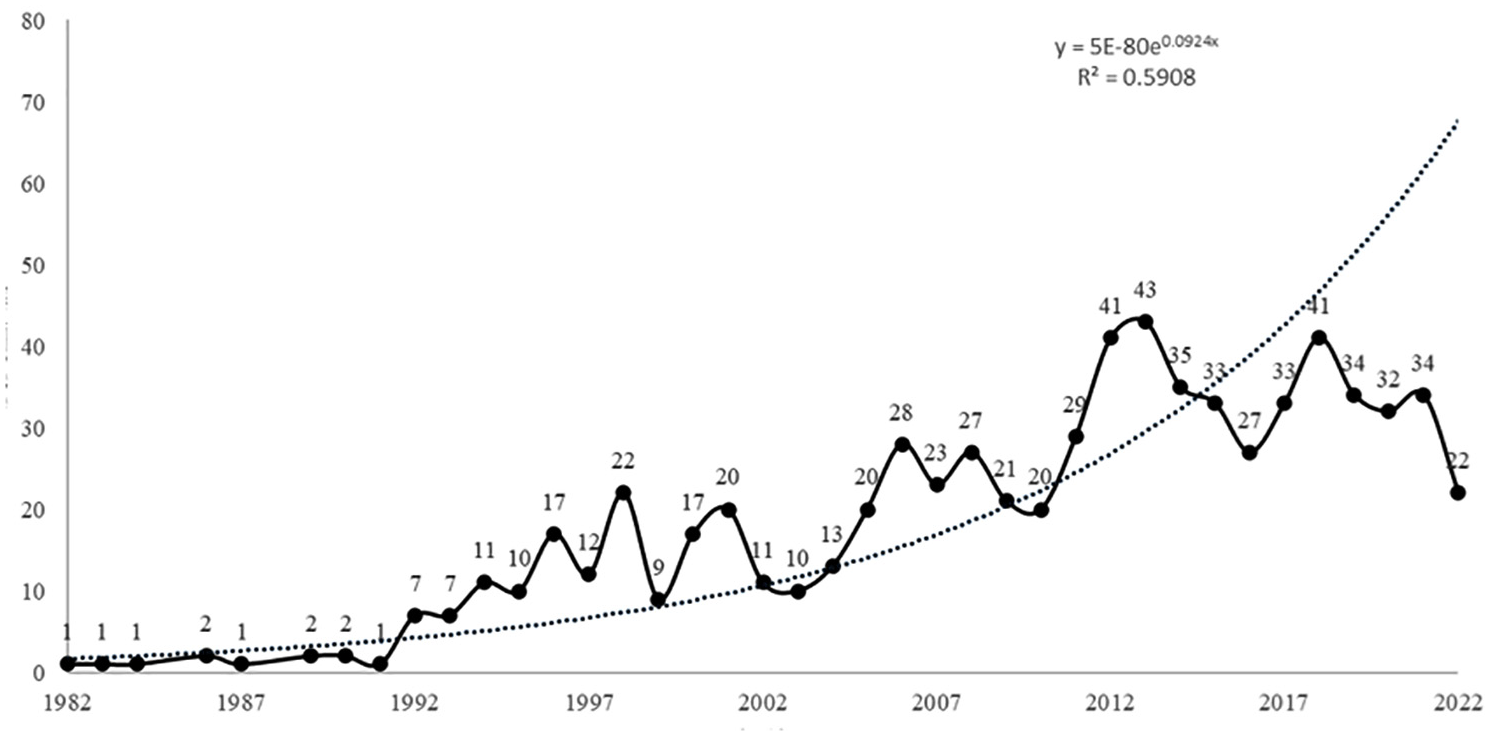
Annual publication volume of Chinese music archaeology research.
Initial Stage (1982–1991): Research outputs were scarce during this period.
Development Stage (1992–2005): The number of publications saw a significant increase compared to the initial stage. This growth was notably spurred by the publication of Li Chunyi’s seminal 600,000-word work, “Comprehensive Discussion on the Unearthed Musical Instruments of Ancient China,” in August 1996, along with the release of the first major foundational project in Chinese music archaeology, the “Complete Collection of Chinese Music Relics” volumes for Hubei, Beijing, and Shaanxi, later that year. The field began attracting scholarly attention, with an average of 13 publications per year.
Peak Development Stage (2006–2022): This stage saw an average of 30 publications per year, indicating heightened interest in music archaeology. In 2012, the 18th National Congress of the Communist Party of China emphasized the importance of cultural relics and archaeology, with President Xi Jinping issuing significant statements on the field (Y. Li & Wang, 2022). In 2013, publications in music archaeology reached a peak of 43 articles. On September 28, 2020, Xi Jinping, speaking at the 19th Central Committee of the Communist Party of China, proposed the development of archaeology with Chinese characteristics, to better understand China’s profound and enduring civilization (Xi, 2020). This suggests that the field of music archaeology may experience renewed research interest in the coming years.
An analysis of the literature sources revealed that related papers were published in 66 journals, with 9 journals publishing 15 or more papers. All of these journals are Chinese publications (see Figures 1 and 2). The journals “Music Research,”“Yellow Bell,”“China Musicology,” and “Chinese Music” accounted for approximately 67% of the total number of publications, making them key platforms for disseminating research findings in this field. The top four journals are primarily focused on music, and “Music Research” and “China Musicology” have been publishing research on music archaeology since as early as 1986. This reflects a longstanding interest in music archaeology within the academic music community.

Proportion of publications in Chinese music archaeology journals.
Music Archaeology Research Institution Analysis (RQ2)
A statistical analysis of publications from music archaeology research institutions indicates that there are a total of 348 institutions involved in this research area. The central institutions are the Chinese National Academy of Arts, Zhengzhou University, and Tianjin Conservatory of Music (see Table 1). When combining different subordinate institutions under the same parent organization, the Chinese National Academy of Arts ranks first in publication volume with 90 articles. This institution, where Mr. Li Chunyi first established the music archaeology specialty in China, focuses on areas such as music theory research and music suspension systems. Zhengzhou University’s Institute of Music Archaeology follows with 38 articles, primarily researching music archaeology and ritual music culture. The publication volume from these two institutions constitutes about 52% of the top eight institutions, indicating a significant influence in the field. The current research model is characterized as being “dominated by universities, with research institutes playing a supplementary role.”
Ranking of the Top 8 Research Institutions by Publication Volume.

An analysis of the cooperative relationships among music archaeology research institutions reveals 173 connections, with a density of 0.0029. The size of the nodes in Figure 3 represents the number of publications by each institution, with larger nodes indicating more publications and smaller nodes indicating fewer. The node color reflects the research timeline, with more recent publications (2022) in red and earlier publications (1982) in light gray. The connections between nodes illustrate the degree of cooperation among research institutions (C. Chen, 2006).

Cooperation relationship diagram among institutions.
The cooperation network diagram shows that, before 2018, music archaeology research formed a relatively concentrated network centered on the Chinese National Academy of Arts and the Wuhan Conservatory of Music. After 2018, Zhengzhou University’s Institute of Music Archaeology emerged as a central hub of cooperation. This institution has received significant support from the Chinese Academic Fund in recent years, including the “Pre-Qin ‘Metal and Stone Music’ Instrumentology Research” project led by Professor Chen Yan, which was the first national-level project in the field of music archaeology. Additionally, in June 2022, Zhengzhou University’s Institute of Music Archaeology initiated the “Complete Collection of Chinese Music Archaeology” compilation and publication project, following the earlier national social science “Seventh Five-Year” and “Ninth Five-Year” key research projects “Complete Collection of Chinese Music Relics.” These two institutions alone have published 104 articles, positioning them at the forefront of scientific research in this field. Outside the Chinese National Academy of Arts and the Central Conservatory of Music, there is relatively little academic cooperation and exchange among other institutions. This suggests that research in music archaeology has not yet developed a cohesive network, with research institutes primarily based within individual universities. There remains considerable potential for enhancing collaboration and exchange between institutions in this field.
Analysis of Research Themes in Music Archaeology (RQ3)
Keywords are a crucial component of an article, encapsulating its core themes. Therefore, analyzing keywords helps to uncover the research hotspots within the field. Each center point in the keyword analysis represents a research cluster, with warmer colors (red tones) indicating more recent research and larger font sizes indicating higher research frequency (Figure 4).

Co-occurrence relationship diagram of keywords.
The combination of high-frequency and high-centrality keywords, such as “music relics,”“Bianzhong,”“bronze instruments,”“music theory,” and “tone measurement,” indicates significant research topics in the field of music archaeology (Table 2).
High Frequency/High Centrality Keyword Statistics.

Keyword Clustering Analysis
While keyword co-occurrence analysis provides insights into the prevalence of specific terms, it does not elucidate the logical relationships and thematic structure within the field. To further explore the primary themes in music archaeology research, keyword clustering analysis was conducted using CiteSpace software, resulting in the keyword clustering map shown in Figure 5.

Keyword clustering map.
The map displays 712 nodes and 1,047 connections, with the connections representing keyword clustering situations. The clusters indicate the main research areas in music archaeology, with colors shifting from light to dark as time progresses from past to present. From 1982 to 2022, the research in music archaeology can be categorized into 10 clusters, including “Musical Relics,”“Bianzhong,”“Bronze Musical Instruments,”“Musical Instrument Combinations,” and “Bibliography.” Early research focused primarily on bibliography organization, beast-face patterns, and ancient musical instruments. In recent years, clusters such as “Musical Instrument Combinations” and “Form and Structure” have emerged, representing the forefront of music archaeology research.
Based on the clustering diagram and the analysis of high-frequency and high-centrality keywords, the current research in music archaeology can be divided into two major themes:
Unearthed Musical Instruments and Related Research
The study of unearthed musical instruments is a cornerstone of music archaeology, focusing primarily on bronze and non-bronze instruments. Research on bronze instruments often revolves around Bianzhong (chime bells), exploring topics such as musical theory spectral analysis (Z. Zheng & Fang, 2007), the distinction between proper drum sound and side drum sound (Q. Wang & Xu, 2017), and the form and structure arrangement (Z. Wang, 2017). The dual-tone characteristic of single bells, which produce two tones differing by a minor third, remains a focal point in understanding the musical properties of ancient Chinese bronze chime bells (Qi, 2007; Yuanzheng, 2023).
Non-bronze instrument research includes studies on stone chimes, zithers, guzhengs, and zhengs, focusing on tone measurement (A. Wang, 2005), form and structure (Xiang et al., 1994; Zhu, 2014), materials, and exegesis (Zi et al., 2021). This research has expanded to encompass material manufacturing, musical imagery, and geographic distribution. For example, F. Wang et al. (2022) studied the materials and production methods of the lacquered zither from the Han tomb in Yizheng, Jiangsu. Y. Liu (2012) noted that the study of musical imagery significantly lags behind the study of physical objects, highlighting image identification as a critical issue. J. Fang (2006) examined Shang and Zhou musical instruments from the perspectives of geographic distribution and musical culture, dividing them into distinct musical culture zones based on archaeological culture zones, series, and types, as well as the locations where they were unearthed.
Ritual Music Systems and Culture
Ritual music systems, alongside feudal clan systems, formed the foundation of ancient China’s social structure and significantly influenced subsequent cultural and artistic developments. Chen Yan and Qiao Jun explored the Han Dynasty’s ritual music system through musical instruments unearthed from Han tombs, concluding that this system was heavily influenced by political factors. They observed that during the Western Han period, the hierarchy of rites became more stringent, and the natural function of music became more secularized, increasingly focusing on public enjoyment, thus establishing a model of music development in the Han Dynasty where elegance and vulgarity coexisted (Y. Chen & Qiao, 2021). P. Wang and Kong (2022) examined the inheritance of ritual music in the Houcun 2040 tomb area, suggesting that after the division of the Jin state, only the Wei state continued its ritual music tradition, exploring the development and inheritance of music culture in the San Jin region. Q. Wang (2007) studied the prehistoric ritual music system based on discovered prehistoric ritual musical instruments, supplemented by literature and historical materials.
In terms of music culture, R. Li’s (2002) comprehensive analysis of historical literature and unearthed Han Dynasty portrait music relics demonstrated that the coexistence of elegance and vulgarity was fundamental to the Han Dynasty music culture development. Y. Chen (2011) noted that the Bianzhong from the Xu Duke’s tomb was deeply influenced by Central Plains and Chu music cultures, representing a specific manifestation of the integration and accumulation of northern and southern cultures, with irreplaceable value in studying Pre-Qin Bianzhong ritual music culture. Liu Qing and Xu Xiaoqian concluded that the bronze nao and bo bells from the Shang Dynasty unearthed in Hunan reflect the high level of Shang Dynasty music culture development in Hunan, influenced by Central Plains culture. The material foundation of “music of metal and stone” serving primitive ritual activities had essentially been established (Q. Liu & Xu, 2015). Zhu Guowei reviewed the music culture of the Three Kingdoms Sun Wu by combining musical relics with historical texts, laying a strong foundation for the subsequent flourishing of music in the south (Zhu, 2016).
In summary, keyword clustering analysis has highlighted the core areas of research in Chinese music archaeology, focusing primarily on unearthed musical instruments and related studies, as well as ritual music systems and culture. Although this overview does not encompass the entire scope of music archaeology research, the interdisciplinary and multi-perspective approaches mentioned are likely to attract more researchers to the field of music archaeology.
Emerging Research Frontiers in Music Archaeology (RQ3)
The study employs keyword co-occurrence and clustering analysis to highlight the hotspots and thematic structures of music archaeology research from 1982 to 2022. To identify development trends and future directions in the field, CiteSpace software’s keyword emergence detection feature was used to track emerging trends and research frontiers. The results revealed 15 emergent keywords, as illustrated in Figure 6. Each keyword’s emergence is characterized by two dimensions: emergence strength and duration, with the red portion indicating the duration of the keyword’s prominence and the strength indicating the surge intensity. Over time, emergent keywords in music archaeology research have evolved, with topics such as Bianqing, Bianzhong, the Tomb of Marquis Yi of Zeng, and musicology remaining focal points for over 20 years. From 2017 to 2020, the research spotlight shifted to Bianzhong, the Tomb of Liu Fei, and Guqin, with surge strengths of 3.49, 2.57, and 2.74, respectively, notably with Bianzhong showing a high surge strength of 3.49. Recently, “Patterns and Ornaments” (strength 2.54) have emerged as a new research hotspot.
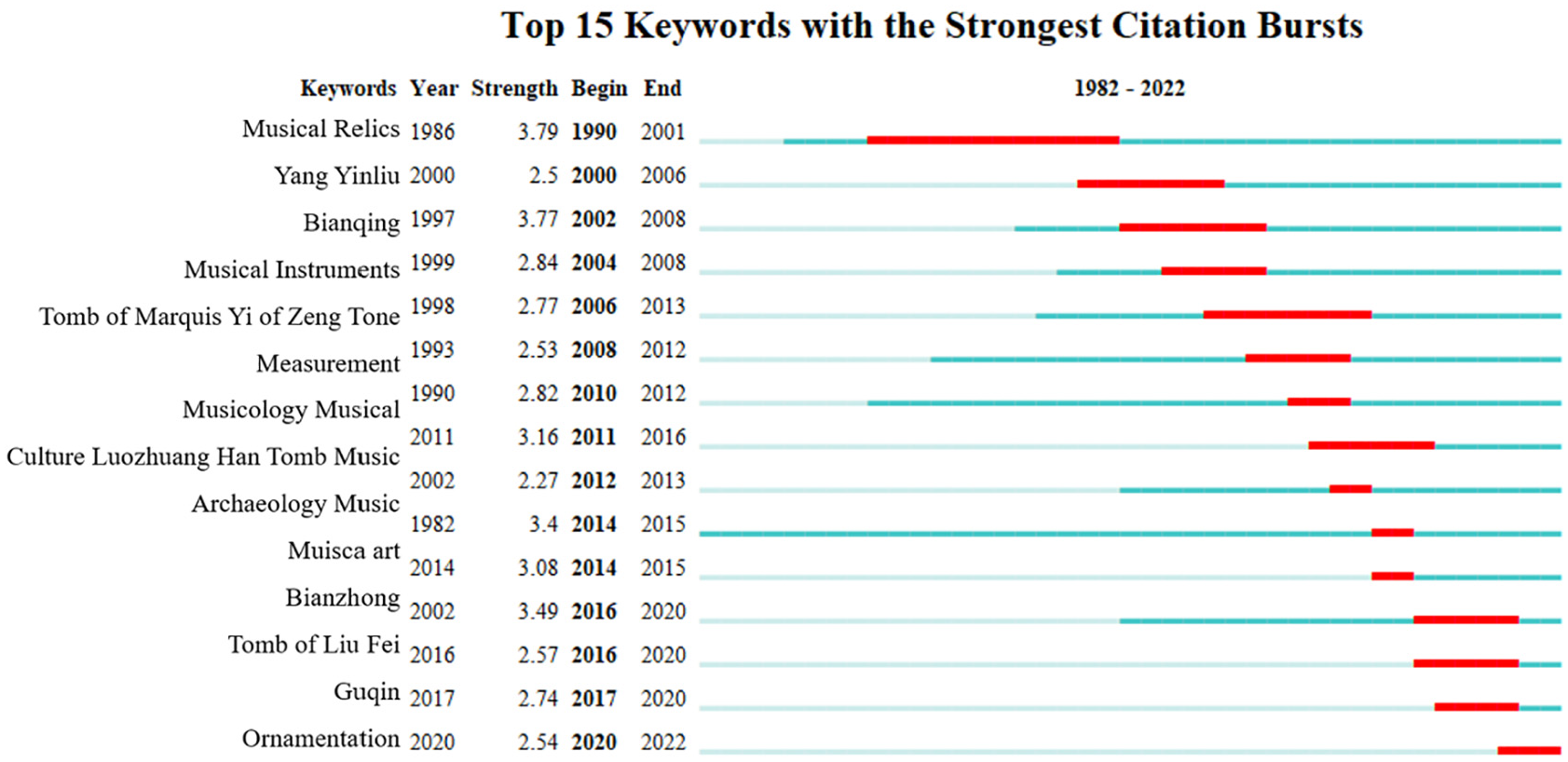
Emergent keywords in the field of music archaeology.
Overall, research hotspots in music archaeology have predominantly focused on unearthed instruments, such as Guqin and Bianzhong, and the field is expected to continue exploring these areas.
Conclusion and Future Research
Based on a bibliometric analysis using knowledge graphs and specific literature studies, this study comprehensively and objectively reveals the current status and future prospects of music archaeology research over the past 40 years.
Currently, Chinese music archaeology research is in a mature stage of development, with subfields becoming more refined, and research perspectives and methods becoming more diverse. From the perspective of the volume of publications in music archaeology, it can be divided into three stages: the initial stage (1982–1991), the developmental stage (1992–2005), and the peak stage (2006–2022). Overall, the literature on music archaeology research shows a fluctuating upward trend, greatly influenced by China’s macro cultural policies.
“Music Research,”“Yellow Bell,” and “Chinese Musicology” are the main platforms for publishing research results in the field of Chinese music archaeology. These journals belong to the field of music research and provide effective communication platforms. However, they also reflect significant shortcomings in archaeological, historical, and comprehensive social science journals’ coverage of music archaeology.
The field has formed representative publishing institutions centered around the China Academy of Art, the Music Archaeology Research Institute of Zhengzhou University, and the Tianjin Conservatory of Music, which have made significant contributions. Therefore, a research model of “dominated by universities, supplemented by research institutes” has emerged. However, there is no clustering phenomenon among research institutions, and music archaeology research institutions are only present in individual universities, indicating the need to enhance cooperation and communication among them.
Current research in Chinese music archaeology primarily focuses on two aspects: unearthed musical instruments and related research, and ritual music systems and culture. Among these, “unearthed musical instruments” is the most popular topic in music archaeology, divided into bronze and non-bronze instruments. Research on bronze instruments predominantly centers on chime bells. The field has evolved from early studies on proper drum sound, side drum sound, and tone measurement to interdisciplinary research methods, including instrument manufacturing, restoration, musical imagery, and geographic location.
Three new frontier research areas have emerged in Chinese music archaeology, such as the tomb of Liu Fei, ancient qin (a traditional Chinese musical instrument), and decorations. As archaeological discoveries continue to emerge, these have become new research hotspots. Traditional hotspots such as chimes, bells, the Zeng Houyi tomb, and musicology remain the mainstay of Chinese music archaeology research and are still the future direction of music archaeology research. The evolution of these research hotspots indicates that with the continuous emergence of archaeological findings, new research challenges arise.
This study is the first to apply bibliometric methods to Chinese music archaeology research, not only exploring the relatively less studied field of Chinese music archaeology but also summarizing the research trajectory in this field over the past few decades, filling a long-standing gap in this field since 1998. With abundant archaeological and cultural heritage, China has rich archaeological materials. The bibliometric study of music archaeology in China undoubtedly provides infinite opportunities for applying archaeological and historical methods and offers a reference for the global evolution of civilization. It also broadens the scope of bibliometric research and the application of CiteSpace in research disciplines.
Furthermore, this study has significant practical significance for scholars and practitioners in the field of Chinese music archaeology. It provides a clear framework for existing research in this field, offers objective guidance for newcomers, and elucidates the development trajectory of this research field. Secondly, the study identifies several contemporary research hotspots, providing valuable decision-making resources for scholars to explore potential research directions. Thirdly, the study conducts a detailed analysis of published literature to identify core journals in the field of music archaeology, with “Music Research” publishing a large number of articles on this topic. This finding may help scholars choose appropriate journals for their research results.
Finally, this research responds to China’s latest diplomatic policies, telling China’s story, spreading China’s voice, and promoting the better dissemination of Chinese culture. Through in-depth exploration of national music culture through music archaeology, it can fully play the important role of historical and cultural exchanges, demonstrating the value of archaeological cultural diplomacy. Based on China’s cultural relics work policy of “exploring value, effective utilization, and bringing cultural relics to life,” it highlights the significance of research on Chinese music archaeology artifacts.
Limitations and Future Research
Despite its comprehensive approach, this study has certain limitations. Firstly, the high standards for data sources in bibliometric analysis led to the selection of only core journal papers indexed by CNKI, excluding other databases, conference papers, and publications. This may have overlooked some scientific research and original viewpoints in Chinese music archaeology. Additionally, while the study uses professional software for bibliometric analysis to obtain objective quantitative data, the analysis and interpretation are inevitably subject to some degree of subjectivity. The influence of personal biases on research analysis cannot be completely eliminated. Future research should broaden the scope of literature sources and strive to minimize the impact of subjective factors on the analysis.
This comprehensive approach provides a foundation for future studies, ensuring a deeper and more nuanced understanding of the evolving landscape of music archaeology research in China.
Footnotes
Acknowledgements
The authors would like to express their sincere gratitude to the reviewers and editor for their valuable suggestions.
Declaration of Conflicting Interests
The author declared no potential conflicts of interest with respect to the research, authorship, and/or publication of this article.
Funding
The author received no financial support for the research, authorship, and/or publication of this article.
Ethical Approval
Ethical approval was not required as the study did not involve human participants.
Informed Consent
Informed consent was not required as the study did not involve human participants.

Data Availability Statement
The data that support the findings of this study are available from the corresponding author upon reasonable request.